#help-28
1 messages · Page 25 of 1
 acoustic pebble
 little fiber
sry what does sin (a) = cos (90-a) look like again?
 tidal reef
what do you mean by
what does sin (a) = cos (90-a) look like again?
little fiber
when put in right triangle?
little fiber
tidal reef
what do you mean by
> what does sin (a) = cos (90-a) look like again?
okay I get it
what is it next?
yes I figured it out
the y of a is the x of (90-a) so basically the cos is on the sin
 full forumBOT
@little fiber Has your question been resolved?
full forumBOT
Channel closed
Closed due to timeout
Use .reopen if this was a mistake.
full forumBOT
 Available help channel!
Send your question here to claim the channel.
Remember:
• Ask your math question in a clear, concise manner.
• Show your work, and if possible, explain where you are stuck.
• After 15 minutes, feel free to ping <@&286206848099549185>.
• Type the command .close to free the channel when you're done.
• Be polite and have a nice day!
Read #❓how-to-get-help for further information on how to ask a good question, and about conduct in the question channels.
 void arch
If two sets are not disjoint and countable, can the union of the sets be countable aswell?
full forumBOT
void arch
If two sets are not disjoint and countable, can the union of the sets be countab...
void arch
I don’t see how a bijective function will be able to be formed if this was the case
 fast peak
but you do know how it works if they are disjoint?
fast peak
what exactly do you mean with array
void arch
I mean you still can make an array with if A and B are not disjoint
void arch
fast peak
what exactly do you mean with array
So listing the elements of A and B in an array?
void arch
Let S_ij denote the jth element in the set i. And S_1=A,S_2=B.
Similar to how you notate a matrix. As A and B are countable you can list them
Let f(1)=s_11, f(2)=s_12 f(3)=s_21 … you can map all the elements from both A and B in a diagonal fashion
fast peak
yes
actually writing the bijection out in the case that they are not disjoint is pretty annoying
but essentially in your process you just skip an element if you already had it earlier
that's it
void arch
Take for example A={1,3,5} and B={2,3,7}
My listing would of AuB is 1,3,5,2,3,7 written in a 2 by 3 matrix way. Theres two sets of {3} in the union so how can you miss it out?
Wouldn’t my above method still work though. Since my image of f is s_ij not the actual value of the element hence it’s injective?
fast peak
your function essentially goes through these two lists in a zigzag. one element at a time
f(1) = first element, then f(2)=next one, f(3) = next one and so on
and if the sets are not disjoint, you just skip the next one if you already had it earlier
full forumBOT
@void arch Has your question been resolved?
full forumBOT
Channel closed
Closed due to timeout
Use .reopen if this was a mistake.
Available help channel!
Send your question here to claim the channel.
Remember:
• Ask your math question in a clear, concise manner.
• Show your work, and if possible, explain where you are stuck.
• After 15 minutes, feel free to ping <@&286206848099549185>.
• Type the command .close to free the channel when you're done.
• Be polite and have a nice day!
Read #❓how-to-get-help for further information on how to ask a good question, and about conduct in the question channels.
 near mauve
How do I find out if a boolean function with three variables is monotone or not?
full forumBOT
near mauve
How do I find out if a boolean function with three variables is monotone or not?
 glass crystal
what is your function?
near mauve
I could get a function but over all how would I determin it?
glass crystal
well it depends on your starting set
in your function
what are the properties
is the order relation an easy one to study?
full forumBOT
@near mauve Has your question been resolved?
Channel closed
Closed by @near mauve
Use .reopen if this was a mistake.
Available help channel!
Send your question here to claim the channel.
Remember:
• Ask your math question in a clear, concise manner.
• Show your work, and if possible, explain where you are stuck.
• After 15 minutes, feel free to ping <@&286206848099549185>.
• Type the command .close to free the channel when you're done.
• Be polite and have a nice day!
Read #❓how-to-get-help for further information on how to ask a good question, and about conduct in the question channels.
 sterile sigil
If f(x)=8 for 0<=x<3, and f(x)=2f(x-3), what is the graph of y=f(x) for -12<=x<6
full forumBOT
sterile sigil
If f(x)=8 for 0<=x<3, and f(x)=2f(x-3), what is the graph of y=f(x) for -12<=x<6
sterile sigil
2f(x-3)=8 for -6<=x<0
4f(x-6)=8 for -24<=x<-12
how should I find y=f(x) for -12<=x<6
full forumBOT
@sterile sigil Has your question been resolved?
full forumBOT
@sterile sigil Has your question been resolved?
full forumBOT
@sterile sigil Has your question been resolved?
full forumBOT
@sterile sigil Has your question been resolved?
sterile sigil
<@&286206848099549185>
sterile sigil
ohh ok got it (nvm)
ty
sterile sigil
 torn jolt
for 3<=x<6, f(x)=2f(x-3)=2*8=16
torn jolt
for 3<=x<6, f(x)=2f(x-3)=2*8=16
how did you get that tho]
torn jolt
sterile sigil
how did you get that tho]
from the given equation?
3<=x<6
then subtract 3 so 0<=x-3<3
so then from the given f(x-3)=8
sterile sigil
Yea I’ll try to
full forumBOT
@sterile sigil Has your question been resolved?
Channel closed
Closed by @sterile sigil
Use .reopen if this was a mistake.
Available help channel!
Send your question here to claim the channel.
Remember:
• Ask your math question in a clear, concise manner.
• Show your work, and if possible, explain where you are stuck.
• After 15 minutes, feel free to ping <@&286206848099549185>.
• Type the command .close to free the channel when you're done.
• Be polite and have a nice day!
Read #❓how-to-get-help for further information on how to ask a good question, and about conduct in the question channels.
 tough idol
Can someone please teach me how to graph this model
 full forumBOT
@tough idol Has your question been resolved?
 gritty rose
tough idol
Someone sent me a message but i lost it in one of these channels
gritty rose
tough idol
Someone sent me a message but i lost it in one of these channels
Look in your discord history in this server
tough idol
How do i do that
full forumBOT
@tough idol Has your question been resolved?
 rocky vale
tough idol
How do i do that
rocky vale
tough idol
How do i do that
Go to the search and do from:(your name)
@tough idol here I searched you and found it
I think, I found where you posted the same picture, anyway
full forumBOT
@tough idol Has your question been resolved?
Channel closed
Closed by @tough idol
Use .reopen if this was a mistake.
Available help channel!
Send your question here to claim the channel.
Remember:
• Ask your math question in a clear, concise manner.
• Show your work, and if possible, explain where you are stuck.
• After 15 minutes, feel free to ping <@&286206848099549185>.
• Type the command .close to free the channel when you're done.
• Be polite and have a nice day!
Read #❓how-to-get-help for further information on how to ask a good question, and about conduct in the question channels.
 sleek brook
i need explanation
 full forumBOT
sleek brook
i need explanation
torn jolt
sleek brook
i need explanation
full forumBOT
sleek brook
i need explanation
torn jolt
sleek brook
i need explanation
You can only integrate in that range if the function is continuous
 sleek brook
how do ik ?
torn jolt
Asymptote
sleek brook
wdym
sleek brook
so i need to replace x with 0?
 woven snow
torn jolt
You can only integrate in that range if the function is continuous
woven snow
torn jolt
You can only integrate in that range if the function is continuous
 is it really the case?
 woven snow
idts that’s correct
You can only integrate in that range if the function is continuous
torn jolt
woven snow
<:catThink:519997422194393108> is it really the case?
Ok that’s just semantics at this point, but in this case you can’t because the function is undefined at x = 0
woven snow
torn jolt
Ok that’s just semantics at this point, but in this case you can’t because the f...
okay now that makes bit sense
perhaps you should take a look at this video https://m.youtube.com/watch?v=dHwrzLDmdT8
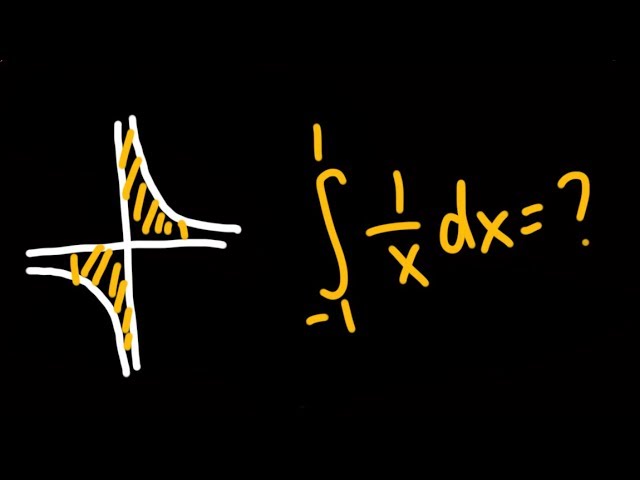
The debate of the improper integral of 1/x from -1 to 1. Is this zero or divergent?
My follow up video: "NO MORE DEBATE" https://youtu.be/b7WUupyMXJk
Let me know what you think!
blackpenredpen
sleek brook
alright thanks
 normal tree
woven snow
idts that’s correct
> You can only integrate in that range if the function is c...
normal tree
woven snow
idts that’s correct
> You can only integrate in that range if the function is c...
this is not correct though
you are allowed to integrate over discontinuities
woven snow
normal tree
you are allowed to integrate over discontinuities
thats what i’m saying
like take for example floor function which is very much integrable
 rare dock
yea it's integrating over unbounded regions that can be troublesome
and even though it's not usually a part of the definition of riemann integral it still makes sense to integrate over regions with finitely many undefined points
full forumBOT
@sleek brook Has your question been resolved?
rare dock
just define the integral to be the integral of the function extended to the whole interval with whatever values for the undefined points you want
normal tree
countably many works, and indeed actually measure zero sets work too
the riemann series still converges okay
rare dock
i think that's a little trickier to make sense of actually
$f:\bR\setminus \bQ$, $f(x) = 1$
 glossy valveBOT
💜𝓁𝒶𝓎𝓁𝒶💜
 rare dock
the convergence of $\int_0^1f(x)dx$ depends on the extension
glossy valveBOT
💜𝓁𝒶𝓎𝓁𝒶💜
 full forumBOT
Channel closed
Closed due to timeout
Use .reopen if this was a mistake.
rare dock
i guess as long as you pick an extension that makes the integral converge that's ok
full forumBOT
Available help channel!
Send your question here to claim the channel.
Remember:
• Ask your math question in a clear, concise manner.
• Show your work, and if possible, explain where you are stuck.
• After 15 minutes, feel free to ping <@&286206848099549185>.
• Type the command .close to free the channel when you're done.
• Be polite and have a nice day!
Read #❓how-to-get-help for further information on how to ask a good question, and about conduct in the question channels.
tough idol
Does anyone here do tutoring
full forumBOT
tough idol
Does anyone here do tutoring
 ivory ruin
 gaunt lynx
tough idol
Does anyone here do tutoring
gaunt lynx
tough idol
Does anyone here do tutoring
it’s okay, just ask ur qn and ppl who can help will :)
tough idol
Ok
well im trying to make a trig function mimic a straight line
with certain conditions
which makes it hard to say over messages so anyone will to help can they jump in a call with me
willing*
 tardy quiver
u can send a picture
tough idol
Ok ill just write the conditions down and send a pic

sorry for bad english
<@&286206848099549185>
full forumBOT
@tough idol Has your question been resolved?
full forumBOT
@tough idol Has your question been resolved?
full forumBOT
@tough idol Has your question been resolved?
full forumBOT
@tough idol Has your question been resolved?
 tough flower
tough idol
tough flower
tough idol
i can't read most of it can you write the conditions down on discord? i can see the picture fine
tough idol
Well the condition is that it has have a base of 200
Walls that are 50m high
The midpoint has to be 100m
The angle of the roof has to be 30 degrees no less or more
The max heigh of roof is 30 meters higher than the walls (so 80)
And it can be any equation but the area under the curve has be an equation that maximizes it’s area
So trig equation would be best

So if you know how to mimic a straight line using a trig function please teach me
tough flower
what do you want the equation to represent @tough idol
tough idol
I want the equation to represent the roof
tough flower
do you want a curve instead of a trapezoid? is that what you are asking for?
tough idol
Yes
That maxmises the area underneath the curve
I did a quadratic and got 8414
And I did a trig which gave me 11 thousand
Someone else got 15 thousand which I can’t see how that is possible
We also need to show proof on how we got the equation so it can’t be a guess
full forumBOT
@tough idol Has your question been resolved?
 ruby yarrow
what is 0-(-6)
 void swift
ruby yarrow
what is 0-(-6)
void swift
ruby yarrow
what is 0-(-6)
6
void swift
ruby yarrow
what is 0-(-6)
also go to #help-9
to get help
go there and send your problem and they will help you
full forumBOT
@tough idol Has your question been resolved?
full forumBOT
@tough idol Has your question been resolved?
full forumBOT
Channel closed
Closed due to timeout
Use .reopen if this was a mistake.
Available help channel!
Send your question here to claim the channel.
Remember:
• Ask your math question in a clear, concise manner.
• Show your work, and if possible, explain where you are stuck.
• After 15 minutes, feel free to ping <@&286206848099549185>.
• Type the command .close to free the channel when you're done.
• Be polite and have a nice day!
Read #❓how-to-get-help for further information on how to ask a good question, and about conduct in the question channels.
 fallen charm
 full forumBOT
fallen charm
fallen charm
full forumBOT
fallen charm
fallen charm
for the second part, why can't we do (5 choose 3) * (7 choose 4) ?
i.e. ways of choosing 3 questions from the first 5, then choosing 4 questions from the remaining 7 unanswered questions
 wild sleet
it's the same as choosing 3 out of 4 by doing (4c1)(3c1)(2c1)
it creates a distinction
you count choices where the question is picked at step 1 and step 2 as separate
fallen charm
sorry I don't quite follow?
wild sleet
i confirmed that it doesn't work, and gave an example where it doesn't work either
we can't choose 3 questions out of 4 by choosing 2 and then choosing 1 out of 2 remaining, this is a different operation, it gives the correct answer if you actually do care if the question was picked when you were choosing 2 or at the second step
you don't care, you don't want this answer, it's too big, you want a smaller one
wild sleet
you're supposed to add up 3 cases probably
fallen charm
what if there are a lot of cases? is there a general approach?
wild sleet
can.t think of anything
fallen charm
ah ok. & thx for clarifying the above!
full forumBOT
@fallen charm Has your question been resolved?
full forumBOT
Channel closed
Closed due to timeout
Use .reopen if this was a mistake.
Available help channel!
Send your question here to claim the channel.
Remember:
• Ask your math question in a clear, concise manner.
• Show your work, and if possible, explain where you are stuck.
• After 15 minutes, feel free to ping <@&286206848099549185>.
• Type the command .close to free the channel when you're done.
• Be polite and have a nice day!
Read #❓how-to-get-help for further information on how to ask a good question, and about conduct in the question channels.
 lone flint
Find solution set of $24-e^{-2x} = 10$
full forumBOT
lone flint
Find solution set of $24-e^{-2x} = 10$
glossy valveBOT
ahmed349

 glossy valveBOT
 lone flint
I got the answer correct
But the answer guide says it should be negative while I got it positive
 shrewd hamlet
So $24-e^{-2x} = 10$
glossy valveBOT
Stephen
 lone flint
Yeah
shrewd hamlet
14 = e^ (-2x)
lone flint
Yeah
lone flint
-2x = ln(1/14)
x = -1/2 ln(1/14) but why is my way wrong
shrewd hamlet
shrewd hamlet
ln(14) = -2x
So x = -ln(14)/(2)
lone flint
The heck
shrewd hamlet
?
lone flint
How
shrewd hamlet
What does the answer say
lone flint
lone flint
-2x = ln(1/14)
x = -1/2 ln(1/14) but why is my way wrong
This
shrewd hamlet
shrewd hamlet
ln(14) = -2x
Do u understand up to this step
lone flint
Yeah
shrewd hamlet
So to solve for x, divide both sides by -2
lone flint
Divide both sides by -2
shrewd hamlet
Are u sure the answer doesn’t say 1/2 (ln (1/14))
 lone flint
Yeah
shrewd hamlet
The - sign in front becomes the exponent of 14
So it becomes 14^-1
Which is 1/14
shrewd hamlet
So what part aren’t u understanding?
lone flint
I got it it moved the - to the exponent
shrewd hamlet
Sure, no worries
lone flint
.close
full forumBOT
Channel closed
Closed by @lone flint
Use .reopen if this was a mistake.
full forumBOT
Available help channel!
Send your question here to claim the channel.
Remember:
• Ask your math question in a clear, concise manner.
• Show your work, and if possible, explain where you are stuck.
• After 15 minutes, feel free to ping <@&286206848099549185>.
• Type the command .close to free the channel when you're done.
• Be polite and have a nice day!
Read #❓how-to-get-help for further information on how to ask a good question, and about conduct in the question channels.
 zealous lion
Need help for this question
 full forumBOT
zealous lion
Need help for this question
full forumBOT
zealous lion
Need help for this question
 scenic wren
can you post your work?
zealous lion
yes, one second.
 deft zodiac
one long second


 devout inlet
To correct it: write it as (y^2 - 1)/y then it's easy to see what the division comes to.
scenic wren
instead you can do this

and to solve this, you can use u substitution
u=y^2-1 works fine
full forumBOT
Channel closed
Closed by @zealous lion
Use .reopen if this was a mistake.
Available help channel!
Send your question here to claim the channel.
Remember:
• Ask your math question in a clear, concise manner.
• Show your work, and if possible, explain where you are stuck.
• After 15 minutes, feel free to ping <@&286206848099549185>.
• Type the command .close to free the channel when you're done.
• Be polite and have a nice day!
Read #❓how-to-get-help for further information on how to ask a good question, and about conduct in the question channels.
 agile vigil
 full forumBOT
agile vigil
agile vigil
full forumBOT
agile vigil
agile vigil
can someone check whether my NFA is correct?
full forumBOT
@agile vigil Has your question been resolved?
full forumBOT
@agile vigil Has your question been resolved?
full forumBOT
@agile vigil Has your question been resolved?
full forumBOT
@agile vigil Has your question been resolved?
full forumBOT
Channel closed
Closed due to timeout
Use .reopen if this was a mistake.
Available help channel!
Send your question here to claim the channel.
Remember:
• Ask your math question in a clear, concise manner.
• Show your work, and if possible, explain where you are stuck.
• After 15 minutes, feel free to ping <@&286206848099549185>.
• Type the command .close to free the channel when you're done.
• Be polite and have a nice day!
Read #❓how-to-get-help for further information on how to ask a good question, and about conduct in the question channels.
 tight monolith

 full forumBOT
tight monolith
full forumBOT
tight monolith
 hot mango
the rate of change is the slope of the graph
this can also be interpreted as the amount that changes between each number on the table
tight monolith
Yeah but i don’t know how to solve the two problems
hot mango
What do you not understand from what I said so I can go into more detail
tight monolith
Like i just don’t understand how to solve it like where do i begin how do i tell what to start with and to begin my equation
tight monolith
One
hot mango

ok so rate of change is how much y is changing between when x changes by 1
so in this case how much is y(cost) changing when x(Tickets) increases by one?
tight monolith
One ticket is 15 dollars so it’s increasing by 15 every time
hot mango
and this is the rate of change
do you need to write an equasion or just find the rate of change
tight monolith
Just to find it
tight monolith
hot mango
alright well problem 1 is done
15 dollars per ticket?
tight monolith
Ok i’m ready for 2 now
hot mango
ok so have you learned about y=mx+b
tight monolith
Yes
tight monolith
Idk how
hot mango
alrighty

so
So b = 0 as it starts at the origin
no we need to find m
as x is any number and our imput
best way to do this is plug in the out put and use algabra to figure it out
so
at point (1,400)
y = 400 and x = 1
400 = m*1
so m=400
this means the equasion is
y=400x
and because the rate of change is the slope, it is 400
tight monolith
So my answer would be 400
hot mango
yes
tight monolith
400 calories per hour
hot mango
yes
tight monolith
Ok thx
hot mango
does this make sense?
tight monolith
Yes
hot mango
alrighty
full forumBOT
Channel closed
Closed by @tight monolith
Use .reopen if this was a mistake.
Available help channel!
Send your question here to claim the channel.
Remember:
• Ask your math question in a clear, concise manner.
• Show your work, and if possible, explain where you are stuck.
• After 15 minutes, feel free to ping <@&286206848099549185>.
• Type the command .close to free the channel when you're done.
• Be polite and have a nice day!
Read #❓how-to-get-help for further information on how to ask a good question, and about conduct in the question channels.
 little river
Is $f: \mathbb{N} \longrightarrow \mathbb{N}, \ n \mapsto \Big{\begin{array}{cc}
\frac{n}{2} & \text{n \ even}\
\frac{n+1}{2} & \text{n \ uneven} \
\end{array}$ bijective?
full forumBOT
little river
Is $f: \mathbb{N} \longrightarrow \mathbb{N}, \ n \mapsto \Big\{\begin{array}{cc...
glossy valveBOT
Levens
 rare dock
try evaluating f at some small n's
little river
is my prove for injectivity correct, cause i lowkey dont think it is:
The mapping is called injective if for every $y \in \mathbb{N}$ there is at most one $x \in \mathbb{N}$ with $f(x) = y$. Let $n_1, n_2 \in \mathbb{N}$. So:
$$
f(n_1) = f(n_2) \Longrightarrow n_1 = n_2.
$$
Case 1; $n_1, n_2$ both even:
$$
\frac{n_1}{2} = \frac{n_2}{2} \Longrightarrow^{| \times 2} n_1 = n_2
$$
\
case 2; $n_1, n_2$ both odd:
$$
\frac{n_1 +1}{2} = \frac{n_2 + 1}{2} \Longrightarrow^{| \cdot 2} n_1 + 1 = n_2 + 1 \Longrightarrow^{| - 1} n_1 = n_2
$$
And so $f_2$ is injective.
glossy valveBOT
Levens
 rare dock
i can tell without reading it that it's not correct
rare dock
rare dock
try evaluating f at some small n's
✨
little river
yeah thats why i dont think its injective
 paper thistle
lol
little river
but idk how to prove it
rare dock
so... you've proved it? lol
rare dock
injective says for all a,b in N, f(a) = f(b) implies a = b
paper thistle
wait I messed up sorry
little river
yeah
rare dock
so to prove f is not injective
you just have to show there exist a,b such that f(a) = f(b) and a =/= b
rare dock
what do ya think?
rare dock
why?
little river
i tried it for the first few n
little river
well for even n's, its 2m = n and for uneven, its 2m - 1 = n
rare dock
you're kinda saying too much
rare dock
it's just
for any m, f(2m) = m
like that's the whole proof
not the only proof but that's all you need
rare dock
what?
little river
im still stuck basically
rare dock
but
i just gave the whole proof
f is surjective if for every m in N, there exists n in N such that f(n) = m
rare dock
rare dock
for any m, f(2m) = m
and this is what that's saying
little river
wait whys that the whole proof
rare dock
rare dock
f is surjective if for every m in N, there exists n in N such that f(n) = m
it shows this
little river
little river
well for even n's, its 2m = n and for uneven, its 2m - 1 = n
why was that too much
little river
rare dock
for any m, f(2m) = m
how does that apply to the uneven n's
rare dock
i don't care about the uneven n's because i don't have to 💅
little river
$f_2$ is called surjective if for every $y \in \mathbb{N}$ there is at least one $n\in \mathbb{N}$ with $f(n)=y$. So we choose an arbitrary $y \in \mathbb{N}$ such that:\
\
- straight n's:
$$
f(n) = y = \frac{n}{2} \Longrightarrow 2 \cdot y = n
$$ - odd n's:
$$
f(n) = y = \frac{n+1}{2} \Longrightarrow 2 \cdot y - 1 = n
$$
Thus $f_2$ is surjective.
is this legal
rare dock
it's not like we have to find them all
little river
oh it cuts off
rare dock
can you rewrite this with consistent variable names?
rare dock
why are there 3 variables?
rare dock
your proof, your choice
rare dock
what are these implication arrows?
rare dock
yes, every single one
little river
aw okay
rare dock
the proof is backwards
little river
Oh
little river
lol
glossy valveBOT
Levens
 rare dock
yes it's still backwards
little river
okay
rare dock
and is saying more than you need to
little river
$f_2$ is called surjective if for every $y \in \mathbb{N}$ there is at least one $n\in \mathbb{N}$ with $f(n)=y$. So we choose an arbitrary $y \in \mathbb{N}$ such that:\
\
- straight n's:
$$
n = 2 \cdot y \Longrightarrow \frac{n}{2} = y = f(n)
$$ - odd n's:
$$
n = 2 \cdot y - 1 \Longrightarrow \frac{n+1}{2} = y = f(n)
$$
Thus $f_2$ is surjective.
is this legal
glossy valveBOT
Levens
 little river
like that?
rare dock
ok look
if someone says
"prove there exists a real number x such that 4x^11 + 5x^5 + x^4 + 2x^3 + 9x = 0"
you can just say 0 is a valid x and you've proved it
you don't need to find them all or even explain how you came up with 0
little river
oh okay.. so i just take the first case which coincidentially was for the even n's
but i could also only do it for uneven
rare dock
rare dock
for any m, f(2m) = m
literally just this is enough
rare dock
maybe 😳
 rare dock
ok, what's confusing?
little river
the whole pair thing with x,x^2
idk how im supposed to show/contraprove surjectivity with that
rare dock
what about the notation is confusing?
little river
like usually for surjectivity
you rewrite for y right
so
f(x) here is (x,x^2)
but how do i rewrite y = (x,x^2)
rare dock
f_1 is surjective would mean: for every pair of real numbers (a,b), there exists a real number x such that f_1(x) = (a,b)
rare dock
the image of f_1 is the exact same as the graph of x -> x^2 (as in the graph of the single variable real function)
and i'm using a kind of technical definition for graph when i say that
that's how i'd 'visualize' it
but can you think of a pair of real numbers that can't be written like (x,x^2)?
little river
I guess (1,2)
rare dock
ok that works
rare dock
alrighty 🙂
little river
rare dock
alrighty 🙂
The mapping $f_1$ is called surjective if for every $(a,b) \in \mathbb{R}^2$ there is a $x \in \mathbb{R}$ with $f_1(x) = (a,b) $ gives. We assume that this is not the case and create a counterexample.\
There is a tuple $(a,b)$ such that $f(x) \neq (a,b)$ holds.\
\
Let $a=1$ and $b=2$, then:
$$
f(x) = (x,x^2) = (1,2)
$$
This is wrong because $1^2 \neq 2$ and thus $f_1$ is not surjective.\
Is this... okay
glossy valveBOT
Levens
 rare dock
holds... for all x in R?
 little river
wdym
rare dock
what are you trying to say there?
little river
there’s a tuple (a,b) with f(x) =/= (a,b)
mb, my original is in german - google translate probably butchered it
rare dock

you don't "assume that's not the case"
you're showing it's not the case by creating a counterexample
little river
true
good point
makes more sense
and for injectivity?
hmm let me think
no right? since it’s real number
rare dock
wait i wasn't done commenting
little river
numbers
rare dock
you're trying to say tuple such that ... holds for all x, right?

cus you didn't really explain why f(x) \neq (1,2) for all x
rare dock
that's all ig
little river
do we disprove injectivity with a counter example again?
rare dock
nope ✨
rare dock
wdy think?
little river
ig it is, at first i thought bc of negatives and all.. but now i think it’s injective. cause even if it was a negative, the output would be different anyway
rare dock
ok sounds good, try to write the proof
full forumBOT
@little river Has your question been resolved?
full forumBOT
Channel closed
Closed due to timeout
Use .reopen if this was a mistake.
Available help channel!
Send your question here to claim the channel.
Remember:
• Ask your math question in a clear, concise manner.
• Show your work, and if possible, explain where you are stuck.
• After 15 minutes, feel free to ping <@&286206848099549185>.
• Type the command .close to free the channel when you're done.
• Be polite and have a nice day!
Read #❓how-to-get-help for further information on how to ask a good question, and about conduct in the question channels.
 polar nacelle
- A six sided die with labels {1, 2, 3, 4, 5, 6} is loaded such that, for each i ∈ {1, 2, 3, 4, 5, 6}, the probability
of seeing i when rolling is directly proportional to i. What is the probability of rolling an even number?
full forumBOT
polar nacelle
1. A six sided die with labels {1, 2, 3, 4, 5, 6} is loaded such that, for each ...
polar nacelle
this would just be event space 2,4,6 right?
1/3?
that's how you'd solve it?
event space 3 divided by sample space 6?
full forumBOT
@polar nacelle Has your question been resolved?
full forumBOT
@polar nacelle Has your question been resolved?
polar nacelle
or 1/6+1/6+1/6+1/6+1/6+1/6=1
 vapid herald
seems like 1/3 to me
full forumBOT
Channel closed
Closed by @polar nacelle
Use .reopen if this was a mistake.
vapid herald
3/6
full forumBOT
Available help channel!
Send your question here to claim the channel.
Remember:
• Ask your math question in a clear, concise manner.
• Show your work, and if possible, explain where you are stuck.
• After 15 minutes, feel free to ping <@&286206848099549185>.
• Type the command .close to free the channel when you're done.
• Be polite and have a nice day!
Read #❓how-to-get-help for further information on how to ask a good question, and about conduct in the question channels.
full forumBOT
 hard phoenix
It depends on the context
Generally it would, since negative 5 x negative 5 = 25
But in cases where a negative value might not be possible (e.g. if you're calculating the length of a line), you can always assume that the square root of 25 would be positive 5
 tropic condor
square root is a function and can only have one value
 hoary valve
its called a principal root
basically if you take the square root of any positive number the root must be positive

 rare dock
because working with functions is nice and it's still easy to capture both the square roots of a number
the square roots of a (nonnegative) number x are sqrt(x) and -sqrt(x)
wdym?
ok so
ugh nvm what i was going to say is too complicated
by a square root of a number x i mean a number y such that y^2 = x
positive x's have two y's such that y^2 = x
so like in your example
if x = 4
2^2 = 4 and (-2)^2 = 4
those are "the square roots" of 4
and 0 just has one square root, 0, and negative numbers have none
not right now but yea those could be different words in other places
ok so
when x is positive, x has a positive square root and a negative square root
sqrt(x) is just, by definition, the positive square root of x
as a function that's how it's defined
the positive square root is 2
sqrt(x) is not "the square roots of x" it's "the positive square root of x"
the stuff i said before was just like
background information
i'm so sorry 😭
full forumBOT
Channel closed
Closed by @late crown
Use .reopen if this was a mistake.
Available help channel!
Send your question here to claim the channel.
Remember:
• Ask your math question in a clear, concise manner.
• Show your work, and if possible, explain where you are stuck.
• After 15 minutes, feel free to ping <@&286206848099549185>.
• Type the command .close to free the channel when you're done.
• Be polite and have a nice day!
Read #❓how-to-get-help for further information on how to ask a good question, and about conduct in the question channels.
 sleek moat
 full forumBOT
sleek moat
sleek moat
full forumBOT
sleek moat
sleek moat
My professor wrote this, but I can't understand how he got from the first equation to the last.
Can someone please elucidate the process? Is it some sort of Taylor expansion?
full forumBOT
@sleek moat Has your question been resolved?
sleek moat
I understand that 2.95e-2 is (0.632/0.368)^2/100 (my professor used different sig figs).
However, I don't understand why we are assuming that $10K=\frac{0.63004}{0.36996}N_{O_2}^{1/2}$.
glossy valveBOT
PhysMan
 sleek moat
I'm pretty sure the limit is $\infty$.
glossy valveBOT
PhysMan

 sweet ingot
glossy valve
**PhysMan**
sweet ingot
glossy valve
**PhysMan**
Should be (N_O_2)^(-1/2) or smth
rn the difference between the expression here for 10K and the one you wrote gets larger and larger as N_O_2 gets smaller (approaches inf)
full forumBOT
@sleek moat Has your question been resolved?
full forumBOT
Channel closed
Closed due to timeout
Use .reopen if this was a mistake.
Available help channel!
Send your question here to claim the channel.
Remember:
• Ask your math question in a clear, concise manner.
• Show your work, and if possible, explain where you are stuck.
• After 15 minutes, feel free to ping <@&286206848099549185>.
• Type the command .close to free the channel when you're done.
• Be polite and have a nice day!
Read #❓how-to-get-help for further information on how to ask a good question, and about conduct in the question channels.
little river
hello, hello, is this function surjective?
 full forumBOT
little river
hello, hello, is this function surjective?
glossy valveBOT
full forumBOT
little river
hello, hello, is this function surjective?
glossy valveBOT
Levens
 full forumBOT
@little river Has your question been resolved?
little river
<@&286206848099549185>
 onyx glen
this sounds weird
like, this function IS surjective but it sounds like you were way off in actually establishing that
fast peak
the function is surjective if for every z in R there exists a pair (x,y) with f(x,y)=z
aka the equation x^2-y^2+1=z has to always be solvable for all z in R
little river
onyx glen
like, this function IS surjective but it sounds like you were way off in actuall...
ye let me scratch that
little river
fast peak
the function is surjective if for every z in R there exists a pair (x,y) with f(...
i tried showing this but i need some help
full forumBOT
@little river Has your question been resolved?
little river
mm it's not injective right? should i show that w a counterexample?
<@&286206848099549185>
full forumBOT
@little river Has your question been resolved?
full forumBOT
Channel closed
Closed due to timeout
Use .reopen if this was a mistake.
Available help channel!
Send your question here to claim the channel.
Remember:
• Ask your math question in a clear, concise manner.
• Show your work, and if possible, explain where you are stuck.
• After 15 minutes, feel free to ping <@&286206848099549185>.
• Type the command .close to free the channel when you're done.
• Be polite and have a nice day!
Read #❓how-to-get-help for further information on how to ask a good question, and about conduct in the question channels.
 weak silo
hi yall, uhm is this a quadratic inequality?
 full forumBOT
weak silo
hi yall, uhm is this a quadratic inequality?
weak silo
full forumBOT
weak silo
hi yall, uhm is this a quadratic inequality?
weak silo
why 0-0
 vast fossil
You can determine that by adding powers in each of the terms
In this case you have x^2 y^1
And nothing higher
full forumBOT
Channel closed
Closed by @weak silo
Use .reopen if this was a mistake.
full forumBOT
Available help channel!
Send your question here to claim the channel.
Remember:
• Ask your math question in a clear, concise manner.
• Show your work, and if possible, explain where you are stuck.
• After 15 minutes, feel free to ping <@&286206848099549185>.
• Type the command .close to free the channel when you're done.
• Be polite and have a nice day!
Read #❓how-to-get-help for further information on how to ask a good question, and about conduct in the question channels.
 rapid laurel
 rapid laurel
.close
full forumBOT
Channel closed
Closed by @rapid laurel
Use .reopen if this was a mistake.
torn jolt
.close
full forumBOT
Available help channel!
Send your question here to claim the channel.
Remember:
• Ask your math question in a clear, concise manner.
• Show your work, and if possible, explain where you are stuck.
• After 15 minutes, feel free to ping <@&286206848099549185>.
• Type the command .close to free the channel when you're done.
• Be polite and have a nice day!
Read #❓how-to-get-help for further information on how to ask a good question, and about conduct in the question channels.
 median beacon
is this cayley table correct?
 simple totem
looks good
median beacon
simple totem
looks good
so i need to show if its a group or not now
there are three properties, associativty, inverse and identity element
how do i use the table to show associativty
?
onyx glen
are you instructed to (dis)prove assoc SPECIFICALLY using the table and nothing else
median beacon
onyx glen
are you instructed to (dis)prove assoc SPECIFICALLY using the table and nothing ...
no
but
in the question, cuz it says cayley table, i just thought we would have to soely use the table
but then again i guess that doesnt have to be the case
simple totem
you can
associativity is annoying to deal with here
consider if there’s an identity element
glossy valveBOT
Ann
 simple totem
onyx glen
it isn't really all that annoying
simple totem
onyx glen
it isn't really all that annoying
oh true
median beacon
is z this identity element we assume?
onyx glen
no
median beacon
onyx glen
no
am i supposed to sub values in to show it holds?
simple totem
you need to show this isn’t a group
check if there’s an identity element in the table
simple totem
median beacon
am i supposed to sub values in to show it holds?
ann showed why associativity holds pretty much
median beacon
simple totem
you need to show this isn’t a group
why this isnt@
is it not a group>
?
simple totem
simple totem
check if there’s an identity element in the table
.
simple totem
median beacon
why this isnt@
this may be a group sorry
median beacon
simple totem
this may be a group sorry
how tho
simple totem
median beacon
theres no 1's through the diagonal
that’s not how you check for an identity
median beacon
there arent any idenity elements
simple totem
you need to check if there’s an element e so that e * g = g * e = g for all g in the group
simple totem
ok how do you check for associativity
do you know the definition @median beacon ?
yes, so how would you check if the operation is associative?
median beacon
simple totem
yes, so how would you check if the operation is associative?
sub in values for x y and check if LHS = RHS
?
simple totem
there’s an easier way
show 3(3xy)z mod 10 = 3x(3yz) mod 10
use the fact that multiplication on the reals is commutative
simple totem
3x(3yz) = 9x(yz) = 9xyz
3(3xy)z = 9(xy)z = 9xyz
median beacon
@simple totem
simple totem
yea looks fine
median beacon
cool
simple totem
now find the identity (there actually is one)
median beacon
simple totem
now find the identity (there actually is one)
wat about commutative?
simple totem
you don’t need to show commutative for a group
median beacon
simple totem
you don’t need to show commutative for a group
wait
how about closure?
median beacon
my module notes doesnt say anything about proving closure
can we do identity element first plz
before inverse
simple totem
they’re saying the . operation is a binary operation
that’s only the case if the set is closed under it
you can take that as granted, or show it
it’s up to you
median beacon
simple totem
read above we already discussed how to find the identity
so all i need to say os
theres 1
in the table
so
theres an indentity element
?
simple totem
no
median beacon
1 in the set?
simple totem
1 is not the identity
look at the definition of the identity again
notice that 1 * 1 =/= 1
median beacon
simple totem
1 is not the identity
is it 7?
simple totem
yes
median beacon
simple totem
and so on
^^
simple totem
you also need to show left multiplication
median beacon
simple totem
you also need to show left multiplication
wdym
median beacon
simple totem
you also need to show 7 * g = g
^^
simple totem
looks fine
median beacon
simple totem
looks fine
do all the elements of S need to be inverses?
for it to be a group?
simple totem
median beacon
do all the elements of S need to be inverses?
they need to have an inverse
simple totem
yes
simple totem
look at your definitions
simple totem
median beacon
and 7 x 7 = 7
and no
median beacon
oh 1 x 9 = 7
median beacon
@simple totem
simple totem
yes
median beacon
simple totem
yes
cool and lastly, would u mark this 7/7?
simple totem
not sure, i’m not a grader
median beacon
simple totem
not sure, i’m not a grader
but is this along the write lines
for these kinda questions?
simple totem
i think so
full forumBOT
Channel closed
Closed by @median beacon
Use .reopen if this was a mistake.
Available help channel!
Send your question here to claim the channel.
Remember:
• Ask your math question in a clear, concise manner.
• Show your work, and if possible, explain where you are stuck.
• After 15 minutes, feel free to ping <@&286206848099549185>.
• Type the command .close to free the channel when you're done.
• Be polite and have a nice day!
Read #❓how-to-get-help for further information on how to ask a good question, and about conduct in the question channels.
 thorny inlet
Hey, I am building a minuture windtunnel and for the contraction I need some help I dont know what they mean by these angles. For example a third degree polynomal curve

 full forumBOT
thorny inlet
Hey, I am building a minuture windtunnel and for the contraction I need some hel...
full forumBOT
thorny inlet
Hey, I am building a minuture windtunnel and for the contraction I need some hel...
@thorny inlet Has your question been resolved?
sleek moat
It appears that $\alpha/2$ is the angle formed because of contraction of $H_{ent}$ to $H_{exit}$. $\alpha/2=\tan^{-1}\frac{(H_{ent}-H_{exit})/2}{d},\ \beta/2=\tan^{-1}\frac{(W_{ent}-W_{exit})/2}{d}$ where $d$ is the distance between the inlet and the exit.
glossy valveBOT
PhysMan
 sleek moat
It seems they do not specify $d$. Instead preferring that you choose a suitable $d$ based on the resulting contraction half-angles.
glossy valveBOT
PhysMan
 full forumBOT
@thorny inlet Has your question been resolved?
full forumBOT
Channel closed
Closed due to timeout
Use .reopen if this was a mistake.
Available help channel!
Send your question here to claim the channel.
Remember:
• Ask your math question in a clear, concise manner.
• Show your work, and if possible, explain where you are stuck.
• After 15 minutes, feel free to ping <@&286206848099549185>.
• Type the command .close to free the channel when you're done.
• Be polite and have a nice day!
Read #❓how-to-get-help for further information on how to ask a good question, and about conduct in the question channels.

 full forumBOT
 obsidian lodge
https://talkmath.ams3.digitaloceanspaces.com/8dqijcc73f6bf81.png
obsidian lodge
https://talkmath.ams3.digitaloceanspaces.com/8dqijcc73f6bf81.png
@obsidian lodge Has your question been resolved?
 spice orchid
Ask a question
obsidian lodge
How do I solve g)
wild sleet
you need to say what's the lowest and highest number you can write
that's range
the smallest is 0
obsidian lodge
For unsigned, that'd be 0000 … 0000
For 16 bits
And highest is 1111 … 1111
Do we consider the 0 as well?
16 bits mean we have 2^16 combinations
wild sleet
you're kinda supposed to just give it in decimal
i think
not 0000 0000 0000 0000, but just 0
obsidian lodge
Integer, 16 Bit Unsigned: Unsigned whole or natural numbers ranging from 0 to +65535. Integer, 16 bit Unsigned data type is used for numerical tags where only positive variables will be used. Integer, 16 Bit BCD: Unsigned Binary Coded Decimal value ranging from 0 to +9999.
wild sleet
yeah you basically do 2^16 and subtract one
obsidian lodge
yep
wild sleet
why do you subtract 10−1, it's not because you don't consider 0 to be a natural number
you just do
obsidian lodge
because 10 is 10^1*1 + 10^0*0
And 9 is 10^0 * 9
It's a two decimal digit numeral
wild sleet
i'll go somewhere else
obsidian lodge
🥲
full forumBOT
@obsidian lodge Has your question been resolved?
full forumBOT
Channel closed
Closed due to timeout
Use .reopen if this was a mistake.
Available help channel!
Send your question here to claim the channel.
Remember:
• Ask your math question in a clear, concise manner.
• Show your work, and if possible, explain where you are stuck.
• After 15 minutes, feel free to ping <@&286206848099549185>.
• Type the command .close to free the channel when you're done.
• Be polite and have a nice day!
Read #❓how-to-get-help for further information on how to ask a good question, and about conduct in the question channels.
 boreal iris
hello
full forumBOT
boreal iris
hello
boreal iris
in this question, i tried solving by taking cases of 113, and 122

but the websites that i refer to, use this formula for a shorter calculation

can sm1 help me with the logic behind this one?
I understand combinatorics by translating stuff into "words", if it makes sense
full forumBOT
@boreal iris Has your question been resolved?
full forumBOT
@boreal iris Has your question been resolved?
full forumBOT
@boreal iris Has your question been resolved?
tough flower
um your website and problem don't match because the website says that one person gets no ball while your problem says each person gets a ball so you have the wrong equation
@boreal iris
boreal iris
No, the solution image is one part of the formula, they subtract what theygot there with the total number of ways of distributions
I need help with how they derived the formula
tough flower
what did they get as the answer? it should be 60 because 5x4x3
the first person has five balls to choose from, the second person has 4 after the first chose, and the last person has 3 after both of them chose, leaving 5x4x3 possibilities
classic combinatoric problem, im assuming they don't care about repeats
@boreal iris are you understanding this?
boreal iris
tough flower
what did they get as the answer? it should be 60 because 5x4x3
The answer is 150
tough flower
?
boreal iris
You're not accounting the distribution of the remaining balls
tough flower
oh wait, i assumed each person only gets one ball, oops, need to read more carefully
right
then you can use sticks and stars method
or whatever its called
tough flower
so like, 5 balls, 3 people, the people are bars, the balls are the stars, and the bars stand between the balls, and you can arrange them in many ways, and you find the amount of ways
like | | | o o o o o
and then you arrange them
but for your problem, its more complicated because each bar has to have one between each other
I've done these types of problems so many times and i keep forgetting how to do it 😭
boreal iris
tough flower
like | | | o o o o o
Oh no, that word be way too tedious, even with multinomial
Ik it's inclusion-exclusion, but can't keep my finger on the logic
full forumBOT
@boreal iris Has your question been resolved?
full forumBOT
Channel closed
Closed due to timeout
Use .reopen if this was a mistake.
Available help channel!
Send your question here to claim the channel.
Remember:
• Ask your math question in a clear, concise manner.
• Show your work, and if possible, explain where you are stuck.
• After 15 minutes, feel free to ping <@&286206848099549185>.
• Type the command .close to free the channel when you're done.
• Be polite and have a nice day!
Read #❓how-to-get-help for further information on how to ask a good question, and about conduct in the question channels.
 vast cove
Hi everyone
full forumBOT
vast cove
Hi everyone
vast cove
I have a question in combinatorics
Here is the question
We choose randomly a number with 10 digits (0 can be the left most digit as well).
a. What is the probability that the sequence 89989 doesn't appear in the number?
b. What is the probability that only 6 different digits will appear in the number?
 floral perch
think about a logically
wait i mis read
ok so in ten digits 89989 (5 digits) can appear 5 times
floral perch
yeah my bad
6
just look at a single case
the numbers to the side of the sequence will always all be available
it's just for 5 digits we can't
rare dock
i think it's harder than it looks because you'll double count things if you aren't really careful
if you do it like that
vast cove
Yup me too
But I think I can say 10^10 is the total options
so I can deduce 6 options that this sequence appears in every point
but it seems too easy
floral perch
i feel like that might just be it
oh wait
8998989989
that would also make the sequence appear
rare dock
8998999891 for example would also get double counted
well that depends what you do but i'm just trying to say that's an example of what makes the problem harder than it looks
full forumBOT
@vast cove Has your question been resolved?
full forumBOT
@vast cove Has your question been resolved?
full forumBOT
Channel closed
Closed by @vast cove
Use .reopen if this was a mistake.
Available help channel!
Send your question here to claim the channel.
Remember:
• Ask your math question in a clear, concise manner.
• Show your work, and if possible, explain where you are stuck.
• After 15 minutes, feel free to ping <@&286206848099549185>.
• Type the command .close to free the channel when you're done.
• Be polite and have a nice day!
Read #❓how-to-get-help for further information on how to ask a good question, and about conduct in the question channels.
full forumBOT
 near ether
thats not the correct derivative
full forumBOT
Channel closed
Closed due to the original message being deleted
full forumBOT
Available help channel!
Send your question here to claim the channel.
Remember:
• Ask your math question in a clear, concise manner.
• Show your work, and if possible, explain where you are stuck.
• After 15 minutes, feel free to ping <@&286206848099549185>.
• Type the command .close to free the channel when you're done.
• Be polite and have a nice day!
Read #❓how-to-get-help for further information on how to ask a good question, and about conduct in the question channels.
 bold temple
I have a math test for tomorrow and and I do not understand anything , can someone help me?
full forumBOT
bold temple
I have a math test for tomorrow and and I do not understand anything , can someo...
@bold temple Has your question been resolved?
full forumBOT
Channel closed
Closed due to timeout
Use .reopen if this was a mistake.
Available help channel!
Send your question here to claim the channel.
Remember:
• Ask your math question in a clear, concise manner.
• Show your work, and if possible, explain where you are stuck.
• After 15 minutes, feel free to ping <@&286206848099549185>.
• Type the command .close to free the channel when you're done.
• Be polite and have a nice day!
Read #❓how-to-get-help for further information on how to ask a good question, and about conduct in the question channels.
 halcyon sleet
How do I isolate y in this?
 full forumBOT
halcyon sleet
How do I isolate y in this?
gritty rose
halcyon sleet
How do I isolate y in this?
full forumBOT
halcyon sleet
How do I isolate y in this?
gritty rose
halcyon sleet
How do I isolate y in this?
Why do you need to
halcyon sleet

I need to find tangent line
and do so I would have to isolate y and then derive it to find the slope
right?
gritty rose
halcyon sleet
and do so I would have to isolate y and then derive it to find the slope
Differentiate
And no. You should have learned implicit derivatives
full forumBOT
@halcyon sleet Has your question been resolved?
Channel closed
Closed by @halcyon sleet
Use .reopen if this was a mistake.
full forumBOT
Available help channel!
Send your question here to claim the channel.
Remember:
• Ask your math question in a clear, concise manner.
• Show your work, and if possible, explain where you are stuck.
• After 15 minutes, feel free to ping <@&286206848099549185>.
• Type the command .close to free the channel when you're done.
• Be polite and have a nice day!
Read #❓how-to-get-help for further information on how to ask a good question, and about conduct in the question channels.
 robust wasp
Is it possible to calculate the time it takes for water to drain from an object that isn't cylinder? I only know of torricelli's' law, but that's with cylinders.
full forumBOT
robust wasp
Is it possible to calculate the time it takes for water to drain from an object ...
 wanton gorge
yeah
using the chain rule
however you need another factor
such as ds/dt or dr/dt
really depends on the object
 harsh carbon
What parameters do you know
wanton gorge
harsh carbon
What parameters do you know
^
robust wasp
I just know height, width, length and volume
However the hyperbola is uneven
One side is larger than the other.
wanton gorge
robust wasp
I found the volume
find the derivative of the volume, in terms of 1 variable, replace.
then if you want how much the volume is decreasing
find how much the radius/side/anything is decreasing
for ex 4cm/s
and then multiply
wanton gorge
robust wasp
One side is larger than the other.
send the picture
robust wasp
 wanton gorge
oh shiz that i cant do
robust wasp
Yeah..
wanton gorge
im not that lvl
wanton gorge
np
also scratch what i said
it'd be wrong in this case
since it'd need a cst shape
robust wasp
Alr.
harsh carbon
Can we have the question too?
full forumBOT
@robust wasp Has your question been resolved?
full forumBOT
Channel closed
Closed due to timeout
Use .reopen if this was a mistake.
Available help channel!
Send your question here to claim the channel.
Remember:
• Ask your math question in a clear, concise manner.
• Show your work, and if possible, explain where you are stuck.
• After 15 minutes, feel free to ping <@&286206848099549185>.
• Type the command .close to free the channel when you're done.
• Be polite and have a nice day!
Read #❓how-to-get-help for further information on how to ask a good question, and about conduct in the question channels.
robust wasp
harsh carbon
Can we have the question too?
It's kinda my own question, simply: Find the time it takes for water filled structure to drain.
full forumBOT
robust wasp
It's kinda my own question, simply: Find the time it takes for water filled stru...
harsh carbon
Oh okay, I'll think about it. Not sure you can get to a definitive answer with volume,height,width and length.
robust wasp
Alr, thanks.
full forumBOT
@robust wasp Has your question been resolved?
torn jolt
robust wasp
It's kinda my own question, simply: Find the time it takes for water filled stru...
pretty sure u should calculate the volume that can be held in that
then check area of like the circle shaped exit
and in each of 1m^2 of areas 1m^2 will be drained i guess
but you still need to know the time so basically this msg is useless
robust wasp
torn jolt
pretty sure u should calculate the volume that can be held in that
then check ar...
I know the volume of the shape and how much water is in there.
robust wasp
torn jolt
pretty sure u should calculate the volume that can be held in that
then check ar...
Also you need to account for different speeds, water depths is greatest at the beginning so water drains faster when its full than when its almost empty.
full forumBOT
@robust wasp Has your question been resolved?
torn jolt
robust wasp
Also you need to account for different speeds, water depths is greatest at the b...
also when the water ia draining air needs to flow inside so this might slow down the draining depending on the way the air is entering
your question is so dependent of many different conditions so im incapable of helping
robust wasp
torn jolt
also when the water ia draining air needs to flow inside so this might slow down...
Alr, thanks for giving some input. I was going to assume there not to be wind for this problem anyway.
full forumBOT
@robust wasp Has your question been resolved?
full forumBOT
Channel closed
Closed due to timeout
Use .reopen if this was a mistake.
Available help channel!
Send your question here to claim the channel.
Remember:
• Ask your math question in a clear, concise manner.
• Show your work, and if possible, explain where you are stuck.
• After 15 minutes, feel free to ping <@&286206848099549185>.
• Type the command .close to free the channel when you're done.
• Be polite and have a nice day!
Read #❓how-to-get-help for further information on how to ask a good question, and about conduct in the question channels.
 stiff swan
why is pi raised to negative infinity =0?
full forumBOT
stiff swan
why is pi raised to negative infinity =0?
stiff swan
<@&268886789983436800>
 reef sparrow
do you mean in a limit?
otherwise raising something "to negative infinity" doesnt make much sense to me
stiff swan
reef sparrow
do you mean in a limit?
kindaaa
something like this

so the way we were taught to do it was
first do limit of the 1/w first
so that's negative infinity
now evaluate pi raised to negative infinity
reef sparrow
in this case that works
reef sparrow
but what youre doing is looking at the LIMIT as pi^[stuff] goes to pi^-infinity
in other words, take pi
and keep taking "more negative" powers
pi^-1, pi^-2, pi^-3
(they dont have to be integers but its just for the sake of example)
you can see its getting successively smaller
1/pi, 1/pi^2, 1/pi^3...
and indeed, by taking "larger negatives" (i.e. closer to -infinity), you can make the value as close to 0 as you want
so the limit is 0 / 0 is an asymptote / whatever phrasing you like to use
[aside: i do caution you that this only works because "w" only occurs in the expression once]
[your technique would give an incorrect result for, say, the limit of (1+1/n)^n as n → infinity]
full forumBOT
@stiff swan Has your question been resolved?
stiff swan
reef sparrow
[your technique would give an incorrect result for, say, the limit of (1+1/n)^n ...
what's the correct way of doing it then?
reef sparrow
well, that limit is precisely euler's number "e"
you probably wont be able to evaluate it with techniques of introductory calculus
stiff swan
dang we got even harder stuff than this
I don't know how they do it
let me show you another example
stiff swan
reef sparrow
you probably wont be able to evaluate it with techniques of introductory calculu...
here

so same thing
they sub t
reef sparrow
yeah, the technique works there as well.
stiff swan
they get tan t, then they evaluate ^e
what's this technique called I can't find it on youtube
reef sparrow
the point is that it may not work if the variable (in this case, t) appears multiple times in the limit
uh i am not familiar with a name
like the mathematical justification is "limits commute with continuous functions" but i dont think thatll help you much
stiff swan
okay so tan(pi/2 from the right) that's negative infinity right?
reef sparrow
yes
stiff swan
e^-infinity = 0?
reef sparrow
yes
reef sparrow
the limit of ln(x) as x→0 from the right is -infinity