#help-28
1 messages · Page 10 of 1
 rapid laurel
 wise widget
Can’t you put the function and the inequality together into an inequality equation and simplify or something?
rapid laurel
this question is supposed to use the CS inequality,,
wise widget
What’s that?
rapid laurel
 rapid laurel
its really just like(a^2+b^2)(c^2+d^2) is greater and equal to (ab+b*d)^2
as an example
wise widget
Ahhh
 torn jolt
And there’s the vector form of it too which is confusing
rapid laurel
^
wise widget
Ooh La la sounds interesting
 rapid laurel
hmmmmm
 rapid laurel
what happened to her😭
i miss her
we were gonna play apex together, but she just left me
so suddenly
 full forumBOT
@torn jolt Has your question been resolved?
full forumBOT
Channel closed
Closed by @quick field
Use .reopen if this was a mistake.
 Available help channel!
Send your question here to claim the channel.
Remember:
• Ask your math question in a clear, concise manner.
• Show your work, and if possible, explain where you are stuck.
• After 15 minutes, feel free to ping <@&286206848099549185>.
• Type the command .close to free the channel when you're done.
• Be polite and have a nice day!
Read #❓how-to-get-help for further information on how to ask a good question, and about conduct in the question channels.
 untold lance
@karmic zinc here would be better, just so we dont get in the way of the other person
full forumBOT
untold lance
<@566699204567891994> here would be better, just so we dont get in the way of th...
untold lance
oop
 karmic zinc
 untold lance
well I'll explain it here
karmic zinc
Alright
untold lance
so, what sort of triangle has 2 sides of equal length?
karmic zinc
Isoceles triangle?
untold lance
can you not?
untold lance
karmic zinc
Isoceles triangle?
yep
so, what else does that mean about the triangle? Isosceles triangles have congruent sides and...
karmic zinc
Equal angles
untold lance
on the two base angles, yep
untold lance
karmic zinc
Equal angles
also, what's the angle measure of a straight line?
karmic zinc
180
untold lance
so, the rest of the angle on that line ACD would be shown by the difference of what?
karmic zinc
109?
karmic zinc
It didn’t work…
 sour mauve
that should be right
untold lance
yeah
karmic zinc
Yup
untold lance
and you selected a reason right?
untold lance
yep
karmic zinc
Yeah I put that
untold lance
wierd
untold lance
for reason, is there anything about subtraction of angles or straight angles?
it could be that
karmic zinc
I think we have to show the steps on how we got the answer for BCD
untold lance
oh I see. so say first how you know what BCA is, then what BCD is based off of that. didn't realize it was a geometric proof
😅
anyways, hope that helps you but I have to head to sleep, I won't be getting any sleep at this rate. Have a good night, good luck
 full forumBOT
@untold lance Has your question been resolved?
full forumBOT
Channel closed
Closed due to timeout
Use .reopen if this was a mistake.
Available help channel!
Send your question here to claim the channel.
Remember:
• Ask your math question in a clear, concise manner.
• Show your work, and if possible, explain where you are stuck.
• After 15 minutes, feel free to ping <@&286206848099549185>.
• Type the command .close to free the channel when you're done.
• Be polite and have a nice day!
Read #❓how-to-get-help for further information on how to ask a good question, and about conduct in the question channels.
 bleak haven
I am trying to write an equation for this graph. I think this has to be a piece wise function (please let me know if there's another way to write this out without using a piecewise function). I have attached what I have so far but I couldn't get the middle part.

 full forumBOT
bleak haven
I am trying to write an equation for this graph. I think this has to be a piece ...
bleak haven
full forumBOT
bleak haven
I am trying to write an equation for this graph. I think this has to be a piece ...
bleak haven
<@&286206848099549185>
wise widget
Looks like an absolute value combines with the absolute value of a radical
Oh it looks like the absolute value of a radical, exactly!
Except shifted some
bleak haven
I tried this but it's not curving the right way

I also tried this which looks the closest but its not hitting (3,0) and (5,0) exactly like in the problem

I think my slope of 1/12 is wrong but idk how to find the right one
wise widget
The graph u showed me look a lot like a radical with two sides. That tells me that even though a radical is normally just one sided, an absolute value inside the radical will allow it to be double sided, going both left and right
Secondly the radicals in the graph get reflected upwards when they touch the x axis, as if they were reflected over the x axis from the negative region underneath. It tells me that there should be a absolute value over everything
bleak haven
I think i got it?
 wise widget
Negate the entire expression, put over everything an absolute value, and does it work?
Actually just put an absolute value over everything is fine too
wise widget
Yeah the third one
If u absolute value your third equation, you won’t need the first or second
Just a single equation that can draw cool stuff
bleak haven
thank you!!
 wise widget
Beautiful [insert chefs kiss]
bleak haven
wise widget
Yeah the third one
this one is completely throwing me off because it's both linear and curved

would this be a radical as well?
someone told me to try piecewise functions but i wasn't sure if there was a way to do this in a single equation
wise widget
Hmm what if it seems linear? Can u check that for me?
Damn ok I think it could be another darn radical with an absolute
bleak haven
I was just thinking how it looks like one side of the first problem
how do i make it so only one side is showing?

would i just note it as x≤3 ?
wise widget
Um remove the absolute value in the radical
 wise widget
No problem!
bleak haven
.close
full forumBOT
Channel closed
Closed by @bleak haven
Use .reopen if this was a mistake.
full forumBOT
Available help channel!
Send your question here to claim the channel.
Remember:
• Ask your math question in a clear, concise manner.
• Show your work, and if possible, explain where you are stuck.
• After 15 minutes, feel free to ping <@&286206848099549185>.
• Type the command .close to free the channel when you're done.
• Be polite and have a nice day!
Read #❓how-to-get-help for further information on how to ask a good question, and about conduct in the question channels.
torn jolt

 rose rain
Have you tried drawing a diagram?

 tall juniper
Since a full circle's 360° and there's four faces, the angles at the top should be 90° each, right?
torn jolt
i think so
full forumBOT
@torn jolt Has your question been resolved?
full forumBOT
Channel closed
Closed due to timeout
Use .reopen if this was a mistake.
Available help channel!
Send your question here to claim the channel.
Remember:
• Ask your math question in a clear, concise manner.
• Show your work, and if possible, explain where you are stuck.
• After 15 minutes, feel free to ping <@&286206848099549185>.
• Type the command .close to free the channel when you're done.
• Be polite and have a nice day!
Read #❓how-to-get-help for further information on how to ask a good question, and about conduct in the question channels.
 unkempt coral
 full forumBOT
unkempt coral
unkempt coral
full forumBOT
unkempt coral
unkempt coral
can someone help me with this?
full forumBOT
@unkempt coral Has your question been resolved?
full forumBOT
@unkempt coral Has your question been resolved?
 rough plaza
hello! @unkempt coral
which part of the question are you stuck on?
full forumBOT
@unkempt coral Has your question been resolved?
full forumBOT
Channel closed
Closed due to timeout
Use .reopen if this was a mistake.
full forumBOT
Available help channel!
Send your question here to claim the channel.
Remember:
• Ask your math question in a clear, concise manner.
• Show your work, and if possible, explain where you are stuck.
• After 15 minutes, feel free to ping <@&286206848099549185>.
• Type the command .close to free the channel when you're done.
• Be polite and have a nice day!
Read #❓how-to-get-help for further information on how to ask a good question, and about conduct in the question channels.
 dense arrow
Quick question do I divide sin42 by 120 to get answer

 warm abyss
120/sin 42
full forumBOT
Channel closed
Closed by @dense arrow
Use .reopen if this was a mistake.
Available help channel!
Send your question here to claim the channel.
Remember:
• Ask your math question in a clear, concise manner.
• Show your work, and if possible, explain where you are stuck.
• After 15 minutes, feel free to ping <@&286206848099549185>.
• Type the command .close to free the channel when you're done.
• Be polite and have a nice day!
Read #❓how-to-get-help for further information on how to ask a good question, and about conduct in the question channels.
 upbeat haven
 full forumBOT
upbeat haven
upbeat haven
full forumBOT
upbeat haven
upbeat haven
Sorry for same question again, but how are both maps going from $$R^s -> R^m$$
 glossy valveBOT
prop

 brave blaze
h is map from R^s to R^r
g is a map from R^r to R^n
f is a map from R^n to R^m
so (f o g) o h is a map from R^s to R^m
upbeat haven
(f o g) o h = h(f(g))?
brave blaze
hell nah
upbeat haven
okay good haha
brave blaze
they basically told you what it is equal too
upbeat haven
OOO
I see
And how does this answer the law that (AB)C = A(BC)?
Like i see that the ending size is the same
brave blaze
did you study abstract algebra ?
 grand yacht
if you do don't learn it from dummit and foote
upbeat haven
what
grand yacht
aa
brave blaze
Well i dont know how to explain in it to you, but associative property for an operation * is like this :
(x*y)*z = x*(y*z)
upbeat haven
yea makes sense for regular numbers
and we showed that the size of the resulting matrix will be the same from 3.20 right?
brave blaze
the operation sign for applications is o
upbeat haven
but how do i know that the result is the same
brave blaze
well matrices represent applications
upbeat haven
wdym by that
brave blaze
kinda hard to explain it without talking about vector spaces
upbeat haven
welp lemme read up on that then?
brave blaze
if you can understand everything, then good
full forumBOT
Channel closed
Closed by @upbeat haven
Use .reopen if this was a mistake.
Available help channel!
Send your question here to claim the channel.
Remember:
• Ask your math question in a clear, concise manner.
• Show your work, and if possible, explain where you are stuck.
• After 15 minutes, feel free to ping <@&286206848099549185>.
• Type the command .close to free the channel when you're done.
• Be polite and have a nice day!
Read #❓how-to-get-help for further information on how to ask a good question, and about conduct in the question channels.
 spare tiger
how many permutations of the letters of the word JUMPER do not start with a J?
full forumBOT
spare tiger
how many permutations of the letters of the word JUMPER do not start with a J?
grand yacht
how many permutations in total?
warm abyss
Maybe try: How many permutations are there in general - how many are there with J first
spare tiger
the ones that do not start with letter j
grand yacht
how many permutations are there without any conditions?
spare tiger
warm abyss
Maybe try: How many permutations are there in general - how many are there with ...
so i do 6!-...
how do i do find the number of permutations with j first
grand yacht
do you agree that the starting letter could be anything with equal likelyhood?
 little helm
spare tiger
how do i do find the number of permutations with j first
little helm
spare tiger
how do i do find the number of permutations with j first
fix J
spare tiger
how
grand yacht
little helm
fix J
yeah this way is better
just fix j to be the first letter
and construct the rest of it
spare tiger
6!-5!?
grand yacht
👍
warm abyss
Yes
full forumBOT
Channel closed
Closed by @spare tiger
Use .reopen if this was a mistake.
Available help channel!
Send your question here to claim the channel.
Remember:
• Ask your math question in a clear, concise manner.
• Show your work, and if possible, explain where you are stuck.
• After 15 minutes, feel free to ping <@&286206848099549185>.
• Type the command .close to free the channel when you're done.
• Be polite and have a nice day!
Read #❓how-to-get-help for further information on how to ask a good question, and about conduct in the question channels.
 empty sapphire
Abstract Algebra proof check. This seems wrong or a stretch, but thought?
full forumBOT
empty sapphire
Abstract Algebra proof check. This seems wrong or a stretch, but thought?
 full forumBOT
Channel closed
Closed by @empty sapphire
Use .reopen if this was a mistake.
Available help channel!
Send your question here to claim the channel.
Remember:
• Ask your math question in a clear, concise manner.
• Show your work, and if possible, explain where you are stuck.
• After 15 minutes, feel free to ping <@&286206848099549185>.
• Type the command .close to free the channel when you're done.
• Be polite and have a nice day!
Read #❓how-to-get-help for further information on how to ask a good question, and about conduct in the question channels.
 spring pelican
Given that y(1)=1 I'm supposed to find y'(1). I'm havent really done much derivation like this, am I supposed to see something with y(1)=1 or just derivate it somehow?
 full forumBOT
spring pelican
Given that y(1)=1 I'm supposed to find y'(1). I'm havent really done much deriva...
full forumBOT
spring pelican
Given that y(1)=1 I'm supposed to find y'(1). I'm havent really done much deriva...
 deft zodiac
,w derivative of y^y
glossy valveBOT


 Requested by Circle#0025
deft zodiac
spring pelican
Given that y(1)=1 I'm supposed to find y'(1). I'm havent really done much deriva...
Requested by Circle#0025
deft zodiac
spring pelican
Given that y(1)=1 I'm supposed to find y'(1). I'm havent really done much deriva...
um
take the derivative to try to find dydx
dy/dx
which is
y'
spring pelican
but y^y didnt get me y'? or do I need to do it again with log(y)?
spring pelican
yeah
spring pelican
ohhhh I think I see what you mean the core rule or idk what its called in english
spring pelican
that will be quite complicated though, maybe theres a shortcut or something smart I dont see
I'll try it though and come back if I cant figure it out hahah, thanks for the help
deft zodiac
d/dy e^(ylny) = (lny + 1) e^(ylny)
just cuz
d/dy ylny = lny + 1
yea
then i think u can do it from there
then ud get some expression with
dy/dx = stuff in x and y
then sub in x=1 n ud get
1 = 1 + stuff in y
spring pelican
I also have the 5 in y^5y, I'm so rusty with derivation hahah but yeah the explination makes sense I just have to get the derivation right, again thanks
 full forumBOT
@spring pelican Has your question been resolved?
Channel closed
Closed by @spring pelican
Use .reopen if this was a mistake.
Available help channel!
Send your question here to claim the channel.
Remember:
• Ask your math question in a clear, concise manner.
• Show your work, and if possible, explain where you are stuck.
• After 15 minutes, feel free to ping <@&286206848099549185>.
• Type the command .close to free the channel when you're done.
• Be polite and have a nice day!
Read #❓how-to-get-help for further information on how to ask a good question, and about conduct in the question channels.
 glad prairie
I wander how to solve that
 full forumBOT
glad prairie
I wander how to solve that
glad prairie
full forumBOT
glad prairie
I wander how to solve that
glad prairie
I think it's something about linearized an expression but idk
torn jolt
perhaps you could you trig identities like double angular formula?
or use half angle formula
convert them to tanx
glad prairie
hum
 glass crystal
it looks like youd have to linearize this
its long though
like use the def of cos and sin from exponential
and developp everything
join as much terms together
and integrate each
glad prairie
i think before doing that there's a way to simplify the expression
glass crystal
maybe there is a smarter way
 sharp vine
you can use Pythagorean Identity and then sin/cos reduction formula but it also takes a long time
glass crystal
teah its the same process one is doing it directly
and one is using the formulas that are obtained doing this
like the cos^2 to cos2x formula is directly a linearization of cos^2
glad prairie
if i remember it correctly then : cos(2x) = 2sin^2 - 1
full forumBOT
@glad prairie Has your question been resolved?
glad prairie
.close
full forumBOT
Channel closed
Closed by @glad prairie
Use .reopen if this was a mistake.
Available help channel!
Send your question here to claim the channel.
Remember:
• Ask your math question in a clear, concise manner.
• Show your work, and if possible, explain where you are stuck.
• After 15 minutes, feel free to ping <@&286206848099549185>.
• Type the command .close to free the channel when you're done.
• Be polite and have a nice day!
Read #❓how-to-get-help for further information on how to ask a good question, and about conduct in the question channels.
 pearl dirge
Hello I need help calculating this figure area and perimeter

 modern sentinel
not enough information
pearl dirge
Well im pretty sure the figure is made from square which is 2 * 2 and two circles which radius are 2
glass crystal
oh ok
i think i can get it
maybe try to do a clear drawing involving everything first
pearl dirge
im thiking the peremeter should be 2+2+3/4 * 2 * pi * r
pearl dirge
k, thx buddy
really glad found this server, bcz learning hard stuff atm
trigonometry and etc ;D
glass crystal
for the area there is a trick
if you make a good drawing of the situation you will find it
its not that hard
full forumBOT
@pearl dirge Has your question been resolved?
Channel closed
Closed by @pearl dirge
Use .reopen if this was a mistake.
Available help channel!
Send your question here to claim the channel.
Remember:
• Ask your math question in a clear, concise manner.
• Show your work, and if possible, explain where you are stuck.
• After 15 minutes, feel free to ping <@&286206848099549185>.
• Type the command .close to free the channel when you're done.
• Be polite and have a nice day!
Read #❓how-to-get-help for further information on how to ask a good question, and about conduct in the question channels.
 compact wasp
Given that P is a projector, how would I prove that $\parallel P \parallel_2 \ge 1 with equality iff P is an orthogonal projector based on the format \frac{\parallel Px \parallel_2}{\parallel x \parallel_2}$?
full forumBOT
compact wasp
Given that P is a projector, how would I prove that $\parallel P \parallel_2 \ge...
glossy valveBOT
Maxerature
 compact wasp
Given that P is a projector, how would I prove that
$\parallel P \parallel_2 \ge 1$
glossy valveBOT
Maxerature
 compact wasp
with equality iff P is an orthogonal projector based on the format
$\frac{\parallel Px \parallel_2}{\parallel x \parallel_2}$
glossy valveBOT
Maxerature
 compact wasp
I can get to $\parallel x - (I-P)x \parallel_2 \ge \parallel Px + (I-P)x \parallel_2$
glossy valveBOT
Maxerature
 compact wasp
But I'm stuck from there
full forumBOT
@compact wasp Has your question been resolved?
compact wasp
<@&286206848099549185>
full forumBOT
@compact wasp Has your question been resolved?
compact wasp
<@&286206848099549185>
full forumBOT
@compact wasp Has your question been resolved?
 gritty rose
compact wasp
Given that P is a projector, how would I prove that $\parallel P \parallel_2 \ge...
gritty rose
compact wasp
Given that P is a projector, how would I prove that $\parallel P \parallel_2 \ge...
can you show the original question with explanations of all your variables
full forumBOT
Channel closed
Closed due to timeout
Use .reopen if this was a mistake.
full forumBOT
Available help channel!
Send your question here to claim the channel.
Remember:
• Ask your math question in a clear, concise manner.
• Show your work, and if possible, explain where you are stuck.
• After 15 minutes, feel free to ping <@&286206848099549185>.
• Type the command .close to free the channel when you're done.
• Be polite and have a nice day!
Read #❓how-to-get-help for further information on how to ask a good question, and about conduct in the question channels.
 glass trench
Hey all
full forumBOT
glass trench
Hey all
glass trench


I am suuuuuuper lost
I understand the pigeonhole principal. But honestly, this solution is not super intuitive
Something something binary string?
Okay... I might be starting to get it...
 ivory cairn
It’s not binary strings. It’s residue classes
Each of 2^k must be in a residue class. Since there are only m of those, at least two of 2^k must be in the same class.
glass trench
Yes — so I've managed to figure that out
And I checked modulus arithematic properties (I'm a little rusty) and I can see how the last step produces something along the lines of 2^(k-l) == 0 mod m
Which means that 2^(k-l) divides m. Where does the -1 fit in
glossy valveBOT
Zybikron
 glass trench
Oh good christ
XD
And because it can be written in the form ca=b where c=2^l, a=2^(k-l) - 1, and b=m
The statement is proved
ivory cairn
not quite.
ca = 0 mod m, So ca | m
er, no
so you need to argue why m doesn't divide 2^l, and it's 2^(k-l)-1
for example, 9*4 is 0 mod 6, but 6 doesn't divide 9 or 4. So why do you know m divides 2^(k-l)-1
glass trench
Okay, one thing I want to clear up
I'm trying to divide into m
Right?
So I want ca=m
Not cm = b
ivory cairn
You have ca= 0 mod m. Which implies that ca is a multiple of m, or that m divides ca.
You’re trying to show that m divides something
glass trench
The division algorithm: b = ca + r. If r is zero, then a divides b perfectly.
ivory cairn
Yes. But b is not (necessarily) equal to m. The best you can say is that it’s a multiple of m
glass trench
XD I'm going to circle back in on this
My brain is too fuzzy right now for all of these variables
I get it — I just can't quite put it into words
ivory cairn
And again, you’re trying to show b divides a, not the other way around
(Using your variables)
full forumBOT
Channel closed
Closed by @glass trench
Use .reopen if this was a mistake.
Available help channel!
Send your question here to claim the channel.
Remember:
• Ask your math question in a clear, concise manner.
• Show your work, and if possible, explain where you are stuck.
• After 15 minutes, feel free to ping <@&286206848099549185>.
• Type the command .close to free the channel when you're done.
• Be polite and have a nice day!
Read #❓how-to-get-help for further information on how to ask a good question, and about conduct in the question channels.
 modest flume
What is the meaning of R^n? Someone said it is n vector basis, someone said n dimension. Is n-dimension same as n vector-basis?
Thank you.
 full forumBOT
modest flume
What is the meaning of R^n? Someone said it is n vector basis, someone said n di...
full forumBOT
modest flume
What is the meaning of R^n? Someone said it is n vector basis, someone said n di...
 torn gust
if the n vectors are all linearly independent yea, it's the same
full forumBOT
@modest flume Has your question been resolved?
modest flume
torn gust
if the n vectors are all linearly independent yea, it's the same
so, is there any difference between R^n function that involve 1 variable (eg: f(x)), and R^n function that involve 2 variables (eg: g(x,y))?
Thank you
torn gust
yea, those are different things
R->R4 vs. R2->R4
gonna be different sized matricies etc.
modest flume
torn gust
R->R4 vs. R2->R4
What is R-> R4?
 modest flume
In my understanding LHS is describing the parameter of the function
But why we care about R-> R4 ? not just look at input and output dimensionality each of the time? @torn gust
torn gust
not sure what you mean, we care that it's 1 dimension of inputs and 4 dimensions of outputs
modest flume
We care about dimensionality of the input, also care about the dimensionality of the output,
Do we need to care about dimensionality of them in a pair?
or, what is the domain for this topic? I am still very confusing, so might have to study these concepts all at once for completeness.
 torn gust
the domain is the left side, R
modest flume
torn gust
the domain is the left side, R
😂 sorry, i should change my word... What is the "study area" for these dimensionality topics in mathematics?
modest flume
torn gust
for stuff like vectors and vector functions of R^n spaces
So vector space is not quite similar to dimensionality, isn't it?
I could have (x,y) (2 dimensional) coordinates, but could have, eg, R^4 vector space if g(x,y, xy,1)
That's quite weird to count the constant "1" as one dimensionality 😂
 torn gust
it's basically the same yea
for that picture, 1 is in the x-axis, x is in the y-axis, x^2 is in the z-axis, and x^3 is in the w-axis
modest flume
torn gust
it's basically the same yea
But g(x,y,xy,1) can be drawn in a 2D Cartesian coordinate system
torn gust
the parameters or "phase space" is 2D yea, but when you draw it out it'll probably be in more dimensions than 2
like instead of a 2d plane it might be some wavy surface in 3D
this study area could also be differential geometry
 torn gust
uh probably just 1.1 in that book
full forumBOT
@modest flume Has your question been resolved?
Channel closed
Closed by @modest flume
Use .reopen if this was a mistake.
full forumBOT
Available help channel!
Send your question here to claim the channel.
Remember:
• Ask your math question in a clear, concise manner.
• Show your work, and if possible, explain where you are stuck.
• After 15 minutes, feel free to ping <@&286206848099549185>.
• Type the command .close to free the channel when you're done.
• Be polite and have a nice day!
Read #❓how-to-get-help for further information on how to ask a good question, and about conduct in the question channels.
torn jolt
how do you parameterize an equation by itself, such as 3x-5y-4z=0?
torn jolt
I know how to do it if given as equality statements like x+2=y-1=-z
but not as a normal equation
I have no work but this isnt a homework question
 woven snow
you should look up parametric equation of planes
torn jolt
okay
torn jolt
it already has, i didnt know what to google and my other searches gave bad results
thank you again
woven snow

Mathematics Stack Exchange
Can you please explain to me how to get from a nonparametric equation of a plane like this:
$$ x_1−2x_2+3x_3=6$$
to a parametric one. In this case the result is supposed to be
$$ x_1 = 6-6t-6s$...
torn jolt
.close
full forumBOT
Channel closed
Closed by @near isle
Use .reopen if this was a mistake.
woven snow
no problem 
full forumBOT
Available help channel!
Send your question here to claim the channel.
Remember:
• Ask your math question in a clear, concise manner.
• Show your work, and if possible, explain where you are stuck.
• After 15 minutes, feel free to ping <@&286206848099549185>.
• Type the command .close to free the channel when you're done.
• Be polite and have a nice day!
Read #❓how-to-get-help for further information on how to ask a good question, and about conduct in the question channels.
 pale ermine
for a rational function, how can you tell the if the domain and range will lead to all real numbers or to infinity?
full forumBOT
pale ermine
for a rational function, how can you tell the if the domain and range will lead ...
 sleek apex
as long as it doesn't vertically asymptote
You can then determine it goes to infinity, infinitely
pale ermine
do you mean by using the vertical line test?
pale ermine
what do you mean by it doesn't vertically asumptote
sleek apex
do you know what an asymptote is
pale ermine
it's an invisible line that doesn't get touched
deft zodiac
sleek apex
What is the vertical line test
this is
to test if a fn is onto
one to one
1 to 1
sleek apex
deft zodiac
one to one
Oh that
sleek apex
pale ermine
it's an invisible line that doesn't get touched
Yes exactly
deft zodiac
yes pengu
sleek apex
if a function asymptotes its domain will stop there
Not going into infinity
Unless its like the function 1/x
Where its just an essential discontinuity
but then the domain is not all real numbers
pale ermine
any other scenarios where it'll lead to infinity?
sleek apex
where it won't?
pale ermine
for hw problems, I need to additionally label the domain and range as all real numbers or infinity
sleek apex
square root graphs
sideways parabolas
circles
many many many things
domain restrictions
pale ermine
so what u just said will NOT lead to infinity but all real numbers correct
sleek apex
It has to lead to infinity to be all real numbers
But leading to infinity doesn't necessarily mean all real numbers
pale ermine
sleek apex
But leading to infinity doesn't necessarily mean all real numbers
then can you please elaborate on this
sleek apex
you can have discontinuities in the graph
so while it does indeed lead to infinity, its not all real numbers
Let's say 1/x
All real numbers except 0
since 1/0 is undefined
pale ermine
i see
when you say discontinuities you were referring to like sideway parabolas and square root graphs correct>
full forumBOT
@pale ermine Has your question been resolved?
Channel closed
Closed by @pale ermine
Use .reopen if this was a mistake.
Available help channel!
Send your question here to claim the channel.
Remember:
• Ask your math question in a clear, concise manner.
• Show your work, and if possible, explain where you are stuck.
• After 15 minutes, feel free to ping <@&286206848099549185>.
• Type the command .close to free the channel when you're done.
• Be polite and have a nice day!
Read #❓how-to-get-help for further information on how to ask a good question, and about conduct in the question channels.
 zenith pecan
The derivative of this should be fx/dx = (x+dx)^2 - (x)^2 / dx right?
 full forumBOT
zenith pecan
The derivative of this should be `fx/dx = (x+dx)^2 - (x)^2 / dx` right?
zenith pecan
full forumBOT
zenith pecan
The derivative of this should be `fx/dx = (x+dx)^2 - (x)^2 / dx` right?
zenith pecan
So then I would get x^2 + 2(x)dx) + dx^2 - x^2 where dx^2 -> 0
Divided by dx
And then I would be left with 2(x)?
 rapid rain
zenith pecan
So then I would get `x^2 + 2(x)dx) + dx^2 - x^2` where `dx^2 -> 0`
rapid rain
zenith pecan
So then I would get `x^2 + 2(x)dx) + dx^2 - x^2` where `dx^2 -> 0`
you get 2x + dx, so since dx -> 0 you indeed have f'(x)= 2x (or notation df/dx(x) = 2x)
zenith pecan
rapid rain
you get 2x + dx, so since dx -> 0 you indeed have f'(x)= 2x (or notation df/dx(x...
Alright thank you
So then I am wondering
When I am looking for the derivative f'(x) where f(x) = x^3
rapid rain
yes, you apply the same formula
rapid rain
[f(x+dx)-f(x)]/dx = [(x+dx)^3 - x^3]/dx
zenith pecan
Because I see I should get this
rapid rain
develop (x+dx)^3
zenith pecan
x^3 + 3(x)^2dx + 3(x)dx^2 + (dx)^3 - x^3
So then I would be left with 3(x)^2dx / dx
Would that then cancel to 3(x)?
Because the power is on the 3(x) not on the dx
rapid rain
3x^2
zenith pecan
Ah I see
So the notation is df/dx where f(x) = x^n, = nx^n-1
Ok that makes sense now
rapid rain
yes
full forumBOT
Channel closed
Closed by @zenith pecan
Use .reopen if this was a mistake.
Available help channel!
Send your question here to claim the channel.
Remember:
• Ask your math question in a clear, concise manner.
• Show your work, and if possible, explain where you are stuck.
• After 15 minutes, feel free to ping <@&286206848099549185>.
• Type the command .close to free the channel when you're done.
• Be polite and have a nice day!
Read #❓how-to-get-help for further information on how to ask a good question, and about conduct in the question channels.
 slate relic
Help
 full forumBOT
slate relic
Help
slate relic
full forumBOT
slate relic
Help
slate relic
How do I find the odd one
 hybrid geyser
find the gradient of each line
since there’s 2 pairs of perp lines
u can use $m1m2=-1$ to help
glossy valveBOT
swaggofishballs
 slate relic
Yeah
 deep flint
i'm guessing what they mean by "odd one out" is that two of those equations specify one line, two specify another line (perpendicular to the first one) and the last, the "odd one", specifies a third line
oh, no, not quite, each of those is a distinct line, but two of them are parallel to each other, two more are parallel to each other and each perpendicular to the first two, and the fifth stands alone, like a cheese
slate relic
??
hybrid geyser
basically u have 2 lines perp to each other
deep flint
i agree with swaggofishballs, you should find the slope of each line
slate relic
Yes
deep flint
two of them will have one slope, two will have another that is perpenculiar, and the fifth will be "different"
slate relic
But I can just make the line perpendicular by using the m1xm2 method
hybrid geyser
m1m2 doesn’t MAKE the lines perp
deep flint
for a line in the form Ax + By = C the slope is -A/B
hybrid geyser
ya basically just rearrange ur eqns in the form $y=mx+c$
glossy valveBOT
swaggofishballs
 slate relic
Yeah
deep flint
you don't need to do that, though, if you just use that above formula
hybrid geyser
I can go thru one w u if u want
hybrid geyser
deep flint
you don't need to do that, though, if you just use that above formula
ya but just to be safe
deep flint
so like for the first one, a, A = 3 and B = 5, so tjhe slope is -A/B or -3/5
hybrid geyser
if u don’t wanna memorise
slate relic
 slate relic
Yeah
deep flint
note that some of the equations are "backwards" , with y before x
slate relic
Yeah
deep flint
which is a dirty little trick
slate relic
True
deep flint
it'll be the one whose slope is unlike any of the others
slate relic
b ig? Since its different
slate relic
Wait how is it a pair for b and e
deep flint
i'm doing these in my head and i might have flipped a sign
slate relic
Yea
deep flint
yup, i did sorry
hybrid geyser
🤩
deep flint
frankly it's a bad question so i don't blame you
slate relic
.close
full forumBOT
Channel closed
Closed by @slate relic
Use .reopen if this was a mistake.
Available help channel!
Send your question here to claim the channel.
Remember:
• Ask your math question in a clear, concise manner.
• Show your work, and if possible, explain where you are stuck.
• After 15 minutes, feel free to ping <@&286206848099549185>.
• Type the command .close to free the channel when you're done.
• Be polite and have a nice day!
Read #❓how-to-get-help for further information on how to ask a good question, and about conduct in the question channels.
torn jolt
Hi. I need help calculating how many points I have. My average grade is 6.1, but it's not listed on the table. Could you figure out how many points I have?
 full forumBOT
torn jolt
Hi. I need help calculating how many points I have. My average grade is 6.1, but...
full forumBOT
torn jolt
Hi. I need help calculating how many points I have. My average grade is 6.1, but...
@torn jolt Has your question been resolved?
full forumBOT
@torn jolt Has your question been resolved?
 hearty lynx
torn jolt
Hi. I need help calculating how many points I have. My average grade is 6.1, but...
hearty lynx
torn jolt
Hi. I need help calculating how many points I have. My average grade is 6.1, but...
What does this mean?
torn jolt
hearty lynx
What does this mean?
I'm inbetween the red line with an average of 6
 hearty lynx
Oh you need about 100 points
torn jolt
7 starts with 80 points and 4 starts with 46 poiints
hearty lynx
70-100 points
full forumBOT
Channel closed
Closed by @silent walrus
Use .reopen if this was a mistake.
full forumBOT
Available help channel!
Send your question here to claim the channel.
Remember:
• Ask your math question in a clear, concise manner.
• Show your work, and if possible, explain where you are stuck.
• After 15 minutes, feel free to ping <@&286206848099549185>.
• Type the command .close to free the channel when you're done.
• Be polite and have a nice day!
Read #❓how-to-get-help for further information on how to ask a good question, and about conduct in the question channels.
Channel closed
Closed due to the original message being deleted
Available help channel!
Send your question here to claim the channel.
Remember:
• Ask your math question in a clear, concise manner.
• Show your work, and if possible, explain where you are stuck.
• After 15 minutes, feel free to ping <@&286206848099549185>.
• Type the command .close to free the channel when you're done.
• Be polite and have a nice day!
Read #❓how-to-get-help for further information on how to ask a good question, and about conduct in the question channels.
 atomic delta
How would you prove by contradiction: There is no smallest irrational number.
What I have tried so far is: Suppose on the contrary that there is a smallest irrational number, call it x. Then x/2 is a smaller number, and so must be rational. This means that x/2 = m/n for some integers m, n, where n != 0. But then we get x = 2m/n, where 2m and n are integers, so x is rational and we get a contradiction.
full forumBOT
atomic delta
How would you prove by contradiction: There is no smallest irrational number.
W...
atomic delta
Is this proof correct and does it account for it not stating: There is no smallest POSITIVE irrational number
 sweet ingot
No you can’t just use abs value
Either split up in cases if positive or negative
Or say you know -pi is irrational and negative
So the lowest irrational number must be negative
atomic delta
does it also account for if it is 0 since it does not state positive or negative irrational numbers
sweet ingot
0 isn’t irrational is it
atomic delta
haha no its rational since any number can be divided by 0 and still equal 0 lol
my bad lol
but would you rephrase my proof above
how would*
sweet ingot
Either of the two ways I said
full forumBOT
Channel closed
Closed by @atomic delta
Use .reopen if this was a mistake.
Available help channel!
Send your question here to claim the channel.
Remember:
• Ask your math question in a clear, concise manner.
• Show your work, and if possible, explain where you are stuck.
• After 15 minutes, feel free to ping <@&286206848099549185>.
• Type the command .close to free the channel when you're done.
• Be polite and have a nice day!
Read #❓how-to-get-help for further information on how to ask a good question, and about conduct in the question channels.
 mortal owl
i’m confused when it states find f(a), and f(a+3) on my homework LOL how would i find f(a)? attached is what i have so far, and that’s when i solved for f(-2). thank you so much:)))

 full forumBOT
mortal owl
i’m confused when it states find f(a), and f(a+3) on my homework LOL how would i...
mortal owl
full forumBOT
mortal owl
i’m confused when it states find f(a), and f(a+3) on my homework LOL how would i...
mortal owl
to be completely honest i do not know LOL i plugged and chugged
math is not my strong suit
 toxic elbow
well with functions
when you are said to evaluate smth like f(-2)
u did the right thing by subbing in the x as -2
but f(-2) is a value itself, you aren't multiply f by -2
you know how f(x) is the same thing as y?
mortal owl
yes!
mortal owl
yes
mortal owl
so i would just sub in -2 and solve for f(x)=2?
rather than just trying to plug and chug
toxic elbow
no
here take this example
f(x)=4x+2
what is f(-2)
what is the first step ur doing btw
mortal owl
i’m putting 4(-2)+2
toxic elbow
yeah and then simplify
mortal owl
a positive?
toxic elbow
yes
mortal owl
so for that second one it’d be positive rather than negative
mortal owl
aaaa
17!
no no
give me
one second
ok so a negative number squared would be a positive so it’d end up being 2+4, which would be 6?
on that second one
wait
jk
i’m having a big blonde moment
 mortal owl
okay okay, so f(-2)=17!
toxic elbow
well it's 17, pro tip in math, never use exclamation mark, that's a factorial symbol
mortal owl
LOL thank you
toxic elbow
17! would be 17 time 16 times 15 all the way to 1
mortal owl
so would 17 be my f(a)?
mortal owl
got it!
toxic elbow
if they havent given some value or way to find a
and x is replaced by a+3 for the other one
f(whatever goes in here) basically means to replace x by "whatever goes in here"
toxic elbow
should be unless there is some given method to getting a, but the problem doesnt say anything so i would just leave it at that
mortal owl
perfect! and then the next part of that segment would be a+3^2-4a+3+5
mortal owl
therefore, a^2+6a+9-4a-12+5
toxic elbow
should be
toxic elbow
i gtg, if you want me to check your work just dm it with the original problem and i'll check when I can
full forumBOT
@mortal owl Has your question been resolved?
Channel closed
Closed by @mortal owl
Use .reopen if this was a mistake.
mortal owl
toxic elbow
i gtg, if you want me to check your work just dm it with the original problem an...
thank you!
full forumBOT
Available help channel!
Send your question here to claim the channel.
Remember:
• Ask your math question in a clear, concise manner.
• Show your work, and if possible, explain where you are stuck.
• After 15 minutes, feel free to ping <@&286206848099549185>.
• Type the command .close to free the channel when you're done.
• Be polite and have a nice day!
Read #❓how-to-get-help for further information on how to ask a good question, and about conduct in the question channels.
 rigid wagon
So I have a number (-91) and I need to find out what makes that number an integer? I'm trying to find the definition of integer but online all I can find is whole number and -91 isn't a whole number.
full forumBOT
rigid wagon
So I have a number (-91) and I need to find out what makes that number an intege...
 fair pulsar
rigid wagon
So I have a number (-91) and I need to find out what makes that number an intege...
fair pulsar
rigid wagon
So I have a number (-91) and I need to find out what makes that number an intege...
-91 is a whole number, whole number means the same as integer, -91 is not a natural number
certain sources say whole numbers are natural and 0 but i've always learned its the same as a whole number and on most sites it says that
full forumBOT
@rigid wagon Has your question been resolved?
full forumBOT
Channel closed
Closed due to timeout
Use .reopen if this was a mistake.
Available help channel!
Send your question here to claim the channel.
Remember:
• Ask your math question in a clear, concise manner.
• Show your work, and if possible, explain where you are stuck.
• After 15 minutes, feel free to ping <@&286206848099549185>.
• Type the command .close to free the channel when you're done.
• Be polite and have a nice day!
Read #❓how-to-get-help for further information on how to ask a good question, and about conduct in the question channels.
 tulip marlin
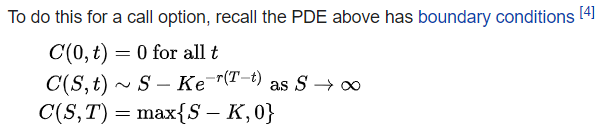
Using Black-Scholes to find the price of a European call option, I'm trying to figure out where the 2nd boundary condition comes from in
https://i.imgur.com/oS6ldTZ.png
https://en.wikipedia.org/wiki/Black–Scholes_equation#Solving_the_Black–Scholes_PDE
wiki ref links to https://www.math.cuhk.edu.hk/~rchan/teaching/math4210/chap08.pdf which says at the end of page 5/17:
full forumBOT
tulip marlin
Using Black-Scholes to find the price of a European call option, I'm trying to f...
tulip marlin
I don't get why as the price gets large, it's more likely the option will be exercised
 tulip marlin
Using Black-Scholes to find the price of a European call option, I'm trying to f...
tulip marlin
tulip marlin
Using Black-Scholes to find the price of a European call option, I'm trying to f...
1st image is https://i.imgur.com/oS6ldTZ.png
 full forumBOT
@tulip marlin Has your question been resolved?
full forumBOT
@tulip marlin Has your question been resolved?
full forumBOT
@tulip marlin Has your question been resolved?
full forumBOT
Channel closed
Closed due to timeout
Use .reopen if this was a mistake.
full forumBOT
Available help channel!
Send your question here to claim the channel.
Remember:
• Ask your math question in a clear, concise manner.
• Show your work, and if possible, explain where you are stuck.
• After 15 minutes, feel free to ping <@&286206848099549185>.
• Type the command .close to free the channel when you're done.
• Be polite and have a nice day!
Read #❓how-to-get-help for further information on how to ask a good question, and about conduct in the question channels.
 prime furnace
 full forumBOT
prime furnace
prime furnace
full forumBOT
prime furnace
prime furnace
can someone explain to me why the answr is B?
 robust slate
b/c the only elements shared with that options and the first set is pi
full forumBOT
Channel closed
Closed by @prime furnace
Use .reopen if this was a mistake.
Available help channel!
Send your question here to claim the channel.
Remember:
• Ask your math question in a clear, concise manner.
• Show your work, and if possible, explain where you are stuck.
• After 15 minutes, feel free to ping <@&286206848099549185>.
• Type the command .close to free the channel when you're done.
• Be polite and have a nice day!
Read #❓how-to-get-help for further information on how to ask a good question, and about conduct in the question channels.
 tribal iris
My question: If E and F are independent events with P(E) = 0.25 and P(F) = 0.29 then what is P(E’ u F)
full forumBOT
tribal iris
My question: If E and F are independent events with P(E) = 0.25 and P(F) = 0.29 ...
tribal iris
I’m stuck with not knowing the formula for P(E’ u F)
tribal iris
Yes
tribal iris
Right I understand that
But in the union
I’m unsure how to calculate it
It’s not .75+.29
glossy valveBOT
tatpoj

 rocky vale
Are you familiar with this?
tribal iris
Hmm I thought AuB was just A+B
tribal iris
AnB= A*B right?
rocky vale
yes
tribal iris
Yesss
rocky vale
tribal iris
Hmm I thought AuB was just A+B
If A and B are mutually exclusive, meaning they cannot both happen, then P(A∩B) is 0 and it simplifies to this
That is a simpler case you may have studied first
tribal iris
Hmmm
Interesting
I didn’t learn that
I cannot find anything about A’uB anywhere online
Driving me crazy
@rocky vale lmfao
rocky vale
You don't need a formula specifically for A' U B
Since you know E, you know E'. Just plug that in instead
glossy valveBOT
tatpoj
 glossy valveBOT
tatpoj
 tribal iris
0.8225
rocky vale
Yep
tribal iris
Tysm!
tribal iris
Do I close this and ask another question or do I keep this open to ask another question?
full forumBOT
@tribal iris Has your question been resolved?
Channel closed
Closed by @tribal iris
Use .reopen if this was a mistake.
Available help channel!
Send your question here to claim the channel.
Remember:
• Ask your math question in a clear, concise manner.
• Show your work, and if possible, explain where you are stuck.
• After 15 minutes, feel free to ping <@&286206848099549185>.
• Type the command .close to free the channel when you're done.
• Be polite and have a nice day!
Read #❓how-to-get-help for further information on how to ask a good question, and about conduct in the question channels.
 outer prawn
Let X be a subspace of Rk and E ⊂ X be a set with the property that
every sequence of points in E has a subsequence that converges to a point
in E. Prove that E is a compact set.
Any idea how can we do this?
full forumBOT
outer prawn
Let X be a subspace of Rk and E ⊂ X be a set with the property that
every sequen...
 native flicker
Assume that E is not bounded.
For every n € N there exists x_n € E such that |x_n| > n
Consider sequence {x_n} where you let x_n_i be subsequence of x_n
Can u start from here
 native flicker
U want me to explain
native flicker
Man I’m outside hol on
 topaz valley
what is your definition of compact?
native flicker
Getting paper
outer prawn
 outer prawn
A subset K of a metric space X is said to be compact if every
open cover of K contains a finite subcover.
topaz valley
oh my
cover compact
okay so this is the proof that sequential compactness = cover compactness (in metric spaces)
outer prawn
Can I assume that E is closed?
outer prawn
if I assume E is closed and it is bounded because it contains subsequence that converges then it uses theorem 2.41 to prove it is compact
outer prawn
Every bounded sequence in Rk contains a convergent subsequence.
native flicker
 outer prawn
as E contains convergent subsequence it is bounded, can also be proved using cauchy subsequence
native flicker
See from here it’s not done yet
topaz valley
like
you're trying to show cover compact
what results do you know to imply cover compactness
native flicker
native flicker
Ok u can figure out the conclusion urself

Therefore we have shown that E is a closed and bounded subset of R^n
By heine borel, E is compact
Is this what ur looking for ?
full forumBOT
@outer prawn Has your question been resolved?
full forumBOT
Channel closed
Closed due to timeout
Use .reopen if this was a mistake.
Available help channel!
Send your question here to claim the channel.
Remember:
• Ask your math question in a clear, concise manner.
• Show your work, and if possible, explain where you are stuck.
• After 15 minutes, feel free to ping <@&286206848099549185>.
• Type the command .close to free the channel when you're done.
• Be polite and have a nice day!
Read #❓how-to-get-help for further information on how to ask a good question, and about conduct in the question channels.
 icy marten
Anyone know how to solve this correctly?

 full forumBOT
icy marten
Anyone know how to solve this correctly?
torn jolt
full forumBOT
icy marten
Anyone know how to solve this correctly?
torn jolt
,rotate
glossy valveBOT

 whole marsh
icy marten
Anyone know how to solve this correctly?
whole marsh
icy marten
Anyone know how to solve this correctly?
is there any x that you know the value of f(-x + 1) for?
icy marten
(8,-5) is a point on the graph before translation and I'm trying to find the corresponding point after translation.
<@&286206848099549185>
torn jolt
What if you use X=-x+1
icy marten
Does the -2 effect the x or nah?
 lofty sigil
icy marten
Anyone know how to solve this correctly?
lofty sigil
icy marten
Anyone know how to solve this correctly?
x-axis reflection, shift 1 unit to the left, 2 units down, reciprocate, horizontal compression by a factor of 3 then shift if up 5 units?
i think?
i havent done transformations in a while
icy marten
lofty sigil
x-axis reflection, shift 1 unit to the left, 2 units down, reciprocate, horizont...
I'll try it thanks 🙂
lofty sigil
shift* not shit 💀
torn jolt
Well i don't know about transformations but you know -5=f(8) so with x=-7 you can calculate y and find the point (-7,y)
lofty sigil
that could also work
full forumBOT
@icy marten Has your question been resolved?
Channel closed
Closed by @icy marten
Use .reopen if this was a mistake.
Available help channel!
Send your question here to claim the channel.
Remember:
• Ask your math question in a clear, concise manner.
• Show your work, and if possible, explain where you are stuck.
• After 15 minutes, feel free to ping <@&286206848099549185>.
• Type the command .close to free the channel when you're done.
• Be polite and have a nice day!
Read #❓how-to-get-help for further information on how to ask a good question, and about conduct in the question channels.
torn jolt
Can anyone check if I graphed these right

 full forumBOT
torn jolt
Can anyone check if I graphed these right
full forumBOT
torn jolt
Can anyone check if I graphed these right

 dense lake
 torn jolt
Well what did I do wrong?
dense lake
maybe you included +3 in the root?
dense lake
nvm, I just checked and that graph doesn't resemble yours.
torn jolt
Oh lol
Yeah I was a bit confused 😅
Yeah and how would I state a function in 2 ways the question c part
dense lake
torn jolt
Yeah I was a bit confused 😅
I'm not sure, but maybe it's asking what's y^-1 and x
dense lake
dense lake
if it's that then y^-1 is the same as g(x)
and you would need to solve for x. I never been asked something like that, so it seems pretty weird to ask
torn jolt
dense lake
I'm not sure, but maybe it's asking what's y^-1 and x
I don’t think so it just said graph f^-1(x)
dense lake
What I meant, is that it's maybe it's asking to state the equation that is equal to that
dense lake
dense lake
since f(x)^-1 is the same as y^-1, then it's the same as g(x) here
basically the whole equation but with negative 1 as exponent
torn jolt
🤔
dense lake
but yeah, it seems unlikely they are asking for that
full forumBOT
@torn jolt Has your question been resolved?
torn jolt
.close
full forumBOT
Channel closed
Closed by @stone gyro
Use .reopen if this was a mistake.
full forumBOT
Available help channel!
Send your question here to claim the channel.
Remember:
• Ask your math question in a clear, concise manner.
• Show your work, and if possible, explain where you are stuck.
• After 15 minutes, feel free to ping <@&286206848099549185>.
• Type the command .close to free the channel when you're done.
• Be polite and have a nice day!
Read #❓how-to-get-help for further information on how to ask a good question, and about conduct in the question channels.
 eternal harbor
 eternal harbor
by differentiation and combination, isolation method anf by determinants
I have tried to differentiate the given equations according to the number of arbitrary constants. but I don't know how to eliminate the arbitrary constants using algebraic manipulation.

<@&286206848099549185>
.close
full forumBOT
Channel closed
Closed by @eternal harbor
Use .reopen if this was a mistake.
eternal harbor
.reopen
full forumBOT
✅

 full forumBOT
Channel closed
Closed by @eternal harbor
Use .reopen if this was a mistake.
Available help channel!
Send your question here to claim the channel.
Remember:
• Ask your math question in a clear, concise manner.
• Show your work, and if possible, explain where you are stuck.
• After 15 minutes, feel free to ping <@&286206848099549185>.
• Type the command .close to free the channel when you're done.
• Be polite and have a nice day!
Read #❓how-to-get-help for further information on how to ask a good question, and about conduct in the question channels.
 steel stone
Help pls
full forumBOT
steel stone
Help pls
steel stone


 full tundra
sure, so what 3 numbers multiplied together equal 27?
steel stone
3 in the cube
 smoky wing
Okay just put a minus there cause it’s -27
full forumBOT
@steel stone Has your question been resolved?
Channel closed
Closed by @steel stone
Use .reopen if this was a mistake.
Available help channel!
Send your question here to claim the channel.
Remember:
• Ask your math question in a clear, concise manner.
• Show your work, and if possible, explain where you are stuck.
• After 15 minutes, feel free to ping <@&286206848099549185>.
• Type the command .close to free the channel when you're done.
• Be polite and have a nice day!
Read #❓how-to-get-help for further information on how to ask a good question, and about conduct in the question channels.
 celest quiver
How to integrate sin(x/2)+cos(x/2) dx?
full forumBOT
celest quiver
How to integrate sin(x/2)+cos(x/2) dx?
 hot herald
chain rule
full forumBOT
@celest quiver Has your question been resolved?
torn jolt
split them and both are chainrule
full forumBOT
Channel closed
Closed due to timeout
Use .reopen if this was a mistake.
full forumBOT
Available help channel!
Send your question here to claim the channel.
Remember:
• Ask your math question in a clear, concise manner.
• Show your work, and if possible, explain where you are stuck.
• After 15 minutes, feel free to ping <@&286206848099549185>.
• Type the command .close to free the channel when you're done.
• Be polite and have a nice day!
Read #❓how-to-get-help for further information on how to ask a good question, and about conduct in the question channels.
 storm nest
 full forumBOT
storm nest
storm nest
full forumBOT
storm nest
storm nest
Not sure where to start with this one
hot herald
were you able to do at least a) and c)?
storm nest
Nope
hot herald
do you understand basic function notation?
storm nest
I’ve never seen this type of question before
storm nest
hot herald
do you understand basic function notation?
I’m not sure, I might know it but not by name
hot herald
sry typo
storm nest
Depends what basic function notation is
hot herald
if you were given
g(x) = x^2 + 6
would you be able to find g(3)
storm nest
Like (3)^2+6?
hot herald
yes
storm nest
Yep
hot herald
it is implied that the image is a graph of y = f(x)
storm nest
Yeah
hot herald
f(-1) will simply be the y-coordinate on the graph where x=-1
hot herald
that's related to the slope at that location
draw a rough sketch of the tangent line at the specified location
note that you are not required to determine the actual slope,
just whether its positive or negative which should be quite clear
 hot herald
the position of your light is a bit off
 hot herald
you want the line tangent to the point on the curve where x=3
and NOT a tangent of the curve that intercepts the x-axis at 3
somehow that's worse
the line looks even further away from the curve and doesn't look like it has any intention of being a tangent line at all
storm nest
Oof
 storm nest
How do I know where it should tilt towards?
hot herald
draw the line that just touches the curve at that point
 hot herald
no
storm nest
Absolute bruh moment
hot herald
i suggest looking up tangent to a curve
storm nest
Yeah I’ll do that

 hot herald
#bookruined
storm nest
Yeah rubbed a bit too hard
How does this indicate whether the value is a positive or negative?
hot herald
but yeh, that looks better
storm nest
Great
hot herald
is the slope of that line positive or negative
storm nest
Negative
full forumBOT
Channel closed
Closed by @storm nest
Use .reopen if this was a mistake.
full forumBOT
Available help channel!
Send your question here to claim the channel.
Remember:
• Ask your math question in a clear, concise manner.
• Show your work, and if possible, explain where you are stuck.
• After 15 minutes, feel free to ping <@&286206848099549185>.
• Type the command .close to free the channel when you're done.
• Be polite and have a nice day!
Read #❓how-to-get-help for further information on how to ask a good question, and about conduct in the question channels.
deep flint
you're supposed to wait 15 minutes before pinging for helpers
there's no rule that a function cannot cross its horizontal asymptotes
asymptotes refer to a function's behavior at very large (positive) or very small (negative) numbers. the function may cross its asymptote "near" the origin as long as, in the limit case, it approaches, but does not reach, the asymptote
yes, vertical asymptotes will never be crossed because the function is undefined at such points
but it is possible for a function to cross a horizontal asymptote

this is a graph of a curve that crosses its (oblique) asymptote infintiely many times
another example is f(x) = sin(x)/x
the x axis is an asymptote because the limit at infinity is 0
the curve crosses the x axis every 2pi
yes
well, it keeps crossing t over and over again, but it never stays there
it always wanders away and then back
for rational functions, you won't see this
rational functions will only cross a horizontal asymptote at most as many times as there are roots of the polynomial in the numerator

this is $f(x) = \frac{4x+2}{x^2+4x+5}$
glossy valveBOT
rome of oxtrot
 deep flint
it crosses once, where the numerator is zero and thus f(x) = 0
at x = -1/2
exactly
right, only x with large absolute values
yw
i graduated in 1998
my degree wa sin political science, but i studied election theory which is actually somewhat math-heavy. my interest in math is personal, and i got back into studying it so i could help my kids with their schoolwork
full forumBOT
@torn jolt Has your question been resolved?
Channel closed
Closed by @tight osprey
Use .reopen if this was a mistake.
Available help channel!
Send your question here to claim the channel.
Remember:
• Ask your math question in a clear, concise manner.
• Show your work, and if possible, explain where you are stuck.
• After 15 minutes, feel free to ping <@&286206848099549185>.
• Type the command .close to free the channel when you're done.
• Be polite and have a nice day!
Read #❓how-to-get-help for further information on how to ask a good question, and about conduct in the question channels.
 visual topaz
can anyone help me with this?
 full forumBOT
visual topaz
can anyone help me with this?
full forumBOT
visual topaz
can anyone help me with this?
 fast peak
what are the norm axioms?

 fast peak
they are
so now show those apply or not apply for the norms given in the exercise
or I shouldn't say norms, lets call it functions
the first question should really specify how long the vectors are tho
visual topaz
i dont get what max stends for in the first question
glossy valveBOT
Denascite
 visual topaz
first property of the vector norm is
= 0 right?
so how im going to show that is what i dont get
how do show this in that problem
 fast peak
well take any vector and show if you compute that formula it will end up >= 0
you can use that |y|>= 0 for all y
visual topaz
the elements of x vector aren't presented in the assigment