#help-28
1 messages · Page 4 of 1
 atomic blade
 swift fulcrum
 full forumBOT
@uncut breach Has your question been resolved?
 proper cave
dont multiply everything out, in this kind of problem just keep it as a fraction so that you can merge/combine like terms and cancel things out if necessary
 proper cave
the square roots are exponent 1/2
3rd root means exponent 1/3
5th root means exponent 1/5
multiply it with all the other things inside the roots
 proper cave
bro stop putting everything in decimals
yeah its wrong
how did you manage to get those numbers tho
wtf? i dont even understand how u did that lol
 uncut breach
Idk wtf I did
proper cave
look
 uncut breach
Okay that helps alot
proper cave
 uncut breach
Once I do that I multiply x and y??
proper cave
?
uncut breach
Like what do I do after I do that
proper cave
x terms and y terms are separate from each other, you cant add one to the other
you can only add x terms with x terms and y terms with y terms
proper cave
 uncut breach
How did you go from fractions to that?
proper cave
 full forumBOT
@uncut breach Has your question been resolved?
 spiral grail
U need help

 uncut breach
Ok ty
spiral grail
You should be able to use this to simplify etc
uncut breach
I also have another question if you're able to answer

I'm not sure how to even start this question
spiral grail
So to rationalize denominator is to get rid of any radicals
So jus multiply top and bottom by sqrt of 5 and sqrt of 3
So u shud get sqrt 15/11x-2y
Got it @uncut breach
uncut breach
I think
Actually nvm not really
There's supposed to be something on the numerator too
Which is what confuses me
spiral grail
Yeah sqrt 15
full forumBOT
Channel closed
Closed due to timeout
Use .reopen if this was a mistake.
 Available help channel!
Send your question here to claim the channel.
Remember:
• Ask your math question in a clear, concise manner.
• Show your work, and if possible, explain where you are stuck.
• After 15 minutes, feel free to ping <@&286206848099549185>.
• Type the command .close to free the channel when you're done.
• Be polite and have a nice day!
Read #❓how-to-get-help for further information on how to ask a good question, and about conduct in the question channels.
 rare dock
a,b like a pair of numbers?
 eager violet
What's the context? Where did you see this?
full forumBOT
@random torrent Has your question been resolved?
full forumBOT
@random torrent Has your question been resolved?
 humble steppe
Probably means $\log_a b$
 glossy valveBOT
jimmy1234
 full forumBOT
@random torrent Has your question been resolved?
full forumBOT
Channel closed
Closed due to timeout
Use .reopen if this was a mistake.
full forumBOT
Available help channel!
Send your question here to claim the channel.
Remember:
• Ask your math question in a clear, concise manner.
• Show your work, and if possible, explain where you are stuck.
• After 15 minutes, feel free to ping <@&286206848099549185>.
• Type the command .close to free the channel when you're done.
• Be polite and have a nice day!
Read #❓how-to-get-help for further information on how to ask a good question, and about conduct in the question channels.
Channel closed
Closed by @bright sandal
Use .reopen if this was a mistake.
full forumBOT
Available help channel!
Send your question here to claim the channel.
Remember:
• Ask your math question in a clear, concise manner.
• Show your work, and if possible, explain where you are stuck.
• After 15 minutes, feel free to ping <@&286206848099549185>.
• Type the command .close to free the channel when you're done.
• Be polite and have a nice day!
Read #❓how-to-get-help for further information on how to ask a good question, and about conduct in the question channels.
 hot mango
@dense hornet how is the 2nd one wrong
 full forumBOT
hot mango
<@474506664309948417> how is the 2nd one wrong
full forumBOT
hot mango
<@474506664309948417> how is the 2nd one wrong
 dense hornet
so
we want to compare number of molecules
which is always directly proportional with number of moles by the avogadro constant
so just compare moles
hot mango
yes
hot mango
is 20g of F2 2 mols bc of the 2?
dense hornet
do you know proportionality? cross-multiplication? criss cross?
dense hornet
hot mango
is 20g of F2 2 mols bc of the 2?
wait until we reach there
dense hornet
dense hornet
do you know proportionality? cross-multiplication? criss cross?
.
you know how to do it?
hot mango
multiplying fractions?
dense hornet
scissor multiplication
you should've heard one of the names for it
if not then no
dense hornet
hot mango
multiplying fractions?
not quite
dense hornet
hot mango
I have
so you do know them?
hot mango
yes
dense hornet
ok
we will need them
do you know how to convert grams to moles?
you know the rule?
hot mango
divide g by atomic number(number at the bottom, i think its called that)
dense hornet
so
not quite correct
you are talking molecules
so molecular number
you need to take in consideration all atoms making the molecule
sum their atomic number up
hot mango
ok
dense hornet
hot mango
is 20g of F2 2 mols bc of the 2?
so back to this
1 mol of F2 is just 2 times the atomic number of the flourine atom
becareful not to get confused
it is still one mole
hot mango
so 38?
dense hornet
wait a second
why are we doing the atomic number 😃
it is the mass number
atomic mass
because both protons and neutrons contribute to the weight
hot mango
so 9?
hot mango
mk
hot mango
yeah
dense hornet
hot mango
so 38?
yeah
hot mango
yeah
hot mango
yeah
dense hornet
dense hornet
so 38
this means that one mole of the fluorine molecule weighs 38 grams
hot mango
ok
dense hornet
now we need to know how many moles is 20 grams fluorine
we need to do cross multiplications
38 grams has one mole
20 grams has ? moles
hot mango
20*38
hot mango
wait i read that wrong
dense hornet
this is a ratio
hot mango
38/20?
dense hornet
and the ratio is equal
dont do it quick
do it with steps
the method is do a big cross
hot mango
it would be 20/38
hot mango
bc of cros multiplication stuffz
dense hornet
hot mango
bc of cros multiplication stuffz
so you do know it?
hot mango
hot mango
it would be 20/38
maybe
hot mango
what
hot mango
so
dense hornet
use the steps
hot mango
what i said
dense hornet
hot mango
what i said
yeah, "one" of them
hot mango
ok
dense hornet
yeah
hot mango
I was reading it as 38g is smaller then 18
but i need to convert it to mols
bc molecules
ty
dense hornet
anytime!
hot mango
dont say that bc ill be dming you constently with in the next 3 hours
dense hornet
ok so not anytime...
hot mango
I heard anytime \0/
dense hornet
... 😃
hot mango
im studing for a chem exam and dying
hot mango
ok
dense hornet
by no means shouldve you pinged me
 calm sphinx
What happened from E to F?
 calm sphinx
dense hornet
by no means shouldve you pinged me
calm sphinx
dense hornet
by no means shouldve you pinged me
Sorry bro, saw that you were helping for Chemistry
dense hornet
yeah last time I took those stuff was enough for ne to forget how organic chemistry works
 hybrid geyser
err shd be nucleophillic substitution
calm sphinx
hybrid geyser
err shd be nucleophillic substitution
Oh shit, thx bro
hybrid geyser
welcc!
hot mango
hybrid geyser
err shd be nucleophillic substitution
hello. I have a chem q if thats ok if not thats also ok
calm sphinx
hot mango
hello. I have a chem q if thats ok if not thats also ok
Ask me bro, I can attempt to solve your issue
hybrid geyser
hot mango
hello. I have a chem q if thats ok if not thats also ok
sure! but no guarantees HAHAHA
full forumBOT
@hot mango Has your question been resolved?
Channel closed
Closed by @hot mango
Use .reopen if this was a mistake.
Available help channel!
Send your question here to claim the channel.
Remember:
• Ask your math question in a clear, concise manner.
• Show your work, and if possible, explain where you are stuck.
• After 15 minutes, feel free to ping <@&286206848099549185>.
• Type the command .close to free the channel when you're done.
• Be polite and have a nice day!
Read #❓how-to-get-help for further information on how to ask a good question, and about conduct in the question channels.
 wary nest
You have 3 blue balls and 2 red balls in a small box. There is no replacement. If you get blue ball you get $1 and if you get red ball you lose $1. What's the expected value of this game?
full forumBOT
wary nest
```You have 3 blue balls and 2 red balls in a small box. There is no replacement...
@wary nest Has your question been resolved?
wary nest
<@&286206848099549185>
 steel cove
how much times do you play the game
wary nest
once
wary nest
how?
wary nest
okay wb 1
steel cove
1/5 i think
full forumBOT
@wary nest Has your question been resolved?
wary nest
steel cove
1/5 i think
Wb stop whenever?
full forumBOT
@wary nest Has your question been resolved?
 warm abyss
wary nest
Wb stop whenever?
warm abyss
wary nest
Wb stop whenever?
Can you repeat the question without using short writing?
full forumBOT
@wary nest Has your question been resolved?
full forumBOT
Channel closed
Closed due to timeout
Use .reopen if this was a mistake.
Available help channel!
Send your question here to claim the channel.
Remember:
• Ask your math question in a clear, concise manner.
• Show your work, and if possible, explain where you are stuck.
• After 15 minutes, feel free to ping <@&286206848099549185>.
• Type the command .close to free the channel when you're done.
• Be polite and have a nice day!
Read #❓how-to-get-help for further information on how to ask a good question, and about conduct in the question channels.
 woeful briar
find a plane parallel to velocity and acceleration of <s^3, s^2, 1/s> when s=1 and passes thru (1,2,3)
v'(1) = <3, 2, -1) and v''(1) = <6, 2, 2>
why is the parallel plane described by the cross-product: v'(1) x v''(1)?
wouldn't that be orthogonal to both vectors
rather than parallel?
full forumBOT
woeful briar
find a plane parallel to velocity and acceleration of <s^3, s^2, 1/s> when s=1 a...
@woeful briar Has your question been resolved?
woeful briar
say you have two vectors: L1 and L2. then L1 x L2 is orthogonal to both. how does that guarantee that the plane n_x(x-x_0) + n_y(y-y_0) + n_z(z-z_0) is parallel to L1 and L2? since we’re using L1 x L2 as the normal, wouldn’t that suggest they’re orthogonal rather than parallel or am i insane
full forumBOT
@woeful briar Has your question been resolved?
woeful briar
.close
full forumBOT
Channel closed
Closed by @woeful briar
Use .reopen if this was a mistake.
Available help channel!
Send your question here to claim the channel.
Remember:
• Ask your math question in a clear, concise manner.
• Show your work, and if possible, explain where you are stuck.
• After 15 minutes, feel free to ping <@&286206848099549185>.
• Type the command .close to free the channel when you're done.
• Be polite and have a nice day!
Read #❓how-to-get-help for further information on how to ask a good question, and about conduct in the question channels.
 sly wagon
hi can someone help me with question 7a and 7b? i have forgotten how to draw graph and what is a gradient of the line
 full forumBOT
sly wagon
hi can someone help me with question 7a and 7b? i have forgotten how to draw gra...
atomic blade
full forumBOT
sly wagon
hi can someone help me with question 7a and 7b? i have forgotten how to draw gra...
atomic blade
Quite literally plot the points and connect the line
 humble steppe
Gradient is just rise over run for any two distinct points in the graph. Now can you calculate that?
atomic blade
4/4 = 1
sly wagon
yes
humble steppe
Correct 🙂
full forumBOT
Channel closed
Closed by @sly wagon
Use .reopen if this was a mistake.
Available help channel!
Send your question here to claim the channel.
Remember:
• Ask your math question in a clear, concise manner.
• Show your work, and if possible, explain where you are stuck.
• After 15 minutes, feel free to ping <@&286206848099549185>.
• Type the command .close to free the channel when you're done.
• Be polite and have a nice day!
Read #❓how-to-get-help for further information on how to ask a good question, and about conduct in the question channels.
 swift rose
how to solve after finding common denominator?
 full forumBOT
swift rose
how to solve after finding common denominator?
full forumBOT
swift rose
how to solve after finding common denominator?
 wild sparrow
Send your work
humble steppe
swift rose
how to solve after finding common denominator?
You may want to expand the two fractions by the common denominator you found. 🙂
full forumBOT
@swift rose Has your question been resolved?
swift rose
humble steppe
You may want to expand the two fractions by the common denominator you found. 🙂
what does that mean?
full forumBOT
@swift rose Has your question been resolved?
swift rose
@humble steppe
full forumBOT
@swift rose Has your question been resolved?
 somber seal
swift rose
what does that mean?
somber seal
swift rose
what does that mean?
Is the question just asking you to solve for y?
swift rose
i have no idea
swift rose
yeah
somber seal
Alright so what is your equation after finding the common denominator?
swift rose
6
swift rose
 tender sedge
ok what do you multiply top and bottom of y/2 to get 6 on denominator
tender sedge
ok what do you multiply top and bottom of y/2 to get 6 on denominator
3y/6 - 2y/6 = 5
tender sedge
ok
tender sedge
swift rose
3y/6 - 2y/6 = 5
what is 3y-2y = ?
swift rose
1y
tender sedge
tender sedge
so now we have y/6 = 5
@swift rose correct?
full forumBOT
@swift rose Has your question been resolved?
full forumBOT
Channel closed
Closed due to timeout
Use .reopen if this was a mistake.
Available help channel!
Send your question here to claim the channel.
Remember:
• Ask your math question in a clear, concise manner.
• Show your work, and if possible, explain where you are stuck.
• After 15 minutes, feel free to ping <@&286206848099549185>.
• Type the command .close to free the channel when you're done.
• Be polite and have a nice day!
Read #❓how-to-get-help for further information on how to ask a good question, and about conduct in the question channels.
 obtuse shuttle

 full forumBOT
obtuse shuttle
obtuse shuttle
full forumBOT
obtuse shuttle
obtuse shuttle
So The question is in the above picture
And The Solution is below
But I am not able to understand
What has been done
To Get the first and second number
 deft zodiac
woah whats that, is that stuff printed onto a notebook
obtuse shuttle
Yea
deft zodiac
so pretty
obtuse shuttle
Yea 😂
 normal tree
obtuse shuttle
So The question is in the above picture
And The Solution is below
But I am not ...
normal tree
obtuse shuttle
So The question is in the above picture
And The Solution is below
But I am not ...
so this uses a cool identity that I just learned about on Wikipedia. G^2 = AH for two numbers
So the first line is about basically substituting AH for G^2
so we have 2A + AH = 27
obtuse shuttle
Yea So I do understand that bit
But Like u See
Its written first number = 4.5+ etc etc
Thats what's confusing me cos Idk from where they spawned it
normal tree
Then we substitute 4 for H and get 2A + 4A = 27, and therefore 6A = 27 and A = 4.5
 topaz valley
normal tree
so this uses a cool identity that I just learned about on Wikipedia. G^2 = AH fo...
topaz valley
normal tree
so this uses a cool identity that I just learned about on Wikipedia. G^2 = AH fo...
you can work this out pretty easily too
normal tree
topaz valley
you can work this out pretty easily too
yeah I assume it checks out algebraically lol
topaz valley
it is pretty neat
not something you usually remember
much like the sum to product trig identities
normal tree
obtuse shuttle
Yea So I do understand that bit
But Like u See
Its written first number = 4.5+ ...
okay so given the geometric and the arithmetic means
you can find each of the two numbers
obtuse shuttle
Yes
normal tree
the solution here doesn't really tell you much about how to do them (and hence why I hate it when people just show calculator work in their solutions)
but it goes something like this
obtuse shuttle
normal tree
the solution here doesn't really tell you much about how to do them (and hence w...
Ikr
normal tree
the arithmetic mean is 4.5 and G^2 = 18
obtuse shuttle
Yup
normal tree
so let's call the first and second numbers x and y respectively
you have x + y = 9
and xy = 18
do you agree?
obtuse shuttle
Yes
normal tree
so we rearrange the first equation to x = 9 - y
obtuse shuttle
Oo
normal tree
does that seem okay to you?
obtuse shuttle
Yes
normal tree
then we substitute it into the second equation
obtuse shuttle
Yup
normal tree
this gives us (9-y)y = 18
and this is a quadratic equation, which is why the solution gives calculator garbage that looks like the quadratic formula
obtuse shuttle
😂😂
normal tree
,w solve 9y-y^2 = 18
glossy valveBOT


 Requested by Saccharine#3780
normal tree
Requested by Saccharine#3780
normal tree
and there you go
obtuse shuttle
Oh damn wow
normal tree
the work shown in the solution is extremely lacking, but that's basically how the thing is solved
obtuse shuttle
Yea It is is indeed
But thx alot really appreciate it
normal tree
np
full forumBOT
@obtuse shuttle Has your question been resolved?
Channel closed
Closed by @obtuse shuttle
Use .reopen if this was a mistake.
Available help channel!
Send your question here to claim the channel.
Remember:
• Ask your math question in a clear, concise manner.
• Show your work, and if possible, explain where you are stuck.
• After 15 minutes, feel free to ping <@&286206848099549185>.
• Type the command .close to free the channel when you're done.
• Be polite and have a nice day!
Read #❓how-to-get-help for further information on how to ask a good question, and about conduct in the question channels.
 viral zenith
Hello
full forumBOT
viral zenith
Hello
viral zenith
.close
full forumBOT
Channel closed
Closed by @viral zenith
Use .reopen if this was a mistake.
 velvet spoke
lol love these hello .close channels
full forumBOT
Available help channel!
Send your question here to claim the channel.
Remember:
• Ask your math question in a clear, concise manner.
• Show your work, and if possible, explain where you are stuck.
• After 15 minutes, feel free to ping <@&286206848099549185>.
• Type the command .close to free the channel when you're done.
• Be polite and have a nice day!
Read #❓how-to-get-help for further information on how to ask a good question, and about conduct in the question channels.
viral zenith
Hi all
full forumBOT
viral zenith
Hi all
viral zenith
Does anyone know anything about Fourier series?
I see two different expansion formulae on the net and in my study guide and I'm not sure if they're supposed to be different and which one I should use
The net

My study guide

The difference seems to be the first term, there's a0 and a0/2
Another difference I can see is what to integrate from
 fast peak
well in the first you have a factor of 1/L and in the second of 1/(2L)
viral zenith
The top formula has 2L on the integral sign, whereas the bottom formula has -L to L
fast peak
so combined with the a_0/2 or just a_0, that's the same
viral zenith
fast peak
so combined with the a_0/2 or just a_0, that's the same
Okay yes I see that now
fast peak
the first says to integrate over an interval of length 2L
you can pick -L to L for that
viral zenith
Aha!
fast peak
because the functions are periodic it doesn't matter
viral zenith
The question I want to do says the period is 2pi

Does that mean L = 2pi?
And if that's the case, I would be integrating from -2pi to 2pi as per the formula?
What do you think @fast peak?
fast peak
well how is L defined in your notes
viral zenith
Look, I wish my notes were more explicit so I wouldn't have to waste anyone's time here
In a sample paper's solution, I can see a similar question with similar ranges

And it seems to me that they used L as pi when finding bn = 1/L etc etc as per the formula
Which is strange seeing that the question I want to do states the period is 2pi
So is it pi or 2pi, that's what I'm confused about
In this question here, the domain is 0 to 2pi, yet L seems to be just pi

It seems like I'm asking for free answers but I've exhausted all my resources to try to figure out this L period on my own, which is why I'm on here hoping for some more direct assistance @fast peak
fast peak
its just pi
we integrate over a single period. if the period is 2pi, then we integrate over an interval of length 2pi
viral zenith
fast peak
its just pi
Okay, how will I know in the future what the period is based on the domain given to me in the question?
viral zenith
viral zenith
The question I want to do says the period is 2pi
So when the question here says assume this to have a period of 2pi, that means L = 2pi because from -pi to pi is 2pi?
fast peak
usually when only the domain is given like this, unless it repeats somewhere already in the domain, the domain is supposed to be one period
viral zenith
fast peak
usually when only the domain is given like this, unless it repeats somewhere alr...
Okay so for this specific question that I want to do, I should use L as only pi?
 fast peak
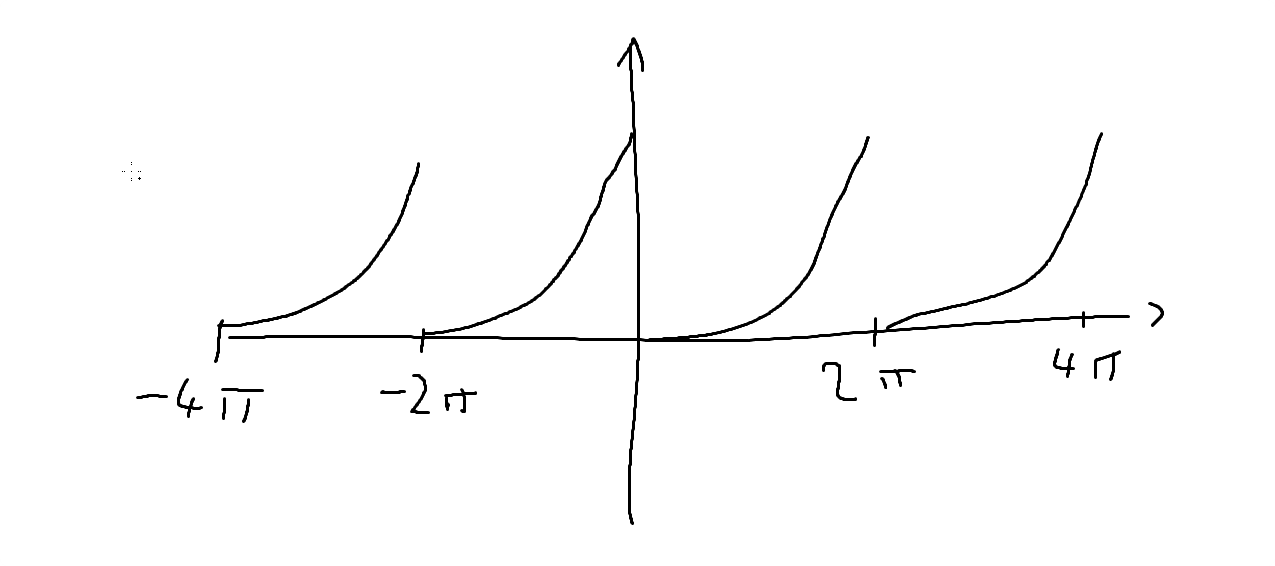
so this is for example how the x^2 function would look like if we expanded the definition to all of R
viral zenith
fast peak
https://i.imgur.com/JtvEpQJ.png
Yes that makes sense to me, so the period here is pi
I mean 2pi
fast peak
yes
viral zenith
But for my question where it's just f(x) = 1 and f(x) = 0, how would that look like? They're just lines
viral zenith
Okay I trust you, I'll use this formula and pi as L
 fast peak
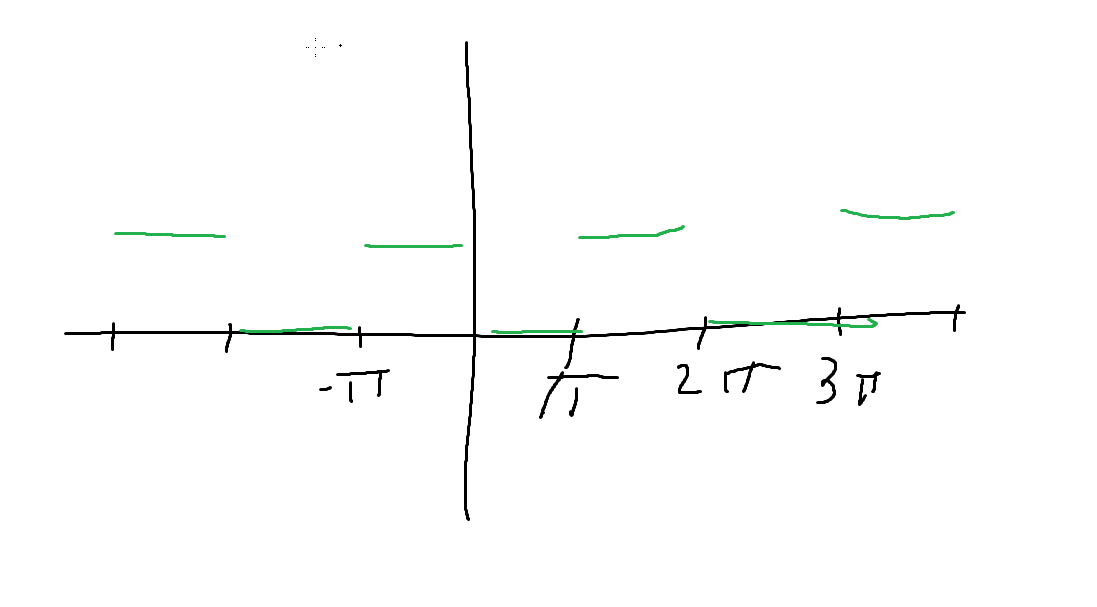 viral zenith
Thanks for the visualisation, I needed it!
viral zenith
fast peak
https://i.imgur.com/7gbqrQF.png
I can do the calculations, I just wasn't sure what to use for L
fast peak
its sad how many courses don't show pictures
viral zenith
No they don't. There's only one example in my notes, and the question I want to do has a piecewise. I wish they had more examples for me to compare and learn from before throwing me into the deep end
fast peak
the thing is, it's obvious when you have seen it once
so it's not like teachers would have to show it often
but that single time is important
viral zenith
fast peak
2L=period=2pi
So just to clarify, when the question says the period is 2pi, period is actually 2L
I think I was confused because I thought period is L
fast peak
but sometimes its hard to remember how non-obvious some stuff is before you have seen that picture
viral zenith
fast peak
so it's not like teachers would have to show it often
I'm learning everything online sadly
It's one of those "career change" courses
fast peak
well some people probably use L as the period itself. it depends on the course
if you put that additional factor of 2 in, it cancels nicely with the 2 from 2pi
which can be nice
viral zenith
But for the question I want to do above, I should use pi for L
fast peak
or if we want to integrate from -something to +something
it's better to be able to integrate from -L to L
instead of -L/2 to L/2
yes, here L=pi
full forumBOT
@viral zenith Has your question been resolved?
viral zenith


@fast peak I think my working out is correct here, would you mind taking a quick look over?
viral zenith
fast peak
https://i.imgur.com/7gbqrQF.png
Also, you’d say that this function is odd based on the graph you drew wouldn’t you?
viral zenith
viral zenith
In a sample paper's solution, I can see a similar question with similar ranges
This is consistent with this question where only bn is needed because an is 0
fast peak
that function is not odd
but the function -1/2 is odd
(which makes sense cause a0=1/2)
I didn't check for sign mistakes but should check out
full forumBOT
@viral zenith Has your question been resolved?
viral zenith
fast peak
but the function -1/2 is odd
Sorry, I’m not sure what you mean here. Could you be more specific with the functions you’re referring to? Which is odd/even?
fast peak
viral zenith
Okay so for this specific question that I want to do, I should use L as only pi?
this one
viral zenith
fast peak
f(x) is not odd
Are you saying that the function in the question I am doing is odd, but if I subtract it by 1/2 it’s odd?
Oh yes and a0 is 1/2
Okay at least that lines up then!
.close
full forumBOT
Channel closed
Closed by @viral zenith
Use .reopen if this was a mistake.
Available help channel!
Send your question here to claim the channel.
Remember:
• Ask your math question in a clear, concise manner.
• Show your work, and if possible, explain where you are stuck.
• After 15 minutes, feel free to ping <@&286206848099549185>.
• Type the command .close to free the channel when you're done.
• Be polite and have a nice day!
Read #❓how-to-get-help for further information on how to ask a good question, and about conduct in the question channels.
 winged geyser
testing please ignore
full forumBOT
winged geyser
testing please ignore
winged geyser
.close
full forumBOT
Channel closed
Closed by @winged geyser
Use .reopen if this was a mistake.
full forumBOT
Available help channel!
Send your question here to claim the channel.
Remember:
• Ask your math question in a clear, concise manner.
• Show your work, and if possible, explain where you are stuck.
• After 15 minutes, feel free to ping <@&286206848099549185>.
• Type the command .close to free the channel when you're done.
• Be polite and have a nice day!
Read #❓how-to-get-help for further information on how to ask a good question, and about conduct in the question channels.
 tawny drift
 full forumBOT
tawny drift
tawny drift
full forumBOT
tawny drift
tawny drift
Hi! I'm trying to understand this proof. If you're proving PSMI => PMI, why does the proof use "By (PMI1).." when PMI is the thing that is supposed to be proven?
 sweet ingot
They are swapped around
tawny drift
What do you mean by swapped around..?
full forumBOT
@tawny drift Has your question been resolved?
sweet ingot
tawny drift
What do you mean by swapped around..?
The text for proof 1 should be in proof 2
tawny drift
I'll ask my prof next week, thanks!
full forumBOT
Channel closed
Closed by @tawny drift
Use .reopen if this was a mistake.
Available help channel!
Send your question here to claim the channel.
Remember:
• Ask your math question in a clear, concise manner.
• Show your work, and if possible, explain where you are stuck.
• After 15 minutes, feel free to ping <@&286206848099549185>.
• Type the command .close to free the channel when you're done.
• Be polite and have a nice day!
Read #❓how-to-get-help for further information on how to ask a good question, and about conduct in the question channels.
 earnest bough
I want to derive x*sqrt((1.5)^2 - 3x).
I need to use the product rule so I have:
- part f(x) = x, f'(x) = 1
- part g(x) = sqrt((1.5)^2 - 3x).
I need the chain rule so I have: - part h(x) = sqrt(x), h'(x) = 1 / (2*sqrt(x))
- part k(x) = (1.5)^2 - 3x, k'(x) = -3
so g'(x) = h'(k(x))*k'(x)
-> -3 / (2 * sqrt((1.5)^2 - 3x))
Setting that together is
3x / (2 * sqrt((1.5)^2 -3x) + sqrt((1.5)^2 - 3x).
Is there something wrong?
Wolfram alpha gives me something different
full forumBOT
earnest bough
I want to derive x*sqrt((1.5)^2 - 3x).
I need to use the product rule so I have:...
 dim dragon
earnest bough
I want to derive x*sqrt((1.5)^2 - 3x).
I need to use the product rule so I have:...
dim dragon
earnest bough
I want to derive x*sqrt((1.5)^2 - 3x).
I need to use the product rule so I have:...
you are missing the negative sign in the start with 3x
also you can simplify the taking the lcm
earnest bough
can you show me how?
 earnest bough
how can you just move the sqrt to the top and remove it?
oh, wait. You can add them together by bringing the other term to a denominator of 2*sqrt((1.5)^2 -3x)
well, thanks!
.close
full forumBOT
Channel closed
Closed by @earnest bough
Use .reopen if this was a mistake.
full forumBOT
Available help channel!
Send your question here to claim the channel.
Remember:
• Ask your math question in a clear, concise manner.
• Show your work, and if possible, explain where you are stuck.
• After 15 minutes, feel free to ping <@&286206848099549185>.
• Type the command .close to free the channel when you're done.
• Be polite and have a nice day!
Read #❓how-to-get-help for further information on how to ask a good question, and about conduct in the question channels.
full forumBOT
Channel closed
Closed due to the original message being deleted
Available help channel!
Send your question here to claim the channel.
Remember:
• Ask your math question in a clear, concise manner.
• Show your work, and if possible, explain where you are stuck.
• After 15 minutes, feel free to ping <@&286206848099549185>.
• Type the command .close to free the channel when you're done.
• Be polite and have a nice day!
Read #❓how-to-get-help for further information on how to ask a good question, and about conduct in the question channels.
 torn jolt

 short crest
are you familiar with SOH CAH TOA ?
 pine wraith
r u sure
 dire sinew
lol
torn jolt
pine wraith
so why did u ask
i cba to do my hw
and its due tommorow
i got 60+ questions
and thats just maths
i have to read a 83 page book and i have to write an essay on it
for tommorow
i also got chinese homework
and science
:p
i need help with this though

 heady elbow
You can use x and y as 45 and 30
torn jolt
but yk what the answer is
full forumBOT
@torn jolt Has your question been resolved?
 cinder kayak
torn jolt
but yk what the answer is
cinder kayak
torn jolt
but yk what the answer is
Substitute x = 45 and y = 30.
I (in fact, most of us) want the askers to solve the problem by themselves, with guidance of the helpers.
full forumBOT
@torn jolt Has your question been resolved?
Channel closed
Closed by @spring kite
Use .reopen if this was a mistake.
Available help channel!
Send your question here to claim the channel.
Remember:
• Ask your math question in a clear, concise manner.
• Show your work, and if possible, explain where you are stuck.
• After 15 minutes, feel free to ping <@&286206848099549185>.
• Type the command .close to free the channel when you're done.
• Be polite and have a nice day!
Read #❓how-to-get-help for further information on how to ask a good question, and about conduct in the question channels.
 teal kindle
Is there an identity associated with this setup when trying to find the limit? I'm trying to use the cosine theorem by dividing by theta on both the numerator and denominator.
 full forumBOT
teal kindle
Is there an identity associated with this setup when trying to find the limit? I...
deft zodiac
full forumBOT
teal kindle
Is there an identity associated with this setup when trying to find the limit? I...
deft zodiac
i think
 native flicker
Evaluate using l hopital
teal kindle
native flicker
Evaluate using l hopital
😦 I don't know derivatives
this is a chapter before derivatives
so I'd assume it's possible somehow
deft zodiac
use big O
 hot herald
you could consider double angle identity for cosine
in combination with the limit identity for sin(t)/t as t→0
teal kindle
hot herald
you could consider double angle identity for cosine
I did see that although I'm not sure how you would get the 1 out of the denominator
deft zodiac
thats an identity? i thought it was just lhopital
hot herald
there are three (common) forms of the double angle identity for cosine
teal kindle
 hot herald
one of those would be more useful here (and rids yourself of a constant in the denom)
teal kindle
ok, I'll try to do that
thanks
ah, I think I needed to use the half angle formula
$$
sin^2(\frac{a}{2})=\frac{1-cos (a)}{2}
$$
glossy valveBOT
Carter
 teal kindle
hmm I'm stuck at
$$
\frac{\frac{\Theta^2}{2}}{sin^2(\frac{\Theta}{2})}
$$
glossy valveBOT
Carter
 teal kindle
I keep on getting 0/0 when trying sin rule
I did try using the pythagorean identity but that just ends up with
$$
\frac{\frac{\Theta^2}{2}}{-cos^2(\Theta)+1}
$$
glossy valveBOT
Carter
 teal kindle
which doesn't really help that much because it simplifies to 0/0
hmm I wonder if it's legal to say sin(theta) = sin(constant * theta) in this case
because theta is always going to be really small it would overpower it anyways
this would open the doors to more formulas
well, at least I know my simplification was fine
per wolfram

alright, I'm closing - I'll ask my teacher on monday
.close
full forumBOT
Channel closed
Closed by @teal kindle
Use .reopen if this was a mistake.
Available help channel!
Send your question here to claim the channel.
Remember:
• Ask your math question in a clear, concise manner.
• Show your work, and if possible, explain where you are stuck.
• After 15 minutes, feel free to ping <@&286206848099549185>.
• Type the command .close to free the channel when you're done.
• Be polite and have a nice day!
Read #❓how-to-get-help for further information on how to ask a good question, and about conduct in the question channels.
 glad prairie
I don't understand the red part
 full forumBOT
glad prairie
I don't understand the red part
glad prairie
full forumBOT
glad prairie
I don't understand the red part
glad prairie
if we put the n in factor we need to minus factorial of n, i'm ok with that
but for the p i don't get it
fast peak
Start with writing out what $\binom{m-1}{p-1}$ is in factorial form
glossy valveBOT
Denascite
 glad prairie
it's already write
i specify that's a demonstration
i just don't understand how they transform the expression by putting the n/p in factor
fast peak
So you understand the numerator but don't understand the denominator?
It's the same thing
In the numerator we factor out m
In the denominator we factor out p
glad prairie
yeah but why changing the (n - p)
fast peak
Well they don't actually change the value of the expression
glad prairie
p!(n-p)! = p * (p-1)!(n-p) for me
glad prairie
ah ok i got it
fast peak
So now it still has the required form of (first thing)-(second thing)
full forumBOT
Channel closed
Closed by @glad prairie
Use .reopen if this was a mistake.
Available help channel!
Send your question here to claim the channel.
Remember:
• Ask your math question in a clear, concise manner.
• Show your work, and if possible, explain where you are stuck.
• After 15 minutes, feel free to ping <@&286206848099549185>.
• Type the command .close to free the channel when you're done.
• Be polite and have a nice day!
Read #❓how-to-get-help for further information on how to ask a good question, and about conduct in the question channels.
 summer pasture
 full forumBOT
summer pasture
summer pasture
full forumBOT
summer pasture
summer pasture
for this question, why do you multiply the quotient rule by whats inside the parenthesis
like whats inside the pink box
i know that in quotient rule, you do the lo d hi - hi d lo all over lo lo
and take the exponent out in front
but when you apply chain rule you take the d/dx of whats inside the parenthesis
but for this, why are you just taking whats inside the parenthesis and not the derivative of it?
<@&286206848099549185>
 lilac topaz
chain rule $$h'(t)=f'(g(t))*g'(t)$$
glossy valveBOT
sbondaryev
 lilac topaz
can you see what are your f and g in this examle?
summer pasture
im not really sure
with chain rule, all we learned is that if its a composite function, you multiply whatever rule you are using by the derivative of whats inside the (_)
lilac topaz
ok, can you see what is the derivative of $h=(x+1)^2$
glossy valveBOT
sbondaryev

 summer pasture
ok
oh ok since the value is raised to the second power, once you use the n-1, it changes the exponent into 1 which is why you are multiplying the derivative by a singular value of (t^3/t^8 +3)
native flicker
ye pretty much
summer pasture
wait so then why does the chain rule have you multiply by the derivative sometimes
like on a question for f(x) = (3t+9)^2/3
it has you find the derivative of (3t+9)^2/3 and also multiply that by the derivative of whats inside the parenthesis which would be 3
summer pasture
ok ty
native flicker
 summer pasture
so could you use either method, or should i stick with the nu^n-1
native flicker
im more familiar with my method
summer pasture
the nu^n-1 is what we got in our notes packet
but when we did examples, the teacher just multiplied by derivative
native flicker
I mean if ur not getting penalized then y not
summer pasture
will it always yield the same results?
or should i just stick with the formula just to be safe
native flicker
Use the one ur more familiar with
full forumBOT
Channel closed
Closed by @summer pasture
Use .reopen if this was a mistake.
Available help channel!
Send your question here to claim the channel.
Remember:
• Ask your math question in a clear, concise manner.
• Show your work, and if possible, explain where you are stuck.
• After 15 minutes, feel free to ping <@&286206848099549185>.
• Type the command .close to free the channel when you're done.
• Be polite and have a nice day!
Read #❓how-to-get-help for further information on how to ask a good question, and about conduct in the question channels.
glad prairie
I don't understand why this expression
 full forumBOT
glad prairie
I don't understand why this expression
full forumBOT
full forumBOT
glad prairie
I don't understand why this expression
full forumBOT
@glad prairie Has your question been resolved?
glad prairie
<@&286206848099549185>
 trail barn
The total number of ways of choosing out of n objects
Is 2^n
Because for each one you either choose it or you don't
This sum disallows the 1 case where no objects are chosen
lilac topaz
you have k=1
trail barn
Because of the k yes
glad prairie
trail barn
This sum disallows the 1 case where no objects are chosen
so the case "0 choose n"
trail barn
N choose 0
trail barn
Yes but the sum is from k=1 and that's the k=0 case so you don't include it
full forumBOT
Channel closed
Closed by @glad prairie
Use .reopen if this was a mistake.
Available help channel!
Send your question here to claim the channel.
Remember:
• Ask your math question in a clear, concise manner.
• Show your work, and if possible, explain where you are stuck.
• After 15 minutes, feel free to ping <@&286206848099549185>.
• Type the command .close to free the channel when you're done.
• Be polite and have a nice day!
Read #❓how-to-get-help for further information on how to ask a good question, and about conduct in the question channels.
 gleaming smelt
 full forumBOT
gleaming smelt
glossy valveBOT
full forumBOT
gleaming smelt
glossy valveBOT
 gleaming smelt
ty, gonna try that now
nvm that was way easier than I thought lol I didn't look at the numbers as pairs

.close
full forumBOT
Channel closed
Closed by @gleaming smelt
Use .reopen if this was a mistake.
 oblique surge
-2*40 = -80
full forumBOT
Available help channel!
Send your question here to claim the channel.
Remember:
• Ask your math question in a clear, concise manner.
• Show your work, and if possible, explain where you are stuck.
• After 15 minutes, feel free to ping <@&286206848099549185>.
• Type the command .close to free the channel when you're done.
• Be polite and have a nice day!
Read #❓how-to-get-help for further information on how to ask a good question, and about conduct in the question channels.
 agile pine
Could someone help with this?
 full forumBOT
agile pine
Could someone help with this?
full forumBOT
agile pine
Could someone help with this?
 fleet cedar
common denominator
agile pine
the common denominator is just all the denominators multiplied right
native flicker
- find common denominator
- multiply each term by common denominator to remove the fractions
- solve the eqn
agile pine
How do I write the final statement though ?
agile pine
so I substitute square root of 3 over 3 to the equation?
Would I not need a final statement though ? I thought that was manditory for proofs
also do I substitute it to the first or second equation?
 median dawn
First you combine them all directly
Then you state something like a/b = 0 only when a = 0
Im not really too sure for proofs tho
agile pine
when u say combine them all directly to which part are u referring too ?
also does that mean like substituting the value of x into it?
median dawn
Combine all the fractions
agile pine
of this ?
 median dawn
Yes
median dawn
Yeah as long as you show some steps and say for x not 1 ,-1 or 0
If you need to show work
 median dawn
No you write that for the proof
and then you can use the combined equation to solve
agile pine
agile pine
3x^2-1/x(x^2-1)
so I substitute the value of x to here ?
agile pine
No I think I'm just confused
that just gives x= square root of 3 over 3 as well though right ?
median dawn
Yes
agile pine
so after doing that done ?
kinda confused how to write the final statement still though
if I need it
median dawn
Im not sure when the proof ends it might end with the algebraic equality
Idk if you prove the 0
So the statement would be the equality if thats where the proof ends
agile pine
sry I'm not quite sure what u mean
median dawn
Like its only asking you to prove the fractions equal
Not prove that sqr(3)/3 is a zero
From the way im reading it
agile pine
so I can already end it at x= square root of 3 over 3 ?
median dawn
That would be the end of the whole problem yes
Just the proof as to be properly worded and whatnot
Has
median dawn
Np
full forumBOT
@agile pine Has your question been resolved?
Channel closed
Closed by @agile pine
Use .reopen if this was a mistake.
Available help channel!
Send your question here to claim the channel.
Remember:
• Ask your math question in a clear, concise manner.
• Show your work, and if possible, explain where you are stuck.
• After 15 minutes, feel free to ping <@&286206848099549185>.
• Type the command .close to free the channel when you're done.
• Be polite and have a nice day!
Read #❓how-to-get-help for further information on how to ask a good question, and about conduct in the question channels.
torn jolt
is there some special case for definite integrals? e.g. $\int_{1}^{2}2xdx=(2^2-1^2)$
full forumBOT
torn jolt
is there some special case for definite integrals? e.g. $\int_{1}^{2}2xdx=(2^2-1...
glossy valveBOT
lcohs 新しいドラゴン
 torn jolt
however $\int_{1}^{4}2xdx \neq (4^2 - 3^2 - 2^2 - 1^2)$
glossy valveBOT
lcohs 新しいドラゴン

 gusty holly
the integral can be calculated by evaluating the antiderivative at the endpoints
so it would be 4² - 1²
[\int_a^b 2 x ; dx = a^2 - b^2]
glossy valveBOT
Samsamson33
 full forumBOT
Channel closed
Closed by @glacial olive
Use .reopen if this was a mistake.
 arctic isle
gusty holly
arctic isle
gusty holly
I'll also note that the integers aren't special here
gusty holly
torn jolt
ah, thanks
so [\int_{1.5}^{\pi} 2 x ; dx = \pi^2 - (1.5)^2]
glossy valveBOT
Samsamson33
 torn jolt
so it doesnt matter if its a decimal or integer
gusty holly
right
gusty holly
glossy valve
**Samsamson33**
this integral is the area under the curve y = 2x from a to b
for any real numbers a and b
torn jolt
pretty sure it's b^2 - a^2 if its positive
full forumBOT
Available help channel!
Send your question here to claim the channel.
Remember:
• Ask your math question in a clear, concise manner.
• Show your work, and if possible, explain where you are stuck.
• After 15 minutes, feel free to ping <@&286206848099549185>.
• Type the command .close to free the channel when you're done.
• Be polite and have a nice day!
Read #❓how-to-get-help for further information on how to ask a good question, and about conduct in the question channels.
torn jolt
 torn jolt
why is 3 a) 1/n^2
rare dock
1/n chance for the first ticket to be number 1, 1/n chance for the second ticket to be number 2
rare dock
if n = 6, this situation would be like rolling two dice and asking the probability of getting a 1 then a 2. There is only one way to roll 1 then 2, and 6*6 = 36 total ways to roll the dice
it also just follows right from the definition of independent events, but that's kinda why it makes sense
full forumBOT
@torn jolt Has your question been resolved?
Channel closed
Closed by @hearty elbow
Use .reopen if this was a mistake.
full forumBOT
Available help channel!
Send your question here to claim the channel.
Remember:
• Ask your math question in a clear, concise manner.
• Show your work, and if possible, explain where you are stuck.
• After 15 minutes, feel free to ping <@&286206848099549185>.
• Type the command .close to free the channel when you're done.
• Be polite and have a nice day!
Read #❓how-to-get-help for further information on how to ask a good question, and about conduct in the question channels.
 stray canyon
Hi. I'm having some issues with this question on my maths homework. I forgot the formula for finding the area of a quadrilateral, and I'm not even sure if its a quadrilateral, as when i type something into google about it nothing really shows up. If someone could help me, thank you. 🙂
 full forumBOT
stray canyon
Hi. I'm having some issues with this question on my maths homework. I forgot the...
teal kindle
full forumBOT
stray canyon
Hi. I'm having some issues with this question on my maths homework. I forgot the...
teal kindle
I'm pretty sure those are right angles on the left
do they denote right angles on the other problems?
because if they're right angles then you can split it up into a rectangle (5x6) and a triangle (6x3)
 silk flame
Triangle area =1/2 x base x height
teal kindle
yep, I was just showing the dimensions
full forumBOT
Channel closed
Closed by @stray canyon
Use .reopen if this was a mistake.
Available help channel!
Send your question here to claim the channel.
Remember:
• Ask your math question in a clear, concise manner.
• Show your work, and if possible, explain where you are stuck.
• After 15 minutes, feel free to ping <@&286206848099549185>.
• Type the command .close to free the channel when you're done.
• Be polite and have a nice day!
Read #❓how-to-get-help for further information on how to ask a good question, and about conduct in the question channels.
 hot void
I have no idea how the ls = rs someone help plz
 full forumBOT
hot void
I have no idea how the ls = rs someone help plz
full forumBOT
hot void
I have no idea how the ls = rs someone help plz
 meager dew
what do you know about the unit circle
hot void
ik like some stuff about it
idk how to explain what ik about it lol

i tried doing that
but 1/root2 is not on the unit circle
full forumBOT
@hot void Has your question been resolved?
hot void
<@&286206848099549185>
warm abyss
hot void
but 1/root2 is not on the unit circle
arcsin(1/sqrt (2))= 45 degrees
full forumBOT
Channel closed
Closed by @hot void
Use .reopen if this was a mistake.
Available help channel!
Send your question here to claim the channel.
Remember:
• Ask your math question in a clear, concise manner.
• Show your work, and if possible, explain where you are stuck.
• After 15 minutes, feel free to ping <@&286206848099549185>.
• Type the command .close to free the channel when you're done.
• Be polite and have a nice day!
Read #❓how-to-get-help for further information on how to ask a good question, and about conduct in the question channels.
 dense edge
 full forumBOT
dense edge
dense edge
full forumBOT
dense edge
dense edge
Umm, I would guess it's B but I'm not sure I'm fully understanding the question here
g(x) ?
 lone flint
dense edge
Umm, I would guess it's B but I'm not sure I'm fully understanding the question ...
lone flint
dense edge
Umm, I would guess it's B but I'm not sure I'm fully understanding the question ...
Sounds correct to me
dense edge

If I zoom into the graph it doesn't exactly look like it's shifting 2 to the left and 3 up
lone flint
Pay attention to the numbers
lone flint
How big is a square?
dense edge
2 units
dense edge
"choose the graph of g below" .. shouldn't it be worded "choose the graph of g(x) below"?
lone flint
g is f shifted in place
lone flint
dense edge
"choose the graph of g below" .. shouldn't it be worded "choose the graph of g(x...
I am not the person qualified to answer notation questions but my teachers use them interchangeably, in the end they refer to the same function
dense edge
what makes it extra confusing is that whenever i see f(x)=, g(x)= or any function declaration in my mind I think y =
don't know if that's always the case for y=
like an inverse function would be finding x instead of y, but you would see f^-1(x)=
so for the most part when I see f(x)= i always think y= whatever this function is spewing out
don't know if that's a heathy way to look at it
I also have to remember if it's y = x + 1
it's y shifting up 1 unit
y = x - 1
y shifting down 1 unit
but if it's y = (x - 1)
x is shifting right
and if it's y = (x + 1)
x is shifting left
I guess I can reword y = x + 1
to be y - 1 = x
y shift up 1 unit instead of down
to get the same result as (x - 1) shifting right instead of left
lone flint
<@&286206848099549185> could you guide this confused soul
dense edge
lol
am I wrong @lone flint ?
with what i have rambled about above in regards to x,y shifting
just want to make sure

Here is what I am getting at
"|x + 2| + 3" is correct, yeah?
left 2, up 3
absolute function, straight lines not curved like a parabola
and if it was "|2x + 2| + 3" it would be stretched (thinner)
"-|1/2x + 2| + 3" it would be inverted and compressed (wider)
but vertical/horizontal shift would remain the same in all 3 examples
<@&286206848099549185> please correct if anything wrong with these statements
topaz valley
dense edge
"|x + 2| + 3" is correct, yeah?
yes
topaz valley
dense edge
and if it was "|2x + 2| + 3" it would be stretched (thinner)
yes
dense edge
Thanks
topaz valley
horizontal shift is different for the 2 you gave
dense edge
i mean where the function starts will be (-2, 3) for all 3?
topaz valley
no
dense edge
topaz valley
horizontal shift is different for the 2 you gave
stretch you mean?
topaz valley
they do not have their vertices at (-2, 3)
dense edge
Hmmm
topaz valley
the absolute value would be 0 if that were the case
ignoring the +stuff outside
2(-1) + 2 = 0
dense edge
Oh right, that tricky modulus
dense edge
Oh
topaz valley
this is not a problem of the modulus
dense edge
OK
topaz valley
this is a problem of the shift being applied before the stretch
your stretch moves your shift
dense edge
Hmmm
I will need to graph these out to compare
One sec
While I do that

I think I answered this correctly, AFAIK? but I didn't use radical notation?
if they want to see a radical symbol in the answer
topaz valley
the denominator is incorrect
in the very first step
and i guess the numerator also
dense edge
I used the negative exponent on base, i'm not supposed to do that?
it should be for the full term only? 2x
glossy valveBOT

 topaz valley
the negative just puts it in the denominator
dense edge
yeah
Hmmm.. I thought I did all that
sorry, still not seeing mistake
I will graph absolute functions now and come back
dense edge

Woah.. I was really not expecting that. all was same vertices (-2,3) until I added stretch and compress 😦
but I guess that makes sense, going from origin, delta rise over delta run
m=slope
of course of course
wait no maybe thats only applicable to linear functions (lines)
confused
full forumBOT
@dense edge Has your question been resolved?
Channel closed
Closed by @dense edge
Use .reopen if this was a mistake.
Available help channel!
Send your question here to claim the channel.
Remember:
• Ask your math question in a clear, concise manner.
• Show your work, and if possible, explain where you are stuck.
• After 15 minutes, feel free to ping <@&286206848099549185>.
• Type the command .close to free the channel when you're done.
• Be polite and have a nice day!
Read #❓how-to-get-help for further information on how to ask a good question, and about conduct in the question channels.
 loud hull
Hey
full forumBOT
loud hull
Hey


 loud hull
Does this look good?
glossy valveBOT
dopediscorduser
 full forumBOT
@loud hull Has your question been resolved?
full forumBOT
Channel closed
Closed due to timeout
Use .reopen if this was a mistake.
Available help channel!
Send your question here to claim the channel.
Remember:
• Ask your math question in a clear, concise manner.
• Show your work, and if possible, explain where you are stuck.
• After 15 minutes, feel free to ping <@&286206848099549185>.
• Type the command .close to free the channel when you're done.
• Be polite and have a nice day!
Read #❓how-to-get-help for further information on how to ask a good question, and about conduct in the question channels.
 tepid trail
can someone confirm that the sequence -2, 0, 14, 46, 102, 188 has a third level of difference
full forumBOT
tepid trail
can someone confirm that the sequence -2, 0, 14, 46, 102, 188 has a third level ...
full forumBOT
@tepid trail Has your question been resolved?
 rocky vale
full forumBOT
rocky vale
full forumBOT
Channel closed
Closed by @tepid trail
Use .reopen if this was a mistake.
Available help channel!
Send your question here to claim the channel.
Remember:
• Ask your math question in a clear, concise manner.
• Show your work, and if possible, explain where you are stuck.
• After 15 minutes, feel free to ping <@&286206848099549185>.
• Type the command .close to free the channel when you're done.
• Be polite and have a nice day!
Read #❓how-to-get-help for further information on how to ask a good question, and about conduct in the question channels.
 spark granite
I have a task on the Gauss elimination method (I think that’s the right translation) with 3 equations to be solved simultaneously but I’m pretty confused on the last step and don’t know how to continue
full forumBOT
spark granite
I have a task on the Gauss elimination method (I think that’s the right translat...
 light sonnet
Do you have the question and work to post?
spark granite
yea I’ll write it down real quick my sheet rn is pretty messy

For the first step I took 1. And multiplied it by 2 and took 2. And multiplied it by 3 so i had 6 for x1 on both and could subtract 2. From 1. but then when I got to the bottom row it started getting weird
Because I need x3 on its own on the bottom row but then ended up with 8x2 + 12x3
light sonnet
spark granite
For the first step I took 1. And multiplied it by 2 and took 2. And multiplied i...
Can you show your step by step work?
spark granite
light sonnet
Can you show your step by step work?
This is pretty much as far as I got before the third row started to bother me

Sorry about my bad handwriting
oh ignore the top part too that was a different page I was copying it off to make it look more consistent and not messy
light sonnet
So what exactly is the confusion?
spark granite
I need to get the value 0 for x1 and x2 on the bottom row but I’m not exactly sure what to do to get there
So that the x1 and -x2 equal 0
light sonnet
Take it one step at a time, don't try to get it to be zeros in one go
First make the x1 be zero
Same process that you did for the second row
spark granite
So I could multiply it by 6 and subtract it from the first row ?
light sonnet
Yes
light sonnet
spark granite
So I could multiply it by 6 and subtract it from the first row ?
When you do that, the third row would be in the form of 0 x1 + A x2 + B x3 = C, where A, B, C are whatever values you get when you do this
Then you can make the x2 to be 0
spark granite
Ohhh I think I got it now
brb

That’s what I have now
The last step is to just solve for the values of x1 x2 and x3 but if I start at the bottom and work my way up that should be fine I think
Unless it’s the wrong value
full forumBOT
@spark granite Has your question been resolved?
Channel closed
Closed by @spark granite
Use .reopen if this was a mistake.
Available help channel!
Send your question here to claim the channel.
Remember:
• Ask your math question in a clear, concise manner.
• Show your work, and if possible, explain where you are stuck.
• After 15 minutes, feel free to ping <@&286206848099549185>.
• Type the command .close to free the channel when you're done.
• Be polite and have a nice day!
Read #❓how-to-get-help for further information on how to ask a good question, and about conduct in the question channels.
 spare mauve
$f_{2}=\dfrac{f_{1}V_{s}}{V_{s}\pm V_{0}}$ How would I solve for $v_s$?\
full forumBOT
spare mauve
$f_{2}=\dfrac{f_{1}V_{s}}{V_{s}\pm V_{0}}$ How would I solve for $v_s$?\
spare mauve
Oops, sorry I phrased the question wrong
atomic blade
spare mauve
Oops, sorry I phrased the question wrong
You're trying to find V of small s
Or big S
glossy valveBOT
ascii
 spare mauve
Sorry, again. Phrased it wrong, I was using a drawing to LATEX tool. @atomic blade
atomic blade
Oh
Hm
Well you made things much harder lol
Let me think
Take the -1 power of each side
Split the fraction
@spare mauve
spare mauve
hold on i think i just got it
i would first put it on the other side, and then use the distributive property to give the f_2 to (v_s + v_0)
then i would remove the f_2 + v_o from the other side
that's going to give me
$f_2v_s - f_1v_s = \pm f_2 v_0$
glossy valveBOT
ascii
 spare mauve
ok im stuck now...
glossy valveBOT
Umbraleviathan
Compile Error! Click the  reaction for more information.
(You may edit your message to recompile.)
 atomic blade
Well ignore the dolar sign
=$ makes an emoji
😒
That emoji
For whatever reason
glossy valveBOT
Umbraleviathan
 spare mauve
hmm
atomic blade
We have equivalent answers
Just depends whether it's mp or pm
My was will get a pm, your way will get an mp
spare mauve
$v_s(f_2 - f_1) = \pm f_2v_o$
glossy valveBOT
ascii
 glossy valveBOT
ascii
 spare mauve
$v_s= \frac{\pm f_2v_o}{f_2-f_1}$
glossy valveBOT
ascii
 spare mauve
Arent they the same?
glossy valveBOT
Umbraleviathan
 spare mauve
$v_s= \frac{\mp f_2v_o}{f_2-f_1}$
glossy valveBOT
ascii
 atomic blade
Yeah
spare mauve
thanks, that was fun lol
atomic blade
Np
spare mauve
.close
full forumBOT
Channel closed
Closed by @spare mauve
Use .reopen if this was a mistake.
full forumBOT
Available help channel!
Send your question here to claim the channel.
Remember:
• Ask your math question in a clear, concise manner.
• Show your work, and if possible, explain where you are stuck.
• After 15 minutes, feel free to ping <@&286206848099549185>.
• Type the command .close to free the channel when you're done.
• Be polite and have a nice day!
Read #❓how-to-get-help for further information on how to ask a good question, and about conduct in the question channels.
 analog kayak
 full forumBOT
analog kayak
analog kayak
full forumBOT
analog kayak
analog kayak
How do I start this problem
light sonnet
!15m
full forumBOT
Please only use the <@&286206848099549185> ping once if your question has not been answered for 15 minutes. Please do not ping or DM individual users about your question.


 wide star
analog kayak
<@&286206848099549185>
wide star
analog kayak
<@&286206848099549185>
Say you have two different lines in algebra 1 with the same slope
As a hint
Are they parallel?
There's an analogy here in your problem.
analog kayak
the thing is im not sure how to form the equations
wide star
Equations of lines in vector algebra have a direction vector that works sort of like a slope.
Another thing you can try to build some intuition is to graph your two lines.
wide star
analog kayak
the thing is im not sure how to form the equations
They gave you the "equations"
Well technically they gave you two expressions
But you can kinda see for ex z=tv+w traces out a line as you vary t
analog kayak
so how do i translate the vector form numbers into the equation?
wide star
Same ides for the other expression r=kv+u will also trace out a line
wide star
analog kayak
so how do i translate the vector form numbers into the equation?
They just wrote the question badly. The two expressions they wrote determine an equation representing a line.
analog kayak
wide star
They just wrote the question badly. The two expressions they wrote determine an ...
i dont follow
how do i translate this:

into equations i can graph
wide star
wide star
But you can kinda see for ex z=tv+w traces out a line as you vary t
I already told you what to do here
For that problem.
They told you tv+w is an "equation" of a line