#help-27
1 messages · Page 445 of 1
 neon folio
 valid rock
...No.
neon folio
so basically
valid rock
To be "Any real things" TBH?
neon folio
we look at the exponent of the highest power in the numerator and denominator
if they are equal
as is the case here
then the horizontal asymptote will be a/b
where a and b are the leading coefficients of the highest powers of x
valid rock
Ah...
neon folio
right so what wikll the hor. asympt be
valid rock
Okay hold on lemme look at them closely again.
neon folio
ok
if the highest exponent in the numerator is smaller than the one in the denominator
then the fucntions has a hor izontal asympt at y=0
neon folio
if the highest exp in the denominator is smaller, it means that the function has no horizant asymtptote
yes
y=1
valid rock
neon folio
y=1
Wait the asymptote is at 1 or there's only one asymptote?
valid rock
I see.
What if there's no ax-kinda thing in there?
No variable tied to a power?
Or whatchamacallit?
In the numerator?
valid rock
More like 3/x-2.
neon folio
ok
valid rock
Is there no horizontal asymptote there?
valid rock
Uh-huh.
neon folio
so no h as
valid rock
Right.
valid rock
If it was something like x^3/x-3.
Does that mean there's MULTIPLE h-asymptotes like three, or that there's only one at y=3?
neon folio
,w plot x^3/(x-3)
 woven radishBOT


 Requested by masteroogway0599
neon folio
Requested by masteroogway0599
neon folio
does it look like it has h. as?
valid rock
Mhm.
Can the horizontal asymptote be elsewhere?
Beyond 1 or zero?
Oh wait I see now.
The coefficients, IE, the number next to the variable right?
Those determine where it is?
neon folio
no
wait
yes it can have 2
0, 1 or 2
but you re probably not gonna encounter any functions that have 2
valid rock
I see.
woven radishBOT
 Requested by masteroogway0599
valid rock
Requested by masteroogway0599
valid rock
Uh-huh...
woven radishBOT
 Requested by masteroogway0599
valid rock
Requested by masteroogway0599
valid rock
Thanks for this BTW.
valid rock
How do I get better at finding the domain and range beyond this?
neon folio
valid rock
Thanks for this BTW.
you re welcome
neon folio
valid rock
How do I get better at finding the domain and range beyond this?
i mena
you should know how to analyse the behavior of funtions for +- infinity
valid rock
neon folio
i mena
Do you have any resources to look up for that or nah?
valid rock
I see.
valid rock
TBH if this is the first section of Precalc and I'm supposed to be studying Calc II in the fall.
Is it good that I'm struggling with the very first section now than being thrown into the deep end in the Fall?
neon folio
ofc
just search up what yo uwanna learn
they have a precalc course
and everything oyu need
valid rock
Ty.
Have a good night!
I'll ask more in case sometime later.
But thank you for now.
 devout snowBOT
If you are done with this channel, please mark your problem as solved by typing .close
@valid rock Has your question been resolved?
Channel closed
Closed by @valid rock
Use .reopen if this was a mistake.
devout snowBOT
 Available help channel!
Send your question here to claim the channel.
Remember:
• Ask your math question in a clear, concise manner.
• Show your work, and if possible, explain where you are stuck.
• Do not immediately ping people or roles. After 15 minutes, feel free to ping <@&286206848099549185> once.
• Type the command .close to free the channel when you're done.
• Be polite and have a nice day!
Read #❓how-to-get-help for further information on how to ask a good question, and about conduct in the question channels.
 atomic idol
I was supposed to examine 4 sets and figure out whether they are open, closed, bounded or compact
I’ve tried solving all of them but I’m not sure if my proofs are enough
The problems are also just like 5-7.5% of the assignment each so I’m not sure if I need more
And some parts were completely unclear to me
 devout snowBOT
atomic idol
I was supposed to examine 4 sets and figure out whether they are open, closed, b...
atomic idol
devout snowBOT
atomic idol
I was supposed to examine 4 sets and figure out whether they are open, closed, b...
atomic idol
Solution for a

Solution for b
(Here I wasn’t sure if I’m allowed to use the limit of the lower bound of the interval to rewrite it like that)

Solution for c)
This one was confusing because I couldn’t tell how to prove that it’s closed or not closed

Solution for d)
This one is probably way too visual for a proof

 graceful cosmos
a) is a famous counter-example for compactness
That one is not compact. That is, there is an infinite covering that doesn't have a finite subcover
I suppose I am also saying it's not closed
atomic idol
graceful cosmos
That one is not compact. That is, there is an infinite covering that doesn't hav...
I don’t understand what you mean by that
Also because I feel like my notes are confusing, when I have something with a line above it, it means the opposite
Compact = not compact
 frozen aurora
graceful cosmos
a) is a famous counter-example for compactness
frozen aurora
graceful cosmos
a) is a famous counter-example for compactness
yeah he wrote not compact
graceful cosmos
oh I see
Okay, so how do you know it's not compact? I don't really see how you get there
atomic idol
graceful cosmos
Okay, so how do you know it's not compact? I don't really see how you get there
It being compact would imply that it’s both closed and bounded
But it’s not closed
Thus it can’t be compact
graceful cosmos
Ah I see. Yeah that does work and is pretty simple
atomic idol
So is a) fine then?
Or the rest?
 inland carbon
atomic idol
Solution for c)
This one was confusing because I couldn’t tell how to prove that...
inland carbon
atomic idol
Solution for c)
This one was confusing because I couldn’t tell how to prove that...
Hint: Im• is a continuous function
Same for |•|
atomic idol
inland carbon
Hint: Im• is a continuous function
Im not sure how to work with that
I haven’t learned anything about continuity
atomic idol
inland carbon
Same for |•|
Also what’s the dot representing
A complex number?
inland carbon
Yeah like a function
inland carbon
atomic idol
Im not sure how to work with that
I haven’t learned anything about continuity
You could show that the complement is open then
atomic idol
inland carbon
You could show that the complement is open then
So is c) right and I need to show that C\A is open to figure out that it’s closed?
inland carbon
It's one way yes
atomic idol
Or in this case specifically
{z complex | Im(z) > 2 or Im(z) < -1}
inland carbon
Same for d
atomic idol
Any idea how I could go on about those proofs?
inland carbon
atomic idol
Any idea how I could go on about those proofs?
Let z be a complex number in C complement.
Either Imz > 2 or im z< -1
Then you find an open ball around z that doesn't intersect C
For instance if $Im(z) > 2$ the open ball of radius $$(Im(z) -2) /2$$ works
woven radishBOT
bloubbloub
 atomic idol
inland carbon
Let z be a complex number in C complement.
Either Imz > 2 or im z< -1
Then y...
atomic idol
inland carbon
Let z be a complex number in C complement.
Either Imz > 2 or im z< -1
Then y...
I’ll go eat breakfast(it’s 4pm) and meditate to figure it out
Hopefully that’ll help
Might be more quiet for a while here
Thanks for now tho
devout snowBOT
@atomic idol Has your question been resolved?
devout snowBOT
@atomic idol Has your question been resolved?
atomic idol
inland carbon
For instance if $Im(z) > 2$ the open ball of radius $$(Im(z) -2) /2$$ works
@inland carbon
Would I take another ball for Im(z)< -1 and define $B_C (z, ( |Im(z)+1| ) / 2)$
woven radishBOT
Geistermeister
 atomic idol
Im still not sure how I could show that these two balls will work for any point in C complement to prove that it’s open
 lunar harbor
atomic idol
Im still not sure how I could show that these two balls will work for any point ...
lunar harbor
atomic idol
Im still not sure how I could show that these two balls will work for any point ...
You need to show that any arbitrary $w$ inside $B(z,r)$ is also in the complement of $C$
woven radishBOT
Civil Service Pigeon
 lunar harbor
I'd use the result
$$\left \lvert \operatorname{Im}(w)-\operatorname{Im}(z) \right \rvert \leq \left \lvert w-z \right \rvert r.$$
woven radishBOT
Civil Service Pigeon
 devout snowBOT
@atomic idol Has your question been resolved?
inland carbon
atomic idol
Im still not sure how I could show that these two balls will work for any point ...
try to draw it
devout snowBOT
@atomic idol Has your question been resolved?
Channel closed
Closed by @atomic idol
Use .reopen if this was a mistake.
devout snowBOT
Available help channel!
Send your question here to claim the channel.
Remember:
• Ask your math question in a clear, concise manner.
• Show your work, and if possible, explain where you are stuck.
• Do not immediately ping people or roles. After 15 minutes, feel free to ping <@&286206848099549185> once.
• Type the command .close to free the channel when you're done.
• Be polite and have a nice day!
Read #❓how-to-get-help for further information on how to ask a good question, and about conduct in the question channels.
 wispy warren
yo I'm still stuck on this problem
devout snowBOT
wispy warren
yo I'm still stuck on this problem
wispy warren
the current time is 17:00, what is the time in 2^37 minutes
neon folio
2^37 minutes is crazy
wispy warren
🔥
 hollow vine
wispy warren
the current time is 17:00, what is the time in 2^37 minutes
hollow vine
wispy warren
the current time is 17:00, what is the time in 2^37 minutes
the time after 2 to the 37th power?
hollow vine
easy way: find 2^47, add it to the current time
neon folio
,w 2^37
wispy warren
i think we need to use mod(24)
woven radishBOT
 Requested by masteroogway0599
wispy warren
Requested by masteroogway0599
wispy warren
hold on one moment
 willow helm
That's hours in a day
hollow vine
it's honestly not that big of a number if u can use a calculator
willow helm
But what about minutes in a day
wispy warren
ye
wispy warren
yes
woven radishBOT
 Requested by masteroogway0599
wispy warren
Requested by masteroogway0599
wispy warren
and then that modulo 60
neon folio
why
neon folio
well what happens when we just add 992 minutes
woven radishBOT

 woven radishBOT
 Requested by masteroogway0599
wispy warren
Requested by masteroogway0599
wispy warren
(17 + 16) mod 24 =
woven radishBOT
 Requested by masteroogway0599
woven radishBOT
Requested by masteroogway0599
woven radishBOT
 wispy warren
it's 9 am right now
neon folio
yes
wispy warren
how much more time do we have left
woven radishBOT
Result:
960
992 - 960
neon folio
yeah
neon folio
yeah
wispy warren
09:32
neon folio
yeah
wispy warren
this question can't be solved without a calculator right
they don't specify whether we're allowed to use one or not on this
neon folio
you re welcome
wispy warren
.close
devout snowBOT
Channel closed
Closed by @wispy warren
Use .reopen if this was a mistake.
devout snowBOT
Available help channel!
Send your question here to claim the channel.
Remember:
• Ask your math question in a clear, concise manner.
• Show your work, and if possible, explain where you are stuck.
• Do not immediately ping people or roles. After 15 minutes, feel free to ping <@&286206848099549185> once.
• Type the command .close to free the channel when you're done.
• Be polite and have a nice day!
Read #❓how-to-get-help for further information on how to ask a good question, and about conduct in the question channels.
 compact bluff
Can I get some help regarding how to read the vectors in graph form I don’t understand what they mean by bases

 devout snowBOT
compact bluff
Can I get some help regarding how to read the vectors in graph form I don’t unde...
devout snowBOT
compact bluff
Can I get some help regarding how to read the vectors in graph form I don’t unde...
 pearl relic
compact bluff
Can I get some help regarding how to read the vectors in graph form I don’t unde...
pearl relic
compact bluff
Can I get some help regarding how to read the vectors in graph form I don’t unde...
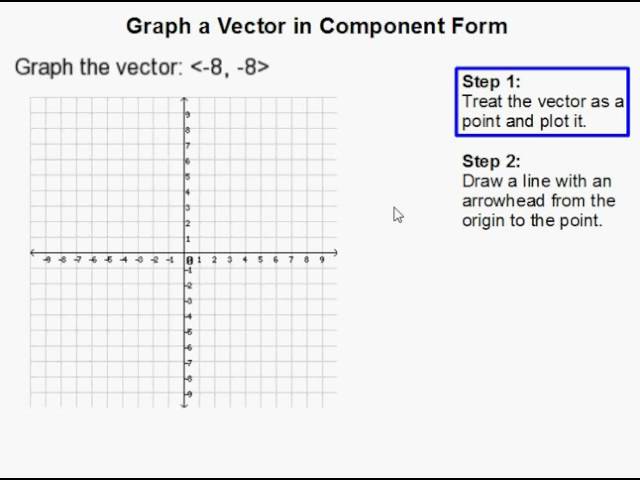
http://www.mathproblemgenerator.com - How to Graph a Vector in Component Form. For more practice and to create math worksheets, visit Davitily Math Problem Generator at www.mathproblemgenerator.com
does that help with the reading part?
 zinc siren
compact bluff
Can I get some help regarding how to read the vectors in graph form I don’t unde...
zinc siren
compact bluff
Can I get some help regarding how to read the vectors in graph form I don’t unde...
This responds to the second part of the question?
 pearl relic
yeah
compact bluff
Bro I got 4 attempts left on this problem so to determine if they are base of their respective dimensions I gotta check the math?
Or is there a faster way to see it visually
zinc siren
You need to check if they're linearly independent
compact bluff
Ahh
 zinc siren
And a basis of R3 must have 3 elemnts
compact bluff
From my understanding they should be good?
 versed juniper
compact bluff
From my understanding they should be good?
versed juniper
compact bluff
From my understanding they should be good?
if they form a basis it means you can express every vector in R^2 or R^3 as A * V1 + B * V2 + C * V3 etc
for example this is NOT a basis because you can't reach every point in R^3 using these vectors
 graceful cosmos
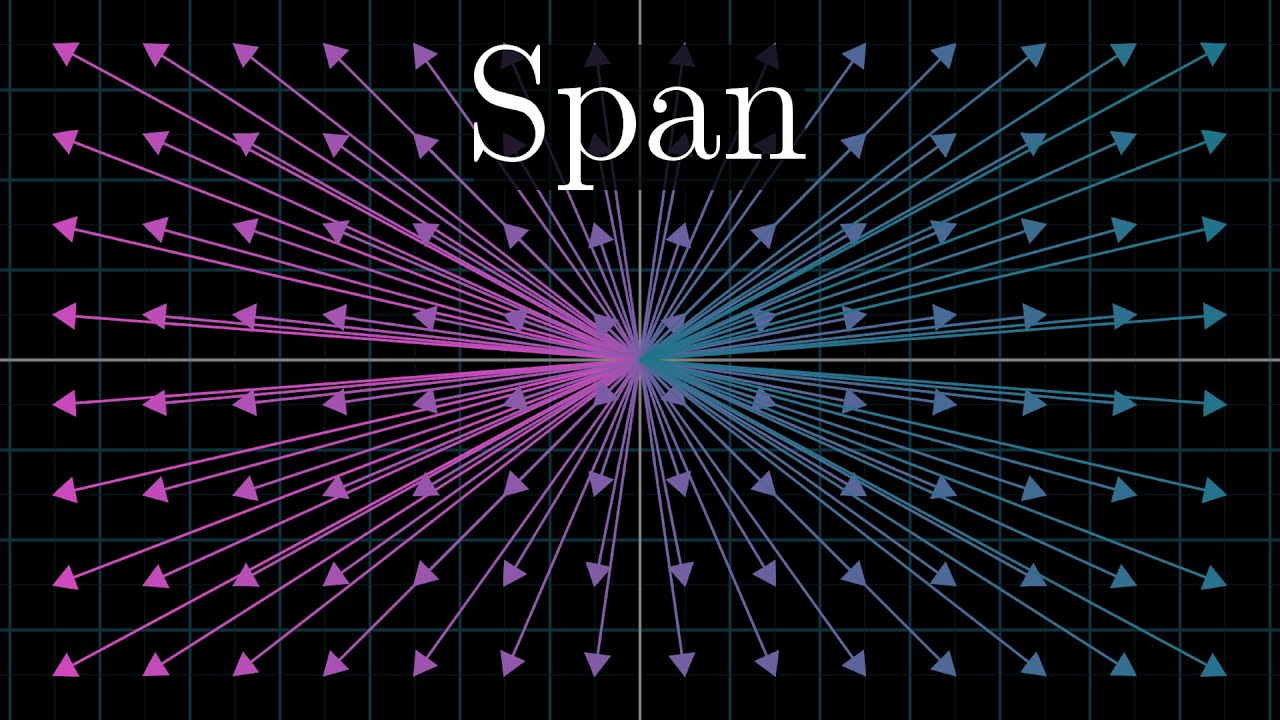
The fundamental concepts of span, linear combinations, linear dependence, and bases.
Help fund future projects: https://www.patreon.com/3blue1brown
Thanks to Elo Marie Viennot and Ambros Gleixner from HTW Berlin (www.htw-berlin.de) for contributing German translations and dubbing.
Thanks to these viewers for their contributions to translations...
compact bluff
Yeah Ty for all the info this is super clear now guys!!
versed juniper
check this again
 compact bluff
How is that gonna have a linear combination? It’s not a base right?
versed juniper
the two vectors on the x-y plane give you a span of the x-y plane
then the third vector goes up which gives you the z dgree of freedom
zinc siren
think that the xy plane there can be represented as a linear combination of the vectors on the "ground"
compact bluff
Oooo I thought all 3 of them must form a base
zinc siren
no, they do
versed juniper
compact bluff
How is that gonna have a linear combination? It’s not a base right?
think about it like this
the two xy vectors allow you to reach anywhere on the xy plane
then to go up or down add the third vector
compact bluff
Okay I think I’m understanding this now
Thank you! You beautiful human beings

This one à base right cuz it cover xy and anywhere on z
pearl relic
wait isnt a basis lin. ind.
versed juniper
compact bluff
this is not a basis because you have multiple ways to get to a point
so same idea, xy plane, but we have two ways to go up into z
so not a basis
compact bluff
Kinda confused on the definition of if it’s a lin dep or lin indep
versed juniper
compact bluff
Kinda confused on the definition of if it’s a lin dep or lin indep
linearly independent means it can't be written as a combination of the other vectors
compact bluff
Depended means it can be written?
versed juniper
yeah
compact bluff
Okay what about now
 versed juniper
compact bluff
Okay what about now
versed juniper
compact bluff
Okay what about now
the top right is nto a basis for the same reason
pearl relic
versed juniper
linearly independent means it can't be written as a combination of the other vec...
i found a definition that says 0 cant be written as a combination which is probably better
versed juniper
pearl relic
i found a definition that says 0 cant be written as a combination which is proba...
wt does that even mean
excluding the trivial combination?
versed juniper
i guess that works but its harder to wrap your head around first
compact bluff
How is the middle down a base?
 versed juniper
u can reach anywhere on xy plane
pearl relic
versed juniper
i guess that works but its harder to wrap your head around first
easier to check probably
pearl relic
compact bluff
But for middle top we can also reach anywhere
middle top we are looking at xyz
versed juniper
yeah thats 3d
pearl relic
middle bottom is xy only
pearl relic
also if theres more vectors than dimensions its not linearly independent
compact bluff
Im gonna remember that till the day I die
It finally clicked for me
Thank you guys have a great rest of your day!
.close
devout snowBOT
Channel closed
Closed by @compact bluff
Use .reopen if this was a mistake.
devout snowBOT
Available help channel!
Send your question here to claim the channel.
Remember:
• Ask your math question in a clear, concise manner.
• Show your work, and if possible, explain where you are stuck.
• Do not immediately ping people or roles. After 15 minutes, feel free to ping <@&286206848099549185> once.
• Type the command .close to free the channel when you're done.
• Be polite and have a nice day!
Read #❓how-to-get-help for further information on how to ask a good question, and about conduct in the question channels.
 proper otter
can someone hellp me finish up the rest of my desmos art project
 flat ibex
thats pretty cool
 solid bear
dont forget to fill out the fafsa if u haven't > fafsa.gov (studentaid is making updates right now, better to submit ASAP)
flat ibex
what help do u need
proper otter
solid bear
dont forget to fill out the fafsa if u haven't > fafsa.gov (studentaid is making...
?
 small inlet
solid bear
dont forget to fill out the fafsa if u haven't > fafsa.gov (studentaid is making...
small inlet
solid bear
dont forget to fill out the fafsa if u haven't > fafsa.gov (studentaid is making...
did you have to send this here
solid bear
small inlet
did you have to send this here
yes
 last parrot
solid bear
yes
last parrot
solid bear
yes
One more message spam like this then mods will grab you

 solid bear
proper otter
solid bear
proper otter
oh wow this is beautiful
proper otter
solid bear
oh wow this is beautiful
thank you so much
solid bear
last parrot
One more message spam like this then mods will grab you
no pls mods i am just trying to spread the news
proper otter
ive lost so much sleep just from this
proper otter
flat ibex
how does this work lol
i enter for example a linear
it gives me a line then i use the line to make art
small inlet
solid bear
no pls mods i am just trying to spread the news
You can say this, like, once in a medium where its not interruptive and people will read it
flat ibex
how do u make the curved lines tho
proper otter
parabola?
proper otter
elipse
solid bear
small inlet
You can say this, like, once in a medium where its not interruptive and people w...
god forbid i try to do good for this community a
 misty crest
solid bear
god forbid i try to do good for this community a
misty crest
solid bear
god forbid i try to do good for this community a
word
i appreciate you bro
flat ibex
solid bear
god forbid i try to do good for this community a
hes not a mod he cant do anything lol
flat ibex
misty crest
i appreciate you bro
thx u too
small inlet
flat ibex
hes not a mod he cant do anything lol
I can certainly ping
flat ibex
small inlet
I can certainly ping
 solid bear
ragtebait
proper otter
.close
devout snowBOT
Channel closed
Closed by @proper otter
Use .reopen if this was a mistake.
devout snowBOT
Available help channel!
Send your question here to claim the channel.
Remember:
• Ask your math question in a clear, concise manner.
• Show your work, and if possible, explain where you are stuck.
• Do not immediately ping people or roles. After 15 minutes, feel free to ping <@&286206848099549185> once.
• Type the command .close to free the channel when you're done.
• Be polite and have a nice day!
Read #❓how-to-get-help for further information on how to ask a good question, and about conduct in the question channels.
 orchid wasp
How do u find kernel and image of a linear transformation
 safe jasper
is the linear transformation given to you in the form of a matrix?
if so, the kernel of that transformation is simply the null space, and the image is the column space
 lean anchor
orchid wasp
How do u find kernel and image of a linear transformation
lean anchor
orchid wasp
How do u find kernel and image of a linear transformation
The kernel is what gets sent to zero
orchid wasp
safe jasper
if so, the kernel of that transformation is simply the null space, and the image...
Like these


I only know how to find when I’m given a matrix and do RREF
Not these ones
safe jasper
right so you'll want to convert these into their corresponding matrices
orchid wasp
safe jasper
right so you'll want to convert these into their corresponding matrices
How
lean anchor
lean anchor
The kernel is what gets sent to zero
So to find the kernel, solve
[
T(v)=0.
\
orchid wasp
lean anchor
So to find the kernel, solve
\[
T(v)=0.
\
How do I turn it into a matrix tho
lean anchor
lean anchor
So to find the kernel, solve
\[
T(v)=0.
\
If (T) is a matrix (A), then solve
[
Ax=0.
]
woven radishBOT
Dex
 safe jasper
you technically don't have to turn it into a matrix, as was mentioned you could just solve for when the outputs are 0, but it's good practice
lean anchor
orchid wasp
How do I turn it into a matrix tho
Image means "what outputs are possible."
lean anchor
lean anchor
Image means "what outputs are possible."
If \ (T \ ) is a matrix \ (A\ ), then the image is the span of the columns of \ (A\ ):
\ [
\operatorname{Im}(T)=\operatorname{Col}(A).
\
safe jasper
try to think about associating anything that's not R^n to something in R^n, for example your first transformation in problem 2 maps from M_22 to R^3, but you can associate any element in M_22 to R^4
orchid wasp
safe jasper
you technically don't have to turn it into a matrix, as was mentioned you could ...
Idk how u solve it by setting it to 0 what am I suppose to find
I only remember for the RREF ones, the image is the columns which have a pivot, and the kernel is the ones with free variables/no pivots
safe jasper
well for your first example, the outputs for some arbitrary input matrix look like (d-b, -b, 3d). you want to see when the outputs are the zero vector
so you're essentially solving for when d-b = 0, -b = 0, and 3d = 0, right?
lean anchor
orchid wasp
Idk how u solve it by setting it to 0 what am I suppose to find
you just need to connect it to (Ax=0)
woven radishBOT
Dex
 lean anchor
You are trying to find all input vectors that get sent to the zero vector
orchid wasp
safe jasper
so you're essentially solving for when d-b = 0, -b = 0, and 3d = 0, right?
So d and b =0
orchid wasp
lean anchor
you just need to connect it to \(Ax=0\)
Idk what A is
Idk how u make the matrix from that
d-b,-b,3d
lean anchor
orchid wasp
Idk what A is
(A) is just the matrix for the linear transformation
woven radishBOT
Dex
 safe jasper
orchid wasp
Idk how u make the matrix from that
safe jasper
orchid wasp
Idk how u make the matrix from that
to get the matrix representing a linear transformation, you basically let each column of the matrix correspond to what your linear transformation sends the associated standard basis vector to
so for your first linear transformation, i consider it as a transformation from R^4 to R^3 that sends (a,b,c,d) to (d-b, -b, 3d)
lean anchor
orchid wasp
Idk how u make the matrix from that
If the transformation is
[
T(b,d)=(d-b,\ -b,\ 3d),
]
then the input variables are (b) and (d). So each output gets written using coefficients of (b) and (d)
woven radishBOT
Dex
 safe jasper
so for your first linear transformation, i consider it as a transformation from ...
safe jasper
safe jasper
so for your first linear transformation, i consider it as a transformation from ...
this transformation sends (1,0,0,0) to (0, 0, 0), sends (0,1,0,0) to (-1, -1, 0), sends (0,0,1,0) to (0, 0, 0), and sends (0,0,0,1) to (1, 0, 3)
lean anchor
lean anchor
If the transformation is
\[
T(b,d)=(d-b,\ -b,\ 3d),
\]
then the input va...
The matrix is
[
\begin{pmatrix}
-1 & 1\
-1 & 0\
0 & 3
\end{pmatrix}.
]
Each row comes from one component of the output
woven radishBOT
Dex
 orchid wasp
lean anchor
The matrix is
\[
\begin{pmatrix}
-1 & 1\\
-1 & 0\\
0 & 3
\end{pmatr...
orchid wasp
lean anchor
The matrix is
\[
\begin{pmatrix}
-1 & 1\\
-1 & 0\\
0 & 3
\end{pmatr...
How u get that
lean anchor
orchid wasp
How u get that
First output:
[
d-b=-1b+1d
]
Second output:
3d=0b+3d
]
Third output:
[
3d=0b+3d
]
woven radishBOT
Dex
Compile Error! Click the  reaction for more information.
(You may edit your message to recompile.)
 orchid wasp
lean anchor
First output:
\[
d-b=-1b+1d
\]
Second output:
3d=0b+3d
\]
Third ou...
orchid wasp
lean anchor
First output:
\[
d-b=-1b+1d
\]
Second output:
3d=0b+3d
\]
Third ou...
Ok and then I solve for image and kernel like I would normally? By doing RREF
lean anchor
orchid wasp
Ok and then I solve for image and kernel like I would normally? By doing RREF
Yes. Once you have the matrix, you use RREF like normal
orchid wasp
lean anchor
Yes. Once you have the matrix, you use RREF like normal
Is this the matrix for the other question then
 lean anchor
orchid wasp
Is this the matrix for the other question then
lean anchor
orchid wasp
Is this the matrix for the other question then
That matrix would be right only if your transformation is something like
[
T(c,d)=(c,0,c,d,d).
]
woven radishBOT
Dex
 lean anchor
Each column is what happens to one input variable
So the first column is the coefficient of (c), and the second column is the coefficient of (d)
woven radishBOT
Dex
 lean anchor
orchid wasp
Is this the matrix for the other question then
lean anchor
orchid wasp
Is this the matrix for the other question then
the outputs would be
[
(c,\ 0,\ c,\ d,\ d).
]
woven radishBOT
Dex

 lean anchor
orchid wasp
lean anchor
orchid wasp
looks like the transpose of the previous matrix, so probably not
If your input variables are (c,d), then the matrix should have 2 columns, one for (c) and one for (d)
woven radishBOT
Dex
 lean anchor
If the first output is (c), the first row should be ((1,0)), not ((0,1))
woven radishBOT
Dex
 orchid wasp
lean anchor
If your input variables are \(c,d\), then the matrix should have 2 columns, one ...
orchid wasp
lean anchor
If your input variables are \(c,d\), then the matrix should have 2 columns, one ...
I’m talking about this one it has b and c
 orchid wasp
woven radish
**Dex**
orchid wasp
woven radish
**Dex**
Also for first column is the image, and second is the kernel right
lean anchor
orchid wasp
Also for first column is the image, and second is the kernel right
The columns are not "image column" and "kernel column."
Each column tells you what happens to one input basis vector
safe jasper
the span of the columns is the image
the image is all possible reachable/achievable outputs
lean anchor
lean anchor
The columns are not "image column" and "kernel column."
Each column tells you w...
The image and kernel are not separate columns. They are two things you find using the whole matrix
safe jasper
(you really don't need a matrix to solve these btw that's probably not even intended)
orchid wasp
lean anchor
The columns are not "image column" and "kernel column."
Each column tells you w...
For image I meant that’s the only pivot column so the original column 1 is the image
orchid wasp
safe jasper
(you really don't need a matrix to solve these btw that's probably not even inte...
So there’s an easier way?
safe jasper
sure, just working with the transformation itself
like for 7a, what do you think the dimension is of P_2?
lean anchor
orchid wasp
For image I meant that’s the only pivot column so the original column 1 is the i...
That idea is right, but for this specific matrix I don't think column 1 is a pivot column
So your method is right, just check which columns actually have pivots
orchid wasp
lean anchor
So your method is right, just check which columns actually have pivots
Both have pivots so both the original columns r images so there’s no kernel?
orchid wasp
safe jasper
sure, just working with the transformation itself
How I do that
lean anchor
orchid wasp
Both have pivots so both the original columns r images so there’s no kernel?
Almost, but remember the full input has 3 variables: (a,b,c).
For this problem the matrix has 3 columns, not just 2
woven radishBOT
Dex
 orchid wasp
orchid wasp
orchid wasp
So this is correct? And I add a column in front which is all 0s
orchid wasp
lean anchor
Almost, but remember the full input has 3 variables: \(a,b,c\).
For this proble...
So does that apply to this also then there is 4 columns in total
 lean anchor
orchid wasp
So does that apply to this also then there is 4 columns in total
lean anchor
orchid wasp
So does that apply to this also then there is 4 columns in total
Yes, for the (P_2) one, your 2-column matrix was basically using only (b,c). Since the full input is
[
ax^2+bx+c,
]
You also need the (a)-column. But (a) does not show up in the output, so the (a)-column is all zeros.
So yes, you add a zero column in front
woven radishBOT
Dex
 lean anchor
For the matrix problem, same idea. The input is
[
\begin{pmatrix}
a & b\
c & d
\end{pmatrix},
]
woven radishBOT
Dex
 lean anchor
so there are 4 input variables:
[
a,b,c,d.
]
woven radishBOT
Dex
 lean anchor
That means the transformation matrix should have 4 columns
 upper schooner
 celest lantern
How did you guys miss this?
celest lantern
How did you guys miss this?
We didn't, autodelete didn't seem to catch it  a recurring problem
celest lantern
upper schooner
We didn't, autodelete didn't seem to catch it <:catbit:1458673839897710788> a re...
No worries there. 
devout snowBOT
@orchid wasp Has your question been resolved?
orchid wasp
lean anchor
That means the transformation matrix should have 4 columns
Ok so the first column a and 4th column d r also all zeros

So do I include them when finding kernel and image or not cus I don’t see how theyre any use since its all 0
lean anchor
orchid wasp
Ok so the first column a and 4th column d r also all zeros
You include zero columns when thinking about the kernel, but you do not include them in a basis for the image
A zero column means that basis direction gets sent to 0, so it is useful for the kernel
Don't include the zero column in the image basis
In this screenshot, there is no 4th column d, only a, b, c
orchid wasp
lean anchor
In this screenshot, there is no 4th column d, only a, b, c
I meant for this one has a b c d

4th column d and first column a
lean anchor
orchid wasp
I meant for this one has a b c d
the input variables are a, b, c, d, so yes there are 4 columns
But the 4th column, d, is not zero. d appears in the output:
T([[a,b],[c,d]]) = (d-b, -b, 3d)
Using variable order a,b,c,d:
a column = (0,0,0)
b column = (-1,-1,0)
c column = (0,0,0)
d column = (1,0,3)
So the zero columns are a and c, not a and d
For the image, ignore the zero columns and use the nonzero independent columns:
im(T) = span{(-1,-1,0), (1,0,3)}
For the kernel, zero columns matter. Solve:
d-b = 0
-b = 0
3d = 0
So b=0 and d=0, while a and c are free
ker(T) = span{ [[1,0],[0,0]], [[0,0],[1,0]] }
devout snowBOT
@orchid wasp Has your question been resolved?
devout snowBOT
Channel closed
Closed due to timeout
Use .reopen if this was a mistake.
Available help channel!
Send your question here to claim the channel.
Remember:
• Ask your math question in a clear, concise manner.
• Show your work, and if possible, explain where you are stuck.
• Do not immediately ping people or roles. After 15 minutes, feel free to ping <@&286206848099549185> once.
• Type the command .close to free the channel when you're done.
• Be polite and have a nice day!
Read #❓how-to-get-help for further information on how to ask a good question, and about conduct in the question channels.
 spring oasis
 devout snowBOT
spring oasis
lean anchor
spring oasis
devout snowBOT
spring oasis
lean anchor
spring oasis
Use Green’s theorem
The curve C goes from (1,-1) to (1,5), and the line x=1 closes the region. Since f(t)>1, the region is to the right of x=1
spring oasis
lean anchor
The curve C goes from (1,-1) to (1,5), and the line x=1 closes the region. Since...
how do you know?
lean anchor
spring oasis
how do you know?
Because of the parametrization
The curve is
sigma(t) = (f(t), t)
spring oasis
yeah? then
lean anchor
x = f(t)
y = t
So as t goes from -1 to 5, the y-value goes from -1 to 5
sigma(-1) = (1,-1)
sigma(5) = (1,5)
so the curve starts and ends on the line x=1
spring oasis
can you do a drawing
lean anchor
f(t) > 1 for -1 < t < 5.
But x = f(t), so for every interior point of the curve, x > 1
lean anchor
lean anchor
f(t) > 1 for -1 < t < 5.
But x = f(t), so for every interior point of the curve...
the curve lies to the right of the vertical line x=1, except at the two endpoints where it touches x=1
spring oasis
lean anchor
the curve lies to the right of the vertical line x=1, except at the two endpoint...
can you draw it
lean anchor
spring oasis
can you draw it
 spring oasis
this is AI
spring oasis
lean anchor
x = f(t)
y = t
So as t goes from -1 to 5, the y-value goes from -1 to 5
here you say that the y value goes from -1 to 5 but in the drawing you sent you are saying that we start at (1,5) and end at (1,-1)
lean anchor
The curve C should go from (1,-1) up to (1,5)
The red closing segment goes from (1,5) down to (1,-1)
spring oasis
it doesn't make any sense to me
spring oasis
lean anchor
The curve C should go from (1,-1) up to (1,5)
you say curve C goes from (1,-1) to (1,5) but in the drawing you show me you are saying the contrary
spring oasis
lean anchor
are you seeing this?
lean anchor
The C arrow direction could be confusing but C goes from (1,-1) to (1,5), because sigma(t)=(f(t),t) and t goes from -1 to 5
C goes up, the closing line goes down
spring oasis
idk if you are trolling me or not
t goes from -1 to 5
sigma(t) = (f(t), t)
sigma(-1) = (1,-1)
sigma(5) = (1,5)
so sigma starts at (1,-1) and ends at (1,5)
spring oasis
lean anchor
the drawing you showed nothing makes sense
lean anchor
It does make sense, it was just confusing
But the math makes more sense
And its correct
spring oasis
it must either
a) the drawing is ai
b) you are trolling me
c) you are hiding something from me about it
lean anchor
When using Green's theorem, we need a closed curve
spring oasis
C is open
lean anchor
You also need to add the vertical segment
spring oasis

spring oasis
the region enclosed between the curve and the line is closed but the curve is open
spring oasis
lean anchor
the arrows doesnt make any sense dawg
lean anchor
But C with the vertical segment forms a closed boundary
spring oasis
yeah this is why we can use green...
but the drawing you showed me is still impossible
maybe like this
 lean anchor
That left blue arrow you added just should be the closing segment with downward direction
Should have added next to C (goes up)
Or just an arrow yeah
spring oasis
lean anchor
That left blue arrow you added just should be the closing segment with downward ...
oh right
lean anchor
But that's right
 lean anchor
Yes
spring oasis
lean anchor
ok yeah because both going downwards doesnt make any sense
lean anchor
No that's why I said it sort of creates a loop
spring oasis
now what?
lean anchor
Now use the correct closed curve for Green’s theorem
spring oasis
how?
lean anchor
- Go along C from (1,-1) to (1,5).
- Then go down the line x=1 from (1,5) back to (1,-1).
That gives a closed boundary around the region
Since
P = log(x^2) - y
Q = x - y
we have
Q_x - P_y = 1 - (-1) = 2
spring oasis
yeah anticlockwise
lean anchor
The closed integral equals
2A
spring oasis
how
lean anchor
Green’s theorem
lean anchor
Green's theorem turns the line integral around the boundary into a double integral over the region
So the double integral appears on the right side because it is over the enclosed region R
lean anchor
Line integral:
∫_C (log(x^2)-y) dx + (x-y) dy = 2025
Double:
∮ (log(x^2)-y) dx + (x-y) dy
∬_R [∂/∂x(x-y) - ∂/∂y(log(x^2)-y)] dA
∂/∂x(x-y) = 1
and
∂/∂y(log(x^2)-y) = -1
So it becomes:
∬_R (1 - (-1)) d
∬_R 2 dA
Equals exactly 2 times the area of R
spring oasis
lean anchor
Line integral:
∫_C (log(x^2)-y) dx + (x-y) dy = 2025
Double:
∮ (log(x^2)-y) d...
right
what is R what is A
@lean anchor
lean anchor
R is the region enclosed by the curve C and the vertical line x=1
R is the region visually
A is the area of that region R
So:
A = area(R)
and
∬_R 1 dA = A
That's why
∬_R 2 dA = 2A
Because integrating 2 over a region just gives 2 times the area of that region
lean anchor
spring oasis
now how do I solve this double integral
You don't need to compute the double integral with bounds
spring oasis
2A
spring oasis
outside
spring oasis
@lean anchor
lean anchor
Im back
So what happens to the double integral when 2 is a constant, how does it look like?
lean anchor
spring oasis
<@1287103956912312503>
2 ∬_R 1 dA
2 changes to 1 and the 2 changes its place
lean anchor
But
∬_R 1 dA
It just means the area if the region R
spring oasis
what about it
spring oasis
how
lean anchor
The problem already gives the integral over C:
∫_C = 2025
C is not closed, so we add the vertical segment x=1 from (1,5) down to (1, -1) from what I was talking about earlier
On that segment:
x = 1
dx = 0
dy stays dy
lean anchor
The integrand is
(log(x^2)-y)dx + (x-y)dy
dx=0 so the first part disappears
Got it until now?
spring oasis
lean anchor
dx=0 so the first part disappears
wat
lean anchor
That part becomes:
(log(x^2)-y)dx = 0
And now this remains =
(x-y)dy = (1-y)dy
You integrate from y=5 to y=1
∫_5^{-1} (1-y)dy = 6
So the closed integral is =
2025 + 6 = 2031
Green theorem gives =
closed integral = 2A
Now we have =
2A = 2031
Therefore
A = 2031/2
Done
spring oasis
what
lean anchor
Where are you stuck currently?
spring oasis
lets start from scratch
lean anchor
Aight

 bold vale
spring oasis
hi can I get some help?
bold vale
spring oasis
hi can I get some help?
the question is asking for the area enclosed by our curve c right
spring oasis
what
bold vale
spring oasis
what
have you learned green's theorem
lean anchor
Yes
spring oasis
how
lean anchor
spring oasis
The problem gives an open curve C
What does that look like written down
spring oasis
C is open, yes
lean anchor
Write down the equation
spring oasis
what equation
bold vale
spring oasis
C is open, yes
and is closed by the line x = 1
spring oasis
C is open
 mystic scarab
Yes
spring oasis
the region enclosed between the open curve C and the line can be interpreted as a closed curve
mystic scarab
bold vale
and is closed by the line x = 1
@spring oasis
mystic scarab
spring oasis
the region enclosed between the open curve C and the line can be interpreted as ...
Yeah that's the key to this problem
mystic scarab
Where was the issue with the terminology?
spring oasis
it was an oversimplification
mystic scarab
But where??
spring oasis
if i wouldn't had the condition f(t) > 1 forall t in -1,5 in mind and the line segment that goes through (1,-1) and (1,5) then is not understandable
mystic scarab
spring oasis
the region enclosed between the open curve C and the line can be interpreted as ...
Actually you were wrong with the terminology here.
The boundary of the region enclosed between the open curve C and the line can be interpreted as a closed curve
spring oasis
mystic scarab
Actually *you* were wrong with the terminology here.
The *boundary of* the regi...
more importantly how do you know the orientation of both sides of the closed curve
is this going clockwise or counterclockwise
because we are separating the close curve into two
@mystic scarab
devout snowBOT
@spring oasis Has your question been resolved?
Channel closed
Closed by @spring oasis
Use .reopen if this was a mistake.
Available help channel!
Send your question here to claim the channel.
Remember:
• Ask your math question in a clear, concise manner.
• Show your work, and if possible, explain where you are stuck.
• Do not immediately ping people or roles. After 15 minutes, feel free to ping <@&286206848099549185> once.
• Type the command .close to free the channel when you're done.
• Be polite and have a nice day!
Read #❓how-to-get-help for further information on how to ask a good question, and about conduct in the question channels.
 bronze void
I've done part a. and got an answer of 13/36. Im a bit stuck on part b. and c. [And i do not have the answers for this either]
 devout snowBOT
bronze void
I've done part a. and got an answer of 13/36. Im a bit stuck on part b. and c. [...
devout snowBOT
bronze void
I've done part a. and got an answer of 13/36. Im a bit stuck on part b. and c. [...
 hasty cargo
last parrot
This is my competition last year
hasty cargo
last parrot
This is my competition last year
Lol
bronze void
last parrot
This is my competition last year
same loll
last parrot
Did you win? I only came 3rd
bronze void
team wise?
last parrot
Team
bronze void
7th
last parrot
so you are year 12 then
bronze void
mhm
bronze void
my teacher is giving us like 2 questions every other day (without sols) so its kind of annoying
last parrot
interesting
I do not remember the probability for part a is that big
over nine or sth
bronze void
,w 13/36
woven radishBOT

 Requested by celui_quils_apellent
bronze void
Requested by celui_quils_apellent
bronze void
hmm
 ornate ember
bronze void
I've done part a. and got an answer of 13/36. Im a bit stuck on part b. and c. [...
ornate ember
bronze void
I've done part a. and got an answer of 13/36. Im a bit stuck on part b. and c. [...
Wat in the sperm is dat-
last parrot
ornate ember
Wat in the sperm is dat-
???
bronze void
ornate ember
Wat in the sperm is dat-
gng, questions related to the topic only pls
ornate ember
😭
last parrot
How did you do part A?
last parrot
Oge
bronze void

so we take the maximum possible ways to get to 9 or greater, and subtract special cases
last parrot
So you want to win if passed or (simply touched) 9
bronze void
mhm
last parrot
Well suppose first roll you get to square 2
Then you need to roll a 7 to get to 9, which is impossible
Next, if you roll to 3, then you need a 6 to get to 9, which is cool, the outcome is 1/6
bronze void
then repeat for 2->6 and find the amount of "winnable" cases
last parrot
To 7
last parrot
since you can roll to 6, 1+6=7
But no need, you can just logically say that total is 36 choices
they are all valid except the square 2
bronze void
since from square 3 onwards you can always end up at 9
with increasing odds for every next square
last parrot
Yes sir
Then for square 3, says you can have 5 or 6, then its 2 possible choice that work
bronze void
yea
so,
for square 2, no possibilities
sq3. 1 poss.
sq4. 2 poss
etc..
and then we sum that and take away cases where we end up on a 5 or 7
bronze void
last parrot
Then for square 3, says you can have 5 or 6, then its 2 possible choice that wor...
5 only gets you to 8
im pretty sure
last parrot
bronze void
5 only gets you to 8
Ah yes
Thats 1 choice
The square 4 one is 2 choice
bronze void
let me see what I get with your method
ill also see if I can get my teacher to send through the answer (but not solution) but im probs not gonna get a response till like next week
last parrot
Eh i just redo and i know the answer anyways
bronze void
u finished the entire thing?
last parrot
just starting part b
bronze void
ah ok
last parrot
part c is a big fraction
bronze void
for part a. when we calculate the square 7 starting position, it just ends up at one
so we can dismiss it along with 2
last parrot
wdym
last parrot
Ye they all return to 1
bronze void
and on second roll, no number gets us to 9
last parrot
so it have 0 possible choices
bronze void
yep
last parrot
brute force be like lol
 bronze void
why would only 6 work?
if im on sq.5 and roll a 4 or higher I finish the game
so theres 3 possible "winnable" outcomes
last parrot
bro is cooked
bronze void
yea ik
last parrot
10 mins for each question btw
bronze void
dc?
last parrot
Dickson
bronze void
relevance?
last parrot
No i thought you are from Dickson, because last year we got 2 geniuses
bronze void
nah
different college
but Sir lowk be trying to replace us yr 12 with yr 11's 💀
all yes ic, only 1 works for 5
bronze void
i hate swiss
last parrot
last year there were some cool fibs
bronze void
"anti-fib" was nonsense
last parrot
i think you mean to go opposite fib
last parrot
And the fraction one was nice
bronze void
i dont recall that one, holly-molly was a great break imo
last parrot
But last year was not my best performance, I lost a lot of time for the cross-part and the running one
bronze void
but it was so dumb trying to figure it out during the rounds
last parrot
just a bit more and i get the cup lol
bronze void
yea lol
last parrot
last last year was cool tho the questions were easy
but anyways what was the answer you got for a, i finished b
bronze void
last parrot
but anyways what was the answer you got for a, i finished b
mhm, so 8/36 or 2/9. And this accounts for the special cases too since we just brute force each combination
i believe yea?
last parrot
Yea correct
bronze void
nice
bronze void
last parrot
last last year was cool tho the questions were easy
my favourite was the cross number, $\sum_{i=1}^{26A} \floor{\frac{1}{i}}}$
woven radishBOT
・゚✧ 𝓀ℬ ✧゚・
Compile Error! Click the reaction for more information.
(You may edit your message to recompile.)
 last parrot
I do not recall that 💀
bronze void
mhm, maybe you got the other paper for cross
anyway, onto p.t. b
is it legit just same thing
but with 3 trees rather than 2
last parrot
Yeah just reuse the materials from A
bronze void
in what way?
last parrot
Well for example, if you got into square 2, you can roll 1-6 and gives you 3 4 (5-> 3), 6, (7->1), 8
Then brute force again here
For example, get in square 2, roll 1, give you square 3, now you have 2 choices to win, roll 6 -> 1 way
bronze void
so since its at most 3, we can finish in \leq3 ways. we already know what \leq 2 ways is (9/2 or 8/36) so 9/3 = 3, so we can start looking from case (3, 3, 3) onwards
and find the amount of ways (3, 3, 3) can "change" to be \geq 9
and exclude cases where we land on 7
since we can land on 5 in first roll, and still make up 9 on majority of rolls
getting to sq.5 on second is also a winnable pos i beleive
last parrot
from here i believe you still need to list out all cases
bronze void
sadge
yea ic its just brute force
WWW question making
so like, is there a trick we can use to "speed up the process" of doing 216 calculations for the third dicce roll or na
last parrot
I do not think so
Like i said last year my bros did that question, i only solve a and b
bronze void
hmm
i think a process like this can speed it up

and repeat for the next 5
although 2 are repeats, so only need to do that 4 more times
and times case 2 by 2
to account for case 4
and since we already do all the calculations for each number, we just copy and paste until we finish the tables
last parrot
so what is total cases then?
bronze void
uhh 70
for exactly 3 rolls making it to \geq 9
or 59/108
for total outcomes for \leq 3 dice rolls
or at least I think thats the answer

.close
devout snowBOT
Channel closed
Closed by @bronze void
Use .reopen if this was a mistake.
bronze void
ty for the help on this problem Nefer, ill finish it off later on
devout snowBOT
Available help channel!
Send your question here to claim the channel.
Remember:
• Ask your math question in a clear, concise manner.
• Show your work, and if possible, explain where you are stuck.
• Do not immediately ping people or roles. After 15 minutes, feel free to ping <@&286206848099549185> once.
• Type the command .close to free the channel when you're done.
• Be polite and have a nice day!
Read #❓how-to-get-help for further information on how to ask a good question, and about conduct in the question channels.
 charred eagle
 devout snowBOT
charred eagle
charred eagle
devout snowBOT
charred eagle
charred eagle
Hi, here is the full q


here are the answers
im confused about the last ine for c), where

this
is equal to
this?

wait nvm
.close
devout snowBOT
Channel closed
Closed by @charred eagle
Use .reopen if this was a mistake.
devout snowBOT
Available help channel!
Send your question here to claim the channel.
Remember:
• Ask your math question in a clear, concise manner.
• Show your work, and if possible, explain where you are stuck.
• Do not immediately ping people or roles. After 15 minutes, feel free to ping <@&286206848099549185> once.
• Type the command .close to free the channel when you're done.
• Be polite and have a nice day!
Read #❓how-to-get-help for further information on how to ask a good question, and about conduct in the question channels.
 pearl grotto
 devout snowBOT
pearl grotto
pearl grotto
devout snowBOT
pearl grotto
pearl grotto
how is this not
S = 0.9r^2 + 2320/r
the 2 sectors = 0.9r^2
the 2 rectangular sides = 2rl
the top arc = 0.9rl
S = 0.9r^2 + 2rl + 0.9rl
S = 0.9r^2 + 2.9rl
0.45(l)r^2 = 360 (volume sub)
l = 360/(0.45r^2)
S = 0.9r^2 + 2.9r(360/(0.45r^2))
S = 0.9r^2 + 2320/r
nvm its an open tank
.close
devout snowBOT
Channel closed
Closed by @pearl grotto
Use .reopen if this was a mistake.
celest lantern
Fastest self-solve channel.
devout snowBOT
Available help channel!
Send your question here to claim the channel.
Remember:
• Ask your math question in a clear, concise manner.
• Show your work, and if possible, explain where you are stuck.
• Do not immediately ping people or roles. After 15 minutes, feel free to ping <@&286206848099549185> once.
• Type the command .close to free the channel when you're done.
• Be polite and have a nice day!
Read #❓how-to-get-help for further information on how to ask a good question, and about conduct in the question channels.
 stone idol
(1+3i)×(2-5i)/(2-√6i)×(-3+2√5i)
devout snowBOT
stone idol
(1+3i)×(2-5i)/(2-√6i)×(-3+2√5i)
stone idol
Find it's modules
 dapper tiger
one of the property of the module is that the module of a product is the product of the module
dapper tiger
for example, |(1+2i) x (2+3i)| = |(1+2i)| x |(2+3i)|
dapper tiger
well since a division is a product, it works with division too
so calculate all modules and you're done
stone idol
What if I use conjugate
dapper tiger
a number has the same module as its conjugate so I'm not sure what you're intending to do
the caculation is very straightforward
 dapper tiger
if you just want the module, it seems useless to me
stone idol
Can u show me the whole process steps wise
dapper tiger

this is your number, you want the module
module of product is product of modules

so you want to know the module of that

and of that
to take the product
and it happens that both are module 1
because module of product is product of modules, you obviously have |a/b| = |a|/|b|
what happens is that 1+3i and 2-sqrt(6)i have same module
stone idol
Ok
dapper tiger
and same for the other
devout snowBOT
@stone idol Has your question been resolved?
devout snowBOT
Channel closed
Closed due to timeout
Use .reopen if this was a mistake.
Available help channel!
Send your question here to claim the channel.
Remember:
• Ask your math question in a clear, concise manner.
• Show your work, and if possible, explain where you are stuck.
• Do not immediately ping people or roles. After 15 minutes, feel free to ping <@&286206848099549185> once.
• Type the command .close to free the channel when you're done.
• Be polite and have a nice day!
Read #❓how-to-get-help for further information on how to ask a good question, and about conduct in the question channels.
solid bear
hello dont forget to fill ou fafsa
devout snowBOT
solid bear
hello dont forget to fill ou fafsa
willow helm
solid bear
hello dont forget to fill ou fafsa
Anyway, this is for asking questions or asking for clarification on topics.
So please .close if you don't have a question
devout snowBOT
@solid bear Has your question been resolved?
devout snowBOT
Channel closed
Closed due to timeout
Use .reopen if this was a mistake.
Available help channel!
Send your question here to claim the channel.
Remember:
• Ask your math question in a clear, concise manner.
• Show your work, and if possible, explain where you are stuck.
• Do not immediately ping people or roles. After 15 minutes, feel free to ping <@&286206848099549185> once.
• Type the command .close to free the channel when you're done.
• Be polite and have a nice day!
Read #❓how-to-get-help for further information on how to ask a good question, and about conduct in the question channels.
wispy warren
hello
devout snowBOT
wispy warren
hello
wispy warren
how many three-lettered-words can you create with the word "kombinatorik"
 faint gorge
in german or english
 mortal bear
Do they have to be real words?
 true thunder
Well you have (kind of) three cases
Case 1: three letters are all distinct
Case 2: two of the letters are the same, one is different (say, ook)
Case 3: three of the same letter (which isn't possible, so rule this out)
So for case one, you have 9 different letters (so without duplicates. there are 9 letters being used)
true thunder
mmhm
wispy warren
case 2:
wispy warren
hmmmmmm
true thunder
so this case is def more tricky
Try and think first how you would pick one of the three pairs
wispy warren
duce is stumped
true thunder
Okay so like
If there are three pairs of repeating letters
I would wanna pick one of said three pairs right?
And well, 3 choose 1 is 3
true thunder
Yeah
And now
you want to pick out the distinct letter
so you have 8 other types of lettters to pick a distinct letter from
So let's say you have the letters "o", "o", and "m" selected. to arrange these, how many ways could you do that?
wispy warren
3 * 2 * 1/ 2
true thunder
wispy warren
3 * 2 * 1/ 2
mmhm
aka 3
so now you have
there are 3 ways to pick a pair of letters
there are 8 ways to pick a distinct letter
there are 3 ways to arrange a pair of letters with a distinct letter
So, how many possible combinations are there for case 2?
wispy warren
3 * 3 * 8
true thunder
mmhm
wispy warren
aight sweet
true thunder
so now you just add the # of ways from case 1 and case 2 tg and that should be the answer
true thunder
yup
devout snowBOT
Channel closed
Closed by @wispy warren
Use .reopen if this was a mistake.
devout snowBOT
Available help channel!
Send your question here to claim the channel.
Remember:
• Ask your math question in a clear, concise manner.
• Show your work, and if possible, explain where you are stuck.
• Do not immediately ping people or roles. After 15 minutes, feel free to ping <@&286206848099549185> once.
• Type the command .close to free the channel when you're done.
• Be polite and have a nice day!
Read #❓how-to-get-help for further information on how to ask a good question, and about conduct in the question channels.
spring oasis
 devout snowBOT
spring oasis
devout snowBOT
spring oasis
 sand dove
spring oasis
sand dove
spring oasis
What have you tried?
(If not tried anything : ||prime factorisation of 70||)
spring oasis
prime factorization of what
spring oasis
sand dove
(If not tried anything : ||prime factorisation of 70||)
7 x 5 x 2
6a^13 + 7a^5 + 4^132 = 6a^13 + 4^132 (mod 7)
@sand dove
ah now little fermat
or what?
sand dove
spring oasis
6a^13 + 7a^5 + 4^132 = 6a^13 + 4^132 (mod 7)
just keep simplifying
sand dove
like for example, 4^n has to have a way to be computed easily mod 7
and yes, it's little fermat
to simplify the powers
spring oasis
,w gcd(132,7)
sand dove
you're not looking for the gcd
spring oasis
7x20=140
sand dove
you're just looking for 132/(7-1) (euclidian division)
spring oasis
,calc 132/7
woven radishBOT
Result:
18.857142857143
,calc 18*7
woven radishBOT
Result:
126
 spring oasis
4^132 = 4^7^18 × 4^6 = 4^18 × 4^6
sand dove
sure, but we're a lot of steps away from simplifying fully if we do this
instead of using a^p = a mod p
use a^(p-1) = 1 mod p
spring oasis
sand dove
use a^(p-1) = 1 mod p
what are the hypothesis
sand dove
then 4^132 = (4^6)^a * 4^b = 4^b
spring oasis
non
sand dove
so we're good to go
woven radishBOT
Result:
22
yeah
spring oasis
dacord?
spring oasis
sand dove
so (4^6)^22 = 1
yep
6a^13 + 7a^5 + 4^132 = 6a^13 + 4^132 = 6a^13 + 1 (mod 7)
@sand dove
6a^13 + 1 = 6a^6 + 1 (mod 7)
now if 7 | a then this shit is congruent to 1
and if 7 does not divide a then, we can use a^(p-1) = 1 (mod p)
and we get this shit is congruent to 0
spring oasis
sand dove
so (4^6)^22 = 1
alles gut?
spring oasis
spring oasis
now if 7 | a then this shit is congruent to 1
hopefully everything is logical until here
spring oasis
spring oasis
and we get this shit is congruent to 0
and here