#help-27
1 messages · Page 376 of 1
 copper spoke
copper spoke
copper spoke

 stone stump
good so thats a_4
copper spoke
is this true
 copper spoke
stone stump
now a_5
copper spoke
stone stump
now a_5
i get the idea
stone stump
$1\cdot3\cdots(2n+1)=\prod_{k=0}^n (2k+1)$
 woven radishBOT
Denascite
 copper spoke
jeah but i get the idea
its just the algebra
I mean i have a_n+1 , thats why i have the term (2n+3)^2 , but in the terminator why there is another (2n+1)^2

thats my problem
stone stump
stone stump
now a_5
humor me
copper spoke
 copper spoke
 stone stump
now we notice that 2*5+1=2*4+3
and we have our (2*4+1)^2 factor before that
aka (2n+1)^2
stone stump
2(n+1)+1=2n+3
stone stump
yes
 devout snowBOT
@copper spoke Has your question been resolved?
devout snowBOT
Channel closed
Closed due to timeout
Use .reopen if this was a mistake.
devout snowBOT
 Available help channel!
Send your question here to claim the channel.
Remember:
• Ask your math question in a clear, concise manner.
• Show your work, and if possible, explain where you are stuck.
• Do not immediately ping people or roles. After 15 minutes, feel free to ping <@&286206848099549185> once.
• Type the command .close to free the channel when you're done.
• Be polite and have a nice day!
Read #❓how-to-get-help for further information on how to ask a good question, and about conduct in the question channels.
 lofty verge
 devout snowBOT
lofty verge
lofty verge
devout snowBOT
lofty verge
lofty verge
How do you even draw this?
My guess is that two points of the parallelogram lie on the circumference of one circle, the other two points on the other circle. These circles are congruent and touch in exactly one point on their circumference
A third circle is drawn with all points on the parellogram nvm thats wrong

like that?
took me forever to draw but i think this is more correct

after i saw definition of circumscribed
i mean its not perfect but
close
but even then i dont see how to find the area of any of those circles

even better drawing ^
devout snowBOT
@lofty verge Has your question been resolved?
devout snowBOT
Channel closed
Closed by @lofty verge
Use .reopen if this was a mistake.
 rain summit
lofty verge
Figured it out using AI (no hope for humanity 😭)
rain summit
lofty verge
Figured it out using AI (no hope for humanity 😭)
!noai
devout snowBOT
lofty verge
Figured it out using AI (no hope for humanity 😭)
Please do not trust ChatGPT or similar AI tools for mathematical tasks, as they often generate output which "sounds correct" but has numerous factual or logical errors. Use of these AI tools to answer other people's help questions is strictly against server rules (see #rules).
rain summit
lofty verge
Figured it out using AI (no hope for humanity 😭)
READ
lofty verge
Tried to avoid it but no human could help...
I know the problems with using AI.
I worked the problem myself, only using the steps given, which are correct.
Use of these AI tools to answer other people's help questions is strictly against server rules
Here are the steps anyway
rain summit
lofty verge
> Use of these AI tools to answer __**other people's help questions**__ is stric...
What did AI tell you tho?
lofty verge
lofty verge
Here are the steps anyway
(this is my own work, not AI, but based on AI response)
This is the AI response
(sorry, latex did not work in the PDF)
rain summit
lofty verge
Anyways this figure is wrong
devout snowBOT
✅ Original question: #help-27 message
lofty verge
how is that wrong?
rain summit
lofty verge
This one is more correct
 rain summit

 rain summit
lofty verge
rain summit
lofty verge
You can easily draw this in geogebra
rain summit
lofty verge
I see what you mean, but I think the wording is just funny here

Reopen dude
lofty verge
it is
rain summit
lofty verge
😭
Sorry
 soft umbra
it's been reopened
lofty verge
But think about it
a circumcircle
is around the triangle
so the circumparallelogram
is around the circles
lofty verge
lofty verge
Here are the steps anyway
and if you go look at my work here, it leads to the official correct answer
but also, im not sure
i could be wrong and somehow right
and if thats the case, please explain
devout snowBOT
@lofty verge Has your question been resolved?
lofty verge
@rain summit Sorry to ping you but do you have any further proof I am incorrect here?
I need to ask another question, so I'll need to close this one...
 tender cobalt
lofty verge
Here are the steps anyway
tender cobalt
lofty verge
Here are the steps anyway
this has a typo
write down that theta = 60, not 30
 tender cobalt
also the fractions have the wrong bar size
do fraction (r) (1/2) instead of two fractions
,,\frac r{1/2}
woven radishBOT
mtt
 rain summit
rain summit
rain summit
.
rain summit
rain summit
circumscribed basically means the points of the shape has to be on the circumference
lofty verge
tender cobalt
do fraction (r) (1/2) instead of two fractions
there
 lofty verge
rain summit
circumscribed basically means the points of the shape has to be on the circumfer...
lofty verge
rain summit
circumscribed basically means the points of the shape has to be on the circumfer...
yeah, the points of the circle on the circumference of the paralelogram
tender cobalt
$\frac r{1/2}$, not $\frac r{\displaystyle\frac12}$
woven radishBOT
mtt
 tender cobalt
the version on the left is more readable
lofty verge
lofty verge
yeah, the points of the circle on the circumference of the paralelogram
i mean maybe your right but can you prove that?
tender cobalt
this should not have a 2
 lofty verge
tender cobalt
the version on the left is more readable
lofty verge
tender cobalt
the version on the left is more readable
i see what you mean now
 tender cobalt
here, remove the s in the subscript

the answer looks to be correct
it doesnt look like youre aware of how to chain = signs together
lofty verge
tender cobalt
the answer looks to be correct
I know it is correct, i saw the answer key. im just unsure if i did the uh circumscribing right
tender cobalt
if you want to show a calculation where one equal thing is being simplified/substituted several times, you can do
A = B = C = D = E
instead of
A = B
A = C
A = D
A = E
lofty verge
yeah i know
idk i just
started the document like on difference lines
so i wanna stay consistent
tender cobalt
you used circumscribed about correctly, yes
about means around
circumscribed around implies the parallelogram is on the outside
the alternative of putting two circles around one shape seems rather forced
and may not be possible
lofty verge
thank you 🙂
tender cobalt
np
devout snowBOT
Channel closed
Closed by @lofty verge
Use .reopen if this was a mistake.
devout snowBOT
Available help channel!
Send your question here to claim the channel.
Remember:
• Ask your math question in a clear, concise manner.
• Show your work, and if possible, explain where you are stuck.
• Do not immediately ping people or roles. After 15 minutes, feel free to ping <@&286206848099549185> once.
• Type the command .close to free the channel when you're done.
• Be polite and have a nice day!
Read #❓how-to-get-help for further information on how to ask a good question, and about conduct in the question channels.
 tidal breach
help w part ii please !!
 devout snowBOT
tidal breach
help w part ii please !!
tidal breach
devout snowBOT
tidal breach
help w part ii please !!
tidal breach
i kinda dont get the question, is it like finding the range of the radius of a circle w centre 3+5i that passes through the condition arg(z-2) = 3pi/4 ??
 pseudo basin
not just passes through the ray
but intersects that ray twice
you're correct to be thinking about circles with center 3+5i
tidal breach
rihght so i find like where it tangents the ray and also the radius where the circle would just barely pass through the base of the ray?
and then do the range between that
 pseudo basin
yes
devout snowBOT
Channel closed
Closed by @tidal breach
Use .reopen if this was a mistake.
devout snowBOT
Available help channel!
Send your question here to claim the channel.
Remember:
• Ask your math question in a clear, concise manner.
• Show your work, and if possible, explain where you are stuck.
• Do not immediately ping people or roles. After 15 minutes, feel free to ping <@&286206848099549185> once.
• Type the command .close to free the channel when you're done.
• Be polite and have a nice day!
Read #❓how-to-get-help for further information on how to ask a good question, and about conduct in the question channels.
 unreal ivy
Hello sir I am having maths doubts
devout snowBOT
unreal ivy
Hello sir I am having maths doubts
 inner sorrel
?
unreal ivy
Sir I want to understand why product of two negative numbers is positive
inner sorrel
don’t ask to ask just ask
unreal ivy
Sir I want to understand why product of two negative numbers is positive
 native gyro
!da2a
devout snowBOT
No need to ask “Can I ask…?” or “Does anyone know about…?”—it’s faster for everyone if you just ask your question!
inner sorrel
Ok so lookee here @unreal ivy
there are multiple ways to do this
one using the box method
and one using pattern
Which one you wanna know
unreal ivy
Sir I want mathematical proof
inner sorrel
no need to call us sir
unreal ivy
Ok
inner sorrel
so let us take two numbers, say x and y
We can represent them aa x = (m-p) and y = (n-q) right
unreal ivy
Yes
inner sorrel
Product of x and y is taken as xy
and xy = (m-p)(n-q) right? (Substituting earlier values)
unreal ivy
Yes
inner sorrel
right now I recommend that you take values of x y m n p and Q
so that it would be easier for you to understand
take easy values
like x = 9, y = 8 or something like that
unreal ivy
Can we do without using values
inner sorrel
yeah but it would be easier for understanding
unreal ivy
Ok
inner sorrel
if you took values
so xy = mn - mq - np +/- pq
understood?
here taking values will be helpful for understanding
so take x as 9, y as 8, m and n as 10, p as 1 and Q as 2
so (9)(8) = (10)(10) + (10)(-1) + (10)(-2) + (-1)(-2)
can you simplify this?
unreal ivy
No but you applied distributive property here in product of -p(n-q)
unreal ivy
How do we know that distributive property holds for negative numbers
inner sorrel
oh my bad you guys didn’t learn properties of integers yet?
Wait what grade r u in?
unreal ivy
I am school passout but wanted to study again
 uneven coral
unreal ivy
I am school passout but wanted to study again
uneven coral
unreal ivy
I am school passout but wanted to study again
love the enthusiasm mate, I wish you all the best
unreal ivy
Thank you
inner sorrel
And distributive property holds for integers
unreal ivy
Is there a proof?
inner sorrel
so we need to prove that a(b+c) = ab + ac even for negative integers
unreal ivy
Yes
pseudo basin
unreal ivy
How do we know that distributive property holds for negative numbers
it holds for all numbers. in fact it's extremely common that even if you're working with things that aren't numbers you still have some kind of distributive law.
inner sorrel
pseudo basin
it holds for all numbers. in fact it's extremely common that even if you're work...
he wants a proof
unreal ivy
Yes proof
pseudo basin
from what axioms
unreal ivy
Yes
pseudo basin
...that was not a yes/no question
inner sorrel
I just recommended number substitution but he’s doesnt prefer it
unreal ivy
Ok sorry
pseudo basin
where (i.e. what axioms) are we starting off?
inner sorrel
unreal ivy
Yes
Do you know what is an axiom?
basically what do you want to keep as a given knowledge
unreal ivy
I just read that it is a statement assumed to be true
inner sorrel
yes exactly
uneven coral
He's just starting up, has very less base knowledge
pseudo basin
yeah but he's also demanding proof
inner sorrel
I think best is to consider the basic properties as axioms
uneven coral
Yeah that's true, mate you gotta work up basic terms first
inner sorrel
for ease of explanation
pseudo basin
so like, what are we really looking for? are we looking for something that's a real formal kind of proof, or are we looking for some explanation of the distributive law on Z?
or like, on what number system. i understood that we're talking about integers thus far.
inner sorrel
pseudo basin
so like, what are we **really** looking for? are we looking for something that's...
his original question was actually why the product of two negative numbers is positive
uneven coral
pseudo basin
so like, what are we **really** looking for? are we looking for something that's...
His initial question was to prove how the product of two negative numbers is positive
pseudo basin
see here is the thing
inner sorrel
I recommended him to substitute some basic values
but then he branched off into the discussion about the properties
pseudo basin
if we are looking for a formal proof,
and if we do not all agree on what to take as the starting point(s),
then we can never produce a proof of anything
inner sorrel
so we need to take some statements as givens
pseudo basin
the thing about the distributive law is that, in my experience, that is quite often taken as an axiom in its own right -- and number systems such as the real numbers are defined axiomatically (leaving separate the question of how to construct such a number system, and then how to verify that all the axioms are true in your construction)
inner sorrel
so stuff like distributive and associative properties must be taken as given s
because if we do not have distributive property as a given
I can’t properly prove to you why the product of two negative numbers is positive
I mean I could but not with the method I was using
pseudo basin
if we wanna go down to the basics basics, there's... peano axioms for natural numbers.
unreal ivy
Ok please explain
inner sorrel
we just explained everything
pseudo basin
no, i can yap.
 queen gazelle
how is this for 5th graders?
inner sorrel
basic integer properties
 sinful siren
queen gazelle
how is this for 5th graders?
sinful siren
queen gazelle
how is this for 5th graders?
even i dont know
pseudo basin
so if you wanna really start at the beginning, then we have to begin with the natural numbers: 0, 1, 2, 3, 4, ...
queen gazelle
uneven coral
His initial question was to prove how the product of two negative numbers is pos...
LOL
i can help bri
bro*
unreal ivy
Is this group for fifth graders?
queen gazelle
unreal ivy
Is this group for fifth graders?
yes
pseudo basin
this server has several hundred thousand people
sinful siren
unreal ivy
Is this group for fifth graders?
13+
pseudo basin
it is not restricted to any grade level but you have to be 13 or older to be on Discord at all, not just here
sinful siren
pseudo basin
this server has several hundred thousand people
i think 20000+
queen gazelle
alr so who was the one who put the question? whats the questiom? i can help bro
inner sorrel
so basically look here
pseudo basin
anyway if everyone else could please allow me to speak uninterrupted???
sinful siren
pseudo basin
it is not restricted to any grade level but you have to be 13 or older to _be on...
that means i can be in grade1
inner sorrel
ok mb
pseudo basin
a mathematician named Peano came up with the following axiom system to describe the natural numbers:
inner sorrel
guys let Ann explanation
sinful siren
pseudo basin
anyway if everyone else could please allow me to speak **uninterrupted**???
gomenasai
pseudo basin
- there is a number called 0
- every number has a next number after it (called its "successor"; in arithmetical terms, it means adding 1)
- two different numbers never have the same successor
- 0 is not anybody's successor
- if some property is true for 0 and it propagates from a number to its successor, then the property is true for all naturals
uneven coral
Okay guys the channel is getting too congested, let's leave it to @pseudo basin and @inner sorrel , the rest of us should leave
sinful siren
uneven coral
Okay guys the channel is getting too congested, let's leave it to <@183668144404...
lets leave
unreal ivy
Actually Ann I need a more mature answer like how a mathematician would answer
pseudo basin
i am answering like a mathematician.
inner sorrel
this is how a mathematician answer
bro
mathematicians said these statements word by word
pseudo basin
i mean i can barf ∀ and ∃ and other such shit at you if you really want to
 astral cargo
this guy is obviously trolling
pseudo basin
but dont be surprised if you then do not understand anything
inner sorrel
I myself don’t understand those symbols
unreal ivy
No I heard that there is explanation in group theory and there are field axioms
pseudo basin
oh you brought up FIELD AXIOMS huh.
do you know what those are, or did you just hear funny math word w/o understanding its meaning
unreal ivy
I just googled and there were things like closure, commutativity and inverse
pseudo basin
yeah, so a "field" is fancy math speak for a number* system where you can do addition, subtraction, multiplication and division and they behave "as you would expect" (from school algebra)
distributive law is actually one of the axioms
so it doesn't have a proof
inner sorrel
so do you want us to explain these step by step
unreal ivy
Yes I would like you to
inner sorrel
or do you want the proof to your original question
pseudo basin
so you want a summary of field axioms
inner sorrel
ok so let us start out with closure
pseudo basin
eh idk maybe i can leave this to BKB since he seems so eager to help
inner sorrel
I need to go eat lunch mv
inner sorrel
pseudo basin
eh idk maybe i can leave this to BKB since he seems so eager to help
It’s lunchtime for me, I need to eat
sorry
unreal ivy
No I want to understand that when we have 3×(-2), we interpret it as adding -2 thrice.
But when we have (-3)×2 how do we interpret it, like how can you take 2 and add it -3 times
pseudo basin
ok, so forget axioms entirely?
unreal ivy
Yes for now
pseudo basin
ok
i would be cautious about attaching yourself to "interpretations" too much, because at some point you'll have to let go of that anyway
but here is one that might work
are you familiar with the concept of a number line?
unreal ivy
Yes
pseudo basin
right.
so then, let's examine (number)×2 as "take that many steps of size 2 on the number line".
for these purposes you always start at 0
5×2 will have you walk two units forward (2) a total of five times, and you end up at the point 10.
4 × 2 = 8 (four steps of 2)
3 × 2 = 6 (three steps of 2)
2 × 2 = 4 (two steps of 2)
1 × 2 = 2 (one step of 2)
just positives so far, but i want to establish this pattern
so that makes perfect sense to you, yes?
unreal ivy
Yes
unreal ivy
2 taken 0 times so 0
unreal ivy
Yes
pseudo basin
so of course if we take no steps then we're left with 0
unreal ivy
Yes
pseudo basin
now (-1) × 2 is a little strange because we don't know what "take -1 steps" means.
unreal ivy
Yes
pseudo basin
but what you may notice is that every time we reduce the step count by 1, our destination shifts 2 units left.
it used to be 10, then it was 8, then 6, then 4, then 2, then 0...
if this pattern keeps going, where will we end up
unreal ivy
But this is just a pattern,
 mortal bison
can u help me for this question i solved half but i didnt understand anything for left solution
 pseudo basin
mortal bison
can u help me for this question i solved half but i didnt understand anything f...
pseudo basin
mortal bison
can u help me for this question i solved half but i didnt understand anything f...
!occupied
devout snowBOT
mortal bison
can u help me for this question i solved half but i didnt understand anything f...
Someone else is already using this help channel. If you need help with a question, please open your own help channel/thread (see #❓how-to-get-help for instructions).
pseudo basin
unreal ivy
But this is just a pattern,
you either get intuitive explanation or formal axiomatic proof. you cannot have both at the same time.
mortal bison
pseudo basin
!occupied
kırıcı
pseudo basin
mortal bison
kırıcı
there is nothing offensive about this, you're just intruding in somebody else's channel. claim your own. read #❓how-to-get-help for instructions.
unreal ivy
So basically (-3)×2 is assumed to be -6 by commutative property
pseudo basin
it isnt "assumed" to be anything, but whatever.
sure, you can invoke the commutative property if you would like.
to tell the truth i kinda don't know how to explain this to you if you dont like axioms AND also you dont like pattern-based explanations.
inner sorrel
ok I finished
unreal ivy
So could you also explain this that why product of negative and a positive number is negative
Please include axioms
inner sorrel
Ann I can take over from here if you want to
unreal ivy
Doinf?
inner sorrel
Remember that commutativeness only applies to addition and multiplication and that it is a axiom
unreal ivy
Ok
inner sorrel
3 * 5 = 15
unreal ivy
Yes
inner sorrel
so let us change 3 to -3
-3 * 5 = ?
so multiplication is basically defined as repeated addition
so 3*5 = 3+3+3+3+3 = 15
so -3 * 5 = -3 + -3 + -3 + -3 + -3.
inner sorrel
yes
unreal ivy
But why do need such a law like commutativity
inner sorrel
because
We need a reason to be able to change around the digits in some operations
Usually questioning such stuff like axioms is pretty bleh
unreal ivy
But how do we know that our answer is right after we change around digits in the operation
inner sorrel
that’s what commutativity says
it says that the answer will stay the same for addition and multiplication if we swap the two numbers position
unreal ivy
No but can we verify it
unreal ivy
Can you explain meaning of infinite cases?
inner sorrel
so there are so many cases you can’t count it
so it’s kinda impossible to prove the thing
inner sorrel
there are infinitely many natural numbers
or integers for that case
so to prove commutativiry as a theorem, you would need to solve every single possible combination of integers
which is impossible
unreal ivy
No I was asking if we have a problem in algebra how do you check your answer
inner sorrel
by substituting your answer
in the equation
you solve, factorise or use quadratic equation and then you substitute your answer in the original equation
inner sorrel
ask
unreal ivy
Why when we have to find 1/7 of 1/3 we represent it by operation of multiplication like this- 1/7 × 1/3
inner sorrel
Yes
unreal ivy
I am asking why we do it
inner sorrel
because
$\fracxy of b$
oh
so x/y of B is asking
if you divide B into y parts, how much would x parts be
unreal ivy
No but why we use multiplication operation to represent it
inner sorrel
that’s because the multiplication operation and operation in question are virtually the same
devout snowBOT
Channel closed
Closed by @unreal ivy
Use .reopen if this was a mistake.
devout snowBOT
Available help channel!
Send your question here to claim the channel.
Remember:
• Ask your math question in a clear, concise manner.
• Show your work, and if possible, explain where you are stuck.
• Do not immediately ping people or roles. After 15 minutes, feel free to ping <@&286206848099549185> once.
• Type the command .close to free the channel when you're done.
• Be polite and have a nice day!
Read #❓how-to-get-help for further information on how to ask a good question, and about conduct in the question channels.
 kindred fern
Hello, can someone help me with this problem?
 devout snowBOT
kindred fern
Hello, can someone help me with this problem?
kindred fern
devout snowBOT
kindred fern
Hello, can someone help me with this problem?
kindred fern
I have to resolve the equation, n is part of N*

that's what I did so far
I don't really know how to continue or what to look for
 untold ravine
on the right hand side you have the sum of 1/k
and on the left hand side you have the sum of 1/k+1
can things cancel
 polar chasm
and then for x^2/(k(k+1)), try partial fractions
kindred fern
untold ravine
can things cancel
 untold ravine
yes go on
untold ravine
take what
untold ravine
k+1 has no significance, its all in terms of n
 kindred fern
kindred fern
kindred fern
the x^2**+k** in the first equation here is wrong, I separated the equations, don't take it into account

I think that's n, not k
or?
I'm very confused

 azure parrot
Does it say find x so that for any n, the equation holds? Cuz ngl I don't think we can cancel out n fully
kindred fern
kindred fern
Hello, can someone help me with this problem?
Let n be part of N*, Resolve the equation
I guess
I'm not really sure what can we do now
azure parrot
$\sum_{i=1}^n \frac{1}{i(i+1)}$
woven radishBOT
Alexis_Fx
 azure parrot
woven radish
**Alexis\_Fx**
azure parrot
woven radish
**Alexis\_Fx**
This sum solely has a closed form, you can factor out x^2 and find the closed form of 1/k(k+1)
kindred fern
kindred fern
so I continue from here?
azure parrot
Yeah
kindred fern
oh so I need to work on x^2/(k^2+k)
 azure parrot
Okay what, could you put brackets
kindred fern
I got 1/k(k+1) in 1/k - 1/(k+1)
and the result should be the same
like 1 - 1/n+1
right?
azure parrot
,w sum 1/(k(k+1)) k from 1 to n
woven radishBOT


 azure parrot
Okay yeah
azure parrot
You're doin it right
azure parrot
kindred fern
not k/k(k+1)
Where's the k come from
azure parrot
kindred fern
Oh wait
azure parrot
Is the whole thing at the end for sum of x^2/k(k+1)
kindred fern
kindred fern
its **k**/k(k+1)
can be written like 1/k - 1/k+1
but the numerator is 1
and I applied this formula
for 1
azure parrot
No lmao
kindred fern
I'm confused
azure parrot
,w pfd 1/(x(x+1))
woven radishBOT
 kindred fern
oh
idk where the k came from
I must be schyzo
I'm sorry

so everything here is correct?
azure parrot
There won't be sum notation in the last step
azure parrot
woven radish
Because
 azure parrot
Okay so far so good, you should put brackets for what's inside the sum it won't be confusing
azure parrot
kindred fern
and I can write the first part of the sum as n/(n+1)
Yeah
kindred fern
 azure parrot
Uh what
kindred fern
this were supposed to be normal brackets
azure parrot
x^2 is not mulitplied with (-1+1/n+1)
kindred fern
so the x is multiplied by the whole sum
isn't it?
I thought -1+1/n+1 was part of the sum
azure parrot
It's not lol

 azure parrot
Bruhhh
kindred fern
I'm sorry
just started using sigma
and I get confused sometimes

so the x multiplis just with the n/n+1
like what I put into parantheses
azure parrot
 kindred fern
 azure parrot
Okay so n+1 can't be 0
kindred fern
the problem says n is N*
azure parrot
Ykw you should try first
azure parrot
kindred fern
can I combine -1 + 1/n+1
Ofc... Why did you ask that
kindred fern
 kindred fern
kindred fern
kindred fern
-(n+1/n+1) + 1/n+1 = -n/n+1
right?
I hope
I'm so sorry I'm this slow
x^2 * n = n
azure parrot
kindred fern
I'm so sorry I'm this slow
Nahh
kindred fern
so x is +- 1?
azure parrot
It's alright
azure parrot
kindred fern
so x is +- 1?
Yeah, if what we did are all correct
azure parrot
Np
devout snowBOT
Channel closed
Closed by @kindred fern
Use .reopen if this was a mistake.
Available help channel!
Send your question here to claim the channel.
Remember:
• Ask your math question in a clear, concise manner.
• Show your work, and if possible, explain where you are stuck.
• Do not immediately ping people or roles. After 15 minutes, feel free to ping <@&286206848099549185> once.
• Type the command .close to free the channel when you're done.
• Be polite and have a nice day!
Read #❓how-to-get-help for further information on how to ask a good question, and about conduct in the question channels.
 jaunty kettle
Example 10,11,12,14 -
 devout snowBOT
jaunty kettle
Example 10,11,12,14 -
devout snowBOT
jaunty kettle
Example 10,11,12,14 -
 final tulip
!show
devout snowBOT
Show your work, and if possible, explain where you are stuck.
jaunty kettle
I have no idea how to solve and stucked in the question obviously
pseudo basin
,rccw
woven radishBOT
 final tulip
start by drawing a figure
 deep abyss
jaunty kettle
Example 10,11,12,14 -
deep abyss
jaunty kettle
Example 10,11,12,14 -
10 can be done using mid point theorem
jaunty kettle
final tulip
start by drawing a figure
I have created
These black once. But they are not much useful to show

For some extent i understood 10th question but not other ones
 fossil locust
if you draw 11, 12, 14 you should be able to guess those
say for q11, you already know that it must be a kind of parallelogram
deep abyss
jaunty kettle
These black once. But they are not much useful to show
How about u name the points? Like label the figure idk how to say
fossil locust
so either it's a square or it's a rhombus
(think about why that shape isn't necessarily a rectangle)
devout snowBOT
@jaunty kettle Has your question been resolved?
jaunty kettle
jaunty kettle
These black once. But they are not much useful to show
As in the notebook. I have already drawn a rectangle.
But how can I guess the figure? I can't just guess
fossil locust
jaunty kettle
But how can I guess the figure? I can't just guess
are those interior angles 90 degrees?
jaunty kettle
fossil locust
are those interior angles 90 degrees?
Which one you are talking about?
fossil locust
jaunty kettle
Which one you are talking about?
the shapes inside the rectangle (q11) and a parallelogram (q14)
both of those
jaunty kettle
fossil locust
are those interior angles 90 degrees?
There is nowhere written that interior angle is 90°
Ok ahm, forget these questions.
I have another question. It would be better if focused on that first
Example 18 -
 fossil locust
jaunty kettle
Example 18 -
fossil locust
jaunty kettle
Example 18 -
,rccw
woven radishBOT
 jaunty kettle
Diagram
 fossil locust
woven radish
fossil locust
woven radish
oh, you should know that the (long) diagonal of a rhombus bisects the angles
hmmm
yes and that's not true for a general parallelogram

you can only conclude angle SPR = angle PRQ for a parallelogram (SSS)
so you would need SP = PQ and SR = RQ, the condition for a rhombus
then the diagonals of a rhombus bisect each other at right angles
devout snowBOT
Channel closed
Closed by @jaunty kettle
Use .reopen if this was a mistake.
devout snowBOT
Available help channel!
Send your question here to claim the channel.
Remember:
• Ask your math question in a clear, concise manner.
• Show your work, and if possible, explain where you are stuck.
• Do not immediately ping people or roles. After 15 minutes, feel free to ping <@&286206848099549185> once.
• Type the command .close to free the channel when you're done.
• Be polite and have a nice day!
Read #❓how-to-get-help for further information on how to ask a good question, and about conduct in the question channels.
 vagrant spire
How to understand indefinite integral, definite integral and antiderivative using a geometric interpretation?
devout snowBOT
vagrant spire
How to understand indefinite integral, definite integral and antiderivative usin...
vagrant spire
I'm confused about the relation between antiderivative and area below the curve
From my understanding, indefinite integral finds the function that uses the given function as its rate of change, which when summing all the previous rate of changes before a certain bound gives the area under the curve in the given function from 0 to the bound
 supple knot
Khan academy has videos on all of this
vagrant spire
supple knot
Khan academy has videos on all of this
Can you link please?
The method to calculate definite integral is by finding the difference between the antiderivative at the 2 bounds (F(x1)-F(x0))
Which sounds intuitive, as it's subtracting a lesser figure at the lower bound from greater figure to the higher bound
However, F(0) can be non-zero (e.g. e^x), but the area should always be 0 at 0 since the figure is a flat line
 misty crest
vagrant spire
Can you link please?
misty crest
vagrant spire
Can you link please?
do you know how to use google?
vagrant spire
misty crest
do you know how to use google?
Yet to find anything that solves my inquiry
I sincerely apologize if I'm being slow
misty crest
literally just look up khan academy calculus and go to the appropriate unit
vagrant spire
Summary:
Why are derivative and indefinite integrals inverse operations of each other, in the sense that definite integrals are area under the curve? (Explain me like 5 why is fundamental theorem of calculus)
What are antiderivatives in the sense that definite integrals are area under the curve?
What does F(x0)-F(x1) mean in geometric sense?
devout snowBOT
@vagrant spire Has your question been resolved?
 sand pumice
vagrant spire
Summary:
Why are derivative and indefinite integrals inverse operations of each ...
sand pumice
vagrant spire
Summary:
Why are derivative and indefinite integrals inverse operations of each ...
https://youtu.be/FnJqaIESC2s?si=Th1m_p52dLB87DTS a great video
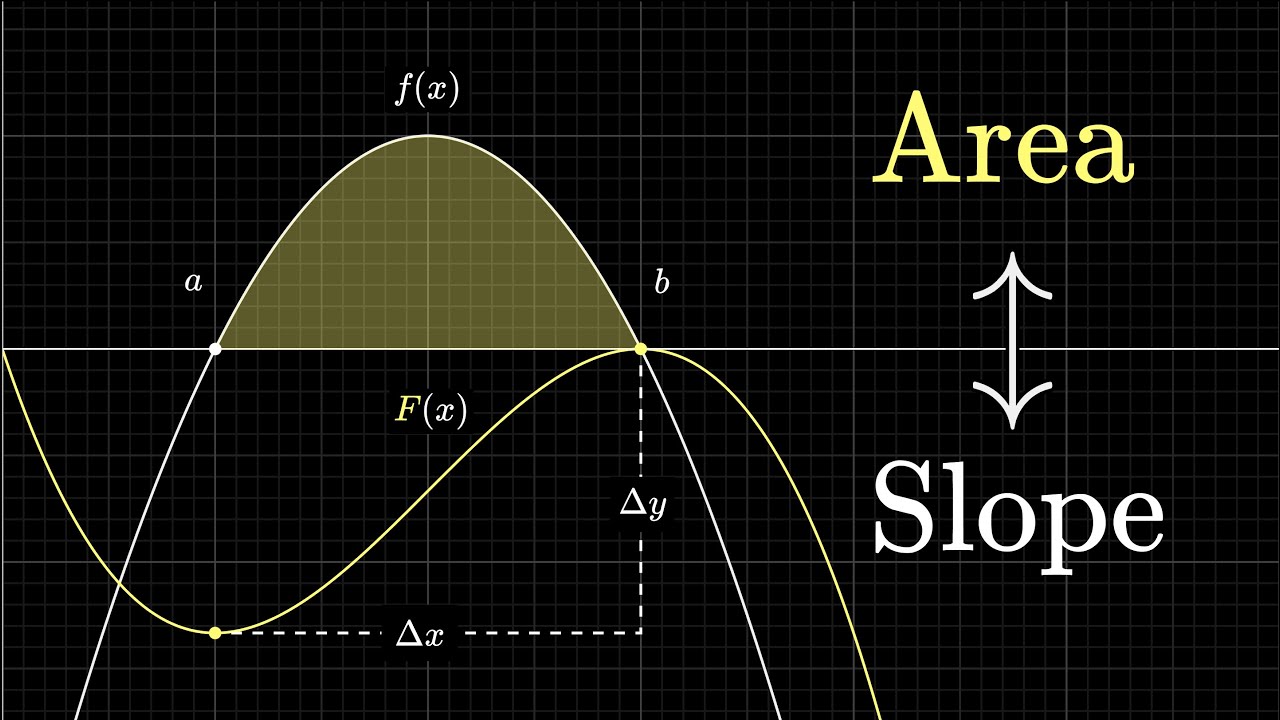
One view on why integrals and derivatives are inverses.
Help fund future projects: https://www.patreon.com/3blue1brown
An equally valuable form of support is to simply share some of the videos.
Special thanks to these supporters: http://3b1b.co/lessons/area-and-slope#thanks
Full series: http://3b1b.co/calculus
Thanks to these viewers for their...
devout snowBOT
@vagrant spire Has your question been resolved?
devout snowBOT
Channel closed
Closed due to timeout
Use .reopen if this was a mistake.
Available help channel!
Send your question here to claim the channel.
Remember:
• Ask your math question in a clear, concise manner.
• Show your work, and if possible, explain where you are stuck.
• Do not immediately ping people or roles. After 15 minutes, feel free to ping <@&286206848099549185> once.
• Type the command .close to free the channel when you're done.
• Be polite and have a nice day!
Read #❓how-to-get-help for further information on how to ask a good question, and about conduct in the question channels.
 glass hare
ok so I have a test in 4 hours and I want to cram the material, can someone go over the material with me?
devout snowBOT
glass hare
ok so I have a test in 4 hours and I want to cram the material, can someone go o...
 timber pebble
did you have any specific questions you wanted to look at?
glass hare
timber pebble
did you have any specific questions you wanted to look at?
eah
yeah
sorry for the wait I’ll send them


@timber pebble
devout snowBOT
@glass hare Has your question been resolved?
supple knot
glass hare
You just do the problems and if you get stuck just ask for help here
No one's gonna do 30+ problems for you
glass hare
supple knot
No one's gonna do 30+ problems for you
wdym for me
I want to be walked through them
I’m still gonna try to do it
supple knot
glass hare
I want to be walked through them
Yea exactly. No one's gonna do this for you
glass hare
welp
supple knot
glass hare
I’m still gonna try to do it
Then do them and if you get stuck show your attempt here
glass hare
Ok
glass hare
supple knot
You just do the problems and if you get stuck just ask for help here
I need help with 44
<@&286206848099549185>
supple knot
devout snow
Show your work for 44 like it says here and then you can ping helpers
 glass hare
 tender wharf
So bus = total time -t
tender wharf
So bus = total time -t
what
tender wharf
Let time for which distance travelled by train be t
Total time is 5.5 so time while traveling by bus = total - t
glass hare
tender wharf
Total time is 5.5 so time while traveling by bus = total - t
actually
I’m gonna do them 1-50
then you tell me
what I got wrong
is that cool
tender wharf
Which one you on?
tender wharf
glass hare
then you tell me
If not me someone will be there
glass hare
tender wharf
Which one you on?
I’m about to start
devout snowBOT
@glass hare Has your question been resolved?
devout snowBOT
@glass hare Has your question been resolved?
 devout grotto
glass hare
is that cool
devout grotto
glass hare
is that cool
that's not how this works-- if you get stuck on a problem come talk to us
devout snowBOT
Channel closed
Closed by @glass hare
Use .reopen if this was a mistake.
devout snowBOT
Available help channel!
Send your question here to claim the channel.
Remember:
• Ask your math question in a clear, concise manner.
• Show your work, and if possible, explain where you are stuck.
• Do not immediately ping people or roles. After 15 minutes, feel free to ping <@&286206848099549185> once.
• Type the command .close to free the channel when you're done.
• Be polite and have a nice day!
Read #❓how-to-get-help for further information on how to ask a good question, and about conduct in the question channels.
 unkempt harness
For this question, why can't we just rewrite the equation with negative exponents and then use the power rule to integrate?
 devout snowBOT
unkempt harness
For this question, why can't we just rewrite the equation with negative exponent...
unkempt harness
devout snowBOT
unkempt harness
For this question, why can't we just rewrite the equation with negative exponent...
unkempt harness
e^-2x - 2e^-x - 3 ^-1
 iron sun
So you’re saying 1/(all that) = what you wrote above?
iron sun
Well it’s unfortunately not true; take something simple as 1/(1+1) ≠ 1^-1 + 1^-1
unkempt harness
Is it because of the multiple terms being added
iron sun
Mhm
unkempt harness
So you could technically rewrite the original function above with a negative exponent right?
(e^2x - 2e^x - 3) ^-1 so e^-2x - 2^-1e^-x - 3^-1?
devout snowBOT
Channel closed
Closed by @unkempt harness
Use .reopen if this was a mistake.
Available help channel!
Send your question here to claim the channel.
Remember:
• Ask your math question in a clear, concise manner.
• Show your work, and if possible, explain where you are stuck.
• Do not immediately ping people or roles. After 15 minutes, feel free to ping <@&286206848099549185> once.
• Type the command .close to free the channel when you're done.
• Be polite and have a nice day!
Read #❓how-to-get-help for further information on how to ask a good question, and about conduct in the question channels.
devout snowBOT


 idle lynx
Apologies for bad formatting but hopefully it's clear when I'm talking about 3-vectors vs 4-vectors etc
In the full context of my question, it's written here, and I'm getting a minus sign before the summation term in the second line (angled brackets mean time ordered vacuum expectation value)

 willow helm
just a tip for latex, when you have this much text, it's much easier to read if math is in blocks instead of inline
idle lynx
apologies i wasn't entirely sure how to do it with this bot
 short hare
this also doesn't look very help-channels-friendly  perhaps search in the 'advanced mathematics' category starting from #get-advanced-access for the appropriate channel.
idle lynx
can I use \begin{equation}?
willow helm
Ah, just double dollar signs do the trick
idle lynx
ah thanks
supple knot
Try uhhhh #diff-geo-diff-top or #advanced-pdes
 acoustic leaf
the bot literally compiles a latex document, it has all of the same features
idle lynx
right I see thanks
idle lynx
short hare
this also doesn't look very help-channels-friendly <:eeveethink:6010290064181166...
Is it ok if I leave this here or should I close my question and move there?
short hare
idle lynx
Is it ok if I leave this here or should I close my question and move there?
It's not prohibited to use help channels for advanced mathematics, It's just suggested to use the intended channels.
so perhaps... do as you please! but yeah, I doubt you'll get help with allllll of that anytime soon
so perhaps closing the channel is a good option.
idle lynx
ok thanks for the advice
woven radishBOT
HugoL
 devout snowBOT
Channel closed
Closed by @idle lynx
Use .reopen if this was a mistake.
devout snowBOT
Available help channel!
Send your question here to claim the channel.
Remember:
• Ask your math question in a clear, concise manner.
• Show your work, and if possible, explain where you are stuck.
• Do not immediately ping people or roles. After 15 minutes, feel free to ping <@&286206848099549185> once.
• Type the command .close to free the channel when you're done.
• Be polite and have a nice day!
Read #❓how-to-get-help for further information on how to ask a good question, and about conduct in the question channels.
 frigid rain
Can somebody give me the steps / hint about how to do this? I recall learning it in the past but am currently reviewing, so i have forgotten, and searching online isnt helping much.
 devout snowBOT
frigid rain
Can somebody give me the steps / hint about how to do this? I recall learning it...
devout snowBOT
frigid rain
Can somebody give me the steps / hint about how to do this? I recall learning it...
 gritty terrace
Use polar form
frigid rain
Okay i found its polar form being radius of 2 and angle of 5pi/6. if i remember correctly, from here, its something to do with demoivre's theorem, yes? i will try that.
gritty terrace
Mhm
frigid rain
okay so im looking at some stuff rn but finding myself stuck on exactly what to do with this polar number. and how exactly to use it in regards to the demoivres theorem? the example in my textbook is using the complex number of just 8 (screenshot) which im not exactly sure how to translate over to this problem. would i have my problem being z^3 = 2, which is its modulus?
 devout snowBOT
@frigid rain Has your question been resolved?
frigid rain
Okay so i tried something and will explain my logic to check if im right. I ended up getting the correct answers (screenshot from the answer sheet) and my logic is like. for example, w0 = (nth root) modulus of z, cis original angle / 3. so in this case, 5pi/18. then for w1, you keep the original part of nth root modulus, add 1 loop around over n (so, 120* or 36 / 3 = 12pi/18) cis that. so 3rd root 2, (5pi/18 + 12pi/18, or 17pi/18)

then for the final one, w0, we keep 3rd root 2, and do the same as w1 just with 2 loops around (720 degrees or 72pi/18), that over 3 for (240 degrees or 24pi/18). plus the original angle for (5pi/18 + 24pi/18, or 29pi/18)
is there any part in my logic which wouldnt work in every circumstance? is what im wondering now.
and something that concerns me is that the fact it was to the fourth power in the original question didnt seem to come up. did i miss something and just get lucky or is that mostly irrelevant or something?
 lunar harbor
frigid rain
Okay so i tried something and will explain my logic to check if im right. I ende...
lunar harbor
frigid rain
Okay so i tried something and will explain my logic to check if im right. I ende...
you used the fourth power stuff at the start
and yes this is generally the logic you use to find all of the nth roots of unity
and hence solve stuff of the form z^n = w
devout snowBOT
@frigid rain Has your question been resolved?
frigid rain
lunar harbor
you used the fourth power stuff at the start
i fear i didnt do that consciously, at least. i found the polar form without regard to the fourth power (-root3)^2 + 1 = 4, making the radius 2, and finding the angle easily enough with that. at that point i lowkey forgot about the fourth power part and just operated without it, which is why im confused that i got it right
eh lowkey i got it right so i dont really care that much 
.close
devout snowBOT
Channel closed
Closed by @frigid rain
Use .reopen if this was a mistake.
Available help channel!
Send your question here to claim the channel.
Remember:
• Ask your math question in a clear, concise manner.
• Show your work, and if possible, explain where you are stuck.
• Do not immediately ping people or roles. After 15 minutes, feel free to ping <@&286206848099549185> once.
• Type the command .close to free the channel when you're done.
• Be polite and have a nice day!
Read #❓how-to-get-help for further information on how to ask a good question, and about conduct in the question channels.
 quick osprey
What is Logarithm
devout snowBOT
quick osprey
What is Logarithm
 solar goblet
the exponent the base must be raised to get a certain number
 jaunty bane
a logarithm is kind of like the inverse or opposite of an exponent.
see this image on how they relate.
 devout snowBOT
Channel closed
Closed by @quick osprey
Use .reopen if this was a mistake.
devout snowBOT
Available help channel!
Send your question here to claim the channel.
Remember:
• Ask your math question in a clear, concise manner.
• Show your work, and if possible, explain where you are stuck.
• Do not immediately ping people or roles. After 15 minutes, feel free to ping <@&286206848099549185> once.
• Type the command .close to free the channel when you're done.
• Be polite and have a nice day!
Read #❓how-to-get-help for further information on how to ask a good question, and about conduct in the question channels.
 dapper quail
I don't understand how to set up calc 2 volume problems
dapper quail
devout snowBOT
Please post images (such as PNGs or JPGs) of the question rather than other filetypes such as PDFs which have to be downloaded. Non-image downloads can potentially contain viruses or other security risks.
 ionic birch
hm
lets start with A first
$x + y = 3 and y = x^2 - 4x + 3
.
Texit stop
$x + y = 3$ and $y = x^2 - 4x + 3$
woven radishBOT
zeppelin
 ionic birch
ok good
so we have the above binding the region
let’s make this easier identify what the curve and what the region are first
@dapper quail do you know how to find either?
ionic birch
yes
exactly
with that in mind we need a graph
you’re gonna have to plot all this
(in order for me to show you what to do obviously)
devout snowBOT
@dapper quail Has your question been resolved?
dapper quail
ionic birch
(in order for me to show you what to do obviously)
sure sorry i went afk
sorry if this is rly slow

 ionic birch
this is fine
dapper quail
ok so i have sort of an idea its going to be 0 to 3 and its between that line and area underneath
dapper quail
yes
dapper quail
yup
ionic birch
and you see the two lines touching on the y axis?
dapper quail
yup
dapper quail
wait why y=-3?
ionic birch
it’s part of the curve
which helps us get our answer
that’s where this comes in:
$(3-x) - (x^2 - 4x + 3) = x^2 + 3x = x(3 - x)$
woven radishBOT
zeppelin
 ionic birch
since we know are points we form an equation
and THIS specific equation is what will help us find our top and bottom curve
dapper quail
ionic birch
that’s our rotation
im still not sure how we figure out the rotation is on this
dapper quail
devout snow
Please post images (such as PNGs or JPGs) of the question rather than other file...
heres an image version of the problem btw

just to have for reference in the chat
ionic birch
so you know how find curves right?
that’s the basic way for me to explain it properly
it’s basically what we went over and what we went over

and what you plotted
ionic birch
yes
you basically look at the points that meet the X-points , and rotate them to find the y
you should get y= -3
dapper quail
sry i hate to make you wait, i have to go but ill come back at some point, should i close the help channel
devout snowBOT
@dapper quail Has your question been resolved?
devout snowBOT
@dapper quail Has your question been resolved?
devout snowBOT
@dapper quail Has your question been resolved?
 brave junco
dapper quail
<@1338176457435774986> lmk when ur back
brave junco
dapper quail
<@1338176457435774986> lmk when ur back
i can help u
dapper quail
alr
brave junco
dapper quail
alr
okay so whats the issue
dapper quail
i dont understand how to set up the problem
brave junco
dapper quail
i dont understand how to set up the problem
this corrrect?
 dapper quail
mhm
dapper quail
yes
brave junco
then you see the parabola y = x^2 - 4x + 3
set them equal to find intersection x values
brave junco
dapper quail
(3-x) = x^2-4x+3 = (x-3)(x-1)
ok so the factoring is fine
but u only factor after u move everything to one side
and set the equation equal to 0
so start with 3 - x = x^2 - 4x + 3
dapper quail
ah yeah that makes it easier
brave junco
and move everything to one side so subtract 3-x from both side
dapper quail
0 = x^2-3x = x(x-3)
brave junco
?
dapper quail
yes
brave junco
ok
now rotation
rotate the horizontal line y = -3
use washers with vertical slices
and integrate with respect to x
brave junco
dapper quail
and decide vertical vs horizontal slices
which is easier with thefunctions u have
both curbes are written as y = f(x)
that makes vertical slices easier
because u do not have to solve for x in terms of y
if the slices are perpendicular to the axis of rotation
disks/washers
if slices are parallel
cylindrical shells
y = -3
vertical slices are perpendicular to horizontal line
so use washers
then you have to find radii for washers
each vertical slice at some x b etween 0 and 3 turns into a washer when rotated around y = -3
distances are measured vertically from the line y = -3
dapper quail
I see
dapper quail
Right
brave junco
dapper quail
Right
then r(x) = distance from axis to top curve
R(x) = y_top - (-3) = (3 - x) - (-3) = 6 - x
then r(x) = distance from axis to bottom curve
r(x) = y_bot - (-3) = (x^2 - 4x + 3) - (-3) = x^2 - 4x + 6
dapper quail
Then is it ytop - ybot
brave junco
dapper quail
Then is it ytop - ybot
no, thats the height of the region
for washers about y = -3
u need radii
which are distances from the axis
dapper quail
Oh ok
brave junco
then u just write the volume integral
v = pi * integral_a^b [ R(x)^2 - r(x)^2 ] dx
amd a = 0 here and b = 3
dapper quail
Right
 cloud remnant
brave junco
this corrrect?
cloud remnant
brave junco
this corrrect?
wouldnt it be easier to transform the coordinate axes to y=-3 and then use integral pi y^2 ?
brave junco
cloud remnant
wouldnt it be easier to transform the coordinate axes to y=-3 and then use integ...
u can do that
but u still do the washer formula
shift up by 3 units
y = y + 3 then axis y = -3 becomes y = 0
cloud remnant
yea
brave junco
top curve: y_top = 3 - x, y_top = Y_top + 3 = (3 - x) + 3 = 6 - x bottom curve: y_bot = x^2 - 4x + 3, Y_bot = y_bot + 3 = x^2 - 4x + 3 + 3 = x^2 - 4x + 6
then roate around Y = 0
the corss section at each x still a washer
dapper quail
I see
dapper quail
So for shells it would be for x=-3
 atomic narwhal
bruh
 scenic thorn
 surreal matrix
guys so you wondereing algebra is the easiest method
surreal matrix
guys so you wondereing algebra is the easiest method
What
scenic thorn
brave junco
top curve: y_top = 3 - x, y_top = Y_top + 3 = (3 - x) + 3 = 6 - x bottom curve: ...
wait that means
(R(x)=(3-x)-(-3)=6-x) ?
woven radishBOT
HOT LESBIAN SERJ TANKIAN
 dapper quail
I guess
devout snowBOT
@dapper quail Has your question been resolved?
 regal fiber
dapper quail
I guess
regal fiber
dapper quail
I guess
do you want me to verify or you’re done ?
If so close ticket once done
devout snowBOT
Channel closed
Closed due to timeout
Use .reopen if this was a mistake.
devout snowBOT
Available help channel!
Send your question here to claim the channel.
Remember:
• Ask your math question in a clear, concise manner.
• Show your work, and if possible, explain where you are stuck.
• Do not immediately ping people or roles. After 15 minutes, feel free to ping <@&286206848099549185> once.
• Type the command .close to free the channel when you're done.
• Be polite and have a nice day!
Read #❓how-to-get-help for further information on how to ask a good question, and about conduct in the question channels.
 bitter echo
does anyone have a good source of open problems in graph theory that's undergraduate level? looking to explore the field a bit more.
devout snowBOT
bitter echo
does anyone have a good source of open problems in graph theory that's undergrad...
bitter echo
I found the following online, but it appears outdated and it looks like it may be very outdated.
https://dimacs.rutgers.edu/~hochberg/undopen/graphtheory/graphtheory.html
http://www.openproblemgarden.org/category/graph_theory
<@&286206848099549185>
devout snowBOT
@bitter echo Has your question been resolved?
devout snowBOT
@bitter echo Has your question been resolved?
devout snowBOT
Channel closed
Closed due to timeout
Use .reopen if this was a mistake.
devout snowBOT
Available help channel!
Send your question here to claim the channel.
Remember:
• Ask your math question in a clear, concise manner.
• Show your work, and if possible, explain where you are stuck.
• Do not immediately ping people or roles. After 15 minutes, feel free to ping <@&286206848099549185> once.
• Type the command .close to free the channel when you're done.
• Be polite and have a nice day!
Read #❓how-to-get-help for further information on how to ask a good question, and about conduct in the question channels.
 civic umbra
Find the curve such that the initial ordinate of any tangent is less than the abscissa at the point of tangency by 3 units
 devout snowBOT
civic umbra
Find the curve such that the initial ordinate of any tangent is less than the ab...
civic umbra
devout snowBOT
civic umbra
Find the curve such that the initial ordinate of any tangent is less than the ab...
civic umbra
<@&286206848099549185>
pseudo basin
civic umbra
Find the curve such that the initial ordinate of any tangent is less than the ab...
wow this handwriting is unreadable
but ok
so let's say you are looking at y=f(x) and its tangent at x=c
the tangent should have y-intercept equal to c-3
pseudo basin
pseudo basin
so let's say you are looking at y=f(x) and its tangent at x=c
can you write the equation of this tangent in general form
civic umbra
y'=m(x'+x)+y ??
pseudo basin
civic umbra
y'=m(x'+x)+y ??
 that looks extremely sus
civic umbra
x' and y' for tangent coordinate?
pseudo basin
... i think you're trying to overdo it or just messing up the symbols real bad
civic umbra
??
pseudo basin
y - f(c) = f'(c) (x - c)
pseudo basin
pseudo basin
y - f(c) = f'(c) (x - c)
this is what i expected to see
line passing through (c, f(c)) with slope f'(c)
civic umbra
It's a differential equations question
Answer: y=Cx - x lnx - 3
I want to know how to get to it?
civic umbra
pseudo basin
y - f(c) = f'(c) (x - c)
Can you explain ?
pseudo basin
line passing through (c, f(c)) with slope f'(c)
do you know point-slope form for straight lines?
civic umbra
Ooh...
So I can frame the diff. equation like:
y - x (dy/dx) = x-3 right
devout snowBOT
Channel closed
Closed by @civic umbra
Use .reopen if this was a mistake.
devout snowBOT
Available help channel!
Send your question here to claim the channel.
Remember:
• Ask your math question in a clear, concise manner.
• Show your work, and if possible, explain where you are stuck.
• Do not immediately ping people or roles. After 15 minutes, feel free to ping <@&286206848099549185> once.
• Type the command .close to free the channel when you're done.
• Be polite and have a nice day!
Read #❓how-to-get-help for further information on how to ask a good question, and about conduct in the question channels.
 steep topaz
Help
devout snowBOT
steep topaz
Help
rain summit
!original
devout snowBOT
Please show the original problem, exactly as it was stated to you, with the entire original context. A picture or screenshot is best. If the original problem is not in English, then post it anyway! The additional context might still be helpful. Do your best to provide a translation.
devout snowBOT
No need to ask “Can I ask…?” or “Does anyone know about…?”—it’s faster for everyone if you just ask your question!
@steep topaz Has your question been resolved?
devout snowBOT
Channel closed
Closed due to timeout
Use .reopen if this was a mistake.
Available help channel!
Send your question here to claim the channel.
Remember:
• Ask your math question in a clear, concise manner.
• Show your work, and if possible, explain where you are stuck.
• Do not immediately ping people or roles. After 15 minutes, feel free to ping <@&286206848099549185> once.
• Type the command .close to free the channel when you're done.
• Be polite and have a nice day!
Read #❓how-to-get-help for further information on how to ask a good question, and about conduct in the question channels.
 molten spindle
This is the formula to rotate p around an arbituary axis using quaternions. When constructing q do I first normalise the rotation axis and then construct q or do I first construct q and then normalise q?
 devout snowBOT
molten spindle
This is the formula to rotate p around an arbituary axis using quaternions. When...
devout snowBOT
molten spindle
This is the formula to rotate p around an arbituary axis using quaternions. When...
 silk crystal
devout snowBOT
silk crystal
devout snowBOT
To ask for mathematics help on this server, please open your own help channel or help thread. See #❓how-to-get-help for instructions.
molten spindle
.close
devout snowBOT
Channel closed
Closed by @molten spindle
Use .reopen if this was a mistake.
willow helm

 steel sage
You find the unit vector v, representing the axis, the angle of rotation θ you want, then q should be cos(θ/2)+sin(θ/2)a. no idea how order or operations comes in.
devout snowBOT
Available help channel!
Send your question here to claim the channel.
Remember:
• Ask your math question in a clear, concise manner.
• Show your work, and if possible, explain where you are stuck.
• Do not immediately ping people or roles. After 15 minutes, feel free to ping <@&286206848099549185> once.
• Type the command .close to free the channel when you're done.
• Be polite and have a nice day!
Read #❓how-to-get-help for further information on how to ask a good question, and about conduct in the question channels.
molten spindle
steel sage
You find the unit vector v, representing the axis, the angle of rotation θ you w...
And what is vector v is not unit vector. Do I first normalise it and then construct q or construct q and then normalise q
devout snowBOT
molten spindle
And what is vector v is not unit vector. Do I first normalise it and then constr...
steel sage
You normalize your v, then you get your q
devout snowBOT
Channel closed
Closed by @molten spindle
Use .reopen if this was a mistake.
devout snowBOT
Available help channel!
Send your question here to claim the channel.
Remember:
• Ask your math question in a clear, concise manner.
• Show your work, and if possible, explain where you are stuck.
• Do not immediately ping people or roles. After 15 minutes, feel free to ping <@&286206848099549185> once.
• Type the command .close to free the channel when you're done.
• Be polite and have a nice day!
Read #❓how-to-get-help for further information on how to ask a good question, and about conduct in the question channels.
 wise wren
It says if t > c, we reject the null hypothesis but on the other slide, we reject it anyways even though t < c.

 devout snowBOT
wise wren
It says if t > c, we reject the null hypothesis but on the other slide, we rejec...
wise wren
devout snowBOT
wise wren
It says if t > c, we reject the null hypothesis but on the other slide, we rejec...
wise wren
Which one is it?
devout snowBOT
@wise wren Has your question been resolved?
devout snowBOT
@wise wren Has your question been resolved?
 young spade
okay
this is more of a generalization
You usually take t and c to be positive when you say "t > c we reject H0", but for this case we have the inverse.
You can rather look at the bounds of the probability dist.
We are conducting a left tail test here, since we are testing at μ<5.
Our critical value (C) is at the bound between the shaded and unshaded region.

You can see that t falls in the shaded region
Which for statistics, means we should reject H0
Hypothesis Test actually allow for a lot of ways to be set up, you can do inner, left, right, two tail, etc...
And you have to know how to read critical values vs estimators.