#help-27
1 messages · Page 374 of 1
 wild spindle
 hushed drift
@wild spindle did u get 120º?
wild spindle
hushed drift
<@1323405758532161556> did u get 120º?
X isn't 120. Because DOC is 180-4x
And DOE is also 180-69=111
And COE is x
So DOE is 180-3x
So 111=180-3x
So 3x=69
 devout snowBOT
@hushed drift Has your question been resolved?
hushed drift
okay ty
devout snowBOT
Channel closed
Closed due to timeout
Use .reopen if this was a mistake.
 Available help channel!
Send your question here to claim the channel.
Remember:
• Ask your math question in a clear, concise manner.
• Show your work, and if possible, explain where you are stuck.
• Do not immediately ping people or roles. After 15 minutes, feel free to ping <@&286206848099549185> once.
• Type the command .close to free the channel when you're done.
• Be polite and have a nice day!
Read #❓how-to-get-help for further information on how to ask a good question, and about conduct in the question channels.
 atomic idol
I have a vector space X with a finite dimension
There’s a projection P for which P * P = P is true
The range of the projection consists of all vectors x so that P(x) = x and the intersection of Ran[P] and Ker[P] is only the zero vector
Now how do I show that there’s a basis V for which the matrix looks like this:
devout snowBOT
atomic idol
I have a vector space X with a finite dimension
There’s a projection P for whic...

 woven radishBOT
 atomic idol
This condition also applies to the diagonal matrix
 devout snowBOT
@atomic idol Has your question been resolved?
Channel closed
Closed by @atomic idol
Use .reopen if this was a mistake.
Available help channel!
Send your question here to claim the channel.
Remember:
• Ask your math question in a clear, concise manner.
• Show your work, and if possible, explain where you are stuck.
• Do not immediately ping people or roles. After 15 minutes, feel free to ping <@&286206848099549185> once.
• Type the command .close to free the channel when you're done.
• Be polite and have a nice day!
Read #❓how-to-get-help for further information on how to ask a good question, and about conduct in the question channels.
 restive river
im stuck pls helppp
i tried using 30 60 90 and bunch of stuff but it doesnt work?
idk how im supposed to get the radius
 devout snowBOT
restive river
im stuck pls helppp
i tried using 30 60 90 and bunch of stuff but it doesnt work...
devout snowBOT
restive river
im stuck pls helppp
i tried using 30 60 90 and bunch of stuff but it doesnt work...
 rotund umbra
have you drawn a diagram of this?
devout snowBOT
@restive river Has your question been resolved?
rotund umbra
👋
devout snowBOT
Channel closed
Closed due to timeout
Use .reopen if this was a mistake.
devout snowBOT
✅ Original question: #help-27 message
restive river
helppppp
 sturdy solstice
restive river
im stuck pls helppp
i tried using 30 60 90 and bunch of stuff but it doesnt work...
sturdy solstice
restive river
im stuck pls helppp
i tried using 30 60 90 and bunch of stuff but it doesnt work...
You need to find the circumcenter (prob spelled wrong who cares) which will be the center of the circle since it is equilateral triangle. Using this, you can then determine the length from the center of the circle to the edge, set that equal to w√3, and solve for w
restive river
oho so like i find the distance from one of the vertices to the center

cuz thats the radius
i think i can do this
i was confused on what to do
sturdy solstice
restive river
oho so like i find the distance from one of the vertices to the center
Basically you need to use the circumcenter equation to get the central point of the triangle. This will then allow you to get the distance from the center to the edge of the circle.
Then go from there
restive river
sturdy solstice
Basically you need to use the circumcenter equation to get the central point of ...
wait i tried to solve without that eq cuz like its for sat and no way im memorizing that like is ther way to solve without using it
i did allat back in alg and trig but i fogor
sturdy solstice
restive river
wait i tried to solve without that eq cuz like its for sat and no way im memoriz...
The way I said is by far the easiest way to do it
There are likely other ways but not easy ones
devout snowBOT
Channel closed
Closed by @craggy summit
Use .reopen if this was a mistake.
sturdy solstice
Actually
sturdy solstice
restive river
ok imma just memorize
Actually
Yeah there is another way actually
Thats prob easier
idk how I missed this
break the triangle into 3 equal triangles
then go from there
devout snowBOT
Available help channel!
Send your question here to claim the channel.
Remember:
• Ask your math question in a clear, concise manner.
• Show your work, and if possible, explain where you are stuck.
• Do not immediately ping people or roles. After 15 minutes, feel free to ping <@&286206848099549185> once.
• Type the command .close to free the channel when you're done.
• Be polite and have a nice day!
Read #❓how-to-get-help for further information on how to ask a good question, and about conduct in the question channels.
 strong igloo
I'm havinga brain aneurysm trying to understand this
 strong igloo
Isn't this true by definition?
The orthogonal complement W^ortho of some subspace W of V consists of all vectors of the V that are orthogonal to the basis vectors of W
devout snowBOT
@strong igloo Has your question been resolved?
 cinder bobcat
well the definition i'm familiar with is that the orthogonal complement is the set of all vectors whose inner product with anything in W is 0
 lyric hornet
or dot product if you're unfamiliar with the term "inner product"
devout snowBOT
@strong igloo Has your question been resolved?
 north grail
Hint : Differences
strong igloo
.close
devout snowBOT
Channel closed
Closed by @strong igloo
Use .reopen if this was a mistake.
Available help channel!
Send your question here to claim the channel.
Remember:
• Ask your math question in a clear, concise manner.
• Show your work, and if possible, explain where you are stuck.
• Do not immediately ping people or roles. After 15 minutes, feel free to ping <@&286206848099549185> once.
• Type the command .close to free the channel when you're done.
• Be polite and have a nice day!
Read #❓how-to-get-help for further information on how to ask a good question, and about conduct in the question channels.
 soft umbra
I need someone to verify my work
 devout snowBOT
soft umbra
I need someone to verify my work
devout snowBOT
soft umbra
I need someone to verify my work
 vital edge
👀
soft umbra
n = 1\
$1 = 1^2$\
n = 2\
$1 + 3 = 2^2$
n = k\
$1+3+5+....+(2k-1) = k^2$\
n = (k+1)\
$1+3+5+...+(2k+1) = (k+1)^2$\
Because $(k+1)^2 - (2k+1) = k^2$\
Hence proven
woven radishBOT
Acknowledged Scumbag
 vital edge
Would be good to expand and show the last statement
And a statement that the kth odd number is 2k-1
vital edge
Also you don't need to show n = 2 usually
soft umbra
just wanna verify my understandings so far
vital edge
Yeye
vital edge
The case of n = 2 only becomes relevant when your induction step involves some form of overlapping intersection
As an example, look up the proof that all horses are the same colour
soft umbra
.close 
devout snowBOT
Channel closed
Closed by @soft umbra
Use .reopen if this was a mistake.
devout snowBOT
Available help channel!
Send your question here to claim the channel.
Remember:
• Ask your math question in a clear, concise manner.
• Show your work, and if possible, explain where you are stuck.
• Do not immediately ping people or roles. After 15 minutes, feel free to ping <@&286206848099549185> once.
• Type the command .close to free the channel when you're done.
• Be polite and have a nice day!
Read #❓how-to-get-help for further information on how to ask a good question, and about conduct in the question channels.
 lusty reef
if g and h are elements of infinite order in SL(2,C), show that g and h commute iff g and h have the same fixed points
devout snowBOT
lusty reef
if g and h are elements of infinite order in SL(2,C), show that g and h commute ...
lusty reef
here, SL(2,C) is acting on C
and fixed point means that for any z in C, gz = z and hz = z
im trying to show just the forwards direction right now - ive already tried showing that the fixed pts of g is a subset of the fixed pts of h and vice versa, but its really hard to do both at the same time
a useful fact is that h stabilizes fixed pts of g and vice versa
lusty reef
lusty reef
a useful fact is that h stabilizes fixed pts of g and vice versa
and this comes from g and h commutative, so i still havent used that g and h are infinite order
devout snowBOT
@lusty reef Has your question been resolved?
lusty reef
i know this is not the place to be venting but man. ive spent way too many hours going over the same elementary computations in the hopes of making a slightly different proof by contradiction
 hidden star
lusty reef
and this comes from g and h commutative, so i still havent used that g and h are...
hidden star
lusty reef
and this comes from g and h commutative, so i still havent used that g and h are...
I'm pretty much sure you already did the hardest part
Are we not going to swap h and fixed points of g rather than fixing them individually?
lusty reef
hidden star
Are we not going to swap h and fixed points of g rather than fixing them individ...
what do you mean by this :0?
hidden star
lusty reef
what do you mean by this :0?
Let's say let's make use of the definition of commutativity
Let me write it down rq
So let's define a few things here
Let's say
S -> set of fixed points of g
P -> point in the set S
So, we can say g(p)=p
So, what happens to the point h(p)? Does g "fixes" h(p)?
Let's say we test it by plugging h(p) to g so smth like
g(h(p))
Since, we already know h and g are commute so we can swap it, right?
h(g(p))
Then we know p is a fixed point of g so we know that g(p) = p
So, that's h(p)
Meaning we have
g(h(p)) = h(p)
lusty reef
yup so hp is a fixed point of g as well
hidden star
Doesn't this prove that h maps the set of g's points to itself
Fixed points in this case but yes
lusty reef
yes
hidden star
Well, that's how I view this so far 
hidden star
lusty reef
i appreciate the help regardless ^^;;
Yea, I'll tell you if I figure something out 😭
devout snowBOT
@lusty reef Has your question been resolved?
lusty reef
so actually theres been partial progress
hidden star
lusty reef
so actually theres been partial progress
What's your current progress?
More like what did you do after?
lusty reef
so transformations in SL(2,C) have the form of being rotations around an axis (elliptic, 2 fixed pts), rotation around one point at infinity (parabolic, 1 fixed pt), and some kind of directional flow (loxodromic, 2 fixed pts)
hidden star
I can agree to this
lusty reef
if g is loxodromic and has fixed points x- and x+ where the transformation is going from x- towards x+, then for any x =/= x-, you have lim g^n (x) = x+
however: suppose for contradiction that h maps x- to x+, ie those fixed pts of g are not fixed pts of h

so in this case, lim g^n h^-1 x is both equal to x- and x+, contradiction
lusty reef
i forgot i was missing some info lol, i just added it in but h is assumed (for contradiction) to swap x- and x+
hidden star
Right, so I assume you assumed that h(x+) is x-?
And vice versa?
Though, shouldn't it not equal? Since loxodromic should have two distinct points?
So x+ ≠ x-
Then, we might have to debunk the statement that h swaps them
😭 I see now why this has got you stuck for hours
So, with that we can somewhat conclude that h cannot swap the fixed points since it'll cause the loxodromic transformation to stray away from it's required two distinct points.
Somehow, need to map x+ to x+ and x- to x-
Wait hold on
We could just say that h must fix each point individually then conclude that h and g share the same fixed points
lusty reef
heres a more clearly written version lol
 devout snowBOT
@lusty reef Has your question been resolved?
devout snowBOT
Channel closed
Closed due to timeout
Use .reopen if this was a mistake.
Available help channel!
Send your question here to claim the channel.
Remember:
• Ask your math question in a clear, concise manner.
• Show your work, and if possible, explain where you are stuck.
• Do not immediately ping people or roles. After 15 minutes, feel free to ping <@&286206848099549185> once.
• Type the command .close to free the channel when you're done.
• Be polite and have a nice day!
Read #❓how-to-get-help for further information on how to ask a good question, and about conduct in the question channels.
 stoic crystal
 devout snowBOT
stoic crystal
stoic crystal
devout snowBOT
stoic crystal
stoic crystal

why is the solution taking time for second half as 5(1.2x)
it's supposed to decrease by 20%
 silk panther
well when u slow down, does the time taken to finish increase or decrease?
stoic crystal
silk panther
well when u slow down, does the time taken to finish increase or decrease?
oh
wow didn't think of it that way
silk panther
haha, try to tie it up with irl examples and u got it
 fossil locust
agree, so if his pace is 10 minutes per kilometer, it increases to 12 minutes per km
so he goes from 6 km per hour to 5 km per hour: that's a reduction of 1/6th
you can think of it like this instead: should work out to the same
stoic crystal
it seems like they are taking pace as 1/speed
fossil locust
stoic crystal
it seems like they are taking pace as 1/speed
yes
fossil locust
no worries!
stoic crystal

wow I just realised we have mutual friends
also can I model this as:
t=d/v
and as pace=1/v
then v=1/pace
t=d*(pace)
and then $5(x)+5(0.8x)<55$
woven radishBOT
Jug
 devout snowBOT
@stoic crystal Has your question been resolved?
hidden star
lusty reef
heres a more clearly written version lol
It looks great
 young spade
stoic crystal
young spade
stoic crystal
the problem was probably meaning to say "minimum pace"
devout snowBOT
Channel closed
Closed due to timeout
Use .reopen if this was a mistake.
devout snowBOT
Available help channel!
Send your question here to claim the channel.
Remember:
• Ask your math question in a clear, concise manner.
• Show your work, and if possible, explain where you are stuck.
• Do not immediately ping people or roles. After 15 minutes, feel free to ping <@&286206848099549185> once.
• Type the command .close to free the channel when you're done.
• Be polite and have a nice day!
Read #❓how-to-get-help for further information on how to ask a good question, and about conduct in the question channels.
 glass zephyr
Can anyone help with (2)
 devout snowBOT
glass zephyr
Can anyone help with (2)
glass zephyr
devout snowBOT
glass zephyr
Can anyone help with (2)
glass zephyr
(this is a 3d space problem, so part (1) dont really effect the problem at all)
 errant harbor
What have you tried?
glass zephyr
errant harbor
What have you tried?
I have tried to calcualte the relation of AB like this:
AB^2 = AC^2 + BC^2 - 2 AC BC cos(ACB)
Since BC^2 =BD^2 + CD^2
AB^2 = AC^2 + BD^2 + CD^2 - 2 AC BC cos(ACB)
My teacher says i'm on the right trach
But i'm not sure how to correlate ACB with the dihedral angle
Hang on lemme retype my writing a bit

Here
From what i see i should be able to connect ACB to the required angle
But it doesnt make sense at all
Oh nvm i think i know how to solve this now
.colse
.close
devout snowBOT
Channel closed
Closed by @glass zephyr
Use .reopen if this was a mistake.
devout snowBOT
Available help channel!
Send your question here to claim the channel.
Remember:
• Ask your math question in a clear, concise manner.
• Show your work, and if possible, explain where you are stuck.
• Do not immediately ping people or roles. After 15 minutes, feel free to ping <@&286206848099549185> once.
• Type the command .close to free the channel when you're done.
• Be polite and have a nice day!
Read #❓how-to-get-help for further information on how to ask a good question, and about conduct in the question channels.
 honest lion
I think part a to this problem is false. Am I correct? In particular, consider a f to be a piece wise linear (table looking) function starting at 0 with slope $n$ for $x \in [0,1/n]$, then horizontal, then slope $-n$ for the last $1/n$ interval. I’m not quite sure if a piece wise linear function is in $H^1_0$ but if not a smooth approximation should still be a counter example. What am I doing wrong?
 devout snowBOT
honest lion
I think part a to this problem is false. Am I correct? In particular, consider a...
woven radishBOT
devout snowBOT
honest lion
I think part a to this problem is false. Am I correct? In particular, consider a...
woven radishBOT
Owen
 honest lion
 honest lion
I think part a to this problem is false. Am I correct? In particular, consider a...
honest lion
honest lion
I think part a to this problem is false. Am I correct? In particular, consider a...
When I say f here I mean u
devout snowBOT
@honest lion Has your question been resolved?
devout snowBOT
@honest lion Has your question been resolved?
devout snowBOT
Channel closed
Closed due to timeout
Use .reopen if this was a mistake.
Available help channel!
Send your question here to claim the channel.
Remember:
• Ask your math question in a clear, concise manner.
• Show your work, and if possible, explain where you are stuck.
• Do not immediately ping people or roles. After 15 minutes, feel free to ping <@&286206848099549185> once.
• Type the command .close to free the channel when you're done.
• Be polite and have a nice day!
Read #❓how-to-get-help for further information on how to ask a good question, and about conduct in the question channels.
atomic idol
How do I show that there’s a basis for the vector space X (with a finite dimension N) that looks like this
Delta is 1 if the condition applies and 0 if not
 devout snowBOT
atomic idol
How do I show that there’s a basis for the vector space X (with a finite dimensi...
atomic idol
devout snowBOT
atomic idol
How do I show that there’s a basis for the vector space X (with a finite dimensi...
atomic idol
P is a projection with the property P = P * P
I’ve shown two things for this problem already but they seem unrelated so I didn’t add them
 violet wind
can you start with a basis for ker(P)?
or maybe you actually want to start with a basis of Im(P)
atomic idol
atomic idol
I’ve shown two things for this problem already but they seem unrelated so I didn...
I’ll add the other things I’ve already shown just in case
 atomic idol
violet wind
or maybe you actually want to start with a basis of Im(P)
atomic idol
violet wind
or maybe you actually want to start with a basis of Im(P)
Do you mean the range?
violet wind
image means range, yes
atomic idol
atomic idol
I’ll add the other things I’ve already shown just in case
Do these help?
violet wind
they look useful, yeah
start with a basis for Im(P)
or Ran(P)
where do those basis elements get mapped?
atomic idol
P(v)=v
violet wind
every vector space has a basis
you can just choose one
you have that Ran(P) is a subspace, right
atomic idol
violet wind
you have that Ran(P) is a subspace, right
Do you mean the first thing I’ve proven?
Also I’ve had this as an idea for the basis
Would this work?
 violet wind
idk what that is
atomic idol
A sum of all standard basis vectors up to the dimension N
violet wind
do you have a theorem that says every vector space has a basis
atomic idol
Im not sure honestly
Im working with a terribly formatted extremely long script
I think i might’ve found sth
violet wind
it's not terribly difficult to prove for finite dimensions
you just keep choosing independent vectors
when you run out of independent vectors, that's your basis
atomic idol
How do you know how many dimensions p has
violet wind
p has a basis of size N
atomic idol
I just know that X has a finite dimension
But not that p has the same dimension
atomic idol
violet wind
p has a basis of size N
Why?
atomic idol
That’s how I write a 1
woven radishBOT
Dreyuk
 violet wind
oh
atomic idol
Handwriting
violet wind
yeah ok
violet wind
atomic idol
Why?
e_1, ..., e_N
atomic idol
It’s just all standard basis vectors from 1 to N scaled and added together to span P
If dim(P) = N that should be the basis correct?
violet wind
that is the basis, which is how you know dim(P)=N
dimenison of N is defined as having a basis of size N
atomic idol
Yes but I don’t know the dimension of P nor do I know what the basis looks like at first
Or do I get the information implicitly somewhere
Does P inherit the dimension of X?
violet wind
the basis is e_1, ..., e_N
atomic idol
The only thing I know is that dim(X) = N =< infinite
Just fyi
The variable N is already used by the task
In case you’re just calling it that for P without knowing about it
atomic idol
Technically yeah
n is just an index
You could start by counting at 0
But I thought 1 would be nicer
violet wind
no like the alpha_n coefficients
violet wind
ok this is strange
inside that thing is only one vector?
you're taking span of a signle vector

 lyric shard
Just chiming in because this problem interests me as well
Would it be possible to start solving this by saying that we're picking some arbitrary basis of Ran[P] that we just call V? And then because P(V)=V (by definition of Ran[P]) our matrix representation would end up looking like the one given to us?
violet wind
lyric shard
Just chiming in because this problem interests me as well
Would it be possible t...
that's what i want to do yeah
lyric shard
Oh ok I see
violet wind
ok so on the left you're leaving out some like set notation then?
P is the set of vectors that result from that sum for all a_1, ..., a_N in F
lyric shard
I'm just not exactly sure how I'd personally write that as a proof since my linear algebra skills got a bit rusty
atomic idol
I am saying P is just the linear combination of all standard basis vectors up to the dimension N
violet wind
and N is the dimension of X?
atomic idol
And that this is equal to the span of all bask vectors
atomic idol
violet wind
P is the set of vectors that result from that sum for all a_1, ..., a_N in F
P is a projection with the properties from the beginning of the conversation
violet wind
if P is a projection then it's a function, not a set, it isn't the "span" of anything
atomic idol
Would the range of P be the span of the basis then?
atomic idol
Yes N is the finite dimension of a vector space called X
P is a projection so that P = P * P
violet wind
...a projection from X to X?
atomic idol
Yes seems like it
violet wind
right ok
atomic idol
Says this
 violet wind
so e_1, e_2, ... e_N is a basis for X
atomic idol
Yes
atomic idol
atomic idol
Yes
And also for P if dim(P)=dim(X)
atomic idol
How would I get a basis for P in that case
Do I just take my sum from earlier and rename the upper limit to D = dim(P)
atomic idol
Can you not give a basis for the image of said function?
violet wind
you can get it because all vector spaces have bases, and Ran(P) is a vector space
but if you don't have that fact given
atomic idol
atomic idol
Alright then
How would I show that there’s a basis v of X with these properties


 woven radishBOT
 atomic idol
I’ve defined the dimension of that range to be D
And changed the sum to only combine all standard basis vectors from 1 to that dimension
Does this work?
violet wind
if i saw that in a paper, i would probably fill in the gaps myself, but I don't imagine you know what the gaps are
atomic idol
No clue
violet wind
if your basis for X is already chosen, you can't just choose the first D elements and hope that they happen to span Ran(P)
there are likely lots of other dimension D subspaces that aren't Ran(P)
and it would probably span one of those instead
atomic idol
So it’s like saying we have 3 dimensions in X and 2 in P (for example)
And pretending that every subset of 2 dimensions will span P
Despite it being one specific option
violet wind
yeah like if i'm working in R^3
and my Ran(P) is {x+y+z = 0}
i can't just choose like <1,0,0> and <0,1,0> as my basis for Ran(P)
atomic idol
Because it could be <0,0,1> instead
violet wind
no
because none of those vectors are even in Ran(P)
<0,0,1> isn't either
so it's not even like i can just choose the right subset and have it span Ran(P)
i have to start from scratch and specifically choose a new basis of Ran(P), rather than starting with an arbitrary existing basis of X
violet wind
So we need to choose a basis of Ran(P), from scratch
If we know that every finite-dimensional vector space has a basis, we can just use that fact
otherwise, we need to make our basis by choosing linearly independent elements one by one until we span all of Ran(P)
atomic idol
Which we can’t do because we don’t know anything about RanP
Can we just say let there be
V = Base(Ran[P]) = { v_1, … , v_D}
violet wind
Probably
don't say Base() though, unless somehow that's actually established notation in your course
just say let V be a basis of Ran(P)
atomic idol
alright I’ll change it
Got rid of it
Can you write @violet wind the basis of a vector space as the reunion of the basis of both the kernel and the range
atomic idol
So?
violet wind
so you can make it work
devout snowBOT
@atomic idol Has your question been resolved?
Channel closed
Closed by @atomic idol
Use .reopen if this was a mistake.
devout snowBOT
Available help channel!
Send your question here to claim the channel.
Remember:
• Ask your math question in a clear, concise manner.
• Show your work, and if possible, explain where you are stuck.
• Do not immediately ping people or roles. After 15 minutes, feel free to ping <@&286206848099549185> once.
• Type the command .close to free the channel when you're done.
• Be polite and have a nice day!
Read #❓how-to-get-help for further information on how to ask a good question, and about conduct in the question channels.
 cursive hazel
question related to advent of code day 2:
what are numbers like 11, 22, 3434, 567567 called? what do they have in common? i feel like there must be some mathematical way to go about this so if someone could tell me what to google that would be great
devout snowBOT
cursive hazel
question related to advent of code day 2:
what are numbers like 11, 22, 3434, 5...
 pseudo basin
567567 is not a palindrome
cursive hazel
 sage ibex
serch in oeis
sage ibex
serch in oeis
the what
 cursive hazel
ohhh
ok ty
sage ibex
11,22,3434,567567,891011891011?
pseudo basin
anyway
cursive hazel
for example
pseudo basin
the best way to describe these is like... numbers that consist of two copies of the same number stuck together
sage ibex
i think there halfway 567|567 2|2
cursive hazel
basically if you split the number in 2 you get 2 of the same
if its a word that is
123123 => 123|123 => 123 and 123
cursive hazel
pseudo basin
the best way to describe these is like... numbers that consist of two copies of ...
yeah
using strings this is easy but inefficient
pseudo basin
how against the rules is it to share the original advent of code problem
cursive hazel
uhhh idk if anyone cares since its yesterdays problem
pseudo basin
can you share it then
so that we have a clearer picture of what you're trying to do
cursive hazel
basically
given some number ranges, find all such numbers in them
11-22 has 2: 11 and 22
95-115 has 1: 99
1188511880-1188511890 has 1: 1188511885
x mod (10^half of digit count of x) == floor(x/10^half of digit count of x)
maybe?
devout snowBOT
@cursive hazel Has your question been resolved?
devout snowBOT
@cursive hazel Has your question been resolved?
cursive hazel
<@&286206848099549185>
devout snowBOT
@cursive hazel Has your question been resolved?
devout snowBOT
@cursive hazel Has your question been resolved?
 tender cobalt
cursive hazel
question related to advent of code day 2:
what are numbers like 11, 22, 3434, 5...
tender cobalt
cursive hazel
question related to advent of code day 2:
what are numbers like 11, 22, 3434, 5...
I dont think they have a name
youre better off using strings, there isnt really anything mathematical I can see here other than being numbers of the form 11 * single digit, 101 * double digit, 1001 * triple digit, 10001 * quadruple digit, etc.
for example think about printing the first 100 numbers of this form, you can go through all of them with strings and easily compare their sizes by how many digits they have
also, day 2 of advent of code and youre already trying to find answers online instead of trying the problem on your own? sort of defeats the purpose
devout snowBOT
Channel closed
Closed due to timeout
Use .reopen if this was a mistake.
Available help channel!
Send your question here to claim the channel.
Remember:
• Ask your math question in a clear, concise manner.
• Show your work, and if possible, explain where you are stuck.
• Do not immediately ping people or roles. After 15 minutes, feel free to ping <@&286206848099549185> once.
• Type the command .close to free the channel when you're done.
• Be polite and have a nice day!
Read #❓how-to-get-help for further information on how to ask a good question, and about conduct in the question channels.
 peak tiger
i need help
devout snowBOT
peak tiger
i need help
peak tiger
how to find height of triangle ABC if the yellow shadded area are the same
 peak tiger

here is better drawing
this problem my dad gave me
if i solve it, i get to play my video games
btw the height is not 16
peak tiger
is my drawing too chopped?
peak tiger
hidden star
Isosceles?
yes
 peak tiger
yes
the height of the red triangle is 11
the height of the trapozoid on the bottom is 5
help find height of abc
hidden star
Okay so, the trapezoid and triangle are supposed to somehow form a big triangle?
peak tiger
trapezoid + triangle does not equal the entire triangle
but the two shaded parts have same area
hidden star
Right, so do they have space in between?
peak tiger
they have space inbetween
hidden star
Let me see
 peak tiger
yes
hidden star
peak tiger
Right just to be sure, it's not measuring the shaded area but rather the height?
 peak tiger
yes
hidden star
An isosceles triangle
AB = AC
peak tiger
yes
hidden star
Right, what have you tried so far?
hidden star
Similar triangles?
so far I find the information insufficient but let's see I might've overlooked something
No I can't link this in any ways with similar triangles unless I'm missing something that I shouldn't 😭
hidden star
I don't know if I can help you on this so, I'm just going to pass this to someone who might know how to deal with this cause my brain is not picking anything up 😭
devout snowBOT
@peak tiger Has your question been resolved?
devout snowBOT
Channel closed
Closed due to timeout
Use .reopen if this was a mistake.
Available help channel!
Send your question here to claim the channel.
Remember:
• Ask your math question in a clear, concise manner.
• Show your work, and if possible, explain where you are stuck.
• Do not immediately ping people or roles. After 15 minutes, feel free to ping <@&286206848099549185> once.
• Type the command .close to free the channel when you're done.
• Be polite and have a nice day!
Read #❓how-to-get-help for further information on how to ask a good question, and about conduct in the question channels.
 real sail
Hello, I'm requesting help with an exponential function formula problem, please!
 devout snowBOT
real sail
Hello, I'm requesting help with an exponential function formula problem, please!
real sail
devout snowBOT
real sail
Hello, I'm requesting help with an exponential function formula problem, please!
real sail
So far I wrote out 2 functions:
f(71) = ab^2
f(83) = ab^6
Then used the ratio method to get
71/83 = 1/b^4
Not sure what to do next
 drifting sierra
real sail
So far I wrote out 2 functions:
f(71) = ab^2
f(83) = ab^6
drifting sierra
real sail
So far I wrote out 2 functions:
f(71) = ab^2
f(83) = ab^6
That makes no sense
I'm guessing you meant "71 =" and "83 ="
pseudo basin
real sail
So far I wrote out 2 functions:
f(71) = ab^2
f(83) = ab^6
those are not "two functions" btw
also yeah definitely 71 not f(71), and 83 not f(83)
71/83 = 1/b^4
Not sure what to do next
if you had b^4 = (number) instead, would you know what to do
real sail
ah, yes that's what I meant
so 71/83 = 1/b^4
I remember being taught this recently, but my memory is failing
I think I got it, thanks
.close
devout snowBOT
Channel closed
Closed by @real sail
Use .reopen if this was a mistake.
devout snowBOT
Available help channel!
Send your question here to claim the channel.
Remember:
• Ask your math question in a clear, concise manner.
• Show your work, and if possible, explain where you are stuck.
• Do not immediately ping people or roles. After 15 minutes, feel free to ping <@&286206848099549185> once.
• Type the command .close to free the channel when you're done.
• Be polite and have a nice day!
Read #❓how-to-get-help for further information on how to ask a good question, and about conduct in the question channels.
 rare kernel
dy/dx = (x+y-2)/(x-y)
devout snowBOT
rare kernel
dy/dx = (x+y-2)/(x-y)
rare kernel
how to solve this
pseudo basin
!status
devout snowBOT
What step are you on?
1. I don't know where to begin.
2. I have begun but got stuck midway.
3. I got an answer but I was told that it's wrong.
4. I got an answer and would like my work checked.
5. I have a question about someone else's work/solution.
6. I have completed the problem and don't need help anymore. Thank you.
7. None of the above
 glossy dew
rare kernel
dy/dx = (x+y-2)/(x-y)
glossy dew
rare kernel
dy/dx = (x+y-2)/(x-y)
convert to homogenous form..
X = x + h and Y = y + k
and find h and k such that equation has only X and Y in numerator and denominator
glossy dew
idk this is a common approach though
 fiery pivot
rare kernel
i just cross multiplied
fiery pivot
rare kernel
i just cross multiplied
Idk what is this abt but my mind telling me, do integral on both sides
glossy dew
fiery pivot
Idk what is this abt but my mind telling me, do integral on both sides
... maybe you need to wait 2 more years and come back to this...
fiery pivot
Nah. I'm wrong. Pardon me
devout snowBOT
Channel closed
Closed by @rare kernel
Use .reopen if this was a mistake.
devout snowBOT
Available help channel!
Send your question here to claim the channel.
Remember:
• Ask your math question in a clear, concise manner.
• Show your work, and if possible, explain where you are stuck.
• Do not immediately ping people or roles. After 15 minutes, feel free to ping <@&286206848099549185> once.
• Type the command .close to free the channel when you're done.
• Be polite and have a nice day!
Read #❓how-to-get-help for further information on how to ask a good question, and about conduct in the question channels.
 cedar briar
I need help as fast as possible, i need to find the domain of these functions, could someone write to me the steps that i have to write and the solution to help me u guys can skip the n1 if u want
 devout snowBOT
cedar briar
I need help as fast as possible, i need to find the domain of these functions, c...
devout snowBOT
cedar briar
I need help as fast as possible, i need to find the domain of these functions, c...
 long pasture
,rcw
woven radishBOT
 cedar briar
Need help its for something important
vital edge
What is it for
vital edge
Well the domain of a function is the region in which it's defined
 mental forum
cedar briar
I need help as fast as possible, i need to find the domain of these functions, c...
mental forum
cedar briar
I need help as fast as possible, i need to find the domain of these functions, c...
You just have to find the domain of values that are "legal to use". So for example, for a division, you can't have 0 in the denominator. Just do the same for the others
vital edge
Possible places where it might not be are divisions by zero, square root of a negative, and tangent of an odd multiple of π/2
Or log of a negative number
cedar briar
The first one i did - 3, 0, 3 as the result idk if its thr correct number
mental forum
cedar briar
The first one i did - 3, 0, 3 as the result idk if its thr correct number
Seems correct
 deep abyss
cedar briar
The first one i did - 3, 0, 3 as the result idk if its thr correct number
deep abyss
cedar briar
The first one i did - 3, 0, 3 as the result idk if its thr correct number
all real except these yeah
cedar briar
The thing is i used ai to do that if im honest bro and i dont want to seem like its blatant copying
And i dont trust ai that much
And theres no one with me too
mental forum
cedar briar
The thing is i used ai to do that if im honest bro and i dont want to seem like ...
Just do denominator = 0 and find all of the values that solve this. These values are what you are searching for, at least for everything that is a division
cedar briar
Bro thats like speaking a foreign language to me like i unxerstand what u sayinh but idk the zteps i gotta zo to find that yk im not asking u guys to do my homework and ifbu dont want thats fine guts i still apprecciste for the concern
mental forum
cedar briar
Bro thats like speaking a foreign language to me like i unxerstand what u sayinh...
So, every function has a domain where they are defined, meaning they have a value. For function that have a fraction, so for example "y = 1/x", the denominator, in this instance "x" must not be equal to 0, because dividing by 0 is not defined.
So for 1. you have to find the values for x that solve the denominator = 0, meaning x³-9x = 0
mental forum
cedar briar
Bro thats like speaking a foreign language to me like i unxerstand what u sayinh...
So, to sum it up, you each function you have to first, see which for which values this function is not defined (1/x, log(x), e^x, √x, tan(x), sin(x)), and then you can solve equations while being mindful of the domain of definition of each function, so for example
1/log(x²-9)
So there is 2 function here
one being similar to 1/x, and another being similar to log(x). So you have to solve log(x²-9) ≥ 0, because log(x²-9) must not be less of equal than 0 because of how log is defined, and also not equal to 0 because of how 1/x is defined
cedar briar
The fiert is -3, 0, 3 the second - infinite - 2 U (1,5) thats what i pur at least
the third R / { 1,0,1} the other two its fine if dont do em
deep abyss
cedar briar
the third R / { 1,0,1} the other two its fine if dont do em
sounds abt ryt
mental forum
cedar briar
The fiert is -3, 0, 3 the second - infinite - 2 U (1,5) thats what i pur at leas...
there is something missing in the 2nd one
cedar briar
whats the answer bro
mental forum
you got some rights, but you forgot the roots of x²+x-5 after factorising x³-6x+5 = (x-1)(x²+x-5)
after that, you have to see for which values of x the whole thing is negative, because the square can't be negative in R
mental forum
cedar briar
The fiert is -3, 0, 3 the second - infinite - 2 U (1,5) thats what i pur at leas...
also, do you have to put it in inverval ?
devout snowBOT
@cedar briar Has your question been resolved?
mental forum
cedar briar
whats the answer bro
you want the answer out right, or do you want more time ? i can also give you a pic with all of the steps
devout snowBOT
Channel closed
Closed due to timeout
Use .reopen if this was a mistake.
Available help channel!
Send your question here to claim the channel.
Remember:
• Ask your math question in a clear, concise manner.
• Show your work, and if possible, explain where you are stuck.
• Do not immediately ping people or roles. After 15 minutes, feel free to ping <@&286206848099549185> once.
• Type the command .close to free the channel when you're done.
• Be polite and have a nice day!
Read #❓how-to-get-help for further information on how to ask a good question, and about conduct in the question channels.
 misty folio
Pls help
 devout snowBOT
misty folio
Pls help
mental forum
misty folio
Pls help
devout snowBOT
misty folio
Pls help
mental forum
misty folio
Pls help
Traduction ?

 gloomy aurora
Could you maybe translate?
devout snowBOT
@misty folio Has your question been resolved?
cedar briar
i guess
devout snowBOT
Channel closed
Closed due to timeout
Use .reopen if this was a mistake.
devout snowBOT
Available help channel!
Send your question here to claim the channel.
Remember:
• Ask your math question in a clear, concise manner.
• Show your work, and if possible, explain where you are stuck.
• Do not immediately ping people or roles. After 15 minutes, feel free to ping <@&286206848099549185> once.
• Type the command .close to free the channel when you're done.
• Be polite and have a nice day!
Read #❓how-to-get-help for further information on how to ask a good question, and about conduct in the question channels.
 mild plaza
Hello
devout snowBOT
mild plaza
Hello
 rain summit
post your question
mild plaza
So basically I wanna ask why this is include instead of belong (sets)

Well that’s what ai told me atleast
This is a segment and a line
I don’t see a set in it for it to be includ
Or subset
Wtv u wanna call it
 uncut crow
i know things about line segments and sets but i have no idea what the notation in that image means
 faint zinc
I have also never seen that notation.
mild plaza
uncut crow
i know things about line segments and sets but i have no idea what the notation ...
Basically they are asking if the sets given are belong or subset
And
That was one of them
mild plaza
faint zinc
I have also never seen that notation.
Same
I have an exam tomorrow
Fucking alien shit
uncut crow
i can’t say anything without more context tbh
mild plaza
uncut crow
i can’t say anything without more context tbh
That’s everything I have on it
uncut crow
lol
faint zinc
Well, ok so AB is a line segment?
mild plaza
The question says to choose between belong doesn’t belong subset no subset
mild plaza
faint zinc
Well, ok so AB is a line segment?
Idk I think so
faint zinc
!original
devout snowBOT
Please show the original problem, exactly as it was stated to you, with the entire original context. A picture or screenshot is best. If the original problem is not in English, then post it anyway! The additional context might still be helpful. Do your best to provide a translation.
uncut crow
this is a long shot but is [AB] a line segment that includes endpoints and (AB) is a line segment that does not include endpoints
faint zinc
I was also thinking that it might be the case.
similar to how [min, max) includes min but does not include max.
mild plaza
uncut crow
this is a long shot but is [AB] a line segment that includes endpoints and (AB) ...
I don’t know
What that means
I’m gonna be honest
uncut crow
😭
faint zinc
So let's consider a concrete example.
Let's say A = (0, 1) and B = (4, 0), so AB is a line segment from (0, 1) to (4, 0)
mild plaza
…
faint zinc
[AB] includes the points (0, 1) and (4, 0), but (AB) does not include these points.
faint zinc

Desmos
Here was what I was talking about
both [AB] and (AB) contain the green line, but (AB) doesn't contain the red and blue points.
faint zinc
mild plaza
Is a segment a non ending line
A line segment is a part of a line between two particular points, it doesn't go off to infinity. A ray is part of a line that starts from a point and goes off to infinity in one direction. A line goes to infinity in both directions.
mild plaza
faint zinc
both [AB] and (AB) contain the green line, but (AB) doesn't contain the red and ...
Oh
faint zinc
this is my guess anyway
mild plaza
faint zinc
A line segment is a part of a line between two particular points, it doesn't go ...
I understand now
So it has an end
Basically
faint zinc
line segments have 2 ends.
mild plaza
faint zinc
line segments have 2 ends.
Yes
That’s what I meant
It’s limited
I’m slow
Okay.
faint zinc
You're not slow
mild plaza
Math is hard
faint zinc
Yes, math is hard.
mild plaza
faint zinc
Yes, math is hard.
Ur a genius tho so
faint zinc
Nah
faint zinc
Yes, I have failed a math class before.
faint zinc
Math is difficult. And it takes work, and demands thinking in particular, very organized, kind of alien ways.
mild plaza
How old are yall
faint zinc
41
 native gyro
16
native gyro
What
mild plaza
native gyro
16
I see
native gyro
Doubt it
faint zinc
yeah, I'm married.
mild plaza
Sorry I just had to ask
native gyro
faint zinc
I'm a moron, so if I can do it, anyone can.
My classmates can do much worse
native gyro
mild plaza
Sorry I just had to ask
Also how old are you
mild plaza
native gyro
Also how old are you
I’m 15.
native gyro
Yea dc normally has teenagers
uncut crow
native gyro
I learnt the whole calculus in 8th grade
wow that’s so impressive
mild plaza
native gyro
Yea dc normally has teenagers
Ur one of them
native gyro
Yep
native gyro
uncut crow
wow that’s so impressive
Ty
native gyro
I hate geometry
uncut crow
i guess i didn’t make that message sarcastic enough
mild plaza
native gyro
I hate geometry
I love geometry.
native gyro
uncut crow
i guess i didn’t make that message sarcastic enough
Xd
native gyro
mild plaza
I love geometry.
Bruh
native gyro
uncut crow
i guess i didn’t make that message sarcastic enough
FYI, i wasnt trying to flex
native gyro
mild plaza
Is sets considered algebra
Nope
mild plaza
I see
native gyro
Its neither
mild plaza
Oh
native gyro
Its sets
 native gyro
Wth is this
mild plaza
native gyro
Wth is this
Idk
Ur the genius here
Basically
They gave me a lot of sets
And I have to say
Belong
Doesn’t belong
Subset
Not subset
native gyro
Aha
native gyro
What is even [AB]…(AB)
faint zinc
that's was our question
native gyro
Is this some marking that i dont know????
faint zinc
It's some marking that I don't know either.
native gyro
Because sets are defined as A:= {something}
native gyro
Woops
mild plaza
Am I cooked
faint zinc
Sets are defined in many different ways, set builder notation is just one method of notating a definition.
native gyro
Gl youll need it
native gyro
faint zinc
Sets are defined in many different ways, set builder notation is just one method...
Aha
native gyro
Oh wow thats impressive
faint zinc
angy, can you take a picture of the rest of the page please?
mild plaza
faint zinc
Sets are defined in many different ways, set builder notation is just one method...
Isn’t builder notation
Comprehension
And
Roster is
Uh
Extension
faint zinc
I'm not sure what you mean by comprehension (list comprehension from python?) or roster and extension.
mild plaza
 mild plaza
faint zinc
I'm not sure what you mean by comprehension (list comprehension from python?) or...
mild plaza
faint zinc
I'm not sure what you mean by comprehension (list comprehension from python?) or...
Uh
Uh
This is comprehension

Rotate it
faint zinc
,rccw
woven radishBOT
 faint zinc
oh, AB are probably two sets not a line segment, and the () vs [] notation is probably intersection and union? Not sure, I haven't encountered this notation either, but it would make more sense in context.
mild plaza
faint zinc
oh, AB are probably two sets not a line segment, and the () vs [] notation is pr...
Idk what that is
We usually say
Intersection and union
In like
u
But also u flipped
Upside down
faint zinc
$\cup \cap$
woven radishBOT
OmnipotentEntity
 faint zinc
what book is this from?
mild plaza
faint zinc
what book is this from?
My school book
mild plaza
faint zinc
what I'm asking for is the name of the book
It’s called mathmatics
My teacher made it
It’s a booklet
faint zinc
oh well, then I really don't know lol
can you contact your teacher and ask the meaning of this notation?
mild plaza
faint zinc
oh well, then I really don't know lol
Do u think ill fail
mild plaza
faint zinc
can you contact your teacher and ask the meaning of this notation?
I did he didn’t answer
He’s bald
Sorry
faint zinc
I don't see how that's relevant?
mild plaza
I’m just joking
native gyro
Wait these notations are pretty normal
faint zinc
are they?
rain summit
mild plaza
I’m just joking
Save those jokes for this
rain summit
mild plaza
He’s bald
!redir
devout snowBOT
mild plaza
He’s bald
This channel is only for on-topic discussion. Please take casual conversation to #discussion or #chill.
faint zinc
same
rain summit
$A = B$?
woven radishBOT
1 divided by 0 equals Infinity
 faint zinc
$[AB]$ vs $(AB)$
woven radishBOT
OmnipotentEntity

 heavy current
I have no idea what the notation [AB] or (AB) means
faint zinc
with A, B presumably sets
mild plaza
rain summit
!redir
My bad
faint zinc
if I had to guess I'd say $[AB] = A \cup B$ and $(AB) = A \cap B$, but this is just a guess from context.
woven radishBOT
OmnipotentEntity
 heavy current
when in doubt, ask your teacher 
faint zinc
yup
mild plaza
heavy current
when in doubt, ask your teacher <:EB_JolteonGiggle2:1036704282587701268>
I did tho
faint zinc
if they don't answer ask again.
native gyro
heavy current
when in doubt, ask your teacher <:EB_JolteonGiggle2:1036704282587701268>
In*
mild plaza
He didn’t answer
native gyro
Lol
faint zinc
Chances are no one here is going to be able to help if you're working from a bespoke book with non-standard notation.
Maybe the notation is defined somewhere earlier in the book
but that would be something you'd need to search for in that case.
mild plaza
I’ll try to check
Thank you so much tho
Please wish me luck
Thanks guys
I hope yall never fail math
.close
devout snowBOT
Channel closed
Closed by @mild plaza
Use .reopen if this was a mistake.
uncut crow
,w bespoke
faint zinc
best of luck
woven radishBOT


 devout snowBOT
Available help channel!
devout snowBOT
Available help channel!
Send your question here to claim the channel.
Remember:
• Ask your math question in a clear, concise manner.
• Show your work, and if possible, explain where you are stuck.
• Do not immediately ping people or roles. After 15 minutes, feel free to ping <@&286206848099549185> once.
• Type the command .close to free the channel when you're done.
• Be polite and have a nice day!
Read #❓how-to-get-help for further information on how to ask a good question, and about conduct in the question channels.
 stiff karma
 devout snowBOT
stiff karma
stiff karma
devout snowBOT
stiff karma
stiff karma
a) is 7/2
rain summit
solution set
native gyro
Ahh sets to sets
rain summit
So should be $\left{ \frac72 \right}$
woven radishBOT
1 divided by 0 equals Infinity
 stiff karma
Yeahvrhays the only dolution
B) is {sqrt(7)}
However it must be in Q.
So idk..
So it isn’t possible
rain summit
stiff karma
So it isn’t possible
No
rain summit
stiff karma
So it isn’t possible
Have you ever heard of an empty set?
deep abyss
So null set
rain summit
stiff karma
Why is it {}
It's a set with 0 elements
stiff karma
Ok ok that makes sense
deep abyss
Factorization of a quadratic
faint zinc
quadratic formula, or just factor it
stiff karma
faint zinc
quadratic formula, or just factor it
I did these recently
y = ax^2 + bx + c
And what now
faint zinc
The thing about math is it's cumulative, so once you learn something you're going to need to use it for things later on.
stiff karma
stiff karma
And what now
@faint zinc
faint zinc
0 = x^2 + 3x + 2, what are a, b, and c?
rain summit
Try d now
rain summit
stiff karma
sqrt(9/4)
Nuh uh
stiff karma
Why
rain summit
stiff karma
Why
negative
stiff karma
sqrt(9/4)
Or
-(sqrt(9/4))
devout snowBOT
@stiff karma Has your question been resolved?
Channel closed
Closed by @stiff karma
Use .reopen if this was a mistake.
Available help channel!
Send your question here to claim the channel.
Remember:
• Ask your math question in a clear, concise manner.
• Show your work, and if possible, explain where you are stuck.
• Do not immediately ping people or roles. After 15 minutes, feel free to ping <@&286206848099549185> once.
• Type the command .close to free the channel when you're done.
• Be polite and have a nice day!
Read #❓how-to-get-help for further information on how to ask a good question, and about conduct in the question channels.
stiff karma
Is this correct?
 devout snowBOT
stiff karma
Is this correct?
devout snowBOT
stiff karma
Is this correct?
 cold haven
,rotate
woven radishBOT

 devout snowBOT
Channel closed
Closed by @stiff karma
Use .reopen if this was a mistake.
Available help channel!
Send your question here to claim the channel.
Remember:
• Ask your math question in a clear, concise manner.
• Show your work, and if possible, explain where you are stuck.
• Do not immediately ping people or roles. After 15 minutes, feel free to ping <@&286206848099549185> once.
• Type the command .close to free the channel when you're done.
• Be polite and have a nice day!
Read #❓how-to-get-help for further information on how to ask a good question, and about conduct in the question channels.
 lilac pelican
Is this
 devout snowBOT
lilac pelican
Is this
lilac pelican
devout snowBOT
lilac pelican
Is this
lilac pelican
Equal to this?

 leaden obsidian
Prob yea
lilac pelican
Probably?😭😭
leaden obsidian
Yea I think so
lilac pelican
Why can I sawp these
 brisk raptor
yes, unless the limit DNE or is infinity because ln(DNE) or ln(inf) doesnt exist
in this case it isnt
 supple knot
lilac pelican
Why can I sawp these
supple knot
lilac pelican
Why can I sawp these
the logarithm is a continuous function so you can swap lim log = log lim
same for any other continuous function
leaden obsidian
Isn't lim(1+1/x)^x=e?
lilac pelican
Yes
There's this video that's asking to spot where the proof of this limit is wrong
😅
Well thanks for answering my question
.close
devout snowBOT
Channel closed
Closed by @lilac pelican
Use .reopen if this was a mistake.
 willow helm
leaden obsidian
Isn't lim(1+1/x)^x=e?
willow helm
leaden obsidian
Isn't lim(1+1/x)^x=e?
As $x \to \infty$ yes
woven radishBOT
USS-Enterprise
 devout snowBOT
Available help channel!
devout snowBOT
Available help channel!
Send your question here to claim the channel.
Remember:
• Ask your math question in a clear, concise manner.
• Show your work, and if possible, explain where you are stuck.
• Do not immediately ping people or roles. After 15 minutes, feel free to ping <@&286206848099549185> once.
• Type the command .close to free the channel when you're done.
• Be polite and have a nice day!
Read #❓how-to-get-help for further information on how to ask a good question, and about conduct in the question channels.
 light hazel
 devout snowBOT
Channel closed
Closed due to timeout
Use .reopen if this was a mistake.
Available help channel!
Send your question here to claim the channel.
Remember:
• Ask your math question in a clear, concise manner.
• Show your work, and if possible, explain where you are stuck.
• Do not immediately ping people or roles. After 15 minutes, feel free to ping <@&286206848099549185> once.
• Type the command .close to free the channel when you're done.
• Be polite and have a nice day!
Read #❓how-to-get-help for further information on how to ask a good question, and about conduct in the question channels.
cursive hazel
tender cobalt
I dont think they have a name
youre better off using strings, there isnt really...
this happens to be available so let me respond
my idea abt the mod and digit count and stuff turned out to be correct
yes its a trivial task with strings but strings are very slow
and i wasnt looking for an answer to the problem just a potential way to solve it with maths  english isnt my first language and idk math vocab so googling smth like this is difficult
devout snowBOT
cursive hazel
this happens to be available so let me respond
my idea abt the mod and digit co...
 ebon coyote
I mean, given the actual question, you can literally just check for them, I would imagine
Like, if you've got a range 2491XXXX - 2491YYYY, it should be pretty obvious that the invalid ID should be 24912491, provided that's in the range itself
devout snowBOT
@cursive hazel Has your question been resolved?
devout snowBOT
Channel closed
Closed due to timeout
Use .reopen if this was a mistake.
devout snowBOT
Available help channel!
Send your question here to claim the channel.
Remember:
• Ask your math question in a clear, concise manner.
• Show your work, and if possible, explain where you are stuck.
• Do not immediately ping people or roles. After 15 minutes, feel free to ping <@&286206848099549185> once.
• Type the command .close to free the channel when you're done.
• Be polite and have a nice day!
Read #❓how-to-get-help for further information on how to ask a good question, and about conduct in the question channels.
 lofty verge
 devout snowBOT
lofty verge
lofty verge
devout snowBOT
lofty verge
lofty verge
Is this impossible?
If so, why?
Can it be approximated without recursion?
$\int (1+(cos(x))^2)^\frac{1}{2} dx$
woven radishBOT
UCYT5040

 acoustic leaf
,w integrate sqrt(1 + cos^2(x)) dx
woven radishBOT


 Requested by cloudedhorizons
acoustic leaf
Requested by cloudedhorizons
acoustic leaf
it's an elliptic integral
supple knot
lofty verge
E is a function???
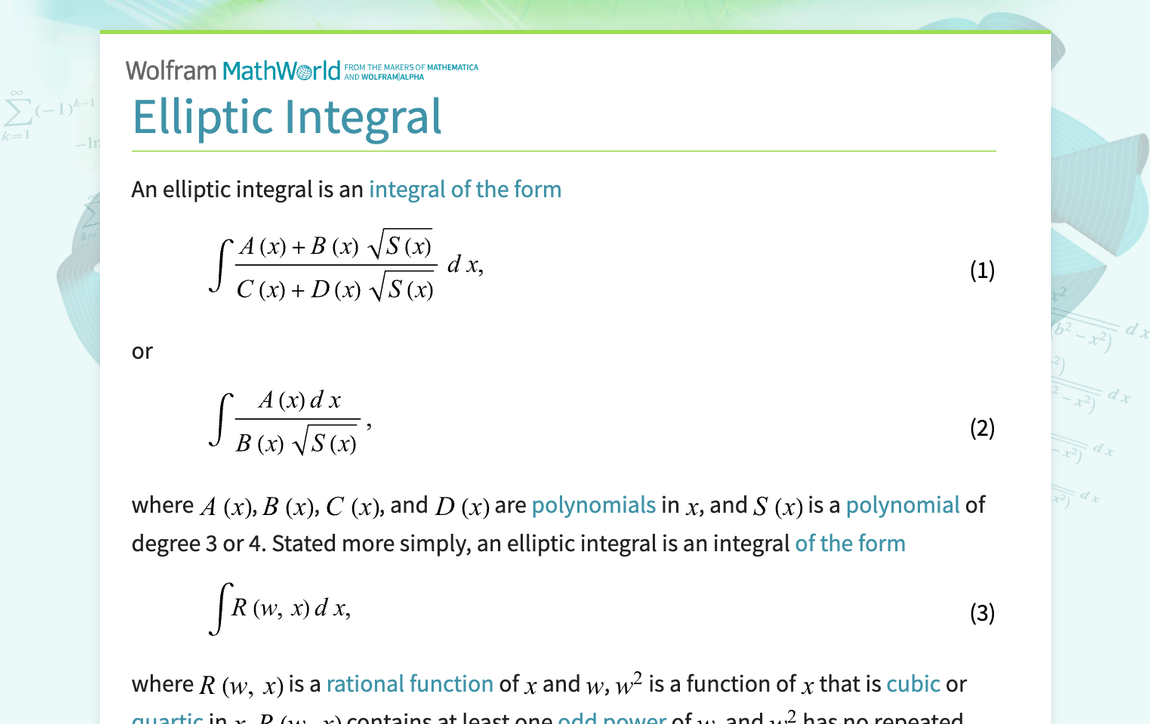
An elliptic integral is an integral of the form int(A(x)+B(x)sqrt(S(x)))/(C(x)+D(x)sqrt(S(x)))dx, (1) or int(A(x)dx)/(B(x)sqrt(S(x))), (2) where A(x), B(x), C(x), and D(x) are polynomials in x, and S(x) is a polynomial of degree 3 or 4. Stated more simply, an elliptic integral is an integral of the form intR(w,x)dx, (3) where R(w,x) ...
devout snowBOT
@lofty verge Has your question been resolved?
devout snowBOT
Channel closed
Closed due to timeout
Use .reopen if this was a mistake.
Available help channel!
Send your question here to claim the channel.
Remember:
• Ask your math question in a clear, concise manner.
• Show your work, and if possible, explain where you are stuck.
• Do not immediately ping people or roles. After 15 minutes, feel free to ping <@&286206848099549185> once.
• Type the command .close to free the channel when you're done.
• Be polite and have a nice day!
Read #❓how-to-get-help for further information on how to ask a good question, and about conduct in the question channels.
 deft flower
how do i properly use feynman's integration technique
 uneven coral
You'd likely have better luck in #math-discussion
deft flower
uneven coral
You'd likely have better luck in <#359052581022203914>
i just don't know what to do after calculating an image of the derivative of the function we set so i thought i might get help here
especially since it's quite a difficult integral
 deft flower
integral from 0 to pi/4 of cubic square of tanx
uneven coral
If you've got a particular question then you can share it here
cubic squares? Didn't get that
can you share an image of the question please
deft flower
uneven coral
cubic squares? Didn't get that
uhh the power of 1/3
 uneven coral
Have you tried the approach for √tanx?
deft flower
uneven coral
Have you tried the approach for √tanx?
not really
wait imma show you the whole progress
uneven coral
Sure mate
deft flower
sorry for the messy paper
 deft flower
alright sure !
woven radishBOT
doctorstrangejr
 uneven coral
Whoops, I hope you get it
deft flower
woven radish
**doctorstrangejr**
are the 3 and 6 powers ?
uneven coral
Yes
wait just take u^4 as t
3u^3du = dt
dt/1 + t^2
arctan(t)
Checks out?
Whoops no
It'd be dt/(1 + t^(3/2)
Ohhhh wait
Just take u^3 as t, and then do partial fraction
deft flower
uneven coral
Just take u^3 as t, and then do partial fraction
oh mb i went to watch a youtube video to help rq
deft flower
woven radish
**doctorstrangejr**
what is this going to help with with the original integral tho
uneven coral
Well multiply numerator and denominator with sec^2x, take tanx = t, then expand the sec^2x at the denominator to 1+t^2
That's how we do √tanx
 lunar harbor
deft flower
uneven coral
lunar harbor
deft flower
uneven coral
Here, I was left with t^(1/3)/(1 + t^2)
So take t^(1/3) as u
That gives 3u^3/(1 + u^6)
deft flower
ahhhhhhh i'm lost
so after i use u substitution i do partial fraction decomposition. is that right ?
uneven coral
Yes, now take u^3 as w
deft flower
like this ?
 uneven coral
Wait I'll do it and send a pic until that step
deft flower
thanks cuz this is midnight and my head is burning out 😭😭
uneven coral
Sorry for the delay

Damn there must be a method shorter than partial fraction after this, if anybody finds it then do message here
deft flower
uneven coral
Damn there must be a method shorter than partial fraction after this, if anybody...
exactly it's gonna be so long imma crash out
uneven coral
I'm doing it
deft flower
alright please send when you do !
deft flower
yeah
uneven coral


Just put in the 0 and 1s
Let me check from the integral calculator if this is correct or not
, w integrate cbrt(tanx)
woven radishBOT

 Requested by doctorstrangejr
uneven coral
Requested by doctorstrangejr
uneven coral
What in the world
deft flower
woven radish
what the hell is this
deft flower
youtube might be our only hope to check
but i think i was pretty close to getting it
with feynman's technique
uneven coral
Wait let's check the final answer
deft flower
i calculated I'(0)
uneven coral
,w arctan(-1/sqrt3)
woven radishBOT
 Requested by doctorstrangejr
deft flower
Requested by doctorstrangejr
deft flower
 deft flower
deft flower
deft flower
indefinite form
 deft flower
uneven coral
WHAT
deft flower
uneven coral
WHAT
where did u get it wrong
uneven coral
Dude
uneven coral
uneven coral
you see my working here
See how I smudged out the +Bx and wrote +Bw in the partial equation
deft flower
deft flower
imma check the answer using desmos
0.56
deft flower
uneven coral
I skipped it when finding the values of A,B and C<:bleakcat:913340873771716630>
LMAO
uneven coral
Holy shit, let me do this again
deft flower
alrrr
i just noticed that i used feynman's technique COMPLETLY wrong 💔
and ended up integration ln(tanx) for absolutly no reason

 deft flower
you're so goated for actually getting this monstrosity correct
uneven coral
Thanks man
uneven coral
Anytime man, this was both fun and a headache
deft flower
.close
devout snowBOT
Channel closed
Closed by @deft flower
Use .reopen if this was a mistake.
Available help channel!
Send your question here to claim the channel.
Remember:
• Ask your math question in a clear, concise manner.
• Show your work, and if possible, explain where you are stuck.
• Do not immediately ping people or roles. After 15 minutes, feel free to ping <@&286206848099549185> once.
• Type the command .close to free the channel when you're done.
• Be polite and have a nice day!
Read #❓how-to-get-help for further information on how to ask a good question, and about conduct in the question channels.
 simple grotto
$P+(VC-P)t+(VX-VO)x+(VY-VO)y=Q$ where VC is where on plane P x and y=0. This is proven correct. All collections of upper case letters are points as one together and lower case are variables. I would like to not have Q much and this is 4d+ projection. Another formula states $P+(VO+(VX-VO)x+(VY-VO)y-P)t=Q$, t is similar but x and y scaled by t here directly relate to the other x and y with subtracting VC x and y. See the program for interesting stuff. X E.
devout snowBOT
simple grotto
$P+(VC-P)t+(VX-VO)x+(VY-VO)y=Q$ where VC is where on plane P x and y=0. This is ...
woven radishBOT
maybeJosiah
