#help-27
1 messages · Page 370 of 1
 sand dove
computers like desmos can't do that because float type numbers have finite precision, when "x is p/q where q is odd" requires infinite precision
 drifting sierra
(so no, it's not that it can't be plotted by a computer, it's that the plot itself is not quite well defined)
 rough sparrow
is x^x defined only for postive integers for convinience?
drifting sierra
Note that Desmos can plot n^n for any integer n
sand dove
.
drifting sierra
sand dove
and that's because desmos works with a different type of data
computers work with integers quite well
sand dove
rough sparrow
is x^x defined only for postive integers for convinience?
x^x defined for all positive reals
drifting sierra
Yeah, you just can't really mix ints and floats (unless you specifically program that, but why bother)
 unborn osprey
drifting sierra
(so no, it's not that it can't be plotted by a computer, it's that the plot itse...
unborn osprey
drifting sierra
(so no, it's not that it can't be plotted by a computer, it's that the plot itse...
oohh cool
sand dove
when you ask to compute f(x) for specific values of x
like x = p/q with q odd
and p negative
desmos responds
but it doesn't plot it
because plotting is done with floats
rough sparrow
hmmm
sand dove
vs computing f(-1/3), -1/3 is interpreted as a rational number
rough sparrow
and then?
sand dove
well that's it
 devout snowBOT
Channel closed
Closed by @rough sparrow
Use .reopen if this was a mistake.
devout snowBOT
 Available help channel!
Send your question here to claim the channel.
Remember:
• Ask your math question in a clear, concise manner.
• Show your work, and if possible, explain where you are stuck.
• Do not immediately ping people or roles. After 15 minutes, feel free to ping <@&286206848099549185> once.
• Type the command .close to free the channel when you're done.
• Be polite and have a nice day!
Read #❓how-to-get-help for further information on how to ask a good question, and about conduct in the question channels.
 spring vessel
 devout snowBOT
spring vessel
spring vessel
devout snowBOT
spring vessel
spring vessel
any easy way to solve this?
i tried with that (5(x^2 +4x+ 3) + 5(4x+3))/(x^2+4x+3) but my answer is really different
 pseudo basin
use ^ for exponents
also 5(x^2 + 4x + 3) + 5(x^2 + 3) ≠ 5x^2 ...
you want to do the polynomial long division first
spring vessel
pseudo basin
also 5(x^2 + 4x + 3) + 5(x^2 + 3) ≠ 5x^2 ...
sorry i meant - instead of that +
spring vessel
pseudo basin
you want to do the polynomial long division first
hmm okay
pseudo basin
5(x^2 + 4x + 3) - 5(x^2 + 3) still isn't equal to 5x^2
pseudo basin
in any case btw, after the long division you'll have a mildly bashy but not terribly hard integral
spring vessel
(5(x^2 +4x+ 3) - 5(4x+3))/(x^2+4x+3
spring vessel
pseudo basin
in any case btw, after the long division you'll have a mildly bashy but not terr...
okay okay
 woven radishBOT
Ann
 spring vessel
pseudo basin
so you have that your fraction equals $5 - \frac{5(4x+3)}{x^2+4x+3}$
spring vessel
pseudo basin
so you have that your fraction equals $5 - \frac{5(4x+3)}{x^2+4x+3}$
yep
spring vessel
pseudo basin
so you just need to partial-fraction the rest
i tried but i am getting B as 45/2 and A as -5/2 , after solving with those values i am still not getting the correct answer
or whatever the answer is given at the back of my book
pseudo basin
theres like 37,000 different places you could've made an arithmetic fuckup
pseudo basin
which of these goes over which denom btw
spring vessel
i am geting (45/2)log (x+3) -(5/2)log(x+1)
spring vessel
pseudo basin
which of these goes over which denom btw
?
pseudo basin
is it A/(x+1) or is it A/(x+3)
spring vessel
the first one
pseudo basin
uh huh...
well ok, probably easier to differentiate your thing
,w d/dx [45/2 * log(x+3) - 5/2 * log(x+1)]
woven radishBOT


 spring vessel
number 16,(answer)
 spring vessel
pseudo basin
so your antideriv is correct
spring vessel
pseudo basin
so your antideriv is correct
yeah
pseudo basin
note the final answer will have to be 5 - I where I is the result of F(2)-F(1) with F(x)=
(45/2)log (x+3) -(5/2)log(x+1)
pseudo basin
spring vessel
number 16,(answer)
and what's your answer
spring vessel
pseudo basin
note the final answer will have to be **5 - I** where I is the result of F(2)-F(...
um i didnt get it
spring vessel
pseudo basin
and what's your answer
that one
spring vessel
woven radish
.
spring vessel
pseudo basin
wdym "didn't get"...
i didnt understand 😭
pseudo basin
when you found the definite integral
what did you get
if NOTHING: where did you hit a barrier
spring vessel
oh i might be dumb as shi 💀 i forgot its a definate integral
😭 i am sorry
i forgot to do that part
pseudo basin
you forgor 💀
devout snowBOT
Channel closed
Closed by @spring vessel
Use .reopen if this was a mistake.
devout snowBOT
Available help channel!
Send your question here to claim the channel.
Remember:
• Ask your math question in a clear, concise manner.
• Show your work, and if possible, explain where you are stuck.
• Do not immediately ping people or roles. After 15 minutes, feel free to ping <@&286206848099549185> once.
• Type the command .close to free the channel when you're done.
• Be polite and have a nice day!
Read #❓how-to-get-help for further information on how to ask a good question, and about conduct in the question channels.
 crimson silo
Can someone help me with part a and b pkease. I have started it but i think its wrong so a bit confused. 🤣
devout snowBOT
crimson silo
Can someone help me with part a and b pkease. I have started it but i think its ...


 hardy trail
crimson silo
Is Q (6,0)
hardy trail
crimson silo
Is Q (6,0)
Yep :) Your working out does show it!
crimson silo
So how do i do part A?
hardy trail
crimson silo
X cant =6 and it doesnt move anlong the x axis, only up the Y.
Wellllll x can equal 6, no?
hardy trail
crimson silo
What are the solutions to 2x(x - 6) = 0?
hardy trail
Good. So, what's the x coordinate of R?
crimson silo
0
hardy trail
crimson silo
Nice. I mean you can also look at the graph and see it's a little obvious:
R lies on the y axis. That means that, you should check x = 0 on both quadratics.
crimson silo
Yea but idk how to get the Y axis
hardy trail
R lies on the curve y = x^2 - 8x + 12, right?
hardy trail
crimson silo
So do i sub 6 in place of x
Hm, why 6?
hardy trail
crimson silo
0
Are you sure?
crimson silo
I sub in 0
hardy trail
You are good. No problem!
crimson silo
Ill fill out the formfor ya too 🙂
devout snowBOT
Channel closed
Closed by @crimson silo
Use .reopen if this was a mistake.
devout snowBOT
Available help channel!
Send your question here to claim the channel.
Remember:
• Ask your math question in a clear, concise manner.
• Show your work, and if possible, explain where you are stuck.
• Do not immediately ping people or roles. After 15 minutes, feel free to ping <@&286206848099549185> once.
• Type the command .close to free the channel when you're done.
• Be polite and have a nice day!
Read #❓how-to-get-help for further information on how to ask a good question, and about conduct in the question channels.
 spring oasis
 devout snowBOT
spring oasis
woven radishBOT
devout snowBOT
spring oasis
woven radishBOT
Renato


 devout snowBOT
Channel closed
Closed by @spring oasis
Use .reopen if this was a mistake.
devout snowBOT
Available help channel!
Send your question here to claim the channel.
Remember:
• Ask your math question in a clear, concise manner.
• Show your work, and if possible, explain where you are stuck.
• Do not immediately ping people or roles. After 15 minutes, feel free to ping <@&286206848099549185> once.
• Type the command .close to free the channel when you're done.
• Be polite and have a nice day!
Read #❓how-to-get-help for further information on how to ask a good question, and about conduct in the question channels.
 iron fiber
I am currently working through a textbook and have the following task
"Show that the equivalence relationships reflexivity, symmetry and transitivity actually are equivalence relationships"
Now I understand the definitions of these three terms as such, what I am struggling with is proving the statement because I do not know how to start. Can someone give me a pointer as to how to frame and think about this problem?
devout snowBOT
iron fiber
I am currently working through a textbook and have the following task
"Show th...
 upper schooner
(do you happen to have a picture of the question, and what it actually says? I'm not sure whether I'm parsing it correctly - are you being asked to show that some relation is an equivalence relation, and so satisfy those three terms?)
iron fiber
It is unfortunately in german. Let me translate it via deepl quickly
 stone stump
show original
iron fiber
ok let me install discord on my phone quickly 😄
Task 3 although I might have realized that I misinterpreted it. The other pages are there for reference


 olive snow
You want to prove that an equivalence relation has these three propreties verified ?
stone stump
"show that the examples of equivalence relations in section 1.2 are indeed equivalence relations"
mentioned examples:
x~y iff x and y live in the same city
x~y iff x and y are represented by the same member of the bundestag
x~y iff x=y
x~y iff x and y are parallel (lines)
x~y iff n | x-y
iron fiber
olive snow
You want to prove that an equivalence relation has these three propreties verifi...
This is probably what I am misunderstanding ... I thought (the question is pretty vague about it) I have to prove the equivalence relationships themselves and was pretty lost so most likely, yes, what you said is correct.
iron fiber
stone stump
"show that the examples of equivalence relations in section 1.2 are indeed equiv...
Ok then it is much clearer ... I'll go solve the question then. Thanks for the patience and dealing with my lack of interpretation skills haha 😄
I will close this chat then
.close
devout snowBOT
Channel closed
Closed by @iron fiber
Use .reopen if this was a mistake.
Available help channel!
Send your question here to claim the channel.
Remember:
• Ask your math question in a clear, concise manner.
• Show your work, and if possible, explain where you are stuck.
• Do not immediately ping people or roles. After 15 minutes, feel free to ping <@&286206848099549185> once.
• Type the command .close to free the channel when you're done.
• Be polite and have a nice day!
Read #❓how-to-get-help for further information on how to ask a good question, and about conduct in the question channels.
 shut crown
.
can someone please explain to me what a parallel projection is? i understand what a normal projection from say vector v onto z but what is a parallel projection. Yeah it gets right of a component but how is it parallel?
devout snowBOT
shut crown
can someone please explain to me what a parallel projection is? i understand wha...
 young spade
shut crown
can someone please explain to me what a parallel projection is? i understand wha...
young spade
shut crown
can someone please explain to me what a parallel projection is? i understand wha...
Okay, so
In reality they are basically the same
Normal Projection is used to find the projection of a vector v, to the direction perpendicular to a plane.
Parallel Projection is the projection of a vector v to a direction parallel to another vector
Or onto a plane.
I separeted the two because, if you give it some thought, the first description is quite literally the same process as Normal Projection
The "onto a plane" version is a bit different tho.
I swear there is a prettier formula for it, but you can find it by choosing two coplanar vectors as reference, doing Normal/parallel projection for each and adding both results
devout snowBOT
@shut crown Has your question been resolved?
devout snowBOT
Channel closed
Closed due to timeout
Use .reopen if this was a mistake.
Available help channel!
Send your question here to claim the channel.
Remember:
• Ask your math question in a clear, concise manner.
• Show your work, and if possible, explain where you are stuck.
• Do not immediately ping people or roles. After 15 minutes, feel free to ping <@&286206848099549185> once.
• Type the command .close to free the channel when you're done.
• Be polite and have a nice day!
Read #❓how-to-get-help for further information on how to ask a good question, and about conduct in the question channels.
Please don't occupy multiple help channels.
Channel closed
Channel closed due to the original message being deleted.
If you did not intend to do this, please open a new help channel,
as this action is irreversible, and this channel may abruptly lock.
Available help channel!
Send your question here to claim the channel.
Remember:
• Ask your math question in a clear, concise manner.
• Show your work, and if possible, explain where you are stuck.
• Do not immediately ping people or roles. After 15 minutes, feel free to ping <@&286206848099549185> once.
• Type the command .close to free the channel when you're done.
• Be polite and have a nice day!
Read #❓how-to-get-help for further information on how to ask a good question, and about conduct in the question channels.
 atomic idol
Ok so there’s this thing and I’m supposed to show that the dimension of it is N-1 by utilizing another expression
 devout snowBOT
atomic idol
Ok so there’s this thing and I’m supposed to show that the dimension of it is N-...
atomic idol
devout snowBOT
atomic idol
Ok so there’s this thing and I’m supposed to show that the dimension of it is N-...
atomic idol
This is the other expression and I was supposed to prove it’s surjective to help with the dimension but I’m not sure how that’s related
I think I have sth showing it’s surjective but it doesn’t seem helpful

The vector w is also complex and not the zero vector
 jaunty mantle
atomic idol
This is the other expression and I was supposed to prove it’s surjective to help...
jaunty mantle
atomic idol
This is the other expression and I was supposed to prove it’s surjective to help...
Think about the properties of tau here
jaunty mantle
atomic idol
Ok so there’s this thing and I’m supposed to show that the dimension of it is N-...
And what does this mean for S
Surjectivity is nice but surjective isn’t that related to the = 0 part
atomic idol
Not sure if I follow
jaunty mantle
What’s interesting about a = 0 condition
What else in linear algebra has a = 0 condition?
atomic idol
Linear independence?
jaunty mantle
True, what else
atomic idol
90 degree angle between vectors
jaunty mantle
Also now that I think about it you also need the surjectivity later
jaunty mantle
atomic idol
90 degree angle between vectors
We’re in a vector space we have no notion of angles
atomic idol
jaunty mantle
We’re in a vector space we have no notion of angles
I don’t think I can think of a different thing atm
jaunty mantle
atomic idol
I don’t think I can think of a different thing atm
Kernel/null space
atomic idol
Sorry I have 3 hours of sleep and a professor who demands that I submit homework in a mailbox
jaunty mantle
If A is a linear transformation then ker(A) is the subset of the domain of A such that Ax = 0
The kernel of A is everything A sends to 0
The kernel of A is a subspace
You should know these things
This is the basics of linear algebra it’s what everything else is built upon
atomic idol
I wish the order in which we learned things made sense
Looks like we’ll both suffer from it
jaunty mantle
Well start here
Show that kernel of A is a subspace
The trick I think here is to look at the kernel of tau
Since tau is surjective the image has dim 1
So the kernel must have dim domain - image = N-1
jaunty mantle
jaunty mantle
So the kernel must have dim domain - image = N-1
This uses the fundamental theorem of linear algebra
atomic idol
jaunty mantle
This uses the fundamental theorem of linear algebra
What would that be?
jaunty mantle
But S is precisely the kernel of tau
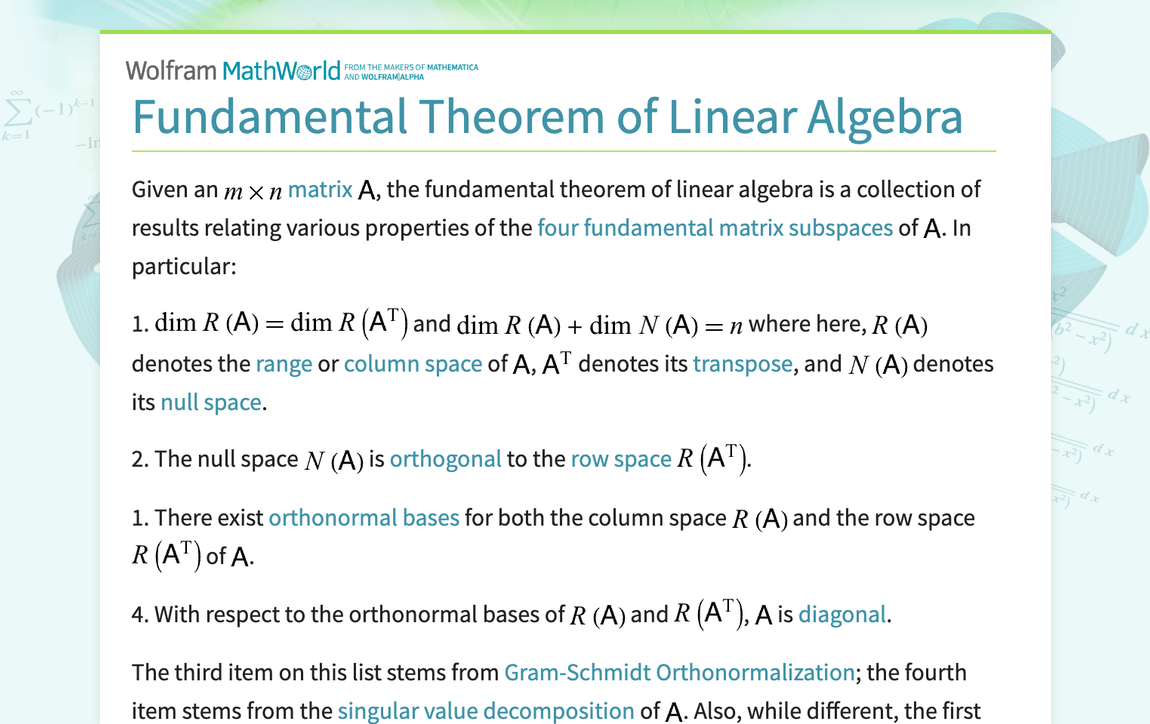
Given an m×n matrix A, the fundamental theorem of linear algebra is a collection of results relating various properties of the four fundamental matrix subspaces of A. In particular: 1. dimR(A)=dimR(A^(T)) and dimR(A)+dimN(A)=n where here, R(A) denotes the range or column space of A, A^(T) denotes its transpose, and N(A) denotes its null space....
You can ignore everything with orthogonality since we have no inner product
atomic idol
I should mention that my prof started talking about matrices today
I don’t know anything about those yet
Except for some very basic things I’ve figured out by myself
atomic idol
jaunty mantle
Since tau is surjective the image has dim 1
Can you elaborate that part please
devout snowBOT
@atomic idol Has your question been resolved?
jaunty mantle
atomic idol
Can you elaborate that part please
The image of a linear transformation is again a subspace
devout snowBOT
@atomic idol Has your question been resolved?
devout snowBOT
Channel closed
Closed due to timeout
Use .reopen if this was a mistake.
devout snowBOT
Available help channel!
Send your question here to claim the channel.
Remember:
• Ask your math question in a clear, concise manner.
• Show your work, and if possible, explain where you are stuck.
• Do not immediately ping people or roles. After 15 minutes, feel free to ping <@&286206848099549185> once.
• Type the command .close to free the channel when you're done.
• Be polite and have a nice day!
Read #❓how-to-get-help for further information on how to ask a good question, and about conduct in the question channels.
 radiant aspen
 devout snowBOT
radiant aspen
radiant aspen
devout snowBOT
radiant aspen
radiant aspen
so far ive completed this


 coral dragon
yeah, so did you calculate the values of Sat - Wed?
radiant aspen
we use something called stat crunch to make these calculations

but i have no clue what to select

can u help me figure how to do it
coral dragon
never seen this in my life ngl
radiant aspen
DAMN
coral dragon
radiant aspen
so far ive completed this
this yeah
coral dragon
you were supposed to do a box plot or answer which box plot is the correct one?
radiant aspen
idk wihich one
radiant aspen
can u help me do that
yo bro
@coral dragon
how do i find the correct box plot
🥀
coral dragon
first calculate Sat - Wed
coral dragon
| Camera | Sat | Wed | Sat − Wed |
|---|---|---|---|
| 2244 | 2 | 19 | −17 |
| 1671 | 14 | 8 | 6 |
| 2081 | 10 | 3 | 7 |
| 1964 | 5 | 8 | −3 |
| 1743 | 4 | 26 | −22 |
| 1151 | 1 | 2 | −1 |
| 2321 | 11 | 4 | 7 |
| 1142 | 30 | 8 | 22 |
| 1652 | 3 | 11 | −8 |
| 1514 | 3 | 17 | −14 |
| 2054 | 3 | 24 | −21 |
| 1934 | 1 | 9 | −8 |
| 3082 | 12 | 4 | 8 |
radiant aspen
ok
coral dragon
sorry for bad allignment
radiant aspen
u good i see it perfectly
coral dragon
now you look at biggest/lowest/median values
 radiant aspen
erm
coral dragon
so with the numbers you said

 radiant aspen
wait look

past this correct
ok
fixed it to noy be on top
then i

?
golod?
radiant aspen
huh
coral dragon

 coral dragon
hold up, cause now I'm confusing myself lol
radiant aspen
ok
🙁
im so cooked
🥀
im studying for my exam tmrw
idk how to even get a box plot
🥀
coral dragon
sir
radiant aspen
?
coral dragon
what program do youuse
radiant aspen
stat crunch
coral dragon
to generate plots
radiant aspen
stat crunch
coral dragon
you just need to select the Diff column, not Camera ID, Sat, or Wed
create the “Diff” column

 coral dragon
ah ok

 radiant aspen
LOL
wiat no ur right
i almost got it mistakend
i have 2 more pwease help me

ill calculate and just tell me if i got it correct
radiant aspen
e
its fine

why did i getting this?

ok
yo

here is the problem
it will only let me select one tax rate
and i need to do both to get my answers
or
i can just do one at a time
?
1


this what i got
its either b or c?
yo
bro
i think its c
am i correct
ik its c
coral dragon
ok lemme see
radiant aspen
and i think this is b


 coral dragon
radiant aspen
coral dragon
radiant aspen
I got this
 radiant aspen
 coral dragon
looks more like a B to me
radiant aspen
so im wrong because women is longer
coral dragon
but idk
radiant aspen
thats where i messed up
coral dragon
image kinda bad to read
coral dragon
radiant aspen
thats where i messed up
yep
coral dragon
that was my line of thought
radiant aspen
wait no
it cant be
so b or c
ima just go with b
but look
look at c
the lines r close
bu b there far
coral dragon
pretty sure it's B, cause woman has longer tail + man has outlier
B is the only that matches both
radiant aspen
radiant aspen
and i think this is b
what abt this im done
coral dragon
oh lemme se
radiant aspen
gemini said it was c 🥀
chat gpt said b 🥀
google said a 🥀
ima just do b fuck it
yo i think im done
i think the other one is correct
coral dragon
AI is bad at reading those imgs
coral dragon
 coral dragon
doesn't look like a match :despair:
radiant aspen
okay
 coral dragon
ah damn
devout snowBOT
If you are done with this channel, please mark your problem as solved by typing .close
radiant aspen
.close
devout snowBOT
Channel closed
Closed by @radiant aspen
Use .reopen if this was a mistake.
devout snowBOT
Available help channel!
Send your question here to claim the channel.
Remember:
• Ask your math question in a clear, concise manner.
• Show your work, and if possible, explain where you are stuck.
• Do not immediately ping people or roles. After 15 minutes, feel free to ping <@&286206848099549185> once.
• Type the command .close to free the channel when you're done.
• Be polite and have a nice day!
Read #❓how-to-get-help for further information on how to ask a good question, and about conduct in the question channels.
 full hollow
 devout snowBOT
full hollow
full hollow
devout snowBOT
full hollow
full hollow
!status
devout snowBOT
What step are you on?
1. I don't know where to begin.
2. I have begun but got stuck midway.
3. I got an answer but I was told that it's wrong.
4. I got an answer and would like my work checked.
5. I have a question about someone else's work/solution.
6. I have completed the problem and don't need help anymore. Thank you.
7. None of the above
Channel closed
Closed by @full hollow
Use .reopen if this was a mistake.
devout snowBOT
Available help channel!
Send your question here to claim the channel.
Remember:
• Ask your math question in a clear, concise manner.
• Show your work, and if possible, explain where you are stuck.
• Do not immediately ping people or roles. After 15 minutes, feel free to ping <@&286206848099549185> once.
• Type the command .close to free the channel when you're done.
• Be polite and have a nice day!
Read #❓how-to-get-help for further information on how to ask a good question, and about conduct in the question channels.
 restive river
i got x = pi/3 or cos(x) = 1/2, can anyone confirm?

 rare kernel
ye its correct
u can confirm by urself putting x value in the expression and seeing what it evaluates to
devout snowBOT
Channel closed
Closed by @granite mural
Use .reopen if this was a mistake.
devout snowBOT
Available help channel!
Send your question here to claim the channel.
Remember:
• Ask your math question in a clear, concise manner.
• Show your work, and if possible, explain where you are stuck.
• Do not immediately ping people or roles. After 15 minutes, feel free to ping <@&286206848099549185> once.
• Type the command .close to free the channel when you're done.
• Be polite and have a nice day!
Read #❓how-to-get-help for further information on how to ask a good question, and about conduct in the question channels.
 fervent helm
 devout snowBOT
fervent helm
fervent helm
devout snowBOT
fervent helm
fervent helm
I can't see the pattern, can anybody please help
 wild grove
The bottom looks like n • (4n+3)
 rain summit
fervent helm
but what about the numerator
rain summit
fervent helm
but what about the numerator
First term is 2^3 - 1^3
Second term adds in 4^3 - 3^3
Third term = 2nd term + 6^3 - 5^3
fervent helm
rain summit
Second term adds in 4^3 - 3^3
but there denominators are different right?
rain summit
fervent helm
but there denominators are different right?
Ye
fervent helm
then how?
rain summit
fervent helm
then how?
So like, each "pair" is just $n^3 - (n-1)^3$
woven radishBOT
1 divided by 0 equals Infinity
 rain summit
Try using the difference of cubes identity
fervent helm
alright
rain summit
woven radish
**1 divided by 0 equals Infinity**
Try to simplify each pair
fervent helm
my bad
rain summit
You should get your first factor as 1
fervent helm
i don't get it
rain summit
woven radish
**1 divided by 0 equals Infinity**
Try factoring this
So you could see what the pattern is clearer
woven radishBOT
Prathmesh
 rain summit
The 1s is self explanatory
wild grove
rain summit
So like, each "pair" is just $n^3 - (n-1)^3$
Isn't that (2n)³-(2n-1)³?
rain summit
wild grove
Isn't that (2n)³-(2n-1)³?
Assuming n is an even number
fervent helm
rain summit
The 1s is self explanatory
I still don't get it
wild grove
rain summit
Assuming n is an even number
Odd work too wdym
 tribal patio
woven radish
**Prathmesh**
tribal patio
woven radish
**Prathmesh**
$\sum_{n=1}^{15} (4n^2 + (2n-1)^2 + 2n \cdot (2n-1))$
woven radishBOT
Hunter
 tribal patio
hmm the first two term would add up so you get sum of square if you know what the formula is
if you expand the last term it would be 4n^2 this's also sum of square
2n is just sum of integers from 1 twice
 glossy dew
yeah
fervent helm
okkkk
glossy dew
or you can do
2 x (sum of even cubes from 2 to 2n) - (sum of cubes from 1 to n)
fervent helm
got it
glossy dew
it all cancels
 tribal patio
find a_n close form, then bn-b_{n-1} = a_n = that close form then you could find close form of b_n
It seems like close form of b_n is quadratic sequence
devout snowBOT
@fervent helm Has your question been resolved?
 deep abyss
(2n-1)n²
This might be tje general form @fervent helm
Then u simplify the sigma
And put n=15 at last
glossy dew
fervent helm
can you please tell this one too
since sequence for a is 1, 3, 5...
sequence for b would be 1, 1 + 3, 1 + 3 + 5, ...
devout snowBOT
Channel closed
Closed due to timeout
Use .reopen if this was a mistake.
glossy dew
which is just n²
devout snowBOT
Available help channel!
Send your question here to claim the channel.
Remember:
• Ask your math question in a clear, concise manner.
• Show your work, and if possible, explain where you are stuck.
• Do not immediately ping people or roles. After 15 minutes, feel free to ping <@&286206848099549185> once.
• Type the command .close to free the channel when you're done.
• Be polite and have a nice day!
Read #❓how-to-get-help for further information on how to ask a good question, and about conduct in the question channels.
devout snowBOT
Channel closed
Channel closed due to the original message being deleted.
If you did not intend to do this, please open a new help channel,
as this action is irreversible, and this channel may abruptly lock.
 gleaming gorge
pseudo basin
gleaming gorge
pseudo basin
it's already closed, just leave it
devout snowBOT
Available help channel!
Send your question here to claim the channel.
Remember:
• Ask your math question in a clear, concise manner.
• Show your work, and if possible, explain where you are stuck.
• Do not immediately ping people or roles. After 15 minutes, feel free to ping <@&286206848099549185> once.
• Type the command .close to free the channel when you're done.
• Be polite and have a nice day!
Read #❓how-to-get-help for further information on how to ask a good question, and about conduct in the question channels.
 wanton tiger
is there a way to do this without randomly putting values
 glossy dew
graph
wanton tiger
and i also want to know what f(x) really is because it says min of smth comma smth?
wanton tiger
glossy dew
graph
like f of x is min of both of those vlaues ?
glossy dew
minimum of the functions at that point
like the smaller of both is the function at that point
 lyric hornet
if 1/2-3x^2/4 at a particular x-value is smaller, take that value, otherwise take the value of 5x^2/4
glossy dew
yeah just draw the graph
lyric hornet
[\operatorname{min}(a(x),b(x)):=\begin{cases}a(x)&\text{if }a(x)<b(x)\b(x)&\text{if }a(x)>b(x)\\end{cases}]
woven radishBOT
ΠαϳαμαΜαμαΛλαμα
 wanton tiger
so what i do is find x where the function changes to the 2nd definition
devout snowBOT
Channel closed
Closed by @wanton tiger
Use .reopen if this was a mistake.
rain summit
woven radish
**ΠαϳαμαΜαμαΛλαμα**
What if a(x) = b(x) 
devout snowBOT
Available help channel!
Send your question here to claim the channel.
Remember:
• Ask your math question in a clear, concise manner.
• Show your work, and if possible, explain where you are stuck.
• Do not immediately ping people or roles. After 15 minutes, feel free to ping <@&286206848099549185> once.
• Type the command .close to free the channel when you're done.
• Be polite and have a nice day!
Read #❓how-to-get-help for further information on how to ask a good question, and about conduct in the question channels.
 frozen aurora
i want to prove that
$$
\int_{x_1=0}^1 \cdots \int_{x_m=x_{m-1}}^m 1 , dx_m \cdots dx_1 = \frac{(m+1)^{m-1}}{m!}
$$
devout snowBOT
frozen aurora
i want to prove that
$$
\int_{x_1=0}^1 \cdots \int_{x_m=x_{m-1}}^m 1 \, dx_m \cd...
woven radishBOT
artemetra
 frozen aurora
but i don't know how to do this

Mathematics Stack Exchange
Let $a_n \sim \operatorname{Unif}[0,n]$ be a sequence independent uniform random variables. The goal of the problem is to find the probability that the first 5 of these random variables turn out to...
frozen aurora
woven radish
**artemetra**
i tried computing a general
$$
\int_{x_1=0}^1 \cdots \int_{x_m=x_{m-1}}^m f(x_m) , dx_m \cdots dx_1
$$
for any $f$ so that i can substitute $f(x_m)=\int_{x_m}^{m+1} 1 dx_m$ and do induction
but that seems to be harder than the original problem
woven radishBOT
artemetra

 faint gorge
woven radish
**artemetra**
faint gorge
woven radish
**artemetra**
can't you use fubini in the inductive step?
frozen aurora
how? the bounds depend on the variable w.r.t. which we are integrating?
or am i wrong
my multivar is rusty asf
also $f(x_m)=\int_{x_{m+1}=x_m}^{m+1} 1 dx_{m+1}$
like that
woven radishBOT
artemetra
 stone stump
so if you compute the inner integral then you have int int int ... c-x_i dx dx dx which you can pull apart into int int int c dx dx dx - int int int x_i dx dx dx
where I'm too lazy to type properly
the first one should certainly be doable with induction
and the second also doesnt feel that bad?
faint gorge
the goat
stone stump
frankly you probably just have to get your hands dirty
devout snowBOT
@frozen aurora Has your question been resolved?
frozen aurora
stone stump
the first one should certainly be doable with induction
the first one is basically the original one if you take the constnant c out of all the integrals, but the second one is like the original but with x instead of 1, which looks harder...
but I'll give it a try
frozen aurora
stone stump
frankly you probably just have to get your hands dirty
that's fair :(
devout snowBOT
@frozen aurora Has your question been resolved?
devout snowBOT
@frozen aurora Has your question been resolved?
 tender kite
devout snowBOT
tender kite
devout snowBOT
@frozen aurora Has your question been resolved?
frozen aurora
i'll try this later
devout snowBOT
Channel closed
Closed by @frozen aurora
Use .reopen if this was a mistake.
Available help channel!
Send your question here to claim the channel.
Remember:
• Ask your math question in a clear, concise manner.
• Show your work, and if possible, explain where you are stuck.
• Do not immediately ping people or roles. After 15 minutes, feel free to ping <@&286206848099549185> once.
• Type the command .close to free the channel when you're done.
• Be polite and have a nice day!
Read #❓how-to-get-help for further information on how to ask a good question, and about conduct in the question channels.
 worldly tapir
How do we turn a sine function into a cos function/ cos function into sin function
devout snowBOT
worldly tapir
How do we turn a sine function into a cos function/ cos function into sin functi...
 hollow jolt
you mean put it in that form?
worldly tapir
hollow jolt
you mean put it in that form?
yes switch between forms i can show an example
hollow jolt
cos(90-A)=sinA
worldly tapir
yea but we do it in radians
hollow jolt
then just cos(pi/2-A)=sinA
worldly tapir
 worldly tapir
worldly tapir
worldly tapir
for this example we dont need to care about the negative sign right
worldly tapir
hollow jolt
but pretend 4(x-3pi/4)=A and then swap it
i see, but then for this pretend we only have cos

shouldnt this be 0?
worldly tapir
hollow jolt
what would be 0?
it would be pie/2 - pie/2
hollow jolt
oh
worldly tapir
hollow jolt
youre just converting a function right?
yes from cos to sine
hollow jolt
$2(\theta-\frac{\pi}{4})=A$
woven radishBOT
ImOakley
 hollow jolt
$\frac{\pi}{2}-A=\frac{\pi}{2}-2(\theta-\frac{\pi}{4})$
woven radishBOT
ImOakley
 hollow jolt
$=\frac{\pi}{2}-2\theta+\frac{\pi}{2}$
woven radishBOT
ImOakley
 hollow jolt
$=\pi-2\theta$
woven radishBOT
ImOakley
 worldly tapir
im so confused 😭
hollow jolt
this is the bit inside the trig function
worldly tapir
hollow jolt
this is the bit inside the trig function
wym
hollow jolt
you have $y=7\sin{[2(\theta-\frac{\pi}{4})]}-3$
woven radishBOT
ImOakley
 hollow jolt
you need to convert $\sin{[2(\theta-\frac{\pi}{4})]}$ into cosine
woven radishBOT
ImOakley
 hollow jolt
the angle in question is always the entirety of whats inside the sine
so to convert it into cosine you minus the whole thing from pi/2
devout snowBOT
@worldly tapir Has your question been resolved?
devout snowBOT
Channel closed
Closed due to timeout
Use .reopen if this was a mistake.
Available help channel!
Send your question here to claim the channel.
Remember:
• Ask your math question in a clear, concise manner.
• Show your work, and if possible, explain where you are stuck.
• Do not immediately ping people or roles. After 15 minutes, feel free to ping <@&286206848099549185> once.
• Type the command .close to free the channel when you're done.
• Be polite and have a nice day!
Read #❓how-to-get-help for further information on how to ask a good question, and about conduct in the question channels.
 ashen temple
hollow jolt
the angle in question is always the entirety of whats inside the sine
ashen temple
hollow jolt
the angle in question is always the entirety of whats inside the sine
I didn't ask 🤣
devout snowBOT
ashen temple
I didn't ask 🤣
ashen temple
Hell yeah
 jade pecan
do u have a question
faint gorge
a question you didn't ask
 soft umbra
.solved
devout snowBOT
Channel closed
Closed by @soft umbra
Use .reopen if this was a mistake.
soft umbra
ashen temple
I didn't ask 🤣
Gotcha
 cold haven
ashen temple
I didn't ask 🤣
cold haven
ashen temple
I didn't ask 🤣
<@&268886789983436800> check their history.
 winter torrent
cold haven
<@&268886789983436800> check their history.
winter torrent
cold haven
<@&268886789983436800> check their history.
what the heck
jade pecan
he didnt ask it seems like
winter torrent
ashen temple
I didn't ask 🤣
find something marginally more productive to do with your time
cold haven
winter torrent
what the heck
...is that for me or for them. 
cold haven
jade pecan
he didnt ask it seems like
ohhh my bad.
devout snowBOT
Available help channel!
Send your question here to claim the channel.
Remember:
• Ask your math question in a clear, concise manner.
• Show your work, and if possible, explain where you are stuck.
• Do not immediately ping people or roles. After 15 minutes, feel free to ping <@&286206848099549185> once.
• Type the command .close to free the channel when you're done.
• Be polite and have a nice day!
Read #❓how-to-get-help for further information on how to ask a good question, and about conduct in the question channels.
devout snowBOT
Channel closed
Channel closed due to the original message being deleted.
If you did not intend to do this, please open a new help channel,
as this action is irreversible, and this channel may abruptly lock.
devout snowBOT
Available help channel!
Send your question here to claim the channel.
Remember:
• Ask your math question in a clear, concise manner.
• Show your work, and if possible, explain where you are stuck.
• Do not immediately ping people or roles. After 15 minutes, feel free to ping <@&286206848099549185> once.
• Type the command .close to free the channel when you're done.
• Be polite and have a nice day!
Read #❓how-to-get-help for further information on how to ask a good question, and about conduct in the question channels.
 jolly notch
wolframalpha doesn't seem to be accepting delay terms? trying to plot a nyquist
 devout snowBOT
jolly notch
wolframalpha doesn't seem to be accepting delay terms? trying to plot a nyquist
jolly notch
devout snowBOT
jolly notch
wolframalpha doesn't seem to be accepting delay terms? trying to plot a nyquist
jolly notch
works fine without delay
jolly notch
sorry i'll try to find somewhere else
devout snowBOT
@jolly notch Has your question been resolved?
devout snowBOT
Channel closed
Closed due to timeout
Use .reopen if this was a mistake.
devout snowBOT
Available help channel!
Send your question here to claim the channel.
Remember:
• Ask your math question in a clear, concise manner.
• Show your work, and if possible, explain where you are stuck.
• Do not immediately ping people or roles. After 15 minutes, feel free to ping <@&286206848099549185> once.
• Type the command .close to free the channel when you're done.
• Be polite and have a nice day!
Read #❓how-to-get-help for further information on how to ask a good question, and about conduct in the question channels.
 spark quarry
help !
 devout snowBOT
spark quarry
help !
devout snowBOT
spark quarry
help !
 weak cove
spark quarry
help !
weak cove
spark quarry
help !
You just have to keep track of your parenthesis and the order of operations
Do you have a specific example of an operation you want to try
spark quarry

this one …. Why isnt it working when i am solving the equation … i manually had to try the options..
 coarse flume
spark quarry
coarse flume
spark quarry
You divided both sides by 0.05 so it should have become 0.15/0.05=1+B
weak cove
spark quarry
put the right hand side of he equation in line 2 inside parenthesis
(0.05+B(0.05)
and then when you divide both sides
you will get something different than what you wrote
spark quarry
so even if right side was 0.05 * B(0.05) i should have put it in parenthesis first?
weak cove
spark quarry
so even if right side was 0.05 * B(0.05) i should have put it in parenthesis fir...
That is what the right hand side is already
So yes
coarse flume
They meant if it was mutiply instead of add
spark quarry
coarse flume
They meant if it was mutiply instead of add
yes… will it still become 1*B ?
 devout snowBOT
Channel closed
Closed by @spark quarry
Use .reopen if this was a mistake.
devout snowBOT
Available help channel!
Send your question here to claim the channel.
Remember:
• Ask your math question in a clear, concise manner.
• Show your work, and if possible, explain where you are stuck.
• Do not immediately ping people or roles. After 15 minutes, feel free to ping <@&286206848099549185> once.
• Type the command .close to free the channel when you're done.
• Be polite and have a nice day!
Read #❓how-to-get-help for further information on how to ask a good question, and about conduct in the question channels.
 faint sage
I think I might be stupid but how do I justify x^2+x+2 is greater than 0 for all reals
trying to find domain and I know the function x^2+x+2 is greater tha 0 for all reals but not sure mathematically how to come to that conclusion
 devout snowBOT
faint sage
I think I might be stupid but how do I justify x^2+x+2 is greater than 0 for all...
devout snowBOT
faint sage
I think I might be stupid but how do I justify x^2+x+2 is greater than 0 for all...
 fossil locust
faint sage
I think I might be stupid but how do I justify x^2+x+2 is greater than 0 for all...
fossil locust
faint sage
I think I might be stupid but how do I justify x^2+x+2 is greater than 0 for all...
complete the square!
faint sage
oh
oh no I completely forgot how to do that
haven't touched complete the square since grade 10 :((((
.close
devout snowBOT
Channel closed
Closed by @faint sage
Use .reopen if this was a mistake.
fossil locust
faint sage
oh
oh no I completely forgot how to do that
haven't touched complete the square...
or you could set d/dx (x^2 + x + 2) = 0
then sub that x-value back in
since it's concave up (*+*x^2) you know that must be the minimum
 fringe summit
 fossil locust
fringe summit
fossil locust
fringe summit
!occupied
devout snowBOT
fringe summit
Someone else is already using this help channel. If you need help with a question, please open your own help channel/thread (see #❓how-to-get-help for instructions).
fringe summit
fossil locust
!occupied
Can u explain clearly
 late scaffold
fringe summit
Can u explain clearly
late scaffold
fringe summit
Can u explain clearly
this channel is in use
fossil locust
fringe summit
Can u explain clearly
ask in #help-44|stanley-🌲-v2-dans
fringe summit
fossil locust
ask in <#972908483877945354>
Ok
devout snowBOT
Available help channel!
Send your question here to claim the channel.
Remember:
• Ask your math question in a clear, concise manner.
• Show your work, and if possible, explain where you are stuck.
• Do not immediately ping people or roles. After 15 minutes, feel free to ping <@&286206848099549185> once.
• Type the command .close to free the channel when you're done.
• Be polite and have a nice day!
Read #❓how-to-get-help for further information on how to ask a good question, and about conduct in the question channels.
 earnest rivet
on the bottom line, i think that if i can show that thing in brackets is equal to 1, then the proof is complete, but im not sure how to show it is equal to 1, as there are so many terms in the bracket, (as its the sum of the recipricol of (k+1) multiplied by any number(x) between 1 and k), or maybe theres a different way to approach this? thanks

 devout snowBOT
earnest rivet
on the bottom line, i think that if i can show that thing in brackets is equal t...
earnest rivet
devout snowBOT
earnest rivet
on the bottom line, i think that if i can show that thing in brackets is equal t...
earnest rivet
oops when n = 3, s_n is also 3
deep abyss
I think it would give an exponential series?
earnest rivet
like e = 1 + 1/1! + 1/2! + ... ?
deep abyss
Yeah
deep abyss
e-1
I dont think u understand the ques
Reciprocal of product of elements
Not product of reciprocals of elements
 dark talon
Sorry to intrude but arent these two the same
deep abyss
Not really no
deep abyss
deep abyss
Reciprocal of *product of elements*
U find the product first then reciprocate it
Oh wait
I dont understand ur soln dang TT
dark talon

earnest rivet
s_k+1 will contain all of s_k and also contain the sum of recipricols of (k+1), (k+1)(k) and loads of other terms like (k+1)(2), (k+1)(k-5)(4)(1) etc
no its ok my working out sucks
earnest rivet
earnest rivet
s_k+1 will contain all of s_k and also contain the sum of recipricols of (k+1), ...
s_k+1 contains s_k and also the sum of all the recipricols or all the possible terms containing a (k+1) 😭 if that makes any sense
 lusty sapphire
I don't get how you're getting $S_2=2$. Wouldn't it be $\frac11+\frac1{1\times2}$?
woven radishBOT
SWR
 lusty sapphire
Oh. You are doing every subset
The question is ambiguous because i think it just wants you to do the subsets {1,2,...,n}
earnest rivet
whats the difference between subsets and every subset
lusty sapphire
My interpretation is that it wants you to do just the sets {1}, {1,2}, {1,2,3} etc
But maybe i am wrong
But it could be the way you are thinking, because you're getting a nice result
earnest rivet

i think this works, since every new term involving (k+1) will be the same as the amount in S_k, since its just each term in S_k multiplied by k+1, and then we have the unique 1/(k+1) term
.close
devout snowBOT
Channel closed
Closed by @earnest rivet
Use .reopen if this was a mistake.
devout snowBOT
Available help channel!
Send your question here to claim the channel.
Remember:
• Ask your math question in a clear, concise manner.
• Show your work, and if possible, explain where you are stuck.
• Do not immediately ping people or roles. After 15 minutes, feel free to ping <@&286206848099549185> once.
• Type the command .close to free the channel when you're done.
• Be polite and have a nice day!
Read #❓how-to-get-help for further information on how to ask a good question, and about conduct in the question channels.
 torn thicket
Let $S$ be a nonempty set and let $e \in S$. Define an operation $*$ on $S$ by putting $a * b = e$ for all $a, b \in S$.
(a) Show that $S$ is a semigroup under the operation $*$.
woven radishBOT
edg
 devout snowBOT
torn thicket
Let $S$ be a nonempty set and let $e \in S$. Define an operation $*$ on $S$ by p...
torn thicket
devout snowBOT
torn thicket
Let $S$ be a nonempty set and let $e \in S$. Define an operation $*$ on $S$ by p...
torn thicket
Here's my current progress so far
\begin{proof}
Let us recall that a semigroup is a nonempty set that has associative property. Suppose that there exists another element $c \in S$, we will verify whether $S$ is associative and closed under $*$.
$$(a * b) * c = a * (b * c)$$
Checking the left side, because we know that $a * b = e$,
$$e * c = a * (b * c)$$
\end{proof}
woven radishBOT
edg
 torn thicket
Since we know that a * b = e, how will we know what's e * c or b * c even? This is the part where I'm kinda stuck
 pulsar sand
You have more than just a * b = e since that is true for all a,b in S
torn thicket
the problem doesnt give anything other than that
 toxic grove
a and b aren't specific elements in S
The question says that for any a and b, a * b = e
i.e. any two elements multiply together to get e
That's what the upside down A means
torn thicket
even though it says for all a, b in S? or am i understanding it wrong
toxic grove
Yes you're understanding it wrong
Think of it this way
If I want to define a function of the real numbers, I might say that f(x) = 2 * x for all x
x isn't a specific number, it's just a stand in
It's exactly the same here
torn thicket
i see
toxic grove
a and b don't represent specific elements of S, they're just standins
toxic grove
torn thicket
\begin{proof}
Let us recall that a semigroup is a nonempty set that has associat...
And it's exactly the same for a, b, c here
torn thicket
then how should i approach this problem?
am i to say that a * b = e and b * c = e?
since they're just arbitrary
toxic grove
That's correct
devout snowBOT
Channel closed
Closed by @torn thicket
Use .reopen if this was a mistake.
toxic grove
torn thicket
\begin{proof}
Let us recall that a semigroup is a nonempty set that has associat...
Oh yeah also another nitpick
torn thicket
oh
toxic grove
The set does not have the associative property
The operation does
The set is just a set
devout snowBOT
Available help channel!
Send your question here to claim the channel.
Remember:
• Ask your math question in a clear, concise manner.
• Show your work, and if possible, explain where you are stuck.
• Do not immediately ping people or roles. After 15 minutes, feel free to ping <@&286206848099549185> once.
• Type the command .close to free the channel when you're done.
• Be polite and have a nice day!
Read #❓how-to-get-help for further information on how to ask a good question, and about conduct in the question channels.
 junior heron
for part A, i just have no idea how to parametrize that intersection curve
 devout snowBOT
junior heron
for part A, i just have no idea how to parametrize that intersection curve
junior heron
devout snowBOT
junior heron
for part A, i just have no idea how to parametrize that intersection curve
junior heron
i tried plugging in for y in the second equation but got 2 quadratics
 upbeat isle
you do not need to parametrize the curve of intersection c to evaluate the line integral
devout snowBOT
@junior heron Has your question been resolved?
junior heron
upbeat isle
you do not need to parametrize the curve of intersection c to evaluate the line ...
HUH???
how would you do it
junior heron
so i see on desmos 3d that from the positive y axis its a circle
so that is a closed loop therefore integral is 0 ??
upbeat isle
yup
upbeat isle
junior heron
so that is a closed loop therefore integral is 0 ??
exactly
junior heron
if thats true how would i know that without desmos 3d
junior heron
and how does that tell me its closed
 graceful cosmos
One curve is a "3d quadratic" and the other is a plane. You might imagine they make some kind of ellipse
upbeat isle
oh wait my bad
upbeat isle
graceful cosmos
One curve is a "3d quadratic" and the other is a plane. You might imagine they m...
yes this is the correct response for that question
 grand edge
junior heron
and how does that tell me its closed
grand edge
junior heron
and how does that tell me its closed
It doesn't tell you it's a closed loop, it just tells you it's a conservative vector field
devout snowBOT
Channel closed
Closed by @junior heron
Use .reopen if this was a mistake.
devout snowBOT
Available help channel!
Send your question here to claim the channel.
Remember:
• Ask your math question in a clear, concise manner.
• Show your work, and if possible, explain where you are stuck.
• Do not immediately ping people or roles. After 15 minutes, feel free to ping <@&286206848099549185> once.
• Type the command .close to free the channel when you're done.
• Be polite and have a nice day!
Read #❓how-to-get-help for further information on how to ask a good question, and about conduct in the question channels.
 karmic sluice
Hey, I’m stuck and this is starting to feel pretty convoluted, so I’ll try to be clear.
What I have:
A timestamped stochastic time-series (e.g. market prices). It’s noisy but when an event happens the series often shows a reaction (up or down), sometimes strong, sometimes subtle, sometimes nothing, thats what I am investigating.
A sequential list of events (ordered list). There are 5 possible event types (call them 1..5). I know the sequence and the type at each position, but no timestamps — just the order (e.g. 3 → 2 → 3 → 4 → 1 → ...).
I expect each event (usually) causes a reaction in the time-series.
Goal:
Align each event in the ordered list to the most likely reaction in the time-series and learn how each event type (1..5) typically affects the series (direction, magnitude).
Why this is hard:
The timeseries is stochastic many spontaneous moves that are not caused by events.
Reactions vary by event type and magnitude.
Events only come with order, not time.
Lag is unknown and non-stationary. Between each event.
Any help will be appreciated
devout snowBOT
karmic sluice
Hey, I’m stuck and this is starting to feel pretty convoluted, so I’ll try to be...
 supple knot
yea there's not enough information to help you unless you give more information to "reaction in the time-series." that's uninformative to the problem
devout snowBOT
@karmic sluice Has your question been resolved?
devout snowBOT
Channel closed
Closed due to timeout
Use .reopen if this was a mistake.
Available help channel!
Send your question here to claim the channel.
Remember:
• Ask your math question in a clear, concise manner.
• Show your work, and if possible, explain where you are stuck.
• Do not immediately ping people or roles. After 15 minutes, feel free to ping <@&286206848099549185> once.
• Type the command .close to free the channel when you're done.
• Be polite and have a nice day!
Read #❓how-to-get-help for further information on how to ask a good question, and about conduct in the question channels.
 bold vale
i found EX1 and EX2 using conditional expectation and im recognizing a pattern but im struggling to find a closed form for the pattern
 devout snowBOT
bold vale
i found EX1 and EX2 using conditional expectation and im recognizing a pattern b...
bold vale
devout snowBOT
bold vale
i found EX1 and EX2 using conditional expectation and im recognizing a pattern b...
bold vale
i did
its
so x1 is 1 + 2/9, x2 is 1 + 4/9 + 4/27
x3 is 1 + 3(2/9) + 3(4/27) + 8/81
bold vale
its def some sort of geometric series but im struggling to find a closed form
bold vale
winter torrent
i think i get it as 1 + 4/9 + 4/81
For X_2?
winter torrent
ya
woven radishBOT
uni
 winter torrent
ya where did that 3 in the denominator come from
winter torrent
bold vale
if you lose twice in a row you have 1/3 dollars
you'd have 1/9
winter torrent
so you mentioned geometric series
bold vale
r is 2/some faactor of 3
winter torrent
why do you think that?
bold vale
it seems like ur multiplying by 1/3 each time
bold vale
yes
winter torrent
and ex1 = 1 + 2/9?
bold vale
yes
winter torrent
and ex2 = 1 + 4/9 + 4/81 
bold vale
yup
winter torrent
do you see a pattern there?
bold vale
so r = 2/9
winter torrent
try computing ex3
winter torrent
yawp
bold vale
1 + 2/3 + 4/9 + 8/9^3
winter torrent
instead of 27^2 let's say 9^3
one thing that's interesting about this problem is that it's kinda symmetric
it doesn't really matter what you start with, right? like it's all the same
if you started with $100
then your ev after 1 round would be 100 (1 + 2/9)
winter torrent
so what if you started with 1 + 2/9?
bold vale
ur ev would be (1 + 2/9)^2?
winter torrent
yawp
bold vale
So is EX2 just EX1 as if you started with (1+2/9)
Ohhhhhhhhh
Thank you
do u have any tips for recognizing patterns like this cuz i feel like this is the part i sometimes struggle w
winter torrent
hmm
sometimes it's just experience but in this case there's something called linearity of expectations
i didn't recognise it immediately
bold vale
wait how does linearity of expectation apply
devout snowBOT
@bold vale Has your question been resolved?
Channel closed
Closed by @bold vale
Use .reopen if this was a mistake.
devout snowBOT
Available help channel!
Send your question here to claim the channel.
Remember:
• Ask your math question in a clear, concise manner.
• Show your work, and if possible, explain where you are stuck.
• Do not immediately ping people or roles. After 15 minutes, feel free to ping <@&286206848099549185> once.
• Type the command .close to free the channel when you're done.
• Be polite and have a nice day!
Read #❓how-to-get-help for further information on how to ask a good question, and about conduct in the question channels.
restive river
im stuck pls helppp
i got a+b+c = 64a-14 but idk what to do from here
 devout snowBOT
restive river
im stuck pls helppp
i got a+b+c = 64a-14 but idk what to do from here
restive river
devout snowBOT
restive river
im stuck pls helppp
i got a+b+c = 64a-14 but idk what to do from here
restive river
only thing i know about a is that it should be positive
restive river
ya
 solemn cloak
What is a vertex?
restive river
9, -14
restive river
like its min/max
here its min
btw i found a+b+c by doing vertex form eq = given eq
solemn cloak
There's a much more straightforward way to do it here
solemn cloak
restive river
like its min/max
What are the properties of a turning point?
restive river
yo are we doing like calc or sm
solemn cloak
Yeah
 scarlet fern
Nvm
restive river
solemn cloak
What are the properties of a turning point?
like when dy/dx = 0?
solemn cloak
Yes
restive river
bruh its D
solemn cloak
😂
scarlet fern
Bruh
9 -14
Then it’s so ob D
Using the same reasoning
A must be positive
64a-14 and a is positive
Only possible answer is D
restive river
solemn cloak
Yes
can you explain this
solemn cloak
Wait you didn't learn calc?
restive river
solemn cloak
Wait you didn't learn calc?
i learned ts
restive river
i did calc bc last year
scarlet fern
Since a is positive 64a is positive
restive river
ya
solemn cloak
scarlet fern
Derivatives can be used to find the vertex
Nah we can manipulate it to help find the coefficients
scarlet fern
solemn cloak
Nah we can manipulate it to help find the coefficients
How?
restive river
scarlet fern
There is no way a,b,c are possible\
?
solemn cloak
How is a positive guys?
scarlet fern
solemn cloak
How is a positive guys?
The parabol intersects the x axis 2 times
scarlet fern
And vertex is at 9 -14 meaning a must be positive
solemn cloak
Ok
scarlet fern
solemn cloak
Nah we can manipulate it to help find the coefficients
Elaborate on this
solemn cloak
We already have the slope
scarlet fern
The coefficients
scarlet fern
restive river
thanks yall
Did you understand my explanation
devout snowBOT
Channel closed
Closed by @craggy summit
Use .reopen if this was a mistake.
solemn cloak
There's a turning point at (9,-14)
scarlet fern
18a+b = 0 then
solemn cloak
Gradient at that point is 0
scarlet fern
Now what
solemn cloak
Sub in (9,-14) to the original equation
scarlet fern
81a+9b+c = -14
You need another eq
There are many equations that satisfy these parameters
restive river
yo why are we using calc for ts 😭
scarlet fern
Our question was to find the possible answer
scarlet fern
restive river
yo why are we using calc for ts 😭
Idk that what I am trying to find out
scarlet fern
restive river
ts like using a bazooka to kill a roach
Calc ain’t all that
solemn cloak
Vertex is -b/2a
restive river
what math are yall in
scarlet fern
12th grade
restive river
i did calc bc last year
scarlet fern
You?
restive river
now im doing mvc
scarlet fern
Are you taking the sat
restive river
ya
restive river
i did allat just to redo algebra
restive river
scarlet fern
December sat?
ya
scarlet fern
I see what grade are you in?
restive river
11th
scarlet fern
Are you aiming for 1500+
restive river
uh im aiming for 1550+ but its my first time so smth like 1500
solemn cloak
Oh wait my bad guys I didn't read the question properly
Yeah you convert it to vertex form, expand and compare coefficients
scarlet fern
restive river
uh im aiming for 1550+ but its my first time so smth like 1500
I got 1530
solemn cloak
Then find the discriminant which must be positive due to 2 real roots
scarlet fern
800 on math is ez
restive river
i need like 750+
scarlet fern
But 700+ on rw is hard
restive river
im mocking 730-750 rn
devout snowBOT
Available help channel!
Send your question here to claim the channel.
Remember:
• Ask your math question in a clear, concise manner.
• Show your work, and if possible, explain where you are stuck.
• Do not immediately ping people or roles. After 15 minutes, feel free to ping <@&286206848099549185> once.
• Type the command .close to free the channel when you're done.
• Be polite and have a nice day!
Read #❓how-to-get-help for further information on how to ask a good question, and about conduct in the question channels.
 lost heart
I would like help understanding how, in audio engineering, sine sweeps recorded in a space are smushed into a single point in time to create an impulse response, to then use in convolution reverbs.
I understand that the sine sweep will go from 20Hz up to 20kHz over the span of let's say 6 seconds.
Then this is "deconvolved" into a single point somehow, containing all the frequencies in one moment, but minus the sine itself. Apparently this uses some kind of inverted sine sweep, but I'm not understanding any of this part.
How does this work? What is this inverted sine that it's being "deconvolved" with? I saw some mentions of the fast fourier transform. How is that involved?
An example shown in this video at 5:10 to 5:30
https://youtu.be/BLKWy-U6iQY?si=XEroyKvGb0sbgfDY
I'm just trying to understand audio software a little better at the lower level, and the math behind it.
Thank you!
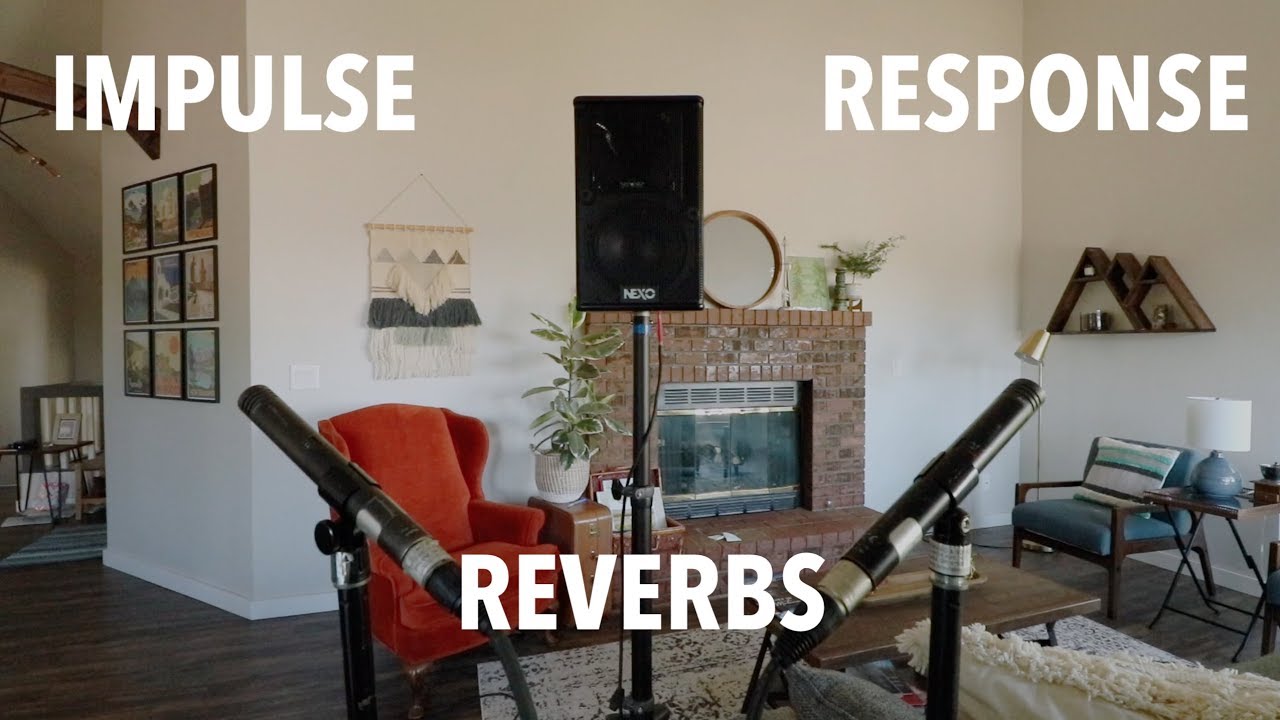
How to make and use IR Convolution reverbs.
devout snowBOT
lost heart
I would like help understanding how, in audio engineering, sine sweeps recorded ...
@lost heart Has your question been resolved?
devout snowBOT
@lost heart Has your question been resolved?
lost heart
I might log off and check this tomorrow morning.
devout snowBOT
@lost heart Has your question been resolved?
devout snowBOT
Channel closed
Closed due to timeout
Use .reopen if this was a mistake.
Available help channel!
Send your question here to claim the channel.
Remember:
• Ask your math question in a clear, concise manner.
• Show your work, and if possible, explain where you are stuck.
• Do not immediately ping people or roles. After 15 minutes, feel free to ping <@&286206848099549185> once.
• Type the command .close to free the channel when you're done.
• Be polite and have a nice day!
Read #❓how-to-get-help for further information on how to ask a good question, and about conduct in the question channels.
restive river
How can I solve these kinds of problems correctly and quickly? I try using formulas, but I still dont really understand them
 devout snowBOT
restive river
How can I solve these kinds of problems correctly and quickly? I try using formu...
restive river
devout snowBOT
restive river
How can I solve these kinds of problems correctly and quickly? I try using formu...
restive river
 welp
welp
 calm blade
rain summit
calm blade
rain summit
wait
rain summit
restive river
How can I solve these kinds of problems correctly and quickly? I try using formu...
use this root property:
$\sqrt[n]{\frac{A}{B}} = \frac{\sqrt[n]{A}}{\sqrt[n]{B}}$
calm blade
1/n
woven radishBOT
1 divided by 0 equals Infinity
 rain summit
this one
rain summit
woven radish
**1 divided by 0 equals Infinity**
@restive river
lyric hornet
Roots obey the same properties as exponents. Notably because they can be represented as exponents: (\sqrt[a]{b}=b^{\frac1a})
woven radishBOT
ΠαϳαμαΜαμαΛλαμα
 devout snowBOT
@restive river Has your question been resolved?
restive river
rain summit
this one
Yes ik
rain summit
have you done any question now?
restive river
Tomorrow I have a test on nth roots. Are there any important formulas or key points I should know?

rain summit
woven radish
**ΠαϳαμαΜαμαΛλαμα**
this one is the key to roots
if you can remember exponents properties then you can remember roots properties
restive river
Wow alr
devout snowBOT
Channel closed
Closed by @proper osprey
Use .reopen if this was a mistake.
Available help channel!
Send your question here to claim the channel.
Remember:
• Ask your math question in a clear, concise manner.
• Show your work, and if possible, explain where you are stuck.
• Do not immediately ping people or roles. After 15 minutes, feel free to ping <@&286206848099549185> once.
• Type the command .close to free the channel when you're done.
• Be polite and have a nice day!
Read #❓how-to-get-help for further information on how to ask a good question, and about conduct in the question channels.
 fierce ruin
 devout snowBOT
fierce ruin
devout snowBOT
fierce ruin
 frigid shale
late scaffold
frigid shale
late scaffold
looks about right