#help-27
1 messages · Page 344 of 1
 worthy heath
 woven radishBOT
∮Ē.dĀ = Qₑₙ꜀/ε₀
 worthy heath
$\mu = e^{\int -\frac{1}{x} \dd{x}} = \frac{1}{x}$
woven radishBOT
∮Ē.dĀ = Qₑₙ꜀/ε₀

 devout snowBOT
Channel closed
Closed by @worthy heath
Use .reopen if this was a mistake.
 restive river
dont worry im also stupid af
devout snowBOT
 Available help channel!
Send your question here to claim the channel.
Remember:
• Ask your math question in a clear, concise manner.
• Show your work, and if possible, explain where you are stuck.
• After 15 minutes, feel free to ping <@&286206848099549185>.
• Type the command .close to free the channel when you're done.
• Be polite and have a nice day!
Read #❓how-to-get-help for further information on how to ask a good question, and about conduct in the question channels.
 golden flower
ez af question but here:
devout snowBOT
golden flower
ez af question but here:

 pseudo basin
this is not an equation. there is nothing to solve.
pseudo basin
well then it should say simplify.
pseudo basin
ok, so disregarding your friends' incorrect step
do you have any other progress so far
golden flower
yeah i do
pseudo basin
show
 true coral
golden flower
my friends put the x^-1+x^-2 down which is illegal lol
true coral
golden flower
my friends put the x^-1+x^-2 down which is illegal lol
Are you saying your friends gave this to you?
golden flower
 golden flower
true coral
Are you saying your friends gave this to you?
golden flower
true coral
Are you saying your friends gave this to you?
yeah we review for an upcoming test it's not part of anything though
true coral
true coral
Are you saying your friends gave this to you?
Tell them next time they write down "solve" there better be an equal sign
golden flower
true coral
Tell them next time they write down "solve" there better be an equal sign
yes 🙏
woven radishBOT
Ann
 pseudo basin
but then what was your final thing
or like
your final answer
cause the way you wrote the cancellation is a bit sus
or maybe the last line is cut off?
golden flower
1/x^2(1-x)
devout snowBOT
Channel closed
Closed by @golden flower
Use .reopen if this was a mistake.
devout snowBOT
Available help channel!
Send your question here to claim the channel.
Remember:
• Ask your math question in a clear, concise manner.
• Show your work, and if possible, explain where you are stuck.
• After 15 minutes, feel free to ping <@&286206848099549185>.
• Type the command .close to free the channel when you're done.
• Be polite and have a nice day!
Read #❓how-to-get-help for further information on how to ask a good question, and about conduct in the question channels.
 rare kernel
how do i find number of solution of x^2 = 2^x
devout snowBOT
rare kernel
how do i find number of solution of x^2 = 2^x
rare kernel
without graphical approach
 supple knot
probably intermediate value theorem
rare kernel
what is that
supple knot
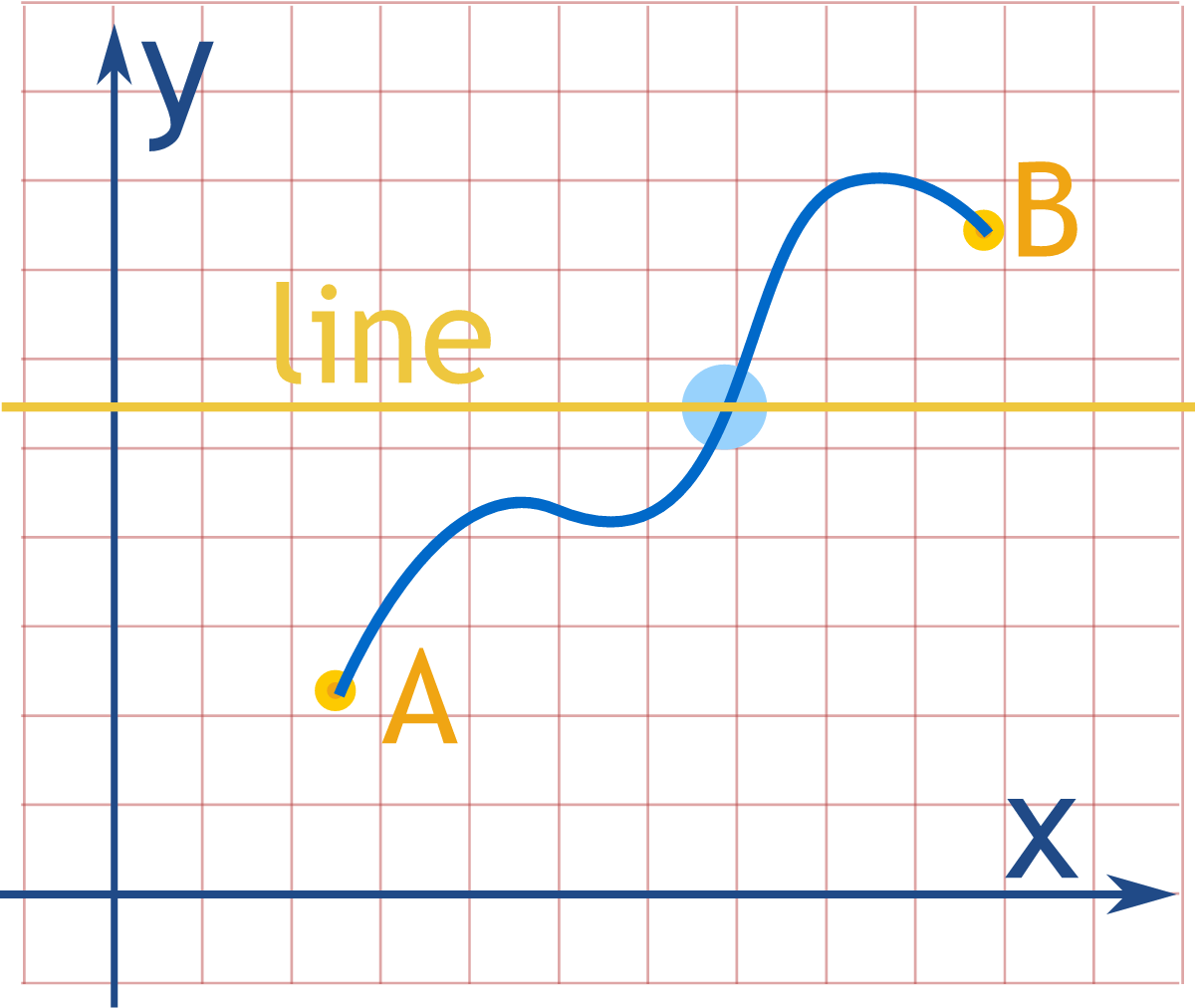
Math is Fun
The idea behind the Intermediate Value Theorem is this: When we have two points connected by a continuous curve:
rare kernel
that is not taught to us
so i guess ill have to do it using graphs itself
or maybe just do substitution method
thx anyway
.close
devout snowBOT
Channel closed
Closed by @rare kernel
Use .reopen if this was a mistake.
devout snowBOT
Available help channel!
Send your question here to claim the channel.
Remember:
• Ask your math question in a clear, concise manner.
• Show your work, and if possible, explain where you are stuck.
• After 15 minutes, feel free to ping <@&286206848099549185>.
• Type the command .close to free the channel when you're done.
• Be polite and have a nice day!
Read #❓how-to-get-help for further information on how to ask a good question, and about conduct in the question channels.
 hexed scaffold
need help solving this problem:
Battleship Puzzle
You have a 10 × 10 grid.
You can place mines on certain squares to prevent a ship from being placed.
Question 1:
What is the minimum number of mines needed to prevent any ship from being placed if ships have the following shape (a horizontal line of 5 squares)?
🟦🟦🟦🟦🟦
Question 2:
Same question for the following shapes (or other shapes of your choice):
🟦
🟦🟦🟦🟦
🟦
🟦🟦🟦
🟦
(A "+" shape)
and
🟦🟦🟦
🟦
🟦
devout snowBOT
hexed scaffold
need help solving this problem:
Battleship Puzzle
You have a 10 × 10 grid.
You ...
@hexed scaffold Has your question been resolved?
devout snowBOT
Channel closed
Closed due to timeout
Use .reopen if this was a mistake.
devout snowBOT
Available help channel!
Send your question here to claim the channel.
Remember:
• Ask your math question in a clear, concise manner.
• Show your work, and if possible, explain where you are stuck.
• After 15 minutes, feel free to ping <@&286206848099549185>.
• Type the command .close to free the channel when you're done.
• Be polite and have a nice day!
Read #❓how-to-get-help for further information on how to ask a good question, and about conduct in the question channels.
 feral agate
where did the first inequality come from?
 devout snowBOT
feral agate
where did the first inequality come from?
woven radishBOT
devout snowBOT
feral agate
where did the first inequality come from?
woven radishBOT
kheer257
 supple knot
u sub and then bound by largest value of f
and then factored that out of the integral
feral agate
supple knot
u sub and then bound by largest value of f
what exactly are we subbing?
ahh I see
supple knot
it's kinda dumb, but z = z(t)
feral agate
[ \begin{aligned}
\abs{\int_{\gamma}f(z) \dd{z}} &= \abs{\int_a^b f(z(t))z'(t)\dd{t}}\
&\le \int_a^b \abs{f(z(t))}\abs{z'(t)} \dd{t} \
&\le \sup_{t\in [a,b]} \abs{f(z(t))}\cdot\int_a^b \abs{z'(t)}\dd{t} \
&= \sup_{z\in\gamma} \abs{f(z)}\cdot\operatorname{length}(\gamma)
\end{aligned} ]
woven radishBOT
kheer257
 feral agate
I don't understand why they added an inequality sign at the end though
is $\sup_{t\in [a,b]}\abs{f(z(t))}$ not necessarily equal to $\sup_{z\in\gamma}\abs{f(z)}$?
woven radishBOT
kheer257
 feral agate
supple knot
could be = instead of <= yea
feral agate
supple knot
could be = instead of <= yea
now that I think about it, how do you even define a supremum on a curve?
supple knot
just call g = f(z) and now you have sup(g) over [a,b]
and the bottom sup is just equal to the top sup by definition

 lilac moat
@feral agate this is sometimes called the ML-inequality, if you want to google it
riemann is correct, but im just giving you a name for it
feral agate
lilac moat
<@799480350292049940> this is sometimes called the *ML*-inequality, if you want ...
thank you very much! I wasn't sure what name to search this by
supple knot
feral agate
but gamma is also just a subset of C
right and z smoothly parameterizes gamma
i'm not sure what is confusing you
feral agate
supple knot
i'm not sure what is confusing you
nothing actually
thank you for your help
.close
devout snowBOT
Channel closed
Closed by @feral agate
Use .reopen if this was a mistake.
Available help channel!
Send your question here to claim the channel.
Remember:
• Ask your math question in a clear, concise manner.
• Show your work, and if possible, explain where you are stuck.
• After 15 minutes, feel free to ping <@&286206848099549185>.
• Type the command .close to free the channel when you're done.
• Be polite and have a nice day!
Read #❓how-to-get-help for further information on how to ask a good question, and about conduct in the question channels.
 vagrant shard
 devout snowBOT
vagrant shard
lilac moat
vagrant shard
Need help tho
devout snowBOT
vagrant shard
lilac moat
vagrant shard
Need help tho
do you know the definition of x-intercept
vagrant shard
yes it’s a point that intersects the x axis
lilac moat
that's true, yeah. so if you have a function y=f(x), in general, not just for this problem, how do you find the x-intercepts of f?
also called the roots of f
 autumn girder
vagrant shard
<@&286206848099549185>
autumn girder
vagrant shard
<@&286206848099549185>
!15min
devout snowBOT
vagrant shard
<@&286206848099549185>
Please only use the <@&286206848099549185> ping once if your question has not been answered for 15 minutes. Please do not ping or DM individual users about your question.
autumn girder
vagrant shard
Think about when will the graph intercept the x axis
What does it mean for a line to touch the x axis
vagrant shard
I have to show my work with out using or showing a graph.
so like through a method ig
Idk how to do that
Like if I got out graphing paper I could find it but without graphing it I’m stuck
autumn girder
Oh, then desmos.com should help. Also, it'll prolly help to watch youtube video on tracing graph of a quadratic function
devout snowBOT
@vagrant shard Has your question been resolved?
devout snowBOT
Channel closed
Closed by @vagrant shard
Use .reopen if this was a mistake.
Available help channel!
Send your question here to claim the channel.
Remember:
• Ask your math question in a clear, concise manner.
• Show your work, and if possible, explain where you are stuck.
• After 15 minutes, feel free to ping <@&286206848099549185>.
• Type the command .close to free the channel when you're done.
• Be polite and have a nice day!
Read #❓how-to-get-help for further information on how to ask a good question, and about conduct in the question channels.
vagrant shard
 devout snowBOT
vagrant shard
vagrant shard
devout snowBOT
vagrant shard
vagrant shard
Can someone check my work and lmk if I’m on the right track or not
I think I’m getting it somewhat
My work seems a bit messy and untrue
devout snowBOT
@vagrant shard Has your question been resolved?
 mellow talon
vagrant shard
Can someone check my work and lmk if I’m on the right track or not
mellow talon
vagrant shard
Can someone check my work and lmk if I’m on the right track or not
Is there a chance that x=-41 isnt right?
The 4 is correct but c/a which is x1.x2 should equal to - 1
Which in your case it is - 164
devout snowBOT
@vagrant shard Has your question been resolved?
Channel closed
Closed by @vagrant shard
Use .reopen if this was a mistake.
vagrant shard
Thanks for ur help!
devout snowBOT
Available help channel!
Send your question here to claim the channel.
Remember:
• Ask your math question in a clear, concise manner.
• Show your work, and if possible, explain where you are stuck.
• After 15 minutes, feel free to ping <@&286206848099549185>.
• Type the command .close to free the channel when you're done.
• Be polite and have a nice day!
Read #❓how-to-get-help for further information on how to ask a good question, and about conduct in the question channels.
 lucid mason
 devout snowBOT
lucid mason
lucid mason
devout snowBOT
lucid mason
lucid mason
ok ik what a unit vector is and ik how to do it
but im confused about c)
because the magnitude that I get for c) is 15.62
but why is the textbook using the same magnitude for a) in the answerkey
isnt the unit vector different since now its u + v so magnitude is different
textbook answer

 acoustic leaf
a unit vector is a vector of magnitude 1
lucid mason
yup
acoustic leaf
if you multiply a vector by a scalar, then its magnitude is multiplied that amount
so if you were to divide by its original magnitude, the new vector would have to have a magnitude of 1
lucid mason
 lucid mason
acoustic leaf
so if you were to divide by its original magnitude, the new vector would have to...
lucid mason
acoustic leaf
so if you were to divide by its original magnitude, the new vector would have to...
ya ik
i know how to form it
but im confused why my answer isnt right
yuhh
so isnt the unit vector 1/sqrt244 ( u + v)
(sqrt244 = 15.62, the magnitude)
 upper schooner
I think they probably messed up 
lucid mason
omg ok
😞
because this is what the texbook wrote..

But 2sqrt21 is the magnitude for u-v...
oh well
Thanks chartbit

upper schooner
Yea and I agree with what you have 
 devout snowBOT
Channel closed
Closed by @lucid mason
Use .reopen if this was a mistake.
devout snowBOT
Available help channel!
Send your question here to claim the channel.
Remember:
• Ask your math question in a clear, concise manner.
• Show your work, and if possible, explain where you are stuck.
• After 15 minutes, feel free to ping <@&286206848099549185>.
• Type the command .close to free the channel when you're done.
• Be polite and have a nice day!
Read #❓how-to-get-help for further information on how to ask a good question, and about conduct in the question channels.
 ember mantle
i need help passing the math section of the ged and getting a better score on my asvab. how do you retain information well? whats the best way to study? please help, everything just goes in one ear and out the other nothing really sticks. am i cooked?
devout snowBOT
ember mantle
i need help passing the math section of the ged and getting a better score on my...
 midnight echo
There's a crayon joke to be made here.
But honestly its just repetition. The asvab isn't particularly tricky or unique, its just a fairly significant amount of material being tested. Don't try to memorize any topic, go through it monday, then wednesday, then friday, and so on. You'll manage to internalize it after enough iterations.
ember mantle
is there any particular trick to studying like i heard chewing gum and scribbling on a paper while reading or some shit like that
idk twin im just tryna become an academic weapon
i just quit smoking weed 3 days ago maybe my brain fog is too bad rn i dont really know 😭
midnight echo
Nah. No need to overcomplicate it. You literally just need to bash your head at as many questions as possible over a long time period and you'll ace it.
Make sure to get step-by-step solutions to the ones you can't do/get wrong though.
But yeah no magic tricks unfort
ember mantle
ive been working with chat gpt as like a sort of math teacher and its been helping i guess your right about it just being repetition. i gotta write down a schedule and stick with it because i kinda js study whenever i gotta be more specific with it
midnight echo
Yeah. Be a bit careful with using chatgpt since llms can get wrong answers while sounding confident, but it should be mostly fine for the asvab. Better if you find practice sets/textbooks etc. I guarentee that if you study for 2-ish hours a day for at least a month or two you'll score high enough to be the nuke guy
which apparently requires a really high score (?)
ember mantle
damn i didn't know chatgpt was buggy like that
but yeah i was thinking of getting textbooks and stuff
ik you can probably find them for free online
aightjamin twin i dont got anymore stuff to ask
ill lock in on studying every other day for 2 hours though
thanks g
,close
fuck
how u close it 😭
.close
devout snowBOT
Channel closed
Closed by @ember mantle
Use .reopen if this was a mistake.
Available help channel!
Send your question here to claim the channel.
Remember:
• Ask your math question in a clear, concise manner.
• Show your work, and if possible, explain where you are stuck.
• After 15 minutes, feel free to ping <@&286206848099549185>.
• Type the command .close to free the channel when you're done.
• Be polite and have a nice day!
Read #❓how-to-get-help for further information on how to ask a good question, and about conduct in the question channels.
 granite bough
Hello!
devout snowBOT
granite bough
Hello!
granite bough
the integral of 1/x dx = lnx + c
wait nevermind it clicked
as i was writing the question
😄
.close
devout snowBOT
Channel closed
Closed by @granite bough
Use .reopen if this was a mistake.
devout snowBOT
Available help channel!
Send your question here to claim the channel.
Remember:
• Ask your math question in a clear, concise manner.
• Show your work, and if possible, explain where you are stuck.
• After 15 minutes, feel free to ping <@&286206848099549185>.
• Type the command .close to free the channel when you're done.
• Be polite and have a nice day!
Read #❓how-to-get-help for further information on how to ask a good question, and about conduct in the question channels.
 forest orchid
how do I solve this? I specifically need more help with part B. I haven’t learned derivatives yet and must utilize the IROC formula but i’m unsure how to start.
 devout snowBOT
forest orchid
how do I solve this? I specifically need more help with part B. I haven’t learne...
supple knot
devout snowBOT
forest orchid
how do I solve this? I specifically need more help with part B. I haven’t learne...
supple knot
Did you try completing the square
forest orchid
How would I do that?
supple knot
,tex .cts
woven radishBOT
riemann
 forest orchid
ty I think i got it from here
devout snowBOT
@forest orchid Has your question been resolved?
Channel closed
Closed by @forest orchid
Use .reopen if this was a mistake.
devout snowBOT
Available help channel!
Send your question here to claim the channel.
Remember:
• Ask your math question in a clear, concise manner.
• Show your work, and if possible, explain where you are stuck.
• After 15 minutes, feel free to ping <@&286206848099549185>.
• Type the command .close to free the channel when you're done.
• Be polite and have a nice day!
Read #❓how-to-get-help for further information on how to ask a good question, and about conduct in the question channels.
 urban shore
How do you approach a question when the bases aren’t the same?
 urban shore
 proud perch
using this knowledge, can you rewrite the equation?
proud perch
using this knowledge, can you rewrite the equation?
Like this?
 proud perch
yeah!
urban shore
proud perch
yeah!
Now I apply the addition formula and switch to exponential form?
Is that the way to do it or am I missing smth?
proud perch
you're overcomplicating things
urban shore
Alright how should I solve this then?
proud perch
it's just basic algebra from here
clear the denominators
multiply the equation through by log(2)*log(3)
urban shore
.close
devout snowBOT
Channel closed
Closed by @urban shore
Use .reopen if this was a mistake.
devout snowBOT
Available help channel!
Send your question here to claim the channel.
Remember:
• Ask your math question in a clear, concise manner.
• Show your work, and if possible, explain where you are stuck.
• After 15 minutes, feel free to ping <@&286206848099549185>.
• Type the command .close to free the channel when you're done.
• Be polite and have a nice day!
Read #❓how-to-get-help for further information on how to ask a good question, and about conduct in the question channels.
 wise nacelle
help
devout snowBOT
wise nacelle
help
wise nacelle

have question about how to write answer
for (a) i got (-1,-7),(3,6)
don’t know if that’s how to write it
pseudo basin
they want the interval between the x values
when we talk about a function's behavior on or over an interval or other set, we talk about stuff on its domain
wise nacelle
pseudo basin
when we talk about a function's behavior _on_ or _over_ an interval or other set...
would i only state the x values then?
wise nacelle
for decreasing would i write (-inf,-1)
devout snowBOT
Channel closed
Closed by @wise nacelle
Use .reopen if this was a mistake.
devout snowBOT
Available help channel!
Send your question here to claim the channel.
Remember:
• Ask your math question in a clear, concise manner.
• Show your work, and if possible, explain where you are stuck.
• After 15 minutes, feel free to ping <@&286206848099549185>.
• Type the command .close to free the channel when you're done.
• Be polite and have a nice day!
Read #❓how-to-get-help for further information on how to ask a good question, and about conduct in the question channels.
 hybrid maple
how do i show that a particular point is the only limit point of a set E
devout snowBOT
hybrid maple
how do i show that a particular point is the only limit point of a set E
hybrid maple
this is my function

 polar chasm
whats your defn of limit point?
Point s.t. its every neighborhood has nonempty intersection with E?
 polar chasm
,rccw
woven radishBOT
 polar chasm
I'd try taking any limit point of E and proving that it equals 1
hybrid maple
my professor hadn’t done an example for a particular number before i didn’t know how to do it
polar chasm
Let's start with a simpler case then. Can you prove that any x < 1 is not a limit point of E?
hybrid maple
tbh i don’t know how to these proofs work at all wouldn’t know how to prove that
polar chasm
hybrid maple
tbh i don’t know how to these proofs work at all wouldn’t know how to prove that
Okay, what does it mean if something is not a limit point?
Refer to the definition
hybrid maple
it wouldn’t have a anything in the set of its delta neighbour hood excluding itself
polar chasm
hybrid maple
it wouldn’t have a anything in the set of its delta neighbour hood excluding its...
Yeah, to be more exact, there would exist such a neighbourhood
because there is no the neighborhood
there are plenty possible neighborhoods
polar chasm
polar chasm
Let's start with a simpler case then. Can you prove that any x < 1 is **not** a ...
Now returning to this, can you find a neighborhood for e.g. x = 0 which doesnt have anything in common with E?
hybrid maple
for my example if i choose x =3/2 and a small delta it will only include itself
polar chasm
hybrid maple
for my example if i choose x =3/2 and a small delta it will only include itself
Yep, that's right and that's also the core of the argument
to make the argument exactly right, you'd only need to choose the right delta
I'd split this up to 2 cases, x < 1 and x > 1
the x < 1 case is simpler, so let's start with that
polar chasm
polar chasm
Now returning to this, can you find a neighborhood for e.g. x = 0 which doesnt h...
what delta can you pick for x = 0?
What delta can you pick for x = 1/2?
what delta can you pick for x = 0.99?
What delta can you pick for general x < 1?
(i just gtg quickly do sth, ill be back in few mins)
hybrid maple
for x= 0 i can pick a delta that is less than 1 because no value of 1 + 1/n is between 1 and 2
polar chasm
Exactly
hybrid maple
in general for 1 i just need to pick a delta such that x + delta is less than 1?
polar chasm
Yep
hybrid maple
okay
polar chasm
one way to do that is just pick delta = 1 - x for x < 1
hybrid maple
hmm okay makes sense
polar chasm
now for x > 1
this one is a bit more complicated
you have the right intuition that by choosing a small enough delta for e.g. x = 3/2, you can ensure that the only point of E inside the neighborhood is x itself
now the question is just how small does the delta have to be
hybrid maple
the delta we choose is because of left of the point if that makes sense
we are closer to the left points
polar chasm
hybrid maple
we are closer to the left points
That's not always true
if you had x = 1.499 you'd be closer to 3/2 than to 4/3
luckily for us, we can just determine the distance between both the point on left and the point on right and just pick the smaller one for our delta
We just need to find the "point on left" for our x
there is a theorem which says that every nonempty subset of naturals has a least element
if we consider the set of all ns, such that 1 + 1/n < x, then we should be able to pick the least n0, which will result in the point of E which is right to the left of x
the point on the left would then just be 1 + 1/n0
1 + 1/(n0 + 1) must then be >= x (since it cant be smaller)
so it's either x itself, or to the right of it
can you finish the argument by choosing the right delta now?
devout snowBOT
@hybrid maple Has your question been resolved?
devout snowBOT
Channel closed
Closed due to timeout
Use .reopen if this was a mistake.
Available help channel!
Send your question here to claim the channel.
Remember:
• Ask your math question in a clear, concise manner.
• Show your work, and if possible, explain where you are stuck.
• After 15 minutes, feel free to ping <@&286206848099549185>.
• Type the command .close to free the channel when you're done.
• Be polite and have a nice day!
Read #❓how-to-get-help for further information on how to ask a good question, and about conduct in the question channels.
 frigid torrent
Guys how do I solve

 devout snowBOT
frigid torrent
Guys how do I solve
frigid torrent
devout snowBOT
frigid torrent
Guys how do I solve
frigid torrent

Ended up getting these 2 linear equations but didn’t work out
Can someone show me the right one
devout snowBOT
@frigid torrent Has your question been resolved?
devout snowBOT
@frigid torrent Has your question been resolved?
devout snowBOT
@frigid torrent Has your question been resolved?
devout snowBOT
Channel closed
Closed due to timeout
Use .reopen if this was a mistake.
Available help channel!
Send your question here to claim the channel.
Remember:
• Ask your math question in a clear, concise manner.
• Show your work, and if possible, explain where you are stuck.
• After 15 minutes, feel free to ping <@&286206848099549185>.
• Type the command .close to free the channel when you're done.
• Be polite and have a nice day!
Read #❓how-to-get-help for further information on how to ask a good question, and about conduct in the question channels.
 graceful oyster
I'm currently working on understanding modal analysis, my starting point is a sdof system to understand the eigenvalue problem. As far as I've seen so far the eigenvalue Lambda was defined as: Lambda = omega², with omega as the angular frequency and omega² = m/k, both of which can be derived from the statements in the screenshot.
What I don't get is the middle part, which states that solving mlambda²+k=0 for Lambda gives you Lambda1,2 = iomega, which in my understanding gives you Lambda1,2 = omega (not squared).
What am I missing here?
 devout snowBOT
graceful oyster
I'm currently working on understanding modal analysis, my starting point is a sd...
devout snowBOT
graceful oyster
I'm currently working on understanding modal analysis, my starting point is a sd...
 sullen island
graceful oyster
I'm currently working on understanding modal analysis, my starting point is a sd...
sullen island
graceful oyster
I'm currently working on understanding modal analysis, my starting point is a sd...
What I don't get is the middle part, which states that solving mlambda²+k=0 for Lambda gives you Lambda1,2 = i*omega, which in my understanding gives you Lambda1,2 = omega (not squared).
what squared part are you talking about from the picture ? I don't see what you're talking about
but anyway, you're solving m L^2 + k = 0 for L, i.e. L^2 = -k/m
k and m are positive most certainly so -k/m is negative
graceful oyster
Sorry, not a native, I'll try to explain better.
sullen island
L^2 = something negative, the solution has to be imaginary/a complex number
graceful oyster
yeah that checks out, this is not the part I'm looking for.
I'm looking at the solution for L:
It's either L = omega² or L = omega, whether imaginary or not.
I have learned so far that L = omega squared, which makes sense, given that L² = -k/m and k/m = omega²
Why is the omega not squared in the middle part?
 sullen island
k/m = omega²
what's sqrt(k/m) then ?
graceful oyster
omega (not squared)
graceful oyster
Ok, I understand where I took a wrong turn in this context.
Still, I have learned that L = omega² when doing modal analysis
Is that only true for dampened systems with one or more degrees of freedom?
 sullen island
graceful oyster
sullen island
graceful oyster
can you post their explanation around that formula ? (gonna be in german I guess)
devout snowBOT
@graceful oyster Has your question been resolved?
graceful oyster
sullen island
can you post their explanation around that formula ? (gonna be in german I guess...
I'm trying to find something useful. I originally got it from an online lesson about modal analysis for 3 dof system (bridge). But there it was just described as a given. Within that example it makes sense and replicating that with my FEM software gave me the right values as well.
Thats a screenshot from the given video. There he only states that Lambda = omega ²

Also another book that I have describes the eigenvalue problem as (K-omega²M)[Eigen vector] = 0 but also for a 2dof system
Sorry that I don't have more to tell you. It's kind of my problem rn

I have found this in english, also speaking about mdof systems.
 sullen island
yeah I'm out of my depth here, sounds like they're talking about a different type of eigenvalue
you could try asking in #modeling if no one else comes here
also ping helpers @graceful oyster
graceful oyster
Alright, thanks for your time and effort regardless
<@&286206848099549185>
To specify for people willing to look into this:
In my understanding the eigenvalue Lambda is equal to the square of the angular frequency omega: L = omega²
for the sdof system without dampening I found that Lambda seems to equal omega (not squared) It's also not specifically described an eigenvalue (problem) in the book I'm working with. I'm confused as to why there seem to be two seperate connections between Lambda and omega
devout snowBOT
@graceful oyster Has your question been resolved?
devout snowBOT
@graceful oyster Has your question been resolved?
devout snowBOT
Channel closed
Closed due to timeout
Use .reopen if this was a mistake.
devout snowBOT
Available help channel!
Send your question here to claim the channel.
Remember:
• Ask your math question in a clear, concise manner.
• Show your work, and if possible, explain where you are stuck.
• After 15 minutes, feel free to ping <@&286206848099549185>.
• Type the command .close to free the channel when you're done.
• Be polite and have a nice day!
Read #❓how-to-get-help for further information on how to ask a good question, and about conduct in the question channels.
 west nova
Is this correct?
devout snowBOT
west nova
Is this correct?

 brittle badge
It's ||not|| incorrect, ||non-||sadly.

 drifting sinew
brittle badge
It's ||not|| incorrect, ||non-||sadly.
drifting sinew
brittle badge
It's ||not|| incorrect, ||non-||sadly.
-# Never let them know your next move.
west nova
.close
devout snowBOT
Channel closed
Closed by @west nova
Use .reopen if this was a mistake.
Available help channel!
Send your question here to claim the channel.
Remember:
• Ask your math question in a clear, concise manner.
• Show your work, and if possible, explain where you are stuck.
• After 15 minutes, feel free to ping <@&286206848099549185>.
• Type the command .close to free the channel when you're done.
• Be polite and have a nice day!
Read #❓how-to-get-help for further information on how to ask a good question, and about conduct in the question channels.
 lunar depot
How to do this correctly ?
 devout snowBOT
lunar depot
How to do this correctly ?
lunar depot
devout snowBOT
lunar depot
How to do this correctly ?
lunar depot
Answer is 0, but how to get it
lunar depot
As simple as possible probably
supple knot
for x between 75 + 15 and 75 + 135
lunar depot
Is there a way by solving something?
supple knot
plotting is as simple as possible
lunar depot
What does that mean ?
supple knot
,w plot cos(x)
woven radishBOT


 lunar depot
Once we have [90:210] what then ?
devout snowBOT
Channel closed
Closed by @lunar depot
Use .reopen if this was a mistake.
devout snowBOT
Available help channel!
Send your question here to claim the channel.
Remember:
• Ask your math question in a clear, concise manner.
• Show your work, and if possible, explain where you are stuck.
• After 15 minutes, feel free to ping <@&286206848099549185>.
• Type the command .close to free the channel when you're done.
• Be polite and have a nice day!
Read #❓how-to-get-help for further information on how to ask a good question, and about conduct in the question channels.
 dusty fox
Is the distance formula for radius the same as it is for diameter?
And..is it derived from the "equation of a circle"?
What's that formula supposed to be used for anyway?
devout snowBOT
dusty fox
Is the distance formula for radius the same as it is for diameter?
And..is it de...
 glacial wyvern
What is the "distance formula for radius"?
 sharp kayak
dusty fox
Is the distance formula for radius the same as it is for diameter?
And..is it de...
sharp kayak
dusty fox
Is the distance formula for radius the same as it is for diameter?
And..is it de...
which formula exactly are you referring to
dusty fox
glacial wyvern
What is the "distance formula for radius"?
Uhh I'm not quite sure but it's just the distance formula.
I just specified it because i was unsure
autumn girder
Can you provide any additional context?
glacial wyvern
Can you formulate the distance formula for us?
autumn girder
Maybe the original problem
 dusty fox
autumn girder
Maybe the original problem
dusty fox
autumn girder
Maybe the original problem
It's not a question problem, I just want to clear my concepts.
 jolly dune
A square bee square sea square?
glacial wyvern
dusty fox
This formula gives you the distance between two points (x1, y1) and (x2, y2)
dusty fox
Yes
glacial wyvern
So where do your radius and diameter come from
dusty fox
So the same i guess
glacial wyvern
radius and diameter relate to a circle
autumn girder
glacial wyvern
this doesn't relate to a circle
You can use it with a circle
but what it does is gives you distance of two points
dusty fox
glacial wyvern
So where do your radius and diameter come from
I don't know i read somewhere that it's (x-h)² + (y-k)² instead for radius
autumn girder
dusty fox
I don't know i read somewhere that it's (x-h)² + (y-k)² instead for radius
That's for offsetting the origin
dusty fox
glacial wyvern
this doesn't relate to a circle
Dude
dusty fox
autumn girder
That's for offsetting the origin
So it's essentially the same thing just using the actual variables for the points as they are?
That seems to be derived from the circle equation.
What's it supposed to entail?
glacial wyvern
dusty fox
I don't know i read somewhere that it's (x-h)² + (y-k)² instead for radius
If we call the center of a circle (x0, y0) and the circle has radius r, then for every point (x, y) on the circle it holds that the distance between (x, y) and (x0, y0) is r.
If you write this algebraically, according to the formula you described, then you get that
sqrt( (x - x0)^2 + (y - y0)^2 ) = r
which is more commonly stated as
(x - x0)^2 + (y - y0)^2 = r^2
autumn girder
dusty fox
I don't know i read somewhere that it's (x-h)² + (y-k)² instead for radius
https://www.desmos.com/calculator/jckfamgeem
Play around with this desmos graph (use sliders for a, b and r) to get some intuition on the topic

Desmos
dusty fox
autumn girder
https://www.desmos.com/calculator/jckfamgeem
Play around with this desmos graph ...
Thanks
glacial wyvern
glacial wyvern
If we call the center of a circle `(x0, y0)` and the circle has radius `r`, then...
The last equation is called the equation of a circle, because every point on the circle described by r and (x0, y0) satisfies the equation
and conversely every point satisfied by the equation lies on the circle
dusty fox
glacial wyvern
If we call the center of a circle `(x0, y0)` and the circle has radius `r`, then...
How'd the r get squared at the end
autumn girder
dusty fox
How'd the r get squared at the end
Because of the pythagoras' theorem
dusty fox
glacial wyvern
The last equation is called the equation of a circle, because every point on the...
But r isn't a point on the circle just the distance
autumn girder
dusty fox
But r isn't a point on the circle just the distance
Yes
dusty fox
autumn girder
Because of the pythagoras' theorem
Oh yeah
My bad didn't see the sqrt
Yeah that is what i was exactly asking
autumn girder
Alr, do you understand it now?
dusty fox
autumn girder
Alr, do you understand it now?
No i still don't understand what the equation of a circle is supposed to be used for
autumn girder
dusty fox
No i still don't understand what the equation of a circle is supposed to be used...
I mean for a few(a lot) things but, primarily for drawing a circle?
Like if you ever have a graph which needs a circle you use this equation
dusty fox
Hmm
dusty fox
autumn girder
Like if you ever have a graph which needs a circle you use this equation
How exactly
Like, coding or?
autumn girder
Programming could be one use for it, ye
glacial wyvern
dusty fox
No i still don't understand what the equation of a circle is supposed to be used...
If a geometric object is of the form some expression of x y z = 0, then we can find its normal vector at any point very easily using multivariable calculus. If we have a temperature distribution T(x, y, z) in space, then we can restrict that temperature distribution to a sphere x^2 + y^2 + z^2 = 1, and find the biggest temperature on the sphere by using multivariable calculus
dusty fox
autumn girder
Programming could be one use for it, ye
I can't code but how could i use it except solving problems from a maths book
autumn girder
dusty fox
I can't code but how could i use it except solving problems from a maths book
That depends really, which field do you wish to pursue IRL
dusty fox
glacial wyvern
If a geometric object is of the form `some expression of x y z = 0`, then we can...
Is that 0 or just a variable
autumn girder
dusty fox
Is that 0 or just a variable
0
dusty fox
autumn girder
That depends really, which field do you wish to pursue IRL
Like anything that i could do as a layman i guess to get a better understanding of it
glacial wyvern
dusty fox
Is that 0 or just a variable
that is actually zero because mathematicians find it aesthetically pleasing (and some other reasons too.)
For instance the equation of a circle can be turned into that form if you write it as
(x - x0)^2 + (y - y0)^2 - r^2 = 0
autumn girder
dusty fox
Like anything that i could do as a layman i guess to get a better understanding ...
If you just wanna get a better understanding of the equation, play around in desmos
That's prolly the easiest way to get used to it, as for how that equation comes to be
Do you know the definition of a circle in math?
mellow talon
How can i find the intersections of 2 circles?
autumn girder
!occupied
devout snowBOT
Someone else is already using this help channel. If you need help with a question, please open your own help channel/thread (see #❓how-to-get-help for instructions).
mellow talon
Mb
dusty fox
Hi
dusty fox
autumn girder
If you just wanna get a better understanding of the equation, play around in des...
Yeah i get it, y-axis, x-axis & circle big/small
autumn girder
mhm
autumn girder
autumn girder
Do you know the definition of a circle in math?
?
dusty fox
glacial wyvern
If a geometric object is of the form `some expression of x y z = 0`, then we can...
Are x y z in "x y z = 0" all multiplied or..?
autumn girder
dusty fox
Are x y z in "x y z = 0" all multiplied or..?
No, he's just saying some expression involving the variables x, y and z
dusty fox
autumn girder
?
Uhh a 2D shape? With all points equidistant from each other from a fixed point.
Is 360° etc
autumn girder
dusty fox
Uhh a 2D shape? With all points equidistant from each other from a fixed point.
...
Yes, Good job
well each other not so much
but from the center
Formally speaking
autumn girder
A circle is the path traced by a point travelling in a 2 dimensional space, such that it remains at a fixed distance from some fixed point.
dusty fox
autumn girder
No, he's just saying some expression involving the variables x, y and z
I don't understand the entire msg tbh, don't know most of the things being talked about or why there are specially 3 variables x,y, & z
autumn girder
Yea, that would make sense considering you're just learning about 2d equations still, don't worry, it'll make sense in future
autumn girder
autumn girder
A circle is the path traced by a point travelling in a 2 dimensional space, such...
Do you understand this?
glacial wyvern
dusty fox
Are x y z in "x y z = 0" all multiplied or..?
I could've written F(x, y, z) = 0 for some function F but some people are scared of functions so I occasionally try to avoid them, perhaps causing more confusion in the process. Sorry about that
dusty fox
autumn girder
A circle is the path traced by a point travelling in a 2 dimensional space, such...
Yeah
Kind of like a planet but not quite
autumn girder
Ok, so now think about it in terms of this definition
dusty fox
You are so motivating hiten thanks
glacial wyvern
dusty fox
I don't understand the entire msg tbh, don't know most of the things being talke...
Our everyday geometry is always three dimensional, and even if it's two dimensional, it's occasionally a good idea to embed a two dimensional object into three dimensional space. Of course three variables is somewhat arbitrary in the sense that these ideas do generalize nicely to higher dimensions as well
autumn girder
autumn girder
Ok, so now think about it in terms of this definition
If a point is in a two dimensional plane, then we measure two things about it, it's vertical distance from the origin, (y), and it's horizontal distance(x) from origin,
dusty fox
Yeah
dusty fox
glacial wyvern
Our everyday geometry is always three dimensional, and even if it's two dimensio...
What do you mean by
Embed a two dimensional object into three dimensional space ?
autumn girder
dusty fox
Yeah
then, let's fix a point, and let's call it $P_C = (x_C, y_C)$ do you know what this notation means?
woven radishBOT
@autumn girder
 glacial wyvern
dusty fox
What do you mean by
Embed a two dimensional object into three dimensional space ...
glacial wyvern
dusty fox
What do you mean by
Embed a two dimensional object into three dimensional space ...
A two dimensional object can rest on the xy-plane, even if we have a z axis. This can occasionally be helpful if we have a special technique that only makes sense in three dimensions, but we still wanna try to apply it to a two dimensional object
dusty fox
autumn girder
then, let's fix a point, and let's call it $P_C = (x_C, y_C)$ do you know what t...
No but I'm guessing P stands for point & C = centre?
autumn girder
Yes
$x_C$ is the horizontal distance of the center point from the origin, also called it's x co-ordinate and same applies for $y_C$
woven radishBOT
@autumn girder
 dusty fox
$P_C = point of centre$ ?
woven radishBOT
👾
 autumn girder
dusty fox
$P_C = point of centre$ ?
autumn girder
dusty fox
$P_C = point of centre$ ?
Yep, it's the central point
of the circle
Does this make sense so far?
glacial wyvern
Sounds like a regional convention, I've never seen that before
dusty fox
autumn girder
$x_C$ is the horizontal distance of the center point from the origin, also calle...
So basically h & k ?
autumn girder
dusty fox
So basically h & k ?
We can get to conventions later
autumn girder
glacial wyvern
Sounds like a regional convention, I've never seen that before
Legit just made it up lol
dusty fox
glacial wyvern
Sounds like a regional convention, I've never seen that before
Where do you guys get the roles from
glacial wyvern
At the end of the day it doesn't matter how you write things down, the mathematics is still nonetheless the same. For me (x0, y0) makes more sense as the center than (h, k), but obviously you can call your center (å, ö) if you want to
dusty fox
glacial wyvern
Sounds like a regional convention, I've never seen that before
I thought you were talking about a cult
autumn girder
autumn girder
We can get to conventions later
that said, yes they're h & k in the formula
dusty fox
glacial wyvern
At the end of the day it doesn't matter how you write things down, the mathemati...
Why's it called h,k?
glacial wyvern
dusty fox
Why's it called h,k?
I don't know. I wouldn't use h and k
autumn girder
dusty fox
Why's it called h,k?
No reason except one guy woke up one day and decided to call it that
dusty fox
Oh
autumn girder
now we say that every point on the circle must be at some fixed distance (radius) from this center
i.e. if some point $P$ is on the circle then $distance(P, P_C) = r$
woven radishBOT
@autumn girder
 autumn girder
So far we have just mathematically written down the statement of definition
I hope there is no confusion thus far?
dusty fox
autumn girder
I hope there is no confusion thus far?
Yeah none
dusty fox
Um the formula
autumn girder
Yep, the distance formula
do you understand how that works?
or should we go into that for a bit
and then come back here
dusty fox
Well
autumn girder
?
dusty fox
I wanted to know about the equation for a circle not the distance formula
autumn girder
I mean from here the next step is just the equation of circle
dusty fox
Yeah let's move on
autumn girder
$distance(P, P_C) = distance\left((x, y), (x_C, y_C)\right)$, because recall that every point is defined with two properties, it's x and y co-ordinates
woven radishBOT
@autumn girder
 autumn girder
$distance((x, y), (x_C, y_C)) = \sqrt{(x - x_C)^2 + (y - y_C)^2}$
woven radishBOT
@autumn girder
 autumn girder
This is just the distance formula by definition
and from here, we put it equal to r, as we derived from the definition of circle a few steps ago
dusty fox
Yeah
autumn girder
$r = \sqrt{(x - x_C)^2 + (y - y_C)^2}$
woven radishBOT
@autumn girder
 autumn girder
and there you go, there you have your equation
dusty fox
autumn girder
and there you go, there you have your equation
What's it supposed to be used for tho? also a last step left lol
dusty fox
woven radish
<@946379454056386560>
Also could i see how to get the formula, step-by-step
dusty fox
autumn girder
Which one?
Circle
autumn girder
What more steps do you want, we went from definition to formula, which step did you feel was missing?
dusty fox
glacial wyvern
If we call the center of a circle `(x0, y0)` and the circle has radius `r`, then...
Yeah this but where does the - minus & square root get added from
dusty fox
autumn girder
That's the distance formula
No there's circle one at the end too
It simplifies to it i guess
I'm just curious why the - & square root get added
autumn girder
woven radish
<@946379454056386560>
They get added when you use the distance formula from here
dusty fox
autumn girder
They get added when you use the distance formula from here
How tho
I don't get how it gets added
autumn girder
Ok, let's go into distance formula then
Would you agree that the distance between P1 and P2 here is gonna be equal to the length of the line joining P1 and P2?
 dusty fox
autumn girder
Would you agree that the distance between P1 and P2 here is gonna be equal to th...
dusty fox
autumn girder
Would you agree that the distance between P1 and P2 here is gonna be equal to th...
Well...yes
autumn girder
Ok good
autumn girder
A lot was added here but does it make sense?
 dusty fox
autumn girder
A lot was added here but does it make sense?
dusty fox
autumn girder
A lot was added here but does it make sense?
Thanks for doing this
autumn girder
NP
dusty fox
autumn girder
A lot was added here but does it make sense?
Yes
autumn girder
You should already have some intuition where we're going with this
dusty fox
y-axis (0,a)
x-axis(a,0)
Yeah
autumn girder
Here I color coded it a bit so that it's easier to see and added more stuff, does this makes sense too?

@dusty fox
autumn girder
Ok cool
So now you see the right angle triangle formed by the purple, blue and orange lines?
dusty fox
Yes
autumn girder
What would the length of purple line be, in terms of the orange and blue line?
Hint: ||Recall, Pythagoras' theorem||
dusty fox
autumn girder
What would the length of purple line be, in terms of the orange and blue line?
Oh Pythagorean,
H² = P² + B²
dusty fox
autumn girder
So, from that what would the lengh of purple line be?
Sum of P2P3 & P1P3 ?

Sorry for keeping you busy for so long, tbh I will revisit this sometime later, getting a bit late.
You could propose a time sometime later to continue from here, how's that sound?
@autumn girder
autumn girder
Would you agree?
 autumn girder
dusty fox
Sorry for keeping you busy for so long, tbh I will revisit this sometime later, ...
autumn girder
dusty fox
Sorry for keeping you busy for so long, tbh I will revisit this sometime later, ...
That's fine by me but you already have the answer at this point
autumn girder
Yes
dusty fox
Oh yeah nvm
autumn girder
p = the length of line between P1P3
autumn girder
$90^{\circ}$
woven radishBOT
@autumn girder
 dusty fox
autumn girder
That's fine by me but you already have the answer at this point
dusty fox
autumn girder
That's fine by me but you already have the answer at this point
Do i..? 🥲
dusty fox
autumn girder
That's fine by me but you already have the answer at this point
So when ?
autumn girder
autumn girder
Would you agree?
h is the distance of P1P2, right?
dusty fox
I gotta adios for now
devout snowBOT
If you are done with this channel, please mark your problem as solved by typing .close
autumn girder
You're welcome
dusty fox
dusty fox
So when ?
.
woven radishBOT
@autumn girder
 woven radishBOT
@autumn girder
 woven radishBOT
@autumn girder
 autumn girder
Yea, and now this is an exercise for you
Calculate p and b from the graph
You can do it on your own
Later if you don't wanna do it rn
autumn girder
Hint: ||Look at the grid lines which have been drawn for your convinience||
autumn girder
dusty fox
You asked the value of the points not the distance
The length of p and b
They won't be h
dusty fox
Yeah half of H
autumn girder
No
dusty fox
Huh
autumn girder
Did you look at the hint?
autumn girder
Well, it happens lol
dusty fox
Ok I'll do it later
dusty fox
thanks again, but when will u be available
autumn girder
You can just post the question here
There are other helpers and they'll also be willing to help
so dw
dusty fox
autumn girder
and if you can't solve it, open another thread
Well yes, will do it later
Can't manage to keep this open
autumn girder
Alr, for now since your original question has been solved
please close this thread with .close
dusty fox
autumn girder
There are other helpers and they'll also be willing to help
But..the homework
autumn girder
?
dusty fox
U just gave for me to solve
autumn girder
You can post it here for people to check or, ask if you have any doubts
don't worry, you'll be fine
If you want you can dm me too
dusty fox
Well
I'm asking cause i don't want to be waiting after sending it.
And if i know when you'll be available then getting it done quicker would be easy
autumn girder
Unfortunately, due to the current circumstances I am in, I can't give you a fixed time
autumn girder
So your best bet will be to use the help channels
when you need them
Under any circumstances, I'll close this channel for now.
.close
devout snowBOT
Channel closed
Closed by @autumn girder
Use .reopen if this was a mistake.
Available help channel!
Send your question here to claim the channel.
Remember:
• Ask your math question in a clear, concise manner.
• Show your work, and if possible, explain where you are stuck.
• After 15 minutes, feel free to ping <@&286206848099549185>.
• Type the command .close to free the channel when you're done.
• Be polite and have a nice day!
Read #❓how-to-get-help for further information on how to ask a good question, and about conduct in the question channels.
 fresh rock
I need some help generating the transition matrix for this problem... I have an answer I'm just not sure if its right. I would love to compare work with someone. Thanks!
 devout snowBOT
fresh rock
I need some help generating the transition matrix for this problem... I have an ...
glacial wyvern
devout snowBOT
fresh rock
I need some help generating the transition matrix for this problem... I have an ...
glacial wyvern
that takes a nontrivial amount of work to do
but maybe someone will be up to the task
You should probably try to network with the students who are actually taking that course with you
fresh rock
I generated a 13x13 matrix with this... Im "pretty" sure its right though
But Q, and I, in the F=(I-Q)^-1
What would those be if i only have 1 absorbing state in my 13x13
Because i need to make a fundamental transition matrix from it
 graceful cosmos
You can cheat it a bit by not including the bottoms of ladders and the tops of chutes, since you can't land on those squares
So we're down to an 8x8
fresh rock
Thats what I was wondering about tbh. I included them in my matrix, but would that change the outcome?
Like in my matrix, since 3 goes to 7 with a ladder, rows 3 and 7 are the exact same in my matrix
same with chutes
The only absorbing state should be the end im pretty sure, so Q would be all others in a 12x12 and I would be a 12x12 identity matrix?
Heres my fundamental transition matrix, what exactly do these numbers mean?
 devout snowBOT
@fresh rock Has your question been resolved?
devout snowBOT
@fresh rock Has your question been resolved?
fresh rock
.close
devout snowBOT
Channel closed
Closed by @fresh rock
Use .reopen if this was a mistake.
devout snowBOT
Available help channel!
Send your question here to claim the channel.
Remember:
• Ask your math question in a clear, concise manner.
• Show your work, and if possible, explain where you are stuck.
• After 15 minutes, feel free to ping <@&286206848099549185>.
• Type the command .close to free the channel when you're done.
• Be polite and have a nice day!
Read #❓how-to-get-help for further information on how to ask a good question, and about conduct in the question channels.
 bleak arrow
if we have something like z = sqrt(4-x^2-y^2) and we were to graph the domain (x^2+y^2<=4) and range (0<=z<=4) together on one graph, what would this represent?
devout snowBOT
bleak arrow
if we have something like z = sqrt(4-x^2-y^2) and we were to graph the domain (x...
drifting sinew
bleak arrow
if we have something like z = sqrt(4-x^2-y^2) and we were to graph the domain (x...
It would look like a hemisphere.
$$x^2 + y^2 + z^2 = 2^2$$
woven radishBOT
@drifting sinew
 drifting sinew
When you take the square root of both sides, you find that z cannot be negative, so the sphere turns into a hemisphere
bleak arrow
if i graph the domain and range at the same time, what would I get?
i know S is a hemisphere
drifting sinew
bleak arrow
if i graph the domain and range at the same time, what would I get?
Try to figure it out yourself; I don't want to do too much of the work for you.
I can try to give you a hint if you're not sure.
bleak arrow
would I get a cylinder?
drifting sinew
bleak arrow
would I get a cylinder?
But we already established the graph is a hemisphere.
 devout snowBOT
@bleak arrow Has your question been resolved?
restive river
That is indeed your domain
In that, the whole upper hemisphere, z = sqrt(2² - x² - y²), having radius 2, is enclosed in (it's a hollow hemisphere note that)
bleak arrow
the domain is x^2+y^2<=4, right? but if i were to graph the domain and the range together, what would you call this in math?
restive river
Nothing really like this is still math. You just restricted your domain R³ to the cylinder
bleak arrow
if u have a curve instead of a surface, u can represent the curve by domain + range, right? if u have something like:
intersection of z = sqrt(4-x^2-y^2) and z = 1, u get for the domain: x^2+y^2=3, and for the range: z = 1, u can write the equation of the curve as "x^2+y^2=3 at z = 1"
is there something similar to surfaces?
restive river
Err note that this is not really a domain technically because z is not defined for the circular strip 2<x²+y²<4. I don't know a better word for this, but if it were a disk of radius 2 centred at 0, that is your domain
Like for a semicircle with radius r, the domain is [-r,r] (which can be restricted), for a hemisphere it's x²+y²≤r² (which can be restricted)
For semi-circle, your "workspace" is R² but is not your domain
So even in hemisphere, you're "working in" R³ but that isn't your domain
restive river
bleak arrow
if u have a curve instead of a surface, u can represent the curve by domain + ra...
The intersection is a level curve that you get -- a circle with radius sqrt(3)
bleak arrow
isn't the domain x^2+y^2=3 and the range z = 1?
is it just a coincidence that the equation of the curve is x^2+y^2=3 at z = 1
restive river
When you say z = sqrt(4-x²-y²), your
domain is the natural domain where the whole function z is defined in (without any restrictions) which is x²+y²≤4 and your range is the z values [0,2]
In other words, z is a mapping from D(0,2) -> [0,2] where D(0,2) denotes disk of radius 2 centred at 0
When you show both of them in R³, you get the surface -- hemisphere
The cylinder is not technically your domain, the disk is
bleak arrow
for the example of the curve, is it always like this? the equation of the curve is the domain + the range?
restive river
Yes when you graph the curve both input values (domain) and output values (range) are there, plotted as points on the curve you get
bleak arrow
restive river
When you show both of them in R³, you get the surface -- hemisphere
show what?
restive river
So when you plot a point on the hemisphere (x,y,z), (x,y) is a part of your domain (the disk) and z is a part of your range
restive river
bleak arrow
show what?
The domain you're working in and the range you get
bleak arrow
so the domain for the surface is the disk x^2+y^2<=4, and the range is the region 0<z<2
restive river
0≤z≤2 yeah
bleak arrow
if i graph them together I get the surface?
restive river
Graph them together as in you're plotting z = sqrt(4-x²-y²)
bleak arrow
how?
restive river
restive river
So when you plot a point on the hemisphere (x,y,z), (x,y) is a part of your doma...
.
If you plot the disk separately that's different
restive river
bleak arrow
the domain is x^2+y^2<=4, right? but if i were to graph the domain and the range...
If you graph domain separately, you get disk
Graphing the range separately gives you a line segment over [0,2] on z-axis
Plotting the curve z=sqrt(4-x²-y²) gives you the hemisphere
restive river
I never used 3D desmos but just typing in z=sqrt(4-x²-y²) should work
bleak arrow
ok thanks
restive river
You're welcome. Have a great day
bleak arrow
.close
devout snowBOT
Channel closed
Closed by @bleak arrow
Use .reopen if this was a mistake.
Available help channel!
Send your question here to claim the channel.
Remember:
• Ask your math question in a clear, concise manner.
• Show your work, and if possible, explain where you are stuck.
• After 15 minutes, feel free to ping <@&286206848099549185>.
• Type the command .close to free the channel when you're done.
• Be polite and have a nice day!
Read #❓how-to-get-help for further information on how to ask a good question, and about conduct in the question channels.
 lusty tapir
I'm getting -10/3
 devout snowBOT
lusty tapir
I'm getting -10/3
lusty tapir
devout snowBOT
lusty tapir
I'm getting -10/3
lusty tapir
Got a=1/2 by solving the inequalities
So the parabola is y²=2x
Then slope is -beta/alpha no?
devout snowBOT
@lusty tapir Has your question been resolved?
devout snowBOT
Channel closed
Closed due to timeout
Use .reopen if this was a mistake.
Available help channel!
Send your question here to claim the channel.
Remember:
• Ask your math question in a clear, concise manner.
• Show your work, and if possible, explain where you are stuck.
• After 15 minutes, feel free to ping <@&286206848099549185>.
• Type the command .close to free the channel when you're done.
• Be polite and have a nice day!
Read #❓how-to-get-help for further information on how to ask a good question, and about conduct in the question channels.
 errant tapir
Hello
devout snowBOT
errant tapir
Hello
errant tapir
Next Tuesday I have my Algebra 1 class final
I was wondering if anybody had anywhere I could find a solid review to go over this material
And also our final will go over a portion of midpoints and distance
errant tapir
supple knot
https://www.khanacademy.org/math/geometry/hs-geo-analytic-geometry/hs-geo-distan...
Oh thanks
But I also need like an algebra 1 full course review
errant tapir
supple knot
https://www.khanacademy.org/math/algebra
Thanks brother 🫡
 warped marsh
I need hlp
devout snowBOT
@errant tapir Has your question been resolved?
Channel closed
Closed by @errant tapir
Use .reopen if this was a mistake.
devout snowBOT
Available help channel!
Send your question here to claim the channel.
Remember:
• Ask your math question in a clear, concise manner.
• Show your work, and if possible, explain where you are stuck.
• After 15 minutes, feel free to ping <@&286206848099549185>.
• Type the command .close to free the channel when you're done.
• Be polite and have a nice day!
Read #❓how-to-get-help for further information on how to ask a good question, and about conduct in the question channels.
 shut drum

 devout snowBOT
@shut drum Has your question been resolved?
 devout snowBOT
@shut drum Has your question been resolved?
devout snowBOT
@shut drum Has your question been resolved?
devout snowBOT
@shut drum Has your question been resolved?
devout snowBOT
@shut drum Has your question been resolved?
devout snowBOT
Channel closed
Closed due to timeout
Use .reopen if this was a mistake.
Available help channel!
Send your question here to claim the channel.
Remember:
• Ask your math question in a clear, concise manner.
• Show your work, and if possible, explain where you are stuck.
• After 15 minutes, feel free to ping <@&286206848099549185>.
• Type the command .close to free the channel when you're done.
• Be polite and have a nice day!
Read #❓how-to-get-help for further information on how to ask a good question, and about conduct in the question channels.
 lost crag
why sqrt(2n)*q^n -> 0
as n-> inf
where -1<q<1 a constant?
lost crag
 vital sedge
something ^ n grows faster than something * sqrt(2n)
vital sedge
something ^ n grows faster than something * sqrt(2n)
not an argument i can use
in calc
vital sedge
Why not?
lost crag
rigorous class
vital sedge
ah.
 versed juniper
have we tried taking limits
lost crag
versed juniper
have we tried taking limits
how exactly
 wind mason
since -1<q<1 we can write it in this format
woven radishBOT
;(
 wind mason
We know 1/q will be some positive number that is not a fraction (since |q|<1 implies that it is such)
For q in the rationals
q in R will be a bit difficult but we can still get there
Just show that an exponential equation a^x with |a|>1 grows faster than sqrt(x) and you're all set
woven radishBOT
;(
 wind mason
Sorry if this is a bit too much info
devout snowBOT
@lost crag Has your question been resolved?
devout snowBOT
Channel closed
Closed due to timeout
Use .reopen if this was a mistake.
Available help channel!
Send your question here to claim the channel.
Remember:
• Ask your math question in a clear, concise manner.
• Show your work, and if possible, explain where you are stuck.
• After 15 minutes, feel free to ping <@&286206848099549185>.
• Type the command .close to free the channel when you're done.
• Be polite and have a nice day!
Read #❓how-to-get-help for further information on how to ask a good question, and about conduct in the question channels.
 dense rampart
is this valid for all discrete distributions?
 devout snowBOT
dense rampart
is this valid for all discrete distributions?
dense rampart
devout snowBOT
dense rampart
is this valid for all discrete distributions?
dense rampart
they say its for discrete distributions with non negative support, but they all kinda do. you cant put negative numbers into NB or Hyp. its just that some supports dont include 0 and now idk what to do with it
pseudo basin
dense rampart
is this valid for all discrete distributions?
it's valid for distributions of RVs that only take natural-number values.
including 0 in the support is fine too as it kinda inherently contributes nothing to the expectation
like
0 * p(0) is just 0
dense rampart
what if its for NB where support starts at r?
pseudo basin
that's also fine, the probabilities for points less than r will just be zero
dense rampart
dense rampart
is this valid for all discrete distributions?
do i have to pay attention to the lower limit of the summation?
pseudo basin
as in...?
dense rampart
do i ever have to change x=0 into sth else
pseudo basin
no, you don't have to
but it is sometimes a good idea to prune known-zero terms from your sum if you see any.
but don't overblow the importance of that.
devout snowBOT
Channel closed
Closed by @dense rampart
Use .reopen if this was a mistake.
Available help channel!
Send your question here to claim the channel.
Remember:
• Ask your math question in a clear, concise manner.
• Show your work, and if possible, explain where you are stuck.
• After 15 minutes, feel free to ping <@&286206848099549185>.
• Type the command .close to free the channel when you're done.
• Be polite and have a nice day!
Read #❓how-to-get-help for further information on how to ask a good question, and about conduct in the question channels.
rare kernel
 devout snowBOT
rare kernel
devout snowBOT
rare kernel
 lilac crescent
Is it f(X) + f(X-1) ?
 cedar berry
oh hol up
wait a min
aight think in terms of difference of 2 consecutive squares
see a pattern
?
brittle badge
f(20) + f(19) = 20^2
=> f(20) = 20^2 - f(19)
f(21) + f(20) = 21^2
=> f(21) = 21^2 - (20^2 - f(19)) = 21^2 - 20^2 + f(19)
f(22) + f(21) = 22^2
f(22) = 22^2 - (21^2 - 20^2 + f(19)
f(23) = 23^2 - 22^2 + 21^2 - 20^2 + f(19)
You can see the pattern.
rare kernel
ohh yeah
cedar berry
brittle badge
f(20) + f(19) = 20^2
=> f(20) = 20^2 - f(19)
f(21) + f(20) = 21^2
=> f(21) = 21^...
bro we r suppose to make people suffer and realise the answer tho
rare kernel
but isnt that kind of an ugly pattern
cedar berry
nope
rare kernel
cause i need to find the remainder right
brittle badge
It's an alternating sum.
cedar berry
yeah
brittle badge
It's not hard to find f(94) itself I guess.
cedar berry
wait is 10^2-9^2
rare kernel
brittle badge
It's not hard to find f(94) itself I guess.
are u kidding
rare kernel
there would be so many squares
brittle badge
(n+1)^2 - n^2 = (2n+1)
cedar berry
think in terms of difference of 2 squares
rare kernel
brittle badge
(n+1)^2 - n^2 = (2n+1)
yeah so ill need to do this for many terms right?
cedar berry
yeah but then u get 94+93+92+91+.......+21+20+f(19)
which ig u can do
if u know wat to do
rare kernel
cedar berry
yeah but then u get 94+93+92+91+.......+21+20+f(19)
huh yes i can do this sum but im a bit confused to how u got it
lilac crescent
cedar berry
yeah but then u get 94+93+92+91+.......+21+20+f(19)
It should be + and - tho
cedar berry
brittle badge
(n+1)^2 - n^2 = (2n+1)
deez
rare kernel
how did 94^2-93^2+92^2 so on become 94+93+92...?
 eternal aspen
This mf trollin
rare kernel
eternal aspen
This mf trollin
me?
cedar berry
92^2-91^2
brittle badge
94^2 - 93^2 = (94 + 93)
eternal aspen
rare kernel
me?
Not u
brittle badge
eternal aspen
Not u
no way
cedar berry
moye moye
rare kernel
cedar berry
yeah but then u get 94+93+92+91+.......+21+20+f(19)
ohhh ok got it
oh ok so i can use this to find f(94) directly
and then divide by 1000
rare kernel
thanks man
cedar berry
np
rare kernel
.close
devout snowBOT
Channel closed
Closed by @rare kernel
Use .reopen if this was a mistake.
cedar berry
👍
brittle badge
wait
rare kernel
.reopen
devout snowBOT
✅
rare kernel
yeah?
devout snowBOT
Channel closed
Closed by @rare kernel
Use .reopen if this was a mistake.
brittle badge
np
devout snowBOT
Available help channel!
Send your question here to claim the channel.
Remember:
• Ask your math question in a clear, concise manner.
• Show your work, and if possible, explain where you are stuck.
• After 15 minutes, feel free to ping <@&286206848099549185>.
• Type the command .close to free the channel when you're done.
• Be polite and have a nice day!
Read #❓how-to-get-help for further information on how to ask a good question, and about conduct in the question channels.
 buoyant dragon
I’ve been trying to get the derivative of this and have done several retries, the strategy I’m employing is taking the natural log on both sides to bring down the exponent of e. Any guidance informing me where I went wrong or how to get this derivative would be greatly appreciated. Thank you
devout snowBOT
buoyant dragon
I’ve been trying to get the derivative of this and have done several retries, th...
buoyant dragon

 autumn girder
,rccw
woven radishBOT
 autumn girder
Do you know implicit derivatives?
buoyant dragon
It’s been a few weeks so I’m rusty
Get the derivative and when you derive y dy/dx becomes a coefficient and you isolate that
Afaik
buoyant dragon
Yeah I’ve been trying to but all the answers I’m getting are different than what google says the answer is
Can I send some other attempts, I feel like there’s something I’m missing
Or maybe does the ln to bring down the exponent strategy not apply here? That’s my best guess
autumn girder
It can work, but there is a much simpler way to do this
$\exp(a-b) = \frac{\exp(a)}{\exp(b)}$
woven radishBOT
@autumn girder
 autumn girder
Where $\exp(x) = e^x$
woven radishBOT
@autumn girder
 buoyant dragon
So the exponent since it has subtraction, can be put into a quotient form basically? Am I understanding that right?
autumn girder
Yes
buoyant dragon
So how would I rewrite that in this case? 5e^(2x/y)?
autumn girder
Isn't it 5e^(2x - y)?
buoyant dragon
Yes
buoyant dragon
I think im misunderstanding the formula my bad
autumn girder
buoyant dragon
So how would I rewrite that in this case? 5e^(2x/y)?
$5e^{2x - y} = \frac{5e^{2x}}{e^y}$
woven radishBOT
@autumn girder
 buoyant dragon
Got it thank you
And then just do quotient rule and chain rule
Going to try it out and send a pic one sec
autumn girder
Ok
 autumn girder
Uh... you should've taken e^y to the LHS and brought x to the rhs
so that you'd have all the y stuff on one side and all the x stuff on one side
This should still work, don't get me wrong
but let me check
buoyant dragon
Oh I see, but like shouldn’t it work out either way, can’t you isolate dx/dy after getting the derivative? (ok cool yes)
I did notice I moved a term and forgot to make it positive cause it was negative
Otherwise though not sure
autumn girder
Where did 2 go from, $5 \cdot e^{2x} \cdot 2 \cdot e^y$
woven radishBOT
@autumn girder
 buoyant dragon
You’re asking like where I got the 2 from? In the quotient rule section? Could you circle it maybe?
autumn girder
No, I'm asking where did it go in the next step?
buoyant dragon
Oh I see yeah I forgot to make it 10e
Thank you, amending that, otherwise how does it look
 buoyant dragon
Thank you I appreciate your help
autumn girder
Though if you can, try seperating variables and then use implicit differentiation
this will give you an answer faster
and less error prone
buoyant dragon
Yeah going to redo the problem and do it in that method
autumn girder
Alr, cool
buoyant dragon
Got a final at the end of this week so gonna do a lot of review, wish me luck and best of luck to you and all your stuff
devout snowBOT
If you are done with this channel, please mark your problem as solved by typing .close
@buoyant dragon Has your question been resolved?
Channel closed
Closed by @buoyant dragon
Use .reopen if this was a mistake.
devout snowBOT
Available help channel!
Send your question here to claim the channel.
Remember:
• Ask your math question in a clear, concise manner.
• Show your work, and if possible, explain where you are stuck.
• After 15 minutes, feel free to ping <@&286206848099549185>.
• Type the command .close to free the channel when you're done.
• Be polite and have a nice day!
Read #❓how-to-get-help for further information on how to ask a good question, and about conduct in the question channels.
 round gate
Can anyone help me with the scalar product of [-28,0,18]*[-1,0,3] I keep getting 82 when I try it but that's wrong
devout snowBOT
round gate
Can anyone help me with the scalar product of [-28,0,18]*[-1,0,3] I keep getting...
 potent tusk
round gate
Can anyone help me with the scalar product of [-28,0,18]*[-1,0,3] I keep getting...
potent tusk
round gate
Can anyone help me with the scalar product of [-28,0,18]*[-1,0,3] I keep getting...
are you sure you are wrong
 untold crag
I think whatever answer sheet you are using is actually wrong though, (-28)*(-1) + 18*3 is indeed 82
if by scalar product you mean the dot product
 near jolt
round gate
Can anyone help me with the scalar product of [-28,0,18]*[-1,0,3] I keep getting...
near jolt
round gate
Can anyone help me with the scalar product of [-28,0,18]*[-1,0,3] I keep getting...
is the question just computing the scalar product of those two vector or is it more than that? maybe you messed up a previous step
round gate
I need to find the Volum of point A(1,0,0) B(4,-3,4) C(4,3,4) and D(0,0,3)
The Crossprodukt of AB and AC is [-28,0,18] and AD is [-1,0,3] and Whenever I dot those I get 78
But when I try to do it without calculator I get 82
near jolt
round gate
The Crossprodukt of AB and AC is [-28,0,18] and AD is [-1,0,3] and Whenever I do...
you messed up the cross product
round gate
I did? I double checked in the CAS calculator and got the same as when I did it on paper.
near jolt
round gate
I did? I double checked in the CAS calculator and got the same as when I did it ...
can you show your steps?
near jolt
round gate
I need to find the Volum of point A(1,0,0) B(4,-3,4) C(4,3,4) and D(0,0,3)
you mean the volume of the parallelipiped formed by AB,AC,AD?
round gate
 devout snowBOT
Channel closed
Closed by @round gate
Use .reopen if this was a mistake.
devout snowBOT
Available help channel!
Send your question here to claim the channel.
Remember:
• Ask your math question in a clear, concise manner.
• Show your work, and if possible, explain where you are stuck.
• After 15 minutes, feel free to ping <@&286206848099549185>.
• Type the command .close to free the channel when you're done.
• Be polite and have a nice day!
Read #❓how-to-get-help for further information on how to ask a good question, and about conduct in the question channels.
 primal shadow
hello again,,,, I've been staring at this for a few minutes and can't figure it out😔
 devout snowBOT
primal shadow
hello again,,,, I've been staring at this for a few minutes and can't figure it ...
primal shadow
devout snowBOT
primal shadow
hello again,,,, I've been staring at this for a few minutes and can't figure it ...
primal shadow
Unless it's just trial and error again where i need to list out every locker
pseudo basin
given a locker number, how can you tell which students will change it?
primal shadow
If it's a multiple of that number?
pseudo basin
what number is a multiple of what
pseudo basin
call the locker number L and the student number S. which one has to be a multiple of which?
primal shadow
L has to be a multiple of S
pseudo basin
right
so a locker L will be toggled by precisely those students whose number is a divisor of L, yes?
primal shadow
yes
i kind of get the basic concept but it gets confusing when the numbers get bigger
pseudo basin
if a locker is left open what can we say about the number of times it has been toggled
primal shadow
is that like after the first student opens them all
does that count as one toggle
or is closing the locker the first toggle
pseudo basin
both opens and closes are toggles
what i mean is after all the students have gone and done their thing
and we look at one particular locker that got left open
primal shadow
so then its been toggled an odd number of times?
pseudo basin
how many times must it have been toggled
pseudo basin
primal shadow
so then its been toggled an odd number of times?
yes
so we are looking for numbers with an odd number of divisors
primal shadow
i seee
pseudo basin
think about what those look like
think about how the divisors of a number can pair up
primal shadow
?
sorry i don't understand 😔
if they have an odd number of divisors does that include 1?
near jolt
primal shadow
if they have an odd number of divisors does that include 1?
ofc, because, in the question, "student 1 toggles every locker that is a multiple of 1"
near jolt
primal shadow
sorry i don't understand 😔
for a positive integer n, there is a natural correspondence between divisors (if "a" is a divisor of n, then naturally, one other number is a divisor of n)
near jolt
primal shadow
so like all numbers divisible by 6 are divisible by 2 and 3
that is one way to think about it, but the correspondence they had in mind is the following: a is a divisor of n if and only if n/a is a divisor of n.
near jolt
so this is a natural way to pair up the divisors, a with n/a
primal shadow
i seee
near jolt
think about how this pairing can be used to prove that the number of divisors of cartain numbers is even.