#help-27
1 messages · Page 341 of 1
 wheat umbra
 devout snowBOT
wheat umbra
somebody give me an intuition for adjoint operators
devout snowBOT
wheat umbra
somebody give me an intuition for adjoint operators
@wheat umbra Has your question been resolved?
 raven plaza
No.
devout snowBOT
@wheat umbra Has your question been resolved?
devout snowBOT
@wheat umbra Has your question been resolved?
wheat umbra
<@&286206848099549185>
 tawny pewter
wheat umbra
then why answer
tawny pewter
wheat umbra
then why answer
i had to endure this in class last semester

but tbh i don’t get it
devout snowBOT
@wheat umbra Has your question been resolved?
tawny pewter
wheat umbra
then why answer
https://www.youtube.com/watch?v=L1gd5PrTcUY This seems not too bad too
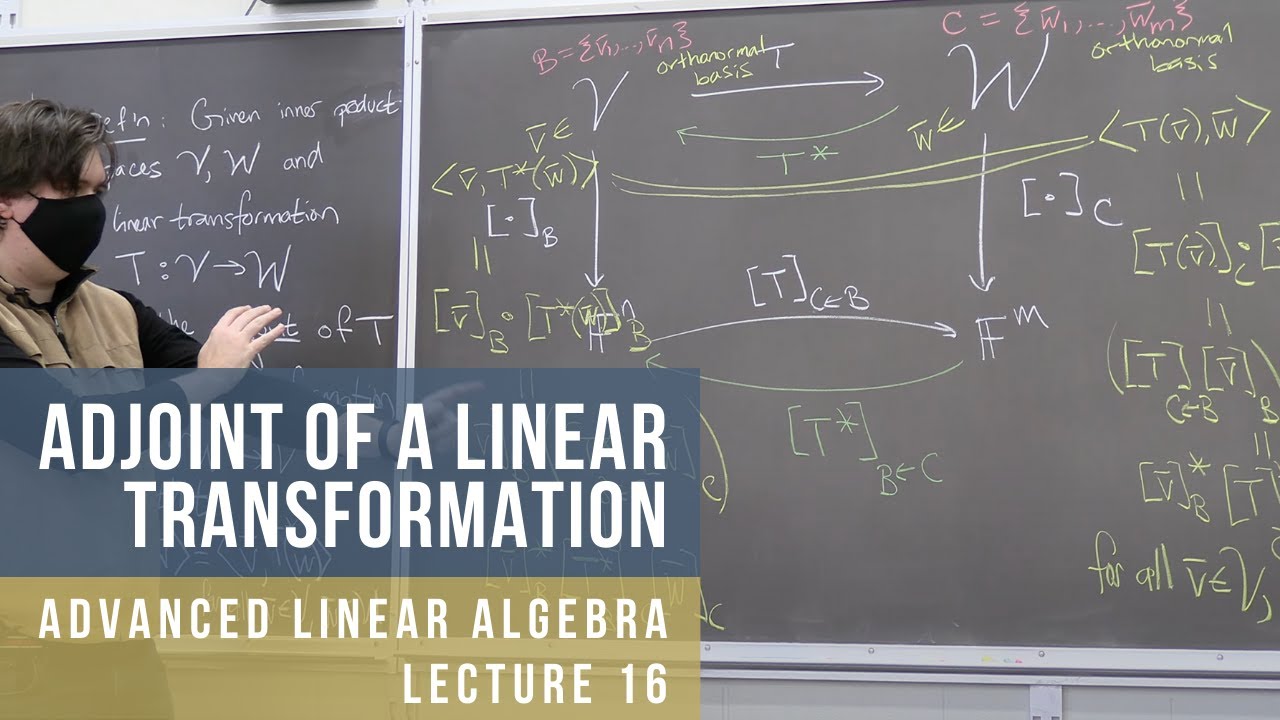
Recorded Friday, February 18.
A second course in linear algebra covering vector spaces and matrix decompositions taught by Dr. Anthony Bosman.
Full Course:
https://www.youtube.com/playlist?list=PLOROtRhtegr4HyXIIHKHketOm2k3JWSpK
The lectures closely follow 'Advanced Linear and Matrix Algebra' by Johnston:
http://www.njohnston.ca/publications/...
devout snowBOT
Channel closed
Closed due to timeout
Use .reopen if this was a mistake.
 Available help channel!
Send your question here to claim the channel.
Remember:
• Ask your math question in a clear, concise manner.
• Show your work, and if possible, explain where you are stuck.
• After 15 minutes, feel free to ping <@&286206848099549185>.
• Type the command .close to free the channel when you're done.
• Be polite and have a nice day!
Read #❓how-to-get-help for further information on how to ask a good question, and about conduct in the question channels.
 sick valley
$\lim_{z\to \pi n} (z-\pi n) \left[\frac{\cos(z)}{\sin(z)} - \frac{1}{z}\right]$
devout snowBOT
sick valley
$\lim_{z\to \pi n} (z-\pi n) \left[\frac{\cos(z)}{\sin(z)} - \frac{1}{z}\right]$


 woven radishBOT
jandro0103
Compile Error! Click the  reaction for more information.
(You may edit your message to recompile.)
 sick valley
can i do this ?
also : the limit on the right approach 0
can i just evaluate the limit on the left side by using de l'Hospital ?
i mean (if i apply the limit on the right side) :
$\lim_{z\to \pi n} (z-\pi n) \frac{\cos(z)}{\sin(z)} - 0$
woven radishBOT
jandro0103
 sick valley
pls help
 viral heath
isn't (z- pi*n) just 0, so the ans is 0?
viral heath
right
sick valley
sick valley
can i do this ?
.
viral heath
idk
sick valley
<@&286206848099549185>
 sand dove
sick valley
$\lim_{z\to \pi n} (z-\pi n) \frac{\cos(z)}{\sin(z)} - 0$
sand dove
sick valley
$\lim_{z\to \pi n} (z-\pi n) \frac{\cos(z)}{\sin(z)} - 0$
remember that sin(z) = (-1)^n sin(z - pin)
so then recall sin(t)/t when t-> 0
sick valley
woven radish
**jandro0103**
Compile Error! Click the <:errors:504266556054962196> reaction fo...
im asking if i can do this
sand dove
sick valley
im asking if i can do this
you're asking whether you can do lim(f+g) = lim(f) + lim(g)
if you know one of f or g converges
sick valley
anyway thanks for the tips
sick valley
sand dove
if you know one of f or g converges
i know that lim(g) is approaching 0
sick valley
yes
sand dove
so you're allowed
because if f diverges
then f+g diverges too
and if f converges
then f+g converges too
sick valley
ok so when i cant do this ?
sand dove
if you have convergence of neither f nor g
sick valley
so if both diverges?
sick valley
okok
sick valley
woven radish
**jandro0103**
so this is correct ?
sand dove
yes
sick valley
that i writed -0
sick valley
oh yes
sand dove
sand dove
remember that sin(z) = (-1)^n sin(z - pin)
also did a little oopsie
forgot a (-1)^n
anyways
that's about it
sick valley
but cant i just apply the l'hospital since its 0/0 ?
sick valley
i mean when i get to this point
$\lim_{z\to \pi n} (z-\pi n) \frac{\cos(z)}{\sin(z)}$
woven radishBOT
jandro0103
 sick valley
i can apply the l'hospital
sand dove
how would you apply it here then
with function is your "numerator"
and which function is your "denominator"
(there's also easier than l'hôpital)
sick valley
$\lim_{z\to \pi n} \frac{(z-\pi n) \cos(z)}{\sin(z)} = 0/0$
woven radishBOT
jandro0103
 sand dove
that's gonna cause you unnecessarily problems imo
sick valley
why?
sand dove
don't you know the limit of sin(x)/x?
sick valley
so its (-1)^n / (-1)^n = 1
sand dove
when x -> 0
sick valley
isnt this enough ?
sand dove
sick valley
N) cos(z) + (z- pi n) * -sin (z)
(z-pin)(sin(z))
just to show we make a lot of mistakes
with unnecessary computations
sick valley
sorry
sick valley
(-1)^n / (-1)^n
sand dove
yes that seems easier
sick valley
ok
sand dove
$\lim_{z\to \pi n} \cos(z)\frac{(z-\pi n)}{\sin(z)} = \lim_{t\to 0} (-1)^n\cos(t)\frac{t}{(-1)^n\sin(t)} = 1$
woven radishBOT
rafilou is not not born in 2003
 sick valley
woven radish
**rafilou is not not born in 2003**
sick valley
woven radish
**rafilou is not not born in 2003**
mm
so you sub t = z - pi n?
oh no
sand dove
sick valley
so you sub t = z - pi n?
yeah
sick valley
ok i got here
woven radishBOT
jandro0103
 sick valley
mm now ?
sick valley
ok
sick valley
sand dove
cos(t+pin) = (-1)^n cos(t)
so we use lim(f*g) = lim f x lim g ?
devout snowBOT
@sick valley Has your question been resolved?
devout snowBOT
Channel closed
Closed due to timeout
Use .reopen if this was a mistake.
devout snowBOT
Available help channel!
Send your question here to claim the channel.
Remember:
• Ask your math question in a clear, concise manner.
• Show your work, and if possible, explain where you are stuck.
• After 15 minutes, feel free to ping <@&286206848099549185>.
• Type the command .close to free the channel when you're done.
• Be polite and have a nice day!
Read #❓how-to-get-help for further information on how to ask a good question, and about conduct in the question channels.
 lavish patio
Given a n x n array with unique entries, with an equivalence relation of a possible rotation by 90k and then a possible reflection across a line that is 45k (k is any natural), how many, and what, are the equivalence classes
devout snowBOT
lavish patio
Given a n x n array with unique entries, with an equivalence relation of a possi...
lavish patio
i solved this problem for 2x2, using differences in diagonal entries, but the general case probably needs linear algebra or smth
no idea where to start with the general solution
most likely needs a case for even and odd n, as odd n results in n times more classes just due to the center
another wording of the question is, how many different initial states would you need if you needed to get all n! possibilities given the transformations
and how would you obtain one of every initial state
 honest lion
If I understand your question correctly I believe if you are given the location of the 4 corners of your array you can figure out the position of all the other elements. Thus, considering 2x2 should be enough
lavish patio
how come
oh i figured it out, you only have to consider quadrant amount and n mod2
ty
.close
.close
devout snowBOT
Channel closed
Closed by @lavish patio
Use .reopen if this was a mistake.
devout snowBOT
Available help channel!
Send your question here to claim the channel.
Remember:
• Ask your math question in a clear, concise manner.
• Show your work, and if possible, explain where you are stuck.
• After 15 minutes, feel free to ping <@&286206848099549185>.
• Type the command .close to free the channel when you're done.
• Be polite and have a nice day!
Read #❓how-to-get-help for further information on how to ask a good question, and about conduct in the question channels.
 zenith viper
wouldnt tan pi/6 be sqrt3?
 devout snowBOT
zenith viper
wouldnt tan pi/6 be sqrt3?
devout snowBOT
zenith viper
wouldnt tan pi/6 be sqrt3?
 pseudo basin
no
 faint zinc
1/sqrt(3)
pseudo basin
pi/6 is 30°
 sand quarry
Try to use the 30-60-90 triangle I mentioned to you in the previous help channel
Again don't memorise those
 pseudo basin
sure
 honest meadow
zenith viper
wait can i use the circle?
honest meadow
zenith viper
wait can i use the circle?
Yes!! One way is to memorize the triangles, the other is to just use sin / cos to find tan
pseudo basin
remember the coordinates are (cos, sin) in that order
pseudo basin
zenith viper
we cant have a sqrt for denominator
eh.
honest meadow
You can but generally we rationalize the denominator
pseudo basin
yeah like you shouldn't treat the presence of roots in denom as something inherently illegal lol
zenith viper
sorry I have another question

how do u graoh this?
i find graphing very confusing
im guessing its based off of the angle so it would probably be d
but how can i be so sure? (The answer was d im just checking if there is something else I can look at incase)
pseudo basin
y = sqrt(3)*x goes thru the origin (as does any line of the form theta=something)
a and c are out on that alone
and it's got positive slope greater than 1
devout snowBOT
@zenith viper Has your question been resolved?
Channel closed
Closed by @zenith viper
Use .reopen if this was a mistake.
zenith viper
.reopen
devout snowBOT
✅
zenith viper
how is this done?

 jagged harbor
how have you been doing polar-to-rectangular conversions normally?
zenith viper
idk i usually find the polar coordinates
 plucky maple
zenith viper
how is this done?
plucky maple
zenith viper
how is this done?
I recommend visualizing this
Then it will be easy to figure out
zenith viper
so i should graph it?
jagged harbor
you know how an angle corresponds to a point on the unit circle?
plucky maple
zenith viper
so i should graph it?
Yeah sure
zenith viper
jagged harbor
you know how an angle corresponds to a point on the unit circle?
sort of
jagged harbor
you take this standard correspondence with your given angle, then scale both coordinates by the given radius
zenith viper
the words are kinda confusing sorry
jagged harbor
zenith viper
sort of
i.e. an angle theta corresponds to the point (cos theta, sin theta)
then scale everything by the radius
plucky maple
zenith viper
the words are kinda confusing sorry
Just make the relevant sketch, it’ll be easy to understand then
jagged harbor
the sketch makes more sense visually
 knotty sage
this might help
 zenith viper
oh ill try that
knotty sage
knotty sage
this might help
forgot the right angle but still the idea is there
zenith viper
wait 2pi/3 is r or y for me?
knotty sage
zenith viper
wait 2pi/3 is r or y for me?
2pi/3 is the theta polar coords are always (r,theta)
knotty sage
zenith viper
wait but its in place of y in (x,y) form
doesn't matter it represent something differently
knotty sage
zenith viper
so like do i use -9 as x and 2pi/3 as y?
no
polar coord use a distance (radius) and an angle to show position
where cartesian only show position
knotty sage
zenith viper
how is this done?
the point given is in polar form (r,theta) and you want to convert to rectangular (cartesian)
knotty sage
knotty sage
this might help
you can use this
ofc don't forget the rectangular is represented as (x,y)
zenith viper
so i find y using 4sin theta and x using rcos theta?
then the answer i get for those is the coordinates for the rectangular
knotty sage
zenith viper
so i find y using 4sin theta and x using rcos theta?
it'll be -9sin(2pi/3)
for y
knotty sage
zenith viper
and -9cos(2pi/3) for x?
yep
zenith viper
or do we find that some other way?
ok thanks
sorry is it ok if u kinda show how ud solve it to end up with a fraction? when i use a calculator i get a decimal
and im pretty sure the question is looking for fractions
knotty sage
zenith viper
and im pretty sure the question is looking for fractions
are you familiar with reference angles and special angles ?
zenith viper
yes
knotty sage
what is the reference angle of 2pi/3 ?
zenith viper
120?
knotty sage
zenith viper
120?
still not the reference angle (that's just the same angle in degrees)
zenith viper
oh sorry i meant the angle was 240
so 4pi/3
i accidentally subtracted 360 from 240 after getting it as an answer when subtracting 120
knotty sage
the reference angle is (pi-2pi/3)=pi/3
but you still need to consider quadrants
the angle is in quadrant to (so the cosine value should be negative and the sine will be positive)
-9cos(2pi/3)=((-1)(-9)cos(pi/3),-9sin(pi/3))
zenith viper
oh ok is there a step after that?
because in the answer key it says that the answer is:
 knotty sage
zenith viper
oh ok is there a step after that?
knotty sage
zenith viper
oh ok is there a step after that?
ofc you need to find the values of sin(pi/3) and cos(pi/3)
pi/3=60deg
zenith viper
oh i got it im so dumb i forgot u can get sin and cos from the coordinates on the circle
devout snowBOT
@zenith viper Has your question been resolved?
devout snowBOT
Channel closed
Closed due to timeout
Use .reopen if this was a mistake.
Available help channel!
Send your question here to claim the channel.
Remember:
• Ask your math question in a clear, concise manner.
• Show your work, and if possible, explain where you are stuck.
• After 15 minutes, feel free to ping <@&286206848099549185>.
• Type the command .close to free the channel when you're done.
• Be polite and have a nice day!
Read #❓how-to-get-help for further information on how to ask a good question, and about conduct in the question channels.
 tawdry harbor
not sure how to simplify it
 devout snowBOT
tawdry harbor
not sure how to simplify it
knotty sage
tawdry harbor
not sure how to simplify it
devout snowBOT
tawdry harbor
not sure how to simplify it
knotty sage
tawdry harbor
not sure how to simplify it
factor out the 1/3 and it's just in form of af(x)
integral of af(x) is aF(x)
devout snowBOT
Channel closed
Closed by @tawdry harbor
Use .reopen if this was a mistake.
devout snowBOT
Available help channel!
Send your question here to claim the channel.
Remember:
• Ask your math question in a clear, concise manner.
• Show your work, and if possible, explain where you are stuck.
• After 15 minutes, feel free to ping <@&286206848099549185>.
• Type the command .close to free the channel when you're done.
• Be polite and have a nice day!
Read #❓how-to-get-help for further information on how to ask a good question, and about conduct in the question channels.
 remote sun
 devout snowBOT
remote sun
devout snowBOT
remote sun

 oak bane
remote sun
How to check for c and d
oak bane
remote sun
How to check for c and d
what happens to f(x), f'(x) as x approaches infinity
remote sun
oak bane
what happens to f(x), f'(x) as x approaches infinity
f'(x) becomes a value bw 0 and 1
f(x) diverges to infinity
ohhhh
I see so after some point f(x)>f'(x)
oak bane
yeah
oak bane
yea
devout snowBOT
Channel closed
Closed by @remote sun
Use .reopen if this was a mistake.
devout snowBOT
Available help channel!
Send your question here to claim the channel.
Remember:
• Ask your math question in a clear, concise manner.
• Show your work, and if possible, explain where you are stuck.
• After 15 minutes, feel free to ping <@&286206848099549185>.
• Type the command .close to free the channel when you're done.
• Be polite and have a nice day!
Read #❓how-to-get-help for further information on how to ask a good question, and about conduct in the question channels.
 junior jewel
How do I solve for perimeter of region
 devout snowBOT
junior jewel
How do I solve for perimeter of region
devout snowBOT
junior jewel
How do I solve for perimeter of region
 light fractal
try connecting the transition points between the segments and the circular arcs to the centers
in order to figure out the measures of the circular arcs
junior jewel
so then each arc would be 60?
light fractal
not quite
junior jewel
or 120
light fractal
junior jewel
or js 360/3
why would it have to be 360/3
junior jewel
idk if this is right but each circle is 360
junior jewel
light fractal
try connecting the transition points between the segments and the circular arcs ...
didnt really indertsnad that
 ebon coyote
It's more that, if you connect the centres to each other, you get an equalateral triangle
junior jewel
oh
 ebon coyote
^
ebon coyote
That angles around a point sum to 360 degrees?
junior jewel
i said that wrong
junior jewel
ebon coyote
That angles around a point sum to 360 degrees?
i knew that
junior jewel
light fractal
but i didnt think to solve it like he did
ebon coyote
Ah
This is less of something that is "taught"
This is general problem-solving skills
ebon coyote
In this case, explicitly:
- if we connect the centres, since they have the same radii, we get an equilateral, so its internal angles are all 60 degrees
- if we connect the centres to the point where the "perimeter" diverges into a straight line by leaving the curve of the circles, then these lines are connecting to tangents of the circles
- this gives us rectangles drawn connected to the main equilateral triangle
- so the other blue angles are each 90 degrees
ebon coyote
You can sorta see that you do know these individually, but the main trick is to force it out of the question and convince yourself (and a reader - in this case just drawing the lines and right-angles will probs be enough) that what information you're drawing out is logical
And then bringing those things together
devout snowBOT
Channel closed
Closed by @junior jewel
Use .reopen if this was a mistake.
devout snowBOT
Available help channel!
Send your question here to claim the channel.
Remember:
• Ask your math question in a clear, concise manner.
• Show your work, and if possible, explain where you are stuck.
• After 15 minutes, feel free to ping <@&286206848099549185>.
• Type the command .close to free the channel when you're done.
• Be polite and have a nice day!
Read #❓how-to-get-help for further information on how to ask a good question, and about conduct in the question channels.
 somber garnet
 devout snowBOT
somber garnet
somber garnet
devout snowBOT
somber garnet
somber garnet
this is so confusing
 clear tree
Im guessing he wants you to fjnd the hypotenuse that the 2 distances of the trains make
 frozen aurora
somber garnet
frozen aurora
somber garnet
first find how far away train A is at 11 am and how far away train B is at 10 am
devout snowBOT
@somber garnet Has your question been resolved?
clear tree
Yeah you can find the distance of train A at 11 am and the distance of train B at 10 am and then try to find the wanted time from there
devout snowBOT
Channel closed
Closed due to timeout
Use .reopen if this was a mistake.
Available help channel!
Send your question here to claim the channel.
Remember:
• Ask your math question in a clear, concise manner.
• Show your work, and if possible, explain where you are stuck.
• After 15 minutes, feel free to ping <@&286206848099549185>.
• Type the command .close to free the channel when you're done.
• Be polite and have a nice day!
Read #❓how-to-get-help for further information on how to ask a good question, and about conduct in the question channels.
somber garnet
frozen aurora
first find how far away train A is at 11 am and how far away train B is at 10 am
how
devout snowBOT
somber garnet
how
somber garnet
somber garnet
can someone help
frozen aurora
somber garnet
how
you know the time and you know the speed
thus you can find distance
somber garnet
like how much they traveled in 1 hour?
somber garnet
frozen aurora
you know the time and you know the speed
how do i find B's distance?
frozen aurora
somber garnet
like how much they traveled in 1 hour?
yes
frozen aurora
somber garnet
how do i find B's distance?
it traveled for 1 hour at 45 km/h
somber garnet
frozen aurora
it traveled for 1 hour at 45 km/h
towards the station right
frozen aurora
yes but that doesn't matter
well it does, but not for the distance
it was at some point an hour before arriving to the station
frozen aurora
somber garnet
towards the station right
it's the same way you did it for train A
somber garnet
then the hypotenuse?
frozen aurora
not sure what you mean by "the hypothenuse" so can't say if it's correct or not
rn you are finding the "boundary values"
frozen aurora
is this a calculus or no calculus question
somber garnet
calculus
frozen aurora
great
frozen aurora
somber garnet
what am i supposed to do after finding the distances
what are they btw
as in what did you get
somber garnet
45 for a 60 for b
frozen aurora
correct
now let's consider what's happening at some time t
how far away is A from the station at time t?
somber garnet
can we let x represent some distance
frozen aurora
(we can let t be in hours)
frozen aurora
why not
somber garnet
nvm
i thoght you said
we cant
mbbb
okay yea
ohhhhhhhhh wait
so we can rewrite the distance at time t
using v = d/t
?
frozen aurora
yes
frozen aurora
what did you get
frozen aurora
frozen aurora
how far away is A from the station at time t?
for this
frozen aurora
how far away from the station is B at time t?
at t=1 hour, how far away is B from the station?
frozen aurora
yes precisely
somber garnet
ohh so we want their position relative to station
frozen aurora
yes
frozen aurora
it would be helpful to draw a little diagram to help visualize this
 woven radishBOT
 frozen aurora
great
somber garnet
do we find the hypotenuse now lol
frozen aurora
woven radish
 frozen aurora
somber garnet
do we find the hypotenuse now lol
frozen aurora
somber garnet
do we find the hypotenuse now lol
yes
somber garnet
omg
frozen aurora
you find its length in terms of those two equations
frozen aurora
hint if needed: ||distance between two points formula||
frozen aurora
i will
frozen aurora
somber garnet
cant we use a^2 +b^2 = c^2
what do you get for c?
frozen aurora
no worries
somber garnet
we need deirvaive riht
frozen aurora
after you get the expression yea
somber garnet
uhhhhhhhhhhhhhhh
frozen aurora
what's up
 somber garnet
OMG
frozen aurora
frozen aurora
bro........
I've done that mistake SO many times
somber garnet
mbbb
frozen aurora
i knowwww 😭😭
frozen aurora
the answer is gonna be nice
 somber garnet
huhhh
frozen aurora
wait actually on line 2 aswell
frozen aurora
,w expand (45-45t^2)^2
woven radishBOT


 Requested by arte_m_etra
frozen aurora
Requested by arte_m_etra
frozen aurora
ye
somber garnet
okay :(
 echo tangle
could i get some help when you guys are done?
frozen aurora
no shame in that – simply sparing you the misery of having to redo a question 5 times from scratch :)
frozen aurora
echo tangle
could i get some help when you guys are done?
take a look in #❓how-to-get-help
echo tangle
ok, sorry
frozen aurora
show
 frozen aurora
no two squares
frozen aurora
you got this broski
frozen aurora
somber garnet
0.36
yessir
that's your final answer
4th time was the charm indeed
good job!
somber garnet
i have an optimization test tmr, do you have any tips cuz i feel like with optimization there's way too many different types of problems to study
somber garnet
frozen aurora
don't apologise
🥹
frozen aurora
somber garnet
i have an optimization test tmr, do you have any tips cuz i feel like with optim...
it's allll about getting the model right
cuz after that it's just derivatives
frozen aurora
frozen aurora
it's allll about getting the model right
so try to use both fornulas and common sense
plug in values to test your model
and you want everything to be in consistent units and (most likely in your case) dependent on exactly one variable
frozen aurora
somber garnet
like howd you even think of this
the question asks to find the time, so i figured using t will be helpful
the only issue is that it's not always like that, for example of they asked to find the least distance between trains you would still pick time to be the variable
that's because time is consistent between both trains: their velocities and distances are completely unrelated
somber garnet
frozen aurora
and you want everything to be in consistent units and (most likely in your case)...
okayy
frozen aurora
if you tried picking distances as your variables, you'd either get stuck with two variables, or eventually stumble upon what we did here anyway
somber garnet
frozen aurora
if you tried picking distances as your variables, you'd either get stuck with tw...
yea omg 😭
frozen aurora
somber garnet
can we let x represent some distance
i thought i reacted to this lol but my internal reaction was like "that's just not gonna work"
frozen aurora
you have like 3 different distances
distsnce between trains and the station, distance between the trains themselves
you can't pick one x
somber garnet
ohhhhhhhhhhhhhhh
frozen aurora
but! all of those depend on time
somber garnet
and they have the same time?
frozen aurora
yes
somber garnet
oh okay
frozen aurora
they all depend on the same time variable
which is why we use time
so yeah i think that's about it i can give advice-wise
frozen aurora
I'll probably go to bed now so i think you'll end up talking to someone else
are you from the US?
somber garnet
frozen aurora
are you from the US?
nope im from canada
somber garnet
frozen aurora
I'll probably go to bed now so i think you'll end up talking to someone else
okayy sleep well
frozen aurora
aha i see
somber garnet
🙇
frozen aurora
7 hour difference damn
somber garnet
oh for uni?
frozen aurora
yes
frozen aurora
somber garnet
i think imight later 😭
well if that's it for now, feel free to type ".close"
devout snowBOT
Channel closed
Closed by @somber garnet
Use .reopen if this was a mistake.
devout snowBOT
Available help channel!
Send your question here to claim the channel.
Remember:
• Ask your math question in a clear, concise manner.
• Show your work, and if possible, explain where you are stuck.
• After 15 minutes, feel free to ping <@&286206848099549185>.
• Type the command .close to free the channel when you're done.
• Be polite and have a nice day!
Read #❓how-to-get-help for further information on how to ask a good question, and about conduct in the question channels.
 royal grail
i need help knowing which trig function to use for which right triangle scenario.
for example:
in the first one, i am given the opposite angle and hypotenuse. this means i use sin.
for triangles #2 and #6, they are the opposite angle & opposite side and adjacent angle & adjacent side. how do i know what function to use for these?
and am i getting any others wrong?
please ping when responding :)
 devout snowBOT
royal grail
i need help knowing which trig function to use for which right triangle scenario...
devout snowBOT
royal grail
i need help knowing which trig function to use for which right triangle scenario...
 wispy oyster
there are no trig functions for opp/opp
that is just 1
we are related ratios of triangle's sides to the angles
they either need to give u two sides (means u r likely finding an angle) or one side and one angle to find the other sides
royal grail
what function would i use for triangle #2 then? since they're both opposite, there's no function that would work
devout snowBOT
@royal grail Has your question been resolved?
royal grail
whatever i'll try later
devout snowBOT
Channel closed
Closed by @royal grail
Use .reopen if this was a mistake.
Available help channel!
Send your question here to claim the channel.
Remember:
• Ask your math question in a clear, concise manner.
• Show your work, and if possible, explain where you are stuck.
• After 15 minutes, feel free to ping <@&286206848099549185>.
• Type the command .close to free the channel when you're done.
• Be polite and have a nice day!
Read #❓how-to-get-help for further information on how to ask a good question, and about conduct in the question channels.
 tough vigil
!help
devout snowBOT
To ask for mathematics help on this server, please open your own help channel or help thread. See #❓how-to-get-help for instructions.
devout snowBOT
tough vigil
!help

 supple knot
Try partial fractions and write it as a telescoping sum
devout snowBOT
Channel closed
Closed by @tough vigil
Use .reopen if this was a mistake.
devout snowBOT
Available help channel!
Send your question here to claim the channel.
Remember:
• Ask your math question in a clear, concise manner.
• Show your work, and if possible, explain where you are stuck.
• After 15 minutes, feel free to ping <@&286206848099549185>.
• Type the command .close to free the channel when you're done.
• Be polite and have a nice day!
Read #❓how-to-get-help for further information on how to ask a good question, and about conduct in the question channels.
 placid trout
 devout snowBOT
placid trout
placid trout
devout snowBOT
placid trout
placid trout
i got my answers but how do i graph it?
horiz tan at (2,-1)
vert tab (1,0)
d^2 y/dx^2 = (-2t+4)/(9t^5)
 lilac moat
placid trout
i got my answers but how do i graph it?
lilac moat
placid trout
i got my answers but how do i graph it?
on paper or with a computer/calculator?
placid trout
lilac moat
on paper or with a computer/calculator?
paper
lilac moat
make a chart, t|x|y
for t = -1, x = 0, y = 3
and so on, for enough values of t that you get a curve
devout snowBOT
Channel closed
Closed by @placid trout
Use .reopen if this was a mistake.
devout snowBOT
Available help channel!
Send your question here to claim the channel.
Remember:
• Ask your math question in a clear, concise manner.
• Show your work, and if possible, explain where you are stuck.
• After 15 minutes, feel free to ping <@&286206848099549185>.
• Type the command .close to free the channel when you're done.
• Be polite and have a nice day!
Read #❓how-to-get-help for further information on how to ask a good question, and about conduct in the question channels.
 hybrid maple
I’m double integrals
I don’t know how to horizontal strips for this example
I feel like I have to split it up but I’m not sure
 devout snowBOT
hybrid maple
I’m double integrals
I don’t know how to horizontal strips for this example
I...
devout snowBOT
hybrid maple
I’m double integrals
I don’t know how to horizontal strips for this example
I...
@hybrid maple Has your question been resolved?
devout snowBOT
Channel closed
Closed due to timeout
Use .reopen if this was a mistake.
Available help channel!
Send your question here to claim the channel.
Remember:
• Ask your math question in a clear, concise manner.
• Show your work, and if possible, explain where you are stuck.
• After 15 minutes, feel free to ping <@&286206848099549185>.
• Type the command .close to free the channel when you're done.
• Be polite and have a nice day!
Read #❓how-to-get-help for further information on how to ask a good question, and about conduct in the question channels.
 unreal falcon
This just confused the hell out of me what happened
 unreal falcon
The y= 3+3.5lamda to z = -1 - 4 lamba also does not make sense to me
oh wait
Why did they pick x to be the lambda?
supple knot
unreal falcon
Why did they pick x to be the lambda?
You can pick any of the three. x, y, or z. x is just conventional I think
pseudo basin
unreal falcon
Why did they pick x to be the lambda?
one of the unknowns gotta become a parameter
there's no sacred meaning to picking x specifically for the role
unreal falcon
Oh ok and I get why the x in the directional is 1 but why is the x in the positional vector 0? is it always zero when the unknown is the lambda?
pseudo basin
x = 0 + λ
devout snowBOT
Channel closed
Closed by @unreal falcon
Use .reopen if this was a mistake.
devout snowBOT
Available help channel!
Send your question here to claim the channel.
Remember:
• Ask your math question in a clear, concise manner.
• Show your work, and if possible, explain where you are stuck.
• After 15 minutes, feel free to ping <@&286206848099549185>.
• Type the command .close to free the channel when you're done.
• Be polite and have a nice day!
Read #❓how-to-get-help for further information on how to ask a good question, and about conduct in the question channels.
 barren gulch
Can someone help me with this
 devout snowBOT
barren gulch
Can someone help me with this
devout snowBOT
barren gulch
Can someone help me with this
 versed juniper
,rccw
woven radishBOT
 barren gulch
For the area of shaded region which is the triangle
versed juniper
barren gulch
For the area of shaded region which is the triangle
the area is base times height over two
what is the base and height?
barren gulch
I tried to find the base QS using pythogaras theorem but I don’t think i did it correctly since the answer is diff
versed juniper
woven radish
 versed juniper
barren gulch
I tried to find the base QS using pythogaras theorem but I don’t think i did it...
versed juniper
barren gulch
I tried to find the base QS using pythogaras theorem but I don’t think i did it...
you know the height doesn't have to be inside the triangle
barren gulch
But i thought h is supposed to be in the middle of triangle
barren gulch
Oh
versed juniper
if you are not convinced, mirror it over the base
it's a parallelogram
which is also base times height
versed juniper
versed juniper

not really mirror but if you add another triangle it makes a parallelogram
area if parallelogram is bh
so the triangle is 1/2 bh
and if you arent convinced that a parallelograms area is bh then i also have something to show you
devout snowBOT
Channel closed
Closed by @barren gulch
Use .reopen if this was a mistake.
devout snowBOT
Available help channel!
Send your question here to claim the channel.
Remember:
• Ask your math question in a clear, concise manner.
• Show your work, and if possible, explain where you are stuck.
• After 15 minutes, feel free to ping <@&286206848099549185>.
• Type the command .close to free the channel when you're done.
• Be polite and have a nice day!
Read #❓how-to-get-help for further information on how to ask a good question, and about conduct in the question channels.
 night cypress
Could someone help me understand what did they just did

 patent token
Which step did u not understand
night cypress
patent token
Which step did u not understand
The one that I have marked
How top red went to bottom red
patent token
oh they used the half angle formula
wait a sec

They used this formula
I dont remember the derivation tho
patent token
Yea
patent token
u mean 1 - cos^2 = sin^2?
patent token
yea
night cypress
Thank you!
patent token
np
night cypress
.close
devout snowBOT
Channel closed
Closed by @night cypress
Use .reopen if this was a mistake.
devout snowBOT
Available help channel!
Send your question here to claim the channel.
Remember:
• Ask your math question in a clear, concise manner.
• Show your work, and if possible, explain where you are stuck.
• After 15 minutes, feel free to ping <@&286206848099549185>.
• Type the command .close to free the channel when you're done.
• Be polite and have a nice day!
Read #❓how-to-get-help for further information on how to ask a good question, and about conduct in the question channels.
faint zinc
@steady marsh every 4th Y means literally if you number the Ys that occur with indices, then the ones numbered 4, 8, 12, etc are guaranteed Xs? Or does it mean that if you have a string of 3 Ys in a row the next one is guaranteed to be an X?
 jaunty mantle
you are asking for P(X) but clearly it depends on which Y you talk about because of the every 4th Y thing
so are you really asking what is the P(X, n) where n is the number of trials?
each trial here will have a 4% to be Y and of those 25% will be X, and every 4th Y will be X as well
so the probability X occurs is a function of how many trials are done
faint zinc
Maybe the value of the number of X/n as n->inf?
jaunty mantle
i dont think that's what's stumping you because i dont think you've precisely asked your question
faint zinc
This sounds like a gacha system.
jaunty mantle
jaunty mantle
so the probability X occurs is a function of how many trials are done
is this what you're looking for
100 in particular?
faint zinc
And I'm guessing you want to know the total occurrence rate of X per pull
As the number of pulls get large
jaunty mantle
faint zinc
And I'm guessing you want to know the total occurrence rate of X per pull
this is not good because each pull has a different probability
you can ask of its limiting probability yes but is that what you're looking for
you need to be clear
any finite trial will not be exactly this limiting probability, but will asymptotically approach it
faint zinc
(especially because it will take a lot of pulls to reach the limiting probability, so it's probably only relevant to whales rather than f2players)
jaunty mantle
well okay in this case we can probably just use the limiting probability
i think given the numbers thousands of trial are sufficiently large in magnitude?
i would say tho
if you arent good at probability you can simulate this
it will do a great job and not be too difficult
it's a good skill to be able to write simple scripts like this!
faint zinc
So every time you pull an X the counter is reset, so we have
X
YX
YYX
YYYX
Each of these we can label with a probability of appearing.
X = 25%
YX = (75%)(25%)
YYX = (75%)^2 (25%)
YYYX = (75%)^3
We can then label each string with the proportion of Xs
X = 1
YX = 1/2
YYX = 1/3
YYYX = 1/4
And finally perform a weighted average
1 * 0.25 + 1/2 * 0.75 * 0.25 + 1/3 * 0.75^2 * 0.25 + 1/4 * 0.75^3
,w 1 * 0.25 + 1/2 * 0.75 * 0.25 + 1/3 * 0.75^2 * 0.25 + 1/4 * 0.75^3
woven radishBOT

 Requested by omnipotententity
faint zinc
Requested by omnipotententity
faint zinc
A little bit under half
jaunty mantle
this is the non-math perspective on conditional probabilities lol
but i really like it for explanatory purposes
faint zinc
It's only ≈ 0.5 so it's slightly less than 2% but yes
jaunty mantle
there's a similar mechanic in world of warcraft actually
it's a sort of badluck protection
faint zinc
And Fire Emblem Heroes
jaunty mantle
everytime X fails the occur when Y happens, the probability that X happens when Y happens increases until 100%
faint zinc
Actually, FEH has 3 layers of bad luck protection
jaunty mantle
so here it stays at a constant 25% until the 3rd fail
faint zinc
Which makes calculating probabilities obnoxious as hell lol
jaunty mantle
the mechanic im describing goes the first fail makes the next one go from 50% to 70% then to 90% then 100%
they just make the odds hard as hell to actually calculate haha
that we can calculate :p
that's what probability is for
we can quantify exactly what the variance will be
faint zinc
I had a streak of luck so bad I went full tilt and made an old spreadsheet where I kept track of my pulls, to verify that the odds were more or less the same as advertised. And keeping track of the probability state was maddening lol
Which, I'm F2P, so I don't even have skin in the game
jaunty mantle
ive just realised that your wording of variance is not what i was thinking
the % are deterministic by number of trials it's not random
faint zinc
Exponential distributions have a very long tail, but have probability mass concentrated near the start
So it will probably take thousands of pulls to approach the limit
Yes
jaunty mantle
i mean given n trials, E[the number of appearances of X / n] is a deterministic number
for n trials, the expected number of appearances of X is not random, so the % at each trial value is deterministic
it's a sequence of % that approaches the 2% value
uh let's see, this seems really complicated 😭
P(X = 0, 1) = 0.96 + 0.04 * 0.75 = 99%
P(X = 1, 1) = 0.04 * 0.25 = 1%
P(X = 0, 2) = 0.96 * 0.96 + 0.96 * 0.04 * 0.75 + 0.04 * 0.75 * 0.96 + 0.04 * 0.75 * 0.04 * 0.75= 98.01%
P(X = 1, 2) = 0.96 * 0.04 * 0.25 + 0.04 * 0.25 * 0.96 + 0.04 * 0.75 * 0.04 * 0.25 + 0.04 * 0.25 * 0.04 * 0.75= 1.98%
P(X = 2, 2) = 0.04 * 0.25 * 0.04 * 0.25 = 0.1%
so this P(X = 1, 2) means the probability that with 2 trials, X shows up exactly once
ideally we have some formula for P(X=k, n)
because then E[X]/n is just 1/n sum k=0 to n of kP(X=k, n)
$\mathbb E[X, n] = \sum_{k=0}^n kP(X=k, n)$
woven radishBOT
frosst
 jaunty mantle
that's the formula for the expected number of X occurences in n trials
but idk if P(X=k, n) has a nice closed form
no yeah i know what you mean
you're looking for |E[X, n]/n - 2%|
how far is this exact value from the limiting value for each n
but the problem is i cant think of an easy way to find E[X, n]
it's an interesting question for sure
devout snowBOT
Channel closed
Closed by @steady marsh
Use .reopen if this was a mistake.
devout snowBOT
Available help channel!
Send your question here to claim the channel.
Remember:
• Ask your math question in a clear, concise manner.
• Show your work, and if possible, explain where you are stuck.
• After 15 minutes, feel free to ping <@&286206848099549185>.
• Type the command .close to free the channel when you're done.
• Be polite and have a nice day!
Read #❓how-to-get-help for further information on how to ask a good question, and about conduct in the question channels.
 twilit scroll
I need help with 31 if anyone knows how to do this
 honest meadow
what have you tried so far?
 wind mason
twilit scroll
I need help with 31 if anyone knows how to do this
wind mason
twilit scroll
I need help with 31 if anyone knows how to do this
Do you know how this would be represented?
wind mason
Then plug the resulting output into f.
wind mason
twilit scroll
so log 5v
Huh?
twilit scroll
whats the input
wind mason
You tell me. We can start with part a.
wind mason
Yes.
twilit scroll
so 6(3x+7)
honest meadow
what's your understanding of composite functions?
twilit scroll
nothing
honest meadow

This algebra video tutorial provides a basic introduction into composite functions. it explains how to evaluate composite functions. This video contains a few examples and practice problems.
Algebra Review: https://www.youtube.com/watch?v=i6sbjtJjJ-A
Join My Newsletter:
https://bit.ly/4jUXp6M
Func...
how about you watch this
and then see if that helps with your question
wind mason
twilit scroll
so 6(3x+7)
Do you know what g(6) represents?
honest meadow
This algebra video tutorial provides a basic introduction into functions. It contains plenty of examples and multiple-choice practice problems as well as free response problems.
Functions - Free Formula Sheet: https://www.video-tutor.net/precalculus-formula-sheets.html
Functions - Video Lessons:
https://www.video-tutor.net/functions.html
...
id recommend watching the videos so you can see how much you understand and so we can help clarify content
wind mason
twilit scroll
no i funny
It represents the value of x that you’re going to subsitute for g.
Hence why g(x)=3x+7.
twilit scroll
can you show me the steps its alot easier for me to learn that way
wind mason
Okay.
So we have g(x)=3x+7.
g(6)=3(6)+7.
Whatever you see inside the parentheses, you replace the x for it.
Does that make sense?
 real mason
twilit scroll
can you show me the steps its alot easier for me to learn that way
real mason
twilit scroll
can you show me the steps its alot easier for me to learn that way
The function g(x) is basically saying, you give me x and I give you 3x+7
twilit scroll
wind mason
Does that make sense?
yes
wind mason
twilit scroll
yes
Okay. Try to apply the principle, then.
wind mason
Yes.
twilit scroll
ok so for B
its different
and idk where to plug in 125
is it
log 5 125 =3x+7
that doesnt make sense
wind mason
Okay.
The one on the outside is applied last.
You apply the innermost one first.
Does that make sense?
devout snowBOT
@twilit scroll Has your question been resolved?
Channel closed
Closed by @twilit scroll
Use .reopen if this was a mistake.
Available help channel!
Send your question here to claim the channel.
Remember:
• Ask your math question in a clear, concise manner.
• Show your work, and if possible, explain where you are stuck.
• After 15 minutes, feel free to ping <@&286206848099549185>.
• Type the command .close to free the channel when you're done.
• Be polite and have a nice day!
Read #❓how-to-get-help for further information on how to ask a good question, and about conduct in the question channels.
 pallid stream
i need help with a geometry task:
there is a rhombus ABCD with an acute angle a. A belongs to a line that divides the angle a by a ratio of 1:3 and |CD| by a ratio of 2:3.
prove that cosa = 1/8
devout snowBOT
pallid stream
i need help with a geometry task:
there is a rhombus ABCD with an acute angle a....
pallid stream

so i ended up with the last equation and earlier i decided to do something like cos(3*1/4a) = cos(3b) but it didnt really work and it made things a lot messier
devout snowBOT
@pallid stream Has your question been resolved?
devout snowBOT
@pallid stream Has your question been resolved?
devout snowBOT
@pallid stream Has your question been resolved?
devout snowBOT
@pallid stream Has your question been resolved?
pallid stream
<@&286206848099549185>
devout snowBOT
@pallid stream Has your question been resolved?
 muted sapphire
pallid stream
<@&286206848099549185>
muted sapphire
pallid stream
<@&286206848099549185>
Have u solve it?
devout snowBOT
Channel closed
Closed due to timeout
Use .reopen if this was a mistake.
devout snowBOT
Available help channel!
Send your question here to claim the channel.
Remember:
• Ask your math question in a clear, concise manner.
• Show your work, and if possible, explain where you are stuck.
• After 15 minutes, feel free to ping <@&286206848099549185>.
• Type the command .close to free the channel when you're done.
• Be polite and have a nice day!
Read #❓how-to-get-help for further information on how to ask a good question, and about conduct in the question channels.
sand quarry
Hey, so this is a semi-mathematical, semi-programmatic question I have. I am trying to implement an algorithm that computes the integer square root of a number. Meaning, for a non-negative integer $x$, the largest integer $r$ that satisfies the inequality [
r \2 r \le x
]
There are several algorithms one could use, but my question is to gain a better intuition on the following iterative, numerical method:
\begin{itemize}
\item Start with a guess $r = x$
\item Repeat: [
r = \lfloor\4{r +\lfloor\4xr\rfloor}2\rfloor
]
\item Stop when $r$ stabilises.
\end{itemize}
I can't really understand the mathematical intuition behind why the above should eventually converge. Could I gain some insight on this?
devout snowBOT
sand quarry
Hey, so this is a semi-mathematical, semi-programmatic question I have. I am try...
woven radishBOT
Aero ݁˖ ❀ ⋆。˚

 stone stump
if r is bigger than the sqrt, then x/r is smaller
and you are taking the average of them
so you get put somewhere in the middle
and then you repeat
so intuitively the numbers r and x/r get closer and closer together
and always one bigger than sqrt, the other smaller
(if you didnt round then this would converge to the actual sqrt)
sand quarry
ahh that makes sense now
If your guess r is too big, then x/r is too small
If r is too small, then x / r is too big
thanks
.close
devout snowBOT
Channel closed
Closed by @sand quarry
Use .reopen if this was a mistake.
devout snowBOT
Available help channel!
Send your question here to claim the channel.
Remember:
• Ask your math question in a clear, concise manner.
• Show your work, and if possible, explain where you are stuck.
• After 15 minutes, feel free to ping <@&286206848099549185>.
• Type the command .close to free the channel when you're done.
• Be polite and have a nice day!
Read #❓how-to-get-help for further information on how to ask a good question, and about conduct in the question channels.
 stuck vortex
is there any formula to find the sides of a polygon
i remember studying something liek that in class but cant recall
devout snowBOT
stuck vortex
is there any formula to find the sides of a polygon
i remember studying somethin...
 winter patrol
length of sides or number of side
and with what given info
stuck vortex
calculate number of sides @stuck vortex
 autumn girder
given?
stuck vortex
angle
winter patrol
what angle
autumn girder
of?
 drifting mauve
strange
winter patrol
as in all interior angles are 156 degrees?
drifting mauve
no polygon has 156 degrees sum of internal angles 💀
winter patrol
as in this is a regular polygon?
winter patrol
drifting mauve
no polygon has 156 degrees sum of internal angles 💀
supposedly not what they mean
drifting mauve
oh
stuck vortex
The diagram shows part of a regular polyugon
The interior angle of the polygon is 132 degree larger than the exterioor angle
Calculate the number of sides of this polygon
drifting mauve
hmmm so all them are 156 degrees
winter patrol
the sum of the exterior angles is the constant 360°
winter patrol
and getting the number of those will get you the number of sides
stuck vortex
24 + 132
we get 156 degree as intereio angle
drifting mauve
i think n * 156 = (n-2) * 180 something like this maybe
winter patrol
i.e.
(number of side/interior/exterior angles)*(your exterior angle x) = 360
drifting mauve
i get 15 from this hmmm
since all the sides are 156, the sum should be n * 156 as there are obviously n vertices then just apply the angle formula...
hmmm
stuck vortex
i swear tehre was a formula to find the no of side
winter patrol
yes
woven radishBOT
BrutalCandor
 winter patrol
try applying that

 devout snowBOT
Channel closed
Closed by @stuck vortex
Use .reopen if this was a mistake.
winter patrol
There's another that uses the exterior angle which is more efficient
which saves you a few lines of work
devout snowBOT
Available help channel!
Send your question here to claim the channel.
Remember:
• Ask your math question in a clear, concise manner.
• Show your work, and if possible, explain where you are stuck.
• After 15 minutes, feel free to ping <@&286206848099549185>.
• Type the command .close to free the channel when you're done.
• Be polite and have a nice day!
Read #❓how-to-get-help for further information on how to ask a good question, and about conduct in the question channels.
 violet vault
Can anybody help me with z tables?
devout snowBOT
violet vault
Can anybody help me with z tables?
violet vault
I don't understand why the solution in this case is Z=+/- 1.96

Cause our critical z value is -2.12, and our alpha/2 is 0.025

So to me, our Z value should be 0.1357 to like 0.0951
supple knot
you need a wider z table
supple knot
violet vault
-1.96 is not shown here
violet vault
Yeah, it's not shown anywhere, but given my critical z value and alpha, it shouldn't be greater than one, right?
This is what I'm given

I found the Z-test and the alpha values
Z_test is -2.12 and alpha/2 is 0.025
So I should get a value that's in the region of 0.0132 and 0.017, right?

I genuinely don't understand where they get their 1.96 from
supple knot
violet vault
Yeah, it's not shown anywhere, but given my critical z value and alpha, it shoul...
the critical z value and alpha values you found are from the data. it has to be measured against the significance level alpha = 0.05 to see if you reject or do not reject the null hypothesis.
violet vault
I think I understand that part, I just don't understand where they got their 1.96 value from at all cause it's in no place in the Z table except for the values go that high for the critical z values
supple knot
supple knot
you need a wider z table
.
violet vault
I've looked everywhere online and I can't reverse engineer this.
Ok, could you show me an example?
Cause here's the thing
GIVEN that critical z value (-2.12), that should be my first column, furthest to the left, right?
violet vault
And GIVEN that alpha is 0.05, that would put me at like ROUGHLY some value between 0.012 or something
violet vault
supple knot
You're supposed to find the z value from alpha=0.05
But that's a whole column??
I'm fonfused
supple knot
What's a whole column
violet vault
Like z could be anything in that column
supple knot
Nope. Should be 1.96
violet vault
You're saying all I have is 0.05

Cause to me, my critical z values was this column...
supple knot
Yea you're not reading z tables correctly
violet vault

So how do I read it correctly? I get that like this is an area under the curve
And the area under the curve can't be more than one
supple knot
violet vault
So how do I read it correctly? I get that like this is an area under the curve

A simple explanation of how to use the Z table, including several step-by-step examples.
violet vault
So that's why I'm so confused about it being 1.96
And I looked online and everything's about how to find the area
Like I'm not given a percentage to find the critical z value, I thought that was this column

Is the z-score my alpha?
Could you just walk through this problem with me? Cause the link you sent me is the same thing as every other tutorial
I would need the alpha and the percentage to find the z value, but I thought that was my -2.12
@supple knot sorry to bother you, I just seriously don't find any relevance in the tutorial you sent me. Is there any way you could walk me through one problem?
supple knot
You have to read the z table correctly first
On the column under z, -3.4 is just the first part
Each column afterwards corresponds to the next decimal place
-3.40,-3.41,..., -3.49
Are the z values for the first row
Then the entries in the table are the area under the normal distribution to the left of that z value
violet vault
supple knot
Each column afterwards corresponds to the next decimal place
The next decimal place of what? My z value?
supple knot
Yes
supple knot
supple knot
Are the z values for the first row
Hence

Stare at that until it makes sense
violet vault
Ok, so my z value is -2.12
My alpha is the first row, right?
So if I go to -2.1
The ROW of -2.1
And I go to the COLUMN of my alpha, which is 0.05
It unsurprisingly does not give me -1.96
Or positive 1.96
supple knot
violet vault
And I go to the COLUMN of my alpha, which is 0.05
No
There is no column of alpha
alpha is the value in the table
violet vault
You're saying that0.5987 is my area?
supple knot
Yes
violet vault
God damn that took way too long to get an answer for. I looked literally everywhere for that information
Ok
supple knot
supple knot
This z table tells you the value (area under normal distribution) left of z=0.25 is 0.5987
violet vault
So in my case we're look for the ROW -2.1, and the alpha 0.05
supple knot
No
alpha = 0.05 is a value in the table, not the first column or row header
Find z=-1.9
Then move to the right until 0.06
Tell me that alpha value
violet vault
So I don't have the table going far enough to the right

Cause there is no 0.05 in this row
supple knot
supple knot
Find z=-1.9
.
violet vault
supple knot
.
I thought my critical z value was -2.12? Is the first row the critical z values?
Somebody should have put axes on this bitch
supple knot
violet vault
I thought my critical z value was -2.12? Is the first row the critical z values?
violet vault
So somehow I was magically supposed to know that my answer would be -1.96

So ALL I'm given is my alha, that makes sense
supple knot
Since this is a two sided test, alpha = 0.05 is split into area to the right of 1.96 + area left of -1.96
violet vault
But then what are the columns? What are those headers?
supple knot
0.05/2 = ?
violet vault
supple knot
0.05/2 = ?
0.025
supple knot
violet vault
So somehow I was magically supposed to know that my answer would be -1.96
What's the value in the table at -1.96
supple knot
violet vault
But then what are the columns? What are those headers?
I explained that here
#help-27 message
supple knot
supple knot
-3.40,-3.41,..., -3.49
.
supple knot
supple knot
Are the z values for the first row
.
supple knot
supple knot
Then the entries in the table are the area under the normal distribution to the ...
.
violet vault
supple knot
On the column under z, -3.4 is just the first part
This is explaining the first column, I'm talking about the header of each column, meaning the first row
With like the 0.00 and 0.01 and so on
supple knot
Yes keep reading
violet vault
You're a saint, riemann thank you so much for helping me out. I'm instantly much more relieved cause I couldn't find this information ANYWHERE
violet vault
supple knot
.
So it's just the decimal place of the alpha value?
supple knot
No
supple knot
supple knot
-3.40,-3.41,..., -3.49
Do you see this list
supple knot
supple knot
And this table as an example
violet vault
supple knot
Do you see this list
Yes but it didn't make any sense
supple knot
0.05 is the 0.05 in 0.25
supple knot
violet vault
Yes but it didn't make any sense
You need to understand these things before trying to jump ahead
violet vault
Oh, so that's my alpha values and my row x column entries are my alpha/2?
supple knot
If you don't say you don't understand and you jump ahead, that signals you're either not paying attention or you understand what I wrote
violet vault
I paid attention and didnt' understand
If I could have understood immediately, I would have
supple knot
Then don't jump ahead
supple knot
violet vault
You're saying that0.5987 is my area?
Did you understand this