#help-27
1 messages · Page 337 of 1
 restive elk
Uhh welp, I dont understand that part myself, since I guess its asking for one cycle for f(sin x)
And not sin x
restive elk
 versed juniper
i think the cycle is still 0 to 2 pi
versed juniper
i think the cycle is still 0 to 2 pi
Any reasons on why...?
versed juniper
restive elk
Any reasons on why...?
its still sin x
not sin 2x or anything
the cycle doesnt change just because you cubed it
restive elk
versed juniper
its still sin x
its sin x but cubic now
restive elk
versed juniper
the cycle doesnt change just because you cubed it
Ooh, didnt knew that
thnx
but still
what after that?
versed juniper
integrate it?
restive elk
versed juniper
you integrated sin cubed -> -cos cubed
Welp its a cubic function over a full period? So I didnt even need to do it? I gues?
restive elk
versed juniper
can you show your work
So sorry for that but I got no phone with me rn
I am on PC
versed juniper
,w integrate sin^3 x - 6 sin^2 x - 15 sin x - 1 from x=0 to 2pi
 woven radishBOT


 woven radishBOT
 versed juniper
,w integrate | sin^3 x - 6 sin^2 x - 15 sin x - 1 | from x=0 to pi
woven radishBOT
 restive elk
whatcha trying to do?
versed juniper
is it asking for unsigned area ?? what does cycle mean 😭
restive elk
versed juniper
is it asking for unsigned area ?? what does cycle mean 😭
cycle means when the sin x completes one rotation and then repeats itself
,w integrate | sin^3 x - 6 sin^2 x - 15 sin x - 1 | from x=0 to 2pi
woven radishBOT


 Requested by koritsuxoxo
restive elk
Requested by koritsuxoxo
restive elk
how do i make it show the answer in terms of pi?
restive elk
,w 57.4692/pi
woven radishBOT
 Requested by koritsuxoxo
woven radishBOT
Requested by koritsuxoxo
woven radishBOT
 Requested by koritsuxoxo
restive elk
woven radish
Requested by koritsuxoxo
restive elk
woven radish
ok so this is the correct answer, according to gemini
but i dont understand how
 mystic scarab
restive elk
but i dont understand how
mystic scarab
restive elk
but i dont understand how
Because that's how you calculate the area 🤷♂️
The absolute value is there for taking into account that a normal integral would give you the signed area
 sudden blaze
What was the original question
mystic scarab
sudden blaze
What was the original question
sudden blaze
Ah so the problem is that the answer doesn't match the given ones
mystic scarab
Yep
sudden blaze
Well only problem could be somewhere forming the correct polynomial,maybe smth went wrong
sudden blaze
Wow nice one
mystic scarab
It goes through (2, -47)
 devout snowBOT
@restive elk Has your question been resolved?
restive elk
sudden blaze
<@886120777630486538>
ye?
sudden blaze
We found your mistake
sudden blaze
Your plinomial goes trough the point 2;-47 and not 2;47
restive elk
sudden blaze
Your plinomial goes trough the point 2;-47 and not 2;47
Didn't I mention that in the question itself?
 restive elk
sudden blaze
The question states it differtly than you said, so which one is correct?
restive elk
sudden blaze
The question states it differtly than you said, so which one is correct?
GPT had a hard time doing OCR... the inflection points are (2,-47)
sudden blaze
Ah ok
I'll try to solve it when I'm home from the gym, I'll DM you when I find smth
If you spot it before me, pls tell me
restive elk
sudden blaze
I'll try to solve it when I'm home from the gym, I'll DM you when I find smth
pls do, tysm sirrrrr
restive elk
sudden blaze
If you spot it before me, pls tell me
will do, tysmmmmmmmmmm
devout snowBOT
@restive elk Has your question been resolved?
devout snowBOT
Channel closed
Closed due to timeout
Use .reopen if this was a mistake.
 Available help channel!
Send your question here to claim the channel.
Remember:
• Ask your math question in a clear, concise manner.
• Show your work, and if possible, explain where you are stuck.
• After 15 minutes, feel free to ping <@&286206848099549185>.
• Type the command .close to free the channel when you're done.
• Be polite and have a nice day!
Read #❓how-to-get-help for further information on how to ask a good question, and about conduct in the question channels.
 oblique mulch
Guys it says 72 is wrong but me and all the LLMs say it’s right? Help

 devout snowBOT
oblique mulch
Guys it says 72 is wrong but me and all the LLMs say it’s right? Help
oblique mulch
devout snowBOT
oblique mulch
Guys it says 72 is wrong but me and all the LLMs say it’s right? Help
oblique mulch
I solved the first formula for T and plugged into the second. Using 11.8 as delta X
 faint gorge
oblique mulch
Guys it says 72 is wrong but me and all the LLMs say it’s right? Help
faint gorge
oblique mulch
Guys it says 72 is wrong but me and all the LLMs say it’s right? Help
i can see right through your hand
 verbal vector
3 sig figs
oblique mulch
verbal vector
3 sig figs
 oblique mulch
well im out of chances but thank you
verbal vector
alright
oblique mulch
.close
devout snowBOT
Channel closed
Closed by @oblique mulch
Use .reopen if this was a mistake.
devout snowBOT
Available help channel!
Send your question here to claim the channel.
Remember:
• Ask your math question in a clear, concise manner.
• Show your work, and if possible, explain where you are stuck.
• After 15 minutes, feel free to ping <@&286206848099549185>.
• Type the command .close to free the channel when you're done.
• Be polite and have a nice day!
Read #❓how-to-get-help for further information on how to ask a good question, and about conduct in the question channels.
 somber dawn
for this i know the first part, but am stuck on finding the parametic

 wind mason
somber dawn
for this i know the first part, but am stuck on finding the parametic
wind mason
somber dawn
for this i know the first part, but am stuck on finding the parametic
Okay, do you have the line?
Or any info about it?
somber dawn
wind mason
Okay, do you have the line?
thats all that was given
somber dawn
can't you turn 2x-y+3z =0 to <2,-1,3> and -x+2y+z=0 to <1,2,1>
then i found normal vector by doing cross multiplication
 cinder bobcat
there's a very easy trick for this involving the normal vectors
somber dawn
cinder bobcat
there's a very easy trick for this involving the normal vectors
please elaborate 🙏
cinder bobcat
the angle between the planes is the same as the angle between the normal vectors
cinder bobcat
somber dawn
can't you turn 2x-y+3z =0 to <2,-1,3> and -x+2y+z=0 to <1,2,1>
also I think you meant <-1,2,1> here
somber dawn
cinder bobcat
the angle between the planes is the same as the angle between the normal vectors
correct, but i'm not confused about the angle part
the tricky part is the parametric
my teacher did this weird thing, am this is where I am confused at
 cinder bobcat
to find the line of intersection, you need to solve the system of equations formed by the planes, which is what your teacher did
they solved for x and y in terms of z, and then they said z = k (usually I see z = t but k works too i guess)
cinder bobcat
somber dawn
my teacher did this weird thing, am this is where I am confused at

this part is actually unnecessary
somber dawn
cinder bobcat
the question says to solve for the equation though.
cinder bobcat
saying x = (-7/3)t, y = (-5/3)t, and z = t is sufficient
cinder bobcat
somber dawn
the question says to solve for the equation though.
the intersection of two planes forms a line, so you need the parametric equation of a line
which is technically 3 equations
somber dawn
cinder bobcat
the intersection of two planes forms a line, so you need the parametric equation...
thank you, i think this helped me better understand it
👍
since you're here could you please help me with this as well?
 devout snowBOT
@somber dawn Has your question been resolved?
wind mason
somber dawn
since you're here could you please help me with this as well?
Ah, this is an application of $\frac{|Ax_0+By_0+Cz_0+D|}{\sqrt{A^2+B^2+C^2}}$, for $Ax+By+Cz+D=0$ a plane and $(x_0, y_0, z_0)$ a point
woven radishBOT
;(
 wind mason
The proof behind this used the normal vector to the plane going through the point
devout snowBOT
Channel closed
Closed due to timeout
Use .reopen if this was a mistake.
devout snowBOT
Available help channel!
Send your question here to claim the channel.
Remember:
• Ask your math question in a clear, concise manner.
• Show your work, and if possible, explain where you are stuck.
• After 15 minutes, feel free to ping <@&286206848099549185>.
• Type the command .close to free the channel when you're done.
• Be polite and have a nice day!
Read #❓how-to-get-help for further information on how to ask a good question, and about conduct in the question channels.
 restive river
yo yo yo
devout snowBOT
restive river
yo yo yo
restive river
@lyric hornet pov my teacher is a piece of shit and gives me a 90% even tho i got everything correct for smalls mistakes
 supple knot
 devout snowBOT
Channel closed
Closed by @supple knot
Use .reopen if this was a mistake.
devout snowBOT
Available help channel!
Send your question here to claim the channel.
Remember:
• Ask your math question in a clear, concise manner.
• Show your work, and if possible, explain where you are stuck.
• After 15 minutes, feel free to ping <@&286206848099549185>.
• Type the command .close to free the channel when you're done.
• Be polite and have a nice day!
Read #❓how-to-get-help for further information on how to ask a good question, and about conduct in the question channels.
 tough vigil
1help
devout snowBOT
tough vigil
1help
tough vigil
!help
devout snowBOT
To ask for mathematics help on this server, please open your own help channel or help thread. See #❓how-to-get-help for instructions.
tough vigil
question if y= a sin x + b cos x then (dy/dx)^2 + y^2 is a) a function of z or b) a constant
 undone chasm
 pseudo basin
tough vigil
question if y= a sin x + b cos x then (dy/dx)^2 + y^2 is a) a function of z or b...
pseudo basin
tough vigil
question if y= a sin x + b cos x then (dy/dx)^2 + y^2 is a) a function of z or b...
what is z here
tough vigil
pseudo basin
what is z here
its was x
pseudo basin
btw just for future reference
you're supposed to just send your question directly
anyway, have you worked out what y'^2 + y^2 simplifies to?
pseudo basin
for a start, ^ for exponents...
but also you could post a screenshot or picture of the thing
tough vigil
(dydx)^2+y^2=(acosx−bsinx)^-2+(asinx+bcosx)2
pseudo basin
to the power of -2 ?
ok no
write this shit out on paper and send it here
also simplify it fully

 pseudo basin
wait what
dx/dy ??
did you not say dy/dx before?
why is dx/dy happening?
also $(a \sin(x) + b \cos(x))^2 \neq a^2 \sin^2(x) + b^2 \cos^2(x)$
woven radishBOT
Ann
 devout snowBOT
Channel closed
Closed by @tough vigil
Use .reopen if this was a mistake.
pseudo basin
since when was a^2 + b^2 equal to 1
dear lord you only stated like 1% of the problem to us 😭
tough vigil
[
\left( \frac{dy}{dx} \right)^2 + y^2 = a^2 + b^2
\quad \Leftarrow \quad \text{This is constant because it has no } x.
]
woven radishBOT
BVB999
 tough vigil
pseudo basin
dear lord you only stated like 1% of the problem to us 😭
tough vigil
pseudo basin
dear lord you only stated like 1% of the problem to us 😭
im sry its not 1 its aconstant beacuse no x and no trig function are left
not 1 im dumb i figured it out
\documentclass{article}
\usepackage{amsmath}
\begin{document}
Given:
[
y = a \sin x + b \cos x
]
Differentiate:
[
\frac{dy}{dx} = a \cos x - b \sin x
]
Square both:
[
\left( \frac{dy}{dx} \right)^2 = a^2 \cos^2 x - 2ab \sin x \cos x + b^2 \sin^2 x
]
[
y^2 = a^2 \sin^2 x + 2ab \sin x \cos x + b^2 \cos^2 x
]
Now, add them:
[
\left( \frac{dy}{dx} \right)^2 + y^2 =
(a^2 \cos^2 x - 2
woven radishBOT
BVB999
Compile Error! Click the  reaction for more information.
(You may edit your message to recompile.)
 tough vigil
Given:
[
y = a \sin x + b \cos x
]
Differentiate:
[
\frac{dy}{dx} = a \cos x - b \sin x
]
Square both:
[
\left( \frac{dy}{dx} \right)^2 = a^2 \cos^2 x - 2ab \sin x \cos x + b^2 \sin^2 x
]
[
y^2 = a^2 \sin^2 x + 2ab \sin x \cos x + b^2 \cos^2 x
]
Now, add them:
[
\left( \frac{dy}{dx} \right)^2 + y^2 =
(a^2 \cos^2 x - 2
woven radishBOT
BVB999
Compile Error! Click the reaction for more information.
(You may edit your message to recompile.)
 tough vigil
[
y = a \sin x + b \cos x
]
[
\frac{dy}{dx} = a \cos x - b \sin x
]
[
\left( \frac{dy}{dx} \right)^2 = a^2 \cos^2 x - 2ab \sin x \cos x + b^2 \sin^2 x
]
[
y^2 = a^2 \sin^2 x + 2ab \sin x \cos x + b^2 \cos^2 x
]
[
\left( \frac{dy}{dx} \right)^2 + y^2 =
(a^2 \cos^2 x - 2
woven radishBOT
BVB999
Compile Error! Click the reaction for more information.
(You may edit your message to recompile.)
 tough vigil
[
\left( \frac{dy}{dx} \right)^2 + y^2
= (a^2 \cos^2 x - 2ab \sin x \cos x + b^2 \sin^2 x)
- (a^2 \sin^2 x + 2ab \sin x \cos x + b^2 \cos^2 x)
]
woven radishBOT
BVB999
 pseudo basin
.reopen
tough vigil
woven radish
**BVB999**
[
\left( \frac{dy}{dx} \right)^2 + y^2 = a^2 + b^2
\quad \Leftarrow \quad \text{This is constant because it has no } x.
]
devout snowBOT
✅
tough vigil
[
\left( \frac{dy}{dx} \right)^2 + y^2 = a^2 + b^2
\quad \Leftarrow \quad \text{This is constant because it has no } x.
]
pseudo basin
well, for what it's worth, you're right in that $y'^2 + y^2 = a^2 + b^2$
woven radishBOT
Ann
 tough vigil
woven radish
**Ann**
tough vigil
woven radish
**Ann**
so its a constat cause there is no x
is it my textbook answer says so???
???????????????????
mystic scarab
tough vigil
im sry its not 1 its aconstant beacuse no x and no trig function are left
Correct
Actually, not because there are no x's
tough vigil
1 last question
tough vigil
mystic scarab
Actually, not because there are no x's
yeah
mystic scarab
But rather because a and b are constants, hence a² + b² is a constant
mystic scarab
mystic scarab
Actually, not because there are no x's
With this I mean that you could have had some y or y' (not in this exercise, though) on the RHS
tough vigil
the position of a particle in a straight line is given by y=3t^3 + t^2 +5 find the accelration at t=2
mystic scarab
tough vigil
the position of a particle in a straight line is given by y=3t^3 + t^2 +5 find t...
Next time post different questions in different channels
So that we don't have too many messages to read through
mystic scarab
tough vigil
the position of a particle in a straight line is given by y=3t^3 + t^2 +5 find t...
Do you know the definition of the acceleration?
mystic scarab
Awesome
tough vigil
because y defines the positon
mystic scarab
So you have all the ingredients to calculate the acceleration
mystic scarab
tough vigil
and why do i get accelaration in square meter
You don't in fact
Acceleration is in m/s²
tough vigil
[
\text{Velocity: } v = \frac{dy}{dt} = 9t^2 + 2t
]
[
\text{Acceleration: } a = \frac{dv}{dt} = \frac{d^2y}{dt^2} = 18t + 2
]
woven radishBOT
BVB999
 tough vigil
[
\text{At } t = 2: \quad a = 18 \times 2 + 2 = 36 + 2 = \boxed{38 \ \text{m/s}^2}
]
woven radishBOT
BVB999
 tough vigil
it is given in cm
mystic scarab
woven radish
**BVB999**
Yep correct
tough vigil
mystic scarab
Acceleration is in m/s²
is it beacuse its the area under a triangle of accelration
mystic scarab
tough vigil
it is given in cm
The positiony you mean?
tough vigil
mystic scarab
The position*y* you mean?
yeah
tough vigil
tough vigil
is it beacuse its the area under a triangle of accelration
answer this
im confused beacuse of s^2
mystic scarab
tough vigil
im confused beacuse of s^2
It's a ratio of velocity over time
 tawny light
tough vigil
answer this
tawny light
tough vigil
answer this
you can think of dimensions right? its velocity/time
tough vigil
mystic scarab
It's a ratio of velocity over time
but why time is squared?
tough vigil
tawny light
you can think of dimensions right? its velocity/time
yeah
mystic scarab
tough vigil
is it beacuse its the area under a triangle of accelration
This is meaningless, though
tawny light
velocity is m/s and you're dividing by another second. so m/s^2
tough vigil
tawny light
velocity is m/s and you're dividing by another second. so m/s^2
oooooooo
yes
thnx
 bye chat
.close
devout snowBOT
Channel closed
Closed by @tough vigil
Use .reopen if this was a mistake.
Available help channel!
Send your question here to claim the channel.
Remember:
• Ask your math question in a clear, concise manner.
• Show your work, and if possible, explain where you are stuck.
• After 15 minutes, feel free to ping <@&286206848099549185>.
• Type the command .close to free the channel when you're done.
• Be polite and have a nice day!
Read #❓how-to-get-help for further information on how to ask a good question, and about conduct in the question channels.
restive river
c
 devout snowBOT
restive river
c
undone chasm
restive river
devout snowBOT
restive river
c
undone chasm
restive river
yes
over n over
i got height 5
got the midpoint
everything
what do i do for c
no way u do some
5 distance
hence
3,4,5 triangle
cos that gives u 4
or u could check all 4 on the line from part b
but thats way too long
for 5 marks
pseudo basin
aight hold up
you did parts a and b right
can you give the equation for line l that you got
restive river
yes
pseudo basin
just for reference
pseudo basin
reverse polish notation?
restive river
 restive river
yes
pseudo basin
do we have an equation for AB as well
restive river
 restive river
pseudo basin
do we have an equation for AB as well
restive river
pseudo basin
do we have an equation for AB as well
no
we dont need it
just grad
gradient
pseudo basin
well ok
we can do a different route: CM = 5 defines a circle
take the eq of line l and that circle's equation and solve them as a system
restive river
what
whyd we do that
to find every point 5 units away midpoint
bit far fetched no
pseudo basin
i mean you did get that the height of the triangle is 5 right
so we gotta do it one way or another
use that info
devout snowBOT
@restive river Has your question been resolved?
devout snowBOT
Channel closed
Closed due to timeout
Use .reopen if this was a mistake.
Available help channel!
Send your question here to claim the channel.
Remember:
• Ask your math question in a clear, concise manner.
• Show your work, and if possible, explain where you are stuck.
• After 15 minutes, feel free to ping <@&286206848099549185>.
• Type the command .close to free the channel when you're done.
• Be polite and have a nice day!
Read #❓how-to-get-help for further information on how to ask a good question, and about conduct in the question channels.
restive river
any help
devout snowBOT
restive river
any help
 rare kernel
with what
undone chasm
what’s ur question
restive river
restive river
c
this

i dont get their method
person above suggested a circle
but thats a bit long
rare kernel
send the question again please
 rare kernel
theres actually a formula for area of triangle
restive river
c
rare kernel
 restive river
rare kernel
theres actually a formula for area of triangle
restive river
rare kernel
theres actually a formula for area of triangle
well yh
restive river
bro ive never seen this IN MY LFIE
rare kernel
ok then leave it
rare kernel
stop crying
 crystal fiber
No worries.
restive river
everyone somehow has some unique genius simplified method
devout snowBOT
@restive river Has your question been resolved?
Channel closed
Closed by @lone scaffold
Use .reopen if this was a mistake.
Available help channel!
Send your question here to claim the channel.
Remember:
• Ask your math question in a clear, concise manner.
• Show your work, and if possible, explain where you are stuck.
• After 15 minutes, feel free to ping <@&286206848099549185>.
• Type the command .close to free the channel when you're done.
• Be polite and have a nice day!
Read #❓how-to-get-help for further information on how to ask a good question, and about conduct in the question channels.
 valid iron
I am not sure where to start with this...
 devout snowBOT
valid iron
I am not sure where to start with this...
valid iron
devout snowBOT
valid iron
I am not sure where to start with this...
valid iron
we have to find Sn here
valid iron
euler?
 wispy oyster
yes
mystic scarab
restive river
Well, I would simply do it with area = 1/2 base × height 🤷♂️
valid iron
wispy oyster
yes
how should i deal with the n power on cos
like de morvie had something to do with powers but im not familirized with it yet...
wait i think i got it
is the answer 0
wispy oyster
no
you need the identity
$\cos^n\theta
=\frac1{2^n}\sum_{j=0}^n\binom nj,e^{,i(n-2j)\theta}$
woven radishBOT
mia
 wispy oyster
stems from de moivre
plug this into the sum so you get a nested sum
then you will realize inner sums are either 0 or n depending on j
im not sure why you would attempt this question if you werent too familiar with de moivre
devout snowBOT
@valid iron Has your question been resolved?
devout snowBOT
Channel closed
Closed due to timeout
Use .reopen if this was a mistake.
Available help channel!
Send your question here to claim the channel.
Remember:
• Ask your math question in a clear, concise manner.
• Show your work, and if possible, explain where you are stuck.
• After 15 minutes, feel free to ping <@&286206848099549185>.
• Type the command .close to free the channel when you're done.
• Be polite and have a nice day!
Read #❓how-to-get-help for further information on how to ask a good question, and about conduct in the question channels.
 storm raptor
Is there a way to bound $\frac{e^z}{z^2 + 1}$ on $|z| < 2$
woven radishBOT
dyxn
 storm raptor
Cant seem to get anything to work
woven radishBOT
dyxn
 storm raptor
:/ doesn't work
oh wait
uh
the function isn't bounded on the disc
whoops 💀
.close
devout snowBOT
Channel closed
Closed by @storm raptor
Use .reopen if this was a mistake.
storm raptor
.reopen
devout snowBOT
✅
storm raptor
The constraint is on |z| = 2 mb
 raven leaf
is this part of a bigger complex analysis question
 arctic field
|z^2 + 1| >= |z|^2 - 1 = 3
raven leaf
arctic field
|z^2 + 1| >= |z|^2 - 1 = 3
I don't agree with the second equality - where did you get that from?
devout snowBOT
@storm raptor Has your question been resolved?
storm raptor
arctic field
|z^2 + 1| >= |z|^2 - 1 = 3
yeah I figured this out lol, thanks
storm raptor
raven leaf
is this part of a bigger complex analysis question
bound an integral
but that's all I needed, so thanks
.close
devout snowBOT
Channel closed
Closed by @storm raptor
Use .reopen if this was a mistake.
Available help channel!
Send your question here to claim the channel.
Remember:
• Ask your math question in a clear, concise manner.
• Show your work, and if possible, explain where you are stuck.
• After 15 minutes, feel free to ping <@&286206848099549185>.
• Type the command .close to free the channel when you're done.
• Be polite and have a nice day!
Read #❓how-to-get-help for further information on how to ask a good question, and about conduct in the question channels.
 queen narwhal
Okay. So. I just randomly thought of this problem, and I genuinely do not know what the answer is, so I can't validate it by anything other than a proof. Also I barely understand what I'm asking, and no this is not for homework, this is purely for casual/fun interest.
So, I am standing somewhere in multi-planar space - somewhere which can be located on a complex plane. North of the origin is the positive imaginary, south of the origin is negative imaginary, east of the origin is positive real, west is negative real.
I'm trying to figure out where I'm standing in relation to the origin. North of me is positive imaginary, but... to my east is negative imaginary, to my south is negative real, and to my west is positive real. How is this possible, and where am I standing?
Valid answers are:
- That's not fking possible bro
- It IS possible and here is your position relative to the origin
devout snowBOT
queen narwhal
Okay. So. I just randomly thought of this problem, and I genuinely do not know w...
 gray summit
I don't think that's possible
queen narwhal
Why not, can you prove it
gray summit
Idk
I'm just saying it based off of common sense, I'm neither good with proofs nor with graphs
queen narwhal
I mean that there could be multiple planes in this space, and that my position may** not be** on the complex plane. I’m actually not sure how many planes there are, but there are definitely at least three (X, Y, Z)
Yes
Probably… sorry I’m a baby at math so my terminology may not be very precise 😄 Would visuals help?
I guess what I’m imagining is it’s possible that maybe the planes have been wrapped around to form a sphere, making the planes no longer infinite
Oof well give me a second because I have to redraw my visual, apparently I merged all the layers and failed to save a copy of the unmerged drawing...
For a little more context by the way, I'm describing metaphysical objects in a little project I'm working on. So the rules definitely are a tiny bit permissive, mostly because I'm still trying to figure out what all the rules are 😄 But there are some rules that I know for sure are fixed
Okay here we go

look at them colors
So, the black dot is the origin right, and the colors represent the planes. Obviously we know that imaginary and real numbers can overlap each other and stuff, but the general point is the yellow is the positive imaginary, red is positive real, green is negative real, blue is negative imaginary
So somewhere along the way while I'm God or whatever making these fancy numeric systems, I dropped my universe making tool down some mysterious wormhole

And it landed somewhere where the planes look like this
yes
I'm trying to figure out how to explain without giving more context than necessary lemme think
It's actually really hard to explain without sounding really mythological, so I'll just do that lmao
So we start with the first image here right
#help-27 message
The "origin" is a location, actually. It's a mythological location that only a bunch of aliens know how to access.
The second image is a compass, which points towards the origin. You only know what the colors mean, and that when the compass points in that color space, it means that's the direction you have to go in to get closer to the origin. So if the compass points to the yellow, you need to move along the positive imaginary line to get closer.
But as you can see, the cardinality is twisted in a weird way. Does that suggest that the compass is oriented wrong, or that you are oriented in a strange way in relation to the origin?
There are project related reasons that they are specifically the real and imaginary plane, which I could explain but idk if it would help make the solving of it any easier
Hmm
I suppose the one contextual detail that may possibly help is: the aliens specifically do not want you to find the origin. They know that if you find where North, South, East, and West is of the origin (aka if you have the first image) you'd be able to find it. There is an alien guarding one of these paths and hiding it from plain sight so that you never find it.
The compass has been constructed by humans, and absolutely definitely works - and we can assume that it always does reliably point to the origin - but because of this alien and its "mysterious ability to relate to the metaphysical world", what will be unclear is whether we are in fact getting any closer to the origin, or if we're just going in circles forever
lore reasons
(I do have a more satisfactory answer, but basically lore reasons)
Well, that is actually helpful, because basically what I could conclude from this is one of two (possibly one in the same) thing:
- If and only if the compass always does point to the origin reliably, then the way the real world relates to the origin makes the compass very deceptive. This is because the aforementioned "guardian alien" is manipulating the real world so that humans with the tools available literally cannot physically find the origin, it would be impossible
- The compass is mapped the way it is because that directionality maps to something concrete in the real world - orienting it any differently would make the compass not work in the real world. That suggests the compass needs to be able to map something almost "super real" in order to arrive at the origin, another deception this alien would be capable of
So to explain a little more fully: there are three worlds in this project I'm making, one is "reality", one is sorta like a super-reality, platonic, metaphysical place. "Heaven" basically. It's assumed that math rules over all the worlds - so anything that can be calculated with math is true for both Heaven and Reality, but just because it's not true in reality doesn't mean it's not true in Heaven
There is a reason I'm using the complex plane in this specific example, but I won't go into that 😄
This?

oh wow i didn't expect that to be invisible
It almost feels like the compass has to be sort of clock-ish to actually work correctly
Basically two different hands, one which cares about imaginary, one which cares about real - but they still might have some challenges pointing any particular way
I'll give it more thought and see what I can do with it
Thanks for the help ❤️
(do I have to mark this channel's discussion as finished or something)
.close
devout snowBOT
Channel closed
Closed by @queen narwhal
Use .reopen if this was a mistake.
devout snowBOT
Available help channel!
Send your question here to claim the channel.
Remember:
• Ask your math question in a clear, concise manner.
• Show your work, and if possible, explain where you are stuck.
• After 15 minutes, feel free to ping <@&286206848099549185>.
• Type the command .close to free the channel when you're done.
• Be polite and have a nice day!
Read #❓how-to-get-help for further information on how to ask a good question, and about conduct in the question channels.
 dark dawn
Hi I need help with 2ii using the hence method
 devout snowBOT
dark dawn
Hi I need help with 2ii using the hence method
devout snowBOT
dark dawn
Hi I need help with 2ii using the hence method

 potent tusk
dark dawn
Hi I need help with 2ii using the hence method
potent tusk
dark dawn
Hi I need help with 2ii using the hence method
hence method?
 sudden blaze
Hence means like therefore
sudden blaze
dark dawn
Hi I need help with 2ii using the hence method
.
devout snowBOT
@dark dawn Has your question been resolved?
devout snowBOT
Channel closed
Closed due to timeout
Use .reopen if this was a mistake.
devout snowBOT
Available help channel!
Send your question here to claim the channel.
Remember:
• Ask your math question in a clear, concise manner.
• Show your work, and if possible, explain where you are stuck.
• After 15 minutes, feel free to ping <@&286206848099549185>.
• Type the command .close to free the channel when you're done.
• Be polite and have a nice day!
Read #❓how-to-get-help for further information on how to ask a good question, and about conduct in the question channels.
 broken wagon
Hi, I'm a little unsure why this is wrong. I was assuming to be independent you needed to sum to 0
 devout snowBOT
broken wagon
Hi, I'm a little unsure why this is wrong. I was assuming to be independent you ...
broken wagon
devout snowBOT
broken wagon
Hi, I'm a little unsure why this is wrong. I was assuming to be independent you ...
broken wagon
And dependent was if it didn't so I interpreted it as "if same direction, then dependent and if it has a counteracting direction then independent"
devout snowBOT
@broken wagon Has your question been resolved?
broken wagon
Oh that reminds me, it's been 15 minutes
<@&286206848099549185> It's not a rush so please help others if needed and assist at your connivence, thanks in advance
Just ping me when you do
devout snowBOT
@broken wagon Has your question been resolved?
devout snowBOT
@broken wagon Has your question been resolved?
devout snowBOT
@broken wagon Has your question been resolved?
 formal delta
broken wagon
Oh that reminds me, it's been 15 minutes
formal delta
broken wagon
Oh that reminds me, it's been 15 minutes
Need help?
broken wagon
formal delta
Need help?
Well if possible yeah, I'm just unsure what I did wrong
formal delta
Top row (left to right):
1. First field: Uniform field pointing right no rotation
Answer: Path independent
2. Second field: Diagonal lines, consistent direction no curl
Answer: Path independent
3. Third field: Vertical vectors only, evenly spaced no curl
Answer: Path independent
Bottom row (left to right):
4. First field: Clear circular flow rotation present
Answer: Path dependent
5. Second field: Another rotational/circular field rotation present
Answer: Path dependent
6. Third field: All vectors horizontal, uniform no rotation
Answer: Path independent
7. Fourth field: Horizontal field again, uniform no rotation
Answer: Path independent
@broken wagon
broken wagon
Oh I see, sorry my eyes aren't too good but I can't recall a 7th field
Unless you mean the 7 attempts lol
potent tusk
formal delta
Top row (left to right):
1. First field: Uniform field pointing right no ...
???
formal delta
What
broken wagon
As in, there are only 6 graphs there
broken wagon
Alright, thanks
formal delta
I got I
U*
- Path independent
2. Path independent
3. Path independent
4. Path dependent
5. Path dependent
6. Path independent
broken wagon
Okay, I apreciiate this, thank you
formal delta
Did that help
Top row (left to right):
1. Graph 1: Vectors point uniformly to the right → no curl
Answer: Path independent
2. Graph 2: Vectors diagonally increasing → no visible circulation
Answer: Path independent
3. Graph 3: Vectors point straight up → uniform, no rotation
Answer: Path independent
⸻
Bottom row (left to right):
4. Graph 4: Obvious circular rotation (counterclockwise) → has curl
Answer: Path dependent
5. Graph 5: Also shows a rotating pattern → curl present
Answer: Path dependent
6. Graph 6: Horizontal vectors, no swirl or circulation → straight and uniform
Answer: Path independent
potent tusk
formal delta
Top row (left to right):
1. Graph 1: Vectors point uniformly to the right...
So tell me how the 5th graph has any rotation
I really think this is ai
broken wagon
formal delta
Did that help
It did
formal delta
potent tusk
So tell me how the 5th graph has any rotation
Just help him i can’t rn

 modest dagger
formal delta
I’m getting on the airplane mb bro
modest dagger
formal delta
I’m getting on the airplane mb bro
If you can't answer somebodies question don't spam llm junk at them.
 winter torrent
formal delta
Top row (left to right):
1. Graph 1: Vectors point uniformly to the right...
winter torrent
formal delta
Top row (left to right):
1. Graph 1: Vectors point uniformly to the right...
chatgpt is not a cheat code for reality, and we do not need you to run it for us.
do not post output from chatgpt in this server ever again (unless specifically requested).
potent tusk
broken wagon
It did
did you uhh get it right?
broken wagon
potent tusk
did you uhh get it right?
Well I was trying to be polite but that's what I put it initially
So at least one of it was wrong anyway unfortunatly
potent tusk
broken wagon
Well I was trying to be polite but that's what I put it initially
here is what i think it is
 broken wagon
potent tusk
here is what i think it is
broken wagon
potent tusk
here is what i think it is
That wasn't it unfortunatly but I really appreciate the assistance
.close
devout snowBOT
Channel closed
Closed by @broken wagon
Use .reopen if this was a mistake.
Available help channel!
Send your question here to claim the channel.
Remember:
• Ask your math question in a clear, concise manner.
• Show your work, and if possible, explain where you are stuck.
• After 15 minutes, feel free to ping <@&286206848099549185>.
• Type the command .close to free the channel when you're done.
• Be polite and have a nice day!
Read #❓how-to-get-help for further information on how to ask a good question, and about conduct in the question channels.
 stark shuttle
Hello
devout snowBOT
stark shuttle
Hello
stark shuttle
When distributing union or intersection why doesn't it switch like from like 4th line to the 5th line?
Comparing it to the 3rd to the 4th line
.close
devout snowBOT
Channel closed
Closed by @stark shuttle
Use .reopen if this was a mistake.
devout snowBOT
Available help channel!
Send your question here to claim the channel.
Remember:
• Ask your math question in a clear, concise manner.
• Show your work, and if possible, explain where you are stuck.
• After 15 minutes, feel free to ping <@&286206848099549185>.
• Type the command .close to free the channel when you're done.
• Be polite and have a nice day!
Read #❓how-to-get-help for further information on how to ask a good question, and about conduct in the question channels.
 zenith spoke
Use a double integral to find the area of :
 devout snowBOT
zenith spoke
Use a double integral to find the area of :
zenith spoke
devout snowBOT
zenith spoke
Use a double integral to find the area of :
zenith spoke
so from the wording of the question it is clear that 3cosθ=<r=<1+cosθ and not the reverse order
my main problem is with determining the bounds of θ
 lyric hornet
the bounds of theta can be found by finding theta such that (1+\cos\theta=3\cos\theta)
woven radishBOT
PajamaMamaLlama
 zenith spoke
$1+\cos\theta=3\cos\theta\implies\cos\theta=\frac 12\implies\theta=\frac{\pi}3+2k\pi,\ k\in\mathbb{Z}$
woven radishBOT
pirateking0723
 zenith spoke
i guess that i am fine if i just consider 0=<θ=<2π so that the solution of this equation is θ=π/3 right ?
but then what about the other bound
lyric hornet
there's another solution to cos(theta)=1/2 👀
zenith spoke
ah -π/3
woven radishBOT
PajamaMamaLlama
 zenith spoke
so $\int_{\frac{\pi}3}^{\frac{5\pi}3}\int_{3\cos\theta}^{1+\cos\theta}r\dd r\dd\theta$?
lyric hornet
5pi/6?? 👀
woven radishBOT
pirateking0723
 lyric hornet
now that can be evaluated using Calc II knowledge :)
zenith spoke
well i checked wolfram to get a number quickly so that i can compare it with the given solution
although it is relatively easy to evaluate it by hand
but then it turns out that the answer is different

woven radishBOT

 Requested by xxmrfancyu2xx
lyric hornet
Requested by xxmrfancyu2xx
lyric hornet
ah wait, bounds on theta should be from pi/3 to 5pi/3
zenith spoke
did you mean to swap them by any chance ?
lyric hornet
oh wait yeah lol
zenith spoke
lyric hornet
ah wait, bounds on theta should be from pi/3 to 5pi/3
because what you wrote here is the same as what you wrote to wolfram 
lyric hornet
 zenith spoke
so the integral now would give 2π
lyric hornet
but yeah that's weird
zenith spoke
which is positive but still not the desired answer
lyric hornet
how did the answer sheet get pi/4?
 lyric hornet
I am actually so confused what ur prof is doing here
zenith spoke
actually this is from stewart's book
well to me it seems that he reached these bounds just after drawing the figure
and didnt figure them out beforehand
 mortal crypt

lyric hornet
zenith spoke
actually this is from stewart's book
really? huh
zenith spoke
lyric hornet
really? huh
yea
lyric hornet
yeah idk man im sorry I may have overlooked something but I have no clue what I did wrong 
zenith spoke
lyric hornet
yeah idk man im sorry I may have overlooked something but I have no clue what I ...
dw man no need to be sorry
instead , tysm for your help
mortal crypt
For the first part of the cardioud and the circle
in the upper right quadrant
then taking the area betwen the two ends up just as the normal integral
however, not the the upper right quadrant
as the r = 3cos(Theta) ends up going negative at that point
zenith spoke
mortal crypt
then taking the area betwen the two ends up just as the normal integral
wdym by the 2 ends
mortal crypt
ill send a picture
zenith spoke
the ones in red ?
 zenith spoke
mortal crypt
ill send a picture
zenith spoke
mortal crypt
ill send a picture
alright
 finite crater
what is solution please
 zenith spoke
finite crater
what is solution please
zenith spoke
finite crater
what is solution please
 topaz crag
finite crater
what is solution please
topaz crag
finite crater
what is solution please
Malika, ce forum est pris, il faut en ouvrir un nouveau
mortal crypt

If we take the inegral to be the same as before, then the 2nd part ends up encompassing not just the small bit between the cardioud and the circle, but because the circle has a negativbe radius, we end up counting that negative area as well
its easier to translate into regular graph form
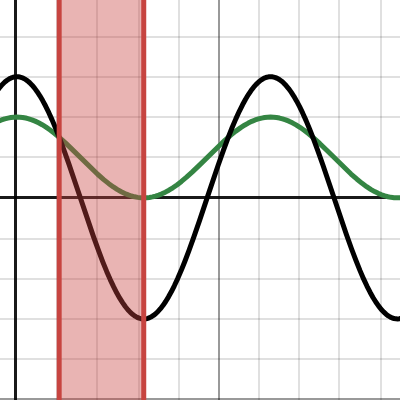
Desmos
We want the area between the green line, and the circle. That would be whatever area is greater than the black line and less than the green curve for the first part. But when the black line goes below 0 after pi/2. Then the integral ends up counting all that negative area
 zenith spoke
mortal crypt
https://www.desmos.com/calculator/ukygon0m7t
zenith spoke
mortal crypt
https://www.desmos.com/calculator/ukygon0m7t
so i want the area between the green and the black curves but then i will need to split into 2 integrals before and after θ=π/2 and flip the sign of the integral after π/2?
mortal crypt
You will have to modify the lower bound of the inner integral to go to the origin instead of the circle
zenith spoke
ah wait
after π/2 the area is no longer between the 2 curves but instead between the black curve and the x-axis, ie y=0
mortal crypt
yep
zenith spoke
thats why the second integral will have lower bound 0 and upper bound 3cosθ (flipped the bounds so that the integral is positive)
mortal crypt
the upp bound will still be the 1+cos(theta) as the outer edge is the heart and not the circle
?
zenith spoke
well, the idea is clear as the figure is in front of me rn
but i need to figure everything out without any reference to the figure
so that i can solve a question like this without needing a diagram
zenith spoke
ik but i think it is troublesome to draw sometimes thats why i usually avoid it
but well maybe i understand a bit without referring to the figure too
the need to split is that 3cosθ<0 for π/2<θ<π
but we dont want to have 3cosθ<0 since this is a radius
is this the correct reason or does this just happen to lead to the result of splitting by chance
mortal crypt
For pi/2 < theta < pi, A line from 1 + cos theta to 3 cos theta ends up crossin the circle at 2 points and not just 1 like before
And for pi/2 < theta < pi, the second point that the line crosses is the one at the origin
So any line in between the origin and the heart (1+costheta) is going to be the area instead

Desmos
devout snowBOT
@zenith spoke Has your question been resolved?
mortal crypt
We want the area between the heart and the circle. So we can think of adding up infinitely many boxes between them. However, because 3cos pi/2 ends up at the origin, that means that the box between 3cos and 1 + cos only needs to go as far as the origin, r = 0 for that point
if r = 0 at pi/2 in this case. Then that means the box used for area will only ever need to go down to that r = 0 for any radius
If I instead took the box from 1+ cos theta down to 3cos theta, then the box will go past the the point at the origin and go through the circle to the other side of it, counting both the area we want as well as the area of the circle as well
as the point of the origin is also a point on the circle
zenith spoke
mortal crypt
https://www.desmos.com/calculator/zzcpbrfjnw
ohhhh i see. This helped me get the idea too
but why does he just stop at θ=π
is it because he only wants to find the area of only one of the 2 bounded regions
and then use symmetry ?
mortal crypt
when theta = pi, then the heart thing radius is 0
the 2 small areas are the same, so rather than setting up a second integral that would be almost the same, we can just multiply by 2
zenith spoke
yea i agree with this
zenith spoke
mortal crypt
~~hold up, im latexing some stuff, 1 min~~
take your time
mortal crypt
I got the integrals, Also I made the ones for if I didn't use symmstry
$A = 2(\int_{\frac{\pi}{3}}^{\frac{\pi}{2}}\int_{3\cos\theta}^{1+\cos\theta}rdrd\theta} + \int_{\frac{\pi}{2}}^{\pi}\int_{0}^{1+\cos\theta}rdrd\theta}) = \int_{\frac{\pi}{3}}^{\frac{\pi}{2}}\int_{3\cos\theta}^{1+\cos\theta}rdrd\theta} + \int_{\frac{\pi}{2}}^{\pi}\int_{0}^{1+\cos\theta}rdrd\theta + \int_{\pi}^{\frac{3\pi}{2}}\int_{0}^{1+\cos\theta}rdrd\theta + \int_{\frac{3\pi}{2}}^{\frac{5\pi}{3}}\int_{3\cos\theta}^{1+\cos\theta}rdrd\theta$
oop
woven radishBOT
Yeatte
Compile Error! Click the reaction for more information.
(You may edit your message to recompile.)
 mortal crypt
lowkey, I do not want to really calculate 4 double integrals
zenith spoke
no you dont need to
zenith spoke
yea sure
mortal crypt
1 + cos(pi) = 1 + -1 = 0
zenith spoke
you dont even need to evaluate that
i only wanted to know how to set up the integral
the calculation is left as an exercise to the author 
mortal crypt

zenith spoke
i still want to know how to set up the integral purely algebraicly (idk if this is a word lol), ie without depending on the figure in any way
but i will try that alone
i wont take more of your time and i now understand why the integral was set up like this thanks to you
mortal crypt
devout snowBOT
Channel closed
Closed by @zenith spoke
Use .reopen if this was a mistake.
zenith spoke
.reopen?
zenith spoke
ah no i was asking if you wanted to add something
mortal crypt
I just wanted to say, that you should be totally fien with drawing things. At some point you will be drawing things in your head or on paper, especially more geometric arguments like these
I can go through my recent notes, and it's not just equations
its a few drawings as well
zenith spoke
the thing is that i am not used to draw these sorts of shapes so i definitely need a bit of time to draw a figure like that
which i dont have in exams for example
zenith spoke
mortal crypt
I just wanted to say, that you should be totally fien with drawing things. At so...
yea sometimes i imagine the figure
mortal crypt
Here's an exmple of something I drew, even if vague

you dont need to care about the other math, but drawing that pentagon really ends up important intuitively
zenith spoke
but i am not sure how to draw a graph of the sort given in this question (r=1+cosθ in this case)
mortal crypt
ah I see, that would come down to kinda already knowing what 1+costheta looks like
zenith spoke
mortal crypt
you dont need to care about the other math, but drawing that pentagon really end...
yea i get what you mean
zenith spoke
mortal crypt
ah I see, that would come down to kinda already knowing what 1+costheta looks li...
exactly
it is much easier to imagine it if you already know what it looks like
mortal crypt
drawing it in x,y plot and then transferring it to polar or vice versa is a great way to change the perspective and gain insight
like, If I only looked at the xy plot and not the r theta version, there's a chance I might not have caught the trick with the origin
zenith spoke
isnt r=1+cosθ something painful in crtesian coordinates
mortal crypt
sqrt(xx+yy) = 1 + x/sqrt(xx+yy)
It ends up being somewhat okay, not but pretty
what i mean is
giogn from
y = 1 + cos(x), to r = 1 + cos(theta)
zenith spoke
mortal crypt
sqrt(xx+yy) = 1 + x/sqrt(xx+yy)
yea exactly
zenith spoke
mortal crypt
y = 1 + cos(x), to r = 1 + cos(theta)
ohhh
mortal crypt
you can think of it as taking the xy plot, and wrapping it aroudn the origin
also stretching the higher the y point is
zenith spoke
hmmm i see
maybe i have to admit that sometimes a sketch will make life easier when setting up multiple integrals
but i just hate to draw a figure for some reason
anyway tysm again
 zenith spoke
.reopen
devout snowBOT
✅
zenith spoke
i reopened it so that we can continue leisurely without being concerned about the channel closing suddenly
zenith spoke
mortal crypt
you flipped 2π and 0 so that you get the same exact figure as that above instead of a reflection of it right ?
but why does just rotating one half like that give the desired figure
and why does it give a reflection of the desired figure if you just rotate without flipping first
mortal crypt
It's not really rotating, but rather stretching around in a circle
And If I stretched first without flipping, then the part on the right side of the graph, the 2pi, would end up on the x axis. But instead of the theta increasing when going counter clock wise, it would be decreasing

If I draw at line at x = 2pi, then its originally vertical, however, after the stretching, it would end up horizontal. So both the left and right parts end up stretching, its just that the left half is stretching and rotated by 3pi/2 while the right part is stretched and rotated by -pi/2
zenith spoke
mortal crypt
It's not really rotating, but rather stretching around in a circle
but i dont see any difference, because if you look at it as stretching around in a circle then you wont be changing the radius that you are going in from the original radius right ? at least thats what you are doing here as far as i can see
mortal crypt
I say stretching because although it would be the same radius from the origin, if we take a y=1 line and a y= 2 line. the distance between (0,1) and (pi,1) aroudn the circle ends up being pi. whereas if I took the points (0,2) and (pi,2) from the y = 2 line and stretched it around the circle, then the distance around the circle of radius 2 would be 2pi for and not pi like the first line
If I instead took the graph y = 0, and looked at the points (0,0) and (pi,0), the distance between them is pi. And then when stretched around the origin, they end up at the same point
so the distance between (0,0) and (pi,0) -> (r = 0, theta = 0) and (r = 0, theta = pi) ends up being 0. so compresssed

,rccw
woven radishBOT
 mortal crypt
the distance gets distorted when transforming functions from a y = f(x) to a r = f(theta) setup
lowkey really interesting math that goes on behind the scenes here
consider 2 points a, and b on the y = 2 graph
And we consider the distance between them along that y = 2 line
Let a = (0,0), and let b = (pi,0).
Then the distance between them along that line is just pi
However, If we then move that to the r = 2 space.
And take the distance along the r = 2 line. we end up with something else

As these 2 points are halfway across the circle. and we are only allowed to move along the r = 2 function. Then we calculate half the circimcfrance. So D' = C/2 = 2pir / 2. And as r = 2. that means that the new distance between these two points along the line r = 2 is D' = 2pi, where as D = pi
So as distance is not the same in this transformation. I would say stretching rather than just rotation
You can alternatively think of this as calculating the length of the line from A to B
u there?
zenith spoke
mortal crypt
Then the distance between them along that line is just pi
by this sentence you mean to take the "usual" distance between (0,2) and (pi,2)
mortal crypt
yep
it might be better to think of it in terms of a line between those 2 points ctually lel
zenith spoke
mortal crypt
So as distance is not the same in this transformation. I would say stretching ra...
ohhh i see your point
yea if you look at it like this then it is reasonable to call that stretching
zenith spoke
mortal crypt
it might be better to think of it in terms of a line between those 2 points ctua...
well you can consider the arc between these 2 points in the r=2 space as a line between them
because that is actually what a line in this space look like right ?
mortal crypt
yep
zenith spoke
i suppose that such transformations are studied in topology ?
idk maybe i am wrong since i am not familiar with topology
i barely have a vague idea of it
mortal crypt
I haven't done topo yet, but I know this sort of thing is doen in differential geometry
zenith spoke
mortal crypt
I haven't done topo yet, but I know this sort of thing is doen in differential g...
ohhh
mortal crypt
which was what the formula from before was a part of
zenith spoke
i see thats nice
mortal crypt
The idea of distance, and how that changes is a pretty big part of it
zenith spoke
what are you studying these days
mortal crypt
I think I've put it on the back burner for now, as my source material and most source materials online don't really have a great answer for my question on it
It ended up being a question of "why am I using the numbers in this way? what does this intuitively mean?"
So I've gone back to doing analysis which I should've done a while ago
mortal crypt
yep
zenith spoke
real analysis ? or you've already done that?
mortal crypt
real analysis, my rigor was really lacking early on in my math, and I'm paying the price for it
-1/12 if you know you know
so I'm building from the ground up to get better at that
zenith spoke
mortal crypt
~~-1/12 if you know you know~~
i didnt get this ngl lol
 severe echo
do you have any advice for how i should go about the class
zenith spoke
mortal crypt
so I'm building from the ground up to get better at that
ah i see yea math gets too rigorous as get deeper
mortal crypt

Read this too: http://www.bradyharanblog.com/blog/2015/1/11/this-blog-probably-wont-help
More links & stuff in full description below ↓↓↓
EXTRA ARTICLE BY TONY: http://bit.ly/TonyResponse
The sum of all natural numbers (from 1 to infinity) produces an "astounding" result.
ANOTHER PROOF & EXTRA FOOTAGE: http://youtu.be/E-d9mgo8FGk
MORE: ht...
zenith spoke
severe echo
analysis rn
i am studying real analysis too
zenith spoke
mortal crypt
https://www.youtube.com/watch?v=w-I6XTVZXww&pp=ygUSbnVtYmVycGhpbGUgLSAxLzEy this...
ah yea i know this
zenith spoke
rearrangement
severe echo
zenith spoke
i am studying real analysis too
nice
zenith spoke
you cant play as you like with any infinite sum
mortal crypt
fortunately I found this sereis
zenith spoke
there have to be some conditions for you to be able to rearrange the terms as you like
(absolute convergence)
mortal crypt
$\sum_{n=1}^{\infty}{\frac{1}{n^2+1}}$
woven radishBOT
Yeatte
 mortal crypt
this really helped me out
zenith spoke
severe echo
do you have any advice for how i should go about the class
i am not sure if i can say something helpful
mortal crypt
^
zenith spoke
but i recommend that you go through the proofs of the propositions/theorems by yourself
so pick up the theorems of the course
try to prove them yourself
zenith spoke
check if your proofs are correct/ if they dont exactly match that doesnt mean that you are wrong so ask on this server for example or something like that
zenith spoke
mortal crypt
this really helped me out
how did it help
it helped you know when you can rearrange and when you cant?
severe echo
zenith spoke
check if your proofs are correct/ if they dont exactly match that doesnt mean th...
yeah this server seems like a really good resource
zenith spoke
severe echo
nah cuz lowkey my school is ass
ohh i see
severe echo
yeah mickey mouse clubhouse university bottom 10 stem school
zenith spoke
rn my university is trash too lol but i will try to get into a better one
that being said, it doesnt mean anything for the only thing that matters is your work to understand the topic
mortal crypt
before, I though that I could do whatever I wanted with any series, after rearranging, I ended up getting 1/2 + "zeta(-2)" + "zeta(-4)" + .... assuming I could do the things I thought I could and so i would get 0 for each term except the first. But a sanity check told me otherwise. that I needed to be careful
as 1/nn+1 def convergeed to more than 1/2
mortal crypt
so I knew the only step that was wrong was assuming finite values for the zeta 'series' and manipulating those without worry
zenith spoke
yea it gets tricky with infinite series
mortal crypt
I also accidentally foudn the solution to the suum anyway lel
zenith spoke
one can easily get something totally wrong just by assuming that usual manipulations for finite sums work just fine for infinite ones
zenith spoke
mortal crypt
I also accidentally foudn the solution to the suum anyway lel
btw are you a math major ?
mortal crypt
I am a bakery worker
zenith spoke
oh thats nice
mortal crypt
I'm not in college for various reasons, so i study on my free time
zenith spoke
everyone has their hardships/reasons for not doing something
i hope you can bypass all of your problems
and btw you dont need college to be knowledgable
well you are the best example
you were just teaching me
mortal crypt

mortal crypt
I took a break from it for a while, but I couldn't stay away
mortal crypt
I finished up some ideas from hs for physics and it ended up leading me down a rabbit whole all the way to diff geo
zenith spoke
ohhh
mortal crypt
electromag is really nice
zenith spoke
in my opinion most of physics is really nice
mortal crypt
ignore air resistence
severe echo
mortal crypt
https://www.youtube.com/watch?v=w-I6XTVZXww&pp=ygUSbnVtYmVycGhpbGUgLSAxLzEy this...
this might be happening cuz like infinity kind of wraps around
well not really but
zenith spoke
there was a point in time where i was choosing between pure math and theoretical physics
zenith spoke
mortal crypt
~~ignore air resistence~~
the part that i hate in hs
severe echo
you know how in computer science once you get to the end of the signed digits and you keep increasing you actually end up wrapping around
zenith spoke
zenith spoke
there was a point in time where i was choosing between pure math and theoretical...
well not too long ago since i just started university some months ago lol
mortal crypt
I should prob go back to college hm
zenith spoke
mortal crypt
https://www.youtube.com/watch?v=w-I6XTVZXww&pp=ygUSbnVtYmVycGhpbGUgLSAxLzEy this...
well you know whats strange about series like this , you can literally get any number that you want
mortal crypt
I heard bout that ye
zenith spoke
mortal crypt
I should prob go back to college hm
if you can then i encourage you to
i think that maybe it is better to close this now that we are done from everything (probably) since it is a help channel
nice to meet you yeatte
mortal crypt
aye, and to you too
zenith spoke
we will probably have more encounters in the future since we are both in this server xD
i am looking forward to it
mortal crypt
🙂
devout snowBOT
Channel closed
Closed by @zenith spoke
Use .reopen if this was a mistake.
devout snowBOT
Available help channel!
Send your question here to claim the channel.
Remember:
• Ask your math question in a clear, concise manner.
• Show your work, and if possible, explain where you are stuck.
• After 15 minutes, feel free to ping <@&286206848099549185>.
• Type the command .close to free the channel when you're done.
• Be polite and have a nice day!
Read #❓how-to-get-help for further information on how to ask a good question, and about conduct in the question channels.
 muted sapphire
I need help
devout snowBOT
muted sapphire
I need help


 full cloak
alright, so you can prove it like this
think about it
anytime you draw a line between two points, what are you doing in terms of their odd/even degrees
devout snowBOT
@muted sapphire Has your question been resolved?
Channel closed
Closed by @muted sapphire
Use .reopen if this was a mistake.
Available help channel!
Send your question here to claim the channel.
Remember:
• Ask your math question in a clear, concise manner.
• Show your work, and if possible, explain where you are stuck.
• After 15 minutes, feel free to ping <@&286206848099549185>.
• Type the command .close to free the channel when you're done.
• Be polite and have a nice day!
Read #❓how-to-get-help for further information on how to ask a good question, and about conduct in the question channels.
 fathom hound
i need help

 devout snowBOT
fathom hound
i need help
devout snowBOT
fathom hound
i need help
 topaz axle
where's it from?
topaz axle
green is middle
because rule 3 says, you need to do VGB or BGV, so green is not 1 or 5
but if it's 2 or 4, then rule 4 doesn't allow it
hm
so like, PBGVG?
topaz axle
it doesn't make sense, there's only 4 colors, so I don't even have to use pink
alright
fathom hound
.close
devout snowBOT
Channel closed
Closed by @fathom hound
Use .reopen if this was a mistake.
Available help channel!
Send your question here to claim the channel.
Remember:
• Ask your math question in a clear, concise manner.
• Show your work, and if possible, explain where you are stuck.
• After 15 minutes, feel free to ping <@&286206848099549185>.
• Type the command .close to free the channel when you're done.
• Be polite and have a nice day!
Read #❓how-to-get-help for further information on how to ask a good question, and about conduct in the question channels.
 daring depot
 devout snowBOT
daring depot
devout snowBOT
daring depot
 strange nimbus
OK, the easiest way will be a Venn diagram.
Have you done this sort of thing with one before?
daring depot
Hmmm, nah.
I have done probability before, but not question like this where there is incomplete data
strange nimbus
OK, draw a Venn diagram with three circles.
One circle for discrete math, one for statistics, one for linear algebra.
daring depot
Okay, then?
strange nimbus
OK, now we work from the center out.
How many take all three? Write that in the middle.
daring depot
Okay, it's 1
strange nimbus
OK, that was the overlap of three circles. Now we do the overlaps of two circles.
How many take statistics and linear algebra?
daring depot
It's 3
strange nimbus
OK, so the overlap of S and L circles has two parts in the Venn diagram.
If you lightly shade it in, you'll see that.
So, we have those two parts of the Venn diagram adding up to 3.
So, something + 1 = 3.
Write that something in the unfilled-in part of the overlap of S and L.
daring depot
Okay, that's 2
strange nimbus
OK, so write that in. Then, we look at the overlap of L and D.
How many people take both linear algebra and discrete math?
daring depot
I don't know, the data is not included in the question
strange nimbus
OK, so there are two parts of the Venn diagram for this, so write x in the unfilled in part.
What about D and S? How many people take discrete math and statistics?
daring depot
It's also not included...
strange nimbus
OK, so write in y for the unfilled in part.
Now let's do the circles themselves.
How many people take statistics?
daring depot
11
strange nimbus
OK, so the four parts of the S circle should add to 11.
So, what will the unfilled in part be?
daring depot
8 - y?
daring depot
19 - x
strange nimbus
OK, what about D?
daring depot
28 - x - y
daring depot
50
strange nimbus
OK, so add up all the parts, set it equal to 50, and simplify the equation as much as you can.
daring depot
I get x = -y + 8
strange nimbus
OK, so x + y = 8.
Then, I guess you can simplify the D alone part of the Venn diagram.
I can't see any more simplifications.
Oh, wait.
Let's see.
Never mind.
OK, from here, you can do part a, but I don't see a way to get b and c.
daring depot
So, does this mean there is no answer for b and c?
strange nimbus
There might be a way to get another equation with different coefficients for x and y when you simplify it so that you can solve simultaneous equations, but other than that, I can't see a way.
Right now we have x + y = 8.
From the five statements they give, all except the discrete mathematics one lead to no variables when simplified, and the discrete mathematics just gives us x + y = 8.
I suppose you can replace y with 8 - x.
Hmm.
It might be even worse than that, since the first sentence implies that it might not be all 50 who take at least one of the three courses ("Out of 50 students in a campus, there are several students..."). That can't refer to students that take all three, since the one student who does that isn't several students.
devout snowBOT
@daring depot Has your question been resolved?
strange nimbus
daring depot
So, does this mean there is no answer for b and c?
I'd recommend answering b and c with something like: "If we take x as the number of students who take discrete math and linear algebra without taking statistics, the answer is whatever/50."
x could also be written as |D n L n S'|.
devout snowBOT
Channel closed
Closed by @daring depot
Use .reopen if this was a mistake.
strange nimbus
You're welcome.
devout snowBOT
Available help channel!
Send your question here to claim the channel.
Remember:
• Ask your math question in a clear, concise manner.
• Show your work, and if possible, explain where you are stuck.
• After 15 minutes, feel free to ping <@&286206848099549185>.
• Type the command .close to free the channel when you're done.
• Be polite and have a nice day!
Read #❓how-to-get-help for further information on how to ask a good question, and about conduct in the question channels.
strange nimbus
daring depot
Ohh okay
Oh wait! |(D u L) n S'|.
devout snowBOT
strange nimbus
Oh wait! |(D u L) n S'|.
strange nimbus
.close
devout snowBOT
Channel closed
Closed by @strange nimbus
Use .reopen if this was a mistake.
devout snowBOT
Available help channel!
Send your question here to claim the channel.
Remember:
• Ask your math question in a clear, concise manner.
• Show your work, and if possible, explain where you are stuck.
• After 15 minutes, feel free to ping <@&286206848099549185>.
• Type the command .close to free the channel when you're done.
• Be polite and have a nice day!
Read #❓how-to-get-help for further information on how to ask a good question, and about conduct in the question channels.
restive river
Need help with this geometry problem
 devout snowBOT
restive river
Need help with this geometry problem
restive river
devout snowBOT
restive river
Need help with this geometry problem
restive river
.close
devout snowBOT
Channel closed
Closed by @cedar merlin
Use .reopen if this was a mistake.
devout snowBOT
Available help channel!
Send your question here to claim the channel.
Remember:
• Ask your math question in a clear, concise manner.
• Show your work, and if possible, explain where you are stuck.
• After 15 minutes, feel free to ping <@&286206848099549185>.
• Type the command .close to free the channel when you're done.
• Be polite and have a nice day!
Read #❓how-to-get-help for further information on how to ask a good question, and about conduct in the question channels.
 thin geode
 devout snowBOT
thin geode
devout snowBOT
thin geode
 woven radishBOT
 thin geode
Pls only give very subtle hints
I need to use 4k-2 and the factorials in some way, probably by multiplying
devout snowBOT
@thin geode Has your question been resolved?
thin geode
i got it
multiply 4k-2 with k-1
factor out the 2 and put it into the k-1
makes 2k-2
devout snowBOT
@thin geode Has your question been resolved?
 real mason
woven radish
real mason
woven radish
look at the factorials
see if you can rearrange(4n-2) * (2n-3)!/(n-2)! to be (2(n+1)-3)!/((n+1)-2)!
if you do that you're done
try expanding the RHS
devout snowBOT
@thin geode Has your question been resolved?
devout snowBOT
Channel closed
Closed due to timeout
Use .reopen if this was a mistake.
Available help channel!
Send your question here to claim the channel.
Remember:
• Ask your math question in a clear, concise manner.
• Show your work, and if possible, explain where you are stuck.
• After 15 minutes, feel free to ping <@&286206848099549185>.
• Type the command .close to free the channel when you're done.
• Be polite and have a nice day!
Read #❓how-to-get-help for further information on how to ask a good question, and about conduct in the question channels.
 final forum
Someone please dm me if they are willing to help me with my pre cal hw it’s just 2 questions
devout snowBOT
final forum
Someone please dm me if they are willing to help me with my pre cal hw it’s just...
 vital sedge
Just ask them here?
final forum
I’m desperate istg
vital sedge
Just send the questions
wispy oyster
ask your question here
 soft umbra
final forum
I’m desperate istg
soft umbra
final forum
I’m desperate istg
Send your question here

 runic grove
final forum
runic grove
final forum
set x + 5 = 0 and y = 0, those values of x and y are your centers
this ellipse is basically shifted
final forum
I honesylu don’t know what’s going on 😭
runic grove
all the properties remain the same, but all the points on the ellipse have been shifted 5 points in the negative direction
okay let me graph this
wispy oyster
in standard ellipse form
$\frac{(x - h)^2}{a^2} + \frac{(y - k)^2}{b^2} = 1$
the center is (h,k)
woven radishBOT
mia
 runic grove
this is a normal ellipse, with it's center being (0, 0)

now that is the same ellipse but it's shifted 5 units in the negative x direction
 final forum
This is a sample question we did in class
runic grove
all the points, the focii, the end points are just shifted 5 units in the negative x direction
final forum
 runic grove
that's all there is to it
final forum
I’m still so confused 😭
wispy oyster

Learn how to graph vertical ellipse which equation is in general form. A vertical ellipse is an ellipse which major axis is vertical. When the equation of an ellipse is written in the general form, we first rewrite it in standard form using completing the square.
After the equation has been rewritten in the standard form, we then graph the vert...
devout snowBOT
@final forum Has your question been resolved?
final forum
Not yet
final forum
wispy oyster
https://youtu.be/lmBcss4NJuI?si=a_SO4SQDpksKmktK
It’s not close to the question ☹️
 cedar bison
This algebra video tutorial explains how to write the equation of an ellipse in standard form as well as how to graph the ellipse when in standard form. It explains how to find the coordinates of the foci, vertices, and co-vertices. This video contains plenty of examples and practice problems.
Get The Full 1 Hour 55 Minute Video: ...
Ig that's exactly what r u looking for
cedar bison
cedar bison
https://youtu.be/OPSCKXXvWiM?si=NWmt0e5g1b5RuFXv
This guy is the best
Physics, calculus, chemistry 
devout snowBOT
Channel closed
Closed due to timeout
Use .reopen if this was a mistake.
devout snowBOT
Available help channel!
Send your question here to claim the channel.
Remember:
• Ask your math question in a clear, concise manner.
• Show your work, and if possible, explain where you are stuck.
• After 15 minutes, feel free to ping <@&286206848099549185>.
• Type the command .close to free the channel when you're done.
• Be polite and have a nice day!
Read #❓how-to-get-help for further information on how to ask a good question, and about conduct in the question channels.
 winter meadow
I’m really struggling to understand maclaurin and Taylor polynomials does anyone have some resources I could use ?
 devout snowBOT
winter meadow
I’m really struggling to understand maclaurin and Taylor polynomials does anyone...
cinder bobcat
devout snowBOT
winter meadow
I’m really struggling to understand maclaurin and Taylor polynomials does anyone...
cinder bobcat
khan academy is always a good place to start
devout snowBOT
@winter meadow Has your question been resolved?
Channel closed
Closed by @winter meadow
Use .reopen if this was a mistake.
devout snowBOT
Available help channel!
Send your question here to claim the channel.
Remember:
• Ask your math question in a clear, concise manner.
• Show your work, and if possible, explain where you are stuck.
• After 15 minutes, feel free to ping <@&286206848099549185>.
• Type the command .close to free the channel when you're done.
• Be polite and have a nice day!
Read #❓how-to-get-help for further information on how to ask a good question, and about conduct in the question channels.
 opaque talon
when ur constructing the table
 devout snowBOT
opaque talon
when ur constructing the table
pseudo basin
opaque talon
when ur constructing the table
devout snowBOT
opaque talon
when ur constructing the table
pseudo basin
opaque talon
when ur constructing the table
it would be better with a venn diagram tbh
3-way tables are kinda tricky
opaque talon
ah they use a table in the mark scheme
Ok i'll try that
even that sounds kinda tricky
ah
how many bubbles should there be
i mean circles in the venn diagram
idek
devout snowBOT
@opaque talon Has your question been resolved?
opaque talon

for iv
on the denominator
i get an extra 0.15
cuz not S is 0.35+0.15
and not T is 0.15 + 0.15
idk
 primal ferry
opaque talon
and not T is 0.15 + 0.15
primal ferry
opaque talon
and not T is 0.15 + 0.15
look at it in terms of the overall area
this is the part signified by S' union T'

this should rule out the extra 0.15
primal ferry
np
opaque talon
opaque talon
when ur constructing the table
idk if u have any tips for the venn diagram here as well? 😅
primal ferry
oh that wasnt answered yet?