#help-27
1 messages · Page 330 of 1
 supple light
 wise scarab
the best I can do for ya is what I've written in the spoilers so far
but try to think about the problem first before unspoilering
supple light
it know it was a binomial experiment
wise scarab
not sure what X and P are supposed to represent, but I assume N is normal. Your class uses notation I'm unfamiliar with
supple light
but like i said it was asking for a letter and then those two blanks seperated by a comma
wise scarab
oh wait wait, I just realized, since it's in parentheses, it's probably telling you to give the parameters of the distribution
supple light
but wouldnt there only be two outcomes correct and incorrect
wise scarab
no
supple light
if he's guessing i though 1 out 3 for probability but like i said i have no clue what they were actually askling
wise scarab
you can think of the outcomes as all permutations of right and wrong answers on his exam
supple light
i see what your saying
wise scarab
supple light
if he's guessing i though 1 out 3 for probability but like i said i have no clue...
yes, that information relates to a parameter for a binomial distribution
(no idea whether your thing asks you to put n, p or p, n)
supple light
i was assuming itd be the same as how you input it in the calc
which is n,p i believe
wise scarab
I have no idea how it's put into a calculator
oh. well alright, there you go
problem solved
supple light
lol i hope so this was a practice assignment im gonna take the real one in the morning
thanks
 devout snowBOT
@supple light Has your question been resolved?
devout snowBOT
Channel closed
Closed due to timeout
Use .reopen if this was a mistake.
 Available help channel!
Send your question here to claim the channel.
Remember:
• Ask your math question in a clear, concise manner.
• Show your work, and if possible, explain where you are stuck.
• After 15 minutes, feel free to ping <@&286206848099549185>.
• Type the command .close to free the channel when you're done.
• Be polite and have a nice day!
Read #❓how-to-get-help for further information on how to ask a good question, and about conduct in the question channels.
 haughty loom
 devout snowBOT
haughty loom
haughty loom
devout snowBOT
haughty loom
haughty loom
Having some trouble with this problem this is the answer that I got


These might be a bit more clear
haughty loom
Oh
devout snowBOT
@haughty loom Has your question been resolved?
Channel closed
Closed by @haughty loom
Use .reopen if this was a mistake.
devout snowBOT
Available help channel!
Send your question here to claim the channel.
Remember:
• Ask your math question in a clear, concise manner.
• Show your work, and if possible, explain where you are stuck.
• After 15 minutes, feel free to ping <@&286206848099549185>.
• Type the command .close to free the channel when you're done.
• Be polite and have a nice day!
Read #❓how-to-get-help for further information on how to ask a good question, and about conduct in the question channels.
 unique vortex
I struggle with non homogeneous de.
devout snowBOT
unique vortex
I struggle with non homogeneous de.
unique vortex
The answer should be like this:

I got answer with arctanh, but can't convert it to ln.

 devout snowBOT
@unique vortex Has your question been resolved?
devout snowBOT
@unique vortex Has your question been resolved?
devout snowBOT
@unique vortex Has your question been resolved?
 mild comet
unique vortex
I got answer with arctanh, but can't convert it to ln.
mild comet
unique vortex
I got answer with arctanh, but can't convert it to ln.
Which part is your working, and which part were you confused about?
devout snowBOT
@unique vortex Has your question been resolved?
unique vortex
mild comet
Which part is your working, and which part were you confused about?
This part, what should i do next?
There should not be any imaginary part.

 cerulean oracle
unique vortex
I struggle with non homogeneous de.
cerulean oracle
unique vortex
I struggle with non homogeneous de.
can you share the DE itself? some context is helpful
 cerulean oracle
unique vortex
This part, what should i do next?
There should not be any imaginary part.
cerulean oracle
unique vortex
This part, what should i do next?
There should not be any imaginary part.
the integral results should use arccoth rather than arctanh because 1+2e^x > 1
unique vortex
cerulean oracle
the integral results should use arccoth rather than arctanh because 1+2e^x > 1
Idk, used mathematica to integrate and it's what it gave me.
cerulean oracle
unique vortex
Idk, used mathematica to integrate and it's what it gave me.
it depends on the magnitude of the argument

the form is the same
with arccoth you can then write $C_1 = \ln ( 1 + e^x ) + \ln e^{-x} = \ln ( 1 + e^x) - x$ and similar for $C_2$
 woven radishBOT
mono
 unique vortex
cerulean oracle
the integral results should use arccoth rather than arctanh because 1+2e^x > 1
unique vortex
cerulean oracle
the integral results should use arccoth rather than arctanh because 1+2e^x > 1
It doesn't depend on me. It's written to use mathematica to integrate so I did it.
I also tried integrating myself using integration by parts, but I am not sure about the answer.

 cerulean oracle
unique vortex
It doesn't depend on me. It's written to use mathematica to integrate so I did i...
cerulean oracle
unique vortex
It doesn't depend on me. It's written to use mathematica to integrate so I did i...
mathematica will just pick one which may or may not be real for whatever values of x
unique vortex
Idk what to do then.
cerulean oracle
you can replace the arctanh with arccoth. it is also a correct antiderivative and is real-valued for real x unlike arctanh
,w Integrate[1/(Exp[x] + 1), x]
woven radishBOT


 cerulean oracle
well i was hoping it would show the same as in my browser
 unique vortex
Can I just make mathematica integrate with ln?
cerulean oracle
,w Integrate[1/(Exp[2x] + Exp[x]), x]
woven radishBOT
 cerulean oracle
i dont know how to make mathematica do this outside of texit, lol
but can you just use these results here
woven radishBOT


 Requested by yannicsimms
devout snowBOT
Requested by yannicsimms
devout snowBOT
Channel closed
Closed by @unique vortex
Use .reopen if this was a mistake.
Available help channel!
Send your question here to claim the channel.
Remember:
• Ask your math question in a clear, concise manner.
• Show your work, and if possible, explain where you are stuck.
• After 15 minutes, feel free to ping <@&286206848099549185>.
• Type the command .close to free the channel when you're done.
• Be polite and have a nice day!
Read #❓how-to-get-help for further information on how to ask a good question, and about conduct in the question channels.
 queen hearth
 devout snowBOT
queen hearth
queen hearth
devout snowBOT
queen hearth
queen hearth

I do not understand the solution
I understand they converted greatest integer to fractional part of x
Then what?
 storm raptor
doesn't get more JEE than this
the differential of the fractional part of x is basically dx if you think about it
because it has the same slope as y = x
queen hearth
Can I do that? Isnt it non differentiable at integers?
queen hearth
How did they take n^2 + n + 1 out of the limits
storm raptor
fractional part is periodic with fundamental period 1
devout snowBOT
Channel closed
Closed by @queen hearth
Use .reopen if this was a mistake.
Available help channel!
Send your question here to claim the channel.
Remember:
• Ask your math question in a clear, concise manner.
• Show your work, and if possible, explain where you are stuck.
• After 15 minutes, feel free to ping <@&286206848099549185>.
• Type the command .close to free the channel when you're done.
• Be polite and have a nice day!
Read #❓how-to-get-help for further information on how to ask a good question, and about conduct in the question channels.
 wraith pumice
-2<x-3<0
devout snowBOT
wraith pumice
-2<x-3<0
wraith pumice
if I take absolute value to everything how does that affect the inequalities?
 olive snow
Since the abs value is decreasing on negative it will flip the inequality
wraith pumice
0<|x-3|<2?
olive snow
Sure
wraith pumice
2>|x-3|>0 is what u mean?
olive snow
wraith pumice
2>|x-3|>0 is what u mean?
This
But its not true in the reverse way
Having |x-3| < 2 do not imply only that -2 < x-3 < 0
Cuz its true for x-3 in [-2,2]
Its just a matter of logic
Which is the worst mistake in math
You see ?
wraith pumice
olive snow
You see ?
kinda
wraith pumice
olive snow
Having |x-3| < 2 do not imply only that -2 < x-3 < 0
what else do you imply?
olive snow
olive snow
Cuz its true for x-3 in [-2,2]
.
wraith pumice
oh I think I get it
olive snow
Its like saying x² = a <=> x = sqrt(a) for all x
Its false
Cuz there is the second value aswell
The correctness would be to write x² = a <= x = sqrt(a)
For all x in R
If you want to write <=>
You must write x in R+
Anyway
It also happen with integrals
f >= g ===> defined integral f >= defined integral of g
But not equivalent
wraith pumice
yeah my professor is definitely gonna give something like this so I'll definitely make note of it
thanks so much!
olive snow
You're welcome
wraith pumice
.close
devout snowBOT
Channel closed
Closed by @wraith pumice
Use .reopen if this was a mistake.
Available help channel!
Send your question here to claim the channel.
Remember:
• Ask your math question in a clear, concise manner.
• Show your work, and if possible, explain where you are stuck.
• After 15 minutes, feel free to ping <@&286206848099549185>.
• Type the command .close to free the channel when you're done.
• Be polite and have a nice day!
Read #❓how-to-get-help for further information on how to ask a good question, and about conduct in the question channels.
 rain sequoia

 devout snowBOT
rain sequoia
rain sequoia
devout snowBOT
rain sequoia
rain sequoia
I want to see if I did these problems correct (GEOMTERY)
 lunar harbor
rain sequoia
lunar harbor
rain sequoia
 lunar harbor
rain sequoia
lunar harbor
rain sequoia
 lunar harbor
rain sequoia
lunar harbor
rain sequoia
,w perimeter of triangle with vertices (1,-2), (0,3), (-2,-3)
 woven radishBOT

 Requested by civil_service_pigeon
 tender sandal
All are correct afaik

 winter patrol
all the answer options are in point-slope form
so use that instead of slope - intercept form
rain sequoia
Do I erease what I have?
winter patrol
just the last line
all that manipulation to get the slope is fine
the y = 3/4 x + B isn't needed
woven radishBOT
ℝαμOmeganato5
 winter patrol
no
overthinking
point slope form
uses point (given to you)
and slope which you just determined
(or at least implied you've found it)
winter patrol
not quite, double check your signs
winter patrol
yes
winter patrol
identify the y value in your given point (this will be the y_1)
and plug it in


 umbral torrent
,rotate
woven radishBOT
 rain sequoia
yeah im hell lost on it
winter patrol
the desired point will divide the x and y coordinates in the same ratio
it may help to draw a line down from Q and a horizontal line from P
rain sequoia
like a right triangle kind of?
winter patrol
yes
rain sequoia
 winter patrol
,rotate
woven radishBOT
 rain sequoia
wrong poc
winter patrol
did you send the wrong image?
rain sequoia
 winter patrol
now split this line
in a ratio of 2:3
 winter patrol
determine the distance,
rain sequoia
10 blocks
winter patrol
then the total number of parts in your ratio
rain sequoia
what does that mean
winter patrol
you can just add up the 2 and the 3
rain sequoia
oh
winter patrol
as for every 5 parts,
one side will have 2, the other will have 3
winter patrol
15/5 isn't useful
rain sequoia
ah alr
winter patrol
dividing the 10 blocks by 2parts,
you get 2 blocks/part
rain sequoia
yes
rain sequoia
since the ration 2:3
I do 2x2 and 2x3
winter patrol
yes
rain sequoia
2x2=4
2x3=6
winter patrol
which says to split 10 blocks in a ratio of 2:3,
you split it into
4 blocks : 6 blocks

which would be there
now similar idea for the vertical component
15/5=3
were you skipping ahead?
that would be useful now
winter patrol
yes, be careful with which one you use for the top/bottom
try indicating where you think it should be split
winter patrol
doesn't matter whether you label or not
winter patrol
what's important is whether you're using the right amount
winter patrol
 rain sequoia
i label both?
winter patrol
no
its important to make sure you're splitting it correctly based on where you're starting
as you're starting from P, and want the ratio of 2:3
the left part would be closer to P
the red line would be incorrect,
as with that you'd be splitting the line in a ratio of 6:4
or 3:2,
which isn't the same as 2:3
rain sequoia
 winter patrol
now applying the principle outlined above, your location is incorrect
as you're starting from P, and want the ratio of 2:3
the left part would be closer to P
for the vertical component, that's 2 * 3 = 6 blocks
 winter patrol
as in you changed the location?

 winter patrol
yep, good
now draw vertical and horizontal lines at those locations
they'll meet at a point on the line PQ,
at that'll be what you want
(if for some reason they don't meet on the line, that means there was a miscalculation/error somewhere)
 winter patrol
stop that lol
 winter patrol
not what i asked
rain sequoia
a
winter patrol
now draw vertical and horizontal lines at those locations
to save time, i'm gonna post it
rain sequoia
good idea
winter patrol
 winter patrol
and that green dot will be the point you want
winter patrol
well you just need to read the coodinates after that
rain sequoia
 winter patrol
you have all that space,
not a good idea to use / to separate equations like that
as they can be interpreted as division
and () aren't optional when representing points
rain sequoia
alr
winter patrol
$\red{(\black{-1,-1})}$
woven radishBOT
ℝαμOmeganato5
 winter patrol
if you want to write multiple equations like that in a single line,
use a comma, and i'd still advise against that
counting squares also isn't practical, so it's also a good idea to do that calculation algebraically
$\Delta x = x_Q - x_P = 5 - (-5) = 10$
woven radishBOT
ℝαμOmeganato5


 winter patrol
good enough
winter patrol
try to read the algebraic method above, its important
as its not always practical to graph and count squares
rain sequoia
winter patrol
try to read the algebraic method above, its important
as its not always practica...
alr
winter patrol
you'll need to raise a ticket with @oak widget
rain sequoia
alr
winter patrol
include all relevant details
rain sequoia
i Just dm it right
winter patrol
yes,
rain sequoia
alr
devout snowBOT
@rain sequoia Has your question been resolved?
devout snowBOT
Channel closed
Closed due to timeout
Use .reopen if this was a mistake.
devout snowBOT
Available help channel!
Send your question here to claim the channel.
Remember:
• Ask your math question in a clear, concise manner.
• Show your work, and if possible, explain where you are stuck.
• After 15 minutes, feel free to ping <@&286206848099549185>.
• Type the command .close to free the channel when you're done.
• Be polite and have a nice day!
Read #❓how-to-get-help for further information on how to ask a good question, and about conduct in the question channels.
 restive river
BE=CE
find alpha
 devout snowBOT
restive river
BE=CE
find alpha
restive river
devout snowBOT
restive river
BE=CE
find alpha
restive river
anyone has any tip for this question? pls
devout snowBOT
@restive river Has your question been resolved?
restive river
<@&286206848099549185>
 runic pelican
are you familiar with the concept of an "incenter"
devout snowBOT
Channel closed
Closed by @crimson tusk
Use .reopen if this was a mistake.
devout snowBOT
Available help channel!
Send your question here to claim the channel.
Remember:
• Ask your math question in a clear, concise manner.
• Show your work, and if possible, explain where you are stuck.
• After 15 minutes, feel free to ping <@&286206848099549185>.
• Type the command .close to free the channel when you're done.
• Be polite and have a nice day!
Read #❓how-to-get-help for further information on how to ask a good question, and about conduct in the question channels.
 static mural
Hello, I'm trying to create a fixed image Cropper in TypeScript, but I'm having trouble with the math involved around scaling and translating an image about a point - demo here
Ultimately I want to zoom in on the user's cursor when they scroll the mouse wheel, which is currently working if the user does not move the image. However when the user moves the image, this functionality is lost and I cannot figure out how to always zoom in on where the user's cursor is.
I get that I have to offset the calculation by the amount the user has moved the image, but I can't figure it out when the image has been scaled.
Would anyone be able to take a look at what I have currently and suggest a solution? Thanks

Next generation frontend tooling. It's fast!
devout snowBOT
static mural
Hello, I'm trying to create a fixed image Cropper in TypeScript, but I'm having ...
@static mural Has your question been resolved?
devout snowBOT
Channel closed
Closed due to timeout
Use .reopen if this was a mistake.
Available help channel!
Send your question here to claim the channel.
Remember:
• Ask your math question in a clear, concise manner.
• Show your work, and if possible, explain where you are stuck.
• After 15 minutes, feel free to ping <@&286206848099549185>.
• Type the command .close to free the channel when you're done.
• Be polite and have a nice day!
Read #❓how-to-get-help for further information on how to ask a good question, and about conduct in the question channels.
 cinder plover
What am i suppose to do for this problem?
 devout snowBOT
cinder plover
What am i suppose to do for this problem?
cinder plover
devout snowBOT
cinder plover
What am i suppose to do for this problem?
cinder plover
how do i find the value that it converges to
i thought that was impossible for series
or sequences
 misty crest
that’s for series
cinder plover
i see
misty crest
this is not a series
just take lim n -> inf
hint
lim a_{n+1} = lim a_n
call it L
cinder plover
misty crest
i think you mean L = sqrt(6 + L)
im a bit confused onhow you set this up, so limn-> inf is L and a_n is also L?
woven radishBOT
knief
 cinder plover
i see
cinder plover
cinder plover
What am i suppose to do for this problem?
sorry if this is a dumb question but what does the information a_1 = 0 tell me?
misty crest
i suppose that if a_1 were for example -6 or if a_1 < -6 then this would be dead wouldn’t it
misty crest
woven radish
**knief**
were you taught this way?
cinder plover
misty crest
were you taught this way?
no i dont remember anything about converging sequences
cinder plover
calc 2
misty crest
you’re welcome
cinder plover
.close
devout snowBOT
Channel closed
Closed by @cinder plover
Use .reopen if this was a mistake.
devout snowBOT
Available help channel!
Send your question here to claim the channel.
Remember:
• Ask your math question in a clear, concise manner.
• Show your work, and if possible, explain where you are stuck.
• After 15 minutes, feel free to ping <@&286206848099549185>.
• Type the command .close to free the channel when you're done.
• Be polite and have a nice day!
Read #❓how-to-get-help for further information on how to ask a good question, and about conduct in the question channels.
 river nacelle
broooo
 devout snowBOT
river nacelle
broooo
devout snowBOT
river nacelle
broooo

 acoustic leaf
start by writing out the definition of the characteristic polynomials of A and A^T
then see what properties you might apply to show they are equal?
 acoustic leaf
rather than writing it down in terms of a matrix with arbitrary entries, just write down the general definition
we would like our proof to work for any size matrix
acoustic leaf
no
 acoustic leaf
,rcw
woven radishBOT
 acoustic leaf
do we have any properties of determinants relating to transposes?
river nacelle
Deta =detA^t
river nacelle
Det((A/A^T)-lambdaI)?
acoustic leaf
woven radish
well we would like to use this property to show that the two expressions you have here are equal
we know that if you take the transpose of a matrix, its determinant is the same
so what would happen if you were to take the transpose of the matrix whose determinant is the char poly?
river nacelle
Is the same
Is that all I say?! DetA = Det transpose A so they will share the same char poly??
acoustic leaf
no
river nacelle
AHH
acoustic leaf
because what we are interested in is det(A - λI) and det(A^T - λI)
but we have established that
det(A - λI) = det((A - λI)^T)
can you simplify (A - λI)^T?
river nacelle
Did you turn A^T-🦙I into (A-🦙I)^T because A^T+B^T = A+B)^T
acoustic leaf
all i noted is that if we call B = A - λI then det(B) = det(B^T)
although that may be a useful property in further simplifying B^T
river nacelle
river nacelle
Property B?
acoustic leaf
that would be a good start
river nacelle
acoustic leaf
because what we are interested in is det(A - λI) and det(A^T - λI)
but we have e...
It equals A^T-🦙I since the transpose of 🦙I is itself
???
acoustic leaf
yes
acoustic leaf
that's pretty much all there is to it
devout snowBOT
Channel closed
Closed by @river nacelle
Use .reopen if this was a mistake.
devout snowBOT
Available help channel!
Send your question here to claim the channel.
Remember:
• Ask your math question in a clear, concise manner.
• Show your work, and if possible, explain where you are stuck.
• After 15 minutes, feel free to ping <@&286206848099549185>.
• Type the command .close to free the channel when you're done.
• Be polite and have a nice day!
Read #❓how-to-get-help for further information on how to ask a good question, and about conduct in the question channels.
 jaunty dagger
is there a way to quickly check if a group is cyclic or do we need to always find a generator?
devout snowBOT
jaunty dagger
is there a way to quickly check if a group is cyclic or do we need to always fin...
 uncut imp
Yes
I mean
For any group i dont think so
But if it is characterised in some way its usually simple
uncut imp
Its small
Very small
You mean group of like
Coprime with 12
Then it is just 4 elements
So it is either cyclic or Klein 4 group
So you just take any element
If its order is 4 it is cyclic
If 2 you try the other one
And if its 2 as well it is Klein 4
Oh wait
yes
jaunty dagger
@uncut imp they all wont be order 4 tho
uncut imp
In klein 4?
jaunty dagger
ohh in klien 4 all elements are order 2
in the cyclic group they are order 4
yeah that makes sense
uncut imp
jaunty dagger
in the cyclic group they are order 4
I mean 2 has order 2
 sand dove
jaunty dagger
is there a way to quickly check if a group is cyclic or do we need to always fin...
sand dove
jaunty dagger
is there a way to quickly check if a group is cyclic or do we need to always fin...
really depends
one time where you can know immediately is if the order is prime
jaunty dagger
third is 4/gcd(3,4) which is 4
sand dove
otherwise mmh
jaunty dagger
sand dove
one time where you can know immediately is if the order is prime
wdym
if the second element is order 2 it can still be either no
sand dove
jaunty dagger
wdym
if there are p elements in your group
uncut imp
Group of order p is always cyclic
sand dove
U(n) is the invertibles of Z/nZ?
uncut imp
No
uncut imp
sand dove
U(n) is the invertibles of Z/nZ?
Yes
jaunty dagger
sand dove
U(n) is the invertibles of Z/nZ?
yeah
sand dove
ok
jaunty dagger
multiplicative group
uncut imp
That would be 4
jaunty dagger
so we would always check the third elemet
jaunty dagger
if its order 2, then its isomophic to V
sand dove
12 = 3 * 4 doesn't fit
jaunty dagger
ortherwise its isomorphic to z_4
sand dove
U(12) is not cyclic
uncut imp
I think that result is a bit much
jaunty dagger
yeah i know, i was wondering how you would go about finding that quickly for most groups


this is why i was asking
I wanted to know if there is a qhick way to tell which groups are cyclic and which are not
sand dove
sand dove
n = 2,4, p^alpha and 2p^alpha where p is odd prime
well the theorem is easy to prove
using chinese remainder theorem
but until then
I guess finding generators is the best way
uncut imp
sand dove
using chinese remainder theorem
How?
jaunty dagger
sand dove
I guess finding generators is the best way
ok so just trying every element was the right way to go
sand dove
by chinese remainder theorem, if n = p1^a1 p2^a2...
then Z/nZ ~ Z/(p1^a1)Z x Z/(p2^a2)Z x ...
so U(n) ~ U(p1^a1) x U(p2^a2) x ...
(since U(n) is the group of invertibles of Z/nZ)
sand dove
Q is not cyclic because if it were, it would have a generator p/q. Try to find 1/(q+1)
the group being (Q,+) ofc
it's all about magnitude, and if not, then use coprimality
sand dove
sand dove
so U(n) ~ U(p1^a1) x U(p2^a2) x ...
anyways since I was here
uncut imp
Mhm
jaunty dagger
wait so
its because there is no number
u can slowly increse to get every element
what about R
uncut imp
That one is easy
It contains Q
If it is generated by rational it would also generate Q
Irrationals cant generate rationals
jaunty dagger
hmm
sand dove
uncut imp
Irrationals cant generate rationals
or rationals can't generate irrationals
anyways
jaunty dagger
I need to come back to cyclic groups
sand dove
sand dove
so U(n) ~ U(p1^a1) x U(p2^a2) x ...
Now I don't remember how to prove exactly the next part
but for odd primes, U(p^a) is cyclic
sand dove
so U(p^a) "=" Z/(p^a)Z
U(2) = {1}
and U(2^k) = Z/2Z x Z/(2^(k-2))Z for k >= 2
that last part is a bit tricky to prove
uncut imp
sand dove
and U(2^k) = Z/2Z x Z/(2^(k-2))Z for k >= 2
I mean ik
sand dove
uncut imp
What is next
well
sand dove
sand dove
so U(n) ~ U(p1^a1) x U(p2^a2) x ...
for this decomposition to be cyclic
you can only have one of them not trivial
sand dove
uncut imp
I see power of 2 not working
which one
uncut imp
Like if you have 2 in prime decomposition greater then 4
Wait
What about 4
For 4 it is z2 too
Yes
Same thing
sand dove
sand dove
and U(2^k) = Z/2Z x Z/(2^(k-2))Z for k >= 2
U(2^2) = Z/2Z x {1} = Z/2Z
anyways if you're ever interested in the idea for proof
5 has order 2^(n-2)
uncut imp
But what about case with more primes?
sand dove
uncut imp
But what about case with more primes?
?
uncut imp
Like U(p^a)xU(q^a)
sand dove
sand dove
so U(n) ~ U(p1^a1) x U(p2^a2) x ...
we made the prime decomposition for a reason
only one of them can be non trivial
if you want the whole product to be cyclic
sand dove
yeah the proof is basically done here
jaunty dagger
okok so
looking at this one

Here is what im thinking
Z_8 is cyclic and abelian
D_4 is not cyclic and not abelian
jaunty dagger
U(18) is non-cyclic, as 2 does not generate the group
uncut imp
Actually
sand dove
uncut imp
Wait
if you have two or more odd primes in your decomposition
jaunty dagger
should 3 have order 4
jaunty dagger
or should 2 have order 4
uncut imp
Yes
sand dove
then doesn't work
uncut imp
Got it
sand dove
alr
uncut imp
Thx
sand dove
jaunty dagger
U(18) is non-cyclic, as 2 does not generate the group
U(18) is cyclic though?
jaunty dagger
I think i did a mistake
sand dove
I'm pretty sure 5 is a generator if you look close enough
 sand dove
jaunty dagger
sand dove
jaunty dagger
why is 2 in U(18)
jaunty dagger
ahhhhhh
sand dove
so not even order 8
sand dove
have you found all abelian ones yet?
just try to list them
there's 3
use the finite abelian factorization theorem
sand dove
A finite abelian group must be of the form Z/aZ x Z/bZ x ...
jaunty dagger
so Z_8 is isomorphic to Z_2 and Z_4
sand dove
no matter if a,b,... are coprime or not
jaunty dagger
jaunty dagger
so Z_8 is isomorphic to Z_2 and Z_4
wait is this true
jaunty dagger
 sand dove
A finite abelian group must be of the form Z/aZ x Z/bZ x ...
sand dove
sand dove
A finite abelian group must be of the form Z/aZ x Z/bZ x ...
oh and there's a unique form such that a divides b, b divides the next, etc...
sand dove
jaunty dagger
yeah that's chinese theorem
jaunty dagger
oh i didnt know that lmao
sand dove
they're two distinct groups of order 8
jaunty dagger
yeah that makes sense
jaunty dagger
ok
sand dove
try to find the last one?
jaunty dagger
ok so we know Z_8 is one of them
Im guessing an non-cyclic Unit group of order 8
as it would still be abelian
sand dove
you can try finding one of those but it's unsure to me whether it's the greatest idea
instead of thinking about unit groups
try thinking about cartesian products of Z_n
jaunty dagger
its non-isomorphic groups right
sand dove
?
jaunty dagger
 sand dove
I mean
there are three abelian non isomorphic groups of order 8
We found Z_8 and Z_2 x Z_4
jaunty dagger
hmm ok wait so
sand dove
find a third abelian group that isn't isomorphic to them
jaunty dagger
order 8 would mean that lcm of both the groups should be 8
jaunty dagger
gcd cant be 1
for it to not be ismorphic
like 2 and 4
z_2Xz_4 would not be isnomorphic to z_8
sand dove
one is cyclic, the other isn't
jaunty dagger
hmm?
sand dove
I don't understand what you're doing
are you trying to prove Z2 x Z4 and Z8 aren't isomorphic?
jaunty dagger
Yes, because both are groups of order 8 but they are not isomorphic
so it would fit the question
jaunty dagger
I just went by gcd(2,4) = 2, and by this theorem they are not isomorphic:
 sand dove
ok sure you used chinese theorem directly
alr one more way to do it
so
that's 2 non isomorphic groups
jaunty dagger
yup
sand dove
how about finding a 3rd one that is abelian
jaunty dagger
D_4 too
oh
hmm
wait
z_2Xz_2xz_2
nah
nvm
wait
hmm
okok going back
thats isomorphic to Z_4Xz_2 right
sand dove
jaunty dagger
thats isomorphic to Z_4Xz_2 right
uh no
sand dove
Z_2 x Z_2 is not isomorphic to Z_4
but why is Z_2 x Z_2 x Z_2 not isomorphic to Z_4 x Z_2?
jaunty dagger
because Z_2 x Z_2 is not isomorphic to Z_4
sand dove
you need an extra argument
jaunty dagger
gcd = 2?
sand dove
no
sand dove
jaunty dagger
because Z_2 x Z_2 is not isomorphic to Z_4
I said this part is correct
sand dove
sand dove
but why is Z_2 x Z_2 x Z_2 not isomorphic to Z_4 x Z_2?
but why does it imply this
jaunty dagger
uhh
im not sure
because if it were true then
Z_4 X Z_2 would be (Z_2 XZ_2 )XZ_2
yeah im not sure
jaunty dagger
no
sand dove
if there's an isomorphism between H and K, call it f:H->K
then T:G x H -> G x K given by T(g,h) = (g,f(h))
is an isomorphism
jaunty dagger
is there a name to this?
sand dove
and so backwards implication
sand dove
jaunty dagger
is there a name to this?
this is just isomorphism of cartesian product of groups
now for the direct implication
if T:G x H -> G x K is an isomorphism
let e be the neutral of G
jaunty dagger
ok
sand dove
then T(e,h) = (e,k) for some k that depends on h
call that k = f(h)
f:H->K is an isomorphism
devout snowBOT
Channel closed
Closed by @jaunty dagger
Use .reopen if this was a mistake.
devout snowBOT
Available help channel!
Send your question here to claim the channel.
Remember:
• Ask your math question in a clear, concise manner.
• Show your work, and if possible, explain where you are stuck.
• After 15 minutes, feel free to ping <@&286206848099549185>.
• Type the command .close to free the channel when you're done.
• Be polite and have a nice day!
Read #❓how-to-get-help for further information on how to ask a good question, and about conduct in the question channels.
 hybrid maple
Doing a real analysis class and doing the textbook questions
I searched up a proof for this but don’t quite get how it’s justified at the end
If someone could run me through how this proof works or even a different one that would be appreciated
 devout snowBOT
hybrid maple
Doing a real analysis class and doing the textbook questions
I searched up a p...
devout snowBOT
hybrid maple
Doing a real analysis class and doing the textbook questions
I searched up a p...
@hybrid maple Has your question been resolved?
devout snowBOT
@hybrid maple Has your question been resolved?
devout snowBOT
Channel closed
Closed due to timeout
Use .reopen if this was a mistake.
devout snowBOT
Available help channel!
Send your question here to claim the channel.
Remember:
• Ask your math question in a clear, concise manner.
• Show your work, and if possible, explain where you are stuck.
• After 15 minutes, feel free to ping <@&286206848099549185>.
• Type the command .close to free the channel when you're done.
• Be polite and have a nice day!
Read #❓how-to-get-help for further information on how to ask a good question, and about conduct in the question channels.
 south wagon
hi
devout snowBOT
south wagon
hi
 dry gyro
.close
south wagon
.close
devout snowBOT
Channel closed
Closed by @south wagon
Use .reopen if this was a mistake.
devout snowBOT
Available help channel!
Send your question here to claim the channel.
Remember:
• Ask your math question in a clear, concise manner.
• Show your work, and if possible, explain where you are stuck.
• After 15 minutes, feel free to ping <@&286206848099549185>.
• Type the command .close to free the channel when you're done.
• Be polite and have a nice day!
Read #❓how-to-get-help for further information on how to ask a good question, and about conduct in the question channels.
 bleak arrow
Lets say you wanna calculate the flux through a circular cylinder x^2 + y^2 = 9, 0<z<3. What would our bounds for theta be? Where is our 2D region so we can find the bounds? Cuz usually in surface integrals you have a 2D region that gives you the bounds.
devout snowBOT
bleak arrow
Lets say you wanna calculate the flux through a circular cylinder x^2 + y^2 = 9,...
storm raptor
in cylindrical coordinates probably just z from 0 to 3, θ from 0 to 2π and r from 0 to 3
bleak arrow
It’s a surface so r = 3. But how do you get the bounds for theta?
devout snowBOT
@bleak arrow Has your question been resolved?
 faint gorge
bleak arrow
It’s a surface so r = 3. But how do you get the bounds for theta?
faint gorge
bleak arrow
It’s a surface so r = 3. But how do you get the bounds for theta?
You are integrating over a circle basically and for a full circle the angle varies from 0 to 2π else it wouldn't be full
bleak arrow
So we look at the projection on the xy plane?
faint gorge
yes
bleak arrow
Btw, the projection on the xy plane gives us a circle of radius 3. Shouldn’t this be our domain D for the integral? Instead of 0<z<3 and 0<theta<2pi, we can have 0<r<3 and 0<theta<2pi?
faint gorge
ok but then you are not integrating over a cylinder but a circle
the 0 < z < 3 is what gives the circle a height
making it a cylinder
bleak arrow
Usually in surface integrals u look at the projection to determine your domain D. Or is that only for rectangular? Cuz our domain of integration is different than the limits of the projected region.
bleak arrow
Rectangular coordinates
faint gorge
no it's not just for rectangular
bleak arrow
What is our domain D in this problem?
faint gorge
the cylinder?
bleak arrow
0<theta<2pi and 0<z<3, right?
faint gorge
and missing r
bleak arrow
But usually to get the domain of integration you have to look at the projected region, right?
faint gorge
ok
bleak arrow
Did you understand my question
bleak arrow
For surface integrals, usually to get your domain D you find the region of projection, right?
faint gorge
yes
bleak arrow
The projected region is x^2 + y^2 <= 9, which would give us (in polar coordinates), 0<r<3 and 0<theta<2pi.
faint gorge
x^2+y^2 = 9*
bleak arrow
Not 0<z<3
faint gorge
bleak arrow
Not 0<z<3
you get that from considering the region from a different plane
like for example in the yz plane z would vary from 0 to 3
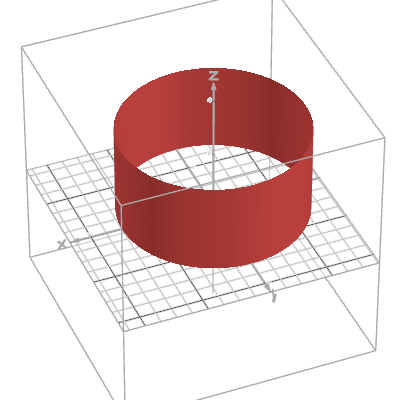
looking from above you get a circle
and looking from the side a rectangular projection
that way you can figure out how to set up the limits
x^2+y^2=9 becomes with x = 3cosθ and y = 3sinθ you get r = 3 where θ from 0 to 2π and z just remains
r is constant
bleak arrow
.close
devout snowBOT
Channel closed
Closed by @bleak arrow
Use .reopen if this was a mistake.
Available help channel!
Send your question here to claim the channel.
Remember:
• Ask your math question in a clear, concise manner.
• Show your work, and if possible, explain where you are stuck.
• After 15 minutes, feel free to ping <@&286206848099549185>.
• Type the command .close to free the channel when you're done.
• Be polite and have a nice day!
Read #❓how-to-get-help for further information on how to ask a good question, and about conduct in the question channels.
 torn kayak
I'm not sure what went wrong, can someone explain it to me?


 fleet cove
Hi guys im having trouble with some trigonometric expressions. I tried asking chatgpt and deepseek but they use rsin and similar which i havent done. Ill send pics of what i have done and what example i have to do.


As you can see i was trying to find a common denominator to have below the line but im not sure how to proceed or if thats even the correct way
devout snowBOT
@torn kayak Has your question been resolved?
 glossy dew
torn kayak
I'm not sure what went wrong, can someone explain it to me?
glossy dew
torn kayak
I'm not sure what went wrong, can someone explain it to me?
you took 1/3 k^3 in the expression for the area of the triangle in the last step instead of 1/2 k^3
also
don't forget to multiply -1 to both the triangle and the curve area
before subtraction
since both will come out to be negative for a given k
torn kayak
glossy dew
you took 1/3 k^3 in the expression for the area of the triangle in the last step...
ohhhhhhhhh
I didn't notice
thank you
torn kayak
glossy dew
since both will come out to be negative for a given k
what do you mean
I got k=2
glossy dew
torn kayak
what do you mean
oh never mind
devout snowBOT
Channel closed
Closed by @torn kayak
Use .reopen if this was a mistake.
devout snowBOT
Available help channel!
Send your question here to claim the channel.
Remember:
• Ask your math question in a clear, concise manner.
• Show your work, and if possible, explain where you are stuck.
• After 15 minutes, feel free to ping <@&286206848099549185>.
• Type the command .close to free the channel when you're done.
• Be polite and have a nice day!
Read #❓how-to-get-help for further information on how to ask a good question, and about conduct in the question channels.
 thin geode
What does smallest positive value mean?
 devout snowBOT
thin geode
What does smallest positive value mean?
thin geode
devout snowBOT
thin geode
What does smallest positive value mean?
thin geode
I don't really get what I'm searching for . Is it when it takes the form or 1+ 0i? Can someone explain the intuition pls?
 fossil locust
the smallest one that works out of n = 1, 2, 3....
fossil locust
thin geode
I don't really get what I'm searching for . Is it when it takes the form or 1+ 0...
right, so if a complex number is a positive real number
what argument must it have?
thin geode
No i in it ?
fossil locust
yep
faint gorge
you can apply demoivre btw
thin geode
So wait
Why isn't it still positive if we have an i term? Like the first quadrat isn't that fully positive even with i components
fossil locust
thin geode
I don't really get what I'm searching for . Is it when it takes the form or 1+ 0...
yes or pi + 0i or sqrt(2)^sqrt(3) + 0i, and so on
fossil locust
thin geode
Why isn't it still positive if we have an i term? Like the first quadrat isn't t...
what is positive?
thin geode
Positive sign between the rel and imaginary part?
 lunar eagle
thin geode
What does smallest positive value mean?
lunar eagle
thin geode
What does smallest positive value mean?
like suppose n= 6 satisfies but so does n= 3
they want u to answer 3
thin geode
No they said 12
fossil locust
thin geode
Positive sign between the rel and imaginary part?
well 5 + 0i and 5 - 0i are the same
lunar eagle
i meant it as an example
thin geode
lunar eagle
i meant it as an example
Oh ok
thin geode
fossil locust
well 5 + 0i and 5 - 0i are the same
So when a question ask for the smallest positive value, it doesn't include imaginary part
fossil locust
thin geode
So when a question ask for the smallest positive value, it doesn't include imagi...
no, you're missing the point
fossil locust
fossil locust
what argument must it have?
you should think about this question first
thin geode
1 or -1 + 0i
fossil locust
thin geode
1 or -1 + 0i
-1 isn't a positive real number
lunar eagle
thin geode
What does smallest positive value mean?
try writing it as z= r e^itheta
fossil locust
thin geode
1 or -1 + 0i
okay what argument does 1 + 0i have?
lunar eagle
and arguement must be 0 or pi
thin geode
0/1 means 0 or 2pi
lunar eagle
for it to be real
fossil locust
thin geode
0/1 means 0 or 2pi
that's correct
thin geode
And we can't use zero either because it's not a positive real?
fossil locust
now what about the argument of 2 + 0i then
fossil locust
thin geode
And we can't use zero either because it's not a positive real?
yeah
also the argument of 0 is undefined
you'd be dividing by 0
thin geode
fossil locust
now what about the argument of 2 + 0i then
Same thing
fossil locust
thin geode
Same thing
right, so yeah, the condition is that the argument needs to be 2kpi
where k is an integer
now what's the argument of (z1)/(z2)?
how about for ((z1)/(z2))^n then?
thin geode
We multiply the n inside the complex expression?
fossil locust
thin geode
We multiply the n inside the complex expression?
arg(z^n) = n * arg(z) is the property you need
you should be more specific when learning and recalling definitions
otherwise you'll hurt yourself by not understanding properly
thin geode
Ya true
But anyways 5npi/6
The only case where we get a multiple or 2pi is for n=12 right
fossil locust
thin geode
The only case where we get a multiple or 2pi is for n=12 right
not the only case, but definitely the smallest possible
n = 24 would work
you get the idea however! yayy!
thin geode
Alright if they ask for positive of a complex function they don't want no i
Wait is i positive or negative
What even is it?
Like intuitively
fossil locust
(5pi/6 * 24 = 20pi, and 20pi is a multiple of 2pi)
so all multiples of 12 would work
fossil locust
thin geode
Wait is i positive or negative
it's neither! that's the whole point
it's not on the real number line
thin geode
But if neither wouldn't a smaller angle be less than 1 and still be positive?
Like the point 1/2, √3/2
Cuz the real value is 1/2 which is smaller than 1?
fossil locust
thin geode
Like the point 1/2, √3/2
well that corresponds to the complex number 1/2 + sqrt(3)/2 i
fossil locust
thin geode
But if neither wouldn't a smaller angle be less than 1 and still be positive?
I don't get your point?
thin geode
fossil locust
well that corresponds to the complex number 1/2 + sqrt(3)/2 i
Ya ya isn't that smaller than 1+ 0i
fossil locust
thin geode
Ya ya isn't that smaller than 1+ 0i
complex numbers can't be compared!
there's no larger or smaller
think about it, like are all complex numbers with the same real part equal? no!
or the same imaginary part?
or the same modulus (infinitely many points are on a circle)
or the same argument (infnitely many points are on a ray)
fossil locust
fossil locust
complex numbers can't be compared!
you can't compare things in 2 dimensions: just doesn't work out
you can only compare 1 dimensional things when talking about size
thin geode
Huh alright so you cannot think in an arithmetic way when you deal with complex numbers
fossil locust
thin geode
Huh alright so you cannot think in an arithmetic way when you deal with complex ...
yes there's no ordering
the complex numbers are not well-ordered is the technical term
thin geode
damm this hit like a bombshell
fossil locust
yeah you're learning some baby baby analysis
thin geode
Wait one question, just a general one. What even is a complex number and why do we need them?
fossil locust
thin geode
Wait one question, just a general one. What even is a complex number and why do ...
For early access to new videos and other perks:
https://www.patreon.com/welchlabs
Want to learn more or teach this series? Check out the Imaginary Numbers are Real Workbook: http://www.welchlabs.com/resources.
Imaginary numbers are not some wild invention, they are the deep and natural result of extending our number system. Imaginary numbers ...
there's a lot of possible answers but they arise naturally, say from quadratic equations
the fundamental theorem of algebra tells you that a degree n polynomial always has n roots
but then when we say 'no real roots', that means the other roots are hiding in some other, higher number system
which is the complex numbers
the complex numbers complete all polynomials
thin geode
Complex roots always comes in positive and negative pairs
fossil locust
the roots of any polynomial with complex coefficients will also be complex numbers
the roots of any polynomial with real coefficients will be complex numbers in general
fossil locust
fossil locust
the roots of any polynomial with complex coefficients will also be complex numbe...
so this means that we can't find a deeper layer using all the simpler layers
if you want to get to even deeper layers than the complex numbers (the quaternions for instance)
you have to sacrifice the fact that a * b will not be equal to b * a anymore
thin geode
Damm there is another number system. Holy do I have a lot to learn
fossil locust
thin geode
Complex roots always comes in positive and negative pairs
that's true for polynomials with real coefficients
fossil locust
thin geode
Damm there is another number system. Holy do I have a lot to learn
and another number system beyond that
and another one and another one but those aren't that useful
thin geode
Alright man I think you answered everything. Thanks for your patience brother
fossil locust
no worries!
devout snowBOT
Channel closed
Closed by @thin geode
Use .reopen if this was a mistake.
devout snowBOT
Available help channel!
Send your question here to claim the channel.
Remember:
• Ask your math question in a clear, concise manner.
• Show your work, and if possible, explain where you are stuck.
• After 15 minutes, feel free to ping <@&286206848099549185>.
• Type the command .close to free the channel when you're done.
• Be polite and have a nice day!
Read #❓how-to-get-help for further information on how to ask a good question, and about conduct in the question channels.
 spare delta
 devout snowBOT
spare delta
spare delta
devout snowBOT
spare delta
spare delta
how might i go about proving or disproving this?
the ratio test came up inconclusive
=1
spare delta
i'll go ahead and try that, brb
ah, that works
ln(x/y) = ln x - ln y
so uhhh
this whole series turns into ln(3 + a1) - ln (3+a inf)
storm raptor
and you know what a_inf is
spare delta
i know a_n is convergent, so it should be 0?
so this is ln (3+a1) - ln(3) and since a_n is convergent, ln(3+an) should exist
meaning that this is a number minus a number, which means the whole thing is convergent?
storm raptor
uh
 storm raptor
the value of the sum is just ln(3 + a_1) - ln(3)
assume 3 + a_1 > 0, the sum exists
spare delta
 tawny thorn
to be honest, i didn't know this existed
i just used the ln property and the telescoping sum hint
tawny thorn
tawny thorn
thats too telescoping sum
spare delta
o
tawny thorn
tawny thorn
you can put here : b(n) = ln(3+a(n))
devout snowBOT
Channel closed
Closed by @spare delta
Use .reopen if this was a mistake.
devout snowBOT
Available help channel!
Send your question here to claim the channel.
Remember:
• Ask your math question in a clear, concise manner.
• Show your work, and if possible, explain where you are stuck.
• After 15 minutes, feel free to ping <@&286206848099549185>.
• Type the command .close to free the channel when you're done.
• Be polite and have a nice day!
Read #❓how-to-get-help for further information on how to ask a good question, and about conduct in the question channels.
 cold crow
Can someone pleaseee help me simplify this
Not a and b not c and d not e + not a and b not c and d and e + not a and b and c not d not e + not a and b and c not d and e + not a and b and c and d not e + not a and b and c and d and e + a not b not c not d not e + a not b not c not d and e + a not b not c and d not e + a not b not c and d and e + a not b and c not d not e
devout snowBOT
cold crow
Can someone pleaseee help me simplify this
Not a and b not c and d not e + n...
 undone chasm
who
cold crow
@lunar drift what are you writting that long😭😭
 lunar drift
help me pls, im trying to get the intersections between two transformed circles but idk how to put it in my graphing calculator using nSolve. my equations were (x-207.5) ^2 + (y-35) ^2 = 31 ^2 and (x-249) ^2 + (y-63) ^2 = 20^2.
this bro 😭 ive actually spent like 3 hrs doing it
cold crow
cold crow
Can someone pleaseee help me simplify this
Not a and b not c and d not e + n...
@lunar drift could you help me with this🙏🙏
tawny thorn
lunar drift
help me pls, im trying to get the intersections between two transformed circles ...
!occupied
devout snowBOT
lunar drift
help me pls, im trying to get the intersections between two transformed circles ...
Someone else is already using this help channel. If you need help with a question, please open your own help channel/thread (see #❓how-to-get-help for instructions).
cold crow
lunar drift
this bro 😭 ive actually spent like 3 hrs doing it
Bro I got like 12 more expression I need to simplify this one is just one of them mine will take longer😭😭🙏
 near jolt
cold crow
Can someone pleaseee help me simplify this
Not a and b not c and d not e + n...
near jolt
cold crow
Can someone pleaseee help me simplify this
Not a and b not c and d not e + n...
I don't understand this what is not a and b not c and d not e?
$\neg a\land b\neg c\land d\neg e$?
cold crow
near jolt
I don't understand this what is not a and b not c and d not e?
It's boolean expression, in a sheet I actually write not a to ā with lines on top but since not b don't have a font where it has a line on top I instead use the full form which is not b and not a
woven radishBOT
qwertytrewq
 cold crow
near jolt
$\neg a\land b\neg c\land d\neg e$?
cold crow
near jolt
$\neg a\land b\neg c\land d\neg e$?
No I don't even know that
I'm not on that level
near jolt
cold crow
It's boolean expression, in a sheet I actually write not a to ā with lines on to...
oh ok
cold crow
near jolt
oh ok
It look like this
Not a and b and c + not a and b and c
ābc+ābc
Like that
near jolt
cold crow
Can someone pleaseee help me simplify this
Not a and b not c and d not e + n...
then for the first term did you mean "not a and b and not c and d and not e"?
$\overline{a}\cdot b\cdot \overline{c}\cdot d\cdot \overline e$ for the first one?
woven radishBOT
qwertytrewq
 cold crow
near jolt
then for the first term did you mean "not a and b *and* not c and d *and* not e"...
cold crow
near jolt
then for the first term did you mean "not a and b *and* not c and d *and* not e"...
You can't put "and" and "not e" together
It should just be not c and d not e
You will mess up the wire on logic circuit
near jolt
cold crow
You can't put "and" and "not e" together
isn't "not" the dash on top and "and" the multiplication?
cold crow
So you should only use one logic implementation at a time each input
cold crow
near jolt
isn't "not" the dash on top and "and" the multiplication?
What multiplication?
near jolt
cold crow
What multiplication?
$\cdot$ i mean
woven radishBOT
qwertytrewq
 near jolt
woven radish
**qwertytrewq**
near jolt
woven radish
**qwertytrewq**
but notations aside is this interpretation correct?
near jolt
cold crow
You can't put "and" and "not e" together
i thought "a and (not b)" makes sense, but i might be wrong
but idk what a not b means
cold crow
near jolt
then for the first term did you mean "not a and b *and* not c and d *and* not e"...
If we use this logic it will look like this in wiring:
[] for and
() for not
A - ()\ _______[]----
B - []/ | |
C ---()-| |
D ---[]-()--|
See how [] and () meet in D input
That is very illogical
So "and" should be eliminated and just be "not"
cold crow
near jolt
i thought "a and (not b)" makes sense, but i might be wrong<:catshrug:5638187350...
No it just:
Not a and b not c and d not e
undone chasm
do you have a picture
cold crow
You can't change it
undone chasm
🖼️ 🖼️ 🖼️
cold crow
undone chasm
do you have a picture
I have some written work but my progress is kind of bad
Plus my handwritting is bad
I've been trying to simplify it myself but I'm bad at simplifying
Wait let me take a picture
cold crow
No I don't have
near jolt
cold crow
If we use this logic it will look like this in wiring:
[] for and
() for not
A...
ummm where is E?
cold crow
I write them all in paper
Including the diagram
And circuit
All progress is in paper
near jolt
 cold crow
near jolt
ummm where is E?
cold crow
near jolt
ummm where is E?
Not a and b not c and d and not e. This what happen if we follow your logic by putting and and not together
A-()__[]-[]--[]
B--/ | | |
C-()--| | |
D--------| |
E--[] -()-----
near jolt
this is what i mean when I say (not a) and b and (not c) and d and (not e)
cold crow
near jolt
this is what i mean when I say (not a) and b and (not c) and d and (not e)
But that's not how you express them
You can't use and to divide them
If you want to divide them just do it straightforwardly just go straight "not" without putting and between them
Or the and becomes an actual circuit
near jolt
cold crow
If you want to divide them just do it straightforwardly just go straight "not" w...
it just automatically implies an and gate?
cold crow
near jolt
it just automatically implies an and gate?
What I mean is if there is "and d not e" just say not e and don't add "and d and not e" to divide it
That's two circuit meeting each other that would give a very different output
near jolt
cold crow
What I mean is if there is "and d not e" just say not e and don't add "and d and...
um then shouldn't it be not a b not c d not e
why are you naming some and gate and not naming some other and gates
cold crow
cold crow
What I mean is if there is "and d not e" just say not e and don't add "and d and...
This what it really looks like
0D----[]--0
1E-()/
0D--[]-0
1E- -[]-()-1
This is actually invalid there's a lot of circuit of missing wires for example two "and" at D and E are missing one wires to each other making the "and" circuit usless
cold crow
near jolt
um then shouldn't it be not a b not c d not e
For b and d they are known as and gate so automatically you should put and b and d in full form but in some way you could also just not put it cuz it can still be understandable as and gate but I just clarify the expression in case someone want to help me simplify actually can someone help me now😭🙏🙏
near jolt
cold crow
This what it really looks like
0D----[]--0
1E-()/
0D--[]-0
1E- -[]-()-1
This i...
yeah but i added brackets: (not a) and (not b) for example so you are wiring the not gate first?