#help-27
1 messages · Page 319 of 1
 wicked rover
 ivory salmon
ooo okay
wicked rover
general rule is all x must go after taking limit
ivory salmon
so remove x then sub and take the limit?
wicked rover
well u take the limit by subbing, theyre not separate steps
if u sub correctly u get
ivory salmon
yea sorry thats what i meant 😭
wicked rover
$\frac{-\sqrt{0+16}}{1+0}$
 woven radishBOT
ロケットジャンプ
 wicked rover
in short response its good to replace before simplifying 🙂
ivory salmon
🫡 on it captain
wicked rover
we took it slow
ivory salmon
so basically what im understanding about limits to inf is to factor the dominant on the top and bottom, remove any x, then take the limit?
wicked rover
to avoid common student errors
ivory salmon
yea i really appreciate that we took it slow 😭 limits are the most confusing part about calc for me
wicked rover
when u say remove any x, do u mean cancel common factors?
ivory salmon
yea
wicked rover
yes
ivory salmon
like how we cancelled the x/x
wicked rover
u can also cancel x^7 if its common
ivory salmon
x^7?
wicked rover
if u have to factor out x^7 on top and bottom
 gleaming fog
just to make sure when we cancel out stuff like that it still leaves behind the hole on the graph right?
ivory salmon
why specifically x^7? /genq
 wicked rover
gleaming fog
just to make sure when we cancel out stuff like that it still leaves behind the ...
wicked rover
gleaming fog
just to make sure when we cancel out stuff like that it still leaves behind the ...
yes
ivory salmon
i understand a lot better now, tysm!!
wicked rover
np 
 faint gorge
so much joy here 

 devout snowBOT
Channel closed
Closed by @ivory salmon
Use .reopen if this was a mistake.
 Available help channel!
Send your question here to claim the channel.
Remember:
• Ask your math question in a clear, concise manner.
• Show your work, and if possible, explain where you are stuck.
• After 15 minutes, feel free to ping <@&286206848099549185>.
• Type the command .close to free the channel when you're done.
• Be polite and have a nice day!
Read #❓how-to-get-help for further information on how to ask a good question, and about conduct in the question channels.
 neon wagon
Hi so here you have to check if the like dimension that goes through the points is parallel to one of the coordinate dimensions

 devout snowBOT
neon wagon
Hi so here you have to check if the like dimension that goes through the points ...
neon wagon
devout snowBOT
neon wagon
Hi so here you have to check if the like dimension that goes through the points ...
neon wagon
wait let me just translate
The plane passing through the points ABC is parallel to a coordinate plane
so when do i know if thats the case generally?
if one of the coordinate on the vectors is 0
then its parallel?
faint gorge
neon wagon
Hi so here you have to check if the like dimension that goes through the points ...
die Punkte liegen alle in der Ebene z = 4
faint gorge
das erkennst du daran weil, der Wert konstant bleibt
faint gorge
nicht wirklich
die können irgendwie in der eben z = 4 liegen
oder meinst du was anderes
neon wagon
also
wenn die ebene parallel zur koordinaten ebene ist
dann muss bei den vektoren x y oder z 0 sein oder
faint gorge
meinst du sowas wie 0x+0y+z=4
faint gorge
achso ich versteh glaube ich
wenn du die ebenen darstellung hast meinst du?
die richtungsvektoren?
neon wagon
aber wie weiß ich generell ob die ebene die durch die punkte geht parallel zu den koordinatenebene ist
faint gorge
also angenommen du hast einen ortsvektor

Ich weiß nicht was genau Q war aber
Aber angenommen Q ist ein Ortsvektor
damit du feststellst ob es eine ebene ist die parallel zu einer koordinatenebene ist da muss zum beispiel hier die z komponente der Richtungsvektoren 0 sein
weil ansonsten wäre die ebene schief
weil dann ein Vektor sozusagen nicht mehr flach liegt
neon wagon
faint gorge
weißt du warum man hier minus rechnen muss
faint gorge
so ist das definiert
ich versuch mal ein Bild zu malen

QR heißt du willst von Q nach R gelangen
naja
Du fängst bei Q
faint gorge
und gehst in die entgegengesetzte Richtung
das ist -Q
und dann gehst du entlang +R
also rechnst du (-Q)+R also R-Q
neon wagon
hä aber
die entgegengesetze richtung
achso
ok ich check
aber was hast du da gezeichnet?
faint gorge
ja wie man R-Q geometrisch interpretiert
Richtungen
Pfade
Vektoren
Intuition hier rein bringen
neon wagon
faint gorge
ja wie man R-Q geometrisch interpretiert
was hat dann die frau gezeichnet?
also
die vorherige zeichnung
faint gorge
das bist du der da entlang läuft
entlang -Q und dann R
schließlich zählst du es ja zsm den Weg
neon wagon
faint gorge
schließlich zählst du es ja zsm den Weg
also wenn ich von q -q entlang gehe
und dann plus R
dann komme ich auf R
faint gorge
ja mach dann bist du aber nicht bei R
neon wagon
faint gorge
ja mach dann bist du aber nicht bei R
wo bin ich dann sonst hö
faint gorge
du verfährst dich komplett
 neon wagon
RQ oder was
neon wagon
faint gorge
das passiert wenn du einfach Q+R machst
aber woher weiß ich wann ich plus rechnen muss
und wann minus
faint gorge
merk dir das einfach
woven radishBOT
 neon wagon
ist das 0 oder o
faint gorge
A nach B machst du B - A
faint gorge
neon wagon
ist das 0 oder o
O steht für den Nullvektor ja
ist die eigentliche Schreibweise
damit man einen Bezug hat
neon wagon
ich schreibe freitag eine kurzarbeit ich checke nichts
aber egal
also dings
was wäre aber A+B
faint gorge
neon wagon
aber egal
hä?😂
dann stell doch fragen
weiter machen bringt dann auch nichts
das baut sich auf
faint gorge
ja
moment gibt eine sekunde
guck mal nochmal

Stell dir vor du bist bei A und willst nach B
orange da ist baustelle zum Beispiel
also hast du keine Wahl
du hast dich verlaufen und du must A zurück gehen also -A
angelangt bei O gehst du entlang B
um nach B zu kommen
jetzt addierst du den Weg (-A) + B = B - A das ist dann die Richtung um von A nach B zu kommen
faint gorge
Im Prinzip ist es besser zu sagen, du addierst immer die Vektoren, die Frage ist wann gehst du vorwärts, wann rückwärts
faint gorge
neon wagon
A ist der startpunkt?
Ja
faint gorge
faint gorge
guck mal nochmal
Angenommen du bist bei O und will nach B dann kannst du dich zwischen zwei Wegen entscheiden
entweder blau oder grün + orange
Also
OB = O + B sozusagen
OB = A + AB = A + (B - A) = B
funktioniert beides
in beiden fällen läufst du nur vorwärts
aber vorher warst du gezwungen rückwärts zu gehen, und da sagt man mathematisch minus
um die Gegenrichtung zu benennen
neon wagon
faint gorge
aber vorher warst du gezwungen rückwärts zu gehen, und da sagt man mathematisch ...
also bei unseren beispieLß
?
faint gorge
was mit dem
neon wagon
du meintest
vorher warst du gezwungen ..
also meinst du das hier

hier geht man aber doch nicht minus oder
faint gorge
ja hier gehst du auch von Q erst zurück zum Bezugspunkt und dann entlang R
 neon wagon
faint gorge
hast du mehr als vektorgeometrie
neon wagon
faint gorge
hast du mehr als vektorgeometrie
nee ich glaub nicht
also
weißt du noch letzte woche
diese parallelogram aufgabe
sowas halt
faint gorge
ja sowas halt ist vektorgeometrie
 faint gorge
ja
ich vergesse aber immer dass du noch schule gehst haha
und wahrscheinlich anderes zeug
das machts bisschen stressiger
neon wagon
faint gorge
und wahrscheinlich anderes zeug
ok ok
also
mischprobleme???
digga
ehrenlos
egal
ich check dieses skalarprodukt nicht
faint gorge
neon wagon
ich check dieses skalarprodukt nicht
wie das funktioniert?
neon wagon
warte
faint gorge
lmao
 faint gorge
das ist nicht das Skalarprodukt
oh man die Terminologie is so scheiße auf deutsch
skalar ist einfach eine zahl
wie 4 mal (1,2,3) hier ist 4 die zahl
das ist doch intuitiv
einfach mit jeder komponente multiplizieren
neon wagon
faint gorge
einfach mit jeder komponente multiplizieren
achso
hä digga
warum muss man jetzt extra skalar sagen
faint gorge
Soll ich es dir erklären hahaha
In der Mathematik ist das Skalarprodukt eine Art Funktion
zwei Vektoren bilden auf einen Skalar ab
des wegen Skalarprodukt
das ist der Grund
skalar Multiplikation heißt wortwörtlich aber zahl mal vektor nicht vektor mal vektor
neon wagon
ok warte
neon wagon
faint gorge
skalar Multiplikation heißt wortwörtlich aber zahl mal vektor nicht vektor mal v...
für was braucht man die meistens
faint gorge
neon wagon
für was braucht man die meistens
im Abi wirst dus brauchen oder im test
neon wagon
faint gorge
im Abi wirst dus brauchen oder im test
ja
aber
ich mein
so von der fragestellung her
werden die mir direkt fragen was ist das skalarprodukt oder wie
faint gorge
hahaha das denke ich nicht
zu 99 %
du wirst da iwas rechnen halt
ist halt schule
du verwendest das gelernte an, und tust es nicht erklären
der mathelehrer hat auch nichts davon wenn du auswendig lernst, wie das skalarprodukt funktioniert
neon wagon
faint gorge
der mathelehrer hat auch nichts davon wenn du auswendig lernst, wie das skalarpr...
ja
was wäre ein beispiel dafür
wie viel punkte hattest du im mathe abi
faint gorge
berechnen Sie das Skalarprodukt der Vektoren (1,2,3) und (3,4,5)
Welchen Winkel haben die Vektoren?
gut das kommt auch drauf an mit oder ohne taschenrechner wie die vektoren sind
faint gorge
neon wagon
wie viel punkte hattest du im mathe abi
genug zum Bestehen
neon wagon
faint gorge
berechnen Sie das Skalarprodukt der Vektoren (1,2,3) und (3,4,5)
ja
ok ok
neon wagon
faint gorge
genug zum Bestehen
hattest du auch Lk
faint gorge
denje ja kp mehr
neon wagon
faint gorge
denje ja kp mehr
guckmal bruder was ist das für ein scheiß
 faint gorge
ja das ist eine perfekte übung
wo du das Skalarprodukt brauchst
weil die Norm eines Vektors ist nichts weiteres wie die Wurzel aus dem Skalarprodukt eines Vektors mit sich selber
oder einfacher
woven radishBOT
 faint gorge
das rechnest du aus und setzt es gleich 10 und löst für b
das ist wie als wenn du eine quadratische gleichung lösen würdest
so 8. klasse
was du hier können musst also sind die Definitionen
was bedeutet nochmal Länge mathematisch
und dann folgt der Rest von alleine
faint gorge
jetzt anwenden
faint gorge
also
ich bin mir sicher du bist gerade erschöpft
weil die aufgabenstellung ist eigentlich klar
die Länge soll gleich 10 sein von a
faint gorge
woven radish
und das ist die Formel für die Länge
jetzt musst du a mal a rechnen, das ist nichts weiteres wie das skalarprodukt
neon wagon
neon wagon
guckmal bruder was ist das für ein scheiß

ist der teil b
also die koordinaten von b
achso
es ist abc
und nicht x y z
oder
faint gorge
what
neon wagon
ach digga
faint gorge
ist doch wurst
faint gorge
2b^2-4 ist die erste Komponente
woven radishBOT
 faint gorge
bei 3 Komponenten einfach die Dritte mal die Dritte
 neon wagon
achso
faint gorge
du machst dann a mal a
neon wagon
ja deswegen meinte ich
warte
also
digga die sind so dumm
warum schreiben die -4
man denkt es ist noch ein vektor da drinne
ja genau
also 10 =
woven radishBOT
 faint gorge
jetzt machst du weiter sonst bringt das nichts
neon wagon
ja
faint gorge
du musst den test schreiben nicht ich
neon wagon
ja hast recht sir
faint gorge
danke sie
faint gorge
[ \sqrt{ \begin{pmatrix} 2b^2-4 \ 9 \ \sqrt{3} \end{pmatrix} \dotproduct \begin{pmatrix} 2b^2-4 \ 9 \ \sqrt{3} \end{pmatrix} } = \sqrt{(2b^2-4)^2+9^2+(\sqrt{3})^2} \stackrel{!}{=} 10 ]
woven radishBOT
 faint gorge
neon wagon
also 4b^2+97+wurzel aus 3 ^2=10
faint gorge
neon wagon
also 4b^2+97+wurzel aus 3 ^2=10
keine ahnung wie ich das lesen sol
woven radishBOT
 faint gorge
yep dann kannst du die terme zsm fassen und beide seiten quadrieren
und diese quartische gleichung kann man mit substitution in eine quadratische umwandeln
ja das alles baut auf von der 11.
neon wagon
faint gorge
ja das alles baut auf von der 11.
locker
ich kann das noch
ahh warte
binomische formel
usw
faint gorge
ja cooked
faint gorge
bro ich geh jetzt penne
faint gorge
ja
faint gorge
gute nacht
devout snowBOT
@neon wagon Has your question been resolved?
Channel closed
Closed by @neon wagon
Use .reopen if this was a mistake.
Available help channel!
Send your question here to claim the channel.
Remember:
• Ask your math question in a clear, concise manner.
• Show your work, and if possible, explain where you are stuck.
• After 15 minutes, feel free to ping <@&286206848099549185>.
• Type the command .close to free the channel when you're done.
• Be polite and have a nice day!
Read #❓how-to-get-help for further information on how to ask a good question, and about conduct in the question channels.
 uncut tiger
can someone help me
 devout snowBOT
uncut tiger
can someone help me
devout snowBOT
devout snowBOT
uncut tiger
can someone help me
devout snowBOT
Channel closed
Closed by @uncut tiger
Use .reopen if this was a mistake.
Available help channel!
Send your question here to claim the channel.
Remember:
• Ask your math question in a clear, concise manner.
• Show your work, and if possible, explain where you are stuck.
• After 15 minutes, feel free to ping <@&286206848099549185>.
• Type the command .close to free the channel when you're done.
• Be polite and have a nice day!
Read #❓how-to-get-help for further information on how to ask a good question, and about conduct in the question channels.
 oblique girder
Hello! looking for help with quadratic equations
devout snowBOT
oblique girder
Hello! looking for help with quadratic equations
 midnight totem
oblique girder
Hello! looking for help with quadratic equations
midnight totem
oblique girder
Hello! looking for help with quadratic equations
have any specific questions?
oblique girder
Yeah I would say a few, I'm just starting it now for a college algebra class but don't really understand a few steps
midnight totem
okay ask
oblique girder
Alrighty!
thanks
Alright I am being asked to solve quadratic equations by using the zero product property
The formula is a^2 + bx + c = 0
So for the first equation
I have x^2 - 8x = 0
 glossy basalt
You have to factorize that
glossy basalt
$xx - 8x$
woven radishBOT
Luca M
 glossy basalt
whats the common factor
oblique girder
x ?
glossy basalt
$x(x-8)$
woven radishBOT
Luca M
 oblique girder
is because x is squared
glossy basalt
yeah. x^2 is just notation that means the same thing as x * x
oblique girder
I guess im also confused as in like
what I am allowed to do
so if its common amongst the equation thats what I factor ?
glossy basalt
yeah. Every term needs to have it
glossy basalt
yeah
oblique girder
Alright im sorta there so far
so now we have x (x - 8) = 0
wait sorry
what happened to the x that was orginally 8x
glossy basalt
so in x^2-8x, we have 2 terms
One is x^2, and one is -8x
When we are factorising, we are taking out a common factor from all the terms
Which we saw was x
So we remove that x from every term
Leaving just x-8
And we then multiply this that is left all by the x we took out
oblique girder
oh so we are allowed to just "remove" them
glossy basalt
As long as you then multiply the x outside by what is left
oblique girder
I thought factoring was just sorta spreading out what was already there
oooo
thats going to be a little hard to grasp
but I sorta understand
glossy basalt
Yeah it is, they are both equivalent
You can show this by going back from the factorised form to the expanded form
oblique girder
I guess what im a little lost by
since this is the way im seeing it
I know if we multiplied that 8 by x we would have the 8x we originally had
but how does that x get in front of - 8
since if we were taking an x off of the x^2 what is it multiplied by
glossy basalt
Yeah your taking a common factor of x out of the x^2 which leaves behind 1 x
oblique girder
ah ok
understood
so now that brings us to x ( x - 8 ) = 0
now since we factored x we need to factor -8 ?
glossy basalt
That’s already fully factorised
Because there is no more factors that are the same between x and -8
Before x^2 and -8x both shared a factor of x which is why we could take the x out of both of them
oblique girder
Alright
whats the general rule for that
if values are being shared we need to get rid of them ?
oblique girder
this formula is relevant for what rule ?
glossy basalt
oblique girder
if values are being shared we need to get rid of them ?
Yeah, this is the idea of factorising.
We want it in a form where none of the terms share a common factor
glossy basalt
Yes, however this example is easier because notice that the constant +c is 0
oblique girder
oo
so going back to where we left off
I guess i couldn't see that
but x(x - 8) = 0
glossy basalt
Yeah. So now the zero product property
It pretty much says if you have two numbers a and b, if their product a*b=0, then the only way this can happen is if either a=0 or b=0
glossy basalt
Yeah the equation is satisfied when either of the factors equals 0
glossy basalt
So if we want to find out when each factor is equal to 0, we need to solve 2 things
x=0 and (x-8)=0
oblique girder
ohh
glossy basalt
And x=0 is already solved, so all you need to do is solve x-8=0 for x
oblique girder
how is x = 0 already solved ?
glossy basalt
We want to find out what number x has to be to be equal to 0. What number is that?
glossy basalt
Exactly
oblique girder
bc there is nothing in that equation
compared to like
x - 8 = 0
so i need to get rid of the 8
oblique girder
so i add 8 and add 8 to the 0
glossy basalt
Yeah
oblique girder
so that would give me x = 8
glossy basalt
Yep, and that’s all
oblique girder
oh so the other solved it self
glossy basalt
You have your two solutions x=0 or x=8 which will make the original equation true
And you can check it by replacing the x in x^2-8x by 0 and then replacing it by 8
And both times the answer should be 0
glossy basalt
Yeah
glossy basalt
What do you mean by -12 4, -12*4?
glossy basalt
So your first goal should always be to get one side of the equation to be = 0
How would you do that in this case
devout snowBOT
@oblique girder Has your question been resolved?
devout snowBOT
Channel closed
Closed due to timeout
Use .reopen if this was a mistake.
devout snowBOT
Available help channel!
Send your question here to claim the channel.
Remember:
• Ask your math question in a clear, concise manner.
• Show your work, and if possible, explain where you are stuck.
• After 15 minutes, feel free to ping <@&286206848099549185>.
• Type the command .close to free the channel when you're done.
• Be polite and have a nice day!
Read #❓how-to-get-help for further information on how to ask a good question, and about conduct in the question channels.
 wintry flare
i am confused about the domain of series
devout snowBOT
wintry flare
i am confused about the domain of series
wintry flare
so, for example you have a series where the limit is |x-3| and you used the root test
wait no
 misty crest
!xy
devout snowBOT
Please show the original problem, exactly as it was stated to you, with the entire original context. A picture or screenshot is best. If the original problem is not in English, then post it anyway! The additional context might still be helpful. Do your best to provide a translation.
wintry flare
i dont even have an original problem
i am just confused about the domain part
i can show the example
misty crest
wintry flare
i can show the example
that’s what i meant by original problem
wintry flare
misty crest
that’s what i meant by original problem

this
so we did root test
and the limit is |x-3|
because the limit is not a definite value, we need the domain the then find convergence ?
misty crest
use the ratio test to find the radius
wintry flare
are radius and domain not the same
misty crest
but yes youll get |x - 3| < 1
misty crest
so your radius is…
misty crest
wintry flare
and then 2<x<4
did you check the endpoints sir
wintry flare
its [2,4)
misty crest
so what’s the problem?
wintry flare
wintry flare
because the limit is not a definite value, we need the domain the then find conv...
this is my question
i already have the work and answers
i am asking in general
if there is a value like x in the limit
misty crest
you mean it’s not a definite value because of |x-3|?
misty crest
wintry flare
if there is a value like x in the limit
well that’s the whole point, as per the ratio/root test you want the limit to be less than 1 so that it converges
wintry flare
my prof went over it today using the term domain and then mentioned radius
and i didnt understand
misty crest
and you find the interval so that it’s satisfied
wintry flare
misty crest
well that’s the whole point, as per the ratio/root test you want the limit to be...
so you set the limit <1 by default ?
and then solve by plugging the endpoints into the series
^
misty crest
well yea the entire goal is to find where the power series converges
misty crest
wintry flare
and then solve by plugging the endpoints into the series
yes well you’ll need to check the endpoints because you’ll only find the radius
it won’t tell you if it converges at the endpoints
misty crest
do you know what converges conditionally means?
misty crest
i mean like i think i know what you’re trying to say
wintry flare
yeah idk how else to word it
misty crest
are you trying to say it converges provided that x is in the interval [2, 4)?
wintry flare
it converges on a small interval
misty crest
that being the "condition"
wintry flare
yeah
misty crest
then yes that’s correct but that’s not how the term conditional convergence is used
misty crest
conditional convergence is used when a series converges but not absolutely
misty crest
misty crest
conditional convergence is used when a series converges but not absolutely
so when the sum of the absolute value of the terms diverges but the original series converges
misty crest
you’re welcome
wintry flare
.close
devout snowBOT
Channel closed
Closed by @wintry flare
Use .reopen if this was a mistake.
Available help channel!
Send your question here to claim the channel.
Remember:
• Ask your math question in a clear, concise manner.
• Show your work, and if possible, explain where you are stuck.
• After 15 minutes, feel free to ping <@&286206848099549185>.
• Type the command .close to free the channel when you're done.
• Be polite and have a nice day!
Read #❓how-to-get-help for further information on how to ask a good question, and about conduct in the question channels.
 still zephyr
How to show that $\mathbb{Z}$ with the usual addition and multiplication operations is not an algebraic structure of the same type?
devout snowBOT
still zephyr
How to show that $\mathbb{Z}$ with the usual addition and multiplication operati...
woven radishBOT
Halex

 graceful cosmos
"An algebraic structure of the same type" doesn't parse for me. Are we missing some of the question?
still zephyr
the addition and multiplication operations in Z are not algebraic structures of the same type
maybe my question is not well formulated
devout snowBOT
@still zephyr Has your question been resolved?
devout snowBOT
@still zephyr Has your question been resolved?
devout snowBOT
Channel closed
Closed due to timeout
Use .reopen if this was a mistake.
Available help channel!
Send your question here to claim the channel.
Remember:
• Ask your math question in a clear, concise manner.
• Show your work, and if possible, explain where you are stuck.
• After 15 minutes, feel free to ping <@&286206848099549185>.
• Type the command .close to free the channel when you're done.
• Be polite and have a nice day!
Read #❓how-to-get-help for further information on how to ask a good question, and about conduct in the question channels.
devout snowBOT
Channel closed
Channel closed due to the original message being deleted.
If you did not intend to do this, please open a new help channel,
as this action is irreversible, and this channel may abruptly lock.
Available help channel!
Send your question here to claim the channel.
Remember:
• Ask your math question in a clear, concise manner.
• Show your work, and if possible, explain where you are stuck.
• After 15 minutes, feel free to ping <@&286206848099549185>.
• Type the command .close to free the channel when you're done.
• Be polite and have a nice day!
Read #❓how-to-get-help for further information on how to ask a good question, and about conduct in the question channels.
 neon folio

 devout snowBOT
neon folio
neon folio
devout snowBOT
neon folio
neon folio
Does this mean there are 2 inverse functions?
 trail eagle
It's likely a result of how you would end up with two solutions when solving for the inverse of $1 + u + u^2$
woven radishBOT
Azyrashacorki
 trail eagle
Maybe not one sec
Yeah idk if the first one isn't even defined for any x I think.
The sqrt is only defined for x >= 3/4.
For 3/4 <= x < 1, the numerator is positive and the denominator is negative, so it's not defined in the log.
For x > 1, then the numerator is negative and the denominator is positive, so it's not defined in the log.
devout snowBOT
@neon folio Has your question been resolved?
 cinder nova
it's something about complex numbers,
but sometimes both of them doesn't work
devout snowBOT
Channel closed
Closed due to timeout
Use .reopen if this was a mistake.
devout snowBOT
Available help channel!
Send your question here to claim the channel.
Remember:
• Ask your math question in a clear, concise manner.
• Show your work, and if possible, explain where you are stuck.
• After 15 minutes, feel free to ping <@&286206848099549185>.
• Type the command .close to free the channel when you're done.
• Be polite and have a nice day!
Read #❓how-to-get-help for further information on how to ask a good question, and about conduct in the question channels.
 outer rover
@pseudo basin
 devout snowBOT
outer rover
<@183668144404037632>
outer rover
devout snowBOT
outer rover
<@183668144404037632>
outer rover
p_i is replaced with r_i
 pseudo basin
the best i can assume is that they meant r_i when they said p_i, and that in the first sentence they meant to put dependent in the first sentence of part d
but whoever wrote this problem was inexcusably sloppy
outer rover
based on the echelon form, if it's independent then how do I do part (d)?
pseudo basin
reduce it further until you solve the system
devout snowBOT
@outer rover Has your question been resolved?
devout snowBOT
Channel closed
Closed due to timeout
Use .reopen if this was a mistake.
Available help channel!
Send your question here to claim the channel.
Remember:
• Ask your math question in a clear, concise manner.
• Show your work, and if possible, explain where you are stuck.
• After 15 minutes, feel free to ping <@&286206848099549185>.
• Type the command .close to free the channel when you're done.
• Be polite and have a nice day!
Read #❓how-to-get-help for further information on how to ask a good question, and about conduct in the question channels.
 smoky gyro
How can I find the natural domain and range of f(z)=e^z
pseudo basin
for what z is the function defined?
smoky gyro
Complex
pseudo basin
is e^z defined for all z in C?
smoky gyro
 smoky gyro
pseudo basin
is e^z defined for all z in C?
smoky gyro
pseudo basin
is e^z defined for all z in C?
I guess ? How should I find the range then
smoky gyro
yeah
pseudo basin
state it here
smoky gyro
e^ix = cosx +isinx
pseudo basin
that's the exponential of a pure imaginary number
smoky gyro
o
pseudo basin
are there any pairs of reals (x,y) for which e^(x+iy) is undefined or doesn't exist?
if so, what are they?
smoky gyro
Would it help to think about the default e^x graph
smoky gyro
pseudo basin
are there any pairs of reals (x,y) for which e^(x+iy) is **undefined** or **does...
I don’t know I don’t think so?
pseudo basin
e^(x+iy) = e^x (cos(y) + i sin(y))
do exp, sin and cos of a REAL variable ever fail to exist?
smoky gyro
Well e^x can be raised to any number and sin cos is defined for all real x
pseudo basin
so, they never throw an error.
does this now let you conclude with confidence that e^z is defined on the entire complex plane?
smoky gyro
So the imaginary part of sin, the “isin(y)” doesn’t change anything about its graph? Like I’m referring to the i being multiplied
pseudo basin
talking about a "graph" at this juncture is a little tricky.
smoky gyro
What would be the right terminology
pseudo basin
for what
smoky gyro
pseudo basin
does this now let you conclude **with confidence** that e^z is defined on the en...
yes
smoky gyro
yes
pseudo basin
now the range
specifically for e^z, you might think about how writing a complex number in polar form is almost the same as writing it as a value of e^z at some other point
re^(iθ) = e^(log(r)+iθ)
smoky gyro
Why do we introduce a log?
smoky gyro
How does this help us tho?
pseudo basin
what is the one complex number that doesn't have a polar form at all?
pseudo basin
indeed
smoky gyro
Well
pseudo basin
this is the only number not in the range of e^z
smoky gyro
0 +0i
pseudo basin
smoky gyro
0 +0i
you don't need to pretend like 0 the real and 0+0i the complex are two somehow fundamentally different things unworthy of being treated as the same
smoky gyro
pseudo basin
you don't need to pretend like 0 the real and 0+0i the complex are two somehow f...
Well I figured I should use the proper notation even tho they are the same thing
pseudo basin
this adds no propriety
smoky gyro
pseudo basin
this is the only number not in the range of e^z
What does e^z look like graphically I’m having trouble visualising this
Wait maybe I can
,w graph e^z
pseudo basin
this will only get you the real graph
smoky gyro
Hm
pseudo basin
graphing complex functions is much more difficult bc you need 4 real dimensions to do it the same way as real ones
smoky gyro
Oh so the only way to find the range is pretty much algebraically?
pseudo basin
... yes
smoky gyro
wow
So what’s the process of finding the range of complex functions then is it the same for every complex function?
Like with real functions you could either graph it to find the range or take it’s inverse and find the domain of that
pseudo basin
there is no "process"
smoky gyro
pseudo basin
there is no "process"
what
So then what are you supposed to do
If e^z has range 0 to all C
then for other complex functions if there’s no approach what do u do?
pseudo basin
smoky gyro
If e^z has range 0 to all C
no
its range is C \ {0}
- if there was something general to say then i would have said it already tbh
devout snowBOT
@smoky gyro Has your question been resolved?
devout snowBOT
Channel closed
Closed due to timeout
Use .reopen if this was a mistake.
Available help channel!
Send your question here to claim the channel.
Remember:
• Ask your math question in a clear, concise manner.
• Show your work, and if possible, explain where you are stuck.
• After 15 minutes, feel free to ping <@&286206848099549185>.
• Type the command .close to free the channel when you're done.
• Be polite and have a nice day!
Read #❓how-to-get-help for further information on how to ask a good question, and about conduct in the question channels.
 green edge
Hii, I don't even know how to start (c) and (d). Can someone help?
 green edge
yup yup
green edge
 winter torrent
i'm not sure what "direction angles" means
winter torrent
i'm not sure what "direction angles" means
I have no idea either T.T
green edge
winter torrent
i'd say just calculate A x B and call it good
ohh is A x B not the answer for (b)
winter torrent
it's an answer for b
probably the easiest
maybe they mean putting it in spherical coordinates?
so you can calculate theta and phi
green edge
ohhh
green edge
winter torrent
so you can calculate theta and phi
what if they're asking the angles of A x B with respect to the axes
winter torrent
yea i guess
green edge
i have no idea what direction angles mean
green edge
hm should i just do that
okiidokii, ill do that thanks for the help!
but wait idk how to do that HAHAH
 green edge
winter torrent
i mean the way i'd do it is by using a . b = |a| |b| cosø
green edge
winter torrent
i mean the way i'd do it is by using a . b = |a| |b| cosø
ohh, so like arccos (a.b)/( |a| |b| )
winter torrent
yea
a . b in this case will be very easy to calculate
same with |b| if it's a unit vector
so it should be pretty quick
green edge
okay im sorry but i still don't have great intuition with these can u help me haha
green edge
0 , 7 , -5
winter torrent
ok cool
0i + 7j - 5k
so we want to find the angle between that and 1i
the magnitude of the first thing is
green edge
oh?
winter torrent
,calc sqrt(7 * 7 + 5 * 5)
green edge
what is 1i? sorry for late replies the wifi is p bad
woven radishBOT
Result:
8.6023252670426
like the unit vectors i j and k
1i is just <1, 0, 0>
if we want to find the angle between <0, 7, -5> and <1, 0, 0> we take their dot product, divide by 8.6, and take arccos
dot product between those is 0, so the angle is π/2
green edge
ohhhhhhhh rightt !!
green edge
okayy ill try
winter torrent
sure. remember, take the dot product between them, divide by 8.6 (that's the magnitude of A x B) and take arccos
winter torrent
yep
winter torrent
green edge
then i divide that by ||A x B| | then arcos it
yep exactly
you'd also divide by || <0, 1, 0> || but like that's just 1 haha
green edge
ohhhhhhhhh
okay okay
okayy thank u sm
i think i got it now. Thanks for your help!
how do i close the channel
winter torrent
type .close
devout snowBOT
Channel closed
Closed by @green edge
Use .reopen if this was a mistake.
devout snowBOT
Available help channel!
Send your question here to claim the channel.
Remember:
• Ask your math question in a clear, concise manner.
• Show your work, and if possible, explain where you are stuck.
• After 15 minutes, feel free to ping <@&286206848099549185>.
• Type the command .close to free the channel when you're done.
• Be polite and have a nice day!
Read #❓how-to-get-help for further information on how to ask a good question, and about conduct in the question channels.
 ripe meteor
integral of 1/root of 1+ sinx. please help 🙂
devout snowBOT
ripe meteor
integral of 1/root of 1+ sinx. please help 🙂
 solar goblet
$\int \frac{\dd x}{\sqrt{1 + \sin x}}$
woven radishBOT
 solar goblet
what have you tried?
devout snowBOT
@ripe meteor Has your question been resolved?
 limpid dove
woven radish
limpid dove
woven radish
try to find write this as a perfect square
limpid dove
ok so that was the hard part
you can rewrite sint + cost entirely in terms of sin, then its a trivial integral
devout snowBOT
@ripe meteor Has your question been resolved?
devout snowBOT
Channel closed
Closed due to timeout
Use .reopen if this was a mistake.
Available help channel!
Send your question here to claim the channel.
Remember:
• Ask your math question in a clear, concise manner.
• Show your work, and if possible, explain where you are stuck.
• After 15 minutes, feel free to ping <@&286206848099549185>.
• Type the command .close to free the channel when you're done.
• Be polite and have a nice day!
Read #❓how-to-get-help for further information on how to ask a good question, and about conduct in the question channels.
 vast delta
a
devout snowBOT
vast delta
a
vast delta
.close
devout snowBOT
Channel closed
Closed by @vast delta
Use .reopen if this was a mistake.
devout snowBOT
Available help channel!
Send your question here to claim the channel.
Remember:
• Ask your math question in a clear, concise manner.
• Show your work, and if possible, explain where you are stuck.
• After 15 minutes, feel free to ping <@&286206848099549185>.
• Type the command .close to free the channel when you're done.
• Be polite and have a nice day!
Read #❓how-to-get-help for further information on how to ask a good question, and about conduct in the question channels.
 vestal bay
Could someone explain to me what I'm supposed to do? I don't understand what they want me to do.
 devout snowBOT
vestal bay
Could someone explain to me what I'm supposed to do? I don't understand what the...
vestal bay
devout snowBOT
vestal bay
Could someone explain to me what I'm supposed to do? I don't understand what the...
vestal bay
Do I need to have it reflected across all 4 quadrants
 sly tundra
each line is a symmetrical reflection
devout snowBOT
Channel closed
Closed by @vestal bay
Use .reopen if this was a mistake.
devout snowBOT
Available help channel!
Send your question here to claim the channel.
Remember:
• Ask your math question in a clear, concise manner.
• Show your work, and if possible, explain where you are stuck.
• After 15 minutes, feel free to ping <@&286206848099549185>.
• Type the command .close to free the channel when you're done.
• Be polite and have a nice day!
Read #❓how-to-get-help for further information on how to ask a good question, and about conduct in the question channels.
 shy hearth
I am confused how my teacher got this as the answer
 devout snowBOT
shy hearth
I am confused how my teacher got this as the answer
devout snowBOT
shy hearth
I am confused how my teacher got this as the answer
 olive snow
,rccw
woven radishBOT

 remote sun
you can use similarity to prove
remote sun
shy hearth
I am confused how my teacher got this as the answer
also what exactly is the Question
 boreal robin
yea can do it by similarity
 crisp tapir
Something about a pekka explaining math
 supple trench
remote sun
also what exactly is the Question
supple trench
remote sun
also what exactly is the Question
that's sth that OP has to explain clearly, say
||apply the Intercept Thorem to the following figure and state the results||
devout snowBOT
@shy hearth Has your question been resolved?
devout snowBOT
Channel closed
Closed due to timeout
Use .reopen if this was a mistake.
Available help channel!
Send your question here to claim the channel.
Remember:
• Ask your math question in a clear, concise manner.
• Show your work, and if possible, explain where you are stuck.
• After 15 minutes, feel free to ping <@&286206848099549185>.
• Type the command .close to free the channel when you're done.
• Be polite and have a nice day!
Read #❓how-to-get-help for further information on how to ask a good question, and about conduct in the question channels.
 serene horizon
need help question 3
 devout snowBOT
serene horizon
need help question 3
devout snowBOT
devout snowBOT
serene horizon
need help question 3
devout snowBOT
@serene horizon Has your question been resolved?
serene horizon
<@&286206848099549185> *
devout snowBOT
@serene horizon Has your question been resolved?
devout snowBOT
Channel closed
Closed due to timeout
Use .reopen if this was a mistake.
devout snowBOT
Available help channel!
Send your question here to claim the channel.
Remember:
• Ask your math question in a clear, concise manner.
• Show your work, and if possible, explain where you are stuck.
• After 15 minutes, feel free to ping <@&286206848099549185>.
• Type the command .close to free the channel when you're done.
• Be polite and have a nice day!
Read #❓how-to-get-help for further information on how to ask a good question, and about conduct in the question channels.
 woven tundra
Anyone know spanish..
devout snowBOT
woven tundra
Anyone know spanish..
woven tundra
I have some questions on a test
olive snow
You can post the problem dw

 olive snow
I mean its a math server
woven tundra
lol
olive snow
Im sure there is spanish server where you can put questions
woven tundra
yes i am waiting on a responce there
olive snow
Ok but in that case close this channel as long this is not math related
devout snowBOT
If you are done with this channel, please mark your problem as solved by typing .close
@woven tundra Has your question been resolved?
devout snowBOT
Channel closed
Closed due to timeout
Use .reopen if this was a mistake.
Available help channel!
Send your question here to claim the channel.
Remember:
• Ask your math question in a clear, concise manner.
• Show your work, and if possible, explain where you are stuck.
• After 15 minutes, feel free to ping <@&286206848099549185>.
• Type the command .close to free the channel when you're done.
• Be polite and have a nice day!
Read #❓how-to-get-help for further information on how to ask a good question, and about conduct in the question channels.
Please don't occupy multiple help channels.
Channel closed
Channel closed due to the original message being deleted.
If you did not intend to do this, please open a new help channel,
as this action is irreversible, and this channel may abruptly lock.
devout snowBOT
Available help channel!
Send your question here to claim the channel.
Remember:
• Ask your math question in a clear, concise manner.
• Show your work, and if possible, explain where you are stuck.
• After 15 minutes, feel free to ping <@&286206848099549185>.
• Type the command .close to free the channel when you're done.
• Be polite and have a nice day!
Read #❓how-to-get-help for further information on how to ask a good question, and about conduct in the question channels.
 slender lynx
I was trying to derive the sum of squares equation and I am getting an answer that is not correct, but I can't find the flaw in my reasoning
 devout snowBOT
slender lynx
I was trying to derive the sum of squares equation and I am getting an answer th...
slender lynx
devout snowBOT
slender lynx
I was trying to derive the sum of squares equation and I am getting an answer th...
slender lynx

 lunar harbor
Where is (n-1) coming from? There's only n/2 pairs of terms, so this part of the sum should have n/2 terms.

also this isn't consistent with your first few terms in the sequence

(Also, all of this makes the implicit assumption that n is even)
slender lynx
I see
lunar harbor
Any questions before I dip? B/c imma go in a minute.
slender lynx
Would this produce the right equation anyway if those two errors you spotted were fixed?
And all the math was done correctly after that
lunar harbor
slender lynx
Would this produce the right equation anyway if those two errors you spotted wer...
it should
I would make the arguments of why the patterns work out like that a bit more rigorous
unless this is just for yourself, in which case you can include however much detail you want
slender lynx
Its just for myself, my friend asked me to derive that equation and i tried like 3 different methods before i landed on this one
But anyway
.close
devout snowBOT
Channel closed
Closed by @slender lynx
Use .reopen if this was a mistake.
lunar harbor
slender lynx
Its just for myself, my friend asked me to derive that equation and i tried like...
Oh on that note
The classic argument to derive the sum of squares formula is to consider a telescoping argument
I'll start with this: Find a cubic $p(n)$ such that $$p(n+1)-p(n)=n^2$$
woven radishBOT
Civil Service Pigeon
 lunar harbor
this is the same logic used to find a formula for the sums of higher powers too
lunar harbor
slender lynx
I was trying to derive the sum of squares equation and I am getting an answer th...
as finding patterns like this becomes increasingly difficult
lunar harbor
woven radish
**Civil Service Pigeon**
Additional remark: This relates to the idea of ||telescoping series||
lunar harbor
woven radish
**Civil Service Pigeon**
Maybe a P.S.? You can also ||consider the sum of (i+1)^3 - i^3|| and finagle the sum of squares out of that
lunar harbor
lunar harbor
The classic argument to derive the sum of squares formula is to consider a teles...
Oh more random shit: You can also use binomial coefficients and hockey stick
slender lynx
Oh I may have done something like this, where I thought about it in terms of stacking blocks, like I would have one block to represent 1^2, 4 blocks to represent 2^2, and then I just line up those right next to each other, and it grows in accordance with an nxnxn cube, so I thought: Okay, so this sum represents some fraction of an nxnxn cube, which means its cubic. So I just did a system of 5 equations to solve for the 4 different variables of a cubic
lunar harbor
slender lynx
Oh I may have done something like this, where I thought about it in terms of sta...
Oh remark for that too
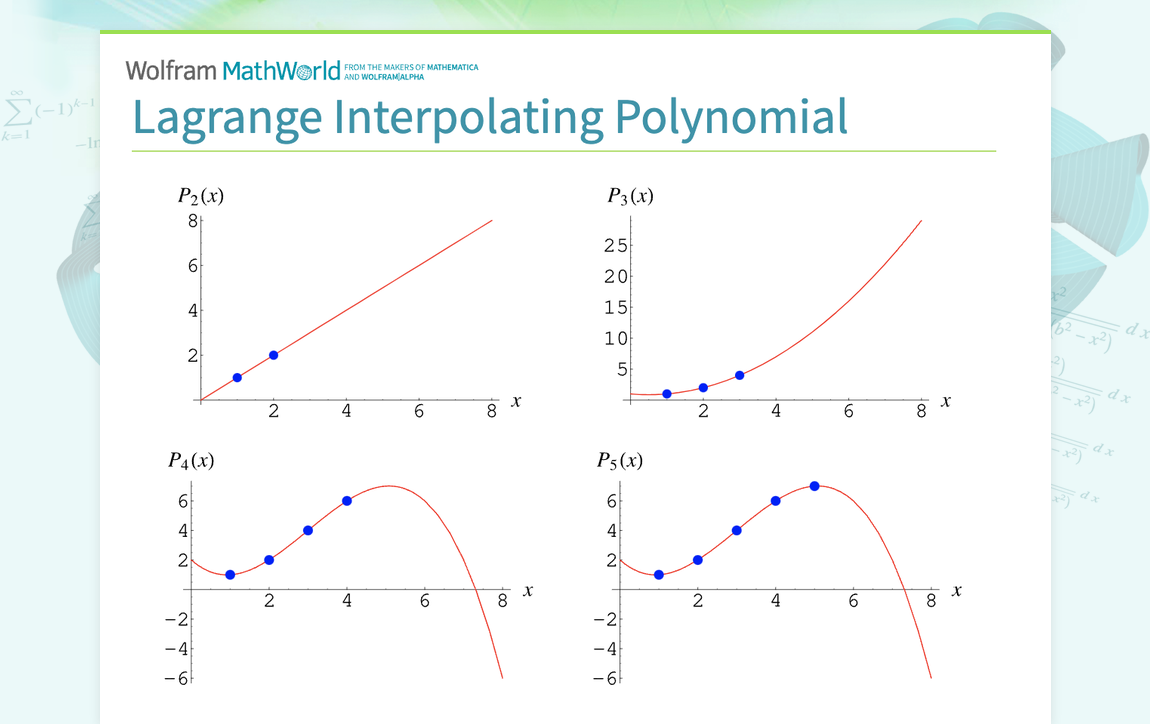
The Lagrange interpolating polynomial is the polynomial P(x) of degree <=(n-1) that passes through the n points (x_1,y_1=f(x_1)), (x_2,y_2=f(x_2)), ..., (x_n,y_n=f(x_n)), and is given by P(x)=sum_(j=1)^nP_j(x), (1) where P_j(x)=y_jproduct_(k=1; k!=j)^n(x-x_k)/(x_j-x_k). (2) Written explicitly, P(x) = (3) The formula was first publishe...
This way you don't have to bash a system
although if you use finite diferences, the system isn't awful tbf
lunar harbor
slender lynx
Oh I may have done something like this, where I thought about it in terms of sta...
Oh also more general remark: The sum of i^k from i=1 to n is a polynomial of degree (k+1)
ok I'm done yapping for now
slender lynx
I'm extremely new to this type of algebra, like i had to google what the summation notation was when my friend sent it to me 😭
lunar harbor
F
lunar harbor
oh it's already closed
there's just a lag
between when you use the command
and it actually closing
slender lynx
Darn
lunar harbor
as you can tell, I really took advantage of that gap lol
slender lynx
I guess that worked out
devout snowBOT
Available help channel!
Send your question here to claim the channel.
Remember:
• Ask your math question in a clear, concise manner.
• Show your work, and if possible, explain where you are stuck.
• After 15 minutes, feel free to ping <@&286206848099549185>.
• Type the command .close to free the channel when you're done.
• Be polite and have a nice day!
Read #❓how-to-get-help for further information on how to ask a good question, and about conduct in the question channels.
 limpid epoch
If the tan of angle x is 22/5 and the triangle was dilated to be two times as big as the original, what would be the value of the tan of x for the dilated triangle?
Would I double the 22/5 to make 44/10, or would it just simplify back to 22/5 anyways and there's no point?
devout snowBOT
limpid epoch
If the tan of angle x is 22/5 and the triangle was dilated to be two times as bi...
 runic prawn
yes
trail eagle
Scaling a triangle doesn’t change its angles
runic prawn
limpid epoch
If the tan of angle x is 22/5 and the triangle was dilated to be two times as bi...
correct
limpid epoch
okay, I figured. Thank you so much!
limpid epoch
tan of x, but the triangle is dilated by a scale factor of 2
runic prawn
trig functions are by defintion scale invariant
runic prawn
limpid epoch
tan of x, but the triangle is dilated by a scale factor of 2
yes ik
tan(x) just takes x as input
no side lengths
so yes it remains the same
limpid epoch
Oh, I see what you mean
runic prawn
yes
devout snowBOT
Channel closed
Closed by @limpid epoch
Use .reopen if this was a mistake.
devout snowBOT
Available help channel!
Send your question here to claim the channel.
Remember:
• Ask your math question in a clear, concise manner.
• Show your work, and if possible, explain where you are stuck.
• After 15 minutes, feel free to ping <@&286206848099549185>.
• Type the command .close to free the channel when you're done.
• Be polite and have a nice day!
Read #❓how-to-get-help for further information on how to ask a good question, and about conduct in the question channels.
 chilly pivot
 devout snowBOT
chilly pivot
chilly pivot
devout snowBOT
chilly pivot
chilly pivot
i'm unsure how to do this without numbers. i can't find the derivative
trail eagle
Well you can just compare the tangent lines at the points they are asking, no need for derivatives
Whichever one is steeper is going faster
chilly pivot
trail eagle
Well you can just compare the tangent lines at the points they are asking, no ne...
how do i compare them
how do i know the tangent line
like d/dx? i assume pink is x2 so derivative is x?
trail eagle
Maybe use a ruler and place it on the line at those points to see it better?
chilly pivot
pretty sure that's not what we are supposed to do
trail eagle
Hmm well I’m pretty sure it is
chilly pivot
how do i draw the tangent line?
trail eagle
It’s just about interpreting derivatives graphically
trail eagle
trail eagle
Maybe use a ruler and place it on the line at those points to see it better?
.
chilly pivot
ahh, but i'm still unsure how to draw it with the ruler, even with ur explanation
how do i know where to trace
devout snowBOT
@chilly pivot Has your question been resolved?
devout snowBOT
@chilly pivot Has your question been resolved?
devout snowBOT
Channel closed
Closed due to timeout
Use .reopen if this was a mistake.
Available help channel!
Send your question here to claim the channel.
Remember:
• Ask your math question in a clear, concise manner.
• Show your work, and if possible, explain where you are stuck.
• After 15 minutes, feel free to ping <@&286206848099549185>.
• Type the command .close to free the channel when you're done.
• Be polite and have a nice day!
Read #❓how-to-get-help for further information on how to ask a good question, and about conduct in the question channels.
 mellow willow
If I have the equation W(x)=-x(x-32) does the -x mean I’m reflecting over the y axis or x axis? I know if I had g(x)=-f(x+3) I would reflect over the x axis. But if I had g(x)=f(-x+3) I would reflect over the y
devout snowBOT
mellow willow
If I have the equation W(x)=-x(x-32) does the -x mean I’m reflecting over the y...
@mellow willow Has your question been resolved?
 haughty monolith
y axis
y = x ---> y = -x (graph the difference)
More generally, when you put the negative sign in front of f(x), you're affecting the y value, so you're reflecting over the x axis. If you put the negative sign in front of x, you're felecting the x value, so you're reflecting over the y axis.
mellow willow
haughty monolith
y = x ---> y = -x (graph the difference)
Even tho it’s outside the function?
cinder nova
it depends what the original function is
it's a reflection over the y axis of x(-x-32)
and it's a reflection over the x axis of x(x-32)
mellow willow
I’m trying to do horizontal compressions and stretched. This one is a horizontal compression and those are the two points, we are going from f to g. I know in the equation k must equal somthing greater than 1. Is mine correct?
 devout snowBOT
@mellow willow Has your question been resolved?
mellow willow
How do I do this table? Would the final row be the opppsite values of the h(x) row or the c row

 upper schooner
,rccw
woven radishBOT
 mellow willow
I desperately need help I am so confused. Why would B be affected by A vertical stretch or compress factor ?
 devout snowBOT
@mellow willow Has your question been resolved?
 wise scarab
mellow willow
I desperately need help I am so confused. Why would B be affected by A vertical ...
wise scarab
mellow willow
I desperately need help I am so confused. Why would B be affected by A vertical ...
I'm sleeping soon, so I may not be able to give you an answer, but it might be helpful if you try to word it a little more clearly (e.g. exactly which equation/sentence are you confused about? what about it is confusing/hard to understand)
a lot of less esoteric questions in this server often remain unanswered simply because it's quite hard to understand what the author is asking
devout snowBOT
Channel closed
Closed due to timeout
Use .reopen if this was a mistake.
Available help channel!
Send your question here to claim the channel.
Remember:
• Ask your math question in a clear, concise manner.
• Show your work, and if possible, explain where you are stuck.
• After 15 minutes, feel free to ping <@&286206848099549185>.
• Type the command .close to free the channel when you're done.
• Be polite and have a nice day!
Read #❓how-to-get-help for further information on how to ask a good question, and about conduct in the question channels.
 snow verge
Hello, I have a question about a statistic thing.
devout snowBOT
snow verge
Hello, I have a question about a statistic thing.
snow verge
I'm doing an experiment, where I'm collecting n samples from a (presumably normal) distribution and taking their average x
then doing the same, collecting n samples from another presumably normal distribution, and taking their average y
My prior belief is that like x and y are around 60 apart and that the two distributions have the same variance (sample variance after 5 samples from x is around 100)
How big should n be so that I'm certain I can distinguish mean(X) and mean(Y) if they really have different means?
..
My thoughts is that, at the end, I'm gonna do a two sample t-test.
But like, its expensive to collect more samples
So I want to know when I can stop collecting samples.
Like if i've collected 100 samples of x and the mean is 140 and the sample variance is 40. The MLE for the mean will have small variance so should be ble to distinguish small variations in the means of X and Y
devout snowBOT
@snow verge Has your question been resolved?
devout snowBOT
Channel closed
Closed due to timeout
Use .reopen if this was a mistake.
Available help channel!
Send your question here to claim the channel.
Remember:
• Ask your math question in a clear, concise manner.
• Show your work, and if possible, explain where you are stuck.
• After 15 minutes, feel free to ping <@&286206848099549185>.
• Type the command .close to free the channel when you're done.
• Be polite and have a nice day!
Read #❓how-to-get-help for further information on how to ask a good question, and about conduct in the question channels.
 timid schooner
hello. does log(A-B) have a direct formula?
devout snowBOT
timid schooner
hello. does log(A-B) have a direct formula?
timid schooner
i know that logA-logB can be written as log(A/B) but i don't think that's the case for log(A-B)?
is it not possible to just- write it as
log(A-B) = logA-logB??
 final osprey
no
timid schooner
may i please know why?
final osprey
you should input some value of A and B and check for yourself using a calculator
timid schooner
okay... what if the question i have to solve has 'x' for an exponent instead...?
remote sun
timid schooner
may i please know why?
yk e^x=c=>logc=x
pseudo basin
timid schooner
is it not possible to just- write it as
log(A-B) = logA-logB??
very much no
log(2-1) is not at all equal to log(2)-log(1) for instance
timid schooner
i see
pseudo basin
timid schooner
okay... what if the question i have to solve has 'x' for an exponent instead...?
can you show what question you're looking at
 timid schooner
pseudo basin
log(2-1) is not at all equal to log(2)-log(1) for instance
timid schooner
pseudo basin
log(2-1) is not at all equal to log(2)-log(1) for instance
wait in this case is the answer not the same?
oh sorry nvm
 abstract zodiac
timid schooner
<@183668144404037632> here you go
abstract zodiac
timid schooner
<@183668144404037632> here you go
Take the lcm between e^x and e^-x
pseudo basin
timid schooner
<@183668144404037632> here you go
taking logs right away won't help here
i would first multiply by 2 and in fact also by e^x on both sides
timid schooner
pseudo basin
i would first multiply by 2 and in fact also by e^x on both sides
right, so e^x-e^-x = 2
and i should multiply that with e^x on both sides??
pseudo basin
yes
pseudo basin
timid schooner
(e^x)^2 - (e^x)(e^-x) = 2e^x?
yes but now simplify that
timid schooner
i'm a little clueless as to how to proceed; is there a formula i should be applying on the left hand side?
or is this where i use log?
abstract zodiac
timid schooner
(e^x)^2 - (e^x)(e^-x) = 2e^x?
Second terms cancels to become 1
timid schooner
i don't get it?
abstract zodiac
(e^-x) is basically 1/e^x
abstract zodiac
Do you see a potential for the formula (a - b)^2
timid schooner
yes?
abstract zodiac
We need to do that
timid schooner
okay
abstract zodiac
add -2e^x and +2 on both sides
abstract zodiac
timid schooner
(e^x)^2-2e^x-1=0
Missing +2
It’s not the right formula yet you need +1 not -1
timid schooner
why do we have to add the +2
timid schooner
abstract zodiac
It’s not the right formula yet you need +1 not -1
noted
abstract zodiac
The formula for (a-b)^2 is a^2 - 2ab + b^2
Now you’ll get (e^x - 1)^2 = 2
Square root both sides
timid schooner
(e^x-1) = square root of 2
timid schooner
okay
timid schooner
abstract zodiac
e^x = sqrt(2) + 1
question; is it not possible for
(e^x - 1) = +sqrt(2) and -sqrt(2)?
oh nvm it seems log is undefined for negative numbers (i did not know that)
anyways, i have my answer now. thanks!! ^^
.close
abstract zodiac
timid schooner
question; is it not possible for
(e^x - 1) = +sqrt(2) and -sqrt(2)?
Yea
devout snowBOT
Channel closed
Closed by @timid schooner
Use .reopen if this was a mistake.
Available help channel!
Send your question here to claim the channel.
Remember:
• Ask your math question in a clear, concise manner.
• Show your work, and if possible, explain where you are stuck.
• After 15 minutes, feel free to ping <@&286206848099549185>.
• Type the command .close to free the channel when you're done.
• Be polite and have a nice day!
Read #❓how-to-get-help for further information on how to ask a good question, and about conduct in the question channels.
 subtle marsh
please help me solve this :
 devout snowBOT
subtle marsh
please help me solve this :
devout snowBOT
subtle marsh
please help me solve this :
@subtle marsh Has your question been resolved?
subtle marsh
how to find |b|.|c| |a|.|b| and |a|.|c|

 subtle marsh
after that?
 soft umbra
State the length of a and c vectors with alpha relatively
Plug into the last given info, that’s all
You’re just a step afar to the solution
You’ve conquered the difficult part, which is recognizing a, b, and c vectors are perpendicular to each others
@subtle marsh
subtle marsh
thanks
soft umbra
Don’t forget to close the channel if your doubts have been cleared
subtle marsh
.close
devout snowBOT
Channel closed
Closed by @subtle marsh
Use .reopen if this was a mistake.
devout snowBOT
Available help channel!
Send your question here to claim the channel.
Remember:
• Ask your math question in a clear, concise manner.
• Show your work, and if possible, explain where you are stuck.
• After 15 minutes, feel free to ping <@&286206848099549185>.
• Type the command .close to free the channel when you're done.
• Be polite and have a nice day!
Read #❓how-to-get-help for further information on how to ask a good question, and about conduct in the question channels.
 restive river
<@&286206848099549185> help
 devout snowBOT
restive river
<@&286206848099549185> help
devout snowBOT
restive river
<@&286206848099549185> help
Please don't occupy multiple help channels.
 fossil flume
Hello guys I need help
 valid vector
restive river
<@&286206848099549185> help
valid vector
restive river
<@&286206848099549185> help
Okay, you want to try and notice a pattern again?
 dull heron
oh sry
valid vector
fossil flume
Hello guys I need help
!occupied
devout snowBOT
fossil flume
Hello guys I need help
Someone else is already using this help channel. If you need help with a question, please open your own help channel/thread (see #❓how-to-get-help for instructions).
restive river
valid vector
Okay, you want to try and notice a pattern again?
yes
valid vector
!occupied