#help-27
1 messages · Page 289 of 1
 alpine python
 lusty sapphire
 grand ledge
we also need to prove it this part using geomtry then?
grand ledge
we also need to prove it this part using geomtry then?
First, is sin(x)<x (for x>0) something you can use right away, or are you concerned you need to prove it first?
grand ledge
We never learned it so I think I might need to prove it
lusty sapphire
okay sure. I have that all ready to show too, thankfully
grand ledge
btw all of this question is just 1 of 4 parts in one of 7 questions too. so they might not expect something this good. but im too invested 🙂
lusty sapphire
grand ledge
btw all of this question is just 1 of 4 parts in one of 7 questions too. so they...
sign of a true mathematician 
It's also why I am here, and put so much work into it
grand ledge
Im learning aeronautics engineering 😮
lusty sapphire
Okay, let us show that $\sin\theta<\theta$ for $0<\theta<\frac{\theta}2$
 woven radishBOT
SWR
 lusty sapphire
grand ledge
Im learning aeronautics engineering 😮
lusty sapphire
grand ledge
Im learning aeronautics engineering 😮
yeah you definitely don't need all of this work then
but whatevs, we're here
Here's our geometric setup
 alpine python
you don't actually need to find the right and left limits to argue that the limit doesn't exist
but yeah, since we're here
might as well see it through
lusty sapphire
alpine python
you don't actually need to find the right and left limits to argue that the limi...
We can look at this after then, I'd be interested to see your idea
grand ledge
lusty sapphire
We can look at this after then, I'd be interested to see your idea
me too
grand ledge
lusty sapphire
Here's our geometric setup
ok
lusty sapphire
lusty sapphire
Here's our geometric setup
We want to show that $\overline{CD}<\frown{CB}$. Any idea how we can do this?
woven radishBOT
SWR
 lusty sapphire

alpine python
what was it they say about the shortest distance between two points?
is that an axiom?  probably
alpine python
yeah
grand ledge
and $\sin{\theta}^2 + \overline{DB}^2 <= \overline{CB}$
woven radishBOT
Shachar
 grand ledge
right its a right triangle
so it's equalcs CB
and CB smalled than CB_arc
than sin theta for sure smaller than CB_arc which is theta
wow geometry is beatiful
lusty sapphire
yup
there you go
That was a lot of headache
but hey, we did it
I think you can do the rest now
It took a lot of working backwards to get to this little geometry problem
alpine python
u can use triangle inequality to say CD <= DB

 lusty sapphire
You $\textit{will}$ need to prove $\overline{CD}<\overline{CB}$, but I do not think you can do that with triangle inequality.
woven radishBOT
SWR
 alpine python
you're right
grand ledge
well damn @lusty sapphire thank you. no way it is what they intended for me to try and do, but it's beatiful
alpine python
oh sin = sqrt(sin^2) < sqrt(sin^2 + DB^2) = CB
alpine python
i'm surprised you're still up for it
grand ledge
I can't not hear it now
lusty sapphire
alpine python
oh sin = sqrt(sin^2) < sqrt(sin^2 + DB^2) = CB
Proving that $A<B$ implies $\sqrt{A}<\sqrt{B}$ is actually not so trivial
woven radishBOT
SWR

 we're going deep
alpine python
grand ledge
I can't not hear it now
we're going deep
alpine python
grand ledge
I can't not hear it now
uh it starts in a similar way
but forget the upper bound
for $x\in (0,\sqrt{\pi}),\ \sin (x^2) \geq 0$ so $\frac{\sin (x^2)}{x}\geq 0$ and $\left\lfloor \frac{\sin (x^2)}{x}\right\rfloor \geq 0$
wait i'm dumb
grand ledge
x <= pi
woven radishBOT
Axe
 grand ledge
ok
lusty sapphire
ohhh. I see it 
alpine python
for $x\in (-\sqrt{\pi},0),\ \sin(x^2) > 0$ so $\frac{\sin (x^2)}{x} < 0$ and $\left\lfloor \frac{\sin (x^2)}{x}\right\rfloor \leq -1$
woven radishBOT
Axe
 grand ledge
what this gives you?
alpine python
this gives you:
$lim_{x\to 0} \left\lfloor \frac{\sin (x^2)}{x}\right\rfloor$ does not exist
woven radishBOT
Axe
 alpine python
um
intuitively, if the right limit is to exist, it must be >= 0, and if the left limit is to exist, it must be <= -1
lusty sapphire
grand ledge
based on what?
This was something I was thinking about too, @alpine python. I get the logic of what you are trying to say right now. I think the nuance of what needs to be said next is that, if the right limit were to exist, then it must be ≥0. And if the right limit existed, then it must be ≤-1.
lusty sapphire
alpine python
intuitively, if the right limit is to exist, it must be >= 0, and if the left li...
ah yes. Exactly
alpine python
yeah
lusty sapphire
Proving that, though, might be hard
alpine python
i guess u do need delta-eps after all for this method
grand ledge
so can't I just take the limit 0+ of the first inequality
 grand ledge
and the limit 0- of the second inequality
lusty sapphire
We do not know yet if the limit exists
grand ledge
intuitivly
it ez
tho the question itself is ez intuitivlly
only hard to prove formally
lusty sapphire
Basically, we have $f(x)\ge0$ for $x\ge 0$, and $f(x)\le-1$ for $x<0$. Taking any limits here is too broad.
woven radishBOT
SWR

 vagrant lichen
the way you guys talk is so fun
grand ledge
vagrant lichen
the way you guys talk is so fun
wym
vagrant lichen
idk you js sound so smart rn
grand ledge
they are smart
vagrant lichen
ikr
 devout snowBOT
@grand ledge Has your question been resolved?
lusty sapphire
@grand ledge @alpine python
 devout snowBOT
Channel closed
Closed due to timeout
Use .reopen if this was a mistake.
lusty sapphire
.bye bye everybody. It was fun
devout snowBOT
 Available help channel!
Send your question here to claim the channel.
Remember:
• Ask your math question in a clear, concise manner.
• Show your work, and if possible, explain where you are stuck.
• After 15 minutes, feel free to ping <@&286206848099549185>.
• Type the command .close to free the channel when you're done.
• Be polite and have a nice day!
Read #❓how-to-get-help for further information on how to ask a good question, and about conduct in the question channels.
 spring oasis
How many three-digit numbers are divisible by $13$?
woven radishBOT
938c2cc0dcc05f2b68c4287040cfcf71

 fast mist
how many 3 digit numbers are divisible by 2
spring oasis
,calc 999/2
woven radishBOT
Result:
499.5
 solid osprey
spring oasis
How many three-digit numbers are divisible by $13$?
solid osprey
spring oasis
How many three-digit numbers are divisible by $13$?
how many numbers less than 1000 are divisible by 13?
spring oasis
fast mist
how many 3 digit numbers are divisible by 2
like 499 I guess
 wicked turtle
2 doesn't have three digits
fast mist
what is a 3 digit number
spring oasis
100 to 999
fast mist
so why 999 / 2
spring oasis
idk, I had a brain fart
solid osprey
solid osprey
how many numbers less than 1000 are divisible by 13?
the subtract by the number of numbers less than 100 that are divisible by 13
spring oasis
,calc 1000/13
woven radishBOT
Result:
76.923076923077
,calc 76*13
woven radishBOT
Result:
988
,calc 100/13
woven radishBOT
Result:
7.6923076923077
,calc 7*13
woven radishBOT
Result:
91
69
fast mist
🎉
woven radishBOT
Result:
69
another way (maybe if you have a calculator): the first multiple of 13 is 104 = 13 * 8. the last is 13 * 76 = 988. so there are 76 - 8 + 1
spring oasis
fast mist
another way (maybe if you have a calculator): the first multiple of 13 is 104 = ...
why +1
fast mist
how many numbers integers are there between 1 and 10 (inclusive)
spring oasis
10-1+1
fast mist
why +1
fast mist
right
so that's why +1
i want to include every number between 8 and 76, endpoints included
devout snowBOT
Channel closed
Closed by @spring oasis
Use .reopen if this was a mistake.
devout snowBOT
Available help channel!
Send your question here to claim the channel.
Remember:
• Ask your math question in a clear, concise manner.
• Show your work, and if possible, explain where you are stuck.
• After 15 minutes, feel free to ping <@&286206848099549185>.
• Type the command .close to free the channel when you're done.
• Be polite and have a nice day!
Read #❓how-to-get-help for further information on how to ask a good question, and about conduct in the question channels.
 fair juniper
Given two numbers $x$ and $m$ where $gcd(x,m)=1$, let $n$ be the smallest positive integer such that $x^n \equiv 1 (\mod m)$. Show that $n | \phi(m)$.
devout snowBOT
fair juniper
Given two numbers $x$ and $m$ where $gcd(x,m)=1$, let $n$ be the smallest posit...
woven radishBOT
LocalLunatic
 fair juniper
I know by FLT, x^phi(m) is congruent to 1 mod m, but i kinda forgot how to do the rest
yes, n is the order
 lament kraken
I seem to remember that it was done by contradiction
fair juniper
oh i think i get it
lament kraken
Yay i actually forgot it lol
fair juniper
if x != m, then n>1
lament kraken
Ok
fair juniper
Assume by contradiction n does not divide phi(m)
lament kraken
Ok
fair juniper
then x^nk = 1 for all k
fair juniper
im tryna work it out too
lament kraken
(i can check the proof ig)
lament kraken
Uh huh
lament kraken
Yes
fair juniper
then we get x^nq = 1 but also x^nq+r = 1
lament kraken
Ah
lament kraken
Yes
fair juniper
heh nice
lament kraken
Nice
devout snowBOT
Channel closed
Closed by @fair juniper
Use .reopen if this was a mistake.
devout snowBOT
Available help channel!
Send your question here to claim the channel.
Remember:
• Ask your math question in a clear, concise manner.
• Show your work, and if possible, explain where you are stuck.
• After 15 minutes, feel free to ping <@&286206848099549185>.
• Type the command .close to free the channel when you're done.
• Be polite and have a nice day!
Read #❓how-to-get-help for further information on how to ask a good question, and about conduct in the question channels.
 heavy monolith
 devout snowBOT
heavy monolith
heavy monolith
devout snowBOT
heavy monolith
heavy monolith

I got up to here
But the answer is wrong apparently
Can someone point out where I messed up?
fair juniper
"their centres form a square"
heavy monolith
So would it be 40-the side of the square?
fair juniper
you start with 4 spheres on the table placed in a square formation
then you get a fifth one and put it on top
devout snowBOT
@heavy monolith Has your question been resolved?
 eager gyro
heavy monolith
So would it be 40-the side of the square?
eager gyro
heavy monolith
So would it be 40-the side of the square?
Their centers form a square, square side will be 2times radius so 20cm
If you still have not solved yet i would like to solve if and drop pic😇
heavy monolith
eager gyro
If you still have not solved yet i would like to solve if and drop pic😇
You can send
devout snowBOT
Channel closed
Closed due to timeout
Use .reopen if this was a mistake.
heavy monolith
I solved it though
devout snowBOT
Available help channel!
Send your question here to claim the channel.
Remember:
• Ask your math question in a clear, concise manner.
• Show your work, and if possible, explain where you are stuck.
• After 15 minutes, feel free to ping <@&286206848099549185>.
• Type the command .close to free the channel when you're done.
• Be polite and have a nice day!
Read #❓how-to-get-help for further information on how to ask a good question, and about conduct in the question channels.
heavy monolith
But I’m happy to see your diagram if you still want to send it
heavy monolith
eager gyro
If you still have not solved yet i would like to solve if and drop pic😇
Yo
eager gyro
I solved just now too lol
heavy monolith
The answer is 34.14
eager gyro
Its easy tbh
heavy monolith
Ye
I just didn’t plan it accordingly
I always miss something when reading the question
Js gotta do more of them
 tribal vessel
Proof that 1+1=2
 eager gyro
 eager gyro
heavy monolith
Yo Sandro can you help me with this question
eager gyro
heavy monolith
Yo Sandro can you help me with this question
Will try ofc
Idk hollow inverted cone
Idk english words
heavy monolith
It’s like a cone upside down without the base
eager gyro
Oh ok

This? Well it is not supposed to be touching base of cone
Oh wait
With this numbers it will be something like this
Ice cream lol

Is answer 1?

@heavy monolith Ig you already did it yourself but still (sorry for ping)
devout snowBOT
@heavy monolith Has your question been resolved?
devout snowBOT
Channel closed
Closed due to timeout
Use .reopen if this was a mistake.
Available help channel!
Send your question here to claim the channel.
Remember:
• Ask your math question in a clear, concise manner.
• Show your work, and if possible, explain where you are stuck.
• After 15 minutes, feel free to ping <@&286206848099549185>.
• Type the command .close to free the channel when you're done.
• Be polite and have a nice day!
Read #❓how-to-get-help for further information on how to ask a good question, and about conduct in the question channels.
 native stone
good morning guys, i need help with this exercise
 devout snowBOT
native stone
good morning guys, i need help with this exercise
native stone
devout snowBOT
native stone
good morning guys, i need help with this exercise
native stone
the translation in english is just: ,,find out F(x),,
 ancient sluice
Ok
native stone
looks like a very easy exercise but i cant figure out what to do
native stone
ancient sluice
Ok
oh hi xor
native stone
ok
ancient sluice
Else you can just consider tanx = z and write an extra step
native stone
so tg'x time 1/cos^2x
so actually its (tan'x)^2
so the derivative of tanx to the second power
ancient sluice
native stone
so actually its (tan'x)^2
Huh ?
native stone
we dont use sec around here, but sec^2x = derivative of tan x
if im not mistaken
and we use the derivative not sec
native stone
yep yep
ancient sluice
native stone
yep yep
Yeayyy !
native stone
ancient sluice
int sec²x = tgx and int tan²xsec²x = tg³x/3
the second one i dont know
but anyway
ancient sluice
native stone
the second one i dont know
Nah
ancient sluice
native stone
but anyway
Use a sub , tanx = z
sec²x = dz
So we get int z²
That gives z³/3
native stone
ah okk
ancient sluice
You understand now ?
native stone
got any solution thats without sec tho?
ancient sluice
native stone
it doesnt seem that complicated
Yeah tgx + tg³x/3 is the soln
native stone
interesting
lets try to figure out a way to write the fraction
so that we get something like what you got
but without the need of sec
if you want ofc, ur solution is correct as well, but i just wanted something different
oh wait
i can just write the nominator as sin^2 x + cos^2 x and it comes out easily
sorry for the bother
i got it
.close
devout snowBOT
Channel closed
Closed by @native stone
Use .reopen if this was a mistake.
devout snowBOT
Available help channel!
Send your question here to claim the channel.
Remember:
• Ask your math question in a clear, concise manner.
• Show your work, and if possible, explain where you are stuck.
• After 15 minutes, feel free to ping <@&286206848099549185>.
• Type the command .close to free the channel when you're done.
• Be polite and have a nice day!
Read #❓how-to-get-help for further information on how to ask a good question, and about conduct in the question channels.
native stone
 devout snowBOT
native stone
native stone
devout snowBOT
native stone
native stone
i thought that this is just an exercise with a usual cos alfa substitution
but it doesnt work here
any other clues on how to solve it?
fair juniper
you can use a u sub
 grand siren
well it's multiple choice so you could just differentiate all of the answers and see which one matches...
fair juniper
lmao yeah
grand siren
also these don't look like particularly fun expressions to differentiate so it might take a while
grand siren
but anyway yeah there is a useful u sub here
native stone
so what the substitution?
grand siren
because then the square root just becomes sqrt(u) which is a lot nicer
native stone

i hope you can read my writing
but as you can see
while it does look close to one of the multiple choices, its not exact them
native stone
grand siren
because then the square root just becomes sqrt(u) which is a lot nicer
are you still here?
native stone
oh yea you are right
grand siren
and the other thing is that you need to replace the u with x^2+1, because you want an answer in terms of x
native stone
yea thats fine
grand siren
also you need a +C
after that i think it should be identical to one of the answers
grand siren
oh fair enough
native stone
grand siren
also you need a +C
after that i think it should be identical to one of the answe...
yea, im just lazy
thanks a lot tho
.close
devout snowBOT
Channel closed
Closed by @native stone
Use .reopen if this was a mistake.
devout snowBOT
Available help channel!
Send your question here to claim the channel.
Remember:
• Ask your math question in a clear, concise manner.
• Show your work, and if possible, explain where you are stuck.
• After 15 minutes, feel free to ping <@&286206848099549185>.
• Type the command .close to free the channel when you're done.
• Be polite and have a nice day!
Read #❓how-to-get-help for further information on how to ask a good question, and about conduct in the question channels.
 lost laurel
Let $0\leq x_1 \leq y_1$.Define $x_{n+1} = \sqrt{x_n y_n}$ and $y_{n+1} = \frac{x_n+y_n}{2}$. Show that lim $x_n$ and $y_n$ both exist and are equal.
devout snowBOT
lost laurel
Let $0\leq x_1 \leq y_1$.Define $x_{n+1} = \sqrt{x_n y_n}$ and $y_{n+1} = \frac{...
woven radishBOT
math_rocks
 lost laurel
so here can I just assume x_1 and y_1 to be arbitrary constants
fair juniper
ooh the AGM
lament kraken
Intresting ngl
lost laurel
yeah, it is. But also looks hard
$x_{n+1}= \sqrt{x_n(2y_{n+1}-x_n})$
would this help in any way
woven radishBOT
math_rocks
 woven radishBOT
math_rocks
 lost laurel
hmm, and $y_n \geq y_{n+1}$ makes sense too
woven radishBOT
math_rocks
 lost laurel
but how does that imply their limits must be equal
okay, so monotone convergence theorm
hmm
Let em think a bit more
thanks
.close
devout snowBOT
Channel closed
Closed by @lost laurel
Use .reopen if this was a mistake.
devout snowBOT
Available help channel!
Send your question here to claim the channel.
Remember:
• Ask your math question in a clear, concise manner.
• Show your work, and if possible, explain where you are stuck.
• After 15 minutes, feel free to ping <@&286206848099549185>.
• Type the command .close to free the channel when you're done.
• Be polite and have a nice day!
Read #❓how-to-get-help for further information on how to ask a good question, and about conduct in the question channels.
 fierce girder
Can anyone help me understand how to calculate the surface area of a sphere? I heard aristotle did it by realizing that a cylinder of base radius 'r' and the height '2r' can completely enclose a sphere of radius 'r' and the shadows of the sphere fall exactly on the cylinder so the surface area of the cylinder must equal the surface area of a sphere and thats how he found that it was 4πr².
I tried to find the volume of a cone, sphere by using integration and I was successful. But I have tried to compute the surface areas of sphere and cone by intergration but failed. I do not care about cones much but I wish to know how to compute the surface area of a sphere by using integration with one variable.
devout snowBOT
fierce girder
Can anyone help me understand how to calculate the surface area of a sphere? I h...
Please don't occupy multiple help channels.
fierce girder
<@&286206848099549185>
 crude wasp
<@&268886789983436800> this person seems to be spamming a few channels with russian that's unrelated? (can't speak russian but google translate says it's spam)
(see hlounge)
 merry patio
fierce girder
Can anyone help me understand how to calculate the surface area of a sphere? I h...
merry patio
fierce girder
Can anyone help me understand how to calculate the surface area of a sphere? I h...
first of all we want to know how to draw a circle in 2d
and half of it should be enough so we can rotate it around either the x or y axis
merry patio
merry patio
first of all we want to know how to draw a circle in 2d
what is the equation for something that looks like a circle?
fierce girder
$\sqrt{1-x^2}$
woven radishBOT
bagelguy3
 fierce girder
@merry patio
merry patio
we can make it generic if you want
and say r^2 instead of 1
wait hold on lemme check if i rember correctly how to do it
woven radishBOT
bagelguy3
 fierce girder
$\f(x) = sqrt{r^2-x^2}$
woven radishBOT
bagelguy3
Compile Error! Click the  reaction for more information.
(You may edit your message to recompile.)
 fierce girder
$\ff(x) = sqrt{r^2-x^2}$
woven radishBOT
bagelguy3
Compile Error! Click the reaction for more information.
(You may edit your message to recompile.)
 fierce girder
${f(x) = sqrt1-x^2}$
woven radishBOT
bagelguy3
$\{f(x) = sqrt1-x^2}$
```Compilation error:```! Extra }, or forgotten $.
l.49 $\{f(x) = sqrt1-x^2}
$
I've deleted a group-closing symbol because it seems to be
spurious, as in `$x}$'. But perhaps the } is legitimate and
you forgot something else, as in `\hbox{$x}'. In such cases
the way to recover is to insert both the forgotten and the
deleted material, e.g., by typing `I$}'.
Preview: Tightpage -1310720 -1310720 1310720 1310720
[1{/usr/local/texlive/2023/texmf-var/fonts/map/pdftex/updmap/pdftex.map}{/usr/l``` fierce girder
$$f(x) = sqrt{r^2-x^2}$
woven radishBOT
bagelguy3
 fierce girder
$f(x) = sqrt{r^2-x^2}$
woven radishBOT
bagelguy3
 fierce girder
$\sqrt(r^2-x^2)$
woven radishBOT
bagelguy3
 fierce girder
$f(x) = /sqrt{r^2 - x^2}$
woven radishBOT
bagelguy3
 fierce girder
wtf
devout snowBOT
@fierce girder Has your question been resolved?
woven radishBOT


 merry patio
u there?
devout snowBOT
Channel closed
Closed due to timeout
Use .reopen if this was a mistake.
devout snowBOT
✅
 merry patio
or circumferences
fierce girder
dam
merry patio
so basically we know the radius is just the function
root of r^2-x^2
but we need to know this length
fierce girder
I broke them into two hemisphere and decided to calculate just the top hemisphere and i tried doing from bottom to the top
merry patio
merry patio
 fierce girder
yes\
merry patio
that length if we zoom in
fierce girder
is that dθ
 fierce girder
right
merry patio
and to find it we use pythagora
fierce girder
so thats dl?
fierce girder
sqrt(1 + f'(x)^2)
merry patio
merry patio
so dL = root( dy^2 + dx^2 )
we can group the dx^2 and put it outside the root
and yes
merry patio
we get root(1+f') dx
merry patio
merry patio
we get root(1+f') dx
so our formula will be the y length and the dL but rewriting it in terms of x
we need to apply the rotation
fierce girder
$/∫ sqrt{1 + f'(x)^2} dx$
woven radishBOT
bagelguy3
Compile Error! Click the reaction for more information.
(You may edit your message to recompile.)
 merry patio
we need to apply the rotation
merry patio
merry patio
we need to apply the rotation
well its not even really a rotation
its just 2piy dL
integrate it
fierce girder
merry patio
we get root(1+f') dx
dont we get the square?
merry patio
square? there are no suqares
fierce girder
i meant
merry patio
merry patio
you are just adding up every circumference
fierce girder
(f')²
merry patio
ih yes
fierce girder
how can we get f'
fierce girder
yes
merry patio
since our y = root(r^2 - x^2)
fierce girder
since we are using a² + b² = c²
merry patio
merry patio
since our y = root(r^2 - x^2)
you can derive this to get dy/dx
fierce girder
dy = y' dx
merry patio
what is your doubt
fierce girder
how to calculate the surface area of a sphere with integration
not the circumference
merry patio
from the left to the right point
merry patio
ye
fierce girder
cut it into the southern hemisphere and northern hemisphere
ignore the south one
just delete
imagine the north
merry patio
ye
fierce girder
now the circum ference from the equator (middle line) to the north pole (top) would be rθ where θ = π/2 so it would be πr/2
now, rotating that would give us πr/2 * 2π = π²r.
multiplying that by 2 to also include the area of the southern hemisphere gives us 2π²r
but we know that the answer is 4πr²
so where did I go wrong
fierce girder
merry patio
with an integral
that integral is the key and you gave me everything aside the integral
merry patio
fierce girder
now the circum ference from the equator (middle line) to the north pole (top) wo...
not sure what you did there circumference from equator to north pole?
merry patio
fierce girder
that integral is the key and you gave me everything aside the integral
yeah you integrate everything at the end, same thing as summing all the circumferences
merry patio
 fierce girder
could u be more elaborate
merry patio
we have this image
fierce girder
yes
merry patio
we want to find the generic area of one circumference
and then add them all up together
from -r to r
or you can do from 0 to r and double it
same thing
we know the circumference is 2pir
problem is we also have that dL
which we found previously
merry patio
merry patio
and basically you integrate this now
we know that our "radius"
is jsut our y of the equation
its our "height"
from the x axis
we can also find dy/dx which is just the derivative
from there you just integrate
 merry patio
which is our radius
fierce girder
2 ∫(0,r) f(x) * sqrt( 1 + f'(x)²) dx
fierce girder
so
fierce girder
∫(-r,r) y dl
fierce girder
right so
merry patio
we are just adding all the circumferences up
we know the circumference is just 2pi * y * dL
fierce girder
4π ∫(0,r) y dl
merry patio
yes
exactly
if you start solving it
you will get to the right answer
our y is sqrt(r^2 - x^2)
then you can find dy/dx
and you just plug in everything
merry patio
np
fierce girder
I also have another question if u dont mind
fierce girder
I understand derivatives
but why does doing the opposite of derivative and pluging in the limits give you the area under the curve between those limits
basically why does integration work?
I understand the infinite summation and I understand the process of making it into infinite rectangles and finding the area and stuff
but I dont see any rectangles when I do integration
just find the anti derivatives and plug in the limits
merry patio
im honestly not quite sure about where the calculation comes from too tbh
i think i forgot it
fierce girder
u knew at a point?
merry patio
bai
devout snowBOT
Channel closed
Closed by @fierce girder
Use .reopen if this was a mistake.
devout snowBOT
Available help channel!
Send your question here to claim the channel.
Remember:
• Ask your math question in a clear, concise manner.
• Show your work, and if possible, explain where you are stuck.
• After 15 minutes, feel free to ping <@&286206848099549185>.
• Type the command .close to free the channel when you're done.
• Be polite and have a nice day!
Read #❓how-to-get-help for further information on how to ask a good question, and about conduct in the question channels.
 restive river
 devout snowBOT
restive river
restive river
devout snowBOT
restive river
restive river
Here, 3x is simplified to 3
I get why
because x^0 = 1
3x if x = 1 is 3.
but then why is there an x next to the 14 in the bottom row?
or even the 2 in the middle row with the 2x.
shouldn't it just be -7 * 2 for the 2nd row and -14 for the bottom row?
woven radishBOT

 solar goblet
refer to the first two rules
restive river
Ye I still can't make sense of it sorry
is it because the 3x has not exponent on the x and the -7x did?
ah because the power rule is only applicable when x != 0.
I think that's right, correct me if I'm wrong please.
.close
devout snowBOT
Channel closed
Closed by @upbeat hemlock
Use .reopen if this was a mistake.
solar goblet
the value of x doesn't matter
restive river
.reopen
devout snowBOT
✅
restive river

That's why the -7x^2 didn't have the x ommited though correct?
or what do you mean please?
solar goblet
the general rule of thumb when differentiating x^n is that you multiply the result with n, and then knock down one power in the exponent
i'd say the condition n != 0 is unnecessary here, it still holds for n = 0
the reason why the derivative of 3x is 3 is because 3x is actually 3x^1
so you would get $(3\times1)x^{1 - 1}$
woven radishBOT
 solar goblet
which is 3
merry patio
would recommend using definition of derivative for the first few times so you can see it in action
solar goblet
restive river
same deal with -7x^2
merry patio
its not good to apply without knowing why
solar goblet
or, just prove the power rule
merry patio
that is a little harder but yes
restive river
merry patio
would recommend using definition of derivative for the first few times so you ca...
I don't know what you mean exactly?
restive river
solar goblet
same deal with -7x^2
but then the exponent of 2 gets subtracted by 1 and the x because x^1
so shouldn't it just be -2
merry patio
you should revise what a derivative is before applying its rules
restive river
give me a sec just gonna process
merry patio
they are just shortcuts in the end to do this
solar goblet
merry patio
that is a little harder but yes
it just requires binomial theorem
merry patio
solar goblet
it just requires binomial theorem
ye
 olive snow
Also its h going to zero, little typo
merry patio
olive snow
Also its h going to zero, little typo
ye idk why the image uses a instead of h
solar goblet

olive snow
merry patio
ye idk why the image uses a instead of h
Both are useful
merry patio
other one should be c
olive snow
Depends situation
merry patio
well same thing
 devout snowBOT
Channel closed
Closed by @upbeat hemlock
Use .reopen if this was a mistake.
restive river
I thought I knew what a derivative is but I don't know how this applies here, thanks for replying anyway though, you don't have to of course but if you find a sec to relate it to the specific example, I'd appreciate it 👍
merry patio
basically the power rule and evey other rule is just a shortcut
you are technically applying the definition of derivative but mathematicians are lazy and find patterns
imo you should use the definition instead for the first few times instead of the shortcut to see what is going on
and for the ones with power rule just try applying the first one
restive river
I mean, I much rather, gonna just think about how to apply the definition of a derivative here.
merry patio
lemme find a better image this one is bad
 restive mauve
also known as "first principles of derivatives" if u wanna do some research on it
restive river
restive mauve
also known as "first principles of derivatives" if u wanna do some research on i...
thanks!
restive mauve
restive mauve
also known as "first principles of derivatives" if u wanna do some research on i...
the image that ryse js deleted*
merry patio
 restive mauve
yeahh^^
merry patio
you had for example 7x^2
applying definition you get (7(x+h)^2 - 7x^2)/h
if you just solve the limit
you will find find out that its just 14x
mathematicians noticed a pattern with the power
and they just said x^n ---> n*x^(n-1)
restive river
This helps a ton, I'll do that moving forward just because it means I don't have to remember the rules and I can instead actually make sense of the solution.
Thank you!
merry patio
no problem!
merry patio
restive river
This helps a ton, I'll do that moving forward just because it means I don't have...
you should still remember the shortcuts otherwise you will take ages to differentiate lol
but yeah if you happen to forget you can always use the definition
restive river
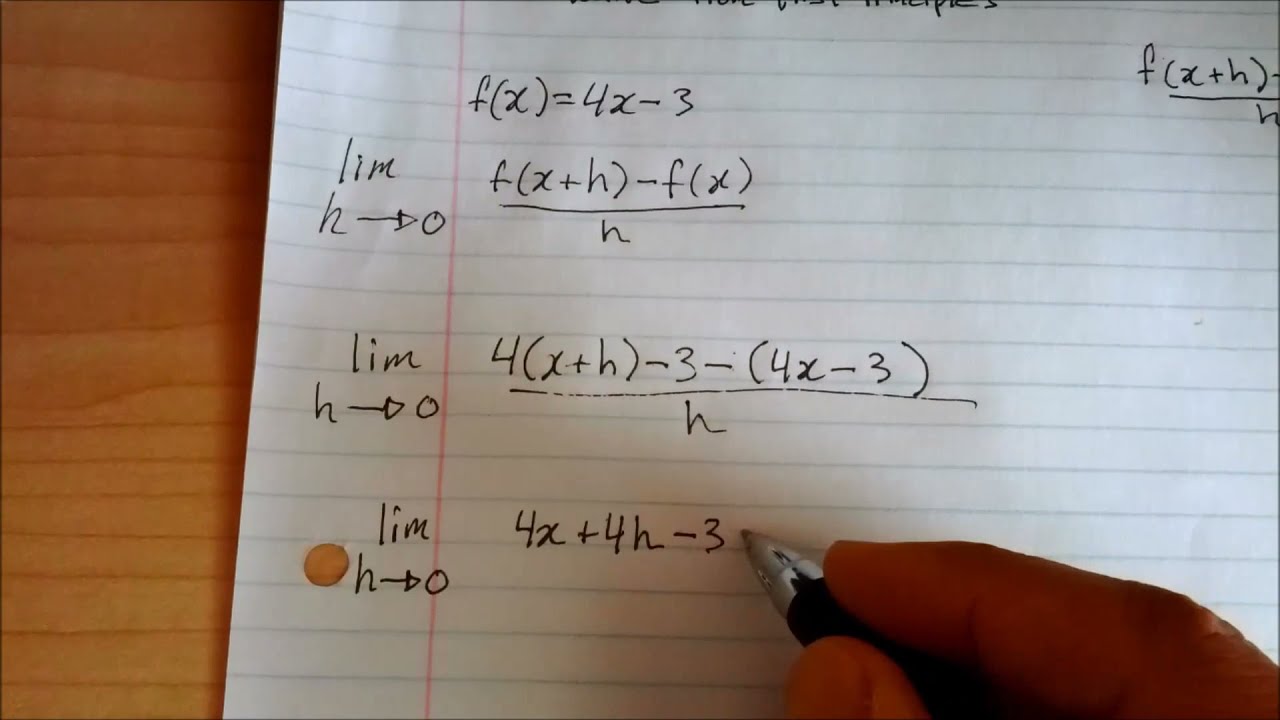
Find Derivative from First Principles.
Found a nice little video about it just before you clarified earlier
devout snowBOT
Available help channel!
Send your question here to claim the channel.
Remember:
• Ask your math question in a clear, concise manner.
• Show your work, and if possible, explain where you are stuck.
• After 15 minutes, feel free to ping <@&286206848099549185>.
• Type the command .close to free the channel when you're done.
• Be polite and have a nice day!
Read #❓how-to-get-help for further information on how to ask a good question, and about conduct in the question channels.
 oblique rover
How to show that $\lim_{x\to\infty} \sin x$ deosn't exist using delta epsilon?. I know that i need to show
[\neg(\exists L\in\bar{\mathbb{R}}\forall\varepsilon>0\exists\delta>0\forall x\in\mathcal{P}{\delta}(\infty):f(x)\in\mathcal{U}{\varepsilon}(L))\iff]
[\iff \forall L\in\bar{\mathbb{R}}\exists\varepsilon>0\forall\delta>0\exists x\in\mathcal{P}{\delta}(\infty):f(x)\notin\mathcal{U}{\varepsilon}(L))]
But how should i do it?
devout snowBOT
oblique rover
How to show that $\lim_{x\to\infty} \sin x$ deosn't exist using delta epsilon?. ...
woven radishBOT
Slowaq

 dire forge
oblique rover
How to show that $\lim_{x\to\infty} \sin x$ deosn't exist using delta epsilon?. ...
dire forge
oblique rover
How to show that $\lim_{x\to\infty} \sin x$ deosn't exist using delta epsilon?. ...
What is P_delta(infinity)?
woven radishBOT
Slowaq
 dire forge
does R with the bar above it mean the extended real numbers?
oblique rover
yes
oblique rover
so i tried putting epsilon equal to 0,5
with this there will always be infinitely many ones or -ones for example for x=pi/2+kpi
or hm
oblique rover
how should i continue?
dire forge
you'll want to verify that your choice actually works, so first what if L is infinity? then we choose epsilon = 0.5 and we fix some number delta too, you need to choose a value of x in P_delta(infinity) so that f(x) is not in U_epsilon(L)
what value of x do you choose?
oblique rover
for example x=pi/2+2kpi for big enough k?
oblique rover
ah sorry 1
oblique rover
for L being infty or -infty definitely not
dire forge
why?
oblique rover
because $\mathcal{U}_{\varepsilon}(\infty)=(\varepsilon,\infty)=(\frac{1}{2},\infty)\nsupseteq \sin x$ since $\sin x \in [-1,1]$
woven radishBOT
Slowaq
 dire forge
but we said for that x, sin x is 1, right?
we're only looking at one specific value of x
is 1 in (1/2, infty)?
oblique rover
hm yes
dire forge
yeah, so we need to pick a different value of x if L is infinity and we're choosing epsilon to be 1/2
dire forge
yeah good
that settles the case where L is infinity, what if L=-infinity?
if we choose epsilon to be 1/2, what would be a good value of x to choose
dire forge
yup good
that settles it for L being infinite
now what if L is finite
let's say epsilon is 1/2
how do we choose x?
oblique rover
hm now it depends on L doesnt it
for example if L is 0 then well use the same x=pi/2+2kpi as in previous
if L is [1;-0,5) then we use x=3pi/2+2kpi
similar for -1
dire forge
yeah, what are all the different cases for L you want to consider?
obviously we can't list them all out one by one
oblique rover
and if its ouside of [-1,1] then x from reals
oblique rover
dire forge
yeah, what are all the different cases for L you want to consider?
if its ouside of [-1,1], if its [1;0) and if its [0,-1]
dire forge
okay, so you said if L is not in [-1,1] then x is from the reals, can you elaborate on that
oblique rover
because for any x from reals sinx wont be fully contained in U_epsilon(L)
ahh no
or yes
dire forge
well choose a number for x
remember x has to be a specific number in P_delta(infinity)
oblique rover
dire forge
remember x has to be a specific number in P_delta(infinity)
hm so then it just needs to be number greater then delta?
dire forge
oblique rover
hm so then it just needs to be number greater then delta?
okay which one?
oblique rover
dire forge
okay which one?
tbh i kind of got lost wdym which one
dire forge
what value are you choosing for x
you need to pick a specific number
because the statement we're trying to prove is "there exists x such that ..."
oblique rover
ah so for example x=kpi?
dire forge
yeah good, why does that work
oblique rover
because its in distance of 1 from 1 and -1 thus i can not be in 0.5 neighbourhood of numbers outside of [-1,1]
devout snowBOT
@oblique rover Has your question been resolved?
devout snowBOT
Channel closed
Closed due to timeout
Use .reopen if this was a mistake.
devout snowBOT
Available help channel!
Send your question here to claim the channel.
Remember:
• Ask your math question in a clear, concise manner.
• Show your work, and if possible, explain where you are stuck.
• After 15 minutes, feel free to ping <@&286206848099549185>.
• Type the command .close to free the channel when you're done.
• Be polite and have a nice day!
Read #❓how-to-get-help for further information on how to ask a good question, and about conduct in the question channels.
 tender reef
Im looking for a good simple video i have this chapter that looks easy but also easier to get wrong i tried to look on youtube but all are very complex what im looking for exactly is explanation for Basic concepts of set theory
devout snowBOT
tender reef
Im looking for a good simple video i have this chapter that looks easy but also ...
tender reef
Its a simple sheet but i would love explanation so i can study and pratice
devout snowBOT
@tender reef Has your question been resolved?
tender reef
<@&286206848099549185>
devout snowBOT
@tender reef Has your question been resolved?
 frosty portal
@tender reef
tender reef
frosty portal
so wht do u need help with
I would like source explanation on basic cocepts of set and theory
Alot of videos in youtube are all complex videos if possible i only want to understand the basics like it shown in the sheet i sent
 supple knot
tender reef
I would like source explanation on basic cocepts of set and theory
supple knot
tender reef
I would like source explanation on basic cocepts of set and theory

Mathematics LibreTexts
Intuitively, a set is a collection of objects with certain properties.
frosty portal
so first we need to get clear on wht is a "set"
devout snowBOT
Channel closed
Closed due to timeout
Use .reopen if this was a mistake.
Available help channel!
Send your question here to claim the channel.
Remember:
• Ask your math question in a clear, concise manner.
• Show your work, and if possible, explain where you are stuck.
• After 15 minutes, feel free to ping <@&286206848099549185>.
• Type the command .close to free the channel when you're done.
• Be polite and have a nice day!
Read #❓how-to-get-help for further information on how to ask a good question, and about conduct in the question channels.
 rugged jewel
How is it x(1+... and not x(1-... here?
 devout snowBOT
rugged jewel
How is it x(1+... and not x(1-... here?
rugged jewel
devout snowBOT
rugged jewel
How is it x(1+... and not x(1-... here?
rugged jewel
Probs something very basic but i dont see it
 carmine burrow
rugged jewel
Probs something very basic but i dont see it
carmine burrow
rugged jewel
Probs something very basic but i dont see it
yeah basically it's because you suppose x<0 here, so sqrt(x^2+4x) = -x sqrt (etc) for x small enough
 devout snowBOT
Channel closed
Closed by @rugged jewel
Use .reopen if this was a mistake.
devout snowBOT
Available help channel!
Send your question here to claim the channel.
Remember:
• Ask your math question in a clear, concise manner.
• Show your work, and if possible, explain where you are stuck.
• After 15 minutes, feel free to ping <@&286206848099549185>.
• Type the command .close to free the channel when you're done.
• Be polite and have a nice day!
Read #❓how-to-get-help for further information on how to ask a good question, and about conduct in the question channels.
 stiff spire
Help
 devout snowBOT
stiff spire
Help
devout snowBOT
stiff spire
Help
 unreal thunder
@stiff spire
unreal thunder
Which values are plotted on the horizontal axis ?
stiff spire
WTf is a horizontal axis 😭😭
 bleak lake
 stiff spire
Idk what ur sbt styll
unreal thunder
| (vertical)
stiff spire
unreal thunder
Which values are plotted on the horizontal axis ?
A and B
unreal thunder
Do you see time should be plotted in horizontal axis?
devout snowBOT
@stiff spire Has your question been resolved?
devout snowBOT
Channel closed
Closed due to timeout
Use .reopen if this was a mistake.
Available help channel!
Send your question here to claim the channel.
Remember:
• Ask your math question in a clear, concise manner.
• Show your work, and if possible, explain where you are stuck.
• After 15 minutes, feel free to ping <@&286206848099549185>.
• Type the command .close to free the channel when you're done.
• Be polite and have a nice day!
Read #❓how-to-get-help for further information on how to ask a good question, and about conduct in the question channels.
stiff spire
devout snow
<@1271393701683400779> Has your question been resolved?
nope
stiff spire
Nope
devout snowBOT
@stiff spire Has your question been resolved?
stiff spire
NO
 jade oak
stiff spire
I know A is 20, my man told me it 😄
jade oak
stiff spire
I know A is 20, my man told me it 😄
The scale is going to be linear, so just count how many squares away B is from 0, then multiply by 20 (since you know A is 1 square away and represents 20 seconds)
big dark squares
not the smaller lighter squares, if you count those instead each one represents 4 seconds (by dividing 20 by 5 since there are 5 small squares in each big square)
stiff spire
jade oak
The scale is going to be linear, so just count how many squares away B is from 0...
Its not 200 tho
wait what.
 granite shuttle
stiff spire
Its not 200 tho
granite shuttle
stiff spire
Its not 200 tho
not with that attitude!!
stiff spire
huh
devout snowBOT
@stiff spire Has your question been resolved?
devout snowBOT
Channel closed
Closed due to timeout
Use .reopen if this was a mistake.
Available help channel!
Send your question here to claim the channel.
Remember:
• Ask your math question in a clear, concise manner.
• Show your work, and if possible, explain where you are stuck.
• After 15 minutes, feel free to ping <@&286206848099549185>.
• Type the command .close to free the channel when you're done.
• Be polite and have a nice day!
Read #❓how-to-get-help for further information on how to ask a good question, and about conduct in the question channels.
 rigid ore
hello
devout snowBOT
rigid ore
hello
rigid ore
so i have a question
First some quick vocab:
Giant Mantis Tame Chance: 11%
1 Elixir Of Influence = 5%
What is the exact probability of failing 2 times in a row the taming of a giant mantis with only 3 elixers of influence to help?
To solve this, you need to add 5 times the number of elixirs to the tame chance of the animal, then subtract it from 100, and divide it by 100. Then, attach an exponent to the number (the exponent is the failed tames in a row) and multiply it by 100 for your final result. (You may need to round to the tenths place) (THIS IS FROM THE WIKI)
(and this is for a game)
This question is multiple choice so here are the possible answers
A) 0%
B) 94.9
C) 35.2
D) 54.8
rigid ore
yep but i got a number way off ;-;
 winter torrent
okay, can you show what you did?
rigid ore
i dont have a picture i just typed the numbers down and kinda erased it ;c
like i did the math in my head and put the number down
and once i was done with it i put another number
i actually had a similar question for this
ill send that and the answer
winter torrent
how about you go ahead and redo the problem and keep track of what you're doing
devout snowBOT
Channel closed
Closed by @rigid ore
Use .reopen if this was a mistake.
rigid ore
.reopen
devout snowBOT
✅
rigid ore
ok
i think i might have an answer
is it 54.8
does that seem reasonable
ill just close it ig
.close
devout snowBOT
Channel closed
Closed by @rigid ore
Use .reopen if this was a mistake.
winter torrent
rigid ore
does that seem reasonable
seems good to me
you have a 1/4 chance of catching it each time
so around 1/2 in two tries
devout snowBOT
Available help channel!
Send your question here to claim the channel.
Remember:
• Ask your math question in a clear, concise manner.
• Show your work, and if possible, explain where you are stuck.
• After 15 minutes, feel free to ping <@&286206848099549185>.
• Type the command .close to free the channel when you're done.
• Be polite and have a nice day!
Read #❓how-to-get-help for further information on how to ask a good question, and about conduct in the question channels.
 pale prawn
how do i do this?
 devout snowBOT
pale prawn
how do i do this?
devout snowBOT
pale prawn
how do i do this?
 safe jasper
a^2 - b^2 = (a+b)(a-b)
pale prawn
safe jasper
a^2 - b^2 = (a+b)(a-b)
i dont understand
olive snow
Remark : 4x² = (2x)² and 9 = 3²
devout snowBOT
@pale prawn Has your question been resolved?
pale prawn
olive snow
Remark : 4x² = (2x)² and 9 = 3²
oh okay thank you
devout snowBOT
Channel closed
Closed by @pale prawn
Use .reopen if this was a mistake.
devout snowBOT
Available help channel!
Send your question here to claim the channel.
Remember:
• Ask your math question in a clear, concise manner.
• Show your work, and if possible, explain where you are stuck.
• After 15 minutes, feel free to ping <@&286206848099549185>.
• Type the command .close to free the channel when you're done.
• Be polite and have a nice day!
Read #❓how-to-get-help for further information on how to ask a good question, and about conduct in the question channels.
 novel violet
y = 4sin3x + 2
Find the smallest zero in the interval 2pi <= x <= 3pi
novel violet
I know that x = 7pi/6 and 11pi/6 between 0 and 2pi, but I dont know what to do next
And I must know how to do it algebraically
I know the new modified domain is 6pi to 9pi
But how do I make my current solutions into the new domain
PING IF HELPING
 idle phoenix
novel violet
y = 4sin3x + 2
Find the smallest zero in the interval 2pi <= x <= 3pi
idle phoenix
novel violet
y = 4sin3x + 2
Find the smallest zero in the interval 2pi <= x <= 3pi
Zero you mean y = 0?
novel violet
Yes
idle phoenix
If that so, 4sin3x + 2 = 0 implies that sin3x = -1/2
So, 3x needs to be 7pi/6 + 2k . pi or 11pi/6 + 2k . pi, where k is an integer, so you have to find k such that 3x is between 6pi and 9pi
Let 7pi/6 + 2k . pi >= 6pi, so 7/6 + 2k >= 6 -> 2k >= 29/6 -> k >= 29/12
You have to do that for 7pi/6 + 2k . pi <= 9pi
And do the same for 11pi/6 + 2k . pi
novel violet
Thank you 🙏
devout snowBOT
@novel violet Has your question been resolved?
Channel closed
Closed by @novel violet
Use .reopen if this was a mistake.
Available help channel!
Send your question here to claim the channel.
Remember:
• Ask your math question in a clear, concise manner.
• Show your work, and if possible, explain where you are stuck.
• After 15 minutes, feel free to ping <@&286206848099549185>.
• Type the command .close to free the channel when you're done.
• Be polite and have a nice day!
Read #❓how-to-get-help for further information on how to ask a good question, and about conduct in the question channels.
 late ruin
can i get some help on smth
devout snowBOT
late ruin
can i get some help on smth
late ruin
 supple knot
supple knot
supple knot
,calc (4-1)^2
woven radishBOT
Result:
9
No
supple knot
Yea those are both right
devout snowBOT
Channel closed
Closed by @late ruin
Use .reopen if this was a mistake.
devout snowBOT
Available help channel!
Send your question here to claim the channel.
Remember:
• Ask your math question in a clear, concise manner.
• Show your work, and if possible, explain where you are stuck.
• After 15 minutes, feel free to ping <@&286206848099549185>.
• Type the command .close to free the channel when you're done.
• Be polite and have a nice day!
Read #❓how-to-get-help for further information on how to ask a good question, and about conduct in the question channels.
 peak blade
Guys what do I do next
devout snowBOT
peak blade
Guys what do I do next
 supple knot
set the left side equal to 0 and use quadratic formula or factor or complete the square to find the roots
quadratics/parabolas have a very specific pattern to being above the x-axis
devout snowBOT
@peak blade Has your question been resolved?
Channel closed
Closed by @peak blade
Use .reopen if this was a mistake.
Available help channel!
Send your question here to claim the channel.
Remember:
• Ask your math question in a clear, concise manner.
• Show your work, and if possible, explain where you are stuck.
• After 15 minutes, feel free to ping <@&286206848099549185>.
• Type the command .close to free the channel when you're done.
• Be polite and have a nice day!
Read #❓how-to-get-help for further information on how to ask a good question, and about conduct in the question channels.
 frozen stump
 devout snowBOT
frozen stump
frozen stump
devout snowBOT
frozen stump
frozen stump
for part a, do I integrate as usual and then sub in two cases where n--> inf and n--> 0?
supple knot
Drawing a picture might help
frozen stump
supple knot
Drawing a picture might help
iv never had to deal with upper and lower rectangles before, so im not quite sure what it really is
After some research i assume this is what you mean

How do I implement this as an actual formula tho?
devout snowBOT
@frozen stump Has your question been resolved?
frozen stump
<@&286206848099549185>
 outer ember
Consider integrating 1/2^n and 1/2^(n+1)
supple knot
frozen stump
How do I implement this as an actual formula tho?
Use the bounds from your own integral
It's just one rectangle for upper and one rectangle for lower
frozen stump
supple knot
It's just one rectangle for upper and one rectangle for lower
Is this alright?
 frozen stump
frozen stump
frozen stump
how do I "hence" for part b?
outer ember
You can expect this integral would larger than n/2
frozen stump
outer ember
You can expect this integral would larger than n/2
?
outer ember
Integrate from 1~2, 2~4, 4~8,....2^(n-1)~2^n. Each part would larger than 1/2.
devout snowBOT
@frozen stump Has your question been resolved?
frozen stump
.close
devout snowBOT
Channel closed
Closed by @frozen stump
Use .reopen if this was a mistake.
devout snowBOT
Available help channel!
Send your question here to claim the channel.
Remember:
• Ask your math question in a clear, concise manner.
• Show your work, and if possible, explain where you are stuck.
• After 15 minutes, feel free to ping <@&286206848099549185>.
• Type the command .close to free the channel when you're done.
• Be polite and have a nice day!
Read #❓how-to-get-help for further information on how to ask a good question, and about conduct in the question channels.
 vivid estuary
What is the roll of nCr(1,1)
devout snowBOT
vivid estuary
What is the roll of nCr(1,1)


 sand quarry
vivid estuary
What is the roll of nCr(1,1)
sand quarry
vivid estuary
What is the roll of nCr(1,1)
you mean "role"?
vivid estuary
ye lol
sand quarry
vivid estuary
If your question is why they wrote it this way then it is just to illustrate the point they're trying to get across because 1C1 = 1. This probability model is what's called a hypergeometric distribution. Basically, the hypergeometric distribution describes the probability of drawing a specific number of successes in a series of draws from a finite population without replacement, which is what the question is describing i suppose
devout snowBOT
@vivid estuary Has your question been resolved?
devout snowBOT
Channel closed
Closed due to timeout
Use .reopen if this was a mistake.
Available help channel!
Send your question here to claim the channel.
Remember:
• Ask your math question in a clear, concise manner.
• Show your work, and if possible, explain where you are stuck.
• After 15 minutes, feel free to ping <@&286206848099549185>.
• Type the command .close to free the channel when you're done.
• Be polite and have a nice day!
Read #❓how-to-get-help for further information on how to ask a good question, and about conduct in the question channels.
 vestal bay
I found that <CAF is 50 using alternate segment theorem and <ACD=50 alternating angles
 devout snowBOT
vestal bay
I found that <CAF is 50 using alternate segment theorem and <ACD=50 alternating ...
vestal bay
devout snowBOT
vestal bay
I found that <CAF is 50 using alternate segment theorem and <ACD=50 alternating ...
vestal bay
I don't know what to do next to find <DCB
vestal bay
 tall stirrup
CD is bisecting <ACB
tall stirrup
CD is bisecting <ACB
I don't know what <ACB is
devout snowBOT
Channel closed
Closed by @vestal bay
Use .reopen if this was a mistake.
devout snowBOT
Available help channel!
Send your question here to claim the channel.
Remember:
• Ask your math question in a clear, concise manner.
• Show your work, and if possible, explain where you are stuck.
• After 15 minutes, feel free to ping <@&286206848099549185>.
• Type the command .close to free the channel when you're done.
• Be polite and have a nice day!
Read #❓how-to-get-help for further information on how to ask a good question, and about conduct in the question channels.
 potent onyx
hi
devout snowBOT
potent onyx
hi
potent onyx
I want help in AP

here is the problem
can anyone tell me the solution + explain this
<@&286206848099549185>
hi @sullen island
 sullen island
yeah you want to use the formula for the sum of an AP certainly
that formatting is so cursed tho
holy
potent onyx
same reaction
i use all the formula of AP given in my book
and my brain stopped braining
Sn = n/2[2a + (n-1)d]
this one ?
or the other one
sullen island
that should do it yes, a is the start and d is the difference right
potent onyx
can u help me with one more?
sullen island
ok
potent onyx
 potent onyx
sullen island
that should do it yes, a is the start and d is the difference right
potent onyx
sullen island
that should do it yes, a is the start and d is the difference right
yes
can u help me with both?
or i have to wait for 4 jan for the answer key
sullen island
well one at a time but sure
potent onyx
ans for 2nd one is 3
sullen island
so you ok with the first one now?
potent onyx
no
sullen island
ok
potent onyx
help me with 1st one
it is okay if you dont help with 2nd one
cus I got the solution on google for 2nd one
sullen island
potent onyx
Sn = n/2[2a + (n-1)d]
well ok what's 2+5+8+... using that formula then ?
sullen island
well n is unknown as of now
that's what we're trying to find remember
so just compute it for any n
potent onyx
lets go for 1
sullen island
keep the n, just plug in a and d
sullen island
you sure a is 1 ?