#help-27
1 messages · Page 274 of 1
 unreal stone
 devout snowBOT
@west osprey Has your question been resolved?
devout snowBOT
Channel closed
Closed due to timeout
Use .reopen if this was a mistake.
 Available help channel!
Send your question here to claim the channel.
Remember:
• Ask your math question in a clear, concise manner.
• Show your work, and if possible, explain where you are stuck.
• After 15 minutes, feel free to ping <@&286206848099549185>.
• Type the command .close to free the channel when you're done.
• Be polite and have a nice day!
Read #❓how-to-get-help for further information on how to ask a good question, and about conduct in the question channels.
 limber wyvern
.reopen
 dark sparrow
 devout snowBOT
dark sparrow
dark sparrow
devout snowBOT
dark sparrow
dark sparrow
Is this a legal operation, mi and ni are row vectors
devout snowBOT
@dark sparrow Has your question been resolved?
devout snowBOT
Channel closed
Closed due to timeout
Use .reopen if this was a mistake.
Available help channel!
Send your question here to claim the channel.
Remember:
• Ask your math question in a clear, concise manner.
• Show your work, and if possible, explain where you are stuck.
• After 15 minutes, feel free to ping <@&286206848099549185>.
• Type the command .close to free the channel when you're done.
• Be polite and have a nice day!
Read #❓how-to-get-help for further information on how to ask a good question, and about conduct in the question channels.
 cosmic pelican
I can’t do literally every trig limit except for this one

 livid thorn
What have you tried so far?
 stone fjord
@cosmic pelican
cosmic pelican
Yes
cosmic pelican
livid thorn
What have you tried so far?
Like one with sin and tan
stone fjord
livid thorn
What have you tried so far?

livid thorn
hmm so what happens when you try to evaluate the expression at x = 0?
cosmic pelican
0/0
livid thorn
what do you usually do if that happens?
stone fjord
Do you know what you can do in this case?
cosmic pelican
For other limits, for this one I’m not sure where to start
livid thorn
do you know L'hospital's rule?
cosmic pelican
Yea
livid thorn
so what are the steps to using that here?
cosmic pelican
Oh yea I forgot that you could use it😭
livid thorn
😛
cosmic pelican
-sinx
livid thorn
yeah and whats the limit of that
cosmic pelican
0?
 livid thorn
you can do the same if you get $\infty/\infty$
cosmic pelican
Yep
 woven radishBOT
VortexNerd
 cosmic pelican
Thank you
 snow raptor
you can also use trig identities without L'Hopital
snow raptor
1-cos(x) = 2sin^2(x/2)
cosmic pelican
Ohhhhhhhhhhhhhhh
snow raptor
snow raptor
1-cos(x) = 2sin^2(x/2)
Derived from (1-cos(2x)) = 2sin^2(x)
devout snowBOT
@cosmic pelican Has your question been resolved?
devout snowBOT
Channel closed
Closed due to timeout
Use .reopen if this was a mistake.
Available help channel!
Send your question here to claim the channel.
Remember:
• Ask your math question in a clear, concise manner.
• Show your work, and if possible, explain where you are stuck.
• After 15 minutes, feel free to ping <@&286206848099549185>.
• Type the command .close to free the channel when you're done.
• Be polite and have a nice day!
Read #❓how-to-get-help for further information on how to ask a good question, and about conduct in the question channels.
 wispy forge
How do I proceed with the 33rd question

 devout snowBOT
wispy forge
How do I proceed with the 33rd question
devout snowBOT
wispy forge
How do I proceed with the 33rd question
 versed juniper
,rccw
woven radishBOT

 restive river
add and subtract f(1)
devout snowBOT
@wispy forge Has your question been resolved?
wispy forge
restive river
add and subtract f(1)
Where though
restive river
numerator
wispy forge
restive river
numerator
Like this?
 wispy forge
restive river
thats the denominator
wispy forge
restive river
thats the denominator
I added f(1) to both numerator and denominator 😭
wispy forge
restive river
i meant something like (9x^n- f(1))-(f(x)-f(1))/(x-1)
Uh huh
wispy forge
restive river
i meant something like (9x^n- f(1))-(f(x)-f(1))/(x-1)
what do I do after that though
restive river
separation
wispy forge
okay
devout snowBOT
Channel closed
Closed due to timeout
Use .reopen if this was a mistake.
wispy forge
.reopen
devout snowBOT
✅
restive river
yes
restive river
ftc
restive river
also i dont think thats ftc so thats my bad
restive river
yes
 woven radishBOT
 restive river
bro what
restive river
restive river
i meant something like (9x^n- f(1))-(f(x)-f(1))/(x-1)
have u checked this message
f(1) is 9 btw
wispy forge
restive river
f(1) is 9 btw
Yeah I reverted it back as I felt it may affect the process
devout snowBOT
@wispy forge Has your question been resolved?
Channel closed
Closed by @wispy forge
Use .reopen if this was a mistake.
Available help channel!
Send your question here to claim the channel.
Remember:
• Ask your math question in a clear, concise manner.
• Show your work, and if possible, explain where you are stuck.
• After 15 minutes, feel free to ping <@&286206848099549185>.
• Type the command .close to free the channel when you're done.
• Be polite and have a nice day!
Read #❓how-to-get-help for further information on how to ask a good question, and about conduct in the question channels.
 fast cliff
Hello, I am trying to solve an exercise that ask me to proof: if f-1 is the inverse function of f, and y=f-1(-x) are the inverse y=f(-x), then f(x) is an odd function
What I did: f(y)=-x, and f-1(y) =-x as the hypothesis conditions, and so I have that x=-f(y), then the exercise what to me show that f(-y)=-f(y), so I want to see that x is also equal to f(-y). Here is where i arrived
devout snowBOT
fast cliff
Hello, I am trying to solve an exercise that ask me to proof: if f-1 is the inve...
@fast cliff Has your question been resolved?
 valid silo
so we have
f^-1(-f(-x))=x
and
f^-1(f(x))=x
since f^-1 is an iverse function, it must be 1 to 1
so
-f(-x)=f(x)
so
f(-x)=-f(x)
fast cliff
valid silo
f(-x)=-f(x)
thank you so much , now I know how to solve this exercise. Have you a nice day!!!!
valid silo
welcome
fast cliff
.close
devout snowBOT
Channel closed
Closed by @fast cliff
Use .reopen if this was a mistake.
devout snowBOT
Available help channel!
Send your question here to claim the channel.
Remember:
• Ask your math question in a clear, concise manner.
• Show your work, and if possible, explain where you are stuck.
• After 15 minutes, feel free to ping <@&286206848099549185>.
• Type the command .close to free the channel when you're done.
• Be polite and have a nice day!
Read #❓how-to-get-help for further information on how to ask a good question, and about conduct in the question channels.
 woven dirge
what are the first 10 digits?
 devout snowBOT
woven dirge
what are the first 10 digits?
devout snowBOT
woven dirge
what are the first 10 digits?
 supple knot
1234567891

 uncut crow
😭
devout snowBOT
@woven dirge Has your question been resolved?
woven dirge
supple knot
1234567891
that didnt work
im so confused
cause i tried the same thing
and it says wrong
supple knot
woven dirge
and it says wrong
show
woven dirge
it just shows red
as in if its green its correct and its red
its automated
@supple knot why is it supposed to be 1234567891 anyways?
@supple knot ?
woven dirge
okay so how do i solve this
devout snowBOT
Channel closed
Closed due to timeout
Use .reopen if this was a mistake.
 cinder nova
what'd be the best number to remove so that the integer doesn't decrease by much?
devout snowBOT
Available help channel!
Send your question here to claim the channel.
Remember:
• Ask your math question in a clear, concise manner.
• Show your work, and if possible, explain where you are stuck.
• After 15 minutes, feel free to ping <@&286206848099549185>.
• Type the command .close to free the channel when you're done.
• Be polite and have a nice day!
Read #❓how-to-get-help for further information on how to ask a good question, and about conduct in the question channels.
 raw sandal
Im doing this geometry assignment right now and Its on my last resubmit so i gotta get a 100% i need to double check my answers im really behind in geometry this year barely know this stuff
devout snowBOT
raw sandal
Im doing this geometry assignment right now and Its on my last resubmit so i got...
raw sandal


 supple knot
you're better off just uploading one at a time
woven dirge
supple knot
you're better off just uploading one at a time
do you know?
raw sandal
<@&286206848099549185>
someone

THIS DOESNT MAKE SENSE
can someone help
<@&286206848099549185>
devout snowBOT
@raw sandal Has your question been resolved?
devout snowBOT
Channel closed
Closed due to timeout
Use .reopen if this was a mistake.
Available help channel!
Send your question here to claim the channel.
Remember:
• Ask your math question in a clear, concise manner.
• Show your work, and if possible, explain where you are stuck.
• After 15 minutes, feel free to ping <@&286206848099549185>.
• Type the command .close to free the channel when you're done.
• Be polite and have a nice day!
Read #❓how-to-get-help for further information on how to ask a good question, and about conduct in the question channels.
 dry lotus


 misty crest
,calc 1/(4(ln(40)-1))
woven radishBOT
The following error occured while calculating:
Error: Undefined function ln
misty crest
,w \frac{1}{4(ln(40)-1)}
woven radishBOT


 dry lotus
Ye
dry lotus
misty crest
yea i mean you could always back check
How??
dry lotus
Oooohhhh
misty crest
wait i forgot the t = 40
woven radishBOT
 dry lotus
Yes
dry lotus
misty crest
so they’re wrong
Tysm
misty crest
you’re welcome
devout snowBOT
Channel closed
Closed by @dry lotus
Use .reopen if this was a mistake.
devout snowBOT
Available help channel!
Send your question here to claim the channel.
Remember:
• Ask your math question in a clear, concise manner.
• Show your work, and if possible, explain where you are stuck.
• After 15 minutes, feel free to ping <@&286206848099549185>.
• Type the command .close to free the channel when you're done.
• Be polite and have a nice day!
Read #❓how-to-get-help for further information on how to ask a good question, and about conduct in the question channels.
 trail wyvern
How can I get faster with my multiplication and long multiplication facts?
devout snowBOT
trail wyvern
How can I get faster with my multiplication and long multiplication facts?
supple knot
trail wyvern
How can I get faster with my multiplication and long multiplication facts?
practice
uncut crow
Balls 🩷🐪💦
devout snowBOT
@trail wyvern Has your question been resolved?
devout snowBOT
Channel closed
Closed due to timeout
Use .reopen if this was a mistake.
Available help channel!
Send your question here to claim the channel.
Remember:
• Ask your math question in a clear, concise manner.
• Show your work, and if possible, explain where you are stuck.
• After 15 minutes, feel free to ping <@&286206848099549185>.
• Type the command .close to free the channel when you're done.
• Be polite and have a nice day!
Read #❓how-to-get-help for further information on how to ask a good question, and about conduct in the question channels.
 violet wolf
I need to find the lenght of EF and I have no idea how to, can someone help?
 devout snowBOT
violet wolf
I need to find the lenght of EF and I have no idea how to, can someone help?
devout snowBOT
violet wolf
I need to find the lenght of EF and I have no idea how to, can someone help?
@violet wolf Has your question been resolved?
violet wolf
For any other questions in this chapter i know the answer but i just dont know how to do this one (its also the final question of this paragraph so that makes sense i guess)
devout snowBOT
@violet wolf Has your question been resolved?
devout snowBOT
@violet wolf Has your question been resolved?
 red sentinel
violet wolf
I need to find the lenght of EF and I have no idea how to, can someone help?
red sentinel
violet wolf
I need to find the lenght of EF and I have no idea how to, can someone help?
What is the chapter name called ?
I think we can do it in similar triangle
violet wolf
"To determine a lenght of x" but its a Dutch book so i dont know if its the same
red sentinel
Ok no problem Let's do it side by side
Which is concider the small triangle ∆SDB,∆FDE
violet wolf
SBD would be the small triangle, if thats what you mean
red sentinel
violet wolf
SBD would be the small triangle, if thats what you mean
Hell yeah
red sentinel
That's easy part . For similar triangle taking two sides
Say, DF/DS=EF/SB
(i.e) 14/4=EF/SB
7SB=2EF
Did you get the answer
violet wolf
red sentinel
(i.e) 14/4=EF/SB
I think so, but im not sure
Since i dont know the lenght of SB, is the answer just 7SB=2EF?
red sentinel
Yes that what we need to find
Concider the 2nd smallest traingle and 3rd smallest triangle
Put SB=x and start solving
violet wolf
Okay
devout snowBOT
@violet wolf Has your question been resolved?
devout snowBOT
Channel closed
Closed due to timeout
Use .reopen if this was a mistake.
devout snowBOT
Available help channel!
Send your question here to claim the channel.
Remember:
• Ask your math question in a clear, concise manner.
• Show your work, and if possible, explain where you are stuck.
• After 15 minutes, feel free to ping <@&286206848099549185>.
• Type the command .close to free the channel when you're done.
• Be polite and have a nice day!
Read #❓how-to-get-help for further information on how to ask a good question, and about conduct in the question channels.
 grim marlin
can anyone help we out here im nbew to greens theorem and having a bit of trouble doing it
 devout snowBOT
grim marlin
can anyone help we out here im nbew to greens theorem and having a bit of troubl...
devout snowBOT
grim marlin
can anyone help we out here im nbew to greens theorem and having a bit of troubl...
 rapid rover
I got 31.5 for this but was marked wrong, would anyone solve it and lmk the answer, already got it wrong anyways
 grim marlin
ive gotten the RHS of greens theorem as double itnegral of x dx dy
having a bit of trouble finding the limits of integration though
 wheat meadow
rapid rover
I got 31.5 for this but was marked wrong, would anyone solve it and lmk the answ...
wheat meadow
rapid rover
I got 31.5 for this but was marked wrong, would anyone solve it and lmk the answ...
no.
devout snowBOT
@grim marlin Has your question been resolved?
devout snowBOT
Channel closed
Closed due to timeout
Use .reopen if this was a mistake.
Available help channel!
Send your question here to claim the channel.
Remember:
• Ask your math question in a clear, concise manner.
• Show your work, and if possible, explain where you are stuck.
• After 15 minutes, feel free to ping <@&286206848099549185>.
• Type the command .close to free the channel when you're done.
• Be polite and have a nice day!
Read #❓how-to-get-help for further information on how to ask a good question, and about conduct in the question channels.
wispy forge
19th question, used l'hôpital in the first step, where did I go wrong exactlt

 devout snowBOT
wispy forge
19th question, used l'hôpital in the first step, where did I go wrong exactlt
devout snowBOT
wispy forge
19th question, used l'hôpital in the first step, where did I go wrong exactlt
 lime wagon
wispy forge
19th question, used l'hôpital in the first step, where did I go wrong exactlt
lime wagon
wispy forge
19th question, used l'hôpital in the first step, where did I go wrong exactlt
in the 4th step
wispy forge
lime wagon
in the 4th step
Okay yeah didn't notice that
 lime wagon
wispy forge
lime wagon
wispy forge
your answer is right but try to modify it acc to the options
try to bring 2/9
it will kinda annoying but thats how you would get the answer
devout snowBOT
@wispy forge Has your question been resolved?
Channel closed
Closed by @wispy forge
Use .reopen if this was a mistake.
Available help channel!
Send your question here to claim the channel.
Remember:
• Ask your math question in a clear, concise manner.
• Show your work, and if possible, explain where you are stuck.
• After 15 minutes, feel free to ping <@&286206848099549185>.
• Type the command .close to free the channel when you're done.
• Be polite and have a nice day!
Read #❓how-to-get-help for further information on how to ask a good question, and about conduct in the question channels.
 crimson niche
Does O(h) time complexity in Backward difference means that the change of h will change the error by the same amount? Like if you halved h the error would also be approximatly halved?
devout snowBOT
crimson niche
Does O(h) time complexity in Backward difference means that the change of h will...
crimson niche
 stone stump
or rather, at least halved. because O(...) is only an upper bound
stone stump
or rather, at least halved. because O(...) is only an upper bound
this goes for other time complexities right?
 brisk raptor
well really it means that the change should be the same regardless of the value of h which is being halved
if it changes by, say, (1/3h + constant) its still O(h)
but if it changes by (1/10 h^2) or something its not
stone stump
what I mean is that the error could for example be 17h^2 which is O(h), if you halve h then the error is changed by a factor 1/4, which is at least halved
crimson niche
stone stump
what I mean is that the error could for example be 17h^2 which is O(h), if you h...
I got it. Thanks all.
brisk raptor
stone stump
what I mean is that the error could for example be 17h^2 which is O(h), if you h...
isnt that omega(x)
f(n) is O(g(n)) if c*g(n) > f(n) for n > k. such c, k dont exist for g(n) = n and f(n) = 17h^2
crimson niche
One last question. Is there a way to calculate the error of Monte Carlo method approximatly? Because there is randomness. I found some websites says its O(1/sqrt(N))
stone stump
brisk raptor
f(n) is O(g(n)) if c\*g(n) > f(n) for n > k. such c, k dont exist for g(n) = n a...
we are talking about h->0 here which is essentially flipped
brisk raptor
oh, yeah
stone stump
also there is a difference between o(g) and O(g)
brisk raptor
yeah my fault lol
stone stump
crimson niche
One last question. Is there a way to calculate the error of Monte Carlo method a...
well then there apparently is a way
or rather, its possible to give an upper bound
for more you would need to introduce all of your notation etc here, there is no one monte carlo method
crimson niche
stone stump
for more you would need to introduce all of your notation etc here, there is no ...
I meant for integration.
stone stump
I didnt even know there is a monte carlo method for integration
do you like check random points in some square and see whether they are above or below the graph?
brisk raptor
stone stump
do you like check random points in some square and see whether they are above or...
 stone stump
ok yeah
brisk raptor
i mean, i wonder about this actually
crimson niche
stone stump
do you like check random points in some square and see whether they are above or...
It takes random points between (a,b) and then multiply it by (b-a) to get approximate area. Doing it for N sample points then calculate the average of the areas
Or thats how I understood it
crimson niche
crimson niche
It takes random points between (a,b) and then multiply it by (b-a) to get approx...
we calculate f(x_rand) forgot to mention it.
brisk raptor
i am finding it hard to understand how this is done for arbitrary functions. wouldnt you need the maximum and minimum of the function on the given interval to know what upper and lower y bounds to use when checking for points?
bc correct me if im wrong, but if you dont have a "bounding box" like in the image i sent, there is infinite space above and below the curve and so you'd think its just 50/50 no matter what?
unless we're not going below the x axis ??
crimson niche
brisk raptor
i am finding it hard to understand how this is done for arbitrary functions. wou...
We only need to know f(x) and some interval to calculate the approximation. I honestly haven't seen an application for a method where the function goes below the x axis.

Maybe I need to check for a function where f(x) has values above and below x axis
brisk raptor
i dont think its possible to apply this in that way
without calculating y bounds for points
i could be wrong but i really dont see how its possible
crimson niche
brisk raptor
i could be wrong but i really dont see how its possible
You mean for exmaple x^3-4?
brisk raptor
imagine a sine wave, and then a second sine wave where the troughs are absurdly deep, but is the same above the x axis.
brisk raptor
crimson niche
We only need to know f(x) and some interval to calculate the approximation. I ho...
this treats them the same
and the only way to treat them differently is to know how deep the sine wave goes which requires knowing the function, and calculating local min/max by hand seems unnatural when you are using a heuristic anyways
crimson niche
brisk raptor
and the only way to treat them differently is to know how deep the sine wave goe...
But why would we need ymax and ymin? if know the bounds it won't matter every iteration we are taking f(x_rand) which would be y and multiply it by (b-a) which would be x this would give us an approximate area and doing this for a large number of samples and then taking the mean would give us the approximate area with some error.
But functions like the one you mentioned will result in a larger error.
brisk raptor
crimson niche
We only need to know f(x) and some interval to calculate the approximation. I ho...
well, now that i think about it, why dont we need an upper bound, even in this case? are these points not truly random? if they are, is there not an infinite amount of space above the curve and a finite amount below? isnt that 0% (probability) that you get a point under the curve?
crimson niche
brisk raptor
well, now that i think about it, why dont we need an upper bound, even in this c...
They aren't truely random we are taking some points between a,b lets say (-5,5) we got -3.4 we calculate f(x) at this point and multiply it by (b-a). this would give us an area in this interval and this area wouldn't go above or below the function bound.
crimson niche
crimson niche
They aren't truely random we are taking some points between a,b lets say (-5,5) ...
And we will take the average of these areas.
brisk raptor
oh you dont pick points you pick x values ?
crimson niche
brisk raptor
oh you dont pick points you pick x values ?
Yes you take random x values and compute f(x) at these values
I just realized I said points when I meant x values points
brisk raptor
well then the worst case scenario is all f(x_i) lie on the same horizontal line which gives an area of (b-a) right
crimson niche
brisk raptor
well then the worst case scenario is all f(x_i) lie on the same horizontal line ...
Yes, but this very unlikely.
crimson niche
brisk raptor
maximum possible error
In numerical analysis unlike computer scientist, they focus on convergence and accuracy of a method under normal or typical conditions rather than the worst case.
for example in Monte carlo. How would the method perform as N gets larger.
I'm not expert in this field, but that what I understood while learning. I could be totaly wrong.
.close
devout snowBOT
Channel closed
Closed by @crimson niche
Use .reopen if this was a mistake.
devout snowBOT
Available help channel!
Send your question here to claim the channel.
Remember:
• Ask your math question in a clear, concise manner.
• Show your work, and if possible, explain where you are stuck.
• After 15 minutes, feel free to ping <@&286206848099549185>.
• Type the command .close to free the channel when you're done.
• Be polite and have a nice day!
Read #❓how-to-get-help for further information on how to ask a good question, and about conduct in the question channels.
 boreal apex
I am stuck on part (a) and for (b), is my answer correct?


 devout snowBOT
boreal apex
I am stuck on part (a) and for (b), is my answer correct?
devout snowBOT
boreal apex
I am stuck on part (a) and for (b), is my answer correct?
@boreal apex Has your question been resolved?
 static ember
for a, maybe split the left integral into three parts, from 0 to a plus from a to a+T plus from a+T to T
static ember
yeah I think so
devout snowBOT
Channel closed
Closed by @boreal apex
Use .reopen if this was a mistake.
devout snowBOT
Available help channel!
Send your question here to claim the channel.
Remember:
• Ask your math question in a clear, concise manner.
• Show your work, and if possible, explain where you are stuck.
• After 15 minutes, feel free to ping <@&286206848099549185>.
• Type the command .close to free the channel when you're done.
• Be polite and have a nice day!
Read #❓how-to-get-help for further information on how to ask a good question, and about conduct in the question channels.
restive river
What are you trying to achieve?
 proud perch
what is 1/D^2 x?
devout snowBOT
Channel closed
Channel closed due to the original message being deleted.
If you did not intend to do this, please open a new help channel,
as this action is irreversible, and this channel may abruptly lock.
devout snowBOT
Available help channel!
Send your question here to claim the channel.
Remember:
• Ask your math question in a clear, concise manner.
• Show your work, and if possible, explain where you are stuck.
• After 15 minutes, feel free to ping <@&286206848099549185>.
• Type the command .close to free the channel when you're done.
• Be polite and have a nice day!
Read #❓how-to-get-help for further information on how to ask a good question, and about conduct in the question channels.
 limber ermine
i found a=1 how do i find b so that the limit is finite and exists? limit of sequence
 devout snowBOT
limber ermine
i found a=1 how do i find b so that the limit is finite and exists? limit of seq...
devout snowBOT
limber ermine
i found a=1 how do i find b so that the limit is finite and exists? limit of seq...
 sand dove
limber ermine
i found a=1 how do i find b so that the limit is finite and exists? limit of seq...
sand dove
limber ermine
i found a=1 how do i find b so that the limit is finite and exists? limit of seq...
here's a hint: $\sqrt a - \sqrt b = \frac{a-b}{\sqrt a + \sqrt b}$
woven radishBOT
rafilou is not not born in 2003
 sand dove
try to prove it if you need to
limber ermine
sand dove
here's a hint: $\sqrt a - \sqrt b = \frac{a-b}{\sqrt a + \sqrt b}$
i did that
but
it gives me big numbers
sand dove
wdym big numbers
limber ermine
wait
limber ermine
limber ermine
i found a=1 how do i find b so that the limit is finite and exists? limit of seq...
do i add n here
limber ermine
woven radish
**rafilou is not not born in 2003**
or do i do this on the collums without addin n
 limber ermine
brackets
sand dove
is to be seen as $\sqrt a - \sqrt b$
woven radishBOT
rafilou is not not born in 2003

 sand dove
ok
sand dove
limber ermine
i found a=1 how do i find b so that the limit is finite and exists? limit of seq...
but if this converges to a finite value
sand dove
woven radish
**rafilou is not not born in 2003**
shouldn't this converge to 0?
the only way n * ... converges to something finite
is if the thing (getting rid of the n) converges to 0
limber ermine
sand dove
the only way n * ... converges to something finite
this was the problem
limber ermine
sand dove
the only way n * ... converges to something finite
wait i used that to find a
it got me a=1
how do i find b
woven radishBOT
rafilou is not not born in 2003
 sand dove
$\sqrt{an^2+bn+3}-n+1 = \frac{an^2+bn+3 - (n-1)^2}{\sqrt{an^2+bn+3}+n-1}$
woven radishBOT
rafilou is not not born in 2003
 sand dove
$\sqrt{an^2+bn+3}-n+1 = \frac{(a-1)n^2+(b+2)n+2}{\sqrt{an^2+bn+3}+n-1}$
woven radishBOT
rafilou is not not born in 2003
 limber ermine
yes
sand dove
and then $\sqrt{n^2+bn+3}-n+1 = \frac{(b+2)n+2}{\sqrt{n^2+bn+3}+n-1}$
limber ermine
and b?
woven radishBOT
rafilou is not not born in 2003
 sand dove
well now remember
sand dove
limber ermine
i found a=1 how do i find b so that the limit is finite and exists? limit of seq...
if we want this to converge to a finite value
sand dove
sand dove
and then $\sqrt{n^2+bn+3}-n+1 = \frac{(b+2)n+2}{\sqrt{n^2+bn+3}+n-1}$
we need this to converge to 0
not a lot of values for b are gonna work
limber ermine
woven radish
**rafilou is not not born in 2003**
ye but if this goes to 0 would it be infinity * 0
sand dove
?
sand dove
limber ermine
ye but if this goes to 0 would it be infinity * 0
well it would be like n * 1/n
limber ermine
 sand dove
looking at 'each coefficient', it goes to infinity * 0
yet the product in its totality converges to 1 (or anything finite)
limber ermine
sand dove
looking at 'each coefficient', it goes to infinity * 0
wait both a and b go to here?
sand dove
limber ermine
wait both a and b go to here?
?
sand dove
sand dove
this
this could be the same as 1/n for all we know
so when you multiply by n
it could converge to 1
limber ermine
wait what did u do with the n at the beginning when u start finding b
sand dove
??
didn't we say
that for n * something to converge to a finite value
we at least need that something to converge to 0?
limber ermine
wait
limber ermine
isn t that an undertermined case or whatever is called?
sand dove
?
well it's an undetermined form when you write it as "the first term goes to infinity but the other goes to 0"
the product could go towards anything
limber ermine
ye but n tends to infinity
 limber ermine
sand dove
it doesn't mean "n * 1/n" doesn't have a limit
limber ermine
sand dove
it doesn't mean "n * 1/n" doesn't have a limit
doesn t this mean it tends to + infinity
sand dove
?????
Unless I'm mistaken, n * 1/n = 1
for ALL n
thus the limit is 1 when n->infinity
limber ermine
oh
sand dove
just because you're looking at
x * y
with x going to infinity
and y going to 0
doesn't mean we can't find out what x*y goes to
"infinity * 0" is an undetermined form because it could mean many different things
it doesn't mean "x * y" has no limit or is unsolvable
limber ermine
woven radish
**rafilou is not not born in 2003**
ok then the whole thing here = 0 and i find b?
limber ermine
ok
sand dove
notice you can write the denominator as n * (something that converges to a finite value)
and that should set you on the right track
limber ermine
sand dove
notice you can write the denominator as n * (something that converges to a finit...
found b = -2
and when i verify the limit with -2n its 1
i think this is what is supposed to give
either way thx
devout snowBOT
@limber ermine Has your question been resolved?
Channel closed
Closed by @limber ermine
Use .reopen if this was a mistake.
devout snowBOT
Available help channel!
Send your question here to claim the channel.
Remember:
• Ask your math question in a clear, concise manner.
• Show your work, and if possible, explain where you are stuck.
• After 15 minutes, feel free to ping <@&286206848099549185>.
• Type the command .close to free the channel when you're done.
• Be polite and have a nice day!
Read #❓how-to-get-help for further information on how to ask a good question, and about conduct in the question channels.
 errant bough
whats the limit of x^(-2/lnx) as x->0+
devout snowBOT
errant bough
whats the limit of x^(-2/lnx) as x->0+
 meager sequoia
what have you tried?
errant bough
Lohopitals rule
take the natural log of f(x)
so its -2lnx/lnx
then derive
-2(1/x)/(1/x)
meager sequoia
it's simpler than what you're making it. can you simplify -2ln(x)/ln(x)?
errant bough
to -2?
meager sequoia
yes
errant bough
yes
meager sequoia
so x^(-2/ln(x))=e^?
 wooden ravine
a^b = e^blna
meager sequoia
I guess you don't have to at this stage
anyway, lets continue with the transformed function
-2ln(x)/ln(x)=-2
so what's the $lim_{x\rightarrow{0^{+}}}-2$?
woven radishBOT
LayneTheAndroid
 errant bough
-2
meager sequoia
exactly
 stray spade
errant bough
why do you have to go back to the original function
stray spade
errant bough
why do you have to go back to the original function
$x^{\frac{-2}{\ln(x)}} = (e^{\ln(x)})^{\frac{-2}{\ln(x)}} = e^{\ln(x) \cdot \frac{-2}{\ln(x)}}$ is the simplification being made here in case you didn't catch it
oops
errant bough
stray spade
$x^{\frac{-2}{\ln(x)}} = (e^{\ln(x)})^{\frac{-2}{\ln(x)}} = e^{\ln(x) \cdot \fra...
i dont think ive seen this before
 iron sun
meager sequoia
I guess you don't have to at this stage
anyway, lets continue with the transfo...
iron sun
meager sequoia
I guess you don't have to at this stage
anyway, lets continue with the transfo...
There’s a clear issue with this since we don’t know yet if the original expression is continuous at x=0, or if there’s somehow an extension that’s continuous at that point
woven radishBOT
kaue
 stray spade
fixed
errant bough
so if i see any variable x i can just say its e^lnx
iron sun
So maybe better if you rewrite the original expression as if it’s a composition of e^x
meager sequoia
errant bough
so if i see any variable x i can just say its e^lnx
any x>0
since e^x>0
meager sequoia
I'm now confused about what you're doing
errant bough
oh
meager sequoia
woven radish
**kaue**
you simplfied the exponent here to be -2
errant bough
meager sequoia
I'm now confused about what you're doing
i took the natural log of again
 iron sun
The point is that you know e^x as a function is continuous, hence our way of rewriting the expression is just a composition of a continuous function, and the very property of a continuous function is that the limit distributes over to the argument
meager sequoia
errant bough
so e^-2?
yes, for any x>0 the original expression is equal to e^(-2) so you can just take the limit of this (constant) function
iron sun
meager sequoia
yes, for any x>0 the original expression is equal to e^(-2) so you can just take...
And x not equal to 1
meager sequoia
iron sun
The point is that you know e^x as a function is continuous, hence our way of rew...
this is an important point too. if you wanted to take the limit by first taking the log, finding the that limit, and plugging back in, you'd need to verify the function is continuous up to that point
meager sequoia
iron sun
And x not equal to 1
good point
in the end this is okay since you're considering the limit as x->0+
errant bough
is there any other straight forward way to solve this because thinking of x as e^lnx feels arbitrary
iron sun
errant bough
is there any other straight forward way to solve this because thinking of x as e...
It makes the problem infact a lot less cumbersome
errant bough
not that im saying e^lnx makes no sense but thinking of that before doing anything else doesn’t feel efficient
meager sequoia
errant bough
not that im saying e^lnx makes no sense but thinking of that before doing anythi...
It's a very standard method and useful because it lets you compare terms in the exponent.
The key point is that this function is constant almost everywhere - I'm not sure how else you could identify that
your first step was to take the log right? we're essentially doing the same thing just moving all the manipulations to inside the exponent
errant bough
is -2lnx/lnx not also equal to the original function?
iron sun
I mean there is a different way
So for our original expression, what was it again?
x^(-2/ln(x)), right?
errant bough
as x->0+
errant bough
i suppose
iron sun
We’re just trying to apply a change of basis
To sinfully it
Since this is the same as log_x(e^-2)
Would u agree?
errant bough
i have general rules of natural logs written down on my wall i havent committed them to memory yet
but yes i would agree
iron sun
Yes this is just those rules, two of them namely
Okay
Now using this
What happens with our original expression?
iron sun
Just trying to simplify it
We’ve seen above that -2/ln(x) = log_x(e^-2) for x well defined
errant bough
im not sure i understand the question then what would/could happen to our original expression
iron sun
Well our original expression was x^(-2/ln(x))
So what happens if we use the knowledge above?
errant bough
Its simplified?
iron sun
Well start off slow
errant bough
Or we converted it to a log
iron sun
Just replace it
errant bough
And play around log rules?
iron sun
Yeah, but first I’d like you to only replace the exponent with the thing we managed to simplify down to from before
errant bough
Oh im sorry i didnt know thats what you meant by the question, it would be x^(log_x(e^-2))
?
iron sun
ln is log_e
iron sun
No
errant bough
logbase of e is lnx
iron sun
log base e of x, is ln (x)
errant bough
sorry i left out e
iron sun
Log base 2 of x is log_2(x)
In our case we have Log base x of e^-2, which is log_x(e^-2)
But more importantly, what do all of these have in common when we raise them to their respective base? (Whenever it’s well defined)
For example what is e^ln(x)?
iron sun
Yes
(for well defined x)
And what is 2^log_2(x)?
Remember x is just a dummy variable
iron sun
That’s the definition of log
It’s precisely log_2(x), that is the solution to 2^? = x
And more generally it doesn’t matter what base we have, as long as it’s positive and not 1
errant bough
yeah but whatever ? is i would say that 2^log_2(x) is 2^(2^?)
or would it just be 2^x
couldnt say i dont know
errant bough
makes sense
a number raised to a log with its base of x is just x?
is what that means basically?
iron sun
A base raised to its correspond log base of x is just x
So more generally, (here’ll ive swapped symbols)
x^log_x(y) = y
When x > 0 and x not 1, with y > 0
Well so why does this matter?
Let’s go back to our simplification we had done
Namely that
x^(-2/lnx) = x^(log_x(e^-2))
when x > 0 and x is not 1
errant bough
right it just equals e^-2
iron sun
Yup!
errant bough
constant
iron sun
Yes, again importantly for certain x
iron sun
Since the original expression only made sense when x was > 0 and not 1
errant bough
oh
iron sun
When we make simplifications like above only formally we lose that information
So we have to remind ourselves of this
errant bough
so would that be why we kept going back to the original function earlier at first
when i started the thread i mean
iron sun
Well we don’t really have to, as long as we repeat the magic words:
“when x > 0 and not 1”
errant bough
right
iron sun
And since we’re interested in x -> 0+, then it’s sufficient to only consider a small enough open interval to the right of 0, like (0, 1/2)
And in this interval our expression is always just e^-2
Hence it follows that the limit must be e^-2
But do you notice how this is slightly more cumbersome than before? (Or maybe not)
errant bough
i feel maybe if i was sharper with the general rules i could do it so that either method wasnt really more or less convenient than the other
iron sun
errant bough
so would that be why we kept going back to the original function earlier at firs...
Oh and to clarify this is a different method
errant bough
but yes it would take slightly more time i think
errant bough
iron sun
Oh and to clarify this is a different method
yes id say the other method was simpler with replacing x simply and multiplying the exponent there
iron sun
errant bough
i feel maybe if i was sharper with the general rules i could do it so that eithe...
Yes it’s really just being comfortable with these manipulations and rules or whatever, the rest, I.e dealing with the limit apart from manipulating it, is not so much harder
errant bough
so i suppose i can recreate the answer using the logic we discussed, but if you have the patience would you briefly describe how lohopitals rule would be compared to the previous methods
iron sun
I don’t really like that rule, and try to avoid it whenever possible; is there anything specific about it?
errant bough
im pretty sure that was how the problem was intended but im more satisfied with the previous ways if solving
errant bough
iron sun
I don’t really like that rule, and try to avoid it whenever possible; is there a...
not really i was just curious since the problem had been related to the chapter i was reading
iron sun
I see, well first off we need to somehow convert the expression into a neat quotient where we have 0/0 or any other typical intermediate form, so uh something like
x^(-2/ln x) = 1/x^(2/ln(x)) I guess?
But I feel already stuck at this, maybe worth trying for yourself 
iron sun
meager sequoia
it's simpler than what you're making it. can you simplify -2ln(x)/ln(x)?
It would very funny if they’re considering applying lhospital to this
I personally just don’t see how lhospital is fruitful here
And it’s honestly rarely fruitful to me atleast
devout snowBOT
@errant bough Has your question been resolved?
devout snowBOT
Channel closed
Closed due to timeout
Use .reopen if this was a mistake.
Available help channel!
Send your question here to claim the channel.
Remember:
• Ask your math question in a clear, concise manner.
• Show your work, and if possible, explain where you are stuck.
• After 15 minutes, feel free to ping <@&286206848099549185>.
• Type the command .close to free the channel when you're done.
• Be polite and have a nice day!
Read #❓how-to-get-help for further information on how to ask a good question, and about conduct in the question channels.
restive river
I have recently found out by accident that sec(tan^-1(x)) = y is the same thing as y^2-x^2 = 1. Can someone help me figure out how?
devout snowBOT
restive river
I have recently found out by accident that `sec(tan^-1(x)) = y` is the same thin...
restive river
unlike the trigonometric representation, the hyperbola does have a negative reflection however
the image of the graph is on its way

 queen hearth
Rewrite sec^-1 (y) in terms of tan^-1 ()?
restive river
what do you mean exactly?
queen hearth
[
\sec^{-1}(y) = \tan^{-1}\left(\sqrt{y^2 - 1}\right)
]
woven radishBOT
Adarsh

 tropic basalt
guys whats 5 plus 117
restive river
queen hearth
\[
\sec^{-1}(y) = \tan^{-1}\left(\sqrt{y^2 - 1}\right)
\]
what did you do there?
you replaced x with that
is that still the same thing?
restive river
tropic basalt
guys whats 5 plus 117
do your homework by yourself
queen hearth
restive river
you replaced x with that
Its not the equation im just saying sec^-1(y) is = that
queen hearth
[
\tan^{-1}\left(\sqrt{y^2 - 1}\right) = \tan^{-1}(x)
]
restive river
ive never seen something like that is this college level math?
woven radishBOT
Adarsh
 restive river
thats very interesting
queen hearth
If you think of a triangle its intuitive
Sec^1(y) means y is the hypotenuse of the triangle with base 1
restive river
hmmmmmmmmmmmm
ok thanks a lot
so can the expression be simplified?
I need sec(tan^-1(x)) to be simplified
wolfram alpha says uh
[
\sqrt(x^2+1)
]
$$ \sqrt(x^2+1) $$
woven radishBOT
HellHeater
 devout snowBOT
Channel closed
Closed by @sacred fjord
Use .reopen if this was a mistake.
Available help channel!
Send your question here to claim the channel.
Remember:
• Ask your math question in a clear, concise manner.
• Show your work, and if possible, explain where you are stuck.
• After 15 minutes, feel free to ping <@&286206848099549185>.
• Type the command .close to free the channel when you're done.
• Be polite and have a nice day!
Read #❓how-to-get-help for further information on how to ask a good question, and about conduct in the question channels.
 patent trellis
how would i do this question?
 devout snowBOT
patent trellis
how would i do this question?
patent trellis
devout snowBOT
patent trellis
how would i do this question?
patent trellis
I know that the length of the first interval has a measurement of 10x where x is the constant speed
devout snowBOT
@patent trellis Has your question been resolved?
devout snowBOT
@patent trellis Has your question been resolved?
Channel closed
Closed by @patent trellis
Use .reopen if this was a mistake.
Available help channel!
Send your question here to claim the channel.
Remember:
• Ask your math question in a clear, concise manner.
• Show your work, and if possible, explain where you are stuck.
• After 15 minutes, feel free to ping <@&286206848099549185>.
• Type the command .close to free the channel when you're done.
• Be polite and have a nice day!
Read #❓how-to-get-help for further information on how to ask a good question, and about conduct in the question channels.
 wheat basin
2 + 4 + 6 + … + 2068 = (1 + 3 + 5 + … + 2067) + x
devout snowBOT
wheat basin
2 + 4 + 6 + … + 2068 = (1 + 3 + 5 + … + 2067) + x
wheat basin
wheat basin
2 + 4 + 6 + … + 2068 = (1 + 3 + 5 + … + 2067) + x
So whenever I try solving for this, I keep getting 1034.5 which is 0.5 greater than the actual answer
 tidal basin
how did you get that
wheat basin
what I did was using arimethic series formula
for each one
and then comparing my answer but
it doesn't work
tidal basin
thats a valid approach but its much easier than that
just subtract the sequence on the right
and you get a series of 1s
 shadow breach
wheat basin
so will there be 2068 ones? or 2067 ones?
shadow breach
wheat basin
so will there be 2068 ones? or 2067 ones?
no, that's double the amount
left hand side helps you know
put 2 as a factor
tidal basin
no, wait
it's 2+4+6+... = 1+3+5+...+2067+x
subtracting the numbers on the right
2+4+6+...+2068 - (1+3+5+...+2067)=x
(2-1)+(4-3)+(6-5)+...+(2068-2067)=x
wheat basin
yea it would be a series of 1s
wheat basin
wheat basin
so will there be 2068 ones? or 2067 ones?
this is my question
tidal basin
2068/2
wheat basin
okay
tidal basin
2068 is the 1034th even number
tidal basin
{2,4,6} how many numbers are these?
shadow breach
wheat basin
but i dont get the divided by 2 part
i want you to look at 1+2+...+1034 not as a summation but as if you're counting the 1's
devout snowBOT
Channel closed
Closed by @wheat basin
Use .reopen if this was a mistake.
devout snowBOT
Available help channel!
Send your question here to claim the channel.
Remember:
• Ask your math question in a clear, concise manner.
• Show your work, and if possible, explain where you are stuck.
• After 15 minutes, feel free to ping <@&286206848099549185>.
• Type the command .close to free the channel when you're done.
• Be polite and have a nice day!
Read #❓how-to-get-help for further information on how to ask a good question, and about conduct in the question channels.
 shy siren
hello, just need a bit of help with a certain question
shy siren
At a local country show 35 people were surveyed about what food they had purchased at the show. There were 17 people who had purchased hotdogs, 26 had purchased fairy floss, and 2 had purchased neither.
 ocean viper
Ok
misty crest
gigagoat you got this
ocean viper
Oh and Knief
misty crest
venn diagrams
ocean viper
shy siren
At a local country show 35 people were surveyed about what food they had purchas...
Alr so what do u need help with and what have u tried
misty crest
ocean viper
WHY WERE YOU UP AT 1:30 AM YESTERDAY 😡
finished my workout then the pre made me stay up a little late
don’t drink caffeine too late
ocean viper
Brother please get some sleep 😭🙏
shy siren
ocean viper
Alr so what do u need help with and what have u tried
just need to be walked through to the answer quickly
so I can understand
shy siren
sure are
ocean viper
Alr so let’s think about this
 young spade
shy siren
At a local country show 35 people were surveyed about what food they had purchas...
young spade
shy siren
At a local country show 35 people were surveyed about what food they had purchas...
i think you meant 45 at the start, since 17+26+2 =/= 35
 gleaming socket
misty crest
finished my workout then the pre made me stay up a little late
gleaming socket
misty crest
finished my workout then the pre made me stay up a little late
You are a pre med student?
misty crest
gleaming socket
You are a pre med student?
nah lol why
ocean viper
We know that 17 people purchased hot dogs
gleaming socket
What is pre made
misty crest
preworkout
ocean viper
So we know that one circle has to be hot dogs
misty crest
misty crest
preworkout
gym supplement
ocean viper
Additionally, 27 people also bought fairy floss
So we know that also has to be another circle
young spade
not to hate, but for the people discussing totally unrelated thing, please go to #discussion ❤️
shy siren
 ocean viper
Does the question say anything about people who bought both?
misty crest
ocean viper
Additionally, 27 people also bought fairy floss
26
ocean viper
Knief how do u do the rotate thing
misty crest
,rotate
woven radishBOT
 shy siren
young spade
oh, i understood already, do you have to find how many people bought both?
shy siren
young spade
oh, i understood already, do you have to find how many people bought both?
I just need to layout the venn diagram
shy siren
I believe I messed up the calcuations
misty crest
ocean viper
So now we have a tricky part
gigagoat do the union of two sets
P(A or B)
ocean viper
Wdym
misty crest
P(A or B) = P(A) + P(B) - P(A and B)
we know 2 are neither so that means 33 are in either
ocean viper
Knief pls take over im incompetent
young spade
2 people are outside, 17 for Hotdog, 26 for Fairyfloss, and 10 that did both
For the "cut circles", is 7 for the left, 16 for the right.
methinks
ocean viper
I’m a terrible tutor bro pls 😭
misty crest
young spade
2 people are outside, 17 for Hotdog, 26 for Fairyfloss, and 10 that did both
Fo...
dawg what
cut circles?
young spade
misty crest
dawg what
i swear im not tripping
i believe
young spade
ill open paint
ocean viper
shy siren
I am more confused then when I got on here
Well he’s right that 2 people are outside
shy siren
ocean viper
Well he’s right that 2 people are outside
that's stated in the question
ocean viper
💀💀
misty crest
young spade
i swear im not tripping
i believe
your numbers are right but by cut circles do you mean hot dog only
ocean viper
I CANNOT be trusted as a tutor 😭
shy siren
At a local country show 35 people were surveyed about what food they had purchased at the show. There were 17 people who had purchased hotdogs, 26 had purchased fairy floss, and 2 had purchased neither.
young spade
misty crest
your numbers are right but by cut circles do you mean hot dog only
with cut circles i meant the light blue things, mb mb
 misty crest
alright then yea
misty crest
you’re chillin then
young spade
yeah, you did i think
 woven radishBOT
 misty crest
is that a 16 or 10 in the middle
shy siren
so what is the correct formula
ocean viper
Looks like a 10
shy siren
misty crest
is that a 16 or 10 in the middle
10, mb
misty crest
let H be hot dog and F be fairy
then
P(H or F) = P(H) + P(F) - P(H and F)
hence
33 = 17 + 26 - P(H and F)
thus P(H and F) = 10
you really should be doing /35 but who cares
because it’s probability
ocean viper
One day I’ll be a good tutor 😢
misty crest
misty crest
33 = 17 + 26 - P(H and F)
i always ignore it though because it’s common to everything here so it cancels
shy siren
do you think following the 'incorrect formula' but gaining the correct answer is a big deal?
misty crest
if you want you could done like n() instead of P()
where n() is the number of as opposed to probability of
misty crest
shy siren
do you think following the 'incorrect formula' but gaining the correct answer is...
yes
very much so
shy siren
misty crest
yes
ah
misty crest
this is why teachers demand you show work
who cares if the answer is right if you did everything wrong to get there
they’re testing if you know how to get the answer rather than having enough time to guess
misty crest
what did you do
shy siren
 misty crest
woven radish
misty crest
woven radish
what you have written here is correct you just didn’t explain it at all by listing the formula
this isn’t incorrect
you did the same operations i did
shy siren
but just not in the correct format
misty crest
you didn’t explain why you did them though
misty crest
misty crest
P(H or F) = P(H) + P(F) - P(H and F)
yea make sure you write this
that’s what they’re looking for
or n()
as i said earlier
shy siren
Does simply doing this put us in the clear?
 shy siren
Does simply doing this put us in the clear?
shy siren
shy siren
Does simply doing this put us in the clear?
@misty crest
misty crest
yea then tbh i’d write like what each of those individually are
id give full credit for that alone but when taking test i always write as much detail as possible
i’ve lost points for bs like that before
never again
shy siren
ahh, yep
I am so pissed off, in my previous test I doubted my original answer when it was correct that would lead onto multiple more questions following
adding up to a third of the tests grade going to waste because I second guessed myself
devout snowBOT
@shy siren Has your question been resolved?
devout snowBOT
Channel closed
Closed due to timeout
Use .reopen if this was a mistake.
Available help channel!
Send your question here to claim the channel.
Remember:
• Ask your math question in a clear, concise manner.
• Show your work, and if possible, explain where you are stuck.
• After 15 minutes, feel free to ping <@&286206848099549185>.
• Type the command .close to free the channel when you're done.
• Be polite and have a nice day!
Read #❓how-to-get-help for further information on how to ask a good question, and about conduct in the question channels.
 finite jolt
Any chance someone could guide me through this
 devout snowBOT
finite jolt
Any chance someone could guide me through this
devout snowBOT
finite jolt
Any chance someone could guide me through this
 rancid field
 finite jolt
this is what I have so far
not sure how to integrate the area beyond this, or how to deal with the left hand side
 acoustic leaf
given that your region is a circle, what might an appropriate choice of coordinates be for integrating it?
finite jolt
3, -3 for both x & y?
that lowkey feels wrong though because the function 3x^2+3y^2 isnt equal to anything lol
 lusty sapphire
(polar double integral)
finite jolt
oh but if it did, it would equal 3, wouldn't it?
so would the bounds be sqrt(3) and -sqrt(3)
acoustic leaf
finite jolt
3, -3 for both x & y?
if you had your bounds as $\int_{-3}^3 \int_{-3}^3 \odif{x,y}$ then you would be integrating a square
woven radishBOT
cloud
 acoustic leaf
in general if you are using cartesian coordinates you would only expect your bounds to be constant if your region is rectangular
acoustic leaf
if you are using cartesian coordinates, then the inner bounds would have to be functions of the outer integration variable, yes
finite jolt
would the bounds be trigonometric?
acoustic leaf
they would not involve trig functions
finite jolt
so would it be something along the lines of x^2+y^2
acoustic leaf
yes, that's what you would use if you were getting the bounds in cartesian coordinates
finite jolt
But how would I organize that in terms of the upper and lower bounds
acoustic leaf
at that point we would want to pick one variable for the inner integral, and one for the outer integral
finite jolt
acoustic leaf
at that point we would want to pick one variable for the inner integral, and one...
so does this mean, if my inner integral is wrt to x, my bounds are 0 to x^2+y^2
or just 0 to x^2
acoustic leaf
your bounds would have to be functions of y which are based on the curve given
I would highly recommend that you review resources on integrating 2D regions before continuing with Green's Theorem. Here are some resources to get you started: https://tutorial.math.lamar.edu/Classes/CalcIII/DIGeneralRegion.aspx
https://www.khanacademy.org/math/multivariable-calculus/integrating-multivariable-functions/double-integrals-a/a/double-integrals-over-non-rectangular-regions
https://www.youtube.com/watch?v=BJ_0FURo9RE
In this section we will start evaluating double integrals over general regions, i.e. regions that aren’t rectangles. We will illustrate how a double integral of a function can be interpreted as the net volume of the solid between the surface given by the function and the xy-plane.

This Calculus 3 video explains how to evaluate double integrals and iterated integrals. Examples include changing the order of integration as well as integrating with u-substitution.
Lines & Planes - Intersection: https://www.youtube.com/watch?v=_W3aVWsMp14
Angle Between Two Planes:
https://www.youtube.com/wat...
for this instance you would probably be more interested in using polar coordinates (see here: https://tutorial.math.lamar.edu/Classes/CalcIII/DIPolarCoords.aspx) than continuing in cartesian
devout snowBOT
@finite jolt Has your question been resolved?
devout snowBOT
Channel closed
Closed due to timeout
Use .reopen if this was a mistake.
Available help channel!
Send your question here to claim the channel.
Remember:
• Ask your math question in a clear, concise manner.
• Show your work, and if possible, explain where you are stuck.
• After 15 minutes, feel free to ping <@&286206848099549185>.
• Type the command .close to free the channel when you're done.
• Be polite and have a nice day!
Read #❓how-to-get-help for further information on how to ask a good question, and about conduct in the question channels.
 daring gulch
can someone help me?
 devout snowBOT
daring gulch
can someone help me?
daring gulch
devout snowBOT
daring gulch
can someone help me?
daring gulch
i have no idea where to start
for a i got 1
because i did y = -2sin(3x)+1
then y = -2sin(3*-pi/12) + 1 and then got y = (pi/2 * sin) +1 and since sin of pi/2 is 0, 0 +1 = 1
<@&286206848099549185>
nevermind
i gave up and hit the give up button
fuck math
wheat meadow
daring gulch
because i did y = -2sin(3x)+1
then y = -2sin(3*-pi/12) + 1 and then got y = (pi/...
$y = -2 \sin\left(3 \cdot \left(-\frac{\pi}{12}\right)\right) + 1 = -2 \sin\left(-\frac{\pi}{4}\right) + 1$
woven radishBOT
DW1
 wheat meadow
$\sin\left(-\frac{\pi}{4}\right) = -\frac{\sqrt{2}}{2}, ; y = -2 \cdot \sin\left(-\frac{\pi}{4}\right) + 1 = -2 \cdot \left(-\frac{\sqrt{2}}{2}\right) + 1 = \sqrt{2} + 1$
woven radishBOT
DW1
 devout snowBOT
@daring gulch Has your question been resolved?
devout snowBOT
Channel closed
Closed due to timeout
Use .reopen if this was a mistake.
Available help channel!
Send your question here to claim the channel.
Remember:
• Ask your math question in a clear, concise manner.
• Show your work, and if possible, explain where you are stuck.
• After 15 minutes, feel free to ping <@&286206848099549185>.
• Type the command .close to free the channel when you're done.
• Be polite and have a nice day!
Read #❓how-to-get-help for further information on how to ask a good question, and about conduct in the question channels.
 coral willow
can anyone help? I know that OQR and VRQ are 90°, and have calculated that VRT is 28°
 devout snowBOT
coral willow
can anyone help? I know that OQR and VRQ are 90°, and have calculated that VRT i...
coral willow
devout snowBOT
coral willow
can anyone help? I know that OQR and VRQ are 90°, and have calculated that VRT i...
coral willow
I have no idea on how to find x and y
 solid osprey
coral willow
can anyone help? I know that OQR and VRQ are 90°, and have calculated that VRT i...
solid osprey
coral willow
can anyone help? I know that OQR and VRQ are 90°, and have calculated that VRT i...
notice how UVR=2UTR and thw outer angle of UVR is 360-2UTR, and the sum of interior angles of quadilateral TUVR is 360
devout snowBOT
@coral willow Has your question been resolved?
devout snowBOT
Channel closed
Closed due to timeout
Use .reopen if this was a mistake.
devout snowBOT
Available help channel!
Send your question here to claim the channel.
Remember:
• Ask your math question in a clear, concise manner.
• Show your work, and if possible, explain where you are stuck.
• After 15 minutes, feel free to ping <@&286206848099549185>.
• Type the command .close to free the channel when you're done.
• Be polite and have a nice day!
Read #❓how-to-get-help for further information on how to ask a good question, and about conduct in the question channels.
 vivid lichen
i have no idea how i can justify to those curves being equal or not, i put it on geogebra to see, and they look different, but i can't find a reason to that
 devout snowBOT
vivid lichen
i have no idea how i can justify to those curves being equal or not, i put it on...
lusty sapphire
vivid lichen
i have no idea how i can justify to those curves being equal or not, i put it on...
devout snowBOT
vivid lichen
i have no idea how i can justify to those curves being equal or not, i put it on...
lusty sapphire
vivid lichen
i have no idea how i can justify to those curves being equal or not, i put it on...
Try to rewrite both curves as algebraic curves of just x and y. And see if they prduce the same or different equations
vivid lichen
i tried that, but everytime i end up with an equation with x y and t that i can't get rid off
lusty sapphire
C2 can be done quickly if you are familiar with hyperbolic trig functions
vivid lichen
i only tried with c1 tbh
lusty sapphire
Really, both can be done if you have some linear algebra knowledge
vivid lichen
since that din't work i dind't even bother with c2
lusty sapphire
Actually that might be dumb, nvm
vivid lichen
@lusty sapphire u mean doing something like this?
 lusty sapphire
yes
vivid lichen
that ends up as a hyperbole
lusty sapphire
precisely
I believe there is a very easy way to prove that these curves are different tho
C1 contains the point (-2, 0)
vivid lichen
doing c2 here, i had the same result for c1

they result in the same equation
so they must be equal right?
vivid lichen
i used geogebra to verify

and they don't look like the same curve
the green one is beneath the blue one as well
so that leads me to think they are no equal, i don't have an official answer to the question, so i really don't know
devout snowBOT
@vivid lichen Has your question been resolved?
lusty sapphire
lusty sapphire
C1 contains the point (-2, 0)
Consider what i said here
vivid lichen
yeah, seeing the curve it makes sense what you said earlier, but i can't guess a point and use that as a justification
and if the resulting equations of both curves matchs, why would they be different
the only "domain" issue is c1 can't have t = 0, besides that, i don't see in the equations the difference
devout snowBOT
@vivid lichen Has your question been resolved?
vivid lichen
<@&286206848099549185>
lusty sapphire
vivid lichen
the only "domain" issue is c1 can't have t = 0, besides that, i don't see in the...
Think of range issues
vivid lichen
wdym?
vivid lichen
.close
devout snowBOT
Channel closed
Closed by @vivid lichen
Use .reopen if this was a mistake.
devout snowBOT
Available help channel!
Send your question here to claim the channel.
Remember:
• Ask your math question in a clear, concise manner.
• Show your work, and if possible, explain where you are stuck.
• After 15 minutes, feel free to ping <@&286206848099549185>.
• Type the command .close to free the channel when you're done.
• Be polite and have a nice day!
Read #❓how-to-get-help for further information on how to ask a good question, and about conduct in the question channels.
devout snowBOT
 eager stone
 devout snowBOT
Channel closed
Channel closed due to the original message being deleted.
If you did not intend to do this, please open a new help channel,
as this action is irreversible, and this channel may abruptly lock.
Available help channel!
Send your question here to claim the channel.
Remember:
• Ask your math question in a clear, concise manner.
• Show your work, and if possible, explain where you are stuck.
• After 15 minutes, feel free to ping <@&286206848099549185>.
• Type the command .close to free the channel when you're done.
• Be polite and have a nice day!
Read #❓how-to-get-help for further information on how to ask a good question, and about conduct in the question channels.
 small urchin
what is the modulus of $dx$?
devout snowBOT
small urchin
what is the modulus of $dx$?
woven radishBOT
crazytime

 thin basin
!original
devout snowBOT
Please show the original problem, exactly as it was stated to you, with the entire original context. A picture or screenshot is best. If the original problem is not in English, then post it anyway! The additional context might still be helpful. Do your best to provide a translation.
 faint gorge
woven radish
**crazytime**
faint gorge
woven radish
**crazytime**
gonna have a crazy time with this one 🔥
small urchin
I have a constant vector in magnitude, direction and direction and I have to calculate the scalar product of it by its displacement dx.
So
 solar goblet
thin basin
small urchin
I have a constant vector in magnitude, direction and direction and I have to cal...
solar goblet
thin basin
small urchin
I have a constant vector in magnitude, direction and direction and I have to cal...
you mean work done?
lmao
$W = \int F \cdot ds$
woven radishBOT
George (Wumpus Man)
 woven radishBOT
crazytime
 small urchin
Knowing that E is constant in magnitude and direction
thin basin
Pls post the original question
 fringe meadow
Bro 
small urchin
$\int_A^B |E| |ds| cos(0)$=|E| $\int_A^B |ds|$=E (B-A)
woven radishBOT
crazytime
 devout snowBOT
Channel closed
Closed by @small urchin
Use .reopen if this was a mistake.
devout snowBOT
Available help channel!
Send your question here to claim the channel.
Remember:
• Ask your math question in a clear, concise manner.
• Show your work, and if possible, explain where you are stuck.
• After 15 minutes, feel free to ping <@&286206848099549185>.
• Type the command .close to free the channel when you're done.
• Be polite and have a nice day!
Read #❓how-to-get-help for further information on how to ask a good question, and about conduct in the question channels.
 mortal aspen
how to find if its continuous or differentiable because they told us not to take equal to 0
 devout snowBOT
mortal aspen
how to find if its continuous or differentiable because they told us not to take...
faint gorge
mortal aspen
how to find if its continuous or differentiable because they told us not to take...
devout snowBOT
mortal aspen
how to find if its continuous or differentiable because they told us not to take...
faint gorge
mortal aspen
how to find if its continuous or differentiable because they told us not to take...
You can first try to see if the limit of x^2sin(1/x) is 0 (apply squeeze theorem)
mortal aspen
squeeze theorem?
faint gorge
yea if you wann show it because -1 <= sin(1/x) <= 1 is bounded
mortal aspen
ohh
faint gorge
For looking if it's also differentiable you may use the limit definition of derivative and apply again squeeze theorem to evaluate it
mortal aspen
faint gorge
yea if you wann show it because -1 <= sin(1/x) <= 1 is bounded
woa learnt a whole new theorem loll
after this shld we apply uv rule to differentiate??
like to find if its differentiable or not?
faint gorge
yea at x=0
usually the product of two differentiable functions is differentiable, but here x=0 is critical
mortal aspen
faint gorge
usually the product of two differentiable functions is differentiable, but here ...
uhmmm sooo we need to apply tht squeeze theorem again?
woven radishBOT
𝔸dωn𝓲²s
 mortal aspen
it doesn't
faint gorge
how so?
woven radishBOT
𝔸dωn𝓲²s
 mortal aspen
faint gorge
how so?
mortal aspen
faint gorge
how so?
cuz sin1/x right soo we can't differentiate cuz its in fraction form
(i guess i need to read this chapter againn sryyyy😭😭)
thnkss for helping
mortal aspen
i thought i knew this chapter well but nahhh i need to learn it once againn sooo its no point of me trying to solve this question
faint gorge
hmm okay what made you think that
mortal aspen
cuz i only know basic stuffs nd when it comes to trignometery i ain't able to prove the continuity nd differentiability
faint gorge
you are just using the fact that sine is bounded that's all lol
faint gorge
woven radish
**𝔸dωn𝓲²s**
you can notice this is basically the same limit as previously
where you checked if it's continuous in the origin
mortal aspen
faint gorge
you are just using the fact that sine is bounded that's all lol
ohhh
mortal aspen
woven radish
**𝔸dωn𝓲²s**
omg so its gonna give us hsin(1/h)?
faint gorge
ye
woven radishBOT
𝔸dωn𝓲²s
 faint gorge
same thing with *x
mortal aspen
nd then we get 0<x^2sin(1/x)<0
faint gorge
yea if you take the limit (with the =)ofc
mortal aspen
yesyess
woven radishBOT
𝔸dωn𝓲²s
 faint gorge
so the limit in between must also be 0
devout snowBOT
Channel closed
Closed by @mortal aspen
Use .reopen if this was a mistake.
mortal aspen
mortal aspen
ohh yeaaa
i give upp sry
mortal aspen
faint gorge
why
i will need to learn it from basics to understand this competitive shit properly
faint gorge
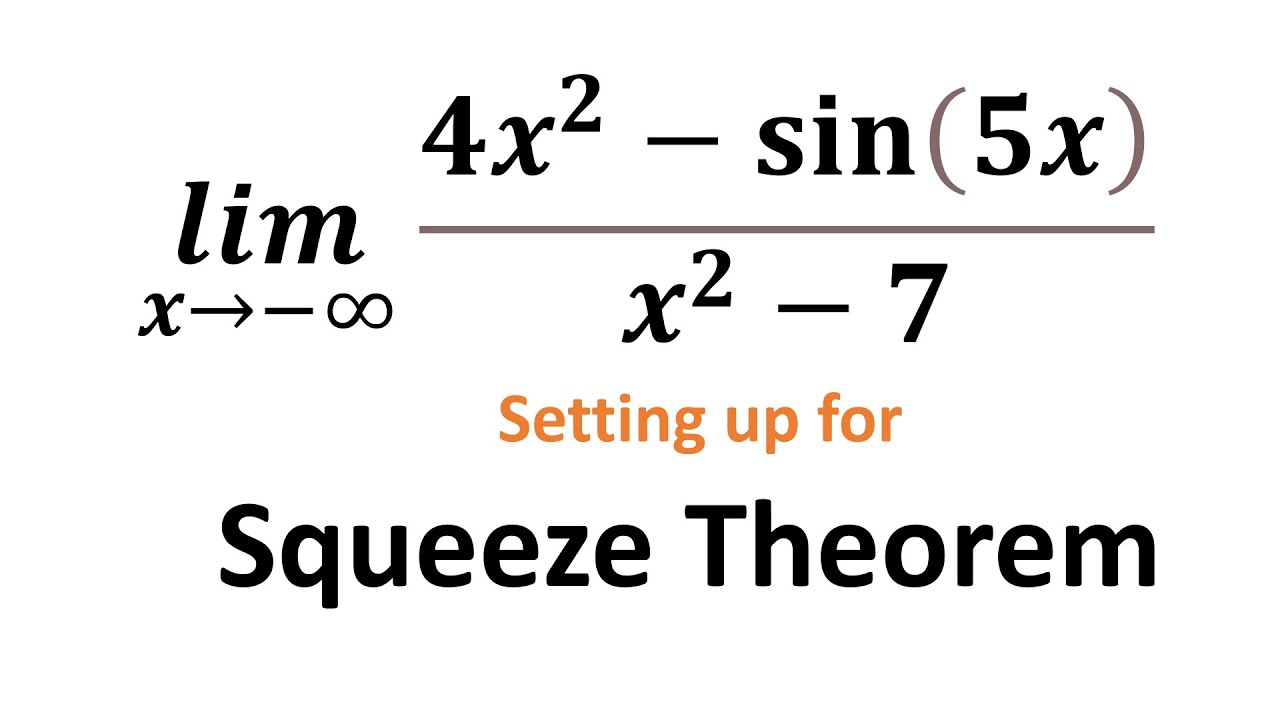
In this video, I showed how to find an appropriate setup for a limit problem requiring the squeeze theorem technique.
mortal aspen
faint gorge
https://www.youtube.com/watch?v=2attRllfd-g
damnn oh thnk god imma watch this now
faint gorge
mortal aspen
i will need to learn it from basics to understand this competitive shit properly
what's competitive
it's you vs you
mortal aspen
faint gorge
it's you vs you
like these questions is like competitive based questions
for us its separated like normal exams has easy questions but other part its tough
devout snowBOT
Available help channel!
Send your question here to claim the channel.
Remember:
• Ask your math question in a clear, concise manner.
• Show your work, and if possible, explain where you are stuck.
• After 15 minutes, feel free to ping <@&286206848099549185>.
• Type the command .close to free the channel when you're done.
• Be polite and have a nice day!
Read #❓how-to-get-help for further information on how to ask a good question, and about conduct in the question channels.
 honest trout
I am doing a grade 9 practise test and can anybody help me with giving the answers so I can check them with mine?
devout snowBOT
honest trout
I am doing a grade 9 practise test and can anybody help me with giving the answe...
honest trout


 faint hearth
honest trout
I am doing a grade 9 practise test and can anybody help me with giving the answe...
faint hearth
honest trout
I am doing a grade 9 practise test and can anybody help me with giving the answe...
!noans
devout snowBOT
honest trout
I am doing a grade 9 practise test and can anybody help me with giving the answe...
The purpose of this server is to help you learn, not to hand out answers. Do not ask someone to give you the answer directly.
faint gorge
honest trout
I am doing a grade 9 practise test and can anybody help me with giving the answe...
Can you show your answers 🙂

 thin basin
,rotate
woven radishBOT
 thin basin
this is correct
honest trout
thin basin
this is correct
thx
devout snowBOT
Please only use the <@&286206848099549185> ping once if your question has not been answered for 15 minutes. Please do not ping or DM individual users about your question.
thin basin
you can ping helpers after 15mins
honest trout
I am a patient person, I dont want to put you guys under presure after 15 min. This is free help....