1 messages · Page 273 of 1
 halcyon rivet
What is the generalisation of these formulae?
 devout snowBOT
halcyon rivet
What is the generalisation of these formulae?
devout snowBOT
halcyon rivet
What is the generalisation of these formulae?
 random helm
halcyon rivet
What is the generalisation of these formulae?
random helm
halcyon rivet
What is the generalisation of these formulae?
It's called Faulhaber's sum
 acoustic leaf
,w faulhaber's formula
 woven radishBOT


 Requested by cloudedhorizons
halcyon rivet
Requested by cloudedhorizons
halcyon rivet
Bernoulli numbers showed up here too
devout snowBOT
Closed by @halcyon rivet
Use .reopen if this was a mistake.
devout snowBOT
 Available help channel!
Send your question here to claim the channel.
Remember:
• Ask your math question in a clear, concise manner.
• Show your work, and if possible, explain where you are stuck.
• After 15 minutes, feel free to ping <@&286206848099549185>.
• Type the command .close to free the channel when you're done.
• Be polite and have a nice day!
Read #❓how-to-get-help for further information on how to ask a good question, and about conduct in the question channels.
 calm trout
Hullo, this is pretty simple math problem but I'm having trouble actually understanding how to solve this, I jus' need a clear step by step since i cant find a specific tutorial for smt like this.
I don't have any work to show yet because i have no idea what to do with the given
 devout snowBOT
calm trout
Hullo, this is pretty simple math problem but I'm having trouble actually unders...
devout snowBOT
calm trout
Hullo, this is pretty simple math problem but I'm having trouble actually unders...
 brisk raptor
calm trout
Hullo, this is pretty simple math problem but I'm having trouble actually unders...
brisk raptor
calm trout
Hullo, this is pretty simple math problem but I'm having trouble actually unders...
215 = (87.5 / 100) * total_books
so, 215 / (87.5 / 100) = toal_books
$215 = \frac{87.5}{100}t$, where $t = \text{total books}$
$\frac{215}{(\frac{87.5}{100})} = t$
Note, this is equivalent to: $215(\frac{100}{87.5}) = t$
woven radishBOT
Karma
 brisk raptor
woven radish
**Karma**
brisk raptor
woven radish
**Karma**
@calm trout
calm trout
brisk raptor
<@1019407821512650802>
hol up i'm reading it but thanks
brisk raptor
to clarify some things that might be confusing
Given some $p$, $p%$ is $\frac{p}{100}$. So, for $87%$, this is equivalent to $\frac{87}{100}$.
To find some $p%$ of a number $n$, its just $p%\cdot n$. For example, $40%$ of 100 is $\frac{40}{100}\cdot 100$
So, to answer the question "$80$ is $40%$ of what?" We realize that $\frac{40}{100} x$ is "$40%$ of what", and we know that is $80$, so we get the equality $80 = \frac{40}{100} x$
Solving for $x$, we multiply by the reciprocal, to cancel out the percentage on one side and leave us with only $x$.
E.g., $80 = \frac{40}{100} x$
$80\frac{100}{40} = x$
$x = 200$
woops
hang on
calm trout
oki
woven radishBOT
Karma
 brisk raptor
woven radish
**Karma**
brisk raptor
woven radish
**Karma**
fixed
devout snowBOT
Closed by @calm trout
Use .reopen if this was a mistake.
devout snowBOT
Available help channel!
Send your question here to claim the channel.
Remember:
• Ask your math question in a clear, concise manner.
• Show your work, and if possible, explain where you are stuck.
• After 15 minutes, feel free to ping <@&286206848099549185>.
• Type the command .close to free the channel when you're done.
• Be polite and have a nice day!
Read #❓how-to-get-help for further information on how to ask a good question, and about conduct in the question channels.
 restive river
My teacher told me I need to learn solving system of inequations with 2 tables and a axis plot. What she ment?
What is she talking about?
devout snowBOT
restive river
My teacher told me I need to learn solving system of inequations with 2 tables a...
restive river
Send me yt videos for everything
devout snowBOT
@restive river Has your question been resolved?
restive river
<@&286206848099549185>
 solid osprey
i guess she wants to plot it?
devout snowBOT
@restive river Has your question been resolved?
devout snowBOT
Closed due to timeout
Use .reopen if this was a mistake.
Available help channel!
Send your question here to claim the channel.
Remember:
• Ask your math question in a clear, concise manner.
• Show your work, and if possible, explain where you are stuck.
• After 15 minutes, feel free to ping <@&286206848099549185>.
• Type the command .close to free the channel when you're done.
• Be polite and have a nice day!
Read #❓how-to-get-help for further information on how to ask a good question, and about conduct in the question channels.
 lean rover
how do i solve this
 devout snowBOT
lean rover
how do i solve this
devout snowBOT
lean rover
how do i solve this
 narrow wigeon
What is 1+2 pls help i cannot figure it out
lean rover
3
lean rover
get a calculator
narrow wigeon
Idh google how to install
lean rover
too bad then
narrow wigeon
:(
solid osprey
narrow wigeon
What is 1+2 pls help i cannot figure it out
please dont troll, you could get a punishment from mods, cheers
lean rover

 modest dagger
narrow wigeon
:(
modest dagger
narrow wigeon
:(
You're muted for trolling. You can come back in a day. Don't do this kind of thing here.
 fossil locust
lean rover
fossil locust
lean rover
well when $n$ is odd, $P'(x) > 0$ for all real $x$
woven radishBOT
south, just south
 lean rover
fossil locust
well when $n$ is odd, $P'(x) > 0$ for all real $x$
lean rover
fossil locust
well when $n$ is odd, $P'(x) > 0$ for all real $x$
how do i prove it when it doesnt give me anything to start with
fossil locust
I think you have to use induction somehow
lean rover
what would my s(0) be
fossil locust
woven radish
**south, just south**
if you can prove the statement for $n = k$, then $P'(x)$ when $n = k + 1$ is just the same as $n = k$
woven radishBOT
south, just south
 lean rover
ah
fossil locust
lean rover
what would my s(0) be
I think this is incomplete though
lean rover
but how do i even get to that line of factorials
fossil locust
cause you need to prove the case where n is even as well
fossil locust
lean rover
but how do i even get to that line of factorials
wdym?
fossil locust
stop thinking about the entire problem
if you knew how to prove it already you wouldn't be asking
you definitely have to use the fact that $P(x) > e^x$ for $x < 0$ also
 frozen aurora
what does "multiple zeroes" mean? like several roots or roots with multiplicity?
woven radishBOT
south, just south
 fossil locust
for when n is even
lean rover
frozen aurora
what does "multiple zeroes" mean? like several roots or roots with multiplicity?
several roots
frozen aurora
i see
lean rover
should i just diff it
frozen aurora
woven radish
**south, just south**
yes, use this fact
lean rover
frozen aurora
yes, use this fact
why doesnt it work for when n is even
 lone ravine
lean rover
i still dk how to solve it
lone ravine
lean rover
i still dk how to solve it
This is how I would solve it:
•Show that P_(n+1)'(x) = P_n(x)
•Assume P_(2n)(x) > 0
•Conclude that P_(2n+1)'(x) has a unique root
•Conclude that it needs to be negative
•Consider P_(2n+2)-P_(2n+1)
•Conclude that P_(2n+2) is strictly positive
What do you think @fossil locust ?
lean rover
what does the _ mean
lone ravine
lean rover
what does the _ mean
Like an index notation. P_n should be the polynomial of degree n
Here you showed that the multiplicity of the roots if they exist is only 1.
Do you want to show that it has a unique root or that the degree of the roots is only 1?
Also why is x ≠ 0?
lean rover
lone ravine
Do you want to show that it has a unique root or that the degree of the roots is...
how do i show that
lone ravine
lean rover
and x^n ≠ 0
Well x^n = 0 <=> x= 0
lean rover
sorry what does that arrow mean
lone ravine
Is equivalent
lean rover
ah ig ur right
lone ravine
So your proof is missing the case if the root is x = 0. Or is it?
lone ravine
Yes, this needs to be considered
lean rover
and since it can only equal to 1
it doesnt have mujltiple roots cos x has to be equal to 0
lean rover
lone ravine
?
p(x)=p'(x)=0 is the only when it has multiple roots
p(x)-p'(x)=0
this only occurs when x=0
but when u sub x=0 into p(x)
u get 1
so it doesnt have multiple roots
lean rover
lone ravine
?
does that make sense
lone ravine
lean rover
so it doesnt have multiple roots
If you mean the degree of the roots is 0 then you're right. If you mean there is only one unique root then you need to do more work
lean rover
how do i do that
lone ravine
The first one is what you already have shown
lone ravine
lone ravine
This is how I would solve it:
•Show that P_(n+1)'(x) = P_n(x)
•Assume P_(2n)(x)...
The second one like that
lean rover
lone ravine
This is how I would solve it:
•Show that P_(n+1)'(x) = P_n(x)
•Assume P_(2n)(x)...
how do you just conclude it has a unique root
whats the properties for having a unique root
.close
devout snowBOT
Closed by @lean rover
Use .reopen if this was a mistake.
devout snowBOT
Available help channel!
Send your question here to claim the channel.
Remember:
• Ask your math question in a clear, concise manner.
• Show your work, and if possible, explain where you are stuck.
• After 15 minutes, feel free to ping <@&286206848099549185>.
• Type the command .close to free the channel when you're done.
• Be polite and have a nice day!
Read #❓how-to-get-help for further information on how to ask a good question, and about conduct in the question channels.
 prime lily
Hey, can someone explain the concept behind matrices because I don’t understand what they are
devout snowBOT
prime lily
Hey, can someone explain the concept behind matrices because I don’t understand ...
 magic thicket
A free course offering the core concept of linear algebra with a visuals-first approach.

 devout snowBOT
@prime lily Has your question been resolved?
devout snowBOT
Closed due to timeout
Use .reopen if this was a mistake.
Available help channel!
Send your question here to claim the channel.
Remember:
• Ask your math question in a clear, concise manner.
• Show your work, and if possible, explain where you are stuck.
• After 15 minutes, feel free to ping <@&286206848099549185>.
• Type the command .close to free the channel when you're done.
• Be polite and have a nice day!
Read #❓how-to-get-help for further information on how to ask a good question, and about conduct in the question channels.
 sour spire
guys how to do b?
 devout snowBOT
sour spire
guys how to do b?
sour spire
devout snowBOT
sour spire
guys how to do b?
sour spire
.close
devout snowBOT
Closed by @sour spire
Use .reopen if this was a mistake.
devout snowBOT
Available help channel!
Send your question here to claim the channel.
Remember:
• Ask your math question in a clear, concise manner.
• Show your work, and if possible, explain where you are stuck.
• After 15 minutes, feel free to ping <@&286206848099549185>.
• Type the command .close to free the channel when you're done.
• Be polite and have a nice day!
Read #❓how-to-get-help for further information on how to ask a good question, and about conduct in the question channels.
 umbral creek
I'm confused about where to find the t-critical value for planned comparisons
devout snowBOT
umbral creek
I'm confused about where to find the t-critical value for planned comparisons
devout snowBOT
@umbral creek Has your question been resolved?
devout snowBOT
@umbral creek Has your question been resolved?
devout snowBOT
Closed due to timeout
Use .reopen if this was a mistake.
Available help channel!
Send your question here to claim the channel.
Remember:
• Ask your math question in a clear, concise manner.
• Show your work, and if possible, explain where you are stuck.
• After 15 minutes, feel free to ping <@&286206848099549185>.
• Type the command .close to free the channel when you're done.
• Be polite and have a nice day!
Read #❓how-to-get-help for further information on how to ask a good question, and about conduct in the question channels.
 sudden slate
can i get the monotonic behavior of a function through algebra or do i have to use a graph or to plug in values to check
devout snowBOT
sudden slate
can i get the monotonic behavior of a function through algebra or do i have to u...
 static ember
that heavily depends on the functions itself, but mostly algebra or calculus is the only way to prove it rigurously. Looking at the graph or plugging in values just helps you understand the function a little better but it cannot replace a proof
woven radishBOT
Luh Roub
 static ember
that heavily depends on the functions itself, but mostly algebra or calculus is ...
static ember
static ember
that heavily depends on the functions itself, but mostly algebra or calculus is ...
(or btw plugging in values can certainly disprove that it's monotone)
sudden slate
I can ez say its behavior from a graph
Or by getting first deriv and plug in

Is there another way tho
static ember
yeah, whats the first derivative?
sudden slate
$x^2+2x$
woven radishBOT
Luh Roub
 sudden slate

static ember
now I guess you already determined the critical points to be -2 and 0
sudden slate
yea
static ember
if we take a look at the second derivative now, it's 2x+2. Plugging in our critical points, we see that at -2 is a maximum and at 0 is a minimum
now on the interval [-2, 0] from the maximum to the minimum, what can you say about the monotonicity?
static ember
yeah it just has to, right?
I'd just say that whenever going from a max to a min, its falling, and when going from a min to a max, its rising. Just make sure there is no critical point inbetween
sudden slate
eggsachly what im saying
Well
If theres only 2 answers (-2 and 0)
Then its only 2 crit points
if there are more answers than its a diff situation innit
static ember
yeah, now anything you can say about (-inf, -2] and [0, inf)?
sudden slate
rising
can you also teach me those [] notations
I dont understand it if theres an asymptote in the function
Also dont we have to define the domain for a function?
static ember
those are intervals. If we include asymptotes and holes in the domain that will make this whole thing a bit more complicated
[a, b] are all the points from a to b, including a and b itself
(a, b) are all the points from a to b, not including a and b
static ember
oh thats just different notation. Means the same as (a, b]
this will not include a but include b
static ember
yeah
static ember
infty
woven radishBOT
Luh Roub
 woven radishBOT
Luh Roub
 sudden slate
Innit
static ember
yeah
sudden slate
Then raising for $[0, \infty[$
woven radishBOT
Luh Roub
 woven radishBOT
Luh Roub
 sudden slate

static ember
ok now what is the domain?
sudden slate
$D=\mathbb R \ {3}$
woven radishBOT
Luh Roub
 woven radishBOT
sudden slate
woven radishBOT
sudden slate
$-\frac{5}{(x-3)^2}$
woven radishBOT
Luh Roub
 static ember
any critical points?
static ember
yeah theres none
but still be careful with the holes in the domain
we gotta figure out their asymptotic behavior now
sudden slate
I agree
static ember
can you figure out the left side and right side limits?
sudden slate
,w lim x to 3 of 5/(x-3)
static ember
need to know how it behaves at 3
woven radishBOT
woven radishBOT
sudden slate
,w lim x to 3+ of 5/(x-3)
woven radishBOT
static ember
so if it goes to -inf and theres no critical points, what can you say about (-inf, 3)?
sudden slate
hm
Ik its falling but idk why
Oh wait
its negative infin
so its going down
falling
static ember
well if it was rising, that cant be, because any point you chose, you can always pick a lower point thats to the right. And if it was neither, then there would have to be a critical point
and what can you say about (3, inf)?
sudden slate
falling?
static ember
yeah
 clever zephyr
can i help you
sudden slate
sure
static ember
see now you figured out the behavior without even looking at the graph
sudden slate
||(I visualized it)||
clever zephyr
what problem?
sudden slate
what ab notation tho
clever zephyr
I like the math
sudden slate
clever zephyr
what problem?
monotonic behavior
clever zephyr
just a minute
static ember
but you could've without
sudden slate
static ember
well if it was rising, that cant be, because any point you chose, you can always...
can we uh
repeat that section?
static ember
repeat?
clever zephyr
critical point equal 3, damn what is your want
sudden slate
static ember
repeat?
didnt exactly understand what was said fr
static ember
just a little reasoning why it has to be falling. It cannot be rising because, well it goes to negative infinity. So whenever you choose any point, then because of that, there is some point to the right that is below, disproving that it's rising. Like take f(2) = -5, then because of the limit, we can just choose some point that is close to 3, like f(2.99) = -500 and we are sure below -5. And it also cannot be neither rising or falling, because then there would be another critical point
static ember
similar reasoning, like going from right to left, it goes to infinity, we can see that it has to be rising when going from right to left, so it's falling when going from left to right
devout snowBOT
@sudden slate Has your question been resolved?
devout snowBOT
@sudden slate Has your question been resolved?
devout snowBOT
@sudden slate Has your question been resolved?
sudden slate
.close
devout snowBOT
Closed by @sudden slate
Use .reopen if this was a mistake.
devout snowBOT
Available help channel!
Send your question here to claim the channel.
Remember:
• Ask your math question in a clear, concise manner.
• Show your work, and if possible, explain where you are stuck.
• After 15 minutes, feel free to ping <@&286206848099549185>.
• Type the command .close to free the channel when you're done.
• Be polite and have a nice day!
Read #❓how-to-get-help for further information on how to ask a good question, and about conduct in the question channels.
 north rivet
 devout snowBOT
north rivet
north rivet
north rivet
devout snowBOT
north rivet
north rivet
north rivet
helpppppppppppp
 wheat pawn
draw the probability tree?
devout snowBOT
@north rivet Has your question been resolved?
devout snowBOT
Closed due to timeout
Use .reopen if this was a mistake.
Available help channel!
Send your question here to claim the channel.
Remember:
• Ask your math question in a clear, concise manner.
• Show your work, and if possible, explain where you are stuck.
• After 15 minutes, feel free to ping <@&286206848099549185>.
• Type the command .close to free the channel when you're done.
• Be polite and have a nice day!
Read #❓how-to-get-help for further information on how to ask a good question, and about conduct in the question channels.
 gritty hare
<@&286206848099549185>
devout snowBOT
gritty hare
<@&286206848099549185>
gritty hare
Can yall please help me with 11-15 thankyou

 supple knot
gritty hare
<@&286206848099549185>
supple knot
gritty hare
<@&286206848099549185>
!15m
devout snowBOT
gritty hare
<@&286206848099549185>
Please only use the <@&286206848099549185> ping once if your question has not been answered for 15 minutes. Please do not ping or DM individual users about your question.
 rustic laurel
,rotate
woven radishBOT
 devout snowBOT
@gritty hare Has your question been resolved?
gritty hare
 golden flower
y=kx
golden flower
y=kx
Yes
golden flower
when y = 8 then x = -2
what do u do
you're still trying to find k right
so what do u do to y= kx
devout snowBOT
@gritty hare Has your question been resolved?
gritty hare
Divide
devout snowBOT
Closed due to timeout
Use .reopen if this was a mistake.
Available help channel!
Send your question here to claim the channel.
Remember:
• Ask your math question in a clear, concise manner.
• Show your work, and if possible, explain where you are stuck.
• After 15 minutes, feel free to ping <@&286206848099549185>.
• Type the command .close to free the channel when you're done.
• Be polite and have a nice day!
Read #❓how-to-get-help for further information on how to ask a good question, and about conduct in the question channels.
 steady shuttle
I have found a2 and I’m not sure where to go from here

 devout snowBOT
steady shuttle
I have found a2 and I’m not sure where to go from here
devout snowBOT
steady shuttle
I have found a2 and I’m not sure where to go from here
@steady shuttle Has your question been resolved?
devout snowBOT
@steady shuttle Has your question been resolved?
devout snowBOT
@steady shuttle Has your question been resolved?
devout snowBOT
Closed due to timeout
Use .reopen if this was a mistake.
devout snowBOT
Available help channel!
Send your question here to claim the channel.
Remember:
• Ask your math question in a clear, concise manner.
• Show your work, and if possible, explain where you are stuck.
• After 15 minutes, feel free to ping <@&286206848099549185>.
• Type the command .close to free the channel when you're done.
• Be polite and have a nice day!
Read #❓how-to-get-help for further information on how to ask a good question, and about conduct in the question channels.
 wanton plume
 devout snowBOT
wanton plume
woven radishBOT
devout snowBOT
wanton plume
woven radishBOT
chofmus
 wanton plume
but i'm not sure how to relate that to the question
wanton plume
yes
 torn bane
maybe my question is vague, it describes the number of times an event needs to happen to get a successful event, e.g. number of dice rolls until you get a 6
so what does the event {Y>a) represent?
wanton plume
the combined probability greater than a
torn bane
i mean the event, not the probability
wanton plume
i am not sure about that
torn bane
well think about what Y is, it's the number of attempts you need before success, if it is greater than a, that means you have to have failed at least a times
torn bane
alright, so what is the probability of failing a times in a row
wanton plume
it's failure vs success right?
torn bane
err yes? not quite sure what you are asking
torn bane
right, they are compliments
wanton plume
so 0.5^a?
torn bane
where'd you get 0.5 from
wanton plume
50% odds?
torn bane
but you have probability of success p and probability of failure q?
torn bane
wanton plume
so 0.5^a?
this is almost right, just replace 0.5 with q
wanton plume
i see
torn bane
ok so then we've shown that the probability of failure a times in a row is q^a which is precisely the event that we have a success after at least a attempts
or in symbols, P(Y>a) = q^a
torn bane
err i thought that was what we were doing this whole time
torn bane
can you elaborate
wanton plume
well we defined what Y is
then the probability of failing a times in a row
which means we have proved it?
wanton plume
the proof feels a bit weak?
torn bane
which part do you think is incorrect
wanton plume
i don't think it is necessarily incorrect but it only relies on the inital statement to prove itself
torn bane
what initial statement
wanton plume
P(Y>a)=q^a
torn bane
yes, as i said at the beginning
devout snowBOT
@wanton plume Has your question been resolved?
Closed by @wanton plume
Use .reopen if this was a mistake.
Available help channel!
Send your question here to claim the channel.
Remember:
• Ask your math question in a clear, concise manner.
• Show your work, and if possible, explain where you are stuck.
• After 15 minutes, feel free to ping <@&286206848099549185>.
• Type the command .close to free the channel when you're done.
• Be polite and have a nice day!
Read #❓how-to-get-help for further information on how to ask a good question, and about conduct in the question channels.
 timid peak
 devout snowBOT
timid peak
timid peak
devout snowBOT
timid peak
timid peak

 wicked turtle
what is your question?
wicked turtle
they seem correct, what is the issue?
timid peak
yea
beacuse its saying cmin(x,y) if x is min, then 0<x<y<1, and if y is min then its 0<y<x<1
oh
I see
im gonna send a picture, I think I get it?

I don’t think it matters if you switch order of integration
like if you do dxdy instead
ok
nvm😅
integration is still integration
doesnt matter if its used in stats or not
timid peak
wicked turtle
(your screenshot)
the picture, yea?
wicked turtle
timid peak
^ this one
timid peak
thank you

Im confused about this one

I dont get their bounds
im gonna send a picture of what I think it should be?

I also dont understand why they got rid of the 3y and 3x in the solution
@wicked turtle
I just calculated my integral, its right, I get the same solution
I think just typos in the solution provided
.close
devout snowBOT
Closed by @timid peak
Use .reopen if this was a mistake.
devout snowBOT
Available help channel!
Send your question here to claim the channel.
Remember:
• Ask your math question in a clear, concise manner.
• Show your work, and if possible, explain where you are stuck.
• After 15 minutes, feel free to ping <@&286206848099549185>.
• Type the command .close to free the channel when you're done.
• Be polite and have a nice day!
Read #❓how-to-get-help for further information on how to ask a good question, and about conduct in the question channels.
 hollow walrus
 devout snowBOT
hollow walrus
hollow walrus
devout snowBOT
hollow walrus
hollow walrus
Can I get a walkthrough on how to prove this?
it involves rational root theorem and integer root theorem
<@&286206848099549185>
devout snowBOT
@hollow walrus Has your question been resolved?
hollow walrus
<@&286206848099549185>
devout snowBOT
@hollow walrus Has your question been resolved?
Closed by @hollow walrus
Use .reopen if this was a mistake.
Available help channel!
Send your question here to claim the channel.
Remember:
• Ask your math question in a clear, concise manner.
• Show your work, and if possible, explain where you are stuck.
• After 15 minutes, feel free to ping <@&286206848099549185>.
• Type the command .close to free the channel when you're done.
• Be polite and have a nice day!
Read #❓how-to-get-help for further information on how to ask a good question, and about conduct in the question channels.
 worldly pewter
I would like to know if there are any problems in my direct proof for the sequential criterion of limits.
 devout snowBOT
worldly pewter
I would like to know if there are any problems in my direct proof for the sequen...
devout snowBOT
worldly pewter
I would like to know if there are any problems in my direct proof for the sequen...
 uncut crow
weird labeling
worldly pewter
yeah…its an uncountable set so can only be labeled like this...
uncut crow
why label it at all 
just take an arbitrary sequence
i would also like to see the statement of what you're proving before i say anything
worldly pewter

 balmy carbon
worldly pewter
balmy carbon
worldly pewter
I sorta guessed that from the proof xD
yea I'm with slayla on this one, the labelling is quite unnecessary
balmy carbon
worldly pewter
and by the way this is an if and only if so make it go both ways
that's from my man rudin
 balmy carbon
yes you are right
for this direction you can use contradiction for a very slick proof that doesn't require any labels
proofs of contradiction always blow my mind
balmy carbon
xD
I see
why does the union form an open cover though
my main issue when i tried to prove this directly was that, if you are past some N that all your sequence elements are within an epsilon of L that doesn't mean that another point in the input set will satisfy the same rule. so you gotta prove somehow that there is a delta for which every x inside is one of the elements of a sequence and is far enough in that sequence that it's less than an epsilon apart
there is also something else interesting about your proof, you showed that delta = 1 will always work for any limit if i'm not mistaken
we can come with counter examples to that though
simplest would be f(x) = x and take any limit where epsilon is much less than one and delta would be forced to be the same as epsilon or lower
devout snowBOT
@worldly pewter Has your question been resolved?
worldly pewter
Hmm let me think a bit…
balmy carbon
worldly pewter
Hmm let me think a bit…
take your time 👀
worldly pewter
I think the problem lies in the step of open cover
It doesnt seem to guarantee coverage of the entire interval
worldly pewter
balmy carbon
there is also something else interesting about your proof, you showed that delta...
I think the intersection for λ will guarantee convergent for f(x), not 1
but is it guaranteed to be non-empty and open? o.o
balmy carbon
worldly pewter
but is it guaranteed to be non-empty and open? o.o
the set you created is non-empy and open yes
but I don't see why it covers (x0-1,x0+1) that's the first, i also don't know why is it necessary for a lambda to exist and guarantee that x is in one of the sequences
worldly pewter
balmy carbon
the set you created is non-empy and open yes
Might not be? Cause inf(delta^lambda) might be 0 tho…
balmy carbon
worldly pewter
Might not be? Cause inf(delta^lambda) might be 0 tho…
it's one of the most occuring scenarios usually when trying to go the direct way in limits is that inf delta in general may or may not be zero and then the proof stops
worldly pewter
D:
balmy carbon
I know because most of these proofs when I did for the first time I did it your way xD
I was really always thinking in terms of direct proofs but I then realized that overcomplicated things
someones I was able to prove (very long proof), and others I got stuck
one of the proofs which is gonna confuse you so much if you try to prove it directly is the proof that every K-cell in R^k is compact.
I spent days on this proof only to realize it's less than half a page by contradiction
usually when going about a proof don't try to just write down the symbols and make it flow, try to imagine how the solution would make sense first then you translate your imagination into mathematics.
how can you guarantee that the set of all sequences in a set are dense enough that for every epsilon there is a delta such that every x in a neighborhood of delta around x0 must be in one of those sequences and must be at an n large enough to have |f(xn)-L| < epsilon
worldly pewter
balmy carbon
how can you guarantee that the set of all sequences in a set are dense enough th...
Hmm does the axiom of choice guarantee that there exists at least one sequence and a n such that x_n=x? However x_n guarantees f(x_n) - L < epsilon is uncertain unless we choose x to be in the intersection, but this will result in inf=0 again D:
balmy carbon
axiom of choice would guarantee that each sequence is mapped to an element of that sequence, but how do you know that the sequence as a whole exists for each x
actually it makes sense you can cook some sequence that has x in it
worldly pewter
balmy carbon
I spent days on this proof only to realize it's less than half a page by contrad...
That is pain. D: At least it will be very rewarding once its proven
balmy carbon
but indeed the issue wouldn't be finding a sequence rather that making sure it gets you close to epsilon xD
worldly pewter
fr
balmy carbon
you can like define any random sequence that approaches L that replace one element of it with x
balmy carbon
worldly pewter
That is pain. D: At least it will be very rewarding once its proven
it is. and I get chills from proofs by contradiction now xD
abusing it so hard
worldly pewter
Hahaha
balmy carbon
xD
worldly pewter
Anyway thank you for your help!! I will try other approaches and hope I can find an effective method ;p
balmy carbon
worldly pewter
Anyway thank you for your help!! I will try other approaches and hope I can find...
more than happy to help ^ ^
balmy carbon
worldly pewter
Anyway thank you for your help!! I will try other approaches and hope I can find...
Love to see people playing with it like you
this is truely the way to learn properly
devout snowBOT
@worldly pewter Has your question been resolved?
devout snowBOT
Closed by @worldly pewter
Use .reopen if this was a mistake.
devout snowBOT
Available help channel!
Send your question here to claim the channel.
Remember:
• Ask your math question in a clear, concise manner.
• Show your work, and if possible, explain where you are stuck.
• After 15 minutes, feel free to ping <@&286206848099549185>.
• Type the command .close to free the channel when you're done.
• Be polite and have a nice day!
Read #❓how-to-get-help for further information on how to ask a good question, and about conduct in the question channels.
 sick leaf
Bit stuck on here. Why does it have to be 2pi/3?

 devout snowBOT
sick leaf
Bit stuck on here. Why does it have to be 2pi/3?
sick leaf
devout snowBOT
sick leaf
Bit stuck on here. Why does it have to be 2pi/3?
sick leaf

Because if my calculations are right then cosine should be a positive and thus 4th quadrant
 gentle crow
sick leaf
Bit stuck on here. Why does it have to be 2pi/3?
gentle crow
sick leaf
Bit stuck on here. Why does it have to be 2pi/3?
Because tan(2π/3) = -√3
sick leaf
gentle crow
Because tan(2π/3) = -√3
Sorry but where does the -√3 come from again?
gentle crow
sick leaf
Sorry but where does the -√3 come from again?
Because trigonometric functions are periodic
It means same value repeats infinity of times
sick leaf
gentle crow
Because trigonometric functions are periodic
Yeah but in that case doesn't the 4th quadrant also work?
i.e. 5pi/3
gentle crow
sick leaf
Yeah but in that case doesn't the 4th quadrant also work?
Nope
Because
tan(a) is positive in 4th quadrant
sick leaf
gentle crow
tan(a) is positive in 4th quadrant
Ain't that cosine?
gentle crow
sick leaf
Ain't that cosine?
Ys cosine is -ve in 4th quadrant
sick leaf
gentle crow
Ys cosine is -ve in 4th quadrant
Brother are we talking about ASTC quadrant or another quadrant
gentle crow
sick leaf
Brother are we talking about ASTC quadrant or another quadrant
Yes
Check dm, I have sent u something that helps
sick leaf
gentle crow
Yes
Pretty sure cosine is a +ve in the 4th quadrant though
 gentle crow
sick leaf
Pretty sure cosine is a +ve in the 4th quadrant though
gentle crow
sick leaf
Pretty sure cosine is a +ve in the 4th quadrant though
Ohh sry
It is negative yes
sick leaf
sick leaf
Anyways back to this
If my calculation is not wrong, at least for the cosine it should be a positive bc sqrt(3) / sqrt(12) >0 and sine should be a negative bc -3/sqrt(12)
gentle crow
Nope
gentle crow
sick leaf
Anyways back to this
If my calculation is not wrong, at least for the cosine it...
Mistakes are part of our life
BTW I can solve all ques
sick leaf
gentle crow
Mistakes are part of our life
TBH that's probably the last semi-major question I have before my exam
So yeah
I am quite interested to know what 5pi/3 wouldn't work
Like I can see why 2pi/3
But my main issue is the positive cosine
Because 2pi/3 is in the 2nd quad which is negative for cosine
gentle crow
sick leaf
Bit stuck on here. Why does it have to be 2pi/3?
Actually I was solving for this
sick leaf
gentle crow
Idk what to do whis this, can u clarify
Well it's basically reference why I got 5pi/3
Bc the cosine is given at postitive according to my step
sick leaf
I just reference other sources (this is a past paper) and they also got 5pi/3
gentle crow
Yaa
sick leaf
It could be that the publisher got something wrong
gentle crow
(x-60degrees) = (x+300degrees)
gentle crow
gentle crow
(x-60degrees) = (x+300degrees)
If u confuse then u can take any value of x (like x=90degrees)
sick leaf
gentle crow
(x-60degrees) = (x+300degrees)
That's probably why
But tbh 5pi/3 is also a correct value then
Or at least in an exam I have enough proof to say that 5pi/3 is an acceptable value
gentle crow
Yes
gentle crow
sick leaf
Or at least in an exam I have enough proof to say that 5pi/3 is an acceptable va...
It is acceptable
gentle crow
Bsc if we complete a full round then it has no affect on value of function
Like tan(90) = tan(2π+90)
sick leaf
Yeah and even we have a postitive cosine
lol
Anyways thanks for comfirming that I am indeed not tripping
Exam's in 9 hours time
devout snowBOT
Closed by @sick leaf
Use .reopen if this was a mistake.
devout snowBOT
Available help channel!
Send your question here to claim the channel.
Remember:
• Ask your math question in a clear, concise manner.
• Show your work, and if possible, explain where you are stuck.
• After 15 minutes, feel free to ping <@&286206848099549185>.
• Type the command .close to free the channel when you're done.
• Be polite and have a nice day!
Read #❓how-to-get-help for further information on how to ask a good question, and about conduct in the question channels.
 mighty birch
Hi! I have the following problem:
Show that cos(x), cos(2x), ... , cos(nx) are linearly independent as elements of the vector space of all real functions. How do I prove this?
devout snowBOT
mighty birch
Hi! I have the following problem:
Show that cos(x), cos(2x), ... , cos(nx) are ...
 finite helm
There is an expression that arises from euler's identity that gives you multiple angle formulas. You can use that to show that cos(nx) is a polynomial of degree n in cos(x)
 dense lynx
mighty birch
Hi! I have the following problem:
Show that cos(x), cos(2x), ... , cos(nx) are ...
dense lynx
mighty birch
Hi! I have the following problem:
Show that cos(x), cos(2x), ... , cos(nx) are ...
is this supposed to specify even functions
mighty birch
finite helm
There is an expression that arises from euler's identity that gives you multiple...
Ahh right thanks, I can try that but we haven't officially done Euler's identity yet
mighty birch
dense lynx
is this supposed to specify even functions
Oh, no it's x, 2x, 3x etc my bad!
dense lynx
oh no you are fine. i just cannot read. apparently
finite helm
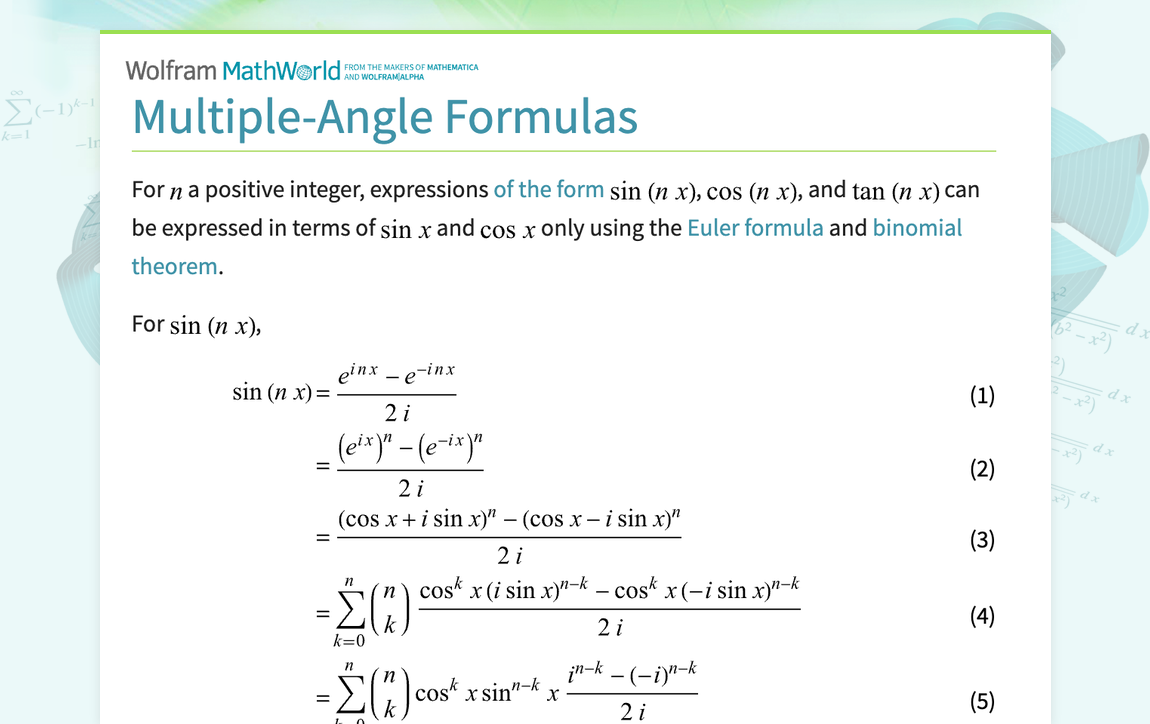
For n a positive integer, expressions of the form sin(nx), cos(nx), and tan(nx) can be expressed in terms of sinx and cosx only using the Euler formula and binomial theorem. For sin(nx), sin(nx) = (e^(inx)-e^(-inx))/(2i) (1) = ((e^(ix))^n-(e^(-ix))^n)/(2i) (2) = ((cosx+isinx)^n-(cosx-isinx)^n)/(2i) (3) = sum_(k=0)^(n)(n; k)(cos^kx(isinx)^(...
mighty birch
finite helm
This thing
https://mathworld.wolfram.com/Multiple-AngleFormulas.html
Uuuu thank you!
.close
devout snowBOT
Closed by @mighty birch
Use .reopen if this was a mistake.
devout snowBOT
Available help channel!
Send your question here to claim the channel.
Remember:
• Ask your math question in a clear, concise manner.
• Show your work, and if possible, explain where you are stuck.
• After 15 minutes, feel free to ping <@&286206848099549185>.
• Type the command .close to free the channel when you're done.
• Be polite and have a nice day!
Read #❓how-to-get-help for further information on how to ask a good question, and about conduct in the question channels.
 scarlet fulcrum
 devout snowBOT
scarlet fulcrum
scarlet fulcrum
devout snowBOT
scarlet fulcrum
scarlet fulcrum
How do I set up 17-18 into a system of equations
I'm assuming 17 will become a 2x2 matrix and 18 is a 3x3 matrix
devout snowBOT
@scarlet fulcrum Has your question been resolved?
fossil locust
scarlet fulcrum
How do I set up 17-18 into a system of equations
Let round trips of 10 ton truck = x
round trips of 12 ton truck = y
can you set up an expression for the total capacity of the trucks in terms of x and y
then set equal to 226, that's 1 of the equations
the other equation is actually just x + y = 20
fossil locust
well what's the capacity if the 10 ton truck does x trips?
fossil locust
scarlet fulcrum
10x+12y=226?
yes!
fossil locust
the strategy is to reduce it down to 2 variables
scarlet fulcrum
uhhh
we have never learned that way
Oh are you talking about gauss elimination
fossil locust
yeah you need 2 more equations
fossil locust
scarlet fulcrum
Oh are you talking about gauss elimination
yeah
but anyway focus on the equations first, writing them out mathematically
fossil locust
scarlet fulcrum
yea I know GE GJ cramers rule and inverse
oh damn I see, so your problem isn't with calculation but with the word problems
ahhhh
fossil locust
scarlet fulcrum
4x+5y+3.5z=173.75
this should be (4x + 5y + 3.5z)/100 = 173.75
scarlet fulcrum
last one is y=x+70
fossil locust
cause it's 4% not 4
fossil locust
and yeah fix your last equation
it's 70 not 40
but also you haven't used the 5% and 4% information
the money in the 5% account is y
the interest in the 5% is not y
fossil locust
scarlet fulcrum
okay wait I don't like money I'm lost
the interest is just 5/100 * y
scarlet fulcrum
(5y+70)/100=4x
fossil locust
ah nearly, so 5y/100 - 70 = 4x/100
scarlet fulcrum
Oh yeah the 70 can't be with the fraction
fossil locust
yeah
fossil locust
interest of y - 70 dollars = interest of x
fossil locust
scarlet fulcrum
because it's 70$ more
well if 170 is 70 more than 100
then 170 + 70 is not 100
170 - 70 = 100
scarlet fulcrum
Okay thank you
I'll solve these on the way to school I have the test first period
fossil locust
no worries
devout snowBOT
Closed due to timeout
Use .reopen if this was a mistake.
scarlet fulcrum
Thank you
fossil locust
npnp
devout snowBOT
Available help channel!
Send your question here to claim the channel.
Remember:
• Ask your math question in a clear, concise manner.
• Show your work, and if possible, explain where you are stuck.
• After 15 minutes, feel free to ping <@&286206848099549185>.
• Type the command .close to free the channel when you're done.
• Be polite and have a nice day!
Read #❓how-to-get-help for further information on how to ask a good question, and about conduct in the question channels.
sour spire
Guys, why is b wrong?
 devout snowBOT
sour spire
Guys, why is b wrong?
devout snowBOT
sour spire
Guys, why is b wrong?
 faint gorge
sour spire
Guys, why is b wrong?
faint gorge
sour spire
Guys, why is b wrong?
the vertex is (4,-9) however your parabola is defined for x < 3
sour spire
faint gorge
the vertex is (4,-9) however your parabola is defined for x < 3
Ohhhh
I’ll try again
Thanku so much
faint gorge
Thanksu too dinosaur
sour spire
faint gorge
Thanksu too dinosaur

faint gorge
A quick drawing could help you deduce the range
since you know the vertex
it's open upwards
sour spire
ohh
okay okay
but i have to find the range by substituting the 3 to x in f(x) right
can we find it by other easier method?
 sand dove
I don't think so... a being positive, the quadratic function decreases before passing through the vertex, and increases afterwards
since your domain is to the left of the vertex, you're due to find the infimum at the right (supremum) of your domain
devout snowBOT
@sour spire Has your question been resolved?
sour spire
sand dove
I don't think so... a being positive, the quadratic function decreases before pa...
ohhh
sour spire
sand dove
since your domain is to the left of the vertex, you're due to find the infimum a...
okaay thank you so much!
devout snowBOT
Closed by @sour spire
Use .reopen if this was a mistake.
devout snowBOT
Available help channel!
Send your question here to claim the channel.
Remember:
• Ask your math question in a clear, concise manner.
• Show your work, and if possible, explain where you are stuck.
• After 15 minutes, feel free to ping <@&286206848099549185>.
• Type the command .close to free the channel when you're done.
• Be polite and have a nice day!
Read #❓how-to-get-help for further information on how to ask a good question, and about conduct in the question channels.
 torn fog
question is:
force F has a component Fu along the u-axis of 6 kN
what is F, and Fv along the v-axis?
(A) F = 3105.8N Fv = 4392.3N
(B) F = 4242.6N Fv = 4242.6N
(C) F = 8485.3N Fv = 4242.6N
answer: A
i solved the question but one method is incorrect. i presume its because you cant use trigonometric functions in non-right triangles, but WHY cant you do that in this case?

 devout snowBOT
torn fog
question is:
force F has a component Fu along the u-axis of 6 kN
what is F, and ...
devout snowBOT
torn fog
question is:
force F has a component Fu along the u-axis of 6 kN
what is F, and ...
 proud perch
torn fog
question is:
force F has a component Fu along the u-axis of 6 kN
what is F, and ...
proud perch
torn fog
question is:
force F has a component Fu along the u-axis of 6 kN
what is F, and ...
because it's not a right triangle? lol?
torn fog
but if u just look at this, why isnt Fu = cos45*F? why do the axes need to be perpendicular for that to be true?

like why do the axes have an influence on that, if im making sense
proud perch
what does cosine mean?
remember SohCahToa
if you assert that Fu = cos(45) F, then you're saying that:
Fu/F = adj/hyp
F is not a hypotenuse
devout snowBOT
@torn fog Has your question been resolved?
torn fog
proud perch
F is not a hypotenuse
ah yeah alright makes sense, ty!
devout snowBOT
Closed by @torn fog
Use .reopen if this was a mistake.
Available help channel!
Send your question here to claim the channel.
Remember:
• Ask your math question in a clear, concise manner.
• Show your work, and if possible, explain where you are stuck.
• After 15 minutes, feel free to ping <@&286206848099549185>.
• Type the command .close to free the channel when you're done.
• Be polite and have a nice day!
Read #❓how-to-get-help for further information on how to ask a good question, and about conduct in the question channels.
restive river
Find the remainder when 10! is divided by 11
devout snowBOT
restive river
Find the remainder when 10! is divided by 11
 valid silo
you know modulo?
restive river
yes
valid silo
yk inverse modulo a prime?
valid silo
a*b=1(mod p)
restive river
yes
valid silo
notice 2*6 = 1 mod 11
restive river
yes
valid silo
in that way 2 and 6 are inverse
restive river
do I just form pairs of numbers?
valid silo
yes
valid silo
almost
restive river
anyways
valid silo
some numbers have delf inverse
restive river
thanks
restive river
valid silo
some numbers have delf inverse
delf?
devout snowBOT
Closed by @waxen crag
Use .reopen if this was a mistake.
devout snowBOT
Available help channel!
Send your question here to claim the channel.
Remember:
• Ask your math question in a clear, concise manner.
• Show your work, and if possible, explain where you are stuck.
• After 15 minutes, feel free to ping <@&286206848099549185>.
• Type the command .close to free the channel when you're done.
• Be polite and have a nice day!
Read #❓how-to-get-help for further information on how to ask a good question, and about conduct in the question channels.
 split shard
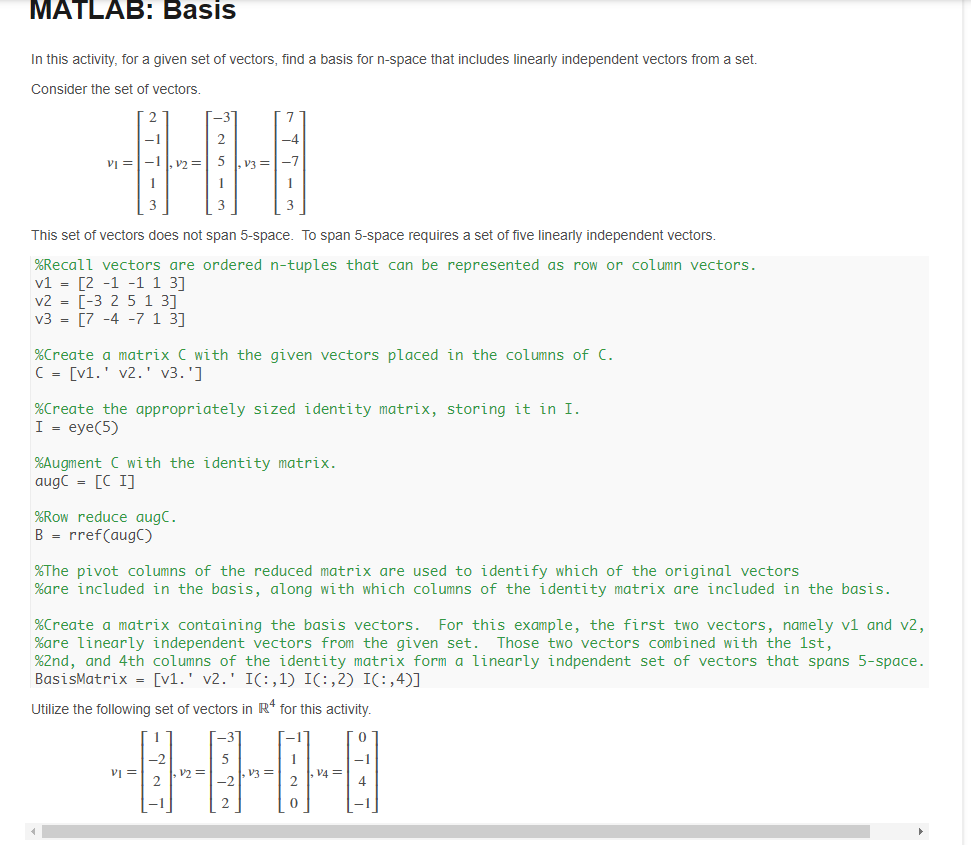
I'm doing something wrong here since it's telling me BasisMatrix is incorrect.
I got no idea what the issue is though.
% Enter vectors v1, v2, v3, and v4
v1 = [1 -2 2 -1];
v2 = [-3 5 -2 2];
v3 = [-1 1 2 0];
v4 = [0 -1 4 -1];

% Create a matrix A with the given vectors placed in the columns of A
A = [v1.' v2.' v3.' v4.'];

% Create the appropriately sized identity matrix
I = eye(4);

% Augment A with the identity matrix
augA = [A I];

% Row reduce augA
reduced_augA = rref(augA);

pivot_columns = find(any(reduced_augA(:, 1:4), 1));

BasisMatrix = A(:, pivot_columns);
@split shard Has your question been resolved?
devout snowBOT
Closed due to timeout
Use .reopen if this was a mistake.
Available help channel!
Send your question here to claim the channel.
Remember:
• Ask your math question in a clear, concise manner.
• Show your work, and if possible, explain where you are stuck.
• After 15 minutes, feel free to ping <@&286206848099549185>.
• Type the command .close to free the channel when you're done.
• Be polite and have a nice day!
Read #❓how-to-get-help for further information on how to ask a good question, and about conduct in the question channels.
 hybrid condor
this is an affine geometry course i'm taking, can someone check if my proof is correct? the textbook did a double inclusion and i found the result directly and now im not sure


 devout snowBOT
hybrid condor
this is an affine geometry course i'm taking, can someone check if my proof is c...
devout snowBOT
hybrid condor
this is an affine geometry course i'm taking, can someone check if my proof is c...
@hybrid condor Has your question been resolved?
hybrid condor
<@&286206848099549185>
devout snowBOT
@hybrid condor Has your question been resolved?
devout snowBOT
@hybrid condor Has your question been resolved?
devout snowBOT
@hybrid condor Has your question been resolved?
devout snowBOT
@hybrid condor Has your question been resolved?
devout snowBOT
Closed due to timeout
Use .reopen if this was a mistake.
devout snowBOT
Available help channel!
Send your question here to claim the channel.
Remember:
• Ask your math question in a clear, concise manner.
• Show your work, and if possible, explain where you are stuck.
• After 15 minutes, feel free to ping <@&286206848099549185>.
• Type the command .close to free the channel when you're done.
• Be polite and have a nice day!
Read #❓how-to-get-help for further information on how to ask a good question, and about conduct in the question channels.
 wooden wolf
My fellow humans i am flabbergasted by this indecipherabl statement
 wooden wolf
Is it this simple?
 fossil locust
wooden wolf
My fellow humans i am flabbergasted by this indecipherabl statement
fossil locust
wooden wolf
My fellow humans i am flabbergasted by this indecipherabl statement
it is simple but your drawing doesn't look right
you're missing that the 125 miles is due south of the destination
wooden wolf
Oh your names south funny, but I see what you mean
fossil locust
yes so try drawing 125 miles south of the right endpoint of the 300 miles
then the longest side will be 325 miles
also you know it has to be right angled cause it satisfies Pythagoras
300^2 + 125^2 = 325^2
that's the really clever bit
wooden wolf
 fossil locust
wooden wolf
fossil locust
wooden wolf
yeah I was imagining the triangle to be flipped upside down
but it's the same thing anyways
the angles inside the triangle don't change after a reflection
wooden wolf
Question is can I assume it's a right triangle ? Just for curiosity sake
 tawny flume
yes it has to be a right triangle
fossil locust
fossil locust
also you know it has to be right angled cause it satisfies Pythagoras
.
wooden wolf
Thx
devout snowBOT
Closed by @wooden wolf
Use .reopen if this was a mistake.
devout snowBOT
Available help channel!
Send your question here to claim the channel.
Remember:
• Ask your math question in a clear, concise manner.
• Show your work, and if possible, explain where you are stuck.
• After 15 minutes, feel free to ping <@&286206848099549185>.
• Type the command .close to free the channel when you're done.
• Be polite and have a nice day!
Read #❓how-to-get-help for further information on how to ask a good question, and about conduct in the question channels.
 patent edge
if I have a graph that is relating Newton to Time, can I connect the dots with a straight line or not?
devout snowBOT
patent edge
if I have a graph that is relating Newton to Time, can I connect the dots with a...
 thick shell
patent edge
if I have a graph that is relating Newton to Time, can I connect the dots with a...
thick shell
patent edge
if I have a graph that is relating Newton to Time, can I connect the dots with a...
Yes, you can
patent edge
thank you, why though
thick shell
I guess it depends on whether the force between the measured time is a steady rate
fossil locust
patent edge
if I have a graph that is relating Newton to Time, can I connect the dots with a...
in many situations it makes sense to draw a line of best fit through your points
 misty crest
patent edge
if I have a graph that is relating Newton to Time, can I connect the dots with a...
misty crest
patent edge
if I have a graph that is relating Newton to Time, can I connect the dots with a...
you can only connect them with a straight line if force increases/decreases at a constant rate meaning the relationship between force and time was linear so no you can not always connect the dots with a straight line
fossil locust
that does not mean connecting the dots point-to-point though
misty crest
!xy
devout snowBOT
Please show the original problem, exactly as it was stated to you, with the entire original context. A picture or screenshot is best. If the original problem is not in English, then post it anyway! The additional context might still be helpful. Do your best to provide a translation.
patent edge
man, there is no original problem
misty crest
fossil locust
that does not mean connecting the dots point-to-point though
do you mean like this
patent edge
yes
fossil locust
patent edge
if I have a graph that is relating Newton to Time, can I connect the dots with a...
why do you want to connect the dots though?
patent edge
cuz I need the area
misty crest
you mean impulse
fossil locust
this is a line of best fit
 patent edge
yes, the impulse is the area
fossil locust
patent edge
cuz I need the area
oh then, I see
yeah then if that helps you find the area using the trapezoidal rule
patent edge
this is what it looks like rn, somewhat like that

how would I even calculate such an area
misty crest
yea but i mean this is making a lot of assumptions
fossil locust
patent edge
how would I even calculate such an area
draw vertical lines down from each point
then you can add up the area of each trapezoid or triangle
misty crest
who’s to say that this isn’t actually fit by some sort of curve
fossil locust
also yeah this will only be an approximation
misty crest
in which case if you had the function you’d just integrate to find the area
fossil locust
yeah I was going to mention calculus
patent edge
i do not have the function
just the values
so I can't just connect them with some kind of straight line tool
misty crest
are you doing some sort of experiment?
misty crest
patent edge
so I can't just connect them with some kind of straight line tool
i mean you can but as south said you’ll have an approximation of the impulse
patent edge
approximation should be sufficient
but if I wanted to do it correctly
would I need to like
draw them kinda out of feeling
with hand
misty crest
you could yea
misty crest
you should use the trapezoidal rule
patent edge
 misty crest
patent edge
this is what it looks like rn, somewhat like that
misty crest
patent edge
this is what it looks like rn, somewhat like that
btw are these points equally spaced
patent edge
imagine the lines are straight
misty crest
like equal intervals of time
misty crest
perfect
patent edge
trapezoidal rule?
misty crest
then look up the trapezoidal rule
patent edge
what is that
misty crest
misty crest
it’s an approximate of the integral
which gives the area under the curve
patent edge
mind explaining that
misty crest
explaining what
patent edge
I don't get the "science language" I'm reading rn lol
misty crest
integral?
patent edge
trapezoid rule
misty crest
trapezoidal rule is a technique of approximating definite integrals which you can think of as continuous sums or just the area under a curve between two points
it uses the area of trapezoids
hence the name trapezoidal rule
you’re familiar with trapezoids yes
misty crest
ok and i hope you remember the area of a trapezoid is the average of the bases times the height yes
patent edge
so I don'T need to remember all formulas
patent edge
misty crest
ok and i hope you remember the area of a trapezoid is the average of the bases t...
no, but now i do
misty crest
patent edge
it is funny
misty crest
i recommend you go to khan academy for this
patent edge
I have that link open rn
misty crest
oh lol
very good
most people i encounter aren’t very resourceful
definitely watch some of those
they probably have an article on it too
it’ll make much more sense if you watch the video
fossil locust
misty crest
it’ll make much more sense if you watch the video
yeah some people are nicer to help than others
I recognise some of the people I help
repeat customers, haha
misty crest
martie is easy
there are other people who probably just come here for answers and are too lazy to learn it themselves from a video
patent edge
I got it
thank you guys
so now the question is
the relation of my y and x axis is
100:1
so 10 incremement steps per 1 cm
and 0,01 for the x axis
how does this change my calculation?
cuz the approximated value is a lot smaller than expected, assuming it is just value*cm^2
fossil locust
patent edge
the relation of my y and x axis is
wait what are your units for x and y?
misty crest
patent edge
how does this change my calculation?
don’t you have the values in newtons and seconds? how does the way you display your graph matter here
misty crest
patent edge
NEwtons and seconds, yes
use the values in newtons and seconds
patent edge
yep, the display does not matter here
fossil locust
yeah so I think that means your result will be 1/10 * 1/100 * area * Newton-seconds
oh wait or is it 10 * 100 instead
patent edge
if I measured the graph however
isntead
instead*
how would this change the vlaue
value*
fossil locust
patent edge
if I measured the graph however
wdym by measure the graph?
patent edge
if I just cut everythign into a square/triangle and measured their area from the graph
fossil locust
patent edge
if I just cut everythign into a square/triangle and measured their area from the...
oh it would be the same
patent edge
that can't be right, no?
doesn'T the relation of the axises change something
I mean if y axis was 100 steps per cm
and the x axis is 0.01
the area would be smaller, no?
fossil locust
patent edge
the area would be smaller, no?
oh ah I see what you mean
but they should cancel each other out, cause 100 * 0.01 = 1
fossil locust
patent edge
multiply by 10
wait so if 10 steps = 1 cm
then 1 step = 1/10 cm
so I think you would need to divide by 10
patent edge
so essentialy I calculated 3,39, which is the addition of all impulses in every intervall iirc
from there I'm supposed to calculate the final speed of a ball
patent edge
fossil locust
wait so if 10 steps = 1 cm
then 1 step = 1/10 cm
so I think you would need to d...
hm, wouldn't that throw off the earlier assumption with 100 steps per 1cm and 0.01 per cm
fossil locust
patent edge
hm, wouldn't that throw off the earlier assumption with 100 steps per 1cm and 0....
yeah it depends on your scaling
so which scaling did you use again?
fossil locust
ahhh okay
fossil locust
patent edge
every cm was 10 newton
yeah so actually you were right
when you find the area in cm^2
you get area * 10 newtons * 0.01 seconds
fossil locust
incorrect
patent edge
cool
fossil locust
patent edge
so if I got 3,39 from the trapozoid rule
you would have to divide 3.39 by 10
and that would be your answer in newton-seconds
fossil locust
patent edge
need a second to get this
cause 1 cm = 10 N
1 cm = 0.01 seconds
so 1 cm^2 = (1 cm) * (1 cm) = (10 N) * (0.01 seconds)
that's your conversion factor
1 cm^2 = 0.1 Ns when you multiply 10 and 0.01
patent edge
ahhhh, but why divide by 10
patent edge
oh, that is the conversion factor
I assumed it was like 0,1 is our current conversion
I see
next
now I have the entire impulse of the thing, the newtons and seconds at intervalls, the weight and am supposed to calculate the maximum speed it had when flying
N = m * a
Impulse = m * v
fossil locust
patent edge
now I have the entire impulse of the thing, the newtons and seconds at intervall...
ah can you open a new help channel for this
sorry just not interested in helping any further
devout snowBOT
Closed by @patent edge
Use .reopen if this was a mistake.
devout snowBOT
Available help channel!
Send your question here to claim the channel.
Remember:
• Ask your math question in a clear, concise manner.
• Show your work, and if possible, explain where you are stuck.
• After 15 minutes, feel free to ping <@&286206848099549185>.
• Type the command .close to free the channel when you're done.
• Be polite and have a nice day!
Read #❓how-to-get-help for further information on how to ask a good question, and about conduct in the question channels.
 limber wyvern
 devout snowBOT
limber wyvern
devout snowBOT
limber wyvern
 winter torrent
have you looked in section A
limber wyvern
winter torrent
have you looked in section A
is the proof of the formula
not the derivative
It is a formula that tells you the number of possible configurations in a space of m rows, n columns with c garbage cans and j_i is the number of garbage cans for each i priority (assuming that 2 garbage cans with the same priority are indistinguishable)
 devout snowBOT
@limber wyvern Has your question been resolved?
devout snowBOT
Closed due to timeout
Use .reopen if this was a mistake.
Available help channel!
Send your question here to claim the channel.
Remember:
• Ask your math question in a clear, concise manner.
• Show your work, and if possible, explain where you are stuck.
• After 15 minutes, feel free to ping <@&286206848099549185>.
• Type the command .close to free the channel when you're done.
• Be polite and have a nice day!
Read #❓how-to-get-help for further information on how to ask a good question, and about conduct in the question channels.
 west osprey
I don’t get how you solve this,
I get that you simplify it by getting rid of a variable, since the second equation doesn’t have an x i get rid of the y variable, but whenever I simplify it down to 2 equations the answer is just never right
 devout snowBOT
west osprey
I don’t get how you solve this,
I get that you simplify it by getting rid of a v...
devout snowBOT
west osprey
I don’t get how you solve this,
I get that you simplify it by getting rid of a v...
 unreal stone
Don’t you jusy simultaenously solve it
unreal stone
Or u can di the elimation method or sum
 ripe grove
!showwork
devout snowBOT
Show your work, and if possible, explain where you are stuck.
ripe grove
You've already explained, please just show your work
unreal stone
U want long or short way
unreal stone
Kk
west osprey
ripe grove
You've already explained, please just show your work
One of the many attempts, I apologize for my handwriting


 untold ravine