#help-27
1 messages · Page 271 of 1
 tame spear
 old carbon
k
 old carbon
tame spear
this should make it a bit more clear?
old carbon
tame spear
this should make it a bit more clear?
a little bit clearer
i need a sec to think
tame spear
 tame spear
Tough question
old carbon
tame spear
Tough question
it is
can't wait to do the math for it
anyway I've been slowly differentiating the first one while we've been talking
and I'm getting a substantially different value than what I first got
tame spear
Fun fact: If you let yourself use any shape (not just a straight line), the biggest possible thing you can fit through the hallway is an open problem. Nobody knows the answer
In mathematics, the moving sofa problem or sofa problem is a two-dimensional idealization of real-life furniture-moving problems and asks for the rigid two-dimensional shape of the largest area that can be maneuvered through an L-shaped planar region with legs of unit width. The area thus obtained is referred to as the sofa constant. The exact v...
old carbon
tame spear
Fun fact: If you let yourself use any shape (not just a straight line), the bigg...
woh
tame spear
old carbon
and I'm getting a substantially different value than what I first got
Not really that surprising, your thinking looked confused. Quite easy to pick up an error somewhere
Hope you do well with the rest of the problems
old carbon
tame spear
Hope you do well with the rest of the problems
thanks, I need all the luck I can get
.close
 devout snowBOT
Channel closed
Closed by @old carbon
Use .reopen if this was a mistake.
devout snowBOT
 Available help channel!
Send your question here to claim the channel.
Remember:
• Ask your math question in a clear, concise manner.
• Show your work, and if possible, explain where you are stuck.
• After 15 minutes, feel free to ping <@&286206848099549185>.
• Type the command .close to free the channel when you're done.
• Be polite and have a nice day!
Read #❓how-to-get-help for further information on how to ask a good question, and about conduct in the question channels.
 daring plank
helloo could i please have an explanation on how to do this problem? it's hyperbolas
 devout snowBOT
daring plank
helloo could i please have an explanation on how to do this problem? it's hyperb...
devout snowBOT
daring plank
helloo could i please have an explanation on how to do this problem? it's hyperb...
 kindred gulch
daring plank
helloo could i please have an explanation on how to do this problem? it's hyperb...
kindred gulch
daring plank
helloo could i please have an explanation on how to do this problem? it's hyperb...
what have you tried
 misty crest
set the functions equal to each other
misty crest
kindred gulch
what have you tried
kindred gulch
misty crest
😭
daring plank
kindred gulch
what have you tried
i haven't really tried anything because i don't know where to start. i'm pretty sure i need to rearrange the equation but i don't really know how to do that 😓
daring plank
misty crest
set the functions equal to each other
sorry, could you please elaborate? i'm really slow at math and i'm especially bad at this topic
kindred gulch
daring plank
i haven't really tried anything because i don't know where to start. i'm pretty ...
we have y=? and y=??, since y is the same value, try setting ?=??
daring plank
kindred gulch
we have y=? and y=??, since y is the same value, try setting ?=??
i'm really sorry, i'm already lost
kindred gulch
daring plank
i'm really sorry, i'm already lost
I'll give you a for free
y=1/x, y=3, so 3=1/x
or 3x=1 and x=1/3
daring plank
kindred gulch
or 3x=1 and x=1/3
is it okay if you explain this please?
kindred gulch
daring plank
is it okay if you explain this please?
just divide by 3, 3/3=1 and 1/3
you can do the same operation on both sides and the equality holds
kindred gulch
daring plank
so the first point is (1/3, 3) ?
yeah
do you know how quadratics work?
or I mean x^2
daring plank
somewhat, but i don't fully understand it
kindred gulch
kindred gulch
y=1/x, y=3, so 3=1/x
try b like I did here
daring plank
kindred gulch
try b like I did here
i don't really know what to do after 4x = 1/x . am i meant to divide both sides by 4x?
kindred gulch
daring plank
i don't really know what to do after 4x = 1/x . am i meant to divide both sides ...
multiply by x, 1/x*x=1
 remote steeple
bro seriously needs to review how to solve rational equations
kindred gulch
remote steeple
bro seriously needs to review how to solve rational equations
I don't judge
remote steeple
neither did I. just an advice
kindred gulch
 restive river
what is rational equation
restive river
what is rational equation
equations involving rationals like 1/x
restive river
kindred gulch
equations involving rationals like 1/x
um.. what is a rational
a fraction?
daring plank
kindred gulch
multiply by x, 1/x*x=1
4x^2 = 1
kindred gulch
restive river
a fraction?
fractions involving polynomials
remote steeple
rational functions rather than transcendental functions
restive river
kindred gulch
fractions involving polynomials
oh ok
kindred gulch
daring plank
4x^2 = 1
do you know how to squareroot?

something like this might help? idk
 daring plank
oh yeah
kindred gulch
but when you take the square root of x^2 make sure it's + or -
daring plank
what happens next?
kindred gulch
you might also find this helpful
 kindred gulch
daring plank
what happens next?
kindred gulch
daring plank
what happens next?
we need to find x=? so we need to take the square root on both sides
daring plank
kindred gulch
we need to find x=? so we need to take the square root on both sides
i don't really understand sorry 😓
kindred gulch
daring plank
i don't really understand sorry 😓
4x^2=1 look at the perfect square chart and use the rules for square roots to show that it is the same as 2x=+-1
daring plank
kindred gulch
4x^2=1 look at the perfect square chart and use the rules for square roots to s...
i'm sorry, i don't get it at all
kindred gulch
daring plank
i'm sorry, i don't get it at all
which part
do you see how 4x^2=2^2x^2?
and 1=1^2?
daring plank
kindred gulch
do you see how 4x^2=2^2x^2?
i don't understand this
daring plank
kindred gulch
and 1=1^2?
but this one i definitely understand
daring plank
remote steeple
you know how to do this right
i do not, could you please explain it to me?
daring plank
remote steeple
x^2=a how to solve x
i don't know that either
daring plank
1
remote steeple
-1 too?
remote steeple
x^2=4 x=+-2 right
daring plank
yes
remote steeple
so x^2=a x=+-a^1/2?
see the pattern?
1^1/2=1
4^1/2=2
thats how you solved x^2=1 and x^2=4
kindred gulch
sorry I got busy
daring plank
remote steeple
so x^2=a x=+-a^1/2?
i'm starting to get lost here
daring plank
kindred gulch
sorry I got busy
no worries, prioritise yourself before others always
remote steeple
look at x^2=4. the way you arrived at x=+-2 is by taking 4^1/2
daring plank
remote steeple
1^1/2=1
yep, sorry for the late response, was looking back at this message
remote steeple
so you do have a pattern. taking +-a^1/2 yields answer?
daring plank
so what would i do now?
daring plank
i'm still lost, really sorry about that. thank you for your time and effort into trying to help me though (same for the previous guy). i'll skip over this question and come back to it and review this conversation to see if doing more hyperbola-related questions will help me further deepen my understanding as well as understand the steps for this question. have a good day/night ^^
.close
devout snowBOT
Channel closed
Closed by @daring plank
Use .reopen if this was a mistake.
devout snowBOT
Available help channel!
Send your question here to claim the channel.
Remember:
• Ask your math question in a clear, concise manner.
• Show your work, and if possible, explain where you are stuck.
• After 15 minutes, feel free to ping <@&286206848099549185>.
• Type the command .close to free the channel when you're done.
• Be polite and have a nice day!
Read #❓how-to-get-help for further information on how to ask a good question, and about conduct in the question channels.
 viral zephyr
which answer is exact and which is aproximate i forgot 
 devout snowBOT
viral zephyr
which answer is exact and which is aproximate i forgot <:catking:812386361297862...
devout snowBOT
viral zephyr
which answer is exact and which is aproximate i forgot <:catking:812386361297862...
 acoustic leaf
the one in terms of logs is a formula which gives an exact answer whereas the decimals is approximate (because it really has infinitely many decimals which you have to round off)
viral zephyr
sorry can you rephrase the first part?
acoustic leaf
an exact answer is a formula which doesn't involve any decimal approximations
basically the thing you put into your calculator
 devout snowBOT
Channel closed
Closed by @viral zephyr
Use .reopen if this was a mistake.
devout snowBOT
Available help channel!
Send your question here to claim the channel.
Remember:
• Ask your math question in a clear, concise manner.
• Show your work, and if possible, explain where you are stuck.
• After 15 minutes, feel free to ping <@&286206848099549185>.
• Type the command .close to free the channel when you're done.
• Be polite and have a nice day!
Read #❓how-to-get-help for further information on how to ask a good question, and about conduct in the question channels.
 whole raven
i'm on my last attempt and i dont wanna waste it before im sure of my answer, why does my answer feel like it's wrong here

 devout snowBOT
whole raven
i'm on my last attempt and i dont wanna waste it before im sure of my answer, wh...
whole raven
devout snowBOT
whole raven
i'm on my last attempt and i dont wanna waste it before im sure of my answer, wh...
whole raven
my final answer is -137/3, just doesnt seem right for the question but i'm not sure
.close
devout snowBOT
Channel closed
Closed by @whole raven
Use .reopen if this was a mistake.
devout snowBOT
Available help channel!
Send your question here to claim the channel.
Remember:
• Ask your math question in a clear, concise manner.
• Show your work, and if possible, explain where you are stuck.
• After 15 minutes, feel free to ping <@&286206848099549185>.
• Type the command .close to free the channel when you're done.
• Be polite and have a nice day!
Read #❓how-to-get-help for further information on how to ask a good question, and about conduct in the question channels.
 distant wave
help i dont get it im wrong
 devout snowBOT
distant wave
help i dont get it im wrong
devout snowBOT
distant wave
help i dont get it im wrong
@distant wave Has your question been resolved?
 analog flume
what have you tried
devout snowBOT
Channel closed
Closed due to timeout
Use .reopen if this was a mistake.
Available help channel!
Send your question here to claim the channel.
Remember:
• Ask your math question in a clear, concise manner.
• Show your work, and if possible, explain where you are stuck.
• After 15 minutes, feel free to ping <@&286206848099549185>.
• Type the command .close to free the channel when you're done.
• Be polite and have a nice day!
Read #❓how-to-get-help for further information on how to ask a good question, and about conduct in the question channels.
 robust scarab
Just a quick question I have a list of numbers (7,345.78, 604.77, -166.64, -120.69, 631.96, -4,421.43, -4,345.38, 2,299.27, -2,136.86, -293.14, 2,271.25, 698.79 ,-754.43, -1,504.32, 848.66, 2,476.32, -3,120.95, -414.77,68.33, 812.07,-1,605.58,-535.75,-1,330.55,306.01, 329.85) I know the average of these numbers are -106.78 does that mean there average gain or an average loss of 106.78
devout snowBOT
robust scarab
Just a quick question I have a list of numbers (7,345.78, 604.77, -166.64, -120....
 wooden wraith
It seems like there's some context missing (they should have told you that the numbers represent a gain or loss of some kind) but since the average is a negative number, I'd assume that represents a loss
@robust scarab
robust scarab
yah
devout snowBOT
@robust scarab Has your question been resolved?
Channel closed
Closed by @robust scarab
Use .reopen if this was a mistake.
Available help channel!
Send your question here to claim the channel.
Remember:
• Ask your math question in a clear, concise manner.
• Show your work, and if possible, explain where you are stuck.
• After 15 minutes, feel free to ping <@&286206848099549185>.
• Type the command .close to free the channel when you're done.
• Be polite and have a nice day!
Read #❓how-to-get-help for further information on how to ask a good question, and about conduct in the question channels.
 harsh hazel
can someone please explain why they are using cross product in this ms


 olive snow
Normal vector to plan
acoustic leaf
the cross product between two vectors returns a vector perpendicular to both
harsh hazel
oh ok got it
so thatd be the normal vector to the plane
ok ok thanks guys
.close
devout snowBOT
Channel closed
Closed by @harsh hazel
Use .reopen if this was a mistake.
devout snowBOT
Available help channel!
Send your question here to claim the channel.
Remember:
• Ask your math question in a clear, concise manner.
• Show your work, and if possible, explain where you are stuck.
• After 15 minutes, feel free to ping <@&286206848099549185>.
• Type the command .close to free the channel when you're done.
• Be polite and have a nice day!
Read #❓how-to-get-help for further information on how to ask a good question, and about conduct in the question channels.
 violet jacinth
can someone prove identity 4 and
3 ? i tried to ask chat gpt but it kept messing up w the proof
 devout snowBOT
violet jacinth
can someone prove identity 4 and
3 ? i tried to ask chat gpt but it kept messi...
devout snowBOT
violet jacinth
can someone prove identity 4 and
3 ? i tried to ask chat gpt but it kept messi...
Please do not trust ChatGPT or similar AI tools for mathematical tasks, as they often generate output which "sounds correct" but has numerous factual or logical errors. Use of these AI tools to answer other people's help questions is strictly against server rules (see #rules).
 twilit comet
also
 coral violet
try simplifying the rhs..
devout snowBOT
The purpose of this server is to help you learn, not to hand out answers. Do not ask someone to give you the answer directly.
violet jacinth
yeah but then what after? why can’t we write it identity 3 in the form of L^3 + M^3 = (L+M) (L+M)^2 instead of that?
violet jacinth
devout snow
The purpose of this server is to help you learn, not to hand out answers. Do not...
also about this im literally trying to learn my math teacher just gave us this and told us to memorize it but i just wanna know where its deprived from
 violet wind
violet jacinth
yeah but then what after? why can’t we write it identity 3 in the form of L^3 + ...
violet wind
violet jacinth
yeah but then what after? why can’t we write it identity 3 in the form of L^3 + ...
Because that isn't true. Test almost any two values of L and M to see it
twilit comet
because
 sage burrow
violet jacinth
yeah but then what after? why can’t we write it identity 3 in the form of L^3 + ...
sage burrow
violet jacinth
yeah but then what after? why can’t we write it identity 3 in the form of L^3 + ...
expand and simplyfy the rhs and you will get the lhs. there is nothing to do after.
 woven radishBOT
ren
 twilit comet
which is what your identity has
violet jacinth
okaayy i will try that
twilit comet
if that were true, L^3 + M^3 = (L+M)^3 which is trivially false
violet jacinth
okay so i just expand then simplify for both?
and lhs and rhs should be equal?
alright tyy
.close
devout snowBOT
Channel closed
Closed by @violet jacinth
Use .reopen if this was a mistake.
devout snowBOT
Available help channel!
Send your question here to claim the channel.
Remember:
• Ask your math question in a clear, concise manner.
• Show your work, and if possible, explain where you are stuck.
• After 15 minutes, feel free to ping <@&286206848099549185>.
• Type the command .close to free the channel when you're done.
• Be polite and have a nice day!
Read #❓how-to-get-help for further information on how to ask a good question, and about conduct in the question channels.
 granite bough
Hello! I am trying to follow along on an example about the sum of an infinite series in my textbook. This one is about a geometric series.
devout snowBOT
granite bough
Hello! I am trying to follow along on an example about the sum of an infinite se...
granite bough
[ \sum_{n=1}^{\infty} \left(\frac{1}{2}\right)^{n-1} = \frac{1}{1-\frac{1}{2}} = 2 ]
woven radishBOT
Neo
 granite bough
I am having trouble understanding the sum notation
coral violet
hmm… try to expand it..
acoustic leaf
granite bough
I am having trouble understanding the sum notation
what about it are you having trouble with?
 fervent hornet
granite bough
I am having trouble understanding the sum notation
fervent hornet
granite bough
I am having trouble understanding the sum notation
do you code?
granite bough
I think everything, I am not very familiar with sum notation
granite bough
fervent hornet
do you code?
No, sorry ,not really
We started learning Python but
No I don't code
fervent hornet
granite bough
No, sorry ,not really
ah i see it would be easier if you knew for loops but alright
granite bough
I have only heard of for loops but I don't know what they are really
acoustic leaf
,, \sum_{n=1}^{\infty} \left(\frac{1}{2}\right)^{n-1} = \left(\frac{1}{2}\right)^{1-1} + \left(\frac{1}{2}\right)^{2-1} + \left(\frac{1}{2}\right)^{3-1} + \cdots
woven radishBOT
cloud
 granite bough
okay
that makes it a little easier to understand
I tried the first problem in my textbook
is this correct?
[ \sum_{n=1}^{\infty} \left(\frac{1}{n^2 + 1}\right) = \frac{1}{2} + \frac{1}{5} + \frac{1}{10} + \frac{1}{17} + ...]
woven radishBOT
Neo
 granite bough
I still don't understand how we would arrive at a number
Or would this just be infinity?
We're adding an infinity of small things so they should become infinity
coral violet
No… its approaching a number
coral violet
granite bough
We're adding an infinity of small things so they should become infinity
Nope, not exactly
granite bough
How do I know which number it approaches
coral violet
That’ll be the concept of GP
granite bough
What's GP?
coral violet
Geometric progression..
acoustic leaf
sometimes for a sum like this it can be much easier to figure out whether it has a value at all than to figure out what that value is
coral violet
every consecutive term has the same ratio…
granite bough
Sorry my grandma called
coral violet
alright..
So here… ill explain you with s diagram why the sum is not infinity
do you get it?
 granite bough
sry i will read it in a minute still talking to grandma
coral violet
Mkk
devout snowBOT
@granite bough Has your question been resolved?
granite bough
okay
im sorry
grandma has been spoken to
i am going to read what you have written
I don't understand the s diagram, I don't know what an s diagram is either
I don't understand what the m represents
devout snowBOT
Channel closed
Closed due to timeout
Use .reopen if this was a mistake.
granite bough
.reopen
devout snowBOT
✅
granite bough
Yeah okay
granite bough
woven radish
**Neo**
To solve this, can I use the following formula?:
$S=\frac{a_1}{1-r}$
woven radishBOT
Neo

 sudden harness
what is the question?
granite bough
woven radish
**Neo**
my bad
[ \sum_{n=1}^{\infty} \left(\frac{1}{n^2 + 1}\right) = \frac{1}{2} + \frac{1}{5} + \frac{1}{10} + \frac{1}{17} + ...]
what am i doing wrong
sudden harness
$$ \sum_{n=1}^{\infty} \left(\frac{1}{n^2 + 1}\right) = \frac{1}{2} + \frac{1}{5} + \frac{1}{10} + \frac{1}{17} + ...$$
woven radishBOT
AnshumanNeon
 sudden harness
this?
sudden harness
we have to compute this sum?
granite bough
the right hand side was just for me to understand what was going on - i am not veyr familiar with sum notation
I tried to find answers on google
and was wondering if this formula works
$S=\frac{a_1}{1-r}$
woven radishBOT
Neo
 granite bough
where S is the "answer" of the sum if it can be computed
a_1 is the first term of the sum
so I assume 1/2 = a_1?
and then r = a_2 / a_1
sudden harness
this looks awfully close to geometric series formula
except what you have is not a geometric series
granite bough
okay that sucks
i dont know the differences between series yet
the original problem is in my textbook
it says this:
"Determine whether the given series converges or diverges
by using any appropriate test
The p-series can be used for comparison as can geometric series.
Be alert for series whose terms do not approach 0"
I don't know what a p-series is
I don't know what a geometric series is
Actually
a geometric series is you go from 1 to positive infinity?
sudden harness
granite bough
I don't know what a geometric series is
geometric series is a series where each term is of form 1/(n^2)
oh no!
wrong
my bad
granite bough
no problem homie
sudden harness
its of form a^x
where a is starting term
x is the common ratio
commonly written as r
granite bough
i have a really hard time visualising that
sudden harness
nth term = a^(n-1)
to get the next term you multiply the previous term by 2
so one such sequence is 2, 4, 8, 16, 32 ...
3, 9, 27, 81 ...
granite bough
in my textbook it says ar^(n-1)
sudden harness
1/2, 1/4, 1/8
sudden harness
granite bough
in my textbook it says ar^(n-1)
shit man
yeah that's correct
i'm extremely sorry. its messed up in my head
granite bough
no problem, this messes up my head already
sudden harness
yeah but its true
granite bough
i dont understand why they are given names
do they have special properties
do we know that all geometric series converge or diverge
sudden harness
they appear a lot, simplify things and yeah have some special properties
granite bough
why are they named
sudden harness
it looks like your series does converge
granite bough
i dont really find the answer interesting, but how you arrive at the answer
sudden harness
there is a ratio test which is very simple
sudden harness
take the ratio of two consecutive terms
sudden harness
if n+1 th term divided by nth term is less than 1
then the series should converge
as n goes to infinity
granite bough
i feel like part of arriving at the answer involves overcoming the hurdle of choosing the correct test
i dont know how to choose the correct test
and do i need to memorize these tests
for exams?
this is messed up
thank God the exam is in january
sudden harness
i haven't reached that level yet
but i'd say keep a few in mind along with knowing when to use which
like often times more than one test can give you the correct answer
start with the one that's less complicated for you, the one you can apply most of the time and you like it
if that doesn't work, then go to the next
you should also take note of when to apply, cuz some convergence tests have conditions
granite bough
$$ \sum_{n=1}^{\infty} \left(\frac{1}{n^2 + 1}\right) = \frac{1}{2} + \frac{1}{5} + \frac{1}{10} + \frac{1}{17} + ...$$
woven radishBOT
Neo
 granite bough
so for this question
the expression inside the parenthesis is a_n?
while the terms listed to the right is a_1 + a_2 + a_3 ...
and so on
what does converge even mean
fervent hornet
,w convergence
woven radishBOT


 Requested by convergence0091
granite bough
Requested by convergence0091
granite bough
,w diverge
woven radishBOT

 Requested by screwtheodds
sudden harness
granite bough
the expression inside the parenthesis is a_n?
Requested by screwtheodds
sudden harness
granite bough
the expression inside the parenthesis is a_n?
yes
sudden harness
granite bough
while the terms listed to the right is a_1 + a_2 + a_3 ...
yes
granite bough
,w divergence
woven radishBOT
Wolfram Alpha doesn't understand your query!
Perhaps try rephrasing your question?
Click here to refine your query online
Requested by screwtheodds
sudden harness
fervent hornet
,w convergence
lol your username itself is convergence
fervent hornet
yes it is that
granite bough
very cool
convergence you seem like the right person to explain to me what a convergence is
wolfram alpha sasod
said
it is when an infintie series approaches a finite number?
granite bough
woven radish
**Neo**
when i looked at this
i thought it would be infinity
so my intuition sucks
how can i tell that it approaches a number
how can i tell that is converges
it is by using tests
okay
what tests, since series look different from one another
fervent hornet
granite bough
it is by using tests
yes
granite bough
my textbook lists a few tests
but i am wondering why there arent more
and frankly some of these tests i do not understand very well because of lack of knowledge
e.g. bounded above and bounded below
i dont know what either means
it is something about a graph
i cant remember
sudden harness
granite bough
but i am wondering why there arent more
there are many
granite bough
is there a couple of tests that encompass all infinite series?
also what does diverge mean
sorry for so many questions
,w diverge
woven radishBOT
 Requested by screwtheodds
granite bough
Requested by screwtheodds
granite bough
im not sure what not having a limit would entale
sudden harness
diverge means that if you compute the whole series, the answer will not be a single number. it will just approach infinity
granite bough
not having a limit means we approach something undefined?
fervent hornet
granite bough
e.g. bounded above and bounded below
let me give you an example the set (1.infinity) its bounded below what it means is that the there is a value such that the elements in this set cant be any smaller
sudden harness
granite bough
not having a limit means we approach something undefined?
that's a way to think
sudden harness
but it doesn't approach something undefined. infinity is perfectly defined if i'm not wrong
sudden harness
granite bough
diverge goes to + or minus infinity
yes
sudden harness
granite bough
and converge goes to a number
yes
fervent hornet
granite bough
diverge goes to + or minus infinity
yes and no
but in general you can consider like that
granite bough
fervent hornet
let me give you an example the set (1.infinity) its bounded below what it means ...
the elements cant be any smaller?
i dont understand that
there exists a value so that the elements cant be any smaller
fervent hornet
granite bough
the elements cant be any smaller?
is there any element smaller than 1 in that set?
sudden harness
that's what it means
no element is smaller than 1
@fervent hornet did you write (1, infinity) as an interval?
fervent hornet
sudden harness
<@1245017023835148302> did you write (1, infinity) as an interval?
yes
granite bough
but what about 1 million
sudden harness
alr
granite bough
there are smaller elements
are we just saying there is a smallest element
is that what you are saying
im just very dense but i really want to understand what you have said
fervent hornet
granite bough
are we just saying there is a smallest element
not really
granite bough
ye sry i dont understand
there is a value so that the elements cant be smaller
and 1 and infinity are the only elements?
sudden harness
granite bough
and 1 and infinity are the only elements?
no
sudden harness
when he wrote (1, infinity) it is an interval (which is a set also)
sudden harness
granite bough
so anything between one and infinity
yes
granite bough
then i am still confused i dont understand what is being said
sudden harness
so if everything is between 1 and infinity. then no value can be smaller than 1
also no value can 1 too, because we said "between"
granite bough
yeah
sudden harness
hence we do not include 1 as an element
granite bough
granite bough
are we just saying there is a smallest element
but how is this different then
isnt that what convergence is saying
fervent hornet
granite bough
isnt that what convergence is saying
in the reals there is no "smallest" element there will always be an element smaller than the element
granite bough
can you try to explain this in a different way?
there is a value such that the elements in this set cant be any smaller
granite bough
fervent hornet
in the reals there is no "smallest" element there will always be an element smal...
that makes sense
i am just confused and trying to understand what you are saying
fervent hornet
its alright these are usually discussed properly in an analysis class
granite bough
im taking single variable analysis
is what the course is called
so i guess that would count as being an analysis class
maybe not
i know there is real analysis as well
and i am not taking that
fervent hornet
granite bough
i know there is real analysis as well
it is taught there but its proof based
granite bough
could you dumb it down
like in a non-math way
we have a interval/set (1, infinity)
fervent hornet
i can try
granite bough
and you said there is a value such that the elements in this set cant be any smaller
i thought that meant you were saying
that a value exists
so that the elements cant be smaller
i guess i dont understand
fervent hornet
alright let me just generalize this consider the interval $(a,\infty)$
granite bough
what or where that value is
woven radishBOT
convergence
 granite bough
okay ye
fervent hornet
so let we let any element in this interval be x
granite bough
okay
a is x, infinity is x
sorry
they are nto in the interval lmao
i meant anything between
fervent hornet
we can also say that $a<x<\infty$
woven radishBOT
convergence
 granite bough
yeah
there exists a value for x?
such that the elements in the interval can't be smaller?
i still dont understand what value that would be
and isnt the elements in the interval already set in stone
like they arent changing, so why would they ever become smaller
fervent hornet
woven radish
**convergence**
generally whatever value x is greater than is called the lower bound of the interval (as long as a is not infinity)
granite bough
so for (1, infinity), 1 is the lower bound?
fervent hornet
yes
fervent hornet
yes
granite bough
1 is the upper bound?
fervent hornet
yes
granite bough
okay
fervent hornet
so when we have a lower bound its called bounded below and when it has an upper bound its called bounded above
do you get it now @granite bough ?
granite bough
not entirely, when would an interval not have an upper bound or lower bound?
fervent hornet
granite bough
not entirely, when would an interval not have an upper bound or lower bound?
it completely depends on the set for example (-infty,infty) is not bounded above or below
fervent hornet
yes as there will always be an x such that x>whatever number you chose
fervent hornet
yes
granite bough
$$ \sum_{n=1}^{\infty} \left(\frac{1}{n^2 + 1}\right) $$
woven radishBOT
Neo
 granite bough
for the original problem
i was reading through tests in my book after clearing up my confusion about the sum notation
one test said "If a_n is ultimately positive, then the series must either converge (if its partial sums are boundeda bove) or diverge to infinity (if its partial sums are bounded above).
and i am thinking a_n would be positive
granite bough
woven radish
**Neo**
for this
sudden harness
a_n is positive here.
granite bough
and partial sums
is that just 1
and n^2 + 1?
no
LOL
wiat
i know what theya re
it is when you add the things up one by one n times
so S_2 = a_1 + a_2
or something
and
WAIT
is it bounded below
by 1/2?
fervent hornet
yes
granite bough
okay that's great but come to think of it that doesnt help me with this test since it was wondering what th bound above was
i dont know what the bound above would be
thats the whole point of the question i think
i still dont know how to find out whether that specific series converges or diverges
sudden harness
@fervent hornet does the ratio test work here, as a side question
fervent hornet
granite bough
i still dont know how to find out whether that specific series converges or dive...
there are several test for that
granite bough
i am reading through them but none of the jump out at me
how would i check if the partial sums are bounded above?
a_1 + a_2 is 1/2 + 1/5
fervent hornet
sudden harness
<@1245017023835148302> does the ratio test work here, as a side question
no its inconclusive from ratio test
granite bough
Wouldnt a partial sum just be a single number
how can it have an upper or lower bound
fervent hornet
granite bough
a_1 + a_2 is 1/2 + 1/5
in this case you would not know but in some other cases you may know cant think of any example rn tho
granite bough
and if it means all the partial sums in general
i have no clue how i would check that
my problem right now is
i am reading through my textbook tests
and they say
"if this sum converges"
sudden harness
fervent hornet
no its inconclusive from ratio test
huh. how? shouldn't
$$\frac{n^2 + 1}{(n+1)^2 + 1} < 1$$
always
?
granite bough
or
fervent hornet
woven radish
**Neo**
personally i would not use the method that you used
woven radishBOT
AnshumanNeon
 granite bough
"if this diverges"
but isnt the point of the test
to find out
if it diverges or converges
the tests in my book say that "if it converges"
but i dont know if it converges, that's why i need the test
i am so confused
fervent hornet
sudden harness
huh. how? shouldn't
$$\frac{n^2 + 1}{(n+1)^2 + 1} < 1$$
always
yes but when we get the limit to be 1 you dont know whether it converges
fervent hornet
granite bough
i am so confused
you can use other tests to find the convergence of thsi series
granite bough
i found a page talking about "convergence tests for positive series"
i am gonna read it
FUCK
I am not kidding
that refers back to the
"if the partial sums are bounded above"
thing
from earlier
wtf man
what is this
it is a labyrinth
fervent hornet
what book are you even using?
granite bough
Calculus a Complete Course
10th edition
is there a cheat sheet
for the tests
it would help so much
if there was a cheat sheet for all the tests
OKAY WAIT
DONT LEAVE ME YET CONVERGENCE
Is this a p-series?
fervent hornet
you can use p series for this
granite bough
YES
Okay
and then it is OBVIOUS that it converges
using p-series
because all those funny fractions
have a positive denominator
wait
i mean all the denominators
are > 1
WAIT
uhh
yes
yes.
sudden harness
shit, even this shit leads to reimann zeta function
woven radishBOT
convergence
 granite bough
woven radish
**convergence**
granite bough
woven radish
**convergence**
this is too much for me

i am trying to understand
let me think a little longer
fervent hornet
yeah its alright you can just state that it converges usind p series
granite bough
yes it makes sense
dividing by 1 + n^2
vs dividing by n^2
yeah it would be smaller because of the 1
sudden harness
well i found this:
granite bough
but i dont understand the and
sudden harness
granite bough
fervent hornet
yeah its alright you can just state that it converges usind p series
i will probably just stick to doing this
sudden harness
woven radish
**convergence**
which is exatcly what this says
granite bough
my goal is not understanding, just being able to do it on the exam is enough
i dont hate math i just dont have any love for it either
fervent hornet
alright 
granite bough
it is really cool though
i wish i had better intuition for it
1 +1 doesnt even make sense to me
thanks for the help
granite bough
sudden harness
thanks for new knowledge <@1245017023835148302>
knowledge collector
no, but seriously thank you for putting up with me
i am very dense
fervent hornet
 if you are done close the channel,other people aslo need help :)
devout snowBOT
Channel closed
Closed by @granite bough
Use .reopen if this was a mistake.
fervent hornet
granite bough
i am very dense
you clearly have not seen me in a real analysis class kek
granite bough
.reopen
devout snowBOT
✅
granite bough
i realized
the whole point of my original question was for me to calculate the sum
sudden harness
shit
granite bough
or see what number it approaches
i understand it approaches a number now
because it converges
same thing
kind of
but i dont know how i would actually decide what number it converges to
sudden harness
this is incredibly close to the basel problem
which makes use of the euler-maclaurin method to compute sums
but it might just be overkill
because it goes into integration, differential eqs, bernoulli numbers
and all the shit
granite bough
i sure hope thats overkill
sudden harness
lol
i'll still try if i can do find the value
i probably won't be able to do it
but let's see
fervent hornet
sudden harness
i probably won't be able to do it
there are many methods to slove it but they involve bit of thinking and by "bit" i mean a lot
granite bough
im gonna close this again until i have a semblance of an idea of how to start computing non-geometric series
.close
devout snowBOT
Channel closed
Closed by @granite bough
Use .reopen if this was a mistake.
devout snowBOT
Available help channel!
Send your question here to claim the channel.
Remember:
• Ask your math question in a clear, concise manner.
• Show your work, and if possible, explain where you are stuck.
• After 15 minutes, feel free to ping <@&286206848099549185>.
• Type the command .close to free the channel when you're done.
• Be polite and have a nice day!
Read #❓how-to-get-help for further information on how to ask a good question, and about conduct in the question channels.
 surreal pivot
hello
devout snowBOT
surreal pivot
hello

 glossy dew
yeah
 pastel pasture
did you notice that x = 1/y?
glossy dew
multiply each number with its conjugate in the numerator and denominator
restive river
 devout snowBOT
@surreal pivot Has your question been resolved?
surreal pivot
still do not understand
devout snowBOT
Channel closed
Closed due to timeout
Use .reopen if this was a mistake.
Available help channel!
Send your question here to claim the channel.
Remember:
• Ask your math question in a clear, concise manner.
• Show your work, and if possible, explain where you are stuck.
• After 15 minutes, feel free to ping <@&286206848099549185>.
• Type the command .close to free the channel when you're done.
• Be polite and have a nice day!
Read #❓how-to-get-help for further information on how to ask a good question, and about conduct in the question channels.
 valid garden
guyss can someone explain the part where i circled pink, i got lost here
 devout snowBOT
valid garden
guyss can someone explain the part where i circled pink, i got lost here
valid garden
devout snowBOT
valid garden
guyss can someone explain the part where i circled pink, i got lost here
valid garden
im making notes and idk what to write for this part
 knotty sage
valid garden
guyss can someone explain the part where i circled pink, i got lost here
knotty sage
valid garden
guyss can someone explain the part where i circled pink, i got lost here
He added the molar masses of CO2 1 carbon atom and 2 oxygen atoms
valid garden
knotty sage
He added the molar masses of CO2 1 carbon atom and 2 oxygen atoms
OHHH okayy
TYY
.close
devout snowBOT
Channel closed
Closed by @valid garden
Use .reopen if this was a mistake.
devout snowBOT
Available help channel!
Send your question here to claim the channel.
Remember:
• Ask your math question in a clear, concise manner.
• Show your work, and if possible, explain where you are stuck.
• After 15 minutes, feel free to ping <@&286206848099549185>.
• Type the command .close to free the channel when you're done.
• Be polite and have a nice day!
Read #❓how-to-get-help for further information on how to ask a good question, and about conduct in the question channels.
 void knot
How to understand this?
 devout snowBOT
void knot
How to understand this?
glossy dew
void knot
How to understand this?
devout snowBOT
void knot
How to understand this?
glossy dew
void knot
How to understand this?
add the three equations
 wheat pawn
void knot
How to understand this?
wheat pawn
void knot
How to understand this?
if those equations hold, any linear combination of the equations must hold.
In this particular case, if the equations hold, the sum of the three equations must hold.
Since x1-x2+x2-x3+x3-x1=0, then b1+b2+b3 needs to be 0, or the equations wont hold
devout snowBOT
@void knot Has your question been resolved?
devout snowBOT
Channel closed
Closed due to timeout
Use .reopen if this was a mistake.
Available help channel!
Send your question here to claim the channel.
Remember:
• Ask your math question in a clear, concise manner.
• Show your work, and if possible, explain where you are stuck.
• After 15 minutes, feel free to ping <@&286206848099549185>.
• Type the command .close to free the channel when you're done.
• Be polite and have a nice day!
Read #❓how-to-get-help for further information on how to ask a good question, and about conduct in the question channels.
void knot
 void knot
I want to ask what's the second pair here?

 random helm
void knot
I want to ask what's the second pair here?
random helm
void knot
I want to ask what's the second pair here?
The second pair is: the column space (dim = 1) and the left nullspace (dim = 2).
void knot
Then what's the two lines😿
devout snowBOT
@void knot Has your question been resolved?
devout snowBOT
Channel closed
Closed due to timeout
Use .reopen if this was a mistake.
Available help channel!
Send your question here to claim the channel.
Remember:
• Ask your math question in a clear, concise manner.
• Show your work, and if possible, explain where you are stuck.
• After 15 minutes, feel free to ping <@&286206848099549185>.
• Type the command .close to free the channel when you're done.
• Be polite and have a nice day!
Read #❓how-to-get-help for further information on how to ask a good question, and about conduct in the question channels.
 exotic vessel
what is the shortcut formula for calculating the variance from grouped data using relative frequencies?
 devout snowBOT
exotic vessel
what is the shortcut formula for calculating the variance from grouped data usin...
devout snowBOT
exotic vessel
what is the shortcut formula for calculating the variance from grouped data usin...
@exotic vessel Has your question been resolved?
 supple knot
exotic vessel
what is the shortcut formula for calculating the variance from grouped data usin...
supple knot
exotic vessel
what is the shortcut formula for calculating the variance from grouped data usin...
Why do you think there's a "shortcut"
I guess you can cancel the n/n
devout snowBOT
Channel closed
Closed due to timeout
Use .reopen if this was a mistake.
Available help channel!
Send your question here to claim the channel.
Remember:
• Ask your math question in a clear, concise manner.
• Show your work, and if possible, explain where you are stuck.
• After 15 minutes, feel free to ping <@&286206848099549185>.
• Type the command .close to free the channel when you're done.
• Be polite and have a nice day!
Read #❓how-to-get-help for further information on how to ask a good question, and about conduct in the question channels.
exotic vessel
supple knot
Why do you think there's a "shortcut"
bc there was a shortcut for calculating the sample variance when using absolute frequencies
 devout snowBOT
exotic vessel
bc there was a shortcut for calculating the sample variance when using absolute ...
devout snowBOT
exotic vessel
bc there was a shortcut for calculating the sample variance when using absolute ...
@exotic vessel Has your question been resolved?
devout snowBOT
Channel closed
Closed due to timeout
Use .reopen if this was a mistake.
devout snowBOT
Available help channel!
Send your question here to claim the channel.
Remember:
• Ask your math question in a clear, concise manner.
• Show your work, and if possible, explain where you are stuck.
• After 15 minutes, feel free to ping <@&286206848099549185>.
• Type the command .close to free the channel when you're done.
• Be polite and have a nice day!
Read #❓how-to-get-help for further information on how to ask a good question, and about conduct in the question channels.
 plucky helm
What do I do for finding absolute extrema when the derivative isn't factorable? For example my derivative is (-x^3 + 6x^2 - 18x) and like I was able to factor out a -x to get x=0 for a critical point, but I'm not sure what to do with (x^2 - 6x + 18) since it's not factorable from what I can tell
devout snowBOT
plucky helm
What do I do for finding absolute extrema when the derivative isn't factorable? ...
 warped night
plucky helm
What do I do for finding absolute extrema when the derivative isn't factorable? ...
warped night
plucky helm
What do I do for finding absolute extrema when the derivative isn't factorable? ...
quadratic formula
even though it's really painful to do
it works
plucky helm
Alright thanks 
I actually just realized I differentiated wrong so that was my issue
But good to know in the future
warped night
plucky helm
I actually just realized I differentiated wrong so that was my issue
oh lol
-3x^2+12x-18
yeah I just realized
plucky helm
d/dx of 3x^3 =/= 6x^2 
warped night
oh wait
plucky helm
My original function was -(x^4)/4 + 3x^3 - 9x^2
plucky helm
No it's just -x^3 + 9x^2 - 18x
plucky helm
There's a 4 in the denominator of the leading term
Yeah I think I should be good from here
warped night
plucky helm
Yeah I think I should be good from here
alr
plucky helm
Was just confused what to do when my derivative isn't factorable normally or by grouping
So thanks
warped night
yw
plucky helm
.close
devout snowBOT
Channel closed
Closed by @plucky helm
Use .reopen if this was a mistake.
warped night
I don't think they'll make you solve by quadratics but idk
plucky helm
I've had to for a problem before in this class so not unreasonable
But only one out of a lot so
devout snowBOT
Available help channel!
Send your question here to claim the channel.
Remember:
• Ask your math question in a clear, concise manner.
• Show your work, and if possible, explain where you are stuck.
• After 15 minutes, feel free to ping <@&286206848099549185>.
• Type the command .close to free the channel when you're done.
• Be polite and have a nice day!
Read #❓how-to-get-help for further information on how to ask a good question, and about conduct in the question channels.
 rancid spire
The rent is 225,000 ISK per month. That's 32.5% of my salary. What do I have as a salary?
devout snowBOT
rancid spire
The rent is 225,000 ISK per month. That's 32.5% of my salary. What do I have as ...
 sharp moth
rancid spire
The rent is 225,000 ISK per month. That's 32.5% of my salary. What do I have as ...
sharp moth
rancid spire
The rent is 225,000 ISK per month. That's 32.5% of my salary. What do I have as ...
692,308 ISK
Salary = 225,000 / 0.325
devout snowBOT
Channel closed
Closed by @rancid spire
Use .reopen if this was a mistake.
supple knot
sharp moth
692,308 ISK
!nosols
devout snowBOT
sharp moth
692,308 ISK
As a helper, please do not give out answers that could be copied as a homework solution. Have the student work through the problem themselves and guide them along the way.
sharp moth
supple knot
!nosols
?
 raven cape
So I'm practicing for a GED and I went to a site for practice questions i got given
x + 36 = 3x
The site simplified it to
x + 36 = 3x
x - x + 36 = 3x - x
36 = 2x
My questions Is where the hell did the 2x come from?
sharp moth
ok
sharp moth
raven cape
My questions Is where the hell did the 2x come from?
huh?
u subtacted x from both sides
raven cape
I thought acting on an X variable with a X variable cancel teacher out and it would end up as 3x
 stone juniper
raven cape
So I'm practicing for a GED and I went to a site for practice questions i got gi...
stone juniper
raven cape
So I'm practicing for a GED and I went to a site for practice questions i got gi...
x=18
sharp moth
3x - x=2x
sharp moth
stone juniper
x=18
he wants to know why ther eis 2x
raven cape
Yeah
sharp moth
raven cape
I thought acting on an X variable with a X variable cancel teacher out and it wo...
but x variable still represents a constant
3x is x+x+x
so 3x - x = x+x+x-x
=2x
basic algebra
raven cape
For you probably because you're at a much higher lvl of math knowledge
But of all the equations I've been doing so far this was never mentioned
So like another example 10x - x
Would that be 90x?
 winged tapir
9x
devout snowBOT
Available help channel!
Send your question here to claim the channel.
Remember:
• Ask your math question in a clear, concise manner.
• Show your work, and if possible, explain where you are stuck.
• After 15 minutes, feel free to ping <@&286206848099549185>.
• Type the command .close to free the channel when you're done.
• Be polite and have a nice day!
Read #❓how-to-get-help for further information on how to ask a good question, and about conduct in the question channels.
 silent sandal
So my textbook says to use integration by parts by setting u =ln(2x+5) and dv=dx. Why is setting dv=dx allowed? Shouldnt there be two things multiplying each other in order to use integration by parts?
 devout snowBOT
silent sandal
So my textbook says to use integration by parts by setting u =ln(2x+5) and dv=dx...
misty crest
silent sandal
So my textbook says to use integration by parts by setting u =ln(2x+5) and dv=dx...
devout snowBOT
silent sandal
So my textbook says to use integration by parts by setting u =ln(2x+5) and dv=dx...
misty crest
silent sandal
So my textbook says to use integration by parts by setting u =ln(2x+5) and dv=dx...
yea it’s 1
1 * ln(2x+5)
that’s how i think about it
i also don’t use the trash integration by parts formula
just do DI or tabular as others call it
silent sandal
yeah i wish i didnt have to, but unfortunately im required to on my exam 😵💫
thank you for the help though, thats a useful way to think about it
.close
devout snowBOT
Channel closed
Closed by @silent sandal
Use .reopen if this was a mistake.
devout snowBOT
Available help channel!
Send your question here to claim the channel.
Remember:
• Ask your math question in a clear, concise manner.
• Show your work, and if possible, explain where you are stuck.
• After 15 minutes, feel free to ping <@&286206848099549185>.
• Type the command .close to free the channel when you're done.
• Be polite and have a nice day!
Read #❓how-to-get-help for further information on how to ask a good question, and about conduct in the question channels.
 tawdry wave
Hey
devout snowBOT
tawdry wave
Hey
tawdry wave
My teacher told me i didn't have to use substitution

I can't see it
I can't see an easy way
 boreal lion
tabular method?
 vestal dirge
Or guess the antidervitive xD
tawdry wave
OHH x² is the derivative of x³
 hollow pulsar
tawdry wave
OHH x² is the derivative of x³
hollow pulsar
tawdry wave
OHH x² is the derivative of x³
u sure abt that?
tawdry wave
hollow pulsar
u sure abt that?
Yeah degree wise so i can manipulate the integral a bit by adding -3 instead and putting -1/3 outside
boreal lion
or if you're bored, expand everything
hollow pulsar
boreal lion
or if you're bored, expand everything
woah
thats one hell of a good method
boreal lion
unless you make a tiny tiny mistake
devout snowBOT
Channel closed
Closed by @tawdry wave
Use .reopen if this was a mistake.
devout snowBOT
Available help channel!
Send your question here to claim the channel.
Remember:
• Ask your math question in a clear, concise manner.
• Show your work, and if possible, explain where you are stuck.
• After 15 minutes, feel free to ping <@&286206848099549185>.
• Type the command .close to free the channel when you're done.
• Be polite and have a nice day!
Read #❓how-to-get-help for further information on how to ask a good question, and about conduct in the question channels.
 spark hound
How do we know dat angle is in da second quadrant?
 devout snowBOT
spark hound
How do we know dat angle is in da second quadrant?
spark hound
devout snowBOT
spark hound
How do we know dat angle is in da second quadrant?
spark hound
Just looking at da unit circle?
I can convert to degrees which is easier, but I wan2 learn to visual radians
acoustic leaf
so we would like to compare $\frac{5\pi}{7}$ to the 4 quadrant angles $0, \frac{\pi}{2}, \pi, \frac{3\pi}{2}$
woven radishBOT
cloud
 acoustic leaf
to do this i would recommend you convert all of them to a common denominator
boreal lion
2nd quadrant is 0.5pi to pi
clearly, 5/7 > 0.5 and less than 1
devout snowBOT
Channel closed
Closed by @spark hound
Use .reopen if this was a mistake.
devout snowBOT
Available help channel!
Send your question here to claim the channel.
Remember:
• Ask your math question in a clear, concise manner.
• Show your work, and if possible, explain where you are stuck.
• After 15 minutes, feel free to ping <@&286206848099549185>.
• Type the command .close to free the channel when you're done.
• Be polite and have a nice day!
Read #❓how-to-get-help for further information on how to ask a good question, and about conduct in the question channels.
 blazing crest
b
 devout snowBOT
blazing crest
b
supple knot
blazing crest
b
devout snowBOT
blazing crest
b
supple knot
blazing crest
b
!show
devout snowBOT
blazing crest
b
Show your work, and if possible, explain where you are stuck.
blazing crest
i can write the sequence has 1/n - n
i understand from this that the sequence approaches -infinity as n approaches infinity
but im stuck at the proof part
supple knot
For any M < 0, can find an N large enough so that 1/n - n < M for all n > N?
Say M = -100
blazing crest
i think there si no l for any n in natural numbers for tn in which it holds that l <= Tn
blazing crest
supple knot
For any M < 0, can find an N large enough so that 1/n - n < M for all n > N?
if M - 100, we can take N is 1000 so for any n>N there is no M
blazing crest
supple knot
What's l and Tn and tn
l being a lower bound, and tn being the sequence (1-n^2)/n
supple knot
You should show what you did for a)
blazing crest
for a, i basically contradict the statement that there exists an L in Real numbers, for any n in Natural number s.t. l <= tn
contradicting this leads to for any L in R, there exists an n in N st l > tn
supple knot
blazing crest
contradicting this leads to for any L in R, there exists an n in N st l > tn
You're missing for all n > N
blazing crest
contradicting this leads to: for any L in R, there exists an N in Natural numbers in which for every n>N , we have l > tn @supple knot
is this better
supple knot
supple knot
For any M < 0, can find an N large enough so that 1/n - n < M for all n > N?
Yea can you find the N for l=-100
blazing crest
Take N = 500, then for every n>N we have that it is smaller than M
i assume we have to now generalize l instead of taking a specific value
right?
@supple knot
supple knot
blazing crest
Take N = 500, then for every n>N we have that it is smaller than M
Right that works fine
Yes
blazing crest
supple knot
Yes
but we need not for M = -100 but for any M in Real numbers..?
supple knot
yes
blazing crest
uh
devout snowBOT
@blazing crest Has your question been resolved?
devout snowBOT
@blazing crest Has your question been resolved?
devout snowBOT
@blazing crest Has your question been resolved?
 unique mesa
hi everyone
devout snowBOT
@blazing crest Has your question been resolved?
devout snowBOT
Channel closed
Closed due to timeout
Use .reopen if this was a mistake.
devout snowBOT
Available help channel!
Send your question here to claim the channel.
Remember:
• Ask your math question in a clear, concise manner.
• Show your work, and if possible, explain where you are stuck.
• After 15 minutes, feel free to ping <@&286206848099549185>.
• Type the command .close to free the channel when you're done.
• Be polite and have a nice day!
Read #❓how-to-get-help for further information on how to ask a good question, and about conduct in the question channels.
devout snowBOT
devout snowBOT
@restive river Has your question been resolved?
devout snowBOT
Channel closed
Closed due to timeout
Use .reopen if this was a mistake.
Available help channel!
Send your question here to claim the channel.
Remember:
• Ask your math question in a clear, concise manner.
• Show your work, and if possible, explain where you are stuck.
• After 15 minutes, feel free to ping <@&286206848099549185>.
• Type the command .close to free the channel when you're done.
• Be polite and have a nice day!
Read #❓how-to-get-help for further information on how to ask a good question, and about conduct in the question channels.
 jovial spire
can anybody explain to me why we subtract 180 from 210 if 210 is in the south?
 devout snowBOT
jovial spire
can anybody explain to me why we subtract 180 from 210 if 210 is in the south?
jovial spire
devout snowBOT
jovial spire
can anybody explain to me why we subtract 180 from 210 if 210 is in the south?
jovial spire
because usually if that 210 was in the west it would be west south which doesnt exist so we would subtract 180
to get whats in the south
 winter patrol
you're interested in the acute angle deviation from north or south
jovial spire
winter patrol
you're interested in the acute angle deviation from north or south
the south but is it bc it starts at north?
that we minus 180
 winter patrol
which you get by subtracting 180 from 210
jovial spire
winter patrol
wait but is that whole revolution not 210
winter patrol
yes
winter patrol
the true bearing, measured clockwise from N would be 210°
jovial spire
because it passes 90 degrees once, 90 degrees twice
which is 180
but not 210
so to find that little angle over there 210-180
winter patrol
yes
jovial spire
winter patrol
the true bearing, measured clockwise from N would be 210°
ahh are compass bearings never three digits?
winter patrol
no,
as mentioned, they indicate deviation from North or South
towards West or East, depending on which is closer
devout snowBOT
Channel closed
Closed by @jovial spire
Use .reopen if this was a mistake.
devout snowBOT
Available help channel!
Send your question here to claim the channel.
Remember:
• Ask your math question in a clear, concise manner.
• Show your work, and if possible, explain where you are stuck.
• After 15 minutes, feel free to ping <@&286206848099549185>.
• Type the command .close to free the channel when you're done.
• Be polite and have a nice day!
Read #❓how-to-get-help for further information on how to ask a good question, and about conduct in the question channels.
 dreamy pelican
I'm a bit confused on what the next step is, I've looked an example question and I'm still kinda confused
 devout snowBOT
dreamy pelican
I'm a bit confused on what the next step is, I've looked an example question and...
dreamy pelican
devout snowBOT
dreamy pelican
I'm a bit confused on what the next step is, I've looked an example question and...
dreamy pelican
The topic is on the top left and the answer next to the green check mark is my working out but it's not fully correct yet
 delicate fossil
They want you to rationalize the denominator
 delicate fossil
dreamy pelican
I'm kinda stuck again now
delicate fossil
dreamy pelican
I'm kinda stuck again now
seems correct
maybee they want to have a common denominator?
dreamy pelican
Ah yeah they did
It's still not correct yet though But I feel like I've got this now so I'll close this for now

Thanks for the headers
.close
devout snowBOT
Channel closed
Closed by @dreamy pelican
Use .reopen if this was a mistake.
devout snowBOT
Available help channel!
Send your question here to claim the channel.
Remember:
• Ask your math question in a clear, concise manner.
• Show your work, and if possible, explain where you are stuck.
• After 15 minutes, feel free to ping <@&286206848099549185>.
• Type the command .close to free the channel when you're done.
• Be polite and have a nice day!
Read #❓how-to-get-help for further information on how to ask a good question, and about conduct in the question channels.
void knot
Any idea is welcomed...I'm cooked
 devout snowBOT
void knot
Any idea is welcomed...I'm cooked
devout snowBOT
void knot
Any idea is welcomed...I'm cooked
 lusty sapphire

fervent hornet
void knot
Any idea is welcomed...I'm cooked
try this it might work
$f_{n+1}(x)=f_n(x) +\frac{x^{n+1}}{(n+1)!}\
\left(f_n(x)\left(f_n(x) +\frac{x^{n+1}}{(n+1)!}\right)\right)=0$
lusty sapphire
Is this ever zero?
woven radishBOT
convergence
 sage burrow
void knot
Any idea is welcomed...I'm cooked
sage burrow
void knot
Any idea is welcomed...I'm cooked
if a product is null, one of the factors need to be 0.
sage burrow
lusty sapphire
Is this ever zero?
for n=1 with x = -1.
devout snowBOT
@void knot Has your question been resolved?
remote steeple
i think this thing is (e^x)^2 when approaching inf
so i dont see how it approaches 0
sage burrow
who is talking about approaching infinity? i see a given n, and f_n(x) times f_(n+1)(x) = 0 is solvable in the reals for some n, not all n i guess.
remote steeple
oh right
then i think it'll always have a root
depends on odd or even n
essentially expansion to what order
sage burrow
and as its the product of f_n and f_(n+1) there is always an odd polynom.
remote steeple
true thats the trick
sage burrow
but that gives only "at least one solution" as answer, but its asked for the number of real roots. could there be more than one?
random helm
void knot
Any idea is welcomed...I'm cooked
prove by induction that f_n is positive for even n and increasing for odd n. So the product f_n * f_(n+1) has only one root.
devout snowBOT
@void knot Has your question been resolved?
devout snowBOT
Channel closed
Closed due to timeout
Use .reopen if this was a mistake.
Available help channel!
Send your question here to claim the channel.
Remember:
• Ask your math question in a clear, concise manner.
• Show your work, and if possible, explain where you are stuck.
• After 15 minutes, feel free to ping <@&286206848099549185>.
• Type the command .close to free the channel when you're done.
• Be polite and have a nice day!
Read #❓how-to-get-help for further information on how to ask a good question, and about conduct in the question channels.
restive river
I think the textbook solution is wrong and should be 3units, I started with double integrals to find my xyz range to get my bounds.

 devout snowBOT
restive river
I think the textbook solution is wrong and should be 3units, I started with doub...
devout snowBOT
restive river
I think the textbook solution is wrong and should be 3units, I started with doub...
 faint gorge
restive river
I think the textbook solution is wrong and should be 3units, I started with doub...
faint gorge
restive river
I think the textbook solution is wrong and should be 3units, I started with doub...
I agree
If you were to compute the volume without integrals, but geometry you end up with 3 as well
restive river
appreciate the confirmation, now i just need to get the integral to work
faint gorge
restive river
appreciate the confirmation, now i just need to get the integral to work
are you struggling to find the bounds?
restive river
yes, i watched some videos on it too
faint gorge
Ok I will try to explain it
you basically need two integrals
this would be the easiest if you did dzdydx

now in dxdydz
you consider the yz plane

you integrate the purple surface over the region 0 <= y <= 2 and 1 <= z <= 2
and then you integrate the other surface x=1 over 0 <= y <= 2 and 0 <= z <= 1
I kinda messed up the drawing with the yellow it should hit z=1 ofc
restive river
ok, ill try that. ty
 restive river
like this?
 faint gorge
restive river
like this?
faint gorge
restive river
like this?
yup
restive river
😁 👍 ty for you time
devout snowBOT
@restive river Has your question been resolved?
Channel closed
Closed by @fair sigil
Use .reopen if this was a mistake.
Available help channel!
Send your question here to claim the channel.
Remember:
• Ask your math question in a clear, concise manner.
• Show your work, and if possible, explain where you are stuck.
• After 15 minutes, feel free to ping <@&286206848099549185>.
• Type the command .close to free the channel when you're done.
• Be polite and have a nice day!
Read #❓how-to-get-help for further information on how to ask a good question, and about conduct in the question channels.
 whole bear
Im doing complex numbers. Im last year in highschool and i have a problem in my calculator. I need someone to please help me fix it urgently cause i have an upcoming exam. Idk how to explain it step by step but i can explain what im doing and show u my calculator and my friends one and hope u can please help.
devout snowBOT
whole bear
Im doing complex numbers. Im last year in highschool and i have a problem in my ...
 fossil locust
whole bear
Im doing complex numbers. Im last year in highschool and i have a problem in my ...
fossil locust
whole bear
Im doing complex numbers. Im last year in highschool and i have a problem in my ...
okay, just ask your question
also which calculator model do you have?
whole bear
Okay so i wanna transform the algebric form into an trigonometric form. I wanna find the R and θ using the calculator. In order to do that, i press shift mode setup and put Rad so i get the angle in rad. I press mode setup and put cmplx. After i write my equation (-1-i) i press equal, then i press shift-> 2 or shift-> [cmplx] and choose the 3rd one r<θ. And there i should get an answer which ill send in a picture, but ill also send my wrong answer.
Calculator model : fx-991ES PLUS CASIO

 whole bear
whole bear
whole bear
I should get this
whole bear
whole bear
But im getting this
fossil locust
whole bear
Okay so i wanna transform the algebric form into an trigonometric form. I wanna ...
oh turn on exact mode on your calculator
whole bear
Sorry to say but idk what it is
fossil locust
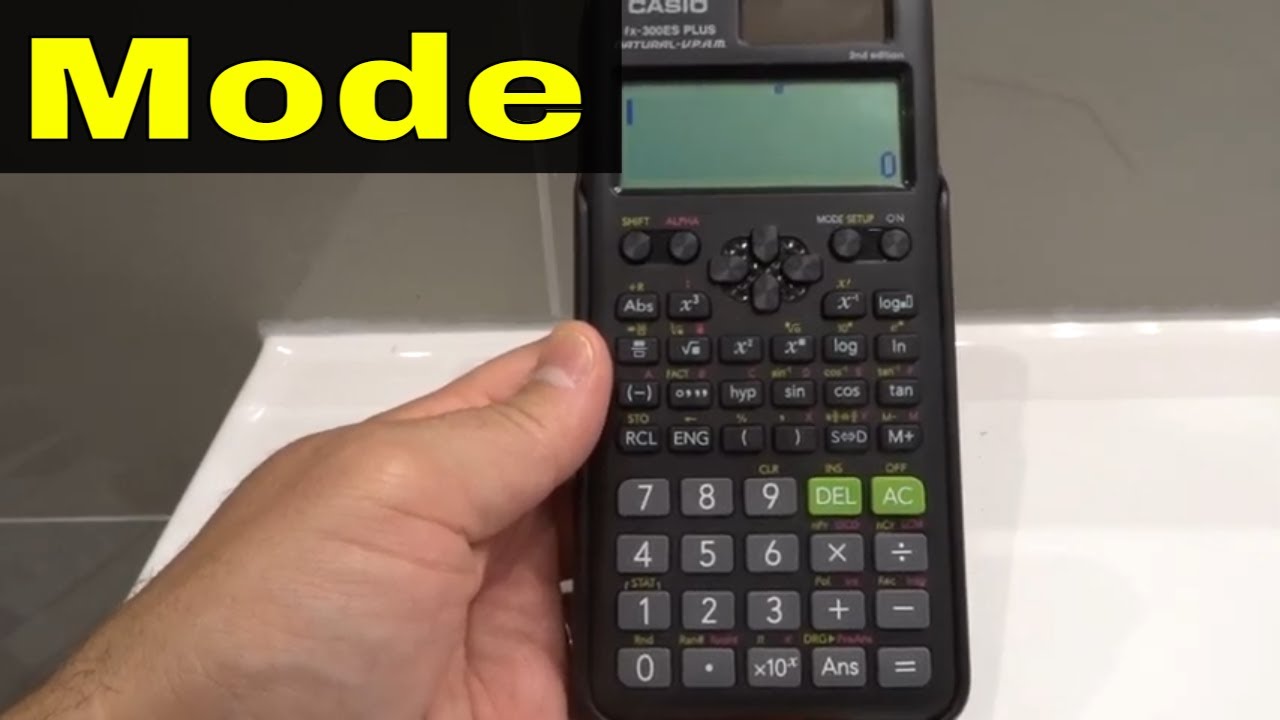
In this video, I show you and tell you how to change the mode on a Casio scientific calculator. it is really easy to do, and if you are doing some advanced mathematical equations, you will likely have to change the mode on a relatively regular basis. With that being said, it is important to know how to do it quickly and easily so that it doesn't...
whole bear
Tyy ill be right backk
fossil locust
one sec
fossil locust
whole bear
Tyy ill be right backk
press shift then menu
whole bear
Menu is mode?
fossil locust
yeah
whole bear
Okay i did
fossil locust
whole bear
I press they put 0~9
ah shit that gives you the number of decimal places
so not that one
whole bear
Okay
I get the R right but the θ wrong
Just in this particular rquation of -1-i
Usually it works fine on othee equations
fossil locust
whole bear
Okay
,calc -3/4 * pi
woven radishBOT
Result:
-2.3561944901923
it's correct
you just want your calculator to display this in exact form
which means a multiple of pi in this case
whole bear
Like is it fixble?
fossil locust
whole bear
Like is it fixble?
it should be but I don't know how
to fix this in the meantime, I would recommend you use degrees
so press shift + mode
press the number that corresponds to degrees; I think it's 1
whole bear
Yeah yeah i can have it in degrees but i dont want to mess up converting degree into rad by my own calculations
Is therw a way to do it on the calculator to like show from deg to rad?
fossil locust
whole bear
Is therw a way to do it on the calculator to like show from deg to rad?
yes press shift + Ans
then press 1 for the degree
that will convert degrees to radians
yes that converts from degrees to radians now
whole bear
Wait ill try
fossil locust
but your calculator has to be in radians mode
whole bear
Okay ill try
Ill put -135 press equal
Than i ress shift ans
And press r?
It gave me what i wrote
Sorry if im wasting ur time or something
But im really stressed about it
fossil locust
whole bear
But im really stressed about it
wait I might have the answer
just press mode
whole bear
Ty alot btw