#help-27
1 messages · Page 266 of 1
 devout snowBOT
devout snowBOT
devout snowBOT
Channel closed
Closed due to timeout
Use .reopen if this was a mistake.
 Available help channel!
Send your question here to claim the channel.
Remember:
• Ask your math question in a clear, concise manner.
• Show your work, and if possible, explain where you are stuck.
• After 15 minutes, feel free to ping <@&286206848099549185>.
• Type the command .close to free the channel when you're done.
• Be polite and have a nice day!
Read #❓how-to-get-help for further information on how to ask a good question, and about conduct in the question channels.
 solid osprey
fimd all primes p such that $x^4+4=py^4$ have positive integers solution (x,y)
devout snowBOT
solid osprey
fimd all primes p such that $x^4+4=py^4$ have positive integers solution (x,y)
 woven radishBOT
Skill_Issue
 solid osprey
by sophie germain (ty south)
$$(x^2+2x+2)(x^2-2x+2)=py^4$$
woven radishBOT
Skill_Issue
 solid osprey
idk what next
 eager nova
GCD of the factors
 olive snow
solid osprey
by sophie germain (ty south)
$$(x^2+2x+2)(x^2-2x+2)=py^4$$
olive snow
solid osprey
by sophie germain (ty south)
$$(x^2+2x+2)(x^2-2x+2)=py^4$$
I think you can say by south 
 torn bane
 solid osprey
 topaz beacon
you know 5|p or 5|y
topaz beacon
you know 5|p or 5|y
hmm if say 5|y then x^4=1 mod 5 which means either x^4=1 mod 5, or x^4=2 mod 5 or x^4=3 mod 5 ir x^4=4 mod 5...
if x^4+4=5y^4 then the (1,1)
topaz beacon
what
topaz beacon
i should say 5=p or 5|y
solid osprey
i couldnt get anything from 5|y tho :(
topaz beacon
idk either, still figuring it out
maybe x^4+4 != 0 mod 25
therre is also a 5|x case
this is messy
solid osprey
if it matters at all even in the slightest bit theme is diophantine equation
 crude wasp
woven radish
**Skill\_Issue**
crude wasp
woven radish
**Skill\_Issue**
find the GCD of the factors
solid osprey
howw
crude wasp
you should find that their gcd is 1
topaz beacon
euclidean
crude wasp
and then you can finish the problem from that
crude wasp
solid osprey
howw
think of x as just a normal number
solid osprey
topaz beacon
euclidean
i thought euclid is geometry whar
topaz beacon
euflidean algo
crude wasp
well ok first observation is to notice that x is odd right? cus if x even then you can look mod 8 to get a contradiction
topaz beacon
i dismissed it too early
solid osprey
crude wasp
well ok first observation is to notice that x is odd right? cus if x even then y...
yea
crude wasp
so we want to find gcd(x^2+2x+2, x^2-2x+2)
r u familiar with how to find the gcd of normal numbers?
solid osprey
find the factors
crude wasp
like if i gave u gcd(137, 752)
crude wasp
solid osprey
find the factors
ah right k
so that's one way to do it but it doesn't work that nicely in our setting here
the first observation tho is that notice that
gcd(a, b) = gcd(a-b, b)
cus if i told you d divides a and b
clearly d divides a-b and b
solid osprey
makes sense
crude wasp
that's in essense the Euclidean algorithm
solid osprey
what if a-b is negative
crude wasp
we'll ignore the case a-b is negative for now
solid osprey
ok
crude wasp
crude wasp
like if i gave u gcd(137, 752)
but like here i could just subtract 137 from 752 etc.
crude wasp
crude wasp
so we want to find gcd(x^2+2x+2, x^2-2x+2)
anyway so you use that principle to work this out
remember here x is just a number
so subtract one from the other to get
gcd(4x, x^2 - 2x + 2)
now notice x^2 - 2x + 2 is odd, so 4 and x^2 - 2x + 2 clearly share no common factors
so = gcd(x, x^2 - 2x + 2) = gcd(x, 2) = 1
so our brackets are coprime
this is like a very common trick for olympiad qs like these
anyway i am like very tired now and i need to go to bed, hf & gl with ur problem!
solid osprey
crude wasp
so = gcd(x, x^2 - 2x + 2) = gcd(x, 2) = 1
wait why is gcd(x,2)=1
what if x is even
also gn!
eager nova
Even will be =2
crude wasp
crude wasp
well ok first observation is to notice that x is odd right? cus if x even then y...
^
solid osprey
oh
hm
if the gcd of the brackets is 1 then one of the brackets is divisible by p and divisible by a^4 and the other is divisibly by b^4 where a coprime b
honestly thats the only tjing i could think of to make use the gcd thing
topaz beacon
you can then bound a factor between two squares
whcih means that it cant be a power of 4
solid osprey
topaz beacon
you can then bound a factor between two squares
what do you mean?
a little sucky but i think p=5 is the only one (i checked b^4 from b=1 to b=15)
a thing thats really really sus is that the roots of x are really really close to an integwr
like .998 close
(x+1)^2+1=b^4
(x+1)^2=b^4-1
n^4=m^4-1 doesent have a solution right?
there is no ^4 that is 1 apart where its greater than 0
so (x+1)^2 must be p
(x-1)^2+1=b^4
(x-1)^2=b^4-1
the same, so (x-1)^2 must be 0, so x=1
(x-1)^2 can be 0 which is a sol
ok im p sure this is it
gtg byee
.close ty all
devout snowBOT
Channel closed
Closed by @solid osprey
Use .reopen if this was a mistake.
devout snowBOT
Available help channel!
Send your question here to claim the channel.
Remember:
• Ask your math question in a clear, concise manner.
• Show your work, and if possible, explain where you are stuck.
• After 15 minutes, feel free to ping <@&286206848099549185>.
• Type the command .close to free the channel when you're done.
• Be polite and have a nice day!
Read #❓how-to-get-help for further information on how to ask a good question, and about conduct in the question channels.
 vale cairn
im on the last step on this induction proof, but i dont know how to continue from here, help please

 devout snowBOT
vale cairn
im on the last step on this induction proof, but i dont know how to continue fro...
devout snowBOT
vale cairn
im on the last step on this induction proof, but i dont know how to continue fro...
 north roost
${\sum_{k=1}^{n+1} \frac{1}{k(k+1)} = \sum_{k=1}^{n} \frac{1}{k(k+1)} + \frac{1}{(n+1)(n+2)} = \frac{n}{n+1} + \frac{1}{(n+1)(n+2)}}$
woven radishBOT
k
 woven radishBOT
k
 vale cairn
okay, but can you explain how you get this part

 vale cairn
so you just change K to n + 1?
north roost
yes
vale cairn
and then you use the assumption and try to simplify it?
vale cairn
so you always plug the n + 1 into whatever variable you have into the Induction conclusion?
devout snowBOT
@vale cairn Has your question been resolved?
devout snowBOT
Channel closed
Closed due to timeout
Use .reopen if this was a mistake.
devout snowBOT
Available help channel!
Send your question here to claim the channel.
Remember:
• Ask your math question in a clear, concise manner.
• Show your work, and if possible, explain where you are stuck.
• After 15 minutes, feel free to ping <@&286206848099549185>.
• Type the command .close to free the channel when you're done.
• Be polite and have a nice day!
Read #❓how-to-get-help for further information on how to ask a good question, and about conduct in the question channels.
 halcyon hound
One message removed from a suspended account.
devout snowBOT
halcyon hound
One message removed from a suspended account.
 native mica
windows shift s lets you snip things, it might make it easier to read js
halcyon hound
native mica
windows shift s lets you snip things, it might make it easier to read js
One message removed from a suspended account.
One message removed from a suspended account.
One message removed from a suspended account.
One message removed from a suspended account.
One message removed from a suspended account.
One message removed from a suspended account.
 honest elm
halcyon hound
One message removed from a suspended account.
honest elm
halcyon hound
One message removed from a suspended account.
do you know the chain rule?
halcyon hound
honest elm
do you know the chain rule?
One message removed from a suspended account.
honest elm
halcyon hound
One message removed from a suspended account.
so if H(x) = F(G(x))
whats H'(x)?
halcyon hound
honest elm
so if H(x) = F(G(x))
whats H'(x)?
One message removed from a suspended account.
One message removed from a suspended account.
One message removed from a suspended account.
halcyon hound
One message removed from a suspended account.
One message removed from a suspended account.
honest elm
halcyon hound
One message removed from a suspended account.
no
honest elm
halcyon hound
One message removed from a suspended account.
lol
halcyon hound
One message removed from a suspended account.
One message removed from a suspended account.
honest elm
no
halcyon hound
One message removed from a suspended account.
honest elm
halcyon hound
One message removed from a suspended account.
have you seen this before?
 halcyon hound
One message removed from a suspended account.
honest elm
halcyon hound
One message removed from a suspended account.
you don't understand what it means?
halcyon hound
honest elm
you don't understand what it means?
One message removed from a suspended account.
One message removed from a suspended account.
One message removed from a suspended account.
honest elm
naw
halcyon hound
One message removed from a suspended account.
honest elm
if you have the derivative of f(x) = f'(x)
halcyon hound
One message removed from a suspended account.
honest elm
and then you put g(x) inside of f'(x)
like g(x) is your new input into f'(x)
so then you have f'( g(x) )
halcyon hound
One message removed from a suspended account.
halcyon hound
One message removed from a suspended account.
halcyon hound
One message removed from a suspended account.
One message removed from a suspended account.
honest elm
so if H(x) = F(G(x))
then H'(x) = F' (G(x)) * G'(x)
you put G(x) as the input of your derivative function F' and then multiply by the derivative of G which is G'
is this making sense or... lol
halcyon hound
One message removed from a suspended account.
One message removed from a suspended account.
One message removed from a suspended account.
honest elm

halcyon hound
One message removed from a suspended account.
halcyon hound
honest elm
ill get an example
One message removed from a suspended account.
honest elm
halcyon hound
One message removed from a suspended account.
yea naw its fine LOL
halcyon hound
One message removed from a suspended account.
One message removed from a suspended account.
One message removed from a suspended account.
honest elm
can i give you an example with actual defined functions so you can maybe see whats going on 💀
 pseudo crescent
if you have the formula written out It's just about plugginf the numbers
honest elm
pseudo crescent
if you have the formula written out It's just about plugginf the numbers
yea
halcyon hound
pseudo crescent
if you have the formula written out It's just about plugginf the numbers
One message removed from a suspended account.
honest elm
honest elm
have you seen this before?
heres the formula
halcyon hound
One message removed from a suspended account.
honest elm
halcyon hound
One message removed from a suspended account.
ok lets use that
you know F(G(x))
halcyon hound
honest elm
ok lets use that
One message removed from a suspended account.
honest elm
means that you plug G(x) into F(x) right?
halcyon hound
honest elm
you know F(G(x))
One message removed from a suspended account.
One message removed from a suspended account.
One message removed from a suspended account.
honest elm
alright
halcyon hound
One message removed from a suspended account.
halcyon hound
One message removed from a suspended account.
honest elm
ok
and
F'(G(x)) * G'(x)
means you plug G(x) into F'(x), and then multiply by G'(x)
this make sense?
halcyon hound
One message removed from a suspended account.
One message removed from a suspended account.
honest elm
its composite functions
halcyon hound
One message removed from a suspended account.
honest elm
plugging functions into other functions
halcyon hound
One message removed from a suspended account.
honest elm
now instead of plugging G(x) into the function F(x), you plug G(x) into the function F'(x)
F'(x) is the derivative function of the function F(x)
how many times can you say function in one sentence
me:

halcyon hound
One message removed from a suspended account.
One message removed from a suspended account.
honest elm
halcyon hound
One message removed from a suspended account.
i'm trying to make sure you know what the chain rule means 😭
halcyon hound
One message removed from a suspended account.
honest elm
because if you know that then the problem is literally just plugging
honest elm
halcyon hound
One message removed from a suspended account.
what is it?
halcyon hound
honest elm
what is it?
One message removed from a suspended account.
honest elm
like could you differentiate (2x+1)^2 ?
honest elm
halcyon hound
One message removed from a suspended account.
what kind of problem
halcyon hound
honest elm
like could you differentiate (2x+1)^2 ?
One message removed from a suspended account.
honest elm
halcyon hound
One message removed from a suspended account.
well you have to multiply by another 2
due to the chain rule
like if
f(x) = x^2
g(x) = 2x+1
f(g(x)) = (2x+1)^2
right?
and then
halcyon hound
One message removed from a suspended account.
honest elm
halcyon hound
One message removed from a suspended account.
take the derivative of
halcyon hound
One message removed from a suspended account.
halcyon hound
honest elm
take the derivative of
One message removed from a suspended account.
honest elm
halcyon hound
One message removed from a suspended account.
i mean this is almost correct
it just missed the...chain rule part
halcyon hound
One message removed from a suspended account.
honest elm
well you need to multiply by 2 due to the exponent
halcyon hound
One message removed from a suspended account.
honest elm
and then you also have to multiply by the derivative of the inside function (2x+1)
halcyon hound
One message removed from a suspended account.
pseudo crescent
halcyon hound
One message removed from a suspended account.
are you polish by any chance?
halcyon hound
One message removed from a suspended account.
honest elm
halcyon hound
One message removed from a suspended account.
but then multiply by the derivative of the inside
halcyon hound
One message removed from a suspended account.
halcyon hound
honest elm
but then multiply by the derivative of the inside
One message removed from a suspended account.
One message removed from a suspended account.
halcyon hound
pseudo crescent
are you polish by any chance?
One message removed from a suspended account.
pseudo crescent
ah nvm
honest elm
halcyon hound
One message removed from a suspended account.
you will end up getting 4 on the outside yeah
pseudo crescent
it's because of the polish cow
halcyon hound
honest elm
you will end up getting 4 on the outside yeah
One message removed from a suspended account.
One message removed from a suspended account.
honest elm
ok
halcyon hound
pseudo crescent
it's because of the polish cow
One message removed from a suspended account.
pseudo crescent
It's probably harder for you to understand it in a second language depending on your skill level in english
pseudo crescent
halcyon hound
One message removed from a suspended account.
a classic
maybe it will be easier to understand like this
halcyon hound
One message removed from a suspended account.
One message removed from a suspended account.
honest elm
halcyon hound
One message removed from a suspended account.
ah u got now?
halcyon hound
pseudo crescent
lets say you differantiate this: f(x^2)
One message removed from a suspended account.
halcyon hound
pseudo crescent
f'(x^2) * 2x
One message removed from a suspended account.
One message removed from a suspended account.
pseudo crescent
the f represents a function which isnt specified here
but yeah basically thats what it is
just like f'(x) is the derivative of f(x)
halcyon hound
One message removed from a suspended account.
halcyon hound
pseudo crescent
just like f'(x) is the derivative of f(x)
One message removed from a suspended account.
pseudo crescent
okie dokie
halcyon hound
One message removed from a suspended account.
pseudo crescent
so what would be the derivative of f(2x+2) ?
halcyon hound
One message removed from a suspended account.
pseudo crescent
2 * f'(2x+2)
halcyon hound
One message removed from a suspended account.
One message removed from a suspended account.
One message removed from a suspended account.
pseudo crescent
you have to do it like this since the function in f is an input
pseudo crescent
halcyon hound
One message removed from a suspended account.
no exponents but you first differantiate the outer layer so f in this case and then multiply it by the derivative of the inside function
halcyon hound
One message removed from a suspended account.
halcyon hound
One message removed from a suspended account.
One message removed from a suspended account.
pseudo crescent
it was hard for me to understand it intuitvelyehfe (I cant spell) too
there is a proof of this but probably too complicated for you now
halcyon hound
One message removed from a suspended account.
pseudo crescent
the general formula is g'(x) * f'(g(x))
pseudo crescent
halcyon hound
One message removed from a suspended account.
look at the formula I written
and now just plug in the values from the ones listed aove
above
and thats it
halcyon hound
One message removed from a suspended account.
pseudo crescent
can you show your process?
halcyon hound
One message removed from a suspended account.
One message removed from a suspended account.
One message removed from a suspended account.
One message removed from a suspended account.
One message removed from a suspended account.
halcyon hound
One message removed from a suspended account.
halcyon hound
One message removed from a suspended account.
pseudo crescent
ok so you now have g'(3) * f'(4)
halcyon hound
One message removed from a suspended account.
pseudo crescent
it's f'(4) because the input to this function was the value of g(3) which is 4
halcyon hound
One message removed from a suspended account.
One message removed from a suspended account.
One message removed from a suspended account.
pseudo crescent
what do you mean by this?
I mean yea it switches thats the whole point since the inoput was another function that for x=3 was equal to 4
halcyon hound
One message removed from a suspended account.
pseudo crescent
yeah it sounds a little confusing but it's just following the rules written out there
halcyon hound
One message removed from a suspended account.
One message removed from a suspended account.
pseudo crescent
we have the formula already: g'(x) * f'( g(x) ) and after plugging x=3 we got g'(3) * f'( g(3) )
pseudo crescent
halcyon hound
One message removed from a suspended account.
rn I am doing calc 2 and linear algebra but it's more of self study
halcyon hound
pseudo crescent
rn I am doing calc 2 and linear algebra but it's more of self study
One message removed from a suspended account.
pseudo crescent
halcyon hound
One message removed from a suspended account.
ok
halcyon hound
One message removed from a suspended account.
One message removed from a suspended account.
One message removed from a suspended account.
One message removed from a suspended account.
One message removed from a suspended account.
pseudo crescent
pseudo crescent
we have the formula already: g'(x) * f'( g(x) ) and after plugging x=3 we got ...
so from this we get g'(3) * f'(4) since g(3) = 4 and then we have 4 * 3 since g'(3) = 4 and f'(4) = 3
pseudo crescent
halcyon hound
One message removed from a suspended account.
thats right!
halcyon hound
One message removed from a suspended account.
One message removed from a suspended account.
One message removed from a suspended account.
pseudo crescent
np
halcyon hound
One message removed from a suspended account.
pseudo crescent
nope
halcyon hound
One message removed from a suspended account.
One message removed from a suspended account.
pseudo crescent
I am doing last year of Polish counterpart of high school online
the Polish education system sucks
it's absolutely terrible
halcyon hound
One message removed from a suspended account.
One message removed from a suspended account.
pseudo crescent
well they dont teach anything except mindlesly following the rules and using formulas
without any derivations or proofs
halcyon hound
One message removed from a suspended account.
pseudo crescent
and thropugh all 4 years of high school there is never mention of derivatives
halcyon hound
One message removed from a suspended account.
pseudo crescent
so there is a class with extended math and physics
halcyon hound
One message removed from a suspended account.
pseudo crescent
and there you actually do get to the derivatives but only at the very end
halcyon hound
One message removed from a suspended account.
pseudo crescent
bruh
halcyon hound
pseudo crescent
and there you actually do get to the derivatives but only at the very end
One message removed from a suspended account.
One message removed from a suspended account.
One message removed from a suspended account.
pseudo crescent
yea so in Poland you have to factorize polynomials with 234802terms and if you get one sign wrong you fail lmao
pseudo crescent
halcyon hound
One message removed from a suspended account.
not regularly
halcyon hound
pseudo crescent
not regularly
One message removed from a suspended account.
halcyon hound
pseudo crescent
but you can ping me if you need help
One message removed from a suspended account.
pseudo crescent
sure
halcyon hound
pseudo crescent
sure
One message removed from a suspended account.
One message removed from a suspended account.
One message removed from a suspended account.
One message removed from a suspended account.
honest elm
halcyon hound
One message removed from a suspended account.
are you familiar with the quotient rule?
halcyon hound
honest elm
are you familiar with the quotient rule?
One message removed from a suspended account.
honest elm
halcyon hound
One message removed from a suspended account.
do you know its formula?
halcyon hound
One message removed from a suspended account.
honest elm
halcyon hound
One message removed from a suspended account.
you can find H'(x) by differentiating F(x)/G(x) right?
halcyon hound
One message removed from a suspended account.
honest elm
yeah
halcyon hound
One message removed from a suspended account.
One message removed from a suspended account.
halcyon hound
One message removed from a suspended account.
honest elm
halcyon hound
One message removed from a suspended account.
oh alr 👌
 boreal helm
Yo
halcyon hound
One message removed from a suspended account.
One message removed from a suspended account.
halcyon hound
boreal helm
Yo
One message removed from a suspended account.
halcyon hound
boreal helm
What you want me to do
One message removed from a suspended account.
One message removed from a suspended account.
boreal helm
e ok
halcyon hound
One message removed from a suspended account.
One message removed from a suspended account.
woven radishBOT


 Requested by oppailol.
halcyon hound
Requested by oppailol.
halcyon hound
One message removed from a suspended account.
boreal helm
This is your error
halcyon hound
One message removed from a suspended account.
halcyon hound
One message removed from a suspended account.
boreal helm
halcyon hound
One message removed from a suspended account.

No probs happens
When you are in a haste
halcyon hound
boreal helm
When you are in a haste
One message removed from a suspended account.
halcyon hound
One message removed from a suspended account.
One message removed from a suspended account.
One message removed from a suspended account.
halcyon hound
boreal helm
Just ping me if you have problems
One message removed from a suspended account.
One message removed from a suspended account.
One message removed from a suspended account.
One message removed from a suspended account.
boreal helm
Oh
I came
Wait wait
@halcyon hound
derivative of inverse of a function is 1/derivative of a function
👍
halcyon hound
One message removed from a suspended account.
One message removed from a suspended account.
One message removed from a suspended account.
 stray spade
first find the inverse function
devout snowBOT
@halcyon hound Has your question been resolved?
halcyon hound
devout snow
<@732777810158026793> Has your question been resolved?
One message removed from a suspended account.
halcyon hound
stray spade
first find the inverse function
One message removed from a suspended account.
stray spade
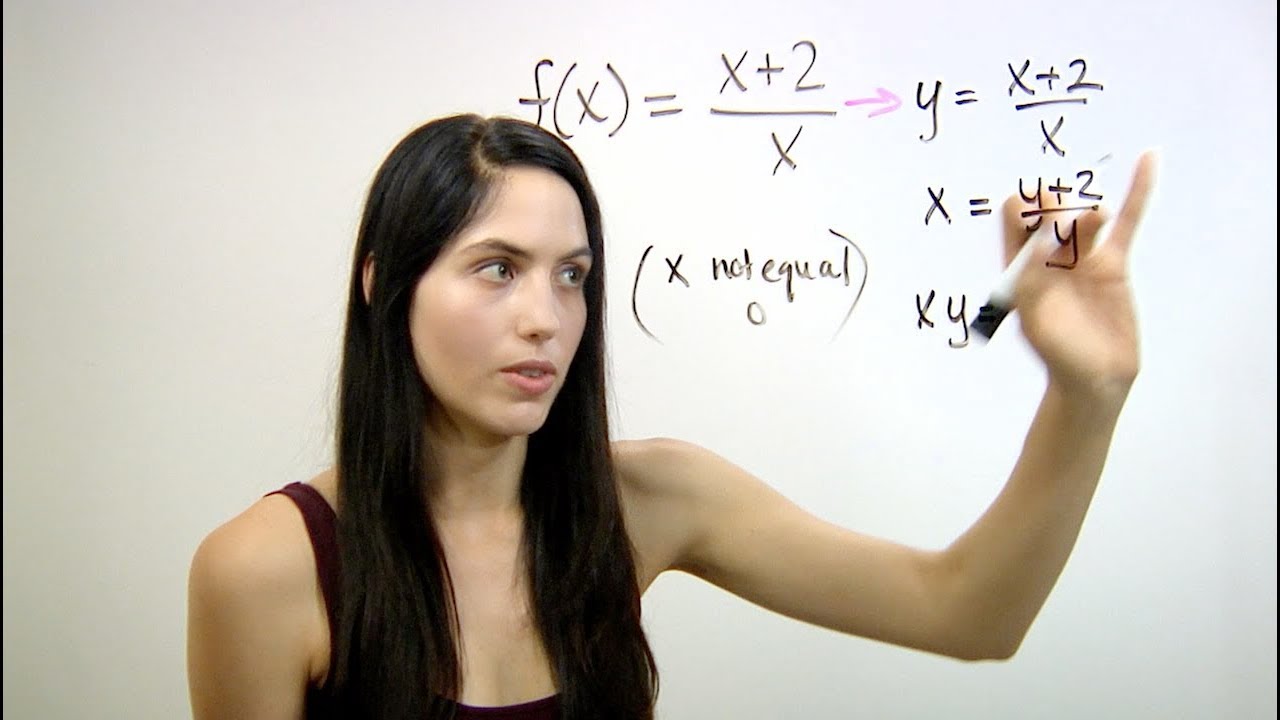
MIT grad shows how to find the inverse function of any function, if it exists. The inverse function is the reverse of your original function. It undoes whatever your function did. If your function takes x and gives you y, then the inverse function takes that y and gives you back x. Nancy formerly of MathBFF explains the steps.
Follow Nancy on I...
devout snowBOT
@halcyon hound Has your question been resolved?
 slow solar
halcyon hound
One message removed from a suspended account.
slow solar
halcyon hound
One message removed from a suspended account.
Hi
slow solar
halcyon hound
One message removed from a suspended account.
If g(x) is the inverse of f(x), then g’(a) = 1/[f’(g(a)]
Uh but for the general derivarive
You need to find the inverse function then differently it normally
slow solar
stray spade
https://youtu.be/-l7U3dEAGa4
^ this should help teach you how to find the inverse of a function, then you can differentiate it and it should be good
I think that should help, lmk if it doesn’t
@halcyon hound
halcyon hound
One message removed from a suspended account.
One message removed from a suspended account.
devout snowBOT
Channel closed
Closed by @halcyon hound
Use .reopen if this was a mistake.
devout snowBOT
Available help channel!
Send your question here to claim the channel.
Remember:
• Ask your math question in a clear, concise manner.
• Show your work, and if possible, explain where you are stuck.
• After 15 minutes, feel free to ping <@&286206848099549185>.
• Type the command .close to free the channel when you're done.
• Be polite and have a nice day!
Read #❓how-to-get-help for further information on how to ask a good question, and about conduct in the question channels.
 bitter marsh
how do we do this question?
 devout snowBOT
bitter marsh
how do we do this question?
devout snowBOT
bitter marsh
how do we do this question?
 restive river
x= [x] + {x}
devout snowBOT
Channel closed
Closed by @bitter marsh
Use .reopen if this was a mistake.
devout snowBOT
Available help channel!
Send your question here to claim the channel.
Remember:
• Ask your math question in a clear, concise manner.
• Show your work, and if possible, explain where you are stuck.
• After 15 minutes, feel free to ping <@&286206848099549185>.
• Type the command .close to free the channel when you're done.
• Be polite and have a nice day!
Read #❓how-to-get-help for further information on how to ask a good question, and about conduct in the question channels.
 vital pilot
a, b, c in R so that a+b+c =1
Prove that at least one of a+bc, b+ac, c+ab is positive or equal to 0
devout snowBOT
vital pilot
a, b, c in R so that a+b+c =1
Prove that at least one of a+bc, b+ac, c+ab is pos...
vital pilot
I tried proving by contradixtion and I have to contradict ab + bc + ac <-1
devout snowBOT
@vital pilot Has your question been resolved?
vital pilot
<@&286206848099549185>
restive river
vital pilot
<@&286206848099549185>
Do you have a question, or are you trying to prove something?
vital pilot
Prove
vital pilot
vital pilot
a, b, c in R so that a+b+c =1
Prove that at least one of a+bc, b+ac, c+ab is pos...
.
vital pilot
vital pilot
I tried proving by contradixtion and I have to contradict ab + bc + ac <-1
But idk what now...
restive river
vital pilot
I tried proving by contradixtion and I have to contradict ab + bc + ac <-1
Is that a 1, or a minus 1?
It matters, because of the sign in-front of it. If it is a minus one, then the sign would be <, so as to - it is a sign that is "smaller than", or if it is a 1, then you are trying to prove that "follows" , and then 1 - as to the contradiction.
devout snowBOT
@vital pilot Has your question been resolved?
devout snowBOT
Channel closed
Closed due to timeout
Use .reopen if this was a mistake.
Available help channel!
Send your question here to claim the channel.
Remember:
• Ask your math question in a clear, concise manner.
• Show your work, and if possible, explain where you are stuck.
• After 15 minutes, feel free to ping <@&286206848099549185>.
• Type the command .close to free the channel when you're done.
• Be polite and have a nice day!
Read #❓how-to-get-help for further information on how to ask a good question, and about conduct in the question channels.
 glacial ether

 devout snowBOT
@glacial ether Has your question been resolved?
 stone stump
you cant just post two big screenshots of a non english exercise and expect to get help
translate the exercise and say where you are stuck
 wheat pawn
you should at least try to translate it.
non germans can help with a partial translation
glacial ether
.close
devout snowBOT
Channel closed
Closed by @glacial ether
Use .reopen if this was a mistake.
devout snowBOT
Available help channel!
Send your question here to claim the channel.
Remember:
• Ask your math question in a clear, concise manner.
• Show your work, and if possible, explain where you are stuck.
• After 15 minutes, feel free to ping <@&286206848099549185>.
• Type the command .close to free the channel when you're done.
• Be polite and have a nice day!
Read #❓how-to-get-help for further information on how to ask a good question, and about conduct in the question channels.
 light marsh
 devout snowBOT
light marsh
devout snowBOT
light marsh
 twilit comet
no
domain is what x-values you can put into the function so it gives a meaningful output
devout snowBOT
@light marsh Has your question been resolved?
devout snowBOT
Channel closed
Closed due to timeout
Use .reopen if this was a mistake.
Available help channel!
Send your question here to claim the channel.
Remember:
• Ask your math question in a clear, concise manner.
• Show your work, and if possible, explain where you are stuck.
• After 15 minutes, feel free to ping <@&286206848099549185>.
• Type the command .close to free the channel when you're done.
• Be polite and have a nice day!
Read #❓how-to-get-help for further information on how to ask a good question, and about conduct in the question channels.
native mica
is [0, 1) homeomorphic to (0, 1)?
devout snowBOT
native mica
is [0, 1) homeomorphic to (0, 1)?
native mica
if not why?
i tried proving it by disputing bijectivity
since [0,1) = 0 U (0,1)
but N is bijective to N+1 as N--->inf
 sand dove
native mica
i tried proving it by disputing bijectivity
sand dove
native mica
i tried proving it by disputing bijectivity
is bijectivity equivalent to homeomorphic?
I think here there is not much to conclude from bijectivity
native mica
sand dove
is bijectivity equivalent to homeomorphic?
no but its an aspect no?
sand dove
both are in bijection with R
native mica
if its not bijective then its not homeomorphic?
sand dove
native mica
if its not bijective then its not homeomorphic?
yes, but here it is bijective
so not much to say unfortunately
native mica
sand dove
yes, but here it is bijective
but its also clearly continuous and the inverse would be continuous too?
so is it homeomorphic?
vital pilot
I'm sorry for interrupting, what grade math is this?
sand dove
native mica
but its also clearly continuous and the inverse would be continuous too?
say there is indeed a homeomorphism
native mica
vital pilot
I'm sorry for interrupting, what grade math is this?
undergrade in my case
sand dove
so call f a potential homeomorphism from [0,1) to (0,1)
in particular it's bijective and continuous
is there a known result about injective continuous functions of real numbers?
about its variations...
native mica
see the hint was "Hint: consider what happens if you remove a point"
sand dove
native mica
see the hint was "Hint: consider what happens if you remove a point"
we could go over the way this hint wants us to solve the question a bit later
sand dove
sand dove
is there a known result about injective continuous functions of real numbers?
right now I'm asking about this
native mica
sand dove
right now I'm asking about this
then it is strictly monotone
sand dove
native mica
then it is strictly monotone
yes
in particular
for x in (0,1)
either f(x) is always above f(0)
or f(x) is always below f(0)
sand dove
so... does every y in (0,1) have an inverse by f?
sand dove
but why
native mica
bc f(x) can never be 0
sand dove
native mica
bc f(x) can never be 0
well yeah, f(x) is in (0,1) by definition isn't it
but why does this imply not every y in (0,1) has an inverse by f?
native mica
wait is f(x) mapping from [0,1) to (0,1) or the other way round
sand dove
it's the correct way as you wrote it
native mica
wait yeah okay so u cant inverse every y because itll have to map to f(0)
sand dove
wdym it'll have to map to f(0)
native mica
itll have to map to x=0
f^-1(y) = 0
also arent you disproving injectivity which in turn disproves bijectivity
am i wrong ? @sand dove ?
sand dove
native mica
f^-1(y) = 0
up until now I have no idea why f wouldn't be injective
we even said it was either increasing all the way or decreasing all the way
no, we're trying to prove there won't be surjectivity
remember
native mica
ah right
sand dove
f(0) is located somewhere on (0,1)
and then either all images are above it
or all images are below it
if all images are above, what about the y below f(0)?
and vice versa
sand dove
the way they wanted it is:
if f:[0,1) -> (0,1) is homeomorphism, then f:(0,1) -> (0,f(0)) U (f(0),1) also a homeomorphism
native mica
assume it is homoeomorphic and then remove an element (0) and f(0) and if they were homoeomorphic then they would keep the same connectivity
sand dove
sand dove
the way they wanted it is:
if f:[0,1) -> (0,1) is homeomorphism, then f:(0,1) ->...
so such an f doesn't exist
native mica
do you show that R2 is not homeomorphic to R the same way then ?
sand dove
not really
I like to do it with disproving injectivity
suppose f:R^2 -> R homeomorphism
native mica
yeah
sand dove
what can you say about g(t) = f(t,0)?
and then what can you say about h(t) = f(0,t)
I think you can figure out the rest
but basically multiple inputs get mapped to a same output close enough to f(0)
native mica
there are ways of mapping R2 onto R1 tho
sand dove
native mica
there are ways of mapping R2 onto R1 tho
not homeomorphically
keep in mind R^2 and R are in bijection
there is a bijection out there
it's just never gonna be continuous with a continuous reciprocal
native mica
ie (1.1221,0.2324) to (10.12232214)
ah ig there are ways of that repeating
like if u swapped the x and y and moved up a placeholder
sand dove
i think it's not surjective
though it's injective
not surjective as
what is the inverse of 0.797979797979... for example
devout snowBOT
Channel closed
Closed by @native mica
Use .reopen if this was a mistake.
devout snowBOT
Available help channel!
Send your question here to claim the channel.
Remember:
• Ask your math question in a clear, concise manner.
• Show your work, and if possible, explain where you are stuck.
• After 15 minutes, feel free to ping <@&286206848099549185>.
• Type the command .close to free the channel when you're done.
• Be polite and have a nice day!
Read #❓how-to-get-help for further information on how to ask a good question, and about conduct in the question channels.
 foggy mist
hi im making a game, and im trying to make an acceleration formula
foggy mist
its going to be complex, with weight affecting it, drag, max speed etc

im looking for a graph to recreate these results but im getting lost
currently messing around with a general logarithmic function but it does not reproduce the results like here
weight will affect the initial slope (0 weight should more or less go diagonally up, adding weight should add like a bend to it delaying the initial speed)
and also make the acceleration a bit slower
acceleration stat should also control general steepness
max speed should be asymptote
and drag i imagine would just be a coefficient
but again i rlly dont know what style of graph to use
cant even find one that starts at 0,0
basically i just need to know what types of functions i can use that can replicate this that start at 0,0
ive tried many
 acoustic leaf
you could consider something like $a(1-e^{-t/b})$ for various values of $a$,$b$
woven radishBOT
cloud
 acoustic leaf
a would control the asymptote, b would control how long it takes to get close to the asymptote
foggy mist
acoustic leaf
you could consider something like $a(1-e^{-t/b})$ for various values of $a$,$b$

i get this
its sort of right but with the graph above u can change parameters to get a sort of s shape ?
dont know if i can do that with this

got thsi after playing around
but i need one more paramter
weight
that affects the intiial curve
 devout snowBOT
@foggy mist Has your question been resolved?
devout snowBOT
@foggy mist Has your question been resolved?
 tawny pewter
foggy mist
was rlly hoping i could get that to work
tawny pewter
foggy mist
was rlly hoping i could get that to work
maybe tweaking the CDF of a beta distribution would work. The PDF would represent acceleration in function of time and when integrated you would get the PDF/ speed w.r. to time.

more generally you could specify the shape of the acceleration A(t) you want then integrate this function to get your speed
foggy mist
this looks promising i will take a look
foggy mist
tawny pewter
how exactly would i define formulae for this?
it mentions a B(a,b) term which confuses me
tawny pewter
 tawny pewter
foggy mist
it mentions a B(a,b) term which confuses me
tawny pewter
foggy mist
it mentions a B(a,b) term which confuses me
it’s a constant to make the area under the curve 1.
what’s annoying with the beta is that it’s tricky to get the top speed you want
with a constant a in front it’s not too bad
foggy mist
this formula is tricky yeah
some values make the integration line dip blow 0 after peaking
actually
the negavtive values
look food
good
i wonder if i can get a formula that always adjusts values to get to a specific top seed

otherwise ive come up with this
tawny pewter
foggy mist
i wonder if i can get a formula that always adjusts values to get to a specific ...
v should get you to the top speed you want and it’s not too complicated go with that imo
foggy mist
yeah may end up using this, thank you though
tawny pewter
yeah i was going a bit crazy with specifying the shape of the acceleration then integrating and it’s probably too complicated for what you need
 foggy mist
yeah its a neat idea though 😭
devout snowBOT
@foggy mist Has your question been resolved?
devout snowBOT
Channel closed
Closed due to timeout
Use .reopen if this was a mistake.
Available help channel!
Send your question here to claim the channel.
Remember:
• Ask your math question in a clear, concise manner.
• Show your work, and if possible, explain where you are stuck.
• After 15 minutes, feel free to ping <@&286206848099549185>.
• Type the command .close to free the channel when you're done.
• Be polite and have a nice day!
Read #❓how-to-get-help for further information on how to ask a good question, and about conduct in the question channels.
 blazing crest
how does this work
 devout snowBOT
blazing crest
how does this work
devout snowBOT
blazing crest
how does this work
 faint zinc
@blazing crest you can prove that if it is convergent then its limit is given by t_inf = sqrt(t_inf + 1), and you can also prove that if you have a perturbation from this value, let's call it delta, that the perturbation gets either larger or smaller. If you can show that this purturbation gets smaller in a particular region, and this region includes your seed value, then you've proven convergence of the sequence.
blazing crest
faint zinc
<@566943768775753729> you can prove that if it is convergent then its limit is g...
no idea man
how do i prove its convergent
faint zinc
You do it by showing that one of the stationary values is attractive over a small region, and this region includes the seed value.
 iron sun
An alternative way if useful is to show that this sequence is increasing (from what it seems atleast) and that it’s bounded above
devout snowBOT
@blazing crest Has your question been resolved?
blazing crest
iron sun
An alternative way if useful is to show that this sequence is increasing (from w...
these words make a little more sense to me
blazing crest
iron sun
An alternative way if useful is to show that this sequence is increasing (from w...
how would that work?
iron sun
blazing crest
how would that work?
Probably by induction, but I can give you a sketch of a proof that shows its atleast increasing without induction.
 random helm
blazing crest
how does this work
random helm
blazing crest
how does this work
- if t is a positive root of t^2=t+1 and t_n<t then t_(n+1)<t (do this by squaring t_(n+1)). So it is an upper bounded sequence.
- t_(n+1)-t_n>0 just from definition of t_n. So it is increasing. So, it has a limit t=(sqrt(5)+1)/2 from the equation t=sqrt(t+1).
 idle swift
blazing crest
how does this work
idle swift
blazing crest
how does this work
found a lower bound for t_n and then use cauchy sequences
blazing crest
random helm
1) if t is a positive root of t^2=t+1 and t_n<t then t_(n+1)<t (do this by squar...
how did u come with t^2 = t+1
blazing crest
iron sun
Probably by induction, but I can give you a sketch of a proof that shows its atl...
sure
random helm
blazing crest
how did u come with t^2 = t+1
it's the required limit from equation t=sqrt(t+1). Just squared it
iron sun
random helm
1) if t is a positive root of t^2=t+1 and t_n<t then t_(n+1)<t (do this by squar...
The increasing part isn’t trivial it highly depends on the base case, so I think expanding on why 2) follows is good
Lmao no
Oh and u deleted since u saw ur mistake lol
blazing crest
random helm
it's the required limit from equation t=sqrt(t+1). Just squared it
do you calcute the limit with t^2 = t + 1
and so that is the bound
random helm
iron sun
Oh and u deleted since u saw ur mistake lol
Oh, yes. I saw mistake. But it is easy from 1)
random helm
blazing crest
do you calcute the limit with t^2 = t + 1
yes
blazing crest
random helm
yes
How will i know that that limit is the upper or lower bound
Sure it converges to some limit but how am i gonna tell which
random helm
blazing crest
How will i know that that limit is the upper or lower bound
well it is encreasing
and it is positive
and it has a limit
and t_(n+1) and t_n have the same limit
blazing crest
Also yeah how did we decide to take t_n+1 - tn > 0
Why did we decide to work this out
And not lets say tn - t_n+1 > 0 if it were to be decreasing
random helm
blazing crest
Also yeah how did we decide to take t_n+1 - tn > 0
it is just the definition of increasing sequence: t_(n+1)-t_n>0
blazing crest
Yeah but we dont know wether its increasing or decreasing beforehand right?
iron sun
blazing crest
How will i know that that limit is the upper or lower bound
The whole reason of showing the sequence is increasing and bounded above is that it shows the sequence converges and more precisely converges to its least upper bound.
So if we can find the least upper bound of the sequence then we’re done. It just so happens that QD2718 picked his upper bound as the least upper bound.
random helm
blazing crest
Yeah but we dont know wether its increasing or decreasing beforehand right?
well, just graph approximately sqrt(1+x) and x
iron sun
blazing crest
Yeah but we dont know wether its increasing or decreasing beforehand right?
That’s part of the problem with this approach, but it’s also a lot easier once you seem to have figured this out
random helm
here is the proof it is increasing
 iron sun
You don’t go blind when doing these, you use your intuition first to get a feel for how it behaves
Then make a claim
blazing crest
iron sun
The whole reason of showing the sequence is increasing and bounded above is that...
Cant we say the whole reason of showing the sequence is decreasing and bounded below is that it shows the sequence converges and more precisely converges to its biggest lower bound
iron sun
random helm
here is the proof it is increasing
Base case is needed
random helm
iron sun
You don’t go blind when doing these, you use your intuition first to get a feel ...
any recurrence of type t_(n+1)=f(t_n) is easily learned by graph of f(x) and x. And just walking a couple of iterations on it.
iron sun
blazing crest
Cant we say the whole reason of showing the sequence is decreasing and bounded b...
??
random helm
iron sun
Base case is needed
sure we remember t1
iron sun
random helm
sure we remember t1
Still, it’s probably not obvious to them that it’s subtle
blazing crest
iron sun
??
😭
iron sun
random helm
any recurrence of type t_(n+1)=f(t_n) is easily learned by graph of f(x) and x. ...
Is this supposed to be directed to me or them?
random helm
iron sun
Is this supposed to be directed to me or them?
to you
I learned what I need to prove from this
 random helm
sqrt(1+x) and x
blazing crest
im not allowed a graphic
iron sun
Uh why? I was not objecting to graphing, I was actually praising it; the reply you sent to mine was not towards you lmao
random helm
blazing crest
im not allowed a graphic
you dont need it for proof. It is for yourself to understand what to prove
blazing crest
ah okay
the same logic you guys were talking would not apply to this right?

it says it is convergent
so an goes to L as n goes to infinity right
L = (1 + sqrt5)/2
L = (1 - sqrt5)/2
blazing crest
blazing crest
L = (1 + sqrt5)/2
we take this one because the second isnt in the interval (0, inf)
random helm
blazing crest
the same logic you guys were talking would not apply to this right?
it would
blazing crest
am i done with the question?
surely not
determine for every a in the interval
induction?
random helm
And it looks like any alpha>0 gives the convergence and the limit is that (1+sqrt(5))/2.

For any alpha<t the next step gets you into [t,+inf]
and the next step gets into [1;t]
blazing crest
uh this is where i get lost
random helm
sorry. too late. I correct too much 🙂
blazing crest
the answers from 2.13 use the contraction theoreom @random helm
random helm
blazing crest
the answers from 2.13 use the contraction theoreom <@450039711520522240>
kinda strange. So does alpha<2.13 give divergence?
 random helm
blazing crest
the answers from 2.13 use the contraction theoreom <@450039711520522240>
random helm
blazing crest
the answers from 2.13 use the contraction theoreom <@450039711520522240>
oh, I see. Yes you can use it too
but as you see it can be solved without it
devout snowBOT
@blazing crest Has your question been resolved?
devout snowBOT
Channel closed
Closed due to timeout
Use .reopen if this was a mistake.
Available help channel!
Send your question here to claim the channel.
Remember:
• Ask your math question in a clear, concise manner.
• Show your work, and if possible, explain where you are stuck.
• After 15 minutes, feel free to ping <@&286206848099549185>.
• Type the command .close to free the channel when you're done.
• Be polite and have a nice day!
Read #❓how-to-get-help for further information on how to ask a good question, and about conduct in the question channels.
restive river
how would I solve
 devout snowBOT
restive river
how would I solve
devout snowBOT
restive river
how would I solve
 gleaming socket
Do you know what C and D represent
devout snowBOT
@restive river Has your question been resolved?
devout snowBOT
@restive river Has your question been resolved?
devout snowBOT
Channel closed
Closed due to timeout
Use .reopen if this was a mistake.
Available help channel!
Send your question here to claim the channel.
Remember:
• Ask your math question in a clear, concise manner.
• Show your work, and if possible, explain where you are stuck.
• After 15 minutes, feel free to ping <@&286206848099549185>.
• Type the command .close to free the channel when you're done.
• Be polite and have a nice day!
Read #❓how-to-get-help for further information on how to ask a good question, and about conduct in the question channels.
 clever spruce
If a uniformly bounded sequence of real values Lebesgue measurable functions has Lebesgue integral converging to zero on a bounded interval, how can you extend this convergence to a disjoint union of bounded open intervals?
This is one piece of a much larger question.
My confusion is on this part in particular and how you can extend from a particular bounded interval to many?
devout snowBOT
clever spruce
If a uniformly bounded sequence of real values Lebesgue measurable functions has...
clever spruce
I can post the original question if that helps, or I can clarify any strange looking details.
<@&286206848099549185>
devout snowBOT
@clever spruce Has your question been resolved?
 safe jasper
clever spruce
If a uniformly bounded sequence of real values Lebesgue measurable functions has...
safe jasper
clever spruce
If a uniformly bounded sequence of real values Lebesgue measurable functions has...
try #real-complex-analysis and/or #advanced-analysis
devout snowBOT
Channel closed
Closed by @clever spruce
Use .reopen if this was a mistake.
devout snowBOT
Available help channel!
Send your question here to claim the channel.
Remember:
• Ask your math question in a clear, concise manner.
• Show your work, and if possible, explain where you are stuck.
• After 15 minutes, feel free to ping <@&286206848099549185>.
• Type the command .close to free the channel when you're done.
• Be polite and have a nice day!
Read #❓how-to-get-help for further information on how to ask a good question, and about conduct in the question channels.
restive river
i’m so confused on how i’m wrong
 devout snowBOT
restive river
i’m so confused on how i’m wrong
devout snowBOT
restive river
i’m so confused on how i’m wrong
 opal patrol
the shape is being rotated 90° counterclockwise. Your answer flips the shape over the x-axis
devout snowBOT
@restive river Has your question been resolved?
Channel closed
Closed by @terse flower
Use .reopen if this was a mistake.
Available help channel!
Send your question here to claim the channel.
Remember:
• Ask your math question in a clear, concise manner.
• Show your work, and if possible, explain where you are stuck.
• After 15 minutes, feel free to ping <@&286206848099549185>.
• Type the command .close to free the channel when you're done.
• Be polite and have a nice day!
Read #❓how-to-get-help for further information on how to ask a good question, and about conduct in the question channels.
restive river
show sum k!/k^k converges without using the ratio test
restive river
it can be an explanation and not sth rigorous
so i started with simplifying the expression to sum sqrt(2pi k)/e^k using stirlings approx
then hmmmmmmm
devout snowBOT
@restive river Has your question been resolved?
Channel closed
Closed by @mental harness
Use .reopen if this was a mistake.
Available help channel!
Send your question here to claim the channel.
Remember:
• Ask your math question in a clear, concise manner.
• Show your work, and if possible, explain where you are stuck.
• After 15 minutes, feel free to ping <@&286206848099549185>.
• Type the command .close to free the channel when you're done.
• Be polite and have a nice day!
Read #❓how-to-get-help for further information on how to ask a good question, and about conduct in the question channels.
 lean juniper
 devout snowBOT
lean juniper
lean juniper
devout snowBOT
lean juniper
lean juniper
can i get help doing this question
 solid hull
 solar goblet
lean juniper
solar goblet
lean juniper
is this a test?
devout snowBOT
@lean juniper Has your question been resolved?
devout snowBOT
@lean juniper Has your question been resolved?
devout snowBOT
@lean juniper Has your question been resolved?
devout snowBOT
Channel closed
Closed due to timeout
Use .reopen if this was a mistake.
Available help channel!
Send your question here to claim the channel.
Remember:
• Ask your math question in a clear, concise manner.
• Show your work, and if possible, explain where you are stuck.
• After 15 minutes, feel free to ping <@&286206848099549185>.
• Type the command .close to free the channel when you're done.
• Be polite and have a nice day!
Read #❓how-to-get-help for further information on how to ask a good question, and about conduct in the question channels.
 abstract otter
I missed a day in class, any chance I could get someone to walk me through this?
 devout snowBOT
abstract otter
I missed a day in class, any chance I could get someone to walk me through this?
devout snowBOT
abstract otter
I missed a day in class, any chance I could get someone to walk me through this?
 tall knoll
tis
devout snowBOT
Channel closed
Closed by @abstract otter
Use .reopen if this was a mistake.
Available help channel!
Send your question here to claim the channel.
Remember:
• Ask your math question in a clear, concise manner.
• Show your work, and if possible, explain where you are stuck.
• After 15 minutes, feel free to ping <@&286206848099549185>.
• Type the command .close to free the channel when you're done.
• Be polite and have a nice day!
Read #❓how-to-get-help for further information on how to ask a good question, and about conduct in the question channels.
acoustic leaf
newton's second law says that (net force) = ma
this is mostly good, but newton's second law applies to the 'net force' (i.e. sum of forces)
so we just need to add the other force acting on your objects
there are methods that people can use, where if you write down the differential equation which relates the derivative of a function to the function itself, you can actually solve for the function
and even if you can't explicitly solve the function there are ways of getting numerical answers and otherwise analyzing the behavior of differential equations
we still only are accounting for one of the forces acting on our object.. are there any others that could apply to an object which is falling?
yes
as long as it has the opposite sign as the drag force
if you want to
well you don't need to solve for v in part 9
for part 10, you make the assumption that v is constant, which simplifies things
devout snowBOT
Channel closed
Closed by @humble grail
Use .reopen if this was a mistake.
Available help channel!
Send your question here to claim the channel.
Remember:
• Ask your math question in a clear, concise manner.
• Show your work, and if possible, explain where you are stuck.
• After 15 minutes, feel free to ping <@&286206848099549185>.
• Type the command .close to free the channel when you're done.
• Be polite and have a nice day!
Read #❓how-to-get-help for further information on how to ask a good question, and about conduct in the question channels.
 abstract scaffold
Can someone help clarify an inequality rule for me and assist with a mathematical induction problem?
The full problem: Prove via mathematical induction that 10n < 3^n for all n>=4
The problem: Proving via induction 10(k+1) < 3^(k+1)
The steps I have taken:
I am going to show lefthand side [ 10(k+1) ] is less than the right hand side [ 3^(k+1) ]
- 10k + 10 (Distributed)
- < 3^k + 10 (Because P(k) is true, I get to replace 10k with 3^k)
This is where I am stumped. What do I do to the 10?
What inequality rule do I use to change it? and how does the rule work?
devout snowBOT
abstract scaffold
Can someone help clarify an inequality rule for me and assist with a mathematica...
stone stump
hint: 3^(k+1)=3^k+3^k+3^k
abstract scaffold
stone stump
hint: 3^(k+1)=3^k+3^k+3^k
What would I do to the 10 to get there...?
stone stump
can you compare 10 and 3^k ?
abstract scaffold
I am unsure.
abstract scaffold
3^k, depending on how big K is.
Ok cool!
So if k is at least 4, then the bigger number between the two is 3^4. Or just 81.
stone stump
so 10<81<=3^k
abstract scaffold
What inequality rule is this?
devout snowBOT
Channel closed
Closed by @abstract scaffold
Use .reopen if this was a mistake.
devout snowBOT
Available help channel!
Send your question here to claim the channel.
Remember:
• Ask your math question in a clear, concise manner.
• Show your work, and if possible, explain where you are stuck.
• After 15 minutes, feel free to ping <@&286206848099549185>.
• Type the command .close to free the channel when you're done.
• Be polite and have a nice day!
Read #❓how-to-get-help for further information on how to ask a good question, and about conduct in the question channels.
 compact thicket
Can some one help me check this? I'm not sure mine was correct. And if I'm wrong can you provide me the solution/formula to the question


 devout snowBOT
compact thicket
Can some one help me check this? I'm not sure mine was correct. And if I'm wrong...
devout snowBOT
compact thicket
Can some one help me check this? I'm not sure mine was correct. And if I'm wrong...
@compact thicket Has your question been resolved?
compact thicket
<@&286206848099549185>
devout snowBOT
@compact thicket Has your question been resolved?
devout snowBOT
@compact thicket Has your question been resolved?
devout snowBOT
@compact thicket Has your question been resolved?
compact thicket
Guys a little help? <@&286206848099549185>
 hot steeple
14 seems good
though the proof of surjectivity needs more explanation as to what you want to prove and why what you wrote down proves it
devout snowBOT
@compact thicket Has your question been resolved?
compact thicket
hot steeple
though the proof of surjectivity needs more explanation as to what you want to p...
Oo ok i will work that later
For number 13? Did my formula was right?
devout snowBOT
Channel closed
Closed due to timeout
Use .reopen if this was a mistake.
Available help channel!
Send your question here to claim the channel.
Remember:
• Ask your math question in a clear, concise manner.
• Show your work, and if possible, explain where you are stuck.
• After 15 minutes, feel free to ping <@&286206848099549185>.
• Type the command .close to free the channel when you're done.
• Be polite and have a nice day!
Read #❓how-to-get-help for further information on how to ask a good question, and about conduct in the question channels.
 carmine orbit
 devout snowBOT
carmine orbit
carmine orbit
devout snowBOT
carmine orbit
carmine orbit
ok so im stuck at 2 + cos(3x) part
the e^-x just becomes 0 so im not too bothered about that
carmine orbit
ok
carmine orbit
hot steeple
what happens when you go arbitrarily large x
not really sure
carmine orbit
ok im confused
hot steeple
what happens to cos(x) when you 'drag' x from 0 to 2pi
hot steeple
just in your mind
think about the graph
of cos(x)
and then think of a point on that graph
that starts out at x = 0
and goes along the graph
to the point where x = 2pi
carmine orbit
yes ok
hot steeple
right so cos(x) when you do that goes from 1 to -1 and back to 1
carmine orbit
why 2pi specifically tho
carmine orbit
hot steeple
right so cos(x) when you do that goes from 1 to -1 and back to 1
yeah
hot steeple
it is arbitrary apart from the fact that it's exactly 1 period for cos(x)
carmine orbit
ok sure
hot steeple
but my point was that at some point you return at the same location vertically
carmine orbit
yeah
carmine orbit
yeah
carmine orbit
mhm
carmine orbit
not really
carmine orbit
ohhhh
hot steeple
$\lim_{x \rightarrow \infty} \cos(x)$ DNE
carmine orbit
oh
hot steeple
and what does cos(3x) mean?
carmine orbit
that works ig
hot steeple
compared to cos
woven radishBOT
Katharine
 carmine orbit
it will narrow the curves
hot steeple
it will make the period shorter
carmine orbit
that too
hot steeple
which is what you mean i think
the curves being narrow is because the period is shorter
carmine orbit
yeah
hot steeple
does that change anything about the limit?
carmine orbit
i dont think so
hot steeple
and to the limit?
carmine orbit
nothing
hot steeple
right
and so now you have a sum of 0 and does not exist
does that mean the limit converges to some value?
carmine orbit
not sure
hot steeple
the answer is no
we say the limit diverges if it swings between 2 or more different values
or if it blows up
as in goes to infinity
and you cannot sum divergent limits
unless you have limits where one limit is positive and the other negative
in which case you need to be a little bit more careful
but in this case you have a limit that converges to 0
and a limit that diverges
and so the summed limit does not exist
it also diverges
hot steeple
no i'm a student :D
devout snowBOT
Channel closed
Closed by @carmine orbit
Use .reopen if this was a mistake.
Available help channel!
Send your question here to claim the channel.
Remember:
• Ask your math question in a clear, concise manner.
• Show your work, and if possible, explain where you are stuck.
• After 15 minutes, feel free to ping <@&286206848099549185>.
• Type the command .close to free the channel when you're done.
• Be polite and have a nice day!
Read #❓how-to-get-help for further information on how to ask a good question, and about conduct in the question channels.
 prisma crag
Can someone look at this problem?

 devout snowBOT
prisma crag
Can someone look at this problem?
devout snowBOT
prisma crag
Can someone look at this problem?
@prisma crag Has your question been resolved?
devout snowBOT
@prisma crag Has your question been resolved?
 visual arch
prisma crag
Can someone look at this problem?
visual arch
prisma crag
Can someone look at this problem?
diverges
it will always oscillate between 0 and 1
prisma crag
visual arch
diverges
yes but how to prove?
visual arch
probably with epsilon delta
i mean id just write as x-> inf, it will keep oscillating
im not great at epsilon delta
devout snowBOT
@prisma crag Has your question been resolved?
prisma crag
I never learned epsilon delta....
visual arch
then u can just say from looking at it, it never converges because it will always oscillate between 0 and 1
prisma crag
visual arch
then u can just say from looking at it, it never converges because it will alway...
hmm
i will ask my teacher
thank you
.close
devout snowBOT
Channel closed
Closed by @prisma crag
Use .reopen if this was a mistake.
Available help channel!
Send your question here to claim the channel.
Remember:
• Ask your math question in a clear, concise manner.
• Show your work, and if possible, explain where you are stuck.
• After 15 minutes, feel free to ping <@&286206848099549185>.
• Type the command .close to free the channel when you're done.
• Be polite and have a nice day!
Read #❓how-to-get-help for further information on how to ask a good question, and about conduct in the question channels.
 languid iris
can some one help me expand log 9 using quotient rule
solar goblet
!xy
devout snowBOT
Please show the original problem, exactly as it was stated to you, with the entire original context. A picture or screenshot is best. If the original problem is not in English, then post it anyway! The additional context might still be helpful. Do your best to provide a translation.
languid iris
expand: log 9 =
stray spade
factorize 9
 granite anchor
hes asking for quotient rule
 lament kraken
sorry i dont really know what you mean
languid iris
its like a properite of the logorithm
granite anchor
do u have to use quotient or any
lament kraken
wdym by quotient rule
lament kraken
is it the calculus one
languid iris
shoot hold up let me take a pic
granite anchor
its like when u subtract 2 logs thats division i think thats the quotient rule
not the derivatives one
lament kraken
granite anchor
its like when u subtract 2 logs thats division i think thats the quotient rule
ah probably
languid iris

 upper schooner
,rcw
woven radishBOT
 lament kraken
oh this quotient rule
languid iris
lowk lost on the power rule to
stray spade
i don't think quotient rule is the rule you should use for this problem
lament kraken
wait why would you need the quotient rule for this
granite anchor
power rule is u gotta factor the inside and the power u take outside and keep the base inside
lament kraken
you should use power rule
granite anchor
yeah youd get 2log3
upper schooner
(you may want to think of two numbers that divide to make 9)
lament kraken
since 9 = 3^2 then log 9 = 2 log 3
granite anchor
ye
upper schooner
lament kraken
wait why would you need the quotient rule for this
and "because they tell you to" I guess 
 lament kraken
upper schooner
and "because they tell you to" I guess <:SparkleShrug:689525295153414178>
lament kraken
upper schooner
and "because they tell you to" I guess <:SparkleShrug:689525295153414178>
oh
confusion
lament kraken
i guess that's the way
 jade oak
log9-log1-log1-log1-…
granite anchor
i mean
languid iris
so like log9 18/2
granite anchor
nah
lament kraken
uh huh
stray spade
kinda
lament kraken
granite anchor
he didnt expand tho i thought its like log18 - log2
yes
languid iris
log9 18- log9 2
thats how
thanks dude
yall possibly down to maybe help with power rule also'
would be awesome
suce
sacue
lament kraken
languid iris
log9 18- log9 2
wat