#help-27
1 messages · Page 255 of 1
 devout snowBOT
devout snowBOT
devout snowBOT
Channel closed
Closed due to timeout
Use .reopen if this was a mistake.
 Available help channel!
Send your question here to claim the channel.
Remember:
• Ask your math question in a clear, concise manner.
• Show your work, and if possible, explain where you are stuck.
• After 15 minutes, feel free to ping <@&286206848099549185>.
• Type the command .close to free the channel when you're done.
• Be polite and have a nice day!
Read #❓how-to-get-help for further information on how to ask a good question, and about conduct in the question channels.
 urban aurora
In this proof for proving the supremum, why can we say that M > 0?
Like what if epsilon is like 100, then M would be less than 0
 devout snowBOT
urban aurora
In this proof for proving the supremum, why can we say that M > 0?
Like what if ...
devout snowBOT
urban aurora
In this proof for proving the supremum, why can we say that M > 0?
Like what if ...
 supple knot
urban aurora
In this proof for proving the supremum, why can we say that M > 0?
Like what if ...
supple knot
urban aurora
In this proof for proving the supremum, why can we say that M > 0?
Like what if ...
pretty much just convention to assume epsilon is less than 1 in most cases
bring up the error and ask your teacher to correct it if you haven't been taught the convention
devout snowBOT
Channel closed
Closed by @urban aurora
Use .reopen if this was a mistake.
devout snowBOT
Available help channel!
Send your question here to claim the channel.
Remember:
• Ask your math question in a clear, concise manner.
• Show your work, and if possible, explain where you are stuck.
• After 15 minutes, feel free to ping <@&286206848099549185>.
• Type the command .close to free the channel when you're done.
• Be polite and have a nice day!
Read #❓how-to-get-help for further information on how to ask a good question, and about conduct in the question channels.
 cold sand
Please
devout snowBOT
cold sand
Please

 twin thunder
first combine the x's in individual terms if there is any square root
like write x*sqrt(x) as x^(3/2)
then use power rule
cold sand
why tho
see i cant remember the rules we learned
like its just not clicking
do you have any yt vids you recommend?
twin thunder
cold sand
why tho
so you can directly use power rule
 eager nova
$x\sqrt{x} = (\sqrt{x})^3$
 woven radishBOT
Samuel
 eager nova
Only be careful to write the 3 outside because inside is not always true
$x\sqrt{x} \neq \sqrt{x^3}$
woven radishBOT
Samuel
 cold sand
eager nova
Only be careful to write the 3 outside because inside is not always true
cold sand
eager nova
Only be careful to write the 3 outside because inside is not always true
Okay, i get that but what is that for?
the 5x sqrt x?
twin thunder
woven radish
**Samuel**
huh
eager nova
twin thunder
huh
What
twin thunder
oh nvm you did mention it is not true for every case
cold sand
So, if i am solving the first problem, whats the first step i should take?
twin thunder
sry i did not notice
twin thunder
woven radish
**Samuel**
do this
cold sand
but which part is that for lmao
twin thunder
it remains as the coefficients
cold sand
isnt it 1
cold sand
2
twin thunder
square ROOT
cold sand
uh i got no clue
twin thunder
1/2
cold sand
oh right
cold sand
?

 mystic scarab
cold sand
Like this
mystic scarab
cold sand
Like this
,rotate
woven radishBOT
 cold sand
thats pretty fkn dope ngl
mystic scarab
Yes, $x\cdot\sqrt{x} = x^1 \cdot x^{\frac{1}{2}} = x^{1 + \frac{1}{2}} = x^{\frac{3}{2}}$
woven radishBOT
Alberto Z.
 cold sand
ok this might be a dumb question but how does 1+1/2 become 3/2
when u add fractions doesn't the denominator need to be the same?
mystic scarab
Yes, you can write 1 as 2/2
mystic scarab
I would highly recommend you to revise (very) basic stuff on fractions operation before studying derivatives (and later integrals)...
cold sand
mystic scarab
I would highly recommend you to revise (very) basic stuff on fractions operation...
okay so, for 3x^5, what would be the process?
I know 3 * 5x^4 = 15x^4

im confused on how he gets 15x^4
mystic scarab
What's 3*5?
cold sand
its 15
but where is the 3 and the 5 coming from
3 is the coefficient right?
and 5 is the power
woven radishBOT
Alberto Z.
 cold sand
i give up
how does he make it seem so easy
like in class i feel like i understand
when i actually practice i cant
mystic scarab
cold sand
how does he make it seem so easy
It is that easy, just need practice and you'll see it'll become almost a piece of cake
mystic scarab
cold sand
do you have any vids for me to watch?
I don't have particular videos, I think that whatever video you find on YouTube by searching "power rule derivatives" or similar it will be fine
cold sand
mystic scarab
I don't have particular videos, I think that whatever video you find on YouTube ...
okay i got it now
lol that was much easier than i thought
makes more sense now

would this be over dx?
wait nvm my professor has 5 * 3/2x^3/2-1
devout snowBOT
@cold sand Has your question been resolved?
devout snowBOT
Channel closed
Closed due to timeout
Use .reopen if this was a mistake.
Available help channel!
Send your question here to claim the channel.
Remember:
• Ask your math question in a clear, concise manner.
• Show your work, and if possible, explain where you are stuck.
• After 15 minutes, feel free to ping <@&286206848099549185>.
• Type the command .close to free the channel when you're done.
• Be polite and have a nice day!
Read #❓how-to-get-help for further information on how to ask a good question, and about conduct in the question channels.
 pure blaze
hi, im a little new to writing pde solvers, and i was just wondering if it's common to have loads of oscillation when solving the advection equation using crank-nicolson + gauss-seidel. i've read that cn should be unconditionally stable for advection, but for large enough time step or fine enough special discretization my simulation blows up. are there better schemes for advection, or is a smaller time step/ more diffusion the best solutions?
devout snowBOT
pure blaze
hi, im a little new to writing pde solvers, and i was just wondering if it's com...
devout snowBOT
Channel closed
Closed by @pure blaze
Use .reopen if this was a mistake.
supple knot
pure blaze
mb, i just joined and dont know the question asking proccess yet
no worries. pretty typical for harder questions like this to get cross posted and or posted on math stack exchange /overflow
pure blaze
fsfs
devout snowBOT
Available help channel!
Send your question here to claim the channel.
Remember:
• Ask your math question in a clear, concise manner.
• Show your work, and if possible, explain where you are stuck.
• After 15 minutes, feel free to ping <@&286206848099549185>.
• Type the command .close to free the channel when you're done.
• Be polite and have a nice day!
Read #❓how-to-get-help for further information on how to ask a good question, and about conduct in the question channels.
 ashen leaf
I have a parameterization of a hyperbola and I need to rewrite this in some form that is recognizable as a hyperbola [i presume this would be X_n = acosh(alpha)-bcosh(beta)] but im not entirely sure how to go about it.
devout snowBOT
ashen leaf
I have a parameterization of a hyperbola and I need to rewrite this in some form...
ashen leaf
 devout snowBOT
@ashen leaf Has your question been resolved?
devout snowBOT
Channel closed
Closed due to timeout
Use .reopen if this was a mistake.
Available help channel!
Send your question here to claim the channel.
Remember:
• Ask your math question in a clear, concise manner.
• Show your work, and if possible, explain where you are stuck.
• After 15 minutes, feel free to ping <@&286206848099549185>.
• Type the command .close to free the channel when you're done.
• Be polite and have a nice day!
Read #❓how-to-get-help for further information on how to ask a good question, and about conduct in the question channels.
 patent birch
I need help in these two questions
devout snowBOT
patent birch
I need help in these two questions

 patent birch
patent birch
patent birch
Part (b) for this one
woven radishBOT
LicensedDumbass
 patent birch
For the second one, I got 0 idea considering this homework is about induction and not combinatorics
I tried normal induction but that doesn't seem to go anywhere
devout snowBOT
@patent birch Has your question been resolved?
patent birch
<@&286206848099549185>
devout snowBOT
@patent birch Has your question been resolved?
devout snowBOT
@patent birch Has your question been resolved?
Channel closed
Closed by @patent birch
Use .reopen if this was a mistake.
Available help channel!
Send your question here to claim the channel.
Remember:
• Ask your math question in a clear, concise manner.
• Show your work, and if possible, explain where you are stuck.
• After 15 minutes, feel free to ping <@&286206848099549185>.
• Type the command .close to free the channel when you're done.
• Be polite and have a nice day!
Read #❓how-to-get-help for further information on how to ask a good question, and about conduct in the question channels.
 raw timber
Using the distance formula, if I get sq rt( (300^2) + (160^2) )
raw timber
Instead of actually doing 300x300 and 160x160, cant i just do 300+160 because im finding the root of them anyway
 solid hull
raw timber
Instead of actually doing 300x300 and 160x160, cant i just do 300+160 because im...
solid hull
raw timber
Instead of actually doing 300x300 and 160x160, cant i just do 300+160 because im...
not in this case
since they aren't equivalent
think about a case like sqrt(2^2+2^2)
that would be sqrt(4+4)=sqrt(8)
if you square rooted both though
it would be sqrt(2+2)=sqrt(4)=2
 misty crest
$\sqrt{a^2 + b^2} \neq a + b$
woven radishBOT
knief
 raw timber
got it, thanks all
sorry if that was a dumb question i havent done math in a year lol
.close
devout snowBOT
Channel closed
Closed by @raw timber
Use .reopen if this was a mistake.
Available help channel!
Send your question here to claim the channel.
Remember:
• Ask your math question in a clear, concise manner.
• Show your work, and if possible, explain where you are stuck.
• After 15 minutes, feel free to ping <@&286206848099549185>.
• Type the command .close to free the channel when you're done.
• Be polite and have a nice day!
Read #❓how-to-get-help for further information on how to ask a good question, and about conduct in the question channels.
 violet canyon
 devout snowBOT
violet canyon
violet canyon
devout snowBOT
violet canyon
violet canyon
is it asking me to write the answer as x=4, x=-4 or x=4,-4
misty crest
maybe try "how to enter you answer"
 versed vault

 uncut crow
i would guess
x=4, x=-4
or
x=4,x=-4
violet canyon
okay thanks
uncut crow
not sure if anyone could know though 🤷🏻♀️
violet canyon
if its wrong imma email cause they gotta be more clear
 upper schooner
uncut crow
i would guess
x=4, x=-4
or
x=4,x=-4
upper schooner
uncut crow
i would guess
x=4, x=-4
or
x=4,x=-4
I'm "highly confident" it's these, as those are the equations 
 versed vault
4 points
you could plug in 1, 2, 3,4
probs easiest to find x ints and y int
and just one random
violet canyon
plug that in for x
 edgy roost
x = 1 , x = -1 are also some good ones
versed vault
x ints and y ints are going to be the easiest
then you just need one more
and it can be any number besides x=7/2
 opaque haven
any point (x,y) that satisfies the function is an ordered pair
 versed vault
ye thats right
devout snowBOT
Channel closed
Closed by @violet canyon
Use .reopen if this was a mistake.
devout snowBOT
Available help channel!
Send your question here to claim the channel.
Remember:
• Ask your math question in a clear, concise manner.
• Show your work, and if possible, explain where you are stuck.
• After 15 minutes, feel free to ping <@&286206848099549185>.
• Type the command .close to free the channel when you're done.
• Be polite and have a nice day!
Read #❓how-to-get-help for further information on how to ask a good question, and about conduct in the question channels.
 lucid swift
im a bit confused on d) here, checking my old notes it should be 2^8 but i don't remember why
 devout snowBOT
lucid swift
im a bit confused on d) here, checking my old notes it should be 2^8 but i don't...
devout snowBOT
lucid swift
im a bit confused on d) here, checking my old notes it should be 2^8 but i don't...
@lucid swift Has your question been resolved?
devout snowBOT
@lucid swift Has your question been resolved?
supple knot
lucid swift
im a bit confused on d) here, checking my old notes it should be 2^8 but i don't...
d is definitely not 2^8
d should depend on n
lucid swift
supple knot
d should depend on n
okay idk why the answer key says 2^8 thank you
devout snowBOT
@lucid swift Has your question been resolved?
Channel closed
Closed by @lucid swift
Use .reopen if this was a mistake.
Available help channel!
Send your question here to claim the channel.
Remember:
• Ask your math question in a clear, concise manner.
• Show your work, and if possible, explain where you are stuck.
• After 15 minutes, feel free to ping <@&286206848099549185>.
• Type the command .close to free the channel when you're done.
• Be polite and have a nice day!
Read #❓how-to-get-help for further information on how to ask a good question, and about conduct in the question channels.
 mint kettle
applied linear alg, supposed to determine only by examination whether the set is linearly dependent or independent
 devout snowBOT
mint kettle
applied linear alg, supposed to determine only by examination whether the set is...
mint kettle
devout snowBOT
mint kettle
applied linear alg, supposed to determine only by examination whether the set is...
mint kettle
just not really sure what im missing
misty crest
mint kettle
just not really sure what im missing
can a linear combination of two of them combine to be the third?
 acoustic leaf
if we have a set of vectors {v1, v2, v3} then k1v1 + k2v2 + k3v3 = 0 must mean that all 3 coefficients k1, k2, and k3 if they are linearly independent
mint kettle
ohhh because theres the 0 vector it can just be 0(3, 5, -1) + 1(0, 0, 0) + 0(-6, 5, 4) right
devout snowBOT
Channel closed
Closed by @mint kettle
Use .reopen if this was a mistake.
devout snowBOT
Available help channel!
Send your question here to claim the channel.
Remember:
• Ask your math question in a clear, concise manner.
• Show your work, and if possible, explain where you are stuck.
• After 15 minutes, feel free to ping <@&286206848099549185>.
• Type the command .close to free the channel when you're done.
• Be polite and have a nice day!
Read #❓how-to-get-help for further information on how to ask a good question, and about conduct in the question channels.
 raw fog
yo
devout snowBOT
raw fog
yo

 timid valley
Ah
Add c to both sides
9+c+c = 15-c+c
The c and the -c cancel out
Then you subtract 9 from both sides
raw fog
mmmmmmmm
raw fog
fs gng
timid valley
Bet
raw fog
thanks gng
timid valley
Anytime
devout snowBOT
Channel closed
Closed by @raw fog
Use .reopen if this was a mistake.
devout snowBOT
Available help channel!
Send your question here to claim the channel.
Remember:
• Ask your math question in a clear, concise manner.
• Show your work, and if possible, explain where you are stuck.
• After 15 minutes, feel free to ping <@&286206848099549185>.
• Type the command .close to free the channel when you're done.
• Be polite and have a nice day!
Read #❓how-to-get-help for further information on how to ask a good question, and about conduct in the question channels.
No need to ask “Can I ask…?” or “Does anyone know about…?”—it’s faster for everyone if you just ask your question! See https://dontasktoask.com/
 fresh mason

 snow raptor
if you plug in a certain value of x
the denominator/numerator goes zero
find that value
It says denominator must not equal zero
x+1 ≠0
x ≠ -1
I gave you a hint for the second one
no
show your work
show what you have done
yea but they need x≠ smth
that was for the first question
bro
!nososl
!nosol
.nosol
fuckj
this server has no solution policy
if you don't understand its always gonna be a problem
but the answer is not 1
just equate the algebraic expression you get to zero
in both numerator and denominator
no
nobody used chat gpt for math

for the second one
 twin stump
You have enough time to solve this before midnight without asking for someone else to give you the answers
twin stump
snow raptor
You don't have to simplify?
snow raptor
thats the division problem
yea bc I don't know how to type in latex
(x+5) or (4x+20) ≠0
buddy
I was talking about x≠ part
calm down
twin stump
how did you get the x neq 1
snow raptor
I told him its wrong
twin stump
oh
snow raptor
snow raptor
just equate the algebraic part here to zero
yea
yep
huh
I'm talking about part A
no, bc you get 0/0 at a certain value of x
find that value of x
its negative
no
show your work
devout snowBOT
@wise compass Has your question been resolved?
devout snowBOT
Channel closed
Closed due to timeout
Use .reopen if this was a mistake.
Available help channel!
Send your question here to claim the channel.
Remember:
• Ask your math question in a clear, concise manner.
• Show your work, and if possible, explain where you are stuck.
• After 15 minutes, feel free to ping <@&286206848099549185>.
• Type the command .close to free the channel when you're done.
• Be polite and have a nice day!
Read #❓how-to-get-help for further information on how to ask a good question, and about conduct in the question channels.
 jagged flare
7.e
 devout snowBOT
jagged flare
7.e
devout snowBOT
jagged flare
7.e
 vast drift
jagged flare
7.e
vast drift
jagged flare
7.e
you can torture yourself by just expanding and rearranging if you wish
jagged flare
Okayy lemme see
jagged flare
 dense lynx
subtract columns 2, 3 from 1
dense lynx
subtract columns 2, 3 from 1
After this?
dense lynx
should be fairly normal process
jagged flare
Isn't normal😭🙏🏻
dense lynx
notice u have column with (c - a) and 0 and (a - c)
 dense lynx
ye
now do row operations
ur choices are limited so do what feels natural
keep in mind the statement u are trying to prove, knowing the answer is (a + b + c)(a - c)^2 should be a hint
jagged flare
What's do you suggest?
devout snowBOT
@jagged flare Has your question been resolved?
devout snowBOT
Channel closed
Closed due to timeout
Use .reopen if this was a mistake.
devout snowBOT
Available help channel!
Send your question here to claim the channel.
Remember:
• Ask your math question in a clear, concise manner.
• Show your work, and if possible, explain where you are stuck.
• After 15 minutes, feel free to ping <@&286206848099549185>.
• Type the command .close to free the channel when you're done.
• Be polite and have a nice day!
Read #❓how-to-get-help for further information on how to ask a good question, and about conduct in the question channels.
 chrome nymph
Is it right that we can get extraneous or missing solutions only when applying not injective functions? Because on the Internet I see that they need to be invertible, i.e. bijective, for that not to happen but I fail to see how them being surjective(an extra condition for bijectiveness) is related to the issue
devout snowBOT
chrome nymph
Is it right that we can get extraneous or missing solutions only when applying n...
 wheat pawn
can you provide an example?
chrome nymph
wheat pawn
can you provide an example?
such as applying f(x) = x^2 to both sides of an equation. It is not injective because more than 1 initial value leads to 1 result, e.g. -2 and 2 to 4. So by doing this we might introduce extraneous solutions
devout snowBOT
@chrome nymph Has your question been resolved?
devout snowBOT
@chrome nymph Has your question been resolved?
devout snowBOT
@chrome nymph Has your question been resolved?
 serene lance
chrome nymph
Is it right that we can get extraneous or missing solutions only when applying n...
serene lance
chrome nymph
Is it right that we can get extraneous or missing solutions only when applying n...
You don't often see simple surjective functions so that's why it maybe isn't too obvious but suppose you have an equation with solutions x0 = 0, x1 = 2. Then by multiplying the equation by 1/x (which is not surjective over the whole R because 1/x is never 0) we loose the x0 solution. You can imagine it as x(x-2) = 0 and multiplying by 1/x gives us x-2=0 or only the x1 solution.
It's the missing solutions part
devout snowBOT
@chrome nymph Has your question been resolved?
chrome nymph
Okay I reviewed the topic and so far have not found any functions other than division which when applied to whole equations introduce missing solutions
Can you think of any?
devout snowBOT
@chrome nymph Has your question been resolved?
 crude wasp
chrome nymph
Is it right that we can get extraneous or missing solutions only when applying n...
crude wasp
chrome nymph
Is it right that we can get extraneous or missing solutions only when applying n...
yeah if u apply an injective function on both sides of the equation that's fine
doesn't have to be surjective
devout snowBOT
Channel closed
Closed by @chrome nymph
Use .reopen if this was a mistake.
devout snowBOT
Available help channel!
Send your question here to claim the channel.
Remember:
• Ask your math question in a clear, concise manner.
• Show your work, and if possible, explain where you are stuck.
• After 15 minutes, feel free to ping <@&286206848099549185>.
• Type the command .close to free the channel when you're done.
• Be polite and have a nice day!
Read #❓how-to-get-help for further information on how to ask a good question, and about conduct in the question channels.
 lost crag
null means the x's that are true for system Ax=0
why is the picture true?
 devout snowBOT
lost crag
null means the x's that are true for system Ax=0
why is the picture true?
lost crag
devout snowBOT
lost crag
null means the x's that are true for system Ax=0
why is the picture true?
lost crag
i mean if x_1 is true for Ax=0 then it's in null(A), therefore also:
A^2x_1=0 => AAx_1=0 => A*0=0 => 0=0 => True
there x_1 in null(A^2)
yes?
acoustic leaf
yes
devout snowBOT
Channel closed
Closed by @lost crag
Use .reopen if this was a mistake.
Available help channel!
Send your question here to claim the channel.
Remember:
• Ask your math question in a clear, concise manner.
• Show your work, and if possible, explain where you are stuck.
• After 15 minutes, feel free to ping <@&286206848099549185>.
• Type the command .close to free the channel when you're done.
• Be polite and have a nice day!
Read #❓how-to-get-help for further information on how to ask a good question, and about conduct in the question channels.
 violet yacht
this is a question about multiplying polynomials; i understand how to do them but in this particular question
[(8m+1)+9b]^2, the answer is 64m^2+16m+1+144mb+18b+81b^2. the math program i use for my algebra class shows me a walkthrough, so here is a screenshot of exactly where i am getting stuck.
i do not understand where the 16m is coming from. it has me square the first term (8m+1)^2, which to my understanding would just be 64m^2+1
 devout snowBOT
violet yacht
this is a question about multiplying polynomials; i understand how to do them bu...
devout snowBOT
violet yacht
this is a question about multiplying polynomials; i understand how to do them bu...
 real socket
violet yacht
this is a question about multiplying polynomials; i understand how to do them bu...
real socket
violet yacht
this is a question about multiplying polynomials; i understand how to do them bu...
Bro
(a+b)^2 = a^2 + b^2 +2ab
!!!!
Not a^2 + b^2
16m comes from 2ab : 2(8m)(1) = 16m
@violet yacht
violet yacht
yeah but in the screenshot you can see they havent solved that section yet
they still have 2(8m+1)(9b) which is the 2ab
real socket
Its already present in above eq also
look clearly again
First eq also has 2(8m+1)(9b)
They're seperate stuff!
Look properly
@violet yacht
@violet yacht
devout snowBOT
Channel closed
Closed by @violet yacht
Use .reopen if this was a mistake.
 real socket
violet yacht
alright
real socket
violet yacht
alright
yeah
violet yacht
yeah cause they havent solved that section yet so there shouldn't be a 16m just yet, but okay
 restive river
why don't you solve all of it ?
just use(a+b)² where (8m+1) is a and 9b is b
solve you'll get what you are looking for
@violet yacht
devout snowBOT
Available help channel!
Send your question here to claim the channel.
Remember:
• Ask your math question in a clear, concise manner.
• Show your work, and if possible, explain where you are stuck.
• After 15 minutes, feel free to ping <@&286206848099549185>.
• Type the command .close to free the channel when you're done.
• Be polite and have a nice day!
Read #❓how-to-get-help for further information on how to ask a good question, and about conduct in the question channels.
restive river
How do you find E(X+Y | Z)
devout snowBOT
restive river
How do you find E(X+Y | Z)
@restive river Has your question been resolved?
crude wasp
restive river
How do you find E(X+Y | Z)
i mean, this is a bit of a vague question
could u give an example?
crude wasp
restive river
How do you find E(X+Y | Z)
by linearity, we can split it as E(X | Z) + E(Y | Z)
but then like u'll have to find the conditional prob. density of X given Z
devout snowBOT
Channel closed
Closed due to timeout
Use .reopen if this was a mistake.
Available help channel!
Send your question here to claim the channel.
Remember:
• Ask your math question in a clear, concise manner.
• Show your work, and if possible, explain where you are stuck.
• After 15 minutes, feel free to ping <@&286206848099549185>.
• Type the command .close to free the channel when you're done.
• Be polite and have a nice day!
Read #❓how-to-get-help for further information on how to ask a good question, and about conduct in the question channels.
 sacred isle
Did I reach the correct answer? If I did not tell me which process was incorrect
 devout snowBOT
sacred isle
Did I reach the correct answer? If I did not tell me which process was incorrect
devout snowBOT
sacred isle
Did I reach the correct answer? If I did not tell me which process was incorrect
@sacred isle Has your question been resolved?
devout snowBOT
@sacred isle Has your question been resolved?
devout snowBOT
Channel closed
Closed by @sacred isle
Use .reopen if this was a mistake.
Available help channel!
Send your question here to claim the channel.
Remember:
• Ask your math question in a clear, concise manner.
• Show your work, and if possible, explain where you are stuck.
• After 15 minutes, feel free to ping <@&286206848099549185>.
• Type the command .close to free the channel when you're done.
• Be polite and have a nice day!
Read #❓how-to-get-help for further information on how to ask a good question, and about conduct in the question channels.
 robust drift
 devout snowBOT
robust drift
supple knot
devout snowBOT
robust drift
supple knot
did you do the volume integral
devout snowBOT
@robust drift Has your question been resolved?
devout snowBOT
Channel closed
Closed due to timeout
Use .reopen if this was a mistake.
Available help channel!
Send your question here to claim the channel.
Remember:
• Ask your math question in a clear, concise manner.
• Show your work, and if possible, explain where you are stuck.
• After 15 minutes, feel free to ping <@&286206848099549185>.
• Type the command .close to free the channel when you're done.
• Be polite and have a nice day!
Read #❓how-to-get-help for further information on how to ask a good question, and about conduct in the question channels.
 placid narwhal
Can $p$ of form $4k + 1$ divide $2^n + 1$ for odd $n$.
woven radishBOT
Pluton
 placid narwhal
I dont see a clear contradiction yet it seems like it cant
As it seems that $4 \mid ord_p (2)$
woven radishBOT
Pluton
 placid narwhal
Ok it can but it doesnt for first few n
restive river
just prove by induction lol
devout snowBOT
Channel closed
Closed by @placid narwhal
Use .reopen if this was a mistake.
devout snowBOT
Available help channel!
Send your question here to claim the channel.
Remember:
• Ask your math question in a clear, concise manner.
• Show your work, and if possible, explain where you are stuck.
• After 15 minutes, feel free to ping <@&286206848099549185>.
• Type the command .close to free the channel when you're done.
• Be polite and have a nice day!
Read #❓how-to-get-help for further information on how to ask a good question, and about conduct in the question channels.
 tranquil cairn
 devout snowBOT
tranquil cairn
tranquil cairn
devout snowBOT
tranquil cairn
tranquil cairn
I am a bit confused by what he means by Event M being the event he has six fingers on his right hand and the probability P(M|R). Isn't that probability just 1 since we know he has six fingers?
devout snowBOT
@tranquil cairn Has your question been resolved?
tranquil cairn
<@&286206848099549185>
devout snowBOT
@tranquil cairn Has your question been resolved?
tranquil cairn
<@&286206848099549185>
devout snowBOT
@tranquil cairn Has your question been resolved?
devout snowBOT
@tranquil cairn Has your question been resolved?
restive river
tranquil cairn
I am a bit confused by what he means by Event M being the event he has six finge...
you have to find the probability between innocent men and the acutal culprit
probability can't be 1 cause he's not a criminal yet
devout snowBOT
Channel closed
Closed due to timeout
Use .reopen if this was a mistake.
Available help channel!
Send your question here to claim the channel.
Remember:
• Ask your math question in a clear, concise manner.
• Show your work, and if possible, explain where you are stuck.
• After 15 minutes, feel free to ping <@&286206848099549185>.
• Type the command .close to free the channel when you're done.
• Be polite and have a nice day!
Read #❓how-to-get-help for further information on how to ask a good question, and about conduct in the question channels.
 inner ibex
 devout snowBOT
inner ibex
devout snowBOT
inner ibex
 lethal pollen
inner ibex
lethal pollen
inner ibex
Believe u can use product rule and chain rule
 cold bone
or logarithmic differentiation
inner ibex
.close
devout snowBOT
Channel closed
Closed by @inner ibex
Use .reopen if this was a mistake.
Available help channel!
Send your question here to claim the channel.
Remember:
• Ask your math question in a clear, concise manner.
• Show your work, and if possible, explain where you are stuck.
• After 15 minutes, feel free to ping <@&286206848099549185>.
• Type the command .close to free the channel when you're done.
• Be polite and have a nice day!
Read #❓how-to-get-help for further information on how to ask a good question, and about conduct in the question channels.
 desert copper
Hello… We are dealing with moments and center of mass in Calculus right now. Does anyone have any clue why I got the moments wrong, but the center of mass correct? From my understanding, the only difference is that the center of mass is the moment over the sum of the masses. But evidently this is wrong.
 devout snowBOT
desert copper
Hello… We are dealing with moments and center of mass in Calculus right now. Doe...
desert copper
devout snowBOT
desert copper
Hello… We are dealing with moments and center of mass in Calculus right now. Doe...
desert copper
sorry for the bad screenshot by the way. No discord on my other device
devout snowBOT
@desert copper Has your question been resolved?
desert copper
<@&286206848099549185> Sorry for ping. It's been 15 minutes, and i'm pretty sure this is what I'm supposed to do
devout snowBOT
@desert copper Has your question been resolved?
devout snowBOT
@desert copper Has your question been resolved?
devout snowBOT
@desert copper Has your question been resolved?
devout snowBOT
Channel closed
Closed due to timeout
Use .reopen if this was a mistake.
Available help channel!
Send your question here to claim the channel.
Remember:
• Ask your math question in a clear, concise manner.
• Show your work, and if possible, explain where you are stuck.
• After 15 minutes, feel free to ping <@&286206848099549185>.
• Type the command .close to free the channel when you're done.
• Be polite and have a nice day!
Read #❓how-to-get-help for further information on how to ask a good question, and about conduct in the question channels.
 frigid zodiac
 devout snowBOT
frigid zodiac
devout snowBOT
frigid zodiac
 trim marsh
The extrema
frigid zodiac
trim marsh
The extrema
what’s that?
frigid zodiac
oh right, I can create the equations by vertices
frigid zodiac
.close
devout snowBOT
Channel closed
Closed by @frigid zodiac
Use .reopen if this was a mistake.
frigid zodiac
.reopen
devout snowBOT
✅
frigid zodiac
trim marsh
I mean you clearly see f(-2) + g(-2) = 0
could u explain how?
devout snowBOT
@frigid zodiac Has your question been resolved?
Channel closed
Closed by @frigid zodiac
Use .reopen if this was a mistake.
Available help channel!
Send your question here to claim the channel.
Remember:
• Ask your math question in a clear, concise manner.
• Show your work, and if possible, explain where you are stuck.
• After 15 minutes, feel free to ping <@&286206848099549185>.
• Type the command .close to free the channel when you're done.
• Be polite and have a nice day!
Read #❓how-to-get-help for further information on how to ask a good question, and about conduct in the question channels.
 thorn timber
 devout snowBOT
thorn timber
devout snowBOT
devout snowBOT
thorn timber
devout snowBOT
Channel closed
Closed by @thorn timber
Use .reopen if this was a mistake.
devout snowBOT
Available help channel!
Send your question here to claim the channel.
Remember:
• Ask your math question in a clear, concise manner.
• Show your work, and if possible, explain where you are stuck.
• After 15 minutes, feel free to ping <@&286206848099549185>.
• Type the command .close to free the channel when you're done.
• Be polite and have a nice day!
Read #❓how-to-get-help for further information on how to ask a good question, and about conduct in the question channels.
 wild badge
Hello, I would like to know if the is is considered as an RREF
wild badge
 uncut crow
hi 
wild badge

mystic scarab
wild badge
What's the definition of RREF?
wild badge
mystic scarab
What's the definition of RREF?
I know, I’m just making sure whether this is one or not but I think it is
Thanks! 
.close
devout snowBOT
Channel closed
Closed by @wild badge
Use .reopen if this was a mistake.
 faint gorge
wild badge
Thanks! <:Foxy_Heart:857729883379728395>
faint gorge
wild badge
Thanks! <:Foxy_Heart:857729883379728395>

upper schooner
wild badge
I know, I’m just making sure whether this is one or not but I think it is
.(In particular, you don’t need the next leading 1 to appear in the very second column, in case that’s what you were wondering about  )
)
devout snowBOT
Available help channel!
Send your question here to claim the channel.
Remember:
• Ask your math question in a clear, concise manner.
• Show your work, and if possible, explain where you are stuck.
• After 15 minutes, feel free to ping <@&286206848099549185>.
• Type the command .close to free the channel when you're done.
• Be polite and have a nice day!
Read #❓how-to-get-help for further information on how to ask a good question, and about conduct in the question channels.
 little gate
I have this function which tell us the position at the time
 little gate
How can i find the function that tell the distance form 0 to t?
 tender cobalt
can you be more specific on distance
little gate
Like integral of 0 to t but it's point idk how to solve it
 tame jackal
?
tender cobalt
sounds like you should post the original question
little gate
I dont have the original question
tender cobalt
thats a shame
little gate
My brain question me
tender cobalt
your brain is coming up with this question?
little gate
Yep
tender cobalt
do you mean how long the curve is starting at t=0
little gate
Randomly and idk how can i solve it
tame jackal
How can u find distance from distance
little gate
tender cobalt
do you mean how long the curve is starting at t=0
Yep
tender cobalt
thats called "arc length" and you can google it for a formula
tender cobalt
little gate
Like integral of 0 to t but it's point idk how to solve it
I gotta inform you that this left me more confused than I started, I was thinking you came up with something that is different from arc length
youre taking an integral from 0 to t of how long the curve is
or from 0 to t of the length of the curve
"its point" does not describe this
 tender cobalt
youre not listening here
little gate
Im back from google it
little gate
little gate
I want to find the length of this thing
little gate
Yeah
tender cobalt
what formula did you get from google?
little gate
This
 tender cobalt
thats unfortunate, google this instead
https://www.google.com/search?q=arc+length+of+curve+formula

...this google search isnt good either
little gate
Oh hell nah i search arc length integral and found this

I never know integral can be use like this
tender cobalt
little gate
Oh hell nah i search arc length integral and found this
this formula is for finding how long a curve y = f(x) is from x=a to x=b
for example:

now if you zoom in on a small part, you get what is essentially a line

we can find how long a line is with pythagorean theorem

the blue length is dx
the green length is dy
and the length of the red bit (hypotenuse) is ds
so dx^2 + dy^2 = ds^2
so 1 + dy^2 / dx^2 = ds^2 / dx^2
so 1 + (dy/dx)^2 = (ds/dx)^2
so sqrt((1 + (dy/dx)^2) = ds/dx
so sqrt(1 + (dy/dx)^2) dx = ds
so ∫ sqrt(1 + (dy/dx)^2) dx = ∫ ds
now "∫ ds" would represent adding up all the ds parts together
tender cobalt
tender cobalt
since each ds represents a red bit of the curve,
adding up all the ds represents the total length of the curve

so the arc length is integral sqrt(1 + (dy/dx)^2) dx
in this case, the arc length is $\int_{-2}^2\sqrt{1+(2x)^2}\dd{x}$
woven radishBOT
mtt
 tender cobalt
(y = x^2 so dy/dx = 2x)
tender cobalt
woven radish
**mtt**
often the integrals you get cannot be simplified, this as it is is your 'best answer'
the integral is about 9.294
so the red curve is 9.294 units long

 tender cobalt
yep thats correct
little gate
Damn that's so scary
tender cobalt
the good news is that after you simplify the derivatives, you dont have to do the integral
you leave the computer to find the length for you
little gate
I wanna ask something integral can be use to find the length and area under curve so can it do something more?
tender cobalt
little gate
the integral simplifies to this

this is not a possible integral, some nonsense is involved to "solve" it
you would get this

or this

didnt realize the integral can be solved, whoops
the other one with the x^2 can also be solved too
little gate
tender cobalt
the integral simplifies to this
It look a lot better
little gate
Wow tysm
I wonder how did we get hyperbolic trig here
But ill search it myself
Thx bro
tender cobalt
np
little gate
How to close this?
tender cobalt
type .close or .solved
little gate
.solved
devout snowBOT
Channel closed
Closed by @little gate
Use .reopen if this was a mistake.
Available help channel!
Send your question here to claim the channel.
Remember:
• Ask your math question in a clear, concise manner.
• Show your work, and if possible, explain where you are stuck.
• After 15 minutes, feel free to ping <@&286206848099549185>.
• Type the command .close to free the channel when you're done.
• Be polite and have a nice day!
Read #❓how-to-get-help for further information on how to ask a good question, and about conduct in the question channels.
 simple vessel
how do you find the partial derivative of P respect to V
 simple vessel
the answer gives this but doesnt differentiating both sides by dV make the right side 0

since nRT can be treated as a constant
but nRT is in the answer
i managed to get the second part but i cant get the first one
restive river
?
woven radishBOT
icannotdoanymorecauchy
 restive river
@simple vessel u can express P as this, no?
simple vessel
oh i did it implicitly
lemme try
ok i got it
then why doesnt implicit work or am i doing smth wrong
restive river
lets see

 simple vessel
d/dV (V-nb) = 1
restive river
blud
the answer is correct
but u forgot to rearrange it
to remove P
let me show ya
woven radishBOT
icannotdoanymorecauchy
 simple vessel
yea i know
restive river
woven radish
**icannotdoanymorecauchy**
and substitute this
the rest is easy for u
devout snowBOT
Channel closed
Closed by @simple vessel
Use .reopen if this was a mistake.
devout snowBOT
Available help channel!
Send your question here to claim the channel.
Remember:
• Ask your math question in a clear, concise manner.
• Show your work, and if possible, explain where you are stuck.
• After 15 minutes, feel free to ping <@&286206848099549185>.
• Type the command .close to free the channel when you're done.
• Be polite and have a nice day!
Read #❓how-to-get-help for further information on how to ask a good question, and about conduct in the question channels.
 fervent ore
Whats the magic trick to this one? how does the given info help? I can rewrite it but not in any helpful way thus far
 devout snowBOT
fervent ore
Whats the magic trick to this one? how does the given info help? I can rewrite i...
devout snowBOT
fervent ore
Whats the magic trick to this one? how does the given info help? I can rewrite i...
 distant perch
fervent ore
Whats the magic trick to this one? how does the given info help? I can rewrite i...
distant perch
fervent ore
Whats the magic trick to this one? how does the given info help? I can rewrite i...
how can you rewrite it
restive river
@fervent ore
fervent ore
Sorry i have to step away i will reopen and ask for help soon when im back so sorry
Do i do .close?
devout snowBOT
@fervent ore Has your question been resolved?
fervent ore
ok back now sorry
i can rewrite ln(2)^-1 approx= 1.443 as 1/1.443 approx= ln(2). I can rewrite in the summation 2^(-k) as -k * ln(2)
fervent ore
distant perch
how can you rewrite it
Those are two things i can rewrite, is there some trick to set 2^-k equal to e^-1000, log both then get k alone and solve for k
if i round i get that to 1000 * 1.443 = 1443 and because we will keep adding numbers the equality wont hold but they are so small that increasing it to 1444 should make it right?
Is this a proper way of solving it?
devout snowBOT
@fervent ore Has your question been resolved?
Channel closed
Closed by @fervent ore
Use .reopen if this was a mistake.
devout snowBOT
Available help channel!
Send your question here to claim the channel.
Remember:
• Ask your math question in a clear, concise manner.
• Show your work, and if possible, explain where you are stuck.
• After 15 minutes, feel free to ping <@&286206848099549185>.
• Type the command .close to free the channel when you're done.
• Be polite and have a nice day!
Read #❓how-to-get-help for further information on how to ask a good question, and about conduct in the question channels.
restive river
I have a question on Claire'ts theorem , as the function 1/ (x-y) is discontinuous
devout snowBOT
restive river
I have a question on Claire'ts theorem , as the function 1/ (x-y) is discontinuo...
distant perch
restive river
I have a question on Claire'ts theorem , as the function 1/ (x-y) is discontinuo...
what does the thm state again
devout snowBOT
@restive river Has your question been resolved?
devout snowBOT
Channel closed
Closed due to timeout
Use .reopen if this was a mistake.
Available help channel!
Send your question here to claim the channel.
Remember:
• Ask your math question in a clear, concise manner.
• Show your work, and if possible, explain where you are stuck.
• After 15 minutes, feel free to ping <@&286206848099549185>.
• Type the command .close to free the channel when you're done.
• Be polite and have a nice day!
Read #❓how-to-get-help for further information on how to ask a good question, and about conduct in the question channels.
 deep marlin
Can someone help me answer this question
devout snowBOT
deep marlin
Can someone help me answer this question
misty crest
nah
 distant perch
lmk when it gets to $30
 olive snow
misty crest
29 and you got a deal
olive snow
misty crest
29 and you got a deal
 deep marlin
If you get all of the remaining 7 points in that question I'll give you $20
And if you help me with another one $30
Final offer and only if the answers right I think this is a tricky question
I was already wrong for #2 and #3
misty crest
so you need b, c, and d
distant perch
^ I can vouch
deep marlin
Is this even the right channel for finance?
Starting to wonder whether this request is a bit different than typical math
 young plover
I think that people here could help you
But giving you answers is not what we do here
!nosols
devout snowBOT
As a helper, please do not give out answers that could be copied as a homework solution. Have the student work through the problem themselves and guide them along the way.
young plover
It’s a rule of this server my friend
devout snowBOT
@deep marlin Has your question been resolved?
devout snowBOT
Channel closed
Closed due to timeout
Use .reopen if this was a mistake.
Available help channel!
Send your question here to claim the channel.
Remember:
• Ask your math question in a clear, concise manner.
• Show your work, and if possible, explain where you are stuck.
• After 15 minutes, feel free to ping <@&286206848099549185>.
• Type the command .close to free the channel when you're done.
• Be polite and have a nice day!
Read #❓how-to-get-help for further information on how to ask a good question, and about conduct in the question channels.
 patent wind
could someone explain what is actually happening in this proof i dont understand the n+1 or the 1/2
 devout snowBOT
patent wind
could someone explain what is actually happening in this proof i dont understand...
upper schooner
devout snowBOT
patent wind
could someone explain what is actually happening in this proof i dont understand...
upper schooner
Any real number that's less than M0 should not be an upper bound, so they chose to subtract 1/2 from M0
The n + 1 is basically taking the n you found from here, you know that adding 1 to any natural number gives you a natural number, but then you know both that (n + 1) is a natural number, and that it's greater than M0, the supposed upper bound of the naturals
 devout snowBOT
Channel closed
Closed by @patent wind
Use .reopen if this was a mistake.
Available help channel!
Send your question here to claim the channel.
Remember:
• Ask your math question in a clear, concise manner.
• Show your work, and if possible, explain where you are stuck.
• After 15 minutes, feel free to ping <@&286206848099549185>.
• Type the command .close to free the channel when you're done.
• Be polite and have a nice day!
Read #❓how-to-get-help for further information on how to ask a good question, and about conduct in the question channels.
fervent ore
can some1 explain this? I understand substituting and i've done u substitution problems before but i don't understand how they even get to the 1st step?
 devout snowBOT
fervent ore
can some1 explain this? I understand substituting and i've done u substitution p...
fervent ore
devout snowBOT
fervent ore
can some1 explain this? I understand substituting and i've done u substitution p...
fervent ore
Maybe they're doing something completely diff idk.
I just learned integration by parts and that doesnt seem applicable here either?
 timber pebble
fervent ore
Maybe they're doing something completely diff idk.
timber pebble
fervent ore
Maybe they're doing something completely diff idk.
multiply and divide by 3
it creates the 1/3 outside
then we find du in the numerator exactly
fervent ore
timber pebble
multiply and divide by 3
wait so dx = 1/3 * du * 1/(x^2 + 5) so when we sub dx with du we get 1 in the nominator and a 1/3 outside?
timber pebble
u = x^3 +15x+ 8
then du = 3x^2 + 15
say num = x^2 +5 is the numerato
so 3 num = du
fervent ore
yeah and then we divide over like you said to get dx expressed with du right?
timber pebble
and (1/3) (3 num) = num
timber pebble
fervent ore
yeah and then we divide over like you said to get dx expressed with du right?
to get du for the sub, yea
timber pebble
timber pebble
then du = 3x^2 + 15
i mean i guess really we uant a dx here too
fervent ore
ok cool and the middle step is that just rewriting it as u^-(4/3) which gives
fervent ore
timber pebble
i mean i guess really we uant a dx here too
yeah prob
fervent ore
timber pebble
i mean i guess really we uant a dx here too
do i have to memorize the power rule for integrals in the next step?
timber pebble
yes
timber pebble
its not too crazy hopefully
just work out a derivative
youll obtain the rule backwards
fervent ore
how would one do that?
timber pebble
take the deriv of x^n
timber pebble
yea
fervent ore
the integral will be one higher so you divide by n+1 and you will remove -1 from the xponent so you also have n+1 there
timber pebble
you want that power that comes down to get eated
so we figure to start with x^n/n
this gives x^(n-1) as deriv
now reverse the action
fervent ore
makes sense
timber pebble

fervent ore
my brain has been kinda exploding with rules these days for an upcoming test, so many new things, polynomial division, taylor polynomial formula, rules for when raising constant to X and differentiating/integrating, integrating by parts formula, geometric series infinite/finite, lagrange multiplier, implicit differentiation, quotient rule, Rational root theorem
but i guess thats part of learning this, assembling a toolbox of all of em. sadly no formula sheet is allowed but that will just make practice harder 🙂
timber pebble
fervent ore
but i guess thats part of learning this, assembling a toolbox of all of em. sadl...
just dont leave urself hanging i always feel like
if you really dont think you understand or believe something then try to convince yourself
then you can develop intuition to replace rote memory
thats my opinion at least
timber pebble
yes
fervent ore
thx for the support, have yourself a lovely rest of ur night or whatever time it is for you ❤️
.close
devout snowBOT
Channel closed
Closed by @fervent ore
Use .reopen if this was a mistake.
devout snowBOT
Available help channel!
Send your question here to claim the channel.
Remember:
• Ask your math question in a clear, concise manner.
• Show your work, and if possible, explain where you are stuck.
• After 15 minutes, feel free to ping <@&286206848099549185>.
• Type the command .close to free the channel when you're done.
• Be polite and have a nice day!
Read #❓how-to-get-help for further information on how to ask a good question, and about conduct in the question channels.
 runic thicket
if each edge of the cube increases by 2 cm, the volume will increase by 98 cm'3. what is the length of the edge of the cube
devout snowBOT
runic thicket
if each edge of the cube increases by 2 cm, the volume will increase by 98 cm'3....
Please don't occupy multiple help channels.
@runic thicket Has your question been resolved?
restive river
runic thicket
if each edge of the cube increases by 2 cm, the volume will increase by 98 cm'3....
let the side lenght of each side be x.
So volume = x^3
now AQT (x+2)^3 = x^3 + 98
,w (x+2)^3 = x^3 + 98
woven radishBOT


 Requested by anjaliji_74295
restive river
Requested by anjaliji_74295
restive river
so x = 3
runic thicket
what is aqt
runic thicket
restive river
so x = 3
hey man how does the x+2 and x3 98 whatever get -5 and 3 i really need to know because i need the full process of the problem
devout snowBOT
@runic thicket Has your question been resolved?
Channel closed
Closed by @runic thicket
Use .reopen if this was a mistake.
Available help channel!
Send your question here to claim the channel.
Remember:
• Ask your math question in a clear, concise manner.
• Show your work, and if possible, explain where you are stuck.
• After 15 minutes, feel free to ping <@&286206848099549185>.
• Type the command .close to free the channel when you're done.
• Be polite and have a nice day!
Read #❓how-to-get-help for further information on how to ask a good question, and about conduct in the question channels.
restive river
am i correct im so bamboozled LOL is it talking about the dotted line cuz if its talking about the actual angle in the red angle thats obv not 330
 devout snowBOT
restive river
am i correct im so bamboozled LOL is it talking about the dotted line cuz if its...
restive river
devout snowBOT
restive river
am i correct im so bamboozled LOL is it talking about the dotted line cuz if its...
restive river
it has to be A none of them would be 330 if its talking about inside the red lines
 tall knoll
it is talking about the dotted line
 tall knoll
how many radians make up a full rotation?
restive river
2pi
tall knoll
so then how many rotations would 3pi radians result in?
restive river
answer A
tall knoll

restive river
.close
devout snowBOT
Channel closed
Closed by @mint breach
Use .reopen if this was a mistake.
devout snowBOT
Available help channel!
Send your question here to claim the channel.
Remember:
• Ask your math question in a clear, concise manner.
• Show your work, and if possible, explain where you are stuck.
• After 15 minutes, feel free to ping <@&286206848099549185>.
• Type the command .close to free the channel when you're done.
• Be polite and have a nice day!
Read #❓how-to-get-help for further information on how to ask a good question, and about conduct in the question channels.
 bitter vigil
where does the 2 come from?
 devout snowBOT
bitter vigil
where does the 2 come from?
bitter vigil
devout snowBOT
bitter vigil
where does the 2 come from?
bitter vigil
aint the x^2 isolated within cos
supple knot
bitter vigil
aint the x^2 isolated within cos
chain rule
devout snowBOT
Channel closed
Closed by @bitter vigil
Use .reopen if this was a mistake.
devout snowBOT
Available help channel!
Send your question here to claim the channel.
Remember:
• Ask your math question in a clear, concise manner.
• Show your work, and if possible, explain where you are stuck.
• After 15 minutes, feel free to ping <@&286206848099549185>.
• Type the command .close to free the channel when you're done.
• Be polite and have a nice day!
Read #❓how-to-get-help for further information on how to ask a good question, and about conduct in the question channels.
 vivid estuary
Is it safe to assume that this is the line integral of f(z) on a piecewise smooth curve gamma?
 devout snowBOT
vivid estuary
Is it safe to assume that this is the line integral of f(z) on a piecewise smoot...
vivid estuary
devout snowBOT
vivid estuary
Is it safe to assume that this is the line integral of f(z) on a piecewise smoot...
vivid estuary
beause the only way I can think of showing this
is by parametrizing gamma and then using the fact we can factor c out of a real valued integral I believe
Is there an easier way to go about these rather than parametrizing gamma and getting real valued functions and then applying laws on on the real valued functions and then converting it back to gamma?

This isn't a complex analysis course so she isn't expecting a rigorous proof
for example if gamma isn't assumed to be piece-wise smooth how would I go about this?
yeah im getting stuck from using my original plan
devout snowBOT
@vivid estuary Has your question been resolved?
 flint spire
vivid estuary
is by parametrizing gamma and then using the fact we can factor c out of a real ...
flint spire
vivid estuary
is by parametrizing gamma and then using the fact we can factor c out of a real ...
this is the way to go imo
devout snowBOT
Channel closed
Closed due to timeout
Use .reopen if this was a mistake.
Available help channel!
Send your question here to claim the channel.
Remember:
• Ask your math question in a clear, concise manner.
• Show your work, and if possible, explain where you are stuck.
• After 15 minutes, feel free to ping <@&286206848099549185>.
• Type the command .close to free the channel when you're done.
• Be polite and have a nice day!
Read #❓how-to-get-help for further information on how to ask a good question, and about conduct in the question channels.
 jolly orchid
Okay so, I’m wrong? 😢

 devout snowBOT
jolly orchid
Okay so, I’m wrong? 😢
jolly orchid
devout snowBOT
jolly orchid
Okay so, I’m wrong? 😢
jolly orchid
My work is on the right picture
Don’t take me step-by-step, just write it out step-by-step if possible.
 lilac patio
you should be right i think
jolly orchid
I believe I used the right formula
The numbers I got seem a little bit over what I should be getting, if I’m siding with it being wrong.
lilac patio
yeah but you rounded it properly so it's still right...try asking your teacher abt it
jolly orchid
Alright bet
I have another one, I’m not sure if I’m doing it correctly.

Here I got SinB=0.6, what do I do afterwards?

I was looking for angle B
Nvm nvm
I remember now, oops.
I was supposed to use Sin^-1
.close
devout snowBOT
Channel closed
Closed by @jolly orchid
Use .reopen if this was a mistake.
devout snowBOT
Available help channel!
Send your question here to claim the channel.
Remember:
• Ask your math question in a clear, concise manner.
• Show your work, and if possible, explain where you are stuck.
• After 15 minutes, feel free to ping <@&286206848099549185>.
• Type the command .close to free the channel when you're done.
• Be polite and have a nice day!
Read #❓how-to-get-help for further information on how to ask a good question, and about conduct in the question channels.
vivid estuary
claim
devout snowBOT
vivid estuary
claim
vivid estuary
flint spire
this is the way to go imo
yeah I think I am getting somewhere

but I got stuck on the last line
the first part is a(integral of f(z) on gamma)
the second part with the b i’m not sure
somehow I need to get (a + ib)(integral of f(z) on gamma)
Im assuming the second part can be represented as bi(integral of f(z) on gamma) somehow
and then I'd be able to factor out a + ib
WAIT I SEE IT
factor out an i on the second part
you get -1/i
let -1 = i^2
you get i
and then it becomes bi(integral f(z))
ok I believe I got it
 devout snowBOT
@vivid estuary Has your question been resolved?
devout snowBOT
Channel closed
Closed due to timeout
Use .reopen if this was a mistake.
devout snowBOT
Available help channel!
Send your question here to claim the channel.
Remember:
• Ask your math question in a clear, concise manner.
• Show your work, and if possible, explain where you are stuck.
• After 15 minutes, feel free to ping <@&286206848099549185>.
• Type the command .close to free the channel when you're done.
• Be polite and have a nice day!
Read #❓how-to-get-help for further information on how to ask a good question, and about conduct in the question channels.
 viral oxide
Given a conical frustum with known the "cross-sectional area" (or idk how its called -> see picture; aka area from the trapezoid) is it possible to get the volume of the conical frustum without knowing other values?
 devout snowBOT
viral oxide
Given a conical frustum with known the "cross-sectional area" (or idk how its ca...
devout snowBOT
viral oxide
Given a conical frustum with known the "cross-sectional area" (or idk how its ca...
 fossil locust
viral oxide
Given a conical frustum with known the "cross-sectional area" (or idk how its ca...
fossil locust
viral oxide
Given a conical frustum with known the "cross-sectional area" (or idk how its ca...
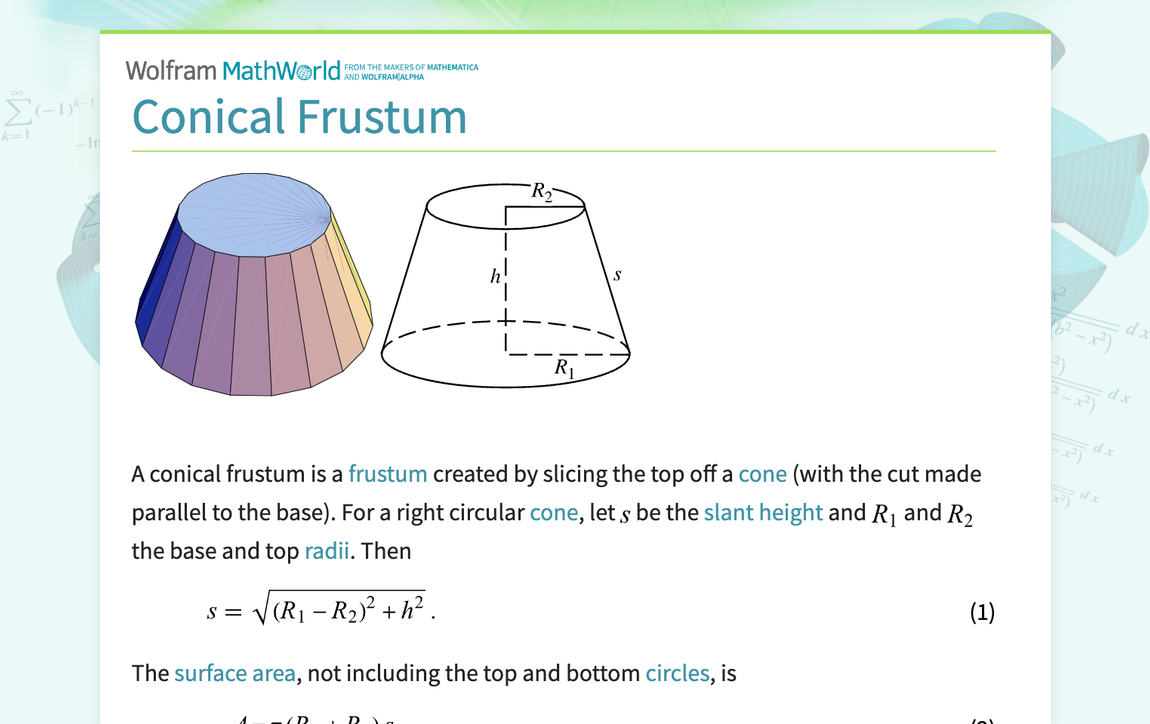
A conical frustum is a frustum created by slicing the top off a cone (with the cut made parallel to the base). For a right circular cone, let s be the slant height and R_1 and R_2 the base and top radii. Then s=sqrt((R_1-R_2)^2+h^2). (1) The surface area, not including the top and bottom circles, is A = pi(R_1+R_2)s (2) = pi(R_1+R_2)sq...
if you know r, R, and h it is possible to find the volume
if you only know the area of the yellow trapezium then it isn't
viral oxide
okay, thank you
devout snowBOT
Channel closed
Closed by @fossil locust
Use .reopen if this was a mistake.
viral oxide
.reopen
devout snowBOT
✅
viral oxide
Is it also not possible if you know h, ((r + R) / 2) and the "cross-sectional area"
fossil locust
viral oxide
Is it also not possible if you know h, ((r + R) / 2) and the "cross-sectional a...
well the cross sectional area is h * (r + R)/2
I'm pretty sure you need 3 independent pieces of information
where you can't say find the "cross-sectional area" from the other 2 pieces of information
viral oxide
okay thank you. I am trying to proof the "keplersche Fassregel" so Simpsonsrule but rotating. But there is only known y0, y1, y2, x2, x0.
I made: A_trapezoid = y_1 * (x_2 - x_0) and A_parallelogram = 0,5 * (y_0 + y_2) * (x_2 - x_0) - A_trapezoid
But now I am struggeling with getting the volumina
 devout snowBOT
@viral oxide Has your question been resolved?
viral oxide
<@&286206848099549185>
devout snowBOT
@viral oxide Has your question been resolved?
devout snowBOT
@viral oxide Has your question been resolved?
devout snowBOT
@viral oxide Has your question been resolved?
devout snowBOT
@viral oxide Has your question been resolved?
devout snowBOT
Channel closed
Closed due to timeout
Use .reopen if this was a mistake.
Available help channel!
Send your question here to claim the channel.
Remember:
• Ask your math question in a clear, concise manner.
• Show your work, and if possible, explain where you are stuck.
• After 15 minutes, feel free to ping <@&286206848099549185>.
• Type the command .close to free the channel when you're done.
• Be polite and have a nice day!
Read #❓how-to-get-help for further information on how to ask a good question, and about conduct in the question channels.
vast drift
Scope is highschool math if that matters
Consider the Bernstein polynomial $B_{n,k}(t)$ of degree n and order k that is defined by $B_{n,k}(t)= ^{n}C_{k} t^{k}(1-t)^{n-k}
part (1) Find the sum of all $B_{n,k}$ where k varies on [0,n] (i got = 1)
part2) (where im stuck)
devout snowBOT
vast drift
Scope is highschool math if that matters
Consider the Bernstein polynomial $B_{...
woven radishBOT
Dootud
Compile Error! Click the  reaction for more information.
(You may edit your message to recompile.)
 vast drift
part2 asks
Show that for $r \leq k \leq n$, $\frac{^{k}C_{r}}{^{n}C_{r}}B_{n,k}(t) = ^{n-r}C_{k-r}t^{k}(1-t)^{n-k}$
woven radishBOT
Dootud
 devout snowBOT
Channel closed
Closed by @vast drift
Use .reopen if this was a mistake.
devout snowBOT
Available help channel!
Send your question here to claim the channel.
Remember:
• Ask your math question in a clear, concise manner.
• Show your work, and if possible, explain where you are stuck.
• After 15 minutes, feel free to ping <@&286206848099549185>.
• Type the command .close to free the channel when you're done.
• Be polite and have a nice day!
Read #❓how-to-get-help for further information on how to ask a good question, and about conduct in the question channels.
 ripe oriole
Hi guys. Can someone verify my answer to correct value? i think there is mismatch in my calculations


 devout snowBOT
ripe oriole
Hi guys. Can someone verify my answer to correct value? i think there is mismatc...
devout snowBOT
ripe oriole
Hi guys. Can someone verify my answer to correct value? i think there is mismatc...
@ripe oriole Has your question been resolved?
devout snowBOT
Channel closed
Closed due to timeout
Use .reopen if this was a mistake.
devout snowBOT
Available help channel!
Send your question here to claim the channel.
Remember:
• Ask your math question in a clear, concise manner.
• Show your work, and if possible, explain where you are stuck.
• After 15 minutes, feel free to ping <@&286206848099549185>.
• Type the command .close to free the channel when you're done.
• Be polite and have a nice day!
Read #❓how-to-get-help for further information on how to ask a good question, and about conduct in the question channels.
 scenic pike
Someone help me I don’t know how I’m supposed to calculate either rates
 devout snowBOT
scenic pike
Someone help me I don’t know how I’m supposed to calculate either rates
scenic pike
devout snowBOT
scenic pike
Someone help me I don’t know how I’m supposed to calculate either rates
scenic pike
HELP
MY FRIENDS THING

Anyways…
I need help with calculating for both rates I have no idea how to do it when it should be something so simple😭
devout snowBOT
@scenic pike Has your question been resolved?
devout snowBOT
@scenic pike Has your question been resolved?
devout snowBOT
@scenic pike Has your question been resolved?
 alpine scaffold
devout snowBOT
alpine scaffold
devout snowBOT
Channel closed
Closed due to timeout
Use .reopen if this was a mistake.
Available help channel!
Send your question here to claim the channel.
Remember:
• Ask your math question in a clear, concise manner.
• Show your work, and if possible, explain where you are stuck.
• After 15 minutes, feel free to ping <@&286206848099549185>.
• Type the command .close to free the channel when you're done.
• Be polite and have a nice day!
Read #❓how-to-get-help for further information on how to ask a good question, and about conduct in the question channels.
devout snowBOT
devout snowBOT
Channel closed
Closed by @storm kiln
Use .reopen if this was a mistake.
devout snowBOT
Available help channel!
Send your question here to claim the channel.
Remember:
• Ask your math question in a clear, concise manner.
• Show your work, and if possible, explain where you are stuck.
• After 15 minutes, feel free to ping <@&286206848099549185>.
• Type the command .close to free the channel when you're done.
• Be polite and have a nice day!
Read #❓how-to-get-help for further information on how to ask a good question, and about conduct in the question channels.
 proven arch
What's the answer to 2(-2)+1/-2+1? is it (3) or (-3.5)? i used calculator but it said (-3.5) but i tried solving it manually and i keep getting (3)...
f(-2) = 2(-2) + 1/(-2)+1
f(-2) = -4 + 1 / -1
f(-2) = -3 / -1
f(-2) = 3
devout snowBOT
proven arch
What's the answer to 2(-2)+1/-2+1? is it (3) or (-3.5)? i used calculator but it...
 safe knoll
proven arch
What's the answer to 2(-2)+1/-2+1? is it (3) or (-3.5)? i used calculator but it...
safe knoll
proven arch
What's the answer to 2(-2)+1/-2+1? is it (3) or (-3.5)? i used calculator but it...
is it 1/(-2+1) or 1/-2 + 1
proven arch
1/-2 + 1
safe knoll
proven arch
1/-2 + 1
can u show the f(x) ? :)
cuz 1/-2 + 1 and 1/(-2+1) are 2 different things
proven arch
2x + 1 / x + 1
safe knoll
with any brackets or just like that?
proven arch
i'm supposed to graph a rational function but i can't seem to point it correctly without table of values
proven arch
safe knoll
with any brackets or just like that?
just as it is
safe knoll
$$\frac{2x+1}{x+1}?$$
woven radishBOT
JustToPro
 proven arch
yess
safe knoll
write it as (2x+1)/(x+1) next time
what ur trying to type is read as
$$2x + \frac{1}{x} + 1$$
woven radishBOT
JustToPro
 safe knoll
probably how the calculator read it as well , so thats why 3.5
proven arch
OHH no wonder i'm overthinking, thanks so much !
i will close now, thx for ur help i gotta watch my syntax now
.close
devout snowBOT
Channel closed
Closed by @proven arch
Use .reopen if this was a mistake.
devout snowBOT
Available help channel!
Send your question here to claim the channel.
Remember:
• Ask your math question in a clear, concise manner.
• Show your work, and if possible, explain where you are stuck.
• After 15 minutes, feel free to ping <@&286206848099549185>.
• Type the command .close to free the channel when you're done.
• Be polite and have a nice day!
Read #❓how-to-get-help for further information on how to ask a good question, and about conduct in the question channels.
 deep gale
 deep gale
for 10. are the numbers 16,8,0,0? just need someone to check
devout snowBOT
@deep gale Has your question been resolved?
deep gale
<@&286206848099549185>
fossil locust
deep gale
for 10. are the numbers 16,8,0,0? just need someone to check
I'm assuming they want the common ratio of the GP to not be 0
deep gale
yes
fossil locust
there has to be another solution, ok let me try
a, a + d, a + 2d, (a + 2d)^2/(a + d)
,w a + (a + 2d)^2 / (a + d) = 16, a + d + a + 2d = 8
woven radishBOT

 fossil locust
ah so if you choose a = -2, d = 4 instead
you get -2, 2, 6, 18
which must be the intended solution
I suspect you divided something in the quadratic instead of factoring properly
 woven radishBOT
 fossil locust
woven radish
fossil locust
woven radish
okay so your attempt that ends with $16r - a_1 r^4 + 16r^2 - a_1 r^5 = 8$ is the most promising I think
woven radishBOT
higher's secret twin brother
 fossil locust
then you haven't used the fact that the 1st, 2nd, 3rd terms are in AP
deep gale
so what would my 2 equations be?
fossil locust
AH the problem is that you've misunderstood the question
the first three are in AP and the last three are in GP
so you can't say that $a_1 + a_1 r^3 = 16$
woven radishBOT
higher's secret twin brother
 fossil locust
a, a + d, a + 2d, (a + 2d)^2/(a + d)
fossil locust
fossil locust
a, a + d, a + 2d, (a + 2d)^2/(a + d)
if you don't mind going along with this method
cause the last 3 terms are in GP
you know the common ratio is (a + 2d)/(a + d)
so the 4th term has to be (a + 2d)/(a + d) * (a + 2d)
fossil locust
deep gale
what should it be then?
so from (a + d) + (a + 2d) = 8 you can replace a with (8 - 3d)/2 for example
now sub that into a + (a + 2d)^2 / (a + d) = 16
 fossil locust
yep!
now multiply everything by 4 - 3/2 d + d = 4 - d/2
and it's a quadratic
@deep gale
deep gale
yes, that's what i'm doing rn
i was trying to solve for another problem while you were gone and got stuck again
fossil locust
okok
 fossil locust
deep gale
fossil locust
deep gale
careful
(a + b)^2 is not a^2 + b^2
so instead of doing that, expand $(4 + d/2)^2$
deep gale
wait i messed up already?
fossil locust
oh yeah and you also didn't multiply by 4 - 3/2 d + d on the right
for some reason you just multiplied by 4 - 3/2 d
hold on
deep gale
fossil locust
oh yeah and you also didn't multiply by 4 - 3/2 d + d on the right
for some rea...
nono but i multiplied 16 to 4-3/2 d to it
fossil locust
oh wait that's correct sorry
fossil locust
fossil locust
oh yeah and you also didn't multiply by 4 - 3/2 d + d on the right
for some rea...
this is the other issue then
deep gale
and i got 64-24d
fossil locust
deep gale
nono but i multiplied 16 to 4-3/2 d to it
you should be multiplying 16 by 4- d/2
deep gale
why 4 - d/2 and not 4 - 3/2 d