#help-27
1 messages · Page 250 of 1
 uncut crow
 ashen carbon
 topaz axle
"number of flips to land at 3 heads in a row"
topaz axle
"number of flips to land at 3 heads in a row"
on average
topaz axle
which is not flips overall
ashen carbon
if we can figure that out somehow
ashen carbon
uncut crow
expected number of flips before string is seen has a numerical answer tho
shorty what is the numerical answer
topaz axle
wait i see
ashen carbon
topaz axle
wait i see
let me know if im asking a broken question btw
i could try to clarify better
not a math guy so i come to the experts 😳
topaz axle
that is probably what you're asking, like if expected number is e.g. 12, then 1/12 of flips are "third in a rows"
assuming that follows
ok whatever i assume you just mean at least once
if you flip 3 times, there's 12.5% chance you have 3 in a row
if you flip 4 times, there's 18.75% chacne
┌──┬─────┬────────┐
│1 │2    │0       │
├──┼─────┼────────┤
│2 │4    │0       │
├──┼─────┼────────┤
│3 │7    │0.125   │
├──┼─────┼────────┤
│4 │13   │0.1875  │
├──┼─────┼────────┤
│5 │24   │0.25    │
├──┼─────┼────────┤
│6 │44   │0.3125  │
├──┼─────┼────────┤
│7 │81   │0.367188│
├──┼─────┼────────┤
│8 │149  │0.417969│
├──┼─────┼────────┤
│9 │274  │0.464844│
├──┼─────┼────────┤
│10│504  │0.507813│
├──┼─────┼────────┤
│11│927  │0.547363│
├──┼─────┼────────┤
│12│1705 │0.58374 │
├──┼─────┼────────┤
│13│3136 │0.617188│
├──┼─────┼────────┤
│14│5768 │0.647949│
├──┼─────┼────────┤
│15│10609│0.676239│
└──┴─────┴────────┘
based on all your other messages i'm not sure that's what you want
ashen carbon
topaz axle
if you flip 4 times, there's 18.75% chacne
wait yeah this is what i mean
if i flip x times theres a x % chance of winning 3 times in a row
on average
and i imagine the odds increase with every flip or something
topaz axle
not on average
ashen carbon
topaz axle
not on average
oh ok
if i flip a coin 50 times, im way more likely to hit tails 3 times in a row than if i was to flip 10 times
due to odds/numbers game right
ashen carbon
topaz axle
```
┌──┬─────┬────────┐
│1 │2 │0 │
├──┼─────┼────────┤
│2 │4 │0 ...
what is this
topaz axle
number of flips − how many ways to "lose" − odds of winning
if you make 3 flips, there's 8 ways it can go, and there's 7 ways you don't get 3 in a row
so 1/8 is the chance of winning
it's like percents
ashen carbon
i think i got it
ashen carbon
topaz axle
so 1/8 is the chance of winning
yes this is what i want
thats with 3 flips, and then that number goes higher the more i flip right
ashen carbon
haha
surely wont have to go that high, just looking for good odds
somewhere around 10 flips puts me at 50% odds
thats good enough
thank you @topaz axle youve been a great help friend
are you still there @topaz axle
id like to evolve the question if u dont mind
topaz axle
yeah i'm here
ashen carbon
if im right 60% of the time on a coin flip (dont ask how lol), how would the same question now work in terms of % just like you gave me
ashen carbon
topaz axle
```
┌──┬─────┬────────┐
│1 │2 │0 │
├──┼─────┼────────┤
│2 │4 │0 ...
basically this list which is perfect just how i want it, but instead of a 50% successrate on the coinflip, make it 60%
topaz axle
good question idk
ashen carbon
do i just leave the question here and it will get picked up ? or do i need to make another post
ashen carbon
topaz axle
brb 10 minutes
ok no worries
topaz axle
┌──┬──────┐
│1 │0.0000│
├──┼──────┤
│2 │0.0000│
├──┼──────┤
│3 │0.2160│
├──┼──────┤
│4 │0.3024│
├──┼──────┤
│5 │0.3888│
├──┼──────┤
│6 │0.4752│
├──┼──────┤
│7 │0.5429│
├──┼──────┤
│8 │0.6032│
├──┼──────┤
│9 │0.6560│
├──┼──────┤
│10│0.7014│
├──┼──────┤
│11│0.7409│
├──┼──────┤
│12│0.7751│
├──┼──────┤
│13│0.8049│
├──┼──────┤
│14│0.8307│
├──┼──────┤
│15│0.8530│
└──┴──────┘
```like this i thinkpretty sure
ashen carbon
ok i trust u and it seems about right
really appreciat your time man, thank u so mcuh
much*
 devout snowBOT
@ashen carbon Has your question been resolved?
Channel closed
Closed by @ashen carbon
Use .reopen if this was a mistake.
 Available help channel!
Send your question here to claim the channel.
Remember:
• Ask your math question in a clear, concise manner.
• Show your work, and if possible, explain where you are stuck.
• After 15 minutes, feel free to ping <@&286206848099549185>.
• Type the command .close to free the channel when you're done.
• Be polite and have a nice day!
Read #❓how-to-get-help for further information on how to ask a good question, and about conduct in the question channels.
 halcyon yew
help plz
devout snowBOT
halcyon yew
help plz

 ashen fossil
Hm?
 maiden dew
touching the curve = tangent
cutting through the curve = secant
ashen fossil
Yep
maiden dew
5 is a bit of an exception to the picture you might imagine though. touching = touching only at one point.
ashen fossil
If it touches it's tangent
If it cuts 2 times then secant
halcyon yew
wait what
is there an easier way to decipher which line it is @maiden dew @ashen fossil
like i want to write a formal definition for notes but have no clue what to write
ashen fossil
halcyon yew
is there an easier way to decipher which line it is <@359179377432592398> <@9440...
Just write what I sent ig
That's the easiest way to define it
Just write it in your own language
halcyon yew
@username can i go over each example with u?
ashen fossil
Yep
ashen fossil
Yep yep
ashen fossil
Mhm
halcyon yew
it is secant cause it touches at two points
ashen fossil
Yes
halcyon yew
thas only reason?
ashen fossil
Intersects rather than touches
halcyon yew
then for 2 only reason is makes contact once?
then for 3 only reason it makes contact once?
ashen fossil
Yes
ashen fossil
Ok so
Tangent means
Touching the curve
Which it does
Secant means intersecting
Also which it does
U see the bottom curve
Where it looks like tangent
That is where the line acts as tangent to the curve
halcyon yew
so tangent is touch and secent is intersect
ashen fossil
Yes
halcyon yew
alr
ashen fossil
Is something that touches the line
Only touch
And then go away from it
Where as
Secant line is something which touches/intersects
The curve
U get it?
halcyon yew
tangents dont intersect
halcyon yew
for 5 or 4?
ashen fossil
Did u understand 4?
halcyon yew
wait what 5?
ashen fossil
Look at the line and direction of the curve
halcyon yew
how does 5 touch]
ashen fossil
Same right?
halcyon yew
ashen fossil
Look at the line and direction of the curve
about the same
ashen fossil
Yes
So it's a tangent
Ull understand it better once u start to solve it mathematically
halcyon yew
but then 1 is also in same direction
wait does the definition in box make sense to u? maybe i should understand this

@ashen fossil my teacher said this
he said this before that tho
 ashen fossil
Just a sec
halcyon yew
np
halcyon yew
like they are both generally traveling to top left or bottom right depending on how u look at it
ashen fossil
Yepp
halcyon yew
i think it will help if i understand what these are trying to say too


@ashen fossil it would be appreciated if u could help me understand this
halcyon yew
alr
ashen fossil
If u take 1st pic
The one which says secant
U see the line intersecting curve at 2 points
Right?
halcyon yew
yes
 ashen fossil
Yes
Make the points come closer
And at the point where
They coincide
Ull see a tangent
Umm and I gotta go
My flight's starting
Be quick
ashen fossil
Mhm
Ok so making it simple
The line in 1st one
Move it slowly
To the left
The points of intersections keep coming closer and closer
Yes?
halcyon yew
so u move the curve too?
ashen fossil

Like this
So what they mean is
If u make 2 points of intersections of secant come closer and closer, it becomes a tangent
halcyon yew
how the heck do u do that? u just drag the line down? where does the dots moving come into play?
ashen fossil
It's just explaining u
What that box means
If u make 2 points of secant come closer, u get a tangent
Which u can see here
In the image i sent
halcyon yew
so then how is the first one a secan and not a tangent with this box knowledge
@ashen fossil
ashen fossil
Look
I'm just explaining what the box says
U shouldn't move the line and curve
The equation of line will change
halcyon yew
so does this have no relevance to getting the answers to the other examples
ashen fossil
Just for the sake of explaining, I moved it to show how it will become a tangent if 2 points coincide
ashen fossil
halcyon yew
so does this have no relevance to getting the answers to the other examples
Nop he is just explaining what a tangent is
In terms of secant
ashen fossil
It's fine
Take a break
And read this again
Slowly
And yea I gotta go
Just dm me if u have doubts
halcyon yew
alr imma add u
ashen fossil
Mhm
halcyon yew
thx
<@&286206848099549185> is anyone able to take over and try to explain in a different way
ashen fossil
halcyon yew
thx
Anytime!
halcyon yew
halcyon yew
<@&286206848099549185> is anyone able to take over and try to explain in a diffe...
<@&286206848099549185>
devout snowBOT
@halcyon yew Has your question been resolved?
devout snowBOT
Channel closed
Closed due to timeout
Use .reopen if this was a mistake.
Available help channel!
Send your question here to claim the channel.
Remember:
• Ask your math question in a clear, concise manner.
• Show your work, and if possible, explain where you are stuck.
• After 15 minutes, feel free to ping <@&286206848099549185>.
• Type the command .close to free the channel when you're done.
• Be polite and have a nice day!
Read #❓how-to-get-help for further information on how to ask a good question, and about conduct in the question channels.
 inner ibex
hi
devout snowBOT
inner ibex
hi
inner ibex

do we differentiate first and then sub in h = 12-r or do we put in 12-r first and then differentiate
can soemone pls help me understand dis
 long pasture
inner ibex
do we differentiate first and then sub in h = 12-r or do we put in 12-r first an...
long pasture
inner ibex
do we differentiate first and then sub in h = 12-r or do we put in 12-r first an...
sub first, since it's better to do it with one variable
if you are doing with multiple variables, it'll be nasty
inner ibex
long pasture
sub first, since it's better to do it with one variable
o oke
what ab for ids
dis q
what do i do wit hthe domain
 long pasture
ah, 2nd question
i see
2 things to check
boundary conditions, and local extrema
since f'(x) always >0 in the domain, so we'll just have to check the boundaries, i.e. when x=-2 and x=1
inner ibex
long pasture
since f'(x) always >0 in the domain, so we'll just have to check the boundaries,...
so we only do 2
long pasture
heyyy
inner ibex
how i do
long pasture
long pasture
2 things to check
check 2 things apply to everything
like with a function and a domain
long pasture
long pasture
boundary conditions, and local extrema
this
long pasture
- boundary conditions:
sub the min and max x into f(x)
- local extrema, find f'(x) and set it to 0 to check
(and check for undefined cases too if have)
see if you can do it with this HW
inner ibex
o
long pasture
it's not that hard for this Question 10, it's good for starters
devout snowBOT
@inner ibex Has your question been resolved?
devout snowBOT
Channel closed
Closed due to timeout
Use .reopen if this was a mistake.
devout snowBOT
Available help channel!
Send your question here to claim the channel.
Remember:
• Ask your math question in a clear, concise manner.
• Show your work, and if possible, explain where you are stuck.
• After 15 minutes, feel free to ping <@&286206848099549185>.
• Type the command .close to free the channel when you're done.
• Be polite and have a nice day!
Read #❓how-to-get-help for further information on how to ask a good question, and about conduct in the question channels.
 tough juniper
Hi, i just did this arithmetico-geometric series problem, and I’m wondering if there a name for this “move” (in image below, lines 3-5), since I couldn’t really search it up
devout snowBOT
tough juniper
Hi, i just did this arithmetico-geometric series problem, and I’m wondering if t...

 junior chasm
oh that complete thing
im not sure if there's a name for that
i just think its part of process to find the sum
tough juniper
It’s just clever manipulation ig?
tough juniper
Ok
 trail eagle
It's sort of rearranging, manipulation probably does the trick. Regardless, note that this somewhat assumes that the series converges in the first place. In general, you could get wrong results if the series doesn't.
But I guess you can show that separately :p
Here it works though
tough juniper
Yes, because i showed that it can be rewritten as a converging series
trail eagle
Lots of diverging series can be rearranged into seemingly convergent series by such manipulations is what I mean.
devout snowBOT
Channel closed
Closed by @tough juniper
Use .reopen if this was a mistake.
devout snowBOT
Available help channel!
Send your question here to claim the channel.
Remember:
• Ask your math question in a clear, concise manner.
• Show your work, and if possible, explain where you are stuck.
• After 15 minutes, feel free to ping <@&286206848099549185>.
• Type the command .close to free the channel when you're done.
• Be polite and have a nice day!
Read #❓how-to-get-help for further information on how to ask a good question, and about conduct in the question channels.
 lucid roost
How to abuse on Desmos
 devout snowBOT
lucid roost
How to abuse on Desmos
devout snowBOT
lucid roost
How to abuse on Desmos
 modest dune
Wdym
lucid roost
Like solve this question in Desmos
devout snowBOT
@lucid roost Has your question been resolved?
junior chasm
lucid roost
Like solve this question in Desmos
plot the equation in desmos
add a slider for p
and add a radius formula
then from where u can vary p using the slider and check the radius value and deduce the value of n
np = r
n(2) = 6
n=3
 devout snowBOT
Channel closed
Closed due to timeout
Use .reopen if this was a mistake.
devout snowBOT
Available help channel!
Send your question here to claim the channel.
Remember:
• Ask your math question in a clear, concise manner.
• Show your work, and if possible, explain where you are stuck.
• After 15 minutes, feel free to ping <@&286206848099549185>.
• Type the command .close to free the channel when you're done.
• Be polite and have a nice day!
Read #❓how-to-get-help for further information on how to ask a good question, and about conduct in the question channels.
 weary maple
Question
Which statement is not true?
Precise measurements are always accurate.
Accurate measurements are always precise.
Precise measurements can be inaccurate.
Inaccurate measurements can be precise.
devout snowBOT
weary maple
Question
Which statement is not true?
Precise measurements are always accurate.
...
 robust berry
 topaz axle
the first one
well the picture thinks 1st and 2nd
but if you have to pick one, 2nd is proly true
devout snowBOT
Channel closed
Closed by @weary maple
Use .reopen if this was a mistake.
Available help channel!
Send your question here to claim the channel.
Remember:
• Ask your math question in a clear, concise manner.
• Show your work, and if possible, explain where you are stuck.
• After 15 minutes, feel free to ping <@&286206848099549185>.
• Type the command .close to free the channel when you're done.
• Be polite and have a nice day!
Read #❓how-to-get-help for further information on how to ask a good question, and about conduct in the question channels.
 visual jetty
It says in the answer sheet the center of the circle I'm finding has diamater AB
How do you prove this?
 devout snowBOT
visual jetty
It says in the answer sheet the center of the circle I'm finding has diamater AB...
devout snowBOT
visual jetty
It says in the answer sheet the center of the circle I'm finding has diamater AB...
@visual jetty Has your question been resolved?
 upper schooner
Non-formally: the greatest distance a line segment through two points on a circle can have is when it forms a diameter…
visual jetty
Think I got it roughly
The problem itself isn't too hard... just the reasoning was a bit confusing
Maybe ill come back to it later for now it's good, thanks!
.close
devout snowBOT
Channel closed
Closed by @visual jetty
Use .reopen if this was a mistake.
devout snowBOT
Available help channel!
Send your question here to claim the channel.
Remember:
• Ask your math question in a clear, concise manner.
• Show your work, and if possible, explain where you are stuck.
• After 15 minutes, feel free to ping <@&286206848099549185>.
• Type the command .close to free the channel when you're done.
• Be polite and have a nice day!
Read #❓how-to-get-help for further information on how to ask a good question, and about conduct in the question channels.
 sturdy mango
is there a formal definition of indefinite integral like for derivatives we have the limit definition for definite integrals we have riemann sum
devout snowBOT
sturdy mango
is there a formal definition of indefinite integral like for derivatives we have...
 fiery marten
The equivalence class of antiderivatives of f, where 2 antiderivatives are equivalent iif they differ by a constant

 stone stump
indefinite integration is basically just definite integration with some lower bound number and upper bound x
sturdy mango
stone stump
indefinite integration is basically just definite integration with some lower bo...
but wouldnt that give us 0
fiery marten
no, you fix the lower bound and very upper bound
stone stump
$\int_0^x f(x) dx = F(x)-F(0)$ which is basically the same as $F(x)+c$
sturdy mango
but we dont tho? is it -infinity
 woven radishBOT
Denascite
 stone stump
not quite but more or less the same
sturdy mango
woven radish
**Denascite**
ohhh
but definite itnegras
dont have the constant of integ
fiery marten
Because they evaluate to a number
sturdy mango
yea
fiery marten
In definite integrals both bounds are fixed
fiery marten
And here we fix only one, but since we could fix it as any number, we get an arbitrary constant term
devout snowBOT
Channel closed
Closed by @sturdy mango
Use .reopen if this was a mistake.
stone stump
fiery marten
And here we fix only one, but since we could fix it as any number, we get an arb...
well not quite, nothing says that we could actually get any constant with F(a)
fiery marten
Yeah, true
stone stump
the constant basically comes afterwards because we know once we differentiate it wont matter again
fiery marten
That's why the definition with antiderivatives makes more sense
sturdy mango
yeah ik the definiton
but i thought maybe there is some more definiton like the limit one
we have for derivatives
stone stump
well that definition dodges the question whether an antiderivative exists in the first place
.reopen
devout snowBOT
✅
stone stump
the existence of an antiderivative is the expression $\int_a^x f(x) dx$ in the first place
woven radishBOT
Denascite
 stone stump
yes once we have some antiderivative we can get all of them. but we need to get the first somehow
and thats still done via definite integrals
sturdy mango
oh
kinda went over my head ngl
kinda get it
we use definite integral to define the indefinite integral?
and we assume that +C helps with the non selected limit of the definite integral?
stone stump
ehhh
fiery marten
- We prove that an antiderivative F0(x) exists using definite integrals
- We show that there're automatically many more antiderivatives: F0(x) + c
We define the indefinite integral as the class of all those antiderivatives (still not completely clean)
stone stump
the technical definition would be something like $$\int f(x) dx = \left{\int_a^x f(x) dx + C: C\in\bR\right}$$
woven radishBOT
Denascite
 stone stump
well, still missing technical details
sturdy mango
yea
stone stump
anyway, the point is definite integrals are the important bit
stone stump
indefinite integrals are more or less just convenient notation
sturdy mango
i use them a lot in physics
stone stump
and physics is well-known for caring a lot about the mathematical details
fiery marten
haha
sturdy mango
lol
devout snowBOT
@sturdy mango Has your question been resolved?
Channel closed
Closed by @sturdy mango
Use .reopen if this was a mistake.
devout snowBOT
Available help channel!
Send your question here to claim the channel.
Remember:
• Ask your math question in a clear, concise manner.
• Show your work, and if possible, explain where you are stuck.
• After 15 minutes, feel free to ping <@&286206848099549185>.
• Type the command .close to free the channel when you're done.
• Be polite and have a nice day!
Read #❓how-to-get-help for further information on how to ask a good question, and about conduct in the question channels.
 primal abyss
 devout snowBOT
primal abyss
devout snowBOT
primal abyss
 devout snowBOT
@primal abyss Has your question been resolved?
primal abyss
<@&286206848099549185>
devout snowBOT
@primal abyss Has your question been resolved?
devout snowBOT
@primal abyss Has your question been resolved?
devout snowBOT
@primal abyss Has your question been resolved?
primal abyss
.close
devout snowBOT
Channel closed
Closed by @primal abyss
Use .reopen if this was a mistake.
Available help channel!
Send your question here to claim the channel.
Remember:
• Ask your math question in a clear, concise manner.
• Show your work, and if possible, explain where you are stuck.
• After 15 minutes, feel free to ping <@&286206848099549185>.
• Type the command .close to free the channel when you're done.
• Be polite and have a nice day!
Read #❓how-to-get-help for further information on how to ask a good question, and about conduct in the question channels.
 fathom rune
how i can deal wiyh it
 devout snowBOT
fathom rune
how i can deal wiyh it
devout snowBOT
fathom rune
how i can deal wiyh it
 wicked turtle
can you find a simple bound for sin(x^2)?
fathom rune
its next chapter in my textbook
 flint spire
fathom rune
1 and -1?
flint spire
fathom rune
1 and -1?
yes, start with that and use it to squeeze the given function between two functions
$h(x) \le \frac{\sqrt[3]{x^2} \cdot \sin(x^2)}{x-1} \le g(x)$
woven radishBOT
Emily
 fathom rune
okkkk
flint spire
after that take the limit on the 3 sides
devout snowBOT
Channel closed
Closed by @fathom rune
Use .reopen if this was a mistake.
Available help channel!
Send your question here to claim the channel.
Remember:
• Ask your math question in a clear, concise manner.
• Show your work, and if possible, explain where you are stuck.
• After 15 minutes, feel free to ping <@&286206848099549185>.
• Type the command .close to free the channel when you're done.
• Be polite and have a nice day!
Read #❓how-to-get-help for further information on how to ask a good question, and about conduct in the question channels.
 prisma lodge
how do i solve
estimate the rate of change of the function at the given point. f(x)=1/3x at x=4
devout snowBOT
prisma lodge
how do i solve
estimate the rate of change of the function at the given point. ...
What step are you on?
1. I don't know where to begin.
2. I have begun but got stuck midway.
3. I got an answer but I was told that it's wrong.
4. I got an answer and would like my work checked.
5. I have a question about someone else's work/solution.
6. I have completed the problem and don't need help anymore. Thank you.
7. None of the above
Channel closed
Closed by @prisma lodge
Use .reopen if this was a mistake.
Available help channel!
Send your question here to claim the channel.
Remember:
• Ask your math question in a clear, concise manner.
• Show your work, and if possible, explain where you are stuck.
• After 15 minutes, feel free to ping <@&286206848099549185>.
• Type the command .close to free the channel when you're done.
• Be polite and have a nice day!
Read #❓how-to-get-help for further information on how to ask a good question, and about conduct in the question channels.
 scenic plume
Would it be possible to define a system of mathematics with such a number j where the square root of j is equal to negative one? I think it might be a problem of definition as the square root function is broken up into the principal and negative square roots due to x^2 being irreversible. What do you guys think? Is it not possible or would it be possible to approach this like defining imaginary and complex numbers(which I was thinking about doing initially)?
devout snowBOT
scenic plume
Would it be possible to define a system of mathematics with such a number j wher...
uncut crow
yea?
 young plover
So if you define j such that sqrt(j) = -1 then that’s allowed sure
But does it give you anything meaningful? Idk
You can derive that j=1
Or it could be -1 I suppose
So yeah there’s the branching issue you mentioned
scenic plume
Okay so what i'm getting is you're talking about somehow expanding or redefining the sqrt functon
young plover
No
scenic plume
Because last time i checked neither square root of 1 nor -1 was -1
 dense lynx
“Remember, you are not locked into a single axiom system. You may invent your own, whenever you wish—just use your intuition and imagination.” goes so hard right about now 
young plover
Truly
scenic plume
I'm talking about the principal square root
In which case sqrt(j)=-1 is currently undefined
young plover
Okay well a number whose square root is -1
You could define it if it exists as j like you’ve done
Sqrt(j) = -1 is the property
So I suppose j must also satisfy |j| = 1
Its on the unit circle
scenic plume
So what i'm getting is it has a chance to work
young plover
If anything you may be able to express j in terms of i but I suspect that j must equal 1 tbh
I think that’s the only number whose square root is -1
devout snowBOT
Channel closed
Closed by @scenic plume
Use .reopen if this was a mistake.
devout snowBOT
Available help channel!
Send your question here to claim the channel.
Remember:
• Ask your math question in a clear, concise manner.
• Show your work, and if possible, explain where you are stuck.
• After 15 minutes, feel free to ping <@&286206848099549185>.
• Type the command .close to free the channel when you're done.
• Be polite and have a nice day!
Read #❓how-to-get-help for further information on how to ask a good question, and about conduct in the question channels.
 timid peak
 devout snowBOT
timid peak
timid peak
devout snowBOT
timid peak
timid peak
where do you get the sqrt(2) from?
upper schooner
timid peak
where do you get the sqrt(2) from?
Magnitude of the complex number -1 + i 
devout snowBOT
@timid peak Has your question been resolved?
devout snowBOT
Channel closed
Closed by @timid peak
Use .reopen if this was a mistake.
Available help channel!
Send your question here to claim the channel.
Remember:
• Ask your math question in a clear, concise manner.
• Show your work, and if possible, explain where you are stuck.
• After 15 minutes, feel free to ping <@&286206848099549185>.
• Type the command .close to free the channel when you're done.
• Be polite and have a nice day!
Read #❓how-to-get-help for further information on how to ask a good question, and about conduct in the question channels.
 vale ether
Suppose I have a group generated by the following permutations on 20 integers: A= (1,2,3,…,20) and B=(1,4)(2,3). Find the maximal group generated by these.
Obviously we have an even and odd permutation and I suspect it just goes to S_20, but haven’t the ideas on how to show that or explain why that must be the case. I know there is a solution beyond brute force computing an (i, j) so looking for a neat way
devout snowBOT
vale ether
Suppose I have a group generated by the following permutations on 20 integers: A...
@vale ether Has your question been resolved?
vale ether
<@&286206848099549185>
 spiral geyser
what kind of group-theoretic tools have you covered so far?
vale ether
Uh the usual early bits up to conjugate classes, centralizers, isomorphism (inner outer, the lot)
I’m just unsure of anything to use
spiral geyser
well to start, you can get 20 different products of two 2-cycles by conjugating B by A
A B A^(-1) is (2 5) (3 4), A^2 B A^(-2) is (3 6) (4 5), and so on
vale ether
Yeah sure. And I get those will be distinct because A is cyclic.
So that gives us some terms, but is there a way to get like a (1 2) from that?
Or are we forming some sorta logic to get to 20!
devout snowBOT
@vale ether Has your question been resolved?
vale ether
@spiral geyser Any thoughts?
devout snowBOT
@vale ether Has your question been resolved?
devout snowBOT
@vale ether Has your question been resolved?
devout snowBOT
Channel closed
Closed due to timeout
Use .reopen if this was a mistake.
Available help channel!
Send your question here to claim the channel.
Remember:
• Ask your math question in a clear, concise manner.
• Show your work, and if possible, explain where you are stuck.
• After 15 minutes, feel free to ping <@&286206848099549185>.
• Type the command .close to free the channel when you're done.
• Be polite and have a nice day!
Read #❓how-to-get-help for further information on how to ask a good question, and about conduct in the question channels.
 void knot
Consider the curve ( y = y(x) ) in the upper half-plane with the condition (x > -\frac{1}{2} )
such that at any point ( M(x, y) ) on the curve, the tangent line intersects the x-axis at a point ( N ), and it satisfies
[ |OM| = |ON|, \quad y(0) = 1, \quad y'(x) > 0. ]
Find the function ( y = y(x) )
devout snowBOT
void knot
Consider the curve \( y = y(x) \) in the upper half-plane with the condition \(x...
woven radishBOT
ive
 devout snowBOT
@void knot Has your question been resolved?
 somber mortar
I need help with a problem which is: prove that for any x ≤ 2, x + 1 + xe^(-x) ≤ 2x+1
devout snowBOT
@void knot Has your question been resolved?
devout snowBOT
@void knot Has your question been resolved?
 faint gorge
void knot
Consider the curve \( y = y(x) \) in the upper half-plane with the condition \(x...
faint gorge
void knot
Consider the curve \( y = y(x) \) in the upper half-plane with the condition \(x...
This looks like it could be some root function
void knot
faint gorge
This looks like it could be some root function
How so? I guess it could be some diff equation but I have no evidence
faint gorge

So that's interesting we have to make sure that the distance from point of tangent is equidistant the origin as the intersection point with the x-axis and tangent line
Say the tangent line had the form t(x) = mx + c
If t(x) = 0 then
mx + c = 0 implies x = -c/m
|-c/m| = |y(x)|
The root of the tangent line has the same distance as the point of y(x)

So we have to make sure that our curve is built in such way so that [x^2+y^2 = \frac{c}{m} \quad \forall x,y ]
woven radishBOT
bacc
 faint gorge
which actually resembles a circle equation  but then we also need to make sure y'(x) > 0
circle makes actually sense
no it doesn't after further inspection
It has to be a an isosceles triangle actually
damn that problem is interesting but i gotta go 😢
|M(x,y(x))| = |T(x,0)|
faint gorge
woven radish
**bacc**
(c/m)²
void knot
faint gorge
damn that problem is interesting but i gotta go 😢
omg I just came back thank you Lemme take a look
faint gorge
Now that think about it
We have to derive a differential equation
Because it could be really any type of function
void knot
Half of my brain cells are dead after thinking about this
void knot
faint gorge
you mean these two line are the same?
 faint gorge
,, y'x+y = \frac{y}{x}
faint gorge
void knot
you mean these two line are the same?
Exactly
faint gorge
We know the tangent line looks like
[ t(x) = y'(a)(x-a)+y(a) ]

 woven radishBOT
bacc
 void knot
wdym
faint gorge
,w x^2+y^2=(y/y')^2
void knot
you have went so far, wait for me to follow up🥲
woven radishBOT


 Requested by adoniszgks
void knot
woven radish
**bacc**
Requested by adoniszgks
void knot
woven radish
**bacc**
you go from this to that ? from c/m to y/y'
faint gorge
Yes
void knot
from a circle to a diff equ
faint gorge
void knot
you mean these two line are the same?
Green triangle
void knot
faint gorge
no it doesn't after further inspection
what's the inspection here
faint gorge
But I think it's weong anyway as it's not a simple solution
faint gorge
void knot
what's the inspection here
Well I realized a circle equation does not satisfy |OM|=|ON|
void knot
you mean we need both equa hold simultaneously?
faint gorge
Yea
void knot
We still have a condition that havent use
faint gorge
Yea
void knot
y'=y-0/x-c/m >0
seems like wrong track
-c/m=x-y/y'
I need to gather all the current conditions
x^2+y^2=c/m=y/y'
uhh
nvm I think somewhere is wrong but idk
idk why we get different result
 void knot
woven radish
**bacc**
void knot
woven radish
**bacc**
What did you sub in for this step, I feel this might be wrong, can you elaborate this step? (ofc later when you're available
void knot
woven radish
**bacc**
We can never deal with diff equ in this form
It's not a regular form covered in college
We have to think another way out
But I'm so headache rn, umm can't think of any
devout snowBOT
@void knot Has your question been resolved?
faint gorge
@void knot
 crude wasp
woven radish
**bacc**
crude wasp
woven radish
**bacc**
haven't read what u've done but i think this equation is wrong
if our original point M = (x_0, y_0)
i get that N = (x0 - y0/y'(x0) )
so our differential equation becomes
$x^2 + y^2 = \big (x-\frac{y}{y'} \big)^2$
faint gorge
crude wasp
haven't read what u've done but i think this equation is wrong
I JUST GOT THIS
woven radishBOT
LY
 faint gorge

Desmos
crude wasp
so i'm tempted to think it's correct lol
 crude wasp
faint gorge
crude wasp
faint gorge
oh ok u've got the same equation as me
faint gorge
I have done mistakes previously
crude wasp
oh right ic lol nw
faint gorge
but now where I am at home I have this
crude wasp
faint gorge
😭 now everybody things i copied you
aha it's fine
i'm sure no one's checking the history of a random help channel
crude wasp
woven radish
**LY**
anyway yeah lemme see how to actually solve the DE
faint gorge
Well I haven't solved it used a calculator
but what matters to me the most is the finding the right approach
now i can play minecraft 🥹
I think the suggestion was to do z = y'
faint gorge
woven radish
**bacc**
I was just missing the x- 😭
crude wasp
yeah ok i think i know how to solve the DE too
crude wasp
woven radish
**LY**
@void knot lemme know if u manage to get this
also if u need help solving the DE
faint gorge
faint gorge
[ (y')^2 + y'(2xy) = y^2 ]
woven radishBOT
bacc
 faint gorge
[ (y'+xy)^2 = y^2+(xy)^2 = y^2(1+x^2) ]
woven radishBOT
bacc
 faint gorge
[ y' = y(\sqrt{1+x^2}-x) ]
woven radishBOT
bacc
 woven radishBOT
bacc
 faint gorge
@crude wasp what do you think?
faint gorge
Did I do a mistake
faint gorge
faint gorge
From here I multiplied by (y')² and added (xy)²
crude wasp
woven radish
**bacc**
yeah i got that too
 restive river
faint gorge
Did I do a mistake <:hmmcat:831508801646755850>
restive river
faint gorge
Did I do a mistake <:hmmcat:831508801646755850>
You can use byparts here
faint gorge
crude wasp
yeah i got that too
Have you seen the desmos file I sent
crude wasp
faint gorge
Have you seen the desmos file I sent
yeah i saw
faint gorge
 faint gorge
woven radish
**bacc**
faint gorge
woven radish
**bacc**
From here doesn't seem to be the same
ngl I am kinda proud of me it's been 1 year since i have had dge's
devout snowBOT
Channel closed
Closed due to timeout
Use .reopen if this was a mistake.
Available help channel!
Send your question here to claim the channel.
Remember:
• Ask your math question in a clear, concise manner.
• Show your work, and if possible, explain where you are stuck.
• After 15 minutes, feel free to ping <@&286206848099549185>.
• Type the command .close to free the channel when you're done.
• Be polite and have a nice day!
Read #❓how-to-get-help for further information on how to ask a good question, and about conduct in the question channels.
 ruby bridge
Anyone able to help me with this question, i'm unsure where to start

 gusty nexus
ruby bridge
Anyone able to help me with this question, i'm unsure where to start
gusty nexus
ruby bridge
Anyone able to help me with this question, i'm unsure where to start
Let's say $sin(\alpha)$ is m, what is $arcsin(-m)$
woven radishBOT
MetuMortis
 ruby bridge
I have no idea what arcsin means
ruby bridge
-1/2
gusty nexus
ruby bridge
-1/2
Yes so if sin(x) is -5/13 what is sin(-x)
ruby bridge
5/13
gusty nexus
Yes, create a right triangle, one of the angles should be -x
gusty nexus
Find cos(-x) using the triangle
Then convert it to cos(x)
Not sure if "converting" is the true verb tho, maybe I should say "calculate"
ruby bridge
ruby bridge
Anyone able to help me with this question, i'm unsure where to start
What does the misshapen E mean in this question
 brittle inlet
gusty nexus
Find cos(-x) using the triangle
brittle inlet
gusty nexus
Find cos(-x) using the triangle
That's not necessary though
brittle inlet
ruby bridge
What does the misshapen E mean in this question
“belongs to“
It's saying that x lies within that interval
ruby bridge
brittle inlet
That's not necessary though
What is the next step according to you?
brittle inlet
ruby bridge
What is the next step according to you?
Do you know the fundamental equation of trigonometry?
The one that relates the squares of cos and sin?
ruby bridge
Which one are you referring to?
brittle inlet
ruby bridge
Which one are you referring to?
The basic one
The one with sin and cos
ruby bridge
The sos cas toa ones?
brittle inlet
ruby bridge
The sos cas toa ones?
Uh, never heard of those abbreviations
Could you explain what you mean?
brittle inlet
ruby bridge
Sin = opposite side/long side
No, not that one
Does sin^2(x)+cos^2(x)=1 ring any bells?
brittle inlet
Yeah, the Pythagorean identity
ruby bridge
But thats only when the long side is 1 right?
brittle inlet
Well, from there, it follows that cos^2(x)=1-sin^2(x)
brittle inlet
ruby bridge
But thats only when the long side is 1 right?
Nope, it's universal, for any angle x, that is satisfied
Whatever angle that may be
ruby bridge
Alright
brittle inlet
brittle inlet
Well, from there, it follows that cos^2(x)=1-sin^2(x)
And you should be able to go on from here
ruby bridge
It gives me a number but how would i make that number into a simplified fraction
brittle inlet
ruby bridge
It gives me a number but how would i make that number into a simplified fraction
What have you done to get there?
ruby bridge
Cos² = 1- ( -5/13)²
brittle inlet
ruby bridge
Cos² = 1- ( -5/13)²
Yup
brittle inlet
ruby bridge
I can Just do 5² and 13² and keep the fraction
Those are fairly simple squares
And you need to subtract them to one
brittle inlet
ruby bridge
Which makes 144/169
Yup, from there you get that cos(x) is the square root of that
brittle inlet
ruby bridge
And then sqrt
Yep
ruby bridge
And then i can divide cos and sin to get tan?
brittle inlet
ruby bridge
And then i can divide cos and sin to get tan?
Yeah, but there's one last thing you gotta keep in mind
Recall they mentioned that x was between pi and 3pi/2
That means it's an angle on the third quadrant(you can visualize the unit circle for this)
What's the sign of cos on the third quadrant?
ruby bridge
Negative
brittle inlet
Yup
So cos is (-1) times the value you got for cos
From there you can proceed normally
brittle inlet
Yup
devout snowBOT
Channel closed
Closed by @ruby bridge
Use .reopen if this was a mistake.
Available help channel!
Send your question here to claim the channel.
Remember:
• Ask your math question in a clear, concise manner.
• Show your work, and if possible, explain where you are stuck.
• After 15 minutes, feel free to ping <@&286206848099549185>.
• Type the command .close to free the channel when you're done.
• Be polite and have a nice day!
Read #❓how-to-get-help for further information on how to ask a good question, and about conduct in the question channels.
 stark shale
watching this video, it gives some perspective over the dot product.
https://youtu.be/LyGKycYT2v0?t=709
it talks about duality. Which i didnt came across in my studies.
just to understand a bit better, any vector of any dimension, i can interpret its components as the basis vectors of a transformation that maps the space into a line ?
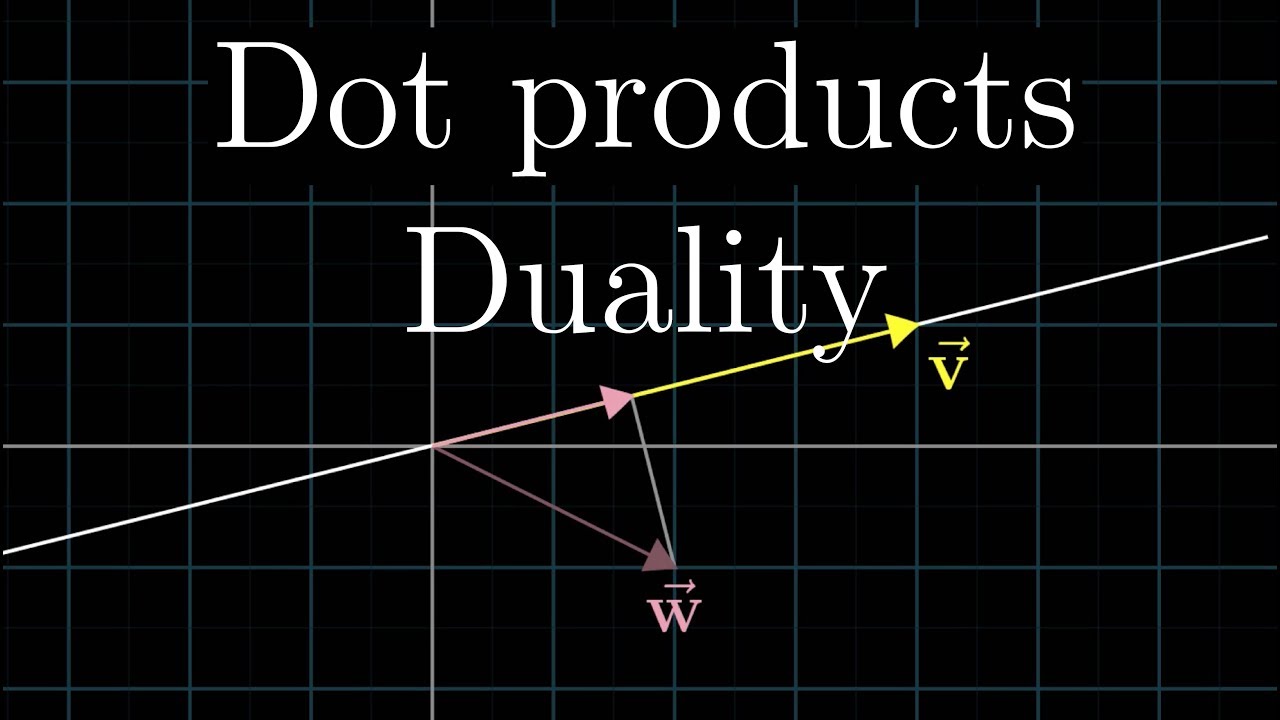
Why the formula for dot products matches their geometric intuition.
Help fund future projects: https://www.patreon.com/3blue1brown
An equally valuable form of support is to simply share some of the videos.
Home page: https://www.3blue1brown.com/
Dot products are a nice geometric tool for understanding projection. But now that we know about lin...
devout snowBOT
stark shale
watching this video, it gives some perspective over the dot product.
https://you...
stark shale
if you play it starts where i'm having my question
 graceful cosmos
Watched the video. I think 3b1b is noting that a dot product with a given vector is itself a linear transformation
He's constructing
f: R² -> R
f(x) = x•(4,1)
f is linear
Using dot products, we can generate linear transformations. Or, we can write linear transformations using dot products
@stark shale
stark shale
graceful cosmos
Watched the video. I think 3b1b is noting that a dot product with a given vector...
i don't know how to read what you wrote there. maybe
f is a function that maps from R2 to R ?
and f is defined as a dot product between input vector x and some other vector.
? is this what you wrote there?
ok
graceful cosmos
Exactly. In 3b1b's version, the "other vector" is (4,1). You could use any other vector though
stark shale
ok yes i think i understand what is going on there
i was just reasoning on that specific part
of the dual
the dual argument is valid only when going from Rn to R ?
graceful cosmos
You can extend it further. See the Riesz representation theorem for more details
Basically, you can write any linear transformation as a list of vectors to dot with
stark shale
ok it's over my heaed
stark shale
graceful cosmos
Basically, you can write *any* linear transformation as a list of vectors to dot...
a matrix baiscally
graceful cosmos
Meaning that "linear transformation" and "vectors to dot with" are essentially the same thing, and therefore those "vectors" are "dual" to linear transformations
stark shale
ok
i think i understand
so, to get back to my orig question at the top..
i have a vector in 3d space, with its components. i can see that vector as a .. vector, a point in space.
But i can create a 1*3 matrix with 3 basis vectors corresponding to the vector components.
graceful cosmos
(4,2) is just 4u + 2v, where u and v is an agreed-upon basis
stark shale
and that matrix, would map a 3d space to 1d space. so it's a dot product basically
does it makes sense what i wrote?
i need yes or no
graceful cosmos
Yes
stark shale
ok, if you want to expand you're welcome, it's just that my brain looks for that first, so i understand how to read the answer
if it's a "youre wrong , this is how it is instead" or "yes let me expand further"
graceful cosmos
Of course, I get it!
stark shale
cool thanks
graceful cosmos
Your explanation works
devout snowBOT
Channel closed
Closed by @stark shale
Use .reopen if this was a mistake.
devout snowBOT
Available help channel!
Send your question here to claim the channel.
Remember:
• Ask your math question in a clear, concise manner.
• Show your work, and if possible, explain where you are stuck.
• After 15 minutes, feel free to ping <@&286206848099549185>.
• Type the command .close to free the channel when you're done.
• Be polite and have a nice day!
Read #❓how-to-get-help for further information on how to ask a good question, and about conduct in the question channels.
 devout snowBOT
 last egret
any way to simplify this?
devout snowBOT
last egret
any way to simplify this?
devout snowBOT
@last egret Has your question been resolved?
flint spire
you could for example do this $\ \frac{y^3 \cdot \cos(xy^3)}{5-3xy^2 , \cos(xy^3)}=\frac{y^3 \cdot \cos(xy^3) ,,, / \cos(xy^3)}{[5-3xy^2 , \cos(xy^3)] , , , / \cos(xy^3)}$
woven radishBOT
Emily
 flint spire
$\frac{y^3}{5 , \sec(xy^3)-3xy^2}$
woven radishBOT
Emily
 flint spire
1 trig function instead of 2, ig expression is simpler in this sense
devout snowBOT
Channel closed
Closed due to timeout
Use .reopen if this was a mistake.
devout snowBOT
Available help channel!
Send your question here to claim the channel.
Remember:
• Ask your math question in a clear, concise manner.
• Show your work, and if possible, explain where you are stuck.
• After 15 minutes, feel free to ping <@&286206848099549185>.
• Type the command .close to free the channel when you're done.
• Be polite and have a nice day!
Read #❓how-to-get-help for further information on how to ask a good question, and about conduct in the question channels.
 formal quarry
Isn't C in the z=y plane?
 devout snowBOT
formal quarry
Isn't C in the z=y plane?
devout snowBOT
formal quarry
Isn't C in the z=y plane?
 serene lance
formal quarry
Isn't C in the z=y plane?
serene lance
formal quarry
Isn't C in the z=y plane?
I think so yeah
z=x doesn't really make sense
formal quarry
serene lance
I think so yeah
Ok that’s what I thought too. I’ll email my professor and see what they say
I just wanted a second opinion to make sure I’m not going insane lol
serene lance
I was like wait a second but looked at it in desmos and seems it is z=y
And just algebraically speaking
Since $z\geq0, y\geq0$ you can get $z=\sqrt{9-x^2}$ and $y=\sqrt{9-x^2}$ so assuming $y=z$ we get an equality but for $z=x$ we just get $2z^2=9$ ig?
woven radishBOT
Goran
 serene lance
That has nothing to do with y
formal quarry
yeah, im definitely gonna ask them about this
serene lance
Took a bit of work but desmos proof (1st image is z=y)

 formal quarry
and the second is z=x?
serene lance
Yeah
formal quarry
just emailed them. we shall see what they say
serene lance
woven radish
**Goran**
Btw looked into this 2z^2=9 we get assuming that z=x which produces a singular solution and it's this corner here
 serene lance
formal quarry
just emailed them. we shall see what they say
serene lance
formal quarry
just emailed them. we shall see what they say
Good luck
devout snowBOT
@formal quarry Has your question been resolved?
devout snowBOT
@formal quarry Has your question been resolved?
 ornate prism
serene lance
That has nothing to do with y
ornate prism
serene lance
That has nothing to do with y
Is this grade 12 math
serene lance
ornate prism
Is this grade 12 math
Well depends this kind of maths is in 1st year of uni mostly in my school system since it deals with multivariable curves
ornate prism
serene lance
Well depends this kind of maths is in 1st year of uni mostly in my school system...
Yeah I expect it
formal quarry
ornate prism
Is this grade 12 math
this is calc 3
devout snowBOT
@formal quarry Has your question been resolved?
devout snowBOT
@formal quarry Has your question been resolved?
devout snowBOT
@formal quarry Has your question been resolved?
devout snowBOT
Channel closed
Closed due to timeout
Use .reopen if this was a mistake.
devout snowBOT
Available help channel!
Send your question here to claim the channel.
Remember:
• Ask your math question in a clear, concise manner.
• Show your work, and if possible, explain where you are stuck.
• After 15 minutes, feel free to ping <@&286206848099549185>.
• Type the command .close to free the channel when you're done.
• Be polite and have a nice day!
Read #❓how-to-get-help for further information on how to ask a good question, and about conduct in the question channels.
 slate glen
hii cld anyone explain how they got R=5 how i solve for r is using simul eqn and solving for alpha then replugging into the eqn and solving for r also cld anyone rlly explain what r formula does or rlly mean im preety curious
 devout snowBOT
slate glen
hii cld anyone explain how they got R=5 how i solve for r is using simul eqn and...
woven radishBOT
devout snowBOT
slate glen
hii cld anyone explain how they got R=5 how i solve for r is using simul eqn and...
woven radishBOT
ananas

 pastel pasture
basically imagine a and b to be the legs of a right triangle
α is the angle such that tan(α) = b/a
and R = sqrt(a^2 + b^2) for you here
slate glen
so cld u say R reprsents the hypotenuse side of the right angled triangle?
pastel pasture
yeah exactly
 devout snowBOT
@slate glen Has your question been resolved?
slate glen
slate glen
hii cld anyone explain how they got R=5 how i solve for r is using simul eqn and...
Also this end eqn like the ans what does it represent
brittle inlet
slate glen
This is an impossible triangle
brittle inlet
slate glen
could you explain why
All the angles in a triangle sum to 180°
Cos and sin are bounded between 1 and -1, so they could, at most, be equal to 1
(leaving aside that there exists no angle such that both sin and cos are 1, we'll assume there is)
Assuming the maximum.value for both cos and sin, we'd get that one angle is 3°, another 4° and another one 90°
Which sum to 97°
slate glen
ohhh okayyy
slate glen
brittle inlet
All the angles in a triangle sum to 180°
hmm then how wld i possibly represent 4sintheta +3costheta =5sin(theta+36.870)
brittle inlet
slate glen
hmm then how wld i possibly represent 4sintheta +3costheta =5sin(theta+36.870)
What are you trying to represent? That equation?
slate glen
yes in a traingle
brittle inlet
slate glen
yes in a traingle
Hm, that's quite the strange exercise
I think it'd be better if someone else helped ya
slate glen
hmm sure tks!
devout snowBOT
@slate glen Has your question been resolved?
slate glen
whjk
devout snowBOT
@slate glen Has your question been resolved?
devout snowBOT
Channel closed
Closed due to timeout
Use .reopen if this was a mistake.
Available help channel!
Send your question here to claim the channel.
Remember:
• Ask your math question in a clear, concise manner.
• Show your work, and if possible, explain where you are stuck.
• After 15 minutes, feel free to ping <@&286206848099549185>.
• Type the command .close to free the channel when you're done.
• Be polite and have a nice day!
Read #❓how-to-get-help for further information on how to ask a good question, and about conduct in the question channels.
 mighty copper
how do i show this
 devout snowBOT
mighty copper
how do i show this
mighty copper
devout snowBOT
mighty copper
how do i show this
mighty copper
i am able to find the resultant motion
but how do i show that this resultant motion follows SHM?
mighty copper
 frozen aurora
for the resultant motion
frozen aurora
for the resultant motion
okay so the resultant motion will be in Acos(wt+delta) form
I am getting delta as
tan^-1(A2sin(phi)/(A1+A2sin(phi))
and then A as
(A1+A2sin(phi))cos(delta)
frozen aurora
great
frozen aurora
mighty copper
okay so the resultant motion will be in Acos(wt+delta) form
so, willthis motion be simple and harmonic?
it's just like x1 and x2: amplitude*cos(wt+phase)
mighty copper
frozen aurora
so, willthis motion be simple and harmonic?
yea i mean it should be as thats the pattern of a SHM motion
i thought there is a rigorous proof or something?
frozen aurora
unless there's a very specific definition of SHM that this textbook uses
i think what you did is definitely enough 
mighty copper
frozen aurora
i think what you did is definitely enough <:catthumbsup:614540188747563008>
got it. thankyouuu
.close
devout snowBOT
Channel closed
Closed by @mighty copper
Use .reopen if this was a mistake.
devout snowBOT
Available help channel!
Send your question here to claim the channel.
Remember:
• Ask your math question in a clear, concise manner.
• Show your work, and if possible, explain where you are stuck.
• After 15 minutes, feel free to ping <@&286206848099549185>.
• Type the command .close to free the channel when you're done.
• Be polite and have a nice day!
Read #❓how-to-get-help for further information on how to ask a good question, and about conduct in the question channels.
 split orbit
hey, i was just wondering if i drew my boxplot correctly according to the right sets of data, the context of the question should be on the top beside “e.)”
 devout snowBOT
split orbit
hey, i was just wondering if i drew my boxplot correctly according to the right ...
split orbit
devout snowBOT
split orbit
hey, i was just wondering if i drew my boxplot correctly according to the right ...
split orbit
<@&286206848099549185>
devout snowBOT
@split orbit Has your question been resolved?
devout snowBOT
@split orbit Has your question been resolved?
devout snowBOT
@split orbit Has your question been resolved?
 drowsy pond
split orbit
drowsy pond
split orbit
I was just wondering whther my box plot was drawn correctly or not, i even provided the context of the question as well
The datasets regarding Q1, Q3 and IQR are all displayed in the photo too, just wanted to check if my boxplot is drawn accurately or illustrated presentably
This question is based off of a stats class btw
 bleak tinsel
split orbit
I was just wondering whther my box plot was drawn correctly or not, i even provi...
bleak tinsel
split orbit
I was just wondering whther my box plot was drawn correctly or not, i even provi...
Unable to clearly understand the question in the image,
Please transcribe it
devout snowBOT
@split orbit Has your question been resolved?
split orbit
.close
devout snowBOT
Channel closed
Closed by @split orbit
Use .reopen if this was a mistake.
Available help channel!
Send your question here to claim the channel.
Remember:
• Ask your math question in a clear, concise manner.
• Show your work, and if possible, explain where you are stuck.
• After 15 minutes, feel free to ping <@&286206848099549185>.
• Type the command .close to free the channel when you're done.
• Be polite and have a nice day!
Read #❓how-to-get-help for further information on how to ask a good question, and about conduct in the question channels.
 ashen leaf
So, I have an equation here for Xn which I know is for a hyperbola but I need to put it into a form that is recognizable as a hyperbola
devout snowBOT
ashen leaf
So, I have an equation here for Xn which I know is for a hyperbola but I need to...
ashen leaf

Intuition tells me this would be something like acosh(theta)+bsinh(theta) or maybe in this case i[acosh(x)+bsinh(x)] thus I would need to substitute my e^thetas back to cosh(theta)+sinh(theta) and so forth and then just separate the terms
but I feel like that is also very wrong
devout snowBOT
@ashen leaf Has your question been resolved?
devout snowBOT
Channel closed
Closed due to timeout
Use .reopen if this was a mistake.
Available help channel!
Send your question here to claim the channel.
Remember:
• Ask your math question in a clear, concise manner.
• Show your work, and if possible, explain where you are stuck.
• After 15 minutes, feel free to ping <@&286206848099549185>.
• Type the command .close to free the channel when you're done.
• Be polite and have a nice day!
Read #❓how-to-get-help for further information on how to ask a good question, and about conduct in the question channels.
 weary parrot
y = x^2 - 5 at P(2, -1)
devout snowBOT
weary parrot
y = x^2 - 5 at P(2, -1)
weary parrot
find the slop and equation of the tangent line
 atomic dome
weary parrot
find the slop and equation of the tangent line
atomic dome
weary parrot
find the slop and equation of the tangent line
What is your work so far?
atomic dome
Alright, so the slope is?
weary parrot
-1
atomic dome
With that knowledge, what is the slope
weary parrot
I already did Calculus 1 but I am struggling in Calculus 2
do I need to re do Calculus 1 and do limits all over again to be successful in Calculus 2?
atomic dome
No, you should focus on mastering the integral and derivative
weary parrot
my professor said I should re do Calculus 1 because at the end they use derivatives
I can't remember all the derivatives and integration formulas
there are so many
weary parrot
should I just try to do Calculus 2 without going back to Calculus 1?
because whenever I see trig in Calc 2 I have troubles
I don't know the trig identities or anything
weary parrot
what country are you in?
atomic dome
US
weary parrot
ok so you think I should just keep going with Calculus 2?
atomic dome
weary parrot
y = x^2 - 5 at P(2, -1)
What is the slope?
atomic dome
You told me the derivative is 2x
Plug in the x value of the coordinate into the derivative
atomic dome
The definition of the derivative is what that is
weary parrot
ok so derivative is 2x
atomic dome
Yes
weary parrot
do I put 2(2) or 2(-1) ?
weary parrot
how do I do that
atomic dome
Use point slope form
weary parrot
its like y2 - y1 = m(x) + b?
atomic dome
Close
weary parrot
y2 - y1 = m(x2 - x1) + b
atomic dome
Yes
weary parrot
what is b in this?
atomic dome
weary parrot
y2 - y1 = m(x2 - x1) + b
There isn’t a b in the point slope form. The b would just subtract into the y1
b is only in slope intercept form
atomic dome
Just keep it as y+1=4(x-2)
weary parrot
y + 1 = 4x - 8
is the only overlap in Calculus 1 derivatives for Calculus 2?
everything else is a waste of time?
atomic dome
Nothing is a waste of time
atomic dome
Wow
weary parrot
since it's been 9 years since I've done Calculus
should I redo Calculus 1
or can I just keep going forward
I remember the product rule and chain rule and derivatives or sin and cos and ln(x) but that's about it
when I get into tan and sec^2 and things like that I forget
the integrals are really hard
atomic dome
Why are you learning calculus again
weary parrot
because I need it for a computer science degree
once I did Calculus 1 the first time I took a break from university because I wasn't having fun
what do you think I should do?
atomic dome
Just take the next calculus course you can
weary parrot
yea that's Calculus 2
but I keep having to drop it

can you help me with this integral
or can you help me on another tangent line question?
devout snowBOT
@weary parrot Has your question been resolved?
weary parrot
@atomic dome can you please help me
atomic dome
weary parrot
<@784145995760009247> can you please help me
Sure, just give me a moment
weary parrot
k thanks
devout snowBOT
@weary parrot Has your question been resolved?
atomic dome
weary parrot
k thanks
Okay, what work have you done so far
weary parrot
e^ u u = -cot(x)
atomic dome
weary parrot
e^ u u = -cot(x)
And what is du and dx
weary parrot
du = -sinx(sinx)^-1 + cosx -(sinx(cosx))^2
du / -sinx(sinx)^-1 + cosx-(sinx(cosx))^2 = dx
atomic dome
You don't have to do all of that
\begin{align}
\frac{dy}{dx}(\cot(x))=-\csc^2(x)\\
\frac{dy}{dx}(-\cot(x))=\csc^2(x)=\frac{1}{\sin^2x}
\end{align}
mari
 atomic dome
Yes
weary parrot
I don't see it on the sheet
atomic dome
I memorised all of the trig identities and derivatives
weary parrot
so you think that would be better than re doing all of Calculus 1?
just remember all the indentities and derivatives and I can do Calc 2
atomic dome
If you can do that for all of the trig functions and their integrals
And you know how rates of change work, then yes
weary parrot
did you memorize them by just looking at a sheet or was it from Calculus 1 making you use derivatives
and then once you finished Calc 1 you had the deriviatives memorized so it made the integrals easier to memorize
atomic dome
weary parrot
did you memorize them by just looking at a sheet or was it from Calculus 1 makin...
I memorised them myself