#help-27
1 messages · Page 204 of 1
 restive river
 rose girder
C-linear means that f(ax + by) = a f(x) + b f(y) for all complex numbers a, b and vectors x, y
rose girder
\RRR is R-linear when it is regarded as a function from R^2 to R (or to R^2)
But it is not C-linear when it is regarded as a function from C to C, can you see why?
restive river
hmmmmmmmmm
well now we are effectively mapping from a vector to another vector
and uh
uhhhhhhh
well
restive river
rose girder
C-linear means that f(ax + by) = a f(x) + b f(y) for all complex numbers a, b an...
right hand side might not be real
would it
and thats the whole thing about R
rose girder
it is real by definition of \RRR
rose girder
rose girder
C-linear means that f(ax + by) = a f(x) + b f(y) for all complex numbers a, b an...
but won't satisfy this property
restive river
fair
rose girder
but if you're talking about R-linearity, then yeah, it's R-linear
\RRR(x + i y) = x \RRR(1) + y \RRR(i) = x
restive river
[2\textwidth]\let\0\cm
So[
19\0\RRR{Ve^{j\omega t}} + 4\7{\dv t}{\0\RRR{Ve^{j\omega t}}} - 2\int_{-\infty}^t \9{\0\RRR{Ve^{j\omega t}}}\dd t = \0\RRR{19Ve^{j\omega t} + 4\7{\dv t}{Ve^{j\omega t}} - 2\int_{-\infty}^t \9{Ve^{j\omega t}} \dd t}
]

 woven radishBOT
 restive river
perhaps?
 lofty oriole
Hi
rose girder
\[\real(V \eu^{\iu \omega t}) = \real(V \cos(\omega t) + \iu V \sin(\omega t)) = V \cos(\omega t)\]
zmukh26
 rose girder
What's the issue then
restive river
woven radish
is this true
Like
the thing is

this is a similar example my book does for example
restive river
woven radish
as u can notice they just erase the RRR and e^jomegat i have in here
meaning they somehow get canceled out or something
rose girder
Yeah, that's fine
restive river
i dont get it
woven radishBOT
zmukh26
 rose girder
And the coefficients 19, 4, (-2) are all real
restive river
yeah fair enough
rose girder
yeah ig
restive river
rose girder
yeah ig
,,,\let\0\cm
\e{align*}{
\0\RRR{19Ve^{j\omega t} + 4\7{\dv t}{Ve^{j\omega t}} - 2\int_{-\infty}^t \9{Ve^{j\omega t}} \dd t} &= \0\RRR{19Ve^{j\omega t} + 4jV\omega e^{j\omega t} - \4{Ve^{j\omega t}}{j\omega}} \ &= \0\RRR{e^{j\omega t}\8{19V+4jV\omega + 2jV\omega}} \ &= \0\RRR{e^{j\omega t}}\8{19V+4jV\omega + 2jV\omega}
}
ok then is this so far so good?
rose girder
You can't do the last transformation
restive river
i cant?
rose girder
-1 = \RRR(-1) = \RRR(i • i) ≠ \RRR(i) \RRR(i) = 0
restive river
okay fair enough
but then i really have no idea how to continue this
i need to somehow get rid of that R and e
oh wait
waaaaaaaaait
waaaaaaaaaaaaaaaaaaaait
rose girder
waiting
woven radishBOT
 restive river
this is fine now i assume
rose girder
No
restive river

rose girder
Recall what I've said about R-linearity and C-linearity :Xd:
restive river
ie^(iwt)
uh
,, j\8{\cos(j\omega) + j\sin(j\omega)} = j\cos(j\omega) - \sin(j\omega)
this i suppose
woven radishBOT
 rose girder
Yeah, then take the real part
 rose girder
I have no idea what the goal even is
rose girder
woven radish
What's inside \RRR can be written in terms of Cartesian coordinates and then you can just take the real part
restive river
\let\0\cm
show that [
\0\RRR{e^{j\omega t}\8{19V+4jV\omega + 2jV\omega}} = \8{19V+4jV\omega +2jV\omega}
]
woven radishBOT
 restive river
thats what i want to figure out
rose girder
that doesn't seem true...
restive river
thats what my textbook basically did though, which is confusing me
rose girder
Maybe show me what your textbook did
restive river
restive river
its here

or here
relating to my problem
they totally erased that e and R
oh wait
maybe i see it
i think they might have just multiplied by e^jomegat at the very end
and took the real part of that
OHHHHHHHHHHHHHHHHHHHHHHHHH
yeah that MAKES SO MCUH SENSE NOW
rose girder
Ok, I'm happy for you if you figured it out 
 devout snowBOT
Channel closed
Closed by @glad quest
Use .reopen if this was a mistake.
devout snowBOT
 Available help channel!
Send your question here to claim the channel.
Remember:
• Ask your math question in a clear, concise manner.
• Show your work, and if possible, explain where you are stuck.
• After 15 minutes, feel free to ping <@&286206848099549185>.
• Type the command .close to free the channel when you're done.
• Be polite and have a nice day!
Read #❓how-to-get-help for further information on how to ask a good question, and about conduct in the question channels.
 maiden gyro
find the number of zeros in 99!
devout snowBOT
maiden gyro
find the number of zeros in 99!
maiden gyro
plz help
 boreal lion
maiden gyro
plz help
boreal lion
maiden gyro
plz help
hint: you get a zero from a 2 * 5
maiden gyro
how?
 surreal lantern
write the 99 factorial expantion
then
which number are divisible by 5 write them in term of 5
like 25
5 *5
35
5*7
like this
maiden gyro
ok
surreal lantern
we are going to aply a logic
maiden gyro
thanks
surreal lantern
see
we know that 2*5 = 10
multiplying any number to 10
we get atleast one zero
so the number 5 directly implies to number of zeros
devout snowBOT
Channel closed
Closed by @maiden gyro
Use .reopen if this was a mistake.
devout snowBOT
Available help channel!
Send your question here to claim the channel.
Remember:
• Ask your math question in a clear, concise manner.
• Show your work, and if possible, explain where you are stuck.
• After 15 minutes, feel free to ping <@&286206848099549185>.
• Type the command .close to free the channel when you're done.
• Be polite and have a nice day!
Read #❓how-to-get-help for further information on how to ask a good question, and about conduct in the question channels.
 open rock
 open rock
need to solve this, function with 3 variables
not sure exactly how its done, cant just put values in
i get 8, but its not one of the answers

 timber pebble
thas subscript notation
 chilly salmon
timber pebble
chilly salmon
timber pebble
thats not derivatives is it
open rock
yes it is, ty
timber pebble
so you want $\pdv[3]{u}{x}{y}{z} \bigg \vert _{x=2, y=1, z=2}$
woven radishBOT
jan Niku
 timber pebble
oh you cant do 3 
open rock
hmm, so its something else?
the third derivative would be 0 hmm
ah im looking at wrong thing
.close
devout snowBOT
Channel closed
Closed by @open rock
Use .reopen if this was a mistake.
Available help channel!
Send your question here to claim the channel.
Remember:
• Ask your math question in a clear, concise manner.
• Show your work, and if possible, explain where you are stuck.
• After 15 minutes, feel free to ping <@&286206848099549185>.
• Type the command .close to free the channel when you're done.
• Be polite and have a nice day!
Read #❓how-to-get-help for further information on how to ask a good question, and about conduct in the question channels.
Channel closed
Channel closed due to the original message being deleted.
If you did not intend to do this, please open a new help channel,
as this action is irreversible, and this channel may abruptly lock.
Available help channel!
Send your question here to claim the channel.
Remember:
• Ask your math question in a clear, concise manner.
• Show your work, and if possible, explain where you are stuck.
• After 15 minutes, feel free to ping <@&286206848099549185>.
• Type the command .close to free the channel when you're done.
• Be polite and have a nice day!
Read #❓how-to-get-help for further information on how to ask a good question, and about conduct in the question channels.
 reef pilot
,tex $\sum\limits_{i = 1}^{p - 1} \frac{(p - 1)!}{(p - i)!i!} n^i$
woven radishBOT
epiphonically
 reef pilot
How can I rewrite this without a summation using binomial theorem?
restive river
are you asking if you can write this without using binomial theorem, or are you asking to get rid of the summation
restive river
okay then
multiply by p in numerator and denominator
that will get you p! in the numerator
devout snowBOT
@reef pilot Has your question been resolved?
devout snowBOT
Channel closed
Closed by @reef pilot
Use .reopen if this was a mistake.
Available help channel!
Send your question here to claim the channel.
Remember:
• Ask your math question in a clear, concise manner.
• Show your work, and if possible, explain where you are stuck.
• After 15 minutes, feel free to ping <@&286206848099549185>.
• Type the command .close to free the channel when you're done.
• Be polite and have a nice day!
Read #❓how-to-get-help for further information on how to ask a good question, and about conduct in the question channels.
 simple belfry
This is just a very quick question but how do you know if the greatest common factor for this is positive or negative. an example being these types of questions
 devout snowBOT
simple belfry
This is just a very quick question but how do you know if the greatest common fa...
devout snowBOT
simple belfry
This is just a very quick question but how do you know if the greatest common fa...
 winter patrol
usually you'd want the leading coefficient for the stuff inside () to be positive
simple belfry
ohhhhh
wait is that it you just have the first coefficient to be positive and find the great common factor like that
ok tyyy
.close
devout snowBOT
Channel closed
Closed by @simple belfry
Use .reopen if this was a mistake.
devout snowBOT
Available help channel!
Send your question here to claim the channel.
Remember:
• Ask your math question in a clear, concise manner.
• Show your work, and if possible, explain where you are stuck.
• After 15 minutes, feel free to ping <@&286206848099549185>.
• Type the command .close to free the channel when you're done.
• Be polite and have a nice day!
Read #❓how-to-get-help for further information on how to ask a good question, and about conduct in the question channels.
 slim anvil
 devout snowBOT
slim anvil
slim anvil
devout snowBOT
slim anvil
slim anvil
how would i go about solving this ?
devout snowBOT
What step are you on?
1. I don't know where to begin.
2. I have begun but got stuck midway.
3. I got an answer but I was told that it's wrong.
4. I got an answer and would like my work checked.
5. I have a question about someone else's work/solution.
6. I have completed the problem and don't need help anymore. Thank you.
7. None of the above
1
boreal lion
draw it
 viscid ivy
draw it on a graph paper and can calculate area
Else its only 4*5sin60°
No 1/2
@restive river bro edit it
Area = |a×b| = absinø
devout snowBOT
Channel closed
Closed by @slim anvil
Use .reopen if this was a mistake.
Available help channel!
Send your question here to claim the channel.
Remember:
• Ask your math question in a clear, concise manner.
• Show your work, and if possible, explain where you are stuck.
• After 15 minutes, feel free to ping <@&286206848099549185>.
• Type the command .close to free the channel when you're done.
• Be polite and have a nice day!
Read #❓how-to-get-help for further information on how to ask a good question, and about conduct in the question channels.
 onyx loom
so far i did $\int (2^t-1)(-\frac{1}{2})dt$ but if i multiply it out i would get $-1^t...$ and intergrating that would result in natural logging a negative number. is any of my maths here flawed?
 devout snowBOT
onyx loom
so far i did $\int (2^t-1)(-\frac{1}{2})dt$ but if i multiply it out i would get...
woven radishBOT
devout snowBOT
onyx loom
so far i did $\int (2^t-1)(-\frac{1}{2})dt$ but if i multiply it out i would get...
woven radishBOT
morphine_addiction

 lunar harbor
$2^t \cdot -\frac{1}{2} \neq (-1)^t$
woven radishBOT
Civil Service Pigeon
 onyx loom
oh ye
lunar harbor
$a^t \cdot b \neq (ab)^t$, so $2^t \cdot -\frac{1}{2} \neq \left(2 \cdot -\frac{1}{2} \right)^t$
woven radishBOT
Civil Service Pigeon
 onyx loom
but it would be $\frac{2^t}{2}$
woven radishBOT
morphine_addiction
 devout snowBOT
Channel closed
Closed by @onyx loom
Use .reopen if this was a mistake.
devout snowBOT
Available help channel!
Send your question here to claim the channel.
Remember:
• Ask your math question in a clear, concise manner.
• Show your work, and if possible, explain where you are stuck.
• After 15 minutes, feel free to ping <@&286206848099549185>.
• Type the command .close to free the channel when you're done.
• Be polite and have a nice day!
Read #❓how-to-get-help for further information on how to ask a good question, and about conduct in the question channels.
 jagged flax
 devout snowBOT
jagged flax
devout snowBOT
jagged flax
 polar chasm
use the fact that tan(x) = sin(x) / cos(x) and that sin^2(x) + cos^2(x) = 1
jagged flax
alright
 safe jasper
if tanx = a, and tan is opposite over adjacent, then you could say tanx = a/1 so opposite is a and adjacent is 1, then hypotenuse is sqrt(a^2 + 1) by pythagorean theorem. then sinx = opposite / hypotenuse = a / sqrt(a^2 + 1)
polar chasm
this works too, but dont forget that 90 <= x <= 180
jagged flax
ok wait
jagged flax
safe jasper
if tanx = a, and tan is opposite over adjacent, then you could say tanx = a/1 so...
im gonna try this oen first
ohw ell
its jsut
right there
actually
safe jasper
yeah there mgiht be a negative sign of the domain of x
if x is in the second quadrant, tanx is negative, so a is negative
but sinx is positive in the second quadrant
a / sqrt(a^2 + 1) would be negative if a is negative
so there would be a negative sign introduced and sinx = -a / sqrt(a^2 + 1)
jagged flax
polar chasm
use the fact that tan(x) = sin(x) / cos(x) and that sin^2(x) + cos^2(x) = 1
meth guy what was this supposed to be? im interested
i got
polar chasm
from the second one you can get cos(x) = +-sqrt(1-sin^2(x))
we're in 2nd quadrant, so cos will be negative
so it will be -sqrt(1-sin^2(x)
substituting it in the first we get (imma type the latex rq)
$a=\tan\left(x\right)=\frac{\sin\left(x\right)}{-\sqrt{1-\sin^{2}\left(x\right)}}$
woven radishBOT
MethIsAlwaysRight
 safe jasper
looks like you can just solve that resulting quadratic?
i didn't think of this approach lol
jagged flax
with yourmethod i got $\sin(x)=-a\sqrt{1-\sin^2(x)}$
woven radishBOT
veryhuman
 jagged flax
is that a valid answer to?
polar chasm
woven radish
**veryhuman**
thats correct
now you can just square both sides
it will introduce extraneous solution but it can be fixed later
in the same way as neil fixed his
it will give
sin^2(x) = a^2(1-sin^2(x))
sin^2(x) = a^2 - a^2 sin^2(x)
sin^2(x) + a^2 sin^2(x) = a^2
jagged flax
dont forget the money signs!
polar chasm
sin^2(x) * (1+a^2) = a^2
jagged flax
oh
polar chasm
jagged flax
dont forget the money signs!
im too lazy to type it in latex format lol
then sin^2(x) = a^2/(1+a^2)
and sin(x) = +-a/sqrt(1+a^2)
we know that a (tanx) is negative
and sin(x) should be positive
so the solution is sin(x) = -a/sqrt(1+a^2)
jagged flax
polar chasm
sin^2(x) * (1+a^2) = a^2
what happened here?
polar chasm
because this gives us the positive value of sin(x)
polar chasm
sin^2(x) + a^2 sin^2(x) = a^2
1 * sin^2(x) + a^2 * sin^2(x) = a^2
(1 + a^2) sin^2(x) = a^2
jagged flax
you took the sinx out
polar chasm
factoring
mhm
quite a good approach when it comes to expressing a variable
move everything that has the variable / term to one side and then factor it out
jagged flax
ive seen this trick done alot of times but i feel like every time i see this happen it still confuses me
lol
i have another question
this one

so ill turn the a+pi/4 into x for the sake of simplicity
polar chasm
thats a good first step
jagged flax
i wanna add them so ill multiply the tops both by denomenators
polar chasm
jagged flax
so ill turn the a+pi/4 into x for the sake of simplicity
oh wait substitution?
jagged flax
i think so?
polar chasm
a = x - pi/4
jagged flax
polar chasm
a = x - pi/4
oh yes
polar chasm
you can do this, but you have to do this on the right side too
jagged flax
on the right side?
polar chasm
so it will be 2sec(x-pi/2)
jagged flax
oh ig so
polar chasm
yes
woven radishBOT
veryhuman
 jagged flax
yeah
polar chasm
the top should be recognizable
jagged flax
sorry i got my formulas mixed up
polar chasm
polar chasm
what's cosx sinx
so this would be just half of it
jagged flax
i think so
polar chasm
jagged flax
i think so
what is it then?
polar chasm
hmm looking at the hint, they probably didnt want you to use substitution
polar chasm
jagged flax
sinx
sin2x you mean?
jagged flax
sin2x yes oops
jagged flax
polar chasm
what's cosx sinx
if this is half of sin2x
oh yeah it woildnt be sinx
it would just be sin2x/2
can i bring the 2 to the top?
polar chasm
$\frac{\sin\left(a+\frac{\pi}{4}\right)}{\cos\left(a+\frac{\pi}{4}\right)}+\frac{\cos\left(a+\frac{\pi}{4}\right)}{\sin\left(a+\frac{\pi}{4}\right)}=\frac{\sin^{2}\left(a+\frac{\pi}{4}\right)+\cos^{2}\left(a+\frac{\pi}{4}\right)}{\sin\left(a+\frac{\pi}{4}\right)\cos\left(a+\frac{\pi}{4}\right)}=\frac{1}{\frac{\sin\left(2\left(a+\frac{\pi}{4}\right)\right)}{2}}$
woven radishBOT
MethIsAlwaysRight
 polar chasm
jagged flax
can i bring the 2 to the top?
polar chasm
jagged flax
can i bring the 2 to the top?
yep
polar chasm
polar chasm
$\frac{\sin\left(a+\frac{\pi}{4}\right)}{\cos\left(a+\frac{\pi}{4}\right)}+\frac...
Here it is without the substitution, it works in same way
jagged flax
and make it 2/sin2x
polar chasm
jagged flax
and make it 2/sin2x
yes
jagged flax
polar chasm
$\frac{\sin\left(a+\frac{\pi}{4}\right)}{\cos\left(a+\frac{\pi}{4}\right)}+\frac...
woah thats a massive line of text
polar chasm
yeah
jagged flax
im impressed you can type that fast
polar chasm
jagged flax
im impressed you can type that fast
I typed it in desmos lol
and then copy pasted the latex
in desmos i dont have to worry about those curly braces
jagged flax
true those are pretty annoying actually wish they just used []
polar chasm
for me its the same, i gotta use alt for both
anyway, i think it might be actually better to do it without the substitution
so that we can properly use the hint
It's done in the same way, every step is same but in the argument there is a + pi/4 instead of x
jagged flax
oh yeah ig it works now
polar chasm
and in turn, we get $\frac{1}{\frac{\sin\left(2\left(a+\frac{\pi}{4}\right)\right)}{2}}=\frac{2}{\sin\left(2a+\frac{\pi}{2}\right)}$
woven radishBOT
MethIsAlwaysRight
 jagged flax
that makes it cos2x
jagged flax
ok now the feller on the bottom do i transform that to sin somehow?
polar chasm
jagged flax
ok now the feller on the bottom do i transform that to sin somehow?
why to sin?
you got 2sec(2a) on the left side
polar chasm
jagged flax
since currently its cos(2x+90)
wait what
polar chasm
oh
jagged flax
wait 2/cos is 2sec?
polar chasm
yep
1/cos is sec, so 2/cos = 2 * 1/cos = 2sec
$\frac{\sin\left(a+\frac{\pi}{4}\right)}{\cos\left(a+\frac{\pi}{4}\right)}+\frac{\cos\left(a+\frac{\pi}{4}\right)}{\sin\left(a+\frac{\pi}{4}\right)}=\frac{\sin^{2}\left(a+\frac{\pi}{4}\right)+\cos^{2}\left(a+\frac{\pi}{4}\right)}{\sin\left(a+\frac{\pi}{4}\right)\cos\left(a+\frac{\pi}{4}\right)}=\frac{1}{\frac{\sin\left(2\left(a+\frac{\pi}{4}\right)\right)}{2}}=\frac{2}{\sin\left(2a+\frac{\pi}{2}\right)}=\frac{2}{\cos\left(2a\right)}=2\sec\left(2a\right)$
woven radishBOT
MethIsAlwaysRight
 polar chasm
here is the full derivation
jagged flax
thanks!
ok yeah this lines up i was a lil confused bc i had substituded the right side
and messed up in unsubstituding
polar chasm
jagged flax
ok yeah this lines up i was a lil confused bc i had substituded the right side
It would work but the hint wouldve to be different
with this hint, it was better to not use the substitution actually
although it adds few extra characters to the proof
jagged flax
ic
ok last 2 and im done

wait actually is number 1 just phythagorean theorem?
2/rt13
if that isnt the case then tell me number, now 2
jagged flax
is that not tan alpha?
polar chasm
how did you even get it?
jagged flax
 jagged flax
using phythagorean theorem c^2=3^2+2^2
ohhh
im pretty sure ive seen this before to prove something
but i forgot what
oh wait no that was 2 right triangles
polar chasm
idk how i would do that geometrically tbh, i cant think of any nice construction. I'd probably just find tan( (A + B) - B)
and use this formula for that
 jagged flax
oh
polar chasm
we know both tan(a+b) and tan(b)
polar chasm
i have absolutely no idea how the 2nd exercise is related though.
jagged flax
oh that can worklike that
alright
i dont think tahts relate to the images
that sjust its own thing
jagged flax
this is considered like the optional hard question
oh alright
uhh could you tell me how do number 2
jagged flax
polar chasm
we know both tan(a+b) and tan(b)
i can prolly do number 1 on my own knowing this
polar chasm
probably do some expanding on the RHS
jagged flax
alright
polar chasm
there should be something more elegant but i cant spot it atm
jagged flax
sin cos^2 and sin^4 = 1.sin^2?
polar chasm
jagged flax
sin cos^2 and sin^4 = 1.sin^2?
hmm that doesnt seem right
jagged flax
yeah
jagged flax
is hat bc of the 32 in front of the cos?
polar chasm
you cant group it arbitarirly
jagged flax
alright
polar chasm
jagged flax
is hat bc of the 32 in front of the cos?
its mainly because of the sin^2 in front of sin^2
it would work if it was (cos^2(x) + sin^2(x)) * sin^2(x)
but its cos^2(x) + (sin^2(x) * sin^2(x))
the order matters
jagged flax
alright
ok about the rigth side since cos2a is cos^2-sin^2
is cos4a just 2(cos^2-sin^2)
polar chasm
jagged flax
is cos4a just 2(cos^2-sin^2)
nope
jagged flax
darn
polar chasm
but it's cos^2(2a) - sin^2(2a)
jagged flax
oh god im writing this down
its so
long
can cos^2(2a) intereact with cos^2(a) in any way?
polar chasm
you can expand the first one
jagged flax
omg
polar chasm
hmm
jagged flax
since the first one is cos(2a)*cos(2a)?
polar chasm
yeah it seems too long and complicated
polar chasm
jagged flax
since the first one is cos(2a)*cos(2a)?
yeah..
jagged flax
ohhh
polar chasm
there must be another way
polar chasm
hmm
Yeah i cant see it
maybe some other helper will
lets just close and reopen the channel to move it to front
.close
devout snowBOT
Channel closed
Closed by @polar chasm
Use .reopen if this was a mistake.
polar chasm
.reopen
devout snowBOT
✅
polar chasm
 jagged flax
ok
ty
ty for helping me for like an hour i hope this isnt like late and night for you
polar chasm
polar chasm
^ this is the helpees new question, attempted expansion of RHS but it became too complicated shortly
devout snowBOT
@jagged flax Has your question been resolved?
devout snowBOT
Channel closed
Closed by @jagged flax
Use .reopen if this was a mistake.
Available help channel!
Send your question here to claim the channel.
Remember:
• Ask your math question in a clear, concise manner.
• Show your work, and if possible, explain where you are stuck.
• After 15 minutes, feel free to ping <@&286206848099549185>.
• Type the command .close to free the channel when you're done.
• Be polite and have a nice day!
Read #❓how-to-get-help for further information on how to ask a good question, and about conduct in the question channels.
 thorn osprey

 royal tiger
thorn osprey
royal tiger
thorn osprey
set up some equations for what you know
thorn osprey
<@&286206848099549185>
devout snowBOT
@thorn osprey Has your question been resolved?
devout snowBOT
@thorn osprey Has your question been resolved?
devout snowBOT
@thorn osprey Has your question been resolved?
devout snowBOT
Channel closed
Closed due to timeout
Use .reopen if this was a mistake.
Available help channel!
Send your question here to claim the channel.
Remember:
• Ask your math question in a clear, concise manner.
• Show your work, and if possible, explain where you are stuck.
• After 15 minutes, feel free to ping <@&286206848099549185>.
• Type the command .close to free the channel when you're done.
• Be polite and have a nice day!
Read #❓how-to-get-help for further information on how to ask a good question, and about conduct in the question channels.
 tender mist
I don't get if this is a laplace thing or a circuit thing but where did the 1/512ns go in denominator?
 devout snowBOT
tender mist
I don't get if this is a laplace thing or a circuit thing but where did the 1/51...
tender mist
devout snowBOT
tender mist
I don't get if this is a laplace thing or a circuit thing but where did the 1/51...
tender mist
and I don't know where these numbers came from at V(s) second step
devout snowBOT
@tender mist Has your question been resolved?
tender mist
.close
devout snowBOT
Channel closed
Closed by @tender mist
Use .reopen if this was a mistake.
devout snowBOT
Available help channel!
Send your question here to claim the channel.
Remember:
• Ask your math question in a clear, concise manner.
• Show your work, and if possible, explain where you are stuck.
• After 15 minutes, feel free to ping <@&286206848099549185>.
• Type the command .close to free the channel when you're done.
• Be polite and have a nice day!
Read #❓how-to-get-help for further information on how to ask a good question, and about conduct in the question channels.
 rigid spire
can someone help me with these 3


 devout snowBOT
rigid spire
can someone help me with these 3
rigid spire
devout snowBOT
rigid spire
can someone help me with these 3
rigid spire
for the one talking about cylinders i looked it up, put in the answers and its still wrong somehow
restive river
thats easy lemme think
rigid spire
whatever you cook up i probably already put 😭 this thing is rigged
restive river
wait for 2 min
rigid spire
alr alr
restive river
bro thats easy simple
by congruence of triangles of SSS we can prove that both triangles are congruent
so this gives angle ABC = angle ADC
and by cpct ADC = angle ACB
angle BCD is given 134 so angle acd is equal to 134/2 = 67 degrees
we have 2 angles so thir angle is equal to 180-(82+67) is your answer
rigid spire
to make sure, its 67 right
restive river
rigid spire
so its not 67
answer is not 67 did i tell u
restive river
restive river
we have 2 angles so thir angle is equal to 180-(82+67) is your answer
?????????????
rigid spire
i thought it was too but when i put the right answer its wrong
rigid spire
idk this is what it says
 restive river
first one is approximate 3818.5
rigid spire
oh
restive river
second is approximate 1272
rigid spire
so itd be 3819 then?
restive river
yes i guess i used calculator to callculate values
rigid spire
C is 1/3 right
restive river
yes
 restive river
lol still wrong?
restive river
lol let me calculate with my hand now
rigid spire
alr
rigid spire
ill try
restive river
ok
 rigid spire
yeah if you want to
i put
neither
perpendicular
parralel
perpendicular
parralel
perpendicular
and that got me 1.67/2
rigid spire
oh okay all good
restive river
A student has to answer 10 questions, choosing atleast 4 from each of
Parts A and B. If there are 6 questions in Part A and 7 in Part B, in how many ways
can the student choose 10 questions?
lol can u help me this qustion?
rigid spire
i can try
restive river
ok
rigid spire
what grade level is this?
restive river
yes its factorials
 visual hazel
restive river
lol can u help me this qustion?
visual hazel
restive river
lol can u help me this qustion?
!occupied
devout snowBOT
restive river
lol can u help me this qustion?
Someone else is already using this help channel. If you need help with a question, please open your own help channel/thread (see #❓how-to-get-help for instructions).
rigid spire
cya thankss
devout snowBOT
@rigid spire Has your question been resolved?
Channel closed
Closed by @rigid spire
Use .reopen if this was a mistake.
devout snowBOT
Available help channel!
Send your question here to claim the channel.
Remember:
• Ask your math question in a clear, concise manner.
• Show your work, and if possible, explain where you are stuck.
• After 15 minutes, feel free to ping <@&286206848099549185>.
• Type the command .close to free the channel when you're done.
• Be polite and have a nice day!
Read #❓how-to-get-help for further information on how to ask a good question, and about conduct in the question channels.

 safe jasper
1/(1+x²) is the derivative of arctan(x), that’s one of those important integration formulas you eventually memorize
if you’d like a short proof of this:
let y = arctan(x), then tan(y) = x, so differentiating both sides with respect to x and then using the chain rule, you get sec²(y) dy/dx = 1. then dy/dx = 1/sec²(y) = 1/(tan²y + 1) = 1/(x² + 1)
also, your integral of 4^x is incorrect
it should be 4^x / ln(4)
devout snowBOT
Channel closed
Closed by @fleet ridge
Use .reopen if this was a mistake.
devout snowBOT
Available help channel!
Send your question here to claim the channel.
Remember:
• Ask your math question in a clear, concise manner.
• Show your work, and if possible, explain where you are stuck.
• After 15 minutes, feel free to ping <@&286206848099549185>.
• Type the command .close to free the channel when you're done.
• Be polite and have a nice day!
Read #❓how-to-get-help for further information on how to ask a good question, and about conduct in the question channels.
 mental edge
 devout snowBOT
mental edge
devout snowBOT
mental edge

 dusky drift
mental edge
dusky drift
mental edge
base?
mental edge
dusky drift
base?
e
dusky drift
mental edge
e
k
mental edge
dusky drift
k
?
dusky drift
 dusky drift
mental edge
?
dusky drift
mental edge
?
solve inequality
dusky drift
oh i missed it damn
dusky drift
mental edge
But if u remove the log it must be >1
yes when we compare with log e 1
so the argument will be more than 1
mental edge
Mhm
mental edge
mental edge
@dusky drift
mental edge
dusky drift
i cant understand it
x<1/3 x>1
devout snowBOT
@mental edge Has your question been resolved?
devout snowBOT
Channel closed
Closed by @mental edge
Use .reopen if this was a mistake.
devout snowBOT
Available help channel!
Send your question here to claim the channel.
Remember:
• Ask your math question in a clear, concise manner.
• Show your work, and if possible, explain where you are stuck.
• After 15 minutes, feel free to ping <@&286206848099549185>.
• Type the command .close to free the channel when you're done.
• Be polite and have a nice day!
Read #❓how-to-get-help for further information on how to ask a good question, and about conduct in the question channels.
 spice bolt
 devout snowBOT
spice bolt
visual hazel
devout snowBOT
spice bolt
visual hazel
,rccw
woven radishBOT

 echo ember
I0 is standard intensity of earthquake
On the Richter scale
Which is different to to magnitude
It says measured 5.4 on Richter scale
Using the range
0-8.9
Since 8.9 is 8x10^8 I0
You can find the value of I0
8.9/(8x10^8)= I0
 final torrent
Is I0 supposed to be a consatnt
echo ember
Yeah
final torrent
so then shouldn't we know I0????
spice bolt
that was unclear 😕
final torrent
can we not do it interms of I0
final torrent
i would've done that if i didn't know the value of I0
final torrent
echo ember
But you won’t get any concrete number since there are two unknown variables
yeah true
devout snowBOT
Channel closed
Closed by @spice bolt
Use .reopen if this was a mistake.
devout snowBOT
Available help channel!
Send your question here to claim the channel.
Remember:
• Ask your math question in a clear, concise manner.
• Show your work, and if possible, explain where you are stuck.
• After 15 minutes, feel free to ping <@&286206848099549185>.
• Type the command .close to free the channel when you're done.
• Be polite and have a nice day!
Read #❓how-to-get-help for further information on how to ask a good question, and about conduct in the question channels.
 neat oasis
hi
devout snowBOT
neat oasis
hi
neat oasis
i have a more of a english question is that fine
 frozen aurora
just ask
devout snowBOT
@neat oasis Has your question been resolved?
Channel closed
Closed by @neat oasis
Use .reopen if this was a mistake.
Available help channel!
Send your question here to claim the channel.
Remember:
• Ask your math question in a clear, concise manner.
• Show your work, and if possible, explain where you are stuck.
• After 15 minutes, feel free to ping <@&286206848099549185>.
• Type the command .close to free the channel when you're done.
• Be polite and have a nice day!
Read #❓how-to-get-help for further information on how to ask a good question, and about conduct in the question channels.
 trim herald
Hello, i want to find all the neN that φ(n)=n-4 , Euler's totient φ(n)
devout snowBOT
trim herald
Hello, i want to find all the neN that φ(n)=n-4 , Euler's totient φ(n)
@trim herald Has your question been resolved?
devout snowBOT
Channel closed
Closed due to timeout
Use .reopen if this was a mistake.
devout snowBOT
Available help channel!
Send your question here to claim the channel.
Remember:
• Ask your math question in a clear, concise manner.
• Show your work, and if possible, explain where you are stuck.
• After 15 minutes, feel free to ping <@&286206848099549185>.
• Type the command .close to free the channel when you're done.
• Be polite and have a nice day!
Read #❓how-to-get-help for further information on how to ask a good question, and about conduct in the question channels.
 oblique rover
when i want tot find power of some matrix can i take that power but of the (reduced) row echelon form of that original matrix? or it changes the result?
devout snowBOT
oblique rover
when i want tot find power of some matrix can i take that power but of the (redu...
 autumn fjord
oblique rover
when i want tot find power of some matrix can i take that power but of the (redu...
autumn fjord
oblique rover
when i want tot find power of some matrix can i take that power but of the (redu...
no, consider taking the first power for example
there are some things to make it easier, but RREF is not one of them
if you’ve heard of diagonalization, taking a matrix A=PDP^(-1), raising A to the n is the same as taking PD^nP^(-1)
which is easy to compute
 acoustic leaf
yes, the usual way to speed up calculating powers of matrices is diagonalization (although that's only faster for large powers of matrices, small powers like 2 or 3 are faster to compute directly by the definition)
oblique rover
autumn fjord
if you’ve heard of diagonalization, taking a matrix A=PDP^(-1), raising A to the...
yes i knwo about this but this would make it even slower in my case
im trying to find jordan normal form
and i need (A-lambdaE)^2
autumn fjord
oblique rover
yes i knwo about this but this would make it even slower in my case
if it’s slower you’re working with a small enough case that it’s not so bad to do it by hand, which i know is an unsatisfying answer
like just the normal way
 oblique rover
autumn fjord
yeah sometimes you just have to be cracked
oblique rover
autumn fjord
yeah sometimes you just have to be cracked
xd true
either way
thx for help
.close
devout snowBOT
Channel closed
Closed by @oblique rover
Use .reopen if this was a mistake.
oblique rover
.reopen
devout snowBOT
✅
oblique rover
.close
devout snowBOT
Channel closed
Closed by @oblique rover
Use .reopen if this was a mistake.
devout snowBOT
Available help channel!
Send your question here to claim the channel.
Remember:
• Ask your math question in a clear, concise manner.
• Show your work, and if possible, explain where you are stuck.
• After 15 minutes, feel free to ping <@&286206848099549185>.
• Type the command .close to free the channel when you're done.
• Be polite and have a nice day!
Read #❓how-to-get-help for further information on how to ask a good question, and about conduct in the question channels.
 azure hill
i need sum help with this proof
 devout snowBOT
azure hill
i need sum help with this proof
devout snowBOT
azure hill
i need sum help with this proof
@azure hill Has your question been resolved?
Channel closed
Closed by @azure hill
Use .reopen if this was a mistake.
Available help channel!
Send your question here to claim the channel.
Remember:
• Ask your math question in a clear, concise manner.
• Show your work, and if possible, explain where you are stuck.
• After 15 minutes, feel free to ping <@&286206848099549185>.
• Type the command .close to free the channel when you're done.
• Be polite and have a nice day!
Read #❓how-to-get-help for further information on how to ask a good question, and about conduct in the question channels.
 dense lynx
AX = AY implies IX = IY
then, since XA = XU and YA = YV,
XA^2 = IX^2 - IU^2
YA^2 = IY^2 - IV^2
definition of point on radical axis is satisfied for point X and point Y
thus XY is the radical axis
well looks like u got it
yea
xdd
devout snowBOT
Channel closed
Closed by @wide cliff
Use .reopen if this was a mistake.
devout snowBOT
Available help channel!
Send your question here to claim the channel.
Remember:
• Ask your math question in a clear, concise manner.
• Show your work, and if possible, explain where you are stuck.
• After 15 minutes, feel free to ping <@&286206848099549185>.
• Type the command .close to free the channel when you're done.
• Be polite and have a nice day!
Read #❓how-to-get-help for further information on how to ask a good question, and about conduct in the question channels.
Channel closed
Channel closed due to the original message being deleted.
If you did not intend to do this, please open a new help channel,
as this action is irreversible, and this channel may abruptly lock.
Available help channel!
Send your question here to claim the channel.
Remember:
• Ask your math question in a clear, concise manner.
• Show your work, and if possible, explain where you are stuck.
• After 15 minutes, feel free to ping <@&286206848099549185>.
• Type the command .close to free the channel when you're done.
• Be polite and have a nice day!
Read #❓how-to-get-help for further information on how to ask a good question, and about conduct in the question channels.
 rapid reef
 devout snowBOT
rapid reef
rapid reef
devout snowBOT
rapid reef
rapid reef
help with part d 😢
 opal anvil
so
in order to do this, we have to look at a rule of exponents
if you multiply two numbers with the same base
but different exponents
rapid reef
i know
but i have to show that thats a true rule by doing their proof
if b^x = sup(B(x))
boiling down to showing that sup(B(x + y)) = sup(B(x))sup(B(y))
 safe fractal
How rigurious does your proof have to be?
Oh I see
Well by their definition we have
b^(x+y) = sup B(x+y) right?
and also
b^(x) = sup B(x)
b^(y) = sup B(y)
Hmm....
rapid reef
yeah
rapid reef
safe fractal
How rigurious does your proof have to be?
id say sorta rigorous?
this is in real analysis
or self studying real analysis
goal is to show sup B(x + y) = sup B(x) sup B(y)
safe fractal
Is the definition of multiplication defined before this?
safe fractal
for sups
rapid reef
oh no
i do know what ur thinking of though
sup(AB) = sup(A)sup(B) right?
if A and B are subsets of r that contain only positives
safe fractal
Yeah, well that's what we're trying to prove
rapid reef
should we also show first that B(x + y) = B(x)B(y)?
safe fractal
but like, can we rewrite sub B(x) as a multiplication of b's
Sorry, not quite familiar with the notation
Like, the way I'd go about this without the sup notation would be to just write out b^(x+y) as b * b * b * ... * b, a total of x+y times
rapid reef
safe fractal
Like, the way I'd go about this without the sup notation would be to just write ...
i think for this question we have to use sup notation if exponentiation by any arbitrary real number hasnt been defined yet
safe fractal
Hmm...
Well we defined exponentiation with reals in part c, no?
Did you previously prove this identity for rational x and y?
rapid reef
safe fractal
Well we defined exponentiation with reals in part c, no?
ah oops yes, i think we're proving additive exponentation of reals
i did, i think
idk if i did it right
safe fractal
If you proved this identity for rationals, then you could use that combined with c to imply d probably
If we've proven that this identity holds for rational exponents, and we've defined real exponents and proven their justified definition in c, then you could like use that justification to justify that the identity holds for reals in a similiar manner
Oh you did that in b
right, so use b and c to prove d essentially
You could attempt to use the proof of c to rewrite b^r as b^x, b^s as b^y and b^(r+s) as b^(x+y)
or something
if that makes sense
don't have time to get into the nitty gritty but that seems like the intended path here
rapid reef
safe fractal
don't have time to get into the nitty gritty but that seems like the intended pa...
could you look at my process in a bit?
im going to type up my proofs
safe fractal
Sure
devout snowBOT
@rapid reef Has your question been resolved?
safe fractal
dw
I might have to go soon, dm me the problem and we can discuss it tomorrow as well if you want
rapid reef
i might do that 🙏 i think i have to fix my proof for c as well first
thanks a bunch @safe fractal ill dm you fs
.close
devout snowBOT
Channel closed
Closed by @rapid reef
Use .reopen if this was a mistake.
devout snowBOT
Available help channel!
Send your question here to claim the channel.
Remember:
• Ask your math question in a clear, concise manner.
• Show your work, and if possible, explain where you are stuck.
• After 15 minutes, feel free to ping <@&286206848099549185>.
• Type the command .close to free the channel when you're done.
• Be polite and have a nice day!
Read #❓how-to-get-help for further information on how to ask a good question, and about conduct in the question channels.
 hoary anvil
Player 1 and Player 2 both flip coins privately, so that their own result is known but their opponent's is hidden. Player 1 starts by placing a marker on one of the four spaces on the folloing board. Player 2 then has the option of advancing the marker any number of spaces to the right, or calling bluff. Players continue alternating turns until one player calls bluff voluntarily, or is forced to call bluff when the marker is on the rightmost square. Whoever calls bluff wins if the marked statement is false, and loses if the marked statement is true.
What is the nash equilibrium to this game?
 devout snowBOT
hoary anvil
Player 1 and Player 2 both flip coins privately, so that their own result is kno...
hoary anvil
devout snowBOT
hoary anvil
Player 1 and Player 2 both flip coins privately, so that their own result is kno...
hoary anvil
(This is a simplified version of the board game "Bluff")
devout snowBOT
@hoary anvil Has your question been resolved?
 graceful cosmos
Imagine if it were just the space "there are two heads". Call this the "two heads bluff" game or something
This game is pretty easy to analyze
graceful cosmos
No I mean the "two heads bluff" game
graceful cosmos
Where the only space is the two headed one
 misty crest
hoary anvil
you're saying we can make it even simpler
misty crest
hoary anvil
you're saying we can make it even simpler
dope pfp
hoary anvil
lol ty
graceful cosmos
If anyone playing bluff moves the token into the last spot, you can almost think of it as "starting a game of two headed bluff"
hoary anvil
Eventually I want to build up to each player has a 6-sided die instead of a coin
graceful cosmos
And likewise you can make a version that includes only the last two squares, and analyze that
It's easier when you have the version with only one square figured out. That's just another few moves
We can keep building the game recursively this way
hoary anvil
so if we just have that single space
player 1 is forced to play on it
and it doesn't even matter that they know their own coin flip
then player 2 is forced to call bluff
again it doesn't matter than they know their own coin flip
and player 2 wins 75% of the time, player 1 wins 25% of the time
graceful cosmos
Great analysis! That's perfect
hoary anvil
ok now there's two ways we can extend it
graceful cosmos
Then we can move onto the "two space" version
hoary anvil
2T, 2H
and
1H, 2H
yeah
(well technically there's more but let's start with these two)
graceful cosmos
It's "kind of stupid" for player 1 to place the marker on the space that they didn't flip.
hoary anvil
I'm not so sure
graceful cosmos
I'm thinking there's a nash equilibrium there, but we can keep going and eventually figure out
hoary anvil
well for 2T, 2H definitely
graceful cosmos
Yeah, that I mean
hoary anvil
I'm wondering if they should do it some percent of the time
hmmm
each player has two choices here
can we model this as a 2x2 game theory square?
graceful cosmos
Oh fk I forgot about mixed strategies
hoary anvil
but the choices are not simultaneous
yes, I'm trying to find the mixed strategy nash equilibrium
graceful cosmos
The choices are not simultaneous but the strategies can be thought of as simultaneous
hoary anvil
well player 2 knows the choice player 1 made
graceful cosmos
Like they decide what they're going to play in response to everything, before the game even starts. That's something you can make a matrix for
hoary anvil
graceful cosmos
Like they decide what they're going to play in response to everything, before th...
how would we make it for 2T, 2H?
it's a 4 by 4?
errr something
2 possible coin flip outcomes and two choices
(usually)
I think we should start with a tree
wait
four trees
graceful cosmos
Lol now that you've got me thinking about mixed strategies I'm rethinking my strategy
hoary anvil
yeah it's like poker
you want to be unpredictable
this is the general decision tree

payoff depends on the coins
(just realized this is 1H 2H not 2T 2H)
w.e


Here I wrote the four possible trees along with winners
We can prune certain branches
For example, if player 1 flips tails they know they're either in TH or TT, so they should never play 2H since they lose in either case
if player 2 flips heads they know they're in HH or TH, so they would never call bluff
I think that's all we can prune


Simplified trees


So now we really only have two decision points: What player 1 plays when flipping heads, and what player 2 plays when flipping tails
I'm a bit stuck here, I know how to solve this when the decisions are simultaneous but here they're sequential
devout snowBOT
@hoary anvil Has your question been resolved?
devout snowBOT
@hoary anvil Has your question been resolved?
hoary anvil
<@&286206848099549185> I'm at work rn so I can't easily collaborate, but any pointers in finding Bayesian Nash equilibrium for iterative games would be greatly appreciated!
 formal spoke
how do i remove this role
hoary anvil
sorry for the ping
hoary anvil
formal spoke
how do i remove this role
devout snowBOT
@hoary anvil Has your question been resolved?
 grand siren
hoary anvil
<@&286206848099549185> I'm at work rn so I can't easily collaborate, but any poi...
grand siren
hoary anvil
<@&286206848099549185> I'm at work rn so I can't easily collaborate, but any poi...
you should be able to view it as just, simultaneously choosing strategies
as in, player 1 plays something like "if i flip heads then {pick 1H, if P2 advances to 1T advance to 2H, if P2 advances to 2H call bluff}, if i flip tails then pick 2H", a set of their responses for the entire game tree
hoary anvil
grand siren
you should be able to view it as just, simultaneously choosing *strategies*
I get off work in 10 minutes give me a moment
I'm a bit skeptical of this approach
grand siren
grand siren
as in, player 1 plays something like "if i flip heads then {pick 1H, if P2 advan...
and then after they both simultaneously make moves like that, the coinflips happen and then the game plays out according to these pre-decided strategies, with neither player making any more moves
for deterministic strategies this is exactly the same - the "position in the game tree" just is the information you'd have access to at the time, so given a game tree you will always have exactly enough information to play it out, and conversely any strategy can be encoded in a game tree by running it on every hypothetical and then just aggregating those results
hoary anvil
So here's an example of where we can't model iterative games as simultaneous games: https://youtu.be/hSYXkDnCpHM?si=7OnGMDBES2R_Pnl9
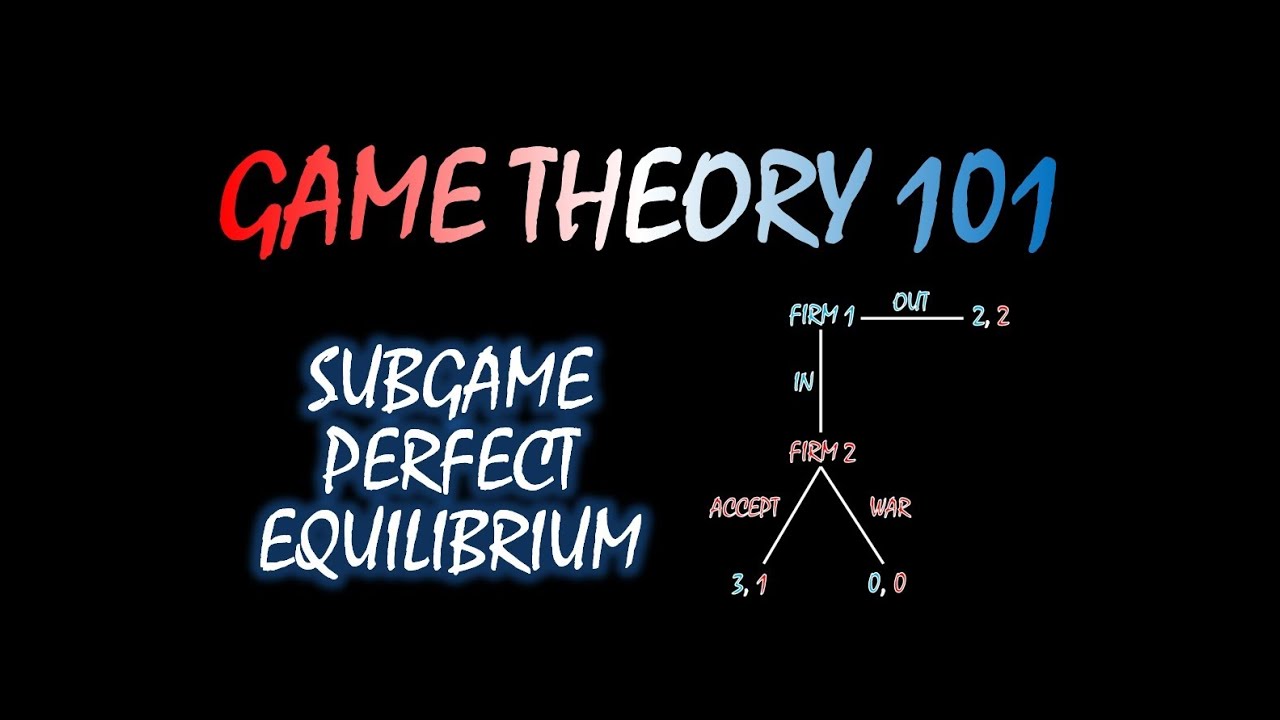
Game Theory 101: The Complete Textbook on Amazon: https://www.amazon.com/Game-Theory-101-Complete-Textbook/dp/1492728152/
http://gametheory101.com/courses/game-theory-101/
This lecture begins our adventure through sequential games, in which players take turns moving. Not all Nash equilibria are sensible in this context, so we introduce a new c...
the simultaneous game has a nash equilibrium that the iterative game does not
hoary anvil
grand siren
you should be able to view it as just, simultaneously choosing *strategies*
ohhhh
grand siren
grand siren
for deterministic strategies this is exactly the same - the "position in the gam...
and any random strategy can be turned into a single random choice followed by a deterministic strategy: just make all of the random choices, all at the same time
then when you get to a point where your original strategy said to do something random, you just look at your already-generated randomness
and this is equivalent to choosing a deterministic strategy at random
hoary anvil
grand siren
and any random strategy can be turned into a single random choice followed by a ...
yes this makes sense
thanks
let me see if I can figure out the matrix
hoary anvil
@grand siren I think this is the matrix

So bluff strictly dominates 2H, and player 1's decision doesn't matter
cool
devout snowBOT
@hoary anvil Has your question been resolved?
hoary anvil
I’d like to answer the original question, or at least have a bit more progress towards it
grand siren
hoary anvil
<@695651562542071871> I think this is the matrix
...i'm pretty sure that's not it...?
each player has four strategies, not two, because their move can depend on their own coinflip
hoary anvil
Wait what?
grand siren
and also the outcome of player 1 picking 2H should be the same regardless of what player 2 chose, because in that situation they only have one legal move (in the original iterative game)
grand siren
hoary anvil
Wait what?
as in "2H if i got heads, 1H if i got tails" would be a valid choice for player 1
hoary anvil
grand siren
as in "2H if i got heads, 1H if i got tails" would be a valid choice for player ...
Idk the matrix show the 2 decision points
Not sure how it could be wrong
I just counted how many wins each player would get and divided by 4
I’m using the simplified trees
grand siren
...oh ok that makes more sense
hoary anvil
How would you do it?
grand siren
i mean simplifying the trees probably is a good idea, i just forgot that you had done that and assumed that you were going to make the full 4x4 matrix
grand siren
although now i'm confused about what choice P2 has that wouldn't have got simplified out
if P1 opens 2H then there's only one legal move
if P1 opens 1H and P2 has H then calling bluff is stupid (guaranteed lose) so the only reasonable move is 2H
if P1 opens 1H and P2 has T then advancing to 2H is stupid (guaranteed lose) so the only reasonable move is to call bluff
so they only really have one strategy that makes any sense, and the game reduces to P1's choice - if P1 has tails, 2H is an instant loss so play 1H, winning iff P2 has H (50%), and if P1 has heads, they either play 1H and win iff P2 has tails (50%), or play 2H and win iff P2 has heads (50%), so they have two strategies which both win with 50% probability
which i guess doesn't disagree with your analysis, which seems to have also got the conclusion that P2 has an optimal strategy, P1 has a choice of two equally good strategies, and the win probability is 50%, but
grand siren
hoary anvil
Simplified trees
ok yeah in the HT and TT trees, why would P2 ever choose 2H? P2 knows that 2H is false (because they have tails) and that their bluff will immediately be called (because it's the end of the game) so choosing that is just a guaranteed loss
hoary anvil
Sorry I’m half asleep
hoary anvil
grand siren
although now i'm confused about what choice P2 has that *wouldn't* have got simp...
Yeah I probably could have simplified early
hoary anvil
grand siren
ok yeah in the HT and TT trees, why would P2 ever choose 2H? P2 *knows* that 2H ...
They wouldn’t that’s why it’s pruned
The two choices for p1 are (H if I have heads | HH if I have heads)
The two choices for p2 are (HH if I have heads | bluff if I have heads)
That’s what I was representing in the 2x2 matrix
grand siren
hoary anvil
The two choices for p2 are (HH if I have heads | bluff if I have heads)
but if P1 claims H and P2 has heads then P1 is right and calling bluff is stupid
hoary anvil
Oh woops
Should be The two choices for p2 are (HH if I have tails | bluff if I have tails)
But yeah HH is stupid if they have tails
So
I could have pruned that as well
That’s why the matrix shows bluff dominating HH
grand siren
yep
hoary anvil
I was mostly doing that for practice writing the square anyway
The initial problem has less strict dominance, I suspect
With four spaces instead of two
grand siren
yeah a lot of what happened here is that the 1H 2H game is so small it's kind of trivial
grand siren
that seems like a reasonable next step
hoary anvil
grand siren
ok yeah in the HT and TT trees, why would P2 ever choose 2H? P2 *knows* that 2H ...
Yeah I could have pruned that mb
grand siren
alright so playing 2T wins if there are two tails and loses otherwise
(so in particular we can prune it for any player who has heads)
grand siren
...ah yes that's true
hoary anvil
So then 2H is never played by someone with tails
Interestingly, 2T might be played by someone with heads
grand siren
tree for HH: P1 1T P2 2T, P1 bluff, P1 P2 2H, P1 bluff, P2 P1 2T, P2 bluff, P2 P1 2H, P2 bluff, P1
(i'm marking which player makes a move just to make it easier to tell what's happening)
grand siren
tree for HT: P1 1T, P2 2T, P1 bluff, P1 P1 2T, P2 bluff, P2 P1 2H, P2 bluff, P2 ...not really much of a "tree", apparently the game is determined after the first move
grand siren
also apparently if P1 has H then 2T always loses
hoary anvil
Side question, is there a lin alg formula for solving m x n game theory matrices?
Kind of like cramer’s rule for linear equations
M x n
Because my plan is to code this in python and ideally I can do the lin alg quickly with numpy
In the actual game we have dice instead of coins so it’s much more complicated
I’m just trying to get a feel for it with coins
grand siren
...i mean it's not linear, if you consider the game where you choose to either get x points or y points, there's this sharp jump in the optimal strategy around x = y
hoary anvil
Right
grand siren
so there might be a way to compute it but it would need to be something that can create that sort of behaviour
grand siren
rock paper scissors, followed by "choose x points or y points"
grand siren
grand siren
tree for HH: ```
P1 1T
P2 2T, P1 bluff, P1
P2 2H, P1 bluff, P2
P1 2T, P2 blu...
wait i missed a move here
it should be P1 1T P2 2T, P1 bluff, P1 P2 2H, P1 bluff, P2 P2 bluff, P2 P1 2T, P2 bluff, P2 P1 2H, P2 bluff, P1
tree for TH: P1 1T P2 2T, P1 bluff, P1 P2 2H, P1 bluff, P1 P2 bluff, P1 P1 2T, P2 bluff, P2
hoary anvil
right P2 has three moves
forgot
So this is the formula for a mixed strategy nash equilibrium in a 2x2

I haven't worked out the formula for a 3x3 symbollically, but I'm wondering if there's a pattern
where sigmaU = probability of playing up etc.
grand siren
tree for TT: P1 1T, P2 2T, P1 bluff, P2 P1 2T, P2 bluff, P1
hoary anvil
it's just this algorithm but done symbollically: https://www.youtube.com/watch?v=aa8USttcDoE
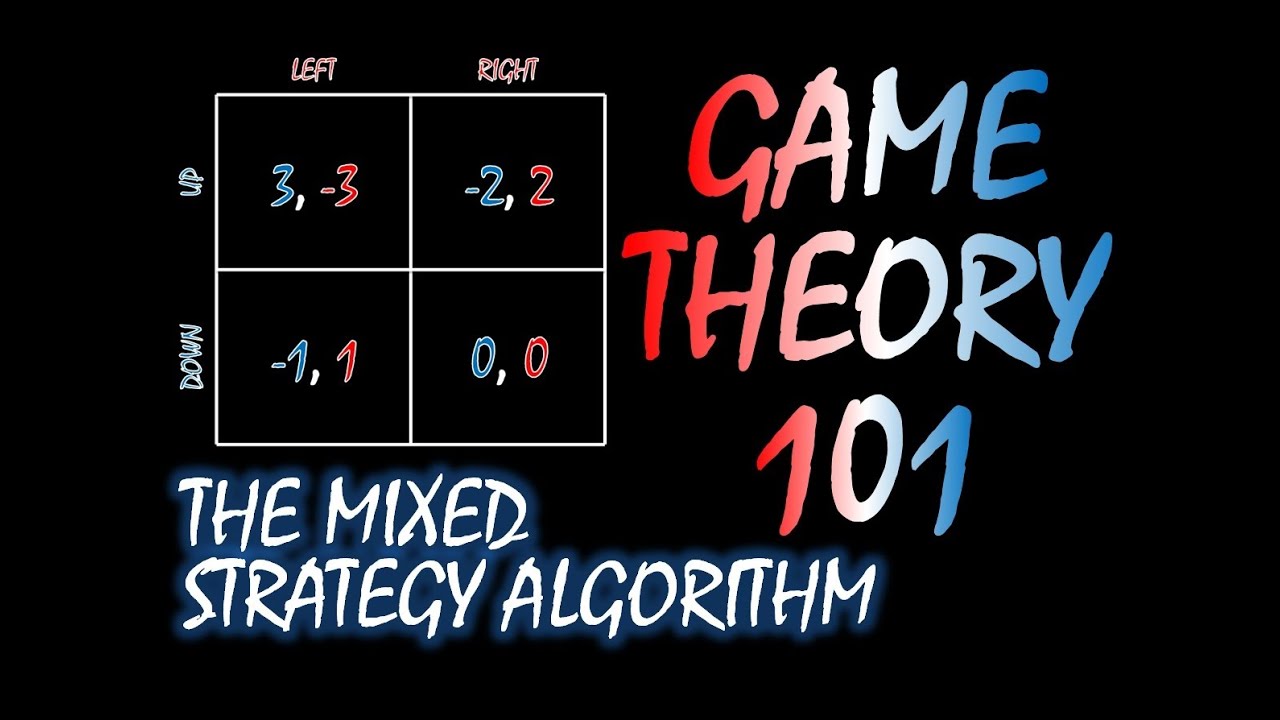
Game Theory 101: The Complete Textbook on Amazon: https://www.amazon.com/Game-Theory-101-Complete-Textbook/dp/1492728152/
http://gametheory101.com/courses/game-theory-101/
To check for mixed strategy Nash equilibria, we must run the mixed strategy algorithm. This algorithm shows whether there exists a mixed strategy for a player that leaves th...
grand siren
so in both HH and HT, P1 shouldn't start with 2T
and in both HH and TH, P2 should not respond to 1T with 2T
so player 2's strategy still doesn't matter, if they have tails they only have one reasonable strategy and if they have heads they have two strategies that are basically equivalent
HH
P1 1T
  P2 2H, P1 bluff, P2
  P2 bluff, P2
P1 2H, P2 bluff, P1

HT
P1 1T, P2 2T, P1 bluff, P1
P1 2H, P2 bluff, P2

TH
P1 1T
  P2 2H, P1 bluff, P1
  P2 bluff, P1
P1 2T, P2 bluff, P2

TT
P1 1T, P2 2T, P1 bluff, P2
P1 2T, P2 bluff, P1```player 1's strategy... also doesn't matter, they basically just have to guess what P2's coin is
and the win probability is... still... 50%
there's no way this keeps holding forever right?? so probably this is just, still too small an instance to see interesting behaviour
i guess time to do the tree for 1T 1H 2T 2H
hoary anvil
give me a moment double checking the trees/pruning
yeah seems right
yeah it's 50/50 💀
and choices don't matter except obvious ones
grand siren
grand siren
i guess time to do the tree for 1T 1H 2T 2H
HH: P1 1T P2 1H P1 2T, P2 bluff, P2 P1 2H, P2 bluff, P1 P2 2T, P1 bluff, P1 P2 2H, P1 bluff, P2 P2 bluff, P2 P1 1H P2 2T, P1 bluff, P1 P2 2H, P1 bluff, P2 P1 2T, P2 bluff, P2 P1 2H, P2 bluff, P1
hoary anvil
maybe that's a good thing, it's simpler than I thought it was
grand siren
HT: P1 1T P2 1H P1 2T, P2 bluff, P2 P1 2H, P2 bluff, P2 P2 2T, P1 bluff, P1 P1 1H P2 2T, P1 bluff, P1 P2 bluff, P1 P1 2T, P2 bluff, P2 P1 2H, P2 bluff, P2
...huh wait
if you have heads you should not play 2T
hoary anvil
right
grand siren
either they have heads and know you're wrong and bluff, or they have tails and won't play 2H (because you'd bluff them and win) so they'd bluff
hoary anvil
I got it backwards but that's right
grand siren
TH: P1 1T P2 1H P1 2T, P2 bluff, P2 P1 bluff, P2 P2 2H, P1 bluff, P1 P2 bluff, P1 P1 1H, P2 2H, P1 bluff, P1 P1 2T, P2 bluff, P2
TT: P1 1T P2 1H P1 2T, P2 bluff, P1 P1 bluff, P1 P2 2T, P1 bluff, P2 P1 1H P2 2T, P1 bluff, P2 P2 bluff, P2 P1 2T, P2 bluff, P1
(i think that should be all of the reasonable moves?)