
#help-27
1 messages · Page 197 of 1
 heady plinth
It’ll go away in a minute
 humble galleon
alr
heady plinth
Don’t stress
 devout snowBOT
 Available help channel!
Send your question here to claim the channel.
Remember:
• Ask your math question in a clear, concise manner.
• Show your work, and if possible, explain where you are stuck.
• After 15 minutes, feel free to ping <@&286206848099549185>.
• Type the command .close to free the channel when you're done.
• Be polite and have a nice day!
Read #❓how-to-get-help for further information on how to ask a good question, and about conduct in the question channels.
 grave glacier
 devout snowBOT
grave glacier
heady plinth
devout snowBOT
grave glacier
heady plinth
Never seen it before
The right hand side is just (3n+3)! Which is kind of interesting
No it’s not true I just checked
 thin fern
No you can just plug in n=1 which is a pretty clear counterexample
grave glacier
ugh
im trying to find out how to expand it
the problem has (n!)^3/(3n)!
i want to figure out how to cancel the 3n!
 polar wharf
What's the original problem?
devout snowBOT
@grave glacier Has your question been resolved?
devout snowBOT
Channel closed
Closed due to timeout
Use .reopen if this was a mistake.
Available help channel!
Send your question here to claim the channel.
Remember:
• Ask your math question in a clear, concise manner.
• Show your work, and if possible, explain where you are stuck.
• After 15 minutes, feel free to ping <@&286206848099549185>.
• Type the command .close to free the channel when you're done.
• Be polite and have a nice day!
Read #❓how-to-get-help for further information on how to ask a good question, and about conduct in the question channels.
 winged wasp
How can i find the shaded area?function r(\theta)=\theta\cdot\sin(2\theta) and it graphed between 0 and pi. I am struggling to find limits of the integral. I know i need to set r equal zero and find the roots. There are 3 roots. 0,pi,pi/2 and i don't know which ones are the limits
 devout snowBOT
winged wasp
How can i find the shaded area?function r(\theta)=\theta\cdot\sin(2\theta) and ...
devout snowBOT
winged wasp
How can i find the shaded area?function r(\theta)=\theta\cdot\sin(2\theta) and ...
 twin hornet
$r(\theta)=\theta\cdot\sin(2\theta)$
 woven radishBOT
DJJ

 stable storm
its most likely between pi/2 and pi, since it is impossible for it to create that curve in the fourth quadrant between 0 and pi/2
the radius can only be positive or negative
meaning that it can either be in the first or third quadrant for all values between 0 and pi/2
winged wasp
stable storm
its most likely between pi/2 and pi, since it is impossible for it to create tha...
the area is between 0 and 3pi/2 that's why i kinda thought 0 pi/2 was the answer but can you elaborate on how did you deicde on those values?
stable storm
if we consider theta ranging from 0 to pi/2
the radius can either be positive or negative
if its positive, then itll sweep out a curve in quadrant 1
if its negative itll sweep out a curve in quadrant 3
winged wasp
i undersand it can be in 1'st quadrant but how can it be on 3th?
winged wasp
stable storm
itll flip it in the opposite direction
wouldn't it be 4th then?
stable storm
not exactly
when we graph these lines, we would imagine ourselves drawing a line through the origin
and at each theta value
if it is positive, itll point in the quadrant that theta lies
if it is negative, we go to the opposite end of the line
which would give us the quadrant that is diagonal from our supposed quadrant
you can also test out theta values between 0 and pi/2 as well as pi/2 and pi to check
winged wasp
can you suggest me a video that can help me understand this? I feel like dumb rn
stable storm
try this
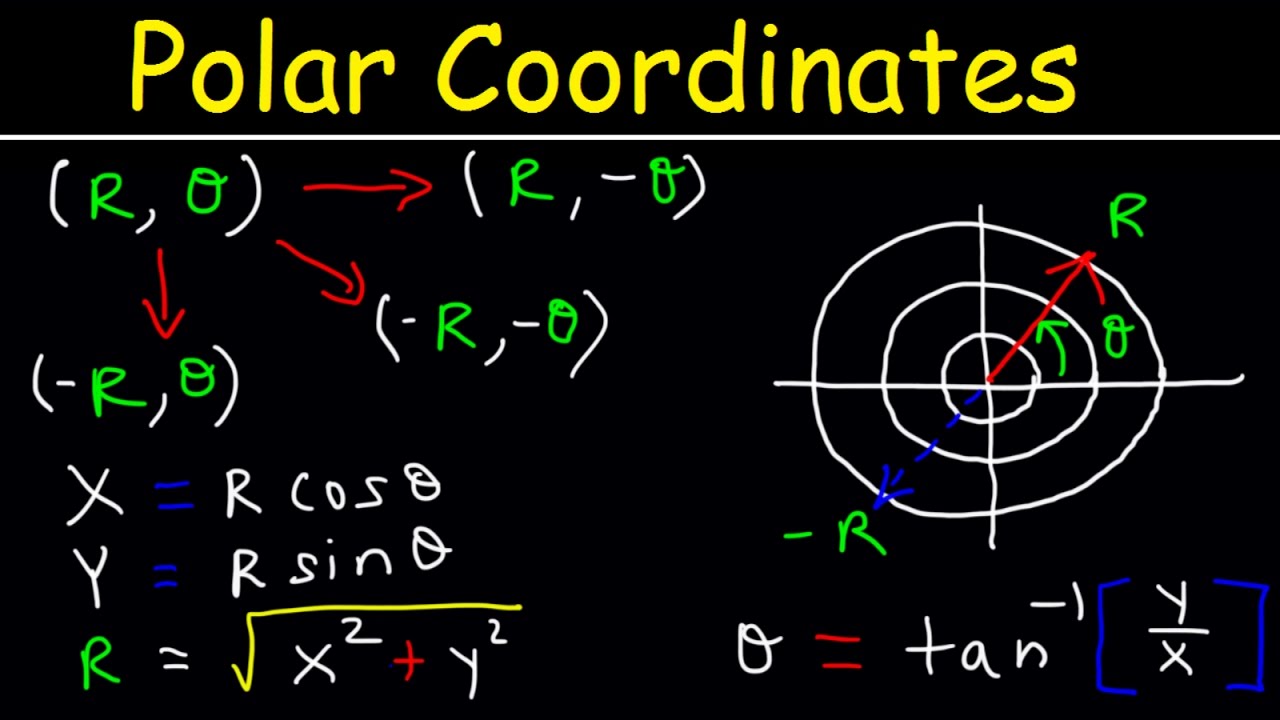
This Precalculus video tutorial provides a basic introduction into polar coordinates. It explains how to convert polar coordinates to rectangular coordinates and how to graph polar coordinates by plotting points using the radius of a circle and the angle measured counter clockwise from the positive x axis. In addition, it explains how to conve...
wait nvm this one is probably better
winged wasp
thanks so you mean 1-3 and 2-4 quadrants would give the same result?
stable storm
what do you mean same result?
winged wasp
stable storm
what do you mean same result?
like if we take the limits of the integral 3pi/2 and 2pi we can take them as pi/2 and pi and it would'nt be wrong
stable storm
so if you were to graph this on desmos, between 3pi/2 and 2pi, it sweeps out an entire different portion of the graph
when compared to pi/2 and pi
maybe itll help to graph it out on desmos to see how it creates the curve
winged wasp
stable storm
maybe itll help to graph it out on desmos to see how it creates the curve
maybe since it is 1 am i have started to loose my marbles. I will check desmos and the video tomorrow
Thanks
stable storm
yw!
winged wasp
.close
devout snowBOT
Channel closed
Closed by @winged wasp
Use .reopen if this was a mistake.
devout snowBOT
Available help channel!
Send your question here to claim the channel.
Remember:
• Ask your math question in a clear, concise manner.
• Show your work, and if possible, explain where you are stuck.
• After 15 minutes, feel free to ping <@&286206848099549185>.
• Type the command .close to free the channel when you're done.
• Be polite and have a nice day!
Read #❓how-to-get-help for further information on how to ask a good question, and about conduct in the question channels.
 twilit estuary
 devout snowBOT
twilit estuary
twilit estuary
devout snowBOT
twilit estuary
twilit estuary
,rotate 270
woven radishBOT
 twilit estuary
i dont get how to do 18
 sterile geyser
twilit estuary
i dont get how to do 18
sterile geyser
twilit estuary
i dont get how to do 18
magnitude formula
sterile geyser
yes
sterile geyser
(5^2+10^2+10^2)^1/2
sterile geyser
npp
twilit estuary
.close
devout snowBOT
Channel closed
Closed by @twilit estuary
Use .reopen if this was a mistake.
devout snowBOT
Available help channel!
Send your question here to claim the channel.
Remember:
• Ask your math question in a clear, concise manner.
• Show your work, and if possible, explain where you are stuck.
• After 15 minutes, feel free to ping <@&286206848099549185>.
• Type the command .close to free the channel when you're done.
• Be polite and have a nice day!
Read #❓how-to-get-help for further information on how to ask a good question, and about conduct in the question channels.
 weak marlin
how do I proceed with this problem
 devout snowBOT
weak marlin
how do I proceed with this problem
stable storm
devout snowBOT
weak marlin
how do I proceed with this problem
stable storm
so represent it with an integral first
stable storm
yep
weak marlin
then do I split it up
stable storm
well just integrate the function from 1 to 3
no need to split it up
or did you mean to split up the integrand
 rustic mountain
Oh and what about y do you keep y as just y?
(i am also learning this I don't know how to solve so asked)
weak marlin
that becomes Area
woven radishBOT
y0shi
 stable storm
no need for any formulas
rustic mountain
Oh so integration of y is area
stable storm
yes between the function and the x axis that is
rustic mountain
Icic
weak marlin
woven radish
**y0shi**
okay so from that I'm a little confused as to how I should start solving
do I do u sub again?
stable storm
yep
maybe the u sub isnt too obvious tho
i would recommend moving the 3 from the x^3 out of the ln first
and then sub the entire numerator
woven radishBOT
y0shi
 stable storm
that should be the integral you have right
weak marlin
yep
weak marlin
so 1 + 3ln(x) / x
stable storm
yep
rustic mountain
woven radish
**y0shi**
So will it be 1/x + 3lnx/x integration
weak marlin
then do I just plug in the lower and upper numbers?
rustic mountain
U integrate first
stable storm
you have to find the antiderivative first
weak marlin
oh right
stable storm
you can definitely split it up first
weak marlin
ah okay
stable storm
or just u sub the entire numerator
weak marlin
I'm confused bc this doesn't allow me to put a C
 stable storm
oh right
this is a definite integral
so we would have to use the fundamental theorem of calculus
weak marlin
wait so what is the difference between this and one where I would add C
I remember that coming up but what does that mean?
stable storm
you would add a C when it is an indefinite integral where there are no bounds
since an indefinite integral would represent us trying to find the antiderivative and not area
woven radishBOT
y0shi
 weak marlin
okay
devout snowBOT
@weak marlin Has your question been resolved?
weak marlin
I did (ln|3| + 3(ln(3)^2)/(2)) - (ln|1| + 3(ln(1)^2)/(2)) and got 1.819
it shows up as the wrong answer tho
what am I doing wrong
 upper schooner
How are you working out the integral?
weak marlin
I split it up into 1/x + 3ln(x)/x
and then I found the derivative for the first to be ln|x|
and the second 3(ln(x))^2)/2
the second might be wrong?
stable storm
did you do ln 3^2 or (ln 3)^2
it should be the second one since that was our antiderivative
weak marlin
yeah I did the second one
stable storm
it shouldnt give you 1.819 then
weak marlin
oh okay I got 2.909 that time
I'm not sure what I did wrong but maybe I didn't use enough parentheses
stable storm
yeah that happens
weak marlin
.close
devout snowBOT
Channel closed
Closed by @weak marlin
Use .reopen if this was a mistake.
weak marlin
yeah lol
maybe I'll use an online calculator bc it's easier to insert parentheses and stuff
especially if you miss them you don't have to rewrite the entire equation
devout snowBOT
Available help channel!
Send your question here to claim the channel.
Remember:
• Ask your math question in a clear, concise manner.
• Show your work, and if possible, explain where you are stuck.
• After 15 minutes, feel free to ping <@&286206848099549185>.
• Type the command .close to free the channel when you're done.
• Be polite and have a nice day!
Read #❓how-to-get-help for further information on how to ask a good question, and about conduct in the question channels.
 near haven
Is this correct? If yes then how did we derived this?

 quaint citrus
See if u can establish a pattern with the terms of the series
2^1 = 2
2^3 = 8
2^5 = 32
2^7 = 128
Also, notice how signs alternate, and numerator is always 1
See if u can go from there
near haven
quaint citrus
See if u can go from there
I had already noticed all that
But I still cannot figure out how it all came out to be sqrt of 1?
I mean 2
quaint citrus
In terms of n, what did u make the pattern out to be
(Or in terms of any variable u want)
near haven
quaint citrus
In terms of n, what did u make the pattern out to be
I didn't get your question
The pattern is simply just two more to the power of two in denominator with alternating plus and minus sign (if that's what you were asking)
near haven
Yes I do
quaint citrus
Ok, excluding the first term, what’s the common ratio of this infinite geometric series
near haven
What about them?
quaint citrus
U have to include the fact that we have alternating signs in ur common ratio. 1/2 * (1/2^2) is not equal to -1/8
near haven
So how should have I written the common ratio?
quaint citrus
Figure it out: what do u multiply 1/2 by to get -1/8?
near haven
I do not remember
near haven
Okay
quaint citrus
Plug in and see what u get
quaint citrus
No
near haven
what?
quaint citrus
Try again
near haven
first term is 1/2 right?
quaint citrus
Yea
quaint citrus
No
near haven
Common ratio was -1/4?
quaint citrus
Yes
near haven
2/5
near haven
Yes
quaint citrus
Why?
near haven
We can say that
but it is not correct
because it would be a rational number
and sqrt2 is irrariotanal
irrational*
near haven
quaint citrus
Yea, or just directly compare the values
ok
Yes
why is that so? why is it wrong?
near haven
quaint citrus
Sqrt2 = 1 + 2/5
Why is this not correct
I mean we used the formula for geomteric series sum
quaint citrus
1+(2/5) = 7/5 = 1.4 != sqrt(2) ~1.414…
near haven
Is that factorial after 1.4?
quaint citrus
No, != means not equal to
quaint citrus
If u wanted something in the form
Sqrt2 = 1 + series
Then yes the series is wrong
near haven
But it does get closer to actual value after every value in the series
why is that so?
quaint citrus
Are u asking why infinite geometric series converge to a certain value?
near haven
no, I am asking that why is the equation wrong
When we evaluate it, it gives value closer and closer to actual value of sqrt 2 after every term
And why is the equation famous? How and why did this equation became popular when it is wrong? Also do you know how someone would have came up with this equation? If we could see the process behind it, we would answer many things by ourselves
near haven
quaint citrus
Sqrt2 = 1 + series
Do we have any equation (maybe an infinite sum series) in maths that gives us answer to any root problem specially when the answer is irrational?
quaint citrus
near haven
And why is the equation famous? How and why did this equation became popular whe...
Honestly I’ve never even heard of this equation. Maybe someone else here has and im just in the dark about it. Seems like some approximation for sqrt(2) but it’s more than 0.01 away from the actual value of sqrt(2), so idk why it’s useful
quaint citrus
near haven
Do we have any equation (maybe an infinite sum series) in maths that gives us an...
Yea I mean u can express some irrational numbers through Taylor series
near haven
quaint citrus
Honestly I’ve never even heard of this equation. Maybe someone else here has and...
oh okay
I just had found this on the internet. I myself wasn't aware of it before as well
near haven
quaint citrus
Yea I mean u can express some irrational numbers through Taylor series
not expressing
I meant a equation that works for any root of any number?
I would just have to insert the values and it gives me the nth root of the specific number
How does our calculators operate the roots? What principle do they use?
quaint citrus
Not too sure honestly, maybe someone else who knows the answer can come along and help
I’m sure Google has some answers too for this kind of stuff
near haven
I couldn't find it on google so I thought to ask here
but thanks for the help
quaint citrus
Yea maybe open a new channel and ask those questions
devout snowBOT
Channel closed
Closed by @near haven
Use .reopen if this was a mistake.
devout snowBOT
Available help channel!
Send your question here to claim the channel.
Remember:
• Ask your math question in a clear, concise manner.
• Show your work, and if possible, explain where you are stuck.
• After 15 minutes, feel free to ping <@&286206848099549185>.
• Type the command .close to free the channel when you're done.
• Be polite and have a nice day!
Read #❓how-to-get-help for further information on how to ask a good question, and about conduct in the question channels.
 restive river
 devout snowBOT
restive river
restive river
devout snowBOT
restive river
restive river
I need help with this question
It didn’t make sense to me since the cup of the coffee or increment was -4
 polar bolt
restive river
It didn’t make sense to me since the cup of the coffee or increment was -4
polar bolt
restive river
It didn’t make sense to me since the cup of the coffee or increment was -4
what?
restive river
Like when I did it
restive river
polar bolt
what?
The maximum value I got was like 1152 but the cup of corfeee was -4 dollars
Which made me confused
polar bolt
,w max (1.4+0.05x)(800-40*x)
woven radishBOT


 Requested by scapeprof
polar bolt
Requested by scapeprof
polar bolt
,w plot (1.4+0.05x)(800-40*x)
woven radishBOT
 Requested by scapeprof
restive river
Requested by scapeprof
restive river
Wdym
So my final answer I got was 1.25
But my friend said it is 1.2
I’m confused
It means like they sold 800 cups of coffee a day
For 1.4$
But then after I did the calculations
I got -4 as how much I should decrease the cost
polar bolt
Yes so 1.4+0.05*-4=1.2
polar bolt
Yes
restive river
Why do you multiply it by four
I just minused it by 0.05 four times
And got 1.25
Like you decrement by 4 times
So 0.05 -0.05x4
polar bolt
Huh?
polar bolt
Your intial price is 1.4
restive river
Yes
polar bolt
maximum is if you decrease the price by 0.05*4
restive river
restive river
0.05 minus 0.05 4 times
This makes it decrease 0.15
restive river
polar bolt
maximum is if you decrease the price by 0.05*4
Why
devout snowBOT
Channel closed
Closed by @limber jacinth
Use .reopen if this was a mistake.
devout snowBOT
Available help channel!
Send your question here to claim the channel.
Remember:
• Ask your math question in a clear, concise manner.
• Show your work, and if possible, explain where you are stuck.
• After 15 minutes, feel free to ping <@&286206848099549185>.
• Type the command .close to free the channel when you're done.
• Be polite and have a nice day!
Read #❓how-to-get-help for further information on how to ask a good question, and about conduct in the question channels.
 short latch
how do I solve this
 devout snowBOT
short latch
how do I solve this
short latch
devout snowBOT
short latch
how do I solve this
short latch
do I gotta do the 3 step continuity test?
or is that not necessary for this problem
im used to solving a continuity question in like a piecewise format
 glacial wyvern
ugh I already hate that problem because the first one isn't defined on that interval
so the question doesn't make a lot of sense
But I think your teacher might think that 1/x is not a continuous function for whatever reason because unfortunately a lot of people seem to think that
short latch
key says the answer is E but how
glacial wyvern
yeah well II and III are certainly continuous
II is continuous because it's piecewise continuous and at x=0 it's clearly continuous
h is continuous because all root functions are continuous
f is up for debate...
short latch
so I just do the 3 step continuity test for each function
if I dont know by just looking at it
glacial wyvern
Well if I understand correctly what the 3 step continuity step is then I think it's a test for determining whether a function is continuous at a given point
so for example you could do that test for |x| at x=0
but if you're asked whether a function is continuous on an interval, then you probably have to appeal to well-known results
unless it's a piecewise function, in which case you have to be very careful when the definition changes
glacial wyvern
glacial wyvern
f is up for debate...
You can tell your teacher that 1/x is a continuous function, meaning it's continuous on all points of its domain, so therefore any problem where you claim that 1/x is, in any sense, "not continuous", is a pedagogical catastrophy
The problem is basically like asking "is 1/x a continuous function on the set of all nonzero polynomials"
but that makes no sense because 1/x is not a function defined for polynomials
And that's a bad example because you could conceivably think of a function that maps a nonzero polynomial p to the rational function 1/p
but you cannot, under any scenario, interpret 1/0 in any reasonable fashion. And as a result, if you remove 0 from the domain, then your function IS continuous on [-1, 1]\{0}
devout snowBOT
@short latch Has your question been resolved?
Channel closed
Closed by @short latch
Use .reopen if this was a mistake.
devout snowBOT
Available help channel!
Send your question here to claim the channel.
Remember:
• Ask your math question in a clear, concise manner.
• Show your work, and if possible, explain where you are stuck.
• After 15 minutes, feel free to ping <@&286206848099549185>.
• Type the command .close to free the channel when you're done.
• Be polite and have a nice day!
Read #❓how-to-get-help for further information on how to ask a good question, and about conduct in the question channels.
 toxic monolith
Can anyone help me ?
I managed to do A, the problem is B, C and D
And I discovered that X≠-5
 devout snowBOT
toxic monolith
Can anyone help me ?
I managed to do A, the problem is B, C and D
And I discov...
toxic monolith
devout snowBOT
toxic monolith
Can anyone help me ?
I managed to do A, the problem is B, C and D
And I discov...
toxic monolith
in question D in the photo it says r but it is X
 magic thicket
toxic monolith
Can anyone help me ?
I managed to do A, the problem is B, C and D
And I discov...
magic thicket
toxic monolith
Can anyone help me ?
I managed to do A, the problem is B, C and D
And I discov...
Notice it's actually affine in y
So for a fixed x there's only one real y leading to a solution
When is that y an integer?
toxic monolith
In fact, I think that X and Y can be several numbers like these:
( X; Y )
( 2; 7 )
( 3; 25 )
( 7; 227)
magic thicket
Well it is asking for the number of solutions
It could even be infinite
toxic monolith
Yes I thought about that too but asking "how many" seems like the question wants a specific number
devout snowBOT
@toxic monolith Has your question been resolved?
toxic monolith
<@&286206848099549185>
devout snowBOT
@toxic monolith Has your question been resolved?
devout snowBOT
@toxic monolith Has your question been resolved?
devout snowBOT
Channel closed
Closed due to timeout
Use .reopen if this was a mistake.
devout snowBOT
Available help channel!
Send your question here to claim the channel.
Remember:
• Ask your math question in a clear, concise manner.
• Show your work, and if possible, explain where you are stuck.
• After 15 minutes, feel free to ping <@&286206848099549185>.
• Type the command .close to free the channel when you're done.
• Be polite and have a nice day!
Read #❓how-to-get-help for further information on how to ask a good question, and about conduct in the question channels.
 mystic jewel
How do you find the parametric equations for this curve? I know how to find the equations when it’s a line, but I’m confused how to start
 devout snowBOT
mystic jewel
How do you find the parametric equations for this curve? I know how to find the ...
heady plinth
devout snowBOT
mystic jewel
How do you find the parametric equations for this curve? I know how to find the ...
heady plinth
looks like an ellipse but i have no idea
 spare crypt
mystic jewel
How do you find the parametric equations for this curve? I know how to find the ...
spare crypt
mystic jewel
How do you find the parametric equations for this curve? I know how to find the ...
you usually start with the parametric equation of a circle of radius r, which is (rcos(t), rsin(t))
and just squish it or whatever to make that shape
devout snowBOT
@mystic jewel Has your question been resolved?
mystic jewel
spare crypt
and just squish it or whatever to make that shape
I tried and I sort of got it, but obviously the left side of the ellipse shouldn’t be there
 spare crypt
mystic jewel
I tried and I sort of got it, but obviously the left side of the ellipse shouldn...
spare crypt
mystic jewel
I tried and I sort of got it, but obviously the left side of the ellipse shouldn...
that's good, try -pi/2 to pi/2
mystic jewel
how do you determine the t values?
spare crypt
the curve starts on the right at t=0, and goes counterclockwise and repeats at 2pi
so bottom to top is -pi/2 to pi/2
devout snowBOT
Channel closed
Closed by @mystic jewel
Use .reopen if this was a mistake.
devout snowBOT
Available help channel!
Send your question here to claim the channel.
Remember:
• Ask your math question in a clear, concise manner.
• Show your work, and if possible, explain where you are stuck.
• After 15 minutes, feel free to ping <@&286206848099549185>.
• Type the command .close to free the channel when you're done.
• Be polite and have a nice day!
Read #❓how-to-get-help for further information on how to ask a good question, and about conduct in the question channels.
 vivid hill
 devout snowBOT
vivid hill
vivid hill
devout snowBOT
vivid hill
vivid hill
can someone explain to me how they got this as the answer ??
devout snowBOT
@vivid hill Has your question been resolved?
 devout snowBOT
@vivid hill Has your question been resolved?
devout snowBOT
Channel closed
Closed due to timeout
Use .reopen if this was a mistake.
devout snowBOT
Available help channel!
Send your question here to claim the channel.
Remember:
• Ask your math question in a clear, concise manner.
• Show your work, and if possible, explain where you are stuck.
• After 15 minutes, feel free to ping <@&286206848099549185>.
• Type the command .close to free the channel when you're done.
• Be polite and have a nice day!
Read #❓how-to-get-help for further information on how to ask a good question, and about conduct in the question channels.
 rugged sparrow
The number of integral solution of the equation:\$x^{3}-8xy+x^{2}y-8x^{2}+xy^{2}-8y^{2}+y^{3}-8=0$\ is?
devout snowBOT
rugged sparrow
The number of integral solution of the equation:\\$x^{3}-8xy+x^{2}y-8x^{2}+xy^{2...
woven radishBOT
B-eard
 rugged sparrow
Help
It doesn't seem to be factorable
the options are
(A) 2
(B) 4
(C) 12
(D) 3
The polynomial is symmetric
so option D is eliminated at first glance
rugged sparrow
oh can I?
 late rose
yeah
rugged sparrow
,w factor x^3-8xy+yx^2-8x^2+xy^2-8y^2+y^3-8
woven radishBOT

 rugged sparrow
erm
 devout snowBOT
@rugged sparrow Has your question been resolved?
rugged sparrow
<@&286206848099549185>
devout snowBOT
@rugged sparrow Has your question been resolved?
devout snowBOT
Channel closed
Closed due to timeout
Use .reopen if this was a mistake.
devout snowBOT
Available help channel!
Send your question here to claim the channel.
Remember:
• Ask your math question in a clear, concise manner.
• Show your work, and if possible, explain where you are stuck.
• After 15 minutes, feel free to ping <@&286206848099549185>.
• Type the command .close to free the channel when you're done.
• Be polite and have a nice day!
Read #❓how-to-get-help for further information on how to ask a good question, and about conduct in the question channels.
 dry iron
im abit confused. how did they see that the 5th score and 6th score is 11? and 10th and 11th score is 12?
 devout snowBOT
dry iron
im abit confused. how did they see that the 5th score and 6th score is 11? and 1...
devout snowBOT
dry iron
im abit confused. how did they see that the 5th score and 6th score is 11? and 1...
 hushed lance
you can imagine the data listed out completely so it would look like
10 10 10
11 11 11 11 11
12 12 12 12
13 13 13 13 13 13
15 15
then just count
dry iron
hushed lance
you can imagine the data listed out completely so it would look like
10 10 10
1...
thanks
devout snowBOT
@dry iron Has your question been resolved?
devout snowBOT
Channel closed
Closed due to timeout
Use .reopen if this was a mistake.
devout snowBOT
Available help channel!
Send your question here to claim the channel.
Remember:
• Ask your math question in a clear, concise manner.
• Show your work, and if possible, explain where you are stuck.
• After 15 minutes, feel free to ping <@&286206848099549185>.
• Type the command .close to free the channel when you're done.
• Be polite and have a nice day!
Read #❓how-to-get-help for further information on how to ask a good question, and about conduct in the question channels.
 fossil moth
 fossil moth
<@&286206848099549185>
fossil moth
<@&286206848099549185>
devout snowBOT
@fossil moth Has your question been resolved?
fossil moth
<@&286206848099549185>
fossil moth

stupid question but whats the difference between ill and well conditioned? how do i recognize it
i also see moderatly ill conditioned
and i mean, how do i look at a matrix and see it? i have the proper definition but what do i actually look for
i see the larger the number, the more ill conditioned. but what is it in reference to?
whats the comparision?

why us 21 considered close? what is it relative to?
devout snowBOT
@fossil moth Has your question been resolved?
fossil moth
<@&286206848099549185>
devout snowBOT
@fossil moth Has your question been resolved?
devout snowBOT
Channel closed
Closed by @fossil moth
Use .reopen if this was a mistake.
Available help channel!
Send your question here to claim the channel.
Remember:
• Ask your math question in a clear, concise manner.
• Show your work, and if possible, explain where you are stuck.
• After 15 minutes, feel free to ping <@&286206848099549185>.
• Type the command .close to free the channel when you're done.
• Be polite and have a nice day!
Read #❓how-to-get-help for further information on how to ask a good question, and about conduct in the question channels.
 atomic torrent
is there an easy way to prove that cos(sqrt(n)) does not converge for naturals n?
devout snowBOT
atomic torrent
is there an easy way to prove that cos(sqrt(n)) does not converge for naturals n...
atomic torrent
or actually, that floor(cos(sqrt(n)) doesn't converge
 stone stump
you would just need to show that its not always positive or negative. that feels doable
 sand dove
there is a quite beautiful way using subgroups of R, are you familiar with group theory?
atomic torrent
yeah a little
sand dove
ok
then the schema for proving all your assertions would be :
- A = {n+2pim | n,m integers} is dense in R
- {cos(n) | n natural integer} is the image of A by cos, thus is dense in [-1,1]
- then cos(n) or floor(cos(n)) doesn't converge
stone stump
I mean showing that A is dense is harder than just showing this
sand dove
but that's overkill
yeah
you can also reason by absurd I think, and if c is the limit of cos(n) then apply trig identities
devout snowBOT
@atomic torrent Has your question been resolved?
devout snowBOT
Channel closed
Closed due to timeout
Use .reopen if this was a mistake.
devout snowBOT
Available help channel!
Send your question here to claim the channel.
Remember:
• Ask your math question in a clear, concise manner.
• Show your work, and if possible, explain where you are stuck.
• After 15 minutes, feel free to ping <@&286206848099549185>.
• Type the command .close to free the channel when you're done.
• Be polite and have a nice day!
Read #❓how-to-get-help for further information on how to ask a good question, and about conduct in the question channels.
 lusty geode
I need to know what im missing here, The question asks for the curvature and radius


 devout snowBOT
lusty geode
I need to know what im missing here, The question asks for the curvature and rad...
lusty geode
devout snowBOT
lusty geode
I need to know what im missing here, The question asks for the curvature and rad...
lusty geode
First pic is the question itself, 2nd pic is the answer and 3rd pic is one (out of many) attempt
The vector T seems very hard to derive, and I don't think I'm in the correct path to the wanted result
lusty geode
lusty geode
I need to know what im missing here, The question asks for the curvature and rad...
(In the point P = (2,2))
Question 147
<@&286206848099549185>
devout snowBOT
@lusty geode Has your question been resolved?
lusty geode
<@&286206848099549185> (pretty please)
 strange moss
This thing is in Portuguese?
lusty geode
Yes, but I'll do my best at translating if needed
strange moss
Go ahead!
lusty geode
- Find the curvature and the radius of curvature of the curvature parameterized by r(t) = ( 2e^t , 2e^(-t) ), at P = ( 2 , 2 )
Crude translation but I hope you can get the ideia
strange moss
Find the curvature and the radius of curvature of the curve parametrized by $(\sigma(t) = (2e^t, 2e^{-t}))$ at the point $ P = (2,2)$.
woven radishBOT
Hass_sml
 devout snowBOT
@lusty geode Has your question been resolved?
lusty geode
<@&286206848099549185> I'm following the 15 minute rule, someone pleeease help
 kind anchor
lusty geode
lusty geode
I need to know what im missing here, The question asks for the curvature and rad...
kind anchor
lusty geode
lusty geode
I need to know what im missing here, The question asks for the curvature and rad...
.
devout snowBOT
@lusty geode Has your question been resolved?
devout snowBOT
@lusty geode Has your question been resolved?
lusty geode
<@&286206848099549185>
lusty geode
lusty geode
I need to know what im missing here, The question asks for the curvature and rad...
.
lusty geode
woven radish
**Hass\_sml**
.
 buoyant flume
do you know the standard formula for this?
there is one for curvature of parametrized curves
devout snowBOT
@lusty geode Has your question been resolved?
devout snowBOT
Channel closed
Closed due to timeout
Use .reopen if this was a mistake.
Available help channel!
Send your question here to claim the channel.
Remember:
• Ask your math question in a clear, concise manner.
• Show your work, and if possible, explain where you are stuck.
• After 15 minutes, feel free to ping <@&286206848099549185>.
• Type the command .close to free the channel when you're done.
• Be polite and have a nice day!
Read #❓how-to-get-help for further information on how to ask a good question, and about conduct in the question channels.
restive river
hi! can any one help me make a product/grid table or tree diagram for this question?: “the mathematics club of a school has three members. how many ways can this club select a president and secretary if everyone is capable but no one can hold both positions?”
devout snowBOT
restive river
hi! can any one help me make a product/grid table or tree diagram for this quest...
restive river
restive river
hi! can any one help me make a product/grid table or tree diagram for this quest...
do you need to draw one of those?
because otherwise the problem is straightforward to do
restive river
restive river
do you need to draw one of those?
yes
ok just do a tree diagram
you can have one of three choices for the first stage (president)
then one of two choices for the second stage (secretary)
do yk how to begin to draw one in that case?
restive river
restive river
do yk how to begin to draw one in that case?
yes so how many tree diagrams are there supposed to be?-
just 1 right?
yes
so first I start with president?
then what do I branch that with?
restive river
restive river
then what do I branch that with?
u have three choices
call the dudes idk
A, B, C
u can branch to either 3
okay so
president -A
-B
-C
what do I branch that with now?
restive river
restive river
what do I branch that with now?
if u picked A then u have B or C to choose from
if u picked B then u have C or A to choose from
if u picked C then u have A or B to choose from
you get the idea
Oooh okay
so I branch A with B and C?
okay okay
OKAY I GET IT NOW Thank you!!!
.close
devout snowBOT
Channel closed
Closed by @desert glacier
Use .reopen if this was a mistake.
devout snowBOT
✅
restive river
restive river
.reopen
wot
I FORGOT
how do I unclaim this
eh?
u did
just
type .close
and it will eventually close on its own
.close
devout snowBOT
Channel closed
Closed by @desert glacier
Use .reopen if this was a mistake.
restive river
okayyy
devout snowBOT
Available help channel!
Send your question here to claim the channel.
Remember:
• Ask your math question in a clear, concise manner.
• Show your work, and if possible, explain where you are stuck.
• After 15 minutes, feel free to ping <@&286206848099549185>.
• Type the command .close to free the channel when you're done.
• Be polite and have a nice day!
Read #❓how-to-get-help for further information on how to ask a good question, and about conduct in the question channels.
 viscid goblet
Hey can someone help me on this
devout snowBOT
viscid goblet
Hey can someone help me on this
 restive river
so the equation of \emph{any} line is given by [
y-y_0 = m(x-x_0)
]
woven radishBOT
 viscid goblet
yes
restive river
the equation of the \textbf{tangent} line is all the same, but the difference is that the slope of the tangent line IS the definition of the derivative. So we have: [
y-y_0 = \6{f'}{x_0}(x-x_0)
]
woven radishBOT
 viscid goblet
yes
restive river
right, does this help?
viscid goblet
So i need to find another close cordinate to find the tangent line?
restive river
no the point (2,5) is all you need
viscid goblet
ok give me a min let me try to solve it now
viscid goblet
restive river
no the point (2,5) is all you need
is the answer the first one
y=10x-15
I used dy/dx to find the slope
the slope was 10x
and then I applied (2,5) to y=10x+c to find c
and c was -15
So the answer should be y=10x-15
@restive river just let me know if I got it right
also Thanks by the way
yep it was correct
.close
devout snowBOT
Channel closed
Closed by @viscid goblet
Use .reopen if this was a mistake.
devout snowBOT
Available help channel!
Send your question here to claim the channel.
Remember:
• Ask your math question in a clear, concise manner.
• Show your work, and if possible, explain where you are stuck.
• After 15 minutes, feel free to ping <@&286206848099549185>.
• Type the command .close to free the channel when you're done.
• Be polite and have a nice day!
Read #❓how-to-get-help for further information on how to ask a good question, and about conduct in the question channels.
 fathom maple
Ello
devout snowBOT
fathom maple
Ello
fathom maple
So i recently found this reel

A-Level Maths 🧮 Mechanics: projectile motion ⚽️ can you use your knowledge of projectile motion to calculate the speed you must kickable to hit the crossbar in a crossbar challenge? 💭
#Mechanics #ProjectileMotion #Projectile #Student #Engineering #Physics #messi #crossbarchallenge #Math #Mathematics #trigonometry #alevelmaths #alevelphysics
Likes
6666

 Instagram
What do they use cos and sin in there?
Why*
 smoky eagle
because you kick the ball horizontally and vertically and the same time
so the velocity vector has a x and y component
Vx = Vcostheta
fathom maple
i dont get it..
 rigid pewter

 junior chasm
fathom maple
What do they use cos and sin in there?
junior chasm
fathom maple
What do they use cos and sin in there?
resolution of a vector
rigid pewter
Ax, the horizontal speed, tells us how fast the ball reaches the net
Ay, the vertical speed, tells us how high the ball is when it reaches the net
rigid pewter
it's a given
junior chasm
whats 30 degrees?
rigid pewter
the question is to find the kick speed
fathom maple
rigid pewter
it's a given
So it could be any other angle
rigid pewter
yeah
fathom maple
Ahh i see i see
smoky eagle
wouldn't give the same answer tho
smoky eagle
fathom maple
a is acceleration right?
yes
-g is the vertical acceleration, or gravity in this case
fathom maple
How about u?
fathom maple
Ahh i see i see
smoky eagle
here it's called u for some reason
devout snowBOT
@fathom maple Has your question been resolved?
devout snowBOT
Channel closed
Closed due to timeout
Use .reopen if this was a mistake.
Available help channel!
Send your question here to claim the channel.
Remember:
• Ask your math question in a clear, concise manner.
• Show your work, and if possible, explain where you are stuck.
• After 15 minutes, feel free to ping <@&286206848099549185>.
• Type the command .close to free the channel when you're done.
• Be polite and have a nice day!
Read #❓how-to-get-help for further information on how to ask a good question, and about conduct in the question channels.
 hasty crane
Is the way I solved correct
devout snowBOT
hasty crane
Is the way I solved correct
hasty crane
.close
devout snowBOT
Channel closed
Closed by @hasty crane
Use .reopen if this was a mistake.
devout snowBOT
Available help channel!
Send your question here to claim the channel.
Remember:
• Ask your math question in a clear, concise manner.
• Show your work, and if possible, explain where you are stuck.
• After 15 minutes, feel free to ping <@&286206848099549185>.
• Type the command .close to free the channel when you're done.
• Be polite and have a nice day!
Read #❓how-to-get-help for further information on how to ask a good question, and about conduct in the question channels.
 undone stump
 undone stump
<@&286206848099549185>
devout snowBOT
@undone stump Has your question been resolved?
devout snowBOT
@undone stump Has your question been resolved?
devout snowBOT
@undone stump Has your question been resolved?
devout snowBOT
@undone stump Has your question been resolved?
devout snowBOT
Channel closed
Closed due to timeout
Use .reopen if this was a mistake.
Available help channel!
Send your question here to claim the channel.
Remember:
• Ask your math question in a clear, concise manner.
• Show your work, and if possible, explain where you are stuck.
• After 15 minutes, feel free to ping <@&286206848099549185>.
• Type the command .close to free the channel when you're done.
• Be polite and have a nice day!
Read #❓how-to-get-help for further information on how to ask a good question, and about conduct in the question channels.
restive river
 devout snowBOT
restive river
restive river
devout snowBOT
restive river
restive river
I just can't solve this question
like
ik we have to v^2 = u^2 + 2as
but idk what value i should substitude
 elfin atlas
um you should use \newline
$h = u_y \cdot t - \frac {1}{2} \cdot g \cdot t^2$ \newline
$u_y = 14 sin(\alpha)$
woven radishBOT
penguin
 elfin atlas
It's a projectile motion under the influence of gravity so the horizontal velocity remains the same in the entire process @restive river now try on your own
You're not supposed to write the answer sir, let them try
 heady cloud
oh sorry i've not seen the "occupied"
elfin atlas
no worries
heady cloud
😅
devout snowBOT
@restive river Has your question been resolved?
devout snowBOT
Channel closed
Closed due to timeout
Use .reopen if this was a mistake.
devout snowBOT
Available help channel!
Send your question here to claim the channel.
Remember:
• Ask your math question in a clear, concise manner.
• Show your work, and if possible, explain where you are stuck.
• After 15 minutes, feel free to ping <@&286206848099549185>.
• Type the command .close to free the channel when you're done.
• Be polite and have a nice day!
Read #❓how-to-get-help for further information on how to ask a good question, and about conduct in the question channels.
 glass perch
hyatt
devout snowBOT
glass perch
hyatt
 glass perch
hyatt
glass perch
glass perch
hyatt
gyatt
 buoyant holly
devout snowBOT
buoyant holly
devout snowBOT
@glass perch Has your question been resolved?
 devout snowBOT
@glass perch Has your question been resolved?
devout snowBOT
Channel closed
Closed due to timeout
Use .reopen if this was a mistake.
Available help channel!
Send your question here to claim the channel.
Remember:
• Ask your math question in a clear, concise manner.
• Show your work, and if possible, explain where you are stuck.
• After 15 minutes, feel free to ping <@&286206848099549185>.
• Type the command .close to free the channel when you're done.
• Be polite and have a nice day!
Read #❓how-to-get-help for further information on how to ask a good question, and about conduct in the question channels.
 jaunty abyss
Hi
devout snowBOT
jaunty abyss
Hi
 lofty glacier
@jaunty abyss post your question
jaunty abyss
Is number 14 correct?? How did I get 5
 jaunty abyss
lofty glacier
<@784618459723857970> post your question
jaunty abyss
lofty glacier
<@784618459723857970> post your question
I first write hi so nobody takes the channel
I was writing my question
Thanks for your patience 🙏
lofty glacier
dont worry of you posted a question no one can take your channel
 upbeat ember
lofty glacier
dont worry of you posted a question no one can take your channel
upbeat ember
lofty glacier
dont worry of you posted a question no one can take your channel
Tried to many times and had it stolen smh
lofty glacier
14th i think is wrong
lofty glacier
upbeat ember
Tried to many times and had it stolen smh
ight i ll raise this matter to mods and see if we can do something about this problem.
thanks for pointing it out
jaunty abyss
lofty glacier
14th i think is wrong
Yeah it didn’t seem right
devout snowBOT
What step are you on?
1. I don't know where to begin.
2. I have begun but got stuck midway.
3. I got an answer but I was told that it's wrong.
4. I got an answer and would like my work checked.
5. I have a question about someone else's work/solution.
6. I have completed the problem and don't need help anymore. Thank you.
7. None of the above
3 I guess
lofty glacier
ight
so when it comes to these type of question.
just write it like this
$(5x^4)^(1/6)

like this
now do what is, that if the terms inside are in multiplication then you can split them like this

@jaunty abyss this is your answer
lofty glacier
yes
if your doubt has been resolved then free this channel, if not then post the doubt here
thanks
and keep doing maths
jaunty abyss
.close
devout snowBOT
Channel closed
Closed by @jaunty abyss
Use .reopen if this was a mistake.
devout snowBOT
Available help channel!
Send your question here to claim the channel.
Remember:
• Ask your math question in a clear, concise manner.
• Show your work, and if possible, explain where you are stuck.
• After 15 minutes, feel free to ping <@&286206848099549185>.
• Type the command .close to free the channel when you're done.
• Be polite and have a nice day!
Read #❓how-to-get-help for further information on how to ask a good question, and about conduct in the question channels.
 frank halo
Jordon scores the 53 on his math test. the class averages 57 with the standard deviation of two points. How many standard deviations below the main does Jordan score?
devout snowBOT
frank halo
Jordon scores the 53 on his math test. the class averages 57 with the standard d...
@frank halo Has your question been resolved?
devout snowBOT
Channel closed
Closed due to timeout
Use .reopen if this was a mistake.
devout snowBOT
Available help channel!
Send your question here to claim the channel.
Remember:
• Ask your math question in a clear, concise manner.
• Show your work, and if possible, explain where you are stuck.
• After 15 minutes, feel free to ping <@&286206848099549185>.
• Type the command .close to free the channel when you're done.
• Be polite and have a nice day!
Read #❓how-to-get-help for further information on how to ask a good question, and about conduct in the question channels.
 inner ibex
exucse me does anyone know how i can input this into my calculator
 rigid pewter
do you know the magnitude formula
inner ibex
rigid pewter
do you know the magnitude formula
yes
but i want to use my calculator to do it
cuz we dont get marks for working out
rigid pewter
i doubt your calculator has a vector magnitude feature built in
inner ibex
rigid pewter
i doubt your calculator has a vector magnitude feature built in
it does
i saw my teacher use it lol
rigid pewter
oh wild
rigid pewter
yes
inner ibex
 devout snowBOT
@inner ibex Has your question been resolved?
 devout snowBOT
Channel closed
Closed due to timeout
Use .reopen if this was a mistake.
Available help channel!
Send your question here to claim the channel.
Remember:
• Ask your math question in a clear, concise manner.
• Show your work, and if possible, explain where you are stuck.
• After 15 minutes, feel free to ping <@&286206848099549185>.
• Type the command .close to free the channel when you're done.
• Be polite and have a nice day!
Read #❓how-to-get-help for further information on how to ask a good question, and about conduct in the question channels.
 spark kite
HELP
devout snowBOT
spark kite
HELP
 devout snowBOT
@spark kite Has your question been resolved?
spark kite
im still waiting
 ocean charm
Ok
Hi
What part are you on
Hello
@spark kite
@spark kite
@spark kite
@inner ibex
spark kite
yes
ocean charm
<@&286206848099549185>
spark kite
stop pining
ocean charm
Ok
spark kite
and start helping
spark kite
im still confused abt
ocean charm
Ok
spark kite
how to figure how many hours are worked on the weekdays
i tried some weird working out but my answer was still wrong
spark kite
spark kite
how to figure how many hours are worked on the weekdays
but the real challenge is here ^^^
devout snowBOT
@spark kite Has your question been resolved?
devout snowBOT
Channel closed
Closed due to timeout
Use .reopen if this was a mistake.
Available help channel!
Send your question here to claim the channel.
Remember:
• Ask your math question in a clear, concise manner.
• Show your work, and if possible, explain where you are stuck.
• After 15 minutes, feel free to ping <@&286206848099549185>.
• Type the command .close to free the channel when you're done.
• Be polite and have a nice day!
Read #❓how-to-get-help for further information on how to ask a good question, and about conduct in the question channels.
 red spire
If f is a linear map with f : IRn → IRn and Kern(f) = {o}, then
the mapping matrix A is invertible.
is this statement true or false?
Can you help me, I don't really know how I can argue. matrix A is invertible could mean that the rank is equal to n
devout snowBOT
red spire
If f is a linear map with f : IRn → IRn and Kern(f) = {o}, then
the mapping matr...
red spire
and Kern(f) = {o} means the only vector I can insert in the mapping matrix is 0 to get the zero vector, all other vectors I insert get me a different vector
oh okay, so a possible mapping matrix is injective because of Kern(f) = {0} and surjective because of IRn -> IRn. And a bijective matrix is invertible, so the statement is correct
devout snowBOT
@red spire Has your question been resolved?
 sullen island
red spire
oh okay, so a possible mapping matrix is injective because of Kern(f) = {0} and ...
sullen island
red spire
oh okay, so a possible mapping matrix is injective because of Kern(f) = {0} and ...
yep
devout snowBOT
Channel closed
Closed due to timeout
Use .reopen if this was a mistake.
Available help channel!
Send your question here to claim the channel.
Remember:
• Ask your math question in a clear, concise manner.
• Show your work, and if possible, explain where you are stuck.
• After 15 minutes, feel free to ping <@&286206848099549185>.
• Type the command .close to free the channel when you're done.
• Be polite and have a nice day!
Read #❓how-to-get-help for further information on how to ask a good question, and about conduct in the question channels.
 light niche
can someone explain how to do part c ?
 devout snowBOT
light niche
can someone explain how to do part c ?
devout snowBOT
light niche
can someone explain how to do part c ?
 regal moat
You can write A(t) as a function that describe the amount of water in the pipe
Then the least amount of water in the pipe will make dA(t)/dt = 0 and d^2A(t)/dt^2 > 0
light niche
regal moat
You can write A(t) as a function that describe the amount of water in the pipe
I worked with that, sorry i didn't mention it but my graphing calculator doesn't have a CAS
light niche
regal moat
Then the least amount of water in the pipe will make dA(t)/dt = 0 and d^2A(t)/dt...
how would i write that into a graphign calculator?
regal moat
A(t) = 30 + R(t) - D(t)
light niche
let me show you the problem i am having with that
regal moat
regal moat
Then the least amount of water in the pipe will make dA(t)/dt = 0 and d^2A(t)/dt...
Then solve for t base on these condition
light niche
regal moat
Then solve for t base on these condition

it want sme to specify a value for x at which i want the result of the derivative
regal moat
You need to solve by hand
light niche
it's a pyq from AP calc AB, it's supposed to be done with a grpahing calculator, 2 questions with four parts each in just 30 minutes by hand is not possible
light niche
i think so
regal moat
regal moat
A(t) = 30 + R(t) - D(t)
Cause u can graph it like Desmos then u can graph this and "see" at which t, A(t) is minimum
light niche
let me see
light niche
regal moat
Cause u can graph it like Desmos then u can graph this and "see" at which t, A(t...
it becomes 0 at a negative value of time 😐
light niche
regal moat
A(t) = 30 + R(t) - D(t)
A(t) = 0 at like -30 or something
regal moat
Thats not possible?
light niche
how can time be negative?
regal moat
.
 regal moat
light niche
how can time be negative?
regal moat
light niche
how can time be negative?
Can u restrict it? 0 < t < 8
regal moat
Whats the solution then?
regal moat
light niche
i just know the answer
Yeah what is it?
light niche
it's 3. something
 light niche
regal moat
light niche
regal moat
Hmm yea I think this works actually
But I would have to check if my graphing calculator would accept input like this
Thanks I will close the thread, I am outside so if I need help I’ll reopen when I get back home
.close
devout snowBOT
Channel closed
Closed by @light niche
Use .reopen if this was a mistake.
devout snowBOT
Available help channel!
Send your question here to claim the channel.
Remember:
• Ask your math question in a clear, concise manner.
• Show your work, and if possible, explain where you are stuck.
• After 15 minutes, feel free to ping <@&286206848099549185>.
• Type the command .close to free the channel when you're done.
• Be polite and have a nice day!
Read #❓how-to-get-help for further information on how to ask a good question, and about conduct in the question channels.
 kind wasp
I have difficulty understanding this problem: Given a binary event $A={0,1}$ with $P(A=1)=0.75$ and a set of finite events $B_i$, $i=1,\dots,n$, mutually independent. Also given the probabilities $P(A|B_i)=\alpha_i$ and $P(B_i)=\beta_i$, $i=1,\dots,n$. How can you calculate $P[A|\bigcap_{i=1}^n B_i]$?
devout snowBOT
kind wasp
I have difficulty understanding this problem: Given a binary event $A=\{0,1\}$ w...
woven radishBOT
lobbst
 kind wasp
Is P(A) = P(A =1) = Probability that even A happens?
kind wasp
And can we deduce something like P(A) = \alpha ?
 jaunty mantle
no
jaunty mantle
jaunty mantle
use the definition of conditional probability
do this
kind wasp
jaunty mantle
{A = 1} is the event
Okay I can get that but what is mean by P(A | B_i)? Probability that B_i happens given … what?
jaunty mantle
no
probability of A given B_i
Let (A, B) be events. Define
$$P(A|B) \coloneq \frac{P(A\cap B)}{P(B)}$$
woven radishBOT
Frosst
 jaunty mantle
if P(B) = 0, define P(A|B) = 0
kind wasp
jaunty mantle
Let \(A, B\) be events. Define
$$P(A|B) \coloneq \frac{P(A\cap B)}{P(B)}$$
The part that I don’t get is that P(A) is not an event by itself. I need to calculate P(A) \times P(B_i). But is it P(A = 1) \times P(B_i) or P(A = 0) \times P(B_i) ?
jaunty mantle
P(A) is not an event it is a number, A is an event
where do you need to calculate P(A) * P(B_i)?
 simple torrent
could i get help
jaunty mantle
kind wasp
jaunty mantle
P(A) is not an event it is a number, A is an event
yes I meant that A is not an event
jaunty mantle
yeah i dont think A is an event either
kind wasp
jaunty mantle
{A = 1} is the event
because of this
jaunty mantle
i dont think P(A|B_i) is well defined
the first slot of P( • | • ) needs to be an event
devout snowBOT
@kind wasp Has your question been resolved?
kind wasp
jaunty mantle
maybe ask your teacher
I’m not a student, just preparing for an exam by myself
<@&286206848099549185>
devout snowBOT
@kind wasp Has your question been resolved?
devout snowBOT
@kind wasp Has your question been resolved?
devout snowBOT
Channel closed
Closed due to timeout
Use .reopen if this was a mistake.
devout snowBOT
Available help channel!
Send your question here to claim the channel.
Remember:
• Ask your math question in a clear, concise manner.
• Show your work, and if possible, explain where you are stuck.
• After 15 minutes, feel free to ping <@&286206848099549185>.
• Type the command .close to free the channel when you're done.
• Be polite and have a nice day!
Read #❓how-to-get-help for further information on how to ask a good question, and about conduct in the question channels.
restive river
 devout snowBOT
restive river
restive river
devout snowBOT
restive river
restive river
how did they turn the first one to the second one?
they factored
I can't see how
 fresh elbow
👍
restive river
.close
devout snowBOT
Channel closed
Closed by @modern idol
Use .reopen if this was a mistake.
Available help channel!
Send your question here to claim the channel.
Remember:
• Ask your math question in a clear, concise manner.
• Show your work, and if possible, explain where you are stuck.
• After 15 minutes, feel free to ping <@&286206848099549185>.
• Type the command .close to free the channel when you're done.
• Be polite and have a nice day!
Read #❓how-to-get-help for further information on how to ask a good question, and about conduct in the question channels.
 zealous umbra
 devout snowBOT
zealous umbra
zealous umbra
devout snowBOT
zealous umbra
zealous umbra
i dont get it, the question was
 zealous umbra
zealous umbra
zealous umbra
i get the second line, how does it go form the second to the third?
devout snowBOT
@zealous umbra Has your question been resolved?
devout snowBOT
Channel closed
Closed due to timeout
Use .reopen if this was a mistake.
Available help channel!
Send your question here to claim the channel.
Remember:
• Ask your math question in a clear, concise manner.
• Show your work, and if possible, explain where you are stuck.
• After 15 minutes, feel free to ping <@&286206848099549185>.
• Type the command .close to free the channel when you're done.
• Be polite and have a nice day!
Read #❓how-to-get-help for further information on how to ask a good question, and about conduct in the question channels.
 unborn atlas
Am I doing this right so far and if so what’s my next step?
 unborn atlas
So
I need to take the antiderivative of it
And so I tried ln|x|
But I don’t see how I can
 glad patio
 lost laurel
partial fractions
lost laurel
partial fractions
You can do it by doing this
$\frac{1}{(u-1)(u)} = \frac{A}{u-1} + \frac{B}{u}$
woven radishBOT
TayBee
 glad patio
After you do that ln will work nicely
unborn atlas
 mossy dove
dz?
mossy dove
dz?
Yes
mossy dove
unborn atlas
How
wait a sec
ok
Im not english native so i can't explain properly, here is the method... i can try to explain if you have any questiosn

@unborn atlas
idk if you did sub for u, just revert to z
devout snowBOT
@unborn atlas Has your question been resolved?
devout snowBOT
Channel closed
Closed due to timeout
Use .reopen if this was a mistake.
Available help channel!
Send your question here to claim the channel.
Remember:
• Ask your math question in a clear, concise manner.
• Show your work, and if possible, explain where you are stuck.
• After 15 minutes, feel free to ping <@&286206848099549185>.
• Type the command .close to free the channel when you're done.
• Be polite and have a nice day!
Read #❓how-to-get-help for further information on how to ask a good question, and about conduct in the question channels.
 fervent dragon
Given a boundary box with known side lengths that fits an ellipse that is tangent to all four sides and the ellipse is at a known angle theta, solve for the lengths of the semi-major axis and semi-minor axis
devout snowBOT
fervent dragon
Given a boundary box with known side lengths that fits an ellipse that is tangen...
fervent dragon
Pretty much every resource I've used to try to get a formula uses a rotated boundary box, but I need a formula to get the axis lengths when the boundary box is aligned with the x and y axis
 devout snowBOT
@fervent dragon Has your question been resolved?
devout snowBOT
@fervent dragon Has your question been resolved?
devout snowBOT
Channel closed
Closed due to timeout
Use .reopen if this was a mistake.
devout snowBOT
Available help channel!
Send your question here to claim the channel.
Remember:
• Ask your math question in a clear, concise manner.
• Show your work, and if possible, explain where you are stuck.
• After 15 minutes, feel free to ping <@&286206848099549185>.
• Type the command .close to free the channel when you're done.
• Be polite and have a nice day!
Read #❓how-to-get-help for further information on how to ask a good question, and about conduct in the question channels.
 modern spear
How they did this?
 devout snowBOT
modern spear
How they did this?
devout snowBOT
modern spear
How they did this?
 covert root
I think the RHS should be 10 for the second equation
Wait let me think
What is written in the picture does not look correct
We would have log_10(x^x)/40 = 1 as the final equation if we want the RHS to equal 1
devout snowBOT
Channel closed
Closed by @modern spear
Use .reopen if this was a mistake.
devout snowBOT
Available help channel!
Send your question here to claim the channel.
Remember:
• Ask your math question in a clear, concise manner.
• Show your work, and if possible, explain where you are stuck.
• After 15 minutes, feel free to ping <@&286206848099549185>.
• Type the command .close to free the channel when you're done.
• Be polite and have a nice day!
Read #❓how-to-get-help for further information on how to ask a good question, and about conduct in the question channels.
 covert root
What is 2^5
 devout snowBOT
Show your work, and if possible, explain where you are stuck.
 final scarab
32 = 2^5
final scarab
hmm
 hearty nexus
,w 2^(2.5^2) = 32(2^(4 * 2.5))
woven radishBOT

 hearty nexus
$\log(2x)^2 = \log[32(2^(4x))]$
woven radishBOT
rynite
 woven radishBOT
rynite
 hearty nexus
$x\log2 + x\log2 = \log32 + 4x\log2$
woven radishBOT
rynite
 hearty nexus
$2x\log2 = \log32 + 4x\log2$
woven radishBOT
rynite
 hearty nexus
$-2x\log2 = \log32$
woven radishBOT
rynite
 hearty nexus
$-2x = \frac{\log32}{\log2}$
woven radishBOT
rynite
 hearty nexus
$-2x = 5$
woven radishBOT
rynite
 hearty nexus
$x = -2.5$
woven radishBOT
rynite
 hearty nexus
@final scarab
woven radishBOT
rynite
 hearty nexus
so what's wrong now?
covert root
The issue is with exponentiation
You have worked with (2^x)^2
You should instead work 2^(x^2)
hearty nexus
covert root
You have worked with (2^x)^2
isn't that equivalent to
2^x + 2^x
covert root
no that is not related to what I have written
To give an analogy: calculate 2^3^2 on a calculator the answer will be 2^9. Instead in your scenairo we are treating it as (2^3)^2 or in other words 8^2
hearty nexus
covert root
no that is not related to what I have written
huh
I thought
$(2^x)^2 = 2^x + 2^x$
woven radishBOT
rynite
 covert root
(2^x)^2 = 2^x * 2^x
hearty nexus
covert root
(2^x)^2 = 2^x * 2^x
OH RIGHT... I understand my mistake now :)
covert root
If we applied logs then we would get 2log(2^x)
devout snowBOT
@hearty nexus Has your question been resolved?
hearty nexus
alright ill solve it again
hearty nexus
covert root
(2^x)^2 = 2^x * 2^x
$x^2\log2 = \log32 + 4x\log2$
woven radishBOT
rynite
 hearty nexus
is that right so far
devout snowBOT
Channel closed
Closed due to timeout
Use .reopen if this was a mistake.
hearty nexus
.reopen
devout snowBOT
✅
 sturdy mirage
hearty nexus
$x^2\log2 = \log32 + 4x\log2$
sturdy mirage
hearty nexus
$x^2\log2 = \log32 + 4x\log2$
Take a slight step back. Let's go back to $log (2^x)^2 = log(2^x+2^x)$.
woven radishBOT
Narutoes
 hearty nexus
sturdy mirage
Take a slight step back. Let's go back to $log (2^x)^2 = log(2^x+2^x)$.
hearty nexus
sturdy mirage
Take a slight step back. Let's go back to $log (2^x)^2 = log(2^x+2^x)$.
I got a right answer though
sturdy mirage
Oh, why'd you reopen it then?
sturdy mirage
All g
hearty nexus
.close
devout snowBOT
Channel closed
Closed by @hearty nexus
Use .reopen if this was a mistake.
devout snowBOT
Available help channel!
Send your question here to claim the channel.
Remember:
• Ask your math question in a clear, concise manner.
• Show your work, and if possible, explain where you are stuck.
• After 15 minutes, feel free to ping <@&286206848099549185>.
• Type the command .close to free the channel when you're done.
• Be polite and have a nice day!
Read #❓how-to-get-help for further information on how to ask a good question, and about conduct in the question channels.
hasty crane
I’m stuck on final step
 devout snowBOT
hasty crane
I’m stuck on final step
devout snowBOT
hasty crane
I’m stuck on final step
 safe fractal
If you have an expression like 1/4 * x the it becomes x/4... is that what you're asking?
hasty crane
An no I mean in the denominator
There’s a 1/4 and then the root
How is it that in the black instead of 1/4 they have just 4
safe fractal
Oh, you mean how the fraction exponent turned into a root?
hasty crane
My answer is identical except for that one
hasty crane
safe fractal
Oh, you mean how the fraction exponent turned into a root?
Nooo the other thing
Wait I’ll draw it
hasty crane

 tame matrix
You took 1/4 in Dr
safe fractal
(a/b) * (c/d) = (ac/bd)