#help-27
1 messages · Page 189 of 1
 glass jetty
Yeah we had 4^5 functions
Wait i think I figured it out
Since we have 5 elements in our domain, we need to group 2 elements together so we do 5C2 as our number of different ways
Then we multiply that by 4! Since that is the number of different ways to arrange all 4 elements
So there's 240 surjections
Is this right?
 livid carbon
hmm seems correct to me
 devout snowBOT
Channel closed
Closed by @glass jetty
Use .reopen if this was a mistake.
livid carbon
Yeah that's correct I checked with stirling number method as well
devout snowBOT
 Available help channel!
Send your question here to claim the channel.
Remember:
• Ask your math question in a clear, concise manner.
• Show your work, and if possible, explain where you are stuck.
• After 15 minutes, feel free to ping <@&286206848099549185>.
• Type the command .close to free the channel when you're done.
• Be polite and have a nice day!
Read #❓how-to-get-help for further information on how to ask a good question, and about conduct in the question channels.
 shrewd plume
 devout snowBOT
shrewd plume
devout snowBOT
shrewd plume
 heady plinth
,rotate
 woven radishBOT
 heady plinth
Not true
If the sides increase by a factor of x, the area changes by a factor of x^2
So if the area got 9 times bigger the sides should have all been 3x bigger
devout snowBOT
@shrewd plume Has your question been resolved?
Channel closed
Closed by @shrewd plume
Use .reopen if this was a mistake.
Available help channel!
Send your question here to claim the channel.
Remember:
• Ask your math question in a clear, concise manner.
• Show your work, and if possible, explain where you are stuck.
• After 15 minutes, feel free to ping <@&286206848099549185>.
• Type the command .close to free the channel when you're done.
• Be polite and have a nice day!
Read #❓how-to-get-help for further information on how to ask a good question, and about conduct in the question channels.
 shrewd widget
I need help with Calculus and finding the absolute extrema of a function
devout snowBOT
shrewd widget
I need help with Calculus and finding the absolute extrema of a function
shrewd widget

 strange arch
shrewd widget
strange arch
shrewd widget
they're parabola opened upwards
so the global maxima are inf.
depending on your definition of the existence of global (absolute) extrema, you'd either write inf. or nonexistent if you exclude {inf., -inf.}
 strange arch
ys but is the maxima part clear?
for the minima you can perform the usual procedure of finding local minima
and comparing them
@shrewd widget shall we go through the first stepwise?
shrewd widget
Yes plz
strange arch
shrewd widget
Yes plz
k you have f(x) = x²-4x+4
meaning f'(x) = 2x-4
f''(x) = 2
now, let's look at minima, the process for maxima is analogous ofc
in general for extrema, there are three types: the local extrema, the boundary extrema and the global extrema
a local extremum just means that the surrounding values are greater/smaller
a boundary extremum means that the surrounding values at the boundary are greater/smaller
and a global extremum means that ALL other values are greater/smaller
e.g. if we look at some graph

each of the blue dots are local extrema

(within that interval)
the red dots are the global (or also called absolute) extrema in the interval, since they are the highest/lowest values

and then we have the boundary extrema

now, if we want to find the global minimum for instance,
we simply find all local minima
and the boundary minima
and take the smallest of these, which will be the global minimum
to find the local minima, we seek points for which f'(x) = 0
because at local extrema the gradient is 0
@shrewd widget understandable so far?
hm
shrewd widget
im still reading sorry lol
Okay
I understand everything so far except the last two lines about f'(x)=0
@strange arch
 midnight grove
shrewd widget
I understand everything so far except the last two lines about f'(x)=0
midnight grove
shrewd widget
I understand everything so far except the last two lines about f'(x)=0
since f'(x) tells us if the function is increasing (if f'(x) is positive) or decreasing (if f'(x) is negative),
if f'(x) is zero, the function is neither increasing nor decreasing at that point, making it a local extrema or a "turning point"
shrewd widget
wait so if f'(x)=2x-4 and you plug in 0 its -4
strange arch
shrewd widget
wait so if f'(x)=2x-4 and you plug in 0 its -4
Not quite, you solve for when f'(x) = 0
since you seek the x-values for which the gradient is 0
Meaning you plug in 0 for f'(x)
so: 0 = 2x - 4
which solves for x = 2
shrewd widget
ohhhhhhhhhhhhhhhhhhh
strange arch
what does that yield? It means the function has in total a single local extremum
and it is at x=2
but how do we know whether it's a local minimum or a local maximum?
for that there typically are two test methods, where you either plug in values right around the extremum
to see if they become greater or smaller than f(2)
for instance you could plug in f(1.999) and f(2.001)
or you can check whether f''(x) is >0 or <0 for x=2
because if at that local extremum f''(x) > 0, then it's a local minimum
and if f''(x) < 0, it's a local maximum
if that part is not clear to you, picture the second derivative f'' as the curvature of the graph. If f''(x) > 0 then the graph curves upwards
meaning that there must be a local minimum
and if f''(x) < 0, the graph curves downwards (or makes a right turn if you will), so it's a local maximum
we already have f''(x) = 2
so if we plug in x=2 we simply get f''(2) = 2
which is greater than 0
shrewd widget
so its a local min
strange arch
therefore we found a local minimum!
strange arch
shrewd widget
so its a local min
Exactly 🦇
okay so local extrema are done
now come the boundary extrema
I presume you didn't yet have them in class given the answer sheet
But I'll enlighten you about them anyways
shrewd widget
ok
strange arch
now, we seek extrema over the entire function, so the interval we regard goes from -infinity to infinity
meaning our interval boundaries are -infinity and infinity
the interval just refers to where we look for extrema
e.g. you could also say "what are the global extrema on the interval [2,4]"
then you'd only have to look in that interval
however in your task you shall look at the entire graph
now, we need to evaluate the function at our boundary points to get the boundary extrema
are you a little familiar with limits?
strange arch
let's look at our initial function:
f(x) = x²-4x+4
Now, what happens if we plug in a big x?
A really big x
So big it tries to reach for infinity :o
Then you might notice that f(x) becomes increasingly bigger for bigger x
shrewd widget
yes
strange arch
in fact, it doesn't stop, meaning our right interval boundary extremum is infinity
shrewd widget
yes
strange arch
and likewise we do for the left side
if we plug in a big negative x value
then f(x) goes towards infinity as well
strange arch
Yop
We found all boundary extrema
and local extrema
lastly the global extrema
what's the smallest minimum we found?
shrewd widget
2
strange arch
What's the largest maximum we found?
shrewd widget
0?
strange arch
Then our largest maximum would be smaller than our smallest minimum :D
strange arch
We found three extrema in total:
2 at x=2
Infinity at x=infinity
Infinity at x=-infinity
Yup
our global maximum is infinity
tada, done :]
in class you'll most likely skip the boundary extrema at first
But now you know how to do it
shrewd widget
okay thank you
strange arch
np
shrewd widget
.close
devout snowBOT
Channel closed
Closed by @shrewd widget
Use .reopen if this was a mistake.
devout snowBOT
Available help channel!
Send your question here to claim the channel.
Remember:
• Ask your math question in a clear, concise manner.
• Show your work, and if possible, explain where you are stuck.
• After 15 minutes, feel free to ping <@&286206848099549185>.
• Type the command .close to free the channel when you're done.
• Be polite and have a nice day!
Read #❓how-to-get-help for further information on how to ask a good question, and about conduct in the question channels.
 strange wolf
what do i do if the derivative has a decimal like x^6.1?
strange wolf
like ik that x^7 is equal to 7x^6 but idk what to do if theres a decimal point
strange wolf
 sharp jungle
the point is, 6.1 = 61/10
sharp jungle
the point is, 6.1 = 61/10
whats the answer to x^6.1 then?
sharp jungle
close, you're missing a factor of 1/2
well, I would say then the derivative of x^6.1 is
6.1*x^5.1
strange wolf
alright, thanks for the help!
sharp jungle
np
strange wolf
.close
devout snowBOT
Channel closed
Closed by @strange wolf
Use .reopen if this was a mistake.
devout snowBOT
Available help channel!
Send your question here to claim the channel.
Remember:
• Ask your math question in a clear, concise manner.
• Show your work, and if possible, explain where you are stuck.
• After 15 minutes, feel free to ping <@&286206848099549185>.
• Type the command .close to free the channel when you're done.
• Be polite and have a nice day!
Read #❓how-to-get-help for further information on how to ask a good question, and about conduct in the question channels.
 mint mesa
help?
devout snowBOT
mint mesa
help?
mint mesa
I failed a test worth 30% of my grade but I have a 76% in the class. Idrk how to calculate to make sure I don't fail the class. It was the last assignment of the semester for me, and if I fail the class, I won't be able to graduate. I feel like crying, since this is the only class I've really struggled in (it was a math class).
 tame palm
!!!!TALK TO YOUR PROFESSOR!!!! They aren't mythical creatures hellbent on causing chaos in the mortal realm. They are people too. They are the person you need to consult about your grade.
mint mesa
I already emailed her about it
mint mesa
tame palm
!!!!TALK TO YOUR PROFESSOR!!!! They aren't mythical creatures hellbent on causi...
my main problem is that without some sort of ease of mind, I won't be able to sleep at all tonight, as it's already 4:30am (I finished the test 2 hours ago)
tame palm
Unfortunately there isn't much you will be able to do about not being able to sleep. Perhaps sit outside, get some fresh air, and meditate.
mint mesa
.close
devout snowBOT
Channel closed
Closed by @mint mesa
Use .reopen if this was a mistake.
 weak cove
mint mesa
I failed a test worth 30% of my grade but I have a 76% in the class. Idrk how to...
weak cove
mint mesa
I failed a test worth 30% of my grade but I have a 76% in the class. Idrk how to...
I can try to help you calculate your grade if you still want
devout snowBOT
Available help channel!
Send your question here to claim the channel.
Remember:
• Ask your math question in a clear, concise manner.
• Show your work, and if possible, explain where you are stuck.
• After 15 minutes, feel free to ping <@&286206848099549185>.
• Type the command .close to free the channel when you're done.
• Be polite and have a nice day!
Read #❓how-to-get-help for further information on how to ask a good question, and about conduct in the question channels.
 nimble turret
sin – cos + 1 tan - 1 + sec
------------ = ----------
sin + cos – 1 tan + 1 - sec
devout snowBOT
nimble turret
sin – cos + 1 tan - 1 + sec
------------ = ----------
sin + cos – 1 ...
 safe knoll
i would change sec and tan into sin and cos and then simplify
 safe knoll
when solving these kind of questions , its best to change tan/sec/cosec/cot into sin and cos
nimble turret
nimble turret
sin – cos + 1 tan - 1 + sec
------------ = ----------
sin + cos – 1 ...
.
so i cant use lhs=rhs
safe knoll
what is the question?
nimble turret
tan - 1 + sec
= ----------
tan + 1 - sec
safe knoll
i thought it was to prove that
nimble turret
no the questtion is
safe knoll
$$\frac{\sin - \cos +1}{\sin + \cos -1}$$
woven radishBOT
JustToPro
 nimble turret
sin – cos + 1 1
------------ = ----------
sin + cos – 1 sec-tan
prove this
but the solution randomly gave
sin – cos + 1 tan - 1 + sec
------------ = ----------
sin + cos – 1 tan + 1 - sec
so i asked how
safe knoll
i dont think thats needed
$$\frac{\sin - \cos +1}{\sin + \cos -1} = \frac{1}{\sec - \tan}$$
just change the $\tan$ and $\sec$ into $\sin$ and $\cos$
woven radishBOT
JustToPro
 nimble turret
 safe knoll
yes i get it , im dumb my bad
weak cove
nimble turret
What is tower of god?
safe knoll
basically they divided the LHS with cos
nimble turret
weak cove
What is tower of god?
manga i have been reading
safe knoll
and then u get the (tan - 1 + sec)/ (tan + 1 - sec)
nimble turret
safe knoll
basically they divided the LHS with cos
so just mutlitply cos in numerator and denominator right
nimble turret
lemme see
nimble turret
safe knoll
and then u get the (tan - 1 + sec)/ (tan + 1 - sec)
am i suppose to change something into ther form?
safe knoll
what u mean?
 safe knoll
$$\frac{\sin - \cos +1}{\sin + \cos -1} \times \frac{\cos}{\cos}$$
woven radishBOT
JustToPro
 safe knoll
$$\frac{\sin - \cos +1}{\cos} \times \frac{\cos}{\sin + \cos -1}$$
woven radishBOT
JustToPro
 safe knoll
$$\frac{\sin - \cos +1}{\cos} \times \frac{1}{\frac{\sin + \cos -1}{\cos}}$$
woven radishBOT
JustToPro
 safe knoll
distribute the cos on to each term to get sin/cos - cos/cos +1/cos
and that equals tan - 1 + sec
same with the other fraction
devout snowBOT
@nimble turret Has your question been resolved?
devout snowBOT
Channel closed
Closed due to timeout
Use .reopen if this was a mistake.
devout snowBOT
Available help channel!
Send your question here to claim the channel.
Remember:
• Ask your math question in a clear, concise manner.
• Show your work, and if possible, explain where you are stuck.
• After 15 minutes, feel free to ping <@&286206848099549185>.
• Type the command .close to free the channel when you're done.
• Be polite and have a nice day!
Read #❓how-to-get-help for further information on how to ask a good question, and about conduct in the question channels.
 onyx jacinth
$\frac{e^x}{x^p} \ge 1 , \forall_x \ge k > 0$, \forall_p >0
onyx jacinth
how do I prove this?
 lost laurel
what is p?
 fossil locust
onyx jacinth
$\frac{e^x}{x^p} \ge 1 , \forall_x \ge k > 0$, \forall_p >0
fossil locust
onyx jacinth
$\frac{e^x}{x^p} \ge 1 , \forall_x \ge k > 0$, \forall_p >0
You have k in your inequality but p in x^p
woven radishBOT
trakevital
Compile Error! Click the  reaction for more information.
(You may edit your message to recompile.)

 regal kayak
do you mean using epslon-delta explanation?
onyx jacinth
no just a basic explanation for this
lost laurel
you'd probably, want to start by evuluvating it at 0
fossil locust
onyx jacinth
no just a basic explanation for this
Intuitively, e^x grows much much faster than any polynomial
lost laurel
and then prove it's increasing
regal kayak
do you mean , there exists a "k", when x > k, ex/xp>=1
onyx jacinth
so how do I show that it is growing faster or is that just a basic fact of polinomial vs exponential functions?
fossil locust
fossil locust
Intuitively, e^x grows much much faster than any polynomial
For example, take the Taylor series which will have infinitely many terms with an exponent of x greater than p
The Taylor series of course converges to f(x) = e^x for all x
onyx jacinth
regal kayak
do you mean , there exists a "k", when x > k, ex/xp>=1
yes
lost laurel
onyx jacinth
so how do I show that it is growing faster or is that just a basic fact of polin...
calculus could help
fossil locust
I guess you could also show that there are finitely many terms where you have e/x * e/x * e/x ... and infinitely many terms where you just have e * e * e...
Since you can take k arbitrarily large
There just has to exist a k (such that the ratio > 1 for all x >= k)
lost laurel
,w derivative of e^x/x^p
woven radishBOT


 Requested by physicsrocks
lost laurel
Requested by physicsrocks
lost laurel
now prove this is greater than 0 for all x and p satisfying your conditions
and you're done
onyx jacinth
so after x>p the expression is positive, so it grows, because it grows then the numerator is bigger than the denominator.. and you've got it proved
fossil locust
onyx jacinth
so after x>p the expression is positive, so it grows, because it grows then the ...
Yes, that's the idea
onyx jacinth
alright thank you!
fossil locust
No worries
onyx jacinth
.close
devout snowBOT
Channel closed
Closed by @onyx jacinth
Use .reopen if this was a mistake.
devout snowBOT
Available help channel!
Send your question here to claim the channel.
Remember:
• Ask your math question in a clear, concise manner.
• Show your work, and if possible, explain where you are stuck.
• After 15 minutes, feel free to ping <@&286206848099549185>.
• Type the command .close to free the channel when you're done.
• Be polite and have a nice day!
Read #❓how-to-get-help for further information on how to ask a good question, and about conduct in the question channels.
 winged pecan
 devout snowBOT
winged pecan
winged pecan
devout snowBOT
winged pecan
winged pecan
What does cot x equal to?
fossil locust
winged pecan
What does cot x equal to?
Multiply both sides by 2 sin x + cos x
Then you will have cos x = a sin x
Where a is some number
winged pecan
3 cos x + 5 sin x = 4 sin x + 2 cos x ?
fossil locust
winged pecan
3 cos x + 5 sin x = 4 sin x + 2 cos x ?
Yes
winged pecan
Then what
fossil locust
winged pecan
3 cos x + 5 sin x = 4 sin x + 2 cos x ?
Can you simplify this?
 eager nova
cosx=asinx
eager nova
What do u think?
eager nova
winged pecan
sin x + cos x = 0
.
eager nova
So…
winged pecan
What does cot x equal to?
eager nova
Do you know what is cot in terms of sin and cos?
winged pecan
Yay
fossil locust
Yes so basically cos x = -sin x
So cos x / sin x = cot x = -1
fossil locust
winged pecan
Yay
It doesn't hurt to ask for confirmation
winged pecan
Yay
fossil locust
It's better to know if you are doing something wrong early than later
winged pecan
Mhmmmm
fossil locust
But in this case the steps are fairly clear
eager nova
She needs to have more confidence
fossil locust
Yeah also this
winged pecan
eager nova
She needs to have more confidence
This is also true
fossil locust
eager nova
She needs to have more confidence
I agree
winged pecan
I'm just not confident in trigonometry
For now
And plus my mind isn't at its best state

What values can x have?
Or actually no, it's asking for y
fossil locust
winged pecan
Or actually no, it's asking for y
Well, what's the range of cos(x)?
winged pecan
1 to -1
fossil locust
Note that the range of cos(x) and cos(x + pi/5) are the same cause the other is just a horizontal translation
fossil locust
winged pecan
1 to -1
Right, -1 to 1
Then you can just sub -1 and 1 for cos(x + pi/5)
Into the equation
(well, 1 to -1 is smart here cause the negative changes the direction of the range, with the same numbers ofc)
winged pecan
fossil locust
(well, 1 to -1 is smart here cause the negative changes the direction of the ran...
The direction of range?
Oh so x + π/5 can have a range of 1 to -1
fossil locust
winged pecan
The direction of range?
Yes, writing 1 to -1 instead of -1 to 1
fossil locust
winged pecan
Oh so x + π/5 can have a range of 1 to -1
Well, cos(x + π/5) and not x + π/5
winged pecan
fossil locust
Well, cos(x + π/5) and not x + π/5
Mhm
fossil locust
fossil locust
Yes, writing 1 to -1 instead of -1 to 1
That's actually pretty smart
winged pecan
True
fossil locust
If you sub in 1 and then -1 you'll see why
winged pecan
I feel like there's a formula I don't know of
fossil locust
winged pecan
I feel like there's a formula I don't know of
There's not really a formula for this
You could also approach this with inequalities more formally
Take u = cos(x + pi/5) for convenience
Then $-1 \le u \le 1$
woven radishBOT
south
 winged pecan
 fossil locust
$3 \ge -3u \ge -3 \implies -3 \le -3u \le 3$ as the inequality sign flips when you multiply by a negative number
So you can just add 7 to both sides
woven radishBOT
south
 fossil locust
And you're done
winged pecan
fossil locust
$3 \ge -3u \ge -3 \implies -3 \le -3u \le 3$ as the inequality sign flips when y...
Mhm I know that
fossil locust
Cool
winged pecan
I need to divide -8 by - 3 

I subtracted 7 from all 3 sides
Now I have thissss
Flipped the ≤s to ≥
Now what
You said something about adding 1 then subtracting 1
Help me outtttt math daddy
fossil locust
winged pecan
I need to divide -8 by - 3 <a:cry_hands:1182401980832956548>
You're overcomplicating this by a lot
fossil locust
woven radish
**south**
$-3 + 7 \le -3u + 7 \le 3 + 7$
fossil locust
fossil locust
Take u = cos(x + pi/5) for convenience
But I said this
fossil locust
So you just have -3 cos(x + pi/5) + 7
woven radishBOT
south
 devout snowBOT
@winged pecan Has your question been resolved?
winged pecan
Yes
devout snowBOT
Channel closed
Closed due to timeout
Use .reopen if this was a mistake.
devout snowBOT
Available help channel!
Send your question here to claim the channel.
Remember:
• Ask your math question in a clear, concise manner.
• Show your work, and if possible, explain where you are stuck.
• After 15 minutes, feel free to ping <@&286206848099549185>.
• Type the command .close to free the channel when you're done.
• Be polite and have a nice day!
Read #❓how-to-get-help for further information on how to ask a good question, and about conduct in the question channels.
 feral bobcat
how do i find the intregal of 4/x
devout snowBOT
feral bobcat
how do i find the intregal of 4/x
feral bobcat
i thought of ln(4x)
fossil locust
feral bobcat
how do i find the intregal of 4/x
It's just 4 * the integral of 1/x dx
fossil locust
feral bobcat
i thought of ln(4x)
Nope, that's not correct
feral bobcat
fossil locust
It's just 4 * the integral of 1/x dx
how did you do that
 tawdry wing
it's a property of integrals
you can pull out constants
$$\int cf(x) dx = c \int f(x)dx$$
woven radishBOT
proofAd
 fossil locust
Why the rule works is that 4f(x) is just the function f(x) stretched out in the y-direction
By a factor of 4
tawdry wing
yeah that makes sense intuitively, you can prove it formally using the definition of the integral.
in your case, your would solve it like this:
fossil locust
 tawdry wing
$$\int \frac{4}{x}dx = 4 \int \frac{1}{x}dx$$
fossil locust
It's similar to the rule for differentiation where you're increasing the run but not the rise, so the slope just gets multiplied by some constant
fossil locust
For integraiton think of the areas
woven radishBOT
proofAd
 fossil locust
npnp, ok
feral bobcat
here before I get rid of "ln" , i substitued 0,5

so i got ln(35)=C
like i did ln(40-M) = 1/4 x + c
then substituted 0,5 to find C
so i got ln(35)
fossil locust
feral bobcat
then substituted 0,5 to find C
You substituted 0.5 where?
feral bobcat
0, 5 not .5
fossil locust
Ohhhh
feral bobcat
0 is t , 5 is M
tawdry wing
feral bobcat
here before I get rid of "ln" , i substitued 0,5
you solved for m incorrectly
feral bobcat
fossil locust
Okay so that would be -ln 35 = C though
yes
fossil locust
Yeah so their solution is correct with C' = -35 at the end
feral bobcat
but at the end
i do not get like that
when we put e
to get rid of ln
i get 40-M=e ^1/4x +35
so i get M= -e ^1/4x + 5
devout snowBOT
@feral bobcat Has your question been resolved?
devout snowBOT
Channel closed
Closed due to timeout
Use .reopen if this was a mistake.
Available help channel!
Send your question here to claim the channel.
Remember:
• Ask your math question in a clear, concise manner.
• Show your work, and if possible, explain where you are stuck.
• After 15 minutes, feel free to ping <@&286206848099549185>.
• Type the command .close to free the channel when you're done.
• Be polite and have a nice day!
Read #❓how-to-get-help for further information on how to ask a good question, and about conduct in the question channels.
 agile glacier
 devout snowBOT
agile glacier
agile glacier
devout snowBOT
agile glacier
agile glacier
is this true?
 ivory saffron
I think he just wrote the e weird
 wicked turtle
well it's all written weird
 hushed lance
is that supposed to be a b
wicked turtle
but isn't e the short leg in the lower left
wicked turtle
well i don't see an e then
hushed lance
I was thinking e is the hypotenuse on the left
ivory saffron
wicked turtle
well i don't see an e then
it's what you said was h
just wrote it weird pretty sure
wicked turtle
how is that an e haha
ivory saffron
🤷♂️
wicked turtle
op, can you type the letters or write more legibly
devout snowBOT
@agile glacier Has your question been resolved?
Channel closed
Closed by @agile glacier
Use .reopen if this was a mistake.
Available help channel!
Send your question here to claim the channel.
Remember:
• Ask your math question in a clear, concise manner.
• Show your work, and if possible, explain where you are stuck.
• After 15 minutes, feel free to ping <@&286206848099549185>.
• Type the command .close to free the channel when you're done.
• Be polite and have a nice day!
Read #❓how-to-get-help for further information on how to ask a good question, and about conduct in the question channels.
 mossy karma
Is there any way to translate the color information of an N×N pixel canvas into a small string? Yes, I could write a script with a 16^6 letter alphabet (HEX) inside, but I don't think that's practical.
 devout snowBOT
mossy karma
Is there any way to translate the color information of an N×N pixel canvas into ...
devout snowBOT
mossy karma
Is there any way to translate the color information of an N×N pixel canvas into ...
@mossy karma Has your question been resolved?
mossy karma
<@&286206848099549185>
mossy karma
.close
devout snowBOT
Channel closed
Closed by @mossy karma
Use .reopen if this was a mistake.
Available help channel!
Send your question here to claim the channel.
Remember:
• Ask your math question in a clear, concise manner.
• Show your work, and if possible, explain where you are stuck.
• After 15 minutes, feel free to ping <@&286206848099549185>.
• Type the command .close to free the channel when you're done.
• Be polite and have a nice day!
Read #❓how-to-get-help for further information on how to ask a good question, and about conduct in the question channels.
agile glacier
edge of the cube is 5cm find distance between cube's vertex and cube's diagonal
devout snowBOT
agile glacier
edge of the cube is 5cm find distance between cube's vertex and cube's diagonal
devout snowBOT
@agile glacier Has your question been resolved?
devout snowBOT
@agile glacier Has your question been resolved?
Channel closed
Closed by @agile glacier
Use .reopen if this was a mistake.
devout snowBOT
Available help channel!
Send your question here to claim the channel.
Remember:
• Ask your math question in a clear, concise manner.
• Show your work, and if possible, explain where you are stuck.
• After 15 minutes, feel free to ping <@&286206848099549185>.
• Type the command .close to free the channel when you're done.
• Be polite and have a nice day!
Read #❓how-to-get-help for further information on how to ask a good question, and about conduct in the question channels.
 marble quail
How do i prove this?
 devout snowBOT
marble quail
How do i prove this?
lost laurel
devout snowBOT
marble quail
How do i prove this?
lost laurel
is that delta supposed to mean derivative ?
 humble ferry
if it's derivative it'd make sense
 ocean silo
looks like gradient
marble quail
It says
"Let f and g be differentiable. Show the formula for the gradient of the product:"
ocean silo
marble quail
How do i prove this?
$\nabla f=\begin{bmatrix}
\frac{\partial f}{\partial x_1}\ \frac{\partial f}{\partial x_2}
\
\vdots
\ \frac{\partial f}{\partial x_i}
\end{bmatrix}$
woven radishBOT
Triaxyz
 marble quail
ocean silo
$\nabla f=\begin{bmatrix}
\frac{\partial f}{\partial x_1}\\ \frac{\partial f}{\p...
marble quail
ocean silo
$\nabla f=\begin{bmatrix}
\frac{\partial f}{\partial x_1}\\ \frac{\partial f}{\p...
Do you know by any chance a video or similar which covers this so that i could learn
ocean silo
about gradients?
ocean silo
organic chem tutor or khan academy or dr trefor bazett have useful vids on this
https://youtu.be/tIpKfDc295M?si=FQxyRNFZ1ZdHpGMZ
https://youtu.be/CnVes9TdnPo?si=6NVATdDcRh38Cl5V
https://youtu.be/DG9NUPaPVbE?si=zvVrdfond1b-IrXl

Courses on Khan Academy are always 100% free. Start practicing—and saving your progress—now: https://www.khanacademy.org/math/multivariable-calculus/multivariable-derivatives/gradient-and-directional-derivatives/v/gradient
The gradient captures all the partial derivative information of a scalar-valued multivariable function.
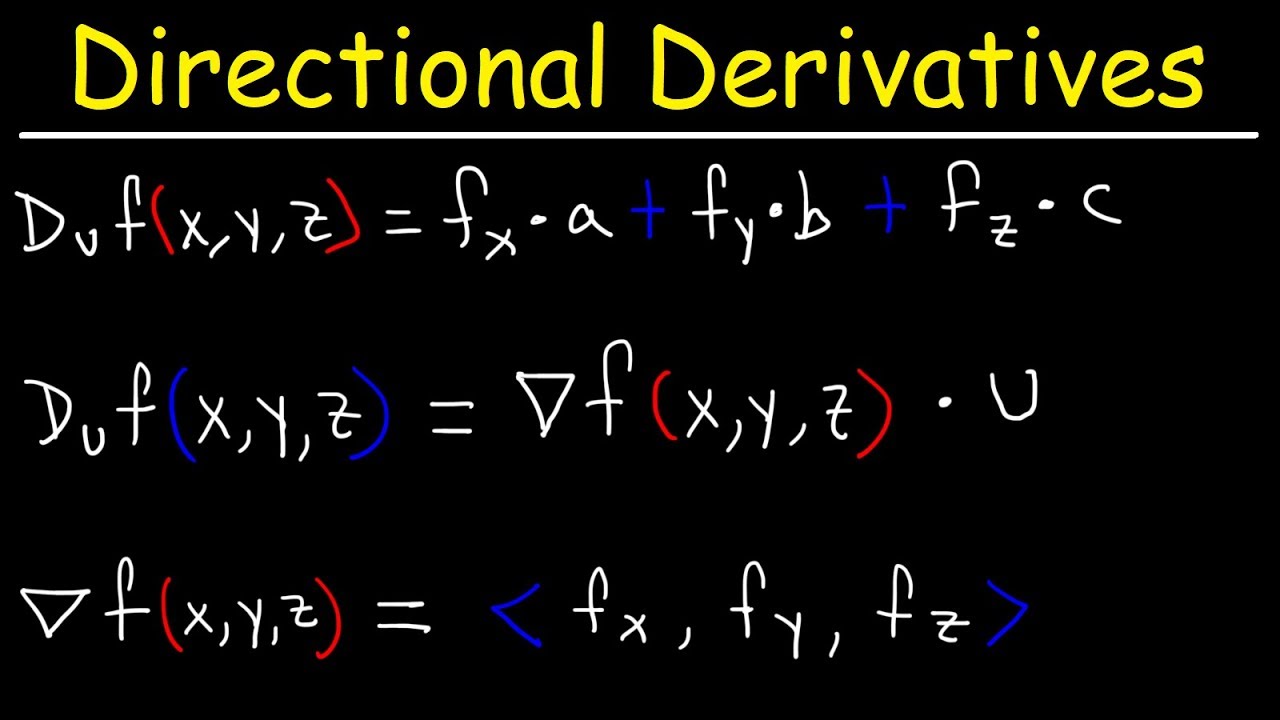
This Calculus 3 video tutorial explains how to find the directional derivative and the gradient vector. The directional derivative is the product of the gradient vector and the unit vector. To find the gradient vector, you need to find the partial derivatives of f with respect to x, y, and maybe z for a 3 variable function.
Lines & Planes - I...
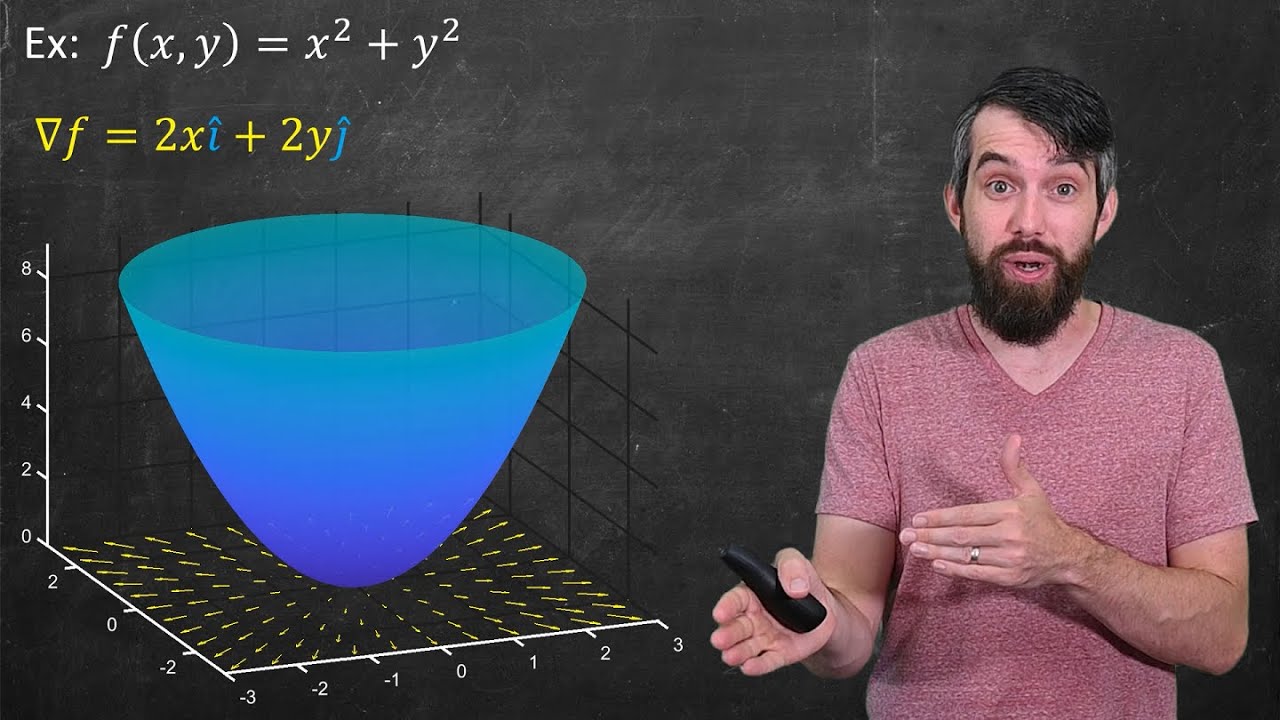
One prominent example of a vector field is the Gradient Vector Field. Given any scalar, multivariable function f: R^n\to R, we can get a corresponding vector field that has a precise geometrical meaning: the vectors point in the direction of maximal increase of the function.
MY VECTOR CALCULUS PLAYLIST:
►VECTOR CALCULUS (Calc IV) https://www....
marble quail
Just finished the khan one
So essentially it is just a vector with all the derivatives
marble quail
So i just have to prove that the gradiant of f and g are equal to teh sum of them ?
ocean silo
the sum?
woven radishBOT
Merineth
 ocean silo
this is more so asking you to prove that the product rule can also be extended to gradients
marble quail
Right okay that makes sense
So i have to prove that the LHS = RHS
What wold the LHS vector look like?
ocean silo
ocean silo
now substitute f*g
.
let f = fg
for every spot that has an f in that matrix I typed out, put fg in its place
and the rest should become very clear
marble quail
$\nabla f=\begin{bmatrix}
\frac{\partial g}{\partial x_1}\ \frac{\partial g}{\partial x_2}
\
\vdots
\ \frac{\partial g}{\partial x_i}
\end{bmatrix}$
woven radishBOT
Merineth
 marble quail
I'm sorry i dont think i understand
ocean silo
$\nabla (fg)=\begin{bmatrix}
\frac{\partial (f\cdot g)}{\partial x_1}\ \frac{\partial (f\cdot g)}{\partial x_2}
\
\vdots
\ \frac{\partial (f\cdot g)}{\partial x_i}
\end{bmatrix}$
woven radishBOT
Triaxyz

 ocean silo
that is exactly what you're trying to prove, yes
marble quail
Isn't it sufficient
marble quail
marble quail
for me to just write this ?
marble quail
Then i have no idea D:
ocean silo
woven radish
**Triaxyz**
theres literally one last step after doing this
when you have two functions being multiplied and then take the derivative, what rule do you use?
marble quail
Product?
ocean silo
yes
ocean silo
woven radish
**Triaxyz**
so now for each entry in this vector, rewrite all the partial derivatives using the product rule
marble quail
I'm so sorry but i have literally no clue how that is done
ocean silo
are you in calc 3?
marble quail
I'm in multivariable calculus
ocean silo
then yes
marble quail
Why?
ocean silo
do you know what the equation for product rule is?
ocean silo
then what is $\frac{\partial (f\cdot g)}{\partial x_i}$?
woven radishBOT
Triaxyz
 marble quail
f*g = f'g + fg'
ocean silo
woven radish
**Triaxyz**
you just computed the partial derivative of the ith entry here
marble quail
I see
ocean silo
another way to write it is $\frac{\partial (f\cdot g)}{\partial x_i} = \frac{\partial (f)}{\partial x_i} \cdot g + \frac{\partial (g)}{\partial x_i} \cdot f$
woven radishBOT
Triaxyz
 ocean silo
woven radish
**Triaxyz**
ocean silo
woven radish
**Triaxyz**
now plug the value we just calculated in this image to the gradient vector in my previous messages
ocean silo
woven radish
**Triaxyz**
right here
marble quail
woven radish
**Triaxyz**
the rhs of this should go into #help-27 message ?
ocean silo
yes
they are equal expressions due to the product rule
so the matrix then turns into
$\nabla (fg)=\begin{bmatrix}
\frac{\partial (f\cdot g)}{\partial x_1}\ \frac{\partial (f\cdot g)}{\partial x_2}
\
\vdots
\ \frac{\partial (f)}{\partial x_i} \cdot g + \frac{\partial (g)}{\partial x_i} \cdot f
\end{bmatrix}$
woven radishBOT
Triaxyz
 ocean silo
agree?
 ocean silo
alright
ocean silo
marble quail
So far at least <:blobsweat:584506239661113371>
now do you agree that the subsequent partial derivatives are also influenced by the product rule due to their multiplication?
marble quail
Yes
ocean silo
$\nabla (fg)=\begin{bmatrix}
\frac{\partial (f)}{\partial x_1} \cdot g + \frac{\partial (g)}{\partial x_1} \cdot f\ \frac{\partial (f)}{\partial x_2} \cdot g + \frac{\partial (g)}{\partial x_2} \cdot f
\
\vdots
\ \frac{\partial (f)}{\partial x_i} \cdot g + \frac{\partial (g)}{\partial x_i} \cdot f
\end{bmatrix}$
woven radishBOT
Triaxyz
 ocean silo
yes?
marble quail
Yea
ocean silo
now split the vector such that you have g * [something] + f * [something else]
marble quail
marble quail
So we essentially get the RHS of this by splitting them?
ocean silo
yes
marble quail
That makes sense
And i assume we have now proven it?
I would've never in a million years figured this out myself lol especially on my own
ocean silo
once you rewrite it as $\nabla (fg)=\begin{bmatrix}
\frac{\partial (f)}{\partial x_1} \cdot g \ \frac{\partial (f)}{\partial x_2} \cdot g
\
\vdots
\ \frac{\partial (f)}{\partial x_i} \cdot g
\end{bmatrix} + \begin{bmatrix}
\frac{\partial (g)}{\partial x_1} \cdot f\ \frac{\partial (g)}{\partial x_2} \cdot f
\
\vdots
\ \frac{\partial (g)}{\partial x_i} \cdot f
\end{bmatrix}$ you can pull f and g out of their respective vectors and rewrite the vectors as the gradients thus completing the proof
woven radishBOT
Triaxyz
 marble quail
god bless you @ocean silo
For real, it's so hard these days to get as good help as yours

tysm, have a lovely weekend!
.close
devout snowBOT
Channel closed
Closed by @marble quail
Use .reopen if this was a mistake.
devout snowBOT
Available help channel!
Send your question here to claim the channel.
Remember:
• Ask your math question in a clear, concise manner.
• Show your work, and if possible, explain where you are stuck.
• After 15 minutes, feel free to ping <@&286206848099549185>.
• Type the command .close to free the channel when you're done.
• Be polite and have a nice day!
Read #❓how-to-get-help for further information on how to ask a good question, and about conduct in the question channels.
 plush grail
 devout snowBOT
plush grail
plush grail
devout snowBOT
plush grail
plush grail
what happened in between these steps
 acoustic leaf
in between the first and second step they split the integral at the + sign and evaluate the first one (integral of 1)
after the second step they did partial fraction decomposition
devout snowBOT
@plush grail Has your question been resolved?
Channel closed
Closed by @plush grail
Use .reopen if this was a mistake.
Available help channel!
Send your question here to claim the channel.
Remember:
• Ask your math question in a clear, concise manner.
• Show your work, and if possible, explain where you are stuck.
• After 15 minutes, feel free to ping <@&286206848099549185>.
• Type the command .close to free the channel when you're done.
• Be polite and have a nice day!
Read #❓how-to-get-help for further information on how to ask a good question, and about conduct in the question channels.
 grave furnace

 quaint citrus
@grave furnace what u tryna do
devout snowBOT
Channel closed
Closed due to timeout
Use .reopen if this was a mistake.
Available help channel!
Send your question here to claim the channel.
Remember:
• Ask your math question in a clear, concise manner.
• Show your work, and if possible, explain where you are stuck.
• After 15 minutes, feel free to ping <@&286206848099549185>.
• Type the command .close to free the channel when you're done.
• Be polite and have a nice day!
Read #❓how-to-get-help for further information on how to ask a good question, and about conduct in the question channels.
 inner thunder
I'm lost on setting up the triple integral for this problem
 inner thunder
I had set the two given equations equal to each other to find at what z value they intersect, which I found to be z=19
But I'm not entirely sure how to proceed
 graceful cosmos
Know spherical coordinates?
You definitely don't want to be doing this in rectangular
inner thunder
Like converting to polar coordinates with x=rcostheta and y=rsintheta?
 junior widget
 graceful cosmos
Polar is a 2D coordinate system. We're looking for spherical, a 3D coordinate system
junior widget
junior widget
I dont understand the simplification that happened from the third equal sign from the top to the fourth
inner thunder
graceful cosmos
Polar is a 2D coordinate system. We're looking for spherical, a 3D coordinate sy...
Oh, we haven't covered that yet
graceful cosmos
I guess this can also be done in polar. You'll need to identify
- The radius of the integration bound
- The bottom surface, in terms of r
- The top surface, in terms of r
inner thunder
.close
devout snowBOT
Channel closed
Closed by @inner thunder
Use .reopen if this was a mistake.
devout snowBOT
Available help channel!
Send your question here to claim the channel.
Remember:
• Ask your math question in a clear, concise manner.
• Show your work, and if possible, explain where you are stuck.
• After 15 minutes, feel free to ping <@&286206848099549185>.
• Type the command .close to free the channel when you're done.
• Be polite and have a nice day!
Read #❓how-to-get-help for further information on how to ask a good question, and about conduct in the question channels.
 torn vessel
the inductive assumption isn't the same as the original statement.
devout snowBOT
@atomic basin Has your question been resolved?
devout snowBOT
Channel closed
Closed due to timeout
Use .reopen if this was a mistake.
devout snowBOT
Available help channel!
Send your question here to claim the channel.
Remember:
• Ask your math question in a clear, concise manner.
• Show your work, and if possible, explain where you are stuck.
• After 15 minutes, feel free to ping <@&286206848099549185>.
• Type the command .close to free the channel when you're done.
• Be polite and have a nice day!
Read #❓how-to-get-help for further information on how to ask a good question, and about conduct in the question channels.
 supple dust
hi all why does the power go from 1/2 to -1/2 when they are integrating?
 devout snowBOT
supple dust
hi all why does the power go from 1/2 to -1/2 when they are integrating?
devout snowBOT
supple dust
hi all why does the power go from 1/2 to -1/2 when they are integrating?
 sullen island
they're differentiating not integrating
supple dust
ohh im stupid, didnt realise it was a differentation question as i was doing the integration questions
thanks
.close
devout snowBOT
Channel closed
Closed by @supple dust
Use .reopen if this was a mistake.
Available help channel!
Send your question here to claim the channel.
Remember:
• Ask your math question in a clear, concise manner.
• Show your work, and if possible, explain where you are stuck.
• After 15 minutes, feel free to ping <@&286206848099549185>.
• Type the command .close to free the channel when you're done.
• Be polite and have a nice day!
Read #❓how-to-get-help for further information on how to ask a good question, and about conduct in the question channels.
Channel closed
Channel closed due to the original message being deleted.
If you did not intend to do this, please open a new help channel,
as this action is irreversible, and this channel may abruptly lock.
Available help channel!
Send your question here to claim the channel.
Remember:
• Ask your math question in a clear, concise manner.
• Show your work, and if possible, explain where you are stuck.
• After 15 minutes, feel free to ping <@&286206848099549185>.
• Type the command .close to free the channel when you're done.
• Be polite and have a nice day!
Read #❓how-to-get-help for further information on how to ask a good question, and about conduct in the question channels.
 hollow portal
Hello
devout snowBOT
hollow portal
Hello
hollow portal
I have a question from my physics lab and I just need help understanding it
"Q9. If the wooden block mass is used as an independent variable (x-axis) and the hanging mass is used as a dependent variable (y-axis), express slope (m) in terms of other variables. Show your work."
So for context the lab is finding the coefficient of static friction and we have a wooden block mass and a hanging object mass
exactly like this

And my teacher gave me a hint:
μs * xg = yg
so it's supposed to resemble y = mx + b
where y is the mass of hanging object, and x is the mass of wooden block
so that means the static friction is the slope
and 'g' is just the gravity thrown in there
"express slope (m) in terms of other variables"
does that mean I isolate for x and then for y
idk if this correct but:
μs = yg / xg

devout snowBOT
@hollow portal Has your question been resolved?
devout snowBOT
@hollow portal Has your question been resolved?
devout snowBOT
Channel closed
Closed due to timeout
Use .reopen if this was a mistake.
Available help channel!
Send your question here to claim the channel.
Remember:
• Ask your math question in a clear, concise manner.
• Show your work, and if possible, explain where you are stuck.
• After 15 minutes, feel free to ping <@&286206848099549185>.
• Type the command .close to free the channel when you're done.
• Be polite and have a nice day!
Read #❓how-to-get-help for further information on how to ask a good question, and about conduct in the question channels.
 restive river
how do i get the bot to help me
devout snowBOT
restive river
how do i get the bot to help me
restive river

 uncut crow
what bot, and help you do what?
restive river
can u help me with decently simple probability?
My question is, "A quarterback completes 60% of his passes. Determine the probability his first completion is his 4th pass."
restive river
uncut crow
what bot, and help you do what?
its j that question and idk if there is a bot that does it quick so i didnt have to bother anyone
 unkempt bear
Bot?
restive river
acoustic leaf
we're all humans here :)
yea ik im not meaning it like that lmfaooo i j mean like its a rlly simple problem
restive river
acoustic leaf
what kind of probability distribution do you have here?
thats the whole question
acoustic leaf
do you have a name for the type of distribution this falls under?
restive river
unkempt bear
...are you trying to make chatgpt help you
no no no, i just joined and in the suggest role it said smtn abt a math helper bot so i got intregued lol
restive river
acoustic leaf
do you have a name for the type of distribution this falls under?
no
im ngl i have no clue what this is and j was on my hw i gotta do
unkempt bear
restive river
no no no, i just joined and in the suggest role it said smtn abt a math helper b...
Hmm
unkempt bear
restive river
Is this sincerely the entirety of the problem
restive river
unkempt bear
Is this sincerely the entirety of the problem
yup
restive river
unkempt bear
Hmm
this one
 acoustic leaf
teXit is just the bot that displays math equations
restive river
i mean thats it
 restive river
acoustic leaf
teXit is just the bot that *displays* math equations
restive river
acoustic leaf
teXit is just the bot that *displays* math equations
gotcha
restive river
restive river
i mean thats it
j an fyi .95 IS NOT the answer for this question
its a math circut or wtvr so its like the question before this had the answer =.95
acoustic leaf
has your class covered the binomial and geometric distributions?
restive river
acoustic leaf
has your class covered the binomial and geometric distributions?
most likely yes, problem is i just cannot learn in the class
its ap stats and ive had 5 differnt teachers
rn im doing a teacher who has no clue how to teach stats teaching us froma zoom call on the smart board 😭
pretty much everything where doing is self led and i got no clue how to do this one
bc i thought it would be .6*4=.15 but thats not an option
acoustic leaf

Khan Academy
Learn for free about math, art, computer programming, economics, physics, chemistry, biology, medicine, finance, history, and more. Khan Academy is a nonprofit with the mission of providing a free, world-class education for anyone, anywhere.
unkempt bear
Ah, maybe it's just that idk quarterback
restive river
unkempt bear
Ah, maybe it's just that idk quarterback
tbh u can prolly ignore thats its just saying that there is a 60% probability that it happens and ist asking the chance that the first time it occurs is the 4th attempt
restive river
acoustic leaf
https://www.khanacademy.org/math/ap-statistics/random-variables-ap/geometric-ran...
o tysm ❤️
acoustic leaf
there are two related probability distributions that you are expected to know in AP stats, which are binomial and geometric
unkempt bear
restive river
tbh u can prolly ignore thats its just saying that there is a 60% probability th...
I mean it was difficult to understand that was what is happening here
restive river
acoustic leaf
there are two related probability distributions that you are expected to know in...
yea ik, im kinda cooked rn for this ap test lol
restive river
unkempt bear
I mean it was difficult to understand that was what is happening here
o sorry
acoustic leaf
!nosols
devout snowBOT
As a helper, please do not give out answers that could be copied as a homework solution. Have the student work through the problem themselves and guide them along the way.
@restive river Has your question been resolved?
Channel closed
Closed by @supple anvil
Use .reopen if this was a mistake.
acoustic leaf
👍
devout snowBOT
Available help channel!
Send your question here to claim the channel.
Remember:
• Ask your math question in a clear, concise manner.
• Show your work, and if possible, explain where you are stuck.
• After 15 minutes, feel free to ping <@&286206848099549185>.
• Type the command .close to free the channel when you're done.
• Be polite and have a nice day!
Read #❓how-to-get-help for further information on how to ask a good question, and about conduct in the question channels.
 inner warren
How do i graph this, whats the equation
 devout snowBOT
inner warren
How do i graph this, whats the equation
inner warren
devout snowBOT
inner warren
How do i graph this, whats the equation
inner warren
i don't need a long winded explanation that last 30 minutes i want a straight answer because google is incapable of even naming this line
 spare crypt
ln(x)
 rustic jetty
it could also be sqrt(x), right?
acoustic leaf
1 - e^(-x)
spare crypt
winner gets a cake btw
inner warren
if its ln(x) how do i make the line smoother so its not like this

or perhaps im too zoomed out
uncut crow
looks very smooth already
devout snowBOT
Channel closed
Closed by @inner warren
Use .reopen if this was a mistake.
devout snowBOT
Available help channel!
Send your question here to claim the channel.
Remember:
• Ask your math question in a clear, concise manner.
• Show your work, and if possible, explain where you are stuck.
• After 15 minutes, feel free to ping <@&286206848099549185>.
• Type the command .close to free the channel when you're done.
• Be polite and have a nice day!
Read #❓how-to-get-help for further information on how to ask a good question, and about conduct in the question channels.
restive river
Hello
devout snowBOT
restive river
Hello
restive river
I need help with compound inequalities
wicked turtle
!da2a
devout snowBOT
No need to ask “Can I ask…?” or “Does anyone know about…?”—it’s faster for everyone if you just ask your question! See https://dontasktoask.com/
@restive river Has your question been resolved?
devout snowBOT
Channel closed
Closed due to timeout
Use .reopen if this was a mistake.
Available help channel!
Send your question here to claim the channel.
Remember:
• Ask your math question in a clear, concise manner.
• Show your work, and if possible, explain where you are stuck.
• After 15 minutes, feel free to ping <@&286206848099549185>.
• Type the command .close to free the channel when you're done.
• Be polite and have a nice day!
Read #❓how-to-get-help for further information on how to ask a good question, and about conduct in the question channels.
 hollow fiber
 devout snowBOT
hollow fiber
devout snowBOT
hollow fiber
 devout snowBOT
@hollow fiber Has your question been resolved?
Channel closed
Closed by @hollow fiber
Use .reopen if this was a mistake.
Available help channel!
Send your question here to claim the channel.
Remember:
• Ask your math question in a clear, concise manner.
• Show your work, and if possible, explain where you are stuck.
• After 15 minutes, feel free to ping <@&286206848099549185>.
• Type the command .close to free the channel when you're done.
• Be polite and have a nice day!
Read #❓how-to-get-help for further information on how to ask a good question, and about conduct in the question channels.
 warped matrix
i do not know how to do ten, pls help
 devout snowBOT
warped matrix
i do not know how to do ten, pls help
acoustic leaf
devout snowBOT
warped matrix
i do not know how to do ten, pls help
acoustic leaf
what have you done so far?
warped matrix
write it in augmented matrix form
acoustic leaf
what does that look like?
warped matrix
 warped matrix
k
acoustic leaf
the first step is to multiply its row by whatever is needed to make the pivot 1
warped matrix
1/4?
acoustic leaf
yes
warped matrix
 acoustic leaf
ok. the next step is to add multiples of the first row to the other two rows to "eliminate" all numbers below the pivot (make them 0)
warped matrix
i dont understand
acoustic leaf
you are going to add (some number) * (the first row) to the second row
you should choose that number so that the number in the second row below the pivot is sent to 0
acoustic leaf
you would add (-5)*(the first row) to the second row, yes
warped matrix
 acoustic leaf
then you will do the same thing with the last row
warped matrix
still using the first rows multiple?
acoustic leaf
yes
warped matrix
 acoustic leaf
what row operation did you perform here?
 acoustic leaf
double check your second number
warped matrix
it came out to be still the same
acoustic leaf
4 + (-3)(-1/2)?
acoustic leaf
oh i didn't see the first 1, it blended into the line
so our next step is to get the second pivot
warped matrix
acoustic leaf
oh i didn't see the first 1, it blended into the line
mb
ok
wait, do u know what the answer is already
acoustic leaf
not off the top of my head, i'm just following the algorithm
warped matrix
do u want me to give it
acoustic leaf
you can send it if you want to
acoustic leaf
ok. so the next step is to find our second pivot
which will be the next number down and to the right of the first pivot, as long as it's not 0
warped matrix
 acoustic leaf
now we will do the same thing of adding to every row below the pivot to make the number below it 0
warped matrix
 acoustic leaf
double check the sign on the last number
warped matrix
its suppose to negative because of -96/2, mb
acoustic leaf
so now we move on to the third pivot, which is again down and to the right
warped matrix
and now make that -12 into a 1?
devout snowBOT
@warped matrix Has your question been resolved?
devout snowBOT
Channel closed
Closed due to timeout
Use .reopen if this was a mistake.
Available help channel!
Send your question here to claim the channel.
Remember:
• Ask your math question in a clear, concise manner.
• Show your work, and if possible, explain where you are stuck.
• After 15 minutes, feel free to ping <@&286206848099549185>.
• Type the command .close to free the channel when you're done.
• Be polite and have a nice day!
Read #❓how-to-get-help for further information on how to ask a good question, and about conduct in the question channels.
 sonic pewter
A piece of wire 10 m long is cut into two pieces. One piece is bent into a square and the other is bent
into an equilateral triangle. How should the wire be cut so that the total area enclosed is a minimum?
devout snowBOT
sonic pewter
A piece of wire 10 m long is cut into two pieces. One piece is bent into a squar...
sonic pewter
Im having trouble with this
I defined the area of the square to be (a/4)^2
and area of the triangle to be (b/3) sqrt(b^2 - (b/2)^2) (1/2)
idk how to proceed from there
 prisma nacelle
sonic pewter
A piece of wire 10 m long is cut into two pieces. One piece is bent into a squar...
prisma nacelle
sonic pewter
A piece of wire 10 m long is cut into two pieces. One piece is bent into a squar...
A=s^2+s^2sqrt3/4?
sonic pewter
for triangle?
prisma nacelle
sonic pewter
for triangle?
total area
sonic pewter
I don't understand how u got there
safe knoll
Where are u stuck?
sonic pewter
I think it might be I tried to define two variables?
safe knoll
prisma nacelle
A=s^2+s^2sqrt3/4?
also this is kinda wrong
A = (a/4)^2 {the area of square} + sqrt3/4 (b/2)^2 {area of equilateral triangle}
safe knoll
sonic pewter
I can refer the areas with the variable x right?
u can
safe knoll
sonic pewter
but the triangle would be ((10-x)/3)^2 times sqrt(3)/4
$$\frac{(10-x)}{3}^2 \times \frac{\sqrt3}{4}$$
where are u getting the 3 in denominator from?
oh ok nvm
sonic pewter
ye
woven radishBOT
JustToPro
 safe knoll
yeah combine both together and derivate it
devout snowBOT
Channel closed
Closed by @sonic pewter
Use .reopen if this was a mistake.
devout snowBOT
Available help channel!
Send your question here to claim the channel.
Remember:
• Ask your math question in a clear, concise manner.
• Show your work, and if possible, explain where you are stuck.
• After 15 minutes, feel free to ping <@&286206848099549185>.
• Type the command .close to free the channel when you're done.
• Be polite and have a nice day!
Read #❓how-to-get-help for further information on how to ask a good question, and about conduct in the question channels.
 short loom
excuse me can someone help me how to calculate this pls?
restive river
calculate what?
 soft umbra
Lag?
short loom
this
 strange arch
short loom
this
strange arch
short loom
this
well what's the perimeter of a triangle? 🐛
short loom
its telling me to find the perimeter and simplify it
restive river
yeah, so lets start with that perimiter
 winter patrol
do you know the definition of perimeter?
short loom
no. that's the part i need help with
winter patrol
what does perimeter mean
short loom
hold on im trying to remember
wait i know
its the length and width outside the shape (i think)
winter patrol
poor description
short loom
wow thanks
winter patrol
look up the proper definition
winter patrol
yes
short loom
so does it mean i have to add all the expressions together?
winter patrol
yes
short loom
so is the answer 8c³
short loom
wait theres something wrong w/ my laptop
short loom
winter patrol
how are you getting that
i got the random answer from adding the c's and the 5 and 3
winter patrol
adding c like that doesn't increase the power of c
nor can you combine non-like terms like that
short loom
oh ok
so if my answer is not right, what is the answer and the rught way to calculate it?
short loom
3 apples
short loom
3c?
winter patrol
yes
short loom
yay
winter patrol
now if you had
3🍎
does adding a number (these aren't apples, just a number)
increase the amount of apples you have?
short loom
well no cause they're numbers not apples
winter patrol
yeh exacltly
same reasoning applies to what you have
you can't combine the number of cs with those numbers (not c) like that
you'd just keep them separate
short loom
we're talking about the 5 and 3, right?
winter patrol
yes
winter patrol
yes
devout snowBOT
Channel closed
Closed by @short loom
Use .reopen if this was a mistake.
devout snowBOT
Available help channel!
Send your question here to claim the channel.
Remember:
• Ask your math question in a clear, concise manner.
• Show your work, and if possible, explain where you are stuck.
• After 15 minutes, feel free to ping <@&286206848099549185>.
• Type the command .close to free the channel when you're done.
• Be polite and have a nice day!
Read #❓how-to-get-help for further information on how to ask a good question, and about conduct in the question channels.
 thorny lily
 devout snowBOT
thorny lily
thorny lily
devout snowBOT
thorny lily
thorny lily
How they get = -theta + 2pi and 3pi
fossil locust
thorny lily
How they get = -theta + 2pi and 3pi
The period of tan x is pi
So tan(x) = tan(x + pi) = tan(x + 2pi) = tan(x + 3pi) = ...
And tan(x) = tan(x - pi) = tan(x - 2pi) = ...
With functions that are not one-to-one, you have to be careful
For example, if x^2 = y^2
x = y or x = -y, both work
So you have to find all the angles that give the same y-value, which is what they are doing here
fossil locust
thorny lily
So would this plusminus 2pi work for sin/cos
Yes
sin and cos are more tricky
Cause remember that sin(pi - x) = sin(x)
So you can have sin(pi - x + 2pi) = sin(3pi - x) = sin(x)
And sin(pi - x - 2pi) = sin(-x - pi) = sin(x)
And ofc sin(2pi + x) = sin(x)
Similarly, remember that cos(-x) = cos(x)
So you could have cos(2pi - x) = cos(-2pi - x) = cos(4pi - x) = cos(x)
thorny lily
Ok
devout snowBOT
@thorny lily Has your question been resolved?
restive river
ur qn solved?
devout snowBOT
Channel closed
Closed due to timeout
Use .reopen if this was a mistake.
Available help channel!
Send your question here to claim the channel.
Remember:
• Ask your math question in a clear, concise manner.
• Show your work, and if possible, explain where you are stuck.
• After 15 minutes, feel free to ping <@&286206848099549185>.
• Type the command .close to free the channel when you're done.
• Be polite and have a nice day!
Read #❓how-to-get-help for further information on how to ask a good question, and about conduct in the question channels.
 lament schooner
 devout snowBOT
lament schooner
acoustic leaf
devout snowBOT
lament schooner
acoustic leaf
you can write that expression directly into webwork
 winter patrol
derivative of x^2 - 1 at x=1 isn't 1
devout snowBOT
Channel closed
Closed by @lament schooner
Use .reopen if this was a mistake.
Available help channel!
Send your question here to claim the channel.
Remember:
• Ask your math question in a clear, concise manner.
• Show your work, and if possible, explain where you are stuck.
• After 15 minutes, feel free to ping <@&286206848099549185>.
• Type the command .close to free the channel when you're done.
• Be polite and have a nice day!
Read #❓how-to-get-help for further information on how to ask a good question, and about conduct in the question channels.
fossil locust
Ahhhh damn
devout snowBOT
fossil locust
Ahhhh damn
fossil locust
.close
devout snowBOT
Channel closed
Closed by @fossil locust
Use .reopen if this was a mistake.
devout snowBOT
Available help channel!
Send your question here to claim the channel.
Remember:
• Ask your math question in a clear, concise manner.
• Show your work, and if possible, explain where you are stuck.
• After 15 minutes, feel free to ping <@&286206848099549185>.
• Type the command .close to free the channel when you're done.
• Be polite and have a nice day!
Read #❓how-to-get-help for further information on how to ask a good question, and about conduct in the question channels.
 tight depot
how do i prove that it increases to inf when approaching 0 from the left, and decreasing to -inf when approaching 0 from the right

 devout snowBOT
tight depot
how do i prove that it increases to inf when approaching 0 from the left, and de...
tight depot
devout snowBOT
tight depot
how do i prove that it increases to inf when approaching 0 from the left, and de...
tight depot
cuz h and c are constants
fossil locust
tight depot
how do i prove that it increases to inf when approaching 0 from the left, and de...
The square root goes to sqrt(h^2 c^2 / lambda) as lambda goes to 0
As h^2 c^2 / lambda is going to blow up to plus or minus infinity
So it will be much bigger in absolute value than m0^2 c^4 for any m0 and c
So the limit equals $\frac{-h^2 c^2}{\lambda^3 (hc/\lambda)}$
woven radishBOT
south
 fossil locust
Wait that's weird
tight depot
fossil locust
Wait that's weird
wdym
fossil locust
woven radish
**south**
I probably did this wrong then
devout snowBOT
@tight depot Has your question been resolved?
devout snowBOT
@tight depot Has your question been resolved?
devout snowBOT
@tight depot Has your question been resolved?
devout snowBOT
@tight depot Has your question been resolved?
devout snowBOT
@tight depot Has your question been resolved?
 tender cobalt
tight depot
how do i prove that it increases to inf when approaching 0 from the left, and de...
tender cobalt
tight depot
how do i prove that it increases to inf when approaching 0 from the left, and de...
,align\lim_{\lambda\to0^{\color{yellow}\pm}}-\frac{h^2c^2}{\lambda^3\sqrt{m_0^2c^4+\frac{h^2c^2}{\lambda^2}}}
&=\lim_{\lambda\to0^{\color{yellow}\pm}}-\frac{h^2c^2}{\lambda^2(\lambda)\sqrt{m_0^2c^4+\frac{h^2c^2}{\lambda^2}}}
\&=\lim_{\lambda\to0^{\color{yellow}\pm}}-\frac{h^2c^2}{\lambda^2({\color{yellow}\pm}\sqrt{\lambda^2})\sqrt{m_0^2c^4+\frac{h^2c^2}{\lambda^2}}}
\&=\lim_{\lambda\to0^{\color{yellow}\pm}}-\frac{h^2c^2}{\lambda^2\cdot{\color{yellow}\pm}\sqrt{\qty(\lambda^2)\qty(m_0^2c^4+\frac{h^2c^2}{\lambda^2})}}
\&=\lim_{\lambda\to0^{\color{yellow}\pm}}-\frac{h^2c^2}{\lambda^2\cdot{\color{yellow}\pm}\sqrt{m_0^2c^4\lambda^2+h^2c^2}}
\&=\lim_{\lambda\to0^{\color{yellow}\pm}}-\frac{h^2c^2}{{\color{yellow}\pm}\sqrt{m_0^2c^4\lambda^2+h^2c^2}}\cdot\lim_{\lambda\to0^{\color{yellow}\pm}}\frac1{\lambda^2}
\&=-\frac{h^2c^2}{{\color{yellow}\pm}\sqrt{h^2c^2}}\cdot\lim_{\lambda\to0^{\color{yellow}\pm}}\frac1{\lambda^2}
\&=-{\color{yellow}\pm}\frac{h^2c^2}{\sqrt{h^2c^2}}\cdot(+\infty)
\&=-{\color{yellow}\pm}\infty
\\lim_{\lambda\to0^{\color{yellow}+}}-\frac{h^2c^2}{\lambda^3\sqrt{m_0^2c^4+\frac{h^2c^2}{\lambda^2}}}
&=-{\color{yellow}+}\infty=-\infty
\\lim_{\lambda\to0^{\color{yellow}-}}-\frac{h^2c^2}{\lambda^3\sqrt{m_0^2c^4+\frac{h^2c^2}{\lambda^2}}}
&=-{\color{yellow}-}\infty=+\infty
woven radishBOT
mtt
 tender cobalt
the weird square root behavior is because √(x^2) does not simplify to x for negative numbers
√((-5)^2) = √25 = 5 instead of -5
so √(x^2) = |x| instead
also the ± stands in for whether youre taking the limit from the right or from the left, you can pretend theyre all +s to get the work required to take the limit from the right
or all -s to get the work required to take the limit from the left
 polar dagger
tender cobalt
,align\lim_{\lambda\to0^{\color{yellow}\pm}}-\frac{h^2c^2}{\lambda^3\sqrt{m_0^2c...
polar dagger
tender cobalt
,align\lim_{\lambda\to0^{\color{yellow}\pm}}-\frac{h^2c^2}{\lambda^3\sqrt{m_0^2c...
did you write this all out??
tender cobalt
ye
polar dagger
damn
tight depot
ok gets thank you @tender cobalt !!
tender cobalt
np
tender cobalt
.close
devout snowBOT
Channel closed
Closed by @tender cobalt
Use .reopen if this was a mistake.
Available help channel!
Send your question here to claim the channel.
Remember:
• Ask your math question in a clear, concise manner.
• Show your work, and if possible, explain where you are stuck.
• After 15 minutes, feel free to ping <@&286206848099549185>.
• Type the command .close to free the channel when you're done.
• Be polite and have a nice day!
Read #❓how-to-get-help for further information on how to ask a good question, and about conduct in the question channels.
 west kestrel
 devout snowBOT
west kestrel
west kestrel
devout snowBOT
west kestrel
west kestrel
i got this answer 1/3(x+3)
but i checked with photomath which is pretty accurate with this topic and it gave me
1/3
can someone double check if i did this right
this is my work but u prob cant read it

.close
devout snowBOT
Channel closed
Closed by @west kestrel
Use .reopen if this was a mistake.
west kestrel
nvm
devout snowBOT
Available help channel!
Send your question here to claim the channel.
Remember:
• Ask your math question in a clear, concise manner.
• Show your work, and if possible, explain where you are stuck.
• After 15 minutes, feel free to ping <@&286206848099549185>.
• Type the command .close to free the channel when you're done.
• Be polite and have a nice day!
Read #❓how-to-get-help for further information on how to ask a good question, and about conduct in the question channels.
 torn fox
what is the geometry of the span of 3 linearly independent R^3 vectors?
wicked turtle
it's all of R^3
torn fox
yea but what do we call it
wicked turtle
euclidean space?
devout snowBOT
Channel closed
Closed by @torn fox
Use .reopen if this was a mistake.
devout snowBOT
Available help channel!
Send your question here to claim the channel.
Remember:
• Ask your math question in a clear, concise manner.
• Show your work, and if possible, explain where you are stuck.
• After 15 minutes, feel free to ping <@&286206848099549185>.
• Type the command .close to free the channel when you're done.
• Be polite and have a nice day!
Read #❓how-to-get-help for further information on how to ask a good question, and about conduct in the question channels.
 hybrid maple
What do i do with the cosh(2x)
devout snowBOT
hybrid maple
What do i do with the cosh(2x)

 open orchid
Solve definite and indefinite integrals (antiderivatives) using this free online calculator. Step-by-step solution and graphs included!
hybrid maple
thanks
 heavy current
open orchid
https://www.integral-calculator.com
heavy current
open orchid
https://www.integral-calculator.com
!nosols
devout snowBOT
open orchid
https://www.integral-calculator.com
As a helper, please do not give out answers that could be copied as a homework solution. Have the student work through the problem themselves and guide them along the way.
heavy current
I know it's not a real solutions
but it's probably best to get them to work thru the problem...
open orchid
heavy current
!nosols
it provides steps
open orchid
why not?
heavy current
...why would one learn better by running away from a problem to use a calculator?
heavy current
it is a calculator imo
yes it provides steps, but how is that better than getting the student to do it themselves?
 distant kite
open orchid
distant kite
open orchid
for many of these integrals you need to know some trick to solve them
 heady tulip
q es esa foto de perfil xd
open orchid
open orchid
for many of these integrals you need to know some trick to solve them
so you can't really guide someone to solve them without telling them the solution
hybrid maple
i have another integral, struggling with 11b
 open orchid
because that trick is the solution
heavy current
open orchid
so you can't really guide someone to solve them without telling them the solutio...
not sure I fully agree, but I'll digress
hybrid maple
could i multiply by x^2 in the root or will it make it worse
usually u need a perfect square for these questions i feel but i don’t know what to do
devout snowBOT
@hybrid maple Has your question been resolved?
devout snowBOT
Channel closed
Closed due to timeout
Use .reopen if this was a mistake.
Available help channel!
Send your question here to claim the channel.
Remember:
• Ask your math question in a clear, concise manner.
• Show your work, and if possible, explain where you are stuck.
• After 15 minutes, feel free to ping <@&286206848099549185>.
• Type the command .close to free the channel when you're done.
• Be polite and have a nice day!
Read #❓how-to-get-help for further information on how to ask a good question, and about conduct in the question channels.
 lunar bluff
I have no idea where to start with this
 devout snowBOT
lunar bluff
I have no idea where to start with this
lunar bluff
devout snowBOT
lunar bluff
I have no idea where to start with this
lunar bluff
is this an alternating series?
 jade oak
lunar bluff
is this an alternating series?
jade oak
lunar bluff
is this an alternating series?
Yes
That sin part can be reduced to just (-1)^n
devout snowBOT
Channel closed
Closed by @lunar bluff
Use .reopen if this was a mistake.