Channel closed
Closed by @subtle kindle
Use .reopen if this was a mistake.
1 messages · Page 153 of 1
 devout snowBOT
Closed by @subtle kindle
Use .reopen if this was a mistake.
devout snowBOT
 Available help channel!
Send your question here to claim the channel.
Remember:
• Ask your math question in a clear, concise manner.
• Show your work, and if possible, explain where you are stuck.
• After 15 minutes, feel free to ping <@&286206848099549185>.
• Type the command .close to free the channel when you're done.
• Be polite and have a nice day!
Read #❓how-to-get-help for further information on how to ask a good question, and about conduct in the question channels.
 cyan axle
How does the equation for a derivative change when I’m trying to find the second or third deravative?
devout snowBOT
cyan axle
How does the equation for a derivative change when I’m trying to find the second...
cyan axle
Like using power rule as an example
X^2= 2X
So what changes when I’m looking for the second or third derivative
 quick peak
cyan axle
Like using power rule as an example
quick peak
cyan axle
Like using power rule as an example
what is your question exactly?
quick peak
it's the same
 supple knot
cyan axle
Like how do I find the second derivative
supple knot
cyan axle
Like how do I find the second derivative
You differentiate the derivative
supple knot
cyan axle
2X but that’s 0
No
cyan axle
How does it work then?
supple knot
cyan axle
Like using power rule as an example
Just use power rule again
And constant multiple rule
,tex .diff rules
cyan axle
There is no power though
 woven radishBOT
dr. matlab plot
 supple knot
cyan axle
There is no power though
supple knot
cyan axle
There is no power though
Yes there is
cyan axle
2X?
supple knot
x = x^1
supple knot
x = x yes
cyan axle
yes
supple knot
cyan axle
It’ll just end up as 2(x)
2x = 2(x) yes
supple knot
What are you confused about
cyan axle
What I’m suppose to do next
supple knot
Do next for what
cyan axle
There’s no slope of a straight line so idk what to do next to find the second derivative
supple knot
supple knot
Just use power rule again
.
supple knot
woven radish
**dr. matlab plot**
.
cyan axle
nx^n-1
supple knot
cyan axle
There’s no slope of a straight line so idk what to do next to find the second de...
All straight lines have a constant slope
cyan axle
So 2X
No that dosent work
Can I even apply the power rule
2x^1.
2x^1-1
Still 2X
supple knot
x^0 = ?
cyan axle
X
cyan axle
So 0
woven radishBOT
Result:
1
No
cyan axle
Mb it’s 1
supple knot
x^1 = x
supple knot
supple knot
x^0 = ?
?
cyan axle
1
supple knot
Yes
supple knot
supple knot
1-1 = 0
.
cyan axle
Dammit
I’m coming off working on physics for like 8 hours cut me some slack
2x
Bro it’s still 2X
supple knot
supple knot
x^0 = ?
.
supple knot
cyan axle
2x^1-1
1-1=0
supple knot
cyan axle
1
.
supple knot
cyan axle
Chill
?????
cyan axle
Lapse of judgement
supple knot
Am I being mean to you
cyan axle
No
Okay to find the second derivative of x^2 I need the first derivative
2x
And the second derivative is getting the derivative of that
So it’s like
F(2)=x^2 ?
Shiiii…..
.close
devout snowBOT
Closed by @cyan axle
Use .reopen if this was a mistake.
devout snowBOT
Available help channel!
Send your question here to claim the channel.
Remember:
• Ask your math question in a clear, concise manner.
• Show your work, and if possible, explain where you are stuck.
• After 15 minutes, feel free to ping <@&286206848099549185>.
• Type the command .close to free the channel when you're done.
• Be polite and have a nice day!
Read #❓how-to-get-help for further information on how to ask a good question, and about conduct in the question channels.
devout snowBOT
Channel closed due to the original message being deleted.
If you did not intend to do this, please open a new help channel,
as this action is irreversible, and this channel may abruptly lock.
devout snowBOT
Available help channel!
Send your question here to claim the channel.
Remember:
• Ask your math question in a clear, concise manner.
• Show your work, and if possible, explain where you are stuck.
• After 15 minutes, feel free to ping <@&286206848099549185>.
• Type the command .close to free the channel when you're done.
• Be polite and have a nice day!
Read #❓how-to-get-help for further information on how to ask a good question, and about conduct in the question channels.
 pallid ravine
did i do this right?? im doing a circuit and i dont see my answer choice anywhere so can anyone tell me what i did wrong?
 devout snowBOT
pallid ravine
did i do this right?? im doing a circuit and i dont see my answer choice anywher...
devout snowBOT
pallid ravine
did i do this right?? im doing a circuit and i dont see my answer choice anywher...
 wicked edge
the slope of the tangent line at c is $$\frac{f(b)-f(a)}{b-a}$$, not c
woven radishBOT
Cycadellic
 wicked edge
so, now that we know $f'(c)$, we need to find c
woven radishBOT
Cycadellic
 wicked edge
just find the derivative of f and set it equal to -1.3...
then, the solution which is in [-3,-1] is c
wicked edge
wicked edge
just find the derivative of f and set it equal to -1.3...
didnt see the ' in the problem at first glance, so since we already know f', we set that = -1.33..., then solve
pallid ravine
why set to -1.333?
Arent the end points the two um points i use to find the slope of the secant line
I thought its -2? No?
And set equal to f’(x) given?
@wicked edge
wicked edge
ill be more concrete
we know $$f'(c)=\frac{f(b)-f(a)}{b-a}, c\in[a,b]$$ and $$f'(x)=\frac{-3-x^2}{x^2}$$
woven radishBOT
Cycadellic
 pallid ravine
yes
wicked edge
you found $$f'(c)=\frac{f(-3)-f(1)}{-3--1}=-1.33...$$
woven radishBOT
Cycadellic
 wicked edge
therefore, $$f'(c)=-1.33...$$
woven radishBOT
Cycadellic
 woven radishBOT
Cycadellic
 wicked edge
remember that we are given $$f'(x)=\frac{-3-x^2}{x^2}$$
woven radishBOT
Cycadellic
 wicked edge
therefore,
$$f'(c)=\frac{-3-c^2}{c^2}$$
woven radishBOT
Cycadellic
 wicked edge
but, by the mean value theorem, $$f'(c)=\frac{f(b)-f(a)}{b-a}=-1.33...$$
woven radishBOT
Cycadellic
 wicked edge
so, i have shown to you that
$$\frac{-3-c^2}{c^2}=f'(c)=-1.33...$$
then, it must follow that
$$\frac{-3-c^2}{c^2}=-1.33...$$
woven radishBOT
Cycadellic
 pallid ravine
No ❌ wait its not saying the answer is -4/3 tho
thats like the answer to the previous quesrion
answer to #7 that brought me there
pallid ravine
ur good
wicked edge
not sure what that was about
pallid ravine
i mustve fucked up then cuz i think the closest answer is - root 3, but it leads me back to the beginning so i messed up somewhere else
😣
wicked edge
you messed up on the last step
pallid ravine
what is wrong there?
wicked edge
arithmetic mistake
pallid ravine
oh
wicked edge
f'(-1.33...)=-2.6875, not -2
pallid ravine
so whats c
pallid ravine
Yes
wicked edge
so, multiply both sides by x^2, and simplify, make quadratic and find the root
and dont forget $\pm$
woven radishBOT
Cycadellic
 wicked edge
good so far
pallid ravine
but poditive isnt in interval
wicked edge
right
pallid ravine
so just - root 3
wicked edge
and since we know a quadratic only has two roots, youre done
wicked edge
np
pallid ravine
it brings me back to #1 so i have to check my work previously idk what else i got wrong but now i get
God bless
.close
devout snowBOT
Closed by @pallid ravine
Use .reopen if this was a mistake.
devout snowBOT
Available help channel!
Send your question here to claim the channel.
Remember:
• Ask your math question in a clear, concise manner.
• Show your work, and if possible, explain where you are stuck.
• After 15 minutes, feel free to ping <@&286206848099549185>.
• Type the command .close to free the channel when you're done.
• Be polite and have a nice day!
Read #❓how-to-get-help for further information on how to ask a good question, and about conduct in the question channels.
 placid verge
 devout snowBOT
placid verge
placid verge
devout snowBOT
placid verge
placid verge
I am not sure if I did this right
 crystal drift
check your c
crystal drift
crystal drift
check your c
if lim from right side = lim from left, then that should equal the lim
crystal drift
crystal drift
and e/f
i think you just made a small mistake here
crystal drift
crystal drift
and i
theres a hole at (3,-2)
placid verge
do i switch e and f
crystal drift
yup
placid verge
i would be undefined?
crystal drift
yup
placid verge
is c 1
crystal drift
that's also right
placid verge
thanks
crystal drift
np
placid verge
.close
devout snowBOT
Closed by @placid verge
Use .reopen if this was a mistake.
devout snowBOT
Available help channel!
Send your question here to claim the channel.
Remember:
• Ask your math question in a clear, concise manner.
• Show your work, and if possible, explain where you are stuck.
• After 15 minutes, feel free to ping <@&286206848099549185>.
• Type the command .close to free the channel when you're done.
• Be polite and have a nice day!
Read #❓how-to-get-help for further information on how to ask a good question, and about conduct in the question channels.
 analog hamlet
How do you find axis of symetry from vertex form?
devout snowBOT
analog hamlet
How do you find axis of symetry from vertex form?
 charred sleet
analog hamlet
How do you find axis of symetry from vertex form?
charred sleet
analog hamlet
How do you find axis of symetry from vertex form?
for a parabola?
it’s symmetrical about the x coordinate of the parabola
analog hamlet

Like how do I find it from this equation??
Does the question I am asking make sense?
 unique spire
$a * (x-h)^2 +k $ where (h ; k) it the coordinate of the point of interest
goddammit
unique spire
h=-1
unique spire
this is how it looks
 analog hamlet
Sweet, thanks
unique spire
since a is negative, there's a max
if a was positive there would be a minimum
analog hamlet
Yeah that makes sense
unique spire
to find the zeros of a function, solve $0 = a * (x-h)^2 + k$
woven radishBOT
nico
 analog hamlet
3?
unique spire
the zeros would be $x=(-1)\pm \sqrt{3}$
woven radishBOT
nico
 unique spire
what do you mean by y int?
analog hamlet
Y intercept
unique spire
it you're talking about the y intercepting the x axis then it the zeros of a fonctions
where simplified :$h\pm \sqrt{\frac{-k}{a}}=x$
woven radishBOT
nico
 analog hamlet
I'm a little stuck on finding the y intercept now
unique spire
i think by axis of symetry: they want the value of h
by vertex : they want the value of k
by y-intercept : they want the value of x where y=0, so the zeros of the function
unique spire
you sure about that?
y=-(3+1)^2+3=-4^2+3=-16+3=-13 not y is not equal 0 at x=3
$y=a(x-h)^2+k\
0=a(x-h)^2+k\
-k=a(x-h)^2\
\frac{-k}{a}=(x-h)^2\
\pm \sqrt{\frac{-k}{a}}=\sqrt{(x-h)^2}\
\pm \sqrt{\frac{-k}{a}}=x-h\
h\pm \sqrt{\frac{-k}{a}}=x\$
woven radishBOT
nico
 analog hamlet
Are you sure it isn't 2? The line intercepts the y axis at positive 2
In the graph you showed me as well
unique spire
oh if you want where f(x) intercept the y axis then solve $y=a(0-h)^2 +k$
woven radishBOT
nico
 devout snowBOT
Closed by @analog hamlet
Use .reopen if this was a mistake.
devout snowBOT
Available help channel!
Send your question here to claim the channel.
Remember:
• Ask your math question in a clear, concise manner.
• Show your work, and if possible, explain where you are stuck.
• After 15 minutes, feel free to ping <@&286206848099549185>.
• Type the command .close to free the channel when you're done.
• Be polite and have a nice day!
Read #❓how-to-get-help for further information on how to ask a good question, and about conduct in the question channels.
 sweet veldt
 devout snowBOT
sweet veldt
devout snowBOT
sweet veldt
 oblique gale
woven radish
**nico**
oblique gale
woven radish
**nico**
Isn't $\sqrt{(x-h)^2}=|x-h|$
woven radishBOT
qbibubi
 sweet veldt
room is occupied
oblique gale
Oh I'm sorry didn't notice!
sweet veldt


also for this one
actually nvm i get how to solve this but im still a bit confused on the last part after doing the substituion with s= in this case or w= in the initial question
like how to go from that step to the final particular solution
<@&286206848099549185>
sweet veldt
sweet veldt
actually nvm i get how to solve this but im still a bit confused on the last par...
@slow burrow
from the characteristic line, bx - ay
in what way am i plugging that in after doing the subtition with w to get the final particular solution
is it litearlly just plugging it into w?
wait
devout snowBOT
Closed by @sweet veldt
Use .reopen if this was a mistake.
Available help channel!
Send your question here to claim the channel.
Remember:
• Ask your math question in a clear, concise manner.
• Show your work, and if possible, explain where you are stuck.
• After 15 minutes, feel free to ping <@&286206848099549185>.
• Type the command .close to free the channel when you're done.
• Be polite and have a nice day!
Read #❓how-to-get-help for further information on how to ask a good question, and about conduct in the question channels.
 fallen mason
I need help regarding problems b-d on this homework problem. I think a is correct ( I got 6 Ohms for my equivalent resistor) but my professor didnt explain divider rules so well.
 devout snowBOT
fallen mason
I need help regarding problems b-d on this homework problem. I think a is correc...
devout snowBOT
fallen mason
I need help regarding problems b-d on this homework problem. I think a is correc...
@fallen mason Has your question been resolved?
devout snowBOT
@fallen mason Has your question been resolved?
fallen mason
Or are they all in series with each other?
devout snowBOT
@fallen mason Has your question been resolved?
devout snowBOT
Closed due to timeout
Use .reopen if this was a mistake.
Available help channel!
Send your question here to claim the channel.
Remember:
• Ask your math question in a clear, concise manner.
• Show your work, and if possible, explain where you are stuck.
• After 15 minutes, feel free to ping <@&286206848099549185>.
• Type the command .close to free the channel when you're done.
• Be polite and have a nice day!
Read #❓how-to-get-help for further information on how to ask a good question, and about conduct in the question channels.
 orchid leaf
If $Y = \emptyset$ but $X \neq \emptyset$, then there are no functions from $X$ to $Y$.
If $A \times B$ and every element of $A$ is related to no elements of $B$, then $R$ is the empty set.
devout snowBOT
orchid leaf
If $Y = \emptyset$ but $X \neq \emptyset$, then there are no functions from $X$ ...
woven radishBOT
Forsaken
 orchid leaf
Are there no functions of this sort because of the definition of a function? While a relation can have the second set empty and exist as the empty relation?
 stone stump
well for a function you need that every element x in X appears in some pair (x,y)
for a relation you dont need that
orchid leaf
That is what I mean
Is it necessary though that every element x is related to some y? I have seen some definitions of function as necessitating only that there is at most one element from the second set. So there can be none?
stone stump
well in that case I wouldnt call it a function. a partial function perhaps
orchid leaf
I see so for it to be a total function it can't be at most one but exactly one
stone stump
yes
devout snowBOT
Closed by @orchid leaf
Use .reopen if this was a mistake.
Available help channel!
Send your question here to claim the channel.
Remember:
• Ask your math question in a clear, concise manner.
• Show your work, and if possible, explain where you are stuck.
• After 15 minutes, feel free to ping <@&286206848099549185>.
• Type the command .close to free the channel when you're done.
• Be polite and have a nice day!
Read #❓how-to-get-help for further information on how to ask a good question, and about conduct in the question channels.
 cosmic gust
Find all triples (a, b, c) such that:\
$a,b,c \in \mathbb{Z^+}$\
$a^3 + b^3 + c^3 = (abc)^2
devout snowBOT
cosmic gust
Find all triples (a, b, c) such that:\\
$a,b,c \in \mathbb{Z^+}$\\
$a^3 + b^3 + ...
woven radishBOT
Oğuzhan
Compile Error! Click the  reaction for more information.
(You may edit your message to recompile.)
 cosmic gust
How can I solve this?
 long sundial
Is this for a particular course or competition maths?
 kind prairie
.
cosmic gust
long sundial
Is this for a particular course or competition maths?
It's from a shortlist, I can't solve it
long sundial
If it's for a particular course there might be a taught method to solve in which case I'm no help.
Otherwise I'd test some low numbers and try get an idea on what works and breaks. Usually gives an idea for the proof
cosmic gust
Hmm okay
long sundial
For instance if a=0 you know b=0 and c,=0
cosmic gust
No it's positive integers
long sundial
Then for a=1 what solutions exist (if any)?
cosmic gust
long sundial
Then for a=1 what solutions exist (if any)?
Hmm let me try that
Ask it somewhere else, this is not the appropriate place to ask
And I don't think you are allowed to do that
long sundial
<@&268886789983436800>
devout snowBOT
@cosmic gust Has your question been resolved?
devout snowBOT
Closed due to timeout
Use .reopen if this was a mistake.
Available help channel!
Send your question here to claim the channel.
Remember:
• Ask your math question in a clear, concise manner.
• Show your work, and if possible, explain where you are stuck.
• After 15 minutes, feel free to ping <@&286206848099549185>.
• Type the command .close to free the channel when you're done.
• Be polite and have a nice day!
Read #❓how-to-get-help for further information on how to ask a good question, and about conduct in the question channels.
 rotund tundra
In the definition of existence,
f is a function defined on a deleted neighborhood of x0.
I don’t get why does it have to be a deleted neighborhood,
what does that mean
And why f can be defined on a neighborhood including X0
devout snowBOT
rotund tundra
In the definition of existence,
f is a function defined on a deleted neighborho...
 rancid grove
existence of what?
devout snowBOT
@rotund tundra Has your question been resolved?
rotund tundra
rancid grove
existence of what?
Existence of limits
rancid grove
okay. the definition says that it CAN just be defined on a deleted neighborhood
being defined at x0 is not a requirement for a limit to exist
sure it can, but it does not have to
rotund tundra
Oh so I understood it wrong, Thanks.
I thought that it has to meet the requirement of being in a deleted neighborhood.
But can I use the definition if I am not referring to necessarily a deleted neighborhood?
Even tho that’s the definition’s assumption?
rancid grove
yes!
rotund tundra
How come?
Just asking to specify that in my answer so there will not be holes in my proof
rancid grove
you can just remove x0 on the neighborhood you consider
consider the deleted neighborhood U around x0 for which f is defined
so now you have the requirement for the existence of an accumulation point
also because with limit, you do not care about what happens AT the exact point but what happens as you approach it. so the numbers around are more important than the number itself
rotund tundra
rancid grove
consider the deleted neighborhood U around x0 for which f is defined
And I don’t care about the neighborhood here
So I can just consider the question in the deleted neighborhood?
rancid grove
 hollow elk
do not take over other people’s help channel
rancid grove
rotund tundra
And I don’t care about the neighborhood here
So I can just consider the question...
yes
i do not get this though. what are you trying to prove??
rotund tundra
I disproved:
if for every g:R->R the limit of [f(x)g(x)] at x->x0 exist
Then the limit of f(x) in x->x0 is 0
With a counter example
rotund tundra
Technically according to the assumption yes
rotund tundra
rancid grove
is that an assumption?
If assumption
Then something
rancid grove
hmm weird statement but okay i think what you showed might be correct.
did you mean that you proved that the individual limits exist?
that’s what you have on the first part here?
rotund tundra
You don’t think I need to show or state that I assume something that isn’t exactly based on the definition?
rotund tundra
rancid grove
that’s what you have on the first part here?
That’s my whole answer techinicly
rancid grove
ohhh the first half is incorrect
just because the limit of the product exists, the individual limit does is incorrect
can you show me the full statement of what you’re proving?
rotund tundra
rancid grove
ohhh the first half is incorrect
Why is the first half incorrect?
I based that on
Exist * something = exist
Then the something has to exist
rancid grove
you dont know if the limit of f even exists
it doesnt say that limit of f exists
there are a lot of counterexamples for your problem. you can even go as far as neither limit of f nor g exists.
rotund tundra
But we have that the multiplication of both exists
rancid grove
yes that can happen
rotund tundra
Is that possible that
(Doesn’t exist) * (doesn’t exist) = exist?
rancid grove
yes
rotund tundra
Crazy
Just saw that
Exist / DNE = DNE
rancid grove
limits are weird
for your problem, no need to prove anything. just write a counterexample
rotund tundra
So if I assume f and g doesn’t have a limit
Then that’s a straight counter example since
Since When saying lim f(x) = 0 the lim is existence which is 0
rancid grove
yes
rotund tundra
Ok thank you so much
Wouldn’t have realized idk how multiplication between works even without u
rancid grove
lmao you are welcome! 👌
rotund tundra
.close
devout snowBOT
Closed by @rotund tundra
Use .reopen if this was a mistake.
devout snowBOT
Available help channel!
Send your question here to claim the channel.
Remember:
• Ask your math question in a clear, concise manner.
• Show your work, and if possible, explain where you are stuck.
• After 15 minutes, feel free to ping <@&286206848099549185>.
• Type the command .close to free the channel when you're done.
• Be polite and have a nice day!
Read #❓how-to-get-help for further information on how to ask a good question, and about conduct in the question channels.
 winged parcel
How do I solve this? 1,(2) being 1,2222222222... and the answer is 5/18, I just need to understand how to get this result
 devout snowBOT
winged parcel
How do I solve this? 1,(2) being 1,2222222222... and the answer is 5/18, I just ...
devout snowBOT
winged parcel
How do I solve this? 1,(2) being 1,2222222222... and the answer is 5/18, I just ...
 worn galleon
The fraction 1/9 has a satisfiying form as a decimal
You can use that to help you out
winged parcel
worn galleon
The fraction 1/9 has a satisfiying form as a decimal
You can use that to help yo...
Just checked, noticed that the fraction 1/4.5 is 0.222222.... , still not sure how to use that to solve the problem
worn galleon
Well you want to find 1.222222222..., preferably as a fraction so you can evaluate it with the other fraction
And you know how to write 0.222222222... in fractional form now
And you also know how to write 1 as a fraction
And you can add fractions together
The rest I think you can do from there
devout snowBOT
Closed by @winged parcel
Use .reopen if this was a mistake.
Available help channel!
Send your question here to claim the channel.
Remember:
• Ask your math question in a clear, concise manner.
• Show your work, and if possible, explain where you are stuck.
• After 15 minutes, feel free to ping <@&286206848099549185>.
• Type the command .close to free the channel when you're done.
• Be polite and have a nice day!
Read #❓how-to-get-help for further information on how to ask a good question, and about conduct in the question channels.
 meager river
i Have an algebra question
devout snowBOT
meager river
i Have an algebra question
meager river
I am just a high school student, but this question stumped me. I even tried looking it up and i still have no solution.
The question is "Find the equation passing (1,-3) and perpendicular to 4y + 2x = 1
 mighty knoll
Have you tried anything?
meager river
The thing that stumped me was i have to type it in y=mx+b form but m and b have to be integers
I was getting 0.5x - 3.5
mighty knoll
m and b don‘t have to be integers unless your question states so
meager river
it does
mighty knoll
Well then it would be useful to post the whole question
meager river
yeah one sec
 winter patrol
how did you get 0.5 for the slope
it doesn't seem you identified the slope and/or applied properties of perpendicular lines correctly
 arctic temple
also there can only be one line passing through 2 distinct points
meager river
finally figured out how to use macs picture editor lol
 meager river
winter patrol
how did you get 0.5 for the slope
it doesn't seem you identified the slope and/o...
meager river
winter patrol
how did you get 0.5 for the slope
it doesn't seem you identified the slope and/o...
i popped it into desmos too
it worked
winter patrol
not sure what you're looking at but
y = 0.5x - 3.5
won't be
and doesn't look perpendicular to 4y + 2x = 1
meager river
 winter patrol
you should be able to see that the angle between those lines isn't 90°
meager river
winter patrol
first identify the slope of:
4y + 2x = 1
meager river
just 2 right?
meager river
-2?
meager river
rise/run
winter patrol
otherwise i'm going to assume its a guess esp if its wrong
meager river
you go down 1 and over 2 so 2/1
winter patrol
that's not how rise/run works
you're treating down as +ve,
and doing stuff like run/|rise|
meager river
so what should i do instead
winter patrol
use proper signs
do rise/run
up is positive, down is negative
you go down 1
the "rise" of the given line will be -1
 glossy dew
meager river
finally figured out how to use macs picture editor lol
glossy dew
meager river
finally figured out how to use macs picture editor lol
Perpendicular slopes multiply to -1
That's a hint
winter patrol
over 2
run will be 2
meager river
yes. -1/2 right?
winter patrol
yes. the slope of the given line will be -1/2
and the apply properties of slopes of perpendiclar lines to get the slope of the desired line
winter patrol
shouldn't use x for slope here
bad to use the same variable to represent multiple things
meager river
but my slope has to be an integer.
winter patrol
yes and it will be
do you know the relation between slopes of perpendicular lines?
meager river
so the slope of the first one was 2x so, the negative reciprocal would be -1/2. Now i do not know how to make that a whole number.
winter patrol
firstly slope shouldn't contain x
meager river
ok
winter patrol
secondly we just established that the slope of the given line is actually -1/2
meager river
yes.
winter patrol
and you literally just mentioned the relation between the slopes of perpendicular lines
the negative reciprocal
glossy dew
Yeah
meager river
2?
meager river
y = 2x + ?
meager river
ok
glossy dew
Now the question says it passes through a point right?
(1, -3)
So that point must be a solution of the line equation that we are trying to find
meager river
-5?
glossy dew
meager river
-5?
You're saying the value of b?
Wait I'll check
Yes, you are right
y = 2x - 5
That's the answer
glossy dew
Now you can close the channel using .close
meager river
.close
glossy dew
So that someone else can use it
devout snowBOT
Closed by @meager river
Use .reopen if this was a mistake.
devout snowBOT
Available help channel!
Send your question here to claim the channel.
Remember:
• Ask your math question in a clear, concise manner.
• Show your work, and if possible, explain where you are stuck.
• After 15 minutes, feel free to ping <@&286206848099549185>.
• Type the command .close to free the channel when you're done.
• Be polite and have a nice day!
Read #❓how-to-get-help for further information on how to ask a good question, and about conduct in the question channels.
 still dawn
for this question, how do you know what to u-sub? i was thinking of doing sinx for my u-sub but the solutions said u-sub was cosx
 devout snowBOT
still dawn
for this question, how do you know what to u-sub? i was thinking of doing sinx f...
devout snowBOT
still dawn
for this question, how do you know what to u-sub? i was thinking of doing sinx f...
 misty crest
well notice that cosx is in the denominator so letting u=sinx wont cancel it
if we let u=cosx then du=-sinxdx
so one of the sinx cancels
and were left with -sin^2x/u du
but
sin^2x can be rewritten in terms of u
which is cosx
@still dawn
does this make sense
still dawn
so i guess u kinda have to think ahead when u choose ur u-subs?
still dawn
right right
misty crest
=1-u^2
but there’s a negative so
it’s really u^2-1
so (u^2-1)/u
=u-1/u
integrate this
 stuck field
I think u = cos(x) was enough help already, don't solve it knief.
misty crest
he knew u=cosx already
stuck field
Then sin^2(x) can be written in terms of u is probably enough.
misty crest
he wasn’t responding
misty crest
ok
still dawn
ty though
stuck field
Preferably you want the terms in your integral can all be broken down into something simpler, an integral that you can do much more easily. And much of the terms should really be just something like "du" when you're choosing u. In this case, when you did u = cos(x) you were able use sin(x) = du and rest all too was easy to write in terms of u.
devout snowBOT
@still dawn Has your question been resolved?
devout snowBOT
Closed due to timeout
Use .reopen if this was a mistake.
Available help channel!
Send your question here to claim the channel.
Remember:
• Ask your math question in a clear, concise manner.
• Show your work, and if possible, explain where you are stuck.
• After 15 minutes, feel free to ping <@&286206848099549185>.
• Type the command .close to free the channel when you're done.
• Be polite and have a nice day!
Read #❓how-to-get-help for further information on how to ask a good question, and about conduct in the question channels.
 restive river
hi can someone help me solve this using log
 devout snowBOT
restive river
hi can someone help me solve this using log
restive river
devout snowBOT
restive river
hi can someone help me solve this using log
restive river
like ik it should be log(base 4)16√128 but how do i further solve
 winter torrent
often with these it's helpful to prime factorize EVERYTHING
and reduce that square root
devout snowBOT
@restive river Has your question been resolved?
restive river
restive river
like ik it should be log(base 4)16√128 but how do i further solve
Simply the second question such that it's 4^x = 4^....
Now you can compare the exponent, it will get you the answer
It doesn't necessarily need log but you can use it I guess
devout snowBOT
Closed due to timeout
Use .reopen if this was a mistake.
Available help channel!
Send your question here to claim the channel.
Remember:
• Ask your math question in a clear, concise manner.
• Show your work, and if possible, explain where you are stuck.
• After 15 minutes, feel free to ping <@&286206848099549185>.
• Type the command .close to free the channel when you're done.
• Be polite and have a nice day!
Read #❓how-to-get-help for further information on how to ask a good question, and about conduct in the question channels.
 hot steppe
 devout snowBOT
hot steppe
hot steppe
devout snowBOT
hot steppe
hot steppe
can someone help
stuck field
write it as exp( ... )
restive river
hot steppe
can someone help
what tools can you use
are you allowed to use taylor series and/or L'hopital
hot steppe
l'hopital
my friend solved it but i have no clue why he solved it the way he did
he basically just put e^ln(sin^2(2x))/ln(3x)
and then he replaced x with 0 but i know that part i just don't know where he got the "e" from
@restive river
devout snowBOT
@hot steppe Has your question been resolved?
woven radishBOT
themadchessplayer

 unkempt narwhal
L is what we want to calculate.
woven radishBOT
themadchessplayer
 hot steppe
would it be possible to explain this with the limit i sent here since that would be easier
@unkempt narwhal
 crisp niche
hot steppe
would it be possible to explain this with the limit i sent here since that would...
crisp niche
hot steppe
would it be possible to explain this with the limit i sent here since that would...
 hot steppe
omg thank you very much i understand it now
crisp niche
yvw
crisp niche
it is not possible if you compute limits of your form
the base of the power, must be positive
the function is called: power-exponential real function, that exists only if the base of the power is positive > 0
hot steppe
ok again thank you so much the a^b=e^blna helped a ton
crisp niche
smiles
hot steppe
is that a rule or something?
crisp niche
it is the basic formula, which is direct form from the logarithm definition, it is being taught in every course, where one is taught the logarithms
hot steppe
so do i use it only when ln is a power of something?
crisp niche
you should formulate your question in different way: you should ask, when you may use it, and the answer is:
if you have an expression of the form [ f ( x ) ] ^ g(x)
when you calculate:
limits
or
derivatives
hot steppe
so even if it was sin(2x)^cos(x) and then i would have been e^cos(x)*ln(sin(2x)
crisp niche
 crisp niche
hot steppe
so even if it was sin(2x)^cos(x) and then i would have been e^cos(x)*ln(sin(2x)
crisp niche
hot steppe
so even if it was sin(2x)^cos(x) and then i would have been e^cos(x)*ln(sin(2x)
correct
please write this formula in your exercise book, to not lose it in the future
hot steppe
ok thank you so very much
crisp niche
🙂
hot steppe
@crisp niche you still here?
crisp niche
hot steppe
<@1035542975503138836> you still here?
for now yes )
crisp niche
hot steppe
that part
let me look at it,
hot steppe
ok
crisp niche
the result is , surely, 0, but you should write it better, i show you the correct style:
hot steppe
why did you add an extra x^2 and then put 16/x^2-1
crisp niche
hot steppe
why did you add an extra x^2 and then put 16/x^2-1
I took the x^2 out, to make it possble be simplfied with numerator
 real pewter
allows you to notice how the functoin behaves asymptotically as x tends to infinity
real pewter
hot steppe
why did you add an extra x^2 and then put 16/x^2-1
you basically divide every term by the highest power of x (x^2 in this case). that either reduces every x term to a constant or a term like a/x^n which would tend to 0 as x tends to infinity, and the constants would not vary. this way you can calculate the limit easily
real pewter
there are other ways to approach this, for example if the denominator and numerator are both polynomials, theres 3 cases:
real pewter
hot steppe
but why -1
thats dividing -x^2 with x^2, giving -1
an easy trick (dont think this is how it works, this is only a short cut) is to only consider the highest powers of x on the numerator and demoniator
hot steppe
wouldn't 16-x^2/x^2 be the same?
real pewter
in this case, you get x/x^2 which is 1/x. "substitue" infinity, and it becomes 0, which si the limit. if you got something like x^2/x it would = x. sub infinity and you get infinity, which is the limit, meaning it diverges. if you had 3x^2/2x^2 you get 3/2, which is the limit
real pewter
hot steppe
wouldn't 16-x^2/x^2 be the same?
no because the highest powers of x on the numeraor and denominator are both x^2
hot steppe
so you can't divide the highest powers of x with each other?
real pewter
so if you divide by x^2 you get (16/x^2 -1)/(1)
limit of 16/x^2 as x -> inf is 0, the limit of -1 and 1 is just -1 and 1 so the function goes to -1/1 which is -1
real pewter
hot steppe
so you can't divide the highest powers of x with each other?
wait i think i misunderstood you
real pewter
hot steppe
so you can't divide the highest powers of x with each other?
yes, you are supposed to divide every term in the function by the. highest power of x
in this case, he just factored out x^2 which yields the same result
induvidually dividing x, x^2 and 16 by x^2 yields the same result
crisp niche
to make it look more elegant )
real pewter
when you have only constants and terms like a/x^n finding the limits is simple, because constants dont vary, and a/x^n always goes to 0 as x goes to infinity
and dividing by the highest power of x leaves you with only constants and terms in the form a/x^n
hot steppe
im so sorry because i might sound dumb right now but is x/16-x^2=x/x^2(16/x^2)=x/16
real pewter
hot steppe
im so sorry because i might sound dumb right now but is x/16-x^2=x/x^2(16/x^2)=x...
it would be better if you could write/type this out, as you seem to have made a mistake
did you factor x^2 out or divide all the terms by x^2?
hot steppe
wait
hot steppe
it really is
crisp niche
hot steppe
im so sorry because i might sound dumb right now but is x/16-x^2=x/x^2(16/x^2)=x...
 hot steppe
ok this is better
crisp niche
but the other photo of mine looks better, hence i used previous wway, to make it look nicer
becasue it is how we write books
hot steppe
ok i understand it now
crisp niche
eng is notmy native one, though )
real pewter
hot steppe
and why do we do this
it reduced every term to either a constant, or a term in the form a/x^n
then you consider the effect of the limit on each term
if its a constant, say a
as x -> inf, a is just a
if its a/x^n, as -> inf, a/x^n goes to 0
that way you can eaisly calculate the limit

notice here how shes calculated the limit for each term
hot steppe
nono i meant why we found 0 for
hot steppe
no i mean what do we need this in the problem i showed earlier
hot steppe
hot steppe
.
crisp niche
hot steppe
nono i meant why we found 0 for
asymptotes
real pewter
does your question require you to draw a graph?
either way, the limit is simply a property of the function
hot steppe
yes
real pewter
graphically its an asymptote yes
you will see the graph tend to y = 0 (the x axis)

you see, the graph tends towards the axis
asymptotes become very important when sketching
hot steppe
ohhhh
real pewter

and heres one that diverges
it actually has an oblique asymptote, see how it approaches being a straight line
real pewter
it would approach a line y=mx+b which you can calculate
some just shoot off to infinty
like the x asymptote
hot steppe
hot steppe
can someone explain how y^i works
real pewter
hot steppe
can someone explain how y^i works
thats y', or y prime
the derivative of y
the function you have is in the form f(x)/g(x) meaning youd use the quotient rule to differentiate it and find its derivative
hot steppe
wouldnt derivative of y be -2x
real pewter
 hot steppe
oh nvm
hot steppe
nono nvm
real pewter
easier to see
hot steppe
yeah
real pewter
does that make sense?
hot steppe
yes
hot steppe
so why would the derivate of y equal to that
the one the person in the photo has equalled it to
real pewter
hot steppe
so why would the derivate of y equal to that
so check this
hot steppe
 real pewter
f(x) = x and g(x) = 16-x^2
hot steppe
yes i know
real pewter
so when you use the chain rule formula
hot steppe
but they continued using that rule
real pewter
hot steppe
you get this
real pewter
hot steppe
but they continued using that rule
wdym? they used it and then simplified
hot steppe
hot steppe
yeah so this is simplification?
real pewter
this is the chain rule substitution
 hot steppe
ok i got this part
hot steppe
hot steppe
im talking about this
real pewter
hot steppe
im talking about this
thats just
real pewter
real pewter
this is the chain rule substitution
this
simplified
they simplified the numerator
by expanding the brackets
hot steppe
yeah so they simplified the chain rule part
real pewter
yeah
devout snowBOT
@hot steppe Has your question been resolved?
devout snowBOT
Closed due to timeout
Use .reopen if this was a mistake.
Available help channel!
Send your question here to claim the channel.
Remember:
• Ask your math question in a clear, concise manner.
• Show your work, and if possible, explain where you are stuck.
• After 15 minutes, feel free to ping <@&286206848099549185>.
• Type the command .close to free the channel when you're done.
• Be polite and have a nice day!
Read #❓how-to-get-help for further information on how to ask a good question, and about conduct in the question channels.
 stark coral
I’ve been at it for probably over 30 mins and I still can’t prove this
 worn galleon
What have you done so far?
 stark shuttle
!status
devout snowBOT
What step are you on?
1. I don't know where to begin.
2. I have begun but got stuck midway.
3. I got an answer but I was told that it's wrong.
4. I got an answer and would like my work checked.
5. I have a question about someone else's work/solution.
6. I have completed the problem and don't need help anymore. Thank you.
7. None of the above
!show
devout snowBOT
Show your work, and if possible, explain where you are stuck.
stark coral
worn galleon
What have you done so far?
i ended up getting it
but its still confusing
1 sec

I don’t understand why we have to use the binomial square formula on the numerator but the difference of 2 squares on the denominator, but if I used diff of 2 squares on the numerator and on the denominator, it wouldn’t work, even though it’s the same thing?
The numerator and denominator could cancel out to 1 if I used difference of 2 squares on both the numerator and the denominator
Yet it also (1-cosx)/(1+cosx)?
devout snowBOT
@stark coral Has your question been resolved?
devout snowBOT
Closed due to timeout
Use .reopen if this was a mistake.
Available help channel!
Send your question here to claim the channel.
Remember:
• Ask your math question in a clear, concise manner.
• Show your work, and if possible, explain where you are stuck.
• After 15 minutes, feel free to ping <@&286206848099549185>.
• Type the command .close to free the channel when you're done.
• Be polite and have a nice day!
Read #❓how-to-get-help for further information on how to ask a good question, and about conduct in the question channels.
restive river
does anyone know of other shorthand notations for the trig functions?
devout snowBOT
restive river
does anyone know of other shorthand notations for the trig functions?
restive river

feynman came up with these but i want a notation for doing antiderivatives fast, and these are easy to mistake for eachother
supple knot
Whatever it is, it's nonstandard and you'd be the only one in your class to use them
devout snowBOT
@restive river Has your question been resolved?
devout snowBOT
Closed due to timeout
Use .reopen if this was a mistake.
Available help channel!
Send your question here to claim the channel.
Remember:
• Ask your math question in a clear, concise manner.
• Show your work, and if possible, explain where you are stuck.
• After 15 minutes, feel free to ping <@&286206848099549185>.
• Type the command .close to free the channel when you're done.
• Be polite and have a nice day!
Read #❓how-to-get-help for further information on how to ask a good question, and about conduct in the question channels.
 jolly sierra
hi
devout snowBOT
jolly sierra
hi
jolly sierra
.close
devout snowBOT
Closed by @jolly sierra
Use .reopen if this was a mistake.
devout snowBOT
Available help channel!
Send your question here to claim the channel.
Remember:
• Ask your math question in a clear, concise manner.
• Show your work, and if possible, explain where you are stuck.
• After 15 minutes, feel free to ping <@&286206848099549185>.
• Type the command .close to free the channel when you're done.
• Be polite and have a nice day!
Read #❓how-to-get-help for further information on how to ask a good question, and about conduct in the question channels.
 strange fractal
Hi
devout snowBOT
strange fractal
Hi
strange fractal
On the right side of the equation you can see the a^(n+1) and - b^(n+1). Did they come about because v=n was used for a in the first sum and 0 was used for b in the second sum?

 timber pebble
sorry, which step are you confused about?
strange fractal
About the last
timber pebble
it would appear they are peeling off the last term of each sum
strange fractal
Its the same like the step before but in the last one you can see first a^(n+1) that is added and the last term -b^(n+1)
timber pebble
$\sum_{\nu = 0}^n a^{\nu + 1}b^{n-\nu} = \sum_{\nu = 0}^{n-1} a^{\nu + 1}b^{n-\nu} + a^{n+1}b^{n-n}$
woven radishBOT
jan Niku
 timber pebble
strange fractal
To get a^(n+1), I have to do n=v in the first sum?
timber pebble
strange fractal
To get a^(n+1), I have to do n=v in the first sum?
i guess, i dont like the use of 'do'
doing nothing but pulling off the last term
strange fractal
hmhhmhmhm
timber pebble
were plucking off the first term
strange fractal
so we set v=0?
timber pebble
$\sum _{\nu=0}^n a^\nu b^{n-\nu+1} = a^0b^{n-0+1} + \sum _{\nu=1}^n a^\nu b^{n-\nu+1}$
woven radishBOT
jan Niku
 timber pebble
strange fractal
so we set v=0?
timber pebble
strange fractal
so we set v=0?
its not really set, again, its just pulling terms out
just like say we had uhh
$\sum _{i=0}^5 i$
woven radishBOT
jan Niku
 timber pebble
we could write this as $0 + \sum_{i=1}^4 i + 5$
woven radishBOT
jan Niku
 timber pebble
and pull out the first and last term
timber pebble
woven radish
**jan Niku**
doing exactly the same thing here
strange fractal
Would this be true? $0 + \sum_{i=2}^5 i + 1$
woven radishBOT
maizz01
 timber pebble
strange fractal
Would this be true? $0 + \sum_{i=2}^5 i + 1$
timber pebble
strange fractal
Would this be true? $0 + \sum_{i=2}^5 i + 1$
yea, youre pulling off the first two terms?
so this is fine
strange fractal
yea ogey
timber pebble
youre not really doing anything other than applying commutative and associative property
timber pebble
yea im not sure what the hell this means
ah, no
just write out some terms
youll see
its actually just a reindexing, i think
but, write out some terms
if you cant sort it ping me after you try, but i think youll see
strange fractal
timber pebble
just write out some terms
Maybe its important to know, the task Substituted l=v-k.
I had that topic never before. Just started in.
As you can see l begins at 0 so I thought if v=k then l=v-k/k-k= 0 but I didnt get the v-1
Above
timber pebble
strange fractal
Maybe its important to know, the task Substituted l=v-k.
I had that topic never...
there are some typical techniques
and important results
when youre working with sums
timber pebble
the one referenced here is $\sum _{i=0}^n i = \sum _{i=1}^n i = \frac{n(n+1)}{2}$
timber pebble
you can derive this yourself, if you want more practice
strange fractal
Yesterday, I tried to understand without knowing this rule/technique whatever. It seems like the gauss sum
n(n+1)/2
or not xD
woven radishBOT
jan Niku
 timber pebble
sorry i had i not n
strange fractal
np
timber pebble
strange fractal
Yesterday, I tried to understand without knowing this rule/technique whatever. I...
typically youd use geometry
well IDK typically
thats how i thought of it
strange fractal
I see
timber pebble
lemme see
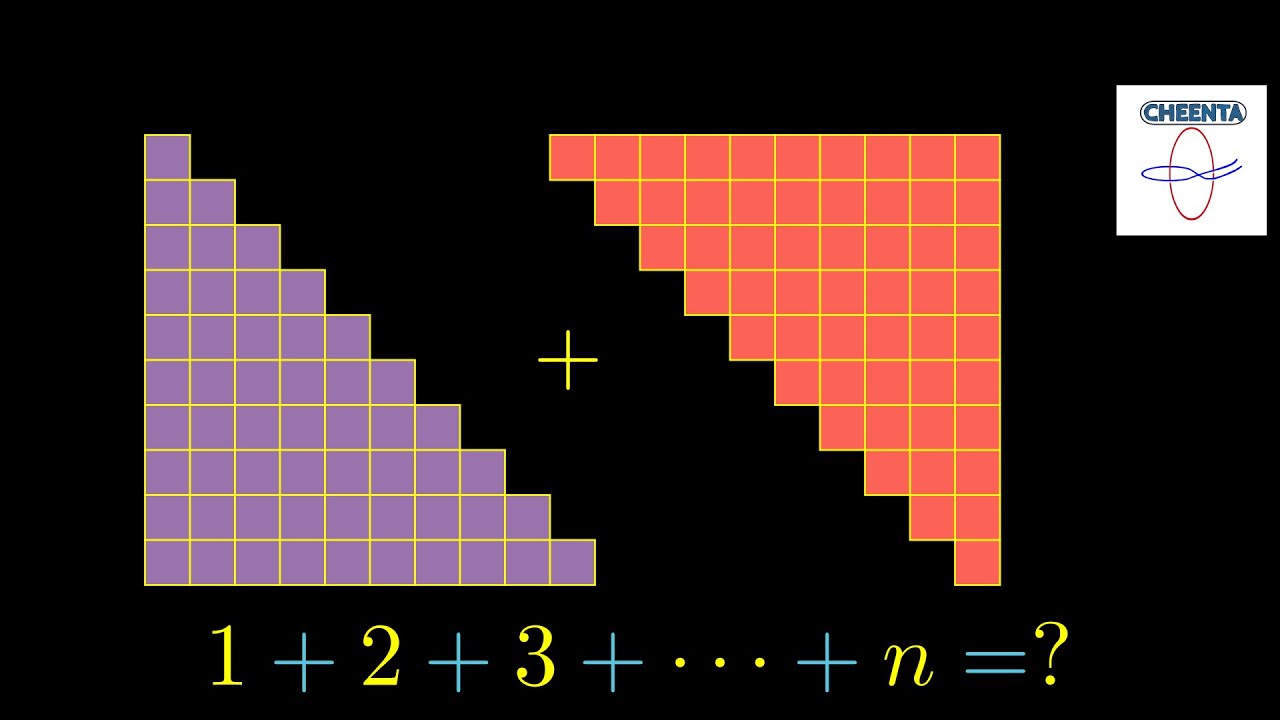
This video shows a visual way to proof the formula for computing the sum of first n natural numbers. This is based on calculating the area of rectangle and rearranging small unit squares.
So I hope you will enjoy the beauty of it.
#proof_without_words , #visual_proof , #sum_of_n_integers
Visit https://www.cheenta.com/ for Advanced Mathematics.
...
this video does a great job of it
you can maybe convince yourself with enough scribbling you could have landed at the same result
timber pebble
strange fractal
Now I understood the formula
there arent too many of these "standard" sums so you can pick them up quickly
strange fractal
True true
woven radishBOT
jan Niku
 timber pebble
classic
strange fractal
There is difference between finite and infinite series in geometry
I noticed that yesterday
devout snowBOT
@strange fractal Has your question been resolved?
devout snowBOT
Closed due to timeout
Use .reopen if this was a mistake.
Available help channel!
Send your question here to claim the channel.
Remember:
• Ask your math question in a clear, concise manner.
• Show your work, and if possible, explain where you are stuck.
• After 15 minutes, feel free to ping <@&286206848099549185>.
• Type the command .close to free the channel when you're done.
• Be polite and have a nice day!
Read #❓how-to-get-help for further information on how to ask a good question, and about conduct in the question channels.
 sleek hamlet
Hey guys I just need help with 7b
 devout snowBOT
sleek hamlet
Hey guys I just need help with 7b
supple knot
devout snowBOT
sleek hamlet
Hey guys I just need help with 7b
supple knot
,tex .point slope
woven radishBOT
dr. matlab plot
 sleek hamlet
What
supple knot
Slope is the same as gradient
sleek hamlet
So?
supple knot
woven radish
**dr. matlab plot**
Did you read this
sleek hamlet
Idk what it means
sleek hamlet
The part where m(x-a)+b
supple knot
Why is it confusing
m is slope
a is the x coordinate of some point
b is the y coordinate of that point
sleek hamlet
If a is the x coordinate what’s x
supple knot
x is a variable
supple knot
sleek hamlet
Hey guys I just need help with 7b
Same x in number 7
You just have numbers and variables for a, b, m
winter patrol
did you try rearranging the equation to slope intercept form?
devout snowBOT
@sleek hamlet Has your question been resolved?
sleek hamlet
winter patrol
did you try rearranging the equation to slope intercept form?
I tried
winter patrol
can you show your attempt
supple knot
sleek hamlet
you didn't multiply both sides by 12 correctly
$r + s = \frac{t}{12} \Ra 12(r+s) = t$
woven radishBOT
dr. matlab plot
 supple knot
what's 12(r+s) = ?
sleek hamlet
Ohh ok
sleek hamlet
Omg actually marry me bro thanks so much for ur help ❤️
devout snowBOT
@sleek hamlet Has your question been resolved?
Closed by @sleek hamlet
Use .reopen if this was a mistake.
Available help channel!
Send your question here to claim the channel.
Remember:
• Ask your math question in a clear, concise manner.
• Show your work, and if possible, explain where you are stuck.
• After 15 minutes, feel free to ping <@&286206848099549185>.
• Type the command .close to free the channel when you're done.
• Be polite and have a nice day!
Read #❓how-to-get-help for further information on how to ask a good question, and about conduct in the question channels.
 proper terrace
 devout snowBOT
proper terrace
proper terrace
devout snowBOT
proper terrace
proper terrace
im confused on what its trying to ask
 thin fern
It's probably because you unnecessarily wrote "a_n = "
 rustic jetty
It seems like you put $a_n$ before your answer, is that visual or did you actually do that?
woven radishBOT
Dork9399
 thin fern
restive river
Have a question
thin fern
restive river
Have a question
this channel is occupied
rustic jetty
!occupied
devout snowBOT
Someone else is already using this help channel. If you need help with a question, please open your own help channel/thread (see #❓how-to-get-help for instructions).
devout snowBOT
Closed by @proper terrace
Use .reopen if this was a mistake.
devout snowBOT
Available help channel!
Send your question here to claim the channel.
Remember:
• Ask your math question in a clear, concise manner.
• Show your work, and if possible, explain where you are stuck.
• After 15 minutes, feel free to ping <@&286206848099549185>.
• Type the command .close to free the channel when you're done.
• Be polite and have a nice day!
Read #❓how-to-get-help for further information on how to ask a good question, and about conduct in the question channels.
 south dust
I had a bonus question on my alg 2 H quiz and it was simply "x/3 = -9/x" I got "x= 3i√3" do you think this was right? what is did was got rid of the fractions by multiplying their denominators and ended up with x^2=-27 and i simplified using the square root method and got my answer. Did i mess up anywhere?
devout snowBOT
south dust
I had a bonus question on my alg 2 H quiz and it was simply "x/3 = -9/x" I got "...
south dust
to go more in-depth with my work
x/3=-9/x
multiply by 3/1 on both sides and get:
x= -27/x
multiply by x/1 on both sides and get:
x^2 = -27
square root both sides:
√-27 = i√27
√27/√9 = 3
√9 = 3 also
giving me:
x = 3i√3
does this make sense, did i go about it wrong?
no one is going to answer?
 tender cobalt
when you square root both sides you have a ±
so x^2 = -27 turns to x = ±√-27
from this, you should have x = ±3i√3
devout snowBOT
@south dust Has your question been resolved?
devout snowBOT
Closed due to timeout
Use .reopen if this was a mistake.
Available help channel!
Send your question here to claim the channel.
Remember:
• Ask your math question in a clear, concise manner.
• Show your work, and if possible, explain where you are stuck.
• After 15 minutes, feel free to ping <@&286206848099549185>.
• Type the command .close to free the channel when you're done.
• Be polite and have a nice day!
Read #❓how-to-get-help for further information on how to ask a good question, and about conduct in the question channels.
tender cobalt
the a0 z here looks like a typo - shouldnt it be a0 instead?
 devout snowBOT
tender cobalt
the a0 z here looks like a typo - shouldnt it be a0 instead?
devout snowBOT
tender cobalt
the a0 z here looks like a typo - shouldnt it be a0 instead?
@tender cobalt Has your question been resolved?
 dim turtle
na it’s fine
devout snowBOT
@tender cobalt Has your question been resolved?
supple knot
tender cobalt
the a0 z here looks like a typo - shouldnt it be a0 instead?
Yea it's fine. Why is this channel still open
devout snowBOT
Closed by @tender cobalt
Use .reopen if this was a mistake.
Available help channel!
Send your question here to claim the channel.
Remember:
• Ask your math question in a clear, concise manner.
• Show your work, and if possible, explain where you are stuck.
• After 15 minutes, feel free to ping <@&286206848099549185>.
• Type the command .close to free the channel when you're done.
• Be polite and have a nice day!
Read #❓how-to-get-help for further information on how to ask a good question, and about conduct in the question channels.
 pulsar tundra
 devout snowBOT
pulsar tundra
pulsar tundra
devout snowBOT
pulsar tundra
pulsar tundra
i'm stuck on this question, i found this work online, but i'm not sure why x² + x², and (2)(x) are square rooted
.close
devout snowBOT
Closed by @pulsar tundra
Use .reopen if this was a mistake.
devout snowBOT
Available help channel!
Send your question here to claim the channel.
Remember:
• Ask your math question in a clear, concise manner.
• Show your work, and if possible, explain where you are stuck.
• After 15 minutes, feel free to ping <@&286206848099549185>.
• Type the command .close to free the channel when you're done.
• Be polite and have a nice day!
Read #❓how-to-get-help for further information on how to ask a good question, and about conduct in the question channels.
 lean robin
 devout snowBOT
lean robin
winter patrol
devout snowBOT
lean robin
winter patrol
show work
 low nexus
i'm pretty sure your work is correct?
winter patrol
-7i + 8i isn't -i
devout snowBOT
Closed by @lean robin
Use .reopen if this was a mistake.
devout snowBOT
Available help channel!
Send your question here to claim the channel.
Remember:
• Ask your math question in a clear, concise manner.
• Show your work, and if possible, explain where you are stuck.
• After 15 minutes, feel free to ping <@&286206848099549185>.
• Type the command .close to free the channel when you're done.
• Be polite and have a nice day!
Read #❓how-to-get-help for further information on how to ask a good question, and about conduct in the question channels.
 magic sigil
someone help me pls.
devout snowBOT
magic sigil
someone help me pls.
woven radishBOT
charlie d amagiglio
 magic sigil
im trying ti find the beta values for this regression function
i found the values but when i do the system of equation and substitution to find B1, I'm not sure if im correct
woven radishBOT
charlie d amagiglio

charlie d amagiglio
Compile Error! Click the reaction for more information.
(You may edit your message to recompile.)
 devout snowBOT
Closed by @magic sigil
Use .reopen if this was a mistake.
Available help channel!
Send your question here to claim the channel.
Remember:
• Ask your math question in a clear, concise manner.
• Show your work, and if possible, explain where you are stuck.
• After 15 minutes, feel free to ping <@&286206848099549185>.
• Type the command .close to free the channel when you're done.
• Be polite and have a nice day!
Read #❓how-to-get-help for further information on how to ask a good question, and about conduct in the question channels.
 cerulean hollow
So if g(7) = 9 and f(9) = 16, then (f ∘ g)(7) =
I'm so confused, how do I do this?
devout snowBOT
cerulean hollow
So if g(7) = 9 and f(9) = 16, then (f ∘ g)(7) =
I'm so confused, how do I do t...
winter patrol
do you understand (f o g) function compostion notation
cerulean hollow
winter patrol
do you understand (f o g) function compostion notation
f o g is f(g(x)) no?
winter patrol
$(f \circ g)(x) = f(g(x))$
woven radishBOT
ℝαμΩℕωⅤ
 winter patrol
apply that here
cerulean hollow
wait, so what do I do after f(g(7))?
winter patrol
use the info given in the question
cerulean hollow
OHHHHH
I see
crazy how I missed that
since g(7) = 9, when its f(g(7)) that is f(9) which is 16 right? @winter patrol
winter patrol
yes
devout snowBOT
Closed by @cerulean hollow
Use .reopen if this was a mistake.
Available help channel!
Send your question here to claim the channel.
Remember:
• Ask your math question in a clear, concise manner.
• Show your work, and if possible, explain where you are stuck.
• After 15 minutes, feel free to ping <@&286206848099549185>.
• Type the command .close to free the channel when you're done.
• Be polite and have a nice day!
Read #❓how-to-get-help for further information on how to ask a good question, and about conduct in the question channels.
 hidden hinge
 devout snowBOT
hidden hinge
hidden hinge
devout snowBOT
hidden hinge
hidden hinge
Similarities is that they are all autonomous
 weak cove
should be easy to graph their direction fields then
hidden hinge
weak cove
should be easy to graph their direction fields then
ok
weak cove
which are going to be invariant under translation
hidden hinge
weak cove
which are going to be invariant under translation
invariant under translation in the 't' direction right?
weak cove
if that's what you want to call the independent variable sure
hidden hinge
 weak cove
mhm
hidden hinge
 hidden hinge
weak cove
should be easy to graph their direction fields then
hidden hinge
weak cove
should be easy to graph their direction fields then
how do i use these direction fields to answer the question/?
weak cove
well you don't want the whole direction field for the second part
you've desrcibed their similarities and differences from the direction fields in general
or atleast you know how to
right?
So moving on to part 2, each direction field, we plug in this initial value problem and we get just 1 solution curve, no longer an entire field of solution curves
which you can directly examine to answer that part of the question
hidden hinge
weak cove
So moving on to part 2, each direction field, we plug in this initial value prob...
yes thats true
weak cove
So do you understand how to proceed then?
hidden hinge
weak cove
So do you understand how to proceed then?
sorta, so im going to compare two lines
hidden hinge
and the lines go through the point (0,1) where (t,y)

How would i solve this problem without using the direction field? or is that what im supposed to do
weak cove
You no longer need the direction fields for the second part
y'=y^2
y(0)=1
is a diffeq you should be able to solve
there is one unique solution
likewise with the other two equations
hidden hinge
weak cove
is a diffeq you should be able to solve
its my first week in linear algebra
i actually don't know how to solve it
😅
weak cove
$$y'=y^2$$
$$\frac{dy}{dx}=y^2$$
woven radishBOT
Austin
 weak cove
If this doesn't help
this is called a seperable differential equation
so search a video on how to solve those if you don't recognize the name
they're very easy to solve
hidden hinge
ok
hidden hinge
to solve for c?
weak cove
and repeat for the other two equations
weak cove
hidden hinge
to solve for c?
yes
hidden hinge
ok will do ty
weak cove
No problem
devout snowBOT
Closed by @hidden hinge
Use .reopen if this was a mistake.
Available help channel!
Send your question here to claim the channel.
Remember:
• Ask your math question in a clear, concise manner.
• Show your work, and if possible, explain where you are stuck.
• After 15 minutes, feel free to ping <@&286206848099549185>.
• Type the command .close to free the channel when you're done.
• Be polite and have a nice day!
Read #❓how-to-get-help for further information on how to ask a good question, and about conduct in the question channels.
 sinful mango
Zinc has a density of 7.10 g/cm^3. If a cylinder of zinc weighing 36.2g is completely immersed in a graduated cylinder that originally contains 33.79 mL of water, what will be the new water level? Please and thank you for help.
 graceful ore


