#help-27
1 messages · Page 143 of 1
 mighty galleon
solve for 9?
mighty galleon
I mean at that point it is just plug in the data and simplify and you have your answer, that is also algebraically the same as this
 keen loom
Because i think were looking for a % of how much caffeine left our body
I did this and got (root2/4) which is .3535
Would my answer be 35% less ?
mighty galleon
35% remaining
mighty galleon
no problem
keen loom
.close
 devout snowBOT
Channel closed
Closed by @keen loom
Use .reopen if this was a mistake.
 Available help channel!
Send your question here to claim the channel.
Remember:
• Ask your math question in a clear, concise manner.
• Show your work, and if possible, explain where you are stuck.
• After 15 minutes, feel free to ping <@&286206848099549185>.
• Type the command .close to free the channel when you're done.
• Be polite and have a nice day!
Read #❓how-to-get-help for further information on how to ask a good question, and about conduct in the question channels.
 high sapphire
Forgot how to do long division, I was completely lost when my teacher tried explaining it
 devout snowBOT
high sapphire
Forgot how to do long division, I was completely lost when my teacher tried expl...
devout snowBOT
high sapphire
Forgot how to do long division, I was completely lost when my teacher tried expl...
 sly ocean
ok so for long division u would divide the first number first by x so what do u get
2x
then put that on the top
then multiply the 2x by the x and the 1 and u would subtract that by your 2x^2+4x
then repeat/bring down the rest in the divisionsign until u get no remainder and get a 0 at the end
devout snowBOT
@high sapphire Has your question been resolved?
 smoky eagle
useful video :
https://youtu.be/_FSXJmESFmQ?si=SR8NqmCfjTSuhUER
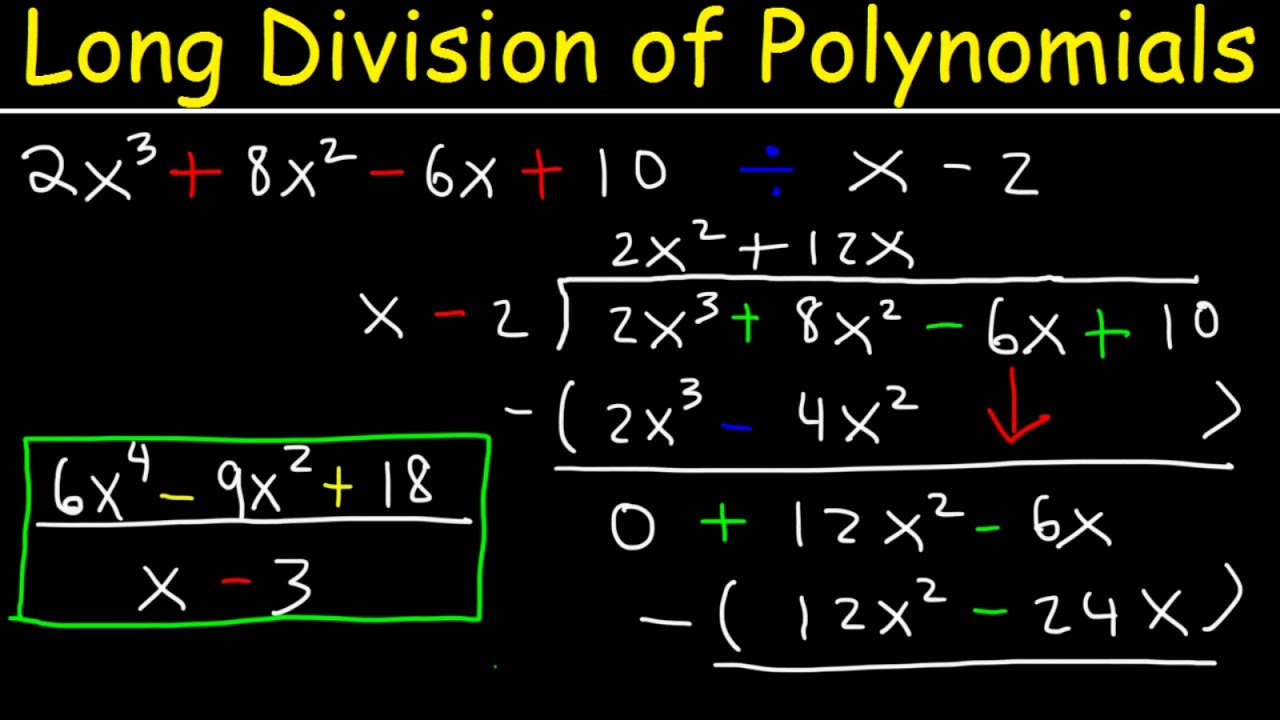
This video tutorial explains how to perform long division of polynomials with remainder and with missing terms.
Introduction to Polynomials: https://www.youtube.com/watch?v=Rxx4HepHI_E
Polynomials - Basic Operations: https://www.youtube.com/watch?v=ZvL9aDGNHqA
Dividing Polynomials By Monom...
devout snowBOT
Channel closed
Closed due to timeout
Use .reopen if this was a mistake.
Available help channel!
Send your question here to claim the channel.
Remember:
• Ask your math question in a clear, concise manner.
• Show your work, and if possible, explain where you are stuck.
• After 15 minutes, feel free to ping <@&286206848099549185>.
• Type the command .close to free the channel when you're done.
• Be polite and have a nice day!
Read #❓how-to-get-help for further information on how to ask a good question, and about conduct in the question channels.
 indigo moth
hey i need help with matrixs
devout snowBOT
indigo moth
hey i need help with matrixs
indigo moth

Im not sure how to evaluate them
or find coordinated from them
and the desmos matrix calculatior is so confusing
 jade oak
indigo moth
jade oak
indigo moth
first number is row, 2nd is column
indigo moth
jade oak
first number is row, 2nd is column
Oh my god
that makes so much sense
how would something like this work
 jade oak
indigo moth
how would something like this work
jade oak
indigo moth
how would something like this work
Subtract corresponding entries
When subtracting matrices they also need to be same size
 devout snowBOT
@indigo moth Has your question been resolved?
devout snowBOT
Channel closed
Closed due to timeout
Use .reopen if this was a mistake.
devout snowBOT
Available help channel!
Send your question here to claim the channel.
Remember:
• Ask your math question in a clear, concise manner.
• Show your work, and if possible, explain where you are stuck.
• After 15 minutes, feel free to ping <@&286206848099549185>.
• Type the command .close to free the channel when you're done.
• Be polite and have a nice day!
Read #❓how-to-get-help for further information on how to ask a good question, and about conduct in the question channels.
 scenic surge
How do u even do a question like this
 devout snowBOT
scenic surge
How do u even do a question like this
scenic surge
devout snowBOT
scenic surge
How do u even do a question like this
scenic surge
firstly, normal vector here would be
(2, 2, 2) right
and then I just plug in all of this into the proj_U(x) formula
what da hell im getting
0f_1 + 0f_2
 eager lodge
Show your work please

 woven radishBOT
 scenic surge
how would I do this then wth
eager lodge
Plug in x = [x,y,z]
scenic surge
do I just let x = [x, y, z] and solve
oh alr
so now im getting
(x-y)/2 * f_1 + (x+y-2z)/6 * f_2
eager lodge
Plug in f_1 and f_2
 eager lodge
Ya
Oh wait you want the matrix
It's probably better to plug in unit vectors for x
Well it's the same anyways
After adding plug in [1,0,0], [0,1,0] and [0,0,1] for [x,y,z]
scenic surge
eager lodge
Ya
 scenic surge
eager lodge
After adding plug in [1,0,0], [0,1,0] and [0,0,1] for [x,y,z]
scenic surge
eager lodge
After adding plug in [1,0,0], [0,1,0] and [0,0,1] for [x,y,z]
wym
so like for the first one jt would be 4/6?
eager lodge
Yes
eager lodge
No
scenic surge
oh
eager lodge
For each unit vector you plug in you should get a vector back
scenic surge
so for [1, 0, 0] I will get
[4/6, 0, 0]?
eager lodge
No
eager lodge
4/6 -2/6 -2/6
scenic surge
oh and then after doing that
eager lodge
Do that for all unit vectors
eager lodge
Exactly
eager lodge
Sure
scenic surge
eager lodge
Sure

A) is true right
because 4 basic solution means
4 pivots
which mean im(A) will have 4 basis?
so 4 dimension
scenic surge
eager lodge
What's basic solution

 wheat pawn
variable != solution
scenic surge
oh fuck i was lookin at the wrong thing this whole time
scenic surge
wheat pawn
variable != solution
wait so its false?
wheat pawn
i did not say that
scenic surge
so if it has 4 basic solutions that means it has 4 free variables which means we have 3 pivot column
wheat pawn
but im not familiar either with the concept of basic solution
scenic surge
so the dimension will be 3
let me show you an example
for a matrix like this, the basic solution is


Just seen on stackoverflow that " number of free parameters will be the number of basic solutions to the system."
wheat pawn
so the degrees of freedom?
scenic surge
amount of free variables ye
devout snowBOT
@scenic surge Has your question been resolved?
Channel closed
Closed by @scenic surge
Use .reopen if this was a mistake.
Available help channel!
Send your question here to claim the channel.
Remember:
• Ask your math question in a clear, concise manner.
• Show your work, and if possible, explain where you are stuck.
• After 15 minutes, feel free to ping <@&286206848099549185>.
• Type the command .close to free the channel when you're done.
• Be polite and have a nice day!
Read #❓how-to-get-help for further information on how to ask a good question, and about conduct in the question channels.
 thin steppe
I used the compound formula tho gotta prove with t formula
 thin steppe
if i sub the 1/2x with the t formula its just really messy
devout snowBOT
@thin steppe Has your question been resolved?
 opal cloak
much simpler than you thin
k
lets expand out the first sum of angles
tan(x/2+pi/4) = [tan(x/2)+tan(pi/4)] / [1-tan(x/2)tan(pi/4)]
thin steppe
yes
opal cloak
thin steppe
yes
sorry internet died
whipped up in paint

then just do the same with tan(x/2-pi/4) and once u add them u should get 2tanx
thin steppe
oh thanks 😅 I overcomplicated it a lot haha
opal cloak
thin steppe
and thenn its 4t / 1-t^2 right
correct, pull out a factor of 2 from the numerator then u have 2 lots of the tan formula
thin steppe
opal cloak
correct, pull out a factor of 2 from the numerator then u have 2 lots of the tan...
wait how is it 2tanx then? isnt it just tanx because tan(0.5x) = 2t / 1-t^2
opal cloak
 thin steppe
opal cloak
thin steppe
opal cloak
i thought its tan (0.5x) is that because in the previous image t = tan 1/2x
opal cloak
tan x/2 = t, but tan x = 2t/1-t^2
thin steppe
OH
bruh
this whoel time
i had them mixed
im getitng mixed with the t formulae and the actual t
😭
opal cloak
all good
thin steppe
conceptually im not very gud 💀
opal cloak
you'll get better with practice dw
devout snowBOT
Channel closed
Closed by @thin steppe
Use .reopen if this was a mistake.
opal cloak
thin steppe
thank you again 😄
all good
devout snowBOT
Available help channel!
Send your question here to claim the channel.
Remember:
• Ask your math question in a clear, concise manner.
• Show your work, and if possible, explain where you are stuck.
• After 15 minutes, feel free to ping <@&286206848099549185>.
• Type the command .close to free the channel when you're done.
• Be polite and have a nice day!
Read #❓how-to-get-help for further information on how to ask a good question, and about conduct in the question channels.
 warm gazelle
i've got taylors theorm, how can we obtain the Lagrange's and Rolle's theories?
devout snowBOT
warm gazelle
i've got taylors theorm, how can we obtain the Lagrange's and Rolle's theories?
warm gazelle
i understand taylors theory as "creating a similar graph, in small domain, that you can use for approximations"
is this reasoning correct?
ofc a polynomial function
And Rolles theory as "if f(a)=f(b) on <a, b> as domain we can say that there exists a point c, where f'(c)=0"
But how would they be connected?
devout snowBOT
@warm gazelle Has your question been resolved?
 supple knot
warm gazelle
i've got taylors theorm, how can we obtain the Lagrange's and Rolle's theories?
supple knot
warm gazelle
i've got taylors theorm, how can we obtain the Lagrange's and Rolle's theories?
What do you mean obtain
You can prove Rolle's theorem without Taylor's theorem
warm gazelle
Well I was told that you can get Rolles theory from taylors
devout snowBOT
@warm gazelle Has your question been resolved?
devout snowBOT
Channel closed
Closed due to timeout
Use .reopen if this was a mistake.
Available help channel!
Send your question here to claim the channel.
Remember:
• Ask your math question in a clear, concise manner.
• Show your work, and if possible, explain where you are stuck.
• After 15 minutes, feel free to ping <@&286206848099549185>.
• Type the command .close to free the channel when you're done.
• Be polite and have a nice day!
Read #❓how-to-get-help for further information on how to ask a good question, and about conduct in the question channels.
 valid iron
i guese
 wooden cairn
i dont really undertsand this one
valid iron
cosh x type of graph
devout snowBOT
Channel closed
Closed by @wooden cairn
Use .reopen if this was a mistake.
devout snowBOT
Available help channel!
Send your question here to claim the channel.
Remember:
• Ask your math question in a clear, concise manner.
• Show your work, and if possible, explain where you are stuck.
• After 15 minutes, feel free to ping <@&286206848099549185>.
• Type the command .close to free the channel when you're done.
• Be polite and have a nice day!
Read #❓how-to-get-help for further information on how to ask a good question, and about conduct in the question channels.
 molten spindle
am i allowed to apply inverse sine to both side to get rid of sin?

 rich summit
not really, if you have $sin(a) = sin(b)$, then either $a = b + 2\pi \cdot k$ or $a = \pi - b + 2\pi \cdot k$
woven radishBOT
Jelle
 devout snowBOT
@molten spindle Has your question been resolved?
devout snowBOT
Channel closed
Closed due to timeout
Use .reopen if this was a mistake.
Available help channel!
Send your question here to claim the channel.
Remember:
• Ask your math question in a clear, concise manner.
• Show your work, and if possible, explain where you are stuck.
• After 15 minutes, feel free to ping <@&286206848099549185>.
• Type the command .close to free the channel when you're done.
• Be polite and have a nice day!
Read #❓how-to-get-help for further information on how to ask a good question, and about conduct in the question channels.
 rustic scarab
Hello, how to solve that without l'hospital?
 devout snowBOT
rustic scarab
Hello, how to solve that without l'hospital?
devout snowBOT
rustic scarab
Hello, how to solve that without l'hospital?

 devout snowBOT
@rustic scarab Has your question been resolved?
rustic scarab
<@&286206848099549185>
devout snowBOT
@rustic scarab Has your question been resolved?
devout snowBOT
Channel closed
Closed due to timeout
Use .reopen if this was a mistake.
Available help channel!
Send your question here to claim the channel.
Remember:
• Ask your math question in a clear, concise manner.
• Show your work, and if possible, explain where you are stuck.
• After 15 minutes, feel free to ping <@&286206848099549185>.
• Type the command .close to free the channel when you're done.
• Be polite and have a nice day!
Read #❓how-to-get-help for further information on how to ask a good question, and about conduct in the question channels.
 restive river
 devout snowBOT
restive river
restive river
devout snowBOT
restive river
restive river
please help on part e
my answers are different then my teachers and I dont know if he made an error or me
 strange nimbus
OK, so you have a graph of the derivative, and it's a piecewise function.
So, write down the piecewise function.
What do you get for the first part where it's going up?
 violet wind
What answers
 restive river
strange nimbus
OK, so you have a graph of the derivative, and it's a piecewise function.
restive river
strange nimbus
OK, so you have a graph of the derivative, and it's a piecewise function.
what
sorry
strange nimbus
Well, it has a graph of the derivative "f'(x)".
And it's a piecewise function, where the graphed function kind of changes to another one a few times.
Like, at first, it's going up linearly. Then, it starts going down linearly. Then, it starts going up linearly.
Does that make sense so far?
restive river
2/1
restive river
2/1x-4
restive river
2x^2/2 - 4x
restive river
-3?
strange nimbus
No, you were right before.
restive river
3
strange nimbus
f(0) = 3 = 0^2 - 4(0) + C
3 = C
So, now you know f(x) for x from 0 to 3.
So, you can get f(2) and f(3) from that, which you have correct.
So, let's look at the second piece, where it's going down.
What's the equation for the line there?
restive river
-2x
strange nimbus
OK, what's the y intercept?
restive river
2?
strange nimbus
No, if you extend the line to the left, it goes up and up.
So, it should be higher than 2.
y intercept is which y value it hits at the y axis.
strange nimbus
Well, you can do point-intercept form.
restive river
ok
restive river
(y-y1)=m(x-x1)
strange nimbus
Yes, you can use any point on that line.
strange nimbus
No problem.
restive river
oh sorry
strange nimbus
So, it should be y = -2x + 6 + 2.
restive river
yes
restive river
-2x^2/2 + 8x
strange nimbus
So, you had f(3) = 0 and f(x) = -x^2 + 8x + C.
Oh, you're doing OK.
So, f(3) = 0 = -(3)^2 + 8(3) + C.
So, what's C?
strange nimbus
No, how did you get that?
restive river
oh sorry 33
strange nimbus
It seems like you did 3^2 + 8(3).
But -3^2 is -9.
So, you have 0 = -9 + 24 + C.
strange nimbus
From PEMDAS, you have exponents before multiplication.
And - in front is like multiplying by -1.
So, you do the squaring before the negating.
Also, if you had it (-3)(-3), then you couldn't say negative of the square.
Because if you do -3^2, that would be 9.
If you do 3^2, that would be 9.
But how do you get -9?
Like if you want to subtract 3^2 or something.
You'd write -3^2 to subtract 9.
But it's that PEMDAS thing that tells why.
restive river
strange nimbus
And - in front is like multiplying by -1.
whaa
restive river
strange nimbus
Well, -x = -1 times x.
ok i guess
strange nimbus
PEMDAS has exponents before multiplication.
So, you do the 3^2.
Then you multiply that by -1.
strange nimbus
OK, so you have 0 = -9 + 24 + C.
restive river
15
restive river
because you move it to the other side?
strange nimbus
You have to take the numeric constants to the other side, which gives their negative.
Right.
restive river
ok yes
strange nimbus
So, the first part is f(x) = x^2 + 4x + 3 from before. Now the second part is f(x) = -x^2 + 8x - 15.
And it looks like your answers are correct with that.
strange nimbus
Like f(5) = -5^2 + 8(5) - 15 = -25 + 40 - 15 = 0.
So, now we do the last part.
We use point-slope form.
restive river
ok
strange nimbus
(5, -2) with a slope of 2.
Or some other point on that line.
What do you get for the point-slope form?
restive river
2x-12
strange nimbus
Good, so integrate that.
strange nimbus
OK, so x^2 - 12x + C.
Now, we use a point that we know, x = 5.
f(5) = 0 = (5)^2 - 12(5) + C.
So, what's C?
restive river
35
restive river
ok so now we would plug in 6 i think
strange nimbus
So, the three parts are:
From x = 0 to x = 3, f(x) = x^2 - 4x + 3
From x = 3 to x = 5, f(x) = -x^2 + 8x - 15
From x = 5 to x = 8, f(x) = x^2 - 12x + 35
restive river
oh ok
and then we plug in the numbers
to those to get the answers?
so like if i want to find 6 i would pick the corresponding equation and plug 6 in ?
strange nimbus
So, the basic idea is that you get the line expression, integrate it, find out C by using an x value you know f(x) for, and then you have a formula for that part.
Yes, that's right.

 strange nimbus
f(8) = 8^2 - 12(8) + 35 = 64 - 96 + 35 = 3
If you have time before your final, see if you can ask them.
restive river
 strange nimbus
Let me try one other thing.
strange nimbus
restive river
are my teachers answers wrong?
I think so, but I'm trying to check.
devout snowBOT
@restive river Has your question been resolved?
strange nimbus
restive river
are my teachers answers wrong?
You were correct:
 strange nimbus
You're welcome.
devout snowBOT
@restive river Has your question been resolved?
restive river

im not really sure how to do part c
for a i said its increasing on (2,4) U (6,8) and decreasing on (0,2)U(4,6)
for part b I said x=2 was a local minimum because the slope was negative before it and positive after it
4 is a local max because the slope was positive before it and negative after
6 was a local minimum since the slope was negative before and positive after
but I'm not sure how to find C
strange nimbus
Concavity and inflection points are about the second derivative.
restive river
ah i see now
restive river
strange nimbus
Concavity and inflection points are about the second derivative.
should i write it in interval notation
or no
from 0,3 it should be concave up
and also 5,8
or is it 5 to infinity
sorry i meant 0,3
strange nimbus
You should take the derivative of the graphed function.
restive river
(0,3)U(5,8)
strange nimbus
It's 2, then -2, then 2.
restive river
concave down on 3,5
strange nimbus
Concave up is when it's positive. Concave down is when it's negative. Inflection points are when it's zero.
restive river
ohhh
ok ok
i mena
is there a point when its 0 on here

3
3,5?
i wanna say but they are sharp
strange nimbus

You're right that it's concave down in (3, 5).
And (0, 3) u (5, 8) is concave up.
strange nimbus
restive river
is there a point when its 0 on here
It's 0 on the second derivative to be an inflection point. That's the first derivative.
The slope for each part of the first derivative is not zero, so the second derivative can't be zero.
strange nimbus
You're welcome.
restive river
but how do you find the original graph based on the derivative?
how do u sketch it i mean

i already did part d and e with you
but
im just not super sure
about f
im sorry i have to use the bathroom
ill be back
strange nimbus
OK.
There are two ways you can do f. One is to use the piecewise function we found for part e and graph that.
Another is to mark all of the points listed in the answer to e and then to use the critical points to find maxima and minima and inflection point x values.
Since there are no inflection points, they'll be local minima and maxima.
restive river
strange nimbus
There are two ways you can do f. One is to use the piecewise function we found f...
ohhhh
bruh
wait we can jsut graph that
strange nimbus
I think they want you to use the second method, though.
strange nimbus
You're welcome.
restive river
strange nimbus
You're welcome.
i have a questio
quesiton
what would be the global minimum?
the global maximum i believe would be 4

on the interval 0,8
 strange nimbus
Why do you think it's 4?
restive river
because it has the highest y value?
strange nimbus
What x value has f(x) = 4?
strange nimbus
Maybe.
strange nimbus
strange nimbus
So, the three parts are:
From x = 0 to x = 3, f(x) = x^2 - 4x + 3
From x = 3 to...
Here's the piecewise function ^
strange nimbus
Yes.
strange nimbus
You just need to check the extreme points and the endpoints.
The first derivative is 0 at x = 2, x = 4, and x = 6.
And then the endpoints are at x = 0 and x = 8.
So, you just look those up and find the highest and lowest.
restive river
yes
but
because 2 and 6 are at the same y value
which would be the global minimum?
strange nimbus
They both are.
The minimum is just the y value.
So, the lowest y value you can get is -1.
Even though it happens more than once.
strange nimbus
Right.
strange nimbus
Oh, not 1.
restive river
i thought u would write the x values assosciated with them
strange nimbus
You have to check the endpoints as well.
restive river
strange nimbus
You have to check the endpoints as well.
is that correct?
strange nimbus
Yes, 3 is correct.
restive river
should i check for 7
strange nimbus
The endpoints and the critical points.
The endpoints are x = 0 and 8, and the critical points are when the first derivative in that graph is zero.
So, x = 2, 4, and 6.
restive river
oh ok
strange nimbus
So, you just check x = 0, 2, 4, 6, 8.
restive river
oh so thats what critical points are
strange nimbus
Yeah, it's when the derivative doesn't exist or it's zero.
restive river
i see
so like i heard the derivative doesnt exist on sharp curves
or something like taht
maybe it was something else
strange nimbus
Yeah, if you have a sudden change in the slope, the first derivative won't exist where it changes.
Or if you have a discontinuity or something like that.
strange nimbus
You're welcome.
restive river
god bless you
devout snowBOT
@restive river Has your question been resolved?
devout snowBOT
Channel closed
Closed due to timeout
Use .reopen if this was a mistake.
Available help channel!
Send your question here to claim the channel.
Remember:
• Ask your math question in a clear, concise manner.
• Show your work, and if possible, explain where you are stuck.
• After 15 minutes, feel free to ping <@&286206848099549185>.
• Type the command .close to free the channel when you're done.
• Be polite and have a nice day!
Read #❓how-to-get-help for further information on how to ask a good question, and about conduct in the question channels.
 tired junco
 devout snowBOT
tired junco
tired junco
devout snowBOT
tired junco
tired junco
"Write the function F for the following circuit. Can you replace the circuit with one gate? Show which gate?"
I'm just not sure how to even perceive this question
devout snowBOT
@tired junco Has your question been resolved?
devout snowBOT
Channel closed
Closed due to timeout
Use .reopen if this was a mistake.
Available help channel!
Send your question here to claim the channel.
Remember:
• Ask your math question in a clear, concise manner.
• Show your work, and if possible, explain where you are stuck.
• After 15 minutes, feel free to ping <@&286206848099549185>.
• Type the command .close to free the channel when you're done.
• Be polite and have a nice day!
Read #❓how-to-get-help for further information on how to ask a good question, and about conduct in the question channels.
 red quartz
 devout snowBOT
red quartz
red quartz
devout snowBOT
red quartz
red quartz
this is just setting the denomiator to 0 right?
so v.a x=-3
or would the numerator have something
 crisp niche
you have to calculate the limit of the given funciton at x = -3
crisp niche
and if, this limit wil be infinite, then th vertical asymptoo exists
but if not, then no such asymptooe
ah i see
so check if
-3 is a zero of the denominator
and also nominator
if -3 is a zero of the nominator then factor the nominator
red quartz
(x+3)(x-8)
crisp niche
and you get x - 8, so you can say: there are no vertical asympototes
red quartz
oh ok
crisp niche
in you rprogramme, the vertiacl asymptote exists
if a zero of the denominator is not a zero of the nominator
and that was not yoru case
crisp niche
yw
red quartz
.close
devout snowBOT
Channel closed
Closed by @red quartz
Use .reopen if this was a mistake.
Available help channel!
Send your question here to claim the channel.
Remember:
• Ask your math question in a clear, concise manner.
• Show your work, and if possible, explain where you are stuck.
• After 15 minutes, feel free to ping <@&286206848099549185>.
• Type the command .close to free the channel when you're done.
• Be polite and have a nice day!
Read #❓how-to-get-help for further information on how to ask a good question, and about conduct in the question channels.
 misty crest
i understand that the convergence of a series is not affected by the removal of a finite number of terms but how does this affect the sum surely it would change the sum
devout snowBOT
misty crest
i understand that the convergence of a series is not affected by the removal of ...
misty crest
how would i calculate the new sum
let’s say u had a geometric sequence
the new formula wouldn’t stay the same would it if u started at n=4 compared to n=0
would i subtract off the first 3 terms?
from the infinite sum
that would make sense
supple knot
If you have an actual problem, just show it

 ocean silo
just try re-indexing the series
misty crest
like n-4?
ocean silo
you want to bring the n down by 4, so all your n terms go up by 4
misty crest
then rewrite it as (1/2)^-4
ocean silo
misty crest
like n-4?
it's not this
misty crest
so how would i do that
ocean silo
as I just stated
you want the index of your series to decrease by 4 so every n term in your series must increase by 4
because when you start at n = 0, you'll have (1/2)^4 which is the same as the previous index
ocean silo
yes
devout snowBOT
Channel closed
Closed by @misty crest
Use .reopen if this was a mistake.
devout snowBOT
Available help channel!
Send your question here to claim the channel.
Remember:
• Ask your math question in a clear, concise manner.
• Show your work, and if possible, explain where you are stuck.
• After 15 minutes, feel free to ping <@&286206848099549185>.
• Type the command .close to free the channel when you're done.
• Be polite and have a nice day!
Read #❓how-to-get-help for further information on how to ask a good question, and about conduct in the question channels.
 hexed willow
"Perform the indicated operations. Give your answer in simplest form."
 devout snowBOT
hexed willow
"Perform the indicated operations. Give your answer in simplest form."
hexed willow
devout snowBOT
hexed willow
"Perform the indicated operations. Give your answer in simplest form."
hexed willow
I forgot how to do this what are the steps?
 mortal sky
hexed willow
I forgot how to do this what are the steps?
mortal sky
hexed willow
I forgot how to do this what are the steps?
You can multiple and divide by the conjugate of the denominator
devout snowBOT
@hexed willow Has your question been resolved?
Channel closed
Closed by @hexed willow
Use .reopen if this was a mistake.
devout snowBOT
Available help channel!
Send your question here to claim the channel.
Remember:
• Ask your math question in a clear, concise manner.
• Show your work, and if possible, explain where you are stuck.
• After 15 minutes, feel free to ping <@&286206848099549185>.
• Type the command .close to free the channel when you're done.
• Be polite and have a nice day!
Read #❓how-to-get-help for further information on how to ask a good question, and about conduct in the question channels.
 molten grotto
How do i calculate the derivative of cos x?
I have a function
1
cos x
devout snowBOT
molten grotto
How do i calculate the derivative of cos x?
I have a function
1
------
cos...
molten grotto
I uhh genuinely have no clue how to go about this 😅
 wraith horizon
do you know the trig derivatives?
molten grotto
Not at all
wraith horizon
I'm not sure if they are reasonable to actually...work out
they've always just been given
but d/dx of sin(x) is cos(x) and d/dx of cos(x) is -sin(x)
tan, csc, sec, cot can be worked out through chain/product/quotient rules
'Both derivatives can be derived using Euler's complex representation of sine and cosine'
molten grotto
Oh god this Euler guy is ruining all of math 
wraith horizon
...okay yeah doing it via euler identities makes sense but this is the first I've seen it. it was always just a given (sin and cos) and the rest fall easily after that
cos(x)= 1/2(e^ix + e^-ix)
sin(x) = i/2(e^ix - ie^-ix)
and go from there. yuck
molten grotto
What uh .. what the hell does this mean 
I'm so sorry I'm terrible at math i don't understand anything
wraith horizon
yeah I'm 90% sure that you've just been told that the derivative of cos is -sin and the derivative of sin is cos
molten grotto
oh then i don't really need to know any more i don't think, are you available for more of my questions btw?
wraith horizon
sure, or there's no shortage of other helpers
 acoustic leaf
wraith horizon
cos(x)= 1/2(e^ix + e^-ix)
sin(x) = i/2(e^ix - ie^-ix)
and go from there. yuck
acoustic leaf
wraith horizon
cos(x)= 1/2(e^ix + e^-ix)
sin(x) = i/2(e^ix - ie^-ix)
and go from there. yuck
you don't necessarily have to use euler identities, you can derive it from the limit definition using angle sum formula + the sin(x)/x limit, still pretty nasty though
molten grotto
wraith horizon
sure, or there's no shortage of other helpers
i got a test tomorrow and realized there's been a lot i'm lacking in 😅
wraith horizon
acoustic leaf
you don't necessarily have to use euler identities, you can derive it from the l...
that's...even worse
molten grotto
Specifically logarithms and that man EULER and his damn number
i'll take an example of what type of questions i don't really understand,
2ˣ * 3x = f(x)
they want me to find the derivative of this
I don't know how I would get the "x" out of the exponent thingy place
pretty sure i could take logarithms but i have no clue how they work, i think it was smth like lg base 2 of x = ???
wraith horizon
Chain rule
Or rather, first rewriter with e
2^x = e^xln2
Then you can chain rule it
molten grotto
wait so
eˣˡⁿ² ?? My god that is.. a weird exponent
wraith horizon
2 = e^ln2
molten grotto
god this euler guy is making me wanna drop out 💀
but it's fine, I'm sure i'll find myself dumb once i understand it
ln is the opposite to e^x right?
wraith horizon
Ln is log base e
Sorry I've got to cycle home from work. If someone else picks up please feel free or I can try to explain more in 15 or so
molten grotto
ty legend, i'll be here for a while i reckon
final-day stress
I got another practice question given to me, it says;
"decide the tangent for y = xe²ˣ in the point where x = 1"
I would assume it's just, first to take the derivative of this entire thing before placing in any value for x, so 2xe²ˣ right?
then place iin the value x = 1
2e²
is this correct?
wraith horizon
Find F' and plyg in x=1 yeah
molten grotto
well derivative of e^kx = ke^kx
molten grotto
molten grotto
2e²
so this is the only logical solution i can reach
wraith horizon
Yup sounds right
molten grotto
awesome! Also ily for helping me 
either way, i got so many questions that will make you wanna shoot me perhaps just as much as yourself
to find derivative of 3e^x^2 i do ???
Is there anything else to solve here..?
Do I take 3(ln x^2)
I don't really know how i'd.. take the derivative of that
even if that's right, how do i take the derivative of all that?
wheat pawn
were you not given a list of rules for the immediate derivatives?
molten grotto
i was given a list of rules, i have a calculator with me though

these are the derivative rules i have
wheat pawn
you were not given the chain rule
molten grotto
there's more pages to it, but most of it is geometry and trigonometry, is that relevant to this ?
wheat pawn
 molten grotto
what uhh .. what the hell does this even mean? 😭😭
is this a function within a function?
wheat pawn
molten grotto
there's more pages to it, but most of it is geometry and trigonometry, is that r...
there should be the rule of addition, product, quotient, and chain at the very least
$f(x) = 3e^{x^{2}}$
woven radishBOT
LordFelix
 wheat pawn
let's divide it in parts
the derivative of a number times a function is the number times the derivative of the function
$f'(x) = [3e^{x^{2}}]' = 3 [e^{x^{2}}]'$
woven radishBOT
LordFelix
 molten grotto
meaning, i can take out the constant (3) in this case?
wheat pawn
correct
molten grotto
and just think about it later right
woven radishBOT
LordFelix
 woven radishBOT
LordFelix
 wheat pawn
if y is a function of x, and you're deriving with respect to x, you have:
$[e^y]'=e^y\cdot y'$
woven radishBOT
LordFelix
 wheat pawn
this is the chain rule
molten grotto
I don't get it, how are these the same?
e^y' is equal to e^y' is it not ?? this isn't a constant we have or anything
so how can e^y * y' = e^y'
wheat pawn

the derivative of the elemental exponential function it's itself (it's literally defined so that property holds)
molten grotto
yeah, that's the part that makes me not understand that.
if e^x' (in this case e^y) is equal to itself, how can e^x * y' be the same??
wheat pawn
remember that i said that in the first case i was differentiating with respect to y, and on the second, with respect to x
on your list of rules, you're always differentiating with respect to x
wraith horizon
(maybe if you write the second as $e^{f(x)}$ it'll be clearer?)
woven radishBOT
PrettyPrincessKitty FS
 wheat pawn
maybe
molten grotto
this is all getting more and more confusing am i a dumbass
wheat pawn
honestly? that table of derivative rules is pretty bad
it's mixed with integrals, it has the elemental functions on different sections, and even doesnt have together all the rules
molten grotto
unfortunately it's the one i got, idk what i'd do about it.
It's possible there are more in the formula book, I assume most of them are there. But this is the one I can bring with me to the exam.
I'd like to say that questions like this won't show up because of that, unfortunately I know that is not the case.
wraith horizon
$$\frac{d(e^x)}{dx} = e^x$$
$$\frac{d(e^{f(x)})}{dx} = \frac{d(e^{f(x)})}{dx} * \frac{d(f(x))}{dx} = e^{f(x)}f'(x)$$
molten grotto
He specifically mentioned that those NEED to be solved
wraith horizon
wow I messed that uphuh
wheat pawn
molten grotto
I'd like to say that questions like this won't show up because of that, unfortun...
you should never trust on what "won't show up".
You need to learn how to do any problem at your current level
most of the time the "hard" problems are not harder, they are simply longer
molten grotto
yea but issue is i just found out i gotta know all this, and the exam's tomorrow
so to me this logarithm stuff and anything to do with euler is messin me up
wheat pawn
now, quick google:


the first two images are mandatory.
Dont bother with the third for now
wraith horizon
there we go
woven radishBOT
PrettyPrincessKitty FS
 molten grotto
i don't even understand the
dy
dx
notation of derivatives 😭
i'm so sorry but all i got told was that this was a different way to write
f'(x)
wraith horizon
nope I forgot to pull the derivate down
wraith horizon
molten grotto
i don't even understand the
dy
--
dx
notation of derivatives 😭
i'm so sorry b...
yeah that is true
if y = f(x), then f'(x) = dy/dx
but you can also do e.g. d(f(x))/dx
wheat pawn
molten grotto
i don't even understand the
dy
--
dx
notation of derivatives 😭
i'm so sorry b...
the apostrophe is used when the variable that you're differentiating with respect to is "obvious"
wraith horizon
or d(e^x)/dx
wheat pawn
in your case, since you're always differentiating with respect to x, it's "obvious" that is your variable
if you want to be explicit, you can write it as:
$\frac{d}{dx}(whatever) = (whatever)'$
molten grotto
wraith horizon
or d(e^x)/dx
but what is d(e^x) and what is dx ? Derivative of e^x ?? that's just e^x, derivative of x?? No clue, just, 1 right?
wheat pawn
which means you're differentiating (whatever) with respect to x
wraith horizon
molten grotto
but what is d(e^x) and what is dx ? Derivative of e^x ?? that's just e^x, deriva...
don't think of (yet) dy/dx, d/dx, df/dx, whatever as a fraction
woven radishBOT
LordFelix
 wraith horizon
think of it just as f'(x)
wheat pawn
it's basically a more explicit way of writing it
molten grotto
woven radish
**LordFelix**
So if i see d/dx or dy/dx on a formula-page, i should just assume derivative and nothing else
wheat pawn
woven radish
**PrettyPrincessKitty FS**
you need to fix the first fraction here on the rhs. Denominator should be f(x)
molten grotto
then what is.. d(f(x)/dx or whatever
wraith horizon
$\frac{d(e^x)}{dx}$ is the same as when $f(x) = e^x$ find $f'(x)$
wheat pawn
molten grotto
So if i see d/dx or dy/dx on a formula-page, i should just assume derivative and...
d/dx means "derivative of with respect to x"
dy/dx means "derivative of y with respect to x"
woven radishBOT
PrettyPrincessKitty FS
 wraith horizon
and for completeness, you have $\frac{dy}{dx} = when y=f(x), f'(x)$
woven radishBOT
PrettyPrincessKitty FS
 molten grotto
what the hell do i just have a completely wrong view of derivatives as a whole? I just saw it as drawing a funny lil tangent mathematically, what does it mean to derive something with respect to something else
wheat pawn
the funny lil tangent is how you define it geometrically
wraith horizon
"with respect" means that you're changing that value
you're drawing the tangent whilst changing x
wheat pawn
these lists are how you define it analytically
(well, the simplification of defining it analytically)
molten grotto
it feels really weird not being given these rules at all 😭
am i just expected to fail ??
molten grotto
 wraith horizon
you threw far too many lists at the poor guy lol


 wheat pawn
molten grotto
https://cdn.discordapp.com/attachments/903486480075354182/1184162275242807306/im...
wheat pawn
molten grotto
https://cdn.discordapp.com/attachments/903486480075354182/1184162275242807306/im...
start with the basics, this one
wraith horizon
you need to learn the derivative of:
x^n
e^x
f(g(x)) - chain rule
f(x)g(x) - product rule
sinx
cosx
the rest you can work out
wheat pawn
i'm gonna go one by one on that list
1st, constant rule: the derivative of a constant is 0.
example: f(x) = 3; f'(x) = 0
2nd, constant multiple rule: The derivative of (constant)*(function) is equal to (constant)*(derivative of function)
example: [3 f(x)]' = 3*f'(x)
molten grotto
wheat pawn
1st, constant rule: the derivative of a constant is 0.
example: f(x) = 3; f'(x) ...
yeah i had to prove this with the derivates definition yesterday, it was something like. I'm not remembering it correctly but i think this gets the point across.
k +f(x+h) - k + f(x)
h
with no variable, we just cross out the opposite constants (k) , with no function we only have h.
** **h
** **- = 1, right?
** **h
wheat pawn
4th: sum rule. The derivative of a sum is the sum of derivatives
wraith horizon
molten grotto
yeah i had to prove this with the derivates definition yesterday, it was somethi...
yes
wheat pawn
molten grotto
yeah i had to prove this with the derivates definition yesterday, it was somethi...
That's if you go by definition of the derivative, which is defined as a limit
all of these rules in the list are the results of actually computing the limit of the definition
(and many are exceedingly annoying to do by definition, that's why you learn the rule in the list)
wheat pawn
molten grotto
yeah i had to prove this with the derivates definition yesterday, it was somethi...
also, you have 0 in the numerator, and h in the denominator.
so whatever h is, the fraction is equal to 0, so the limit is also 0
5th: difference rule: basically the same as sum
molten grotto
wheat pawn
also, you have 0 in the numerator, and h in the denominator.
so whatever h is, t...
but if we divide 0.000000...001 by the same thing, we still get 1 no?
if it actually does become zero, it becomes undefined
how would it become 0 at all
wheat pawn
6th: product rule. The derivative of a product of functions, [f*g]' is equal to derivative of first times second not derived, plus non-derived first times second derived
[f*g]' = f'g + fg'
wheat pawn
molten grotto
if it actually does become zero, it becomes undefined
numerator is 0.
denominator is a number as close to 0 as we want, but without ever being exactly at 0. Remember you're working with limits.
molten grotto
wheat pawn
***numerator*** is 0.
***denominator*** is a number as close to 0 as we want, bu...
but if one is 0, and the other is not, then they can't possibly be considered both = h
that's just adding extra confusion
wheat pawn
0/h = 0, no matter how much h is
wheat pawn
but thats not what you actually have
molten grotto
lim
h -> 0
but h is a variable, how can it be different in the denominator and numerator?
wheat pawn

let's say your function is the constant y=f(x)=3
f(x+h) = f(x) = 3
so the numerator of that limit is 0
the denominator is h, which approaches 0
0 divided by any non-zero number is zero
"approaches" is not "is"
molten grotto
but h = h, h != 0 because if h = 0 then the whole thing is undefinied
how can h in the denominator have a different value than the numerator
then you might as well use different variables
wheat pawn
f(x+h) means the value of the function at point x+h.
Assuming h is positive, it is the value of the function at some point "h units to the right" of x
how many units? as close to zero as we want to get
f(x) is the value of the function at point x
and h is the distance between the two points
if the function is constant, it doesnt matter where you are. It always has the same value
so the values at both points are equal, and thus the difference is zero
and then we divide by the distance between those points. Since zero divided by anything-non-zero is still zero, and we have some distance, however small, that division will result in zero
wheat pawn
it doesnt
wheat pawn
you're confusing h with x+h and with the value of the function at x+h
molten grotto
wheat pawn
it doesnt
so then, h/h = 1 because we can't have two different values for it?
wheat pawn
but you dont have h/h
molten grotto
ah.
wheat pawn
look carefully at what i wrote
molten grotto
i think i just did wrong, and well, the site too
i did this on a site with a bunch of assignments and they claimed the answer is 1
because a constant with the derivatives function will become 1
but that doesn't actually make .. any sense
because the constant is supposed to have derivative 0
oh shit forgot to continue
yes i assume the site was just wrong
 fervent rapids
math.
molten grotto
but whatever, i know that a constants derivative will be zero
wheat pawn
you were probably differentiating x, not a constant
molten grotto
if i want to solve something like (2x -1)e^x
would it be
(2-1)e^x
1e^x
e^x?
bcs the derivative of something like kx will always be the constant
and the derivative of e^x is well.. e^x
wheat pawn
you're not respecting the rules
wraith horizon
molten grotto
if i want to solve something like (2x -1)e^x
would it be
(2-1)e^x
1e^x
e^x?
write this as f(x)g(x)
wheat pawn
also, you solve an equation. You differentiate a function
your function is (2x -1)e^x
wraith horizon
strongly recommend you do all the steps very explicitly
molten grotto
wheat pawn
also, you solve an equation. You differentiate a function
yeah sorry that's mb, i don't do this in english
wheat pawn
which is a product of two functions: (2x-1), and e^x
so the derivative of the product follows the product rule
wraith horizon
f(x) = this, g(x) = that. f'(x) = this other thing, g'(x) = another thing. d(f(x)g(x))/dx = product rule = put it all together
wheat pawn
[(2x -1)e^x]' = (2x-1)' * e^x + (2x-1) (e^x)'
molten grotto
this is terrifying as hell
wraith horizon
this makes sure you don't accidentally try to skip a step
wheat pawn
molten grotto
this is terrifying as hell
no. It's just following the instructions to the letter
wraith horizon
molten grotto
this is terrifying as hell
can you write (2x-1)e^x as f(x)g(x)
molten grotto
wheat pawn
no. It's just following the instructions to the letter
yea that's whats terrifying me, because this isn't stuff i've been taught 😭
wheat pawn
and the moment you dont respect the instructions completely perfectly you fucked up and have to start over :)
instruction 1: you have a function
wraith horizon
wheat pawn
and the moment you dont respect the instructions completely perfectly you fucked...
this is my main problem with math pedagogy as it stands. too much "follow the instructions. oh it's wrong? follow them better"
molten grotto
wraith horizon
can you write (2x-1)e^x as f(x)g(x)
f(x) * g(x)?
f(x) = (2x-1)
g(x) = e^x
but i don't understand why we have different functions at all, both have same variable
molten grotto
wheat pawn
and the moment you dont respect the instructions completely perfectly you fucked...
yes this is the terrifying part, i can't follow a recipe, or google maps. I'm not sure how math will go
wraith horizon
molten grotto
f(x) * g(x)?
f(x) = (2x-1)
g(x) = e^x
but i don't understand why we have differe...
we want to make (2x-1)e^x into smaller pieces that we can differentiate
wheat pawn
wraith horizon
this is my main problem with math pedagogy as it stands. too much "follow the in...
the problem is not "follow the instructions".
The problem is them not justifying where the instructions come from.
It's "trust this". "why?" "just do so".
molten grotto
wraith horizon
we want to make (2x-1)e^x into smaller pieces that we can differentiate
Well, i suppose this makes sense. Can I do derivates definition for f(x)? (2x-1)
wheat pawn
when you actually get them from the start everything is crystal clear
wraith horizon
no. that is how you get a generation that hates maths and thinks they can't do it
wheat pawn
when you get them from step 714, you go "wtf?"
molten grotto
and then just multiply by e^x because e^x' = e^x
wheat pawn
and curriculums nowdays start in step 714
so you have no fking idea on where anything comes from
molten grotto
wheat pawn
the problem is not "follow the instructions".
The problem is them not justifying...
wow uhh this sounds very similar to a convo i had with my math/physics teacher
wheat pawn
Proper way:
Definition A.
Definition B.
Because definition A and B, C happens. Proof.
Because definition A and B, D happens. Proof.
wraith horizon
molten grotto
Well, i suppose this makes sense. Can I do derivates definition for f(x)? (2x-1)
we can differentiate smaller pieces, and we can combine smaller pieces into the whole piece
so we say h(x) = (2x-1)e^x, and f(x)g(x) = h(x)
so f(x)=2x-1 and g(x)=e^x
then we can differentiate each piece; f'(x) = 2 and g'(x) = e^x
now we have the product rule: (f(x)g(x))' = f'(x)g(x) + f(x)g'(x) (aka the derivative of a product is taking one part and multiplying by the derivative of the other, plus the derivative of that part multiplied by the regular other)
now we just connect up the dots and we've found h'(x)
wheat pawn
i'm gonna try to go in the absolute maximum detail (hold on for text)
wheat pawn
$[ (2x-1) e^x ]' =\newline = [2x-1]'\cdot e^x + (2x-1)\cdot [e^x]' =\newline = ([2x]' - [1]')\cdot e^x + (2x-1)\cdot e^x =\newline = (2[x]' - 0)\cdot e^x + (2x-1)\cdot e^x =\newline = 2\cdot 1\cdot e^x+(2x-1)\cdot e^x =\newline = 2e^x + 2xe^x-e^x =\newline = 2xe^x+e^x=\newline =(2x+1)e^x$
wraith horizon
(see, I feel like making it explicit that you're distributing the differentiation over addition but not having it be explicit why you've split this along the (2x-1)e^x lines, or how you've assembled the pieces, feels a bit odd?)
woven radishBOT
LordFelix
 wheat pawn
Each row:
Product rule. (fg)' = f'g + fg'
Difference rule. (f-g)' = f' - g'. Also: derivative of e^x is e^x (table)
Constant multiple rule. If k is a constant, (kf)' = k(f'). Also, derivative of a constant is zero (table).
Derivative of x is 1 (table)
Multiply the terms
Add the terms
Common factor, e^x
Basically, if you dont have a derivative in the tables, you decompose it by using the Basic Derivatives Rules until you reach one in the tables.
Constant rule and Power rule are usually in the tables, not in the Basic Rules, but that's not really that relevant
and after you have differentiated everything (potentially earlier, if able), you simplify
molten grotto
woven radish
**LordFelix**
hope it's fine to print out your latex code to paper 🫡
molten grotto
wheat pawn
Each row:
Product rule. (fg)' = f'g + fg'
Difference rule. (f-g)' = f' - g'. Als...
but i don't get how the difference rule plays in here, f(x) = 2x-1
g(x) = e^x
why do we add (2x-1)' multiplied by e^x +(2x-1) multiplied by e^x'
wraith horizon
the difference rule here is that if you add or subtract two things, you can differentiate each separately
in this case, it's 2x and 1
you differentiate 2x (to 2) and 1 (to 0) and get 2-0 = 2
wraith horizon
molten grotto
why do we add (2x-1)' multiplied by e^x **+(2x-1) multiplied by e^x'**
product rule; differentiate one of the functions and multiply by the other, plus flip them around
molten grotto
ok so differentiate is to take derivative of it or what
sorry i don't know this stuff in english
or in my language for that matter actually
molten grotto
wraith horizon
product rule; differentiate one of the functions and multiply by the other, plus...
OHHH MB DIDN'T SEE THAT ONE
but wouldn't it be f(x)' + fg(x)'
this if f(x)' multiplied by g(x) + f(x) multiplied by g(x)'
wheat pawn
molten grotto
this if f(x)' multiplied by g(x) + f(x) multiplied by g(x)'
yes
one thing is the chain rule, when you got a function OF a function, and another is the product rule, where you have a function multiplied by another
devout snowBOT
@molten grotto Has your question been resolved?
molten grotto
wheat pawn
one thing is the ***chain*** rule, when you got a function OF a function, and an...
i think i understand how to do it, it's just fuzzy on why 😭
but it's fine, i can learn why later.
for now, the curriculum has decided i don't need to know why
do you know how to take 2^x like.. differentiated
i assume i just take
ln x = 2 or smth
but idk how that works 😅
especially not in derivatives
like how's that help me find the derivative
wheat pawn
the "why" in this case would be getting each of the rules in the table by computing each of the limits
for very few of them, this is easily accomplished. For example, the derivative of a constant or the derivative of a power
now, since these functions come up a lot and need to be derived a lot, and taking the limit is a lot of effort, people went and organized the results of said limits in tables like these
so instead of actually calculating very slightly different limits each time, you can skip a ton of the steps by going "okay, the limit of function A is result B, so i'm gonna skip everything in between"
molten grotto
i mean even if you don't always do the middle-steps, to understand them can strengthen understanding
wheat pawn
it definetly does
that's why i ask my students to actually prove the easy ones
specifically i ask them to prove some of the powers, typically x^3 or x^4
by actually computing the limit
Example, if you were to obtain the derivative of x^3:
$\frac{d}{dx}x^3 = [x^3]' = \newline
= \lim_{h\to 0}\frac{(x+h)^3-x^3}{h} = \newline
= \lim_{h\to 0}\frac{x^3 + 3x^2h + 3xh^2 + h^3 -x^3}{h} = \newline
= \lim_{h\to 0}\frac{3x^2h + 3xh^2 + h^3}{h} = \newline
= \lim_{h\to 0}(3x^2+3xh+h^2) = \newline
= 3x^2 + 0 + 0 = \newline
= 3x^2$
woven radishBOT
LordFelix
 wheat pawn
which you will notice that it's in the table. Derivative of x^n is n*x^(n-1)
since n=3, derivative of x^3 = 3x^(3-1) = 3x^2
devout snowBOT
@molten grotto Has your question been resolved?
molten grotto
Yeah I get that, do you think you can help me understand rule of chain completely as a last thing before i well, pray that the exam goes well tomorrow?
I'm wondering how it works .. because apparently it can be applied to almost EVERY single example I have.
but it just is so ":|" to me
somebody used it to show me
3e^x^2
I understand that I can factor out the 3
to make it 3(e^x^2)
But well uh.. how do i differentiate this?
LMAO I KNOW WHY I DIDN'T LEARN CHAIN RULE
IT'S NEXT YEAR CURRICULUM
well whatever, i'd still love to learn it
if it's applicable i want to know it
wheat pawn
how the f are you learning derivatives without the chain rule
pretty much every derivative needs it
molten grotto
wheat pawn
how the f are you learning derivatives without the chain rule
yeaaah idk, i'm reading math 3c and chainrule is math 4c
wheat pawn
that's really stupid
molten grotto
but, whatever. The teacher won't care as long as it's a good method. If this rule works, even if it's froma d ifferent course it'll work
and it seems like it works better
based on your reaction to it
OHHH SHIT I MIGHT FINALLY UNDERSTAND CHAINRULE
wheat pawn
molten grotto
https://cdn.discordapp.com/attachments/903486480075354182/1184162353718243378/im...
Back to the list of derivatives.
This is the rules for most elemental functions
now, if instead of "x" you have "a function of x", then you apply the chain rule
molten grotto
THE FORMULA'S LIKE
F(G(X)) =
SO WE MAKE G(X) OR HWATEVER
AND THAT'S WHY WE MULTIPLY IT ALL
NGL I'M STILL VERY SHAKY
BUT AT LEAST I GOT SOME UNDERSTANDING OF IT
molten grotto
wheat pawn
now, if instead of "x" you have "a function of x", then you apply the chain rule
so for each x in this list of formulas, i instead just assume "function of x"?
wheat pawn
yes
some are already explicitly stated there
look at e^x vs e^f(x)
if instead of "x" you got "a function of x", then you differentiate as if the function of x was in the table, and then multiply by the derivative of the function of x
usually, that's written with u
Actually, i do have a better table of derivatives, in the first page here
here, u and v represent functions of x
wheat pawn
Okay
you got basic functions
the basic functions are:
k - constant
x^n - power
n-root(x) - particular case of a power, just with a fraction in the exponent
lnx - natural logarithm, base e
e^x - exponential function, base e
sinx, cosx - trig functions
you then have the almost-basic functions:
logarithm in other bases, logx
exponential in other bases, a^x
and as you can see, this are the simplest ones in the tables.
these ones are the ones that do not require the chain rule if they are alone, if they are multiplied by a number, if they are added to each other, or any combination of the three
if instead of "x" you have anything more complicated than "x" in the same spot, then you have "a function of x"
if you have "a function of x", then you start by differentiating as if you didnt, and then you multiply everything by the derivative of said "function of x"
example
the derivative of sinx is cosx
let's say you have a function of x instead: 2x
the derivative of sin2x is cos2x, multiplied by the derivative of 2x. The derivative of 2x is 2.
So the derivative of sin2x is 2cos2x
now let's say you have a more complicated function: sin(2x^2)
the derivative is cos(2x^2), times the derivative of (2x^2)
The derivative of 2x^2 is 4x
molten grotto
OHH I THINK I GET IT, SO THEN WE MULTIPLY 4X BY THE DERIVATIVE OF SIN(2X^2)??
MAKING IT
4XCOS4X I THINK
WAIT NO
4XCOS(2X^2)
Was I cooking or did i burn down the entire kitchen
molten grotto
oh my god
wheat pawn
you have cos(sin(x^2)) times the derivative of sin(x^2)
the derivative of sin(x^2) is cos(x^2) times the derivative of x^2
and the derivative of x^2 is 2x
so you got that the derivative of sin(sin(x^2)) is cos(sin(x^2)) * cos(x^2) * 2x
molten grotto
but what about the second sin?
oh wait , we did derive that
i'll see if i understood this
sin(sin(x^2) derivative is cos(sin(x^2), we multiply this by original function.
Giving us
cos(sin(x^2) * sin(sin(x^2)
for the first sin derivative
then we derive the second one
would that be
sin(x^2)' = cos(x^2)
making new (full equation)
cos(sin(x^2) * sin(sin(x^2) * cos(x^2)
then we derive the final term
x^2' = 2x
cos(sin(x^2) * sin(sin(x^2) * cos(x^2) * 2x
is this .. correct?
wheat pawn
molten grotto
i'll see if i understood this
**sin**(sin(x^2) derivative is cos(sin(x^2), we mu...
not by original function
by the derivative of what is replacing x
molten grotto
ah crap so this is wrong :[
wheat pawn
wheat pawn
you have cos(sin(x^2)) times the derivative of sin(x^2)
compare what i wrote here to what you wrote
molten grotto
wheat pawn
so you got that the derivative of sin(sin(x^2)) is cos(sin(x^2)) \* cos(x^2) \* ...
so if i remove the original function, my solution will be correct then?
FROM
cos(sin(x^2) * sin(sin(x^2) * cos(x^2) * 2x
TO
cos(sin(x^2)) * cos(x^2) * 2x
Btw, memento to you LordFelix

Ofc back is signed in your name 😎😎
wheat pawn
molten grotto
so if i remove the original function, my solution will be correct then?
## FROM...
yes, except for the missing parenthesis on the first term
molten grotto
Oh you're right
fixed !!
ILY SO MUCH LORDFELIX
I REALLY APPRECIATE YOUR HELP
MAYBE YOU GET IT BECAUSR YOU SAID YOU HAD STUDENTS, I ASSUME YOU ARE A TEACHER. THE HATRED FOR MATH HAS BECOME LOVE BECAUSE YOU HELPED ME UNDERSTAND IT
wheat pawn
now you simply have to remember to keep using the basic rules as many times as needed until you reduce it to one of the derivatives in the table
wheat pawn
molten grotto
MAYBE YOU GET IT BECAUSR YOU SAID YOU HAD STUDENTS, I ASSUME YOU ARE A TEACHER. ...
precisely what PPK was complaining about before. The "why" not being taught anymore
molten grotto
wheat pawn
precisely what PPK was complaining about before. The "why" not being taught anym...
ty for teaching me the way ilysm
sorry i made you spend your entire day/night/evening whatever
you've done your work with me, i'll redirect my questions to somewhere else so you can get some (according to me) well-earned rest
I guess we may meet next time I have insane trouble with math, until then I wish you a great life !!
.close
devout snowBOT
Channel closed
Closed by @molten grotto
Use .reopen if this was a mistake.
Available help channel!
Send your question here to claim the channel.
Remember:
• Ask your math question in a clear, concise manner.
• Show your work, and if possible, explain where you are stuck.
• After 15 minutes, feel free to ping <@&286206848099549185>.
• Type the command .close to free the channel when you're done.
• Be polite and have a nice day!
Read #❓how-to-get-help for further information on how to ask a good question, and about conduct in the question channels.
 marble quail
Does this formula apply to lim functions where we have trig in it?
 marble quail
For example:
 marble quail
Does this formula apply to lim functions where we have trig in it?
marble quail
marble quail
Does this formula apply to lim functions where we have trig in it?
x=-1 is one asymptote
To find out the inclining/declining asymptote, can i use this?
 prisma shell
just keep on doing long division until your remainder is not a constant. Whatever the quotient is, that is your oblique asymptote
devout snowBOT
@marble quail Has your question been resolved?