
#help-27
1 messages · Page 137 of 1
 woven radishBOT


 devout snowBOT
@honest thorn Has your question been resolved?
devout snowBOT
@honest thorn Has your question been resolved?
 indigo copper
 honest thorn
Original commission = 60 x 0.05 = 3
Discounted commission = 60 x (1-0.2) x 0.05 = 48 x0.05 =2.4
3-2.4 = 0.6 = (60 - 48)x 0.05
devout snowBOT
Channel closed
Closed due to timeout
Use .reopen if this was a mistake.
 Available help channel!
Send your question here to claim the channel.
Remember:
• Ask your math question in a clear, concise manner.
• Show your work, and if possible, explain where you are stuck.
• After 15 minutes, feel free to ping <@&286206848099549185>.
• Type the command .close to free the channel when you're done.
• Be polite and have a nice day!
Read #❓how-to-get-help for further information on how to ask a good question, and about conduct in the question channels.
 wet dock
Hi,
For random variables $(X_n)$ and $X$, I am looking for a direct proof without first going to the other parts of the portmanteau of $Ef(X_n) \rightarrow Ef(X)$ for bounded continuous function f implies $Eg(X_n) \rightarrow Eg(X)$ for bounded lipschitz function g. Could anyone please help?
devout snowBOT
wet dock
Hi,
For random variables $(X_n)$ and $X$, I am looking for a direct proof with...
woven radishBOT
FrankF
 devout snowBOT
@wet dock Has your question been resolved?
devout snowBOT
Channel closed
Closed due to timeout
Use .reopen if this was a mistake.
Available help channel!
Send your question here to claim the channel.
Remember:
• Ask your math question in a clear, concise manner.
• Show your work, and if possible, explain where you are stuck.
• After 15 minutes, feel free to ping <@&286206848099549185>.
• Type the command .close to free the channel when you're done.
• Be polite and have a nice day!
Read #❓how-to-get-help for further information on how to ask a good question, and about conduct in the question channels.
 restive river
help meeee

 queen zephyr
As I said earlier , you cannot solve it without values of a, b and the equation
devout snowBOT
Channel closed
Closed by @void pike
Use .reopen if this was a mistake.
Available help channel!
Send your question here to claim the channel.
Remember:
• Ask your math question in a clear, concise manner.
• Show your work, and if possible, explain where you are stuck.
• After 15 minutes, feel free to ping <@&286206848099549185>.
• Type the command .close to free the channel when you're done.
• Be polite and have a nice day!
Read #❓how-to-get-help for further information on how to ask a good question, and about conduct in the question channels.
 mossy turret
I've got two perpendicular sinusoids
one x = A cos m
and another
y = A cos m+n
now I've got to talk about the resultant geometrical shapes on these when I vary n
so like, n can be 0,90,180,270
I know this has something to do with lissajous figures like the basic path I can tell that its gonna be rectilinear/elliptical
but i am confused about the direction
like will it be clockwise/counterclockwise?
devout snowBOT
mossy turret
I've got two perpendicular sinusoids
one x = A cos m
and another
y = A cos m+...
@mossy turret Has your question been resolved?
mossy turret
<@&286206848099549185>
 drifting sierra
Are you talking about the parametric curve (a cos(t), a cos(t+n))?
@mossy turret
If n can only be pi/2 * i for some integer i, then it's easy to predict what the curve will look like using basic trigonometric identities
mossy turret
drifting sierra
If n can only be pi/2 * i for some integer i, then it's easy to predict what the...
yeah I got the curve
I am just confused about whether it'll be clockwise or counterclockwise (y with respect to x) for say n = 90
something like this
 mossy turret
drifting sierra
m is the variable, right?
mossy turret
drifting sierra
m is the variable, right?
yeah
mossy turret
drifting sierra
When you say n = 90, do you mean degrees (n = 90º)?
also yeah
drifting sierra
mossy turret
yeah
Then call it t instead
And drop the A, it's just a scaling factor
drifting sierra
mossy turret
something like this
And this is not what happens for 90º (pi/2)
mossy turret
sure okay
we just need to talk about the basic idea
mossy turret
drifting sierra
And this is not what happens for 90º (pi/2)
yeah I just gave you a graphic at some xyz angle
its this whole "wobbly" thing when I make n vary
so i just wanna talk about the direction as it "wobbles"
drifting sierra
Ok so for n = pi/2, here are the two coordinates over time:

x is the pure cos, so the blue one, y is shifted to the left since n is positive
mossy turret
drifting sierra
Ok so for n = pi/2, here are the two coordinates over time:
you've got it wrong
its x and y
two perpendicular sinusoids
the graph you have above is just x, x+90
drifting sierra
I just said "the two coordinates over time"
mossy turret
uh
why take it over time though
we won't be able to visualize as it moves then
drifting sierra
If you want to know in what direction the curve goes, you have to look at the relation between x and y over time
mossy turret
right
both are cosines
but y is always ahead by n
so what can we say about the direction then?

you can get a visual on desmos using this
drifting sierra
I know
mossy turret
cool
so like, what's the direction gonna be?
drifting sierra
That's what I was coming to
mossy turret
"For n = 270°, the y-motion lags behind the x-motion by 270°. If you visualize the vectors representing these motions at an initial time, the y-vector would be behind the x-vector. As time progresses, the y-vector would rotate counterclockwise with respect to the x-vector. So, the correct answer is (iii) Elliptical path in counterclockwise"
this is what chatgpt gave for n =270
i assume its gonne be clockwise for n = 90 but i don't get how did it even conclude this?
drifting sierra
I mean... that's what you get for using ChatGPT
mossy turret
sorry
ik it does 2+2 =5 sometimes
drifting sierra
drifting sierra
Ok so for n = pi/2, here are the two coordinates over time:
If n = pi/2, like here, you get a circle (pretty easy to see that when one coordinate is 0 the other is 1 or -1)
Because the y coordinate is "ahead" (it's closer to the x coordinate if you shift it back to the right than to the left), you get that both coordinates start decreasing at t=0, and then y starts increasing before x, then x catches up, then y starts decreasing before x, and so on
At the start, you're at (1,0)
This is what it looks like if both x and y are decreasing

Then y starts increasing before x, so:

Then they both increase, then y decreases before x, and so on:

Animate l in this: https://www.desmos.com/calculator/un3h2bfgba
devout snowBOT
@mossy turret Has your question been resolved?
mossy turret
drifting sierra
Because the y coordinate is "ahead" (it's closer to the x coordinate if you shif...
but this is for n=pi/2
its clockwise
for n=3pi/2, its counterclockwise
then ig chatpgt was right
also thanks for explaining that
i got it now
mossy turret
mossy turret
but this is for n=pi/2
its clockwise
for n=3pi/2, its counterclockwise
then ig ...
just confirm whether this is right or not
drifting sierra
Yes because when n = 3pi/2 the y coordinate is "behind" the x coordinate, because it's closer when you shift it to the left this time
devout snowBOT
@mossy turret Has your question been resolved?
mossy turret
drifting sierra
Yes because when n = 3pi/2 the y coordinate is "behind" the x coordinate, becaus...
Thanks as always Nel
You're very dependable.
devout snowBOT
Channel closed
Closed by @mossy turret
Use .reopen if this was a mistake.
devout snowBOT
Available help channel!
Send your question here to claim the channel.
Remember:
• Ask your math question in a clear, concise manner.
• Show your work, and if possible, explain where you are stuck.
• After 15 minutes, feel free to ping <@&286206848099549185>.
• Type the command .close to free the channel when you're done.
• Be polite and have a nice day!
Read #❓how-to-get-help for further information on how to ask a good question, and about conduct in the question channels.
 flat talon
This is a circle theorems question. i just want to verify that w is 108
 flat talon
due to the property

 hybrid snow
The theorem only works for chords
OA and OC are not chords
So the theorem doesn't apply
flat talon
but can't you make a imaginary line ?
also here is the marking scheme

but i can't seem to get why
u multiple 108 with 0.5
 violet wind
Have you learned the inscribed angle theorem
flat talon
oh
since the edge angle is multiple by 2 to get the centre angle
so divide by 2
thank you for the hint
violet wind
Np
devout snowBOT
Channel closed
Closed by @flat talon
Use .reopen if this was a mistake.
Available help channel!
Send your question here to claim the channel.
Remember:
• Ask your math question in a clear, concise manner.
• Show your work, and if possible, explain where you are stuck.
• After 15 minutes, feel free to ping <@&286206848099549185>.
• Type the command .close to free the channel when you're done.
• Be polite and have a nice day!
Read #❓how-to-get-help for further information on how to ask a good question, and about conduct in the question channels.
restive river
I have a set of numbers 1,2,3,5,6,10,15,30, and I need to calculate the complement of 6,3,30. How can I do that, what is the complement?
devout snowBOT
restive river
I have a set of numbers 1,2,3,5,6,10,15,30, and I need to calculate the compleme...
restive river
Draw the Hasse diagram of the complementary net.

Why haven't we added the number 6 next to 5 here, when it is also divisible by 6 and is already above 2?
devout snowBOT
@restive river Has your question been resolved?
restive river
discrete mathematics is called the subject from which this question is
i mean relations, properties of relations, etc
devout snowBOT
@restive river Has your question been resolved?
 sonic smelt
restive river
Why haven't we added the number 6 next to 5 here, when it is also divisible by 6...
sonic smelt
restive river
Why haven't we added the number 6 next to 5 here, when it is also divisible by 6...
 You are saying that 5 is divisible by 6?
And what's the definition of the complement in this context?
restive river
sonic smelt
<:thonk:406575732563902485> You are saying that 5 is divisible by 6?
no 1-> 6
1 is the smallest
sonic smelt
Why would that be a reason for 6 to be next to 5? 30 is also divisible by 1, why doesn't 30 stand on the same level as 5 then?
The point of Hasse diagrams is that you assume transivity while analizing one; In the Hasse diagram that you have sent, 1 is connected to 2 and 2 is connected to 6, transitivity already tells you that 1 is also related to 6, it's just not shown on the diagram to save space
restive river
okey
devout snowBOT
Channel closed
Closed by @young geyser
Use .reopen if this was a mistake.
sonic smelt
Did you figure out the question about the complement?
devout snowBOT
Available help channel!
Send your question here to claim the channel.
Remember:
• Ask your math question in a clear, concise manner.
• Show your work, and if possible, explain where you are stuck.
• After 15 minutes, feel free to ping <@&286206848099549185>.
• Type the command .close to free the channel when you're done.
• Be polite and have a nice day!
Read #❓how-to-get-help for further information on how to ask a good question, and about conduct in the question channels.
restive river
you mean the lowest common divisor and the lowest common denominator?
devout snowBOT
restive river
you mean the lowest common divisor and the lowest common denominator?
restive river
NZD and NZS
sonic smelt
Well I don't really know what you mean by the complement so, I'd like to see the definition in case you need help with that
 sonic smelt
Yeah, right, what does it mean?
sonic smelt
You are asked to find a "complement" meanwhile there is no definition of a "complement" given?
Can you show how the problem is stated?
restive river
I will have to talk to my colleagues and the professor to explain
okey can i take a picture of the whole task i need to solve?
sonic smelt
Yeah
 sonic smelt
,rotate
woven radishBOT

 Wait
restive river
Wait
restive river
and calculate and you have an expression, I guess
sonic smelt
So $\vee$ is supremum and $\wedge$ is infimum of two elements
woven radishBOT
A Lonely Bean


 restive river
profesro said what is the compliment of 6, that was before all of this that we wrote down. I want to know how someone managed to understand that
restive river
sonic smelt
Could you translate this?
unique element
that also
why is 5 unique element
sonic smelt
My best guess is that the complement of a means the largest element that is coprime to a
This makes sense because then we have $a \vee \overline{a} = 1$ always
woven radishBOT
A Lonely Bean
 sonic smelt
I guess
And it says "the unique element" because there may be several elements in the set that are coprime to a
In this case 5 happened to be the only largest element that is coprime to 6 or smth
restive river
I'll find out tomorrow..You have dealt with this topic? relations, prove that something is, prove that something is not, etc?
 sonic smelt
NZD means greatest common divisor and NZS means lowest common factor, right?
restive river
just to add more context to the question
restive river
sonic smelt
NZD means greatest common divisor and NZS means lowest common factor, right?
Greatest Common Divisor (NZD)
sonic smelt
Yeah
So it looks like my guess was right, the complement of $a$ should be the element $\overline{a}$ such that $a \vee \overline{a} = \text{the minimal element}$ and $a \wedge \overline{a} = \text{the maximal element}$
woven radishBOT
A Lonely Bean
 sonic smelt
In the case of divisibility, you just need to find the greatest number coprime to a
I guess this also assumed the existence of the maximal and minimal element
Sorry, I meant to say the lowest and greatest elements instead of minimal and maximal
restive river
Do you have any recommendations for literature where I can find more tasks like this?
not easy to find
sonic smelt
I don't really know but in this case #book-recommendations might be a place you want to visit
restive river
sonic smelt
I don't really know but in this case <#716264872018706443> might be a place you ...
what time zone are you? I guess London
sonic smelt
GMT+4
restive river
since I didn't notice that this topic is somewhat popular
therefore, not everyone can help
.close
devout snowBOT
Channel closed
Closed by @young geyser
Use .reopen if this was a mistake.
devout snowBOT
Available help channel!
Send your question here to claim the channel.
Remember:
• Ask your math question in a clear, concise manner.
• Show your work, and if possible, explain where you are stuck.
• After 15 minutes, feel free to ping <@&286206848099549185>.
• Type the command .close to free the channel when you're done.
• Be polite and have a nice day!
Read #❓how-to-get-help for further information on how to ask a good question, and about conduct in the question channels.
 cobalt torrent
how can i solve 2x+3y=12 if the x is 1
devout snowBOT
cobalt torrent
how can i solve 2x+3y=12 if the x is 1
 stone stump
2*1+3y=12
cobalt torrent
nah like the what is the y
 winter patrol
simplify and solve for y using algebraic manipulation
work towards isolating y by applying the same operations to both sides of the equation
cobalt torrent
but how do i put the rectangular coordinate system?
winter patrol
separate the section between 3 and 4 into 3 equal sections
alternatively find/use points where both coordinates are integers
cobalt torrent
ohh I see
devout snowBOT
@cobalt torrent Has your question been resolved?
Channel closed
Closed by @cobalt torrent
Use .reopen if this was a mistake.
Available help channel!
Send your question here to claim the channel.
Remember:
• Ask your math question in a clear, concise manner.
• Show your work, and if possible, explain where you are stuck.
• After 15 minutes, feel free to ping <@&286206848099549185>.
• Type the command .close to free the channel when you're done.
• Be polite and have a nice day!
Read #❓how-to-get-help for further information on how to ask a good question, and about conduct in the question channels.
 elfin mauve
I missed a few classes and I'm not sure what the notation means where it says "F|Rg"
 devout snowBOT
elfin mauve
I missed a few classes and I'm not sure what the notation means where it says "F...
elfin mauve
devout snowBOT
elfin mauve
I missed a few classes and I'm not sure what the notation means where it says "F...
elfin mauve
to my knowledge | means "can divide"
but the subscript R is throwing me what does that represent?
is it simply asking to prove that f|g iff f=g?
stone stump
yes
using that they are both of same degree and monic
otherwise it would clearly not be true
elfin mauve
just fancy notation to include the possibilities of all sets of numbers?
thanks man appreciate it
.close
devout snowBOT
Channel closed
Closed by @elfin mauve
Use .reopen if this was a mistake.
devout snowBOT
Available help channel!
Send your question here to claim the channel.
Remember:
• Ask your math question in a clear, concise manner.
• Show your work, and if possible, explain where you are stuck.
• After 15 minutes, feel free to ping <@&286206848099549185>.
• Type the command .close to free the channel when you're done.
• Be polite and have a nice day!
Read #❓how-to-get-help for further information on how to ask a good question, and about conduct in the question channels.
 thorny pawn
How do I show the sequence defined by $a_n = \frac{n^3 -2}{n^2 +5n+6}$ diverges with the definition of convergence?
devout snowBOT
thorny pawn
How do I show the sequence defined by $a_n = \frac{n^3 -2}{n^2 +5n+6}$ diverges ...
woven radishBOT
Faq

 supple knot
do you know the definition of divergence?
or are you only given definition of convergence?
thorny pawn
Only the definition of convergence
 prime egret
Note that the sequence is positive for n>=2 and take epsilon to be 1. See if you can find a way to make contradiction.
thorny pawn
Okay
devout snowBOT
@thorny pawn Has your question been resolved?
devout snowBOT
Channel closed
Closed due to timeout
Use .reopen if this was a mistake.
Available help channel!
Send your question here to claim the channel.
Remember:
• Ask your math question in a clear, concise manner.
• Show your work, and if possible, explain where you are stuck.
• After 15 minutes, feel free to ping <@&286206848099549185>.
• Type the command .close to free the channel when you're done.
• Be polite and have a nice day!
Read #❓how-to-get-help for further information on how to ask a good question, and about conduct in the question channels.
 heady coral
I'm lost, in my teacher example 1 ⊕ 1 = 1, but I search on google and says that 1 ⊕ 1 = 0 
 devout snowBOT
heady coral
I'm lost, in my teacher example 1 ⊕ 1 = 1, but I search on google and says that ...
devout snowBOT
heady coral
I'm lost, in my teacher example 1 ⊕ 1 = 1, but I search on google and says that ...
 versed jetty
 small quartz
it depends what is ⊕
small quartz
it depends what is ⊕
modular addition
 sand dove
If + is "OR", then this is justified.
Is this the matrix of "attainability"?
versed jetty
mod 2 to be precise
heady coral
Mm I'm learning graph theory, and I didn't know that ⊕ means various things :0
 versed jetty
(i should note that's what i saw it used for when i was studying qit)
(not sure if it's being used in the same way here)
sand dove
weird symbol but whatever
heady coral
sand dove
so OR addition is implied
I don't understand what you say :c
sand dove
heady coral
I don't understand what you say :c
For your teacher, a⊕b = max(a,b)
it's like an "OR" logic gate
if at least one of them is 1, the result is 1
otherwise, it's 0
Notations will vary across teachers and domains, so everytime take a step back to see if the notations you find on the internet are used in the same domain first
versed jetty
(see again my thing about it being used for addition mod 2 in qit)
sand dove
yes QIT is different from graph theory
 gleaming socket
How do you write XOR then?
sand dove
gleaming socket
How do you write XOR then?
does XOR need to exist in the context of graph theory?
gleaming socket
Not sure
heady coral
gleaming socket
Not sure
x2
sand dove
Yep well if it's not needed then no need to define it
Another example is like the notation $\Bar{A}$, which can mean "Complement of a set A" or "Closure of a set A" depending on if you're in Set theory or Topology
woven radishBOT
rafilou2003
 heady coral

sand dove
sand dove
For your teacher, a⊕b = max(a,b)
so answer to your original question
sand dove
sand dove
Notations will vary across teachers and domains, so everytime take a step back t...
and something to remember
devout snowBOT
Channel closed
Closed by @heady coral
Use .reopen if this was a mistake.
devout snowBOT
Available help channel!
Send your question here to claim the channel.
Remember:
• Ask your math question in a clear, concise manner.
• Show your work, and if possible, explain where you are stuck.
• After 15 minutes, feel free to ping <@&286206848099549185>.
• Type the command .close to free the channel when you're done.
• Be polite and have a nice day!
Read #❓how-to-get-help for further information on how to ask a good question, and about conduct in the question channels.
 near latch
,roate
devout snowBOT
near latch
,roate
 woven radishBOT
 near latch
please help
versed jetty
ok so let your two roots be a and b
hm
maybe not
hold on
maybe try the quadratic formula, set one root as the square of the other and see where that gets you
 ashen dagger
near latch
please help
ashen dagger
near latch
please help
So
One way to do it
Is since yiu know one root is the square of the other
You can write it as (x-r)(x-r^2)
Now try expanding that
devout snowBOT
@near latch Has your question been resolved?
devout snowBOT
Show your work, and if possible, explain where you are stuck.
 untold lodge
-> (x - p)^2 +q^3 -p^2 = 0
-> (x-p)^2 = p^2 - q^3
-> x - p = sqrt(p^2 - q^3)
-> x = sqrt(p^2 - q^3) + p
near latch
.close
devout snowBOT
Channel closed
Closed by @near latch
Use .reopen if this was a mistake.
Available help channel!
Send your question here to claim the channel.
Remember:
• Ask your math question in a clear, concise manner.
• Show your work, and if possible, explain where you are stuck.
• After 15 minutes, feel free to ping <@&286206848099549185>.
• Type the command .close to free the channel when you're done.
• Be polite and have a nice day!
Read #❓how-to-get-help for further information on how to ask a good question, and about conduct in the question channels.
 short barn
 devout snowBOT
short barn
short barn
devout snowBOT
short barn
short barn
i found $dF = 4kr^3*dr$
 short barn
but now i dont know what to do, since we dont have k, r or dr
devout snowBOT
@short barn Has your question been resolved?
devout snowBOT
Channel closed
Closed by @short barn
Use .reopen if this was a mistake.
devout snowBOT
Available help channel!
Send your question here to claim the channel.
Remember:
• Ask your math question in a clear, concise manner.
• Show your work, and if possible, explain where you are stuck.
• After 15 minutes, feel free to ping <@&286206848099549185>.
• Type the command .close to free the channel when you're done.
• Be polite and have a nice day!
Read #❓how-to-get-help for further information on how to ask a good question, and about conduct in the question channels.
restive river
 devout snowBOT
restive river
restive river
devout snowBOT
restive river
restive river
I want to evaluate a sum like this with mathematica or some software but have no idea how to, I know python pretty well and tried with that, it would be a great amount of work compared to using mathematica.
 cold bough
very strange symbol $\in$ in the summation
woven radishBOT
everg
 restive river
Thats an epsilon ε
cold bough
ops
restive river
No problem
restive river
I want an analytical result if possible
Because I have a potential answer from another calculation and want to see if they give the same thing
 sour meteor
How is the fraction not 1?
restive river
Yes
woven radishBOT
tales
 restive river
cold bough
just use N cycles in python
restive river
cold bough
just use N cycles in python
How exactly?
sour meteor
restive river
I'll call $S = n_1+n_2+\cdots+n_N$.
There is one way to $S = 0$. (all n = 0).
There are $N$ ways for $S = 1$. (one $n_i = 1$).
There are ${ N \choose 2}$ ways for $S = 2$. ( N choose 2)
woven radishBOT
tales
 sour meteor
Basically you calculate $e^{-\beta \varepsilon \cdot S} \cdot S$
woven radishBOT
tales
 sour meteor
And find how many ways that term will appear in the sum
The max value for $S$ is $N$.
woven radishBOT
tales
 sour meteor
@restive river you there bro
restive river
sour meteor
And find how many ways that term will appear in the sum
Well this seems to be difficult
Can you give me a hint?
sour meteor
Supose $S = 3$.
woven radishBOT
tales
 sour meteor
You will set $n_i,n_j,n_k = 1$
woven radishBOT
tales
 sour meteor
You have to set 3 numbers equal to 1 from $N$ numbers.
woven radishBOT
tales
 restive river
Yeah
sour meteor
That is know as ${ N \choose 3}$
woven radishBOT
tales
 sour meteor
In mathematics, a combination is a selection of items from a set that has distinct members, such that the order of selection does not matter (unlike permutations). For example, given three fruits, say an apple, an orange and a pear, there are three combinations of two that can be drawn from this set: an apple and a pear; an apple and an orange; ...
In general, it will be ${ N \choose S}$
woven radishBOT
tales
 sour meteor
from S = 0 to $S = N$
woven radishBOT
tales
 restive river
So it will have a product of "N choose S" running from S=0 to S=N
Multiplied by S exp(-βεS)
Nah wait
sour meteor
Yes
$\displaystyle \sum_{S = 0 }^{N} { N \choose S } \cdot S \cdot e^{-\beta \varepsilon S}$
restive river
wow
woven radishBOT
tales
 restive river
I actually meant a product, but close enough lol
It matches the other calculation! Thanks so much
.close
devout snowBOT
Channel closed
Closed by @marble ocean
Use .reopen if this was a mistake.
Available help channel!
Send your question here to claim the channel.
Remember:
• Ask your math question in a clear, concise manner.
• Show your work, and if possible, explain where you are stuck.
• After 15 minutes, feel free to ping <@&286206848099549185>.
• Type the command .close to free the channel when you're done.
• Be polite and have a nice day!
Read #❓how-to-get-help for further information on how to ask a good question, and about conduct in the question channels.
 safe tulip
is there an operation that changes the sign of the argument
safe tulip
some operation that makes x(t) into x(-t)
stone stump
well define F as an operation by doing exactly that
 rapid merlin
so you mean you have a function x of t
that you want it to be x(-t)
then substitute t = -t in x(t)
restive river
rapid merlin
so you mean you have a function x of t
that you want it to be x(-t)
then substit...
t = -t
 rapid merlin
LOL
I said substitute it in the function
I understand that it doesn't have a meaning as it is in that form
safe tulip
i'm trying to spot a pattern between solutions of ODEs
and so far my hypothesis is that it switches the sign of the argument
so I don't think i can just construct fuck an operation
stone stump
!original
devout snowBOT
Please show the original problem, exactly as it was stated to you, with the entire original context. A picture or screenshot is best. If the original problem is not in English, then post it anyway! The additional context might still be helpful. Do your best to provide a translation.
stone stump
this seems like some sort of xy problem
of course you can just define F:some function space -> same function space, x(t) -> x(-t)
safe tulip
.close
devout snowBOT
Channel closed
Closed by @safe tulip
Use .reopen if this was a mistake.
devout snowBOT
Available help channel!
Send your question here to claim the channel.
Remember:
• Ask your math question in a clear, concise manner.
• Show your work, and if possible, explain where you are stuck.
• After 15 minutes, feel free to ping <@&286206848099549185>.
• Type the command .close to free the channel when you're done.
• Be polite and have a nice day!
Read #❓how-to-get-help for further information on how to ask a good question, and about conduct in the question channels.
 still zephyr
Find z∈ℂ such that
 devout snowBOT
still zephyr
Find z∈ℂ such that
still zephyr
devout snowBOT
still zephyr
Find z∈ℂ such that
still zephyr
not sure how to go on this one, it is easier when you don't have the modulus
still zephyr
a + bi; a, b ∈ ℝ
still zephyr
| a + bi + 3i| = 3|a + bi|
 hasty saffron
Indeed.
still zephyr
not sure what to do next, simplifying it will get me to nowhere
 winter torrent
there will be many solutions
hasty saffron
Ye
winter torrent
but you can simplify it a bit by just squaring both sides right
still zephyr
As the problem states I can find one value
winter torrent
if you only need one value then just pick a number for a or b
still zephyr
winter torrent
but you can simplify it a bit by just squaring both sides right
yes, but beyond that I can't do much
 hasty saffron
Yeah
winter torrent
sure
hasty saffron
If b is 0 it would be easier
winter torrent
still zephyr
yes, but beyond that I can't do much
what you would normally do is complete the square with b and then put this in the standard circle form
hasty saffron
Coz you wouldn't have to solve the quadratic
still zephyr
winter torrent
what you would normally do is complete the square with b and then put this in th...
could you show me how?
winter torrent
um so like you'd rewrite it as $8a^2 + 8b^2 - 6b = 9$
woven radishBOT
hayle-girl
 still zephyr
hasty saffron
Coz you wouldn't have to solve the quadratic
still zephyr
hasty saffron
Coz you wouldn't have to solve the quadratic
yeah, it workss
winter torrent
,,tex \begin{align}
8a^2 + 8(b^2 - \f34b) &= 9 \
8a^2 + 8(b^2 - \f34b + \f9{64}) &= 9 + \f98 \
8a^2 + 8(b-\f38)^2 &= \f{81}8
\end{align}
woven radishBOT
hayle-girl
 winter torrent
oh right then divide everything by 8 to get
$a^2 + \lp b-\f38\rp^2 = \lp\f98\rp^2$
woven radishBOT
hayle-girl
 winter torrent
@still zephyr like that
still zephyr
so it's the formula of the circle
winter torrent
yeah
still zephyr
cool, I see it now
thaaanks
I have a much more agressive problem, I have to find all the x, y in the reals that satisfies the equation
 hasty saffron
Oh
Ig you need to compare the coefficients essentially
But we can start by having a common denominator ig
still zephyr
hasty saffron
But we can start by having a common denominator ig

the denoms cancel out and then apply equalitie of complex numbers property, right?
hasty saffron
Yup
still zephyr
 hasty saffron
still zephyr
hasty saffron
still zephyr
How did you get common denominator again?
still zephyr
I think I have a mistake
hasty saffron
Oh
still zephyr
hasty saffron
How did you get common denominator again?
just did the sum
 woven radishBOT
Lorentz
 hasty saffron
still zephyr
x = 1, y = 2
hasty saffron
still zephyr
x = 1, y = 2
Yes
still zephyr
last one

not sure if I have to solve the right side or calculate the fourth root
it's x = -4, y = 0
hasty saffron
still zephyr
it's x = -4, y = 0
How did you do it
still zephyr
expand the right side of the equation
 vagrant stump
Expanding right side seems very easy
still zephyr
yup
hasty saffron
But
Can't we write (1-i)^4 using e^i* (-pi/4)?
4th power of that
So it becomes e^i*(-pi)
hasty saffron
hasty saffron
Can't we write (1-i)^4 using e^i* (-pi/4)?
Oh wait multiply with sqrt2 before that coz it's the modulus
still zephyr
Could you help me in this last one? @hasty saffron
If |z| = 3 What is the maximum value that |1 + z + z³| can take?
z is a complex number
hasty saffron
Hmm
Gimme a min
Ig we have to use the fact that
For any two complex numbers Z1 and Z2,
|Z1+Z2| is less than or equal to |Z1|+|Z2|
||My final ans is 31, not sure if it's right tho||
still zephyr
hasty saffron
||My final ans is 31, not sure if it's right tho||
Same
hasty saffron
Oh
still zephyr
|1 + z + z³| ≤ |1| + |z| + |z³| = 1 + 3 + |z|³ = 4 + 3³ = 31
hasty saffron
Another way would be to substitute z=x+iy again and use the fact that x^2 + y^2 = 9 and differentiate or smth
But that would be...
hasty saffron
still zephyr
|1 + z + z³| ≤ |1| + |z| + |z³| = 1 + 3 + |z|³ = 4 + 3³ = 31
Yeah
still zephyr
I just proved that |z|³ = |z³| to be sure of my answer
hasty saffron
How?
still zephyr
they give me the same thing both sides
still zephyr
just noticed that it was an excerside I did some days ago, but generalized for all n in the naturals 😔
hasty saffron
What was an exercise?
still zephyr
for all n in the naturals

easy to prove by induction, so I didn't have to prove the case n = 3
haha, thank you lorentz
hasty saffron
Np
hasty saffron
still zephyr
for all n in the naturals
Wait but
Another way would be to use
$re^{i\theta}$
woven radishBOT
Lorentz
 devout snowBOT
@still zephyr Has your question been resolved?
devout snowBOT
Channel closed
Closed due to timeout
Use .reopen if this was a mistake.
Available help channel!
Send your question here to claim the channel.
Remember:
• Ask your math question in a clear, concise manner.
• Show your work, and if possible, explain where you are stuck.
• After 15 minutes, feel free to ping <@&286206848099549185>.
• Type the command .close to free the channel when you're done.
• Be polite and have a nice day!
Read #❓how-to-get-help for further information on how to ask a good question, and about conduct in the question channels.
 lament schooner
 devout snowBOT
lament schooner
lament schooner
devout snowBOT
lament schooner
lament schooner
For 74 my answer is 0.8
Is it correct?
Also it’s linear I stood
Linearization*
still zephyr
lament schooner
For 74 my answer is 0.8
your answer seems good to me
devout snowBOT
@lament schooner Has your question been resolved?
 forest rapids
Yes. It is correct.
devout snowBOT
Channel closed
Closed due to timeout
Use .reopen if this was a mistake.
devout snowBOT
Available help channel!
Send your question here to claim the channel.
Remember:
• Ask your math question in a clear, concise manner.
• Show your work, and if possible, explain where you are stuck.
• After 15 minutes, feel free to ping <@&286206848099549185>.
• Type the command .close to free the channel when you're done.
• Be polite and have a nice day!
Read #❓how-to-get-help for further information on how to ask a good question, and about conduct in the question channels.
 glacial python
how is this wrong
 devout snowBOT
glacial python
how is this wrong
devout snowBOT
glacial python
how is this wrong
Show your work, and if possible, explain where you are stuck.
 storm gyro
Because F is correct as well
(forming a coefficient matrix A with u_1,u_2,u_3 as its columns, we can see that it has a nonzero determinant, therefore an inverse, and that Ax=b with b in R^3 always has a solution A^(-1)b)
glacial python
Ah bet
devout snowBOT
@glacial python Has your question been resolved?
Channel closed
Closed by @glacial python
Use .reopen if this was a mistake.
devout snowBOT
Available help channel!
Send your question here to claim the channel.
Remember:
• Ask your math question in a clear, concise manner.
• Show your work, and if possible, explain where you are stuck.
• After 15 minutes, feel free to ping <@&286206848099549185>.
• Type the command .close to free the channel when you're done.
• Be polite and have a nice day!
Read #❓how-to-get-help for further information on how to ask a good question, and about conduct in the question channels.
restive river
Does anyone know how to do this? This is the only Optimization problem I don't understand.
A silo (base not included) is to be constructed in the form of a cylinder surmounted by a hemisphere. The cost of construction per square unit of surface area is 3 times as great for the hemisphere as it is for the cylindrical sidewall. Determine the dimensions to be used if the volume is fixed and the cost of construction is to be kept to a minimum. Neglect the thickness of the silo and waste in construction.
devout snowBOT
restive river
Does anyone know how to do this? This is the only Optimization problem I don't u...
restive river
 devout snowBOT
@restive river Has your question been resolved?
devout snowBOT
@restive river Has your question been resolved?
devout snowBOT
@upbeat goblet Has your question been resolved?
devout snowBOT
Channel closed
Closed due to timeout
Use .reopen if this was a mistake.
Available help channel!
Send your question here to claim the channel.
Remember:
• Ask your math question in a clear, concise manner.
• Show your work, and if possible, explain where you are stuck.
• After 15 minutes, feel free to ping <@&286206848099549185>.
• Type the command .close to free the channel when you're done.
• Be polite and have a nice day!
Read #❓how-to-get-help for further information on how to ask a good question, and about conduct in the question channels.
 polar sand
why does
{x : x^3 ≥ 8}
have a GLB of 2
BUT
{x : x^2 > 4}
have no GLB or LUB? shouldnt it be 2 and -2?
AS WELL
{x : x^2 < 4}
has a GLB and LUB of -2 and 2, what difference does the inequality make?
devout snowBOT
polar sand
why does
{x : x^3 ≥ 8}
have a GLB of 2
BUT
{x : x^2 > 4}
have no GLB or LU...
 trail eagle
{x : x^2 > 4} is not bounded above or below.
polar sand
why tho?
why is {x : x^2 <4} bounded then? cause if {x : x^2 > 4} isnt bounded, for example -1 wouldnt work so doesnt there have to be a bound or restriction or smht?
polar sand
yea so shouldnt it be boudned by -2 and 2? because anything inbetween -2 and 2 doesnt work?
trail eagle
Maybe just write down the sets in interval noataion
polar sand
huh? how do I do that?
 orchid sierra
polar sand
huh? how do I do that?
orchid sierra
polar sand
huh? how do I do that?
write the domain in interval notation
 raven fjord
Anyone able to help me with a foundation paper
polar sand
trail eagle
Solve the equations x^2 < 4 and x^2 > 4
if i solve this isnt it just x>2, and x<2?
trail eagle
x^2 < 4 implies |x| < 2 implies -2 < x < 2
x^2 > 4 implies |x| > 2 implies x < -2 and x > 2.
Can you see now why the otherset doesn't have a GLB or LUB?
polar sand
oooh, I see now thank u!
devout snowBOT
@polar sand Has your question been resolved?
devout snowBOT
Channel closed
Closed due to timeout
Use .reopen if this was a mistake.
devout snowBOT
Available help channel!
Send your question here to claim the channel.
Remember:
• Ask your math question in a clear, concise manner.
• Show your work, and if possible, explain where you are stuck.
• After 15 minutes, feel free to ping <@&286206848099549185>.
• Type the command .close to free the channel when you're done.
• Be polite and have a nice day!
Read #❓how-to-get-help for further information on how to ask a good question, and about conduct in the question channels.
 whole hemlock
Here is my question. I know I need to work out the derivative and then work out an x value. Then work out the second derivative to know wether it’s a postitive or a negative (tells me if it’s a minimum-maximum point.
 devout snowBOT
whole hemlock
Here is my question. I know I need to work out the derivative and then work out ...
whole hemlock
devout snowBOT
whole hemlock
Here is my question. I know I need to work out the derivative and then work out ...
whole hemlock

Here is my work
I’m not too sure on my working out of the x value
1/64 does not work in the original equation
drifting sierra
That's wrong
 whole hemlock
drifting sierra
That's wrong
whole hemlock
drifting sierra
That's wrong
So it wouldn’t be 8x^1\2?
whole hemlock
drifting sierra
That's wrong
For the second one down I didn’t mean to put the 8
Just equal to 1
drifting sierra
Not sure what these things I circled are but in any case the x I underlined disappeared
 whole hemlock
drifting sierra
Not sure what these things I circled are but in any case the x I underlined disa...
whole hemlock
drifting sierra
Not sure what these things I circled are but in any case the x I underlined disa...
I can’t remember how to work out the 8x times x^1\2
seems pretty basic though
drifting sierra
x = sqrt(x) sqrt(x)
 pastel pasture
x > 0 
drifting sierra
pastel pasture
x > 0 <:sotrue:826971355542192148>
Sure, but there's already a sqrt(x) in the question, so...
whole hemlock
drifting sierra
x = sqrt(x) sqrt(x)
What does that mean 😭
Haven’t seen that before
drifting sierra
sqrt is "square root"
pastel pasture
drifting sierra
Sure, but there's already a sqrt(x) in the question, so...
Stupid joke on my part, ignore me
whole hemlock
Oh right
Only one of them is a root
I’m not really sure how to solve 4x- root x then
I mean this thing
 drifting sierra
That's wrong
drifting sierra
drifting sierra
That's wrong
You had it right until that part
whole hemlock
So it would actually work?
whole hemlock
drifting sierra
Not sure what these things I circled are but in any case the x I underlined disa...
I just don’t understand how to simplify the top one here
drifting sierra
$8x \sqrt{x} = 1 \implies \sqrt{x}^3 = \frac18$
woven radishBOT
Nel
 whole hemlock
I mean this thing
whole hemlock
whole hemlock
I mean this thing
Could you try that with this one?
See if it gets the same
drifting sierra
Wdym? It's the same thing, you already did the steps in between
whole hemlock
drifting sierra
Wdym? It's the same thing, you already did the steps in between
It’s not exactly equal to x
And I need to put it into another equation
drifting sierra
??
whole hemlock
woven radish
**Nel**
Is that the final answer?
drifting sierra
No, you can continue
whole hemlock
Oh perfect
Thank you
I thought that meant it was the most simplified it could be
drifting sierra
Take the cube root of 8
whole hemlock
1\4.
drifting sierra
Yes that's x
whole hemlock
Thank you so much
drifting sierra

whole hemlock
.close
devout snowBOT
Channel closed
Closed by @whole hemlock
Use .reopen if this was a mistake.
devout snowBOT
Available help channel!
Send your question here to claim the channel.
Remember:
• Ask your math question in a clear, concise manner.
• Show your work, and if possible, explain where you are stuck.
• After 15 minutes, feel free to ping <@&286206848099549185>.
• Type the command .close to free the channel when you're done.
• Be polite and have a nice day!
Read #❓how-to-get-help for further information on how to ask a good question, and about conduct in the question channels.
 coarse tapir
could someone help me out with this? its a simple question of finding an equation of the curve of good fit, but its really confusing because the vertex is (0,0). i found a = 0.007 which is correct but i have no idea where to go from here bc usually you'd just distribute it to the (x-h)^2 but i cant really do that when h=0. i highlighted the important parts in the photos. please help me out yall


 devout snowBOT
coarse tapir
could someone help me out with this? its a simple question of finding an equatio...
coarse tapir
devout snowBOT
coarse tapir
could someone help me out with this? its a simple question of finding an equatio...
coarse tapir
to clarify: first photo is my work, second photo is the question, third photo is the answer at the back of the textbook. i drew the graph and am trying to find the equation
devout snowBOT
@coarse tapir Has your question been resolved?
devout snowBOT
Channel closed
Closed due to timeout
Use .reopen if this was a mistake.
Available help channel!
Send your question here to claim the channel.
Remember:
• Ask your math question in a clear, concise manner.
• Show your work, and if possible, explain where you are stuck.
• After 15 minutes, feel free to ping <@&286206848099549185>.
• Type the command .close to free the channel when you're done.
• Be polite and have a nice day!
Read #❓how-to-get-help for further information on how to ask a good question, and about conduct in the question channels.
 forest sierra
 devout snowBOT
forest sierra
devout snowBOT
devout snowBOT
forest sierra
devout snowBOT
@forest sierra Has your question been resolved?
devout snowBOT
Channel closed
Closed due to timeout
Use .reopen if this was a mistake.
Available help channel!
Send your question here to claim the channel.
Remember:
• Ask your math question in a clear, concise manner.
• Show your work, and if possible, explain where you are stuck.
• After 15 minutes, feel free to ping <@&286206848099549185>.
• Type the command .close to free the channel when you're done.
• Be polite and have a nice day!
Read #❓how-to-get-help for further information on how to ask a good question, and about conduct in the question channels.
 tall knot
I need help
devout snowBOT
tall knot
I need help

 tribal peak
What is 16×10
tall knot
yeah youre right lol
tribal peak
Yessir
tall knot
idk why i thought 20 * 5 was 80
sorry about that guys
at least i know how to do ti now though 😄
tribal peak
Cheers
devout snowBOT
@tall knot Has your question been resolved?
devout snowBOT
Channel closed
Closed due to timeout
Use .reopen if this was a mistake.
devout snowBOT
Available help channel!
Send your question here to claim the channel.
Remember:
• Ask your math question in a clear, concise manner.
• Show your work, and if possible, explain where you are stuck.
• After 15 minutes, feel free to ping <@&286206848099549185>.
• Type the command .close to free the channel when you're done.
• Be polite and have a nice day!
Read #❓how-to-get-help for further information on how to ask a good question, and about conduct in the question channels.
 sacred plank
 devout snowBOT
sacred plank
sacred plank
devout snowBOT
sacred plank
sacred plank
how do i do common factoring
 arctic silo
which Q you on
 jade oak
sacred plank
like is it the same method for all the questions?
jade oak
sacred plank
like is it the same method for all the questions?
It is basically the same thing for all problems here
Look for the largest thing each term is divisible by (when divided wont be a fraction) then “pull it out” using distributive property
If the largest thing is 1, you can say its not possible
sacred plank
jade oak
If the largest thing is 1, you can say its not possible
what about the exponents
do i add them
jade oak
I do not think you ever add in any of these problems as theyre already simplified.
For 1c, we have b^4 and b^2 (and some numbers infront of them. They are both divisible by b^2, so if we just had b^4+b^2 we would pull out b^2 to get b^2(b^2+1)
In 1c you also can pull out a constant
sacred plank
im confused on what u mean
jade oak
sacred plank
im confused on what u mean
Do you know what gcd is (greatest common divisor)
sacred plank
jade oak
Do you know what gcd is (greatest common divisor)
yes
isnt it like the number gets divided by
for 1 c)
isnt it like 6
jade oak
Close, that is the gcd of just 12 and 18
But since we also have b^4 and b^2 in front of them we also have to account for that
jade oak
Yeah
sacred plank
would that be like 2
jade oak
When finding the gcd of unknown numbers (letters) the gcd will include the letters
If we rewrite them as b * b * b * b and b * b, we can see that both of them have 2 b’s
sacred plank
oh
jade oak
So it would be b * b aka b^2
jade oak
If we divide (b * b)/(b * b * b * b) we get 1/(b * b) which is a fraction, so that means b^4 does not divide b^2
jade oak
Yeah I can probably find a good one give me a sec
sacred plank
tyy!
jade oak

u12 l1 t1 we2 GCF to Factor a Polynomial
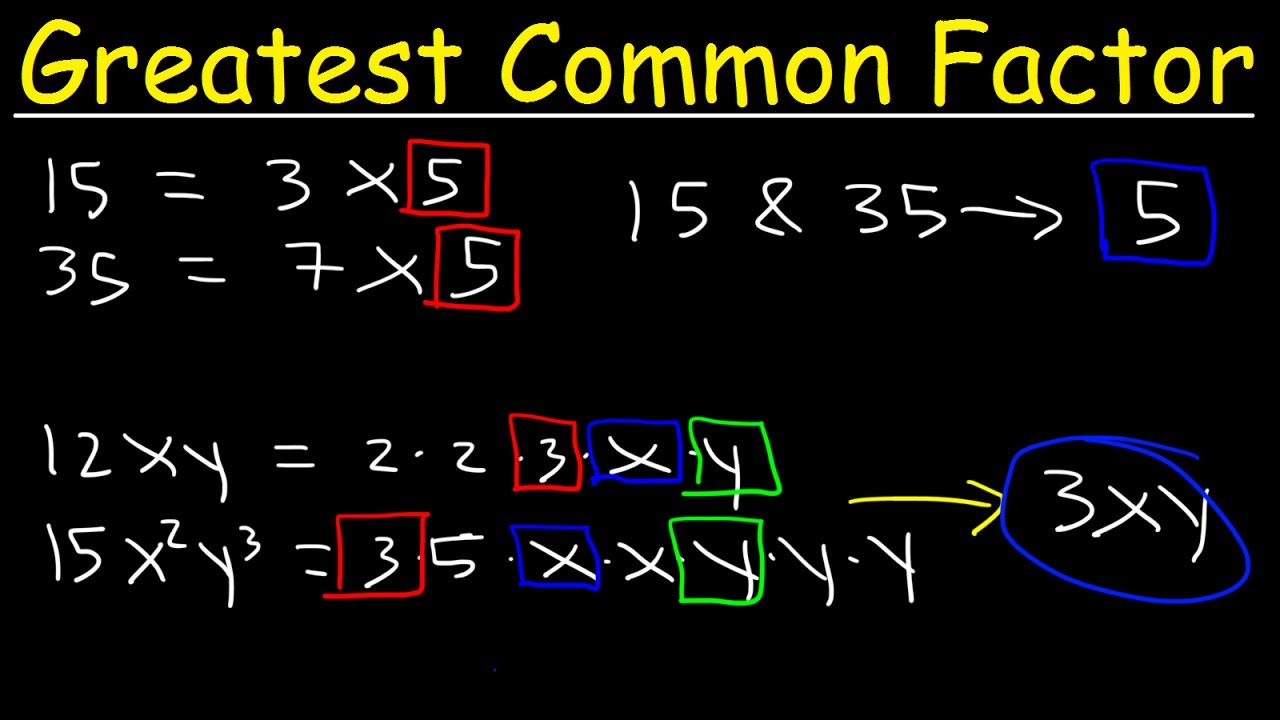
This Pre-algebra video tutorial explains how to find the greatest common factor of two monomials with variables & exponents and how to find the GCF given two or three large numbers.
Algebra For Beginners: https://www.youtube.com/watch?v=MHeirBPOI6w
Chemistry For Beginners: ...
 devout snowBOT
Channel closed
Closed by @sacred plank
Use .reopen if this was a mistake.
Available help channel!
Send your question here to claim the channel.
Remember:
• Ask your math question in a clear, concise manner.
• Show your work, and if possible, explain where you are stuck.
• After 15 minutes, feel free to ping <@&286206848099549185>.
• Type the command .close to free the channel when you're done.
• Be polite and have a nice day!
Read #❓how-to-get-help for further information on how to ask a good question, and about conduct in the question channels.
 dusty stone
Hey so I have absolutely no idea what to do for 1)b), I looked at the mark scheme and for some reason they were multiplying everything by e^t, I don’t get how that helped and how they came up with it. Also how do you do 2)c and d? If you know how please ping me

 devout snowBOT
dusty stone
Hey so I have absolutely no idea what to do for 1)b), I looked at the mark schem...
devout snowBOT
dusty stone
Hey so I have absolutely no idea what to do for 1)b), I looked at the mark schem...
@dusty stone Has your question been resolved?
 old stag
What you're saying about 1b sounds like the method of integrating factors. Maybe you've done this in class?
devout snowBOT
@dusty stone Has your question been resolved?
dusty stone
old stag
What you're saying about 1b sounds like the method of integrating factors. Maybe...
Integrating factors? I’ll check it out
What about the other one?
old stag
Part c is by using your standard roots of polynomials stuff.
(x - a)(x - b) = x^2 - (a+b)x + ab
By looking at the coefficients of the polynomial you get info about the roots. Same basic idea works for the polynomial z^5 - 1
devout snowBOT
@dusty stone Has your question been resolved?
dusty stone
old stag
Part c is by using your standard roots of polynomials stuff.
(x - a)(x - b) = x...
Could you explain this a bit further with an example please?
devout snowBOT
@dusty stone Has your question been resolved?
devout snowBOT
Channel closed
Closed due to timeout
Use .reopen if this was a mistake.
Available help channel!
Send your question here to claim the channel.
Remember:
• Ask your math question in a clear, concise manner.
• Show your work, and if possible, explain where you are stuck.
• After 15 minutes, feel free to ping <@&286206848099549185>.
• Type the command .close to free the channel when you're done.
• Be polite and have a nice day!
Read #❓how-to-get-help for further information on how to ask a good question, and about conduct in the question channels.
 lyric hornet
Ok, there's gonna be something elementary I'm just missing how do I evaluate: $\lim_{h\to0}\frac{a^{h}-1}{h}$ to be $\ln(a)$, I can't use l'Hôpital's nor can I use the exponent rule of derivatives for some reason all websites/resources I look at take this to be a given/trivial I am really struggling to find anything that shows why this is the result without using the above two mentioned
devout snowBOT
lyric hornet
Ok, there's gonna be something elementary I'm just missing how do I evaluate: $\...
woven radishBOT
PajamaMamaLlama
 prime egret
Idk what you’re trying to do but that’s derivative of a^x at x=0
(Maybe that’s what you’re trying to do?)
@lyric hornet
Ah nvm I think that’s what you meant by can’t use exponent rule of derivatives
lyric hornet
prime egret
(Maybe that’s what you’re trying to do?)
trying to prove the exponential rule 
lyric hornet
prime egret
Idk what you’re trying to do but that’s derivative of a^x at x=0
ye I tried that but that went out the window pretty quick 
 crisp niche
$\forall _{x\in \left( 0,1 \right)}\text{ }1\le \frac{e^{x}-1}{x}\le \frac{1}{1-x}\\\text{and}\\\forall {x\lt 0}\text{ }\frac{1}{1-x}\le \frac{e^{x}-1}{x}\le 1\\\text{ hence}\\\lim{x \to 0}\frac{e^{x}-1}{x} =1$
woven radishBOT
Joanna Angel
Compile Error! Click the  reaction for more information.
(You may edit your message to recompile.)
 prime egret
If you’re fine with the $$\lim_{h \to 0} \frac{e^h -1}{h} = 1$$ then you can write a as e^…
woven radishBOT
Pure
Compile Error! Click the reaction for more information.
(You may edit your message to recompile.)
 lyric hornet
woven radish
**Joanna Angel**
Compile Error! Click the <:errors:504266556054962196> reaction ...
lyric hornet
woven radish
**Joanna Angel**
Compile Error! Click the <:errors:504266556054962196> reaction ...
that's a very good squeeze idea, but how'd you get the bounds?
then from $\frac{e^h-1}{h}=1$ how do I generalize to base $a$?
woven radishBOT
PajamaMamaLlama
 prime egret
lyric hornet
that's a very good squeeze idea, but how'd you get the bounds? <:thonk:406575732...
prime egret
lyric hornet
that's a very good squeeze idea, but how'd you get the bounds? <:thonk:406575732...
this follows from $e^x \geq x+1$
woven radishBOT
Pure
 prime egret
(which follows from bernouli inequality)
,, e^x = \lim_{n \to \infty} \left( 1+\frac{x}{n}\right)^n \geq 1+x
woven radishBOT
Pure
 prime egret
then
\begin{align*}
e^{-x} \geq & 1 -x \
e^x \leq & \frac{1}{1-x}
\end{align*}
woven radishBOT
Pure
 lyric hornet
how did we go from $e^x\geq{x+1}$ to $e^{-x}\geq{1-x}$? (I just really wanna understand this, sorry 😅)
woven radishBOT
PajamaMamaLlama
 prime egret
just by replacing x with -x
lyric hornet
ohhhhh that makes sense, that was kinda obivous...
so then how does the lower bound of the inequality arise?
oh wait that was just a dumb question wasn't that...
prime egret
its just a bit of algebra
lyric hornet
so now I see how to apply the squeeze theorem where a=e, then how do I generalize for a?
$\frac{a^h-1}{h}=\frac{e^{h\ln(a)}-1}{h}$?
woven radishBOT
PajamaMamaLlama
 lyric hornet
prime egret
and i suppose make a substitution h to h/ln(a)
lyric hornet
prime egret
and i suppose make a substitution h to h/ln(a)
yep! I see Pure this helped so much  I hope you have an awesome holiday season, and wish you well on all your other adventures
lyric hornet
.close
devout snowBOT
Channel closed
Closed by @lyric hornet
Use .reopen if this was a mistake.
Available help channel!
Send your question here to claim the channel.
Remember:
• Ask your math question in a clear, concise manner.
• Show your work, and if possible, explain where you are stuck.
• After 15 minutes, feel free to ping <@&286206848099549185>.
• Type the command .close to free the channel when you're done.
• Be polite and have a nice day!
Read #❓how-to-get-help for further information on how to ask a good question, and about conduct in the question channels.
 quick lichen
is this correct?
 devout snowBOT
quick lichen
is this correct?
devout snowBOT
quick lichen
is this correct?
 pale bolt
the parenthesis are definitely wrong, but im not sure if your software cares
,w integral of (7x^2+12x^(-5))/(x^6) dx
woven radishBOT


 pale bolt
yeah looks right
first one needs to be 7x^(-4) + 12x^(-11) to be actually correct but i doubt it matters much
quick lichen
pale bolt
first one needs to be 7x^(-4) + 12x^(-11) to be actually correct but i doubt it ...
well this is what the preview looks like

but both ways work ig
thanks
pale bolt
ya looks good then
devout snowBOT
@quick lichen Has your question been resolved?
devout snowBOT
Channel closed
Closed due to timeout
Use .reopen if this was a mistake.
Available help channel!
Send your question here to claim the channel.
Remember:
• Ask your math question in a clear, concise manner.
• Show your work, and if possible, explain where you are stuck.
• After 15 minutes, feel free to ping <@&286206848099549185>.
• Type the command .close to free the channel when you're done.
• Be polite and have a nice day!
Read #❓how-to-get-help for further information on how to ask a good question, and about conduct in the question channels.
 stark shuttle
Hello
devout snowBOT
stark shuttle
Hello
 supple knot
Can you simplify sin(arcsec(y))?
stark shuttle
Not sure how
supple knot
Draw a right triangle of angle arcsec(y)
stark shuttle
supple knot
Draw a right triangle of angle arcsec(y)
oppo/hypo?
supple knot
I don't understand your question
arcsec(y) is an angle
You can draw a right triangle where one side is length y
devout snowBOT
@stark shuttle Has your question been resolved?
stark shuttle
 stark shuttle
supple knot
You can draw a right triangle where one side is length y
stark shuttle
supple knot
You can draw a right triangle where one side is length y
Like this?
woven radishBOT
Besym

 woven radishBOT
Besym
 stark shuttle
Okay


 stark shuttle
How did you derive that?


 stark shuttle
.close
devout snowBOT
Channel closed
Closed by @stark shuttle
Use .reopen if this was a mistake.
Available help channel!
Send your question here to claim the channel.
Remember:
• Ask your math question in a clear, concise manner.
• Show your work, and if possible, explain where you are stuck.
• After 15 minutes, feel free to ping <@&286206848099549185>.
• Type the command .close to free the channel when you're done.
• Be polite and have a nice day!
Read #❓how-to-get-help for further information on how to ask a good question, and about conduct in the question channels.
restive river
 devout snowBOT
restive river
restive river
devout snowBOT
restive river
restive river
How do I do these exponenitial decay questions?
I know you can use $P(t)=a(b)^t$ or $P(t)=P_0e^kt$ but i dont know how to implement it
woven radishBOT
Matt

 meager yarrow
From the given info
You know that P(7000)=0.64P_0
restive river
meager yarrow
From the given info
You know that P(7000)=0.64P_0
where are you getting that equation from
i thought you have to use $P(t)=a(b)^t$ or $P(t)=P_0e^kt$
woven radishBOT
Matt
 meager yarrow
Well the question says
After 7000 years, there is 64% of Trucelite remaining
So the ending amount is 64% of the initial amount
restive river
meager yarrow
Well the question says
*After 7000 years, there is 64% of Trucelite remaining*
S...
ok so you input 7k years into the function and you recieve 64% of the initial amount
got that
but how do i use that to find the half life
 hazy quail
Find the decay constant
meager yarrow
$0.64P_0=P_0e^{7000k}$
woven radishBOT
Afi
 hazy quail
^
restive river
how do i find the decay constant tho?
im assuming thats the k but im not sure how I would find that as P is missing
meager yarrow
You can just cancel out the P_0
restive river
Also why are you guys using $P(t)=P_0e^{kt}$ instead of $P(t)=a(b)^t$
woven radishBOT
Matt
 hazy quail
Both work
restive river
hazy quail
Both work
ok this is what i got from solving for it

so i plug it in and do what with it?
restive river
half of the original substance
or well how long it takes for the original substance to reach half of its original amount
hazy quail
Ok so what is P(t)
woven radishBOT
ed
 restive river
P(t) is the function where you input the amount of time (in years) and it returns how much substance you have left
woven radishBOT
ed
 restive river
ok idk what the h is in $t_h$
woven radishBOT
Matt
 restive river
thats confusing me
cause you should be just inputting the time into the function right?
@hazy quail
restive river
oh
ok
so youre inputting the half life into the function which returns half the original substance amount
correct?
hazy quail
correct
restive river
so how do i solve for half life with that information?
All I have right now is $P(t)=P_0e^{(7000)(−0.0000637553003755)}$
woven radishBOT
Matt
Compile Error! Click the reaction for more information.
(You may edit your message to recompile.)
 hazy quail
yes
woven radishBOT
ed
 restive river
the half life
hazy quail
if half the original is left what is it
woven radishBOT
ed
 hazy quail
simply*
restive river
ok yes i get that
meager yarrow
So $P(t_h)$ should be $0.5P_0$ right?
woven radishBOT
Afi
 restive river
oh
woven radishBOT
ed
 hazy quail
was what i was looking for
restive river
ok so $0.5P_0e^{(7000)(−0.0000637553003755)}$
woven radishBOT
Matt
Compile Error! Click the reaction for more information.
(You may edit your message to recompile.)
 woven radishBOT
Afi
 woven radishBOT
ed
 hazy quail
^
meager yarrow
Yeah
restive river
$0.5P_0=P_0e^{(7000)(−0.0000637553003755)}$
woven radishBOT
Matt
Compile Error! Click the reaction for more information.
(You may edit your message to recompile.)
 hazy quail
^
woven radishBOT
Matt
Compile Error! Click the reaction for more information.
(You may edit your message to recompile.)
 meager yarrow
From this you can easily find t_h
restive river
10872
yup i just checked the answer key and its right
im just confused still
why did you put the 0.5 infront of the P?
meager yarrow
Hmm wait for a bit
hazy quail
at time t, P(t) gives the amount of radioactive substance left correct?
restive river
yes
woven radishBOT
ed
 hazy quail
P_0 is the original
so after t_h (the half life) years pass
we should have 1/2 of that left
restive river
ok that makes sense
hazy quail
is that clearer now
restive river
yes but one more hting
how did you guys find the decay number
this one −0.0000637553003755
woven radishBOT
ed
 restive river
ohh
ok
i think thats all
but one more thing
for problems like this
how do you know which of these equations to use $P(t)=a(b)^t$ or $P(t)=P_0e^{kt}$
woven radishBOT
Matt
 restive river
i get it how to do it w that equation but how do you know which is better for the situation
hazy quail
they both work
they literally both work
the a in the first one should be P_0 btw
you know that constant is the original sample
hazy quail
yes a is the original amount
meager yarrow
Both P_0 and a represents the initial amount, they are exchangeable
devout snowBOT
Channel closed
Closed by @inner pawn
Use .reopen if this was a mistake.
Available help channel!
Send your question here to claim the channel.
Remember:
• Ask your math question in a clear, concise manner.
• Show your work, and if possible, explain where you are stuck.
• After 15 minutes, feel free to ping <@&286206848099549185>.
• Type the command .close to free the channel when you're done.
• Be polite and have a nice day!
Read #❓how-to-get-help for further information on how to ask a good question, and about conduct in the question channels.
honest thorn
Two hoses, A and B, are used to fill a fish tank with water. Hose A puts water into the tank twice as fast as hose B. If both hoses are used, the tank is filled five minutes faster than if just hose A is used. How many minutes would it take for hose B to fill the tank on its own?
devout snowBOT
honest thorn
Two hoses, A and B, are used to fill a fish tank with water. Hose A puts water i...
 quiet pawn
Well you know that A is twice as fast as B
So you could represent A as 2B and B as is
Does that help?
Just tag me if you need me to expand it
honest thorn
quiet pawn
Just tag me if you need me to expand it
yeah i did do that and also a+b=a+5
but it doesnt give the correct answer
 quiet pawn
Hm can you tag another helper 😭 i can explain but i was shown a vastly different way of representing everything
honest thorn
Question: Two hoses, $A$ and $B$, are used to fill a fish tank with water. Hose $A$ puts water into the tank twice as fast as hose $B$. If both hoses are used, the tank is filled five minutes faster than if just hose $A$ is used. How many minutes would it take for hose $B$ to fill the tank on its own?
woven radishBOT
龖

 devout snowBOT
@honest thorn Has your question been resolved?
honest thorn
<@&286206848099549185>
devout snowBOT
@honest thorn Has your question been resolved?
quiet pawn
Oh i see
The solution is worded incorrectly
Its saying let pump A, be A and pump be being twice as slow being represented as 1/2A
The rate that pump B pumps water can be represented as t-5
t being the time for pump A to fill and -5 being the minusing of 5 minutes due to pump A and pump B being 5 minutes faster
(t-5) = pump B and A+.5A = A+1/2A = pump a + pump b
Does that help?
@honest thorn
Never express something algebraically using decimals
quiet pawn
Therefore
devout snowBOT
Channel closed
Closed due to timeout
Use .reopen if this was a mistake.
devout snowBOT
Available help channel!
Send your question here to claim the channel.
Remember:
• Ask your math question in a clear, concise manner.
• Show your work, and if possible, explain where you are stuck.
• After 15 minutes, feel free to ping <@&286206848099549185>.
• Type the command .close to free the channel when you're done.
• Be polite and have a nice day!
Read #❓how-to-get-help for further information on how to ask a good question, and about conduct in the question channels.
 formal steppe
Can anyone tell me if this is correct, before I submit?
 devout snowBOT
formal steppe
Can anyone tell me if this is correct, before I submit?
devout snowBOT
formal steppe
Can anyone tell me if this is correct, before I submit?
@formal steppe Has your question been resolved?
devout snowBOT
Channel closed
Closed due to timeout
Use .reopen if this was a mistake.
Available help channel!
Send your question here to claim the channel.
Remember:
• Ask your math question in a clear, concise manner.
• Show your work, and if possible, explain where you are stuck.
• After 15 minutes, feel free to ping <@&286206848099549185>.
• Type the command .close to free the channel when you're done.
• Be polite and have a nice day!
Read #❓how-to-get-help for further information on how to ask a good question, and about conduct in the question channels.
 proper island
 devout snowBOT
proper island
proper island
devout snowBOT
proper island
proper island
Hi I have a question with arithmetic sequence
 wraith horizon
okay, so your sequence starts at 5000 and then adds 250 a year?
and you want to find the value of a_10
proper island
Yes, but I’m not sure if it means that the second year it is 5250, or 10250
Like we suppose it’s about money
I’m not sure if I should just put +250 or even the 5000
wraith horizon
without seeing the full question it's hard to tell you exactly
it looks to me that S(1) = 5000 and then S(2) = S(1)+250 and S(3) = S(2)+250
and so on
proper island
wraith horizon
without seeing the full question it's hard to tell you exactly
it *looks* to me...
Yes I don’t remember the whole question sorry:/
wraith horizon
...or maybe it means S1 is 5000 and then S2 is +5250 and S3 is +5000+250+250
proper island
Oh I see…the problem is the missing question but now I see how I could do it
So thank you
.close
devout snowBOT
Channel closed
Closed by @proper island
Use .reopen if this was a mistake.
Available help channel!
Send your question here to claim the channel.
Remember:
• Ask your math question in a clear, concise manner.
• Show your work, and if possible, explain where you are stuck.
• After 15 minutes, feel free to ping <@&286206848099549185>.
• Type the command .close to free the channel when you're done.
• Be polite and have a nice day!
Read #❓how-to-get-help for further information on how to ask a good question, and about conduct in the question channels.
proper island
wraith horizon
...or maybe it means S1 is 5000 and then S2 is +5250 and S3 is +5000+250+250
Oh now I got it, so it was meant like in first month its 5000, the next month its 5250, the third one its 5500 and the whole year them is 7750.
And they ask how much it’s in 10 year?
So could I put it like in the first year its 2750 difference so I could put 9x2750?
devout snowBOT
proper island
Oh now I got it, so it was meant like in first month its 5000, the next month it...
wraith horizon
without seeing the question I'm stll not sure. it depends if adding the 5000 counts as the first month or not
if it does, then you only make 11 (11*250=2250) additions the first year and 12 the other years
proper island
wraith horizon
if it does, then you only make 11 (11*250=2250) additions the first year and 12 ...
Oh thank you.
devout snowBOT
@proper island Has your question been resolved?
Channel closed
Closed by @proper island
Use .reopen if this was a mistake.
Available help channel!
Send your question here to claim the channel.
Remember:
• Ask your math question in a clear, concise manner.
• Show your work, and if possible, explain where you are stuck.
• After 15 minutes, feel free to ping <@&286206848099549185>.
• Type the command .close to free the channel when you're done.
• Be polite and have a nice day!
Read #❓how-to-get-help for further information on how to ask a good question, and about conduct in the question channels.
Channel closed
Channel closed due to the original message being deleted.
If you did not intend to do this, please open a new help channel,
as this action is irreversible, and this channel may abruptly lock.
Available help channel!
Send your question here to claim the channel.
Remember:
• Ask your math question in a clear, concise manner.
• Show your work, and if possible, explain where you are stuck.
• After 15 minutes, feel free to ping <@&286206848099549185>.
• Type the command .close to free the channel when you're done.
• Be polite and have a nice day!
Read #❓how-to-get-help for further information on how to ask a good question, and about conduct in the question channels.
 lapis raft
I tried, but got stuck so i have no idea how to do this
 lapis raft
This is what I have, but i dont know how to go further

 upper schooner
,rccw
woven radishBOT

 sharp dagger
lapis raft
This is what I have, but i dont know how to go further
sharp dagger
lapis raft
This is what I have, but i dont know how to go further
Use delta
Delta = b²-4ac
X1=-(b-sqrt(delta))/2a
X2=-(b+sqrt(delta))/2a
lapis raft
Oh, if thats all then thank you
I thought there was a different way or something
Thank you
.close
devout snowBOT
Channel closed
Closed by @lapis raft
Use .reopen if this was a mistake.
Available help channel!
Send your question here to claim the channel.
Remember:
• Ask your math question in a clear, concise manner.
• Show your work, and if possible, explain where you are stuck.
• After 15 minutes, feel free to ping <@&286206848099549185>.
• Type the command .close to free the channel when you're done.
• Be polite and have a nice day!
Read #❓how-to-get-help for further information on how to ask a good question, and about conduct in the question channels.
restive river
<siunitx>
Question regarding units. You often represent acceleration similar to:\[
\map {\vb*a} t = \parens [*]{\qty{0.400}{m/s^2}} \, \vu*\imath - \parens [*]{\qty{0.180}{m/s^3}}t \, \vu*\jmath
\]
But for the $\vu*\jmath$ term do you have to represent the coefficient quantity with $\qty{}{m/s^3}$ because of an implicit $\qty{}s$ that appears when evaluating $t$?

 lone ravine
Yes, the extra s and the „s in t" cancel
restive river
Okay great. Now say you take the integral of the acceleration to obtain the velocity
how do the units convert?
 wooden veldt
Vaguely, the "dt" in the integral has units s so that's what's cancelling with the m/s² to get m/s
Kind of handwavey but that's how to think about it
restive river
hmm i see okay
and for the derivative?
i guess like
getting rid of a 't' doesnt get rid of the 's' associated with it, if that makes sense?
okay that doesnt make sense 💀
stone stump
well you can check the units in the difference quotient
numerator is just same unit again and then you divide by s
devout snowBOT
@restive river Has your question been resolved?
restive river
stone stump
numerator is just same unit again and then you divide by s
gotcha!
.close
devout snowBOT
Channel closed
Closed by @worthy tiger
Use .reopen if this was a mistake.