#help-27
1 messages · Page 130 of 1
 crystal token
<@&286206848099549185>
 last holly
difference of 2 suqares on the denominator gives $(\frac{\sin v}{\cos v}+\frac{\cos v}{\sin v})(\frac{\sin v}{\cos v}-\frac{\cos v}{\sin v})$
 woven radishBOT
mygenderisanonnewtonianfluid
 last holly
this cancels with the numerator, giving the whole expression as $\frac{1}{\frac{\sin v}{\cos v}+\frac{\cos v}{\sin v}}$
woven radishBOT
mygenderisanonnewtonianfluid
 crystal token
So I convert my image to what you wrote of the difference of 2squares on the denominator
last holly
yea show me when ur done
cuz the next step should be clear but i'll help you out if you need it
i just realized that sounds very insulting
i'm sorry
that was not my intention
crystal token
Its ok 👍
last holly
cool
crystal token
I very much need help
last holly
ok
so we are trying to prove now that $\frac{1}{\frac{\sin v}{\cos v}+\frac{\cos v}{\sin v}}=\sin v\cos v$
woven radishBOT
mygenderisanonnewtonianfluid
 crystal token
It looks like a fundamental identity , the image above
last holly
so we're going to now multiply both sides by $\frac{1}{\sin v\cos v}$ to get $\frac{1}{\sin^2 v+ \cos^2 v}=1$
woven radishBOT
mygenderisanonnewtonianfluid
 last holly
it's the first pythagorean identity
crystal token
Yup
last holly
I can help you with writing the proof, too if you want
crystal token
Yes please I apprecaite it
last holly
Ok. So we're trying to prove that $\frac{\tan v-\cot v}{\tan^2 v-\cot^2 v}=\sin v\cos v \forall v\in\mathbb{R}$
woven radishBOT
mygenderisanonnewtonianfluid
 last holly
this should be the first line of the proof.
And it's easier to do the difference of 2 squares step here, so for the second line, we say that this is equivalent to $\frac{\tan v-\cot v}{(\tan v+\cot v)(\tan v-\cot v)}=\sin v\cos v \forall v\in\mathbb{R}$
woven radishBOT
mygenderisanonnewtonianfluid
 last holly
and we now expand using the definitions of tan and cot: $\frac{\frac{\sin v}{\cos v}-\frac{\cos v}{\sin v}}{(\frac{\sin v}{\cos v}+\frac{\cos v}{\sin v})(\frac{\sin v}{\cos v}-\frac{\cos v}{\sin v})}=\sin v\cos v\forall v\in\mathbb{R}$
woven radishBOT
mygenderisanonnewtonianfluid
 last holly
this is the third line
and by cancellation, we see that this is equivalent to $\frac{1}{\frac{\sin v}{\cos v}+\frac{\cos v}{\sin v}}=\sin v\cos v\forall v\in\mathbb{R}$
woven radishBOT
mygenderisanonnewtonianfluid
 last holly
this is the fourth line
and now we multiply both sides by $\frac{1}{\sin v\cos v}$, we get $\frac{1}{\sin^2 v+\cos^2 v}=1\forall v\in\mathbb{R}$
woven radishBOT
mygenderisanonnewtonianfluid
 last holly
this is the fifth line
and we know that $\frac{1}{\sin^2 v+\cos^2 v}=1\forall v\in\mathbb{R}$. And we've shown that $\frac{\tan v-\cot v}{\tan^2 v-\cot^2 v}=\sin v\cos v \forall v\in\mathbb{R}\Leftrightarrow\frac{1}{\sin^2 v+\cos^2 v}=1\forall v\in\mathbb{R}$
woven radishBOT
mygenderisanonnewtonianfluid
 last holly
therefore, $\frac{\tan v-\cot v}{\tan^2 v-\cot^2 v}=\sin v\cos v\forall v\in\mathbb{R}$
woven radishBOT
mygenderisanonnewtonianfluid
 last holly
and that's the proof
👍
do you have any further questions?
if not, please close the question
crystal token
No , no questions I just want to say thank you for helping me your way of doing the work is sooo much better than how my teacher did it, your an awesome person and thank you for your time
crystal token
.close
 devout snowBOT
Channel closed
Closed by @crystal token
Use .reopen if this was a mistake.
 Available help channel!
Send your question here to claim the channel.
Remember:
• Ask your math question in a clear, concise manner.
• Show your work, and if possible, explain where you are stuck.
• After 15 minutes, feel free to ping <@&286206848099549185>.
• Type the command .close to free the channel when you're done.
• Be polite and have a nice day!
Read #❓how-to-get-help for further information on how to ask a good question, and about conduct in the question channels.
 calm belfry
i need help with finding y
 devout snowBOT
calm belfry
i need help with finding y
calm belfry
devout snowBOT
calm belfry
i need help with finding y
calm belfry
i need help finding x i mean
calm belfry
yeah
last holly
so the way i like to do this is by defining the inverse function
but im self taught so im not sure how teachers typically introduce this
does ur teacher have a specific way they want you to do this?
calm belfry
ion think it matters as long as i show how i got it
last holly
ok
so we have x defined as a function of y, and to find y for some x value, we can define y as a function of x
we have $y=-5\cos(2x-\frac{2}{3}x)$ and we can transform this into $\cos^{-1}(-\frac{y}{5})=(2-\frac{2}{3})x$
woven radishBOT
mygenderisanonnewtonianfluid
 calm belfry
dat shit looks more complicated lol
last holly
it'll all be easier i promise
we can then divide both sides by $1+\frac{1}{3}$ to get $\frac{1}{1+\frac{1}{3}}\cos^{-1}(-\frac{y}{5})=x$
woven radishBOT
mygenderisanonnewtonianfluid
 last holly
we now have x as a function of y
and we evaluate $\frac{1}{1+\frac{1}{3}}cos^{-1}(-\frac{y}{5})$ at $y=0$ to get $x$ when $y=0$
woven radishBOT
mygenderisanonnewtonianfluid
 last holly
this is also just $\frac{3}{4}cos^{-1}(-\frac{y}{5})$
woven radishBOT
mygenderisanonnewtonianfluid
 last holly
this yields $\frac{3\pi}{4}$
woven radishBOT
mygenderisanonnewtonianfluid
 last holly
which is obviously wrong
i did something wrong
im sorry
i was thinking that $\cos^{-1}(0)=\pi$ but it's $\frac{\pi}{2}$
woven radishBOT
mygenderisanonnewtonianfluid
 last holly
the real answer is $\frac{3\pi}{8}$
woven radishBOT
mygenderisanonnewtonianfluid
 calm belfry
.close
devout snowBOT
Channel closed
Closed by @calm belfry
Use .reopen if this was a mistake.
Available help channel!
Send your question here to claim the channel.
Remember:
• Ask your math question in a clear, concise manner.
• Show your work, and if possible, explain where you are stuck.
• After 15 minutes, feel free to ping <@&286206848099549185>.
• Type the command .close to free the channel when you're done.
• Be polite and have a nice day!
Read #❓how-to-get-help for further information on how to ask a good question, and about conduct in the question channels.
 restive river
I have a question. I've written my equation for a degree as Sin(2/3pi(t))+1 and Sin(120)+1 I believe the ground level would be the radius under the water.
 devout snowBOT
restive river
I have a question. I've written my equation for a degree as Sin(2/3pi(t))+1 and ...
devout snowBOT
restive river
I have a question. I've written my equation for a degree as Sin(2/3pi(t))+1 and ...
 timber pebble
restive river
I have a question. I've written my equation for a degree as Sin(2/3pi(t))+1 and ...
timber pebble
restive river
I have a question. I've written my equation for a degree as Sin(2/3pi(t))+1 and ...
its hard to tell but i think by "above or below water" they mean that the water surface is at 1 meter of the ground
restive river
Would the mid-line also be 1 meter than?
timber pebble
yea, thats kind of how im reading it
timber pebble

devout snowBOT
@restive river Has your question been resolved?
devout snowBOT
Channel closed
Closed due to timeout
Use .reopen if this was a mistake.
devout snowBOT
Available help channel!
Send your question here to claim the channel.
Remember:
• Ask your math question in a clear, concise manner.
• Show your work, and if possible, explain where you are stuck.
• After 15 minutes, feel free to ping <@&286206848099549185>.
• Type the command .close to free the channel when you're done.
• Be polite and have a nice day!
Read #❓how-to-get-help for further information on how to ask a good question, and about conduct in the question channels.
 maiden zephyr
help
devout snowBOT
maiden zephyr
help
 restive river
r(x) represents revenue you want to find the x values that will result in the revenue that you want
For example you are trying to find what value of x would give you 14000 as the revenue
devout snowBOT
Channel closed
Closed by @maiden zephyr
Use .reopen if this was a mistake.
devout snowBOT
Available help channel!
Send your question here to claim the channel.
Remember:
• Ask your math question in a clear, concise manner.
• Show your work, and if possible, explain where you are stuck.
• After 15 minutes, feel free to ping <@&286206848099549185>.
• Type the command .close to free the channel when you're done.
• Be polite and have a nice day!
Read #❓how-to-get-help for further information on how to ask a good question, and about conduct in the question channels.
 snow sentinel
I have 4 digits,
for instance:
1234
How can I calculate how many combinations of such digits there are?
For example:
combinations for 1234:
1234
1,234
12,34
123,4
1,2,34
1,23,4
12,3,4
1,2,3,4
(8 combinations)
devout snowBOT
snow sentinel
I have 4 digits,
for instance:
1234
How can I calculate how many combinations o...
devout snowBOT
@snow sentinel Has your question been resolved?
 stone stump
combination is the wrong word
I am actually not exactly sure what you want
it seems slightly more like partitions but for that you would also have stuff like 13,24
do you just want to know in how many ways you can place commas between the numbers?
if yes, there are 3 places for a comma and each comma can be there or not. so 2^3 options
snow sentinel
stone stump
if yes, there are 3 places for a comma and each comma can be there or not. so 2^...
👍
That's what I wanted thanks
devout snowBOT
@snow sentinel Has your question been resolved?
devout snowBOT
Channel closed
Closed by @snow sentinel
Use .reopen if this was a mistake.
Available help channel!
Send your question here to claim the channel.
Remember:
• Ask your math question in a clear, concise manner.
• Show your work, and if possible, explain where you are stuck.
• After 15 minutes, feel free to ping <@&286206848099549185>.
• Type the command .close to free the channel when you're done.
• Be polite and have a nice day!
Read #❓how-to-get-help for further information on how to ask a good question, and about conduct in the question channels.
 rapid latch
s
devout snowBOT
rapid latch
s
 rapid latch
But we have to determine the properties of the function
like the vertex, y int, x int, AoS, orientation
 dense jay
so?
use the quadratic formula to get the x ints
use vertex form for the vertex and Aos
rapid latch
show
 urban harbor
remember that x-intercept are just points where y = 0, so that's just another word for solutions / roots of the equation
rapid latch
wait i think im dumb

i am not a mathematicallly inclined individual
idk if this is right or not

 prisma snow
i would do
-2(x^2 + 8x -5/2)
-2(x^2 + 8x + 16 - 16 - 5/2)
-2([x+4]^2 - 37/2)
-2(x+4)^2 + 37 = 0
devout snowBOT
@rapid latch Has your question been resolved?
Channel closed
Closed by @rapid latch
Use .reopen if this was a mistake.
Available help channel!
Send your question here to claim the channel.
Remember:
• Ask your math question in a clear, concise manner.
• Show your work, and if possible, explain where you are stuck.
• After 15 minutes, feel free to ping <@&286206848099549185>.
• Type the command .close to free the channel when you're done.
• Be polite and have a nice day!
Read #❓how-to-get-help for further information on how to ask a good question, and about conduct in the question channels.
 mortal merlin
So i have been doing this math exercise and the awnser is y=6 but i have found 4y=6 and cant figure out my mistake can anyone help?
 devout snowBOT
mortal merlin
So i have been doing this math exercise and the awnser is y=6 but i have found 4...
devout snowBOT
mortal merlin
So i have been doing this math exercise and the awnser is y=6 but i have found 4...
 untold lodge
there is no way the answer is y = 6
you can check this by subsituting y = 6 in the equation
you will get something like this:
2 - 2 = 3 - 5
and 0 is not equal to -2
mortal merlin
Oh so my awnser is correct?
devout snowBOT
@mortal merlin Has your question been resolved?
Channel closed
Closed by @mortal merlin
Use .reopen if this was a mistake.
devout snowBOT
Available help channel!
Send your question here to claim the channel.
Remember:
• Ask your math question in a clear, concise manner.
• Show your work, and if possible, explain where you are stuck.
• After 15 minutes, feel free to ping <@&286206848099549185>.
• Type the command .close to free the channel when you're done.
• Be polite and have a nice day!
Read #❓how-to-get-help for further information on how to ask a good question, and about conduct in the question channels.
 high pewter
ello. have a calculus quiz in about an hour and while i don’t expect this to be on it, i don’t quite see where i’m going wrong
devout snowBOT
high pewter
ello. have a calculus quiz in about an hour and while i don’t expect this to be ...
high pewter

i’m finding the second derivative of this to be

but putting using points but those just gives me solid negatives all the way across
 winter patrol
 high pewter
i really just want to know where i’m going wrong and why i’m ending up with a negative consistently
winter patrol
fked up the multiplication here
high pewter
wooo
woop *
well
actually i think i thought ahead there and i still treat it as a 16
or else i wouldn’t have ended up with -8x
winter patrol
ok, then the next error is that you didn't factor out the - sign properly
$-8x^2 + 28 \redneq -4(2x^2 + 7)$
$\frac{-a+b}{c} = -\frac{a-b}{c} \redneq -\frac{a+b}{c}$
woven radishBOT
ℝαμΩℕωⅤ

 sullen island
\redneq lmao
high pewter
i see i see
woven radishBOT
ℝαμΩℕωⅤ
 high pewter
that leaves me at a loss with what to do with the (2x^2+7)^2 then
winter patrol
you can just leave stuff as is,
high pewter
oh wait yeah
winter patrol
don't try to forcefully reducing the expression by illegally erasing stuff
if there isn't anything meaningful to be done, don't do anything
high pewter
how would i end up with the square root in that case?
winter patrol
solve for when f''(x) = 0
and determine whether those candidates are locations of inflection (just solving for f''(x) = 0 is insufficient)
devout snowBOT
Channel closed
Closed by @high pewter
Use .reopen if this was a mistake.
Available help channel!
Send your question here to claim the channel.
Remember:
• Ask your math question in a clear, concise manner.
• Show your work, and if possible, explain where you are stuck.
• After 15 minutes, feel free to ping <@&286206848099549185>.
• Type the command .close to free the channel when you're done.
• Be polite and have a nice day!
Read #❓how-to-get-help for further information on how to ask a good question, and about conduct in the question channels.
 calm nest
hey
devout snowBOT
calm nest
hey
calm nest
Problem description:
A thief stole a necklace at 9:00, and shortly after threw it somewhere in a dock. The waterlevels in the dock change in accordance to the formula: y = 0.75 + 1.5sin(π(x+3)/6). Y = waterlevels in meters. X = time in hours starting from midnight.
Multiple people visit the dock throughout the day. Which person or persons will find the necklace?
a) Charlie passes by at 11:00
b) Jack looks at the boats between 12:00 and 13:00.
c) The thief returns to find the necklace at 15:00.
d) Molly and her friends come to fish between 16:00 and 18:00
e) Emma watches the sunfall between 21:00 and 22:00
f) workers scout the dock at 23:00
My work:

is this correct?
i think this is how i am supposed to solve it
<@&286206848099549185>
devout snowBOT
@calm nest Has your question been resolved?
devout snowBOT
Channel closed
Closed due to timeout
Use .reopen if this was a mistake.
Available help channel!
Send your question here to claim the channel.
Remember:
• Ask your math question in a clear, concise manner.
• Show your work, and if possible, explain where you are stuck.
• After 15 minutes, feel free to ping <@&286206848099549185>.
• Type the command .close to free the channel when you're done.
• Be polite and have a nice day!
Read #❓how-to-get-help for further information on how to ask a good question, and about conduct in the question channels.
 alpine tapir
Could someone give me a curve sketching problem to help me study (no exponential or ln functions)
devout snowBOT
alpine tapir
Could someone give me a curve sketching problem to help me study (no exponential...
alpine tapir
 sweet heath
btw what do you mean by " curve sketching problem"?
sweet heath
btw what do you mean by " curve sketching problem"?
To sketch any equation
On a graph
devout snowBOT
@alpine tapir Has your question been resolved?
devout snowBOT
@alpine tapir Has your question been resolved?
devout snowBOT
Channel closed
Closed by @alpine tapir
Use .reopen if this was a mistake.
Available help channel!
Send your question here to claim the channel.
Remember:
• Ask your math question in a clear, concise manner.
• Show your work, and if possible, explain where you are stuck.
• After 15 minutes, feel free to ping <@&286206848099549185>.
• Type the command .close to free the channel when you're done.
• Be polite and have a nice day!
Read #❓how-to-get-help for further information on how to ask a good question, and about conduct in the question channels.
 rugged raven
Can anyone help me out on how to solve the task? I'm desperate 
Stochastics / University-Level
Task:
The following is known about the value of three shares: Each of the three shares currently costs 1 €.
The value of share 1 rises with probability 0.61 in one year to 1.50 € and falls to 0.50 € with a probability of 0.39.
Share 2 rises in the same period with a probability of 0.24 to 1.60 € and falls to 0.40 € with a probability of 0.76.
Share 3 is worth 1.70 € in one year with a probability of 0.45 and is still worth 0.30 € with a probability of 0.55.
A trader randomly selects two of the three shares and buys one each at the current price of current price of 1 euro.
a) What is the probability that the trader will make a profit with this portfolio within one year? make a profit?
(b) What is the probability that his portfolio consists of shares 1 and 2 if the trader has made a profit?
devout snowBOT
rugged raven
Can anyone help me out on how to solve the task? I'm desperate <a:BocchiHyperCry...
@rugged raven Has your question been resolved?
devout snowBOT
@rugged raven Has your question been resolved?
devout snowBOT
@rugged raven Has your question been resolved?
devout snowBOT
Channel closed
Closed due to timeout
Use .reopen if this was a mistake.
Available help channel!
Send your question here to claim the channel.
Remember:
• Ask your math question in a clear, concise manner.
• Show your work, and if possible, explain where you are stuck.
• After 15 minutes, feel free to ping <@&286206848099549185>.
• Type the command .close to free the channel when you're done.
• Be polite and have a nice day!
Read #❓how-to-get-help for further information on how to ask a good question, and about conduct in the question channels.
 fervent jewel
So I need to show that $p(x) = x^n + a_{n-1}x^{n-1} + \cdots + a_0$ where n is odd has $a$ and $b$ such that $p(a) < 0 < p(b)$.
devout snowBOT
fervent jewel
So I need to show that $p(x) = x^n + a_{n-1}x^{n-1} + \cdots + a_0$ where n is o...
woven radishBOT
WhoTao
 fervent jewel
Here is a outline of what I have done.
Ive shown that $\lim_{x \to \infty} p(x) = \infty$ and $\lim_{x \to -\infty} p(x) = -\infty$
woven radishBOT
WhoTao
 fervent jewel
Then I claim that there exists $a$ and $b$ such that $p(a) < 0 < p(b)$.
woven radishBOT
WhoTao
 fervent jewel
Is that a valid argument?
dense jay
you may need to show its continuous, thats the only thing i can think of
or actually
no you dont
i think thats fine
fervent jewel
I kind of use that is is continuous within the proof.
To use the algebraic continuity theorem
But that is fine, since I've shown that polynomials in general are continuous in a previous assignment.
SO I can just site it
ty
.close
devout snowBOT
Channel closed
Closed by @fervent jewel
Use .reopen if this was a mistake.
Available help channel!
Send your question here to claim the channel.
Remember:
• Ask your math question in a clear, concise manner.
• Show your work, and if possible, explain where you are stuck.
• After 15 minutes, feel free to ping <@&286206848099549185>.
• Type the command .close to free the channel when you're done.
• Be polite and have a nice day!
Read #❓how-to-get-help for further information on how to ask a good question, and about conduct in the question channels.
 vapid summit
I’m not sure if my set up is correct. I’m only getting 0 for my answer and that’s not right

 devout snowBOT
vapid summit
I’m not sure if my set up is correct. I’m only getting 0 for my answer and that’...
devout snowBOT
vapid summit
I’m not sure if my set up is correct. I’m only getting 0 for my answer and that’...
@vapid summit Has your question been resolved?
devout snowBOT
Channel closed
Closed by @vapid summit
Use .reopen if this was a mistake.
Available help channel!
Send your question here to claim the channel.
Remember:
• Ask your math question in a clear, concise manner.
• Show your work, and if possible, explain where you are stuck.
• After 15 minutes, feel free to ping <@&286206848099549185>.
• Type the command .close to free the channel when you're done.
• Be polite and have a nice day!
Read #❓how-to-get-help for further information on how to ask a good question, and about conduct in the question channels.
 cold hornet
engineering help?
devout snowBOT
cold hornet
engineering help?
cold hornet
Your fourth task is to identify the extent of the turbulent mixing region from your plot any idea?


I understand this is a maths server but i decided to go for it
dense jay
im clueless, i think there is an engineering server in #old-network might be a better shot
cold hornet
dense jay
im clueless, i think there is an engineering server in <#406129911992942593> mi...
ah okay i didn't know thanks i appreciate it
.close
devout snowBOT
Channel closed
Closed by @cold hornet
Use .reopen if this was a mistake.
Available help channel!
Send your question here to claim the channel.
Remember:
• Ask your math question in a clear, concise manner.
• Show your work, and if possible, explain where you are stuck.
• After 15 minutes, feel free to ping <@&286206848099549185>.
• Type the command .close to free the channel when you're done.
• Be polite and have a nice day!
Read #❓how-to-get-help for further information on how to ask a good question, and about conduct in the question channels.
 sleek wind
how to do this?
 devout snowBOT
sleek wind
how to do this?
devout snowBOT
sleek wind
how to do this?
 lusty sapphire
Synthetic division and setting the remainder to zero is my first guess
sleek wind
wut?
 fast ruin
@sleek wind do yk sum and product of roots formulas
sleek wind
fast ruin
<@314804128574603264> do yk sum and product of roots formulas
(x-α)(x-β)(x-γ)and roots r like α+β+γ αβ+αγ+βγand αβγ no?
fast ruin
no like r1 + r2 + r3 = -b/a, r1*r2 + r2*r3 + r3*r1 = c/a, r1*r2*r3 = -d/a
oh eyah
yeah
mb
sleek wind
yh
sleek wind
sleek wind
how to do this?
wut does it mean by α, 1/α
sleek wind
fast ruin
1/3
-1/3, no?
fast ruin
no reciprocal roots just means taht they are reciprocals of each other
a and 1/a type stuff
sleek wind
im confused
sleek wind
fast ruin
and plug in the alpha and 1/alpha
where do i plug it?
fast ruin
like α+β+γ = -b/a
sleek wind
yh
sleek wind
fast ruin
but γ = 1/α
how u know that?
sleek wind
can beta be 1/α or no?
sleek wind
yh
fast ruin
and u could prolly do sm from there
sleek wind
β = 1/α
α + (1/α) + γ 1 + αγ + (1/a)(γ) γ, is it this?
fast ruin
u set beta as 1/alpha right
sleek wind
yh
sleek wind
yh...?
fast ruin
and then yk gamma in terms of c and a
so u can manipulate the first 2 equations to get an equation in terms of a,b,c,d
instead of alpha and gamma
devout snowBOT
@sleek wind Has your question been resolved?
devout snowBOT
Channel closed
Closed due to timeout
Use .reopen if this was a mistake.
Available help channel!
Send your question here to claim the channel.
Remember:
• Ask your math question in a clear, concise manner.
• Show your work, and if possible, explain where you are stuck.
• After 15 minutes, feel free to ping <@&286206848099549185>.
• Type the command .close to free the channel when you're done.
• Be polite and have a nice day!
Read #❓how-to-get-help for further information on how to ask a good question, and about conduct in the question channels.
 rancid canyon
help me i need help understanding integrals and memorising since i have hard time memorising stuff
devout snowBOT
rancid canyon
help me i need help understanding integrals and memorising since i have hard tim...
rancid canyon
i am taking calculus 3 and its not been easy to me
dense jay
what kind of integrals are you working with?
dense jay
screenshots please
rancid canyon
and it has not been easy fr


 rancid canyon
supposed to use riemann sums
rancid canyon
rancid canyon
supposed to use riemann sums
i dont know how to use it
dense jay
rancid canyon
supposed to use riemann sums
riemann sums are things such as the rectangle rule, trapezium rule etc
you would be applying these rules with a limit as n -> infinity where n is the number of 'strips' or partitions, youd end up with something like this
rancid canyon
dense jay
riemann sums are things such as the rectangle rule, trapezium rule etc
you would...
dude mind explaining?
dense jay
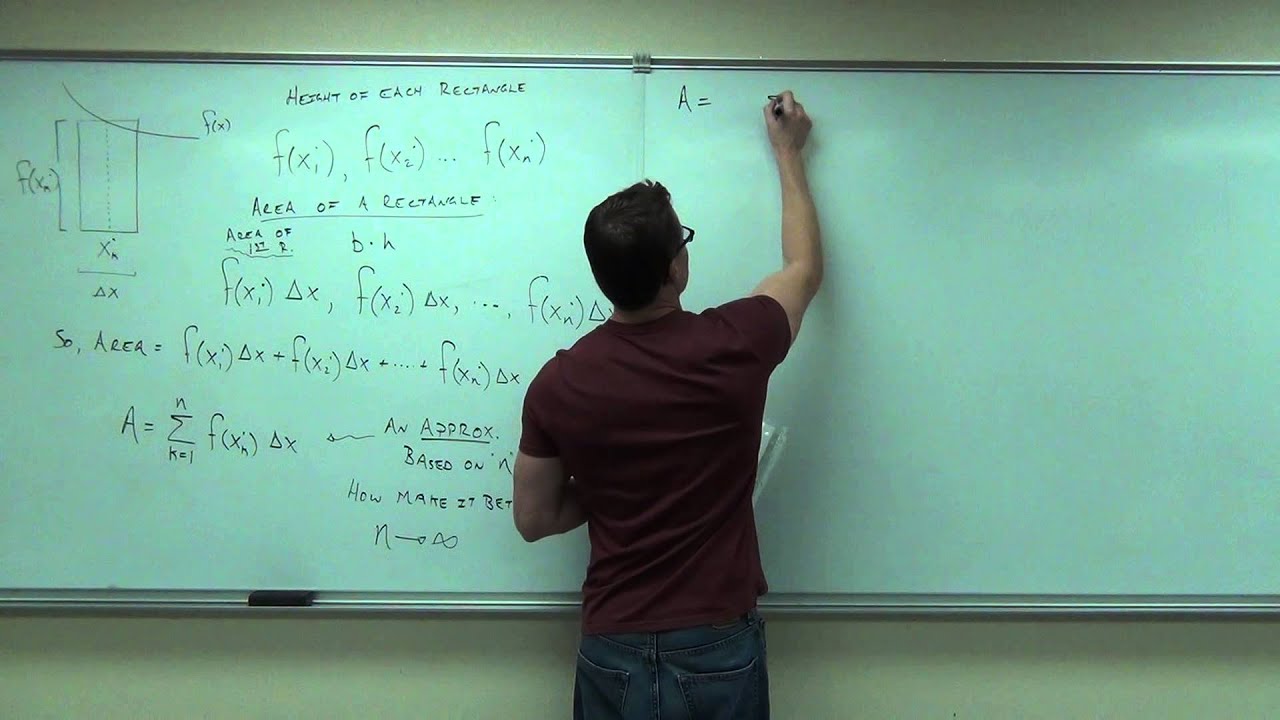
Calculus 1 Lecture 4.3: Area Under a Curve, Limit Approach, Riemann Sums
if you watch this from around 00:23:00
ish it gives a general idea
rancid canyon
oo allright
thanks alot
as of for the rest of the testt?
like 1st quesion? im really lost
dense jay
https://youtu.be/gFpHHTxsDkI?si=y5ZbZ7ZXyr5nuiDQ
this one seems to have a more specific example that might help you out seeing it in practice

Thanks to all of you who support me on Patreon. You da real mvps! $1 per month helps!! :) https://www.patreon.com/patrickjmt !! Please consider being a supporter on Patreon! https://www.patreon.com/patrickjmt
Calculating a Definite Integral Using Riemann Sums - Part 1.
In this video, I show how to set up a definite integral using Riemann Sums...
if you have to use riemann sums this is basically what youll be doing
devout snowBOT
@rancid canyon Has your question been resolved?
devout snowBOT
@rancid canyon Has your question been resolved?
devout snowBOT
Channel closed
Closed due to timeout
Use .reopen if this was a mistake.
Available help channel!
Send your question here to claim the channel.
Remember:
• Ask your math question in a clear, concise manner.
• Show your work, and if possible, explain where you are stuck.
• After 15 minutes, feel free to ping <@&286206848099549185>.
• Type the command .close to free the channel when you're done.
• Be polite and have a nice day!
Read #❓how-to-get-help for further information on how to ask a good question, and about conduct in the question channels.
 haughty pendant
Hi
devout snowBOT
haughty pendant
Hi
haughty pendant

I understand that one to one is for every x there’s a 1 corresponding y but in terms of this question idk where to start
woven radishBOT
$Pure$

 prime egret
So start from f(x1) = f(x2) deduce that x1 = x2 to show injectivity
devout snowBOT
@haughty pendant Has your question been resolved?
haughty pendant
But what do I put for the left side of the equation? (3x-1)/x?
devout snowBOT
@haughty pendant Has your question been resolved?
devout snowBOT
Channel closed
Closed due to timeout
Use .reopen if this was a mistake.
Available help channel!
Send your question here to claim the channel.
Remember:
• Ask your math question in a clear, concise manner.
• Show your work, and if possible, explain where you are stuck.
• After 15 minutes, feel free to ping <@&286206848099549185>.
• Type the command .close to free the channel when you're done.
• Be polite and have a nice day!
Read #❓how-to-get-help for further information on how to ask a good question, and about conduct in the question channels.
 carmine swallow
 devout snowBOT
carmine swallow
carmine swallow
devout snowBOT
carmine swallow
carmine swallow
how do I solve this
 small raptor
might want to use the product rule
 soft stump
carmine swallow
how...
soft stump
carmine swallow
how...
well
product rule is h(x) * p'(x) + h'(x) * p(x)
you would have to do that with the x and the f(x) that you are givin in the function g(x)
devout snowBOT
@carmine swallow Has your question been resolved?
carmine swallow
soft stump
you would have to do that with the x and the f(x) that you are givin in the func...
so what functions would I put for h and p
 carmine swallow
soft stump
carmine swallow
soft stump
so -1 and f of -1
oh wait
do I do like
nvm idk
can you show me the equation
soft stump
soft stump
well
product rule is h(x) * p'(x) + h'(x) * p(x)
well this is the equation
devout snowBOT
Channel closed
Closed by @carmine swallow
Use .reopen if this was a mistake.
Available help channel!
Send your question here to claim the channel.
Remember:
• Ask your math question in a clear, concise manner.
• Show your work, and if possible, explain where you are stuck.
• After 15 minutes, feel free to ping <@&286206848099549185>.
• Type the command .close to free the channel when you're done.
• Be polite and have a nice day!
Read #❓how-to-get-help for further information on how to ask a good question, and about conduct in the question channels.
 coral wraith
im confused on what to do for the height
 devout snowBOT
coral wraith
im confused on what to do for the height
vapid summit
devout snowBOT
coral wraith
im confused on what to do for the height
vapid summit
what do you have set up so far?
devout snowBOT
@coral wraith Has your question been resolved?
coral wraith
vapid summit
what do you have set up so far?
2x*x*??=26
coral wraith
Wdym?
vapid summit
rearrange the equation you got for volume to have height by itself on one side
you just divide both sides of the equation by 2xx
vapid summit
yes
so now you can plug that in for height in the cost equation
that gives you only one variable so you can take the derivative
coral wraith
Oh
vapid summit
do you understand now?
coral wraith
So I just plug it in
vapid summit
yes
devout snowBOT
Channel closed
Closed by @coral wraith
Use .reopen if this was a mistake.
Available help channel!
Send your question here to claim the channel.
Remember:
• Ask your math question in a clear, concise manner.
• Show your work, and if possible, explain where you are stuck.
• After 15 minutes, feel free to ping <@&286206848099549185>.
• Type the command .close to free the channel when you're done.
• Be polite and have a nice day!
Read #❓how-to-get-help for further information on how to ask a good question, and about conduct in the question channels.
 thick dust
How to measure area because theres a curve. I need to measure the blue part. Thank you
 devout snowBOT
thick dust
How to measure area because theres a curve. I need to measure the blue part. Tha...
dense jay
devout snowBOT
thick dust
How to measure area because theres a curve. I need to measure the blue part. Tha...
dense jay
!original
devout snowBOT
Please show the original problem, exactly as it was stated to you, with the entire original context. A picture or screenshot is best. If the original problem is not in English, then post it anyway! The additional context might still be helpful. Do your best to provide a translation.
@thick dust Has your question been resolved?
thick dust
devout snow
Please show the original problem, **exactly as it was stated to you**, with the ...
Oh this isnt mine, its my sister’s sorry 😅
Im not able to get the full question from her because of some problems, but this is what she is trying to figure out
dense jay
its just, i cant really do much with only what you gave me
id like to assume that curved bit is the segment of a circle but i cant say for sure
thick dust
Oh ok i understand, and thank you very much
devout snowBOT
@thick dust Has your question been resolved?
Channel closed
Closed by @thick dust
Use .reopen if this was a mistake.
Available help channel!
Send your question here to claim the channel.
Remember:
• Ask your math question in a clear, concise manner.
• Show your work, and if possible, explain where you are stuck.
• After 15 minutes, feel free to ping <@&286206848099549185>.
• Type the command .close to free the channel when you're done.
• Be polite and have a nice day!
Read #❓how-to-get-help for further information on how to ask a good question, and about conduct in the question channels.
 pure drum
I need help finding the area of the blue shaded side. I don't know where to start!
 devout snowBOT
pure drum
I need help finding the area of the blue shaded side. I don't know where to star...
devout snowBOT
pure drum
I need help finding the area of the blue shaded side. I don't know where to star...
 supple knot
Show the entire question
pure drum
 lusty sapphire
My guess is 18 is the length of the blue triangle base
pure drum
yea I think so
devout snowBOT
@pure drum Has your question been resolved?
pure drum
.close
devout snowBOT
Channel closed
Closed by @pure drum
Use .reopen if this was a mistake.
Available help channel!
Send your question here to claim the channel.
Remember:
• Ask your math question in a clear, concise manner.
• Show your work, and if possible, explain where you are stuck.
• After 15 minutes, feel free to ping <@&286206848099549185>.
• Type the command .close to free the channel when you're done.
• Be polite and have a nice day!
Read #❓how-to-get-help for further information on how to ask a good question, and about conduct in the question channels.
Channel closed
Channel closed due to the original message being deleted.
If you did not intend to do this, please open a new help channel,
as this action is irreversible, and this channel may abruptly lock.
Available help channel!
Send your question here to claim the channel.
Remember:
• Ask your math question in a clear, concise manner.
• Show your work, and if possible, explain where you are stuck.
• After 15 minutes, feel free to ping <@&286206848099549185>.
• Type the command .close to free the channel when you're done.
• Be polite and have a nice day!
Read #❓how-to-get-help for further information on how to ask a good question, and about conduct in the question channels.
 spiral cape
 devout snowBOT
spiral cape
devout snowBOT
spiral cape
 devout snowBOT
@spiral cape Has your question been resolved?
spiral cape
.close
devout snowBOT
Channel closed
Closed by @spiral cape
Use .reopen if this was a mistake.
Available help channel!
Send your question here to claim the channel.
Remember:
• Ask your math question in a clear, concise manner.
• Show your work, and if possible, explain where you are stuck.
• After 15 minutes, feel free to ping <@&286206848099549185>.
• Type the command .close to free the channel when you're done.
• Be polite and have a nice day!
Read #❓how-to-get-help for further information on how to ask a good question, and about conduct in the question channels.
 brazen dome
I've solved AC using the law of cosine, but I don't know how to find the radius of O. Any clue?
 devout snowBOT
brazen dome
I've solved AC using the law of cosine, but I don't know how to find the radius ...
devout snowBOT
brazen dome
I've solved AC using the law of cosine, but I don't know how to find the radius ...
@brazen dome Has your question been resolved?
brazen dome
<@&286206848099549185>
 dry flume
The circumscribed circle of quadrangle ABCD and the circumscribed circle of △ABC is the same
So you can use the law of sine to solve it
devout snowBOT
@brazen dome Has your question been resolved?
brazen dome
dry flume
The circumscribed circle of quadrangle ABCD and the circumscribed circle of △ABC...
Why you can decide that it's the same?
dry flume
brazen dome
Why you can decide that it's the same?
Because point A、B、C and D are all on the circle O
So OA=OB=OC=OD
O is the outer center of △ABC
brazen dome
dry flume
So OA=OB=OC=OD
O is the outer center of △ABC
I see. Then, which side of the triangle(?) Should I use the law of sine?
dry flume
brazen dome
I see. Then, which side of the triangle(?) Should I use the law of sine?
AC because we already know ∠ABC
It is easier to compute
You can also use another angle
But you need more computation
brazen dome
dry flume
AC because we already know ∠ABC
Then sinABC/AC, right? after that? Sorry I still do not fully understand
dry flume
AC/sin∠ABC=AB/sin∠ACB=BC/sin∠BAC=2r
r is the radius of circumscribed circle
This is law of sine
brazen dome
dry flume
AC/sin∠ABC=AB/sin∠ACB=BC/sin∠BAC=2r
r is the radius of circumscribed circle
I see, I've never heard that it's equal to 2R
Alright, I've found the answer. Thanks @dry flume
.close
devout snowBOT
Channel closed
Closed by @brazen dome
Use .reopen if this was a mistake.
Available help channel!
Send your question here to claim the channel.
Remember:
• Ask your math question in a clear, concise manner.
• Show your work, and if possible, explain where you are stuck.
• After 15 minutes, feel free to ping <@&286206848099549185>.
• Type the command .close to free the channel when you're done.
• Be polite and have a nice day!
Read #❓how-to-get-help for further information on how to ask a good question, and about conduct in the question channels.
 urban aurora
Surely there must be a link between this and calculus? What is it?
 devout snowBOT
urban aurora
Surely there must be a link between this and calculus? What is it?
devout snowBOT
urban aurora
Surely there must be a link between this and calculus? What is it?
@urban aurora Has your question been resolved?
prisma snow
i don’t see a link, calculus is about rate of change and area under a curve
odd numbers are in the form of 2k + 1 where k is an integer
the difference between odd numbers always is a multiple of 2n, where n is a positive integer or 0
urban aurora
prisma snow
i don’t see a link, calculus is about rate of change and area under a curve
The pink equation is the change in the black equation
The blue is the change in the pink
Also the black equation is the sum of the pink (Like an integral is the sum of the changes)
urban aurora
prisma snow
does the brown text have a significance?
the a,b and c values are the values for: ax^2 + bx + c
Which is another thing. Notice how the black one is a quadratic, the pink one is linear and the blue one is constant
urban aurora
Not exactly. In that example we find a by saying 2a = 2 therefore a = 1
Then 3a+b = 5 therefore b = 2
Then a + b + c = 6 therefore c = 3
Therefore we have x^2 + 2x + 3 (Which is the equation that describes the black equation)
prisma snow
why is 3a + b = 5 and not 7, 9 or so on?
urban aurora
Because 5 is the first change. We consider this diagonal of numbers

 finite briar
urban aurora
Surely there must be a link between this and calculus? What is it?
finite briar
urban aurora
Surely there must be a link between this and calculus? What is it?
2nd difference implies that second derivative remain constant, ithink
urban aurora
finite briar
2nd difference implies that second derivative remain constant, ithink
Is there some way I can use calculus to derive the formulas? I have tried, but gotten the wrong answer
finite briar
urban aurora
Is there some way I can use calculus to derive the formulas? I have tried, but g...
I dont exactly understand the question
What are a,b,c?
is it used in the formula that determines the sequence?
so something like $ax^2 + bx + c$?
urban aurora
finite briar
is it used in the formula that determines the sequence?
ax^2 + bx + c is the formula that determines the sequence
woven radishBOT
ItzKraken
 urban aurora
yes
finite briar
okay
finite briar
finite briar
2nd difference implies that second derivative remain constant, ithink
By this, if you differentiate the the formula for the sequence twice and set it equal to 2, what do u get?
urban aurora
finite briar
By this, if you differentiate the the formula for the sequence twice and set it ...
x^2 + 2x + 3 (This describes the formula)
2x + 2 (This is off by 1 for some reason?)
2 (This describes the second difference)
finite briar
urban aurora
x^2 + 2x + 3 (This describes the formula)
2x + 2 (This is off by 1...
x^2 + 2x + 3 is given..??
okay god am so confused
urban aurora
Just copying the image to bring it back
 prisma snow
so:
x^2 + 2x + 3
3x^2 + 2x
2x^2
urban aurora
In that example we find a by saying 2a = 2 therefore a = 1
Then 3a+b = 5 therefore b = 2
Then a + b + c = 6 therefore c = 3
Therefore we have x^2 + 2x + 3 (Which is the equation that describes the black equation)
The a, b, and c are only used for the quadratic
finite briar
oh thats what u meant
so ur asking if its possible to solve this using calculus only?
urban aurora
Yes
prisma snow
i feel like you are just differentiating each level
there is a pattern use power rule
finite briar
prisma snow
i feel like you are just differentiating each level
not really what he did
prisma snow
urban aurora
x^2 + 2x + 3 (This describes the formula)
2x + 2 (This is off by 1...
according to this
urban aurora
prisma snow
according to this
As mentioned there. The first derivative does not describe the first difference for some reason? It is off by exactly 1.
prisma snow
urban aurora
As mentioned there. The first derivative does not describe the first difference ...
why do you assume it’s meant to be in a parabolic form?
why not ax^2 + bx^1.0382
(these are abitrary values)
urban aurora
prisma snow
why do you assume it’s meant to be in a parabolic form?
Good point. We did these things in highschool though, and someone was asking me about it. It has been years since I have done it and I forgot how to so I wanted to use calculus to do it. Anyway, the reason I assume it is parabolic is because that is what I was taught years ago. Another way of thinking about it I guess is the fact that the first difference is changing by a constant amount (Just as a parabola has a derivative that changes by a constant amount)
prisma snow
here’s why it can’t work if you assume it’s parabolic:
we are given a function which provides an odd number (pink)
f’(x) = |2x| + 5 (assuming 5 is the starting value, or 0th term)
and we are given a function which produces 2 (blue)
f’’(x) = 2
and we want to find f’(x), integrating f’’(x), so
f’(x) = 2x + c where c is a real number
if we sub in (0,5)
c = 5
hence f’(x) = 2x + 5
integrating f’(x) give us
f(x) = x^2 + 5x + d where d is a real number
subbing in (0,6) yields d = 6
hence f(x) = x^2 + 5x + 6
let’s sub in values and see if this works:
f(0) = 6 (works)
f(1) = 12 (doesn’t work)
hence this is just a recurrence relation in the form of T(n) = 5 + T(n-1) where T(0) = 6
urban aurora
prisma snow
here’s why it can’t work if you assume it’s parabolic:
we are given a function w...
But x^2 + 2x + 3 accurately describes the black equation if you start at n = 1
Also because it is quadratic, this T(n) = 5 + T(n-1) should be T(n) = 2n + 5 + T(n-1)
As T(1) = 2(n-1) + 5 + (6) = 11 (Expected result if starting at 0)
T(2) = 2*1 + 5 + (11) = 16 (Expected result)
devout snowBOT
@urban aurora Has your question been resolved?
prisma snow
urban aurora
But x^2 + 2x + 3 accurately describes the black equation if you start at n = 1
you cannot obtain this through calculus
urban aurora
prisma snow
you cannot obtain this through calculus
Another thing that makes me think there surely must be a link though, is the fact that this is just a discrete version of what we do in calculus (which is continuous)
urban aurora
.close
devout snowBOT
Channel closed
Closed by @urban aurora
Use .reopen if this was a mistake.
Available help channel!
Send your question here to claim the channel.
Remember:
• Ask your math question in a clear, concise manner.
• Show your work, and if possible, explain where you are stuck.
• After 15 minutes, feel free to ping <@&286206848099549185>.
• Type the command .close to free the channel when you're done.
• Be polite and have a nice day!
Read #❓how-to-get-help for further information on how to ask a good question, and about conduct in the question channels.
sleek wind
how to do this?
 devout snowBOT
sleek wind
how to do this?
devout snowBOT
sleek wind
how to do this?
 stuck field
Well do you know what the product of roots is going to be?
 sudden harness
sleek wind
how to do this?
sudden harness
sleek wind
how to do this?
seems like an interesting problem regarding roots of a cubic eq
 empty yoke
Write ax^3 + bx^2 + cx + d = 0 as x^3 + (b/a) x^2 + (c/a) x + (d/a) = 0
Now assume roots to be alpha, 1/alpha, beta
sleek wind
empty yoke
Now assume roots to be alpha, 1/alpha, beta
Can beta be gamma?
empty yoke
Now - b/a = sum of roots, c/a = pairwise multiplication and sum of root (like 2.3 + 3.4 +2.4) and - d/a as product of roots
empty yoke
sleek wind
Can beta be gamma?
Yeah sure it's just a variable
sleek wind
Oh ok
empty yoke
Take it whatever you want
empty yoke
empty yoke
Now - b/a = sum of roots, c/a = pairwise multiplication and sum of root (like 2....
Then you'll have 3 equations solve for it u will have the identity above
sleek wind
empty yoke
Write ax^3 + bx^2 + cx + d = 0 as x^3 + (b/a) x^2 + (c/a) x + (d/a) = 0
I understand this part
empty yoke
 sleek wind
empty yoke
sleek wind
empty yoke
Ah Yh I got that
empty yoke
Like this now solve for this
U will get the relation, first eliminate beta/gamma by putting - d/a
Since roots are reciprocal last equation is just beta/gamma
sleek wind
In those 2 equations?
empty yoke
Yup
empty yoke
Ok let me write it down

Ignore bottom left scribble
First u put value of Beta in first equation, u will get value for (alpha + 1/alpha) = d/a - b/a
Then put beta and value of this in second equation
It will become c/a = 1 +(-d/a) (d/a-b/a)
c/a = 1 - d(d-b)/(a^2)
ca = a^2 - d^2 +db
ca-db=a^2-d^2
Hence verified
Im just substituting roots with a, b, c, d terms
devout snowBOT
@sleek wind Has your question been resolved?
sleek wind
Mb for taking so long to reply
empty yoke
No problem, so makes sense?
devout snowBOT
Channel closed
Closed by @sleek wind
Use .reopen if this was a mistake.
Available help channel!
Send your question here to claim the channel.
Remember:
• Ask your math question in a clear, concise manner.
• Show your work, and if possible, explain where you are stuck.
• After 15 minutes, feel free to ping <@&286206848099549185>.
• Type the command .close to free the channel when you're done.
• Be polite and have a nice day!
Read #❓how-to-get-help for further information on how to ask a good question, and about conduct in the question channels.
 thorny pawn
 devout snowBOT
thorny pawn
thorny pawn
devout snowBOT
thorny pawn
thorny pawn

I’m looking at this
I’m looking at this but then what if c=1
Then isn’t |1-c| = 0 so for any epsilon it’s less than epsilon.
thorny pawn
Right but can I somehow modify the solution?
I want to just use the negation of epsilon delta
Oh I see what you mean
thorny pawn
Like if x<0 then we have |-1 - c|
empty yoke
Yup
thorny pawn
Yeah
empty yoke
|1-c| > epsilon
thorny pawn
Well just the case when c=1
Then my epsilon is 0
But isn’t epsilon supposed to be greated than 0
empty yoke
Look x/|x| € {-1,1} right
So, u must prove that to show continuity
|1-c| < epsilon and |1+c| < epsilon
Which is not possible and discontinuous
thorny pawn
I can prove the left limit is -1 and right limit is 1
But can I also do it this way?
empty yoke
thorny pawn
But can I also do it this way?
Yess
True
If left hand limit =/= right hand limit
Then discontinuous
You can prove it that way too
thorny pawn
No I mean I just want to do it with the negation
Should setting epsilon = |1-c| covers most cases
Except when c=1
empty yoke
thorny pawn
Should setting epsilon = |1-c| covers most cases
This fucntion is piecewise continuous, i mean if you just take x>0 then just choose c something like 0.9999 or 1 which will prove its continuous when x>0
And when x<0, choose c = - 0.9999 or - 1 which would prove epsilon delta for it but not on whole domain
Let me post the graph of it

You get it?
thorny pawn
Right yeah I get that so can’t I say if c is = 1 look at x<0 then it’s not continuous there
Well I suppose we come back to |1+c| < epsilon and |1-c|<epsilon
empty yoke
thorny pawn
Right yeah I get that so can’t I say if c is = 1 look at x<0 then it’s not conti...
Exactly it discontinuous
Basically you cant close the gap at x= 0 for f(x)
Its 2 units wide
1-(-1)=2
thorny pawn
Yeah But I’m not quite sure how to write this proof formally
Maybe I can choose epsilon to be the max[ |1-c|, |1+c| ]
Because then we have a counter example for either case
thorny pawn
thorny pawn
Maybe I can choose epsilon to be the max[ |1-c|, |1+c| ]
Can anyone verify if this works because I think it does
empty yoke
thorny pawn
Maybe I can choose epsilon to be the max[ |1-c|, |1+c| ]
Yess you can choose max
It will work by being bigger than minimum ond
One
thorny pawn
Yeah I think this is the way to go
empty yoke
If epsilon = max(|1-c|, |1+c|) = |1+c|
thorny pawn
Then we look at x<0
empty yoke
Oh wait not max but min
thorny pawn
Oh
empty yoke
Then epsilon < max
Lol a blunder
Or u can take
Half of |1+c|
And epsilon < |1+c|
thorny pawn
empty yoke
Oh wait not max but min
Oh Hm but if we choose epsilon to be min then epsilon can be 0 no?
Say c=1
Then we have epsilon is max(2,0)
Choose 2 then look at x<0
|1+1|=|2|=epsilon
empty yoke
thorny pawn
Oh Hm but if we choose epsilon to be min then epsilon can be 0 no?
We are trying to prove discontinuity right?
thorny pawn
Yes
So prove there’s an epsilon for any delta such that |f(x) - c|>=epsilon for some x
empty yoke
Yup and when we take min
Okay
The the other side would be greater than epsilon
Since we took min of them
thorny pawn
But then epsilon can be 0 no?
empty yoke
Like min(2,0) = epsilon okay and 2 is for lets say x> 0, then |1-c|> 0 so no such epsilon can be given for both
empty yoke
thorny pawn
But then epsilon can be 0 no?
Yup so be it we are making sure that it will fail
empty yoke
Fk typing let me write it on paper
Yeah min it is

So we found one such epsilon by using min
Also c = 1 is arbitrary so it should work for all
thorny pawn
But my confusion is then epsilon is 0 which contradicts the assumption of epsilon greater than 0 no?
empty yoke
thorny pawn
But my confusion is then epsilon is 0 which contradicts the assumption of epsilo...
Oh that just exclude then 1 and - 1
For c
Its giving 0 at 1,-1 because actually function is continuous on x>0, and x<0
So basically you doing is
Limit f(x) - 1
And limit f(x) = 1 at x>0
Or lets choose some other epsilon
thorny pawn
empty yoke
Or lets choose some other epsilon
Right okay
thorny pawn
Yeah
Wait I’m still not sure why it’s min and not max
If it’s max then isn’t it guaranteed that epsilon will be equal to at least one of |fx -c|
Either when x<0 or x>0
empty yoke
empty yoke
If it is max then it would be bigger than other one, so it would not work since its an AND
thorny pawn
No it should be an or right
We’re saying there exists some x
That this epsilon doesn’t work
empty yoke
We are finding epsilon which should not work at x=0
And function take value c at x=0
If we put c=0, then epsilon = 1/2 would have worked
empty yoke
Yeah
thorny pawn
But say c is 1 then if I choose epsilon to be 2 it should work? Because if we look at x<0 then |1+c| = 2 = epsilon
It doesn’t matter than |1-1| =0 < epsilon
Or am I misunderstanding the definition here
For c=1?
if x>0 we have |-1-c| right
So it’s |1+c| >= epsilon
empty yoke
thorny pawn
So it’s |1+c| >= epsilon
If we have x>0 its 1-c
thorny pawn
Yeah I meant x<0 sorry
empty yoke
thorny pawn
Here
empty yoke
thorny pawn
Yeah I meant x<0 sorry
Yup
thorny pawn
So max should work?
Since we only need to find some epsilon that for at least 1 x it doesn’t work?
empty yoke
thorny pawn
They have pretty much done the same, chosen e for one side then proved that it is smaller for other
We have to make cases
thorny pawn
Okay let me rewrite this
Choose epsilon to be max[|1-c|,|1+c|] then,
If epsilon = |1-c| > 0 look at x>0, we have |f(x) - c| = |1-c| = epsilon
If epsilon = |1+c| > 0 look at x<0 we have |f(x) -c| = |-1-c| = |1+c| = epsilon
So we’re done
thorny pawn
empty yoke
We have to make cases
Is this right?
empty yoke
thorny pawn
Choose epsilon to be max[|1-c|,|1+c|] then,
If epsilon = |1-c| > 0 look at x>0, ...
Both works lol
For min u can do this
The thing is u take max u compare it to same side
U take min u compare it to other
I think you should look up if it needs to AND or OR
thorny pawn
No but if u take min then epsilon can be 0 tho isn’t that a problem
I’m fairly sure it’s meant to be or
The negation of for all x is there’s some x it doesn’t work
I’ve read this in spivak calculus
empty yoke
thorny pawn
The negation of for all x is there’s some x it doesn’t work
Yup right
empty yoke
thorny pawn
Choose epsilon to be max[|1-c|,|1+c|] then,
If epsilon = |1-c| > 0 look at x>0, ...
I think this should just work fine
empty yoke
Signum is actually neither continuous nor discontinuous
thorny pawn
Thanks so much @empty yoke and @modern frost I’ll go have lunch now
empty yoke
thorny pawn
Thanks so much <@364294192286924800> and <@424945599192760321> I’ll go have lunc...
Np
thorny pawn
I only have 1 right now but if I get another I’ll send here
empty yoke
Analysis by tao
devout snowBOT
@thorny pawn Has your question been resolved?
Channel closed
Closed by @thorny pawn
Use .reopen if this was a mistake.
devout snowBOT
Available help channel!
Send your question here to claim the channel.
Remember:
• Ask your math question in a clear, concise manner.
• Show your work, and if possible, explain where you are stuck.
• After 15 minutes, feel free to ping <@&286206848099549185>.
• Type the command .close to free the channel when you're done.
• Be polite and have a nice day!
Read #❓how-to-get-help for further information on how to ask a good question, and about conduct in the question channels.
 solar yoke
How would I do this
 devout snowBOT
solar yoke
How would I do this
devout snowBOT
solar yoke
How would I do this
 old tusk
Showork
alpine tapir
solar yoke
How would I do this
First one you can do it with pythag
old tusk
!status
devout snowBOT
What step are you on?
1. I don't know where to begin.
2. I have begun but got stuck midway.
3. I got an answer but I was told that it's wrong.
4. I got an answer and would like my work checked.
5. I have a question about someone else's work/solution.
6. I have completed the problem and don't need help anymore. Thank you.
7. None of the above
@solar yoke Has your question been resolved?
solar yoke
alpine tapir
First one you can do it with pythag
How would you do that with pythag theroem?
I’ve only seen pythag theroem done with measures so im confused
devout snowBOT
@solar yoke Has your question been resolved?
devout snowBOT
Channel closed
Closed due to timeout
Use .reopen if this was a mistake.
Available help channel!
Send your question here to claim the channel.
Remember:
• Ask your math question in a clear, concise manner.
• Show your work, and if possible, explain where you are stuck.
• After 15 minutes, feel free to ping <@&286206848099549185>.
• Type the command .close to free the channel when you're done.
• Be polite and have a nice day!
Read #❓how-to-get-help for further information on how to ask a good question, and about conduct in the question channels.
 brisk hare
Integrate (a^2 - x^2)^1/2 where the limit is from 0 to a
 worthy talon
trig sub
If you do x=asint, dx=acostdt youll have a²-a²sin²t under the root which becomes √a²cos²t acost dt or acos²tdt which you can easily solve using power reduction formula
Remember to change limits of integration when subbing
devout snowBOT
@brisk hare Has your question been resolved?
devout snowBOT
Channel closed
Closed due to timeout
Use .reopen if this was a mistake.
Available help channel!
Send your question here to claim the channel.
Remember:
• Ask your math question in a clear, concise manner.
• Show your work, and if possible, explain where you are stuck.
• After 15 minutes, feel free to ping <@&286206848099549185>.
• Type the command .close to free the channel when you're done.
• Be polite and have a nice day!
Read #❓how-to-get-help for further information on how to ask a good question, and about conduct in the question channels.
 sweet elk
 sweet elk
What does diagram look like and how to get T
devout snowBOT
@sweet elk Has your question been resolved?
devout snowBOT
@sweet elk Has your question been resolved?
 drowsy cedar
 sweet elk
Wut
devout snowBOT
Channel closed
Closed due to timeout
Use .reopen if this was a mistake.
Available help channel!
Send your question here to claim the channel.
Remember:
• Ask your math question in a clear, concise manner.
• Show your work, and if possible, explain where you are stuck.
• After 15 minutes, feel free to ping <@&286206848099549185>.
• Type the command .close to free the channel when you're done.
• Be polite and have a nice day!
Read #❓how-to-get-help for further information on how to ask a good question, and about conduct in the question channels.
 alpine forge
??????
 dry flume
The denominator is ∂y∂x
For most functions,change the order of variable which we take partial derivative with,the result is still the same
But there are some exceptions
alpine forge
but isnt this the derivative wrt x then wrt y
dry flume
fxy means doing partial derivative of x first then doing partial derivative of y
dry flume
And the sequence of the variable is from back to front in ∂f/∂... notation
So the correct sequence is ∂y∂x
alpine forge
dry flume
And the sequence of the variable is from back to front in ∂f/∂... notation
ah so it's backwards
alright tahnks
thanks
.close
devout snowBOT
Channel closed
Closed by @alpine forge
Use .reopen if this was a mistake.
Available help channel!
Send your question here to claim the channel.
Remember:
• Ask your math question in a clear, concise manner.
• Show your work, and if possible, explain where you are stuck.
• After 15 minutes, feel free to ping <@&286206848099549185>.
• Type the command .close to free the channel when you're done.
• Be polite and have a nice day!
Read #❓how-to-get-help for further information on how to ask a good question, and about conduct in the question channels.
 balmy dove
 devout snowBOT
balmy dove
balmy dove
devout snowBOT
balmy dove
balmy dove
how is this 1/a

this is the final step
I understand that when x => inf
the whole thing becomes 0
but why does it become 1/a (positive) when x = 0

 acoustic leaf
you subtract the lower bound so the negatives cancel out
devout snowBOT
Channel closed
Closed by @balmy dove
Use .reopen if this was a mistake.
devout snowBOT
Available help channel!
Send your question here to claim the channel.
Remember:
• Ask your math question in a clear, concise manner.
• Show your work, and if possible, explain where you are stuck.
• After 15 minutes, feel free to ping <@&286206848099549185>.
• Type the command .close to free the channel when you're done.
• Be polite and have a nice day!
Read #❓how-to-get-help for further information on how to ask a good question, and about conduct in the question channels.
 zinc pecan
 devout snowBOT
zinc pecan
zinc pecan
zinc pecan
devout snowBOT
zinc pecan
zinc pecan
zinc pecan
Pl i need help in this ( generalite sur les fonction
 tender lotus
!status
devout snowBOT
What step are you on?
1. I don't know where to begin.
2. I have begun but got stuck midway.
3. I got an answer but I was told that it's wrong.
4. I got an answer and would like my work checked.
5. I have a question about someone else's work/solution.
6. I have completed the problem and don't need help anymore. Thank you.
7. None of the above
@zinc pecan Has your question been resolved?
devout snowBOT
@zinc pecan Has your question been resolved?
devout snowBOT
Channel closed
Closed due to timeout
Use .reopen if this was a mistake.
devout snowBOT
Available help channel!
Send your question here to claim the channel.
Remember:
• Ask your math question in a clear, concise manner.
• Show your work, and if possible, explain where you are stuck.
• After 15 minutes, feel free to ping <@&286206848099549185>.
• Type the command .close to free the channel when you're done.
• Be polite and have a nice day!
Read #❓how-to-get-help for further information on how to ask a good question, and about conduct in the question channels.
 pliant wind
Is anyone here familiar with cournot?
devout snowBOT
pliant wind
Is anyone here familiar with cournot?
pliant wind
game theory?
devout snowBOT
Please only use the <@&286206848099549185> ping once if your question has not been answered for 15 minutes. Please do not ping or DM individual users about your question.
devout snowBOT
@pliant wind Has your question been resolved?
devout snowBOT
Channel closed
Closed due to timeout
Use .reopen if this was a mistake.
Available help channel!
Send your question here to claim the channel.
Remember:
• Ask your math question in a clear, concise manner.
• Show your work, and if possible, explain where you are stuck.
• After 15 minutes, feel free to ping <@&286206848099549185>.
• Type the command .close to free the channel when you're done.
• Be polite and have a nice day!
Read #❓how-to-get-help for further information on how to ask a good question, and about conduct in the question channels.
 cursive thicket
 devout snowBOT
cursive thicket
cursive thicket
devout snowBOT
cursive thicket
cursive thicket
Just want to double check
Both of these notations mean i first differentiate wrt to y and then second derivtive wrt x right?
 wooden veldt
yes, they are annoyingly opposite (as in the letters are in opposite order)
devout snowBOT
Channel closed
Closed by @cursive thicket
Use .reopen if this was a mistake.
cursive thicket
.reopen
devout snowBOT
✅
wooden veldt
it is not, correct
devout snowBOT
Channel closed
Closed by @cursive thicket
Use .reopen if this was a mistake.
Available help channel!
Send your question here to claim the channel.
Remember:
• Ask your math question in a clear, concise manner.
• Show your work, and if possible, explain where you are stuck.
• After 15 minutes, feel free to ping <@&286206848099549185>.
• Type the command .close to free the channel when you're done.
• Be polite and have a nice day!
Read #❓how-to-get-help for further information on how to ask a good question, and about conduct in the question channels.
 obsidian wasp
.
devout snowBOT
Channel closed
Channel closed due to the original message being deleted.
If you did not intend to do this, please open a new help channel,
as this action is irreversible, and this channel may abruptly lock.
Available help channel!
Send your question here to claim the channel.
Remember:
• Ask your math question in a clear, concise manner.
• Show your work, and if possible, explain where you are stuck.
• After 15 minutes, feel free to ping <@&286206848099549185>.
• Type the command .close to free the channel when you're done.
• Be polite and have a nice day!
Read #❓how-to-get-help for further information on how to ask a good question, and about conduct in the question channels.
cursive thicket
 devout snowBOT
cursive thicket
cursive thicket
devout snowBOT
cursive thicket
cursive thicket
at the end i get b + 5 = a - 1
is there anything else i have to do?
or is it already continous?
or do i just express a and b and say those are the required parameters?
cursive thicket
 winter patrol
was there anything else in the question?
cursive thicket
nope
winter patrol
that's pretty much all that you can do then
cursive thicket
oh also
just to make sure
when i write lim x->1
its the same limit approaching 1 from negative side is equal to limit approaching 1 from positive side?
winter patrol
can you reword that
cursive thicket
wait
winter patrol
there are slight issues with the notation in your work though
$\lim_{x\to 1^-} = \red{\lim_{x\to 1^-}}(x^2+ax-2) = 1 + a - 2 \
\lim_{x\to 1^+} = \red{\lim_{x\to 1^+}}(bx^3++5) = b+5$
woven radishBOT
ℝαμΩℕωⅤ

 winter patrol
$\lim_{x\to a} f(x) = \lim_{x\to a^-} f(x) = \lim_{x\to a^+} f(x)$ if $\lim_{x\to a^-} f(x) = \lim_{x\to a^+} f(x)$
woven radishBOT
ℝαμΩℕωⅤ
 cursive thicket
woven radish
**ℝαμΩℕωⅤ**
cursive thicket
woven radish
**ℝαμΩℕωⅤ**
thank you for this, will make sure to write it properly next time
in the context of continuous functions do i have to write the if?
winter patrol
for continuity you want
$$\lim_{x\to a^-} f(x) = \lim_{x\to a^+} f(x) = f(a)$$
woven radishBOT
ℝαμΩℕωⅤ
 winter patrol
(given you can approach from both sides of a)
cursive thicket
but its the same if i write as x tends to a, no?
winter patrol
wdym
cursive thicket
 winter patrol
if you want
cursive thicket
just making sure its not a mistake to write it that way
winter patrol
well
the whole thing i wrote would essentially be required, just stating that isn't very good
you'd want to determine whether lim as x→a f(x) exists
and to do that, you'd need to consider the one sided limits and see if they're the same
devout snowBOT
Channel closed
Closed by @cursive thicket
Use .reopen if this was a mistake.
Available help channel!
Send your question here to claim the channel.
Remember:
• Ask your math question in a clear, concise manner.
• Show your work, and if possible, explain where you are stuck.
• After 15 minutes, feel free to ping <@&286206848099549185>.
• Type the command .close to free the channel when you're done.
• Be polite and have a nice day!
Read #❓how-to-get-help for further information on how to ask a good question, and about conduct in the question channels.
 night depot
how would one isolate x in this equation?
 devout snowBOT
night depot
how would one isolate x in this equation?
devout snowBOT
night depot
how would one isolate x in this equation?
 frigid merlin
how do you find factors of a number?
night depot
uh
frigid merlin
am i supposed to send a pic
 dry oxide
frigid merlin
how do you find factors of a number?
dry oxide
frigid merlin
how do you find factors of a number?
open a new channel
night depot
check #❓how-to-get-help
frigid merlin
oops
night depot
night depot
how would one isolate x in this equation?
im trying to make it so that if i have the varriables a t and p i can find the value for x
though im not sure how to find the equation
devout snowBOT
@night depot Has your question been resolved?
devout snowBOT
@night depot Has your question been resolved?
night depot
seems like no one can / wants to do my question so ill close it after next
devout snowBOT
@night depot Has your question been resolved?
night depot
no
devout snowBOT
Channel closed
Closed by @night depot
Use .reopen if this was a mistake.
devout snowBOT
Available help channel!
Send your question here to claim the channel.
Remember:
• Ask your math question in a clear, concise manner.
• Show your work, and if possible, explain where you are stuck.
• After 15 minutes, feel free to ping <@&286206848099549185>.
• Type the command .close to free the channel when you're done.
• Be polite and have a nice day!
Read #❓how-to-get-help for further information on how to ask a good question, and about conduct in the question channels.
 kind cedar
is there any way to do this without solving every option?

 vapid nest
kind cedar
is there any way to do this without solving every option?
vapid nest
kind cedar
is there any way to do this without solving every option?
maybe...
but it depends
are you trying to be lazy here or do you want to find a better solution
kind cedar
vapid nest
are you trying to be lazy here or do you want to find a better solution
i want to find a way to take any polynomial into its matrix form
vapid nest
kind cedar
i want to find a way to take any polynomial into its matrix form
so write it out
so first of all we know that $x^T(Ax)$ = $x * (Ax)$
woven radishBOT
nosqldb
 kind cedar
yeah
vapid nest
kind cedar
yeah
yeah and I'd just keep it like this and solve
kind cedar
vapid nest
yeah and I'd just keep it like this and solve
sorry i dont get it...
vapid nest
kind cedar
sorry i dont get it...
like since A keeps changing
I wouldn't bother with altering it
if A was the same and x was changing, I'd tell you to figure out the inner product or sm
devout snowBOT
Channel closed
Closed by @kind cedar
Use .reopen if this was a mistake.
devout snowBOT
Available help channel!
Send your question here to claim the channel.
Remember:
• Ask your math question in a clear, concise manner.
• Show your work, and if possible, explain where you are stuck.
• After 15 minutes, feel free to ping <@&286206848099549185>.
• Type the command .close to free the channel when you're done.
• Be polite and have a nice day!
Read #❓how-to-get-help for further information on how to ask a good question, and about conduct in the question channels.
 hidden dragon
If in indefinite integration, a constant is always added, why do we say in physics, indefinite integration of dv gives v(velocity) and not v+c?
devout snowBOT
hidden dragon
If in indefinite integration, a constant is always added, why do we say in physi...
 toxic flower
well its actually v+C used
hidden dragon
There was a equation I saw and in that it was not used
toxic flower
can you share?
stone stump
we hopefully have some initial velocity to figure out which C it is
toxic flower
yeh exactly
hidden dragon
Yeah it was a question like that
The equation was integration of dv = integration of f(t)dt
On rhs a constant was added but on LHS no constant was added
toxic flower
lets say a constant is also added on lhs named c1, and on rhs c2
hidden dragon
Ok
toxic flower
thn you can subtract c1 from both the sides
hidden dragon
OHh!
toxic flower
now on rhs you will get c2-c1=C
hidden dragon
Yes I understand now
toxic flower
which is counted as a single constant
hidden dragon
But did they skip that step though?
toxic flower
hm yeah
hidden dragon
Ohk
toxic flower
usually that step is skipped
toxic flower
if you solve LDE then also this step is skipped
hidden dragon
LDE?
toxic flower
hidden dragon
Thank u!


toxic flower
hidden dragon
LDE?
linear differential equations
devout snowBOT
Channel closed
Closed by @hidden dragon
Use .reopen if this was a mistake.
devout snowBOT
Available help channel!
Send your question here to claim the channel.
Remember:
• Ask your math question in a clear, concise manner.
• Show your work, and if possible, explain where you are stuck.
• After 15 minutes, feel free to ping <@&286206848099549185>.
• Type the command .close to free the channel when you're done.
• Be polite and have a nice day!
Read #❓how-to-get-help for further information on how to ask a good question, and about conduct in the question channels.
 gilded coyote
I feel like this is a stupid question. We define a circle with 360 degrees as 2pi. But this obviously means that 2pi/2 = pi. 360/2 is 180 degrees. Making pi = 180 degrees.
Mathematically, it all makes sense, but my head gets jumbled up with the geometry. I guess because Pi is typically the ratio of the circumference and diameter, my brain doesn't like it being a half-circle. My brain still wants to associate pi with the whole circle.
When I ignore the 2 and just make pi the ratio of the circumference to the radius, all of the issues go away.
When we're talking about the degrees of a circle, does pi cease to represent a full circle?
devout snowBOT
gilded coyote
I feel like this is a stupid question. We define a circle with 360 degrees as 2p...
gilded coyote
And secondly, is there any inherent problem with just ignoring pi altogether and just making it the ratio of the radius to the circumference when I'm working with trig?
Because then I get pi = 360 degrees. pi/2 = 180 degrees., etc. The fractions make more sense to me.
1 radian becomes 360/pi
 drifting sierra
You can just consider 2pi as a single thing