#help-27
1 messages · Page 123 of 1
 hexed ocean
oh yes
so when u exponent that by 4
it becomes
-4pi/6
or
-2pi/3
wait thats the same
anyways
then when u multiply with the other cis you add the two angles
so its pi - 2pi/3
so
pi/3
so then u end up with 128cis(pi/3)
is that correct @winter patrol
 winter patrol
yeh
 devout snowBOT
Channel closed
Closed by @hexed ocean
Use .reopen if this was a mistake.
 Available help channel!
Send your question here to claim the channel.
Remember:
• Ask your math question in a clear, concise manner.
• Show your work, and if possible, explain where you are stuck.
• After 15 minutes, feel free to ping <@&286206848099549185>.
• Type the command .close to free the channel when you're done.
• Be polite and have a nice day!
Read #❓how-to-get-help for further information on how to ask a good question, and about conduct in the question channels.
 restive river
What does number 6 want here?
 devout snowBOT
restive river
What does number 6 want here?
winter patrol
devout snowBOT
restive river
What does number 6 want here?
winter patrol
show that it simplifies to a constant,
that the result is independent of a
restive river
How would you go about doing such?
I don't think omitting any of those powers will go anywhere...
winter patrol
factoriation would be an efficient route to simplify that
restive river
The book hasn't yet explained that so I would assume that it wants me to solve it in a different manner
winter patrol
concept of factorisation comes up very earlier in algebra
 green crypt
You can take 2a-1 common
winter patrol
pretty sure that your teacher would've brought that up at some point already
restive river
I am doing this solo ahaha
restive river
green crypt
You can take 2a-1 common
ohhh I didn't notice
winter patrol
you can factor out more than that
restive river
ohhh thats facorising...
 winter patrol
yes
restive river
The book didn't name it but it did explain it yes
green crypt
Oop mb
restive river
it alright
let me try to solve it this way
Stuck again...

where would the equation go after this point?
 strange nimbus
You can't distribute over just addition.
restive river
oh right...
restive river
yeah let me try this again
Stuck again T.T

I was able to factor out (1-2a)^5 but thats about it
strange nimbus
Well, you have to be careful there.
Not all of them have exactly (1 - 2a). Some of them have (2a - 1) and those aren't the same thing.
restive river
Yeah and those can't be factored in this case
strange nimbus
Like if a is 5, you have 1 - 2a = 1 - 10 = -9, but you also have 2a - 1 = 10 - 1 = 9.
restive river
The third term allows you to either factor the first or second term
strange nimbus
But see if you notice something there.
restive river
strange nimbus
Like if a is 5, you have 1 - 2a = 1 - 10 = -9, but you also have 2a - 1 = 10 - 1...
Those are the inverse of each other
restive river
That would mean that the first term + the second adds to 0
restive river
not with their powers intact
strange nimbus
But you have powers.
restive river
yeah
strange nimbus
So, let's do something.
restive river
I am with you
strange nimbus
Let's make all the 2a - 1s and the 1 - 2as the same thing.
Which one do you want to end up with? 2a - 1 or 1 - 2a?
restive river
2a - 1
strange nimbus
OK, so we need (1 - 2a) to be replaced by (-1)(2a - 1).
restive river
so you're saying to trasnform all the other ones into 2a-1?
strange nimbus
Yes.
restive river
ohhh
strange nimbus
It's the negative, so we can switch 1 - 2a to 2a - 1 if we also multiply by -1.
restive river
I tried to think of this but my brain froze
strange nimbus
So, if we look at the three terms, we have (2a - 1)^7 for the first one, which is good.
What do we get for the second term?
restive river
hmm (-1) (2a-1)^6 ?
restive river
that will reverse the (-) on it's own or something?
strange nimbus
So, when we have (1 - 2a)^6, we will get six -1s and six (2a - 1)s.
(1 - 2a) = (-1)(2a - 1), right?
restive river
right
strange nimbus
So, (1 - 2a)^6 is (-1)(2a - 1)(-1)(2a - 1)(-1)(2a - 1)(-1)(2a - 1)(-1)(2a - 1)(-1)(2a - 1).
restive river
and if we do to the power of 6, the (-) dies
strange nimbus
Right.
restive river
so we take only 5 of them
strange nimbus
No, we take all of them.
strange nimbus
(1 - 2a)^6 = (1 - 2a)(1 - 2a)(1 - 2a)(1 - 2a)(1 - 2a)(1 - 2a)
Do you see how that's true?
restive river
Oh right, still new to the terminology
strange nimbus
And that's what I did there.
restive river
Correct.
strange nimbus
So, we have (1 - 2a)^6 = (1 - 2a)(1 - 2a)(1 - 2a)(1 - 2a)(1 - 2a)(1 - 2a) = (-1)(2a - 1)(-1)(2a - 1)(-1)(2a - 1)(-1)(2a - 1)(-1)(2a - 1)(-1)(2a - 1)
I just replaced each and every (1 - 2a) with (-1)(2a - 1).
strange nimbus
(-1)(2a - 1)(-1)(2a - 1)(-1)(2a - 1)(-1)(2a - 1)(-1)(2a - 1)(-1)(2a - 1) = (-1)(-1)(-1)(-1)(-1)(-1)(2a - 1)(2a - 1)(2a - 1)(2a - 1)(2a - 1)(2a - 1)
Now we rearrange it a bit.
And then we convert the things into powers.
restive river
Right!
strange nimbus
(-1)^6(2a - 1)^6.
And then you noticed that (-1)^6 = 1.
So, we end up with (2a - 1)^6
strange nimbus
No, to factor it out, we have to divide by the factor we'll have in front.
restive river
Oh god right
strange nimbus
But we can't divide those terms by (2a - 1)^13 because we only have (2a - 1)^7 + (2a - 1)^6.
The highest we can take out is the 6.
restive river
so we only factor by the 6 keeping one
restive river
strange nimbus
The highest we can take out is the 6.
that part flew over my head my bad
strange nimbus
OK, so we have (2a - 1)^7 + (2a - 1)^6 = (2a - 1)(2a - 1)(2a - 1)(2a - 1)(2a - 1)(2a - 1)(2a - 1) + (2a - 1)(2a - 1)(2a - 1)(2a - 1)(2a - 1)(2a - 1)
So, let's factor (2a - 1) out one-by-one.
So, we have:
(2a - 1)(2a - 1)(2a - 1)(2a - 1)(2a - 1)(2a - 1)(2a - 1) + (2a - 1)(2a - 1)(2a - 1)(2a - 1)(2a - 1)(2a - 1)
(2a - 1)[(2a - 1)(2a - 1)(2a - 1)(2a - 1)(2a - 1)(2a - 1) + (2a - 1)(2a - 1)(2a - 1)(2a - 1)(2a - 1)]
(2a - 1)[(2a - 1)^6 + (2a - 1)^5]
restive river
right
strange nimbus
See how, if we factor out (2a - 1), it gets rid of one of our (2a - 1)s inside and that takes one away from the power.
So, we had (2a - 1)^7 + (2a - 1)^6, but now we have one less for the powers: (2a - 1)^6 + (2a - 1)^5.
restive river
it will keep a (2a-1)^6 [ (2a-1) + 1]
strange nimbus
Yes, that'll work.
restive river
Thankfully.
strange nimbus
I wanted to show you that so you can see how the powers work.
But we need to go back a step.
restive river
again??? oh my god this is a maze
strange nimbus
We had three terms, but we only converted the first two to only (2a - 1) and no (1 - 2a)s.
Let's look at the third term.
strange nimbus
Don't forget the 5 exponent.
restive river
ops
We can prob just convert this to -> -2a (2a-1)(2a-1)^5
this time, the (-) didn't die
restive river
Yes
strange nimbus
Don't forget the -1s.
restive river
I did not
strange nimbus
Oh, I see what you did.
restive river
it transformed 2a to -2a
strange nimbus
You got it right.
strange nimbus
Right.
restive river
The final part would be... I forgot the first and secon term already...
strange nimbus
So, we have (2a - 1)^7 + (2a - 1)^6 - 2a(2a - 1)^5.
restive river
Yes, that!
strange nimbus
After everything is converted to (2a - 1)s.
So, what power of (2a - 1) is in all of the terms?
restive river
5
strange nimbus
Right, so what do you get after you factor that out?
strange nimbus
Almost. Don't forget that you had - 2a from before.
strange nimbus
restive river
We can prob just convert this to -> -2a (2a-1)(2a-1)^5
From this one.
restive river
Oh I converted the whole thing
(2a-1)^5 [(2a-1)^2 + (2a-1) - 2a] would be the next step then?
strange nimbus
Wait, I think I made a mistake.
strange nimbus
restive river
and then the powers will combine to a ^6
On the third term, you said this ^
So, the third term should have a 6 exponent.
restive river
oh...
strange nimbus
So, it would be (2a - 1)^7 + (2a - 1)^6 - 2a(2a - 1)^6.
restive river
Wait does this mean we're taking out 6 not 5 powers?
strange nimbus
After the correction, yes.
The lowest power is 6, so that's what you can take out.
strange nimbus
Right.
restive river
finally
strange nimbus
Now simplify the part in square brackets.
strange nimbus
Right, so it's always 0 no matter what a is.
restive river
Ohhhhhhh
This explains a lot
math just loves making you work for 3 pages only to hit you with a 0
Well, thanks so much for the help! Couldn't have asked for better.
strange nimbus
You're welcome.
restive river
What can I do to "finish" this channel?
strange nimbus
Say .close
restive river
.close
devout snowBOT
Channel closed
Closed by @livid kettle
Use .reopen if this was a mistake.
Available help channel!
Send your question here to claim the channel.
Remember:
• Ask your math question in a clear, concise manner.
• Show your work, and if possible, explain where you are stuck.
• After 15 minutes, feel free to ping <@&286206848099549185>.
• Type the command .close to free the channel when you're done.
• Be polite and have a nice day!
Read #❓how-to-get-help for further information on how to ask a good question, and about conduct in the question channels.
 humble fractal
How to generate the third solution for sinx=-1/3
devout snowBOT
humble fractal
How to generate the third solution for sinx=-1/3
 bitter bough
keep adding 2pi

 woven radishBOT
Danny
 devout snowBOT
@humble fractal Has your question been resolved?
devout snowBOT
Channel closed
Closed due to timeout
Use .reopen if this was a mistake.
Available help channel!
Send your question here to claim the channel.
Remember:
• Ask your math question in a clear, concise manner.
• Show your work, and if possible, explain where you are stuck.
• After 15 minutes, feel free to ping <@&286206848099549185>.
• Type the command .close to free the channel when you're done.
• Be polite and have a nice day!
Read #❓how-to-get-help for further information on how to ask a good question, and about conduct in the question channels.
 analog badge
 devout snowBOT
analog badge
analog badge
devout snowBOT
analog badge
analog badge


If you have a problem with infinite optimal solutions like this one
how do you prove that the solution must belong in here

Z its the objective funcion and VB are the basic variables
And other question how do you do this with matrices, and how do you realise that is an optimal solution with infinite choices
devout snowBOT
@analog badge Has your question been resolved?
devout snowBOT
Channel closed
Closed due to timeout
Use .reopen if this was a mistake.
Available help channel!
Send your question here to claim the channel.
Remember:
• Ask your math question in a clear, concise manner.
• Show your work, and if possible, explain where you are stuck.
• After 15 minutes, feel free to ping <@&286206848099549185>.
• Type the command .close to free the channel when you're done.
• Be polite and have a nice day!
Read #❓how-to-get-help for further information on how to ask a good question, and about conduct in the question channels.
 lyric plover
Help
 devout snowBOT
lyric plover
Help
lyric plover
devout snowBOT
lyric plover
Help
lyric plover
<@&286206848099549185>
devout snowBOT
lyric plover
<@&286206848099549185>
Please only use the <@&286206848099549185> ping once if your question has not been answered for 15 minutes. Please do not ping or DM individual users about your question.
lyric plover
K
devout snowBOT
@lyric plover Has your question been resolved?
lyric plover
<@&286206848099549185>
 vocal plank
Which grade math is that?
lyric plover
12
lyric plover
vocal plank
Which grade math is that?
It's for a uni entry exam
But I think I figured it out
yz/y+z= 4/11 so y+z/yz is 11/4
Which means y/yz+ Z/yz is 11/4
Which means 1/Z+1/y is basically 4/11
And it goes on
devout snowBOT
@lyric plover Has your question been resolved?
Channel closed
Closed by @lyric plover
Use .reopen if this was a mistake.
devout snowBOT
Available help channel!
Send your question here to claim the channel.
Remember:
• Ask your math question in a clear, concise manner.
• Show your work, and if possible, explain where you are stuck.
• After 15 minutes, feel free to ping <@&286206848099549185>.
• Type the command .close to free the channel when you're done.
• Be polite and have a nice day!
Read #❓how-to-get-help for further information on how to ask a good question, and about conduct in the question channels.
 whole star
hey friends , i cant seem to solve a problem can u help me out ? it says : proof that v is a solution for the diffrential equation (y'-2y=0) only if v+u is a solution for (y'-2y=xe^x) where u(x) = (ax+b)e^x
devout snowBOT
whole star
hey friends , i cant seem to solve a problem can u help me out ? it says : proof...
Please don't occupy multiple help channels.
@whole star Has your question been resolved?
devout snowBOT
@whole star Has your question been resolved?
devout snowBOT
Channel closed
Closed due to timeout
Use .reopen if this was a mistake.
Available help channel!
Send your question here to claim the channel.
Remember:
• Ask your math question in a clear, concise manner.
• Show your work, and if possible, explain where you are stuck.
• After 15 minutes, feel free to ping <@&286206848099549185>.
• Type the command .close to free the channel when you're done.
• Be polite and have a nice day!
Read #❓how-to-get-help for further information on how to ask a good question, and about conduct in the question channels.
 gentle wagon
 devout snowBOT
gentle wagon
gentle wagon
devout snowBOT
gentle wagon
gentle wagon
can someone walk me through how to do this with square roots?
like how does the multiplication work
 raw skiff
gentle wagon
like how does the multiplication work
raw skiff
gentle wagon
like how does the multiplication work
could you give me an example?
sqrt(6) * sqrt(6) = 6 obviously
raw skiff
gentle wagon
do you know what synthetic division is?
 near trout
gentle wagon
like how does the multiplication work
near trout
gentle wagon
like how does the multiplication work
${\sqrt{6}}^2 = 6 \
{\sqrt{6}}^3 = \sqrt{6} \times {\sqrt{6}}^2 = \sqrt{6} \times 6 = 6 \sqrt{6} \
{\sqrt{6}}^4 = \sqrt{6} \times {\sqrt{6}}^3 = \sqrt{6} \times 6 \sqrt{6} = 6 \times 6 = 36 \
{\sqrt{6}}^5 = \sqrt{6} \times {\sqrt{6}}^4 = \sqrt{6} \times 36 = 36 \sqrt{6} \$
woven radishBOT
Kaisheng21
Compile Error! Click the  reaction for more information.
(You may edit your message to recompile.)
 devout snowBOT
@gentle wagon Has your question been resolved?
gentle wagon
raw skiff
could you give me an example?

like r(8) times 1 + r8 + (-2)
how does that work
raw skiff
gentle wagon
how does that work
so u have sqrt(8) times (1+sqrt(8))
then just distributive property
which gives you sqrt(8) + 8
near trout
no? hmm
bot please
$ \sqrt{8} \left( 1 + \sqrt{8}\right) \
= \sqrt{8} \times 1 + \sqrt{8} \times \sqrt{8} $
weird
gentle wagon
raw skiff
so u have sqrt(8) times (1+sqrt(8))
wouldnt the sqrt of 8 times the sqrt of 8 just give me 8?
gentle wagon
so isnt my answer 9?
gentle wagon
raw skiff
but you also have sqrt(8) * 1 which is why you have a sqrt(8) left
wdym?
like 1 + 1sqrt8?
gentle wagon
so 8 + 8sqrt8
gentle wagon
so 6 + 8sqrt8?
raw skiff
wait no
just sqrt8 not 8sqrt8
sqrt8 * sqrt8 is just 8
and then you have sqrt8 * 1 left
which is just 1sqrt8 not 8
gentle wagon
oh
it does cancel out
but
its still doing sqrt8 * 1
so i still end up with 8 sqrt 8
 devout snowBOT
Channel closed
Closed by @gentle wagon
Use .reopen if this was a mistake.
devout snowBOT
Available help channel!
Send your question here to claim the channel.
Remember:
• Ask your math question in a clear, concise manner.
• Show your work, and if possible, explain where you are stuck.
• After 15 minutes, feel free to ping <@&286206848099549185>.
• Type the command .close to free the channel when you're done.
• Be polite and have a nice day!
Read #❓how-to-get-help for further information on how to ask a good question, and about conduct in the question channels.
 orchid wind
I need help with this.
devout snowBOT
Someone else is already using this help channel. If you need help with a question, please open your own help channel/thread (see #❓how-to-get-help for instructions).
 pseudo basin
@restive river unfortunately you got here a few sconds too late
restive river
Ok
devout snowBOT
Channel closed
Closed by @pseudo basin
Use .reopen if this was a mistake.
pseudo basin
@restive river post in an available channel please
devout snowBOT
Available help channel!
Send your question here to claim the channel.
Remember:
• Ask your math question in a clear, concise manner.
• Show your work, and if possible, explain where you are stuck.
• After 15 minutes, feel free to ping <@&286206848099549185>.
• Type the command .close to free the channel when you're done.
• Be polite and have a nice day!
Read #❓how-to-get-help for further information on how to ask a good question, and about conduct in the question channels.
 deep wing
 deep wing
 merry urchin
i would check over question 5
merry urchin
i would check over question 5
oh comparison test i see now
i changed 5 to c but it still says 50% corect
i think all the ones with -1 are fine with AST
devout snowBOT
@deep wing Has your question been resolved?
 wicked turtle
6 is not alternating
devout snowBOT
Channel closed
Closed by @deep wing
Use .reopen if this was a mistake.
Available help channel!
Send your question here to claim the channel.
Remember:
• Ask your math question in a clear, concise manner.
• Show your work, and if possible, explain where you are stuck.
• After 15 minutes, feel free to ping <@&286206848099549185>.
• Type the command .close to free the channel when you're done.
• Be polite and have a nice day!
Read #❓how-to-get-help for further information on how to ask a good question, and about conduct in the question channels.
 heady eagle
How would I find the equation of the graph
 devout snowBOT
heady eagle
How would I find the equation of the graph
heady eagle
devout snowBOT
heady eagle
How would I find the equation of the graph
heady eagle
I know that its a sort of exponential function rotated 180 degrees
 shell python
heady eagle
How would I find the equation of the graph
shell python
heady eagle
How would I find the equation of the graph
thats exactly what i studied for my math exam
no idea tho
heady eagle
 wicked moss
i'm working on it
wicked moss
i'm working on it
you done?
wicked moss
heady eagle
you done?
i got that it's smth like y-y0=1/2^(x-x0), but it should be y-y0=-1/2^(x-x0)
heady eagle
wicked moss
i got that it's smth like y-y0=1/2^(x-x0), but it should be y-y0=-1/2^(x-x0)
hmm
wicked moss
y-4=-2^(-x)
wicked moss
wicked moss
y-4=-2^(-x)
that's what i got in desmos, but idk how to explain that
 torn bramble
not sure if it helps ya'll, but do you know how to do interpolation?
heady eagle
torn bramble
not sure if it helps ya'll, but do you know how to do interpolation?
nope
torn bramble
what level of math are ya'll in?
heady eagle
grade 9
torn bramble
ah, ok, yeah, interpolation is later in college
shell python
torn bramble
not sure if it helps ya'll, but do you know how to do interpolation?
i heard of that
shell python
shell python
i heard of that
i heard of that but not in math but in german class 💀
torn bramble
i can explain it real quick, though. it's not too terribly difficult to understand. but your teacher may have been trying to teach you something else
heady eagle
torn bramble
i can explain it real quick, though. it's not too terribly difficult to understa...
i never had a teacher i just read off textbooks so all you
torn bramble
if i gave you two points, you know how to make a line, yeah?
wicked moss
if we look on the graph, we can find some sort of points, that included in function:
f(-3)=-4
f(-2)=0
f(-1)=2
f(0)=3
f(1)=3.5
etc.
f(inf)=4
if x increases for 1, y increases by half of previous increase.
so, that means:
y-y0=-1/2^(x-x0) (minus bc y increases, not decreases)
if we put (inf, 4) in this equation, we'll get:
4-y0=-1/2^(inf-x0)=0
so, y0=4
if we'll put (0,3) in this equation, we'll get:
3-4=-1/2^(-x0)
1=1/2^(-x0)
so, x0=0
ANSWER: y-4=-1/2^x
heady eagle
torn bramble
if i gave you two points, you know how to make a line, yeah?
yeah a line
heady eagle
wicked moss
if we look on the graph, we can find some sort of points, that included in funct...
but like won't it take a long time to plug in values
is there like a way to do it with 1 point and the knowledge that its an exponential?
torn bramble
rand's method is far better than me explaining interpolation, i think 😛
wicked moss
heady eagle
is there like a way to do it with 1 point and the knowledge that its an exponent...
hmm, i don't think so, bc you need at least 2 points and a ton of luck to find exponent base
 viscid apex
log funtion for the win
 wicked moss
viscid apex
log funtion for the win
wicked moss
viscid apex
log funtion for the win
same here
 heady eagle
wicked moss
hmm, i don't think so, bc you need at least 2 points and a ton of luck to find e...
heady eagle
wicked moss
hmm, i don't think so, bc you need at least 2 points and a ton of luck to find e...
howd you get -1/2 as the base
shell python
this is exactly what we are doing in math rn and i dont understand it at all when we were doing exponetoial growth i thought it would be easy until exponential functions
wicked moss
heady eagle
howd you get -1/2 as the base
bc increase is half of previous increase
heady eagle
oh
wicked moss
and minus bc if we'll make x larger w/ base of 1/2, it'll decrease (because 1/2 < 1)
wicked moss
heady eagle
or just because the function is flipped across the x axis?
basically yeah
shell python
wicked moss
same here
are you russian or something
wicked moss
shell python
are you russian or something
i've born in Ukraine, but now i live in Belarus for about 14 years
so i can speak russian
shell python
why are you using desmos and not geogebra
wicked moss
shell python
why are you using desmos and not geogebra
didn't heard about geogebra
heady eagle
wicked moss
if we look on the graph, we can find some sort of points, that included in funct...
why is it 4 - y0 and also why did you input (0,3)
heady eagle
shell python
why are you using desmos and not geogebra
desmos looks a lot cleaner in my op
wicked moss
heady eagle
why is it 4 - y0 and also why did you input (0,3)
that's because we solving for x0 and y0 inputting x and y
shell python
heady eagle
desmos looks a lot cleaner in my op
ngl it does
wicked moss
wicked moss
that's because we solving for x0 and y0 inputting x and y
first input was x=inf, y=4
second input was x=0, y=3
first input should be x=inf, because it is a lot easier to find y0
but as second input, it isn't essential to put (0,3), but it is the easiest one to use to find x0
heady eagle
wicked moss
first input should be x=inf, because it is a lot easier to find y0
$4 - y_0 = -\frac{1}{2}^{\infinity - x_0}$ How did you get a solution for $y_0$
woven radishBOT
0_0
Compile Error! Click the reaction for more information.
(You may edit your message to recompile.)
 heady eagle
well look there r
2 variables
in the equation
right?
howd you get the solution for 1
wicked moss
wicked moss
didn't heard about geogebra
oh, geogebra can work w/ complex numbers? that's very cool!
shell python
woven radish
**0\_0**
Compile Error! Click the <:errors:504266556054962196> reaction for more...
what grade is that
wicked moss
$4 - y_0 = -\frac{1}{2}^{\inf - x_0}$
woven radishBOT
rand06
 wicked moss
inf-x0=inf
(-1/2)^inf=0
4-y0=0
y0=4
heady eagle
wicked moss
inf-x0=inf
(-1/2)^inf=0
4-y0=0
y0=4
oh
heady eagle
wicked moss
oh, geogebra can work w/ complex numbers? that's very cool!
wait does it have the complex plane on it?
shell python
heady eagle
oh
what grade are you in
shell python
heady eagle
.
I am in grade 10 and that looks like chinese to me
wicked moss
heady eagle
wait does it have the complex plane on it?
hmm, i didn't looked for it, but it can actually take sqrt of negative numbers
heady eagle
shell python
I am in grade 10 and that looks like chinese to me
chinese?
heady eagle
wicked moss
hmm, i didn't looked for it, but it can actually take sqrt of negative numbers
oh
shell python
what does x0 mean
 heady eagle
unlucky
wicked moss
shell python
what does inf mean
inf means infinity
wicked moss
shell python
i think i will stick to grade 1 math
💀
that's okay
what grade are you on?
heady eagle
btw is y - y0 = -1/2^(x-x0) the formula for finding the variables for exponents?
shell python
wicked moss
what grade are you on?
10 and that guy is grade 9
heady eagle
in exponential function
heady eagle
shell python
10 and that guy is grade 9
no but i learn stuff from textbooks
my teacher stil lteaches slopes
and gradients
for linear equations
shell python
heady eagle
btw is y - y0 = -1/2^(x-x0) the formula for finding the variables for exponents?
wtf is that
all i know is
y = a X b^x or something like that
wicked moss
shell python
10 and that guy is grade 9
i am at 2nd year of university and my brain was boiling during solve of this insanity
heady eagle
heady eagle
btw is y - y0 = -1/2^(x-x0) the formula for finding the variables for exponents?
@wicked moss
shell python
germany is doing a bad job in teaching maths
heady eagle
because how did u come up with that/
wicked moss
heady eagle
<@569550498462564354>
i don't understand the question 😅
heady eagle
oh like why did you plug in the points into the equation
y - y0 = -1/2^(x-x0)
8is it like a formula?
to find the equation of an exponential function?
wicked moss
heady eagle
to find the equation of an exponential function?
basically, yeah, i guess so
heady eagle
wicked moss
basically, yeah, i guess so
oh ok
wicked moss
shell python
germany is doing a bad job in teaching maths
i was studying german in school an oh god how complicated is education system in Germany
heady eagle
.close
devout snowBOT
Channel closed
Closed by @heady eagle
Use .reopen if this was a mistake.
heady eagle
thanks @wicked moss
wicked moss
heady eagle
thanks <@569550498462564354>
not at all
devout snowBOT
Available help channel!
Send your question here to claim the channel.
Remember:
• Ask your math question in a clear, concise manner.
• Show your work, and if possible, explain where you are stuck.
• After 15 minutes, feel free to ping <@&286206848099549185>.
• Type the command .close to free the channel when you're done.
• Be polite and have a nice day!
Read #❓how-to-get-help for further information on how to ask a good question, and about conduct in the question channels.
 marsh bone
 devout snowBOT
marsh bone
marsh bone
devout snowBOT
marsh bone
marsh bone
 devout snowBOT
@marsh bone Has your question been resolved?
devout snowBOT
@marsh bone Has your question been resolved?
devout snowBOT
@marsh bone Has your question been resolved?
devout snowBOT
@marsh bone Has your question been resolved?
marsh bone
How to solve this question?
marsh bone
.close
devout snowBOT
Channel closed
Closed by @marsh bone
Use .reopen if this was a mistake.
Available help channel!
Send your question here to claim the channel.
Remember:
• Ask your math question in a clear, concise manner.
• Show your work, and if possible, explain where you are stuck.
• After 15 minutes, feel free to ping <@&286206848099549185>.
• Type the command .close to free the channel when you're done.
• Be polite and have a nice day!
Read #❓how-to-get-help for further information on how to ask a good question, and about conduct in the question channels.
 ocean haven
Btw 1/alpha and 1/beta are roots of x^+bx+a
 devout snowBOT
ocean haven
Btw 1/alpha and 1/beta are roots of x^+bx+a
ocean haven
devout snowBOT
ocean haven
Btw 1/alpha and 1/beta are roots of x^+bx+a
ocean haven
i dont understand what they've done after converting 1-cosx to 2sin^(x/2)
 brisk mesa
ocean haven
i dont understand what they've done after converting 1-cosx to 2sin^(x/2)
brisk mesa
ocean haven
i dont understand what they've done after converting 1-cosx to 2sin^(x/2)
its an identity ma'am
ocean haven
brisk mesa
its an identity ma'am
i dont understand what they've done after sir
brisk mesa
wait
 jaunty tusk
if its a question can you send a pic of it?
brisk mesa
yes
 jaunty tusk
i think ik whats happening
brisk mesa
my teacher told me statement
i don't remeber it
correctly
but
its something like
if a equation has
roots alpha and beta
ocean haven
I know that we can make 1-cosx into standard form
or use LHL
but I'm stuck while using these
brisk mesa
it will have roots 1/alpha and 1/beta
jaunty tusk
yea
ocean haven
brisk mesa
it will have roots 1/alpha and 1/beta
That i know
someone told me
few hours back
😃
brisk mesa
ocean haven
I know that we can make 1-cosx into standard form
yes
jaunty tusk
so basically you put 1/x in x
ocean haven
i did
jaunty tusk
to get equation with roots 1/alpha and 1/beta
jaunty tusk
they factorised the equation since its roots are 1/alpha and 1/beta
jaunty tusk
ocean haven
Btw 1/alpha and 1/beta are roots of x^+bx+a
thts what happened in the third step
brisk mesa
they took alpha commen
ocean haven
So here instead of using LHL i multiplied and divided by [(x-1/alpha)(x-1/beta)] to Use the standard form so i got 1/2 [(x-1/alpha)(x-1/beta)] / 2(1-alpha x)^2 and whole root ofcourse
idk where i am going wrong
brisk mesa
in the third step
god damm it man
i did this type of ques
months ago
and know i fucked
🫠
i got it
ocean haven
I'm all eyes
 jaunty tusk
yeah they are
jaunty tusk
no its correct
brisk mesa
so that it could be equalized
jaunty tusk
multiply divide
brisk mesa
will that both term get canceled?
 rugged sparrow
$ax^{2}+bx+1=0\ ⇒\ aα^{2}+bα+1=0$\\$x\to\frac{1}{α}\ x^{2}+bx+a$\\$=\left(\frac{1}{α}\right)^{2}+\left(\frac{b}{α}\right)+a$\\$=\frac{aα^{2}+bα+1}{α^{2}}$
woven radishBOT
B-eard
 jaunty tusk
she understood this part
ocean haven
😭
brisk mesa
brisk mesa
if both the beta term are getting cancelled
then i got it
and probably it should
ocean haven
could anybody just
ocean haven
solve it using 1-cosx/x^2 method
brisk mesa
sinx/x is 1
ocean haven
And send me a photo of it
this is confusing me
Idk why I'm not able to solve further
brisk mesa
you want to solve by 1-cosx form?
ocean haven
yeah
brisk mesa
cause my doubt is still pending
ocean haven
DOUBT OF WHAT?
ocean haven
Nah wtf
brisk mesa
not alpha
jaunty tusk
no
jaunty tusk
what
jaunty tusk
lol
brisk mesa
i sloved this type of ques
jaunty tusk
me too
jaunty tusk
weeks ago tho
brisk mesa
for jee
jaunty tusk
same
jaunty tusk
damn
ocean haven
bruh
jaunty tusk
ok
ocean haven
Ok
ocean haven
There is
brisk mesa
it losted man
jaunty tusk
ocean haven
.
brisk mesa
-1/pi^2
ocean haven
ocean haven
@restive river
brisk mesa
i know the destination but not the path
 ocean haven
jaunty tusk
ocean haven
jaunty tusk
how did u get denominator as 2alpha^2(1/alpha-x)^2?
jaunty tusk
i took alpha^2 common
devout snowBOT
Channel closed
Closed by @ocean haven
Use .reopen if this was a mistake.
Available help channel!
Send your question here to claim the channel.
Remember:
• Ask your math question in a clear, concise manner.
• Show your work, and if possible, explain where you are stuck.
• After 15 minutes, feel free to ping <@&286206848099549185>.
• Type the command .close to free the channel when you're done.
• Be polite and have a nice day!
Read #❓how-to-get-help for further information on how to ask a good question, and about conduct in the question channels.
 tacit oyster
Is this just the derivate of 3sqrt(x)? 3/2sqrt(x)
 devout snowBOT
tacit oyster
Is this just the derivate of 3sqrt(x)? 3/2sqrt(x)
devout snowBOT
tacit oyster
Is this just the derivate of 3sqrt(x)? 3/2sqrt(x)
@tacit oyster Has your question been resolved?
devout snowBOT
@tacit oyster Has your question been resolved?
 strange tapir
tacit oyster
Is this just the derivate of 3sqrt(x)? 3/2sqrt(x)
strange tapir
tacit oyster
Is this just the derivate of 3sqrt(x)? 3/2sqrt(x)
No
Make use of chain rule
Construct the distance function as variable of x and y
And you have y as function of x
Then make x as a function of time (t)
Then chain rule will magically work
devout snowBOT
@tacit oyster Has your question been resolved?
devout snowBOT
Channel closed
Closed due to timeout
Use .reopen if this was a mistake.
Available help channel!
Send your question here to claim the channel.
Remember:
• Ask your math question in a clear, concise manner.
• Show your work, and if possible, explain where you are stuck.
• After 15 minutes, feel free to ping <@&286206848099549185>.
• Type the command .close to free the channel when you're done.
• Be polite and have a nice day!
Read #❓how-to-get-help for further information on how to ask a good question, and about conduct in the question channels.
 hazy coral
Against which number does the serie: n/(2^n) converge?
With the "Root test" I can show, that it is a convergenz series.
devout snowBOT
hazy coral
Against which number does the serie: n/(2^n) converge?
With the "Root test" I ca...
hazy coral
.close
devout snowBOT
Channel closed
Closed by @hazy coral
Use .reopen if this was a mistake.
Available help channel!
Send your question here to claim the channel.
Remember:
• Ask your math question in a clear, concise manner.
• Show your work, and if possible, explain where you are stuck.
• After 15 minutes, feel free to ping <@&286206848099549185>.
• Type the command .close to free the channel when you're done.
• Be polite and have a nice day!
Read #❓how-to-get-help for further information on how to ask a good question, and about conduct in the question channels.
 vestal thunder
Given is f(x) = ½x√(11-2x) + 5
Show that the derivative function f'(x) is given by:
f'(x) = (11-3x) / (2√(11-2x))
--- call me a dummy but i cant figure out what rules to apply here. i assume product as well as chain-rule, but i may or may not have forgotten on how to apply them lmao ---
devout snowBOT
vestal thunder
Given is ``f(x) = ½x√(11-2x) + 5``
Show that the derivative function f'(x) is g...
 dry oxide
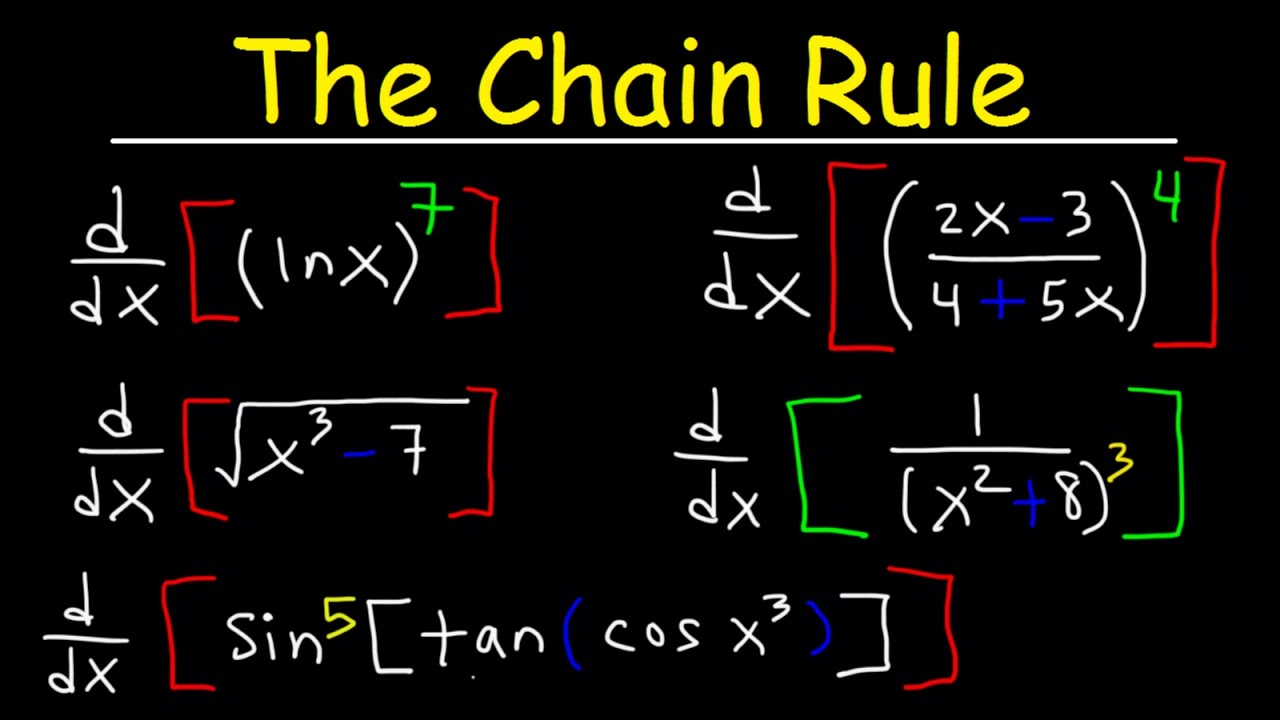
This calculus video tutorial explains how to find derivatives using the chain rule. This lesson contains plenty of practice problems including examples of chain rule problems with trig functions, square root & radicals, fractions, ln, product rule, and quotient rule. This video gives you a simple way to find the derivative of a function using ...
 sonic smelt
Start by Rewriting sqrt() as ()^(1/2)
dry oxide
you should watch this then
vestal thunder
yajat, i know, but it's the combination that's throwing me off.
 brazen star
combination of what? (oh there are so many helpers here, ima just go)
dry oxide
the terms
vestal thunder
let me write down what i mean, one moment please.
f.e.:
f'(x) = ½(11-2x)^½ + ½x * ½(11-2x)^-½ * -2
this is what the answer model shows as initial step
but idk how the heck they get there. why is the original function there again
like why is ½x√(11-2x) there again but just written differently
oh wait, ½(11-2x)^-½ * -2 is the derivative. * -2 comes from the derivative of 11-2x
but then I still do not understand why they're combining the two for the finished derivative.
dry oxide
you can use the sum rule for the first and second term and then use the product rule on the first one
and then use chain rule where needed
vestal thunder
i dont understand why i cant just apply (g(f(x)))' = g'(f(x)) * f'(x)
am i just stupid or am i missing sth here

like what step am i forgetting, and why?
vestal thunder
vestal thunder
f.e.:
``f'(x) = ½(11-2x)^½ + ½x * ½(11-2x)^-½ * -2``
cause here they have the same answer but they add the original function to the sum and i am confused on as to why
im sure its just some rule that im looking over, but bare with me, its been a long day 😅
product rule?
vestal thunder
vestal thunder
f.e.:
``f'(x) = ½(11-2x)^½ + ½x * ½(11-2x)^-½ * -2``
but then ig the answer wont be this either, since then it has to be in the shape of f'(x) * g(x) + f(x) * g'(x)
mayne what the- 🤣
devout snowBOT
@vestal thunder Has your question been resolved?
devout snowBOT
@vestal thunder Has your question been resolved?
devout snowBOT
Channel closed
Closed by @vestal thunder
Use .reopen if this was a mistake.
devout snowBOT
Available help channel!
Send your question here to claim the channel.
Remember:
• Ask your math question in a clear, concise manner.
• Show your work, and if possible, explain where you are stuck.
• After 15 minutes, feel free to ping <@&286206848099549185>.
• Type the command .close to free the channel when you're done.
• Be polite and have a nice day!
Read #❓how-to-get-help for further information on how to ask a good question, and about conduct in the question channels.
restive river
need hellp with all fo em
 devout snowBOT
restive river
need hellp with all fo em
devout snowBOT
restive river
need hellp with all fo em
 coral tulip
!status
devout snowBOT
What step are you on?
1. I don't know where to begin.
2. I have begun but got stuck midway.
3. I got an answer but I was told that it's wrong.
4. I got an answer and would like my work checked.
5. I have a question about someone else's work/solution.
6. I have completed the problem and don't need help anymore. Thank you.
7. None of the above
Also, an you give each question individually (preferably one by one)? My eyes hurt from having to look at small letters.
restive river
ok
the area of region bounded by curve 8x^2 + 6y^2 -16x + 12y + 13 = 0
pi/sqrt(40)
pi/(sqrt(48)
pi/sqrt(36)
pi/sqrt(60)
are options
coral tulip
What have you tried?
restive river
i tried putting it in form of (x - h) ^2 + (y-k)^2 = r^2, got 1 somehow
coral tulip
It isn't a circle
restive river
oh
coral tulip
I think ellipse
restive river
then waht do I do?
coral tulip
Try to convert in ellipse form
coral tulip
Then try another one
restive river
waht si the formulla to calculate area of ellipse?
restive river
the ratio of marbles with jack and dave is 13:9, if they have 10 more which ant be ratio
I 7:4
II 7:5
III 15:11
IV 31:23
how do I solve this?
coral tulip
Have you tried something?
coral tulip
You should learn some basics and then do problems
restive river
i guess
school doesnt teach basic stuff like number theory and combinatorics
any recommendations?
coral tulip
I have but they are not in English
coral tulip
restive river
school doesnt teach basic stuff like number theory and combinatorics
Yeah
restive river
coral tulip
I have but they are not in English
which language?
coral tulip
Hindi
coral tulip
Mohit tyagi sir on yt
devout snowBOT
Channel closed
Closed by @vale forge
Use .reopen if this was a mistake.
Available help channel!
Send your question here to claim the channel.
Remember:
• Ask your math question in a clear, concise manner.
• Show your work, and if possible, explain where you are stuck.
• After 15 minutes, feel free to ping <@&286206848099549185>.
• Type the command .close to free the channel when you're done.
• Be polite and have a nice day!
Read #❓how-to-get-help for further information on how to ask a good question, and about conduct in the question channels.
 junior mica
Are square roots one-to-one function?
devout snowBOT
junior mica
Are square roots one-to-one function?
junior mica
The second one
 dense jay
the second isnt 1-1 no
dense jay
something ^2?
 jaunty mantle
You can say that the sqrt function itself is one to one
jaunty mantle
$\sqrt{\cdot} : \mathbb R^{0+} \to \mathbb R^{0+}$
woven radishBOT
Frosst
 jaunty mantle
That’s 1 to 1
jaunty mantle
junior mica
For example x²+y²=4
Depends on what the domain is
junior mica
That's the given itself
Actually I'm a bit confused cos our instructor said if it has a sqrt it's 1-1
Now I researched abt it to be sure and most of the sites are saying it's not
So idk what to believe ._.
jaunty mantle
So you have f(x, y) = x² + y² - 4
This is clearly not one to one since there are multiple different x and y’s that give the same output
But also if you had y + x = 1 you could say f(x, y) = y + x - 1 is not 1 to 1
junior mica
Okay I kinda get it now
jaunty mantle
Now if you instead wrote y = f(x) = 1 - x then f is now one to one
So it depends how you look at an equation
devout snowBOT
Channel closed
Closed by @junior mica
Use .reopen if this was a mistake.
devout snowBOT
Available help channel!
Send your question here to claim the channel.
Remember:
• Ask your math question in a clear, concise manner.
• Show your work, and if possible, explain where you are stuck.
• After 15 minutes, feel free to ping <@&286206848099549185>.
• Type the command .close to free the channel when you're done.
• Be polite and have a nice day!
Read #❓how-to-get-help for further information on how to ask a good question, and about conduct in the question channels.
 sage socket
 devout snowBOT
sage socket
sage socket
devout snowBOT
sage socket
sage socket
I don't understand how this isn't the answer
pseudo basin
-sqrt(-64) 
sage socket
maybe I needed to put y = ?
sonic smelt
Like Ann noted, your solution doesn't match the initial condition
pseudo basin
your solution isnt even defined at x=0.
but it is impossible to diagnose where you went wrong, as you have not shown your owrk.
work*
sage socket

 sage socket
I originally put 32 but it said my solution was wrong so I figured it was ghat.
Hmmm
Wonder what else I did wrong
devout snowBOT
@sage socket Has your question been resolved?
devout snowBOT
@sage socket Has your question been resolved?
Channel closed
Closed by @sage socket
Use .reopen if this was a mistake.
Available help channel!
Send your question here to claim the channel.
Remember:
• Ask your math question in a clear, concise manner.
• Show your work, and if possible, explain where you are stuck.
• After 15 minutes, feel free to ping <@&286206848099549185>.
• Type the command .close to free the channel when you're done.
• Be polite and have a nice day!
Read #❓how-to-get-help for further information on how to ask a good question, and about conduct in the question channels.
 rigid rain
I need to find an equation for the tangent line at point (c,f(c)) where am i going wrong here
 devout snowBOT
rigid rain
I need to find an equation for the tangent line at point (c,f(c)) where am i goi...
devout snowBOT
devout snowBOT
rigid rain
I need to find an equation for the tangent line at point (c,f(c)) where am i goi...
devout snowBOT
Channel closed
Closed by @rigid rain
Use .reopen if this was a mistake.
Available help channel!
Send your question here to claim the channel.
Remember:
• Ask your math question in a clear, concise manner.
• Show your work, and if possible, explain where you are stuck.
• After 15 minutes, feel free to ping <@&286206848099549185>.
• Type the command .close to free the channel when you're done.
• Be polite and have a nice day!
Read #❓how-to-get-help for further information on how to ask a good question, and about conduct in the question channels.
 halcyon perch
Can anyone help me write a statement-reasoning chart (aka a proof) for this to find the answer? I already did the first statement and reasoning, which is AB=AC=X, the statement, and Definition of isocolese triangle, the reasoning, but I do not know what to do after that.
 devout snowBOT
halcyon perch
Can anyone help me write a statement-reasoning chart (aka a proof) for this to f...
devout snowBOT
halcyon perch
Can anyone help me write a statement-reasoning chart (aka a proof) for this to f...
 haughty pendant
Is there a specific way the teacher wants you to write the proof?
halcyon perch
Hmm, im not very sure, but she always starts with Definiton of Isocolese triangle (for the reasoning), and then base angels theorum (for the second reasoning)
But I do not think it works for this specific problem
devout snowBOT
@halcyon perch Has your question been resolved?
halcyon perch
<@&286206848099549185>
halcyon perch
.close
devout snowBOT
Channel closed
Closed by @halcyon perch
Use .reopen if this was a mistake.
Available help channel!
Send your question here to claim the channel.
Remember:
• Ask your math question in a clear, concise manner.
• Show your work, and if possible, explain where you are stuck.
• After 15 minutes, feel free to ping <@&286206848099549185>.
• Type the command .close to free the channel when you're done.
• Be polite and have a nice day!
Read #❓how-to-get-help for further information on how to ask a good question, and about conduct in the question channels.
 cold gust
Got part a and b
 devout snowBOT
cold gust
Got part a and b
devout snowBOT
devout snowBOT
cold gust
Got part a and b
devout snowBOT
Channel closed
Closed by @cold gust
Use .reopen if this was a mistake.
Available help channel!
Send your question here to claim the channel.
Remember:
• Ask your math question in a clear, concise manner.
• Show your work, and if possible, explain where you are stuck.
• After 15 minutes, feel free to ping <@&286206848099549185>.
• Type the command .close to free the channel when you're done.
• Be polite and have a nice day!
Read #❓how-to-get-help for further information on how to ask a good question, and about conduct in the question channels.
 main oasis
The blue line is made of 2 semicircles.
The red line is made of 4 semicircles
The red line and the blue line share their beginning and their end. (Shown in the picture)
Mark the true sentence:
A: The blue line is longer
B: The red line is longer
C: They are of equal length
D: Not enough information
I have no idea where to start. Could someone please help?
 devout snowBOT
main oasis
*The blue line is made of 2 semicircles.*
*The red line is made of 4 semicircles...
devout snowBOT
devout snowBOT
main oasis
*The blue line is made of 2 semicircles.*
*The red line is made of 4 semicircles...
devout snowBOT
Channel closed
Closed by @main oasis
Use .reopen if this was a mistake.
Available help channel!
Send your question here to claim the channel.
Remember:
• Ask your math question in a clear, concise manner.
• Show your work, and if possible, explain where you are stuck.
• After 15 minutes, feel free to ping <@&286206848099549185>.
• Type the command .close to free the channel when you're done.
• Be polite and have a nice day!
Read #❓how-to-get-help for further information on how to ask a good question, and about conduct in the question channels.
 fervent jewel
 devout snowBOT
fervent jewel
fervent jewel
devout snowBOT
fervent jewel
fervent jewel
The limit of this sequence is i, right?
 sullen island
i'd probably look at the modulus and argument of (1+i)/sqrt(2)
at a quick glance it doesn't converge
@fervent jewel
 cold bough
it's a unit vector
sullen island
sure
cold bough
it doesn t converge . it goes trough every quarter of the unit circle forever
sullen island
are you whotao?
fervent jewel
the modulus of the sequence, is it not 0?
sullen island
(1+i)/sqrt(2) definitely has modulus 1
cold bough
sullen island
are you whotao?
no i am not
sullen island
cold bough
no i am not
alright
fervent jewel
right.
fervent jewel
sullen island
at a quick glance it doesn't converge
Hm what does the modulus have to do with it though? Since I think it is generally false that if |zn| -> |A| then zn -> A
sullen island
it's the argument that's problematic
as everg said, it increases pi/4 for each term
z_n just spins around the unit circle
1, cis(pi/4), cis(pi/2), cis(3pi/4), cis(pi), ..., cis(2pi) = 1, ...repeating
that is your sequence @fervent jewel
fervent jewel
oh. i see
fervent jewel
sullen island
1, cis(pi/4), cis(pi/2), cis(3pi/4), cis(pi), ..., cis(2pi) = 1, ...repeating
so I can write it out like this
that makes it easy to see
sullen island
yup
fervent jewel
thanks
devout snowBOT
Channel closed
Closed by @fervent jewel
Use .reopen if this was a mistake.
Available help channel!
Send your question here to claim the channel.
Remember:
• Ask your math question in a clear, concise manner.
• Show your work, and if possible, explain where you are stuck.
• After 15 minutes, feel free to ping <@&286206848099549185>.
• Type the command .close to free the channel when you're done.
• Be polite and have a nice day!
Read #❓how-to-get-help for further information on how to ask a good question, and about conduct in the question channels.
 dry sentinel
A quick question
devout snowBOT
dry sentinel
A quick question
dry sentinel
First of all sorry if I can't explain myself at all, I'm not too good talking about maths in English
I wanted to know if there is any reason like a axiom or a theorem that explains why in a matrix (I think that's how it's called in English) you can do any number of elemental operations without changing the state of lineal dependence or lineal independence of its lines or columns
 worthy solar
you may want to look into the fundamental theorem of invertible matrices
dry sentinel
And why is this property of the matrix useful? I mean, that enables me to use the Gauss method and the Gauss-Jordan method, but there are other methods to do the same thing that we can do with them (using the determinant of the matrix to calc the inverse or to discover if there's some line with lineal dependence) idk if I there's maybe any other uses of them that I haven't studied yet, but even having those alternative ways to get the same things (which are even faster) the teacher puts many interest in Gauss and Gauss-Jordan
cold bough
if you have a linear system then you can find the solution faster if you put it in starecase form
sullen island
dry sentinel
And why is this property of the matrix useful? I mean, that enables me to use th...
using determinants to compute inverses is awfully slow in general
cold bough
if you want that staircase form you have to do the elementary operation on the row
sullen island
gaussian elimination is pretty much the fastest thing we have to solve systems if you don't know anything else about the matrix
cold bough
there are linear system that "are not invertible" so you can t simply compute the inverse ...you have to put it in staircase form
 stone stump
elementary row operations correspond to multiplying the system Ax=b with an elementary matrix from the left. so EAx=Eb. which doesnt change the set of solutions x
worthy solar
and in general matrices are not square so in most cases there is no determinant
dry sentinel
So I could do any permutation and my matrix wouldn't change its determinant, so it wouldn't change if it's invertible or not, so its not dependence won't change isn't it?
stone stump
permutations do change the determinant by a factor of +-1
they dont change whether the determinant is nonzero
aka whether the matrix is invertible
dry sentinel
Oh I understand
Thank you all ^^
And about the other thing I guess that it's just simple to calculate with both methods
Thanks!
.close
devout snowBOT
Channel closed
Closed by @dry sentinel
Use .reopen if this was a mistake.
devout snowBOT
Available help channel!
Send your question here to claim the channel.
Remember:
• Ask your math question in a clear, concise manner.
• Show your work, and if possible, explain where you are stuck.
• After 15 minutes, feel free to ping <@&286206848099549185>.
• Type the command .close to free the channel when you're done.
• Be polite and have a nice day!
Read #❓how-to-get-help for further information on how to ask a good question, and about conduct in the question channels.
 pallid marsh
How do i evolve/simplify
3x³ × 3x³ divided by x³ + x³ + x³
pallid marsh

 onyx cedar
Take out a common factor
pallid marsh
how tho
 lament cradle
combine like terms of denominator and it should pop out at you
onyx cedar
 pallid marsh
like 3(something)?
onyx cedar
pallid marsh
which is x³?
YES
pallid marsh
then that times what?
lament cradle
can you simplify x + x + x?
pallid marsh
yeah 3x?
onyx cedar
pallid marsh
then that times what?
 lament cradle
okay now do that to the denominator
x^3 + x^3 + x^3
what is it
you know how to do this, what is the answer
pallid marsh
so js 3x³?
lament cradle
so we have (3x^3)^2/3x^3
what can we do when a numerator and denominator share a common factor?
lament cradle
what is $\frac{3\cdot3}{3}$?
woven radishBOT
b0ngl0rd
 pallid marsh
Its 3?
lament cradle
right but how did you do that? did you multiply out and then divide, or did you just cancel out a 3 from the top and bottom?
pallid marsh
multiplied n divided, faster to cancel out then?
 pallid marsh
i'll do that in the future then
woven radishBOT
b0ngl0rd
 lament cradle

 lament cradle
3x^3 is the answer
pallid marsh
ye
n x³ + x³ +x³ is the same as 3x³
so ik thst better now
thanks @onyx cedar, @lament cradle
gona close it
.close
devout snowBOT
Channel closed
Closed by @pallid marsh
Use .reopen if this was a mistake.
devout snowBOT
Available help channel!
Send your question here to claim the channel.
Remember:
• Ask your math question in a clear, concise manner.
• Show your work, and if possible, explain where you are stuck.
• After 15 minutes, feel free to ping <@&286206848099549185>.
• Type the command .close to free the channel when you're done.
• Be polite and have a nice day!
Read #❓how-to-get-help for further information on how to ask a good question, and about conduct in the question channels.
 coral dome
why is this wrong?

 devout snowBOT
coral dome
why is this wrong?
devout snowBOT
coral dome
why is this wrong?
 zinc veldt
did you use the chain rule
coral dome
yes
zinc veldt
maybe write out the entire formula
coral dome
?
winter patrol
you're differentiating stuff you shouldn't be
y = g(sec^2(x))
apply chain rule for the derivative of that.
what's the first thing you get?
don't worry about the rest of the question or further simplification
devout snowBOT
Channel closed
Closed by @coral dome
Use .reopen if this was a mistake.
devout snowBOT
Available help channel!
Send your question here to claim the channel.
Remember:
• Ask your math question in a clear, concise manner.
• Show your work, and if possible, explain where you are stuck.
• After 15 minutes, feel free to ping <@&286206848099549185>.
• Type the command .close to free the channel when you're done.
• Be polite and have a nice day!
Read #❓how-to-get-help for further information on how to ask a good question, and about conduct in the question channels.
 flint flume
z satisfies arg(z+i) = arg(z-1). Sketch locus of p representing z in the argand diagram
devout snowBOT
flint flume
z satisfies arg(z+i) = arg(z-1). Sketch locus of p representing z in the argand ...
flint flume
do u move arg(z-1) to other side to get arg(z+i) - arg(z-1) = 0
then arg((z-(-i)/(z-1)) = 0
flint flume
i meant z-(-i)
 smoky abyss
ok
flint flume
to skecth the locus do i just plot i and x=1 with open circle
and then arrow going out
smoky abyss
If you have the form memorized, you can do that. otherwise, you can let z=x+iy and apply the arg(z) definition to get it in terms of x and y cartesian equation
but be careful of domain
flint flume
wdym domain
smoky abyss
You might get the equation of a circle
but it won't be the full circle
that's what i mean be careful of domain
flint flume
u mean like it might exclude the point
smoky abyss
right
flint flume
so u have to sub the point back in to see if its a closed point
flint flume
smoky abyss
right
im also not sure how to find the cartesuian equation
smoky abyss
So, you let $z=x+iy$, then you will have $$\arg(\frac{x+iy+i}{x+iy-1})$$ and then you simplify and stuff. And you apply the definition of $\arg(z)$
woven radishBOT
Ratatatat
 flint flume
how do u simplify
smoky abyss
Multiply top and bottom by conjugate of the denominator. So, (x-1) - iy
Then you will have a real part and imaginary part
then you apply definition of arg
flint flume
so since the arg = 0 it must be real
purely real
so u just take the purely real part
smoky abyss
right
flint flume
alr

i got this somehow
isnt the denominator suppose to be real because its a sum of 2 squares
(x-1)^2+y^2
smoky abyss
flint flume
(x-1)^2+y^2
Yes
Now turn into a real part and imaginary part
and equate the imaginary part to 0
For questions like this, when you in exam conditions, it's best to just memorize the form as time matters in the exam and the derivation can be an algebra grind.
You can also use geogebra to check your answer
 flint flume
why wolfram alpha say smth different tho
flint flume
smoky abyss
For questions like this, when you in exam conditions, it's best to just memorize...
whats form mean
smoky abyss
flint flume
why wolfram alpha say smth different tho
Because you are multiplying by 1. Wolfram gives you the same the expression you started with. Instead, write this in wolfram: $((x-1)+iy)((x-1)-iy)$
woven radishBOT
Ratatatat
 flint flume
 smoky abyss
say expand or something
flint flume
should expand to real
ye
does form mean like what the arrow directions look like
like if it was = pi/2 its a semicricle
smoky abyss
flint flume
like if it was = pi/2 its a semicricle
yes. like if u plot some, like this,

u will see some kind of pattern emerge
i cant remember what it is because i havent done this in a while
flint flume
u mean like whether somethings forms a major/minor arc and stuff
smoky abyss
but the center is related to the complex numbers
flint flume
for the final result i get (x^2 - (1 - i) x + y^2 + (1 - i) y - i)/(x-1)^2+y^2
smoky abyss
Yeah, I just plotted it
turns out in this case, it's a straight line
But I am not sure if it will be the full straight line
Probably not, maybe someone else can weigh in because im rusty on this topic
devout snowBOT
@flint flume Has your question been resolved?
Channel closed
Closed by @flint flume
Use .reopen if this was a mistake.
Available help channel!
Send your question here to claim the channel.
Remember:
• Ask your math question in a clear, concise manner.
• Show your work, and if possible, explain where you are stuck.
• After 15 minutes, feel free to ping <@&286206848099549185>.
• Type the command .close to free the channel when you're done.
• Be polite and have a nice day!
Read #❓how-to-get-help for further information on how to ask a good question, and about conduct in the question channels.
 mystic bloom
 devout snowBOT
mystic bloom
mystic bloom
devout snowBOT
mystic bloom
mystic bloom
Is it 5.337
restive river
i don't think so
 tacit wedge