Channel closed
Closed by @green verge
Use .reopen if this was a mistake.
1 messages · Page 101 of 1
 devout snowBOT
Closed by @green verge
Use .reopen if this was a mistake.
devout snowBOT
 Available help channel!
Send your question here to claim the channel.
Remember:
• Ask your math question in a clear, concise manner.
• Show your work, and if possible, explain where you are stuck.
• After 15 minutes, feel free to ping <@&286206848099549185>.
• Type the command .close to free the channel when you're done.
• Be polite and have a nice day!
Read #❓how-to-get-help for further information on how to ask a good question, and about conduct in the question channels.
 jaunty mantle
Hello friends
devout snowBOT
jaunty mantle
Hello friends
jaunty mantle

So why is it like that on the right side
Doesn’t the preimage of {z} under f give only the 2 sets in the σ-algebra of M (domain of f) whose measure is z?
Or maybe a better way to phrase it is what does the preimage of {z} under f look like
Here’s what I think: all k ∈ M such that f(k) = z is included in the preimage of {z} under f, ie the union of all such k’s
 supple knot
Wtf does that even say
jaunty mantle
;-;
Let $f$ be a non negative measurable function.
$\$1) Markov Inequality.
$\\int f d\mu \geq z\cdot \mu(\text{preim}_f({z}))$
 woven radishBOT
Frosst
 jaunty mantle
What I think it should say:
$\\int f d\mu \geq z\cdot \mu(\text{preim}_f({s\in\mathbb{R}^{+0}| s\geq z}))$
woven radishBOT
Frosst
 devout snowBOT
@jaunty mantle Has your question been resolved?
 arctic field
jaunty mantle
Let $f$ be a non negative measurable function.
$\\$1) Markov Inequality.
$\\\int...
arctic field
jaunty mantle
Let $f$ be a non negative measurable function.
$\\$1) Markov Inequality.
$\\\int...
[ f \ge z , \chi_{\set {f = z}} ]
woven radishBOT
 jaunty mantle
jaunty mantle
jaunty mantle
Doesn’t that on his example give only the 2 points where z intersects the function?
woven radishBOT
 arctic field
this is also true
jaunty mantle
But how do we measure just 2 sets
arctic field
2 sets?
jaunty mantle
Doesn’t the measure function take in a set (an element) of the σ-algebra?
jaunty mantle
jaunty mantle
Doesn’t that on his example give only the 2 points where z intersects the functi...
Well the 2 points are 2 sets aren’t they?
2 sets (elements) of the σ-algebra
arctic field
[ \set {f = z} = f^{-1}(z) = \set {x \in \op{dom} f \where f(x) = z} ]
woven radishBOT
 arctic field
it's a set
jaunty mantle
Ok
Then we can split them up and measure them separately?
Then we add them together?
arctic field
well the measure is defined on this set when f is measurable
arctic field
so there's no need to "split" since μ of that set is well defined
jaunty mantle
Cos otherwise you don’t get everything between
jaunty mantle
jaunty mantle
What he’s saying here is that the blue area is less than or equal to the white and blue area
arctic field
yes
jaunty mantle
Sure but that’s only equality
Which fine you can have non-strict inequality
But that inequality part is meaningless
jaunty mantle
Let’s say the 2 points of intersection is a, b
arctic field
sure
jaunty mantle
mu({a, b}) and mu({a, a₁, a₂, …, b}) aren’t the same right?
Well, unless the middle bits have measure 0
Then they are equal
jaunty mantle
jaunty mantle
mu({a, b}) and mu({a, a₁, a₂, …, b}) aren’t the same right?
But if they aren’t measure 0 then the right side is bigger than the left side
arctic field
yeah
jaunty mantle
So what’s the point of saying int f dmu >= z mu({a, b}) when this is trivial, and equality only when the middle bits have measure = mu({a})
Wouldn’t it make more sense to talk about how it’s > when the middle bits have measure > mu({a})
arctic field

arctic field
f could have a part which is constant at z
but i think they meant to write >= z
the usual markov inequality has >=
jaunty mantle
Ok if I’m not the only one that thinks there should be a >= so it’s not a trivial statement
Then I’m probably not going crazy yet
I mean I can see that the inequality holds, but is trivial
jaunty mantle
Well the integral part already measures {a, b}, so with the rest of the integral it must be at least the measure of {a, b}
arctic field
woven radish
it's a consequence of this pointwise inequality of functions
yeah but f^-1(z) could be much more than just two points
and much worse behaved
jaunty mantle
woven radish
Shouldn’t this just have f = z chi_{f=z}
Well it’s not wrong but isn’t it more reasonable
jaunty mantle
Oh
Oh wait the chi only gives 0 or 1
So when f ≠ z, then f >= 0
Nice
When f = z, then f = z
So in general, f >= z chi_{f=z}
arctic field
yeah
devout snowBOT
Closed by @jaunty mantle
Use .reopen if this was a mistake.
devout snowBOT
Available help channel!
Send your question here to claim the channel.
Remember:
• Ask your math question in a clear, concise manner.
• Show your work, and if possible, explain where you are stuck.
• After 15 minutes, feel free to ping <@&286206848099549185>.
• Type the command .close to free the channel when you're done.
• Be polite and have a nice day!
Read #❓how-to-get-help for further information on how to ask a good question, and about conduct in the question channels.
 restive river
Currently, I am working on polynomials. I am comparing the tasks and the content in the books. Could I have made a mistake?
 devout snowBOT
restive river
Currently, I am working on polynomials. I am comparing the tasks and the content...
restive river
devout snowBOT
restive river
Currently, I am working on polynomials. I am comparing the tasks and the content...
restive river
I also watched the tutorial to remind myself
restive river
5
 pseudo basin
did you maybe mean x^5
restive river
yes
pseudo basin
okay so you're dividing x^5 + 3x^2 - 4x + 1 by x^2 - 3
restive river
-3
pseudo basin
and you are confused because terms of different degree ended up under each other
is that what happened
restive river
I have the same done task in my notebook and it doesn't say 6x^5
pseudo basin
...
this
does not answer my question at all
oh also $3x^2 + 3x^3 \neq 6x^5$ at all if that's what you thought
woven radishBOT
Ann
 restive river
ummm I divided x^2-3 by x^3 and got x^5-3x^3 when I subtract that, what do you get?
frst is 0 but yhen u have 6x^5 and that doesn't match my notebook
pseudo basin
you get $3x^3 + 3x^2 - 4x + 1$
woven radishBOT
Ann
 pseudo basin
restive river
frst is 0 but yhen u have 6x^5 and that doesn't match my notebook
pseudo basin
restive river
frst is 0 but yhen u have 6x^5 and that doesn't match my notebook
no you don't have 6x^5.
no you don't have 6x^5.
3x^2 + 3x^3 is not 6x^5.
by your logic x + x is 2x^2.
which it isn't
pseudo basin
no the tutorial isn't bad
YOU are bad for thinking exponents add like this.
do you really honestly think that 3 * x * x + 3 * x * x * x equals (3+3) * x * x * x * x * x?
restive river
+3x^2 - (-3x^3) is not 6x^5
pseudo basin
you're right it is not!
restive river
bro what is this
oh
when I can't just take subtraction i just rewrite them
cus that is +3x^2+3x^3
.close
devout snowBOT
Closed by @young geyser
Use .reopen if this was a mistake.
Available help channel!
Send your question here to claim the channel.
Remember:
• Ask your math question in a clear, concise manner.
• Show your work, and if possible, explain where you are stuck.
• After 15 minutes, feel free to ping <@&286206848099549185>.
• Type the command .close to free the channel when you're done.
• Be polite and have a nice day!
Read #❓how-to-get-help for further information on how to ask a good question, and about conduct in the question channels.
 silver anchor
Whats the best way to simplify this?
 devout snowBOT
silver anchor
Whats the best way to simplify this?
devout snowBOT
silver anchor
Whats the best way to simplify this?
 winter torrent
poly'l division
silver anchor
Could you help me with it? Idk how to solve it though
supple knot
silver anchor
Could you help me with it? Idk how to solve it though

This precalculus video tutorial provides a basic introduction into synthetic division of polynomials. You can use it to find the quotient and remainder of a division problem with polynomials. This video contains plenty of examples and practice problems.
Algebra 1 Review:
https://www.video-tutor.net/algebra-for-beginners-basic-introduction.h...
the video has specific numbers, but you'll have to use variables a, b, and c
winter torrent
i would use long division over synthetic
silver anchor
Im trying to do it with long division but i dont get it
Ill try it again later thanks
.close
devout snowBOT
Closed by @silver anchor
Use .reopen if this was a mistake.
supple knot
silver anchor
Im trying to do it with long division but i dont get it
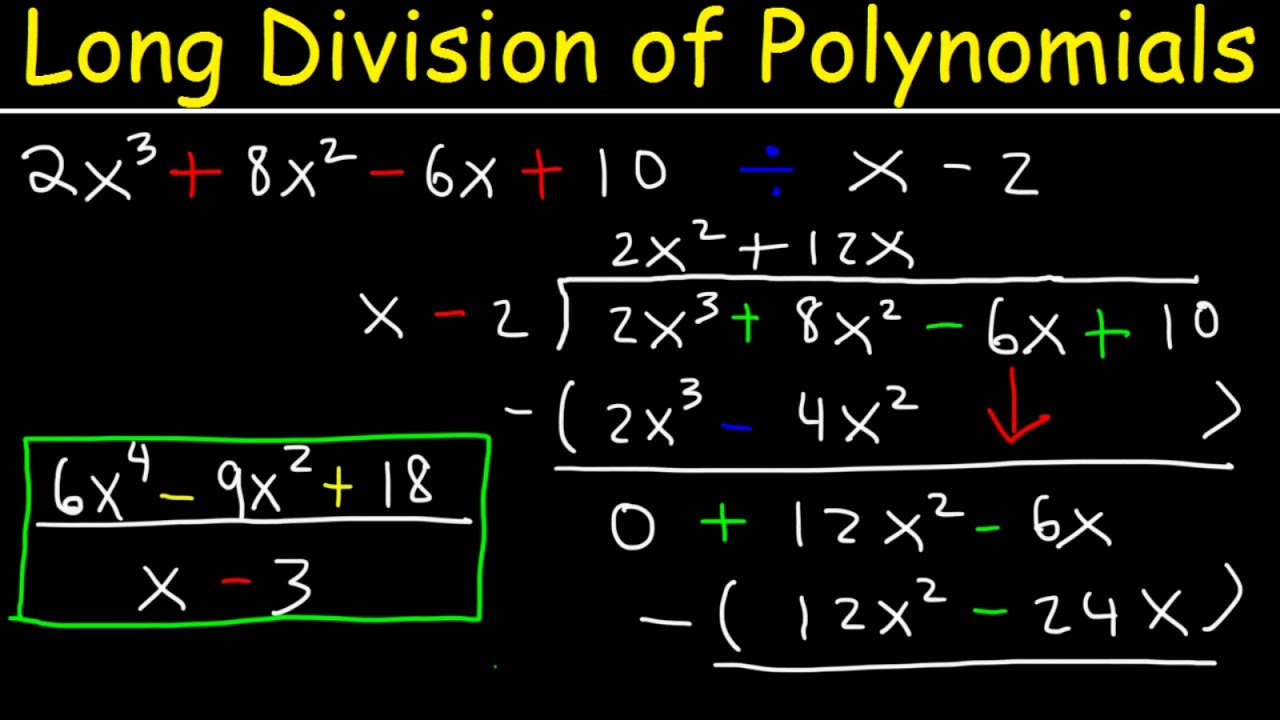
This video tutorial explains how to perform long division of polynomials with remainder and with missing terms. It's explains how to do long division easily and it provides the step by step process to get it done. Basically, there are 3 steps that you have to repeat. 1. Divide 2. Multiply 3. Subtract This video contains plenty of ex...
winter torrent
$\polylongdiv[stage=1]{x^4+x^3-2x^2-5x+6}{x^2-2x+1}$
woven radishBOT
hayley!
 devout snowBOT
Available help channel!
devout snowBOT
Available help channel!
Send your question here to claim the channel.
Remember:
• Ask your math question in a clear, concise manner.
• Show your work, and if possible, explain where you are stuck.
• After 15 minutes, feel free to ping <@&286206848099549185>.
• Type the command .close to free the channel when you're done.
• Be polite and have a nice day!
Read #❓how-to-get-help for further information on how to ask a good question, and about conduct in the question channels.
restive river
$y=2^{2} + 16x + 30$
devout snowBOT
restive river
$y=2^{2} + 16x + 30$
woven radishBOT
Chocolate
 restive river
how can I turn this to vertex form
 trail eagle
You're missing an x. Once it's fixed, you find the vertex form by completing the square.
restive river
trail eagle
You're missing an x. Once it's fixed, you find the vertex form by completing the...
great explanations, Thank you sir
short, using simple words, concise, brief, amazing explanation mate
.close
devout snowBOT
Closed by @rigid ivy
Use .reopen if this was a mistake.
devout snowBOT
Available help channel!
Send your question here to claim the channel.
Remember:
• Ask your math question in a clear, concise manner.
• Show your work, and if possible, explain where you are stuck.
• After 15 minutes, feel free to ping <@&286206848099549185>.
• Type the command .close to free the channel when you're done.
• Be polite and have a nice day!
Read #❓how-to-get-help for further information on how to ask a good question, and about conduct in the question channels.
 stable atlas
 devout snowBOT
stable atlas
stable atlas
devout snowBOT
stable atlas
stable atlas
how do i get the 1/s part
 supple pasture
Do you know about partial fractions?
supple pasture
stable atlas
how do i get the 1/s part
You mean by how 1/s(s^2+1) is equal to 1/s-s/(s^+1) right?
supple pasture
Ok
stable atlas
like i dont understand how that works
supple pasture
If you only want to verify it, you can use the common denominator method for adding and subtracting fractions
stable atlas
supple pasture
If you only want to verify it, you can use the common denominator method for add...
how do i do that
supple pasture
 stable atlas
supple pasture
stable atlas
supple pasture
oh ik how to do this
i just dont know how to implement it into my qns
supple pasture
In this case a is 1, b is s, c is s, d is s^2+1
stable atlas
supple pasture
In this case a is 1, b is s, c is s, d is s^2+1
ahhh okay that makes sense
ty
.close
devout snowBOT
Closed by @stable atlas
Use .reopen if this was a mistake.
Available help channel!
Send your question here to claim the channel.
Remember:
• Ask your math question in a clear, concise manner.
• Show your work, and if possible, explain where you are stuck.
• After 15 minutes, feel free to ping <@&286206848099549185>.
• Type the command .close to free the channel when you're done.
• Be polite and have a nice day!
Read #❓how-to-get-help for further information on how to ask a good question, and about conduct in the question channels.
 hasty flame
 devout snowBOT
hasty flame
hasty flame
devout snowBOT
hasty flame
hasty flame
is my halfassed explanation gud nuf
devout snowBOT
@hasty flame Has your question been resolved?
 ornate creek
I need help
devout snowBOT
@hasty flame Has your question been resolved?
devout snowBOT
@hasty flame Has your question been resolved?
devout snowBOT
@hasty flame Has your question been resolved?
devout snowBOT
Closed due to timeout
Use .reopen if this was a mistake.
Available help channel!
Send your question here to claim the channel.
Remember:
• Ask your math question in a clear, concise manner.
• Show your work, and if possible, explain where you are stuck.
• After 15 minutes, feel free to ping <@&286206848099549185>.
• Type the command .close to free the channel when you're done.
• Be polite and have a nice day!
Read #❓how-to-get-help for further information on how to ask a good question, and about conduct in the question channels.
devout snowBOT
 short hinge
I have no idea where to start
short hinge
I have no idea where to start
 winter patrol
the 2 is on the wrong side, also make sure you write a multiplication symbol between the 2 and the fraction
short hinge
 short hinge
winter patrol
the 2 is on the wrong side, also make sure you write a multiplication symbol bet...
short hinge
winter patrol
the 2 is on the wrong side, also make sure you write a multiplication symbol bet...
Ok
Wait but the big R
Is twice the size
Right
 manic condor
Yeah. Exactly. It can be confused as a mixed fraction so make sure to use a multiplication symbol or dot.
 prime hollow
If you multiply it it is 4 times
short hinge
manic condor
Yeah. Exactly. It can be confused as a mixed fraction so make sure to use a mult...
Ok I will do that in the future
manic condor
short hinge
Is twice the size
Yes. So, one with R has more volume. Right?
short hinge
manic condor
Yes. So, one with R has more volume. Right?
Yes
So 2 * formula for R = formula for r
manic condor
So shouldn't you be multiplying the smaller one with 2 so that volume of smaller one becomes equal to volume of bigger one?
short hinge
wait wtf yeah ur right
Idk what I was thinking thx
So it becomes that


7

Did I do it right? Like I got the same answer but I want to make sure I did it the right way
winter patrol
type .close
short hinge
.close
devout snowBOT
Closed by @short hinge
Use .reopen if this was a mistake.
devout snowBOT
Available help channel!
Send your question here to claim the channel.
Remember:
• Ask your math question in a clear, concise manner.
• Show your work, and if possible, explain where you are stuck.
• After 15 minutes, feel free to ping <@&286206848099549185>.
• Type the command .close to free the channel when you're done.
• Be polite and have a nice day!
Read #❓how-to-get-help for further information on how to ask a good question, and about conduct in the question channels.
 languid vessel
 devout snowBOT
languid vessel
devout snowBOT
languid vessel
 lucid oracle
No this graph represents the position of the boat, not the velocity. Remember that the displacement is simply the difference in the position of the object and is independent of the path taken when traveling between those two positions
Therefor the displacement is the distance between where the object is at time t=16 and at time t=0
which is -15 meters from our reference point minus 6 meters from our reference point
devout snowBOT
Closed by @languid vessel
Use .reopen if this was a mistake.
devout snowBOT
Available help channel!
Send your question here to claim the channel.
Remember:
• Ask your math question in a clear, concise manner.
• Show your work, and if possible, explain where you are stuck.
• After 15 minutes, feel free to ping <@&286206848099549185>.
• Type the command .close to free the channel when you're done.
• Be polite and have a nice day!
Read #❓how-to-get-help for further information on how to ask a good question, and about conduct in the question channels.
 wooden axle
Can we apply epsilon delta of limit definition to check limit exist?
wooden axle
Or just check f(a+h) =f(a-h) existantance
 sour meteor
You can
wooden axle
Can I drop a question?
sour meteor
You can
sour meteor
No way it's asking this
wooden axle
What?
sour meteor
I don't know how to prof $\lim_{x\to 0 } \dfrac{\sin x }{x} = 1$ with eps delta
woven radishBOT
tales
 sour meteor
wooden axle
What?
sour meteor
wooden axle
What?
Is it specifically written epsilon delta proof?
wooden axle
sour meteor
Is it specifically written epsilon delta proof?
Nope
It's only me who is trying 
sour meteor
woven radish
**tales**
Then you have to prove this with eps delta
wooden axle
I know it's exist
sour meteor
And prove product rule
sour meteor
sour meteor
And prove product rule
that's easier
wooden axle
I don't know how to do it
sour meteor
sour meteor
Then you have to prove this with eps delta
I searched online and there is no proof

How can one prove the statement
$$\lim_{x\to 0}\frac{\sin x}x=1$$
without using the Taylor series of $\sin$, $\cos$ and $\tan$? Best would be a geometrical solution.
This is homework. In my math c...
devout snowBOT
@wooden axle Has your question been resolved?
devout snowBOT
Closed due to timeout
Use .reopen if this was a mistake.
Available help channel!
Send your question here to claim the channel.
Remember:
• Ask your math question in a clear, concise manner.
• Show your work, and if possible, explain where you are stuck.
• After 15 minutes, feel free to ping <@&286206848099549185>.
• Type the command .close to free the channel when you're done.
• Be polite and have a nice day!
Read #❓how-to-get-help for further information on how to ask a good question, and about conduct in the question channels.
 chrome stag
I'm not sure how to calculate the original price of the car here or how to find the interest paid. The answer to one of them leads to the answer of the other ofc since I know how much Madeline paid for the car. Which do I solve for first and how? (Attachment 1 is the problem and confirmed correct figures I have come up with, Attachment 2 is the work I have done, and Attachment 3 is the given formula sheet)


 devout snowBOT
chrome stag
I'm not sure how to calculate the original price of the car here or how to find ...
devout snowBOT
chrome stag
I'm not sure how to calculate the original price of the car here or how to find ...
@chrome stag Has your question been resolved?
chrome stag
<@&286206848099549185> Sorry to bother, just using the ping since I can use it once after 15 minutes
devout snowBOT
@chrome stag Has your question been resolved?
 novel totem
The principal is the original amount of the loan - P by definition
devout snowBOT
@chrome stag Has your question been resolved?
chrome stag
It was that simple, dang
chrome stag
novel totem
The principal is the original amount of the loan - P by definition
Thanks for the help!
.close
devout snowBOT
Closed by @chrome stag
Use .reopen if this was a mistake.
devout snowBOT
Available help channel!
Send your question here to claim the channel.
Remember:
• Ask your math question in a clear, concise manner.
• Show your work, and if possible, explain where you are stuck.
• After 15 minutes, feel free to ping <@&286206848099549185>.
• Type the command .close to free the channel when you're done.
• Be polite and have a nice day!
Read #❓how-to-get-help for further information on how to ask a good question, and about conduct in the question channels.
 dry oxide
 dry oxide
help anyone
and please try to guide me further from the second step i did
because our teacher told this as a hint
i tried using sinC+sinD and inverse in the denominator
but didnt do anything
 red turret
no need
woven radishBOT
Dyssrupt
 dry oxide
wait lemme do it this way
red turret
you should've noticed that the sum was 90 degrees
dry oxide
wait what do you mean, does this identity is apllicable if A+B=90?
dry oxide
woven radish
**Dyssrupt**
wait, i dont know this identity
woven radishBOT
Dyssrupt
 red turret
for denominator
red turret
dry oxide
wait, i dont know this identity
um
use C D formula on where you left
you'll eventually get this
woven radishBOT
 dry oxide
i think i did something wrong?, didnt i?
red turret
combine the pairs to form sin(2x)
 dry oxide
yeah i thought of that
devout snowBOT
@dry oxide Has your question been resolved?
devout snowBOT
Closed due to timeout
Use .reopen if this was a mistake.
devout snowBOT
Available help channel!
Send your question here to claim the channel.
Remember:
• Ask your math question in a clear, concise manner.
• Show your work, and if possible, explain where you are stuck.
• After 15 minutes, feel free to ping <@&286206848099549185>.
• Type the command .close to free the channel when you're done.
• Be polite and have a nice day!
Read #❓how-to-get-help for further information on how to ask a good question, and about conduct in the question channels.
supple pasture

In mathematics, smooth functions (also called infinitely differentiable functions) and analytic functions are two very important types of functions. One can easily prove that any analytic function of a real argument is smooth. The converse is not true, as demonstrated with the counterexample below.
One of the most important applications of smoot...
devout snowBOT
supple pasture
The page: https://en.wikipedia.org/wiki/Non-analytic_smooth_function
@supple pasture Has your question been resolved?
devout snowBOT
Closed due to timeout
Use .reopen if this was a mistake.
devout snowBOT
Available help channel!
Send your question here to claim the channel.
Remember:
• Ask your math question in a clear, concise manner.
• Show your work, and if possible, explain where you are stuck.
• After 15 minutes, feel free to ping <@&286206848099549185>.
• Type the command .close to free the channel when you're done.
• Be polite and have a nice day!
Read #❓how-to-get-help for further information on how to ask a good question, and about conduct in the question channels.
Closed by @hardy tapir
Use .reopen if this was a mistake.
 formal bronze
Show your work
devout snowBOT
Available help channel!
Send your question here to claim the channel.
Remember:
• Ask your math question in a clear, concise manner.
• Show your work, and if possible, explain where you are stuck.
• After 15 minutes, feel free to ping <@&286206848099549185>.
• Type the command .close to free the channel when you're done.
• Be polite and have a nice day!
Read #❓how-to-get-help for further information on how to ask a good question, and about conduct in the question channels.
restive river
I cannot understand these numbers or the concept of Using Quadratic Equations to Represent Motion
 devout snowBOT
restive river
I cannot understand these numbers or the concept of Using Quadratic Equations to...
pseudo basin
devout snowBOT
restive river
I cannot understand these numbers or the concept of Using Quadratic Equations to...
pseudo basin
it is difficult to give good interpretations to the numbers in this problem
devout snowBOT
Closed by @rigid ivy
Use .reopen if this was a mistake.
devout snowBOT
Available help channel!
Send your question here to claim the channel.
Remember:
• Ask your math question in a clear, concise manner.
• Show your work, and if possible, explain where you are stuck.
• After 15 minutes, feel free to ping <@&286206848099549185>.
• Type the command .close to free the channel when you're done.
• Be polite and have a nice day!
Read #❓how-to-get-help for further information on how to ask a good question, and about conduct in the question channels.
restive river
Hello, I'm needing help with my homework, not necessarily help me get the answer, I'm just a bit unclear what it's asking me. if anybody can let me know it would be great, Like does it want me to list each point on the unit circle or am i supposed to increment
devout snowBOT
restive river
Hello, I'm needing help with my homework, not necessarily help me get the answer...
winter patrol
you're supposed to increment t
as well as write the respective point
(until you get all the red points )
restive river
okay so basically filling out each red bullet by incrimenting?
winter patrol
yes
restive river
Okay, thank you so much lol, I was a bit confused
winter patrol
e.g.
what's pi/4 + pi/4
and what are the coordinates of the terminal point there
and continue
devout snowBOT
Closed by @neat summit
Use .reopen if this was a mistake.
devout snowBOT
Available help channel!
Send your question here to claim the channel.
Remember:
• Ask your math question in a clear, concise manner.
• Show your work, and if possible, explain where you are stuck.
• After 15 minutes, feel free to ping <@&286206848099549185>.
• Type the command .close to free the channel when you're done.
• Be polite and have a nice day!
Read #❓how-to-get-help for further information on how to ask a good question, and about conduct in the question channels.
 wraith prawn
 devout snowBOT
wraith prawn
wraith prawn
devout snowBOT
wraith prawn
wraith prawn
i need help simplifying this equation (pardon the handwriting)
 timber pebble
its just $3 \qty( \frac{9+13}{6} )$?
woven radishBOT
jan Niku
 wraith prawn
yep
timber pebble
hmm what have you tried?
wraith prawn
well i tried adding 9 + 13
timber pebble
whatd you get
wraith prawn
22
timber pebble
alright
woven radishBOT
jan Niku
 timber pebble
what else could you do here?
wraith prawn
well i dont know how to multiply with the 3 since its outside the quantities
timber pebble
hmm what sort of fraction rules do you know
maybe its helpful to write this as
$\frac 31 \cdot \frac{22}{6}$
woven radishBOT
jan Niku
 wraith prawn
and 1 * 6?
timber pebble
yea
wraith prawn
wait up
timber pebble
$\frac{3 \cdot 22 }{ 1 \cdot 6}$
woven radishBOT
jan Niku
 wraith prawn
66 and 6
woven radishBOT
jan Niku
 wraith prawn
so final answer?
timber pebble
this simplifies nice
wraith prawn
wait no
wraith prawn
11
timber pebble
yup
wraith prawn
then
timber pebble
cant get much simpler than that
wraith prawn
11 * 3
timber pebble
❌
wraith prawn
oh wait no
wraith prawn
we already did something with the 3
wraith prawn
yeah a fraction
timber pebble
it lives inside 66
wraith prawn
yes
timber pebble
idk im just expressing that you already dealt with it
wraith prawn
yeah
so could you like make a list of what to do in this situation
like 1st step and last step
then ill be good to go
wraith prawn
sorry
timber pebble
youll get better at it as you do more
timber pebble
np
wraith prawn
.close
devout snowBOT
Closed by @wraith prawn
Use .reopen if this was a mistake.
Available help channel!
Send your question here to claim the channel.
Remember:
• Ask your math question in a clear, concise manner.
• Show your work, and if possible, explain where you are stuck.
• After 15 minutes, feel free to ping <@&286206848099549185>.
• Type the command .close to free the channel when you're done.
• Be polite and have a nice day!
Read #❓how-to-get-help for further information on how to ask a good question, and about conduct in the question channels.
 still radish
Why my thought was wrong? I had to solve lim x->0 (sin(3x)/x) so I multiplied the number by 3/3, so I could get a (sin(3x)/3x). The problem is that after multiplying by 3/3 I got lim x->0 (3sin(3x)/3x) and the first thing I have tried was split the limits (lim x -> 0 of 3/3x and lim x->0 sin(3x)/3x) I got a 0. According to my text book the answer should be 3, which would make sense if first I find the limit of sin and then multiply by 3, but the limit will make the denominator "disappear"? Probably I'm having an algebraic issue here but I can't see why resolving the sin limit it would make the 3x disappear. I am mistaken? I know that this is a stupid question and I should know the answer
devout snowBOT
still radish
Why my thought was wrong? I had to solve lim x->0 (sin(3x)/x) so I multiplied th...
 hybrid elk
the first thing I have tried was split the limits (lim x -> 0 of 3/3x and lim x->0 sin(3x)/3x)
do you mean you did
$$\lim_{x\to0}\frac{3\sin(3x)}{3x}=\lim_{x\to0}\frac{\sin(3x)}{3x}\cdot\lim_{x\to0}\frac{3}{3x}$$
woven radishBOT
light
 still radish
Yes!
hybrid elk
youve applied the limit property incorrectly
hybrid elk
its not a big deal, just a small error to remember in the future
still radish
It should have been lim x->0 3sin(3x)?
Thanks light! It makes sense. I really appreciate the help
hybrid elk
still radish
It should have been lim x->0 3sin(3x)?
im not sure how you got rid of the 3x in the denom?
still radish
Oh, no, you're right, I can't do that either
hybrid elk
$$\lim_{x\to0}\frac{\sin(3x)}{3x}\cdot\lim_{x\to0}\frac{3}{3x}=\lim_{x\to0}\left(\frac{\sin(3x)}{3x}\cdot\frac{3}{3x}\right)$$
still radish
Yup! Got it now! Thanks 😄
woven radishBOT
light
 hybrid elk
there we go lol
still radish
I appreciate the help
hybrid elk
you should split up the 3sin(3x)/3x into two components, (3 * sin(3x)/3x)
still radish
Yes, we're talking about this property, right?
 hybrid elk
yes
you can factor out a 3 from the numerator
and after factoring out that 3, you're left with just limit of sin(3x)/3x as x > 0
devout snowBOT
Closed by @still radish
Use .reopen if this was a mistake.
Available help channel!
Send your question here to claim the channel.
Remember:
• Ask your math question in a clear, concise manner.
• Show your work, and if possible, explain where you are stuck.
• After 15 minutes, feel free to ping <@&286206848099549185>.
• Type the command .close to free the channel when you're done.
• Be polite and have a nice day!
Read #❓how-to-get-help for further information on how to ask a good question, and about conduct in the question channels.
 burnt leaf
 devout snowBOT
burnt leaf
burnt leaf
devout snowBOT
burnt leaf
burnt leaf
How can I find the reference angle for 100?
It suggests to subtract using multiples of 2pi but I did but I’m not sure if I’m missing something or passed by an answer
timber pebble
use the definition
An angle’s reference angle is the measure of the smallest, positive, acute angle t formed by the terminal side of the angle t and the horizontal axis.
is 100 acute?
timber pebble
burnt leaf
It suggests to subtract using multiples of 2pi but I did but I’m not sure if I’m...
its maybe easier to just think of it as this definition like
make the smallest angle between your angle and the horizontal axis
burnt leaf
So it would be anything less than pi/2?
Or the nearest to 2pi

The one in red I tried close to 2pi and close to 0. Still no answer
devout snowBOT
@burnt leaf Has your question been resolved?
burnt leaf

burnt leaf
<@&286206848099549185>
devout snowBOT
@burnt leaf Has your question been resolved?
burnt leaf
 tall galleon
The reference angle is the degree or radian angle that would result in you getting back to the horizontal axis the fastest. 100 is in quadrant 2, so figure out how you can get that angle which is in quadrant 2 to the x axis on the left.
That angle is either pi, or 180°.
@burnt leaf
burnt leaf
It’s in Radians
100 is not specified as degrees and I already tried it as degrees just in case it was that
tall galleon
Try converting 100 radians to degrees and then back to radians, and then subtracting 2pi until you’re within a radius of 2pi.
I find it to be more confusing when the radian angle does not include pi.
devout snowBOT
Closed by @burnt leaf
Use .reopen if this was a mistake.
devout snowBOT
Available help channel!
Send your question here to claim the channel.
Remember:
• Ask your math question in a clear, concise manner.
• Show your work, and if possible, explain where you are stuck.
• After 15 minutes, feel free to ping <@&286206848099549185>.
• Type the command .close to free the channel when you're done.
• Be polite and have a nice day!
Read #❓how-to-get-help for further information on how to ask a good question, and about conduct in the question channels.
 eager latch
I need to express the sequence {...,-3/10,-2/5,-1/2,0,1/2,2/5,3/10,4/17...} using N as my ambient set
devout snowBOT
eager latch
I need to express the sequence {...,-3/10,-2/5,-1/2,0,1/2,2/5,3/10,4/17...} usin...
eager latch
Does it look better to say:
woven radishBOT
Invictus
 eager latch
or,
woven radishBOT
Invictus
 eager latch
typo: ignore the ^2 in the numerators of both sets
 faint zinc
I would consider the two equivalent
devout snowBOT
@eager latch Has your question been resolved?
eager latch
faint zinc
I would consider the two equivalent
yes definitely, but which is more aesthetically pleasing
i prefer the 2nd but i guess the 1st is more "detailed"
faint zinc
I prefer the second
And do not think the 1st is more detailed
It's just more verbose
devout snowBOT
Closed due to timeout
Use .reopen if this was a mistake.
Available help channel!
Send your question here to claim the channel.
Remember:
• Ask your math question in a clear, concise manner.
• Show your work, and if possible, explain where you are stuck.
• After 15 minutes, feel free to ping <@&286206848099549185>.
• Type the command .close to free the channel when you're done.
• Be polite and have a nice day!
Read #❓how-to-get-help for further information on how to ask a good question, and about conduct in the question channels.
restive river
Like, $\sum$ do $\prod$ also have property if so what are they can you provide a yt video or explain?
devout snowBOT
restive river
Like, $\sum$ do $\prod$ also have property if so what are they can you provide a...
woven radishBOT
.fire007

 blissful cloak
here is a video i found after searching for a bit about sigma
https://www.youtube.com/watch?v=st-6vZESf8A

👉 Learn how to find the partial sum of an arithmetic series. A series is the sum of the terms of a sequence. An arithmetic series is the sum of the terms of an arithmetic sequence. The formula for the sum of n terms of an arithmetic sequence is given by Sn = n/2 [2a + (n - 1)d], where a is the first term, n is the term number and d is the common...
capital pi is used similarly to sigma, except instead of adding were multiplying
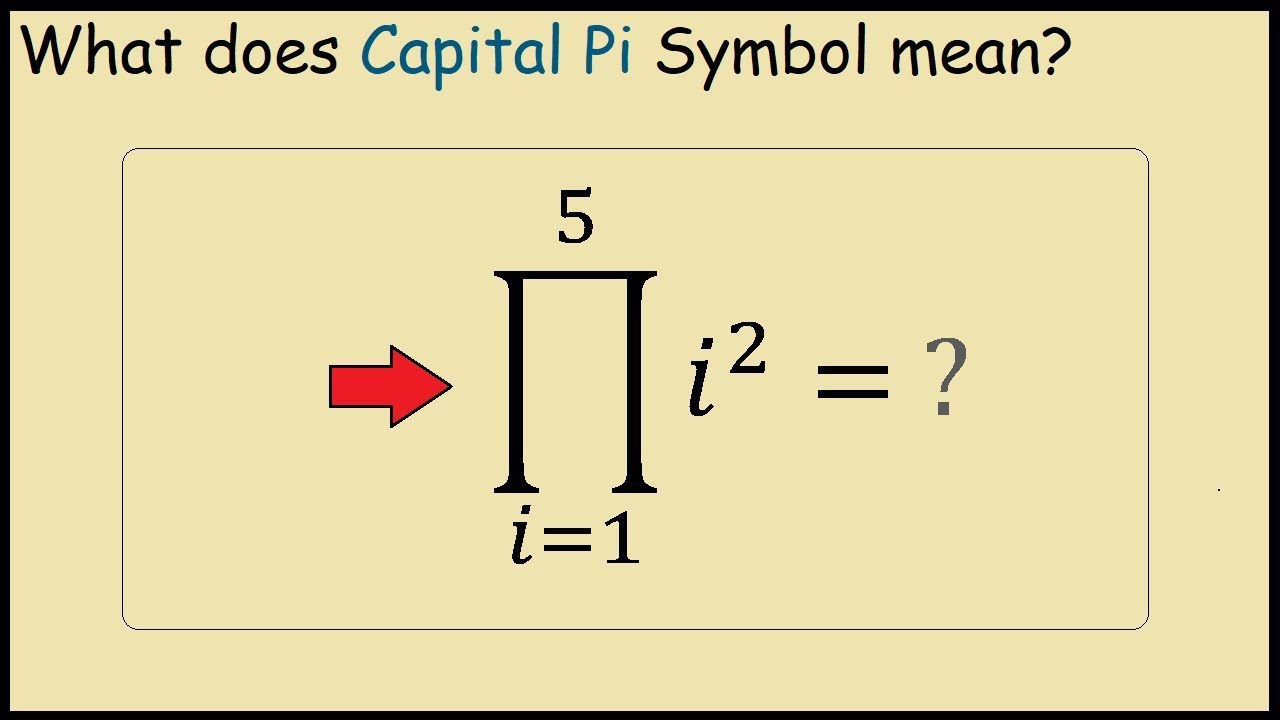
What does the symbol capital pi mean in mathematics?
Capital Pi or upper-case pi (Π) commonly appears in summations and acts as a product operator. So instead of adding terms, we multiply them when substituting our starting and end points.
In summary you can think of the more commonly used summation involving the use of Sigma but replaced with...
restive river
Does it follow the property that $\prod a \pm \prod b = \prod a \pm b$?
woven radishBOT
.fire007
 blissful cloak
nope
 devout snowBOT
Closed by @spice pecan
Use .reopen if this was a mistake.
blissful cloak
np
devout snowBOT
Available help channel!
Send your question here to claim the channel.
Remember:
• Ask your math question in a clear, concise manner.
• Show your work, and if possible, explain where you are stuck.
• After 15 minutes, feel free to ping <@&286206848099549185>.
• Type the command .close to free the channel when you're done.
• Be polite and have a nice day!
Read #❓how-to-get-help for further information on how to ask a good question, and about conduct in the question channels.
 pastel onyx
Is it accurate to call this slightly left skewed?
 devout snowBOT
pastel onyx
Is it accurate to call this slightly left skewed?
devout snowBOT
pastel onyx
Is it accurate to call this slightly left skewed?
 weak cove
Left skewed is the opposite
 hard rivet
Well this distribution doesn't have a very significant skew, so I'd suggest that if you are going to call this a skewed distribution, include a comparison of the mean, median, and mode in your justification.
hard rivet
weak cove
Left skewed is the opposite
I think @pastel onyx is correct in calling this a (slightly) left-skewed distribution?
devout snowBOT
Closed by @pastel onyx
Use .reopen if this was a mistake.
Available help channel!
Send your question here to claim the channel.
Remember:
• Ask your math question in a clear, concise manner.
• Show your work, and if possible, explain where you are stuck.
• After 15 minutes, feel free to ping <@&286206848099549185>.
• Type the command .close to free the channel when you're done.
• Be polite and have a nice day!
Read #❓how-to-get-help for further information on how to ask a good question, and about conduct in the question channels.
 lusty swift
Why is the domain of (f∘g)(x) = ((sqrt(x+6)^2)+5 [-6, +inf) and not (-inf, +inf)? (f∘g)(x) = ((sqrt(x+6)^2)+5 simplifies to x+11. Why do we calculate the domain before we square the sqrt(x+6)?
devout snowBOT
lusty swift
Why is the domain of `(f∘g)(x) = ((sqrt(x+6)^2)+5` [-6, +inf) and not (-inf, +in...
lusty swift

To be clear, I understand that the text here says that it is "useful to consider the composition before any simplification", but this doesn't really seem like something that is "useful". It seems like something that is "mandatory".
Do i misunderstand the order of operations? Does squaring (sqrt(x+6)) not counteract the radical? Or are we supposed to take the square root, and then square the result, thereby "undoing" the radical?
winter patrol
(f o g)(x) = f(g(x))
g(x) itself needs to be defined at the value of x
to be able to have something to plug into f
e.g taking x=-7 for example
g(-7) = sqrt(-1)
(undefined in the real number system, which is what you're working in)
f(something undefined),
can't compute that
devout snowBOT
Closed by @lusty swift
Use .reopen if this was a mistake.
Available help channel!
Send your question here to claim the channel.
Remember:
• Ask your math question in a clear, concise manner.
• Show your work, and if possible, explain where you are stuck.
• After 15 minutes, feel free to ping <@&286206848099549185>.
• Type the command .close to free the channel when you're done.
• Be polite and have a nice day!
Read #❓how-to-get-help for further information on how to ask a good question, and about conduct in the question channels.
 cloud thunder
im at 2x^2 + 9x -980 = 0
 devout snowBOT
cloud thunder
im at 2x^2 + 9x -980 = 0
cloud thunder
devout snowBOT
cloud thunder
im at 2x^2 + 9x -980 = 0
cloud thunder
im stuck at (2x+ )(x - )
whats the fast way to find factor for the -980
like im guessing what times what makes 980 but that takes long im sure theres a faster way?
 final storm
cloud thunder
whats the fast way to find factor for the -980
final storm
cloud thunder
whats the fast way to find factor for the -980
afaik, i cant think of any fast ways for a number that large, what about the quadratic formula?
cloud thunder
oh that would b better i suppose
final storm
or if calculators are allowed, u can use that
devout snowBOT
Closed by @cloud thunder
Use .reopen if this was a mistake.
cloud thunder
.reopen
devout snowBOT
✅
 silver crane
What's ur question?
cloud thunder
no
 granite tulip
Hes trynna find the factor for it
silver crane
oh
silver crane
oh
silver crane
Isaac, u want to factorize that thing?
silver crane
x^2 + 9x/2 -490 = 0?
granite tulip
Yes
cloud thunder
yheah
granite tulip
2x² prevents it
granite tulip
Looks about right
silver crane
For me, I would use quad formla
cloud thunder
bro
granite tulip
It didnt work for him
silver crane
silver crane
(x-20)(x+49/2)
I use quad to have this...
silver crane
granite tulip
It didnt work for him
how...
granite tulip
I dont know ask him lmao
cloud thunder
ikd i got a fat sqrt
granite tulip
I just backreaded and he said thta
devout snowBOT
Closed by @cloud thunder
Use .reopen if this was a mistake.
Available help channel!
Send your question here to claim the channel.
Remember:
• Ask your math question in a clear, concise manner.
• Show your work, and if possible, explain where you are stuck.
• After 15 minutes, feel free to ping <@&286206848099549185>.
• Type the command .close to free the channel when you're done.
• Be polite and have a nice day!
Read #❓how-to-get-help for further information on how to ask a good question, and about conduct in the question channels.
weak cove
hard rivet
I think <@246091131371126784> is correct in calling this a (slightly) left-skewe...
.close

 mental grove
how do i solve this]
 devout snowBOT
mental grove
how do i solve this]
mental grove
devout snowBOT
mental grove
how do i solve this]
mental grove
like it doesnt exactly make sense\
silver crane
am here to help u
mental grove
so what do i have to do to find it
pseudo basin
mental grove
like it doesnt exactly make sense\
which part doesn't make sense to you?
you have a triangle here in which two sides have been given as 550m and 700m, and the angle between them as 30°.
mental grove
idk what to do after that
pseudo basin
ok so it's that's you're stumped, and not that the problem itself doesn't make sense.
big difference.
ok now
do you know your basic trig? like soh-cah-toa stuff?
mental grove
yh
mental grove
so to find the area 0f the traingle i have to find the area of the rectangle
pseudo basin
that's what the problem wants you to do, yes.
maybe you know "half-base-times-height" as a canned/memorized formula for the area of a triangle, but this rectangle stuff has always been there as its proof.
anyway, do you catch my drift here with the red line i drew?
pseudo basin
i don't know what "a triangle that is cos" or "a triangle that isn't cos" even is tbh.
so either you're confusing me with your wording or you are confused yourself
mental grove
what
pseudo basin
would the triangle be cos?
i don't have the faintest clue what you might possibly mean by this.
pseudo basin
again i don't know what "it" is.
are you trying to write out a ratio of sides here?
mental grove
yh
pseudo basin
ok then write out a ratio of sides
all the points have names so all sides can be talked about without trouble
___(30°) = ___ / ___
fill in the blanks, the first with a trig function, and the other two with sides
silver crane
huh
pseudo basin
don't give out answers esp. wrong ones!
silver crane
pseudo basin
don't give out answers esp. wrong ones!
ok
mental grove
cos 30 =550/700
pseudo basin
incorrect
this would only be true if ABC were known to be a right triangle.
which we don't know.
and i am asking you to look at triangle ABH and not at ABC.
and also i drew that red line for a reason... its length is what we want to find.
mental grove
idk what to do
pseudo basin
ok then let us go through this step by step
i will give you instructions that i expect you to read carefully and follow precisely.
are you willing to do both of those?
mental grove
yes
pseudo basin
ok
look at triangle ABH in this diagram. of its three sides, only one has a length known to us. which one?
answer in the following format, filling in the blanks:
The only known side is ___, and its length is ___.
 mental grove
AH and 700\
pseudo basin
❌ instruction not followed
❌ info incorrect
when i say "answer in the following format, filling in the blanks" i expect you to copy down the sentence i write and send it back to me with the blanks filled
try again
mental grove
The only known side is AH__, and its length is 700 m___.
pseudo basin
❌ info incorrect
700 m is NOT the length of AH.
700 m is AC, and AC isn't a side of triangle ABH.
also you fucked up and didn't delete the underscores.
try again
@mental grove
 dim knot
@mental grove
Formula called 0.5 * a * b * sinA :
pseudo basin
dim knot
<@776679161519013898>
Formula called 0.5 * a * b * sinA :
!nosols
devout snowBOT
As a helper, please do not give out answers that could be copied as a homework solution. Have the student work through the problem themselves and guide them along the way.
dim knot
pseudo basin
1. don't do the number one-half dirty by shoving it into a decimal
2. op still n...
are u telling me to demonastarte the proof of that formula?
pseudo basin
no i'm telling you to back off until OP comes back
dim knot
Gotchu
devout snowBOT
@mental grove Has your question been resolved?
devout snowBOT
Closed due to timeout
Use .reopen if this was a mistake.
Available help channel!
Send your question here to claim the channel.
Remember:
• Ask your math question in a clear, concise manner.
• Show your work, and if possible, explain where you are stuck.
• After 15 minutes, feel free to ping <@&286206848099549185>.
• Type the command .close to free the channel when you're done.
• Be polite and have a nice day!
Read #❓how-to-get-help for further information on how to ask a good question, and about conduct in the question channels.
 south rampart
 devout snowBOT
south rampart
south rampart
devout snowBOT
south rampart
south rampart
Hello, I am not sure if this is correct please someone check it. I got everything from YouTube but don’t think it’s correct
<@&286206848099549185>
 rare lagoon
ik
south rampart
alr
rare lagoon
I am in the course of the real world rn
south rampart
bruh
thas crazy
bro i have been waiting the whole day for someone to help me with this page
i am not joking btw
also if you can can you check my others papers aswell if you have the time
south rampart
what
south rampart
alr
rare lagoon
so what is the question mate
there are like more than 1 sub question
solving all of them?
devout snowBOT
@south rampart Has your question been resolved?
Closed by @south rampart
Use .reopen if this was a mistake.
Available help channel!
Send your question here to claim the channel.
Remember:
• Ask your math question in a clear, concise manner.
• Show your work, and if possible, explain where you are stuck.
• After 15 minutes, feel free to ping <@&286206848099549185>.
• Type the command .close to free the channel when you're done.
• Be polite and have a nice day!
Read #❓how-to-get-help for further information on how to ask a good question, and about conduct in the question channels.
 tough light
Bhaskara I sin(x) rational fraction approximation. i dropped out of high school at sophomore year and don’t know the symbols/operations related to alot of symbols especially in respect to the symbols before them. ive read that the brackets/parentheses are solved from the innermost nested to the outer, but ive also read that square brackets are a list or more importantly a range between the zeroth entry and the next so i just need some help understanding the application in this formula. do i divide the former by every integer between zero and the answer to the equation in the brackets or just divide by the solutions on either side of the division symbol.
devout snowBOT
tough light
Bhaskara I sin(x) rational fraction approximation. i dropped out of high school ...
tough light
Bhaskara I was an Indian mathematicians who wrote commentaries on the work of Aryabhata I.
the equation /expression whatever is in that link towards the middle of the oage
page
pseudo basin
but ive also read that square brackets are a list or more importantly a range between the zeroth entry and the next so i just need some help understanding the application in this formula.
in this case the square brackets do not mean that
they are just the same as parentheses only they look different
tbh this is better written as a fraction: $\sin(x) = \frac{16x(\pi - x)}{5\pi^2 - 4x(\pi - x)}$
woven radishBOT
Ann
 pseudo basin
@tough light
tough light
can yall stick around to let me solve it and check me to make sure i understand please
pseudo basin
sure, just tell us exactly what you're solving here
devout snowBOT
@tough light Has your question been resolved?
devout snowBOT
Closed due to timeout
Use .reopen if this was a mistake.
Available help channel!
Send your question here to claim the channel.
Remember:
• Ask your math question in a clear, concise manner.
• Show your work, and if possible, explain where you are stuck.
• After 15 minutes, feel free to ping <@&286206848099549185>.
• Type the command .close to free the channel when you're done.
• Be polite and have a nice day!
Read #❓how-to-get-help for further information on how to ask a good question, and about conduct in the question channels.
formal bronze
 formal bronze
<@&286206848099549185>
formal bronze
<@&286206848099549185> 🥲
devout snowBOT
@formal bronze Has your question been resolved?
devout snowBOT
Closed due to timeout
Use .reopen if this was a mistake.
Available help channel!
Send your question here to claim the channel.
Remember:
• Ask your math question in a clear, concise manner.
• Show your work, and if possible, explain where you are stuck.
• After 15 minutes, feel free to ping <@&286206848099549185>.
• Type the command .close to free the channel when you're done.
• Be polite and have a nice day!
Read #❓how-to-get-help for further information on how to ask a good question, and about conduct in the question channels.
 finite briar
Help
 devout snowBOT
finite briar
Help
pseudo basin
devout snowBOT
finite briar
Help
pseudo basin
you've determined that the factor count of a^7 is always 1 mod 7
given k ∈ N try to find a number whose 7th power has exactly 7k+1 factors
this number will serve as a witness for the luckiness of 7k+1
finite briar
Hi
finite briar
pseudo basin
you've determined that the factor count of a^7 is always 1 mod 7
I haven't learnt modular arithmetic
pseudo basin
ok, then rephrase that as "the factor count of a^7 is always one more than a multiple of 7"
finite briar
Help
pseudo basin
...
finite briar
pseudo basin
ok, then rephrase that as "the factor count of a^7 is always one more than a mul...
K
finite briar
pseudo basin
ok, then rephrase that as "the factor count of a^7 is always one more than a mul...
How did I figure that out?
pseudo basin
the factor count of a^7 is 7 * (SOME SHIT) + 1
where the shit is all made of integers
 strong lava
help
 finite briar
pseudo basin
the factor count of a^7 is 7 * (SOME SHIT) + 1
finite briar
pseudo basin
the factor count of a^7 is 7 * (SOME SHIT) + 1
If a is prime only then no
finite briar
strong lava
help
pseudo basin
strong lava
help
please open your own channel. #❓how-to-get-help
pseudo basin
finite briar
If a is prime only then no
au contraire
8 is also of the same form
7*1 + 1
finite briar
pseudo basin
the factor count of a^7 is 7 * (SOME SHIT) + 1
How did u get this
pseudo basin

by looking at this thing you wrote
do you not see that it's all a sum of various assorted multiples of 7 with a one at the end
finite briar
pseudo basin
I generalized the expansion (7x+1)(7y+1)...
finite briar
pseudo basin
do you not see that it's all a sum of various assorted multiples of 7 with a one...
Oh yes
But is it necessary that- OHHh
Got it
So now I find k?
finite briar
pseudo basin
given k ∈ N try to find a number whose 7th power has exactly 7k+1 factors
Trial and error?
finite briar
pseudo basin
this number will serve as a witness for the luckiness of 7k+1
Meaning N =7k+ 1?
finite briar
pseudo basin
> N = 7k + 1
sure
Pls tell me u aren't being sarcastic
pseudo basin
see if you can consider something more general than primes but less general than all composites
what's a type of number that's in between those complexity-wise
finite briar
pseudo basin
see if you can consider something more general than primes but less general than...

finite briar
pseudo basin
see if you can consider something more general than primes but less general than...
Uhm...what's there except prime and composite and 1 in terms of factorization
pseudo basin
i didn't say to discover a new class of numbers disjoint from those
i'll give you one more nudge in that direction and if you don't get it still i'll tell you what i meant
finite briar
Okay
pseudo basin
i'm talking about composite numbers but only ones whose factorizations are particularly simple
finite briar
Hmm so like 2 times 3? I.e. not involving powers > 1? Or only involving 1 number in power?
pseudo basin
only involving 1 number in power
shoddy wording but yes that
im talking about prime powers
i.e. numbers of the form p^k
finite briar
Okay...
pseudo basin
how many divisors does (p^k)^7 have?
finite briar
pseudo basin
how many divisors does (p^k)^7 have?
7k + 1
pseudo basin
i'd like to acknowledge explicitly that we've proved one important thing:
finite briar
Find all multiples of 7 less than 99
pseudo basin
a number is lucky IF AND ONLY IF it is of the form 7k+1
pseudo basin
why do you ask me for permission
it's your channel
you are the only one who knows whether or not you have anything else to ask
devout snowBOT
Closed by @finite briar
Use .reopen if this was a mistake.
Available help channel!
Send your question here to claim the channel.
Remember:
• Ask your math question in a clear, concise manner.
• Show your work, and if possible, explain where you are stuck.
• After 15 minutes, feel free to ping <@&286206848099549185>.
• Type the command .close to free the channel when you're done.
• Be polite and have a nice day!
Read #❓how-to-get-help for further information on how to ask a good question, and about conduct in the question channels.
 scenic goblet
I need help on this math problem, im stuck on what it means by "a sum to infinity of 60", thank you
 devout snowBOT
scenic goblet
I need help on this math problem, im stuck on what it means by "a sum to infinit...
manic condor
devout snowBOT
scenic goblet
I need help on this math problem, im stuck on what it means by "a sum to infinit...
manic condor
Do you know what is a geometric series?
manic condor
Yes.
The number that they are multiplied by(to get the next term) is called common ratio.
scenic goblet
yep
manic condor
You might be used to representing common ratio by r, let's say that our common ratio is r.
scenic goblet
thats what i usually do
manic condor
Since first term is 6, and common ratio is r, what are the terms of the series? Try writing those.
scenic goblet
u1=6 u2=6r u3=6r^2?
manic condor
Yes and so on.
What they mean is that if you write such infinite terms and sum them all, you get 60.
Using that, you have to find r.
manic condor
Basically,
$6 + 6r + 6r^2 + \cdots = 60$
woven radishBOT
Enemagneto
 manic condor
scenic goblet
got it, does that mean r is a fraction
manic condor
scenic goblet
got it, does that mean r is a fraction
Has to be. Otherwise, it won't have a finite sum.
scenic goblet
yeah true
manic condor
Anyway, you can try to do it now. If you get stuck, i'll be here.
scenic goblet
manic condor
Anyway, you can try to do it now. If you get stuck, i'll be here.
so if the formula is: u1(1-r^n)/1-r, do i put n as infinity or as 60?
manic condor
What does n denote?
scenic goblet
the number of the sequence
manic condor
Number of terms in the sequence.
scenic goblet
so it would be infinite
manic condor
And, how many terms are there in your summation expression?
manic condor
scenic goblet
so it would be infinite
Yes.
But it would be more like taking limit $(n\to \infty)$, as you aren't exactly supposed to substitute infinity.
woven radishBOT
Enemagneto
 scenic goblet
im unsure of what youre saying here
manic condor
So, for sum of n terms of Geometric series, you have -
$$S_{n} = u_{1} \cdot \left(\frac{1 - r^n}{1-r}\right)$$
woven radishBOT
Enemagneto
 manic condor
Okay.
scenic goblet
👍
manic condor
You need to put n as infinity. Right?
scenic goblet
Yes i believe so.
manic condor
Can you evaluate the expression $S_{n}$ for n = infinity?
woven radishBOT
Enemagneto
 scenic goblet
s-infinity = 6 x (1-r^infinity/1-r)?
manic condor
scenic goblet
s-infinity = 6 x (1-r^infinity/1-r)?
Yes, but how will you calculate value of RHS here?
scenic goblet
i forgot all of this but im not sure if its possible with the infinite power
manic condor
Yes. You are supposed to take the limit therefore.
Are you familiar with taking limits?
scenic goblet
no not yet
scenic goblet
yes
manic condor
So, if you take any number such that |r|<1, then if you multiply the number to itself, it becomes smaller(magnitude wise).
For example, r=1/2
r^2 = r * r = 1/4 which is smaller than 1/2.
If you multiply it once more with itself, it's 1/8 which is even smaller.
Good so far?
woven radishBOT
Enemagneto
 manic condor
Which is equal to
scenic goblet
exactly
manic condor
,w (1/2)^10
woven radishBOT


 Requested by .enemagneto
scenic goblet
Requested by .enemagneto
scenic goblet
small number
manic condor
Yes. Point is that as you increase power for a number r, where |r| < 1, magnitude reaches closer to 0.
If power goes to infinity, then it can be taken as just 0.
scenic goblet
mhm
manic condor
So, you have $r^{\infty} = 0$
woven radishBOT
Enemagneto
 scenic goblet
alright
manic condor
Now, you should be able to solve your question, i believe.
manic condor
Well, you know what is S here.
You were given in the question.
After that, just isolate r.
scenic goblet
s is 60?
scenic goblet
manic condor
After that, just isolate r.
i got that 60=6(1/1-r) so then 10=1/1-r. then i realized that 1/0.1 is 10 so made it so 1-r equals 0.1 which makes r, the common different 0.9. Is this right?
manic condor
Yeah, that's correct. You arrived at it little weirdly but it's alright.
scenic goblet
manic condor
Yeah, that's correct. You arrived at it little weirdly but it's alright.
but then this next one is just as confusing, i get u1=x, u2=x-3 and s/un=75

putting in the formula i got 75=x(1/1-r)
but i have 2 variables
manic condor
scenic goblet
how would you have arrived at it
No, you are good. You probably just put it weirdly. Lol
scenic goblet
manic condor
Well, you can write r in terms of x.
how, i dont understand
manic condor
Well, r is the common ratio.
and you have two consecutive terms.
What will be their ratio?
manic condor
No. Come on. Just take the ratio of the term.
Since x-3 is the second term, that means that
(x-3) = x * r
So, you get r as ?
manic condor
Think about it, buddy.
You have a geometric progression. Where, each term is multiplied by r(common ratio) to get the next term.
That means that since $x$ is the first term, second term would be $x \times r$. Makes sense?
woven radishBOT
Enemagneto
 manic condor
@scenic goblet
scenic goblet
yes pal
woven radishBOT
Enemagneto
 manic condor
Now, just isolate r.
You'll get r in terms of x.
Then, it's just one variable. You can solve it.
manic condor
Well, how about dividing by x on the both sides?
You get $\frac{x\cdot r}{x} = \frac{x-3}{x}$
woven radishBOT
Enemagneto

 brave zodiac
r=-3
scenic goblet
r=-2
manic condor
Now, x gets cancelled out, and you are left with
$r = \frac{x-3}{x}$
woven radishBOT
Enemagneto
 scenic goblet
yes
manic condor
That's wrong.
scenic goblet
k
manic condor
woven radish
**Enemagneto**
You get this.
brave zodiac
im consfused aswell
me and @scenic goblet are in the same school and math class
could you just give the answer first
and then explain why please 🙏
manic condor
brave zodiac
could you just give the answer first
I can't.
I can only help you get it.
manic condor
woven radish
**Enemagneto**
Well, is this much clear?
brave zodiac
wait let me read
scenic goblet
can you give us the answer and tell us how you got there, thanks in advance
it woukd be so much more helpful
brave zodiac
woven radish
**Enemagneto**
do we have what xis
scenic goblet
as it seems to me as you keep repeating the same thigns
manic condor
brave zodiac
do we have what xis
No. you have what r is, in terms of x.
manic condor
scenic goblet
putting in the formula i got 75=x(1/1-r)
Which you can substitute here, and get x.
brave zodiac
how would u subsitite that
scenic goblet
manic condor
Which you can substitute here, and get x.
i havent got r yet so im not really sure as to what to do
brave zodiac
think about it, buddy!
manic condor
scenic goblet
i havent got r yet so im not really sure as to what to do
You got r in terms of x.
manic condor
woven radish
**Enemagneto**
.
brave zodiac
im puzzled
scenic goblet
manic condor
Not x/(x-3)
GOT IT!
scenic goblet
i get it 105%
brave zodiac
sorry we are a bit distracted w upping the ratio in the geometrial sequence of our fortnite career
amny thanks talk later
scenic goblet
@manic condor thank you so extremely much for your help. For the future, could you give alittle hint with each message because i felt you kept repeating the same equation but thanks!
let me quickly plug it into the equation
brave zodiac
what do you get
manic condor
scenic goblet
<@1116326425088241714> thank you so extremely much for your help. For the future...
Well, you learn if you get it on your own. Also, it wasn't tough so i had expected you to get it on your own.
Seemingly, you seem to have too little patience for learning. Try to improve on that.
manic condor
scenic goblet
i got 75=x(1/1-x-3/x), much too confusing
try simplifying (x-3)/x a bit more. It would be easier.
Use the fact that $\frac{a-b}{c} = \frac{a}{c} - \frac{b}{c}$
woven radishBOT
Enemagneto
 scenic goblet
manic condor
Well, you learn if you get it on your own. Also, it wasn't tough so i had expect...
scenic goblet
manic condor
Well, you learn if you get it on your own. Also, it wasn't tough so i had expect...
you never know, i could be doing matsh way above my level so need more assistance!
scenic goblet
manic condor
Well, you learn if you get it on your own. Also, it wasn't tough so i had expect...
will try my best to improve
manic condor
Agreed. Regardless, you knew what geometric series is, so it's not too much to expect you to come up with (x-3)/x = r.
manic condor
manic condor
try simplifying (x-3)/x a bit more. It would be easier.
Any progress on this?
scenic goblet
i apologize prefusely for my lack of mathematical talent
brave zodiac
woudlnt it be 1-3/x?
scenic goblet
1-3/x?
manic condor
scenic goblet
i apologize prefusely for my lack of mathematical talent
Come on. You know that's not what i want at all. Also, i can't even tell if you are being backhanded or not.
Regardless, let's get back to question.
manic condor
brave zodiac
woudlnt it be 1-3/x?
Yes
brave zodiac
okay
manic condor
$\frac{x-3}{x} = \frac{x}{x} - \frac{3}{x} = 1- \frac{3}{x}$
brave zodiac
so what to do next tchobs
woven radishBOT
Enemagneto
 brave zodiac
i dont have the formu;a
manic condor
Now, look carefully at the denominator.
you have $1 - r$.
woven radishBOT
Enemagneto
 manic condor
If you substitute this r,
you get $1 - \left(1- \frac{3}{x}\right)$


 hardy tapir

 eager lodge


