#help-27
1 messages · Page 97 of 1
 restive river
 zealous ether
@polar wharf could you help me with this other question
zealous ether
restive river
You didn't ping themmm
lol facts


Adding all gives 4/9 but answer is 5/9 i guess
This is the question for reference
 restive river
No one came yet?
zealous ether
restive river
No one came yet?
:C no
restive river
I would have helped but idk abt this 1/3 method like can you explain what are you trying to do by taking (1/3)^3
zealous ether
restive river
I would have helped but idk abt this 1/3 method like can you explain what are yo...
np i appreciate your will to help
also 1/3^3 is basically
just cuz
if diana, for instnace, has to choose a group of 3 then there's 1/3 chance she'll choose 1 group
nnothing fancy
similarly for the other 2 brothers
so 1/3 * 1/3 * 1/3 = 1/3^3
restive river
Oh oh oh okayyy
Got it
Okay so
I got the answer
From this 1/3 method 😭
But my thinking again is ig different may I ?
In the first one
Where all are in same group
Shouldn't it be (1/3)^3 * 3C1
(Selection of one group where all will be together out of three groups)
That would be uhhhhhh 1/9
Then second case,
Where either B or C are with D
That means if D comes, C shoudlnt come in that place
So
[[(1/3)^2 x (3C1) ] *[(1/3)^1 x 2C1] ] into 2 for both cases
Damn
Adding both we get 5/9
@zealous ether
restive river
restive river
[[(1/3)^2 x (3C1) ] *[(1/3)^1 x 2C1] ] into 2 for both cases
Here the first part is like B or C with D , in one group they get 3C1 chances to select one group of their choice
Then the remaining person who is not with D, gets to choose group in 2C1 ways
Whole into 2 cuz I directly chose C or B and you can do it differently
restive river
zealous ether
So here what's wrong is
zealous ether
lol bruh i don't get it maybe my brain is not working rn
but thank you!
I'll read it later cuz now i got class
restive river
When you multiply by 3! It means you're distributing B C D when you have already taken them in one group
restive river
Aye np
zealous ether
cheers
restive river
zealous ether
i'll check and then let you know
Yeah
zealous ether
.close
 devout snowBOT
Channel closed
Closed by @zealous ether
Use .reopen if this was a mistake.
devout snowBOT
 Available help channel!
Send your question here to claim the channel.
Remember:
• Ask your math question in a clear, concise manner.
• Show your work, and if possible, explain where you are stuck.
• After 15 minutes, feel free to ping <@&286206848099549185>.
• Type the command .close to free the channel when you're done.
• Be polite and have a nice day!
Read #❓how-to-get-help for further information on how to ask a good question, and about conduct in the question channels.
 whole iron
 devout snowBOT
whole iron
whole iron
devout snowBOT
whole iron
whole iron
what can i do further to simplify ut
 sonic smelt
Make common denominators in $1 - \frac{\cos^2\theta}{\sin^2\theta}$
 woven radishBOT
A Lonely Bean
 devout snowBOT
Channel closed
Closed by @whole iron
Use .reopen if this was a mistake.
Available help channel!
Send your question here to claim the channel.
Remember:
• Ask your math question in a clear, concise manner.
• Show your work, and if possible, explain where you are stuck.
• After 15 minutes, feel free to ping <@&286206848099549185>.
• Type the command .close to free the channel when you're done.
• Be polite and have a nice day!
Read #❓how-to-get-help for further information on how to ask a good question, and about conduct in the question channels.
 gilded wharf
Hi guys can someone please help me get started with this question?
gilded wharf

 supple knot
draw a picture
gilded wharf
A picture?
supple knot
gilded wharf
A picture?
of p(x)
gilded wharf
I’m not sure what you mean by drawing p(x)
I’ve done something similar to that question but this one is a bit complicated
 supple knot
gilded wharf
supple knot
gilded wharf
just do the integrals like you did in this question
gilded wharf
That’s it?!
supple knot
the definition of standard deviation involves two integrals
 flat rain
Here to learn, can I have the definition?
I only know the sum definition for like a list of data points
gilded wharf
@supple knot do I work with 1 and 3
supple knot
gilded wharf
<@261933205387477002> do I work with 1 and 3
what do you mean "work with"
both values are important
gilded wharf
Like with substituting
gilded wharf
gilded wharf
Here I used 0 and 1
supple knot
gilded wharf
Here I used 0 and 1
yes both endpoints are necessary when evaluating integrals
 supple knot
should be dx
supple knot
do you know how to do integrals?
power rule would be useful in this case
actually the left side is wrong

the integral is the expected value
this is p(x)
 supple knot
read this since you keep getting stuck
https://www.probabilitycourse.com/chapter4/4_1_2_expected_val_variance.php
Definitions and examples for expected values of continuous distributions
 supple knot
no?
 devout snowBOT
@gilded wharf Has your question been resolved?
gilded wharf
<@&286206848099549185>
supple knot
,w 0.25 * int 1 to 3 of x^2
woven radishBOT


 supple knot
read this since you keep getting stuck
https://www.probabilitycourse.com/chapter...
supple knot
supple knot
read this since you keep getting stuck
https://www.probabilitycourse.com/chapter...
read this for the rest of the definition of standard deviation
devout snowBOT
@gilded wharf Has your question been resolved?
devout snowBOT
Channel closed
Closed due to timeout
Use .reopen if this was a mistake.
Available help channel!
Send your question here to claim the channel.
Remember:
• Ask your math question in a clear, concise manner.
• Show your work, and if possible, explain where you are stuck.
• After 15 minutes, feel free to ping <@&286206848099549185>.
• Type the command .close to free the channel when you're done.
• Be polite and have a nice day!
Read #❓how-to-get-help for further information on how to ask a good question, and about conduct in the question channels.
devout snowBOT
 plush knot
Can you explain better what you mean?
devout snowBOT
@restive river Has your question been resolved?
devout snowBOT
@restive river Has your question been resolved?
devout snowBOT
@restive river Has your question been resolved?
Channel closed
Closed by @edgy plinth
Use .reopen if this was a mistake.
Available help channel!
Send your question here to claim the channel.
Remember:
• Ask your math question in a clear, concise manner.
• Show your work, and if possible, explain where you are stuck.
• After 15 minutes, feel free to ping <@&286206848099549185>.
• Type the command .close to free the channel when you're done.
• Be polite and have a nice day!
Read #❓how-to-get-help for further information on how to ask a good question, and about conduct in the question channels.
restive river
How do i solve this?
devout snowBOT
restive river
How do i solve this?
restive river
$$x^2\cos(x) = 1$$
woven radishBOT
Brandon H

 pastel pasture
,w x^2cos(x) = 1


 pastel pasture
Like that
restive river
pastel pasture
Like that
ummm, i can't do that
pastel pasture
There's really no other way to solve stuff like this
Unless you're really really good at plotting graphs
restive river
pastel pasture
There's really no other way to solve stuff like this
Do you know how i'm supposed to solve this then?

 MVT
devout snowBOT
MVT
devout snowBOT
@restive river Has your question been resolved?
Channel closed
Closed by @exotic vortex
Use .reopen if this was a mistake.
devout snowBOT
Available help channel!
Send your question here to claim the channel.
Remember:
• Ask your math question in a clear, concise manner.
• Show your work, and if possible, explain where you are stuck.
• After 15 minutes, feel free to ping <@&286206848099549185>.
• Type the command .close to free the channel when you're done.
• Be polite and have a nice day!
Read #❓how-to-get-help for further information on how to ask a good question, and about conduct in the question channels.
 ivory bluff
in geometry, how do you prove that some AB is longer than say AC
ivory bluff
like a reliable tool to do so
 last hill
What are you given about A, B and C?
 manic condor
Ptolemy's
ivory bluff
manic condor
Ptolemy's
yes
ivory bluff
last hill
What are you given about A, B and C?
im just talking in general
i guess its just play with simple inequalities we have
.close
devout snowBOT
Channel closed
Closed by @ivory bluff
Use .reopen if this was a mistake.
devout snowBOT
Available help channel!
Send your question here to claim the channel.
Remember:
• Ask your math question in a clear, concise manner.
• Show your work, and if possible, explain where you are stuck.
• After 15 minutes, feel free to ping <@&286206848099549185>.
• Type the command .close to free the channel when you're done.
• Be polite and have a nice day!
Read #❓how-to-get-help for further information on how to ask a good question, and about conduct in the question channels.
 alpine forge
How?
 devout snowBOT
alpine forge
How?
manic condor
alpine forge
please **reply** to my message
devout snowBOT
alpine forge
How?
manic condor
alpine forge
please **reply** to my message
Equate their coordinates.
alpine forge
their parametric equations?
alpine forge
sorry it's like my first/second time properly studying this
 versed jetty
it's ok
we all have to start somewhere
if the lines meet then they'll meet at some well-defined point, and consequently the (x,y,z) of line 1 and the (x,y,z) of line 2 will have to coincide
versed jetty
thr c9mmsnd is .close
devout snowBOT
@alpine forge Has your question been resolved?
Channel closed
Closed by @alpine forge
Use .reopen if this was a mistake.
Available help channel!
Send your question here to claim the channel.
Remember:
• Ask your math question in a clear, concise manner.
• Show your work, and if possible, explain where you are stuck.
• After 15 minutes, feel free to ping <@&286206848099549185>.
• Type the command .close to free the channel when you're done.
• Be polite and have a nice day!
Read #❓how-to-get-help for further information on how to ask a good question, and about conduct in the question channels.
zealous ether
if i have
devout snowBOT
zealous ether
if i have
woven radishBOT
hiii
 woven radishBOT
hiii
 sonic smelt
Of course you can


 zealous ether
oh sure
maybe i just messed something up np
but that aside
if i have:
2^{99} \equiv 6 (mod 11)
and
2^{99} \equiv 8 (mod 9)
i want mod 99 so i'd be sieving right?
,, 2^{99} \equiv \text{something} \pmod{99}
woven radishBOT
hiii
 sonic smelt
What's sieving?
zealous ether
sonic smelt
What's sieving?
it's used to find the first solution for n systems of congruences
after which chinese remainder generalizes
this

.close
devout snowBOT
Channel closed
Closed by @zealous ether
Use .reopen if this was a mistake.
Available help channel!
Send your question here to claim the channel.
Remember:
• Ask your math question in a clear, concise manner.
• Show your work, and if possible, explain where you are stuck.
• After 15 minutes, feel free to ping <@&286206848099549185>.
• Type the command .close to free the channel when you're done.
• Be polite and have a nice day!
Read #❓how-to-get-help for further information on how to ask a good question, and about conduct in the question channels.
 mighty flume
How do I approach this problem?
 devout snowBOT
mighty flume
How do I approach this problem?
mighty flume
devout snowBOT
mighty flume
How do I approach this problem?
mighty flume
I first have to find theta but I'm not sure how to unwrap sin θ = 1/4
would 1 be opposite and 4 for the hypotenuse?
 long pasture
you don't have to find theta, you'll just have to find which quadrant theta is in
that's the first step
mighty flume
it would be in quadrant 1
long pasture
mighty flume
would 1 be opposite and 4 for the hypotenuse?
this would be the second step
long pasture
but then, since tangent is positive, therefore it's in Q1
mighty flume
is it a pythagorean identity?
mighty flume
cos(2θ) = 1-2sin^2(θ) ?
mighty flume
how would i plug in sin θ as 1/4?
long pasture
mighty flume
would 1 be opposite and 4 for the hypotenuse?
we would now use this
sin(theta)=1/4 and theta in Q1
what will cos(theta) be
mighty flume
it will also be positive if its in Q1
mighty flume
let me draw the triangle
long pasture
sure
mighty flume
my minds blanking, how would i solve for the adjacant angle?
i have opposite = 1, hyp = 4
ohh
nvm
long pasture
hehe
you found it
you just solve for cosine theta
not the theta itself
which will be adj/hyp
therefore we just have to solve for the length of adj
mighty flume
2/4 = cosθ
 long pasture
1²+x²=4²
mighty flume
1 * 1 = 1
long pasture
good
long pasture
yey
 drifting hearth
finding the other side won’t help since you need cos (x/2)
you’ll need to solve for theta to get the answer
long pasture
now that we have
cos(theta)=(√15)/4
long pasture
long pasture
cos(theta)=2cos²(theta/2)-1
we plug back into this
drifting hearth
oh i see
mighty flume
 long pasture
good
mighty flume
i put that over 2?
long pasture
$\cos\theta=\frac{\sqrt{15}}{4}$
woven radishBOT
Biscuity
 long pasture
mighty flume
i put that over 2?
long pasture
mighty flume
i put that over 2?
nope
long pasture
long pasture
we plug back into this
.
mighty flume
long pasture
cos(theta)=2cos²(theta/2)-1
wouldnt it be cos2theta = 2cos^2(theta/2)-1?
since its a double angle identity?
mighty flume
oh is it because you changed the inside to /2
long pasture
cos(x)=2cos²(x/2)-1
long pasture
hehe
mighty flume
square root 15/4 = 2cos^2(x/2)-1
mighty flume
I get to here
 long pasture
opps
mighty flume
i feel like i misstepped in the beginning
my first step should be to get rid of the /4 right?
or move over the -1?
long pasture
mighty flume
square root 15/4 = 2cos^2(x/2)-1
well both works for this q
anyways
sqrt(15)/4+1=2cos²(x/2)
(sqrt(15)/4+1)/2=cos²(x/2)
good?
mighty flume
in simplifying? should i sqrt both sides?
long pasture
we just take sqrt on both sides of course
mighty flume
sqrt(sqrt(15)/4 + 1)/2 = cos(x/2)
long pasture
yey
remember to see if it's positive or negative!
sqrt(sqrt(15)/4 + 1)/2) = cos(x/2)
 mighty flume
yes
long pasture
got it?
 long pasture
now simplify it to get the final answer
for the numerator of the whole thing
do common denominator thingy first
that is
sqrt(15)/4+4/4
mighty flume
huh?
woven radishBOT
Biscuity
 long pasture

mighty flume
cross multiply instead?
mighty flume
not sure
long pasture
$\sqrt{\frac{\frac{\sqrt{15}+4}{4}}{2}}$
woven radishBOT
Biscuity
 long pasture
it's the numerator part divided by 2
mighty flume
the denominator of 4 isnt being divided by 2?
long pasture
$\sqrt{\frac{\sqrt{15}+4}{8}}$
woven radishBOT
Biscuity
 long pasture
this
mighty flume
oh so we can multiply the denominators
i thought we could but looking at the answer choices i wasnt sure
oh wait
nono i get it
sqrt8
long pasture
hehe
now that 8 is NOT a square number, we do something to make it into a square number
i.e. expand this new fraction by 2/2
long pasture
$\sqrt{\frac{\sqrt{15}+4}{8}\cdot\frac22}$
mighty flume
until its squarable
woven radishBOT
Biscuity
 mighty flume
right of course
mighty flume
easy!
long pasture
try writing them in × and ÷ with in case you are stuck with fractions
e.g.
(2/4)/6
we can write it as
(2÷4)÷6
mighty flume
i see i see
long pasture
and now, given that you are familiar with brackets operations, we can express it into
2÷4÷6
or
$\frac24÷6$
woven radishBOT
Biscuity
 woven radishBOT
Biscuity
 devout snowBOT
@mighty flume Has your question been resolved?
Channel closed
Closed by @mighty flume
Use .reopen if this was a mistake.
Available help channel!
Send your question here to claim the channel.
Remember:
• Ask your math question in a clear, concise manner.
• Show your work, and if possible, explain where you are stuck.
• After 15 minutes, feel free to ping <@&286206848099549185>.
• Type the command .close to free the channel when you're done.
• Be polite and have a nice day!
Read #❓how-to-get-help for further information on how to ask a good question, and about conduct in the question channels.
 rain bluff
is this enough info or do they need all sides distance

 winter torrent
seems fine
Word has an equation editor I think if you want to play with that but you don't need to
rain bluff
ok ty
but like
its a rhombus
ive done left and right
do i need to do top and bottom too or
supple knot
rain bluff
its a rhombus
Show the image
We don't know what top/bottom/left/right mean
winter torrent
rain bluff
its a rhombus
did they tell you it's a rhombus?
 devout snowBOT
@rain bluff Has your question been resolved?
winter torrent
that does not look like a rhombus to me at all
winter torrent
,w rhombus
woven radishBOT


 Requested by kitten.in.a.teacup
devout snowBOT
Requested by kitten.in.a.teacup
devout snowBOT
@rain bluff Has your question been resolved?
rain bluff
i am dumb
looking at my assignment
i actually wrote that it was a paralellogram
sigh
 violet wind
Yeah they would need all sides
An isosceles trapezoid is an example of a shape with only one pair of opposite parallel sides
devout snowBOT
Channel closed
Closed due to timeout
Use .reopen if this was a mistake.
Available help channel!
Send your question here to claim the channel.
Remember:
• Ask your math question in a clear, concise manner.
• Show your work, and if possible, explain where you are stuck.
• After 15 minutes, feel free to ping <@&286206848099549185>.
• Type the command .close to free the channel when you're done.
• Be polite and have a nice day!
Read #❓how-to-get-help for further information on how to ask a good question, and about conduct in the question channels.
 mild crypt
So ( ((1)/(x+y)) - ((1)/(x)))/(y)
Can be simplified with some common denominator thing but I don’t rly understand it. Like I get how you can rewrite the top part of the fraction to -y/(x+y) but in the video I’m watching they write (1/y)*((x-(x+y))/((x+y)x)
devout snowBOT
mild crypt
So ( ((1)/(x+y)) - ((1)/(x)))/(y)
Can be simplified with some common denominator...
mild crypt
I don’t get what they are doing
I think it has something to do with the fraction they write before it but I don’t get how they just get rid of the top fraction
Oh sorry should I use the help forums ?
 wooden wraith
$\frac{1}{x+y} - \frac{\frac{1}{x}}{y}$ This is the expression you're starting with?
woven radishBOT
tatpoj
 wooden wraith
@mild crypt
mild crypt
Waif I found notes
So ye I guess this is a shortcut then right? I guess it does look easier tho lol

 mild crypt
wooden wraith
<@829000603614838866>
mild crypt
wooden wraith
<@829000603614838866>
I understand the notes a lot better like I understand every step I just don’t get how you can get the value that is infront if the thing in the first step. Is that just gotten by multiplying the denominator of the top parts?
Idk it still feels a bit weird
Like I get the steps but
wooden wraith
value in front of the thingi n the first step?
mild crypt
Its weird how you write something that’s literally 1 *
wooden wraith
oh you mean the (x0)((x0 + deltax) over itself on the third line?
 wooden wraith
Yeah it's so you can cancel the denominator of the numerator
Instead, you could just combine the two fractions in the numerator by making a common denominator
it's the same thing
it's the GCF of the denominators in the numerator
mild crypt
Like I could Do the top part seperatly and get something similar but it would be (-dx /(x0+dx) ) / dx
wooden wraith
cancel those dx's and you're right at the end
that's equivalent to the last line in your picture
mild crypt
How can I cancel them
Its like
A fraction inside a fraction
Idk how to rhen cancel the numerator of the numerator with the denominator of the big fraction
wooden wraith
Think back to middle school, how would you simplify any fraction like that?
These are variables but it works the same way
as something like (2/3) / 4
or whatever
mild crypt
wooden wraith
Think back to middle school, how would you simplify any fraction like that?
Im in highschool and I never got that 💀
mild crypt
wooden wraith
as something like (2/3) / 4
Uhhhh
wooden wraith
Haha no worries
mild crypt
Like multiply i guess
wooden wraith
$\frac{\frac{a}{b}}{\frac{c}{d}} = \frac{a}{b} \cdot \frac{d}{c}$
 woven radishBOT
tatpoj
 mild crypt
woven radish
**tatpoj**
mild crypt
woven radish
**tatpoj**
Oh ye I never got that 🤣
 hot steeple
 wooden wraith
Dividing by any number is the same as multiplying by its reciprocal
mild crypt
Ah
wooden wraith
or 2/5 and 5/2
mild crypt
Ye
wooden wraith
or in your case, dx and 1/dx
mild crypt
Yes wait can you like do that math thing so I can visualize
For like the method I did
Idk how that works
wooden wraith
mild crypt
Like I could Do the top part seperatly and get something similar but it would be...
from here, right?
mild crypt
Yep
wooden wraith
$\frac{\frac{-\Delta x}{x_0 + \Delta x}}{\Delta x}$
eh, it doesn't show up well but the dx at the bottom is the "whole" denominator
also I forgot a negative lol
woven radishBOT
tatpoj
 mild crypt
Ye
wooden wraith
You're dividing by dx, which is the same as multiplying by 1/dx
mild crypt
Ah so you’ll just do -dx * dx
So -1
Ah and then you get -1/x0+dx?
Wait no I think that’s wrong tho
wooden wraith
$\frac{-\Delta x}{x_0 + \Delta x} \cdot \frac{1}{\Delta x}$
woven radishBOT
tatpoj
 mild crypt
Ye what
That’s different
Becuase you can divide the too bu dx to get the -1
But then you have a *dx missing in the bottom
wooden wraith
oh you're missing a factor of x0 in the denominator
wooden wraith
mild crypt
Like I could Do the top part seperatly and get something similar but it would be...
can you show your work on how you got here?
mild crypt
NVM ye that is what you get if you do the top part properly
I messed that up XD just did it quick on my phone
wooden wraith
haha i didnt' notice it was missing either, looked right at first
mild crypt
woven radish
**tatpoj**
Here it looks like you can also divide the very top with the very bottom and take the middle as the new bottom tho
wooden wraith
That is also true, yes
mild crypt
Ok well tyvm! I understand now and can probably do it in the future myself now ^^ altho maybe I should practice like 2 more 🤣 imma sleep now tho idk why I’m doing math at 00:30 midnight
wooden wraith
$\frac{\frac{a}{b}}{c} = \frac{\frac{a}{c}}{b} = \frac{a}{bc}$
woven radishBOT
tatpoj
 wooden wraith
mild crypt
Ok well tyvm! I understand now and can probably do it in the future myself now ^...
wooden wraith
mild crypt
Ok well tyvm! I understand now and can probably do it in the future myself now ^...
no problem 👍
mild crypt
woven radish
**tatpoj**
Uh what
But if I multiply that with opposite
1/c * b/a rhats b/ac not a/bc @wooden wraith
wooden wraith
you only flip the denominator
$\frac{\frac{a}{b}}{c} = \frac{a}{b} \cdot \frac{1}{c} = \frac{a}{bc}$
woven radishBOT
tatpoj
 mild crypt
Nothing is flipped there
wooden wraith
huh?
mild crypt
There is nothing flipped tho
wooden wraith
the reciprocal of c is 1/c
wooden wraith
yes, a more general form would be $\frac{a/b}{c/d} = \frac{a}{b} \cdot \frac{d}{c}$
woven radishBOT
tatpoj
 mild crypt
woven radish
**tatpoj**
mild crypt
woven radish
**tatpoj**
Oh ye fair that’s what you did here too
Ye in my mind you just took it and put it down a level lower
Its nice to visualize it makes sense like
Damn that’s pretty easy
Ok I’ll practice some more but I think I got it
Thank you again 🙏
wooden wraith
np 👍
devout snowBOT
@mild crypt Has your question been resolved?
devout snowBOT
Channel closed
Closed due to timeout
Use .reopen if this was a mistake.
Available help channel!
Send your question here to claim the channel.
Remember:
• Ask your math question in a clear, concise manner.
• Show your work, and if possible, explain where you are stuck.
• After 15 minutes, feel free to ping <@&286206848099549185>.
• Type the command .close to free the channel when you're done.
• Be polite and have a nice day!
Read #❓how-to-get-help for further information on how to ask a good question, and about conduct in the question channels.
 glass plume
 devout snowBOT
glass plume
glass plume
devout snowBOT
glass plume
glass plume
Why is the answer D?
I thought for the formula for inverse trig sin,
its sin^-1 (u/a) + C
but where did the 1/3 come from
 vocal cypress
because you take out the 9 from the square root, which becomes sqrt(9(4/9-x^2))
and sqrt9 = 3, and its on the bottom so when you take it out you get a 1/3
devout snowBOT
@glass plume Has your question been resolved?
Channel closed
Closed by @glass plume
Use .reopen if this was a mistake.
devout snowBOT
Available help channel!
Send your question here to claim the channel.
Remember:
• Ask your math question in a clear, concise manner.
• Show your work, and if possible, explain where you are stuck.
• After 15 minutes, feel free to ping <@&286206848099549185>.
• Type the command .close to free the channel when you're done.
• Be polite and have a nice day!
Read #❓how-to-get-help for further information on how to ask a good question, and about conduct in the question channels.
 left robin
hey
devout snowBOT
left robin
hey
 weak cove
hello
left robin
$\text{for small }\frac{s}{r_0}: \ \frac{1}{(r_0+s)^3}\approx\frac{1}{r_0^3}-\frac{3s}{r_0^4}+...$
woven radishBOT
Martin
 left robin
in a previous exam someone had to use this
can someone explain how we can derive this?
my first guess would be taylor
but then i wouldnt know if we would differentiate with respect to r or s
weak cove
[r0(1+s/r0)]^3
left robin
this shows how we get the first term, but how do we get the second?
nvm got it
thx^^
.close
devout snowBOT
Channel closed
Closed by @left robin
Use .reopen if this was a mistake.
weak cove
left robin
nvm got it
can you show
 devout snowBOT
Available help channel!
devout snowBOT
Available help channel!
Send your question here to claim the channel.
Remember:
• Ask your math question in a clear, concise manner.
• Show your work, and if possible, explain where you are stuck.
• After 15 minutes, feel free to ping <@&286206848099549185>.
• Type the command .close to free the channel when you're done.
• Be polite and have a nice day!
Read #❓how-to-get-help for further information on how to ask a good question, and about conduct in the question channels.
devout snowBOT
left robin
wait
 left robin
.close
devout snowBOT
Channel closed
Closed by @left robin
Use .reopen if this was a mistake.
restive river
hello
devout snowBOT
Available help channel!
Send your question here to claim the channel.
Remember:
• Ask your math question in a clear, concise manner.
• Show your work, and if possible, explain where you are stuck.
• After 15 minutes, feel free to ping <@&286206848099549185>.
• Type the command .close to free the channel when you're done.
• Be polite and have a nice day!
Read #❓how-to-get-help for further information on how to ask a good question, and about conduct in the question channels.
restive river
 devout snowBOT
restive river
restive river
devout snowBOT
restive river
restive river
Just wanted to make sure if my working is correct
Sorry if handwriting sucky just ask if something is unclear 
zealous ether
restive river
Sorry if handwriting sucky just ask if something is unclear <:thonk:406575732563...
i mean yeah it is correct
laplace transform of cos(at) is a standard result
and you did end up with exactly that
restive river
Great nice
woven radishBOT
hiii
 restive river
Another question just for clarification on another question

What do they mean by "use the linearity of the Laplace transform" exactly
zealous ether
restive river
What do they mean by "use the linearity of the Laplace transform" exactly
no clue, idk where you can even use linearity here
restive river
Hmmm
I should probably include the full thing here

Do they just mean to like
Split up the integral?
last hill
Yes
zealous ether
yeah
they want you to use the exponential definition
and then find the laplace transform of each
 restive river
So the integral for the cos one should match the one I found thru ibp
zealous ether
restive river
So the integral for the cos one should match the one I found thru ibp
sure
restive river
zealous ether
Oh why not multiply g(t) by a constant too?
zealous ether
restive river
Oh why not multiply g(t) by a constant too?
you can lol
idk why the picture didn't include it
but yeah basically they want you to find the laplace transform of e^{ibt}/2 and e^{-ibt}/2
then linearity is trivial
restive river
Fair enough let me try it
Hmm so
I get [
\map F s = \f1{2i} \bracks{\int_0^\infty e^{t(ib-s)} \dd t -\int_0^\infty e^{-t(ib+s)}\dd t}
]
woven radishBOT
 restive river
I'm guessing that's the point?
last hill
Yes, and these are easy integrals to solve
restive river
Wait am I tripping but doesn't the first integral just diverge
last hill
No, note that the real part is negative
restive river
Oh huh, I never really tackled with complex integrals but I assume we ignore the imaginary part when we take the limit?
last hill
No, just work with i as if it's a number
But $\lim_{a\to\infty} e^{-a + bi} = \lim_{a\to\infty}e^{-a} \left( \cos(b) + i\sin(b)\right)$
woven radishBOT
DAILI
 last hill
And cos and i*sine are bounded in size by 1 so it goes to zero
since the decaying exponential dominates
restive river
Ohh I see this makes a lot of sense ty
Hmmm
So all in all
[
\map F s = \f1{2i} \bracks{\f1{ib-s}+ \f1{ib+s}}
]
woven radishBOT
 restive river
Fingers crossed I didn't mess it up lmfao
last hill
I think you're off by a minus sign
Since it's - the antideriv at 0
Could be wrong though
restive river
Oh right I see why
I think it's like
- for both
And we pull it out
Wait well
,w Laplace transform of sin(at)
woven radishBOT

 restive river
,w a/(a^2 +s^2) = -1/(2i) (1/(ia-s) + 1/(ia+s))
woven radishBOT
 devout snowBOT
Channel closed
Closed by @worthy tiger
Use .reopen if this was a mistake.
Available help channel!
Send your question here to claim the channel.
Remember:
• Ask your math question in a clear, concise manner.
• Show your work, and if possible, explain where you are stuck.
• After 15 minutes, feel free to ping <@&286206848099549185>.
• Type the command .close to free the channel when you're done.
• Be polite and have a nice day!
Read #❓how-to-get-help for further information on how to ask a good question, and about conduct in the question channels.
 untold vector
Should expected and observed frequencies match in the table ?


 devout snowBOT
@untold vector Has your question been resolved?
untold vector
.close
devout snowBOT
Channel closed
Closed by @untold vector
Use .reopen if this was a mistake.
Available help channel!
Send your question here to claim the channel.
Remember:
• Ask your math question in a clear, concise manner.
• Show your work, and if possible, explain where you are stuck.
• After 15 minutes, feel free to ping <@&286206848099549185>.
• Type the command .close to free the channel when you're done.
• Be polite and have a nice day!
Read #❓how-to-get-help for further information on how to ask a good question, and about conduct in the question channels.
 void lance
how in the world do I find this
 devout snowBOT
void lance
how in the world do I find this
devout snowBOT
void lance
how in the world do I find this
@void lance Has your question been resolved?
winter torrent
void lance
how in the world do I find this
why not just plug in 100 into the formula?
void lance
wdym ?
winter torrent
you have a function that gives cost right?
so if i asked you for the cost if t = 50 you could calculate it
void lance
Ah I see
Another question rq too


I couldn't understand how to solve this one bc there's no x intercept
winter torrent
at the origin?
devout snowBOT
@void lance Has your question been resolved?
devout snowBOT
Channel closed
Closed by @void lance
Use .reopen if this was a mistake.
devout snowBOT
Available help channel!
Send your question here to claim the channel.
Remember:
• Ask your math question in a clear, concise manner.
• Show your work, and if possible, explain where you are stuck.
• After 15 minutes, feel free to ping <@&286206848099549185>.
• Type the command .close to free the channel when you're done.
• Be polite and have a nice day!
Read #❓how-to-get-help for further information on how to ask a good question, and about conduct in the question channels.
 onyx grove
 devout snowBOT
onyx grove
devout snowBOT
onyx grove

 pallid rock
Is there a free tutor here?
 midnight bane
onyx grove
midnight bane
onyx grove

this is a video of the creator of the question doing it
He explains how to do the question roughly but doesn't actually do it because he runs out of time
but I don't see how he gets the answer in the show that part of iii)

that makes cos theta = 1/2 / root7/4
which makes 2 arccos 1/2 / root7/4 the angle of the sector, because theta is half of the angle
which is not what he got, he got 1/root7 ,which as he says in the video you should get if you do the question the way I just showed, as the angle.
Also another question I have is I know that 7pi/4 is the area of the entire circle, and that the angle is one I have gotten wrong, but I don't get why the 1/180 degrees, and also that if you calculate it by area of circle * portion of sector proportional to the entire circle you get the area of the sector, not the triangle they have in question
so I was wondering if you did it with 1/2absinc but you get sin as a result so it couldn't be that.
PS. the question is a non-calculator paper
devout snowBOT
@onyx grove Has your question been resolved?
onyx grove
<@&286206848099549185>
devout snowBOT
@onyx grove Has your question been resolved?
 lunar harbor
onyx grove
which is not what he got, he got 1/root7 ,which as he says in the video you shou...
lunar harbor
onyx grove
which is not what he got, he got 1/root7 ,which as he says in the video you shou...
$\frac{\frac{1}{2}}{\sqrt{\frac{7}{4}}}=\frac{\frac{1}{2}}{\frac{\sqrt 7}{2}}=\frac{1}{\sqrt 7}$
woven radishBOT
Civil Service Pigeon
 lunar harbor
onyx grove
so I was wondering if you did it with 1/2absinc but you get sin as a result so i...
lunar harbor
onyx grove
so I was wondering if you did it with 1/2absinc but you get sin as a result so i...
You could convert between sin and cos by drawing a right triangle and interpreting geometrically tho
lunar harbor
onyx grove
Also another question I have is I know that 7pi/4 is the area of the entire circ...
Pretty sure the website is just wrong cause here’s the original paper

At least if I’m interpreting you correctly
Run-on sentences are hard to understand
onyx grove
ohhh I see
where did the pi go in the answer

How would I use the 1/2 ab sin c rule if I have c in terms of cos c
also when it says it is bounded by the arc, does it mean the straight line from A to B or does it mean the curved circumference of the circle from A to B
onyx grove
woven radish
**Civil Service Pigeon**
so I have the cos-1 1/root7 as half of the angle required, so why doesn't it multiply the angle by 2 and where did the pi on 7/4 go.
This is in the case if you think the arc AB is the curved circle line from A to B which I'm not sure it is
lunar harbor
onyx grove
where did the pi go in the answer
Nvm I’m dumb
The idea is to convert 1/180 deg to radians probably
Idk why that’s there but ig that’s a “modification”
lunar harbor
onyx grove
How would I use the 1/2 ab sin c rule if I have c in terms of cos c
Pythagorean
lunar harbor
onyx grove
also when it says it is bounded by the arc, does it mean the straight line from...
Curved circumference
onyx grove
Why do they have 1/180 degrees in the first place
I thought the formula for area of a sector is just =area of circle * proportion of angle compared to full circle
onyx grove
lunar harbor
Pythagorean
Oh yeah, I would just get the angle in terms of sin instead, but the answer is in terms of cos which is my question, if I get some 1/2 ab sin c answer how would I change it to cos without a calculator, it would be something really messy
onyx grove
lunar harbor
The idea is to convert 1/180 deg to radians probably
If they were to translate it to radians it would not cancel out the 7pi/4 as radians is simply a measure of degrees and is not actually any value of area, so it would not interact with the 7pi/4 and would only be inside the arccos
Which is why I am confused because why is there a measure of degrees outside of the arccos
lunar harbor
onyx grove
Oh yeah, I would just get the angle in terms of sin instead, but the answer is i...
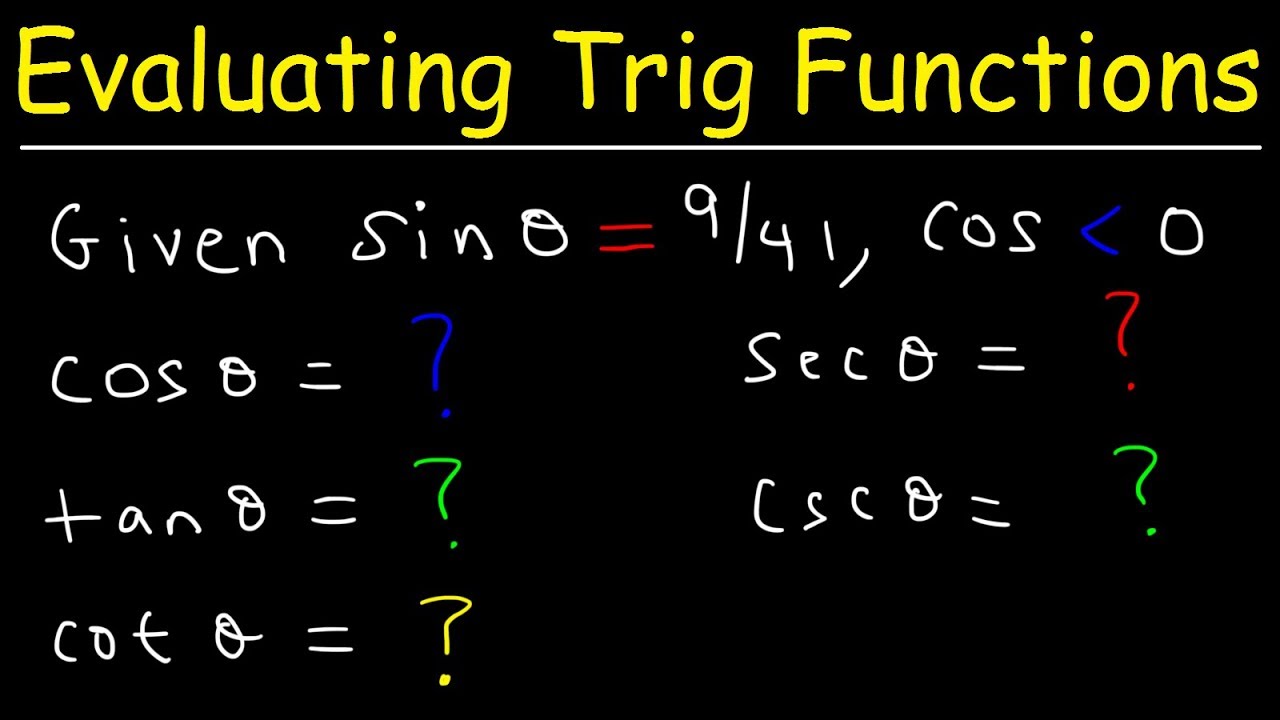
This trigonometry video tutorial explains how to find the exact value of the five remaining trigonometric functions given one trig function and the sign of another. You need to identify the quadrant in which the angle lies in and use right triangle trigonometry to find the exact value of the other trig functions.
lunar harbor
onyx grove
If they were to translate it to radians it would not cancel out the 7pi/4 as rad...
You do you ig
I gave you my interpretation
You’re free to take it or leave it
onyx grove
Sorry I wasn't trying to be a dick just confused about the question
thank you for the help though it does clear quite a bit up
i'll try again to figure it out tommorow
.close
devout snowBOT
Channel closed
Closed by @onyx grove
Use .reopen if this was a mistake.
Available help channel!
Send your question here to claim the channel.
Remember:
• Ask your math question in a clear, concise manner.
• Show your work, and if possible, explain where you are stuck.
• After 15 minutes, feel free to ping <@&286206848099549185>.
• Type the command .close to free the channel when you're done.
• Be polite and have a nice day!
Read #❓how-to-get-help for further information on how to ask a good question, and about conduct in the question channels.
 sharp citrus
 devout snowBOT
sharp citrus
sharp citrus
devout snowBOT
sharp citrus
sharp citrus
is there some formula im supposed to use for this question
cus i have no idea how to approach it
 potent nebula
P(A U B) = P(A) + P(B) - P(A and B)
for events that are not mutually exclusive
if they are then P(A U B) = P(A) + P(B)
do you know how to calculate P(A and B)
 strange arch
@sharp citrus ?
devout snowBOT
Channel closed
Closed by @sharp citrus
Use .reopen if this was a mistake.
devout snowBOT
Available help channel!
Send your question here to claim the channel.
Remember:
• Ask your math question in a clear, concise manner.
• Show your work, and if possible, explain where you are stuck.
• After 15 minutes, feel free to ping <@&286206848099549185>.
• Type the command .close to free the channel when you're done.
• Be polite and have a nice day!
Read #❓how-to-get-help for further information on how to ask a good question, and about conduct in the question channels.
 stark shuttle
How do I calculate the horizontal shift for a function like this?
devout snowBOT
@stark shuttle Has your question been resolved?
Channel closed
Closed due to the original message being deleted
devout snowBOT
Available help channel!
Send your question here to claim the channel.
Remember:
• Ask your math question in a clear, concise manner.
• Show your work, and if possible, explain where you are stuck.
• After 15 minutes, feel free to ping <@&286206848099549185>.
• Type the command .close to free the channel when you're done.
• Be polite and have a nice day!
Read #❓how-to-get-help for further information on how to ask a good question, and about conduct in the question channels.
 cursive totem
,,13^{2019}\mod 95
devout snowBOT
cursive totem
,,13^{2019}\mod 95
woven radishBOT
 cursive totem
I've used fermat's to obtain 13^4 = 1 mod 5 and 13^18 = 1 mod 19
but idk where to go from there
.close
devout snowBOT
Channel closed
Closed by @cursive totem
Use .reopen if this was a mistake.
Available help channel!
Send your question here to claim the channel.
Remember:
• Ask your math question in a clear, concise manner.
• Show your work, and if possible, explain where you are stuck.
• After 15 minutes, feel free to ping <@&286206848099549185>.
• Type the command .close to free the channel when you're done.
• Be polite and have a nice day!
Read #❓how-to-get-help for further information on how to ask a good question, and about conduct in the question channels.
restive river
Am i reading this problem correctly?
 devout snowBOT
restive river
Am i reading this problem correctly?
devout snowBOT
restive river
Am i reading this problem correctly?
@restive river Has your question been resolved?
 devout snowBOT
Channel closed
Closed by @exotic vortex
Use .reopen if this was a mistake.
devout snowBOT
Available help channel!
Send your question here to claim the channel.
Remember:
• Ask your math question in a clear, concise manner.
• Show your work, and if possible, explain where you are stuck.
• After 15 minutes, feel free to ping <@&286206848099549185>.
• Type the command .close to free the channel when you're done.
• Be polite and have a nice day!
Read #❓how-to-get-help for further information on how to ask a good question, and about conduct in the question channels.
 wooden axle
I have to find the equation of a plave which passes through x axis and (3,2,4) point
devout snowBOT
wooden axle
I have to find the equation of a plave which passes through x axis and (3,2,4) p...
 pseudo basin
☠️
 uncut crow
☠️
weak cove
💀
pseudo basin
anyway it's 2b + 4c = 0 not 2b + 4z = 0
wooden axle
@uncut crow your PFP😂
wooden axle
pseudo basin
anyway it's 2b + 4**c** = 0 not 2b + 4z = 0
Yes
uncut crow
what about it 
pseudo basin
you can now find b and c
take one of them as whatever you want (except 0) and find the value of the other one
wooden axle
U meant 2b=-4c ?
pseudo basin
do the same thing we did yesterday only with (0,0,0) and (3,2,4) as your two points
wooden axle
Now it's done🤦
pseudo basin
i don't want to repeat myself with different numbers
devout snowBOT
Channel closed
Closed by @wooden axle
Use .reopen if this was a mistake.
Available help channel!
Send your question here to claim the channel.
Remember:
• Ask your math question in a clear, concise manner.
• Show your work, and if possible, explain where you are stuck.
• After 15 minutes, feel free to ping <@&286206848099549185>.
• Type the command .close to free the channel when you're done.
• Be polite and have a nice day!
Read #❓how-to-get-help for further information on how to ask a good question, and about conduct in the question channels.
 past laurel
dont even know how to start this i plug in -1 on top and get 3.45... but idk what to do in the bottom
 devout snowBOT
past laurel
dont even know how to start this i plug in -1 on top and get 3.45... but idk wha...
devout snowBOT
past laurel
dont even know how to start this i plug in -1 on top and get 3.45... but idk wha...
@past laurel Has your question been resolved?
past laurel
<@&286206848099549185>
supple knot
That's very small
devout snowBOT
@past laurel Has your question been resolved?
Channel closed
Closed by @past laurel
Use .reopen if this was a mistake.
Available help channel!
Send your question here to claim the channel.
Remember:
• Ask your math question in a clear, concise manner.
• Show your work, and if possible, explain where you are stuck.
• After 15 minutes, feel free to ping <@&286206848099549185>.
• Type the command .close to free the channel when you're done.
• Be polite and have a nice day!
Read #❓how-to-get-help for further information on how to ask a good question, and about conduct in the question channels.
wooden axle
How to find the equation of a plane which passes through middle point (3,-2,1)(1,4,-3)
devout snowBOT
wooden axle
How to find the equation of a plane which passes through middle point (3,-2,1)(1...
manic condor
There are infinite planes passing through a single point.
manic condor
What do you mean?
wooden axle
We need to find the equation of place which is perpendicular to these points and passes through the middle point
Do you understand hindi?
manic condor
wooden axle
We need to find the equation of place which is perpendicular to these points and...
Plane perpendicular to a point? What does that even mean? 😐
manic condor
wooden axle
Do you understand hindi?
Sure. Go ahead.
 manic condor
wooden axle
manic condor
wooden axle
Even now, if they want plane passing through perpendicular bisector of that line segment, there are infinite such planes.
However, if angle between line and plane has to be 90°, then it has a unique plane.
wooden axle
Middle point and x,y,z then direction ratio will be 2-x,1-y,-1-z and dot product with normal(1,-3,2) will be zero
manic condor
wooden axle
Dot product
Well, it's even simpler. In the second case that i mentioned, perpendicular vector to plane is in same direction as this line.
Just put value of middle point and solve for constant.
manic condor
wooden axle
Middle point and x,y,z then direction ratio will be 2-x,1-y,-1-z and dot product...
How is normal (1, -3, 2)?
Check your thinking again.
I'll be back in a few minutes.
manic condor
Ah. You took with midpoint. That's correct.
wooden axle
I am confused about whether I do dot products or cross?
devout snowBOT
@wooden axle Has your question been resolved?
devout snowBOT
@wooden axle Has your question been resolved?
 vernal monolith
wooden axle
I am confused about whether I do dot products or cross?
vernal monolith
wooden axle
I am confused about whether I do dot products or cross?
I think you need 2 vectors for cross product, you only found a single vector that passes through both points
Given vector (a,b,c) that is perpendicular to a plane, can you type the formula for that plane
Hint: take two arbitrary points on the plane, find a vector that passes through both points on the plane, and lastly take dot product of these vectors , since one vector is perpendicular to other, it should be equal to 0
wooden axle
wooden axle
Middle point and x,y,z then direction ratio will be 2-x,1-y,-1-z and dot product...
See
I guess this is correct
vernal monolith
That vector will be our normal vector yes
You can type the formula of plane from that
manic condor
wooden axle
Middle point and x,y,z then direction ratio will be 2-x,1-y,-1-z and dot product...
This is already done. What are you confused about now?
wooden axle
Why i didn't try the cross product
vernal monolith
Do you know the purpose of cross product?
Why we use it
Its used to find a normal/perpendicular vector to our current 2 existing vectors
Here we only have 1 vector
Plus our vector is already a normal to the plane we are trying to find
wooden axle
vernal monolith
Do you know the purpose of cross product?
So that we can get a perpendicular vector
vernal monolith
wooden axle
So that we can get a perpendicular vector
Exactly
Do we need to do that when we already have one though
wooden axle
If it was given two points of plane
vernal monolith
You need like at least 3 points to take cross product
vernal monolith
On 3 points?
wooden axle
Yes
vernal monolith
It wouldnt be perpendicular to every point then
wooden axle
Ohh now i got it the loophole
Here we are taking all the points because it is in x,y,z form so all points included
So dot product is making sense
vernal monolith
Lets say you have points P, Q and R
Then to find perpendicular vector you need to take 2 vectors whose union contains all these points, so i will take the vectors PQ and QR,
( but you can also do it like: PR and PQ or PR and QP, however you'd like)
Then i take cross product of PQ and QR => |PQ x QR|
Reminder that cross product is perpendicular to the vectors it consists so
|PQ x QR| . PQ = 0
|PQ x QR| . QR = 0
vernal monolith
wooden axle
So dot product is making sense
Actually dot product isnt needed for your question if you know the shortcut
vernal monolith
vernal monolith
Given vector (a,b,c) that is perpendicular to a plane, can you type the formula ...
Shortcut i mean is this
But its derived from the dot product way, i think
So far your work is like this @wooden axle

I typed equation of the plane from the shortcut, but longer way to do is by taking points $P=(x_0,y_0,z_0)$ , $Q=(x,y,z)$ and constructing $$\overrightarrow{PQ}$$ which is normal to vector $\vec{n}$
woven radishBOT
Cyrenux
 wooden axle
We can take a point P as middle point
vernal monolith
wooden axle
(3,-2,1) - (2,1,-1)
By middle point are you referring the to point between (3,-2,1) and (2,1,-1)
vernal monolith
Ah i see, my bad
The vector you typed still passes through it, so we are good i think
After typing the equation of plane
We can find term d, by using the fact that middle point should satisfy the plane since plane is passing through it
wooden axle
Suppose we have to find a plane equation and we are given a point perpendicular to plane, 2points on plane what will we do cross product?
<@&286206848099549185>
manic condor
wooden axle
Suppose we have to find a plane equation and we are given a point perpendicular ...
What do you even mean by a point perpendicular to plane ?
wooden axle
Like in this
vernal monolith
There is no 'point perpendicular to plane'
wooden axle
Question
vernal monolith
Its a vector that is perpendicular to a plane who consists the point
manic condor
Write in Hindi.
wooden axle
Mera sawal hain
Agar ek plane ka equation nikalna hain and hamko diya hain
Ek point (3,-2,1) jo plane k upr hain aur 2 points plane ka upr hain (2,-1,1) and (4,-5,2)
@manic condor
manic condor
Perpendicular point makes no sense to me.
Do you mean that (3,-2,1) is lying above the plane ?
Or somewhere out of the plane(not on the plane) ?
wooden axle
manic condor
Do you mean that (3,-2,1) is lying above the plane ?
Yes
wooden axle
manic condor
Or somewhere out of the plane(not on the plane) ?
Out of the plane and above

Give me the idea how will cross/dot product will happen here?
vernal monolith
That plane you drew seems random, what was your idea with it?
It seems like you want to find a plane which consists these 3 points
wooden axle
I guess here we will do cross product
vernal monolith
Yeah its forced kinda
wooden axle
We will find vector PQ and QR then cross product
And cross product will make all the points of the plane
vernal monolith
wooden axle
And cross product will make all the points of the plane
Cross product, which you will evaluate is the vector that will be perpendicular to plane, if cross product is (a,b,c) then equation of plane is ax + by + cz + d = 0
Since cross product, who is perpendicular to the vectors who consists the points P Q R, the plane who is perpendicular to the cross product, will in fact contain these 3 points
After finding equation of plane you can insert one of the points
To find value; d
 vernal monolith
That doesnt seem to contain the point P
wooden axle
So here PQ like perpendicular to the plane
vernal monolith
Also i can already see that you are trying to say P perpendicular to the plane, but that is like the most illegal thing ever, in a way its like saying two points are perpendicular which makes no sense
wooden axle
We will do dot product
vernal monolith
You can say that P is a point on a normal vector
wooden axle
Yes
vernal monolith
wooden axle
So here PQ like perpendicular to the plane
There are many planes that include points R and Q
vernal monolith
But i believe there is only one plane that contains P Q and R
vernal monolith
wooden axle
In this situation we can do cross dot both right?
We need 2 vectors for it, NOT a plane and vector
We can take PQ and QR or QP and QR or ... etc
vernal monolith
wooden axle
Oh i see an issue with your take
PQ is not perpendicular to that plane
You already know points P, Q and R, evaluate PQ and QR
Since Q and R are in the plane so is the vector QR, but notice that PQ . QR is not 0
 empty flame
hello everyone , what are the coordinates of P,Q,R?
wooden axle
vernal monolith
PQ is not perpendicular to that plane
Both pictures are different
P is perpendicular in last picture
vernal monolith
wooden axle
Here are the points P Q and R
wooden axle
In the first picture p is not perpendicular so we choose only cross product
vernal monolith
wooden axle
P is perpendicular in last picture
Point P cannot be perpendicular
Because points cannot be perpendicular
wooden axle
In the second picture it is perpendicular so we can use cross product and dot product both that's my doubt
I meant PQ straight line is perpendicular
vernal monolith
To what
wooden axle
To the plane
vernal monolith
Its not
wooden axle
I am stating it is
vernal monolith
I just explained why its not
The numbers you picked dont satisfy such conditition
empty flame
wooden axle
is this the second picture that you are talking about ?
empty flame
then no $\vec{PQ}$ isnt perp to the plane containing Q and R
woven radishBOT
calculus is fun
 wooden axle
But in the second picture PQ.QR and PQ×QR both are possible or not that's my doubt because PQ perpendicular to QR
empty flame
try $\vec{PQ}.\vec{QR}$
woven radishBOT
calculus is fun
 empty flame
try $\vec{PQ}.\vec{QR}$
empty flame
empty flame
try $\vec{PQ}.\vec{QR}$
can you try this
wooden axle
Seriously i need help in Hindi to be sure when we do cross and dot and in which situation we can use both products
vernal monolith
They said its irrevelant from the values they posted earlier
wooden axle
Is there no situation where we can do both products?
empty flame
when you try this you will see that $\vec{PQ}$ isnt perpendicular to the plane that you showed in the picture
woven radishBOT
calculus is fun
 vernal monolith
empty flame
when you try this you will see that $\vec{PQ}$ isnt perpendicular to the plane t...
vernal monolith
empty flame
when you try this you will see that $\vec{PQ}$ isnt perpendicular to the plane t...
The picture he sent is irrevelant to his previous one so not same values
wooden axle
empty flame
when you try this you will see that $\vec{PQ}$ isnt perpendicular to the plane t...
I am saying it is perpendicular
wooden axle
I don't want shortcuts
vernal monolith
If you dont want shortcut just do cross product then why bother to see their dot product is 0
empty flame
look if the dot product is 0 then you get the equation of the plane directly
if the dot product is not 0 then you use the cross product to get a normal vector of the plane ( a vector perpendicular to the plane) then you get the dot product between a vector in the plane and the result of the cross product to get the equation of the plane
vernal monolith
empty flame
look if the dot product is 0 then you get the equation of the plane directly
If the dot product is 0, does plane contain all P Q R or only Q and R or only P
empty flame
i am saying that if P is a point outside the plane containing Q and R and PQ.QR = 0 then you can directly get the equation of the plane
empty flame
but no matter what points P Q and R you choose you can always put them in the same plane
so as long as you choose 3 points you can always find a plane that contains all 3 points
empty flame
vernal monolith
This plane consists all the points P,Q and R?
which plane
vernal monolith
I see