#help-27
1 messages · Page 94 of 1
 edgy thicket
I mean sure i can say that sin(90+x) = cosx
But
When it comes to the cos(90+x) its
OUUH
Right cos(90+x) = -sinx cause the cos value of the top left side is negative
Am i making sense?
 craggy escarp
Yes
It's at the left of the origin 0
it's then < 0
for sine, below x-axis and below zero
then < 0
edgy thicket
Riggttt
I have one more problem..(its trig related)
Can i ask you?
Or you thinks just too exhausting for today?
@craggy escarp
edgy thicket
Sin(270+x)
Why is it -cosine
By the same logic shouldn’t it be positive cosine since the value of cos is positive on the 4th quadrant
 edgy thicket
Assuming green is sin and blue cos?
craggy escarp
y-axis is ALWAYS sine
x-axis is ALWAYS cosine
Well yeah, if you're looking at it that way
edgy thicket
So thats a no?
craggy escarp
the green segments are sine, true
i was looking in a different way
the blue segments are cosine
 edgy thicket
craggy escarp
but for 270+x, no
edgy thicket
craggy escarp
but for 270+x, no
No no I didn’t say
craggy escarp
the horizontal is always cosine
craggy escarp
okay
 craggy escarp
Right!
edgy thicket
Are we sure?
edgy thicket
And the cosine for the 270+x is this righy?
 craggy escarp
yess
edgy thicket
Oe the one on the x axis
craggy escarp
both
edgy thicket
Oshh
Wiatt
They look like.. idk maybe triangles in different orientations
So like…
Hmmzz
craggy escarp
yes right
with cosine being adjacent to the angle
and sine being opposite
that's SOHCAH
 edgy thicket
Yess
craggy escarp
270° anti-clockwise
edgy thicket
Thats why i for some reason my Brian said rotated lol
OH MY FRIGGING gosh
I finally understand this sheiße
edgy thicket
Oki
craggy escarp
cos(x-90) = ?
craggy escarp
just draw x and x-90
edgy thicket
Cos-(90-x)
craggy escarp
and look at x-90's cosine
Leave it as x-90
What's the problem!
Just do it the same way
draw x and (x-90)
look at cosine of (x-90)
edgy thicket
X - 90 you say?
craggy escarp
yes
craggy escarp
Rotate x by 90° clockwise
edgy thicket
Hmm
craggy escarp
- is counter clockwise
edgy thicket
Well i kinda said that here
craggy escarp
the - is clockwise
edgy thicket
edgy thicket
Cos-(90-x)
This??
So like we can get the values at the normal quadrants but we just multiply the answer with negative ?
Sorryb
craggy escarp
never mind, never mind
edgy thicket
Whattt
edgy thicket
Little advanced 😥
craggy escarp
Right!
edgy thicket
Haha
craggy escarp
cos(270-x)
edgy thicket
Waitt
Oh no waiy
Yess its
-cosx
Sorry
Took a little longer cause I didn’t see the x was negative
Am I correct vvv
edgy thicket
Ohh crapp
craggy escarp
Check again
craggy escarp
😝
edgy thicket
Lol look at this

I solved for sin
Instead of cos
And the minus i forgot to add
craggy escarp
😋
craggy escarp
Maybe you were not yet taught the notion of negative angles
All you meet for now are positive angles
Counter Clockwise
craggy escarp
correct
edgy thicket
WOAH
craggy escarp
😃
edgy thicket
No way
craggy escarp
Haha
edgy thicket
You’re lying lmao
craggy escarp
No, it actually is correct
craggy escarp
Wut!
 edgy thicket
Omg oki
craggy escarp
Well done!
edgy thicket
Be friends?
craggy escarp
Good luck, I will see you around
 devout snowBOT
@edgy thicket Has your question been resolved?
devout snowBOT
Channel closed
Closed due to timeout
Use .reopen if this was a mistake.
 Available help channel!
Send your question here to claim the channel.
Remember:
• Ask your math question in a clear, concise manner.
• Show your work, and if possible, explain where you are stuck.
• After 15 minutes, feel free to ping <@&286206848099549185>.
• Type the command .close to free the channel when you're done.
• Be polite and have a nice day!
Read #❓how-to-get-help for further information on how to ask a good question, and about conduct in the question channels.
 grim mountain
4x^2+7x+2=0
devout snowBOT
grim mountain
4x^2+7x+2=0
 near stone
!status
devout snowBOT
What step are you on?
1. I don't know where to begin
2. I have begun but got stuck midway
3. I got an answer but I'm told it's wrong
4. I got an answer and would like my work checked
5. I have a question about someone else's worked solution
6. None of the above
Take the common terms and simplify
grim mountain
I couldn’t factor out
 restive river
the solution isnt rational, so factoring doesnt work
use the quadratic formula instead
near stone
use quadratic formula
near stone
grim mountain
4x^2+7x+2=0
Appy a, b and c on formula
near stone
grim mountain
Or 4x+1
Doesn't factor
grim mountain
near stone
Appy a, b and c on formula
What you mean
near stone
Do you know how quadratic formula works?
 woven radishBOT
Akira
 near stone
This what I mean
grim mountain
Ah I figured
I use pq formula
If I use pq formula I will have 7/4 which is bothersome
near stone
Wdym by pq?
 grim mountain
Yeah
near stone
Oh I see
grim mountain
I can’t use abc-formula
near stone
Well honestly quadratic formula is easier
Never heard of this before
Do you still need help? or done

grim mountain
The only reason I didn’t do pq formula at first is 7/4
near stone
Does the question asking you to solve it by pq formula or quadratic
grim mountain
It just says solve the solution
near stone
I see
 near stone
I suggest you using the quadratic formula because this formula you are using doesn't makes sense at all
grim mountain
Is quadric formula abc formula?
near stone
woven radish
**Akira**
Have you read this
near stone
Why can't you use that wdym
near stone
Oh that's the point
But do you know how to use Wolfram
It tells to use quadratic
,w calc 4x^2+7x+2=0
woven radishBOT


 Requested by kensukeken#0
near stone
Requested by kensukeken#0
near stone
see
grim mountain
I won’t learn like that
near stone
Well you just learned it
 devout snowBOT
Channel closed
Closed by @grim mountain
Use .reopen if this was a mistake.
Available help channel!
Send your question here to claim the channel.
Remember:
• Ask your math question in a clear, concise manner.
• Show your work, and if possible, explain where you are stuck.
• After 15 minutes, feel free to ping <@&286206848099549185>.
• Type the command .close to free the channel when you're done.
• Be polite and have a nice day!
Read #❓how-to-get-help for further information on how to ask a good question, and about conduct in the question channels.
 naive basin
(\left|z_1\right| = 15) and (\theta_1 = 209^\circ). Express (z_1) in rectangular form as (z_1 = a + bi), where (a) and (b) are rounded to the nearest thousandth.
devout snowBOT
naive basin
(\left|z_1\right| = 15) and (\theta_1 = 209^\circ). Express (z_1) in rectangular...
naive basin
$(\left|z_1\right| = 15) and (\theta_1 = 209^\circ). Express (z_1) in rectangular form as (z_1 = a + bi), where (a) and (b) are rounded to the nearest thousandth.$
woven radishBOT
TangentLINE
 naive basin
Can somebody please help
Now, since (\theta_1 = 209^\circ), we subtract it from (360^\circ) and it equals (151^\circ). We are already given that (\left|z_1\right| = 15). Putting these two together, we have (15\left(\cos(151^\circ) + i\sin(151^\circ))). We then distribute the (15) and we will have our answer.
$(\left|z_1\right| = 15) and (\theta_1 = 209^\circ). Express (z_1) in rectangular form as (z_1 = a + bi), where (a) and (b) are rounded to the nearest thousandth.$
woven radishBOT
TangentLINE
 naive basin
$Now, since (\theta_1 = 209^\circ), we subtract it from (360^\circ) and it equals (151^\circ). We are already given that (\left|z_1\right| = 15). Putting these two together, we have (15\left(\cos(151^\circ) + i\sin(151^\circ))). We then distribute the (15) and we will have our answer.$
woven radishBOT
TangentLINE
Compile Error! Click the  reaction for more information.
(You may edit your message to recompile.)
 naive basin
.close
devout snowBOT
Channel closed
Closed by @naive basin
Use .reopen if this was a mistake.
Available help channel!
Send your question here to claim the channel.
Remember:
• Ask your math question in a clear, concise manner.
• Show your work, and if possible, explain where you are stuck.
• After 15 minutes, feel free to ping <@&286206848099549185>.
• Type the command .close to free the channel when you're done.
• Be polite and have a nice day!
Read #❓how-to-get-help for further information on how to ask a good question, and about conduct in the question channels.
 short stag
Help me please. Using double and triple integrals.
 devout snowBOT
short stag
Help me please. Using double and triple integrals.
devout snowBOT
short stag
Help me please. Using double and triple integrals.
What step are you on?
1. I don't know where to begin
2. I have begun but got stuck midway
3. I got an answer but I'm told it's wrong
4. I got an answer and would like my work checked
5. I have a question about someone else's worked solution
6. None of the above
 mild comet
Can you find the boundary constraints on the solid?
devout snowBOT
@short stag Has your question been resolved?
short stag
mild comet
Can you find the boundary constraints on the solid?
I tried converting it to cylindrical and for theta, I have 0 to 2pi. For the r, I tried finding the intersection point of the two surfaces and I arrived at z=sqrt(9-x²). So for r, i have 0 to sqrt(9-x²).
Please help me.
 neat ember
Hi
short stag
I don't know how to solve it. Huhu
 coral crescent
short stag
Help me please. Using double and triple integrals.
coral crescent
short stag
Help me please. Using double and triple integrals.
did you sketch the shape
we have symmetry here so we can just cut the shape 3 times and just get the volume of this slice and multiply by 8, see if this helps
 short stag
Hi, I can't really get it. Huhu
coral crescent
Don't understand how we cut it?
short stag
I barely understand it. Sorry.
coral crescent
it's alright
Start with sketching the body
that's always where you want to start when doing work like this
making solving much easier
short stag
Getting this problem right is my only chance to pass this course. But I am so dumbfounded right now.
coral crescent
you can draw it in 2D and make your brain fill the gaps
coral crescent
short stag
Getting this problem right is my only chance to pass this course. But I am so du...
it's okay, im guiding through it, it isn't a hard problem. Just work with me
short stag
Please, I don't want to fail this course.🥹
coral crescent
well have you understood what i said before :p
short stag
That's my problem right now. I am stuck looking at the graph.
coral crescent
can you show me the graph you have
short stag
coral crescent
we have symmetry here so we can just cut the shape 3 times and just get the volu...
Im just looking at here. huhu, im sorry
But, would it be helpful if I convert the equations to polar coordinates?
coral crescent
oh you meant the one i sent okay
let's work it out in Cartesian coordinates now and worry about polar later
coral crescent
we have this shape right? we can cut it in half and get the volume of the other half

and to get the full volume we multiply by 2
got me?
short stag
I see. Im following.
coral crescent
coral crescent
we have symmetry here so we can just cut the shape 3 times and just get the volu...
same idea here, we cut at xoy then zoy plane (both ways work)
and since we cut 2 times we should multiply by 4
and with the 2 from the previous cut, we should multiply the same section by 8
reminder we can do all this since we have symmetry
short stag
Wait, im getting lost.
 short stag
Yes yes. So that's why it should be multiplied by 4. Knowing we have a symmetry.
coral crescent
yes, should be enough to get the volume of one of these quadrants then multiply by 8 to get the volume of the entire body
so good so far?
short stag
Yes yes. But how do I get the volume of one quadrant?🥲
coral crescent
first we choose Which axis we want to work on first
y axis seems the easiest
oops
i meant square root
sorry another blunder
short stag
The given is 18.
coral crescent
lemma delete all this
coral crescent
short stag
The given is 18.
yah sorry
short stag
Ok ok
coral crescent
now we can choose to either work on x or z plane
ah actually before that
we need to separate the body at where the cone and sphere intersect
short stag
How do we do that?🥲
coral crescent
x^2 + y^2 + z^2 - 18 = x^2 - y^2 + z^2
and fortunately for us stuff cancel out nicely here
and we can calculate the value of y
coral crescent
correct
short stag
OMG. Ok ok.
short stag
Ok. I see.
coral crescent
if we project the shape onto the xoy plane
we get a section of a circle with radius 3sqrt(2)
after projection we have x^2 + y^2 = 18
and we solve for x
short stag
It's 3, right?
coral crescent
hmm?
short stag
Oh wait.
coral crescent
we are trying to get x in terms of y
short stag
x = sqrt(18-y²)
coral crescent
yah correct
coral crescent
now to late step, bounds of z
here comes the importance of splitting the integral at y = 3
cause z doesnt follow the same rule all across xoy
short stag
Ohh
coral crescent
from 0 to 3 we have z defined by the cone and from 3 to 3sqrt(2) we have it defined by the sphere
actually i made a mistake
a big one
x is also not the same
x will have 2 forms too
like z from 0 to 3 x defined by the cone, from 3 to 3sqrt(2) defined by the sphere
so
x^2 - y^2 = 0 for 0 to 3
x^2 + y^2 = 18 from 3 to 3sqrt(2)
short stag
coral crescent
so
x^2 - y^2 = 0 for 0 to 3
x^2 + y^2 = 18 from 3 to 3sqrt(2)
Is this for x?
coral crescent
yes
coral crescent
yah sorry, big mistake on my part
coral crescent
short stag
Anyway, let's continue. Hehe
got it tho?
short stag
Yes yes
coral crescent
alright
for z we have
from 0 to 3 x^2-y^2+z^2=0
from 3 to 3sqrt(2) x^2+y^2+z^2=18
and we solve for z
short stag
is z = sqrt(9-x²)?
coral crescent
👍
now write the integral
polar coordinates going to be much easier
actually we will use spherical*
short stag
Gosh, how do i start writing it?
short stag
OMG, im lost. Haha
coral crescent
we said y is from 0 to 3sqrt(2) with a cut at 3
[ \int_{0}^{3\sqrt{2}} [ \int_{D_{xz}} ,dxdz ] ,dy ]
woven radishBOT
alihsaas
 short stag
Ok, im following.
coral crescent
and since x is different from 0 to 3 and 3 to 3sqrt(2) it becomes:
[ \int_{0}^{3} [ \int_{D_{xz}} ,dxdz ] ,dy + \int_{3}^{3\sqrt{2}} [ \int_{D_{xz}} ,dxdz ] ,dy ]
woven radishBOT
alihsaas
 coral crescent
continue from here
short stag
OMG, im lost. Im not sure if im doing it right.
coral crescent
show me what you did
short stag
 coral crescent
just a moment, phone gonna die
short stag
Ok ok
coral crescent
ok the problem is you can swiped the bounds of x and z
you can't do that with the equations you go
like in the first integral
you used x before we defined x
short stag
How do I do that?
coral crescent
see what we did
 short stag
Yes
short stag
OMG, spherical.😭 Let's go.
coral crescent
spherical is R Theta Phi
ill define Theta as the angle between Z axis and M and phi the angle betwen x axis and projection
so phi is the polar angle
short stag
Ok ok
coral crescent
can you tell me what R is here
the interval it belongs to
also lets work on the same slice
short stag
Wait, it's hard for me.
short stag
coral crescent
see what we did
0 to 3 and 3 to 3√2 is the interval which R belongs to of not?🥲
short stag
How do i determin phi?
coral crescent
can you tell me what Beta is here
 short stag
Does beta represent phi?
coral crescent
you haven't told me what beta is
short stag
Sorry. I can'r figure it out.
coral crescent
equation of cone is x^2 - y^2 + z^2 = 0 right?
and since we are looking at the projection on xoy
z is zero
short stag
Yes
coral crescent
so we get x = y
short stag
Ok ok
coral crescent
and beta here is tanBeta = x/y

solving for Beta
tan^-1 (x/y) = tan^1 (1) = pi/4
i mean /4
short stag
Oh, wow. Amazing. Sorry, i was too dumb.
coral crescent
now we can deduce phi
short stag
0 to pi/4?
coral crescent
why 0
short stag
Because we started at the origin? Im not sure. Sorry, huhu.
coral crescent
going from 0 to pi/4 means going like this, the correct idea is pi/4 to pi/2

while it should give the same answer, better write correctly
short stag
Ok ok
coral crescent
now write the integral
short stag
Is this correct?
 short stag
So what I wrote is incorrect?
coral crescent
just need to change the sin
rest should be correct
and don't forget to multiply by 8
 coral crescent
they took theta as the polar angle in your image
we took phi as the polar angle here
short stag
Oh i see
coral crescent
sorry for the confusion but that's how I usually work
short stag
No problem.
coral crescent
so i have consistent naming between spherical and polar
short stag
How do I solve it using double integrals?
coral crescent
this is a volume, you have to use triple
short stag
But our professor asked us to solve it using both methods. Huhu
coral crescent
ah actually right
basically what we did originally using Cartesian coordinates
but instead of the integral of z we put the function
short stag
How I do that?
coral crescent
originally we got z in terms of x and y right?
short stag
Yes
coral crescent
for both domains
from 0 to 3 and 3 to 3✓2
just replace the integral dz with them
they are our functions
short stag
I dont follow. Huhu, sorry.
woven radishBOT
alihsaas
 coral crescent
to calculate the area a curve
[ \int_{a}^{b} \int_{y_1(x)}^{y_2(x)} f(x, y) dydx ]
woven radishBOT
alihsaas
 short stag
Can you help me do it?
coral crescent
short stag
Can you help me do it?
did you try writing it
 short stag
Oh i see.
coral crescent
cause cone is x^2 - y^2 + z^2 = 0
and don't forget to multiply by 8
cause this is volume of section
short stag
My problem now is how to integrate the function with respect to x and y.
short stag
Can we transform it into polar?
coral crescent
yah sure same thing as spherical but no theta
and we take x = r cos phi
y = r sin phi
devout snowBOT
@short stag Has your question been resolved?
coral crescent
@short stag any problem?
short stag
Hi, just finished solving. But I have another problem. Huhu
You were really a great help to me, @coral crescent thank you so much!🥹
coral crescent
short stag
You were really a great help to me, <@590126280289288205> thank you so much!🥹
you're welcome anytime
short stag
Here's another problem
 devout snowBOT
@short stag Has your question been resolved?
devout snowBOT
Channel closed
Closed due to timeout
Use .reopen if this was a mistake.
Available help channel!
Send your question here to claim the channel.
Remember:
• Ask your math question in a clear, concise manner.
• Show your work, and if possible, explain where you are stuck.
• After 15 minutes, feel free to ping <@&286206848099549185>.
• Type the command .close to free the channel when you're done.
• Be polite and have a nice day!
Read #❓how-to-get-help for further information on how to ask a good question, and about conduct in the question channels.
 maiden zinc
i have f(x, y) = x²y² / (x² + y²) and i wanna calculate $D_1f(x,y)$
 devout snowBOT
@maiden zinc Has your question been resolved?
devout snowBOT
Channel closed
Closed due to timeout
Use .reopen if this was a mistake.
Available help channel!
Send your question here to claim the channel.
Remember:
• Ask your math question in a clear, concise manner.
• Show your work, and if possible, explain where you are stuck.
• After 15 minutes, feel free to ping <@&286206848099549185>.
• Type the command .close to free the channel when you're done.
• Be polite and have a nice day!
Read #❓how-to-get-help for further information on how to ask a good question, and about conduct in the question channels.
 junior stratus
hey i just wanted to know if i’m trippin or did i get the right answers for these
 devout snowBOT
junior stratus
hey i just wanted to know if i’m trippin or did i get the right answers for thes...
devout snowBOT
junior stratus
hey i just wanted to know if i’m trippin or did i get the right answers for thes...
 supple knot
junior stratus
hey i just wanted to know if i’m trippin or did i get the right answers for thes...
supple knot
junior stratus
hey i just wanted to know if i’m trippin or did i get the right answers for thes...
!show
devout snowBOT
junior stratus
hey i just wanted to know if i’m trippin or did i get the right answers for thes...
Show your work, and if possible, explain where you are stuck.
junior stratus
So for North I used 90Cos36deg
and for West I used 90Sin36deg @supple knot
<@&286206848099549185>
 devout snowBOT
@junior stratus Has your question been resolved?
devout snowBOT
Channel closed
Closed due to timeout
Use .reopen if this was a mistake.
 scenic ether
.reopen
devout snowBOT
Channel closed
Closed due to timeout
Use .reopen if this was a mistake.
devout snowBOT
Available help channel!
Send your question here to claim the channel.
Remember:
• Ask your math question in a clear, concise manner.
• Show your work, and if possible, explain where you are stuck.
• After 15 minutes, feel free to ping <@&286206848099549185>.
• Type the command .close to free the channel when you're done.
• Be polite and have a nice day!
Read #❓how-to-get-help for further information on how to ask a good question, and about conduct in the question channels.
 fleet ermine
Let $\mathrm{P}_{i\in I}\mathcal{A}_i={f\mid \mathrm{Dom}(f)=I\land \forall i(f_i\in \mathcal{A}_i)}$ be the "direct product" of an indexed family of sets with domain $I$ and let $\mathrm{Pr}_i={f_i\mid f \text{is a function}\land i\in\mathrm{Dom}(f)}$ be the i-th projection function. On my set theory book it's written that there is a strict geometric relation between the direct product and the i-th projection... does anyone know what is it supposed to be?
devout snowBOT
fleet ermine
Let $\mathrm{P}_{i\in I}\mathcal{A}_i=\{f\mid \mathrm{Dom}(f)=I\land \forall i(f...
woven radishBOT
.lasur
 devout snowBOT
@fleet ermine Has your question been resolved?
 grand siren
do they define what a "strict geometric relation" is?
devout snowBOT
@fleet ermine Has your question been resolved?
devout snowBOT
Channel closed
Closed due to timeout
Use .reopen if this was a mistake.
Available help channel!
Send your question here to claim the channel.
Remember:
• Ask your math question in a clear, concise manner.
• Show your work, and if possible, explain where you are stuck.
• After 15 minutes, feel free to ping <@&286206848099549185>.
• Type the command .close to free the channel when you're done.
• Be polite and have a nice day!
Read #❓how-to-get-help for further information on how to ask a good question, and about conduct in the question channels.
fleet ermine
grand siren
do they define what a "strict geometric relation" *is*?
yeah they say "the direct product of a is an I-dimensional space; the elements f of the direct product of a are I-tuples, where the i-th coordinate is f_i, i\in I. It is natural to consider the operation of projection of the i-th coordinate A_i". But I don't understand what does it mean
devout snowBOT
fleet ermine
yeah they say "the direct product of a is an I-dimensional space; the elements f...
fleet ermine
btw that was in the appendix
restive river
which part are you confused with?
maybe the pictures here help https://en.wikipedia.org/wiki/Cartesian_product
devout snowBOT
@fleet ermine Has your question been resolved?
fleet ermine
restive river
which part are you confused with?
what does he mean when it says "the projection"?
sorry for the notation, he means to use the capital pi notation for the cardinal product
 fleet ermine
ohhhh the notation threw me off a bit. thank you
the book is pretty old so the notation is kinda weird
restive river
yeah, I agree. haven't seen that notation before
devout snowBOT
Channel closed
Closed by @fleet ermine
Use .reopen if this was a mistake.
devout snowBOT
Available help channel!
Send your question here to claim the channel.
Remember:
• Ask your math question in a clear, concise manner.
• Show your work, and if possible, explain where you are stuck.
• After 15 minutes, feel free to ping <@&286206848099549185>.
• Type the command .close to free the channel when you're done.
• Be polite and have a nice day!
Read #❓how-to-get-help for further information on how to ask a good question, and about conduct in the question channels.
 untold ether
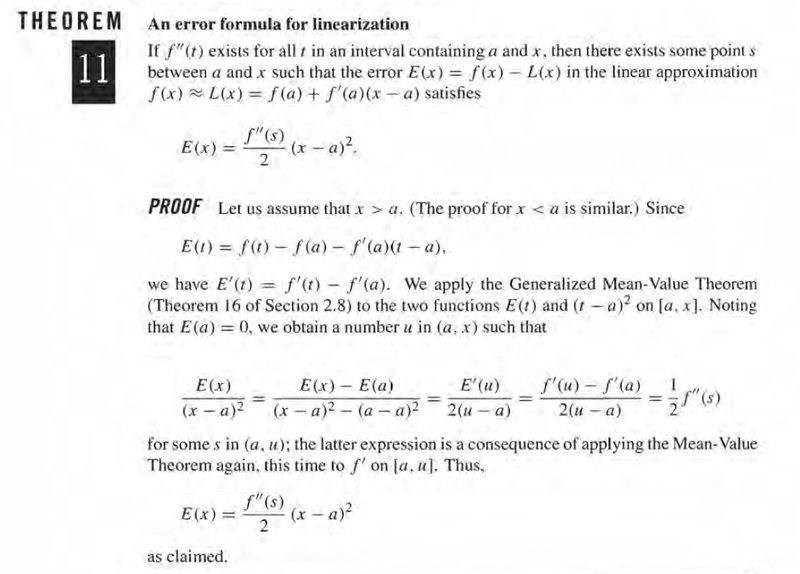
At question 5C, are they asking for a specific number, or can I replace the second order derivitative with the notation f''? I ask because they ask for an expression and the second order derivative isn't very concise
devout snowBOT
untold ether
At question 5C, are they asking for a specific number, or can I replace the seco...
 supple knot
yes very confusing
untold ether
yea
 untold ether
I know of the rror formula
supple knot
 untold ether
I wondered how I should fill it in according to the question
supple knot
show your form of the formula then
untold ether
Should I leave f''(s) be
supple knot
,rotate
 woven radishBOT
 untold ether
That is one way to do it
supple knot
supple knot
there are 3 variables here but you're treating s the same
untold ether
Also, would you agree with using 0,04 as the maximum bound?
supple knot
calculate $f''(s)$
woven radishBOT
rie.mann

 woven radishBOT
rie.mann
 untold ether
supple knot
``between" means either $a < s < x$ or $x < s < a$
untold ether
supple knot
``between" means either $a < s < x$ or $x < s < a$
Should I find the maximum value of f'' then?
supple knot
errr, those all should be less than or equal signs
supple knot
untold ether
Should I find the maximum value of f'' then?
yes on the interval [a, x] or [a, x]
untold ether
Yea
So I need the third order derivative as well
Is there no easier way @supple knot ?
The question doesn't give a lot of points
Also, the book never went into picking the correct value of s
supple knot
untold ether
The question doesn't give a lot of points
points for what?
untold ether
supple knot
points for what?
For getting the answer correct
supple knot
oh is that a test
untold ether
it's a practice test, but it's very similar to the real one
supple knot
what does "lot of points mean"
 supple knot
i don't know how you get around calculating the second derivative since it explicitly tells you to use it
 untold ether
Yeah no that's fine
But how do you calculate the maximum of the second derivative or do you even need to
Like the book doesn't get into picking an s at all
They just assert the correct s during the examples
 supple knot
yea in that example, sqrt(x) is monotone increasing so it's the right endpoint
but exp(x^2 - sin(x)) is less obvious, to me at least
untold ether
Same
supple knot
,w plot exp(x^2 - sin(x)) for 0 < x < 0.1
woven radishBOT

 Requested by rie.mann#0
untold ether
Requested by rie.mann#0
untold ether
Wouldn't you need to plot the derivative?
supple knot
maybe just observe that sin(x) ~ x ? so x^2 << x for that range
untold ether
d/dx(exp(x^2 - sin(x))) = e^(x^2 - sin(x)) (2 x - cos(x))
and then this is the second order derivative: d/dx(e^(x^2 - sin(x)) (2 x - cos(x))) = e^(x^2 - sin(x)) (4 x^2 + sin(x) + cos^2(x) - 4 x cos(x) + 2)
supple knot
nah don't do that
supple knot
supple knot
<:hmmCat:831508801646755850> maybe just observe that sin(x) ~ x ? so x^2 << x fo...
x^2 - sin(x) is approx -sin(x) for small x and -sin(x) is approx -x
so exp(x^2 - sin(x)) is approx 1-x
supple knot
untold ether
the function exp(...) is decreasing so you use the same logic here
untold ether
How does that help me with: e^(x^2 - sin(x)) (4 x^2 + sin(x) + cos^2(x) - 4 x cos(x) + 2)
supple knot
you don't need to differentiate at all
supple knot
supple knot
the function exp(...) is decreasing so you use the same logic here
exp(x^2 - sin(x)) is decreasing
supple knot
supple knot
<:hmmCat:831508801646755850> maybe just observe that sin(x) ~ x ? so x^2 << x fo...
go back and read everything i said from here
untold ether
supple knot
the function exp(...) is decreasing so you use the same logic here
But why does it matter whether or not f is decreasing? Isn't the important question whether f'' decreases? It is the only way to figure the maximum value for f'', right?
supple knot
untold ether
did you not understand this example with square root being monotone increasing
untold ether
Nope
I assumed you confused sqrt with the second derivative of sqrt
Sorry, should've mentioned it at the time
supple knot
no
untold ether
supple knot
no
Then I don't see how sqrt(x) is relevant when calculating the maximum value of the second order derivative
supple knot
untold ether
Is there no easier way <@261933205387477002> ?
then i guess there's no easy way for you
untold ether
.close
devout snowBOT
Channel closed
Closed by @untold ether
Use .reopen if this was a mistake.
Available help channel!
Send your question here to claim the channel.
Remember:
• Ask your math question in a clear, concise manner.
• Show your work, and if possible, explain where you are stuck.
• After 15 minutes, feel free to ping <@&286206848099549185>.
• Type the command .close to free the channel when you're done.
• Be polite and have a nice day!
Read #❓how-to-get-help for further information on how to ask a good question, and about conduct in the question channels.
restive river
 devout snowBOT
restive river
devout snowBOT
restive river
 glacial lagoon
when something is proportional then that means
var 1 = const. x var 2
in this case:
y = const. x x
restive river
glacial lagoon
when something is proportional then that means
var 1 = const. x var 2
so y=mx+b?
glacial lagoon
without the b
glacial lagoon
basically: if you multiply the left side by 5
restive river
ok
glacial lagoon
then the right side also has to be multiplied by 5
and as const. is a constant
you would need 5x to fulfill it
restive river
ahh i see
glacial lagoon
in other words:
y = const. x x
<=>
5y = const. x 5x
glacial lagoon
restive river
so y=mx+b?
what you mentioned previously, is what you would need in cases where you would want to display this as a graph
for example: time distance diagrams from physics
but in your case that's not needed
glacial lagoon
A good every day example would be the cost of apples:
f.e. 1 kg of apples costs 1 €
Then if y = price, and the apple weight x you would get:
y = 1 €/kg * xkg
maybe this makes it easier to grasp
because obviously if you pay more you can take more apples
and if you take more apples then you need to pay more
therefore the price and the weight of the apples is directly proportional
glacial lagoon
👍
restive river
.close
devout snowBOT
Channel closed
Closed by @fickle anvil
Use .reopen if this was a mistake.
Available help channel!
Send your question here to claim the channel.
Remember:
• Ask your math question in a clear, concise manner.
• Show your work, and if possible, explain where you are stuck.
• After 15 minutes, feel free to ping <@&286206848099549185>.
• Type the command .close to free the channel when you're done.
• Be polite and have a nice day!
Read #❓how-to-get-help for further information on how to ask a good question, and about conduct in the question channels.
 quaint oracle
Pls help
 devout snowBOT
quaint oracle
Pls help
quaint oracle
devout snowBOT
quaint oracle
Pls help
quaint oracle
With the b part only
devout snowBOT
@quaint oracle Has your question been resolved?
devout snowBOT
Channel closed
Closed due to timeout
Use .reopen if this was a mistake.
Available help channel!
Send your question here to claim the channel.
Remember:
• Ask your math question in a clear, concise manner.
• Show your work, and if possible, explain where you are stuck.
• After 15 minutes, feel free to ping <@&286206848099549185>.
• Type the command .close to free the channel when you're done.
• Be polite and have a nice day!
Read #❓how-to-get-help for further information on how to ask a good question, and about conduct in the question channels.
 vale bear
help
 devout snowBOT
vale bear
help
vale bear
devout snowBOT
vale bear
help
vale bear
laplace
devout snowBOT
@vale bear Has your question been resolved?
devout snowBOT
@vale bear Has your question been resolved?
devout snowBOT
Channel closed
Closed due to timeout
Use .reopen if this was a mistake.
devout snowBOT
Available help channel!
Send your question here to claim the channel.
Remember:
• Ask your math question in a clear, concise manner.
• Show your work, and if possible, explain where you are stuck.
• After 15 minutes, feel free to ping <@&286206848099549185>.
• Type the command .close to free the channel when you're done.
• Be polite and have a nice day!
Read #❓how-to-get-help for further information on how to ask a good question, and about conduct in the question channels.
 wooden axle
 devout snowBOT
wooden axle
devout snowBOT
wooden axle


 pseudo basin
yeah you're right
devout snowBOT
@wooden axle Has your question been resolved?
devout snowBOT
Channel closed
Closed due to timeout
Use .reopen if this was a mistake.
devout snowBOT
Available help channel!
Send your question here to claim the channel.
Remember:
• Ask your math question in a clear, concise manner.
• Show your work, and if possible, explain where you are stuck.
• After 15 minutes, feel free to ping <@&286206848099549185>.
• Type the command .close to free the channel when you're done.
• Be polite and have a nice day!
Read #❓how-to-get-help for further information on how to ask a good question, and about conduct in the question channels.
devout snowBOT
Channel closed
Closed by @potent gulch
Use .reopen if this was a mistake.
Available help channel!
Send your question here to claim the channel.
Remember:
• Ask your math question in a clear, concise manner.
• Show your work, and if possible, explain where you are stuck.
• After 15 minutes, feel free to ping <@&286206848099549185>.
• Type the command .close to free the channel when you're done.
• Be polite and have a nice day!
Read #❓how-to-get-help for further information on how to ask a good question, and about conduct in the question channels.
restive river
So
devout snowBOT
restive river
So
 pseudo basin
note the balls touch the top and bottom of the cylinder
so you in fact CAN find the height
restive river
I don’t think you can get the height of a sphere from the volume
 sage burrow
restive river
I don’t think you can get the height of a sphere from the volume
sage burrow
restive river
I don’t think you can get the height of a sphere from the volume
which height? the height of a ball is given. the container is exctly 3 balls "high". which height do you think is unknown?
restive river
The cylinder
sage burrow
it is 3 balls high
restive river
restive river
I don’t think you can get the height of a sphere from the volume
bro
I need the balls height
sage burrow
it is given
 sage burrow
and what is the diameter of a ball?
devout snowBOT
Channel closed
Closed by @stray sierra
Use .reopen if this was a mistake.
Available help channel!
Send your question here to claim the channel.
Remember:
• Ask your math question in a clear, concise manner.
• Show your work, and if possible, explain where you are stuck.
• After 15 minutes, feel free to ping <@&286206848099549185>.
• Type the command .close to free the channel when you're done.
• Be polite and have a nice day!
Read #❓how-to-get-help for further information on how to ask a good question, and about conduct in the question channels.
 dark kelp
How is probability in de tomain 2<x<=3 calculated? Why does inserting x=2 has to result in 0?
 devout snowBOT
dark kelp
How is probability in de tomain `2<x<=3` calculated? Why does inserting `x=2` ha...
supple knot
dark kelp
How is probability in de tomain `2<x<=3` calculated? Why does inserting `x=2` ha...
devout snowBOT
dark kelp
How is probability in de tomain `2<x<=3` calculated? Why does inserting `x=2` ha...
supple knot
dark kelp
How is probability in de tomain `2<x<=3` calculated? Why does inserting `x=2` ha...
Are you asking why F(2) = 0?
dark kelp
Rather what is implied after that: 'thus 0 = 1/4*2^2 - 2 + C1 = -1 + C1'
Is it equal to 0, because it comes right after the 0 of x <= 2?
 supple knot
dark kelp
Rather what is implied after that: 'thus `0 = 1/4*2^2 - 2 + C1 = -1 + C1`'
supple knot
dark kelp
Rather what is implied after that: 'thus `0 = 1/4*2^2 - 2 + C1 = -1 + C1`'
can you solve for $C_1$ in the equation $0 = -1 + C_1$
woven radishBOT
rie.mann
 dark kelp
Oh- I'm sorry, I only just noticed the text up there

 hollow mantle
so now you know why is it 0?
dark kelp
Honestly no, would you mind elaborating?
supple knot
do you know how to read f(x) as a piecewise function

it's exactly the same for F(x) for x<= 2
dark kelp
f(x)=0 for every value of x below or equal to 2
hollow mantle
and 2 is below or equal than 2?
dark kelp
Correct
hollow mantle
so F(2) is
dark kelp
I understand, but I fail to fathom the implication after that
supple knot
woven radish
**rie.mann**
.
dark kelp
Where does this come from?
 supple knot
F(x) is right continuous
do you know what continuity at a point means?
using limits, say
supple knot
because you're solving for unknowns
using continuity lets you solve for unknowns
these are the two unknowns
 devout snowBOT
Channel closed
Closed by @dark kelp
Use .reopen if this was a mistake.
devout snowBOT
Available help channel!
Send your question here to claim the channel.
Remember:
• Ask your math question in a clear, concise manner.
• Show your work, and if possible, explain where you are stuck.
• After 15 minutes, feel free to ping <@&286206848099549185>.
• Type the command .close to free the channel when you're done.
• Be polite and have a nice day!
Read #❓how-to-get-help for further information on how to ask a good question, and about conduct in the question channels.
 lucid night
Is (a•b) : (c•d) = (a:c) • (b:d) ?
devout snowBOT
lucid night
Is (a•b) : (c•d) = (a:c) • (b:d) ?
 inland seal
yes
lucid night
yay
inland seal
$\frac{a \cdot b}{c \cdot d} = \frac{a}{c} \cdot \frac{b}{d}$
woven radishBOT
redstoneplayz09
 lucid night
Right
Me dumb
I can’t imagine things in different manners
I mean that was so simple
lucid night
Thanks 🙏
devout snowBOT
@lucid night Has your question been resolved?
Channel closed
Closed by @lucid night
Use .reopen if this was a mistake.
Available help channel!
Send your question here to claim the channel.
Remember:
• Ask your math question in a clear, concise manner.
• Show your work, and if possible, explain where you are stuck.
• After 15 minutes, feel free to ping <@&286206848099549185>.
• Type the command .close to free the channel when you're done.
• Be polite and have a nice day!
Read #❓how-to-get-help for further information on how to ask a good question, and about conduct in the question channels.
 kind cedar
 devout snowBOT
@kind cedar Has your question been resolved?
 grizzled roost
Okay, I think a good strategy to approach this is first trying to count in how many ways can you draw three tickets such that they form a 1-progression
Solve simpler individual problems, and then with that in mind try to solve the bigger one
After that, try doing the same for 2-progressions
See if there is a pattern you can exploit
devout snowBOT
@kind cedar Has your question been resolved?
devout snowBOT
Channel closed
Closed due to timeout
Use .reopen if this was a mistake.
Available help channel!
Send your question here to claim the channel.
Remember:
• Ask your math question in a clear, concise manner.
• Show your work, and if possible, explain where you are stuck.
• After 15 minutes, feel free to ping <@&286206848099549185>.
• Type the command .close to free the channel when you're done.
• Be polite and have a nice day!
Read #❓how-to-get-help for further information on how to ask a good question, and about conduct in the question channels.
 distant cypress
Is it possible to integrate this $\int{\frac{1}{dx}}$
woven radishBOT
Bring Back Beatrix

 left robin
i dont know if that is defined anywhere, but not as far as i know
dx is a very small thing, so 1/dx is very large
and the sense of integration is to add up lots of very small things
so here, we would add up lots of very large things which is why i would think this would diverge to +- infinity
distant cypress
so its inifinity
what if you add a term on the denominator to compensate it example $\int{\frac{1}{x^2 dx}}$
woven radishBOT
Bring Back Beatrix
 left robin
it is important to note that i am not saying that it is like that
i am just outputting my intuition here
distant cypress
alright
left robin
i would assume that the x^2 wouldnt change anything
 hybrid snow
It's still gonna be big
distant cypress
yeah just want some insight here
distant cypress
yep i think its just some undefined term
left robin
well i guess you can define it yourself if you have context
after all, in some cases stuff like 1/0 is defined
if it makes sense in some context, then why not define it there
but in this case, i would say it would just be infinity usually
instead of undefined
distant cypress
I think that $\int{\frac{f(x)}{dx}}$ is just the slope of the diagonal of the dArea of a function
woven radishBOT
Bring Back Beatrix
 distant cypress
so since as it dx get smaller and smaller, its approaching 90 degree and the slope becomes undefined
 stone stump
you can define it as whatever you want. but the notation is not defined. the dx in "normal" integrals is notation, it isnt actually some small thing
distant cypress
you could think of dx as an abstract notation or you could treat it as some geometric entity
supple knot
distant cypress
you could think of dx as an abstract notation or you could treat it as some geom...
Do you actually have a definition
stone stump
you can think of stuff however you want. without a proper definition its still just a bunch of meaningless symbols
distant cypress
All these integral and derivative are just somehow derived from the concept of limits, and all rules of inetgration are from limits so i think the notation and definition are just "formality"
stone stump
"just"
supple knot
Yes formality is how you give definitions
If you don't want to do that, then you're just admitting you don't know what your symbols mean
distant cypress
its like 1+1, you could give whatever formality you want, but intuition in its sense is well understood
supple knot
Awful analogy
stone stump
those symbols are defined. that definition just checks out with our intuition (because that is how we chose the definition)
the collection of symbols you wrote down is not defined
distant cypress
i understand the symbols not in a rigid strict definition most "mathematicians" like to think about, i just understand it by intuition
distant cypress
i probalby have
supple knot
You don't have any questions then?
distant cypress
i thinks it good for now
supple knot
.close
devout snowBOT
Channel closed
Closed by @supple knot
Use .reopen if this was a mistake.
distant cypress
.close
devout snowBOT
Available help channel!
Send your question here to claim the channel.
Remember:
• Ask your math question in a clear, concise manner.
• Show your work, and if possible, explain where you are stuck.
• After 15 minutes, feel free to ping <@&286206848099549185>.
• Type the command .close to free the channel when you're done.
• Be polite and have a nice day!
Read #❓how-to-get-help for further information on how to ask a good question, and about conduct in the question channels.
grizzled roost
Prove that $||A_n||_2$ tends to infinity when\
$A=\begin{pmatrix}
1&1&1&\cdots &1\
1&2&2&\cdots &2\
1&2&3&\cdots &3\
\vdots &\vdots &\vdots &\ddots &\vdots\
1&2&3&\cdots & n\
\end{pmatrix}$
devout snowBOT
grizzled roost
Prove that $||A_n||_2$ tends to infinity when\\
$A=\begin{pmatrix}
1&1&1&\cdots ...
grizzled roost
Huh, not sure why latex doesn't like that
I tried to find some eigenvalue that depends on n, but I couldn't
woven radishBOT
casiel368

 small quartz
How about using the definition and x the all ones vector

 distant harbor
small quartz
distant harbor
small quartz
So the l2 norm of x is sqrt(n) (for x= all ones vector )
and the l2 norm of Ax is at least n (because the sum of each row is at least n)
So ||A||_2 is at least sqrt(n)
@grizzled roost
small quartz
yw
devout snowBOT
Channel closed
Closed by @grizzled roost
Use .reopen if this was a mistake.
Available help channel!
Send your question here to claim the channel.
Remember:
• Ask your math question in a clear, concise manner.
• Show your work, and if possible, explain where you are stuck.
• After 15 minutes, feel free to ping <@&286206848099549185>.
• Type the command .close to free the channel when you're done.
• Be polite and have a nice day!
Read #❓how-to-get-help for further information on how to ask a good question, and about conduct in the question channels.
restive river
f(x)=ln(sin(x)^sin(x) + 1) where 0<x<pi/2 how to find the range?
restive river
<@&286206848099549185>
 deft marsh
Hi.
restive river
hello
restive river
restive river
f(x)=ln(sin(x)^sin(x) + 1) where 0<x<pi/2 how to find the range?
this question
deft marsh
Can you text the problem again?
restive river
f(x)=ln(sin(x)^sin(x) + 1) where 0<x<pi/2 how to find the range?
restive river
k
 tame palm
To find the minimum and maximum, there are two things that you should do. First, calculate the derivative and evaluate when it is equal to zero. The second thing you will need to do is evaluate the end points of the interval. Whichever values are the largest and smallest will determine the interval of the range.
restive river
tame palm
To find the minimum and maximum, there are two things that you should do. First...
how to calculate the derivative?
supple knot
restive river
how to calculate the derivative?
If you never heard of it, you probably have to do it a different way
restive river
supple knot
If you never heard of it, you probably have to do it a different way
okay, tell me the other way to do it.
supple knot
,w plot sin(x)^sin(x) for 0 < x < pi/2
woven radishBOT
 Requested by rie.mann#0
supple knot
Requested by rie.mann#0
supple knot
,w min sin(x)^sin(x) on [0, pi/2]
woven radishBOT
 Requested by rie.mann#0
supple knot
Requested by rie.mann#0
supple knot
Yea I'm not sure how
tame palm
restive river
how to calculate the derivative?
Do you know how to calculate a derivative or just not how to calculate this particular derivative?
restive river
tame palm
Do you know how to calculate a derivative or just not how to calculate this part...
is this the derivative?

@tame palm @supple knot
tame palm
,wolf derivative ln( (sin(x))^(sin(x)) + 1)
 wooden veldt
Wait is it sin(x)^sin(x) or sin(x^sin(x))?
woven radishBOT

 Requested by kookiemon#0
restive river
wooden veldt
Wait is it sin(x)^sin(x) or sin(x^sin(x))?
Requested by kookiemon#0
restive river
wooden veldt
Wait is it sin(x)^sin(x) or sin(x^sin(x))?
latter
tame palm
Ugh, that looks ugly. 😖
restive river
tame palm
,wolf derivative ln( (sin(x))^(sin(x)) + 1)
this is not the question
its x^sin(x)
wooden veldt
For the record that's not what you wrote originally
restive river
i don't know how to use LaTeX, otherwise i would have used it
supple knot
Do you know what a^b means
restive river
supple knot
Wat
what
supple knot
$a^b$
woven radishBOT
rie.mann
 restive river
bro
supple knot
restive river
f(x)=ln(sin(x)^sin(x) + 1) where 0<x<pi/2 how to find the range?
With a=b=sin(x)
restive river
wait i will send the picture
woven radishBOT
ultravioletvoodoo
Compile Error! Click the reaction for more information.
(You may edit your message to recompile.)

 tame palm
Is is (sin(x))^(sin(x)) or sin(x^(sin(x)))?
restive river
tame palm
Is is (sin(x))^(sin(x)) or sin(x^(sin(x)))?
latter 😅
tame palm
I would first simpifly th eproblem using logarithm rules.
tame palm
restive river
latter 😅
I hate it when books don't use parentheses. 😛
restive river
tame palm
I would first simpifly th eproblem using logarithm rules.
how to simplify this?
tame palm
Hmm, nevermind. I had my rules mixed up.
 rigid shadow
doesn't look like you can use log rules here
rigid shadow
restive river
how to simplify this?
you do know how to calculate a derivative right?
restive river
restive river
is this the derivative?
is this correct @rigid shadow
tame palm
,wolf derivative ln(sin( x^(sin(x))) + 1)
woven radishBOT
 Requested by kookiemon#0
tame palm
Requested by kookiemon#0
tame palm
Yup, still an ugly derivative.
rigid shadow
very bad chain rule derivative
restive river
ya
tame palm
Can you post the entire question? I feel like there is something missing.
tame palm
No, post the entire question as it is written.
restive river
ok
 tame palm
No, if that's it, then no.
restive river
okay
supple knot
tame palm
To find the minimum and maximum, there are two things that you should do. First...
Then it's just this
The logarithm is monotonic so you just need to find the min and max of the argument
restive river
why should we evaluate the derivative at 0?
distant cypress
you could find the range without differentiating
restive river
distant cypress
you could find the range without differentiating
how?
woven radishBOT
Bring Back Beatrix
 distant cypress
what do you think the highest value it could have
restive river
distant cypress
what do you think the highest value it could have
1
distant cypress
it would be $log(1+1)$
woven radishBOT
Bring Back Beatrix
 woven radishBOT
Bring Back Beatrix
 distant cypress
woven radish
**Bring Back Beatrix**
distant cypress
woven radish
**Bring Back Beatrix**
and this one is at max when x is $\frac{\pi}{2}$
woven radishBOT
Bring Back Beatrix
 restive river
oh right
but pi/2 isn't included, so ln 2 should also not be included in the range?
sorry
distant cypress
yes
restive river
and for the minimum value?
woven radishBOT
Bring Back Beatrix
 distant cypress
restive river
if i put 0, its ln(sin1+1)
distant cypress
restive river
if i put 0, its ln(sin1+1)
do you think its the minimum value
look at this one $x^{sin(x)}$
woven radishBOT
Bring Back Beatrix
 devout snowBOT
Channel closed
Closed by @rigid zodiac
Use .reopen if this was a mistake.
restive river
.reopen
devout snowBOT
✅
restive river
you know by doing this we can bump our question
distant cypress
what do you think is the minimum value of this $x^{sin(x)}$
woven radishBOT
Bring Back Beatrix
 distant cypress
no
restive river
0?