#help-27
1 messages · Page 82 of 1
 analog trellis
 drifting frigate
analog trellis
Good luck. 🙂
drifting frigate
analog trellis
Good luck. 🙂
youu too bro 🫡🫡🫡
 devout snowBOT
@drifting frigate Has your question been resolved?
devout snowBOT
Channel closed
Closed due to timeout
Use .reopen if this was a mistake.
 Available help channel!
Send your question here to claim the channel.
Remember:
• Ask your math question in a clear, concise manner.
• Show your work, and if possible, explain where you are stuck.
• After 15 minutes, feel free to ping <@&286206848099549185>.
• Type the command .close to free the channel when you're done.
• Be polite and have a nice day!
Read #❓how-to-get-help for further information on how to ask a good question, and about conduct in the question channels.
 chrome egret
D and E are random points on triangle ABC on CB and AB, knowing that you can write a circle on BEPD and on AEDC proof that AD and CE are heights of this triangle, (ADB 90, CEB 90)
devout snowBOT
chrome egret
D and E are random points on triangle ABC on CB and AB, knowing that you can wri...
chrome egret
 devout snowBOT
@chrome egret Has your question been resolved?
chrome egret
<@&286206848099549185>
devout snowBOT
@chrome egret Has your question been resolved?
devout snowBOT
Channel closed
Closed due to timeout
Use .reopen if this was a mistake.
devout snowBOT
Available help channel!
Send your question here to claim the channel.
Remember:
• Ask your math question in a clear, concise manner.
• Show your work, and if possible, explain where you are stuck.
• After 15 minutes, feel free to ping <@&286206848099549185>.
• Type the command .close to free the channel when you're done.
• Be polite and have a nice day!
Read #❓how-to-get-help for further information on how to ask a good question, and about conduct in the question channels.
 orchid glade
 devout snowBOT
orchid glade
orchid glade
devout snowBOT
orchid glade
orchid glade
from bprp
just moments before he uses squeeze theorem
but i do not find his reasoning satisfactory
i can see why theta would be greater than sin(theta)
but i couldnt seem to agree with the next two
yes theta is not reaching as high up as tan(theta) but its a curve
how do we be sure tan(theta) is longer than theta
 twin wedge
the area of the circular sector
is (1/2)x
and the area of the big triangle
is 1/2 tanx
1/2tanx > 1/2x
tanx>x
orchid glade
x= theta?
twin wedge
yes
devout snowBOT
Channel closed
Closed by @orchid glade
Use .reopen if this was a mistake.
Available help channel!
Send your question here to claim the channel.
Remember:
• Ask your math question in a clear, concise manner.
• Show your work, and if possible, explain where you are stuck.
• After 15 minutes, feel free to ping <@&286206848099549185>.
• Type the command .close to free the channel when you're done.
• Be polite and have a nice day!
Read #❓how-to-get-help for further information on how to ask a good question, and about conduct in the question channels.
 restive river
Hello, can someone explain to me how i can reformulate this as eulers cos(R) + i * sin(R) form. I am stuck on this because of the 5 * i
 devout snowBOT
restive river
Hello, can someone explain to me how i can reformulate this as eulers cos(R) + i...
devout snowBOT
restive river
Hello, can someone explain to me how i can reformulate this as eulers cos(R) + i...

 devout snowBOT
Channel closed
Closed by @reef turret
Use .reopen if this was a mistake.
devout snowBOT
Available help channel!
Send your question here to claim the channel.
Remember:
• Ask your math question in a clear, concise manner.
• Show your work, and if possible, explain where you are stuck.
• After 15 minutes, feel free to ping <@&286206848099549185>.
• Type the command .close to free the channel when you're done.
• Be polite and have a nice day!
Read #❓how-to-get-help for further information on how to ask a good question, and about conduct in the question channels.
 potent marlin
So is this now available?
devout snowBOT
potent marlin
So is this now available?
potent marlin
Could someone please fast check f) h) e) (the ones with ??? On the right side) bcs the results shows some other answers.


 long fog
What's the order of these photos

 long fog
These are answers right
potent marlin
Yes
long fog
Your answer to e seems same
potent marlin
See i think that im just dumb to do it completely
long fog
f is right so far too
long fog
potent marlin
See i think that im just dumb to do it completely
I won't even start on that
potent marlin
Ah i dont mean it in that sense, but i think that i know how to derive that but i think that the answers are fully completed
long fog
Well they are kind of completed, it's not necessary to simplify
potent marlin
Yea i think im fine as long i derive them
Im also not sure abt this

Am i supposed to put sin x 2
potent marlin
Idk i was taugut to derive something that effects x after "some other" thing that effects its first
Kinda sounds weird in eng
long fog
I think you mean chain rule
potent marlin
Basically this

 woven radishBOT
fäf
 long fog
Yeah the second one is done by chain rule
woven radishBOT
fäf
 potent marlin
Idk abt that but he have like a table of derived stuff already
long fog
The formulas?
long fog
woven radish
**fäf**
Try learing this method you have to use it pretty often
potent marlin
Yea
 potent marlin
Yea my course isnt rly oriented on this math so we just kinda do basic math i think
But do u think h) is also correct
long fog
Yeah it is
devout snowBOT
Channel closed
Closed by @potent marlin
Use .reopen if this was a mistake.
Available help channel!
Send your question here to claim the channel.
Remember:
• Ask your math question in a clear, concise manner.
• Show your work, and if possible, explain where you are stuck.
• After 15 minutes, feel free to ping <@&286206848099549185>.
• Type the command .close to free the channel when you're done.
• Be polite and have a nice day!
Read #❓how-to-get-help for further information on how to ask a good question, and about conduct in the question channels.
 radiant pivot
 devout snowBOT
radiant pivot
radiant pivot
devout snowBOT
radiant pivot
radiant pivot
is it tru that at graph III f'(4) does not exist?
 formal haven
yes it is true
radiant pivot
so on graph II f''(4) DNE right?
formal haven
because of the sharp turn (derivatives dont match)
radiant pivot
yeah bc you would need to draw like
2 tangent lines from the point in both directoins
right?
formal haven
yes
radiant pivot
so whenever that happens the limit DNE
formal haven
well the limit exists but the derivative at that point is undefined
radiant pivot
oh yeah the limit exists cuz
theres no jump
and then for graph II f'(4) also DNE? but its different bcause
f''(4) DNE as well?
wait no i think f''(4) DNE on graph III as well
formal haven
radiant pivot
wait no i think f''(4) DNE on graph III as well
why
radiant pivot
cuz if f'(x) DNE how could f''(x) exist
won't it have different values since its a jump discontinuity
devout snowBOT
@radiant pivot Has your question been resolved?
Channel closed
Closed by @radiant pivot
Use .reopen if this was a mistake.
Available help channel!
Send your question here to claim the channel.
Remember:
• Ask your math question in a clear, concise manner.
• Show your work, and if possible, explain where you are stuck.
• After 15 minutes, feel free to ping <@&286206848099549185>.
• Type the command .close to free the channel when you're done.
• Be polite and have a nice day!
Read #❓how-to-get-help for further information on how to ask a good question, and about conduct in the question channels.
 frosty mantle
since in $a_k = \frac{k}{2k+1}$, the denominator is bigger than the numerator for all k, shouldn't this be decreasing for all k?
 devout snowBOT
frosty mantle
since in $a_k = \frac{k}{2k+1}$, the denominator is bigger than the numerator fo...
woven radishBOT
devout snowBOT
frosty mantle
since in $a_k = \frac{k}{2k+1}$, the denominator is bigger than the numerator fo...
woven radishBOT
hers only
 frosty mantle
$a_{k+1} = \frac{k+1}{2(k+1) + 1}$ and it seems obvious that $2(k+1) + 1 > k+1$ for all natural numbers, so shouldn't $a_{k+1} \leq a_k$ for all k?
woven radishBOT
hers only
 frosty mantle
entire problem for reference
 frosty mantle
sorry lemme edit that rq
$a_{k+1} = \frac{k+1}{2(k+1) + 1}$ and it seems obvious that $2(k+1) + 1 > 2k+1$ (2k+1 from $a_k = \frac{k}{2k+1}$ )for all natural numbers, so shouldn't $a_{k+1} \leq a_k$ for all k?
woven radishBOT
hers only
 frosty mantle
actually
hmm
i feel like there's a flaw in my logic but i still dont understand how the series is increasing
 alpine python
You're comparing the denominators of consecutive terms, but you're not taking the numerators into account
frosty mantle
i'm sorry i'm still confused
plugging in some numbers i realize that it's increasing now but
i dont understand why
alpine python
Try looking at the difference or the ratio of consecutive terms
frosty mantle
$\frac{k+1}{2k+3} * \frac{2k+1}{k} = \frac{2k^2 + 3k + 1}{2k^2 + 3k}$
woven radishBOT
hers only
 devout snowBOT
Channel closed
Closed by @frosty mantle
Use .reopen if this was a mistake.
Available help channel!
Send your question here to claim the channel.
Remember:
• Ask your math question in a clear, concise manner.
• Show your work, and if possible, explain where you are stuck.
• After 15 minutes, feel free to ping <@&286206848099549185>.
• Type the command .close to free the channel when you're done.
• Be polite and have a nice day!
Read #❓how-to-get-help for further information on how to ask a good question, and about conduct in the question channels.
 viral ember
Hello
devout snowBOT
viral ember
Hello
viral ember
I've seen someone asking on a forum f(x)+f(1-x)=3x+2
They ask for f(x) and f is defined on real numbers, but x is an integer
is it solvable?
If i substitute x with 1-x I get nothing
 feral agate
viral ember
If i substitute x with 1-x I get nothing
feral agate
viral ember
If i substitute x with 1-x I get nothing
how do you get nothing
viral ember
Also If I do x = 0: f(0) + f(1) = 2 and for x = 1 : f(1) +f(0) = 5
I get a contradiction as you can see there, why?
I get f(1-x) + f(x) = 5-3x
But I need to find f(x)
or the number of the functions that satisfy the condition
 stone stump
viral ember
Also If I do x = 0: f(0) + f(1) = 2 and for x = 1 : f(1) +f(0) = 5
stone stump
viral ember
Also If I do x = 0: f(0) + f(1) = 2 and for x = 1 : f(1) +f(0) = 5
and from this you get that no function satisfies the condition
so thats it
viral ember
Nice
It's kinda strange
It's asking for the number of functions
but there are just 0
stone stump
so that's the number
viral ember
.close
devout snowBOT
Channel closed
Closed by @viral ember
Use .reopen if this was a mistake.
Available help channel!
Send your question here to claim the channel.
Remember:
• Ask your math question in a clear, concise manner.
• Show your work, and if possible, explain where you are stuck.
• After 15 minutes, feel free to ping <@&286206848099549185>.
• Type the command .close to free the channel when you're done.
• Be polite and have a nice day!
Read #❓how-to-get-help for further information on how to ask a good question, and about conduct in the question channels.
 karmic ledge
 devout snowBOT
karmic ledge
karmic ledge
devout snowBOT
karmic ledge
karmic ledge
P_6 implies the positive integers mod 6. So are we only looking at {..,-6,0,6,...} or all the congruence classes {0-5}
stone stump
that is not well-defined
karmic ledge
Which the question my teacher gave or the question I asked ?
karmic ledge
oh yeah which is why im a bit confused
cause it seems like then I should just find the answer to g(n) only for the numbers 0-5
stone stump
that might be the intent of the question, yes
karmic ledge
so in that case wouldnt the answer just be (0,4),(1,1),(2,2),(3,1),(4,4),(5,1)?
stone stump
yes
karmic ledge
Ok cool
Should I just write like a sentence that explains since we're only working in P_6 we only need to to look at the cases where n = {0,1,2,3,4,5}. Then, show the gcd work ?
stone stump
well if anything you should write a sentence that you aren't working in P_6 cause then g would not be well-defined
and instead work in {0,1,2,3,4,5}
devout snowBOT
Channel closed
Closed by @karmic ledge
Use .reopen if this was a mistake.
Available help channel!
Send your question here to claim the channel.
Remember:
• Ask your math question in a clear, concise manner.
• Show your work, and if possible, explain where you are stuck.
• After 15 minutes, feel free to ping <@&286206848099549185>.
• Type the command .close to free the channel when you're done.
• Be polite and have a nice day!
Read #❓how-to-get-help for further information on how to ask a good question, and about conduct in the question channels.
devout snowBOT
 lament cradle
the first equation you can get B+C
then you solve the second equation for A
these problems its all about finding a way to make an equation with only one variable
right
then you figure out how to solve for the other two vars
 magic thicket
or let s = B+C
Then notice that A^2 = 1632 + S^2 gets rewritten as (A-S)(A+S) = 1632, making A+S known
lament cradle
i feel like introducing another variable here is counterintuitive
magic thicket
It's just a shorthand for b+c
lament cradle

magic thicket
Because really they're not useful to separate
magic thicket
magic thicket
or let s = B+C
Then notice that A^2 = 1632 + S^2 gets rewritten as (A-S)(A+S) = ...
Otherwise this is much harder to notice
And this trick turns it from a high school quadratic equation problem to a middle school working with variables problem
lament cradle
was diff of squares taught in middle school? 
magic thicket
magic thicket
And this trick turns it from a high school quadratic equation problem to a middl...
Though note that bonglord's way is still good practice if you've studied quadratic equations
lament cradle
personally i would just ooga booga solve for A, but @magic thicket is more pragmatic.
magic thicket
Experience is a lot about finding these tricks that make things a lot simpler, or sometimes simply doable
lament cradle
math is humbling like that. the more you practice the more you see the patterns
magic thicket
Use the other equation to find A-S
Then notice A+S is actually what you're asked for
lament cradle
remember S = B + C
magic thicket
Little extra : 1632 = 16*102
lament cradle
notice A+S = A + B + C, and we can find A + B + C through that first equation. in case its still not clear
devout snowBOT
Channel closed
Closed by @random oar
Use .reopen if this was a mistake.
devout snowBOT
Available help channel!
Send your question here to claim the channel.
Remember:
• Ask your math question in a clear, concise manner.
• Show your work, and if possible, explain where you are stuck.
• After 15 minutes, feel free to ping <@&286206848099549185>.
• Type the command .close to free the channel when you're done.
• Be polite and have a nice day!
Read #❓how-to-get-help for further information on how to ask a good question, and about conduct in the question channels.
restive river
Can someone walk me through how to do this
 devout snowBOT
restive river
Can someone walk me through how to do this
restive river
devout snowBOT
restive river
Can someone walk me through how to do this
restive river
Should the answer not be 3x-8?
orchid glade
there are a few ways
do u at least know the name of the method you are taught
or maybe anything you know abt how to do this
restive river
wdym?
 sonic smelt
restive river
Should the answer not be 3x-8?
sonic smelt
restive river
Should the answer not be 3x-8?
The x-interception of that is 8/3, which is between 2 and 3
orchid glade
so u know the y = mx + b form as well
restive river
yes
orchid glade
whats m and b
restive river
m is slope b is y intercept
orchid glade
ok from the diagram try to find the value of m
restive river
oh shoot
i know what i mess up
i didnt pay attention to the unit
its by 2s and 4s not 1s
6/4=3/2
ahhhhh
devout snowBOT
Channel closed
Closed by @stark hearth
Use .reopen if this was a mistake.
Available help channel!
Send your question here to claim the channel.
Remember:
• Ask your math question in a clear, concise manner.
• Show your work, and if possible, explain where you are stuck.
• After 15 minutes, feel free to ping <@&286206848099549185>.
• Type the command .close to free the channel when you're done.
• Be polite and have a nice day!
Read #❓how-to-get-help for further information on how to ask a good question, and about conduct in the question channels.
 languid kettle
 devout snowBOT
languid kettle
sonic smelt
devout snowBOT
languid kettle
sonic smelt
!status
devout snowBOT
What step are you on?
1. I don't know where to begin
2. I have begun but got stuck midway
3. I got an answer but I'm told it's wrong
4. I got an answer and would like my work checked
5. I have a question about someone else's worked solution
6. None of the above
 stone stump
!status
devout snowBOT
What step are you on?
1. I don't know where to begin
2. I have begun but got stuck midway
3. I got an answer but I'm told it's wrong
4. I got an answer and would like my work checked
5. I have a question about someone else's worked solution
6. None of the above
 stone stump
!status
devout snowBOT
What step are you on?
1. I don't know where to begin
2. I have begun but got stuck midway
3. I got an answer but I'm told it's wrong
4. I got an answer and would like my work checked
5. I have a question about someone else's worked solution
6. None of the above
 pseudo basin
@languid kettle you realize you should probably do something OTHER than just posting your question for the 4th time now, right?
languid kettle
sorry i didnt realize i sent that so many times
my disc lagged
how do i solve it without turning the base the same
stone stump
the intent here is probably to just guess the solution
sonic smelt
Would recommend multiplying both sides by 3^x
Because then you get a quadratic equations in terms of 3^x
If it seems hard, then consider doing a substitution
languid kettle
pseudo basin
<@636958272217153586> you realize you should probably do something OTHER than ju...
I’m sorry, my discord completely lagged out and I didn’t see the messages I sent
sonic smelt
Something like t = 3^x so that it looks more familiar
stone stump
oh true you actually get a decent quadratic
languid kettle
sonic smelt
Because then you get a quadratic equations in terms of 3^x
Oh okay I’ll try that
languid kettle
sonic smelt
Something like t = 3^x so that it looks more familiar
Alright I’ll try that
languid kettle
sonic smelt
Would recommend multiplying both sides by 3^x
if i do that to other side, it would becmoe 24^x, how would i convert that to the same base
languid kettle
oh
oh then thats my bad
lemme try
3^3x^2 - 3^6-6x=8*3^x, ive got this but not clear as to what im meant to do now
i multiplied both sides by 3^x
nvm my multiplication was wrong then i thikn i got it
thanks
sorry for the accidentlal spam,
.close
devout snowBOT
Channel closed
Closed by @languid kettle
Use .reopen if this was a mistake.
Available help channel!
Send your question here to claim the channel.
Remember:
• Ask your math question in a clear, concise manner.
• Show your work, and if possible, explain where you are stuck.
• After 15 minutes, feel free to ping <@&286206848099549185>.
• Type the command .close to free the channel when you're done.
• Be polite and have a nice day!
Read #❓how-to-get-help for further information on how to ask a good question, and about conduct in the question channels.
 hushed oyster
How do I integrate $$\int_{0}^{\infty} \frac{1}{1 + e^x} dx$$
woven radishBOT
AMNT2006
 sonic smelt
Consider multiplying top and bottom by e^(-x)
hushed oyster
The hint given for the problem is to let $e^{\frac{x}{2}} = \tan \theta$
woven radishBOT
AMNT2006
 sonic smelt
Sounds like tons of work though
Let's try anyway
So, then $\frac12e^{\frac{x}2}\dd{x} = \sec^2\theta\dd\theta$
woven radishBOT
A Lonely Bean
 hushed oyster
So, $$\frac{1}{2}e^{\frac{x}{2}} = \sec^{2} \theta d \theta$$ Which can transform to $$dx = \frac{2}{\tan \theta} \sec^{2} \theta d \theta$$
woven radishBOT
AMNT2006

 shadow prairie
If you have freedom to do the problem, you can try $u = 1 + e^x$ later @hushed oyster
woven radishBOT
Rub05
 hushed oyster
So I need to integrate $$\int \frac{1}{1 + \tan^2 \theta } \frac{2}{\tan \theta} \sec^2 \theta d \theta$$
woven radishBOT
AMNT2006
 sonic smelt
woven radish
**AMNT2006**
sonic smelt
woven radish
**AMNT2006**
Right, and 1 + tan^2 = sec^2
Meaning the secants cancel out and you are left with 2cos/sin
Which can be integrated with another substitution
hushed oyster
which then becomes $2 \ln | \sin \theta | + C$
woven radishBOT
AMNT2006
 sonic smelt
Right
sonic smelt
Which doesn't approach anything at infinity
Ah wait
We forgot to change aboundaries
hushed oyster
Would drawing the triangle work?
sonic smelt
Or we could simply rewrite theta with x
sonic smelt
hushed oyster
Would drawing the triangle work?
Yes
hushed oyster
ok, give me a little time to think
sonic smelt
So we picked e^(x/2) = tan(theta)
We could say opposite is e^(x/2) and adjacent is 1
Meaning the hypotenuse is sqrt(1 + e^x)
And sin(theta) is therefore e^(x/2)/sqrt(1 + e^x)
hushed oyster
oh, so $$\sin \theta = \frac{e^{\frac{x}{2}}}{\sqrt{1 + e^x}}$$
woven radishBOT
AMNT2006
 sonic smelt
Right
When x = 0 it becomes 1
And when x = inf we are going to have to take the limit
hushed oyster
Oh, then it's now just a limit problem
sonic smelt
Yeah
hushed oyster
The limit of $$\sin \theta = \frac{e^{\frac{x}{2}}}{\sqrt{1 + e^x}}$$ is 1
woven radishBOT
AMNT2006
 hushed oyster
And if we take the log we get 0
sonic smelt
I think it would be easier to change boundaries btw
Because theta goes from 0 to pi/2 clearly
hushed oyster
wait, then is the answer $\frac{\ln 2}{3}$
woven radishBOT
AMNT2006
 sonic smelt
Wait no it doesn't
It goes from pi/4 to pi/2
No I don't think so wait
Should be ln2?
hushed oyster
Oh, I messed up
sonic smelt
,w integrate 1/(1 + e^x) from 0 to infinity
woven radishBOT


 Requested by A Lonely Bean#7998
sonic smelt
Requested by A Lonely Bean#7998
sonic smelt
Right, it's ln2
hushed oyster
When I took the limit I forgot to subtract by $\ln \left( \frac{1}{\sqrt{2}} \right)$
woven radishBOT
AMNT2006
 hushed oyster
But that just becomes $\frac{\ln 2}{2}$, right?
woven radishBOT
AMNT2006
 sonic smelt
No, just ln2
devout snowBOT
Channel closed
Closed by @hushed oyster
Use .reopen if this was a mistake.
devout snowBOT
Available help channel!
Send your question here to claim the channel.
Remember:
• Ask your math question in a clear, concise manner.
• Show your work, and if possible, explain where you are stuck.
• After 15 minutes, feel free to ping <@&286206848099549185>.
• Type the command .close to free the channel when you're done.
• Be polite and have a nice day!
Read #❓how-to-get-help for further information on how to ask a good question, and about conduct in the question channels.
restive river
prove that
9 | n^3 + (n+1)^3 + (n+2)^3 with induction
restive river
i did n= 1 and i assumed where n is true
but i got stuck here with n+1
9 | (n+1)^3 + (n+2)^3 + (n+3)^3
 lunar harbor
Try setting $n^3+(n+1)^3+(n+2)^3=9k$ for some positive integer $k$
woven radishBOT
Civil Service Pigeon

 deep vortex
lunar harbor
Try setting $n^3+(n+1)^3+(n+2)^3=9k$ for some positive integer $k$
deep vortex
lunar harbor
Try setting $n^3+(n+1)^3+(n+2)^3=9k$ for some positive integer $k$
He wants to prove it with induction though
lunar harbor
deep vortex
He wants to prove it with induction though
Can't you ||expand (n+3)³, giving 9k+9(n²+3n+3)||, hence true
restive river
What does this give me XD
restive river
lunar harbor
Can't you ||expand (n+3)³, giving 9k+9(n²+3n+3)||, hence true
I dont understand how this contributes
Or im missing something
lunar harbor
What have you done with what I said so far?
I skipped a fair amount of stuff just so I could provide a quick overview of how it works to Kepe
restive river
So basically i expand all this
(n+1)^3 + (n+2)^3 + (n+3)^3
deep vortex
lunar harbor
Can't you ||expand (n+3)³, giving 9k+9(n²+3n+3)||, hence true
Here is one way to do it with induction: the base case $n = 1$ obviously holds, now our induction hypothesis is that $9 | n^3 + (n+1)^3 + (n+2)^3 = 3n^3 + 9n^2 + 15n + 9$. \\ We need to show that $9 | (n+1)^3 + (n+2)^3 + (n+3)^3 = 3n^3 + 18n^2 + 42n + 36$. The difference between those two is just $3n^3 + 18n^2 + 42n + 36 - (3n^3 + 9n^2 + 15n + 9) = 9n^2 + 27n + 27$, which is certainly divisible by 9. $\hspace{1cm} \square$

There might be a more elegant way though
lunar harbor
I did $(n+1)^3+(n+2)^3=9k-n^3$ and substituted that into the $n+1$ step, but that's pretty similar
woven radishBOT
Civil Service Pigeon
 restive river
When you did the difference between the 2 equations what did that show us
Like why is that a proof
lunar harbor
deep vortex
Here is one way to do it with induction: the base case $n = 1$ obviously holds, ...
Does the difference between two things being divisible by 9 mean that each of those two things is divisible by 9?
I can't tell if that's the idea behind your proof
Cause a counterexample would be 14-5=9
deep vortex
We can subtract all of the terms that are already divisible by 9 after our induction hypothesis out
 arctic field
the first is already known to be divisible by 9
deep vortex
We only need to show what is new is also divisible by 9
arctic field
lunar harbor
Can't you ||expand (n+3)³, giving 9k+9(n²+3n+3)||, hence true
but like, just do the sub here, it's more motivated
literally the same proof but more direct
restive river
deep vortex
We can subtract all of the terms that are already divisible by 9 after our induc...
Its like subtracting 1 times 9
?
deep vortex
restive river
Its like subtracting 1 times 9
Say the first term is 18, the second is 27.
If we knew that 18 was divisible by 9 but we didn't know if 27 is divisible by 9, to show that 27 is divisible by 9, we could just show that 27 - 18 = 9 is divisible by 9
restive river
I understand
But i have a small feeling of feeling not convinced myself
If we dont know something that is divisible and subtract something that is divisble why is that remaining devisible
arctic field
the argument is not really necessary because essentially it just comes down to saying 27 = 18 + 9, and both 18 and 9 are multiples of 9
arctic field
woven radish
**Civil Service Pigeon**
here you want to start by doing this, which is known from the induction hypothesis
devout snowBOT
@restive river Has your question been resolved?
devout snowBOT
Channel closed
Closed due to timeout
Use .reopen if this was a mistake.
Available help channel!
Send your question here to claim the channel.
Remember:
• Ask your math question in a clear, concise manner.
• Show your work, and if possible, explain where you are stuck.
• After 15 minutes, feel free to ping <@&286206848099549185>.
• Type the command .close to free the channel when you're done.
• Be polite and have a nice day!
Read #❓how-to-get-help for further information on how to ask a good question, and about conduct in the question channels.
 frozen pier
Felix and Adrian are leaving on a ski trip and Felix asks Adrian to bring some board games. Of the 10 board games they have, 4 are ones that Felix likes. Adrian randomly selects 6 out of their 10 games to bring on the trip.
What is the probability that the last game that Adrian chooses is one that Felix likes?
devout snowBOT
frozen pier
Felix and Adrian are leaving on a ski trip and Felix asks Adrian to bring some b...
frozen pier
Im struggling with this, I have no idea how to begin honestly, I can draw a prob tree but that seems inefficient
frozen pier
I dont understand how
 topaz axle
the last one chosen is the same thing as second or first one chosen
it's symmetrical
i don't know how to explain
frozen pier
yeah I still dont understand 😭
frozen pier
topaz axle
it's symmetrical
im curious what you mean by this
topaz axle
well do you see how the first game adrian chooses has 4/10 chance
frozen pier
yes
topaz axle
okay
so like we can calculate this about the second one
,calc (4/10)(3/9) + (6/10)(4/10)
woven radishBOT
Result:
0.37333333333333
depending on if we choose the right one we get 3/9 or again 4/9 no?
woven radishBOT
The following error occured while calculating:
Error: Value expected (char 1)
topaz axle
,calc (4/10)(3/9) + (6/10)(4/9)
woven radishBOT
Result:
0.4
is that total probability?
topaz axle
what
frozen pier
yeah nvm
frozen pier
topaz axle
,calc (4/10)(3/9) + (6/10)(4/9)
this represents, the second time you choose, can you do the same for the third one? what do you get then?
topaz axle
you could like count outcomes
Felix likes 1,2,3 and 4
there are 9×8×7×6×5 outcomes that end in 1
same with 2, 3 and 4
topaz axle
frozen pier
this represents, the second time you choose, can you do the same for the third o...
you can do it for the third one you're supposed to get 0.4
,calc (9)(8)(7)(6)(5)(4) * 4 / (10)(9)(8)(7)(6)(5)
woven radishBOT
Result:
1.6
Result:
0.4
yeah
that's counting everything at once
so you can notice that if it asked for e.g. third game instead of last, the formula wouldn't even look different
frozen pier
topaz axle
you could like count outcomes
Felix likes 1,2,3 and 4
there are 9×8×7×6×5 outcom...
that times 4 divided by the all the combinations? like 10!/4!?
topaz axle
yes
frozen pier
topaz axle
so you can notice that if it asked for e.g. third game instead of last, the form...
it is symmetrical damn, is this because it is a special distribution or would I see this in other distributions?
topaz axle
i'm not sure, too hard question 🙂
 np, you helped me enough, have a nice one
devout snowBOT
np, you helped me enough, have a nice one
devout snowBOT
Channel closed
Closed by @frozen pier
Use .reopen if this was a mistake.
Available help channel!
Send your question here to claim the channel.
Remember:
• Ask your math question in a clear, concise manner.
• Show your work, and if possible, explain where you are stuck.
• After 15 minutes, feel free to ping <@&286206848099549185>.
• Type the command .close to free the channel when you're done.
• Be polite and have a nice day!
Read #❓how-to-get-help for further information on how to ask a good question, and about conduct in the question channels.
 drowsy jetty
please can someone explain how does this happen 
 devout snowBOT
drowsy jetty
please can someone explain how does this happen <:emoji_13:939996782010720287>
devout snowBOT
drowsy jetty
please can someone explain how does this happen <:emoji_13:939996782010720287>
 grand siren
what's g?
other than that it kind of looks like they negated both the numerator and denominator of the fraction
but then also changed y into x and x into g(x)? which is weird
drowsy jetty
im learning math in my native language which isnt english so i dont know the terminology
but g(x) is f(x)s opposite…?
this is the full thing if it helps

cuz it doesnt help me at all
grand siren
hmm
grand siren
drowsy jetty
im learning math in my native language which isnt english so i dont know the ter...
opposite
(if i'm right about what you're referring to then that's usually called an "inverse")
drowsy jetty
i guess so
grand siren
drowsy jetty
this is the full thing if it helps
i think the idea is basically
we want g(f(x)) = x
because that's what an inverse is
so for some reason they create y and make y = f(x)
and then work out x in terms of y, so, in terms of f(x)
$x = \frac{3y+1}{4-y}$
woven radishBOT
bee
 grand siren
then they just mess with variables a bit more because they want the argument to g to be called x
but you could just say $g(y) = \frac{3y+1}{4-y}$ and it would mean the same thing
woven radishBOT
bee
 drowsy jetty
this is just as confusing
woven radishBOT
bee
 grand siren
and we want to find $g$ so that $g(f(x)) = x$
woven radishBOT
bee
 grand siren
does that make sense so far?
woven radishBOT
bee
 grand siren
that's basically what all of this part is
 drowsy jetty
got that
grand siren
woven radish
**bee**
so now we have x, in terms of f(x)
so $g(f(x)) = \frac{3f(x)+1}{4-f(x)}$
woven radishBOT
bee
 grand siren
(since both of those are x)
now if we just replace all of the f(x) with something else (i'll use y)
$g(y) = \frac{3y+1}{4-y}$
woven radishBOT
bee
 grand siren
does that make sense...?
drowsy jetty
not really…
grand siren
woven radish
**bee**
did this make sense?
drowsy jetty
i understand what’s supposed to be happening but where are the numbers coming from
like how did it go from -3y-1/y-4 to 3x+1/4-x
like what steps did we take to get that and how do i just do it
 fierce matrix
f(x) = x is the same as y = x
grand siren
drowsy jetty
i understand what’s supposed to be happening but where are the numbers coming fr...
really they did two steps at once there
firstly, $\frac{-3y-1}{y-4}=\frac{3y+1}{4-y}$
woven radishBOT
bee
 grand siren
and then they replace y with x
drowsy jetty
grand siren
firstly, $\frac{-3y-1}{y-4}=\frac{3y+1}{4-y}$
change - to + and vise versa ?
grand siren
they negated the numerator and denominator
$\frac{-3y-1}{y-4}=\frac{-(-3y-1)}{-(y-4)}=\frac{3y+1}{4-y}$
woven radishBOT
bee
 drowsy jetty
then how did this happen in another exercise

3y+6 changed into 3x+6
why did we not negate that
drowsy jetty
how do i know when to and when not to negate
grand siren
they just decided to skip writing the last step of algebraic manipulation of the expression with y
grand siren
drowsy jetty
how do i know when to and when not to negate
never
drowsy jetty
grand siren
they just decided to skip writing the last step of algebraic manipulation of the...
thats my math teacher for you
i have no idea what she’s teaching
grand siren
the only reason it happened here is that they're not writing all of the steps
grand siren
an extra line here that says $x=\frac{3y+1}{4-y}$
 woven radishBOT
bee
 drowsy jetty
why do we need to do that
grand siren
well we could also have just said $g(x) = \frac{-3x-1}{x-4}$
woven radishBOT
bee
 drowsy jetty
and we cant leave it like that because…?
fierce matrix

Desmos
drowsy jetty
so all of my confusion just manifested cuz my teacher just decided she wanted to change the minuses and pluses…
.close
devout snowBOT
Channel closed
Closed by @drowsy jetty
Use .reopen if this was a mistake.
devout snowBOT
Available help channel!
Send your question here to claim the channel.
Remember:
• Ask your math question in a clear, concise manner.
• Show your work, and if possible, explain where you are stuck.
• After 15 minutes, feel free to ping <@&286206848099549185>.
• Type the command .close to free the channel when you're done.
• Be polite and have a nice day!
Read #❓how-to-get-help for further information on how to ask a good question, and about conduct in the question channels.
 trail sierra
 devout snowBOT
trail sierra
trail sierra
devout snowBOT
trail sierra
trail sierra
am really stuck on the 2nd part
i dont understand how they go from (t+pi) to -pi

for the 2nd intergrand
i understand that sin(t+pi) = -sint
but how does the t+pi = pi
<@&286206848099549185>
ping me if anyone can help
devout snowBOT
@trail sierra Has your question been resolved?
devout snowBOT
Channel closed
Closed due to timeout
Use .reopen if this was a mistake.
Available help channel!
Send your question here to claim the channel.
Remember:
• Ask your math question in a clear, concise manner.
• Show your work, and if possible, explain where you are stuck.
• After 15 minutes, feel free to ping <@&286206848099549185>.
• Type the command .close to free the channel when you're done.
• Be polite and have a nice day!
Read #❓how-to-get-help for further information on how to ask a good question, and about conduct in the question channels.
 lone crane
 devout snowBOT
lone crane
lone crane
devout snowBOT
lone crane
lone crane
not sure how to do this cuz they don’t give a limit 😦
is it just like -infinity to infinity? but then how would i solve?
devout snowBOT
@lone crane Has your question been resolved?
lone crane
<@&286206848099549185>
devout snowBOT
@lone crane Has your question been resolved?
devout snowBOT
Channel closed
Closed by @lone crane
Use .reopen if this was a mistake.
devout snowBOT
Available help channel!
Send your question here to claim the channel.
Remember:
• Ask your math question in a clear, concise manner.
• Show your work, and if possible, explain where you are stuck.
• After 15 minutes, feel free to ping <@&286206848099549185>.
• Type the command .close to free the channel when you're done.
• Be polite and have a nice day!
Read #❓how-to-get-help for further information on how to ask a good question, and about conduct in the question channels.
 sharp glen
- 5x+y- (2x-4y) 2. (2a^2 b)^2 -2(3^4 b^2) Simiplying Algebraic expressions
devout snowBOT
sharp glen
1. 5x+y- (2x-4y) 2. (2a^2 b)^2 -2(3^4 b^2) Simiplying Algebraic expression...
 hexed vortex
this one you do it yourself
i can only help you check the answers.
nothing special since it's just fundamental mathematical operations.
sharp glen
I dont understand
hexed vortex
are you 12
sharp glen
Im 13+
 random dome
can anyone help with this, laplace equation -> Y(s) = X(s)(1-s^2)/1+as+X(s). I want to get Y(s)/X(s) independent of X(s) on RHS
 dark lava
give em a break
sharp glen
I got 3x+ 3y for the first one
dark lava
do you know how to distribute a negative sign for the first q?
dark lava
sharp glen
I got 3x+ 3y for the first one
the x is right
sharp glen
I am not sure what I did wrong
dark lava
what s a negative multiplied by a negative
sharp glen
positive
dark lava
sharp glen
6
no
sharp glen
Oh its 5y
+y --4 gives +5
- (2a^2 b)^2 -2(3^4 b^2) is the answer 4a^4 b^2- 6a^4 b^2
dminh?
.close
devout snowBOT
Channel closed
Closed by @sharp glen
Use .reopen if this was a mistake.
Available help channel!
Send your question here to claim the channel.
Remember:
• Ask your math question in a clear, concise manner.
• Show your work, and if possible, explain where you are stuck.
• After 15 minutes, feel free to ping <@&286206848099549185>.
• Type the command .close to free the channel when you're done.
• Be polite and have a nice day!
Read #❓how-to-get-help for further information on how to ask a good question, and about conduct in the question channels.
 steady tide
Just have a question as to why I can’t take the anti derivative of the tilted sine graph
devout snowBOT
steady tide
Just have a question as to why I can’t take the anti derivative of the tilted si...
 jaunty mantle
what do you mean
steady tide
I mean the graph of sin(x+(sinx/2))
twin wedge
some functions just dont have an antiderivative
or just unable to express it
why do you need the antideriv though
devout snowBOT
@steady tide Has your question been resolved?
steady tide
I just wanna know why I can’t calculate it
devout snowBOT
@steady tide Has your question been resolved?
devout snowBOT
Channel closed
Closed due to timeout
Use .reopen if this was a mistake.
Available help channel!
Send your question here to claim the channel.
Remember:
• Ask your math question in a clear, concise manner.
• Show your work, and if possible, explain where you are stuck.
• After 15 minutes, feel free to ping <@&286206848099549185>.
• Type the command .close to free the channel when you're done.
• Be polite and have a nice day!
Read #❓how-to-get-help for further information on how to ask a good question, and about conduct in the question channels.
 north violet
s
devout snowBOT
north violet
s
north violet

 wooden zodiac
?
north violet
1 min
im trying to screenshot it


okay, for question b) i got the answer as more simple than the question
i don't know where i went wrong
its either my drawing is wrong or my caluclation for question a) is wrong
$b - \lambda b$ do make sense
woven radishBOT
yomiko
 north violet
i can't get it in terms of 'a' as well as 'b'

i could factor 'a' out but i wouldn't get 3/2λ inside of the bracket
devout snowBOT
@north violet Has your question been resolved?
north violet
<@&286206848099549185>
restive river
@north violet

Your initial vector flow was wrong
Always take it from positive flow
Plus your factorisation did not make sense. You were trying to get b by itself. Next time write all similar coefficients next to each other to assist you
The main problem was setting an outside constant to represent a single variable
See my first line
 frozen lark
hi
devout snowBOT
@north violet Has your question been resolved?
north violet
restive river
The main problem was setting an outside constant to represent a single variable
wdym?
north violet
restive river
Your initial vector flow was wrong
how is it wrong?
devout snowBOT
@north violet Has your question been resolved?
Channel closed
Closed by @north violet
Use .reopen if this was a mistake.
Available help channel!
Send your question here to claim the channel.
Remember:
• Ask your math question in a clear, concise manner.
• Show your work, and if possible, explain where you are stuck.
• After 15 minutes, feel free to ping <@&286206848099549185>.
• Type the command .close to free the channel when you're done.
• Be polite and have a nice day!
Read #❓how-to-get-help for further information on how to ask a good question, and about conduct in the question channels.
 deep eagle
 devout snowBOT
deep eagle
deep eagle
devout snowBOT
deep eagle
deep eagle
how would i get a answer to something like this

 rotund heron
If you are given options, then what are you having trouble with?
deep eagle
what im supposed to utilize to reach the correct answer?
oh do i just guess until i choose the right options or what
 fierce pelican
deep eagle
oh do i just guess until i choose the right options or what
fierce pelican
deep eagle
oh do i just guess until i choose the right options or what
observe the quadrant
where do you think 20 deg lies
in first or FOurth
devout snowBOT
@deep eagle Has your question been resolved?
devout snowBOT
Channel closed
Closed due to timeout
Use .reopen if this was a mistake.
Available help channel!
Send your question here to claim the channel.
Remember:
• Ask your math question in a clear, concise manner.
• Show your work, and if possible, explain where you are stuck.
• After 15 minutes, feel free to ping <@&286206848099549185>.
• Type the command .close to free the channel when you're done.
• Be polite and have a nice day!
Read #❓how-to-get-help for further information on how to ask a good question, and about conduct in the question channels.
 light fractal
 devout snowBOT
light fractal
light fractal
devout snowBOT
light fractal
light fractal
i've drawn a diagram, but I'm not sure how to start the problem
 dim spindle
do you mind sharing that diagram?
 crimson tiger
Both the locations are on the same latitude
So its following a path along one latitude only
Thus the northernmost latitude is the given latitude, ie 30 degrees
The values of angles of longitudes don’t matter in this question
light fractal
hmm, but wouldn't the shortest path be along the great circle passing through both of the points?
light fractal
crimson tiger
And which circle would that be?
the circle with the same center as the sphere and passing through the two points?
crimson tiger
Ah okay ure right I made a mistake, sorry
light fractal
how do i find the midpoint of that arc thingy?
dim spindle
you could find the "true" midway point of the two given points in space and then "project" that midway point onto the sphere
hope that's somewhat understandable
light fractal
ok ill try that
to find the true midpoint, should I use rectangular or spherical coords?
dim spindle
rectangular (or cartesian) imo
light fractal
dim spindle
rectangular (or cartesian) imo
i got $(0, \frac{-R\sqrt{3}}{2\sqrt{2}}, \frac{R}{2})$
woven radishBOT
FireBlazer
 light fractal
( i let the points be in the 3rd and 4th octants)
devout snowBOT
@light fractal Has your question been resolved?
devout snowBOT
Channel closed
Closed due to timeout
Use .reopen if this was a mistake.
light fractal
.reopen
devout snowBOT
✅
light fractal
dim spindle
u got this for sin(theta) ?
no i got this for the true midpoint
(if R is the radius of the circle)
dim spindle
ahh
light fractal
i dont know how i could "project" this onto the sphere
do i extend the ray from the origin to this midpoint?
dim spindle
light fractal
do i extend the ray from the origin to this midpoint?
yes
so that the length of the vector equals R
dim spindle
you mean sign?
light fractal
no, sine
dim spindle
same to what?
light fractal
the same as the sine of angle opposite the z-side in the right triangle with legs of the y and z coords of the midpoint
dim spindle
sorry you lost me
light fractal
i mean the right triangle formed from the origin to the midpoint
with three vertices the origin, the foot of the perpendicular from midpoint to the xy-plane and the midpoint itself
dim spindle
the sine of the projection will be higher than sin(30°) if that's what you are asking
light fractal
oh i thought that extending the ray makes a similar triangle
dim spindle
the triangle is similar
light fractal
so if we let M be the midpoint, P be the point on the extension of OM and on the sphere, and X and Y be the projections of those two onto the xy-plane, would OMX be similar to OPY?
dim spindle
yes
light fractal
so cant we just find sin(XOM) instead of sin(YOP)?
intuitively, the sine should be larger than 1/2 tho...
i dont think finding the true midpoint and then extending the ray will give us the correct point
devout snowBOT
@light fractal Has your question been resolved?
devout snowBOT
Channel closed
Closed due to timeout
Use .reopen if this was a mistake.
Available help channel!
Send your question here to claim the channel.
Remember:
• Ask your math question in a clear, concise manner.
• Show your work, and if possible, explain where you are stuck.
• After 15 minutes, feel free to ping <@&286206848099549185>.
• Type the command .close to free the channel when you're done.
• Be polite and have a nice day!
Read #❓how-to-get-help for further information on how to ask a good question, and about conduct in the question channels.
 tiny depot
If i have a list of numbers, and i add a variable to it, does the variance change?
devout snowBOT
tiny depot
If i have a list of numbers, and i add a variable to it, does the variance chang...
tiny depot
And if so, is there an equation to find out how the variance is affected?
 magic pine
can you give an example
 prisma snow
i’m no expert but i’m pretty sure your variance changes if your data is not linear
tiny depot
magic pine
can you give an example
Ill try look for one, i have the question if needed
prisma snow
send it
 woven radishBOT
 devout snowBOT
@tiny depot Has your question been resolved?
 lusty sapphire
@tiny depot Use Var(X)=E[X²]-E[X]²
 supple knot
tiny depot
What does E mean
supple knot
tiny depot
What does E mean
expectation
supple knot
tiny depot
Idk what that means
Definitions and examples for expected values of continuous distributions
lusty sapphire
tiny depot
Idk what that means
E[X] is the average value for all elements in X
E[X²] is the average value for all squares of elements in X
tiny depot
Ah i see
Ill try it tomorrow
So E[X] is 528 in that case?
What is E[X] hen
Then*
supple knot

This video explains how to calculate the expected value of winning a game. it also explains how to calculate the expected value of a company manufacturing a laptop.
How To Calculate Standard Deviation In Excel:
https://www.youtube.com/watch?v=k17_euuiTKw&t=1s
Simplifying a Super Complex Fraction:
https://www.youtube.com/watch?v=Lm66pbKcP5Q
H...
devout snowBOT
@tiny depot Has your question been resolved?
devout snowBOT
Channel closed
Closed by @tiny depot
Use .reopen if this was a mistake.
Available help channel!
Send your question here to claim the channel.
Remember:
• Ask your math question in a clear, concise manner.
• Show your work, and if possible, explain where you are stuck.
• After 15 minutes, feel free to ping <@&286206848099549185>.
• Type the command .close to free the channel when you're done.
• Be polite and have a nice day!
Read #❓how-to-get-help for further information on how to ask a good question, and about conduct in the question channels.
 vast violet
Hello
devout snowBOT
vast violet
Hello
vast violet
I am doing this problem over here


and here is some work
Which is the mistake i make it please
apparently it is wrong and i dont get how it can be wrong
 main gull
vast violet
main gull
vast violet
The y - 3 is in the denominator
Why is it in the numerator?
After you canceled the y + 3 out
devout snowBOT
@vast violet Has your question been resolved?
main gull
Yes
devout snowBOT
Channel closed
Closed due to timeout
Use .reopen if this was a mistake.
Available help channel!
Send your question here to claim the channel.
Remember:
• Ask your math question in a clear, concise manner.
• Show your work, and if possible, explain where you are stuck.
• After 15 minutes, feel free to ping <@&286206848099549185>.
• Type the command .close to free the channel when you're done.
• Be polite and have a nice day!
Read #❓how-to-get-help for further information on how to ask a good question, and about conduct in the question channels.
 atomic turtle
I got a question im stuck on for my homework
A spherical reservoir with a radius of 4 meters is full of water, but because of a leak, water is draining at 2pi cubic meters per hour.
a) Find the minimal speed which the level of water is lowering in the reservoir
b) What speed is the water lowering when the height is 0.5 from the bottom?
devout snowBOT
atomic turtle
I got a question im stuck on for my homework
A spherical reservoir with a radiu...
@atomic turtle Has your question been resolved?
devout snowBOT
@atomic turtle Has your question been resolved?
devout snowBOT
@atomic turtle Has your question been resolved?
Channel closed
Closed by @atomic turtle
Use .reopen if this was a mistake.
devout snowBOT
Available help channel!
Send your question here to claim the channel.
Remember:
• Ask your math question in a clear, concise manner.
• Show your work, and if possible, explain where you are stuck.
• After 15 minutes, feel free to ping <@&286206848099549185>.
• Type the command .close to free the channel when you're done.
• Be polite and have a nice day!
Read #❓how-to-get-help for further information on how to ask a good question, and about conduct in the question channels.
fierce pelican
 devout snowBOT
fierce pelican
fierce pelican
devout snowBOT
fierce pelican
fierce pelican
!status
devout snowBOT
What step are you on?
1. I don't know where to begin
2. I have begun but got stuck midway
3. I got an answer but I'm told it's wrong
4. I got an answer and would like my work checked
5. I have a question about someone else's worked solution
6. None of the above
specifically i don't have a initial idea about the approach
devout snowBOT
@fierce pelican Has your question been resolved?
fierce pelican
.close
devout snowBOT
Channel closed
Closed by @fierce pelican
Use .reopen if this was a mistake.
Available help channel!
Send your question here to claim the channel.
Remember:
• Ask your math question in a clear, concise manner.
• Show your work, and if possible, explain where you are stuck.
• After 15 minutes, feel free to ping <@&286206848099549185>.
• Type the command .close to free the channel when you're done.
• Be polite and have a nice day!
Read #❓how-to-get-help for further information on how to ask a good question, and about conduct in the question channels.
 shut drum
Help
devout snowBOT
shut drum
Help

 velvet sand
shut drum
velvet sand
shut drum
Ok so, they are going in opposite directions.
If A does 1 lap, and B does 0 laps we agree that they meet once.
If A does 2 laps and B does 0 they meet twice.
So we can surely say that the number of times they meet when B doesn’t move is the number of laps A does.
In your example though, B does move.
Let’s look at this situation:
A does 1 lap and B does 1 lap (in opposite directions).
Since they are going in opposite directions they will meet each other at the other side and then back at the start, so they will meet each other 2 times. 2 is the sum of the laps of A and the laps of B. So no matter how fast or slow they go, they will always meet 2 times in this case.
Now using the sum of laps of A and B when they are going in opposite directions also works in your example.
A does 10 laps, which means that according to the ratio, B does 6.66666… laps. This means they will meet 16.66666 times, but the 0.6666 is just getting close to meeting, not actually meeting. So we can say that they meet 16 times.
I think it’s like this.
shut drum
Woah
Can you explain to me in a easy explanation
I do not do space science
Rocket science
velvet sand
Ok.
Imagine they both do 1 lap in opposite directions. First A does 1 lap, while B doesn’t move, and then B does 1 lap and A doesn’t move.
How many times would they meet?
velvet sand
Well, 2.
A does 1 lap and meets B at the end. B does another lap and meets A again after he’s done
So 2 times
shut drum
Oh yeah
velvet sand
Now imagine instead of waiting for each other to start, they just do it together. They meet on the other side (if they go at the same speed since they are going in the opposite direction) and then they meet again at the end
Still 2 times
So we can notice that changing when they do the laps doesn’t change how many times they meet.
shut drum
velvet sand
So we can notice that changing when they do the laps doesn’t change how many tim...
?
velvet sand
What I am saying is that, if they wait for each other or they do the laps together (in opposite directions) doesn’t matter, they still meet twice.
Do you understand that
shut drum
Yeah
Wait I have to go, but can you explain it to me in a dm
My mom calling me
So can you send the reason in dm
velvet sand
Alright, now that works with more laps too.
In your exercise A does 10 laps and B does about 6 laps.
Since we learned that the order of the laps doesn’t matter we can imagine that they wait for each other. First a does 10 and then b does 6. That means they meet 16 times
devout snowBOT
Channel closed
Closed by @shut drum
Use .reopen if this was a mistake.
Available help channel!
Send your question here to claim the channel.
Remember:
• Ask your math question in a clear, concise manner.
• Show your work, and if possible, explain where you are stuck.
• After 15 minutes, feel free to ping <@&286206848099549185>.
• Type the command .close to free the channel when you're done.
• Be polite and have a nice day!
Read #❓how-to-get-help for further information on how to ask a good question, and about conduct in the question channels.
 normal forum
Given a formula -2x^2+px+3. Can someone explain how/why any value of 'p' has two solutions using the discriminant only?
devout snowBOT
normal forum
Given a formula -2x^2+px+3. Can someone explain how/why any value of 'p' has two...
restive river
do you know what the discriminant tells you?
normal forum
Yes, D > 0 is 2 solution, D = 0 is 1 solution and D < 0 is no solution.
But how can we proof that it is true?
devout snowBOT
@normal forum Has your question been resolved?
normal forum
But when I use the discriminant I get p^2 +24 > 0, then p > sqrt(-24) and p < -sqrt(-24). But that isn't possible right, because of the negative root.
devout snowBOT
@normal forum Has your question been resolved?
normal forum
<@&286206848099549185>
normal forum
Wait I got it, because the p^2 + 24 is always greater than (>) 0 with any real number. We can say that 'p' always has two solutions, right??
<@&286206848099549185> can someone confirm this if it's true?
 modern thicket
normal forum
Given a formula -2x^2+px+3. Can someone explain how/why any value of 'p' has two...
modern thicket
normal forum
Given a formula -2x^2+px+3. Can someone explain how/why any value of 'p' has two...
What is the determinant for $-2x^2 + px + 3$?
woven radishBOT
waris
 normal forum
modern thicket
What is the determinant for $-2x^2 + px + 3$?
normal forum
modern thicket
What is the determinant for $-2x^2 + px + 3$?
I'm sorry but I haven't learned about determinants yet
modern thicket
normal forum
Wait I got it, because the p^2 + 24 is always greater than (>) 0 with any real n...
The question asked you to prove that $-2x^2 + px + 3=0$ has two solutions. To do that, you show that the determinant is greater than 0. As you calculated, the determinant is $p^2 + 24$, which is greater than $0$ for all $p$. That is, the determinant is greater than $0$ for all $p$. That is, $-2x^2 +px + 3$ has two solutions for all $p$.
woven radishBOT
waris
 modern thicket
normal forum
I'm sorry but I haven't learned about determinants yet
modern thicket
normal forum
I'm sorry but I haven't learned about determinants yet
Is it that it hasn't been taught, or is it that you somehow ended up not learning it?
normal forum
It hasn't been taught
modern thicket
normal forum
It hasn't been taught
What does your question ask exactly?
Can you tell me the precise words, please?
normal forum
Ok wait a minute I'm gonna check
normal forum
modern thicket
Can you tell me the precise words, please?
Prove that the quadratic equation -2x^2 + px + 3 = 0 has two roots for any "p".
The original question was actually in Dutch and was like this: 'Toon aan dat de vergelijking -2x^2 + px + 3 = 0 voor elke "p" twee oplossingen heeft.'
modern thicket
Okay, are you sure determinants have not been taught?
 modern thicket
Wait..
: |
Discriminant.. i mean discriminant 🤦♂️
You know what a discriminant is, right?
normal forum
Ohh I was confused😅
normal forum
modern thicket
You know what a discriminant is, right?
Yes of course
modern thicket
The question asked you to prove that $-2x^2 + px + 3=0$ has two solutions. To do that, you show that the discriminant is greater than 0. As you calculated, the discriminant is $p^2 + 24$, which is greater than $0$ for all $p$. That is, the discriminant is greater than $0$ for all $p$. That is, $-2x^2 +px + 3=0$ has two solutions for all $p$.
modern thicket
normal forum
Ohh I was confused😅
Yea, my bad.
woven radishBOT
waris
 modern thicket
Please remember to close the channel with .close if your question has been resolved.
normal forum
But what if we do p > sqrt(-24) and p < -sqrt(-24), what are we calculating here?
modern thicket
normal forum
But what if we do p > sqrt(-24) and p < -sqrt(-24), what are we calculating here...
I'm not sure what you mean.
$p^2=(-p)^2 \geq 0$
woven radishBOT
waris
 modern thicket
Which means p^2 + 24 is greater than 0 for all p, and is equal to 24 for p=0
normal forum
When we have p^2 + 24 > 0 and we do
p^2 + 24 > 0
p^2 > -24
p > sqrt(-24) AND p < -sqrt(-24)
What is sqrt(-24)?
modern thicket
normal forum
When we have p^2 + 24 > 0 and we do
```
p^2 + 24 > 0
p^2 > -24
p > sqrt(-24) AND...
Can you put sqrt(-24) in a calculator and tell me what you get?
normal forum
Ohh yeah it returns undefined
modern thicket
Think of this way:
The discriminant is p^2 + 24
We need to show that it's greater than 0 for any p, right?
Now p can be either negative, zero, or positive.
If we use a negative p, p^2 is positive. And 24 is obviously positive. So positive plus positive is positive i. e. greater than 0.
If we use a positive p, p^2 is positive. And 24 is obviously positive. So positive plus positive is positive i. e. greater than 0.
 modern thicket
restive river
modern thicket
restive river
This is an occupied channel. Please read #❓how-to-get-help.
modern thicket
modern thicket
If we use a positive p, p^2 is positive. And 24 is obviously positive. So positi...
And if we use p=0, then p^2 is 0. And p^2 + 24 is 24, which is also greater than 0.
So, for any p, p^2 +24 is greater than 0 i. e. positive.
Now recall that p^2 + 24 is the discriminant. So we've established that the discriminant is positive.
Which implies that there are two solutions to the quadratic equation of concern.
normal forum
Oh ok so we don't need to calculate further because we have already proven it.
So when the equation was like 2x^2 + px + 3 = 0, we have to calculate the p to find the value where it has two solutions, right?
modern thicket
normal forum
Oh ok so we don't need to calculate further because we have already proven it.
...
They didn't ask us to find p. They asked us to prove that the quadratic equation has two roots for whatever you can plug-in in place of p. That's equivalent to say that they asked you to prove that the discriminant, p^2+24 is positive for whatever you can plug-in in place of p.
And we established that there does not exist a p so that the discriminant would be non-positive. Which is equivalent to saying that it is positive for any p.
Which proves that the discriminant is positive for whatever p you put in, and thus proves that the quadratic equation in concern has 2 roots for whatever p you put in.
Is that clear? @normal forum
modern thicket
normal forum
But it's a different scenario if the x^2 was positive.
Compute the determinant for the special case you're asking abt
It is likely that there would be a condition imposed on p
normal forum
$2x^2 + px + 3 = 0$
woven radishBOT
Bennxy
 normal forum
So here we need to calculate the p to find the scenario where it has 2 solution right?
modern thicket
normal forum
So here we need to calculate the p to find the scenario where it has 2 solution ...
You wouldn't calculate p, you'll be imposing a condition on it.
modern thicket
Please remember to close the channel using .close if your question has been resolved.
devout snowBOT
Channel closed
Closed by @normal forum
Use .reopen if this was a mistake.
Available help channel!
Send your question here to claim the channel.
Remember:
• Ask your math question in a clear, concise manner.
• Show your work, and if possible, explain where you are stuck.
• After 15 minutes, feel free to ping <@&286206848099549185>.
• Type the command .close to free the channel when you're done.
• Be polite and have a nice day!
Read #❓how-to-get-help for further information on how to ask a good question, and about conduct in the question channels.
 hard iron
does anyone know whats wrong with this?
 devout snowBOT
hard iron
does anyone know whats wrong with this?
devout snowBOT
hard iron
does anyone know whats wrong with this?
 sand dove
Maybe your calculator isn't equipped to compute antiderivatives and wants you to input bounds? Or put a parentheses at the beginning of the integral and after dx
hard iron
sand dove
Maybe your calculator isn't equipped to compute antiderivatives and wants you to...
with bounds it work
for the 2nd question isnt there already a parenthesis?
which is why im confused lol
sand dove
Then I guess you need bounds
hard iron
 sand dove
Yep "too few arguments" means missing bounds most likely
hard iron
sand dove
Then I guess you need bounds
if the questions have no bounds then im assuming im unable to use the calculator?
sand dove
If you specifically want antiderivatives, I suggest as always wolframalpha.com
hard iron
sand dove
If you specifically want antiderivatives, I suggest as always wolframalpha.com
i cant use that on the test lol
sand dove
Yeah so if you want antiderivatives I'm afraid you'll have to compute them yourself bc I don’t think your calculator can
devout snowBOT
Channel closed
Closed by @hard iron
Use .reopen if this was a mistake.
Available help channel!
Send your question here to claim the channel.
Remember:
• Ask your math question in a clear, concise manner.
• Show your work, and if possible, explain where you are stuck.
• After 15 minutes, feel free to ping <@&286206848099549185>.
• Type the command .close to free the channel when you're done.
• Be polite and have a nice day!
Read #❓how-to-get-help for further information on how to ask a good question, and about conduct in the question channels.
 polar chasm
In 3 $\implies$ 2 in answer, how does $1x^{-1} \in H$ mean that x is invertible in H?
 devout snowBOT
polar chasm
In 3 $\implies$ 2 in answer, how does $1x^{-1} \in H$ mean that x is invertible ...
woven radishBOT
devout snowBOT
polar chasm
In 3 $\implies$ 2 in answer, how does $1x^{-1} \in H$ mean that x is invertible ...
woven radishBOT
MathIsAlwaysRight
 polar chasm

 lone ravine
woven radish
**MathIsAlwaysRight**
lone ravine
woven radish
**MathIsAlwaysRight**
1•x^[-1] = x^[-1] ?
polar chasm
lone ravine
1•x^[-1] = x^[-1] ?
Yes, that should be true. But I dont see how is it implied from the fact that $H \subset G$ and $\forall{x,y \in H} \implies x y^{-1} \in H$
woven radishBOT
MathIsAlwaysRight
 lone ravine
It was already proven that 1 is in H. Let x be 1. Then you have for all y in H y^[-1] is in H
lone ravine
polar chasm
Yes, that should be true. But I dont see how is it implied from the fact that $H...
Love your status btw 🙂
polar chasm
lone ravine
It was already proven that 1 is in H. Let x be 1. Then you have for all y in H y...
Oh ic now, tysm
 devout snowBOT
Channel closed
Closed by @polar chasm
Use .reopen if this was a mistake.
devout snowBOT
Available help channel!
Send your question here to claim the channel.
Remember:
• Ask your math question in a clear, concise manner.
• Show your work, and if possible, explain where you are stuck.
• After 15 minutes, feel free to ping <@&286206848099549185>.
• Type the command .close to free the channel when you're done.
• Be polite and have a nice day!
Read #❓how-to-get-help for further information on how to ask a good question, and about conduct in the question channels.
 gleaming star
this is what i've started with i need help finishing this problem


 small raptor
gleaming star
this is what i've started with i need help finishing this problem
small raptor
gleaming star
this is what i've started with i need help finishing this problem
Maybe deal with each set of brackets seperatly?
gleaming star
i am i started with the second one and need some help finishing it
deep vortex
$(a+b)(a-b) = a^2 - b^2$ and $a^2 + 2ab + b^2 = (a+b)^2$

For the second bracket, it seems like we have two negative summands, so we can't apply a^2 + 2ab + b^2 for real numbers (we could if we use complex numbers)
gleaming star
yeah im trying to figure out how to factor what they have in common i don't why i can't grasp the concept
so this part right here
 deep vortex
gleaming star
yeah im trying to figure out how to factor what they have in common i don't why ...
deep vortex
gleaming star
yeah im trying to figure out how to factor what they have in common i don't why ...
There is an interesting theorem for polynomials that states that you can factor out each zero
gleaming star
okay what is it?
deep vortex
So if you found the zeros of x^2 - 27x - 90, or atleast one of them (in that case you could do polynomial long division), then you could factor it
gleaming star
ahh okay i think i might get it
deep vortex
Say some polynomial ax^2 + bx + c has zero z, then the theorem states that (x - z) must be a factor of it. That's the theorem
gleaming star
okay let me see if can get that down
deep vortex
gleaming star
okay let me see if can get that down
Here an example: if you have a polynomial $x^2 - \frac 1 2 x - \frac{15}{2}$ and you know that it has a zero at $x = 3$ and $x = -2.5$, then you can factor it in the form $a(x-3)(x-(-2.5)) = a(x-3)(x+2.5)$, where $a$ is some constant factor in $\mathbb{R}$

Since the first term is $x^2$, having a factor of $1$, $a$ has to be $1$ too, otherwise the first term would not have the factor $1$

Thus, $x^2 - \frac 1 2 x - \frac{15}{2} = (x-3)(x+2.5)$.
 gleaming star
how does that look?

 gleaming star
im sorry im a lot confused are you saying that they aren't equal?
deep vortex
gleaming star
im sorry im a lot confused are you saying that they aren't equal?
Yes
In the first picture you sent, you assumed that they are equal
gleaming star
yup i had used the ac method to get my answer
where did i mess up then since i had found ac method using it i had found factors of -90 which would be -30 and 3 which could also give us our B
-27x
then I just split the bracket so we could have to brackets
deep vortex
gleaming star
where did i mess up then since i had found ac method using it i had found factor...
For $x^2 - 27x - 90$, we have that \begin{align*} x_1 + x_2 &= 27 \ x_1 \cdot x_2 &= -90 \end{align*}
 deep vortex
gleaming star
then I just split the bracket so we could have to brackets
deep vortex
gleaming star
then I just split the bracket so we could have to brackets
Is that what you used?
gleaming star
one second let me show you i dont think i put it up

i pretty much use the theorm from this video to get to where i'm at in the problem
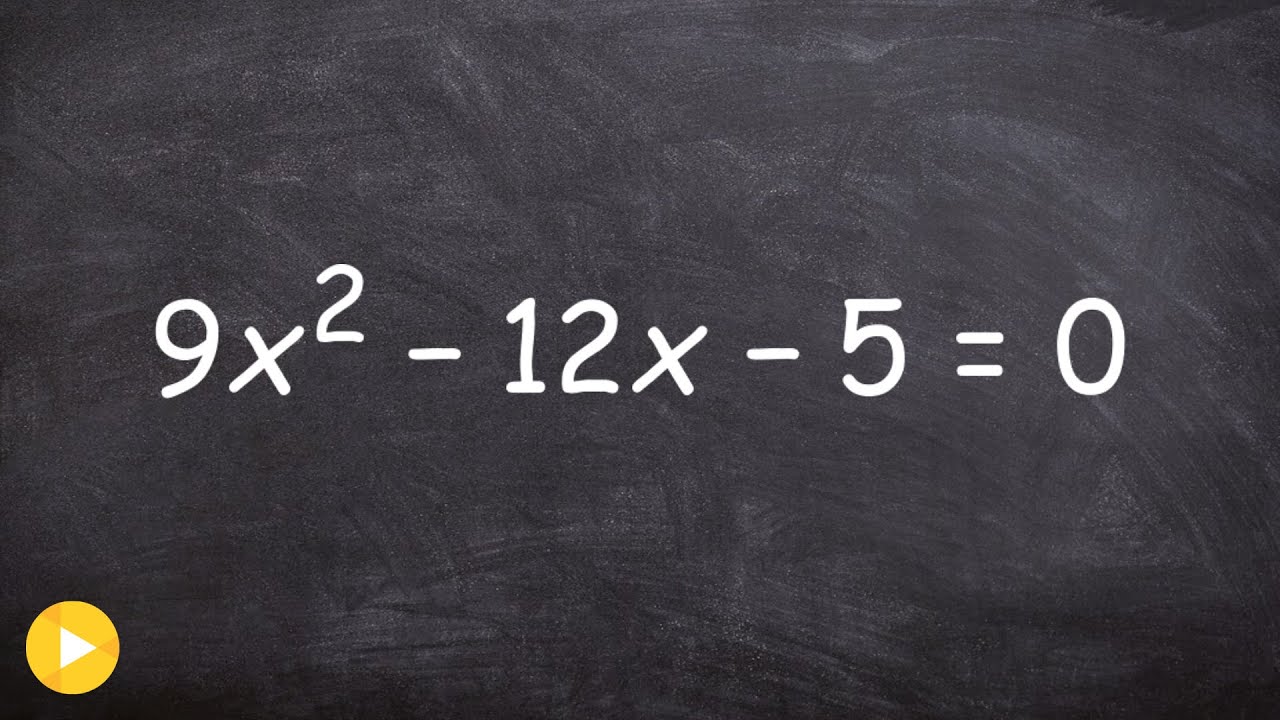
we find two factors of the product of the constant term (the term with no variable) and the coefficient of the squared variable whose sum gives the linear term. These factors are now placed in separate brackets with x to form the factors of the quadratic equation.
There are other methods that can be used to achive this including the AC, Berry, ...
what in the ac method though you make a x then for the top you put what you get when you multiply the first and last term which is -90 since we don't have any real numbers in x^2
then you put the middle term in the bottem
then you find factors of 90 that can make us a -27
deep vortex
gleaming star
Well, if you have $(x^2 - 30x)(3x - 90)$, you can see that the term with the highest degree (highest power) will be $x^2(3x) = 3x^3$, so a degree of $3$, while your original expression only has a degree of $2$.
 gleaming star
oh no we wouldn't multiply them together we would have to break them down into an even simpler form which is x(x-30) and 3(x-30)
deep vortex
gleaming star
oh no we wouldn't multiply them together we would have to break them down into a...
Well, if we multiply them together, what we should get is $x^2 - 27x - 90$, that's the point of factoring a polynomial
 gleaming star
oh no i'm not trying to get back to the original probelm im trying to solve for m
deep vortex
gleaming star
oh no i'm not trying to get back to the original probelm im trying to solve for ...
You want to factor $x^2 - 27x - 90$, right?
 gleaming star
i mean yeah but im trying to solve for 0 so like x^2 -27x -90=0
deep vortex
gleaming star
i mean yeah but im trying to solve for 0 so like x^2 -27x -90=0
If you factor it, you can very quickly find the zeros. If you had something like $(x-3)(x+5) = 0$ for example, you could quickly say that the zeros are $3$ and $-5$, since if you plug those in, then one term in the product would be $0$, making the entire product $0$.
gleaming star
gleaming star
oh no i'm not trying to get back to the original probelm im trying to solve for ...
oh i mean't here trying to solve for x to see what leads to 0
deep vortex

That's most likely why the exercises says "factor and ...", it probably wants you to factor first
gleaming star
oh wait it cuts off for you so you don't see the whole thing
??

heres the whole thing
deep vortex
No, I can see it says factor and find the solutions/zeros
gleaming star
oh okay
deep vortex
<@&268886789983436800>
deep vortex
gleaming star
heres the whole thing
So you need to further factor $(36x^2 - 49)(x^2 - 27x - 90)$, the first bracket should be very quick to factor, since there is $(a^2 - b^2) = (a+b)(a-b)$

Both of the terms in the first bracket are perfect squares, so you can apply that (it's called the difference of squares)
Can you say what we would get if we want to factor $36x^2 - 49$?
 gleaming star
thats the thing im not sure im not used to factoring binominals
first we want to start with finding the GCF right?
deep vortex
gleaming star
thats the thing im not sure im not used to factoring binominals
$a^2 - b^2 = (a+b)(a-b)$. \\
We can use that here, since we have $36x^2 - 49$, both of which are squares, and we are taking the difference of them, just like in the formula above.
Since $36x^2 = (6x)^2$ and $49 = 7^2$, we can say that $a = 6x$ and $b = 7$ and apply the above.

So $36x^2 - 49 = (6x + 7)(6x - 7)$
 gleaming star
ohh i think i get it
i gotta leave but could it be possible to leave this room open and just ping you when i get back?
deep vortex
gleaming star
ohh i think i get it
Here some other examples: \\ \begin{align*} 25x^2 - 36 &= (5x - 6)(5x + 6) \ 81x^2 + 100 &= (9x - 10)(9x + 10) \ 49x^2 - 4 &= (7x-2)(7x+2)\end{align*}
 deep vortex
gleaming star
i gotta leave but could it be possible to leave this room open and just ping you...
deep vortex
gleaming star
i gotta leave but could it be possible to leave this room open and just ping you...
Sure, if I am still there
gleaming star
alright cool
deep vortex
gleaming star
i gotta leave but could it be possible to leave this room open and just ping you...
If not, someone else will probably help you
deep vortex
gleaming star
alright cool
But the room auto-closes in 20 minutes or so
so it might be closed by that time
gleaming star
okay got you
deep vortex
You can just open a new room in that case
devout snowBOT
@gleaming star Has your question been resolved?
devout snowBOT
Channel closed
Closed due to timeout
Use .reopen if this was a mistake.
Available help channel!
Send your question here to claim the channel.
Remember:
• Ask your math question in a clear, concise manner.
• Show your work, and if possible, explain where you are stuck.
• After 15 minutes, feel free to ping <@&286206848099549185>.
• Type the command .close to free the channel when you're done.
• Be polite and have a nice day!
Read #❓how-to-get-help for further information on how to ask a good question, and about conduct in the question channels.
 quaint ice
Blanking on some basic stuff before my final
devout snowBOT
quaint ice
Blanking on some basic stuff before my final

 topaz beacon
use your knowledge of limits
 frail cosmos
Can be drawn on the papers a width and length LXW
Stacks can make 3D
Area can be dfefind by any formular LxW
3d only has 1/3 2/3
All of them equal 360, sides are same add them all up = 90
Point a to b how to get it easy distance all perpendicular
Two lines meet and they make a 90 degrees and perpendocular
Cl H looks like a corner
Sharp corner
Biceps… divides them into half
Parrallel keep on rising infinity
Intersecting lines crosses each other like relation ships
Parrallel minds there buisness never meet
Opposite sides are parralel
All 2D shapes are not parallel
Formular (m-2)180
Formular (m-2)180 divide n
 paper bone
yes
frail cosmos
Yo guys
paper bone
quaint ice
try graphing the function, the limit at zero is clear
topaz beacon
you can do it without graphing it
 dark dawn
use both 😎
topaz beacon
paper bone
but why not use a visual when possible
perhaps its not allowed on a test
quaint ice
I can use a ti-84 on exam