#help-27
1 messages · Page 69 of 1
 magic pine
,rccw
 woven radishBOT
 magic pine
btw your proof for 1d is not correct
you’re meant to show it for every odd function (i would assume)
 boreal blaze
magic pine
you’re meant to show it for every odd function (i would assume)
boreal blaze
magic pine
you’re meant to show it for every odd function (i would assume)
nope its correct, i confirmed with teacher. i just had to show one example
magic pine
can you do the same for 1e?
boreal blaze
magic pine
can you do the same for 1e?
shes not responding
wait
u mean try prooving with an example?
magic pine
yes
boreal blaze
uh not sure. it just doesnt make sense to me
magic pine
if it was allowed for 1d then why not for 1e?
boreal blaze
thats why i asked for help lol
boreal blaze
magic pine
if it was allowed for 1d then why not for 1e?
she could help me. shes just not responding
probably sleeping 
magic pine
the actual proof for this would use limits and the limit definition of a derivative
i don’t know how rigorous you’re meant to write it
boreal blaze
magic pine
i don’t know how rigorous you’re meant to write it
just a simple proof
nothing complex
a proof or an example
woven radishBOT
maximo
 magic pine
since both derivatives on the right exists, the one of the left does as well
that’s not rigorous at all but the idea is there
boreal blaze
magic pine
since both derivatives on the right exists, the one of the left does as well
alright
so how would i explain it
magic pine
i just write it
boreal blaze
magic pine
since both derivatives on the right exists, the one of the left does as well
oh this part
hmm
i feel like my professor would want more, but ig i can make sense of it
woven radishBOT
maximo
 magic pine
and do the chain rule
boreal blaze
alright
done thanks
can u help me with another question please
How would i do 4c and question 5

i think ik how to do question 5 but im not sure what its asking for
and question 4c, im just lost af 
magic pine
find a general pattern for the derivatives
in particular, for the first, third, fifth, seventh,…
boreal blaze
magic pine
find a general pattern for the derivatives
thats what im not understanding how to do lol
we were never taught that
magic pine
it’s just basic pattern recognition
look at the first derivative and the third and the fifth and so on
boreal blaze
magic pine
look at the first derivative and the third and the fifth and so on
all i see is beta increasing by 1 power
and the derivative of the trig function (sin or cos) is taken
magic pine
you’re looking at every derivative
i’m saying look at the first and third
and think about what the fifth should be
boreal blaze
- beta ^6 (sin(beta x))
magic pine
write it in terms of k
boreal blaze
but i dont know how to integrate it into a formula
magic pine
try something
first
how can you write the power
of beta
in terms of the derivative
note that we were just talking about the odd derivatives
so f^1 f^3 f^5 ...
so in general, we can write this derivative as f^(2k+1)
magic pine
we want a genreal formula for f^(2k+1)
in terms of k
for example, when k = 0
we get
f^(1), the first derivative
which is just beta * cos(beta * x)
when k = 1, we get f^(3) = - beta^3 * cos(beta * x)
k=2, f^(5) = beta^5 * cos(beta * x)
magic pine
is that for the even one?
boreal blaze
i think thats odd
magic pine
you're missing one thing
magic pine
yes
boreal blaze
so would it be
- beta ^(2k) sin (beta x)
boreal blaze
would it be
(-1)^k beta ^(2k) sin (beta x)
boreal blaze
and for the odd function it is:
(-1)^(k-1) * beta^(2k-1) * cos(betax)
magic pine
you're saying that's for f^(2k-1) right?
ah the quesiton used minus
yeah i think that's fine
 devout snowBOT
@boreal blaze Has your question been resolved?
Channel closed
Closed by @boreal blaze
Use .reopen if this was a mistake.
 Available help channel!
Send your question here to claim the channel.
Remember:
• Ask your math question in a clear, concise manner.
• Show your work, and if possible, explain where you are stuck.
• After 15 minutes, feel free to ping <@&286206848099549185>.
• Type the command .close to free the channel when you're done.
• Be polite and have a nice day!
Read #❓how-to-get-help for further information on how to ask a good question, and about conduct in the question channels.
 sonic ravine
 devout snowBOT
sonic ravine
sonic ravine
devout snowBOT
sonic ravine
sonic ravine
is there any way to find out the equation of this line without trial and error?
like actually using maths to figure out, the only have 2 points, 1 being x-intercept
 restive river
 final laurel
a straight line?
final laurel
a straight line?
He means green line
restive river
😑
sonic ravine
no cyan line is 0.016x^2-0.233x+12.5
final laurel
you can't determine the equation of the line if it's curved from 2 points
unless you know more information
like what type of function it is
sonic ravine
what if i say
it can be any type of function
quadratic, cubic, sin, anything you can think of
final laurel
only a line can be uniquely defined by 2 points
 craggy dagger
so you want to find a curve that lies inside this region?
you can try a quadratic first
sonic ravine
 sonic ravine
craggy dagger
so you want to find a curve that lies inside this region?
sonic ravine
craggy dagger
so you want to find a curve that lies inside this region?
just the equation
if you say quadratic then
is it all trial and error?
is there a way to mathematically figure it out
craggy dagger
there are mathematical ways to find quadratics
so what you do is you plot more points along the curve
and find the interpolating polynomial
all you need is 1 more point along the curve
sonic ravine
YO
that sounds good
can you tell me more
i have not learnt interpolating polynomial yet
restive river
sonic ravine
no cyan line is 0.016x^2-0.233x+12.5
Wtf will I learn these things😪
sonic ravine
but the purpose of this investigation is for me to learn new maths
craggy dagger
however, the shape might be wrong, so you can consider maybe adding different number of points to make a different degree polynomial
,w lagrange interpolation
woven radishBOT


 Requested by Element118#2437
craggy dagger
Requested by Element118#2437
craggy dagger
that's the general formula for it, but there's ways to gain intuition on how that works
craggy dagger
Let's say I give you the problem "given a bunch of points, find a polynomial passing through them"
Let's consider a special case. Say all of them except 1 are on the x-axis
can you solve this special case?
so you have $(a_0,y),(a_1,0),(a_2,0),\dots,(a_n,0)$
woven radishBOT
Element118
 sonic ravine
i have not learnt this-
do you have time to explain me the steps?
or you have like a youtube video
craggy dagger
hmm let me check

A basic introduction to Lagrange Interpolation.
Chapters
0:00 Introduction
01:07 Lagrange Polynomials
03:58 The Lagrange Interpolation formula
05:10 The Resulting Polynomials
The product links below are Amazon affiliate links. If you buy certain products on Amazon soon after clicking them, I may receive a commission. The price is the same for...
this is probably good
devout snowBOT
@sonic ravine Has your question been resolved?
craggy dagger
well another way which might be more successful would be to formulate it as part of a circular arc
sonic ravine
 sonic ravine
craggy dagger
well another way which might be more successful would be to formulate it as part...
sonic ravine
craggy dagger
well another way which might be more successful would be to formulate it as part...
what is this way?
sonic ravine
sonic ravine
here i tried to copy the larange interpolation method to find the y-intercept
but the result is -67.9
its so far off
craggy dagger
I don't think that's a problem
because -67.9 is not within the range we are interested anyway
sonic ravine
but why does it give that value
is my working wrong?
i simply copy, i have no idea what i am doing
craggy dagger
sonic ravine
what is this way?
try finding a circle (x-a)^2+(y-b)^2=r^2 that looks like the curve you are interested in
craggy dagger
sonic ravine
but why does it give that value
we don't care what the polynomial does beyond the range [5.5, 8]
sonic ravine
craggy dagger
try finding a circle (x-a)^2+(y-b)^2=r^2 that looks like the curve you are inter...
okay
i am testing things out
also
the "r" in the equation
what do you call this type of function
i always do functions with only x and y, never touched on r
@craggy dagger

i found a pretty accurate one
craggy dagger
sonic ravine
i always do functions with only x and y, never touched on r
r is just an arbitrary constant (radius of the circle)
since your k is positive this would mean it would break apart into 2 functions
when you solve for y in terms of x
sonic ravine
ok
how do i say i come up with these numbers
trial and error..?
like the numbers -17, 0.8 and 25
the work that i am doing is for an essay, where i model the shape of that thing
i need to explain what i have done to get a certain function that fits
@craggy dagger how should i explain the method i used for the circle equation
craggy dagger
<@&268886789983436800>
sonic ravine
is there a way to prove it mathematically..or do i just say i use trial and error..
craggy dagger
basically just trial and error
though the circle might not pass through the points of interest in your diagram
which are (5.5, 11.7) and (8, 0), it you want it to pass through those points then you need to use math stuff
sonic ravine
oh ok
one more thing
lets assume i will stick with that circle

how do i find the area here
is there a separate way to integrate a part of a circle?
that looks like half of a segment to me..maybe i am wrong
devout snowBOT
@sonic ravine Has your question been resolved?
devout snowBOT
@sonic ravine Has your question been resolved?
devout snowBOT
Channel closed
Closed due to timeout
Use .reopen if this was a mistake.
devout snowBOT
Available help channel!
Send your question here to claim the channel.
Remember:
• Ask your math question in a clear, concise manner.
• Show your work, and if possible, explain where you are stuck.
• After 15 minutes, feel free to ping <@&286206848099549185>.
• Type the command .close to free the channel when you're done.
• Be polite and have a nice day!
Read #❓how-to-get-help for further information on how to ask a good question, and about conduct in the question channels.
 dapper quail
In a function, f(x)=[x-1][x+5]
Solve for f(1/a)
devout snowBOT
dapper quail
In a function, f(x)=[x-1][x+5]
Solve for f(1/a)
restive river
sub in 1/a for x

 stuck field
,rcw
woven radishBOT
 stuck field
Show work.
stuck field
Actually.
It's right.
And it's the same as what they wrote.
Notice how they've the answer in the factored form. While you distributed the expression.
You might every well sub 1/a in the originally factored expression.
To get the same form.
dapper quail
I don't entirely understand could you show me what you mean?
How'd they keep it in factored form?
Like
[1/a-1][1/a+5]
How'd they simplify it?
stuck field
LCM
dapper quail
Least common multiple?
woven radishBOT
What the hell am I doing here?
 stuck field
Oops, forget that extra (
dapper quail
Ah
Makes sense now yes
The book also has these other problems
Which are simple but idk how they calculated it without a calculator and idk if they're suggesting something by showing these problems or they're done by like actual rote math
So like in #4

Ugh idk why it rotates like that
And #5 it also gives the value of sqrt(2) as a solution and idk if I'm just supposed to know that or use a calculator
Is there are easier way to find those values that I don't know of?
I'm just curious
,rcw
woven radishBOT

 winter patrol
by definition of fractional exponents
dapper quail
What's the definition of fractional exponents?
Oh wait are you talking abt the sqrt of 2
Oh yeah I understand that
I meant like knowing what the value of sqrt 2 actually is
Being 1.414..
Idk why the book put that instead of sqrt of 2 I thought they wanted me to know the value or somethg
winter patrol
sqrt(2) is the exact value
 sonic smelt
dapper quail
What's the definition of fractional exponents?
sonic smelt
dapper quail
What's the definition of fractional exponents?
$a^{\frac{b}c}=\sqrt[c]{a^b}$
woven radishBOT
A Lonely Bean
 winter patrol
1.414...whatever is only a decimal approximation
dapper quail
Yeah ik idk why they didn't just write sqrt 2 in the solutions
winter patrol
i thought you said they did
dapper quail
Oh I meant the opposite idk what I said
And for #4 idk how to do it without rote math or a calculator, I just did it with a calculator
But I'm wondering if there's some sort of shortcut mathematically
craggy dagger
$(a+b)^2=a^2+2ab+b^2$
woven radishBOT
Element118
 craggy dagger
might help with squaring those things by hand
dapper quail
woven radish
**Element118**
Oh yaa thinking of it that way does help me do it in my head
winter patrol
Yeah ik idk why they didn't just write sqrt 2 in the solutions
nfi
dapper quail
9+.6+.01
Makes it a lot easier
I also don't know how they simplify number 8 after plugging it in
dapper quail
Oh ok
winter patrol
9 + 0.6 + 0.01
dapper quail
Also I wanna learn to use latex it'd be nice
Also to make stuff easier to read over this
winter patrol
dots may be hard to see, makes it easier to read too
there's an introduction in #latex-help
 hybrid snow
Or you learn vicariously like me. Stalk channels and see how others use latex
Because why would you read a whole document when you can watch Ramonov's every step 24/7/365
dapper quail
winter patrol
dots may be hard to see, makes it easier to read too
Oh cool I didn't know that was a thing
winter patrol
if you already understand basic function notation,
that's already most of the basics done already
dapper quail
i replied to the wrong thing i meant latex help .-.
dapper quail
winter patrol
if you already understand basic function notation,
that's already most of the ba...
oh ok cool
dapper quail
hybrid snow
Because why would you read a whole document when you can watch Ramonov's every s...
facts 😂
real stalker that's crazy
So for #8 I have (x+∆x)^2 + 2(x+∆x) + 1
Idk if there's an easier way of simplifying it than distributing jt
winter patrol
there isn't
dapper quail
I feel like I'm always doing extra work and the book is trying to teach me to do less
Oh ok
dapper quail
omg that's why it's wrong 😂
i definitely forgot the - f(x)
makes sense now 😂
alr no more issues I finished that problem set
devout snowBOT
@dapper quail Has your question been resolved?
Channel closed
Closed by @dapper quail
Use .reopen if this was a mistake.
devout snowBOT
Available help channel!
Send your question here to claim the channel.
Remember:
• Ask your math question in a clear, concise manner.
• Show your work, and if possible, explain where you are stuck.
• After 15 minutes, feel free to ping <@&286206848099549185>.
• Type the command .close to free the channel when you're done.
• Be polite and have a nice day!
Read #❓how-to-get-help for further information on how to ask a good question, and about conduct in the question channels.
 rain garnet
helo
devout snowBOT
rain garnet
helo
 rain garnet
yes yes agree
 fathom thicket
now cos(arccos(x)) = x
rain garnet
but wait
rain garnet
maybe i dont understant tthe way is it written
fathom thicket
fathom thicket
now cos(arccos(x)) = x
also this is from x between -1 and 1
rain garnet
dont i need firstly calciulate arccos(2/3)?
devout snowBOT
Channel closed
Closed by @rain garnet
Use .reopen if this was a mistake.
devout snowBOT
Available help channel!
Send your question here to claim the channel.
Remember:
• Ask your math question in a clear, concise manner.
• Show your work, and if possible, explain where you are stuck.
• After 15 minutes, feel free to ping <@&286206848099549185>.
• Type the command .close to free the channel when you're done.
• Be polite and have a nice day!
Read #❓how-to-get-help for further information on how to ask a good question, and about conduct in the question channels.
 sharp axle
As part of our homework we have this question "simplify tanx/(1-sinx)" and I'm kind of stuck.
devout snowBOT
sharp axle
As part of our homework we have this question "simplify tanx/(1-sinx)" and I'm k...

 queen zephyr
i dont think we can simplify that
winter patrol
was that the exact wording of the question?
sharp axle
winter patrol
was that the exact wording of the question?
Yeah
Just the word "simplify"
winter patrol
did you copy down the question correctly
as there isn't really something thats objectively simpler
sharp axle
winter patrol
did you copy down the question correctly
The teacher sent it to us through telegram
So I'm pretty sure that I did
winter patrol
through telegram? the sus app?
sharp axle
winter patrol
through telegram? the sus app?
The app doesn't matter, what matters is that he sent us a pic
winter patrol
check the pic again
 winter patrol
are you 100% sure these are "simplify" questions?
sharp axle
100%
winter patrol
because there's not much that can be done with Q4,
and 5,7 are clearly already in the simplest form
sharp axle
We asked him today where did you get these questions since we searched in the textbook and these weren't in it.
He said they aren't from the textbook
winter patrol
some of these can be objectively simplified,
8 isn't one of them
sharp axle
Well
I tried the others
In some programs
And no answer
But when I tried them myself I was able to simplify
So that's why I ask here because maybe people know something that solvers don't
Anyhow I'll go eat something
And I'll ask him about this particular point next time
.close
devout snowBOT
Channel closed
Closed by @sharp axle
Use .reopen if this was a mistake.
Available help channel!
Send your question here to claim the channel.
Remember:
• Ask your math question in a clear, concise manner.
• Show your work, and if possible, explain where you are stuck.
• After 15 minutes, feel free to ping <@&286206848099549185>.
• Type the command .close to free the channel when you're done.
• Be polite and have a nice day!
Read #❓how-to-get-help for further information on how to ask a good question, and about conduct in the question channels.
 near belfry
 devout snowBOT
near belfry
near belfry
devout snowBOT
near belfry
near belfry
Can someone tel me how I show this
 pseudo basin
,rccw
woven radishBOT
 pseudo basin
cos(180n°) = ?
near belfry
What? Ann
pseudo basin
"I'm very bad with sigma notation"
in response to a question that doesnt concern sigma notation at all
ok lets see here
what is cos(180°)?
near belfry
-1
pseudo basin
and cos(2*180°)?
near belfry
1?
pseudo basin
and cos(3*180°)?
pseudo basin
yes, so how else can you write down a sequence that goes 1, -1, 1, -1, 1, -1, ... alternating between 1 and -1 forever
near belfry
-1^(n-1)
magic pine
parentheses
restive river
 restive river
restive river
restive river
,rccw
woven radishBOT
 magic pine
restive river
magic pine
restive river
!help
devout snowBOT
restive river
Please read #❓how-to-get-help
near belfry
@restive river can you explain why the geometric sequence isn’t -1^(n-1)
magic pine
-1^n = -(1^n)
pseudo basin
near belfry
-1^(n-1)
(-1)^n
pseudo basin
near belfry
Ar^(n-1)
overattachment to form
restive river
near belfry
<@456226577798135808> can you explain why the geometric sequence isn’t -1^(n-1)
 magic pine
oh @restive river sorry about the !help thing, i thought you were asking a question
devout snowBOT
@near belfry Has your question been resolved?
devout snowBOT
Channel closed
Closed due to timeout
Use .reopen if this was a mistake.
Available help channel!
Send your question here to claim the channel.
Remember:
• Ask your math question in a clear, concise manner.
• Show your work, and if possible, explain where you are stuck.
• After 15 minutes, feel free to ping <@&286206848099549185>.
• Type the command .close to free the channel when you're done.
• Be polite and have a nice day!
Read #❓how-to-get-help for further information on how to ask a good question, and about conduct in the question channels.
 pure grotto

 devout snowBOT
@pure grotto Has your question been resolved?
devout snowBOT
Channel closed
Closed due to timeout
Use .reopen if this was a mistake.
Available help channel!
Send your question here to claim the channel.
Remember:
• Ask your math question in a clear, concise manner.
• Show your work, and if possible, explain where you are stuck.
• After 15 minutes, feel free to ping <@&286206848099549185>.
• Type the command .close to free the channel when you're done.
• Be polite and have a nice day!
Read #❓how-to-get-help for further information on how to ask a good question, and about conduct in the question channels.
pure grotto
help
devout snowBOT
pure grotto
help


 devout snowBOT
@pure grotto Has your question been resolved?
 surreal frigate
It's correct
devout snowBOT
@pure grotto Has your question been resolved?
Channel closed
Closed by @pure grotto
Use .reopen if this was a mistake.
pure grotto
surreal frigate
It's correct
thank you boss
pure grotto
surreal frigate
It's correct
iloveyoumwa
devout snowBOT
Available help channel!
Send your question here to claim the channel.
Remember:
• Ask your math question in a clear, concise manner.
• Show your work, and if possible, explain where you are stuck.
• After 15 minutes, feel free to ping <@&286206848099549185>.
• Type the command .close to free the channel when you're done.
• Be polite and have a nice day!
Read #❓how-to-get-help for further information on how to ask a good question, and about conduct in the question channels.
 cunning perch
 devout snowBOT
cunning perch
cunning perch
cunning perch
I know the range is {y|y=-5}
devout snowBOT
cunning perch
cunning perch
cunning perch
I know the range is {y|y=-5}
It cant equal -5
pseudo basin
then why write = and not ≠
cunning perch
I just don't have the symbol on keyboard
pseudo basin
you can substitute with !=
cunning perch
oh
pseudo basin
also i would not be so sure the range actually is R \ {-5}
i have a suspicion about that
cunning perch
pseudo basin
also i would not be so sure the range actually is R \ {-5}
but how do you find the domain?
pseudo basin
how do you normally find the domain of a fraction like this?
cunning perch
make the denominator 0?
pseudo basin
you find all points where the denominator is zero, and exclude those.
pseudo basin
does x = sqrt(3) make the denominator zero?
pseudo basin
you should get that the equation x^2 + 3 = 0 has no real solutions!
cunning perch
oh
wait
so
it can't be less than 0
no,
I mean
it has to be less than or equal to 0
I'm not sure
pseudo basin
what's "it"
cunning perch
x
pseudo basin
why does x have to be less than or equal to 0?
pseudo basin
then why say it does...
pseudo basin
in this case, since you have no complications other than the fraction,
you find all points where the denominator is zero, and exclude those.
cunning perch
I can't get the denominator to be 0 though
pseudo basin
you have found that the denominator is never equal to 0, yes.
so there is nothing to exclude.
pseudo basin
yes...
cunning perch
pseudo basin
yes...
I know for the range one of the values is y=-5
oh wait
I got it
already
pseudo basin
no, you know that one of the excluded values is y=-5...
cunning perch
pseudo basin
no, you know that one of the _excluded_ values is y=-5...
Yeah
pseudo basin
confusion between "i know this value belongs to the <domain/range>" and "i know this value DOESN'T belong to the <domain/range>" is HIGHLY DANGEROUS.
cunning perch
and the other one is anything greater than 3
cunning perch
pseudo basin
confusion between "i know this value belongs to the <domain/range>" and "i know ...
yeah
thanks for your help!
.close
devout snowBOT
Channel closed
Closed by @cunning perch
Use .reopen if this was a mistake.
devout snowBOT
Available help channel!
Send your question here to claim the channel.
Remember:
• Ask your math question in a clear, concise manner.
• Show your work, and if possible, explain where you are stuck.
• After 15 minutes, feel free to ping <@&286206848099549185>.
• Type the command .close to free the channel when you're done.
• Be polite and have a nice day!
Read #❓how-to-get-help for further information on how to ask a good question, and about conduct in the question channels.
 jade falcon
For this question we can use the ideal gas law. PV=nRT
P is pressure
V is volume
n is moles(quantity of gas)
R is a constant(ideal gas constant)
T is the temperature of the room
Since the gas is in a sealed vessel, n cannot change. And T can be ignored since we can assume that the gas will reach the same room temp after some time as in the initial conditions. And since R is a constant, it can be ignored as well.
devout snowBOT
jade falcon
For this question we can use the ideal gas law. PV=nRT
P is pressure
V is volum...
 stuck field
Enlargement factor, that is for volume right?
jade falcon
ya
stuck field
Alright. And you say T is to be assumed constant?
 stuck field
Again, you're changing problems. Which one do you need help with?
jade falcon
idk
stuck field
...
jade falcon
it just says enlargement factor
stuck field
Didn't ask that. Do you need help with 3 or 4.
jade falcon
4
stuck field
Alright.
If nRT is completely constant then you have PV = constant.
Meaning P is inversely proportional to V.
jade falcon
ok
stuck field
Do you know how to do it from there?
jade falcon
stuck field
Do you know how to do it from there?
no
stuck field
And if V changes by a factor of x. Then P should change by a factor of 1/x.
So that their product is always a constant.
jade falcon
stuck field
So that their product is always a constant.
.
stuck field
That is it.
It tells you the enlargement factor is F.
So you should get the factor by which P changes as well.
jade falcon
ok thanks
jade falcon
stuck field
And if V changes by a factor of x. Then P should change by a factor of 1/x.
so can i write the x here as F
like
And if V changes by a factor of F. Then P should change by a factor of 1/F
stuck field
It should.
jade falcon
one last quesion
does P being inversly proportional to V mean the same as V being inversely proportional to P
?
stuck field
Yes.
jade falcon
then cant it also mean that if P is enlarged by a factor of F then V is enlarged by a factor of 1/F
?
jade falcon
stuck field
Yes.
.
stuck field
jade falcon
then cant it also mean that if P is enlarged by a factor of F then V is enlarged...
It can. All of it is the same thing.
But your question doesn't say that.
jade falcon
ok
and what if the enlargment factor was for pressure?
then would it be that if P is enlarged by a factor of F then V is enlarged by a factor of 1/F
?
stuck field
Yes, just now you asked the same and I said yes.
Whatever the enlargement factor for either of them is, for the other it is 1/that quantity.
Makes sense?
stuck field
Obviously it matters.
Since they've told you volume is the quantity that enlarges by F. Then you can surely comment on pressure.
jade falcon
but the question just says the enlargement factor is F. not the enlargement factor for volume
stuck field
Well, clearly volume is the one changing. And that is also what I asked you in the first place.
Besides by "enlarge" you'd assume the volume is the one that changes.
devout snowBOT
Channel closed
Closed by @stuck field
Use .reopen if this was a mistake.
Available help channel!
Send your question here to claim the channel.
Remember:
• Ask your math question in a clear, concise manner.
• Show your work, and if possible, explain where you are stuck.
• After 15 minutes, feel free to ping <@&286206848099549185>.
• Type the command .close to free the channel when you're done.
• Be polite and have a nice day!
Read #❓how-to-get-help for further information on how to ask a good question, and about conduct in the question channels.
 jaunty gazelle
can someone help me with this problem?
 devout snowBOT
jaunty gazelle
can someone help me with this problem?
jaunty gazelle
devout snowBOT
jaunty gazelle
can someone help me with this problem?
jaunty gazelle
trig integration
I think I have some of it down...this is what I have so far, can you tell me if im on right track:

Number 4
I used trig identity tan^2(x)+1=sec^2(x) to solve problem
but now im stuck
sonic smelt
I think I would get more tans instead
sonic smelt
Hm, but the powers are odd
jaunty gazelle
 upper schooner
Should be product but otherwise yea right track 🛤️
upper schooner
Should be product but otherwise yea right track 🛤️
I have integral tan(x) *(sec^2-1)sec^7(x)dx . I then multiply the sec^7x by sec^2 and -1 respectively, right?
hold on
upper schooner
You could then factor out a sec(x)tan(x)
jaunty gazelle
upper schooner
You could then factor out a sec(x)tan(x)
Wouldn’t I do u substitution or something?
 upper schooner
jaunty gazelle
Wouldn’t I do u substitution or something?
upper schooner
jaunty gazelle
Wouldn’t I do u substitution or something?
Second term should be tan(x)sec^7(x) (or you're missing  ), and yes you would
jaunty gazelle
upper schooner
Second term should be tan(x)sec^7(x) (or you're missing <:PARENS:371658456215584...
Maybe I misunderstood a step. Wouldn't we just keep the tan(x), multiply the sec^7(x) by sec^2(x) and -1 and get tan(x)*sec^9(x)-sec^7(x)dx
upper schooner
jaunty gazelle
I have integral tan(x) *(sec^2-1)sec^7(x)dx . I then multiply the sec^7x by sec^...
Here you said you had
[
\int \tan(x) \cdot (\sec^2(x)-1) \sec^7(x) \dd x
]
right?
jaunty gazelle
yes
woven radishBOT
@upper schooner
 jaunty gazelle
yeah, tan^2(x) turns into (sec^2(x)-1)
upper schooner
woven radish
<@788085606483361802>
You then multiplied out the brackets here, right?
jaunty gazelle
upper schooner
You then multiplied out the brackets here, right?
I only multiplied sec^7(x) by sec^2(x) and -1
woven radishBOT
@upper schooner
 upper schooner
woven radish
<@788085606483361802>
upper schooner
woven radish
<@788085606483361802>
[note the in the first one]
jaunty gazelle
upper schooner
[note the <:PARENS:371658456215584789> in the first one]
So this would get us this:
 upper schooner
Almost
upper schooner
 jaunty gazelle
upper schooner
jaunty gazelle
upper schooner
I canceled the sec(x) with the sec^9(x) though..
upper schooner
jaunty gazelle
I canceled the sec(x) with the sec^9(x) though..
You can't do it with only one, you need to do it for both
jaunty gazelle
upper schooner
You can't do it with only one, you need to do it for both
Thank you.
upper schooner
upper schooner
You could then factor out a sec(x)tan(x)
See here 
if you factored out another sec(x) you'd see how it cancels for both
devout snowBOT
@jaunty gazelle Has your question been resolved?
jaunty gazelle
upper schooner
if you factored out another sec(x) you'd see how it cancels for both
Okay, so assuming this is right, I've learned that everything comes down to trying to apply a trig identity, factoring and/or multiplying, some sort of integration technique like u substitution, and simplification?

The following above was another problem I attempted just now (problem above):

 crystal rune
jaunty gazelle
crystal rune
jaunty gazelle
This is correct.
jaunty gazelle
crystal rune
This is correct.
Is my thought process and steps right to?
crystal rune
Yep.
jaunty gazelle
crystal rune
Yep.
Is this statement also true: "Okay, so assuming this is right, I've learned that everything comes down to trying to apply a trig identity, factoring and/or multiplying, some sort of integration technique like u substitution, and simplification?"
crystal rune
Uh, I wouldn't say everything because there are a lot of identities and I don't know if you know them all, I don't know if you know when to apply which identity
But in this case you certainly did apply the right one, however there's almost always more than one way to integrate something
Just keep practicing
I for one certainly don't know everything when it comes to applying a trig identity and simplifying
jaunty gazelle
crystal rune
But in this case you certainly did apply the right one, however there's almost a...
Okay. Let me ask, I also tried doing it the other way, as in, applying the trig identity to sin^2(x) to get (1-cos^2(x))*(cos^3)dx. I gave up eventually. Would that not work for a problem like this?
crystal rune
It can but it's lengthy
Gotta use some angle identities I think
Your way is the shortest I believe
jaunty gazelle
Okay. Another final question, would I have to use a reduction formula on this:
it's not uploading..
crystal rune
Btw Idk if it'll work but you can also try using u = cosx or u = sinx and see what happens
jaunty gazelle
crystal rune
Btw Idk if it'll work but you can also try using u = cosx or u = sinx and see wh...
 crystal rune
What do you think?
jaunty gazelle
crystal rune
What do you think?
I know I have to factor the 5 out, maybe take the antiderivative of x^3...but idk if it this is meant to be used with reduction formula
crystal rune
A simple u-sub
jaunty gazelle
crystal rune
A simple u-sub
let me check hold on.
jaunty gazelle
crystal rune
A simple u-sub
with our u sub being cos?
I am getting tis as an answer, and this is my work:

I don't think I'm getting this correct.
Can anyone help? <@&286206848099549185>
 nova idol
jaunty gazelle
I am getting tis as an answer, and this is my work:
nova idol
jaunty gazelle
I am getting tis as an answer, and this is my work:
use an integral calculator
jaunty gazelle
nova idol
use an integral calculator
Any you recommend? Can't see the steps using symbolab..
crystal rune
@jaunty gazelle Derivative of x^4 is 4x^3 and 5x^3 is already given.
This implies a u-sub, u = x^4
jaunty gazelle
crystal rune
This implies a u-sub, u = x^4
Is there another way of seeing that x^4 is u sub...
crystal rune
Other than seeing that its derivative x^3 is given, no
jaunty gazelle
crystal rune
Other than seeing that its derivative x^3 is given, no
doing u substitution i get 5/4* integral of cos^2(x^4)..
do I apply trig integration on cos^2(x^4)?
crystal rune
Should be $\int \cos^{2} (u) \dd{u}$
woven radishBOT
Sup?
 crystal rune
5/4 outside too
jaunty gazelle
crystal rune
5/4 outside too
okay so err...
we do something with the cos^2, right?
trig identity!
crystal rune
Yes
jaunty gazelle
crystal rune
Yes
1-sin^2?
crystal rune
Nope
jaunty gazelle
wait
jaunty gazelle
crystal rune
Nope
? I thought the trig identity was cos^2(x)+sin^2(x)=1..
crystal rune
There are more
jaunty gazelle
crystal rune
There are more
that wouldn't apply here?
jaunty gazelle
crystal rune
If u cant integrate cos^2, how can you integrate sin^2
I see...this is my work for it:
jaunty gazelle
crystal rune
If u cant integrate cos^2, how can you integrate sin^2

so we apply double angle identity 1+cos(2pheta)/2 du
and then we simplify to get 5/8 (u+1/2sin(2u))
crystal rune
at the end it should be sin(2u)/4
All good otherwise
chain rule, you divide by the derivative of 2u
Oh wait
Nvm
You factored out the 2
Okay
All good.
jaunty gazelle
crystal rune
All good.
Thanks so much, Sup. 🙂
devout snowBOT
@jaunty gazelle Has your question been resolved?
devout snowBOT
Channel closed
Closed by @jaunty gazelle
Use .reopen if this was a mistake.
Available help channel!
Send your question here to claim the channel.
Remember:
• Ask your math question in a clear, concise manner.
• Show your work, and if possible, explain where you are stuck.
• After 15 minutes, feel free to ping <@&286206848099549185>.
• Type the command .close to free the channel when you're done.
• Be polite and have a nice day!
Read #❓how-to-get-help for further information on how to ask a good question, and about conduct in the question channels.
 indigo abyss
how is this wrong?
 devout snowBOT
indigo abyss
how is this wrong?
surreal frigate
devout snowBOT
indigo abyss
how is this wrong?
surreal frigate
You forgot to plug in 0
devout snowBOT
@indigo abyss Has your question been resolved?
 supple knot
indigo abyss
how is this wrong?
supple knot
indigo abyss
how is this wrong?
cos(0) = 1
devout snowBOT
Channel closed
Closed due to timeout
Use .reopen if this was a mistake.
Available help channel!
Send your question here to claim the channel.
Remember:
• Ask your math question in a clear, concise manner.
• Show your work, and if possible, explain where you are stuck.
• After 15 minutes, feel free to ping <@&286206848099549185>.
• Type the command .close to free the channel when you're done.
• Be polite and have a nice day!
Read #❓how-to-get-help for further information on how to ask a good question, and about conduct in the question channels.
 mild summit
Simple question:
devout snowBOT
mild summit
Simple question:
mild summit

Why can one not construct confidence interval of beta_0?
this is what we have

<@&286206848099549185>
yo
devout snowBOT
@mild summit Has your question been resolved?
devout snowBOT
@mild summit Has your question been resolved?
 timber pebble
mild summit
Why can one not construct confidence interval of beta_0?
timber pebble
mild summit
Why can one not construct confidence interval of beta_0?
you can
its done in exactly the same way
its just not especially useful
or statistically meaningful
unless you have a really specific research question
devout snowBOT
@mild summit Has your question been resolved?
devout snowBOT
Channel closed
Closed due to timeout
Use .reopen if this was a mistake.
devout snowBOT
Available help channel!
Send your question here to claim the channel.
Remember:
• Ask your math question in a clear, concise manner.
• Show your work, and if possible, explain where you are stuck.
• After 15 minutes, feel free to ping <@&286206848099549185>.
• Type the command .close to free the channel when you're done.
• Be polite and have a nice day!
Read #❓how-to-get-help for further information on how to ask a good question, and about conduct in the question channels.
 hollow forge
can anyone help me with this error if they have ever used mathematica?
 devout snowBOT
hollow forge
can anyone help me with this error if they have ever used mathematica?
hollow forge
devout snowBOT
hollow forge
can anyone help me with this error if they have ever used mathematica?
hollow forge
nvm i found the problem
devout snowBOT
@hollow forge Has your question been resolved?
Channel closed
Closed by @hollow forge
Use .reopen if this was a mistake.
devout snowBOT
Available help channel!
Send your question here to claim the channel.
Remember:
• Ask your math question in a clear, concise manner.
• Show your work, and if possible, explain where you are stuck.
• After 15 minutes, feel free to ping <@&286206848099549185>.
• Type the command .close to free the channel when you're done.
• Be polite and have a nice day!
Read #❓how-to-get-help for further information on how to ask a good question, and about conduct in the question channels.
 sharp citrus
 devout snowBOT
sharp citrus
supple knot
devout snowBOT
sharp citrus
supple knot
,rotate
woven radishBOT
 sharp citrus
(x-y)^2 is bigger or equal to 0
supple knot
sharp citrus
(x-y)^2 is bigger or equal to 0
this is all you need
supple knot
yes so do you see why the - signs don't matter
sharp citrus
yes ye
so i can just move on to the conclusion right
no need for further explanation
like for the answer
devout snowBOT
@sharp citrus Has your question been resolved?
sharp citrus
.close
devout snowBOT
Channel closed
Closed by @sharp citrus
Use .reopen if this was a mistake.
Available help channel!
Send your question here to claim the channel.
Remember:
• Ask your math question in a clear, concise manner.
• Show your work, and if possible, explain where you are stuck.
• After 15 minutes, feel free to ping <@&286206848099549185>.
• Type the command .close to free the channel when you're done.
• Be polite and have a nice day!
Read #❓how-to-get-help for further information on how to ask a good question, and about conduct in the question channels.
 visual lark
anyone who can help me on the right path with this integral?https://gyazo.com/6d8e5975fa5827996ba4b1532f250672
 devout snowBOT
visual lark
anyone who can help me on the right path with this integral?https://gyazo.com/6d...
visual lark
devout snowBOT
visual lark
anyone who can help me on the right path with this integral?https://gyazo.com/6d...
visual lark
.close
devout snowBOT
Channel closed
Closed by @visual lark
Use .reopen if this was a mistake.
Available help channel!
Send your question here to claim the channel.
Remember:
• Ask your math question in a clear, concise manner.
• Show your work, and if possible, explain where you are stuck.
• After 15 minutes, feel free to ping <@&286206848099549185>.
• Type the command .close to free the channel when you're done.
• Be polite and have a nice day!
Read #❓how-to-get-help for further information on how to ask a good question, and about conduct in the question channels.
restive river
just making sure the possibilities of sitting in a round table is (n-1)! and like a class with normal tables is n! ? or not.
devout snowBOT
restive river
just making sure the possibilities of sitting in a round table is (n-1)! and lik...
@restive river Has your question been resolved?
nova idol
restive river
just making sure the possibilities of sitting in a round table is (n-1)! and lik...
m8 what
devout snowBOT
@restive river Has your question been resolved?
devout snowBOT
@restive river Has your question been resolved?
 wide lynx
restive river
just making sure the possibilities of sitting in a round table is (n-1)! and lik...
wide lynx
restive river
just making sure the possibilities of sitting in a round table is (n-1)! and lik...
Yes
devout snowBOT
@restive river Has your question been resolved?
Channel closed
Closed by @brazen depot
Use .reopen if this was a mistake.
Available help channel!
Send your question here to claim the channel.
Remember:
• Ask your math question in a clear, concise manner.
• Show your work, and if possible, explain where you are stuck.
• After 15 minutes, feel free to ping <@&286206848099549185>.
• Type the command .close to free the channel when you're done.
• Be polite and have a nice day!
Read #❓how-to-get-help for further information on how to ask a good question, and about conduct in the question channels.
 deep pelican
Collatz conjecture
devout snowBOT
deep pelican
Collatz conjecture
 alpine tapir
are you asking what it is?
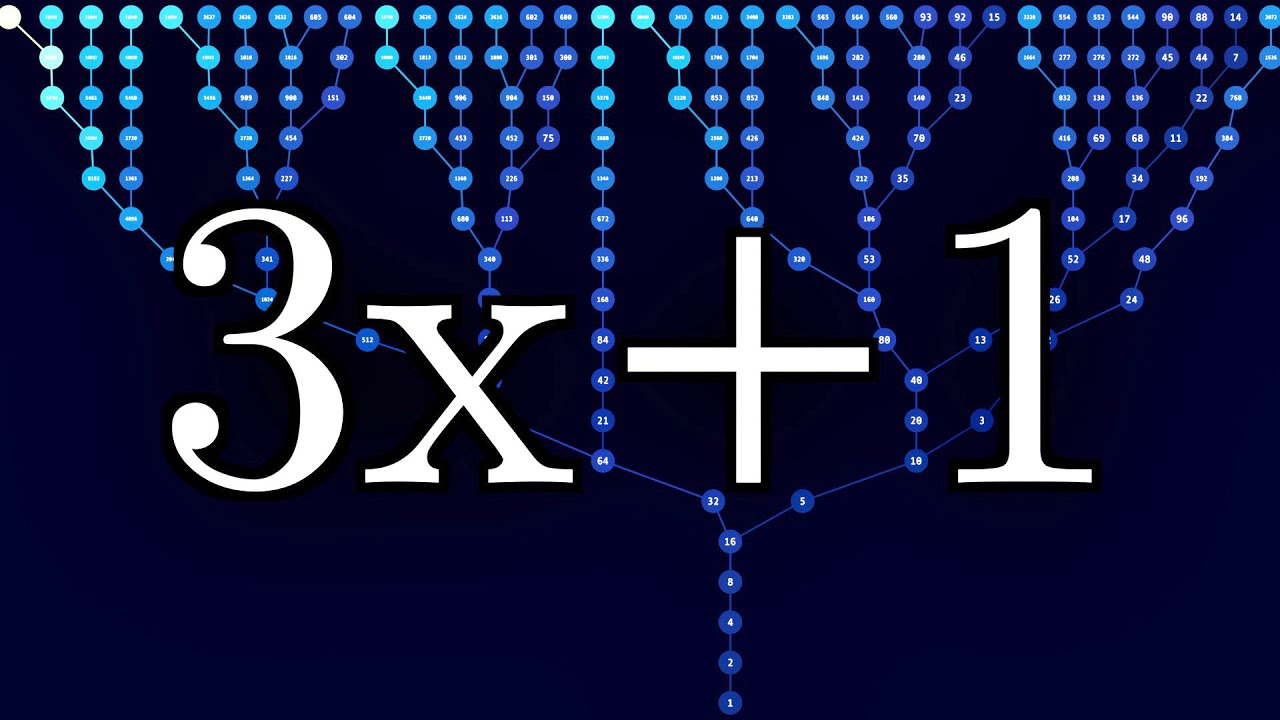
The Collatz Conjecture is the simplest math problem no one can solve — it is easy enough for almost anyone to understand but notoriously difficult to solve. This video is sponsored by Brilliant. The first 200 people to sign up via https://brilliant.org/veritasium get 20% off a yearly subscription.
Special thanks to Prof. Alex Kontorovich for in...
deep pelican
nope sorry should have been more clear i have a proof but am having a hard time wording it
looking for people to chat about with it
devout snowBOT
Channel closed
Closed by @deep pelican
Use .reopen if this was a mistake.
devout snowBOT
Available help channel!
Send your question here to claim the channel.
Remember:
• Ask your math question in a clear, concise manner.
• Show your work, and if possible, explain where you are stuck.
• After 15 minutes, feel free to ping <@&286206848099549185>.
• Type the command .close to free the channel when you're done.
• Be polite and have a nice day!
Read #❓how-to-get-help for further information on how to ask a good question, and about conduct in the question channels.
 ivory yoke
how to find the derivative of this function
 devout snowBOT
ivory yoke
how to find the derivative of this function
fathom thicket
ivory yoke
how to find the derivative of this function
devout snowBOT
ivory yoke
how to find the derivative of this function
fathom thicket
ivory yoke
how to find the derivative of this function
chain rule
dont use someone elses channel
!help
devout snowBOT
Please read #❓how-to-get-help
ivory yoke
Something like this?
 fathom thicket
ivory yoke
Something like this?
fathom thicket
ivory yoke
Something like this?
yh
devout snowBOT
Channel closed
Closed by @ivory yoke
Use .reopen if this was a mistake.
Available help channel!
Send your question here to claim the channel.
Remember:
• Ask your math question in a clear, concise manner.
• Show your work, and if possible, explain where you are stuck.
• After 15 minutes, feel free to ping <@&286206848099549185>.
• Type the command .close to free the channel when you're done.
• Be polite and have a nice day!
Read #❓how-to-get-help for further information on how to ask a good question, and about conduct in the question channels.
 odd wave
Hi can someone explain this question and answer? I'm stuck thanks!
 fathom thicket
odd wave
Hi can someone explain this question and answer? I'm stuck thanks!
fathom thicket
odd wave
Hi can someone explain this question and answer? I'm stuck thanks!
its asking you to expand that
and compare terms
devout snowBOT
@odd wave Has your question been resolved?
devout snowBOT
Channel closed
Closed due to timeout
Use .reopen if this was a mistake.
Available help channel!
Send your question here to claim the channel.
Remember:
• Ask your math question in a clear, concise manner.
• Show your work, and if possible, explain where you are stuck.
• After 15 minutes, feel free to ping <@&286206848099549185>.
• Type the command .close to free the channel when you're done.
• Be polite and have a nice day!
Read #❓how-to-get-help for further information on how to ask a good question, and about conduct in the question channels.
 lofty monolith
Even though that force is acting up, the particle moves down the slope?
 devout snowBOT
lofty monolith
Even though that force is acting up, the particle moves down the slope?
lofty monolith
devout snowBOT
lofty monolith
Even though that force is acting up, the particle moves down the slope?
lofty monolith
Idk I assumed the force would pull it up the slope or something 😭
devout snowBOT
@lofty monolith Has your question been resolved?
devout snowBOT
Channel closed
Closed due to timeout
Use .reopen if this was a mistake.
devout snowBOT
Available help channel!
Send your question here to claim the channel.
Remember:
• Ask your math question in a clear, concise manner.
• Show your work, and if possible, explain where you are stuck.
• After 15 minutes, feel free to ping <@&286206848099549185>.
• Type the command .close to free the channel when you're done.
• Be polite and have a nice day!
Read #❓how-to-get-help for further information on how to ask a good question, and about conduct in the question channels.
 maiden zinc
is F = ker(f - id) the same thing as F = Im(f)?
devout snowBOT
maiden zinc
is F = ker(f - id) the same thing as F = Im(f)?
maiden zinc
because ker(f - id) is the same as the set of f(x) - x = 0
ie f(x) = x
but the set Im(f) is all the x of f(x) so not the same
 stone stump
devout snowBOT
stone stump
devout snowBOT
@maiden zinc Has your question been resolved?
maiden zinc
that's what i thought
devout snowBOT
@maiden zinc Has your question been resolved?
devout snowBOT
Channel closed
Closed due to timeout
Use .reopen if this was a mistake.
Available help channel!
Send your question here to claim the channel.
Remember:
• Ask your math question in a clear, concise manner.
• Show your work, and if possible, explain where you are stuck.
• After 15 minutes, feel free to ping <@&286206848099549185>.
• Type the command .close to free the channel when you're done.
• Be polite and have a nice day!
Read #❓how-to-get-help for further information on how to ask a good question, and about conduct in the question channels.
 floral turtle
Am I supposed to have a whole number here?
 devout snowBOT
floral turtle
Am I supposed to have a whole number here?
devout snowBOT
floral turtle
Am I supposed to have a whole number here?
 dense jay
brackets
 rocky sparrow
devout snowBOT
rocky sparrow
devout snowBOT
Channel closed
Closed by @floral turtle
Use .reopen if this was a mistake.
Available help channel!
Send your question here to claim the channel.
Remember:
• Ask your math question in a clear, concise manner.
• Show your work, and if possible, explain where you are stuck.
• After 15 minutes, feel free to ping <@&286206848099549185>.
• Type the command .close to free the channel when you're done.
• Be polite and have a nice day!
Read #❓how-to-get-help for further information on how to ask a good question, and about conduct in the question channels.
 foggy snow
if i have a function that is continuous, differentiable and positive, then would its sum be greater (>=) or its integral? or does it depend?
devout snowBOT
foggy snow
if i have a function that is continuous, differentiable and positive, then would...
foggy snow
 violet wind
like Riemann sum?
violet wind
like Riemann sum?
no, like a finite sum
$$\sum_{x=1}^{n} f(x) \geq \int_{0}^{n} f(x) \textrm{ or } \sum_{x=1}^{n} f(x) \leq \int_{0}^{n} f(x)$$
violet wind
f(x) when the index variable is i?
foggy snow
oh my bad
woven radishBOT
ibzi
 foggy snow
if the function is increasing
 uncut crow
also i think you can remove the differentiable and positive conditions
uncut crow
continuous and increasing or continuous and decreasing should be enough to state inequalities like that
foggy snow
oh okay
violet wind
integrable and increasing 
foggy snow
okay okay one second
uncut crow
violet wind
integrable and increasing <:sotrue:826971355542192148>
can't tell if you're serious haha
violet wind
you don't get strict then but I don't see why not
foggy snow
foggy snow
okay, so if the function is increasing then the integral would be greater right?
wait is this correct ^
violet wind
Should be yeah
foggy snow
okay; awesome!
violet wind
If it's not continuous you can't guarantee they're not equal
Or if it's constant
If it's strictly increasing though then you're good
uncut crow
violet wind
you don't get strict then but I don't see why not
$\sum_{x=1}^n f(x)$ could be 0 when it doesn't look like it should be at all
woven radishBOT
💜𝓁𝒶𝓎𝓁𝒶💜
 uncut crow
by just making f(1), f(2), etc 0
violet wind
for increasing functions tho
f(a) = f(b) = 0 implies f([a,b])=0
In that case I'd say it definitely would look like it should be zero
uncut crow
ok true
foggy snow
does it work the other way around, i.e., can i say $\sum_{x=1}^{n} f(x) \leq \int_{0}^{n} f(x) \Longrightarrow$ mono increasing?
woven radishBOT
ibzi
 foggy snow
uncut crow
no, let f(x) = 0 when x is 1 or 2 and f(x) = 1 for everything else
foggy snow
uncut crow
no, let f(x) = 0 when x is 1 or 2 and f(x) = 1 for everything else
oh yeah!
again, thank you so much!
uncut crow
that's what i thought was an issue before it wasn't really haha
devout snowBOT
Channel closed
Closed by @foggy snow
Use .reopen if this was a mistake.
Available help channel!
Send your question here to claim the channel.
Remember:
• Ask your math question in a clear, concise manner.
• Show your work, and if possible, explain where you are stuck.
• After 15 minutes, feel free to ping <@&286206848099549185>.
• Type the command .close to free the channel when you're done.
• Be polite and have a nice day!
Read #❓how-to-get-help for further information on how to ask a good question, and about conduct in the question channels.
 urban harbor
was looking through an old classic textbook on Calculus by Courant and i think it contains an error..if h = 0, it's just 1 = 1 so is this lemma supposed to be >= instead of > or what am i missing?
 devout snowBOT
urban harbor
was looking through an old classic textbook on Calculus by Courant and i think i...
upper schooner
devout snowBOT
urban harbor
was looking through an old classic textbook on Calculus by Courant and i think i...
upper schooner
Pretty much everywhere else I’ve seen that stated, it’s been a non strict inequality as well
violet wind
Seems to be strict whenever h≠0 which is weird
urban harbor
ok thanks, always love finding errors in print 😬
violet wind
guess they forgot lol
urban harbor
.close
devout snowBOT
Channel closed
Closed by @urban harbor
Use .reopen if this was a mistake.
devout snowBOT
Available help channel!
Send your question here to claim the channel.
Remember:
• Ask your math question in a clear, concise manner.
• Show your work, and if possible, explain where you are stuck.
• After 15 minutes, feel free to ping <@&286206848099549185>.
• Type the command .close to free the channel when you're done.
• Be polite and have a nice day!
Read #❓how-to-get-help for further information on how to ask a good question, and about conduct in the question channels.
 sacred rock
I'm at a point where I have worked out k-6 = 3x-2y and k+12=4y-x on Q2.3 how can I now prove point P lies on y=x+3 ( I have got this from the knowledge that Q= B*P )
 devout snowBOT
sacred rock
I'm at a point where I have worked out k-6 = 3x-2y and k+12=4y-x on Q2.3 how can...
dense jay
devout snowBOT
sacred rock
I'm at a point where I have worked out k-6 = 3x-2y and k+12=4y-x on Q2.3 how can...
dense jay
make k the subject of: k-6=3x-2y and 3k+12=4y-x
since k is constant you can then equate those 2 equations and rearrange for y
sacred rock
dense jay
make k the subject of: k-6=3x-2y and 3k+12=4y-x
since k is constant you can then...
Okay Imma try that now I'll be 2 secs
sacred rock
dense jay
make k the subject of: k-6=3x-2y and 3k+12=4y-x
since k is constant you can then...
Okay so I have y = (2x+9)/3
Which I suppose I can now make 2/3x + 3 ?
dense jay
sacred rock
Okay so I have y = (2x+9)/3
how did you come to this?
sacred rock
So I got
k =3x - 2y + 6
and
k = 4y - x - 12
Then equated to each other to get 6y = 4x +18
divided through by 6
dense jay
k doesnt =4y-x-12
dense jay
3k does
dense jay
with brackets, yeah
sacred rock
Okay 2 secs
sacred rock
dense jay
with brackets, yeah
so y = (7x+30)/10 ?
dense jay
howd you get 7x?
sacred rock
(4y-x-12)/3 = 3x -2y +6
*3
4y-x-12 = 6x - 4y + 18
+x
4y-12=7x-4y+18
dense jay
3(3x-2y+6)=9x-6y+18
sacred rock
dense jay
3(3x-2y+6)=9x-6y+18
How did you get this ?
I can see the 3x-2y+6 is from the k = of equation 1
dense jay
(4y-x-12)/3=3x-2y+6, just multiplied both sides by 3
sacred rock
dense jay
how also did 3(-2y)=-4y😅
should be -6y i actually had that written down at least XD
Lemme neaten up my work a sec so I can see where I'm at, theres a lot of scribbles rn
sacred rock
dense jay
dw about it
Okay so Just to check
K = 3x-2y+6
and
k = (4y-x-12)/3
dense jay
yup
sacred rock
(4y-x-12)/3 = 3x-2y+6
4y-x-12 = 9x - 6y +18
10y = 10x+30
y = x + 3
?
Is this enough to prove that point P lies on that line?
dense jay
it is, since p is the point (x, y) youve shown that y=x+3, so P lies on that line
sacred rock
Legendaryyyyy
i've been waiting for help since like 2 hours ago you're such a big help here
dense jay
no worries
sacred rock
any idea on the approach to Q2.4? I've only just learnt invariant lines and I've never done a question like this before is all
dense jay
its been quite a while since i did this
but the way i learnt it was to create 2 line equations, since you have B here, then we can have:
y=mx+c and y'=mx'+c, so an invariant line is where these 2 are the same, the y' and x' are y and x under the transformation
3x-2y=x' ->3x-2(mx+c)=x' 3x-2mx-2c=x'
-x+4y=y' ->-x+4mx+4c=mx'+c =m(3x-2mx-2c)+c
-x+4mx+4c=m(3x-2mx-2c)+c
x(-1+4m-3m+2m^2)+c(4+2m-1)=0
(2m^2+m-1)x+(2m+3)c=0
so then either m=-1, 0.5 or m=-3/2 or c=0
so since the m values arent consistent , we can have a combination of m=-1, c=0 or m=0.5 c=0
so y=-x or y=0.5x
its been a few years since i did this so forgive me for any errors
sacred rock
It's okay I appreciate the help, so Just the start bit, Is this equivilant to what I did with the last one where I started with Q= B*P but instead I'm doing [x' ; y'] = [3x-2 ; 4y-x ] ?
dense jay
basically yeah if you wrote it in matrix form its B( x y ) = ( x' y')
sacred rock
pefect okay so that makes sense to me
and then you just sub in y=mx + c to both of them equations
dense jay
yup
sacred rock
Or sorry do you sub in y'=mx'+c into the y' equation ?
dense jay
i replaced any y with mx+c and any y' with mx'+c
sacred rock
Rightttt
Then we wanna equate them and arrange to = 0 to find the possible values for m
and possible values for c
dense jay
when you say equate them, what do you mean?
from the 2 lines that has the first part 3x-2y=x'
first i replaced the y and y' with their respective equations, and then replaced x' in the second line with the equation for x' from the first
but then yes you want to check for possible m and c values
sacred rock
Yeah sorry that's what I meant, you used x' to eliminate the x' in the y' one so the only variables you're left with are x m and c
dense jay
yup
sacred rock
Okay so im caught up to there, now im confused with the m =-1, c = 0 and m=3/2 c = 0
does this mean that the invariance lines are at y = 3/2x and y =-x?
dense jay
we have (2m^2+m-1)x+(2m+3)c=0
for that equation to be true, then 2m^2+m-1 has to be 0, AND (2m+3)c=0
the reason i dont use m=-3/2 is because then the quadratic isnt 0 which we need it to be so that m value is discarded, forcing c to be 0
sacred rock
So m has to be -1 or 0.5
dense jay
yup, for the quadratic to be 0
dense jay
yes, those are the invariant lines
sacred rock
Love that ! thank you so much for your help XD
dense jay
no problem
devout snowBOT
Channel closed
Closed by @sacred rock
Use .reopen if this was a mistake.
devout snowBOT
Available help channel!
Send your question here to claim the channel.
Remember:
• Ask your math question in a clear, concise manner.
• Show your work, and if possible, explain where you are stuck.
• After 15 minutes, feel free to ping <@&286206848099549185>.
• Type the command .close to free the channel when you're done.
• Be polite and have a nice day!
Read #❓how-to-get-help for further information on how to ask a good question, and about conduct in the question channels.
 valid gale
Why ∫^{y}_{0}∫^{x}_{1}\frac{1}{t}dt dx = ∫^{y}_{0}\frac{\log{x}}{\log{e}}dx
devout snowBOT
valid gale
Why ∫^{y}\_{0}∫^{x}\_{1}\frac{1}{t}dt dx = ∫^{y}\_{0}\frac{\log{x}}{\log\{e}}dx
fathom thicket
Why $\int^{y}{0}∫^{x}{1}\frac{1}{t}dt dx = \int^{y}_{0}\frac{\log{x}}{log{e}}dy$
woven radishBOT
doctor99268
 valid gale
Maybe
devout snowBOT
@valid gale Has your question been resolved?
restive river
fathom thicket
<@959377781312077915> should that be a dy?
No it needs to be a dx
fathom thicket
restive river
No it needs to be a dx
I phrased that wierd. I meant, shouldn't that be a dx instead of a dy.
 dull otter
valid gale
Why ∫^{y}\_{0}∫^{x}\_{1}\frac{1}{t}dt dx = ∫^{y}\_{0}\frac{\log{x}}{\log\{e}}dx
dull otter
valid gale
Why ∫^{y}\_{0}∫^{x}\_{1}\frac{1}{t}dt dx = ∫^{y}\_{0}\frac{\log{x}}{\log\{e}}dx
 restive river
fathom thicket
I phrased that wierd. I meant, shouldn't that be a dx instead of a dy.
restive river
fathom thicket
I phrased that wierd. I meant, shouldn't that be a dx instead of a dy.
Oh u meant that, yeah
devout snowBOT
Channel closed
Closed due to timeout
Use .reopen if this was a mistake.
Available help channel!
Send your question here to claim the channel.
Remember:
• Ask your math question in a clear, concise manner.
• Show your work, and if possible, explain where you are stuck.
• After 15 minutes, feel free to ping <@&286206848099549185>.
• Type the command .close to free the channel when you're done.
• Be polite and have a nice day!
Read #❓how-to-get-help for further information on how to ask a good question, and about conduct in the question channels.
 placid rover
dull otter
placid rover
dull otter
!nosols
devout snowBOT
placid rover
!nosols
Channel closed
Closed by @placid rover
Use .reopen if this was a mistake.
As a helper, please do not give out answers that could be copied as a homework solution. Have the student work through the problem themselves and guide them along the way.
Available help channel!
Send your question here to claim the channel.
Remember:
• Ask your math question in a clear, concise manner.
• Show your work, and if possible, explain where you are stuck.
• After 15 minutes, feel free to ping <@&286206848099549185>.
• Type the command .close to free the channel when you're done.
• Be polite and have a nice day!
Read #❓how-to-get-help for further information on how to ask a good question, and about conduct in the question channels.
 west raft
suppose this is a function f(x)
 devout snowBOT
west raft
suppose this is a function f(x)
west raft
devout snowBOT
west raft
suppose this is a function f(x)
west raft
and i want to find the unsigned area under the graph
when i do ∫f(x) the negative and positive area cancels out
if i want the unsigned area, can i just do ∫ | f(x) | dx?
west raft
 left robin
For what x do you want the area?
left robin
For what x do you want the area?
its my own question, not necessarily from a textbook. so uh chose lets just say 0 to 2pi idk
left robin
Sin is positive from 0 to pi and negative from pi to 2pi
So we can split the integral up
Or we can see that the area from 0 to pi is the same as from pi to 2pi, just negative
Therefore we can just get one area and double it
west raft
mhm makes sense. i just chose sin(x) arbitrarily, i was thinking about a general function
west raft
west raft
if i want the unsigned area, can i just do ∫ | f(x) | dx?
so ig i'll just do this?
 scenic pivot
well if you solve the points f(x) = 0, you can see where the function is negative and positive, idk tho which way is faster
upper schooner
west raft
so ig i'll just do this?
Doing that pretty much may require you to split the integral up into the parts where the function is positive and negative to use the piecewise definition of the absolute value
Depending on what you're integrating, of course
west raft
ohhh yea i remember doing a question like that now that u mention it
makes sense
alright got it thanks
.close
devout snowBOT
Channel closed
Closed by @west raft
Use .reopen if this was a mistake.
Available help channel!
Send your question here to claim the channel.
Remember:
• Ask your math question in a clear, concise manner.
• Show your work, and if possible, explain where you are stuck.
• After 15 minutes, feel free to ping <@&286206848099549185>.
• Type the command .close to free the channel when you're done.
• Be polite and have a nice day!
Read #❓how-to-get-help for further information on how to ask a good question, and about conduct in the question channels.
 abstract sleet
Unsure what the method would look like
 devout snowBOT
abstract sleet
Unsure what the method would look like
abstract sleet
devout snowBOT
abstract sleet
Unsure what the method would look like
abstract sleet
I understand the question (kinda) but I don't get how I'm supposed to show my working out
 shut folio
abstract sleet
Unsure what the method would look like
shut folio
abstract sleet
Unsure what the method would look like
the method is stated in the task: "by first factorizing"
use the formula for the difference of two squares
abstract sleet
Can't figure that part out for the life of me
 fair minnow
a^2 - b^2 = (a-b)(a+b)
using this theorem you can factorise anything of the form a^2 - b^2
abstract sleet
Ah I get it now