#help-26
1 messages · Page 211 of 1
 deep forum
 plain abyss
先吃晚餐先
 hoary burrow
好
plain abyss
我等下try 看
如果不能还找你们
hoary burrow
 sinful flint
they both speak chinese, so they decided to talk in chinese
sinful flint
they both speak chinese, so they decided to talk in chinese
Nah I mean the other doggo picture
The meme one
I was the one talking in Chinese 😭
hoary burrow
Bro pulled out the emojis😭
 merry hill
is ur question solved @plain abyss
hoary burrow
merry hill
is ur question solved <@1026358559660847174>
He has more questions to try later
But he's eating dinner first
And he wants to try them himself first too
 topaz sinewBOT
Channel closed
Closed by @merry hill
Use .reopen if this was a mistake.
hoary burrow
plain abyss
我等下try 看
如果不能还找你们
Open another channel when you come back
topaz sinewBOT
 Available help channel!
Send your question here to claim the channel.
Remember:
• Ask your math question in a clear, concise manner.
• Show your work, and if possible, explain where you are stuck.
• After 15 minutes, feel free to ping <@&286206848099549185>.
• Type the command .close to free the channel when you're done.
• Be polite and have a nice day!
Read #❓how-to-get-help for further information on how to ask a good question, and about conduct in the question channels.
 static rune
Can anyone tell me how to solve these I have 0 idea how

 topaz sinewBOT
static rune
Can anyone tell me how to solve these I have 0 idea how<:cat_happycry:6364078131...
sinful flint
topaz sinewBOT
static rune
Can anyone tell me how to solve these I have 0 idea how<:cat_happycry:6364078131...
sinful flint
!status
topaz sinewBOT
What step are you on?
1. I don't know where to begin.
2. I have begun but got stuck midway.
3. I got an answer but I was told that it's wrong.
4. I got an answer and would like my work checked.
5. I have a question about someone else's work/solution.
6. I have completed the problem and don't need help anymore. Thank you.
7. None of the above
 smoky sparrow
2nd pic, use the angle bisector theorem
BC/BA = CD/DA
now note triangle DBA is isosceles
can you proceed from here?
(and triangle DCB is also isosceles)
there's a lot of similarity going on as well
for the 1st pic I would draw AE such that AEC = ACD = y and hence angle EAB = x
isosceles triangles again
static rune
smoky sparrow
for the 1st pic I would draw AE such that AEC = ACD = y and hence angle EAB = x
Thanks
smoky sparrow
np!
topaz sinewBOT
Channel closed
Closed by @static rune
Use .reopen if this was a mistake.
plain abyss
.reopen
topaz sinewBOT
Available help channel!
Send your question here to claim the channel.
Remember:
• Ask your math question in a clear, concise manner.
• Show your work, and if possible, explain where you are stuck.
• After 15 minutes, feel free to ping <@&286206848099549185>.
• Type the command .close to free the channel when you're done.
• Be polite and have a nice day!
Read #❓how-to-get-help for further information on how to ask a good question, and about conduct in the question channels.
 neon iron
yo
topaz sinewBOT
neon iron
yo
neon iron

4c
i dont get what to d
for part b
ur boundaries are 150,180
so
lower boundary for heavy
180
we find z score of 100%
and find boundary
which is 305
so heavy
is
180<W<305
we find z score of 200
200-165/35
then find probability
which is
0.8413
is probability weighs less than 200
and since it must be freater 180
0.8413-2/3
then u must find probaility of it being heavy
so then
(0.8413-2/3)/(1/3)
and done
ffs i answered the question
but what i dont get also
is D
topaz sinewBOT
@neon iron Has your question been resolved?
topaz sinewBOT
@neon iron Has your question been resolved?
topaz sinewBOT
Channel closed
Closed due to timeout
Use .reopen if this was a mistake.
Available help channel!
Send your question here to claim the channel.
Remember:
• Ask your math question in a clear, concise manner.
• Show your work, and if possible, explain where you are stuck.
• After 15 minutes, feel free to ping <@&286206848099549185>.
• Type the command .close to free the channel when you're done.
• Be polite and have a nice day!
Read #❓how-to-get-help for further information on how to ask a good question, and about conduct in the question channels.
 obtuse robin
Help please
topaz sinewBOT
obtuse robin
Help please
obtuse robin

 acoustic pecan
what have you tried
acoustic pecan
perhaps try rationalising the denominator
obtuse robin
But how do I do square root 2 -1
obtuse robin
acoustic pecan
perhaps try rationalising the denominator
How do I do that-
obtuse robin
acoustic pecan
multiply the fraction only by (sqrt(2)+1)/(sqrt(2)+1)
Ohh
wait the whole fraction or?
acoustic pecan
just the 12/(sqrt(2) -1)
 topaz sinewBOT
@obtuse robin Has your question been resolved?
acoustic pecan
Yeah
obtuse robin
acoustic pecan
Yeah
so what do I do now?
acoustic pecan
simplify it
obtuse robin
acoustic pecan
simplify it
?
 acoustic pecan
what does your denominator say?
obtuse robin
Square root 2-1 x Square root 2+1
obtuse robin
acoustic pecan
what does your denominator say?

 obtuse robin
acoustic pecan
expand it
obtuse robin
acoustic pecan
expand it
This?
acoustic pecan
im unsure how you came to that
obtuse robin

Wait I made a mistake
Idk how to expand it
Maybe I'll watch a video on surds and come back here later-
.close
topaz sinewBOT
Channel closed
Closed by @obtuse robin
Use .reopen if this was a mistake.
topaz sinewBOT
Available help channel!
Send your question here to claim the channel.
Remember:
• Ask your math question in a clear, concise manner.
• Show your work, and if possible, explain where you are stuck.
• After 15 minutes, feel free to ping <@&286206848099549185>.
• Type the command .close to free the channel when you're done.
• Be polite and have a nice day!
Read #❓how-to-get-help for further information on how to ask a good question, and about conduct in the question channels.
 barren arrow
can someone help me with finding f'(x) because i genuinely don't know how to even approach this
 topaz sinewBOT
barren arrow
can someone help me with finding f'(x) because i genuinely don't know how to eve...
topaz sinewBOT
barren arrow
can someone help me with finding f'(x) because i genuinely don't know how to eve...
 thorny flameBOT
Kepe
 barren arrow
what would i take as u and v?
 barren arrow
so e^3sin(x) would be u and cos(x) would be v?
 shut obsidian
Yes
shut obsidian
(Since multiplication is commutative in R you can also exchange u and v, it doesn't matter)
You should get $f'(x) = 2\Big(\big(e^{3\sin(x)} \cdot 3\cos(x)\big)\cos(x) + e^{3\sin(x)} \cdot (-\sin(x))\Big)$
 topaz sinewBOT
@barren arrow Has your question been resolved?
barren arrow
ah i forgot to get back on here
topaz sinewBOT
Channel closed
Closed by @barren arrow
Use .reopen if this was a mistake.
Available help channel!
Send your question here to claim the channel.
Remember:
• Ask your math question in a clear, concise manner.
• Show your work, and if possible, explain where you are stuck.
• After 15 minutes, feel free to ping <@&286206848099549185>.
• Type the command .close to free the channel when you're done.
• Be polite and have a nice day!
Read #❓how-to-get-help for further information on how to ask a good question, and about conduct in the question channels.
 blazing lotus
can someone give me an expression that i can use to solve it. I dont want to solve it by listing out all possible combinations
 topaz sinewBOT
blazing lotus
can someone give me an expression that i can use to solve it. I dont want to sol...
topaz sinewBOT
blazing lotus
can someone give me an expression that i can use to solve it. I dont want to sol...
 pseudo bear
OK, so there are two major ways of making a square.
You can pick two of two different colors.
You can pick two of one color and one each from two other colors.
Let's do the first first.
Let's say you have two reds and two blues.
How many different (according to the rules here) squares are there with two red sides and two blue sides?
blazing lotus
2 right?
pseudo bear
Right, so 6 'different' squares on the first part.
Let's do the second part.
Let's say we have two red sides, one green side, and one blue side.
How many 'different' squares are there?
blazing lotus
2?
is there one where reds are connecting
and one where reds arent
becasue if you reflect you can haveb the green ands blue swapped
pseudo bear
Yes, you do the same thing.
And then there are 3 ways of choosing the color for the two sides.
So, you have 6.
blazing lotus
is it just 6+6 then?
pseudo bear
Right.
pseudo bear
You're welcome.
blazing lotus
.close
topaz sinewBOT
Channel closed
Closed by @blazing lotus
Use .reopen if this was a mistake.
topaz sinewBOT
Available help channel!
Send your question here to claim the channel.
Remember:
• Ask your math question in a clear, concise manner.
• Show your work, and if possible, explain where you are stuck.
• After 15 minutes, feel free to ping <@&286206848099549185>.
• Type the command .close to free the channel when you're done.
• Be polite and have a nice day!
Read #❓how-to-get-help for further information on how to ask a good question, and about conduct in the question channels.
pseudo bear
.close
topaz sinewBOT
Channel closed
Closed by @pseudo bear
Use .reopen if this was a mistake.
topaz sinewBOT
Available help channel!
Send your question here to claim the channel.
Remember:
• Ask your math question in a clear, concise manner.
• Show your work, and if possible, explain where you are stuck.
• After 15 minutes, feel free to ping <@&286206848099549185>.
• Type the command .close to free the channel when you're done.
• Be polite and have a nice day!
Read #❓how-to-get-help for further information on how to ask a good question, and about conduct in the question channels.
 opal vault
class 1 and class 3 are the same according to the rules since you can turn over the square and rotate it
topaz sinewBOT
opal vault
class 1 and class 3 are the same according to the rules since you can turn over ...
opal vault
.close
topaz sinewBOT
Channel closed
Closed by @opal vault
Use .reopen if this was a mistake.
pseudo bear
opal vault
class 1 and class 3 are the same according to the rules since you can turn over ...
Ahh, OK. Thanks.
 cedar wagon
Need help rafilou?
opal vault
cedar wagon
Need help rafilou?
I am deciding whether to write "1+1" or not
cedar wagon
Thats 1
 sweet shard
have you tried learning Z_2, + and its group structure first
pseudo bear
Fixed my test program. Now it shows two classes: [["BGRR","BRRG","GBRR","GRRB","RBGR","RGBR","RRBG","RRGB"],["BRGR","GRBR","RBRG","RGRB"]].
topaz sinewBOT
Available help channel!
Send your question here to claim the channel.
Remember:
• Ask your math question in a clear, concise manner.
• Show your work, and if possible, explain where you are stuck.
• After 15 minutes, feel free to ping <@&286206848099549185>.
• Type the command .close to free the channel when you're done.
• Be polite and have a nice day!
Read #❓how-to-get-help for further information on how to ask a good question, and about conduct in the question channels.
 vestal badger
Hey everyone, I argued with my math teacher and need some help figuring out who’s correct here.
Here’s the situation: We were solving a problem where I had to multiply three ranges of numbers together. Two of them were already negative (e.g., something like -3 ≤ x ≤ -1), but the third was positive (e.g., 1 ≤ y ≤ 3 ). Instead of making everything positive before multiplying (as my teacher wanted), I decided to "give the minus" to the positive range, flipping it to be between negative numbers (-3≤ - y ≤ -1) . Then, I multiplied all the ranges and flipped the result at the end to return to the original signs.
My result was correct. But my teacher said I wasn’t allowed to do it this way. She insisted that I make all the ranges positive before multiplying them because that’s the rule she teaches us. She also said it wasn’t valid to just multiply negative ranges like that. We argued, and she couldn’t give me an actual counterexample to prove me wrong, so I’m stuck wondering: Am I right?
For context, I study in the Common Core in Morocco. I understand that the method I used isn’t the "standard" one, and I’m not saying it’s easier or better. But as far as I can tell, the math works out.
So is my method valid, or did I miss something? Let me know what you think, especially if you’ve dealt with similar arguments before!
Thanks in advance!
PS: She tried showing me a counterexample but couldn't. Also, I write in French, and so does my teacher. The text in red in the copy means you can't multiply a negative by a negative.
-'' on a '' means we got
- P(x) equals (x+2)(x-1)(2x-3)

 topaz sinewBOT
vestal badger
Hey everyone, I argued with my math teacher and need some help figuring out who’...
topaz sinewBOT
vestal badger
Hey everyone, I argued with my math teacher and need some help figuring out who’...
 glacial sandal
How do I solve for x with the exponent being a fraction?
 cedar wagon
glacial sandal
How do I solve for x with the exponent being a fraction?
cedar wagon
glacial sandal
How do I solve for x with the exponent being a fraction?
!occupied
topaz sinewBOT
glacial sandal
How do I solve for x with the exponent being a fraction?
Someone else is already using this help channel. If you need help with a question, please open your own help channel/thread (see #❓how-to-get-help for instructions).
 light nebula
Just do square
 rigid ivy
vestal badger
<@&286206848099549185>
rigid ivy
vestal badger
<@&286206848099549185>
I'll take a look in a bit. At a glance, what you did is fine, but let me double check
vestal badger
Alright
rigid ivy
@vestal badger tbh it's too hard to read
cedar wagon
Tu ne peux pas multiplier membre à membre sur des inegalites négatives, c'est une règle
rigid ivy
First, what is the problem you are trying to solve?
 clear lodge
i'm not following the image either tbh
rigid ivy

vestal badger
rigid ivy
First, what is the problem you are trying to solve?
I want to know where is located P(x)
Between what and what
rigid ivy
vestal badger
I want to know where is located P(x)
what is P(x)?
vestal badger
P(x) equals (x+2)(x-1)(2x-3)
rigid ivy
vestal badger
P(x) equals (x+2)(x-1)(2x-3)
equals? Or inquality?
vestal badger
and we have -1<x<1
clear lodge
so you want to know the image of P(x) for x between -1 and 1?
vestal badger
clear lodge
so you want to know the image of P(x) for x between -1 and 1?
Yesss
clear lodge
and you're asked to do this without differentiation?
vestal badger
rigid ivy
equals? Or inquality?
P(x) = (x+2)(x-1)(2x-3) and we have to give the image of it for x between -1 and 1 , like knowing between what and what
vestal badger
clear lodge
and you're asked to do this without differentiation?
i didn't understand what do you mean by differentiation
clear lodge
dont worry about it then
it's just that i find weird being asked what you are being asked, because with the tools that you have your bounds are gonna be significantly larger than the actual answer
okay, so from what i see, you're computing the range of each of the three terms
rigid ivy
vestal badger
P(x) = (x+2)(x-1)(2x-3) and we have to give the image of it for x between -1 and...
Oh okay, so you want the range of $P(x)=(x+2)(x-1)(2x-3)$ restricted to $x\in[-1, 1]$?
thorny flameBOT
SWR
 vestal badger
rigid ivy
Oh okay, so you want the range of $P(x)=(x+2)(x-1)(2x-3)$ restricted to $x\in[-1...
vestal badger
rigid ivy
Oh okay, so you want the range of $P(x)=(x+2)(x-1)(2x-3)$ restricted to $x\in[-1...
Exaclty
clear lodge
so for -1<x<1 you have:
1<x+2<3
-2<x-1<0
-5<2x-3<-1
vestal badger
Correct
cedar wagon
-1*
vestal badger
and i gave a minus to x+2 to make it negative
clear lodge
why?
clear lodge
okay, so technically, you can say that
-3<-(x+2)<-1
vestal badger
clear lodge
okay, so technically, you can say that
-3<-(x+2)<-1
Correct
clear lodge
however, your initial polynomial does not have that
so while your interval is correct, your usage of it is not
basically, if your polynomial is P=A*B*C, you're computing the bounds of P'=(-A)*B*C
vestal badger
clear lodge
so while your interval is correct, your usage of it is not
Wait wait , when I gave it the minus i multiplied all of them together and at the end i multiplied by -1
vestal badger
clear lodge
basically, if your polynomial is P=A\*B\*C, you're computing the bounds of P'=(-...
Exactly and i multiplied everything by -1 to make it ABC
clear lodge
no, what you want is on the three exact factors that you have, the product that gives the maximum value, and the product that gives the minimum value
you have 8 possible products, since each factor can have two values
so in theory, you'd neet to compute the 8 products, and get the minimum and maximum values
this would give you bounds of -30<=P<=10
however, there has to be something wrong here, since P can have values over 10 in that range
(and is always positive)
vestal badger
why would it be always positive
 vestal badger
damn bro this is too advanced for me
clear lodge
see, the thing is, usually with differentiation you'd compute where those two maximum and minimum points are, and you'd obtain the exact values for the range
vestal badger
clear lodge
see, the thing is, ***usually*** with differentiation you'd compute where those ...
Ohhh i see
but we didnt do that , we just did order rules
clear lodge
oh, wait, i see the issue
while as you can see on the image, the actual value is between 0 and (approx) 10.05
vestal badger
But the correct answer (according to the teachers correction ) is 0<P(x)<30
vestal badger
clear lodge
while as you can see on the image, the actual value is between 0 and (approx) 10...
Oooh
clear lodge
cedar wagon
-1*
two mistakes in the table actually

there you go your 0 to +30
im gonna delete the other 2
that's what happens when i try to math at bedtime
vestal badger
Yea it arrives to everyone dw
But it doesn’t answer my qst
Because I had the same result but the teacher didn’t count it because I can’t multiply when they are negative
clear lodge
well, you can, but you're just doing redundant unnecessary steps
it makes no sense bounding -P when you can bound P directly
vestal badger
Yea
But as you said it is still correct
And there is no logical or mathematical issue there
topaz sinewBOT
@vestal badger Has your question been resolved?
Channel closed
Closed by @vestal badger
Use .reopen if this was a mistake.
vestal badger
Thank youuuu
topaz sinewBOT
Available help channel!
Send your question here to claim the channel.
Remember:
• Ask your math question in a clear, concise manner.
• Show your work, and if possible, explain where you are stuck.
• After 15 minutes, feel free to ping <@&286206848099549185>.
• Type the command .close to free the channel when you're done.
• Be polite and have a nice day!
Read #❓how-to-get-help for further information on how to ask a good question, and about conduct in the question channels.
 upbeat minnow
What am I doing wrong here?
 topaz sinewBOT
upbeat minnow
What am I doing wrong here?
upbeat minnow
topaz sinewBOT
upbeat minnow
What am I doing wrong here?
upbeat minnow

I solved for a_2 by plugging a_1 in, then used the geometric sequence equation, plugged everything in and its wrong
this is the correct answer and im not sure why

 pseudo horizon
it's the same
upbeat minnow
pseudo horizon
it's the same
?
 upbeat minnow
oh, i thought that was a decimal in the textbook?
certainly looked like one, thats weird
pseudo horizon
yeah that's strange...
topaz sinewBOT
Channel closed
Closed by @upbeat minnow
Use .reopen if this was a mistake.
Available help channel!
Send your question here to claim the channel.
Remember:
• Ask your math question in a clear, concise manner.
• Show your work, and if possible, explain where you are stuck.
• After 15 minutes, feel free to ping <@&286206848099549185>.
• Type the command .close to free the channel when you're done.
• Be polite and have a nice day!
Read #❓how-to-get-help for further information on how to ask a good question, and about conduct in the question channels.
 jade glade
If a quadratic function only has positive value for -1 < x < 3 and has a maximum value of 3, then the equation for that quadratic function is?
topaz sinewBOT
jade glade
If a quadratic function only has positive value for -1 < x < 3 and has a maximum...
pseudo bear
!status
topaz sinewBOT
What step are you on?
1. I don't know where to begin.
2. I have begun but got stuck midway.
3. I got an answer but I was told that it's wrong.
4. I got an answer and would like my work checked.
5. I have a question about someone else's work/solution.
6. I have completed the problem and don't need help anymore. Thank you.
7. None of the above
 ivory sorrel
jade glade
If a quadratic function only has positive value for -1 < x < 3 and has a maximum...
ivory sorrel
jade glade
If a quadratic function only has positive value for -1 < x < 3 and has a maximum...
many such functions
jade glade
 pseudo bear
OK, but how far have you made it in solving it?
 golden wigeon
This seems a little weird; assuming the function is continuous, arent there a lot more positive values than 2?
pseudo bear
They didn't say it was positive values for integers in -1 < x < 3.
golden wigeon
pseudo bear
They didn't say it was positive values for integers in -1 < x < 3.
Thats exactly my point
Isnt it fully possible for f(x) = 1.99999999999
pseudo bear
Is that within -1 < x < 3?
golden wigeon
Oh wait i didnt read the question properly
topaz sinewBOT
@jade glade Has your question been resolved?
jade glade
pseudo bear
OK, but how far have you made it in solving it?
I can't solve it 
Eh to be accurate, I don't know where to begin
pseudo bear
OK, so they're saying it's a quadratic.
Which means the graph of it will be a parabola.
Like:
,w plot x^2 - 5
@jade glade
thorny flameBOT


 Requested by chai.t.rex
pseudo bear
Requested by chai.t.rex
pseudo bear
Does that make sense so far?
jade glade
Yes
pseudo bear
OK, now notice where it crosses the x axis.
In between those two points, it's all negative.
And it has a minimum value that's halfway between where it crosses the x axis.
jade glade
pseudo bear
In between those two points, it's all negative.
The y value is all negative?
pseudo bear
In between the two places where it crosses the x axis, yes.
jade glade
Yes that is what I mean 
thorny flameBOT
 Requested by chai.t.rex
pseudo bear
Requested by chai.t.rex
pseudo bear
Notice how that opens downwards.
You can also see where it crosses the x axis.
Between the two places it crosses the x axis, everything is positive.
That's kind of like in your problem.
Everything between x = -1 and x = 3 is positive.
Do you see that in the graph?
jade glade
pseudo bear
Everything between x = -1 and x = 3 is positive.
Yes, it is because before x intercept all of the y value is positive
I cant.....
pseudo bear
You can't what?
pseudo bear
Oh, right now, we're just noticing what's in the graph.
The parabola curve crosses the x axis at x = -1 and x = 3.
Between those two xs, y is always positive.
jade glade
Waitt? So -1+3/2 = 2 so vertex is (3,2)
pseudo bear
Nope.
The places where it crosses the x axis (x intercepts) are called the roots.
Roots are where the graph is at y = 0.
Where it crosses the x axis.
The x intercepts.
Now there's a special form for roots called the factored form.
jade glade
pseudo bear
The x intercepts.
Yes
pseudo bear
y = a(x - (-1))(x - 3)
Notice the x intercepts are at -1 and 3.
And I wrote those subtracted from x.
y = a(x - (-1))(x - 3).
pseudo bear
Subtracting a negative number is the same as adding, so:
y = a(x + 1)(x - 3)
Now, you have a maximum of 3.
The maximum or minimum will appear right in the middle of the two roots.
So, like our roots are at x = -1 and x = 3. What's halfway between -1 and 3?
jade glade
pseudo bear
So, like our roots are at x = -1 and x = 3. What's halfway between -1 and 3?
-1+3/2 is 1?
pseudo bear
Right.
So, our maximum will be at x = 1, y = 3.
So, now we can figure out that a value.
y = a(x + 1)(x - 3)
jade glade
3 = a(1 + 1)(1 - 3) like this?
pseudo bear
Right.
jade glade

pseudo bear
Now we know the whole thing in factored form.
y = -3/4(x + 1)(x - 3)
Then, we multiply out everything on the right side.
And that'll give us one of the answers.
 topaz sinewBOT
Channel closed
Closed by @jade glade
Use .reopen if this was a mistake.
topaz sinewBOT
Available help channel!
Send your question here to claim the channel.
Remember:
• Ask your math question in a clear, concise manner.
• Show your work, and if possible, explain where you are stuck.
• After 15 minutes, feel free to ping <@&286206848099549185>.
• Type the command .close to free the channel when you're done.
• Be polite and have a nice day!
Read #❓how-to-get-help for further information on how to ask a good question, and about conduct in the question channels.
 solar ferry
True or false
- If the Taylor expansion of ( f(x, y) ) is of the form ( 2 + 3x + 4xy + o ), the gradient of the function is ( (3, 0) ).
- When interpolating an odd function ( f(x) = -f(-x) ) with 9 points, we obtain a polynomial of degree 7.
- The Newton method for finding the roots of an equation has quadratic convergence, which means that the number of correct digits doubles from iteration to iteration.
- Numerical approximation of integrals is more precise when partitions of the integration interval are approximated.
- An approximation of ( \int_0^1 x^2 dx ) using the trapezoidal rule is exact.
- Given the function ( \ln x ), we define Newton iterations starting from ( x_0 = 3 ); in this case, the iteration ( x_1 = 3(1 + \ln 3) ).
topaz sinewBOT
solar ferry
True or false
1. If the Taylor expansion of \( f(x, y) \) is of the form \( 2 + ...
thorny flameBOT
jvrt.
 topaz sinewBOT
@solar ferry Has your question been resolved?
topaz sinewBOT
Channel closed
Closed due to timeout
Use .reopen if this was a mistake.
topaz sinewBOT
Available help channel!
Send your question here to claim the channel.
Remember:
• Ask your math question in a clear, concise manner.
• Show your work, and if possible, explain where you are stuck.
• After 15 minutes, feel free to ping <@&286206848099549185>.
• Type the command .close to free the channel when you're done.
• Be polite and have a nice day!
Read #❓how-to-get-help for further information on how to ask a good question, and about conduct in the question channels.
 serene acorn
Hi everyone! This is more of a physics question, but I hope someone can still help me. I am trying to solve question 10.
It says:
On the diagram below, results for an experiment which attempts to calculate the heat capacity and heat of vaporization for water are shown. 490 grams of water was warmed until only 395 grams remained. What is the result of heat capacity and heat of vaporization of water?
I am currently trying to calculate what the heat capacity is, but im getting the wrong answer. The correct answer is c = 4.21
topaz sinewBOT
serene acorn
Hi everyone! This is more of a physics question, but I hope someone can still he...

 topaz sinewBOT
@serene acorn Has your question been resolved?
smoky sparrow
serene acorn
Hi everyone! This is more of a physics question, but I hope someone can still he...
you haven't considered the heat of vaporisation of the water
2 250 000 J/kg
(I got this value online)
adding the two together you have $E = mc \Delta T + mL$
$c = \frac{E - mL}{m \Delta T}$
thorny flameBOT
south
 smoky sparrow
2 250 000 J/kg
(I got this value online)
smoky sparrow
smoky sparrow
2 250 000 J/kg
(I got this value online)
ah and the standard units are J and g (or kJ and kg)
so you should convert this to L = 2250 J / g
topaz sinewBOT
@serene acorn Has your question been resolved?
serene acorn
smoky sparrow
you haven't considered the heat of vaporisation of the water
I cant find any sources that show heat if vaporization being used in calculating heat capacity
smoky sparrow
yeah I think I made a mistake
serene acorn
Also not sure if I did it wrong, but if i try doing E - mL, i get:
160 - 2250 = -2090
smoky sparrow
,calc 160000/(75 * 490)
thorny flameBOT
Result:
4.3537414965986
Btw i made a mistake in my notebook, it should be 0.49 kg and not 490 g
smoky sparrow
yeah the heat capacity is given by the slope
and then the enthalpy of vaporisation is given by the (change in energy) / (mass lost), Q = mL, so two separate calculations that's correct
smoky sparrow
serene acorn
Hi everyone! This is more of a physics question, but I hope someone can still he...
honestly that just sounds like a textbook error then
serene acorn
smoky sparrow
honestly that just sounds like a textbook error then
Could be, but the real heat capacity for water is 4.2, which isnt exactly what the textbook says but its close enough, while mine isnt
Which is what worries me that I might have missed something
.close
topaz sinewBOT
Channel closed
Closed by @serene acorn
Use .reopen if this was a mistake.
topaz sinewBOT
Available help channel!
Send your question here to claim the channel.
Remember:
• Ask your math question in a clear, concise manner.
• Show your work, and if possible, explain where you are stuck.
• After 15 minutes, feel free to ping <@&286206848099549185>.
• Type the command .close to free the channel when you're done.
• Be polite and have a nice day!
Read #❓how-to-get-help for further information on how to ask a good question, and about conduct in the question channels.
 lament fractal
the question as to find the components of vector q


 dense lily
lament fractal
dense lily
lament fractal
You swapped the values of q1 and q2
lament fractal
what do y mean ?
dense lily
your value for q1 is actually supposed to be the value of q2
@lament fractal
It's in the 4th quadrant so the x component is positive and the y component is negative
And are you told that || q ||=1
lament fractal
no the magnitue of q is 1
the question says it is a unit vector
i confused

nvm
dense lily
lament fractal
nvm
Oh okay
topaz sinewBOT
lament fractal
nvm
If you are done with this channel, please mark your problem as solved by typing .close
@lament fractal Has your question been resolved?
topaz sinewBOT
Channel closed
Closed due to timeout
Use .reopen if this was a mistake.
Available help channel!
Send your question here to claim the channel.
Remember:
• Ask your math question in a clear, concise manner.
• Show your work, and if possible, explain where you are stuck.
• After 15 minutes, feel free to ping <@&286206848099549185>.
• Type the command .close to free the channel when you're done.
• Be polite and have a nice day!
Read #❓how-to-get-help for further information on how to ask a good question, and about conduct in the question channels.
 cyan basalt
How do I find the angle of BAC and the length of BC? Advance thank you :3(I'm bad at geometry)
 topaz sinewBOT
cyan basalt
How do I find the angle of BAC and the length of BC? Advance thank you :3(I'm ba...
topaz sinewBOT
cyan basalt
How do I find the angle of BAC and the length of BC? Advance thank you :3(I'm ba...
 junior nimbus
Can u find the angle CAK?
topaz sinewBOT
Channel closed
Closed by @cyan basalt
Use .reopen if this was a mistake.
topaz sinewBOT
Available help channel!
Send your question here to claim the channel.
Remember:
• Ask your math question in a clear, concise manner.
• Show your work, and if possible, explain where you are stuck.
• After 15 minutes, feel free to ping <@&286206848099549185>.
• Type the command .close to free the channel when you're done.
• Be polite and have a nice day!
Read #❓how-to-get-help for further information on how to ask a good question, and about conduct in the question channels.
 limber summit
hello, i have two linearly independent continuous functions u and v from [0,1] to R and i need to prove that for all (a,b) in R^2, there exists a continuous function f from [0,1] to R such that
topaz sinewBOT
limber summit
hello, i have two linearly independent continuous functions u and v from [0,1] t...
limber summit
$\int_{0}^{1} u(x)f(x) dx = a$ and $\int_{0}^{1} v(x)f(x) dx =b$
thorny flameBOT
macilak

 limber ridge
Well if the functions u and v are linearly independent, think of a way to get two orthogonoal functions from u and v
limber summit
what's an orthogonal function ?
is it a function such that the integral of the product of the two is zero ?
limber ridge
limber summit
is it a function such that the integral of the product of the two is zero ?
exactly yes
limber summit
so i need to construct f ?
limber ridge
if you have a pair of orthogonal functions, f is very straightforward to construct
say you orthogonal functions are g and h
then $\int_0^1g(x)g(x) dx=k$ and $\int_0^1h(x)h(x) dx=l$
thorny flameBOT
The د
 limber summit
mmm why did you take the integral of the square of the functions ?
limber ridge
you can now replace the second $g(x)$ with $c_1\cdot g(x)$ so that the inner product is equal to $c_1k$
thorny flameBOT
The د
 limber ridge
and you can choose $c_1$ such that $c_1k = a$
thorny flameBOT
The د
 limber ridge
now you can also replace $c_1g(x)$ with $c_1g(x)+c_2h(x)$ without changing the value of the integral at all since $h$ is orthogonal to $g$
thorny flameBOT
The د
 limber ridge
also choose $c_2$ such that $\int_0^1 h(x) [c_1g(x)+c_2h(x)]dx=b$
thorny flameBOT
The د
 limber summit
are two linearly independent functions orthogonal ?
ah no
you said to get two orthogonal functions from u and v
limber ridge
limber summit
you said to get two orthogonal functions from u and v
yes exactly
do you know how to do that?
limber summit
mmm nop
limber ridge
I encourage you to look up the Gram-Schmidt orthogonalization process
its not so bad at all
limber ridge
limber summit
and what do h and g look like ?
i wouldn't know much about how they look other than that $\int_0^1h(x)g(x)dx=0$
thorny flameBOT
The د
 limber summit
but aren't their expressions supposed to have v and u ?
limber ridge
limber summit
but aren't their expressions supposed to have v and u ?
yes they would depend on u and v for sure
they would be linear combinatoins of u and v
limber summit
is it possible to get an explicit expression of h and g ?
limber ridge
yes thats what the Gram-Schmidt orthogonalization process is all about
limber summit
okay when you said wouldn't know much about how they look i thought it wasn't possible
limber ridge
limber summit
okay when you said wouldn't know much about how they look i thought it wasn't po...
mb i misunderstood what you meant by how they looked
limber summit
so you do know their explicit expression right ?
limber ridge
limber summit
so you do know their explicit expression right ?
yes
a short summary of how it works is as follows
let $g(x)=u(x)$
thorny flameBOT
The د
 limber ridge
$h(x)=v(x)-\int_0^1u(x)v(x)dx\cdot u(x)$
thorny flameBOT
The د
 limber ridge
this removes all the component that is parallel to u from v
enusruing that v is orthogonal to u
this video explains it well: https://youtu.be/rHonltF77zI

Courses on Khan Academy are always 100% free. Start practicing—and saving your progress—now: https://www.khanacademy.org/math/linear-algebra/alternate-bases/orthonormal-basis/v/linear-algebra-the-gram-schmidt-process
Finding an orthonormal basis for a subspace using the Gram-Schmidt Process
Watch the next lesson: https://www.khanacademy.org/ma...
limber summit
you mean g orthogonal to h ?
limber ridge
limber ridge
this video explains it well: https://youtu.be/rHonltF77zI
its in terms of vectors but same same
limber ridge
limber summit
you mean g orthogonal to h ?
sorry yes
g is orthogonal to u which is equal to h
limber summit
so what would be the expression of f ?
limber summit
thorny flame
**macilak**
this f
limber ridge
$f=c_1g+c_2h=c_1u+c_2(v-\int_0^1uv \cdot u)$
thorny flameBOT
The د
 limber ridge
where $c_1 ||u||^2=a$ and $c_2 ||v||^2=b$
thorny flameBOT
The د
 limber ridge
limber summit
also if i have a question can i ping you ?
limber ridge
limber summit
also if i have a question can i ping you ?
sure no worries
topaz sinewBOT
@limber summit Has your question been resolved?
topaz sinewBOT
Channel closed
Closed due to timeout
Use .reopen if this was a mistake.
topaz sinewBOT
Available help channel!
Send your question here to claim the channel.
Remember:
• Ask your math question in a clear, concise manner.
• Show your work, and if possible, explain where you are stuck.
• After 15 minutes, feel free to ping <@&286206848099549185>.
• Type the command .close to free the channel when you're done.
• Be polite and have a nice day!
Read #❓how-to-get-help for further information on how to ask a good question, and about conduct in the question channels.
 final thunder
yo guys, i may have found a new formula for factorials, it works for every z in C except (1, -1/2 and every other negative integer). the last step to complete it would be to solve the integral but i couldnt do it, i would appriciate it if somebody here has time to waste trying to solve it. (also lemme know eventually if the formula is arleady known or not thanks)
topaz sinewBOT
final thunder
yo guys, i may have found a new formula for factorials, it works for every z in ...
final thunder
if you try putting z=1/2 it works so i assumed it works for every other number in the field of existence.
 gilded plume
i solved it but it is too small to write in the margins of this discord message
final thunder
i wrote the formula wrong im sorry here the good one
 final thunder
gilded plume
i solved it but it is too small to write in the margins of this discord message
final thunder
gilded plume
i solved it but it is too small to write in the margins of this discord message
lmao
not the fermat ref haha
gilded plume
regardless please close this channel for actual problems
 broken niche
???
 final thunder
yes
broken niche
Ur using a factorial in your formula for a factorial
final thunder
yes why not lol
it was just to show off it useless ik but it was kinda fun proving it :)
 cursive thorn
Disproven by desmos
 final thunder
try with 1/2
cursive thorn
That does work, but that's just one number though
cursive thorn
Unfortunate
 lethal anchor
how did you even get to this point
final thunder
do you want the short or the long explanation?
lethal anchor
there is a long answer?
final thunder
i mean the complete proof with long answer
i can screenshot it from notebook
.close
topaz sinewBOT
Channel closed
Closed by @final thunder
Use .reopen if this was a mistake.
topaz sinewBOT
Available help channel!
Send your question here to claim the channel.
Remember:
• Ask your math question in a clear, concise manner.
• Show your work, and if possible, explain where you are stuck.
• After 15 minutes, feel free to ping <@&286206848099549185>.
• Type the command .close to free the channel when you're done.
• Be polite and have a nice day!
Read #❓how-to-get-help for further information on how to ask a good question, and about conduct in the question channels.
 wispy burrow
What does the ± but with the minus on top mean?
topaz sinewBOT
wispy burrow
What does the ± but with the minus on top mean?
 loud oasis
it means that it takes the opposite sign of the ±
topaz sinewBOT
Channel closed
Closed by @wispy burrow
Use .reopen if this was a mistake.
 odd pagoda
if you write it in a series then that means that the next term would have a minus
topaz sinewBOT
Available help channel!
Send your question here to claim the channel.
Remember:
• Ask your math question in a clear, concise manner.
• Show your work, and if possible, explain where you are stuck.
• After 15 minutes, feel free to ping <@&286206848099549185>.
• Type the command .close to free the channel when you're done.
• Be polite and have a nice day!
Read #❓how-to-get-help for further information on how to ask a good question, and about conduct in the question channels.
 stable jacinth
does anyone understand 1b
 topaz sinewBOT
stable jacinth
does anyone understand 1b
stable jacinth
topaz sinewBOT
stable jacinth
does anyone understand 1b
stable jacinth

 golden blade
stable jacinth
does anyone understand 1b
golden blade
stable jacinth
does anyone understand 1b
trivial solution means L = {(0,0,0)}
thorny flameBOT
anti-algebraist 𝔸dωn𝓲²s
 golden blade
where did I say we ignore something?
stable jacinth
the answersheet didnt mention it was what i meant mb
so a isnt equal to minus 1
and how can we follow this up
a isnt equal to -1 and beta is a ?
golden blade
2(beta) - 2(alpha) = 0
alpha = beta
so whatever alpha is, is also beta
stable jacinth
alright
so we indeed have x3 = 0
but looking at the 2nd row
isnt x2 = 2 then?
golden blade
hmm I just noticed too
cedar wagon
take the last row reduced matrix
4th column should be fulled of 0
and then yeah
1+a^3 != 0
else the only trivial sol wouldn't be 000
for (c) its quite the same mind but little bit different
same for (d)
topaz sinewBOT
@stable jacinth Has your question been resolved?
Channel closed
Closed by @stable jacinth
Use .reopen if this was a mistake.
Available help channel!
Send your question here to claim the channel.
Remember:
• Ask your math question in a clear, concise manner.
• Show your work, and if possible, explain where you are stuck.
• After 15 minutes, feel free to ping <@&286206848099549185>.
• Type the command .close to free the channel when you're done.
• Be polite and have a nice day!
Read #❓how-to-get-help for further information on how to ask a good question, and about conduct in the question channels.
upbeat minnow
Determine the limit of the sequence or show that the sequence diverges. If it converges, find its limit.
$a_n=\frac{(n!)^2}{(2n)!}$
topaz sinewBOT
upbeat minnow
Determine the limit of the sequence or show that the sequence diverges. If it co...
thorny flameBOT
dingypine
 upbeat minnow
Ok so I don't really know where to start with this problem. The thing that's really throwing me off is the factorial.
I know to determine whether the sequence converges or diverges I should take the limit of a_n as n -> heads to infinity
 crisp raptor
first thing that comes to mind is the Stirling formula, are you allowed to use that?
upbeat minnow
I've never heard of that, and I don't believe we went over that in class ever
crisp raptor
its a approximation for the factorial function, that is actually equal in the limit
upbeat minnow
I guess are there any other methods to go about this besides Stirling's formula?
crisp raptor
[
\boxed{
\lim_{n \to \infty} \frac{\sqrt{2 \pi n} \left(\frac{n}{e}\right)^n}{n!} = 1
}
]
thorny flameBOT
tobi
 crisp raptor
yes there are other methods, like I said that was just the first thing that came to my mind
upbeat minnow
aha okay, what else could I do then?
 agile harness
do you know how the factorial is defined
crisp raptor
well thats how its defined
agile harness
upbeat minnow
unless you mean like how it works, 5! = 1 * 2 * 3 * 4 * 5
yes that’s fine now just do that for each and expand
crisp raptor
maybe try writing it for a general case n and using the product notation
 upbeat minnow
Ok I'll do that rn

i think this works, i had to change it because it was being multiplied somehow since its being multiplied by 2

assuming that works, what can I do next here then? If I try to take the limit it will just be inf/inf I think
crisp raptor
for that matter
upbeat minnow
whats wrong with it?
upbeat minnow
oh cool
crisp raptor
first of all you can cancel some things
multiplying by the number 1 in the way you are doing is not necessary :D
upbeat minnow
aha ok good to know

ok so i think ive cancelled what I could, what can I do from here tho?
i think itll still be inf/inf if i try to take the limit as n -> inf
crisp raptor
do you know how to write n! in product notation?
upbeat minnow
honestly no
crisp raptor
have you worked with summation notation before?
upbeat minnow
yes ive worked with summation notation before
crisp raptor
okay then the product notation wont be that different
its just that instead of adding the terms we multiply that
and write that with a capital pie
upbeat minnow
Ok let me try then
crisp raptor
try with writing n! in product notation
 crisp raptor
what would that be equal to?
upbeat minnow
would equal to n!?

 crisp raptor
yeah nice
upbeat minnow
Ok cool
upbeat minnow
upbeat minnow
So you want this, to be in that form?
crisp raptor
yeah
maybe factor it like this
$\frac{1}{n+1} \cdot \frac{2}{n+2} \cdot \frac{3}{n+3} \cdot \dots \cdot \frac{n}{2n}$
thorny flameBOT
tobi

 sinful flint
so close
upbeat minnow
 crisp raptor
👏 👏
crisp raptor
now products are kinda annoying right?
upbeat minnow
i guess so
crisp raptor
if there would be any way to turn products into sums hm
thats usally what I try when solving these problems
upbeat minnow
how would you do that tho?
crisp raptor
however im still not sure how to solve the problem from there but we will figure it out
crisp raptor
upbeat minnow
how would you do that tho?
$\ln(a \cdot b) = \ln(a) + \ln(b)$
thorny flameBOT
tobi
 upbeat minnow
Do you want me to put everything around an ln and work on seperating it from there?
crisp raptor
I would try that, that's usually a good idea, when working with a limit of a product
 crisp raptor
yeah
crisp raptor
you can add 0 in the denominator adding + n - n

 crisp raptor
well you can do further algebraic manipulation
crisp raptor
that's not how you add or cancel fractions
upbeat minnow
ok yeah im a dumbass let me try again
crisp raptor
take your time, we are all here to learn
upbeat minnow
is this what youre looking for?
I'm honestly not sure what else i could do
wait what
it didn’t paste the right image
hold on

ok that’s the one i was looking to paste
crisp raptor
$\frac{i+n-n}{i+n} = \frac{i+n}{i+n} - \frac{n}{i+n}$
upbeat minnow
but yeah idk what else i could manipulate algebraically
thorny flameBOT
tobi
 crisp raptor
yeah or you can write it in one ln
upbeat minnow
Alright
Ok so one fraction cancels out, and then youre just left with the one all the way on the right
crisp raptor
have you had taylor series before?
crisp raptor
first of all do you have an intuition for what the solution should be?
its easier to show something, when you have a goal in mind
upbeat minnow
Well I'm honestly not sure, I assume it will be divergent just by looking at some graphs but idk
crisp raptor

the number in the numerator, will always be smaller then the one in the denominator
upbeat minnow
Does that mean it’ll head to 0?
crisp raptor
yeah, but now we have to proof that
upbeat minnow
How do you go about doing that? The way I usually go about doing these problems is setting up a limit but that hasn’t worked so far here
upbeat minnow
In this case? I'm honestly not sure.
crisp raptor
okay what we can also do is we can show that
1/a_n tends to + inf as n -> inf
this implies a_n goes to 0 as n goes to inf
upbeat minnow
Ok
upbeat minnow
I honestly have no idea
thorny flameBOT
tobi
 crisp raptor
if this is limit is equal to + (or - inf) then your original limit is equal to 0
crisp raptor
upbeat minnow
just like you wrote down this
upbeat minnow
Okay I see
Alright man thank you for all the help and the support  . I'll try to finish this on my own since I don't wanna take up much more of your time since we've been working on this for more than an hour, but I appreciate it. Thank you ‼️
.close
topaz sinewBOT
Channel closed
Closed by @upbeat minnow
Use .reopen if this was a mistake.
topaz sinewBOT
Available help channel!
Send your question here to claim the channel.
Remember:
• Ask your math question in a clear, concise manner.
• Show your work, and if possible, explain where you are stuck.
• After 15 minutes, feel free to ping <@&286206848099549185>.
• Type the command .close to free the channel when you're done.
• Be polite and have a nice day!
Read #❓how-to-get-help for further information on how to ask a good question, and about conduct in the question channels.
neon iron
Alright i just wanna make sure i got a right answer will show my work in a second
 topaz sinewBOT
neon iron
Alright i just wanna make sure i got a right answer will show my work in a secon...
neon iron
topaz sinewBOT
neon iron
Alright i just wanna make sure i got a right answer will show my work in a secon...
neon iron
 topaz sinewBOT
@neon iron Has your question been resolved?
Channel closed
Closed by @uncut wadi
Use .reopen if this was a mistake.
Available help channel!
Send your question here to claim the channel.
Remember:
• Ask your math question in a clear, concise manner.
• Show your work, and if possible, explain where you are stuck.
• After 15 minutes, feel free to ping <@&286206848099549185>.
• Type the command .close to free the channel when you're done.
• Be polite and have a nice day!
Read #❓how-to-get-help for further information on how to ask a good question, and about conduct in the question channels.
 unkempt bane
question 3 jai pas compris comment la travaille
 topaz sinewBOT
unkempt bane
question 3 jai pas compris comment la travaille
topaz sinewBOT
unkempt bane
question 3 jai pas compris comment la travaille
Please don't occupy multiple help channels.
rigid ivy
unkempt bane
question 3 jai pas compris comment la travaille
stay in one channel please
#help-22
.close
topaz sinewBOT
Channel closed
Closed by @rigid ivy
Use .reopen if this was a mistake.
Available help channel!
Send your question here to claim the channel.
Remember:
• Ask your math question in a clear, concise manner.
• Show your work, and if possible, explain where you are stuck.
• After 15 minutes, feel free to ping <@&286206848099549185>.
• Type the command .close to free the channel when you're done.
• Be polite and have a nice day!
Read #❓how-to-get-help for further information on how to ask a good question, and about conduct in the question channels.
 pliant cypress
could I just be walked through why it's done this way? I'm having trouble visualizing the question
 topaz sinewBOT
pliant cypress
could I just be walked through why it's done this way? I'm having trouble visual...
pseudo horizon
topaz sinewBOT
pliant cypress
could I just be walked through why it's done this way? I'm having trouble visual...
pseudo horizon
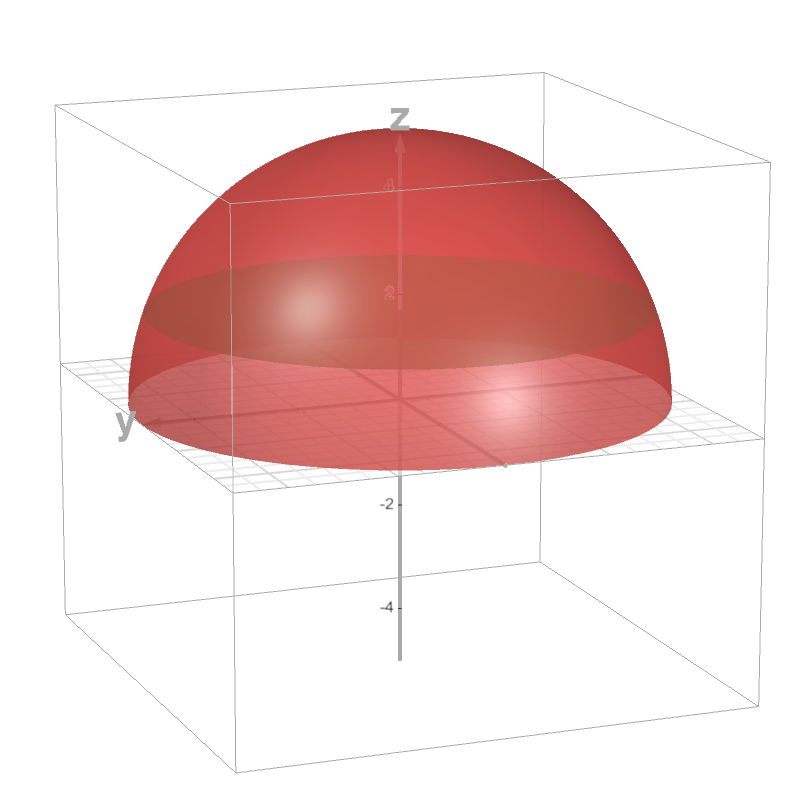
can you visualize the disks?
pliant cypress
not in three dimensions, the delta y is confusing me
i keep visualizing it with circles instead

 topaz sinewBOT
@pliant cypress Has your question been resolved?
pliant cypress
but where do they get figure 8.4 from 😭
 pallid zenith
pliant cypress
but where do they get figure 8.4 from 😭
pallid zenith
pliant cypress
but where do they get figure 8.4 from 😭
like, where is it coming from, or what is it itself?
pliant cypress
pallid zenith
like, where is it coming from, or what is it itself?
where is it coming from?
pallid zenith
pliant cypress
where is it coming from?
the "slices" here encompass dy and the inside of the hemisphere; in other words, its representing the infinitesimally small slices (which here are circles, if you take cross-sections parallel to the base) (also use your logic of hemi-"sphere") so i suppose its true derivation would be from a question, but that is all the information i can gather from the picture
pseudo horizon
figure 8.4 is a side view
the disk is just a horizontal line here. they didn't give it any thickness
pliant cypress
oh wait
and then the radius is the only thing changing
which like
okay i see
thank you
.close
topaz sinewBOT
Channel closed
Closed by @pliant cypress
Use .reopen if this was a mistake.
topaz sinewBOT
Available help channel!
Send your question here to claim the channel.
Remember:
• Ask your math question in a clear, concise manner.
• Show your work, and if possible, explain where you are stuck.
• After 15 minutes, feel free to ping <@&286206848099549185>.
• Type the command .close to free the channel when you're done.
• Be polite and have a nice day!
Read #❓how-to-get-help for further information on how to ask a good question, and about conduct in the question channels.
 pearl brook
 topaz sinewBOT
pearl brook
thorny flameBOT
topaz sinewBOT
pearl brook
thorny flameBOT
 pearl brook
Hi, i need help with 6
sinful flint
!status
topaz sinewBOT
What step are you on?
1. I don't know where to begin.
2. I have begun but got stuck midway.
3. I got an answer but I was told that it's wrong.
4. I got an answer and would like my work checked.
5. I have a question about someone else's work/solution.
6. I have completed the problem and don't need help anymore. Thank you.
7. None of the above
2
agile harness
sinful flint
!show
topaz sinewBOT
Show your work, and if possible, explain where you are stuck.
 agile harness
your work is hard to read
agile harness
14 + 4/11?
pearl brook
for what
agile harness
i was just guessing
pearl brook
ok
agile harness
did you do that in your work
pearl brook
no
agile harness
do that
agile harness
then you can start building a continued fraction
pearl brook
agile harness
then you can start building a continued fraction
what is thi
pearl brook
ok
agile harness

Start learning today, click https://brilliant.org/blackpenredpen/ to check out Brillant.org. First 200 people to sign up will get 20% off your annual premium subscription!
What Are Continued Fractions?
Continued Fractions,
Write sqrt(2) as a continued fraction, infinite simple continued fraction
☀️support bprp on Patreon: https://www.patreon...
start with $\frac{158}{11} = 14 + \frac{4}{11}$
thorny flameBOT
knief
 thorny flameBOT
knief
 pearl brook
ok
what
i just asked someone
and they said
1/11/4
no
wait
ok
they a
14
agile harness
well it was 2a right
agile harness
2a = 14
pearl brook
yes
then
they did 1 over 4/11 is equal
to b-2 over c
and they b as 3
and c as 8
and they did trail and error
agile harness
thorny flame
**knief**
yea well this way doesn’t require trial and error
pearl brook
how
agile harness
$\frac{11}{4} = 2 + \frac{3}{4}$
thorny flameBOT
knief
 agile harness
which means we have
agile harness
$14 + \frac{1}{2 + \frac{3}{4}}$
thorny flameBOT
knief
 agile harness
yea i guess
agile harness
well i was just going to match terms
agile harness
yea i was going to make $\frac{3}{4}\to \frac{2}{\frac{8}{3}}$
thorny flameBOT
knief
 agile harness
oh c needs to be an integer yea
agile harness
pearl brook
how
i just multiplied top and bottom by 2/3
pearl brook
ok'
agile harness
$14 + \frac{1}{3 - \frac{2}{8}}$
pearl brook
wait then you
what
i have to go eat
can u just right down how you got the soultion
sorry i have to go
agile harness
pearl brook
can u just right down how you got the soultion
you can just read the chats back
oh it says -2/c
ok so 2 + 3/4 = 3 - 1/4
then just write 1/4 as 2/8
done
thorny flameBOT
knief
 topaz sinewBOT
@pearl brook Has your question been resolved?
topaz sinewBOT
Channel closed
Closed by @pearl brook
Use .reopen if this was a mistake.
topaz sinewBOT
Available help channel!
Send your question here to claim the channel.
Remember:
• Ask your math question in a clear, concise manner.
• Show your work, and if possible, explain where you are stuck.
• After 15 minutes, feel free to ping <@&286206848099549185>.
• Type the command .close to free the channel when you're done.
• Be polite and have a nice day!
Read #❓how-to-get-help for further information on how to ask a good question, and about conduct in the question channels.
 manic yew
$x^2 +6x + 9 = 1$
topaz sinewBOT
manic yew
$x^2 +6x + 9 = 1$
thorny flameBOT
Simon James B
 manic yew
can someone explain how to solve this using delta? i am stuck because we have = 1 and always i had = 0 idk what to do with this 1 to we take it to the left hand side and then say = 0 ? or??
cedar wagon
don't use delta
manic yew
?
cedar wagon
whats the lhs
manic yew
x^2 +6x + 9
cedar wagon
don't you see smth about it ?
manic yew
(x+3)^2
manic yew
OH
cedar wagon
no need goofy delta
manic yew
x + 3 = 1
x = 1 - 3
x = -2
x+3 = -1
x = - 4
manic yew
cedar wagon
no need goofy delta
i am on the lesson with delta so i think it's point was to use it
cedar wagon
manic yew
i am on the lesson with delta so i think it's point was to use it
then -1 both sides
so that you have quad = 0
and use delta
manic yew
$x^2 + 6x + 9 -1 = 0$
thorny flameBOT
Simon James B
 thorny flameBOT
Simon James B
 manic yew
so delta here is = 36 - 32 = 4
cedar wagon
y
cedar wagon
wunderbar
manic yew
.close
topaz sinewBOT
Channel closed
Closed by @manic yew
Use .reopen if this was a mistake.
topaz sinewBOT
Available help channel!
Send your question here to claim the channel.
Remember:
• Ask your math question in a clear, concise manner.
• Show your work, and if possible, explain where you are stuck.
• After 15 minutes, feel free to ping <@&286206848099549185>.
• Type the command .close to free the channel when you're done.
• Be polite and have a nice day!
Read #❓how-to-get-help for further information on how to ask a good question, and about conduct in the question channels.
@quasi raft Has your question been resolved?
 quasi raft
.close
topaz sinewBOT
Channel closed
Closed by @quasi raft
Use .reopen if this was a mistake.
topaz sinewBOT
Available help channel!
Send your question here to claim the channel.
Remember:
• Ask your math question in a clear, concise manner.
• Show your work, and if possible, explain where you are stuck.
• After 15 minutes, feel free to ping <@&286206848099549185>.
• Type the command .close to free the channel when you're done.
• Be polite and have a nice day!
Read #❓how-to-get-help for further information on how to ask a good question, and about conduct in the question channels.
 forest ibex
Could someone help me here pls
 topaz sinewBOT
forest ibex
Could someone help me here pls
agile harness
topaz sinewBOT
forest ibex
Could someone help me here pls
agile harness
distribute
agile harness
🤔
 coarse herald
wont the 'x' cancel out?
agile harness
what happened to the /x
 coarse herald
yes
topaz sinewBOT
Channel closed
Closed by @forest ibex
Use .reopen if this was a mistake.
topaz sinewBOT
Available help channel!
Send your question here to claim the channel.
Remember:
• Ask your math question in a clear, concise manner.
• Show your work, and if possible, explain where you are stuck.
• After 15 minutes, feel free to ping <@&286206848099549185>.
• Type the command .close to free the channel when you're done.
• Be polite and have a nice day!
Read #❓how-to-get-help for further information on how to ask a good question, and about conduct in the question channels.
 languid tapir
limx→0 sin3x /x
topaz sinewBOT
languid tapir
limx→0 sin3x /x
 craggy haven
no, it's not the same
try to get it in the form of $\lim_{x\to0} \frac{\sin\bsq}{\bsq}$ where $\bsq$ is anything
thorny flameBOT
hayley (measurable)
 craggy haven
like you have 3x on the top, can you multiply or divide by something to get 3x on the bottom as well?
languid tapir
craggy haven
like you have 3x on the top, can you multiply or divide by something to get 3x o...
3/3
limx→0 3 * sin3x/3x
yeah I get it
thx
topaz sinewBOT
@languid tapir Has your question been resolved?
topaz sinewBOT
Channel closed
Closed due to timeout
Use .reopen if this was a mistake.
Available help channel!
Send your question here to claim the channel.
Remember:
• Ask your math question in a clear, concise manner.
• Show your work, and if possible, explain where you are stuck.
• After 15 minutes, feel free to ping <@&286206848099549185>.
• Type the command .close to free the channel when you're done.
• Be polite and have a nice day!
Read #❓how-to-get-help for further information on how to ask a good question, and about conduct in the question channels.
 hybrid pasture
I am struggling to understand exactly why their solution works, and I don't know how to prove that mine works. So basically I would like to know how I could construct a truth table for my solution to see if it matches the textbooks so I can test my logic
 topaz sinewBOT
hybrid pasture
I am struggling to understand exactly why their solution works, and I don't know...
topaz sinewBOT
hybrid pasture
I am struggling to understand exactly why their solution works, and I don't know...
 prisma mesa
hybrid pasture
I am struggling to understand exactly why their solution works, and I don't know...
prisma mesa
hybrid pasture
I am struggling to understand exactly why their solution works, and I don't know...
yours works
their says
"If (you are under 4 feet tall and you're not older than 16 years old), then you can't ride a roller coaster"
your says
"Either (if you're under 4 feet tall, you can't ride a roller coaster) or you're older than 16"
hybrid pasture
ok I have one more example to ask
if I get this one
I think I got it

for my solution (give me 1 sec to draw in paint)
 prisma mesa
okay, now this is not the same
hybrid pasture
how come?
prisma mesa
yours says that the automated reply cannot be sent exactly when the file system is full
hybrid pasture
doesn't that symbol mean iff?
prisma mesa
but there could also be kind of malfunction in the system (although it isnt necessarily full) and the reply wouldnt be said either
prisma mesa
hybrid pasture
doesn't that symbol mean iff?
yeah, it does
hybrid pasture
oh I see what you mean
my statement makes it seem like file system = full is the only way a reply cannot be sent
instead of it being just 1 of the cases
prisma mesa
"The automated reply cannot be sent when the file system is full" only tells you that if the system is full, then it cant send the reply
prisma mesa
hybrid pasture
my statement makes it seem like file system = full is the only way a reply canno...
Yep
prisma mesa
hybrid pasture
instead of it being just 1 of the cases
yeah
hybrid pasture
so then I would say if the file system is full, then* the* automated reply cannot be sent
prisma mesa
hybrid pasture
so then I would say if the file system is full, then* the* automated reply canno...
yeah, this is fine
hybrid pasture
 prisma mesa
and its the same thing as their solution, except they named the constants differently
hybrid pasture
so c -> a
prisma mesa
their -p is same as your a
hybrid pasture
gotcha
yeah I try to solve these without looking at solutions first so I usually come to something different
I think I get it a bit better now thanks
kind of hard to go from language -> logic
and vice versa
prisma mesa
Yeah, the point of that is just to make your understand logic on intuitive level
once you get some understanding, no more translations like these will be needed
you'll be able to do coherent reasoning in natural language
hybrid pasture
is this how ai works?