
#help-26
1 messages · Page 191 of 1
 glass harbor
so you derive x^2 into 2 after multiplying x^2 on the tops?
 lusty marsh
huh
glass harbor
wait but where did the 2 over x^2 go?
lusty marsh
glass harbor
wait but where did the 2 over x^2 go?
in the 5/x part u mean?
glass harbor
nono like
you have x^2(2/x^2...)
oh wait x^2 derived isn't even 2, hm
why did the x^2 and 2 flip places?
(not doubting you, just confused)
lusty marsh
glass harbor
why did the x^2 and 2 flip places?
cz a* b=b* a
so I can write 2* x=x *2
lusty marsh
glass harbor
you have x^2(2/x^2...)
the x^2 on top and bottom get cancelled out
glass harbor
that's a thing ?? @~@
 thorny flameBOT
swerriee
 glass harbor
incheresting, I would never have gotten that 😭
oki lemme attempt to write this out again
oki got it! :D Thank you <3
have a great night :D
.close
 topaz sinewBOT
Channel closed
Closed by @glass harbor
Use .reopen if this was a mistake.
topaz sinewBOT
 Available help channel!
Send your question here to claim the channel.
Remember:
• Ask your math question in a clear, concise manner.
• Show your work, and if possible, explain where you are stuck.
• After 15 minutes, feel free to ping <@&286206848099549185>.
• Type the command .close to free the channel when you're done.
• Be polite and have a nice day!
Read #❓how-to-get-help for further information on how to ask a good question, and about conduct in the question channels.
 terse lotus
Snagging this channel to ask a more general version of the question I asked in #help-27 . When calculating an eigenvector, for example - for the matrx ([-7,-7],[-5,-5]), you end up with something like -7a -7b = 0. You can choose an eigenvector as (1,-1), and I get that - but why not (2,-2)? And is that equivalent? When you're doing calculations with that eigenvector, how does the scaling work?
topaz sinewBOT
terse lotus
Snagging this channel to ask a more general version of the question I asked in <...
Please don't occupy multiple help channels.
terse lotus
🫠
topaz sinewBOT
@terse lotus Has your question been resolved?
glass harbor
terse lotus
🫠
Hi :D I would close both channels and start anew in a new one, it's a lot more likely to get a response in my experience
topaz sinewBOT
Channel closed
Closed by @terse lotus
Use .reopen if this was a mistake.
topaz sinewBOT
Available help channel!
Send your question here to claim the channel.
Remember:
• Ask your math question in a clear, concise manner.
• Show your work, and if possible, explain where you are stuck.
• After 15 minutes, feel free to ping <@&286206848099549185>.
• Type the command .close to free the channel when you're done.
• Be polite and have a nice day!
Read #❓how-to-get-help for further information on how to ask a good question, and about conduct in the question channels.
 urban gust
Can someone help me with finding the increasing and decreasing intervals
topaz sinewBOT
urban gust
Can someone help me with finding the increasing and decreasing intervals
Please don't occupy multiple help channels.
urban gust

 sharp vigil
Hello
urban gust
Hi
sharp vigil
First calculate those points
When the function is going down
It's decreasing
When function going up It's increasing
urban gust
Yes
sharp vigil
Just state the regions in which these things are happening
That's it right?
What else is their to know
urban gust
(+ inf, -7)?
sharp vigil
Nope
You see
The function is decreasing even after that

From x belongs to - infinity to 0
It's decreasing
The interval is of x
Not y
Then from x = 0 to 8/3 it's increasing
Then from x=8/3 to infinty
It's decreasing again
You can do the same for the last question
Hope this helped
urban gust
Ty
urban gust
sharp vigil
Hope this helped
Would it be decreasing: (+inf, -7), (8/3, -inf) and increasing is (-7, 8/3)
topaz sinewBOT
@urban gust Has your question been resolved?
Channel closed
Closed by @urban gust
Use .reopen if this was a mistake.
Available help channel!
Send your question here to claim the channel.
Remember:
• Ask your math question in a clear, concise manner.
• Show your work, and if possible, explain where you are stuck.
• After 15 minutes, feel free to ping <@&286206848099549185>.
• Type the command .close to free the channel when you're done.
• Be polite and have a nice day!
Read #❓how-to-get-help for further information on how to ask a good question, and about conduct in the question channels.
Channel closed
Channel closed due to the original message being deleted.
If you did not intend to do this, please open a new help channel,
as this action is irreversible, and this channel may abruptly lock.
Available help channel!
Send your question here to claim the channel.
Remember:
• Ask your math question in a clear, concise manner.
• Show your work, and if possible, explain where you are stuck.
• After 15 minutes, feel free to ping <@&286206848099549185>.
• Type the command .close to free the channel when you're done.
• Be polite and have a nice day!
Read #❓how-to-get-help for further information on how to ask a good question, and about conduct in the question channels.
 little pond
But if the x^2 - x case directly implied that x is an integer already, then what would the point have been of them telling you that x^n - x is also an integer?
topaz sinewBOT
little pond
But if the x^2 - x case directly implied that x is an integer already, then what...
@little pond Has your question been resolved?
Channel closed
Closed by @little pond
Use .reopen if this was a mistake.
little pond
.reopen
topaz sinewBOT
✅
little pond
Here’s what I have so far:
if $x^2 - x = k$, and k is an integer, then $x = \frac{1 \pm \sqrt{1 + 4k}}{2}$
That means that the fact that $x^n - x$ is an integer must imply that $1 + 4k$ is a perfect square, but that’s where I got stuck. How can I show that? I tried doing it out for n = 3 and n = 4, where I realised that the factorisation is $x(x-1)$(some other stuff), and since $x(x-1)$ is an integer, the rest of the stuff must be an integer too, but I wasn’t able to prove that - it’s definitely not true for n = 3 or n = 4, but I’m not sure how to deal with the n in the power.
 thorny flameBOT
Fear na bPónairí

 keen plinth
I would recommend prove by contrapositive, if x is not an integer, then for all $n\ge 3$, $x^n-x$ is not integer
thorny flameBOT
ManMan
 topaz sinewBOT
@little pond Has your question been resolved?
little pond
keen plinth
I would recommend prove by contrapositive, if x is not an integer, then for all ...
But what about x^2 - x?
keen plinth
similarly, x^2-x is not integer either
topaz sinewBOT
@little pond Has your question been resolved?
little pond
keen plinth
similarly, x^2-x is not integer either
I’ll give that a go after, but I wanna try to finish my first idea if possible
topaz sinewBOT
@little pond Has your question been resolved?
topaz sinewBOT
@little pond Has your question been resolved?
 jaunty leaf
thorny flame
**Fear na bPónairí**
jaunty leaf
thorny flame
**Fear na bPónairí**
Thing is, since $x(x-1)$ is integer and $x(x-1)$(some other stuff) is integer, we conclude that (some other stuff) is rational. On the other hand, (some other stuff) = $x^{n-2} - x^{n-3} + ... \pm 1$. Substitute $\frac{1\pm\sqrt{1+4k}}{2}$ here and you'll get (something rational) + (something rational)$\sqrt{1+4k} \in \mathbb{Q}$, which implies that $\sqrt{1+4k} \in \mathbb{Q}$ for some integer $k$. Hence $\sqrt{1+4k} \in \mathbb{Z}$ and notably it's odd. Now it's not hard to see that $x$ is integer
thorny flameBOT
EQUENOS
 topaz sinewBOT
@little pond Has your question been resolved?
little pond
jaunty leaf
Thing is, since $x(x-1)$ is integer and $x(x-1)$(some other stuff) is integer, w...
Is it formal enough to say “substitute and you’ll see…”? Because of course you can’t really sub it in because of the powers of n
jaunty leaf
little pond
Is it formal enough to say “substitute and you’ll see…”? Because of course you c...
You should prove that the coefficient of sqrt(1+4k) is not zero
little pond
How can I do that when there are possibly infinitely many terms?
And it didn’t specify that n is an integer so technically this might not prove it, so how do I get aroun that?
jaunty leaf
little pond
And it didn’t specify that n is an integer so technically this might not prove i...
n is definitely an integer. Otherwise the statement isn't true
For example consider x = (1+sqrt(5))/2. Then x^2 - x = 1, and we can find some n >= 3 such that x^n - x is also an integer
Solve x^n - x = 4 relative to n. It yields n = ln(x + 4)/ln(x) ≈ 3.587
jaunty leaf
little pond
How can I do that when there are possibly infinitely many terms?
The number of terms is finite but yes, n is arbitrary. But that doesn't mean that the task is impossible
Oh, and actually I was mistaken and that long sum should've been
$$x^{n-2} + x^{n-3} + ... + 1$$
thorny flameBOT
EQUENOS
 jaunty leaf
Actually I think it's better to express it as $\frac{x^{n-1}-1}{x-1}$
thorny flameBOT
EQUENOS
 jaunty leaf
Good luck
little pond
jaunty leaf
Actually I think it's better to express it as $\frac{x^{n-1}-1}{x-1}$
So you’re saying if I sub my expression for x into here, I should be able to deduce that x is an integer? (Or in other words, 1 + 4n is a perfect square?)
Since the other part is also an integer?
jaunty leaf
little pond
So you’re saying if I sub my expression for x into here, I should be able to ded...
Yes, but again, only if you prove that the coefficient of sqrt(1+4k) is not zero
little pond
jaunty leaf
Yes, but again, only if you prove that the coefficient of sqrt(1+4k) is not zero
It’s pretty late for me rn, so I’ll probably just try it tomorrow, but would you mind if I shoot you a DM if I have any problems? Just so I can close this channel
jaunty leaf
little pond
It’s pretty late for me rn, so I’ll probably just try it tomorrow, but would you...
Yes, of course. Feel free to DM
topaz sinewBOT
@little pond Has your question been resolved?
topaz sinewBOT
Channel closed
Closed by @little pond
Use .reopen if this was a mistake.
topaz sinewBOT
Available help channel!
Send your question here to claim the channel.
Remember:
• Ask your math question in a clear, concise manner.
• Show your work, and if possible, explain where you are stuck.
• After 15 minutes, feel free to ping <@&286206848099549185>.
• Type the command .close to free the channel when you're done.
• Be polite and have a nice day!
Read #❓how-to-get-help for further information on how to ask a good question, and about conduct in the question channels.
 robust stone
 topaz sinewBOT
robust stone
robust stone
topaz sinewBOT
robust stone
robust stone
im just stuck on how they got x=cot5y (this is the mark scheme)

oh wait no lol i got it
.close
topaz sinewBOT
Channel closed
Closed by @robust stone
Use .reopen if this was a mistake.
topaz sinewBOT
Available help channel!
Send your question here to claim the channel.
Remember:
• Ask your math question in a clear, concise manner.
• Show your work, and if possible, explain where you are stuck.
• After 15 minutes, feel free to ping <@&286206848099549185>.
• Type the command .close to free the channel when you're done.
• Be polite and have a nice day!
Read #❓how-to-get-help for further information on how to ask a good question, and about conduct in the question channels.
 coral fog
If I have E[X^2] is there a way to find E[X^4] quickly?
without doing integrals all over again
topaz sinewBOT
coral fog
If I have E[X^2] is there a way to find E[X^4] quickly?
without doing integrals ...
 pearl peak
Depends on the integral but in general I don’t think so


 ionic oar
I mean
you could do the
Expectation version of the formula
[ \text{Var} (X^2) = E(X^2)^2 - E(X^4) ]
thorny flameBOT
neon
 ionic oar
and those are pretty simple to solve with an integral
coral fog
if there is a shorter way to find E[X^4]
thorny flameBOT
neon
 ionic oar
do you know about this?
ionic oar
you can prove it pretty easily with integration by parts
ionic oar
coral fog
Is this calc 4?
ehh idk not really
coral fog
I mean It's a probability course
ionic oar
thorny flame
**neon**
it's fairly easy to prove
coral fog
I don't think they'll ask for proofs about integrals
ionic oar
yeah alright
coral fog
thanks 🙂
coral fog
I don't think so
ionic oar
okay no problem then
ionic oar
thorny flame
**neon**
this is useful to remember though
it will be of use to you here for instance
thorny flameBOT
neon
 ionic oar
wdym by "split"
ionic oar
x/4 = u
thorny flameBOT
neon
 ionic oar
do you understand this?
ionic oar
so that integral is just 4!
coral fog
correct
ionic oar
,calc 4^4*4!
thorny flameBOT
Result:
6144
there you go
coral fog
ty
topaz sinewBOT
@coral fog Has your question been resolved?
Channel closed
Closed by @coral fog
Use .reopen if this was a mistake.
topaz sinewBOT
Available help channel!
Send your question here to claim the channel.
Remember:
• Ask your math question in a clear, concise manner.
• Show your work, and if possible, explain where you are stuck.
• After 15 minutes, feel free to ping <@&286206848099549185>.
• Type the command .close to free the channel when you're done.
• Be polite and have a nice day!
Read #❓how-to-get-help for further information on how to ask a good question, and about conduct in the question channels.
 distant totem
If i understood correct, f'(x) is the growth factor of a given point x when delta x goes towards 0, but at the same time is f'(x) the slope of the tangent?
topaz sinewBOT
distant totem
If i understood correct, f'(x) is the growth factor of a given point x when delt...
 shut night
f'(x) is the growth of the function f(x) at a given x. the tangent is the same thing
distant totem
so what really is the difference then between a tangent and secant
 fading owl
there is no secant in a graph
shut night
secant is the line through two points, and when you move the second point really close to the first one it becomes the tangent is probably the best intuition
distant totem
so a secant is basically something we can draw to help us find the slope of a tangent?
 neon iron
distant totem
If i understood correct, f'(x) is the growth factor of a given point x when delt...
neon iron
distant totem
If i understood correct, f'(x) is the growth factor of a given point x when delt...
Yeah pretty much
shut night
well
neon iron
Formally the derivative of a function is defined as the instantaneous rate of change
At a point
shut night
if you find the slope of the secant it gives you the average rate of change
and from that the idea is, but what if i want to know the rate of change at a given point
but if i tried to divide y_1-y_0 / (x_1 - x_0)
and i took some point
i would be dividing by 0 and thats not possible
distant totem
so when the question asks "Find the momentary growth factor when x=2". They're really asking for what the slope of the tanget is when x=a, and we can draw a secant through 2 points to find the average rate of change by doing a = f(x2) - f(x1) / delta x
shut night
so the idea is we move the second point really close to the first point
Yes and no
you want the rate of change at x=2
if you took a second point f(a) really far away from the first point
youd get the average between the two points, but thats not the rate of change at the first point
So you take the limit as a gets really close to x
which is the derivative of x or the tangent
neon iron
3Blue1Brown has an amazing video on what @shut night with a visualisation
https://youtu.be/9vKqVkMQHKk?si=-n-gaTfX9PUOkGwK
do check it out if you wish

What is an "instantaneous rate of change" when change happens across time?
Help fund future projects: https://www.patreon.com/3blue1brown
This video was supported in part by Art of Problem Solving: https://aops.com/3blue1brown
An equally valuable form of support is to simply share some of the videos.
Special thanks to these supporters: http://3b...
distant totem
Ah alright, so to summarize a bit.
We can use the equation for f'(x) to find the rate of change at a given point x = a, when lim delta x -> 0. However, we can also find the rate of change of a secant by basically drawing it through 2 points in the graph and use delta y / delta x
distant totem
neon iron
3Blue1Brown has an amazing video on what <@523189697971879940> with a visualisat...
I'll definitely check it out, thanks!
shut night
Yeah just remember the secant is the average rate of change between two points, and the tangent is the rate of change at a given point
distant totem
Yeah alright, thank you so much! Looked really like they were the same in the book, but I'll watch the video to maybe make it easier by visualizing it 🙂
fading owl
neon iron
3Blue1Brown has an amazing video on what <@523189697971879940> with a visualisat...
we concur on what we watch
3b1b is an amazing channel
shut night
But the idea is you take a secant and move the second point reallllyyyy close to the first one (the limit) and then two points super close to each other must have the slope of the given point!
distant totem
I usually watch, the Chemistry Tutor as he also explains physics
neon iron
fading owl
3b1b is an amazing channel
Agreed. This legend literally made an open source programme (which a lot of other maths channels use as well) for creating his maths animations
Grant Sanderson is really god tier
neon iron
distant totem
I usually watch, the Chemistry Tutor as he also explains physics
Yeah he’s amazing as well
fading owl
five awards
distant totem
.close
topaz sinewBOT
Channel closed
Closed by @distant totem
Use .reopen if this was a mistake.
topaz sinewBOT
Available help channel!
Send your question here to claim the channel.
Remember:
• Ask your math question in a clear, concise manner.
• Show your work, and if possible, explain where you are stuck.
• After 15 minutes, feel free to ping <@&286206848099549185>.
• Type the command .close to free the channel when you're done.
• Be polite and have a nice day!
Read #❓how-to-get-help for further information on how to ask a good question, and about conduct in the question channels.
 rare atlas
'
 topaz sinewBOT
rare atlas
'
topaz sinewBOT
rare atlas
'
 opal vault
rare atlas
'
opal vault
rare atlas
'
!status
topaz sinewBOT
rare atlas
'
What step are you on?
1. I don't know where to begin.
2. I have begun but got stuck midway.
3. I got an answer but I was told that it's wrong.
4. I got an answer and would like my work checked.
5. I have a question about someone else's work/solution.
6. I have completed the problem and don't need help anymore. Thank you.
7. None of the above
2
topaz sinewBOT
Show your work, and if possible, explain where you are stuck.
rare atlas
when taking derivative , there is always one that does not change, (x-1)^2024
and there is one at the final 2024! but i can not find the middle one
opal vault
did you use leibniz formula of derivation?
rare atlas
dont know what is that
opal vault
f = g*h, all of which being functions
$f^{(n)}(x) = \sum_{k=0}^n \binom{n}{k}g^{(k)}(x)h^{(n-k)}(x)$
thorny flameBOT
rafilou is not not born in 2003
 opal vault
you should, it helps a lot
rare atlas
ok ty
with this formula, I find answer 0?
is it correct?
@opal vault ?
@fair thorn ?
<@&286206848099549185>
 somber geyser
hai
rare atlas
rare atlas
with this formula, I find answer 0?
.
guys, help please
<@&286206848099549185>
 glad folio
<@&286206848099549185>
 fair thorn
@glad folio
why tf are you pinging helpers
a. in someone else's channel
b. within 2 minutes of the last ping
topaz sinewBOT
Please only use the <@&286206848099549185> ping once if your question has not been answered for 15 minutes. Please do not ping or DM individual users about your question.
rare atlas
fair thorn
show your work
I said g(x)= x-1
h(x)= x+1
and used the formula given
it givess 0
fair thorn
show how you used it, maybe?
rare atlas
.close
topaz sinewBOT
Channel closed
Closed by @rare atlas
Use .reopen if this was a mistake.
opal vault
rare atlas
it givess 0
incorrect answer
rare atlas
why
topaz sinewBOT
Available help channel!
Send your question here to claim the channel.
Remember:
• Ask your math question in a clear, concise manner.
• Show your work, and if possible, explain where you are stuck.
• After 15 minutes, feel free to ping <@&286206848099549185>.
• Type the command .close to free the channel when you're done.
• Be polite and have a nice day!
Read #❓how-to-get-help for further information on how to ask a good question, and about conduct in the question channels.
 vapid seal
For question f are they orthonormal?
 topaz sinewBOT
vapid seal
For question f are they orthonormal?
vapid seal
topaz sinewBOT
vapid seal
For question f are they orthonormal?
vapid seal
I found the dot product of the first vector and second = 0.000448
 vernal vale
bad sign
vapid seal
vernal vale
bad sign
Shouldn't we find if they are perpendicular?
vernal vale
yea they have to be an orthogonal set before they can be orthonormal for sure
vapid seal
vapid seal
For question f are they orthonormal?
The books says they are orthonormal, but I don't understand how
 eager compass
vapid seal
Shouldn't we find if they are perpendicular?
eager compass
vapid seal
Shouldn't we find if they are perpendicular?
orthonormal means each vector has length 1 and is orthogonal to each other
vapid seal
eager compass
orthonormal means each vector has length 1 and is orthogonal to each other
If the dot product was close to 0 can we say that they are perpendicular?
eager compass
vapid seal
If the dot product was close to 0 can we say that they are perpendicular?
no
for which one did you found 0.000448?
vernal vale
,w Dot[{0.921, 0.294, -0.254}, {-0.254, 0.951, 0.178}]
thorny flameBOT


 vernal vale
not orthogonal
eager compass
close to 0 is not 0
topaz sinewBOT
Channel closed
Closed by @vapid seal
Use .reopen if this was a mistake.
Available help channel!
Send your question here to claim the channel.
Remember:
• Ask your math question in a clear, concise manner.
• Show your work, and if possible, explain where you are stuck.
• After 15 minutes, feel free to ping <@&286206848099549185>.
• Type the command .close to free the channel when you're done.
• Be polite and have a nice day!
Read #❓how-to-get-help for further information on how to ask a good question, and about conduct in the question channels.
 mossy nest
 topaz sinewBOT
mossy nest
mossy nest
topaz sinewBOT
mossy nest
mossy nest
can someone help me with my homework?
this is my solution but im not 100% sure
also not sure with the derivatives
topaz sinewBOT
@mossy nest Has your question been resolved?
topaz sinewBOT
@mossy nest Has your question been resolved?
topaz sinewBOT
@mossy nest Has your question been resolved?
topaz sinewBOT
@mossy nest Has your question been resolved?
 stark crater
<@&286206848099549185>
topaz sinewBOT
@mossy nest Has your question been resolved?
topaz sinewBOT
Channel closed
Closed due to timeout
Use .reopen if this was a mistake.
Available help channel!
Send your question here to claim the channel.
Remember:
• Ask your math question in a clear, concise manner.
• Show your work, and if possible, explain where you are stuck.
• After 15 minutes, feel free to ping <@&286206848099549185>.
• Type the command .close to free the channel when you're done.
• Be polite and have a nice day!
Read #❓how-to-get-help for further information on how to ask a good question, and about conduct in the question channels.
 merry bridge
I'm supposed to find the derivative of this parametric equation, and I did. (sin(t)(2cos(t)-1))/(cos(t)-cos(2t))
But I'm supposed to simplify it further using the double angle identities. The problem is, when I do, I get left with a really ugly expression, and my prof said it's supposed to look "better"?
 topaz sinewBOT
merry bridge
I'm supposed to find the derivative of this parametric equation, and I did. (sin...
merry bridge
topaz sinewBOT
merry bridge
I'm supposed to find the derivative of this parametric equation, and I did. (sin...
merry bridge
I simplified it to (sin(t)(2cos(t)-1))/((-2cos(t)-1)(cos(t)-1))
let me actually put this into neat formatting because it's unreadable inline
 agile harness
$\frac{dy}{dx} = \frac{-2\sin(t) + 2\sin(2t)}{2\cos(t) - 2\cos(2t)}$
thorny flameBOT
knief

 merry bridge
right and I did lol but this isn't neat
 agile harness
merry bridge
right and I did lol but this isn't neat
agile harness
merry bridge
right and I did lol but this isn't neat
is this your answer
merry bridge
he said that there's a way to simplify it further
agile harness
merry bridge
he said that there's a way to simplify it further
and what have you tried for that
if it helps, think of cos(t) as x
or u
u - 2u^2 + 1
merry bridge

we're not supposed to use half angle identity so I can't make it cot(3t/2)
i see no other way to simplify it
agile harness
merry bridge
we're not supposed to use half angle identity so I can't make it cot(3t/2)
how did he want it then?
merry bridge
that's the issue, he didn't really specify lol. We're supposed to take the limit for when t approaches 0, but like
im not sure how to take the limit of it if it weren't in this quotient form... so i guess this is the best i can do lol
nvm, sorry for wasting your time lol
agile harness
all good
topaz sinewBOT
Channel closed
Closed by @merry bridge
Use .reopen if this was a mistake.
topaz sinewBOT
Available help channel!
Send your question here to claim the channel.
Remember:
• Ask your math question in a clear, concise manner.
• Show your work, and if possible, explain where you are stuck.
• After 15 minutes, feel free to ping <@&286206848099549185>.
• Type the command .close to free the channel when you're done.
• Be polite and have a nice day!
Read #❓how-to-get-help for further information on how to ask a good question, and about conduct in the question channels.
 royal sky
why does the line here must be a homogenous equation
 topaz sinewBOT
royal sky
why does the line here must be a homogenous equation
topaz sinewBOT
royal sky
why does the line here must be a homogenous equation
 sweet shard
royal sky
why does the line here must be a homogenous equation
sweet shard
royal sky
why does the line here must be a homogenous equation
As opposed to what?
royal sky
sweet shard
As opposed to what?
just that, like why cant the line be (x,y) vector here why does it have to be a homogenous equation
sweet shard
so you mean c=0?
royal sky
sweet shard
so you mean c=0?
no like ax+by+c=0
topaz sinewBOT
@royal sky Has your question been resolved?
topaz sinewBOT
Channel closed
Closed due to timeout
Use .reopen if this was a mistake.
topaz sinewBOT
Available help channel!
Send your question here to claim the channel.
Remember:
• Ask your math question in a clear, concise manner.
• Show your work, and if possible, explain where you are stuck.
• After 15 minutes, feel free to ping <@&286206848099549185>.
• Type the command .close to free the channel when you're done.
• Be polite and have a nice day!
Read #❓how-to-get-help for further information on how to ask a good question, and about conduct in the question channels.
neon iron
 neon iron
<@&286206848099549185>
 thorny remnant
!15mins
topaz sinewBOT
Please only use the <@&286206848099549185> ping once if your question has not been answered for 15 minutes. Please do not ping or DM individual users about your question.
neon iron
Yeah
 smoky sparrow
neon iron
Then the answer is 50
smoky sparrow
neon iron
Then the answer is 50
yep!
topaz sinewBOT
Channel closed
Closed by @final anvil
Use .reopen if this was a mistake.
topaz sinewBOT
Available help channel!
Send your question here to claim the channel.
Remember:
• Ask your math question in a clear, concise manner.
• Show your work, and if possible, explain where you are stuck.
• After 15 minutes, feel free to ping <@&286206848099549185>.
• Type the command .close to free the channel when you're done.
• Be polite and have a nice day!
Read #❓how-to-get-help for further information on how to ask a good question, and about conduct in the question channels.
 forest plank
Someone please explain this statement in the solution

 alpine dirge
forest plank
Someone please explain this statement in the solution
alpine dirge
forest plank
Someone please explain this statement in the solution
which book is it? i really like these questions
 crimson wasp
forest plank
Someone please explain this statement in the solution
crimson wasp
forest plank
Someone please explain this statement in the solution
u live in India
smoky sparrow
forest plank
Someone please explain this statement in the solution
suppose that g is not 1-to-1, that there exist natural a, b such that g(a) = g(b)
then f(g(a)) = f(g(b)) so that would imply that h(n) = n is also not 1-to-1
forest plank
 alpine dirge
forest plank
alpine dirge
forest plank
thankss
smoky sparrow
f must be surjective also, shouldn't be too hard to see what happens if f is not surjective
forest plank
smoky sparrow
suppose that g is not 1-to-1, that there exist natural a, b such that g(a) = g(b...
Oooooh got it
Thanks
crimson wasp
forest plank
Oooooh got it
where u live
smoky sparrow
no worries!
forest plank
.close
topaz sinewBOT
Channel closed
Closed by @forest plank
Use .reopen if this was a mistake.
crimson wasp
i livw in india too
forest plank
smoky sparrow
f must be surjective also, shouldn't be too hard to see what happens if f is not...
F is surjective because g is surjective correct?
smoky sparrow
forest plank
F is surjective because g is surjective correct?
g doesn't actually need to be surjective
forest plank
.reopen
topaz sinewBOT
✅
smoky sparrow
wait
yeah you could have f(x) = tan(x) but g(x) = x for -pi/2 < x < pi/2
for instance
 obtuse garden
forest plank
obtuse garden
forest plank
writing rmo tomorrow?
forest plank
smoky sparrow
yeah you could have f(x) = tan(x) but g(x) = x for -pi/2 < x < pi/2
This ones a polynomial tho
forest plank
obtuse garden
writing rmo tomorrow?
Ya
smoky sparrow
forest plank
This ones a polynomial tho
it doesn't matter
we just need to find what conditions $f \circ g$ being 1-to-1 imposes on $f, g$
thorny flameBOT
south's secret twin brother
 smoky sparrow
also tan x is not a polynomial but
obtuse garden
forest plank
Ya
ooh noice which grade
smoky sparrow
thorny flame
**south's secret twin brother**
and this is abstract I know
forest plank
ya
forest plank
obtuse garden
ooh noice which grade
message me in dm i dont want to clutter this chat
forest plank
smoky sparrow
suppose that g is not 1-to-1, that there exist natural a, b such that g(a) = g(b...
since f o g of n = n is injective, g(n) is also injective, but how do we know that f is onto?
smoky sparrow
forest plank
since f o g of n = n is injective, g(n) is also injective, but how do we know th...
well if f is not onto, then there must be some k such that f(n) = k has no solutions
so n can be anything, and g(n) can be anything, so we can just replace $n \mapsto g(n)$
thorny flameBOT
south's secret twin brother
 forest plank
right got it
and since g(n) = f(n) + 2, that means that f is also injective and g is also surjective correct?
ok final question
what does it mean that f and g are inverse of each other
nvm got that too. becuase f returns the preimage of n on g right?
thanks
.close
topaz sinewBOT
Channel closed
Closed by @forest plank
Use .reopen if this was a mistake.
Available help channel!
Send your question here to claim the channel.
Remember:
• Ask your math question in a clear, concise manner.
• Show your work, and if possible, explain where you are stuck.
• After 15 minutes, feel free to ping <@&286206848099549185>.
• Type the command .close to free the channel when you're done.
• Be polite and have a nice day!
Read #❓how-to-get-help for further information on how to ask a good question, and about conduct in the question channels.
topaz sinewBOT
 cedar spindle
Solve for x, y
x/4 = y/5 and x + y = 54
cedar spindle
cedar spindle
Solve for x, y
x/4 = y/5 and x + y = 54
cedar spindle
i know the answer but dunno how to solve 😔
<@&286206848099549185>
nobody replies?
ig imma close
.close
topaz sinewBOT
Channel closed
Closed by @cedar spindle
Use .reopen if this was a mistake.
 regal cave
hey
do you still need help
@cedar spindle
so you can write it as 5x = 4y
and then you can solve it via substitution
x = 4y/5
4y/5 + y = 54
9y/5 = 54
9y = 260
y = 260/9
and then you can solve for x
topaz sinewBOT
Available help channel!
Send your question here to claim the channel.
Remember:
• Ask your math question in a clear, concise manner.
• Show your work, and if possible, explain where you are stuck.
• After 15 minutes, feel free to ping <@&286206848099549185>.
• Type the command .close to free the channel when you're done.
• Be polite and have a nice day!
Read #❓how-to-get-help for further information on how to ask a good question, and about conduct in the question channels.
 broken stone
If you’re dividing 1/2x^2 by 1/2x, wouldn’t it be 1/4x instead of x? Watching a tutorial and apparently it’s x - 12, not 1/4x - 12
 topaz sinewBOT
broken stone
If you’re dividing 1/2x^2 by 1/2x, wouldn’t it be 1/4x instead of x? Watching a ...
topaz sinewBOT
broken stone
If you’re dividing 1/2x^2 by 1/2x, wouldn’t it be 1/4x instead of x? Watching a ...
 heady bay
Two ships leave from the same port. One ship travels on a bearing of 157° at 20 knots. The second ship travels on a bearing of 247° at 35 knots. (1 knot is a speed of 1 nautical mile per hour).
a. How far apart are the ships after 8 hours?
b. Calculate the bearing of the second ship from the first?
I cant answer question b
<@&286206848099549185>
neon iron
! occupied
topaz sinewBOT
Someone else is already using this help channel. If you need help with a question, please open your own help channel/thread (see #❓how-to-get-help for instructions).
@broken stone Has your question been resolved?
broken stone
broken stone
If you’re dividing 1/2x^2 by 1/2x, wouldn’t it be 1/4x instead of x? Watching a ...
^
 worn trout
broken stone
If you’re dividing 1/2x^2 by 1/2x, wouldn’t it be 1/4x instead of x? Watching a ...
worn trout
broken stone
If you’re dividing 1/2x^2 by 1/2x, wouldn’t it be 1/4x instead of x? Watching a ...
how did 5x become 6x on the second line?
oh nvm im blind
worn trout
broken stone
If you’re dividing 1/2x^2 by 1/2x, wouldn’t it be 1/4x instead of x? Watching a ...
so ur asking what happens if you divide x^2/2 by x/2? or 1/2*x^2 by 1/2**x
broken stone
worn trout
so ur asking what happens if you divide x^2/2 by x/2? or 1/2*x^2 by 1/2**x
Id guess the 2nd, I’m dividing everything in the 2nd line (except 0) by the GCF, which is 1/2x
 worn trout
broken stone
Id guess the 2nd, I’m dividing everything in the 2nd line (except 0) by the GCF,...
worn trout
broken stone
Id guess the 2nd, I’m dividing everything in the 2nd line (except 0) by the GCF,...
Yes and u did it correctly, I don't see the problem here
broken stone
worn trout
Yes and u did it correctly, I don't see the problem here
My original answer was 1/4x - 3, I just corrected it according to a video guide
worn trout
okay so (1/2)*x^2 divided by (1/2)x is just x
Its pretty clear to see
this is mad confusing, let me work it out and ill send a pic
broken stone
worn trout
okay so (1/2)*x^2 divided by (1/2)x is just x
Subbed in 2 for x and see it now, just saw dividing half by a half and thought “half of half is a 4th”
 topaz sinewBOT
@broken stone Has your question been resolved?
topaz sinewBOT
Channel closed
Closed due to timeout
Use .reopen if this was a mistake.
Available help channel!
Send your question here to claim the channel.
Remember:
• Ask your math question in a clear, concise manner.
• Show your work, and if possible, explain where you are stuck.
• After 15 minutes, feel free to ping <@&286206848099549185>.
• Type the command .close to free the channel when you're done.
• Be polite and have a nice day!
Read #❓how-to-get-help for further information on how to ask a good question, and about conduct in the question channels.
 lusty cedar
 topaz sinewBOT
lusty cedar
lusty cedar
topaz sinewBOT
lusty cedar
lusty cedar
Im so lost here
I got it wrong
for 6b
I used the addition formula
to get 5 root 3/2 cos x - 5/2 sinx = 4/5 sinx
and then just solve from there
Idk why its wrong
😭
eager compass
Can you show us your work?
 subtle dust
lusty cedar
😭
subtle dust
lusty cedar
😭
solve cos(x-30) further
agile harness
lusty cedar
to get 5 root 3/2 cos x - 5/2 sinx = 4/5 sinx
subtle dust
lusty cedar
to get 5 root 3/2 cos x - 5/2 sinx = 4/5 sinx
yo mb didint notice u opened it
but anyways
u opened it wrong
agile harness
$\cos(u-v) = \cos(u)\cos(v) + \sin(u)\sin(v)$
thorny flameBOT
knief
 lusty cedar
no because sin (-30) returns -1/2
lusty cedar
wait what
agile harness
brother
agile harness
thorny flame
**knief**
^
agile harness
lusty cedar
no because sin (-30) returns -1/2
the audacity lol
agile harness
you’re welcome
lusty cedar
.close
topaz sinewBOT
Channel closed
Closed by @lusty cedar
Use .reopen if this was a mistake.
Available help channel!
Send your question here to claim the channel.
Remember:
• Ask your math question in a clear, concise manner.
• Show your work, and if possible, explain where you are stuck.
• After 15 minutes, feel free to ping <@&286206848099549185>.
• Type the command .close to free the channel when you're done.
• Be polite and have a nice day!
Read #❓how-to-get-help for further information on how to ask a good question, and about conduct in the question channels.
 faint otter
how is this wrong
 topaz sinewBOT
faint otter
how is this wrong
topaz sinewBOT
faint otter
how is this wrong
 neon venture
faint otter
how is this wrong
neon venture
faint otter
how is this wrong
huh (-2, oo) should be enough tho
 loud oasis
faint otter
how is this wrong
loud oasis
faint otter
how is this wrong
i think you can combine your answers for the increasing part
faint otter
yeah i think im a bit slow
i didnt even notice i could combine them 😭 thank u guys
.close
topaz sinewBOT
Channel closed
Closed by @faint otter
Use .reopen if this was a mistake.
topaz sinewBOT
Available help channel!
Send your question here to claim the channel.
Remember:
• Ask your math question in a clear, concise manner.
• Show your work, and if possible, explain where you are stuck.
• After 15 minutes, feel free to ping <@&286206848099549185>.
• Type the command .close to free the channel when you're done.
• Be polite and have a nice day!
Read #❓how-to-get-help for further information on how to ask a good question, and about conduct in the question channels.
 iron blaze
If xy is a perfect square
topaz sinewBOT
iron blaze
If xy is a perfect square
iron blaze
and yz is a perfect square
prove that xz is a perfect square
So what i figured
is let xy = i^2
yz = j^2
therefore xy^2z = i^2j^2
and xz = i^2*j^2/y^2
so I have to prove that i * j /y is an integer
so if y is a prime number
than this is obvious
however if y is a composite number, how do i go about proving this?
yo
 outer salmon
iron blaze
and xz = i^2*j^2/y^2
outer salmon
iron blaze
and xz = i^2*j^2/y^2
Since the square root of any natural number that is not a perfect square is irrational, xz must be a perfect square here
iron blaze
Oh i get it
outer salmon
(Assuming x and y are natural numbers?)
iron blaze
ya and xz isnt a fraction
its an integer
yes
x y and z are
natural numbers
not integers
natural numbers
ya
aight thanks
.close
topaz sinewBOT
Channel closed
Closed by @iron blaze
Use .reopen if this was a mistake.
topaz sinewBOT
Available help channel!
Send your question here to claim the channel.
Remember:
• Ask your math question in a clear, concise manner.
• Show your work, and if possible, explain where you are stuck.
• After 15 minutes, feel free to ping <@&286206848099549185>.
• Type the command .close to free the channel when you're done.
• Be polite and have a nice day!
Read #❓how-to-get-help for further information on how to ask a good question, and about conduct in the question channels.
 copper fossil
can someone explain what is going on in this problem lol
 copper fossil
This section is taking forever and the solutions given skip tons of steps
Specifically the part where it says "From the volume equation. h = ..."
Why is there a 4 in the numerator all of the sudden? don't I plug r and V into h to find h?
Here's the full problem:

I've already spent way more time on this than I can afford so I need to move on
topaz sinewBOT
@copper fossil Has your question been resolved?
 acoustic pecan
C=2pi r h + 2pi r^2
V=pi r^2 h + 2/3 pi r^3
V/(pi r^2)=h+2/3 r, h=V/(pi r^2) - 2r/3)
C=2pi r[V/(pi r^2) - 2r/3]+2pi r^2 = 2V/r - 4/3 pi r^2 +2pi r^2 = 2V/r +8/3 pi r^2
dC/dr=-2V/r^2+16/3 pi r =0
v/r^2= 8/3 pi r V=8/3 pi r^3, then r=...
subbing it into the h equation
h=V/pi * 1/(3V/8pi)^2/3 -...
=V/pi * (8pi/3V)^2/3 -... 8^(2/3)=4, is where the 4 is coming from
just follow the calculations
copper fossil
So I don't plug V = 8/3* pi * r^3 into h?
acoustic pecan
no youre plugging r=(3V/8pi)^1/3 into h
copper fossil
Is V not plugged in because the problem said volume is fixed?
acoustic pecan
yeah, since we know V is a fixed value it just makes it easier to work with than r
topaz sinewBOT
Channel closed
Closed due to timeout
Use .reopen if this was a mistake.
acoustic pecan
r and h are our only changing things
topaz sinewBOT
Available help channel!
Send your question here to claim the channel.
Remember:
• Ask your math question in a clear, concise manner.
• Show your work, and if possible, explain where you are stuck.
• After 15 minutes, feel free to ping <@&286206848099549185>.
• Type the command .close to free the channel when you're done.
• Be polite and have a nice day!
Read #❓how-to-get-help for further information on how to ask a good question, and about conduct in the question channels.
 boreal surge
 topaz sinewBOT
boreal surge
boreal surge
topaz sinewBOT
boreal surge
boreal surge
oops
 strong sable
sry lol
boreal surge
nah i was just bad timing lol
I was wondering if I used the right formula for this
i used the 1-PropZtest formula for this
<@&286206848099549185>
 short mesa
yes that would be good
 short mesa
looks correct to me
boreal surge
okay thank you
short mesa
if i’m wrong im sorry; it’s been a bit since i’ve done statistics but the first formula is right and im assuming you used a stats list for the second portion
 short mesa
yep
looks like what i would do
do you know if it is correct? if so; you did it correctly
i don’t have access to a calculator rn
boreal surge
the answer choices were 0.1835 0.1822 0.1935 and 0.1922
the professor said to choose the closest answer
so 0.1935 is what I chose
short mesa
well you got a direct answer and your formulae are correct
topaz sinewBOT
Channel closed
Closed by @boreal surge
Use .reopen if this was a mistake.
topaz sinewBOT
Available help channel!
Send your question here to claim the channel.
Remember:
• Ask your math question in a clear, concise manner.
• Show your work, and if possible, explain where you are stuck.
• After 15 minutes, feel free to ping <@&286206848099549185>.
• Type the command .close to free the channel when you're done.
• Be polite and have a nice day!
Read #❓how-to-get-help for further information on how to ask a good question, and about conduct in the question channels.
 teal umbra
Given triangle ABC inscribed in (O). Any circle through B, C intersects AC, AB times as at E, F. Prove that AO is perpendicular to EF
topaz sinewBOT
teal umbra
Given triangle ABC inscribed in (O). Any circle through B, C intersects AC, AB t...
teal umbra
help me pls
topaz sinewBOT
@teal umbra Has your question been resolved?
topaz sinewBOT
Channel closed
Closed due to timeout
Use .reopen if this was a mistake.
topaz sinewBOT
Available help channel!
Send your question here to claim the channel.
Remember:
• Ask your math question in a clear, concise manner.
• Show your work, and if possible, explain where you are stuck.
• After 15 minutes, feel free to ping <@&286206848099549185>.
• Type the command .close to free the channel when you're done.
• Be polite and have a nice day!
Read #❓how-to-get-help for further information on how to ask a good question, and about conduct in the question channels.
 strange mortar
Im unsure what to do for this. why would i break it up into 30 sets based on the odds?
 topaz sinewBOT
strange mortar
Im unsure what to do for this. why would i break it up into 30 sets based on the...
strange mortar
topaz sinewBOT
strange mortar
Im unsure what to do for this. why would i break it up into 30 sets based on the...
strange mortar
this is a pigeonhole principle proof, but i dont really know where to start
i thought of the subset of primes or something but idk if that helps
and im guessing you cant really use that anyway
topaz sinewBOT
@strange mortar Has your question been resolved?
 vernal ledge
okk
so i tried searching up on this question
and i think i get it
so as the hint says you indeed have 30 odd numbers
but, the even numbers are also just odd numbers multiplied by a power of 2
say we have 5
and another even number 20
but then 20 is 2^2 * 5
and the even number which divides 5 must obviously be greater than 5
strange mortar
vernal ledge
but, the even numbers are also just odd numbers multiplied by a power of 2
not necessarily
vernal ledge
example?
vernal ledge
like take a prime factorization of an even number
and remove ALL the 2 powers
so 4 = 2^2 * 1
so if you have an even number
you can remove all the two powers and map it to an odd number
which will divide the even number
strange mortar
im guessing ur reading off the same thing im seeing
but i just dont know what the number pairing hint means
or i meant the 30 sets thing
vernal ledge
so say you take a set containing all the 30 odd numbers
then no matter what single even number you take
youll have at least one odd number mapping to it
say we take 52
which is 2^2 * 13
but then we already have 13 in our set
topaz sinewBOT
Channel closed
Closed by @strange mortar
Use .reopen if this was a mistake.
topaz sinewBOT
Available help channel!
Send your question here to claim the channel.
Remember:
• Ask your math question in a clear, concise manner.
• Show your work, and if possible, explain where you are stuck.
• After 15 minutes, feel free to ping <@&286206848099549185>.
• Type the command .close to free the channel when you're done.
• Be polite and have a nice day!
Read #❓how-to-get-help for further information on how to ask a good question, and about conduct in the question channels.
 jolly vale
How do we solve this? This chosen answer is wrong btw
 loud oasis
we would like to apply the intermediate value theorem
jolly vale
Yes
D can't be the answer bc the product would have to be negative to have a solution in the interval?
loud oasis
we can see that all of the solution choices involve 0, so we need to find a function which, given this information, is guaranteed to equal 0 in this interval
jolly vale
Such as?
loud oasis
well let's consider the statement of the intermediate value theorem

can we find a function, using the given information, so that 0 is between f(a) and f(b)?
jolly vale
Any function?
loud oasis
well we would like for it to be related to f(x) and g(x)
using information from the problem statement
jolly vale
Sorry cant think of anything
loud oasis
what information are we given in the original problem statement, about f(x) and g(x)?
jolly vale
both continuous on the interval could polynomials I think
loud oasis
let's not assume they're any particular class of funciton
is there anything else that we are explicitly given about them?
jolly vale
f(a)>g(a)
loud oasis
could we rearrange that inequality so that one side is 0?
jolly vale
f(b)<g(b)
loud oasis
loud oasis
could we rearrange that inequality so that one side is 0?
yes. so could we do this with both inequalities
jolly vale
f(a)-g(a)>0
jolly vale
f(b)-g(b)<0
loud oasis
yes. can we combine those two inequalities now?
jolly vale
How?
loud oasis
... < 0 < ...
jolly vale
Oh okay
f(b)-g(b)<0<f(a)-g(a)
jolly vale
Idk the only way I've used ivt was when both a graph and points were given
loud oasis
the intermediate value theorem says, that if we have some function $h(x)$ which is continuous on $[a,b]$, and we have a function value $y_0$ where either $h(a) < y_0 < h(b)$ or $h(b) < y_0 < h(a)$, we are guaranteed an input value $c$ in the interval $(a,b)$ such that $h(c) = y_0$
thorny flameBOT
cloud
 loud oasis
the y_0 we are interested in this case is 0
so do we have any functions $h(x)$ where we have $h(a) < 0 < h(b)$ or $h(b) < 0 < h(a)$?
thorny flameBOT
cloud
 loud oasis
(thinking about the inequality we just made)
topaz sinewBOT
@jolly vale Has your question been resolved?
jolly vale
I'm not sure I understand what you are talking about, sorry got busy
loud oasis
remember that sums, differences, products etc of functions are also functions
loud oasis
jolly vale
Oh okay
f(b)-g(b)<0<f(a)-g(a)
we would like to use this inequality
topaz sinewBOT
Channel closed
Closed due to timeout
Use .reopen if this was a mistake.
Available help channel!
Send your question here to claim the channel.
Remember:
• Ask your math question in a clear, concise manner.
• Show your work, and if possible, explain where you are stuck.
• After 15 minutes, feel free to ping <@&286206848099549185>.
• Type the command .close to free the channel when you're done.
• Be polite and have a nice day!
Read #❓how-to-get-help for further information on how to ask a good question, and about conduct in the question channels.
jolly vale
loud oasis
remember that sums, differences, products etc of functions are also functions
Yeah h(a)and h(b)
jolly vale
 smoky sparrow
jolly vale
smoky sparrow
jolly vale
f(a) - g(a) > 0 and f(b) - g(b) < 0
now if you let h(x) = f(x) - g(x), what can you conclude
jolly vale
That's the answer is c cuz f(x)=g(x) when x=0
smoky sparrow
jolly vale
That's the answer is c cuz f(x)=g(x) when x=0
yeah
IVT implies that f(x) - g(x) = 0 has at least one sol
cause f(x) - g(x) is continuous
jolly vale
Thanks
smoky sparrow
cool no worries
jolly vale
.close
topaz sinewBOT
Channel closed
Closed by @jolly vale
Use .reopen if this was a mistake.
smoky sparrow
as helpers we do our best to explain
I've definitely been in situations where I wasn't explaining very well
also I see you've done the work above
topaz sinewBOT
Available help channel!
Send your question here to claim the channel.
Remember:
• Ask your math question in a clear, concise manner.
• Show your work, and if possible, explain where you are stuck.
• After 15 minutes, feel free to ping <@&286206848099549185>.
• Type the command .close to free the channel when you're done.
• Be polite and have a nice day!
Read #❓how-to-get-help for further information on how to ask a good question, and about conduct in the question channels.
 sweet trout
Hi guys may I know how to solve this question?
 topaz sinewBOT
sweet trout
Hi guys may I know how to solve this question?
topaz sinewBOT
sweet trout
Hi guys may I know how to solve this question?
 verbal crater
sweet trout
Hi guys may I know how to solve this question?
verbal crater
sweet trout
Hi guys may I know how to solve this question?
what does diagram 13.1 look like
 verbal crater
no its good
verbal crater
sweet trout
Hi guys may I know how to solve this question?
TS and PQ are not the same no?
sweet trout
verbal crater
TS and PQ are not the same no?
uh ignore what i drew
i realised that after i took the picture
🗿
verbal crater
hmm then i guess heron's formula is your best bet
sweet trout
really?
verbal crater
you can find TQ and TS by using papa pythagoras
sweet trout
verbal crater
you can find TQ and TS by using papa pythagoras
its not 90 degrees though
verbal crater
is it not?
sweet trout
doesnt seem like it
verbal crater
T is vertically above P though
verbal crater
sweet trout
bro my other q isnt sending
classic tm speed
or whatever isp u using lol
sweet trout
tm?
verbal crater
telekom malaysia
 verbal crater
nah lol im thinking
sweet trout
this is the one time i got confused in ambigious
usually is i can imagine a isosceles triangle
verbal crater
i used to just randomly draw it lol
 verbal crater
ye
verbal crater
wait nvm that doesnt work lol
verbal crater
oh i got it maybe
you gotta project a line down to PS such that Q'S' is the same as QS
 verbal crater
ye only PQ and QS has to be the same
topaz sinewBOT
@sweet trout Has your question been resolved?
Channel closed
Closed by @sweet trout
Use .reopen if this was a mistake.
Available help channel!
Send your question here to claim the channel.
Remember:
• Ask your math question in a clear, concise manner.
• Show your work, and if possible, explain where you are stuck.
• After 15 minutes, feel free to ping <@&286206848099549185>.
• Type the command .close to free the channel when you're done.
• Be polite and have a nice day!
Read #❓how-to-get-help for further information on how to ask a good question, and about conduct in the question channels.
 crisp night
How do I find the sum of two vectorial spaces? Exercise number 3. The vector that generates W are v1(1,1,0,0); v2(-2,0,1,-1)
 topaz sinewBOT
crisp night
How do I find the sum of two vectorial spaces? Exercise number 3. The vector tha...
topaz sinewBOT
crisp night
How do I find the sum of two vectorial spaces? Exercise number 3. The vector tha...
 desert peak
Posso scriverti in italiano?
crisp night
I found the intersection of the two spaces by a system of the Cartesian equations of the two vector spaces
Va bene
Anzi molto meglio
desert peak
Ok, l'intersezione te la ottieni come intersezione delle equazioni cartesiane dei sottospazi


 desert peak
L'altro spazio mi pare che si ottenga (ho fatto geometria 1 sei anni fa, quindi verifica) come span dei vettori che generano i due spazi
crisp night
Si però essendo una base devo rimuovere i vettori che possono essere scritti come combinazione lineare
desert peak
Questo è vero
crisp night
Applicando il teorema della dimensione di uno spazio vettoriale la dim di U+W deve per forza essere 3
Quindi ho pensato di togliere uno dei vettori che mi dava lintersezione se sommato
Che sicuramente può essere una soluzione ma cercavo qualcosa di più generale
desert peak
crisp night
Si però essendo una base devo rimuovere i vettori che possono essere scritti com...
Mi sa che ti tocca fare questo oppure provare quello che dicevo tu. Se metti i 4 vettori assieme, sei sicuro che i due vettori di U (o di V se parti da V) stanno nella base di U+V
Bisogna vedere quale degli altri due che rimangono è indipendente o meno con gli altri
crisp night
Conviene procedere con un sistema a questo punto riscrivo tutti e quattro i vettori e trovo i parametri liberi che generano lo spazio U+W
desert peak
Anche questo si può fare
crisp night
Brutta situazione però
Ponendoli a sistema mi da che nessuno è linearmente indipendente
Sia ad occhio sia utilizzando Sympy


Però per il teorema sulla dimensione deve essere per forza 3 e quindi uno va scritto come combinazione lineare per forza
Io concluderei togliendo uno dei vettori che sommati mi da il vettore base di U intersecato W a questo punto essendo la somma definita seguendo il teorema vettori di U vettori W - vettori dell Intersezione
desert peak
Io ho fatto questo

Ho messo riga per riga i vettori e poi ho ridotto per riga la matrice. Siccome l'ultima riga è nulla, allora il quarto è c.l. degli altri 3
Questo funziona per le regole della c.l.: quando hai uno spazio che è generato da una combinazione lineare di vettori, tu puoi cambiare uno dei vettori con lo stesso vettore a cui sommi o sottrai una combinazione lineare dei rimanenti
topaz sinewBOT
@crisp night Has your question been resolved?
crisp night
Corretto
Grazie mille
Il risultato è analogo a quello che ho trovato io
Questo metodo è molto molto più generale grazie mille
.close
topaz sinewBOT
Channel closed
Closed by @crisp night
Use .reopen if this was a mistake.
topaz sinewBOT
Available help channel!
Send your question here to claim the channel.
Remember:
• Ask your math question in a clear, concise manner.
• Show your work, and if possible, explain where you are stuck.
• After 15 minutes, feel free to ping <@&286206848099549185>.
• Type the command .close to free the channel when you're done.
• Be polite and have a nice day!
Read #❓how-to-get-help for further information on how to ask a good question, and about conduct in the question channels.
 burnt fjord
Show that B=5^n×12−12^n×5 can be divide by 7.
 topaz sinewBOT
burnt fjord
Show that B=5^n×12−12^n×5 can be divide by 7.
burnt fjord
topaz sinewBOT
burnt fjord
Show that B=5^n×12−12^n×5 can be divide by 7.
burnt fjord
can you help me resolve this with congruence ?
smoky sparrow
burnt fjord
Show that B=5^n×12−12^n×5 can be divide by 7.
oh that is just congruent to 5^n * 5 - 5^n * 5
12 = 5 (mod 7)
burnt fjord
smoky sparrow
oh that is just congruent to 5^n * 5 - 5^n * 5
can you explain a little more please i dont really understand
smoky sparrow
burnt fjord
can you explain a little more please i dont really understand
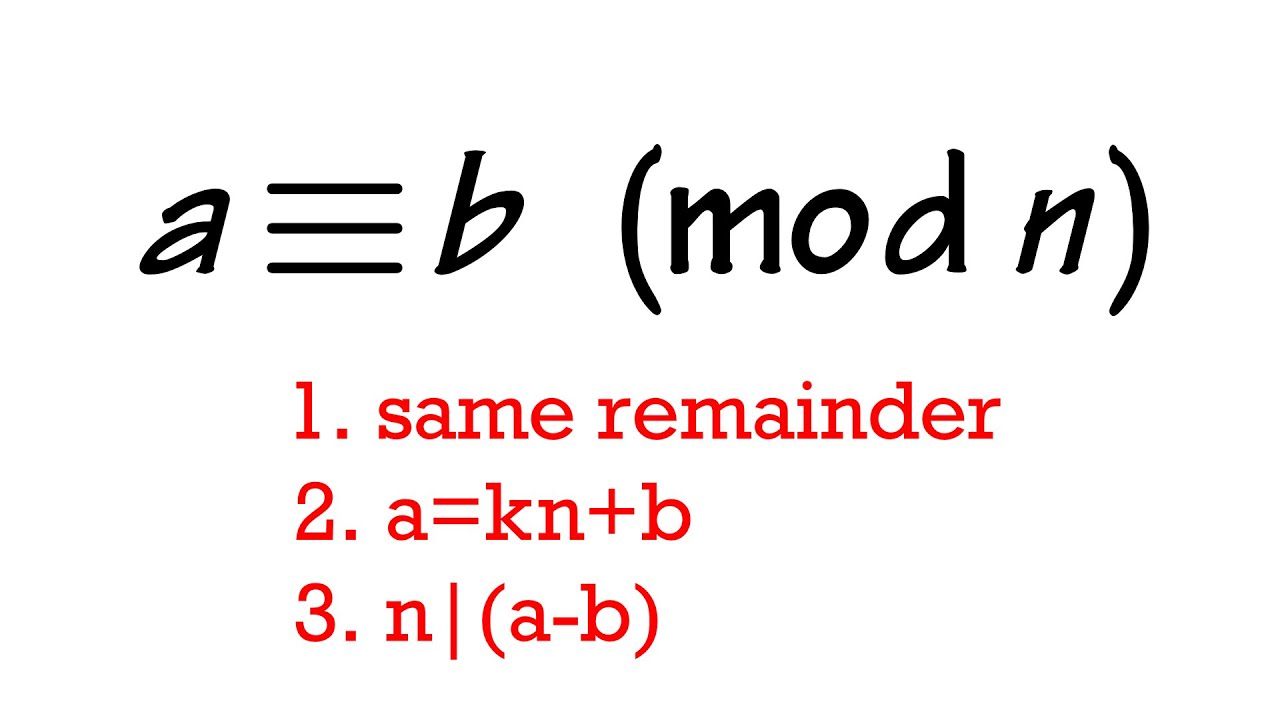
Basic congruence introduction in modular arithmetic. We will go over 3 ways to interpret a ≡ b (mod n), and you will see this in a number theory or a discrete math class. Learn how to solve congruence, subscribe to @blackpenredpen
💪 Support this channel, https://www.patreon.com/blackpenredpen
 golden blade
burnt fjord
can you explain a little more please i dont really understand
golden blade
burnt fjord
can you explain a little more please i dont really understand
You can subtract 7 from 12
smoky sparrow
you can just replace the 12 with 5 wherever 12 appears
burnt fjord
just because 12 = 1*7 + 5 ?
smoky sparrow
burnt fjord
just because 12 = 1*7 + 5 ?
yes
burnt fjord
smoky sparrow
yes
so in every congruence expression you can just simplify numbers with no others impacts on other ?
smoky sparrow
burnt fjord
so in every congruence expression you can just simplify numbers with no others i...
yeah
burnt fjord
smoky sparrow
yeah
ok i didnt know that thanks 👍
and so 5^n5-5^n5 is just 0 so ≡ 0 ?
smoky sparrow
burnt fjord
ok i didnt know that thanks 👍

Mathematics Stack Exchange
Find the least positive integer $x$ that satisfies the congruence $90x\equiv 41\pmod{73}$.
It is clear that an attempt to write this out as $90x-41=73n,\exists n\in \mathbb{Z}$ won't be very effic...
here's another example
smoky sparrow
burnt fjord
and so 5^n*5-5^n*5 is just 0 so ≡ 0 ?
yes
topaz sinewBOT
Channel closed
Closed by @burnt fjord
Use .reopen if this was a mistake.
burnt fjord
smoky sparrow
yes
hey excuse me i dont understand this reply in the link you gave me

why 90x is equivalent to 15x
topaz sinewBOT
Available help channel!
Send your question here to claim the channel.
Remember:
• Ask your math question in a clear, concise manner.
• Show your work, and if possible, explain where you are stuck.
• After 15 minutes, feel free to ping <@&286206848099549185>.
• Type the command .close to free the channel when you're done.
• Be polite and have a nice day!
Read #❓how-to-get-help for further information on how to ask a good question, and about conduct in the question channels.
 pearl fog
find all integers n such that x^3+y^3+z^3-3xyz=n has a positive integer solution (x,y,z)
topaz sinewBOT
pearl fog
find all integers n such that x^3+y^3+z^3-3xyz=n has a positive integer solution...
pearl fog
so like if you factor tou can get
(x+y+z)(x^2+y^2+z^2-xy-xz-yz)=n
but idk what next
ig n is positive
idk what next
wait gold on
doesent this like make no sense
x^3+y^3+z^3-3xyz has like infinite ranges
pearl fog
yeah but im pretty sure there is infinite n
 prisma mesa
yeah, there 100% is
topaz sinewBOT
Channel closed
Closed by @pearl fog
Use .reopen if this was a mistake.
topaz sinewBOT
Available help channel!
Send your question here to claim the channel.
Remember:
• Ask your math question in a clear, concise manner.
• Show your work, and if possible, explain where you are stuck.
• After 15 minutes, feel free to ping <@&286206848099549185>.
• Type the command .close to free the channel when you're done.
• Be polite and have a nice day!
Read #❓how-to-get-help for further information on how to ask a good question, and about conduct in the question channels.
 left egret
I type
topaz sinewBOT
left egret
I type
topaz sinewBOT
No need to ask “Can I ask…?” or “Does anyone know about…?”—it’s faster for everyone if you just ask your question! See https://dontasktoask.com/
left egret
Look this is the math problem if someone knows please help me

I did the basic stuff already but don't know what's next

 river marsh
remember its the 45 45 90 triangle
 finite moth
left egret
finite moth
left egret

the red is the radius of the large circle
the green is the radius of the small circle
what should the length of the side be?
left egret
so i use pythagorem theorem to find the hypothenius?
left egret
once i have the answer for the hypothenius what should I do next?
finite moth
if we use s for the side of the square
we know that s^2 + s^2 = 20^2
we also know that s = 10 + x
which means that (10+x)^2 + (10+x)^2 = 20^2
now you can expand and then solve for x
left egret
would it be 10√2 − 10?
river marsh
Correct
left egret
aah thank you very much
topaz sinewBOT
@left egret Has your question been resolved?
Channel closed
Closed by @left egret
Use .reopen if this was a mistake.
Available help channel!
Send your question here to claim the channel.
Remember:
• Ask your math question in a clear, concise manner.
• Show your work, and if possible, explain where you are stuck.
• After 15 minutes, feel free to ping <@&286206848099549185>.
• Type the command .close to free the channel when you're done.
• Be polite and have a nice day!
Read #❓how-to-get-help for further information on how to ask a good question, and about conduct in the question channels.
keen plinth
so i’m really confused about how an isolating point could be continuous, mainly the difference of continuity of function and point
 topaz sinewBOT
keen plinth
so i’m really confused about how an isolating point could be continuous, mainly ...
keen plinth
topaz sinewBOT
keen plinth
so i’m really confused about how an isolating point could be continuous, mainly ...
keen plinth
so is my drawing of understanding p, E and f(x) correct, according to the statement?
 pseudo jetty
what do the arcs represent?
keen plinth
upper arc represents the function f(x), lower arc represents the domain
pseudo jetty
you've draw p somewhere floating in midair, why?
p is a point of the domain E
it should be sitting on the horizontal axis
keen plinth
yes, sorry it means the x-coordinate of that point
pseudo jetty
is p isolated in your drawing?
pseudo jetty
well im not sure which set you consider f(p) to be part of
perhaps of the graph
then you've drawn (p, f(p)) as an isolated point of the graph of f
keen plinth
yes but p itself isn't isolated in E
pseudo jetty
it is most definitely not in your picture
keen plinth
so what will a correctly depicted graph looks like
pseudo jetty
every point of Z as a subset of R is isolated
try drawing a function defined on Z
then see if its continuous
keen plinth
is it a must that it is only defined on Z?
pseudo jetty
i guess it isnt made explicit in what you sent
f should be a function E -> some other set
presumably R
f : E -> R
keen plinth
so having an intuitive thought on Z only tho
pseudo jetty
Z is just a convenient example where every point is isolated
feel free to use other sets
,, (-\infty, -1) \union \set 0 \union (1, \infty)
thorny flameBOT
 thorny flameBOT
 pseudo jetty
here again every point is isolated
keen plinth
I still don't get how it can be continuous tho, what will be the visulization of the graph, the continuity at a limit point statement is only true if it is a limit point?
pseudo jetty
its just requiring the limit to equal the value of the function
neighbourhoods of an isolated point eventually only contain the isolated point itself
so you are taking the limit over a single point
keen plinth
pseudo jetty
so you are taking the limit over a single point
so are we using the epsilon delta definition here
pseudo jetty
sure why not
$L$ is a limit of $f$ at $x$ if for all $\epsilon > 0$, there exists $\delta > 0$ such that if $\abs {x - a} < \delta$ then $\abs {f(x) - L} < \epsilon$
thorny flameBOT
 pseudo jetty
if $p$ is an isolated point of $E$, then there exists $\eta > 0$ such that $\set {x \where \abs {x - p} < \eta} = \set p$
thorny flameBOT
 keen plinth
Ohh wait, so as we have the value of f(x) defined here as p, any $\epsilon > 0$ will be automatically true for this statement
thorny flameBOT
ManMan
 pseudo jetty
then taking $\delta = \eta$, you yield $\abs {x - p} < \eta$ if and only if $x = p$, whence $\abs {f(p) - f(p)} < \epsilon$ holds trivially for all $\epsilon > 0$
keen plinth
wait, lemme digest
thorny flameBOT
 keen plinth
yeh, it is challenging but interesting
through out those definitions, a lot of misconceptions in calculus are cleaned
pseudo jetty
im sure you can get a nice picture of this
topaz sinewBOT
Channel closed
Closed by @keen plinth
Use .reopen if this was a mistake.
pseudo jetty
keen plinth
thx for your help

here is a picture btw
0 on the x-axis is isolated
so whatever point you put as the blue one, the function will be continuous
keen plinth
I was confused about HOW it looks so discontinuous, but then realise that the requirement of continuity in the statement only holds for domain E, so it is still continuous in the domain E
topaz sinewBOT
Available help channel!
Send your question here to claim the channel.
Remember:
• Ask your math question in a clear, concise manner.
• Show your work, and if possible, explain where you are stuck.
• After 15 minutes, feel free to ping <@&286206848099549185>.
• Type the command .close to free the channel when you're done.
• Be polite and have a nice day!
Read #❓how-to-get-help for further information on how to ask a good question, and about conduct in the question channels.
 novel solar
a couple decide to start having children and keep having children until they have the same number of boys and girls. how many children do they expect to have?
topaz sinewBOT
novel solar
a couple decide to start having children and keep having children until they hav...
neon iron
novel solar
a couple decide to start having children and keep having children until they hav...
Is this real
fair thorn
yes
novel solar
lol
novel solar
yeah like the prob of either child is 50/50
we're trying to find the expected number of children
fair thorn
i think it's fairly obvious?
2?
novel solar
so like the expected number of coin flips if we want to stop at an equal number of heads and tails with a fair coin
n
fair thorn
actually yeah interesting question
novel solar
why'd you say 2? the value is 2 if you have one boy and one girl or one girl and one boy. that happens with probability 1/4 each so 1/2 total
novel solar
so it's 2 only 1/2 of the time
neon iron
I think it's 3 man
fair thorn
some power of two no doubt
neon iron
Okay lile
 hearty turret
novel solar
a couple decide to start having children and keep having children until they hav...
hearty turret
novel solar
a couple decide to start having children and keep having children until they hav...
define X_n = difference between #boys - #girls
hearty turret
then X_n is a simple symmetric random walk starting at 0
define T = inf{n >= 1 s.t. X_n = 0}
we want to compute E(T)
it isn't too hard to show E(T) is infinite
fair thorn
LY what year of undergrad ru in
hearty turret
novel solar
a couple decide to start having children and keep having children until they hav...
so tell that couple to better start getting busy!
hearty turret
fair thorn
LY what year of undergrad ru in
2nd
novel solar
hearty turret
define T = inf{n >= 1 s.t. X_n = 0}
first of all i don't really understand this my bad
hearty turret
fair thorn
LY what year of undergrad ru in
if u were wondering abt the courses i've done/doing,
- numbers&sets (introductory maths course), differential equations, vectors&matrices, groups, vector calculus, dynamics&relativity, probability, analysis, groups rings & modules
- analysis&topology, markov chains, quantum mechanics, linear algebra, methods, galois theory & prob&measure (unofficially)
hearty turret
novel solar
infinity doesn't sound right...
yeah probability is weird
neon iron
novel solar
infinity doesn't sound right...
Well if u think abt it
novel solar
wow i ran a simulation with 1000 trials and it gave me 25k as the answer
a lot larger than i thought
i thought it'd be between 2 and 6 dang
neon iron
novel solar
wow i ran a simulation with 1000 trials and it gave me 25k as the answer
💀💀💀
hearty turret
novel solar
wow i ran a simulation with 1000 trials and it gave me 25k as the answer
yeah basically the answer is infinity, so if you keep running more and more trials, you should find that the answer just keeps going up and up