

1 messages · Page 181 of 1
 dawn venture
i am solving this separable differential equation.
my issue is with how we do this integration:
 topaz sinewBOT
dawn venture
i am solving this separable differential equation.
my issue is with how we do th...
dawn venture
topaz sinewBOT
dawn venture
i am solving this separable differential equation.
my issue is with how we do th...
dawn venture
am i supposed to do some sort of substitution? i know the solution, but i cant find the right steps
solution is this

 strange whale
well u'/u^2+1 is the derivative of arctan(u), so yeah a sub is a good idea
dawn venture
but what would the sub be ?
if the sub is the answer i sent, then i am subbing for the answer to the problem at that point...
strange whale
nah the answer is the answer
dawn venture
what would be a fitting sub here
strange whale
y = arctan(u)
strange whale
the integrand is of the form some function of arctan(u) * (arctan(u))'
very chain rule-y
dawn venture
yeah i noticed it reminded me of the chain rule
but i didn’t really know what to do with it
strange whale
that's why the sub is a good idea
strange whale
integration by substitution is essentially chain rule in reverse
dawn venture
if i see resemblance of the chain rule like that, is it a good idea to then try to substitute for, in this case, arctan?
strange whale
yeah
dawn venture
i didn’t really think of it that way
very cool
thanks
i’ll solve it with the sub and should work
alright
i solved it
thanks
.close
topaz sinewBOT
Closed by @dawn venture
Use .reopen if this was a mistake.
topaz sinewBOT
 Available help channel!
Send your question here to claim the channel.
Remember:
• Ask your math question in a clear, concise manner.
• Show your work, and if possible, explain where you are stuck.
• After 15 minutes, feel free to ping <@&286206848099549185>.
• Type the command .close to free the channel when you're done.
• Be polite and have a nice day!
Read #❓how-to-get-help for further information on how to ask a good question, and about conduct in the question channels.
 dull lantern
 topaz sinewBOT
dull lantern
dull lantern
topaz sinewBOT
dull lantern
dull lantern


The problem is part a don't understand how to conceptually pick values to make inequalities of
Here
's what the mark scheme says

 topaz sinewBOT
@dull lantern Has your question been resolved?
topaz sinewBOT
Closed due to timeout
Use .reopen if this was a mistake.
topaz sinewBOT
Available help channel!
Send your question here to claim the channel.
Remember:
• Ask your math question in a clear, concise manner.
• Show your work, and if possible, explain where you are stuck.
• After 15 minutes, feel free to ping <@&286206848099549185>.
• Type the command .close to free the channel when you're done.
• Be polite and have a nice day!
Read #❓how-to-get-help for further information on how to ask a good question, and about conduct in the question channels.
 night sonnet
 topaz sinewBOT
night sonnet
topaz sinewBOT
night sonnet
 neon iron
ur cooked
night sonnet
why 💀
neon iron
yeah no shit its big
night sonnet
it is
neon iron
do you understand the theorems
opening channel is more for 1 problem help not an entire page
night sonnet
yes
no i got like
2.1, and 2.2 are easy, 2.3 is where i get a little confused
and i just dont know how to solve 2.4
neon iron
what ab 2.3 confuses you
night sonnet
the rest i haven't even gotten too
you have to show that there are infinitely many primes
now i could just show it in the same way as the fundamental theorem
but how would i prove it?
my professor told me to try and prove it through contradiction
neon iron
yes
night sonnet
apparently thats the main objective of the question
and i dont know where to begin with that
night sonnet
neon iron
assume there are finite prime numbers
yes so that would be pn
neon iron
if n =0 => 5 = > prime
night sonnet
so essentially i get the equation
6p1p2p3p4p5.........pn+5
right
but then again it says there are infinitely many primes
but 3 isnt considered
thats how i answered
i know its wrong but idk how i'd prove through contradiction
night sonnet
neon iron
no?
primes in the form of 6n+5
so technically if n=0 in every case
you'd still have 5
night sonnet
neon iron
if n =0 => 5 = > prime
wdym by that
neon iron
night sonnet
so technically if n=0 in every case
n cant be 0 in every case
night sonnet
neon iron
n cant be 0 in every case
can you prove it?
neon iron
what n
night sonnet
you're not getting what im saying
neon iron
explain to me
night sonnet
in the equation we use pn to denote a prime number n
neon iron
ok
topaz sinewBOT
@night sonnet Has your question been resolved?
 timid junco
@night sonnet do u still need help with 2.4?
night sonnet
yea
timid junco
So 10^99 integer mult of 10^88 prob ( this is only so I dont havfta scroll up )
so you can simplify to 10^12
probability that mult of 10 is a factor of 10^12
10^12 = 5^12 x 2^12
hmm
let me think
night sonnet
yea
night sonnet
not exactly
can u tell me where ur coming from
maybe i can understand it from there
timid junco
Ok so mult of 10 can only divide 10^12 if 10 times n is 5 or 2 to 10^12
so the max is 2^12 and 5^12
and to find the number of factors of 2^12 and 5^12 its just (12+1)(12+1)
night sonnet
ok so ur doing the permutation thingy?
timid junco
its not a permutation ;-:
Its the formula to find the number of factors a number has
for ex if we take 24
24's prime factorization is 2^3 and 3^1
night sonnet
oh that thing
timid junco
add 1 to the exponents and mult those numbers to find number of facoters
so its 4x2=8
night sonnet
i saw (12+1) and i thought you were doing the combinatorics thingy
night sonnet
timid junco
add 1 to the exponents and mult those numbers to find number of facoters
bro how does that work
i aint ever seen that wtf
timid junco
its from competition maths so not a lot of people know it
they never teach this in school
night sonnet
damn bro
timid junco
we found the number of factors in 10^12 after we simplified the expression
night sonnet
yea
timid junco
since a number is only divisivble by its factors we found how many factors 10^12 had
so thats how many mults of 10 can go into 10 ^ 12
night sonnet
that makes sense
timid junco
its just my take on this one
night sonnet
i have another session next saturday
timid junco
ahh ok
night sonnet
timid junco
its just my take on this one
it makes sense to me
topaz sinewBOT
Closed by @night sonnet
Use .reopen if this was a mistake.
topaz sinewBOT
Available help channel!
Send your question here to claim the channel.
Remember:
• Ask your math question in a clear, concise manner.
• Show your work, and if possible, explain where you are stuck.
• After 15 minutes, feel free to ping <@&286206848099549185>.
• Type the command .close to free the channel when you're done.
• Be polite and have a nice day!
Read #❓how-to-get-help for further information on how to ask a good question, and about conduct in the question channels.
 proud cradle
find x*y
 topaz sinewBOT
proud cradle
find x*y
proud cradle
topaz sinewBOT
proud cradle
find x*y
proud cradle
how should i start guys?
 mellow breach
equate (x+y)
 dapper storm
do u know how to isolate (x+y)
dapper storm
so for the first equation try to apply
$(x+y)^{\frac{1}{2}} = 2 \implies (x+y)^{\frac{1}{2}\cdot 2} = 2^2$
 thorny flameBOT
Infectia
 dapper storm
the other one just divide $2^{y-x}$ on both sides
thorny flameBOT
Infectia
 proud cradle
let me try
proud cradle
yes
 alpine breach
 alpine breach
proud cradle
yes
alpine breach
proud cradle
yes
OK
alpine breach
...
proud cradle
what
alpine breach
Emm
thorny flameBOT
cutedogha
 alpine breach
 proud cradle
dude u very smart
alpine breach
but I only see one answer for the first equation, not infinite
alpine breach
proud cradle
you probably working with finances
nah, it was the only thing that come to me
proud cradle
the answer is 35
alpine breach
ok
proud cradle
alpine breach
but I only see one answer for the first equation, not infinite
you did good
alpine breach
proud cradle
the answer is 35
.
proud cradle
where you studied math if not secret
topaz sinewBOT
alpine breach
As a helper, please do not give out answers that could be copied as a homework solution. Have the student work through the problem themselves and guide them along the way.
alpine breach
ok
proud cradle
alpine breach
in what course are you in?
ukraine
alpine breach
in what grade
 odd dirge
Oh this is math
proud cradle
.close
topaz sinewBOT
Closed by @proud cradle
Use .reopen if this was a mistake.
topaz sinewBOT
Available help channel!
Send your question here to claim the channel.
Remember:
• Ask your math question in a clear, concise manner.
• Show your work, and if possible, explain where you are stuck.
• After 15 minutes, feel free to ping <@&286206848099549185>.
• Type the command .close to free the channel when you're done.
• Be polite and have a nice day!
Read #❓how-to-get-help for further information on how to ask a good question, and about conduct in the question channels.
neon iron
Can any help with this? I got 673.6 N but idk if its correct

 finite moth
if we treat the 2 boxes as a system
m = 80kg
θ = tan^-1(2.5/4.75) = 27.758 deg
sum of forces = F - mgsin(θ) - μmgcos(θ) = 0
F = mgsin(θ) + μmgcos(θ) = 673.18
hmm
topaz sinewBOT
@neon iron Has your question been resolved?
topaz sinewBOT
Closed due to timeout
Use .reopen if this was a mistake.
Available help channel!
Send your question here to claim the channel.
Remember:
• Ask your math question in a clear, concise manner.
• Show your work, and if possible, explain where you are stuck.
• After 15 minutes, feel free to ping <@&286206848099549185>.
• Type the command .close to free the channel when you're done.
• Be polite and have a nice day!
Read #❓how-to-get-help for further information on how to ask a good question, and about conduct in the question channels.
 uneven galleon
given a square ABCD and a triangle of points A, E, F (on A, BC and CD), with angles AEB=70, EAF = 45, find the angle AFE
topaz sinewBOT
uneven galleon
given a square ABCD and a triangle of points A, E, F (on A, BC and CD), with ang...
timid junco
finite moth
AFD + AFE + EFC = 180
x would be 0 then
finite moth
ah shit you right
timid junco
uneven galleon
Its the same question from earlier
Btw you should set the AEF to another variable
uneven galleon
timid junco
Its the same question from earlier
Yeah I want to see if I get more answers here
uneven galleon
timid junco
Btw you should set the AEF to another variable
wdym
timid junco
wait a minute u right
 plucky pilot
oh ok
timid junco
50
 cosmic silo
45
uneven galleon
cosmic silo
i did get the ans, but was just a shot in the dark unfortunately
Any number you try will initially work out.
lol
plucky pilot
uneven galleon
Any number you try will initially work out.
yeah
timid junco
yea thats what im seeing now lol
uneven galleon
any value for x such that 25 < x < 115 will work
cosmic silo
uneven galleon
Any number you try will initially work out.
damnn thought was drunk for a sec
timid junco
so I dont think there is an equation for this stuff
cosmic silo
uneven galleon
any value for x such that 25 < x < 115 will work
then is there any real solution for this??
uneven galleon
cosmic silo
then is there any real solution for this??
yes
you can get it from inverse trig functions
cosmic silo
uneven galleon
you can get it from inverse trig functions
ahh, out of my reach of knowledge at the moment
uneven galleon
Im 100% certain you can also get there by simple geometry but I lack creativity
cosmic silo
uneven galleon
Im 100% certain you can also get there by simple geometry but I lack creativity
ohh
plucky pilot
uneven galleon
Im 100% certain you can also get there by simple geometry but I lack creativity
wait get where?
uneven galleon
plucky pilot
wait get where?
to the answer
uneven galleon
plucky pilot
doesn't any x work
only if you check the sum of angles
but only a single value of x works for the length of the sides
plucky pilot
oh would you like set the square side to 1 and check if the angles work or smth?
plucky pilot
uneven galleon
but only a single value of x works for the length of the sides
ohh ok i see
uneven galleon
set the sides of the square to 1 and you can find the exaxt value with trig
uneven galleon
plucky pilot
oh would you like set the square side to 1 and check if the angles work or smth?
yeah lol
plucky pilot
yeah that makes sense, thx
cosmic silo
do you have the ans to it?
and are just confused to get to it?
or no idea whole together?
cosmic silo
uneven galleon
set the sides of the square to 1 and you can find the exaxt value with trig
you are solving ur own ques???
uneven galleon
cosmic silo
do you have the ans to it?
I can get the answer using trig, but I want to know how to get to the answer using basic geometry manipulation, because I know it is possible
timid junco
Oh ok
Algebraiclly it works out
to X=X
but since it cannot be negative its just 25<x<115
thats it
there is no geometry manipulation that gives 25<x<115
plucky pilot
what
25<x<115 works but you need to check if the angles satisfy all properties using trig
topaz sinewBOT
@uneven galleon Has your question been resolved?
topaz sinewBOT
@uneven galleon Has your question been resolved?
uneven galleon
timid junco
there is no geometry manipulation that gives 25<x<115
There is
timid junco
Im pretty sure there isnt since algebra can go negative but geometry cant
timid junco
?
uneven galleon
timid junco
?
Algebra regarding this type of geometry assumes that negative numbers and 0 don't exist. Same as when working out quantities of objects, where we assume negatives and non-integers dont exist
timid junco
I dont think there is a algebraic expression that calculates what x can be
I mean maybe u can use limits?
 fierce kayak
Well there's an infinity of solutions so the range would be fine ig
I quickly went over it with linalg and there's no unique solution for this system
topaz sinewBOT
@uneven galleon Has your question been resolved?
topaz sinewBOT
Closed due to timeout
Use .reopen if this was a mistake.
topaz sinewBOT
Available help channel!
Send your question here to claim the channel.
Remember:
• Ask your math question in a clear, concise manner.
• Show your work, and if possible, explain where you are stuck.
• After 15 minutes, feel free to ping <@&286206848099549185>.
• Type the command .close to free the channel when you're done.
• Be polite and have a nice day!
Read #❓how-to-get-help for further information on how to ask a good question, and about conduct in the question channels.
 stoic pollen

I have an elementary question on sampling without replacement, but I thought I must ask here, to be sure I've understood it.
Example. There are 100 slips of paper in a hat, each of which has one...
topaz sinewBOT
stoic pollen
https://math.stackexchange.com/questions/1983111/sampling-without-replacement-se...
stoic pollen
My question is the same as the post above.
topaz sinewBOT
@stoic pollen Has your question been resolved?
stoic pollen
<@&286206848099549185>
topaz sinewBOT
@stoic pollen Has your question been resolved?
 long stirrup
you draw a random letter without replacement, from a,b,c...x,y,z 10 times
the probability that your 6th draw is b equals something
the probability that your 6th draw is n equals something
if they are not equal, how the hell does it even work
this is called symmetry, it's the simplest way to think about it
stoic pollen
long stirrup
this is called symmetry, it's the simplest way to think about it
Right but each time you draw a letter without replacement it changes the probability so the distribution is not DUnif(1,2,...,100)
Isn't he saying that all Yj are distributed as DUnif(1,2,...,100)?
long stirrup
it would be stupid if it followed something else
it would "violate symmetry"
you would have a better chance of drawing n over b
stoic pollen
On my first draw the chance is 1/100. On my second draw the chance is 1/99.... etc. Right?
long stirrup
if you didn't draw 84 it's 1/99 to draw 84
if you drew 84 it's 0 to draw 84
if you don;t know if you drew 84 or not, it's 1/100
stoic pollen
long stirrup
if you don;t know if you drew 84 or not, it's 1/100
So lets say Y5 or my 5th draw the distribution would still be discrete uniform 1/100?
long stirrup
yeah
if you don't want to think about it abstractly, take a small example and calculate
like 3 numbers
chance to draw 1 on 3rd draw
stoic pollen
1/98 because I drew 2 before?
stoic pollen
If there 3 numbers total and you drew 2 and didn't draw the number you were looking for, the probability is 1.
long stirrup
yes
and it's 1/3 if you don;t know if you drew the number or not
and it's 0 if you drew the number
and we're talking about the don't know case
stoic pollen
So if you don't know the first two cards you drew then the probability the 3rd card is the one is 1/3. Is that the logic?
long stirrup
yeah
stoic pollen
long stirrup
yeah
Can I ask where it's known that's the case he is talking about?
long stirrup
it's not "known", it's an interpretation where he's right
you can imagine he's wrong i guess, talking about the other case
lol
stoic pollen
long stirrup
you can imagine he's wrong i guess, talking about the other case
I mean when you say draw cards usually you assume you know the cards you are drawing at least that's what I would assume.
long stirrup
but then you still don't know if you drew the card already or not
you as in the reader of the problem
so is it 0 or 1
you would just not be able to solve it
stoic pollen
long stirrup
but then you still don't know if you drew the card already or not
If I know the first two cards I drew I would know if it's drawn or not.
long stirrup
yes, you would know if it is 0 or 1
"it's 0 or 1" is not a distribution
so like your answer is "I would know what it is in this situation"
i guess that makes sense in a way, like in algebra the problem could be "you have x apples, and you eat y. How many apples do you have left" and the expected answer (x − y) is essentially "I would know how many apples I had and how many I ate..."
and it's not like probability problems are never this kind of problem where there's uncertainty in premise, and you give an uncertain answer
so i guess i understand your confusion now
topaz sinewBOT
Closed by @stoic pollen
Use .reopen if this was a mistake.
topaz sinewBOT
Available help channel!
Send your question here to claim the channel.
Remember:
• Ask your math question in a clear, concise manner.
• Show your work, and if possible, explain where you are stuck.
• After 15 minutes, feel free to ping <@&286206848099549185>.
• Type the command .close to free the channel when you're done.
• Be polite and have a nice day!
Read #❓how-to-get-help for further information on how to ask a good question, and about conduct in the question channels.
 ivory sorrel
 topaz sinewBOT
ivory sorrel
ivory sorrel
topaz sinewBOT
ivory sorrel
ivory sorrel
I think contrapositive
 pseudo sonnet
sure
ivory sorrel
So if $n$ isn't prime, then $2^n-$ isn't prime
thorny flameBOT
Veni, vidi, perii is $\R - \Q$
 ivory sorrel
This is logically equivalent to proving that if $n$ is composite then $2^n-1$ is composite too. As $n$ is composite, there exists $p,q$, such that $p ,q \neq 1 \lor n$.
\
\
We thus have $n=pq$. So $2^{pq}-1$'s parity is what we wish to determine.
\
$(2^p)^q-1 = (2^{p-1}+2^{p-2} +\dots +1)(2^p-1)$
right so far?
ivory sorrel
oops
thorny flameBOT
Veni, vidi, perii is $\R - \Q$

 torpid sparrow
Now is good
ivory sorrel
that's better
ivory sorrel
oops
torpid sparrow
Now looks ok, i just woke up and can’t read well lol
ivory sorrel
$[(2^p)^{q-1}+(2^p)^{q-2} + \dots + 1)(2^{p-1}+2^{p-2} + \dots +1)=(2^p)^q-1$
thorny flameBOT
Veni, vidi, perii is $\R - \Q$
 torpid sparrow
Ok what about 11
torpid sparrow
2^11-1 is not
Do not overthink, it is a fake question by me
You are looking the other way
ivory sorrel
I mean the contrapositive of if $2^n-1$is prime then $n$ is prime is if $n$ is not prime, $2^n-1$ isn't prime
isn't it
thorny flameBOT
Veni, vidi, perii is $\R - \Q$
 torpid sparrow
Yes, I just wanted to trick u lol
topaz sinewBOT
Closed by @ivory sorrel
Use .reopen if this was a mistake.
topaz sinewBOT
Available help channel!
Send your question here to claim the channel.
Remember:
• Ask your math question in a clear, concise manner.
• Show your work, and if possible, explain where you are stuck.
• After 15 minutes, feel free to ping <@&286206848099549185>.
• Type the command .close to free the channel when you're done.
• Be polite and have a nice day!
Read #❓how-to-get-help for further information on how to ask a good question, and about conduct in the question channels.
neon iron
Just learning linear programming. Why does the corner point method work?
topaz sinewBOT
neon iron
Just learning linear programming. Why does the corner point method work?
@neon iron Has your question been resolved?
topaz sinewBOT
Closed due to timeout
Use .reopen if this was a mistake.
topaz sinewBOT
Available help channel!
Send your question here to claim the channel.
Remember:
• Ask your math question in a clear, concise manner.
• Show your work, and if possible, explain where you are stuck.
• After 15 minutes, feel free to ping <@&286206848099549185>.
• Type the command .close to free the channel when you're done.
• Be polite and have a nice day!
Read #❓how-to-get-help for further information on how to ask a good question, and about conduct in the question channels.
 sterile cape
Well hello
topaz sinewBOT
sterile cape
Well hello
sterile cape
I want to derive the Maclaurin series by myself
But I am not sure what it does
is this series like valid for every function
 smoky sparrow

Taylor polynomials are incredibly powerful for approximations and analysis.
Help fund future projects: https://www.patreon.com/3blue1brown
An equally valuable form of support is to simply share some of the videos.
Special thanks to these supporters: http://3b1b.co/lessons/taylor-series#thanks
Home page: https://www.3blue1brown.com/
Full series: ...
recommend this video
sterile cape
Nooo I wanna do it myself
smoky sparrow
sterile cape
is this series like valid for every function
no, there's a radius of convergence depending on the function
well you can pause at certain moments
and move on when you are ready
sterile cape
smoky sparrow
no, there's a radius of convergence depending on the function
Can you elaborate 🤯
smoky sparrow
sterile cape
Can you elaborate 🤯
outside the radius of convergence, the Taylor series won't converge
sterile cape
So if the function is bounded in a range
Then only this series is valid ig?
smoky sparrow
it might oscillate wildly, up and down
smoky sparrow
sterile cape
So if the function is bounded in a range
Then only this series is valid ig?
yes
there's a certain interval where the Taylor series is valid
smoky sparrow
yeah I recommend watching the cos(x) example for inspiration
sterile cape
I know basic calc
smoky sparrow
you can absolutely derive it yourself
the concept is that all the nth derivatives of the Taylor series polynomial match that of the original function
so you can start by writing out $a_0 + a_1 x + a_2 x^2 + \cdots a_n x^n$ for the Taylor series
thorny flameBOT
south's secret twin brother
 smoky sparrow
repeatedly differentiate and sub in $x_0$ to get $f(x_0), f'(x_0), f"(x_0)$ and so on
thorny flameBOT
south's secret twin brother
 smoky sparrow
so you can find what $a_0, a_1, \cdots, a_n$ are in terms of these derivatives above
thorny flameBOT
south's secret twin brother
 sterile cape
Okay so the person who derived the series
What was he thinking before that?
If a function is bounded then it can be represented as an infinite sum of function of x ??
Then he used his knowledge to find the series???
Yeah the language isn't proper but you know what I mean
smoky sparrow
sterile cape
Okay so the person who derived the series
What was he thinking before that?
If ...
that polynomials are super easy to differentiate
so it makes sense to have a best polynomial approximation: that's literally what a Taylor series is
also you can find the Taylor series of the sum, difference, product, and composition of two functions pretty easily
sterile cape
smoky sparrow
that polynomials are super easy to differentiate
But did he knew about the fx must have definite range??
Convergence as you said earlier
smoky sparrow
sterile cape
But did he knew about the fx must have definite range??
I mean we have discovered a lot of things since calculus was first discovered
I'm pretty sure Newton and Leibniz were smart enough to realise that
smoky sparrow
sterile cape
Convergence as you said earlier
you should look into tests for convergence of a series
specifically, the ratio test, and the nth root test
sterile cape
smoky sparrow
you should look into tests for convergence of a series
Can I do that too?
smoky sparrow
sterile cape
Can I do that too?
it's hard to derive them yourself without knowing anything beforehand
sterile cape
What do I need to know
smoky sparrow
sterile cape
What do I need to know
honestly, what do you have to gain by deriving everything yourself
I'm not saying exploring stuff on your own is bad
but you've got to realise that it's impossible for one person to come up with all of calculus by themselves
smoky sparrow
why not just look through a few different proofs yourself
see if you can work out what the author means by yourself
sterile cape
Yeah it's just like I think we have discovered so much in mathematics that young students won't be able to discover something new by themselves, it will take them a lifetime
It makes me kinda sad
smoky sparrow
yeah maths is definitely not the field to discover new truths quickly
it's one of the longest I'd say, like as long as becoming a fully qualified doctor
cause there's just so much foundational work people have done in the centuries before today
topaz sinewBOT
@sterile cape Has your question been resolved?
Closed by @sterile cape
Use .reopen if this was a mistake.
Available help channel!
Send your question here to claim the channel.
Remember:
• Ask your math question in a clear, concise manner.
• Show your work, and if possible, explain where you are stuck.
• After 15 minutes, feel free to ping <@&286206848099549185>.
• Type the command .close to free the channel when you're done.
• Be polite and have a nice day!
Read #❓how-to-get-help for further information on how to ask a good question, and about conduct in the question channels.
 misty ore
yo can anyone explain me operations in Q? i know that it's ez stuff but i dont understand them😭
topaz sinewBOT
misty ore
yo can anyone explain me operations in Q? i know that it's ez stuff but i dont u...
misty ore
so there's a expression
3 - 1/2 + [3/4 + (1/5 - 6/10)]-1
the result should be 37/20 but it's 9/2 to me lmao
 restive inlet
show your work
misty ore
3/1 - 1/2 + [3/4 + (1/5 - 6/10)] - 1/1
3/1 - 1/2 + [3/4 + (-2/1)] - 1/1
3/1 - 1/2 + 1/4 - 1/1
5/2 + 1/4 - 1/1
11/2 - 1/1= 9/2
restive inlet
how are you getting
-2/1 from the 1/5 - 6/10
misty ore
nvm found a error
topaz sinewBOT
@misty ore Has your question been resolved?
Closed by @misty ore
Use .reopen if this was a mistake.
Available help channel!
Send your question here to claim the channel.
Remember:
• Ask your math question in a clear, concise manner.
• Show your work, and if possible, explain where you are stuck.
• After 15 minutes, feel free to ping <@&286206848099549185>.
• Type the command .close to free the channel when you're done.
• Be polite and have a nice day!
Read #❓how-to-get-help for further information on how to ask a good question, and about conduct in the question channels.
neon iron
$f(x)=\frac{3}{x^2+2}$

 topaz sinewBOT
neon iron
$f(x)=\frac{3}{x^2+2}$
thorny flameBOT
topaz sinewBOT
neon iron
$f(x)=\frac{3}{x^2+2}$
thorny flameBOT
forMaths
 neon iron
Can I say, part c;
$\3\int_0^k\frac{1}{x^2+2}dx=3\int_k^{\sqrt{6}}\frac{1}{x^2+2}dx$
and maybe even divide both sides by 3 anyway?
2

im thinking this might work considering that if region R is divided into two equal areas, then those two would be equal?
neon iron
neon iron
2
?
oh nvm
oh wait
you are talking about the exponent. i forgot
lemme add that
there you go!
thorny flameBOT
forMaths
 neon iron
lol
no
awww man, why not?
i was talking about doing
integral 0 to sqrt 6 f(x)dx = 2 integral 0 to k f(x) dx
oh....
that... makes more sense actually
more efficient even
still dont see why mine doesnt work
i mean your idea is defo better and i will use this one
but why does my idea not work?
your's is not working ?
you said no
neon iron
neon iron
you are talking about the exponent. i forgot
no for this
oh!
ooooh
miscommunication
😂
mb, that's on me
i get what you are saying. so both ideas work but honestly, i like yours better
cuz we are dealing with k only on one side
rather than two
ok that is all ig
thanks!!
.close
topaz sinewBOT
Closed by @noble olive
Use .reopen if this was a mistake.
Available help channel!
Send your question here to claim the channel.
Remember:
• Ask your math question in a clear, concise manner.
• Show your work, and if possible, explain where you are stuck.
• After 15 minutes, feel free to ping <@&286206848099549185>.
• Type the command .close to free the channel when you're done.
• Be polite and have a nice day!
Read #❓how-to-get-help for further information on how to ask a good question, and about conduct in the question channels.
 junior rain
How can you mathematically prove the circled angle is equal to theta
Given that the vertical line is perpendicular to the horizontal line?

 topaz sinewBOT
junior rain
How can you mathematically prove the circled angle is equal to theta
Given that ...
topaz sinewBOT
junior rain
How can you mathematically prove the circled angle is equal to theta
Given that ...
 steady escarp
This will be the case if the two diagonal lines in ur picture are perpendicular
junior rain
steady escarp
This will be the case if the two diagonal lines in ur picture are perpendicular
This was the second part of a moments questions so yeah they are perpendicular
Thank you
.close
topaz sinewBOT
Closed by @junior rain
Use .reopen if this was a mistake.
topaz sinewBOT
Available help channel!
Send your question here to claim the channel.
Remember:
• Ask your math question in a clear, concise manner.
• Show your work, and if possible, explain where you are stuck.
• After 15 minutes, feel free to ping <@&286206848099549185>.
• Type the command .close to free the channel when you're done.
• Be polite and have a nice day!
Read #❓how-to-get-help for further information on how to ask a good question, and about conduct in the question channels.
 timid goblet
 topaz sinewBOT
timid goblet
timid goblet
topaz sinewBOT
timid goblet
timid goblet
,rccw
thorny flameBOT
 timid goblet
Can anyone pls explain me this underlined statement
topaz sinewBOT
@timid goblet Has your question been resolved?
topaz sinewBOT
What step are you on?
1. I don't know where to begin.
2. I have begun but got stuck midway.
3. I got an answer but I was told that it's wrong.
4. I got an answer and would like my work checked.
5. I have a question about someone else's work/solution.
6. I have completed the problem and don't need help anymore. Thank you.
7. None of the above
 topaz sinewBOT
@timid goblet Has your question been resolved?
topaz sinewBOT
@timid goblet Has your question been resolved?
topaz sinewBOT
Closed due to timeout
Use .reopen if this was a mistake.
Available help channel!
Send your question here to claim the channel.
Remember:
• Ask your math question in a clear, concise manner.
• Show your work, and if possible, explain where you are stuck.
• After 15 minutes, feel free to ping <@&286206848099549185>.
• Type the command .close to free the channel when you're done.
• Be polite and have a nice day!
Read #❓how-to-get-help for further information on how to ask a good question, and about conduct in the question channels.
 young lagoon
Could someone please point out my delusion
 topaz sinewBOT
young lagoon
Could someone please point out my delusion
mellow breach
topaz sinewBOT
young lagoon
Could someone please point out my delusion
mellow breach
its right
thorny flameBOT


 Requested by adoniszgks
topaz sinewBOT
Requested by adoniszgks
topaz sinewBOT
@young lagoon Has your question been resolved?
Closed by @young lagoon
Use .reopen if this was a mistake.
young lagoon
Thank you
topaz sinewBOT
Available help channel!
Send your question here to claim the channel.
Remember:
• Ask your math question in a clear, concise manner.
• Show your work, and if possible, explain where you are stuck.
• After 15 minutes, feel free to ping <@&286206848099549185>.
• Type the command .close to free the channel when you're done.
• Be polite and have a nice day!
Read #❓how-to-get-help for further information on how to ask a good question, and about conduct in the question channels.
 regal harbor
how do you denest a radical like this?
 topaz sinewBOT
regal harbor
how do you denest a radical like this?
topaz sinewBOT
regal harbor
how do you denest a radical like this?
 static viper
You could try multiplying and dividing by the conjugate
regal harbor
multiply the entire expression by 5 + 2 sqrt 6?
regal harbor
yea I tried
 half cape
In the form of (a+b)²
regal harbor
b = sqrt 6, a = 2 right
regal harbor
yes, but in the expression
 supple haven
half cape
(a+b)² = a² + 2ab + b²
supple haven
half cape
(a+b)² = a² + 2ab + b²
Ye use this
half cape
First rewrite this as 2 - 2sqrt(6) + 3
Then take sqrt(2) as a and sqrt(3) as b, you'll find a² = 2 and b² = 3 and 2ab = 2sqrt(6)
regal harbor
is it possible to de-nest every radical expression like this?
or are there situations where you can't do this
half cape
Not always, it really depends
regal harbor
by the way, does it need the radical?
 supple haven
they wont give it to u
 hearty turret
regal harbor
how do you denest a radical like this?
hearty turret
regal harbor
how do you denest a radical like this?
you could also find a polynomial it satisfies
regal harbor
like equating it to x?
regal harbor
I've seen a method like that, its a lot of pain
hearty turret
i.e. $x = \sqrt{5-2\sqrt{6}} \implies x^2 - 5 = -2\sqrt{6}$ etc.
thorny flameBOT
LY
 regal harbor
I see
the formula method is way easier though
is this the final answer?

or does it not need the radical
hearty turret
regal harbor
how do you denest a radical like this?
often u can just spot i.e. thing inside brackets is sqrt(2)+sqrt(3) squared
hearty turret
regal harbor
or are there situations where you can't do this
yeah lots
most of the time if u don't have something nice then you won't be able to simplify any further
regal harbor
hearty turret
yeah lots
so you can't do anything about it
hearty turret
so if u come across a question in the wild where it's like "simplify this thing"
regal harbor
if you can't simplify via the formula
hearty turret
then it'll be something nice
regal harbor
yea I see
hearty turret
hearty turret
i.e. $x = \sqrt{5-2\sqrt{6}} \implies x^2 - 5 = -2\sqrt{6}$ etc.
basically if u do this u find that x is a solution to a quartic equation
regal harbor
hearty turret
you could also find a polynomial it satisfies
do I use this method if I can't apply the formula?
hearty turret
regal harbor
do I use this method if I can't apply the formula?
yeah it's something else to try
regal harbor
I see
half cape
There are lots of methods to denest stuff tho
regal harbor
this just seems the most popular one
regal harbor
half cape
There are lots of methods to denest stuff tho
is the answer wrong?

I have to flip the signs too as I see it
since it can't be negative
 half cape
Yes, indeed
half cape
regal harbor
It technically is equal to the absolute value of that thing, but since sqrt(3) is greater than sqrt(2), it has to be this one
topaz sinewBOT
Closed by @regal harbor
Use .reopen if this was a mistake.
Available help channel!
Send your question here to claim the channel.
Remember:
• Ask your math question in a clear, concise manner.
• Show your work, and if possible, explain where you are stuck.
• After 15 minutes, feel free to ping <@&286206848099549185>.
• Type the command .close to free the channel when you're done.
• Be polite and have a nice day!
Read #❓how-to-get-help for further information on how to ask a good question, and about conduct in the question channels.
 proven venture
I got answer x=3/2 - 3/(2i), but answer is supposed to be x= (3i)/2 + 3/2. Topic is about imaginary numbers. and for the 8e^(pi/2)i x =(I got) 8xi. Can someone help me to find the mistake? Or is my answer correct and my teacher has made mistake?
 topaz sinewBOT
proven venture
I got answer x=3/2 - 3/(2*i), but answer is supposed to be x= (3*i)/2 + 3/2. Top...
topaz sinewBOT
proven venture
I got answer x=3/2 - 3/(2*i), but answer is supposed to be x= (3*i)/2 + 3/2. Top...
 sweet shard
Can you show all your steps
sweet shard
I see
proven venture
Idk if i made mistake or my teacher
thorny flameBOT
riemann
 sweet shard
Same answer, just different representation
topaz sinewBOT
Closed by @proven venture
Use .reopen if this was a mistake.
topaz sinewBOT
Available help channel!
Send your question here to claim the channel.
Remember:
• Ask your math question in a clear, concise manner.
• Show your work, and if possible, explain where you are stuck.
• After 15 minutes, feel free to ping <@&286206848099549185>.
• Type the command .close to free the channel when you're done.
• Be polite and have a nice day!
Read #❓how-to-get-help for further information on how to ask a good question, and about conduct in the question channels.
 burnt pumice
 topaz sinewBOT
burnt pumice
burnt pumice
topaz sinewBOT
burnt pumice
burnt pumice
Hey could someone help me figure out where I went wrong? Final answer should be 33.5 but I didn’t get that
sweet shard
Minus sign mistake when evaluating dx integral at the lower endpoint
topaz sinewBOT
Closed by @burnt pumice
Use .reopen if this was a mistake.
Available help channel!
Send your question here to claim the channel.
Remember:
• Ask your math question in a clear, concise manner.
• Show your work, and if possible, explain where you are stuck.
• After 15 minutes, feel free to ping <@&286206848099549185>.
• Type the command .close to free the channel when you're done.
• Be polite and have a nice day!
Read #❓how-to-get-help for further information on how to ask a good question, and about conduct in the question channels.
sweet shard
Halfway between a and 2
Any "max" you find, you can find a bigger "max" with b
Try something and see
Halfway between two numbers x and y is (x+y)/2
x and y are a and 2 here
2 is both the right endpoint and the denominator in b
6 is not the right endpoint
I have no idea what you're trying to show
Why aren't you following this
topaz sinewBOT
Channel closed due to the original message being deleted.
If you did not intend to do this, please open a new help channel,
as this action is irreversible, and this channel may abruptly lock.
Available help channel!
Send your question here to claim the channel.
Remember:
• Ask your math question in a clear, concise manner.
• Show your work, and if possible, explain where you are stuck.
• After 15 minutes, feel free to ping <@&286206848099549185>.
• Type the command .close to free the channel when you're done.
• Be polite and have a nice day!
Read #❓how-to-get-help for further information on how to ask a good question, and about conduct in the question channels.
 brisk sky
help
topaz sinewBOT
brisk sky
help
 worn aurora
brisk sky
first question
worn aurora
brisk sky
first question
what certain part do you not understand
brisk sky
oh
sry i forgot to say i have a snwer
just checking its right
and my thought process is wrong or right
i think its c
no
b
i know v must increase
looking at in energy wise
mgh = i/2 mv^2
1/2**
worn aurora
اعتبر انه عندك سياره وأنت قاعد تسوق، بس تضغط ع البنزين سرعتك تزيد ولا تنقص؟
brisk sky
يزيد
worn aurora
يعني الV increases
worn aurora
i said it increases
brisk sky
oh ok
worn aurora
and so as acceleration does because
brisk sky
ahh
worn aurora
it’s an formula
worn aurora
correct
brisk sky
may allah bless you
worn aurora
thank you
brisk sky
مع السلامة
topaz sinewBOT
@brisk sky Has your question been resolved?
topaz sinewBOT
Closed due to timeout
Use .reopen if this was a mistake.
Available help channel!
Send your question here to claim the channel.
Remember:
• Ask your math question in a clear, concise manner.
• Show your work, and if possible, explain where you are stuck.
• After 15 minutes, feel free to ping <@&286206848099549185>.
• Type the command .close to free the channel when you're done.
• Be polite and have a nice day!
Read #❓how-to-get-help for further information on how to ask a good question, and about conduct in the question channels.
 somber moon
Let $(P_k)_{k \in \mathbb{N}}$ be a sequence of polynomials in $\mathbb{C}[X_1,\dots,X_n]$ such that for every $x \in \mathbb{C}^n P_k(x)=0$.
\begin{enumerate}
\item Show that there exists $K \in \mathbb{N}$ such that $P_K = 0$ (the zero polynomial).
\item Does the result remain valid if we replace $\mathbb{C}$ with $\mathbb{Q}$?
\end{enumerate}
topaz sinewBOT
somber moon
Let $(P_k)_{k \in \mathbb{N}}$ be a sequence of polynomials in $\mathbb{C}[X_1,\...
thorny flameBOT
Cornelius
 thorny flameBOT
Cornelius
 somber moon
Let $(Pk){k \in \mathbb{N}}$ be a sequence of polynomials in $\mathbb{C}[X_1,\dots,X_n]$ such that for every $x \in \mathbb{C}^n \exists k\in \mathbb{N},P_k(x)=0$.
\begin{enumerate}
\item Show that there exists $K \in \mathbb{N}$ such that $P_K = 0$ (the zero polynomial).
\item Does the result remain valid if we replace $\mathbb{C}$ with $\mathbb{Q}$?
\end{enumerate}
thorny flameBOT
Cornelius

 keen raptor
So every x must be a zero of some polynomial
There are uncountably many x and only countably many polynomials in the sequence
somber moon
I need help with part 1. Initially, I thought of using an argument based on the countability of roots, but I believe that doesn't work because, for example, ( P(X, Y) = X^2 + Y^2 - 1 ) has an uncountably infinite number of roots: if ( (x, y) ) belongs to the unit circle, then ( P(x, y) = 0 ).
keen raptor
What would "pigeonhole principle" tell us here
thorny flameBOT
Cornelius
 keen raptor
Ah
The set of roots is always closed and has empty interior right
could you use the fact that C^n is a Baire space?
somber moon
Oh I’m sorry, I don’t know what a Baire space is.
keen raptor
A Baire space is one in which countable unions of closed sets with empty interiors also have empty interiors
(Is it easier to show that the set of roots has measure 0?)
somber moon
What is the definition of an empty interior?
Also, we didn’t cover anything about measure theory in class... 😅
keen raptor
It's when the interior is the empty set
somber moon
How do you define the interior of a subset of C ?
keen raptor
the set of points which are contained in a ball which is contained in your set S
somber moon
ok!
keen raptor
The first containment being $\in$ and the second one being $\subset$
thorny flameBOT
mommymorphism aficionado
 keen raptor
so in other words your set has no balls
somber moon
😳
keen raptor
There's probably another way to do this I'm just too topologypilled to see it
(or you could try looking at the proof of the Baire category theorem and see if you can translate it to something your teacher will accept  )
)
 late junco
What if instead of death note it was freak note and it made people get freaky
somber moon
keen raptor
There's probably another way to do this I'm just too topologypilled to see it
I thank you for your help and your ideas. 🙂
keen raptor

topaz sinewBOT
Closed by @somber moon
Use .reopen if this was a mistake.
Available help channel!
Send your question here to claim the channel.
Remember:
• Ask your math question in a clear, concise manner.
• Show your work, and if possible, explain where you are stuck.
• After 15 minutes, feel free to ping <@&286206848099549185>.
• Type the command .close to free the channel when you're done.
• Be polite and have a nice day!
Read #❓how-to-get-help for further information on how to ask a good question, and about conduct in the question channels.
 merry bridge
when I finished differentiating a function (ex: ax^(1/2)) and it has negative exponents and fractional exponents (ex: (1/2)(ax^(-1/2))) should I leave it in its exponent form or reorganize it into its appropriate square root/fractional form? (ex: (1/2)(ax^(-1/2)) or (1/2)(a/sqrt(x)))
topaz sinewBOT
merry bridge
when I finished differentiating a function (ex: ax^(1/2)) and it has negative ex...
merry bridge
*and I'm not taking a second order derivative afterwards
topaz sinewBOT
@merry bridge Has your question been resolved?
topaz sinewBOT
@merry bridge Has your question been resolved?
sweet shard
It really doesn't matter
topaz sinewBOT
@merry bridge Has your question been resolved?
topaz sinewBOT
Closed by @merry bridge
Use .reopen if this was a mistake.
Available help channel!
Send your question here to claim the channel.
Remember:
• Ask your math question in a clear, concise manner.
• Show your work, and if possible, explain where you are stuck.
• After 15 minutes, feel free to ping <@&286206848099549185>.
• Type the command .close to free the channel when you're done.
• Be polite and have a nice day!
Read #❓how-to-get-help for further information on how to ask a good question, and about conduct in the question channels.
 sharp nacelle
Two model rockets are launched 200 meters apart. The launch pad for rocket A can be seen on a bearing of 330 degrees from the observation site, while the launch pad for rocket B is on a bearing of 040 degrees. The angle of elevation from the observation site to rocket A is 30 degrees and 35 degrees for rocket B. If the distance between the observation site and each launch pad is the same, what is the altitude of each rocket?
How do I do this question? Could someone help me draw the diagram to visualize it
My teacher said this take advantage of cosine law but I do not really understand that, pls help thank you
topaz sinewBOT
sharp nacelle
**Two model rockets are launched 200 meters apart. The launch pad for rocket A c...
@sharp nacelle Has your question been resolved?
topaz sinewBOT
Closed due to timeout
Use .reopen if this was a mistake.
sharp nacelle
.reopen
topaz sinewBOT
@sharp nacelle Has your question been resolved?
topaz sinewBOT
@sharp nacelle Has your question been resolved?
topaz sinewBOT
Closed due to timeout
Use .reopen if this was a mistake.
Available help channel!
Send your question here to claim the channel.
Remember:
• Ask your math question in a clear, concise manner.
• Show your work, and if possible, explain where you are stuck.
• After 15 minutes, feel free to ping <@&286206848099549185>.
• Type the command .close to free the channel when you're done.
• Be polite and have a nice day!
Read #❓how-to-get-help for further information on how to ask a good question, and about conduct in the question channels.
ivory sorrel
 topaz sinewBOT
ivory sorrel
ivory sorrel
topaz sinewBOT
ivory sorrel
ivory sorrel
If $\sqrt{3} \in \Q$, there would exist an $x \in \Q$ such that $x^2=3$, but we've already proven that this curve has no rational points, thus this is false
thorny flameBOT
Veni, vidi, perii is $\R - \Q$
 ivory sorrel
That's it?
 fading owl
i think so
 vernal matrix
I would've just said something like "the point (sqrt{3}, 0) lies on the curve" probably
fading owl
because proving that the circle equation has no rational points should be good
ivory sorrel
Cool. Thanks!
fading owl
vernal matrix
I would've just said something like "the point (sqrt{3}, 0) lies on the curve" p...
yea that sounds better
ivory sorrel
fading owl
because proving that the circle equation has no rational points should be good
My god was that hard took me almost 2.5 hours 😭
fading owl
pog
thorny flameBOT
Wolfram Alpha doesn't understand your query!
Perhaps try rephrasing your question?
Click here to refine your query online
 Requested by physicsrocks
thorny flameBOT
Requested by physicsrocks
thorny flameBOT
Wolfram Alpha doesn't understand your query!
Perhaps try rephrasing your question?
Click here to refine your query online
 Requested by craze.cv
fading owl
Requested by craze.cv
fading owl
rip
ivory sorrel
.close
topaz sinewBOT
Closed by @ivory sorrel
Use .reopen if this was a mistake.
topaz sinewBOT
Available help channel!
Send your question here to claim the channel.
Remember:
• Ask your math question in a clear, concise manner.
• Show your work, and if possible, explain where you are stuck.
• After 15 minutes, feel free to ping <@&286206848099549185>.
• Type the command .close to free the channel when you're done.
• Be polite and have a nice day!
Read #❓how-to-get-help for further information on how to ask a good question, and about conduct in the question channels.
ivory sorrel
Prove that Given $x,y \in \R ;y + \frac{1}{x} = \frac{1}{y}+ x$ iff either x or y is 1
topaz sinewBOT
ivory sorrel
Prove that Given $x,y \in \R ;y + \frac{1}{x} = \frac{1}{y}+ x$ iff either x or...
thorny flameBOT
Veni, vidi, perii is $\R - \Q$
 thorny flameBOT
Veni, vidi, perii is $\R - \Q$
 ivory sorrel
To prove: if x or y is 1, then $y + \frac{1}{x} = \frac{1}{y}+x$
\
Case 1: $x=1; y = \R \setminus {0}$
\
$y+1=1/y+1$
\
so $y=1/y$. Which makes no sense?
thorny flameBOT
Veni, vidi, perii is $\R - \Q$

 icy sky
why not
thorny flameBOT
Veni, vidi, perii is $\R - \Q$
 vernal matrix
Do you have a picture of the original?
ivory sorrel
yes
Suppose x and y are real numbers and x = 0. Prove that y + 1/x = 1 + y/x iff either x = 1 or y = 1.
ooh
oops
read it wrong
To prove: if x or y is 1, then $y + \frac{1}{x} = \frac{y}{x}+1$
\
Case 1: $x=1; y = \R \setminus {0}$
\
$y+1=y+1$
\
Adding the additive inverse of 1 to both sides
\
$y=y$
\
Similarly if $x \in \R \setminus {0} ; y=1$, we can obtain $x=$ concluding our proof
vernal matrix
ivory sorrel
To prove: if x or y is 1, then $y + \frac{1}{x} = \frac{y}{x}+1$
\\
Case 1: $x=1...
And again 
thorny flameBOT
Veni, vidi, perii is $\R - \Q$
 icy sky
theres a Super Fast Funky Trick that you can use to circumvent all of this btw
ivory sorrel
Yes ?
 vapid hemlock
ivory sorrel
Yes ?
vapid hemlock
ivory sorrel
Yes ?
multiply both sides by x and factor
icy sky
you dont even need to
ivory sorrel
vapid hemlock
multiply both sides by x and factor
I see okay
ivory sorrel
icy sky
theres a Super Fast Funky Trick that you can use to circumvent all of this btw
What is that ?
icy sky
sfft
ivory sorrel
sfft?
icy sky
simons favorite factoring trick
move everything to one side
then factor by grouping
sfft also includes having an adjustment term, but you dont need it
ivory sorrel
This isn't a NT course 😭 . I have to prove every. little thing I use that isn't axiomatic
But got it
Thanks!
ivory sorrel
now to prove that if $y + \frac{1}{x} = 1 + \frac{y}{x}$, then $x,y=1$
ivory sorrel
icy sky
this is not a theorem
I'll keep this in mind, thanks!
thorny flameBOT
Veni, vidi, perii is $\R - \Q$
 ivory sorrel
To prove :-if $y + \frac{1}{x} = 1 + \frac{y}{x}$, then $x,y=1$
\
$yx+1=x+y$ ( Multiplying both sides by x, and then distributing multiplication over addition)
\
$yx-y = x-1$( Adding -1 and -y to both sides )
\
$y(x-1) = (x-1)$ ( Distrbutive property)
\
$y(x-1)-(x-1)=0$ ( Adding the additive inverse of (x-1) to both sides)
\
$(x-1)(y-1)=0$
\
Now multiplying both sides by the multiplicative inverse of $(x-1), x \neq 1$
, we get $y-1=0 \implies y=1 $. Simialrly if $y-1 \neq 0$, we get $x=1$.
\
Thus if $y + \frac{1}{x} = 1 + \frac{y}{x}$, then $x \lor y=1$
thorny flameBOT
Veni, vidi, perii is $\R - \Q$
 topaz sinewBOT
@ivory sorrel Has your question been resolved?
Closed by @ivory sorrel
Use .reopen if this was a mistake.
Available help channel!
Send your question here to claim the channel.
Remember:
• Ask your math question in a clear, concise manner.
• Show your work, and if possible, explain where you are stuck.
• After 15 minutes, feel free to ping <@&286206848099549185>.
• Type the command .close to free the channel when you're done.
• Be polite and have a nice day!
Read #❓how-to-get-help for further information on how to ask a good question, and about conduct in the question channels.
Channel closed due to the original message being deleted.
If you did not intend to do this, please open a new help channel,
as this action is irreversible, and this channel may abruptly lock.
Available help channel!
Send your question here to claim the channel.
Remember:
• Ask your math question in a clear, concise manner.
• Show your work, and if possible, explain where you are stuck.
• After 15 minutes, feel free to ping <@&286206848099549185>.
• Type the command .close to free the channel when you're done.
• Be polite and have a nice day!
Read #❓how-to-get-help for further information on how to ask a good question, and about conduct in the question channels.
 plucky patio
Im confused by the A and B and the C and D
 topaz sinewBOT
plucky patio
Im confused by the A and B and the C and D
plucky patio
topaz sinewBOT
plucky patio
Im confused by the A and B and the C and D
plucky patio
which one is a and which one is b?
is a the one on top, the numerator and b the bottom?
smoky sparrow
plucky patio
which one is a and which one is b?
it says that A < B
no, that's not how the roots work
if f(x) = 0, which part of f(x) also has to be 0?
plucky patio
smoky sparrow
if f(x) = 0, which part of f(x) also has to be 0?
huh?
smoky sparrow
plucky patio
huh?
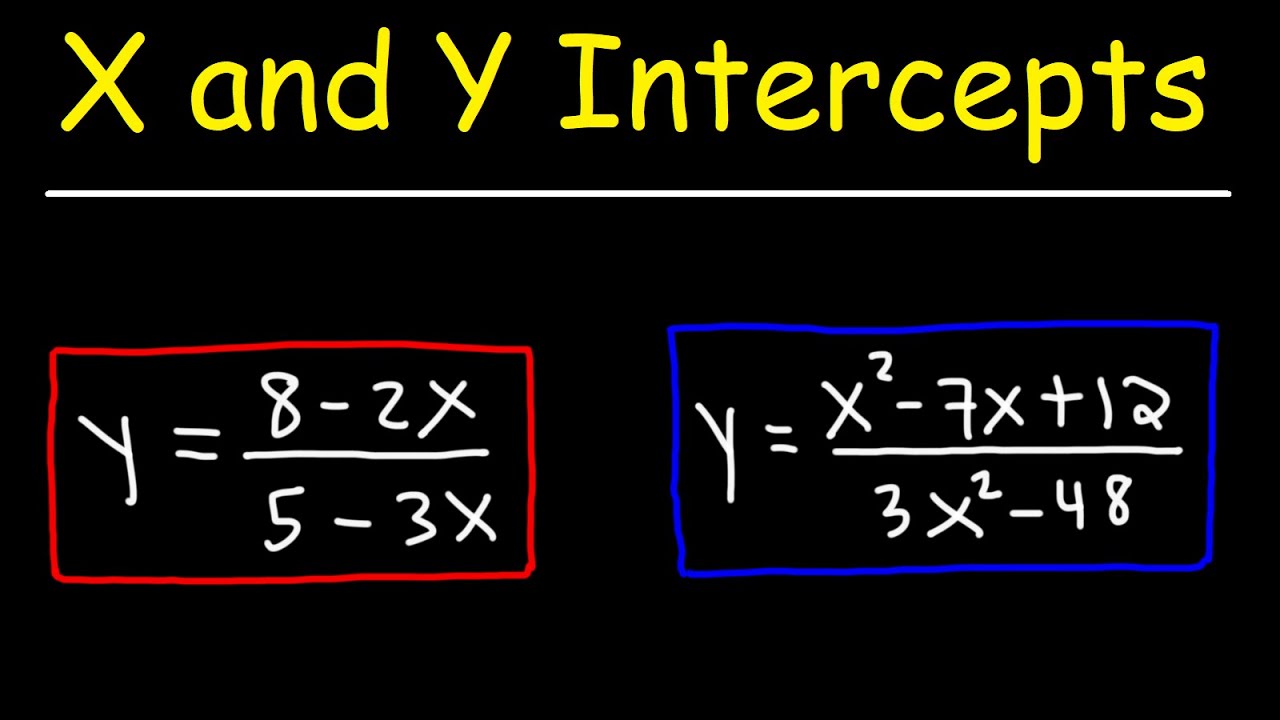
This algebra 2 video tutorial explains how to find the X and Y intercepts of a rational function.
Fundamental Theorem of Algebra: https://www.youtube.com/watch?v=cAfRgqEOURw
Rational Expressions - Basic Intro:
https://www.youtube.com/watch?v=0Gq3uw2p6fA
Simplifying Rational Expressions: ...
this video will help
mellow breach
top one
plucky patio
mellow breach
top one
ty
plucky patio
mellow breach
top one
so a is top.
and c is top as well?
<@&286206848099549185>
nvm
.close
topaz sinewBOT
Closed by @plucky patio
Use .reopen if this was a mistake.
topaz sinewBOT
Available help channel!
Send your question here to claim the channel.
Remember:
• Ask your math question in a clear, concise manner.
• Show your work, and if possible, explain where you are stuck.
• After 15 minutes, feel free to ping <@&286206848099549185>.
• Type the command .close to free the channel when you're done.
• Be polite and have a nice day!
Read #❓how-to-get-help for further information on how to ask a good question, and about conduct in the question channels.
neon iron
 neon iron
Require assistance with the (a) part of this question
what I have done uptill now is that I have drawn this as a Venn diagram
where p is the probability of only A
q is the probability of A intersection B
r is the probability of only B
and s is the proability of neither A nor B
using this I can see that P(B) = q + r
using equation number 1 and 3 I can figure out the value of r
which is equal to 19/40
how do I figure out the value of q?
oh wait nvm
.close
topaz sinewBOT
Closed by @echo oxide
Use .reopen if this was a mistake.
smoky sparrow
anyways
 flint stump
(q+r) = (p+q+r+s) - (p+s)
neon iron
yup
smoky sparrow
nw!
neon iron
yeah
I have a habit of sometimes overcomplicating things
this should've been obvious 😆
thanks so much nevertheless
topaz sinewBOT
Available help channel!
Send your question here to claim the channel.
Remember:
• Ask your math question in a clear, concise manner.
• Show your work, and if possible, explain where you are stuck.
• After 15 minutes, feel free to ping <@&286206848099549185>.
• Type the command .close to free the channel when you're done.
• Be polite and have a nice day!
Read #❓how-to-get-help for further information on how to ask a good question, and about conduct in the question channels.
 tacit turret
One message removed from a suspended account.
topaz sinewBOT
tacit turret
One message removed from a suspended account.
tacit turret
One message removed from a suspended account.
One message removed from a suspended account.
pseudo sonnet
right, so you need to find when the particle is moving to the left 
it is convention to take moving to the right as meaning that v(t) is positive, and to the left to mean v(t) is negative
so you're really being asked "at which of these times is v(t) negative?"
tacit turret
One message removed from a suspended account.
One message removed from a suspended account.
One message removed from a suspended account.
One message removed from a suspended account.
pseudo sonnet
you need the velocity, not the position 
s(t) is the position of the particle 
how do you get velocity from position? 
tacit turret
One message removed from a suspended account.
One message removed from a suspended account.
tacit turret
One message removed from a suspended account.
pseudo sonnet
now at which of those times is v(t) negative?
tacit turret
One message removed from a suspended account.
One message removed from a suspended account.
 fallow heart
Negative means < 0 🙈
neon iron
yup
fallow heart
It's a first degree inequality
pseudo sonnet
tacit turret
One message removed from a suspended account.
that would tell you at what times the velocity is 0
not negative
neon iron
and once you have solved the inequality, you can see which of the points here satisfy the inequality
tacit turret
One message removed from a suspended account.
neon iron
what did you get?
tacit turret
One message removed from a suspended account.
One message removed from a suspended account.
One message removed from a suspended account.
One message removed from a suspended account.
One message removed from a suspended account.
One message removed from a suspended account.
One message removed from a suspended account.
tacit turret
One message removed from a suspended account.
neon iron
,w solve -2t + 7 <0
thorny flameBOT

 Requested by alison_burg3r5
tacit turret
Requested by alison_burg3r5
tacit turret
One message removed from a suspended account.
neon iron
t is greater than 7/2
tacit turret
One message removed from a suspended account.
One message removed from a suspended account.
One message removed from a suspended account.
neon iron
tru tru
tacit turret
One message removed from a suspended account.
neon iron
when you multiply or divide either side of the inequality with negative number
easier way would be to just make the -2t positive
no flippity flippity required
tacit turret
One message removed from a suspended account.
One message removed from a suspended account.
One message removed from a suspended account.
One message removed from a suspended account.
One message removed from a suspended account.
One message removed from a suspended account.
fallow heart
Of course 😅
tacit turret
One message removed from a suspended account.
fallow heart
velocity = 0 means indeed velocity = 0
tacit turret
One message removed from a suspended account.
One message removed from a suspended account.
topaz sinewBOT
Closed by @tacit turret
Use .reopen if this was a mistake.
Available help channel!
Send your question here to claim the channel.
Remember:
• Ask your math question in a clear, concise manner.
• Show your work, and if possible, explain where you are stuck.
• After 15 minutes, feel free to ping <@&286206848099549185>.
• Type the command .close to free the channel when you're done.
• Be polite and have a nice day!
Read #❓how-to-get-help for further information on how to ask a good question, and about conduct in the question channels.
 heavy ingot
Graph of f(x), is this still a local min?
 topaz sinewBOT
heavy ingot
Graph of f(x), is this still a local min?
neon iron
topaz sinewBOT
heavy ingot
Graph of f(x), is this still a local min?
neon iron
yup yup looks like it
topaz sinewBOT
Closed by @heavy ingot
Use .reopen if this was a mistake.
topaz sinewBOT
Available help channel!
Send your question here to claim the channel.
Remember:
• Ask your math question in a clear, concise manner.
• Show your work, and if possible, explain where you are stuck.
• After 15 minutes, feel free to ping <@&286206848099549185>.
• Type the command .close to free the channel when you're done.
• Be polite and have a nice day!
Read #❓how-to-get-help for further information on how to ask a good question, and about conduct in the question channels.


 vestal totem

 golden blade


