#help-26
1 messages · Page 173 of 1
 neon iron
great!
ok but now, i have an issue
because i get $\dfrac{\cos(6x^2)}{x^2} = \sum_{n=0}^\infty (-1)^n \dfrac{6^{2n} \cdot x^{4n-2}}{(2n)!}$
 thorny flameBOT
Derivative
 neon iron
now if i subtract by 1/x^2 how will i incorporate this into the sum?
 neon iron
i dont know
i just did what i could hahah
did i invent math rules?
🤣
that happens to me when im lost hahahah
 vernal matrix
Well, I mean, I'm just being fussy 
vernal matrix
thorny flame
**Derivative**
But, anyways, write out the first few terms of what you have
vernal matrix
Yep 
neon iron
alright let me try
vernal matrix
(but be a bit careful, it's a bit confusing  )
)
(In particular, the term corresponding to the coefficient of x^10)
vernal matrix
You could, or write what you'd basically find $\sum_{n = 1}^{\infty} (-1)^n\frac{6^{2n} \cdot x^{4n - 2}}{(2n)!}$ and see what the $x^{10}$ term's coefficient must be (or just write out the first few terms, shouldn't take too long)
vernal matrix
Not quite, you want x^10, and n = 10 would give you x^38
neon iron
ah ok
n=3 then
ok
but here is my question
my series does look ugly
how do i make it look nicer
thorny flameBOT
@vernal matrix
 neon iron
like you are right the x^4n-2 is pretty ugly
but anyway if there is no other way so be it hahah
vernal matrix
Not that much you can really do that'd make it any nicer 
neon iron
so my answer should be -6^2*3
its wrong for some reason
i must have got the series wrong then
vernal matrix
Actually wait a moment 
Ideally we should have something that's close to the "standard form" when you're centred about 0, the whole $\sum_k \frac{f^{(k)}(0)}{k!} x^k$, but here it's a bit messier as the power and factorial don't quite match up
thorny flameBOT
@vernal matrix

 raven field
just a question what is the first term of the Taylor expansion of cos(6x)
neon iron
i used the taylor exapsnion of cos(x)
and then did cos(6x^2)
and plugged in 6x^2 into x
raven field
But the first term is 1 right ?
vernal matrix
I'd think to just write out the x^10 term and work with it to get it in the right form 
neon iron
raven field
But the first term is 1 right ?
yes
vernal matrix
In particular, it works out as $-6^6 \frac{x^{10}}{6!}$, and if we can make that denominator $10!$, we're happy
thorny flameBOT
@vernal matrix
 raven field
neon iron
yes
raven field
neon iron
yes
Ok so the numerator will be
(1+x^2/2!-x^4/4!….)-1
neon iron
ah ok
but i need cos(6x^2)tho
because thats part of the function
then i divide by x^2
and subtract by 1/x^2 to get the taylor expansion of f(x)
raven field
How about expanding it like this
 vernal matrix
raven field
How about expanding it like this
vernal matrix
raven field
How about expanding it like this
Still get the "not in correct form" thing
Hence my suggestion to write the x^10 term out and manipulate it to be in the right form
raven field
but doesn’t all the terms now divide by x^2 and when x=0 all terms are zero
vernal matrix
I think you're misunderstanding what the question wants
They want the tenth derivative, which is effectively "the stuff that multiplies x^10/10!"
neon iron
vernal matrix
Hence my suggestion to write the x^10 term out and manipulate it to be in the ri...
so what would be the x^10 term though
thats the problem
raven field
ohhhhh I reread the question sorry for the mistakes
vernal matrix
neon iron
so what would be the x^10 term though
The $x^{10}$ term is $-6^6 \frac{x^{10}}{6!}$, but notice the denominator is $6!$ rather than $10!$
thorny flameBOT
@vernal matrix

 topaz sinewBOT
@neon iron Has your question been resolved?
topaz sinewBOT
Channel closed
Closed due to timeout
Use .reopen if this was a mistake.
topaz sinewBOT
 Available help channel!
Send your question here to claim the channel.
Remember:
• Ask your math question in a clear, concise manner.
• Show your work, and if possible, explain where you are stuck.
• After 15 minutes, feel free to ping <@&286206848099549185>.
• Type the command .close to free the channel when you're done.
• Be polite and have a nice day!
Read #❓how-to-get-help for further information on how to ask a good question, and about conduct in the question channels.
topaz sinewBOT
@subtle gulch Has your question been resolved?
topaz sinewBOT
@subtle gulch Has your question been resolved?
Channel closed
Channel closed due to the original message being deleted.
If you did not intend to do this, please open a new help channel,
as this action is irreversible, and this channel may abruptly lock.
 subtle gulch
.close
topaz sinewBOT
Available help channel!
Send your question here to claim the channel.
Remember:
• Ask your math question in a clear, concise manner.
• Show your work, and if possible, explain where you are stuck.
• After 15 minutes, feel free to ping <@&286206848099549185>.
• Type the command .close to free the channel when you're done.
• Be polite and have a nice day!
Read #❓how-to-get-help for further information on how to ask a good question, and about conduct in the question channels.
 broken matrix
can someone tell me why in convolution when we shift the h(t) like integral f(τ)*h(t-τ) dt , why dont we substitute in the "delayed value" ?
topaz sinewBOT
broken matrix
can someone tell me why in convolution when we shift the h(t) like integral f(τ...
 vestal sigil
we prefer leaving it as t and vary it from -oo to +oo
broken matrix
the delayed - shifted value of h(t) over x(t)
broken matrix
vestal sigil
we prefer leaving it as **t** and vary it from -oo to +oo
why
but how the function gonna have the right values?
vestal sigil
because before you evaluate the integral on a certain overlapping interval
you substitute h(t-τ) by the expression of the function in that interval!
its not always the same, it may differ depending on interval
also, when you shift by t0, it becomes h(t0 - τ) right
so youre only finding y(t0) ?
we want to determine the whole signal y(t)
not just one value of it!
broken matrix
and how
vestal sigil
 sweet shard
What substitution are you even talking about
sweet shard
What substitution are you even talking about
this is engineering, linear time-invariant systems 😛
broken matrix
it alter the signal
with delayed signal
after integration
@vestal sigil
that doesnt make any sense to me
vestal sigil
setting t=t0, gives you the value of y(t0) only
but we want the whole signal y(t)
its useless to set t=t0
we vary it from -oo to +oo
to have the value of y(t) for all t in R
vestal sigil
broken matrix
that doesnt make any sense to me
if youre ONLY interested in the response of the system at a certain time t0
then you can let t=t0
broken matrix
oke i got it
vestal sigil
but if you want to determine the entire signal y(t), for all t in R
vestal sigil
im bad at explaining, hopefully you really got it 😛
vestal sigil
if h(t)=sin(t) for example, it does not get altered
its always sin(t)
but if h(t) is a square wave for example, then for some intervals it will be +A and for other intervals it will be -A
you just gotta graphically shift h(τ)
and decide what to substitute for h(t-τ)
based on the overlapping interval
this stuff is hard to explain like this
sweet shard
vestal sigil
this is engineering, linear time-invariant systems 😛
Explains the non existent context
vestal sigil
video on YT is better
vestal sigil
sweet shard
Explains the non existent context
lol
topaz sinewBOT
@broken matrix Has your question been resolved?
Channel closed
Closed by @broken matrix
Use .reopen if this was a mistake.
Available help channel!
Send your question here to claim the channel.
Remember:
• Ask your math question in a clear, concise manner.
• Show your work, and if possible, explain where you are stuck.
• After 15 minutes, feel free to ping <@&286206848099549185>.
• Type the command .close to free the channel when you're done.
• Be polite and have a nice day!
Read #❓how-to-get-help for further information on how to ask a good question, and about conduct in the question channels.
 smoky musk
need help
topaz sinewBOT
smoky musk
need help
smoky musk
Translated: Solve the following Function for x
 sweet shard
Uhhh probably change your username
 agile harness
name is fire
smoky musk
cant
sweet shard
smoky musk
cant
<@&268886789983436800> man needs help username change
agile harness
damn
smoky musk
I dont have the power to change it to "Big" or something like that
sweet shard
Skill issue
smoky musk
naw I dont want to actually change my name
Only for this server so I dont get trouble
agile harness
maybe they changed it for you
smoky musk
smoky musk
Translated: Solve the following Function for x
do you guys know how I can go about my problem?
agile harness
looks like angle sum
smoky musk
thanks for changing
 bright trail
If you want a particular nick I can give you it so long as it is sfw
smoky musk
yeah, the problem is that I have to calculate by hand so I can´t do anything fancy that requires a calc
smoky musk
bright trail
If you want a particular nick I can give you it so long as it is sfw
Joe pls
agile harness
smoky musk
yeah, the problem is that I have to calculate by hand so I can´t do anything fan...
brother
$\sin(u-v) = \sin(u)\cos(v) - \cos(u)\sin(v)$
thorny flameBOT
knief
 agile harness
look familiar?
smoky musk
💀
agile harness
apology accepted
agile harness
brother what
sweet shard
Use the identity knief told you on the right side
sweet shard
smoky musk
Translated: Solve the following Function for x
Of this
 sweet shard
Plug your angle in to the starting equation to check
smoky musk
Kk
agile harness
$\sin(\frac{\pi}{3}) = -\frac{\sqrt{3}}{2}$?
thorny flameBOT
knief

 topaz sinewBOT
Channel closed
Closed by @smoky musk
Use .reopen if this was a mistake.
Available help channel!
Send your question here to claim the channel.
Remember:
• Ask your math question in a clear, concise manner.
• Show your work, and if possible, explain where you are stuck.
• After 15 minutes, feel free to ping <@&286206848099549185>.
• Type the command .close to free the channel when you're done.
• Be polite and have a nice day!
Read #❓how-to-get-help for further information on how to ask a good question, and about conduct in the question channels.
 mild stratus
a pleasant day to anyone there, I'm in real need of help with something
topaz sinewBOT
mild stratus
a pleasant day to anyone there, I'm in real need of help with something
mild stratus
it's somewhat related to physics but certainly applies trig
I just wanna understand it better


got a project wherein we're trying to use a method of sound source localization with the use of two microphones
and I'm having a hard time understanding how the process yields the angle of the sound source

I have some ideas but I still can't quite grasp how the direction of the sound source could be found
original link to the article
 vernal vale
mild stratus
I have some ideas but I still can't quite grasp how the direction of the sound s...
vernal vale
mild stratus
I have some ideas but I still can't quite grasp how the direction of the sound s...
which part is giving you issues?
mild stratus
I don't understand the relation of the sin function to finding the sound source
where the specific angle is too
thx for the response btw
vernal vale

theres a lot in this diagram
Do you wanna go over it a little
or do you feel like you generally get the diagram
since it really kinda says it all
mild stratus
mhm, I would like a bit of an explanation, that would be nice
vernal vale
okay, so you understand those two red lines, theyre the sound, and they come from a single point
they move at the same speed, and the speed doesnt change, in this picture
vernal vale

 mild stratus
mhm, on temp I believe
vernal vale
humidity and other stuff
mild stratus
mhm
vernal vale
but youre probably talking about a change in ... whatever 330 to 340
over a distance of whatever, 2 meters?
youll have more errors from latency than using the wrong constant
or idk i say that, id have to crunch the numbers 
anyways
vernal vale
vernal vale
heres a different drawing of the same picture
so the blue lines connect the waves at certain points in time
just imagine the red lines as individual sound waves, and they leave the object at the same time, at the same speed
but in different directions
so the distance between them grows, but we can always draw a line between them at some instant in time, and these will always be parallel to other lines we could draw at some other time
good to there? @mild stratus
mild stratus
vernal vale
youll have more errors from latency than using the wrong constant
def worried 'bout that mhm
mild stratus
vernal vale
good to there? <@769109507938713620>
yep, so far so good
vernal vale
okay
one of these blue lines is in your other diagram

its the adjacent side to the marked alpha angle
so for some t value, both sound waves are at exactly the same place
lets call the left wave Wave 1, it's just hit the first microphone
but the right wave, Wave 2, is a little bit behind from hitting microphone 2
it takes a little bit longer, since the distance is a little longer, it actually takes t+ delta t to reach microphone 2
and in that time, it moves the final delta s remaining distance, from where it was just behind, to finally hitting the microphone 2
Thats almost the entire physical picture. The only other piece is to know that the tiny distance it traveled, delta s, is just the speed it was moving, multiplied by the time it spent traveling
@mild stratus physical picture good?
mild stratus
oop, sorry for the late reply, hold on
mild stratus
vernal vale
and in that time, it moves the final delta s remaining distance, from where it w...
oh alright, that makes sense
mild stratus
vernal vale
Thats almost the entire physical picture. The only other piece is to know that t...
mhm
vernal vale

there is a tiny simplification were applying here, but you might not even notice/care
mild stratus
oh? alright
vernal vale
important parts here
we know d, in fact we can choose it by moving the microphones, so that's known
mild stratus
right
vernal vale
we "know" the speed of sound, and we are measuring delta t, so delta s is known
mild stratus
yep
vernal vale
now its just normal ol right triangle math
thorny flameBOT
jan Niku
 vernal vale
since SOH (cah toa)
and we're there 
a more advanced geometry problem: Remember that the blue lines are only parallel to each other, and they are actually all different lengths
so where we drew a right angle, its actually a LITTLE bigger than 90 (how much bigger? what's the error we incur by assuming its only 90?)
but maybe for another day
mild stratus
vernal vale
and we're there <:happy:908558103992225822>
oo woah
mild stratus
vernal vale
also question, could angle alpha there perhaps also act as the angle that points towards the sound source?
vernal vale
yea, and it's shown like this in your original drawing. It's just some basic complementary/supplementary angle line-drawing and angle-matching logic to get there
mild stratus
vernal vale
so where we drew a right angle, its actually a LITTLE bigger than 90 (how much b...
that is an interesting question lol
vernal vale

youll have to do some work
but not a lot
remember alpha picks up the error that you make in the 90 degree part
so that's going to track
but there's other errors as well
if you actually implement this and start getting crazy results that dont make sense
maybe thats the time to start doing some of this more crazy math
vernal vale
vernal vale
like here i think that Wave 1 makes an angle 90 + alpha with the wall?
so maybe you imagine that alpha to the left from a directly vertical line points to the sound source
like is drawn to the other side
mild stratus
vernal vale
yea, and it's shown like this in your original drawing. It's just some basic com...
oo I see, will have to review a bit on those, the idea I sorta have is that the angle of the sound source from mic 2 could be taken with "90°"-alpha
mild stratus
hope so too, thanks so much for your help
vernal vale

mild stratus
this problem has stunted me for days now and I couldn't find any sources on the Internet that tackled it in a simple way
much appreciated
topaz sinewBOT
@mild stratus Has your question been resolved?
mild stratus
Yes
topaz sinewBOT
Channel closed
Closed due to timeout
Use .reopen if this was a mistake.
Available help channel!
Send your question here to claim the channel.
Remember:
• Ask your math question in a clear, concise manner.
• Show your work, and if possible, explain where you are stuck.
• After 15 minutes, feel free to ping <@&286206848099549185>.
• Type the command .close to free the channel when you're done.
• Be polite and have a nice day!
Read #❓how-to-get-help for further information on how to ask a good question, and about conduct in the question channels.
 distant shadow
 topaz sinewBOT
distant shadow
distant shadow
topaz sinewBOT
distant shadow
distant shadow
Can anyone see where i went wrong in this partial derivitive question?
original function is $F(x,y)=-3x^{2}-6y^{2}+3xy=0$
thorny flameBOT
epi

 gleaming reef
distant shadow
gleaming reef
distant shadow
yeah i have that in other parts i just forgot to add it it when i was rewriting it for discord
oopsies
oh shit
at the end i missed it
that is correct thank you
<3
.close
topaz sinewBOT
Channel closed
Closed by @distant shadow
Use .reopen if this was a mistake.
Available help channel!
Send your question here to claim the channel.
Remember:
• Ask your math question in a clear, concise manner.
• Show your work, and if possible, explain where you are stuck.
• After 15 minutes, feel free to ping <@&286206848099549185>.
• Type the command .close to free the channel when you're done.
• Be polite and have a nice day!
Read #❓how-to-get-help for further information on how to ask a good question, and about conduct in the question channels.
 safe mica
 safe mica
does this check out?
can i use cos(s+t) to figure out what quadrant (s+t) is in
and so on for all trig functions of that expression
topaz sinewBOT
@safe mica Has your question been resolved?
safe mica
 mental trench
what class is this?
mental trench
what class is this?
precal
safe mica
mental trench
can't you convert sin(s+t) into sin(s)cos(t) + cos(s)sin(t)?
yeah thats what i did in the work
thats an identity

the result of sin(s+t) they want to know what quadrant is so i just figured if i did the identity for cos(s+t) it would work? and that would be sufficient enough to show it's quadrant 3 since the result of cos(s+t) is positive and since the result of sin(s+t) is negative it cant be quadrant 1 so maybe it must be 3
mental trench
yeah I think its Q3 too
topaz sinewBOT
@safe mica Has your question been resolved?
topaz sinewBOT
Channel closed
Closed due to timeout
Use .reopen if this was a mistake.
Available help channel!
Send your question here to claim the channel.
Remember:
• Ask your math question in a clear, concise manner.
• Show your work, and if possible, explain where you are stuck.
• After 15 minutes, feel free to ping <@&286206848099549185>.
• Type the command .close to free the channel when you're done.
• Be polite and have a nice day!
Read #❓how-to-get-help for further information on how to ask a good question, and about conduct in the question channels.
 quiet sorrel
so i understand the solution, but i just want to clarify a few things:
- is the conjugate of z in polar form always r*e^-iθ?
- is r^2 = 1 always true in regards to complex numbers?
 topaz sinewBOT
quiet sorrel
so i understand the solution, but i just want to clarify a few things:
1. is the...
quiet sorrel
topaz sinewBOT
quiet sorrel
so i understand the solution, but i just want to clarify a few things:
1. is the...
quiet sorrel
answer is 7 btw
 cursive patrol
r^2 = 1 misses the point
r can be any real value, but e^(i angle) is what you know to have a magnitude of 1
(ans to ur first question is yes)
quiet sorrel
cursive patrol
r can be any real value, but e^(i angle) is what you know to have a magnitude of...
but how does that make r^2 = 1
 molten raven
quiet sorrel
but how does that make r^2 = 1
molten raven
quiet sorrel
but how does that make r^2 = 1
r=1 when r=/=0 by considering the magnitude
e^(6 i theta) always has magnitude 1 so r has magnitude 1 when it isn’t 0
topaz sinewBOT
@quiet sorrel Has your question been resolved?
Channel closed
Closed by @quiet sorrel
Use .reopen if this was a mistake.
topaz sinewBOT
Available help channel!
Send your question here to claim the channel.
Remember:
• Ask your math question in a clear, concise manner.
• Show your work, and if possible, explain where you are stuck.
• After 15 minutes, feel free to ping <@&286206848099549185>.
• Type the command .close to free the channel when you're done.
• Be polite and have a nice day!
Read #❓how-to-get-help for further information on how to ask a good question, and about conduct in the question channels.
 dusk raft
 dusk raft
do I deserve the mark
 hallow shuttle
yup
 somber socket
Just that
dusk raft
😔
somber socket
You have to explain how to got 60
You just wrote 60 bc it worked
Didn’t actually say why it had to be 60
You can’t use the answer given to use to help justify
topaz sinewBOT
Channel closed
Closed by @dusk raft
Use .reopen if this was a mistake.
topaz sinewBOT
Available help channel!
Send your question here to claim the channel.
Remember:
• Ask your math question in a clear, concise manner.
• Show your work, and if possible, explain where you are stuck.
• After 15 minutes, feel free to ping <@&286206848099549185>.
• Type the command .close to free the channel when you're done.
• Be polite and have a nice day!
Read #❓how-to-get-help for further information on how to ask a good question, and about conduct in the question channels.
 royal sky
 royal sky
what is it asking here?
 flint stump
Every solution of the first system, when pre-multiplied by S, is a solution to the second system
the question asks you to prove that
topaz sinewBOT
Channel closed
Closed by @royal sky
Use .reopen if this was a mistake.
Available help channel!
Send your question here to claim the channel.
Remember:
• Ask your math question in a clear, concise manner.
• Show your work, and if possible, explain where you are stuck.
• After 15 minutes, feel free to ping <@&286206848099549185>.
• Type the command .close to free the channel when you're done.
• Be polite and have a nice day!
Read #❓how-to-get-help for further information on how to ask a good question, and about conduct in the question channels.
 trim dove
What have i done wrong here
 topaz sinewBOT
trim dove
What have i done wrong here
topaz sinewBOT
trim dove
What have i done wrong here
 cunning kayak
send ques

 sudden temple
trim dove
What have i done wrong here
sudden temple
trim dove
What have i done wrong here
where the logarithm disappeared
that's a mistake
topaz sinewBOT
@trim dove Has your question been resolved?
Channel closed
Closed by @trim dove
Use .reopen if this was a mistake.
trim dove
.close
topaz sinewBOT
Available help channel!
Send your question here to claim the channel.
Remember:
• Ask your math question in a clear, concise manner.
• Show your work, and if possible, explain where you are stuck.
• After 15 minutes, feel free to ping <@&286206848099549185>.
• Type the command .close to free the channel when you're done.
• Be polite and have a nice day!
Read #❓how-to-get-help for further information on how to ask a good question, and about conduct in the question channels.
 visual monolith
Hi I have a question about checking work for antiderivatives, so I have the equation f(x)=(x^2)/4 +1 so the general antiderivative would be F(x)=(x^3)/12+x+C
I am a bit confused on how to check the answer for F(x)
topaz sinewBOT
visual monolith
Hi I have a question about checking work for antiderivatives, so I have the equa...
 pseudo sonnet
visual monolith
Hi I have a question about checking work for antiderivatives, so I have the equa...
pseudo sonnet
visual monolith
Hi I have a question about checking work for antiderivatives, so I have the equa...
differentiate it
you should get back f(x)
F'(x) = f(x)
topaz sinewBOT
Channel closed
Closed by @visual monolith
Use .reopen if this was a mistake.
pseudo sonnet
topaz sinewBOT
Available help channel!
Send your question here to claim the channel.
Remember:
• Ask your math question in a clear, concise manner.
• Show your work, and if possible, explain where you are stuck.
• After 15 minutes, feel free to ping <@&286206848099549185>.
• Type the command .close to free the channel when you're done.
• Be polite and have a nice day!
Read #❓how-to-get-help for further information on how to ask a good question, and about conduct in the question channels.
 clear scroll
can I carryout an anova analysis if my variable are not correlated.
topaz sinewBOT
clear scroll
can I carryout an anova analysis if my variable are not correlated.
@clear scroll Has your question been resolved?
topaz sinewBOT
Channel closed
Closed due to timeout
Use .reopen if this was a mistake.
Available help channel!
Send your question here to claim the channel.
Remember:
• Ask your math question in a clear, concise manner.
• Show your work, and if possible, explain where you are stuck.
• After 15 minutes, feel free to ping <@&286206848099549185>.
• Type the command .close to free the channel when you're done.
• Be polite and have a nice day!
Read #❓how-to-get-help for further information on how to ask a good question, and about conduct in the question channels.
clear scroll
topaz sinew
<@787972836513808405> Has your question been resolved?
no...
 outer salmon
.close
topaz sinewBOT
Channel closed
Closed by @outer salmon
Use .reopen if this was a mistake.
Available help channel!
Send your question here to claim the channel.
Remember:
• Ask your math question in a clear, concise manner.
• Show your work, and if possible, explain where you are stuck.
• After 15 minutes, feel free to ping <@&286206848099549185>.
• Type the command .close to free the channel when you're done.
• Be polite and have a nice day!
Read #❓how-to-get-help for further information on how to ask a good question, and about conduct in the question channels.
 elfin niche
How do you solve for x :
topaz sinewBOT
elfin niche
How do you solve for x :
elfin niche
$2log_{2}X - log_{2}(x+3) = 2$
thorny flameBOT
Beersathought
 thorny flameBOT
Beersathought
 elfin niche
Not sure where to go on from there though
 restive inlet
raise 2 to the power of each side
(apply the definition of log / relation between exponents and log)
elfin niche
I also saw that explanation, but how does it work really?
u mean like
$2^{log_{2}\frac{x^2}{x+3}} = 2^{2}$
thorny flameBOT
Beersathought
 restive inlet
yeh
thorny flameBOT
Beersathought
 elfin niche
is there no other way than this?
restive inlet
not really, no
thorny flameBOT
Beersathought
 thorny flameBOT
Beersathought
 elfin niche
so always by the base?
restive inlet
yes
thorny flameBOT
Beersathought
 elfin niche
$M = N$
thorny flameBOT
Beersathought
 restive inlet
its fine
topaz sinewBOT
Channel closed
Closed by @elfin niche
Use .reopen if this was a mistake.
topaz sinewBOT
Available help channel!
Send your question here to claim the channel.
Remember:
• Ask your math question in a clear, concise manner.
• Show your work, and if possible, explain where you are stuck.
• After 15 minutes, feel free to ping <@&286206848099549185>.
• Type the command .close to free the channel when you're done.
• Be polite and have a nice day!
Read #❓how-to-get-help for further information on how to ask a good question, and about conduct in the question channels.
neon iron
question about the minimal number of edges in a graph: at the beginning of the section they said that they assume G to be always a multi-graph that is connected. Here they are saying the minimal amount of edges for G are nk/2 for k being the minimal possible degree. but shouldn't the minimal number of edges in a connected graph be n-1 (a tree)? Correct me if I am wrong
 topaz sinewBOT
neon iron
question about the minimal number of edges in a graph: at the beginning of the s...
topaz sinewBOT
neon iron
question about the minimal number of edges in a graph: at the beginning of the s...
 craggy haven
I'm not sure what their μ is but in a tree the minimum degree is 1 (or 0 for degenerate cases)
topaz sinewBOT
@neon iron Has your question been resolved?
neon iron
craggy haven
I'm not sure what their μ is but in a tree the minimum degree is 1 (or 0 for deg...
sorry, forgot to metion that; μ is the size of the minimal cut
and sorry, I also noticed something just now; what i am specifically asking is what if minimal degree is 1? could we then even say |E| <= n-1, since a connected graph with minimal degree 1 has as least as many edges as a tree with n vertices?
when the graph also has n vertices ofc
topaz sinewBOT
@neon iron Has your question been resolved?
topaz sinewBOT
@neon iron Has your question been resolved?
neon iron
.close
topaz sinewBOT
Channel closed
Closed by @spare summit
Use .reopen if this was a mistake.
topaz sinewBOT
Available help channel!
Send your question here to claim the channel.
Remember:
• Ask your math question in a clear, concise manner.
• Show your work, and if possible, explain where you are stuck.
• After 15 minutes, feel free to ping <@&286206848099549185>.
• Type the command .close to free the channel when you're done.
• Be polite and have a nice day!
Read #❓how-to-get-help for further information on how to ask a good question, and about conduct in the question channels.
 karmic widget
find the general term
 topaz sinewBOT
karmic widget
find the general term
topaz sinewBOT
topaz sinewBOT
karmic widget
find the general term
topaz sinewBOT
@karmic widget Has your question been resolved?
topaz sinewBOT
Channel closed
Closed due to timeout
Use .reopen if this was a mistake.
Available help channel!
Send your question here to claim the channel.
Remember:
• Ask your math question in a clear, concise manner.
• Show your work, and if possible, explain where you are stuck.
• After 15 minutes, feel free to ping <@&286206848099549185>.
• Type the command .close to free the channel when you're done.
• Be polite and have a nice day!
Read #❓how-to-get-help for further information on how to ask a good question, and about conduct in the question channels.
 lusty cedar
 topaz sinewBOT
lusty cedar
lusty cedar
topaz sinewBOT
lusty cedar
lusty cedar
I need some help
so basically
I write it as an exponential to the power of a half
then I get 1/2(3-sin^2x)^-1/2 times the deravative of the inside which is -2cos x i think
so -1/2cos^2x(3-sin^2x)^-1/2

but this is the answer
restive inlet
times the deravative of the inside which is -2cos x i think
derivative is wrong
you forgot about the second application of chain rule for the derivative of sin^2(x)
lusty cedar
2sinxcox x
ah
damn
thanks
Im rly quite lost on this one

I tried bringing the power down
and deravative of the inside
isnt that 1/tanx x -cotx
well its sec^2 x apparently not cot x
tf
lusty cedar
shit u have to use quotient to derive that
they give it in my formula booklet anyway
 static viper
No
static viper
Derivative of ln(tanx) = 1/tanx * derivative of (tanx)
lusty cedar
yeah i derived tanx wrong


I had gotten -4xsin(x^2+1)
by doing du/dx times dy/du
why is there still a cos^2(x^2+1)?
topaz sinewBOT
@lusty cedar Has your question been resolved?
restive inlet
why is there still a cos^2(x^2+1)
there isn't
just cos(x^2+1)
similar to the previous questions, there are two applications of chain rule
from the first application you'll have
2cos(x^2+1) * d/dx (cos(x^2+1))
topaz sinewBOT
@lusty cedar Has your question been resolved?
lusty cedar
restive inlet
from the first application you'll have
2**cos(x^2+1)** * d/dx (cos(x^2+1))
Thanks
topaz sinewBOT
Channel closed
Closed by @lusty cedar
Use .reopen if this was a mistake.
Available help channel!
Send your question here to claim the channel.
Remember:
• Ask your math question in a clear, concise manner.
• Show your work, and if possible, explain where you are stuck.
• After 15 minutes, feel free to ping <@&286206848099549185>.
• Type the command .close to free the channel when you're done.
• Be polite and have a nice day!
Read #❓how-to-get-help for further information on how to ask a good question, and about conduct in the question channels.
 reef field
Hey there folks, if I could get some help walking through a question similar to this I would appreciate it.
 topaz sinewBOT
reef field
Hey there folks, if I could get some help walking through a question similar to ...
pseudo sonnet
reef field
Hey there folks, if I could get some help walking through a question similar to ...
topaz sinewBOT
reef field
Hey there folks, if I could get some help walking through a question similar to ...
pseudo sonnet
reef field
Hey there folks, if I could get some help walking through a question similar to ...
you need to find the points where g(x) has either an asymptote or a hole
those points will not be in the domain of g(x)
asymptotes occur when at points where we divide by 0 (without 0 in the numerator also), and holes occur at points where when plugging a number into g(x) gets you something looking like 0/0
so our job here is to find at what numbers we’ll be dividing by 0, or getting a hole
once we do that, we’ll know that the domain of g(x) is simply all of R minus those problematic numbers
now since we care about division by 0, a good first step to take is to examine which numbers make the denominator 0, which means setting it to 0 and solving for x
 barren ember
I think the way to solve it should be via wavy curve method
topaz sinewBOT
Channel closed
Closed by @reef field
Use .reopen if this was a mistake.
pseudo sonnet
topaz sinewBOT
Available help channel!
Send your question here to claim the channel.
Remember:
• Ask your math question in a clear, concise manner.
• Show your work, and if possible, explain where you are stuck.
• After 15 minutes, feel free to ping <@&286206848099549185>.
• Type the command .close to free the channel when you're done.
• Be polite and have a nice day!
Read #❓how-to-get-help for further information on how to ask a good question, and about conduct in the question channels.
 sleek prism
@neon iron
topaz sinewBOT
sleek prism
<@456226577798135808>
sleek prism
👍

 neon iron
${c = c_1 + c_2}$, no?
thorny flameBOT
icannotdoanymorecauchy
 neon iron
so $c^2 = c_1^2 + 2c_1c_2 + c_2^2$
sleek prism
Am a little confused with the handwritting
thorny flameBOT
icannotdoanymorecauchy


 neon iron
also
neon iron
neon iron
u can prove this using right triangle too
maybe i overcomplicate
if u're interested:
https://youtu.be/_gTClIbHreI?si=yq9VrFWA9EpvMYYb

This inequality is famous in math competitions and in theoretical proofs. But why is it true? The video presents a great geometric visualization and proof for two variables. Pay attention--I'll use this inequality in an upcoming video!
Desmos.com link
https://www.desmos.com/calculator/6kbruja3wb
Link to proofs of generalized case
https://artof...
topaz sinewBOT
Channel closed
Closed by @sleek prism
Use .reopen if this was a mistake.
Available help channel!
Send your question here to claim the channel.
Remember:
• Ask your math question in a clear, concise manner.
• Show your work, and if possible, explain where you are stuck.
• After 15 minutes, feel free to ping <@&286206848099549185>.
• Type the command .close to free the channel when you're done.
• Be polite and have a nice day!
Read #❓how-to-get-help for further information on how to ask a good question, and about conduct in the question channels.
 shut rose
Why are there more reals between 0 and 1 than naturals?
Here's the explanation I heard:
Assign every real number a natural "index", like so:
0 - 0.123...
1 - 0.456...
2 - 0.999...
Then, make a new real number by taking the nth decimal of the nth real, adding 1, or making it a zero if it is a 9. So our new number would be 0.260..., and it's nowhere in the list.
The reason I don't understand that this as proof is the fact that we have an unending amount of naturals. Even when we come up with a new real number, can't we just come up with a new natural? Instead of doing it the way above, I could assign each real number between 0 and 1 an identical natural, except I remove the decimal point and increment the one's digit. So, 0.0123... has 10123.., 0 has 1, and 1 has 2. Another way I could do it is Hilbert's Hotel style. Increment every index and insert the new number created by diagonalization at the beginning.
topaz sinewBOT
shut rose
Why are there more reals between 0 and 1 than naturals?
Here's the explanation I...
neon iron
the thing is
there will always be at least one more new real number than the natural that u will come up with
 prisma mesa
neon iron
there will always be at least one more new real number than the natural that u w...
prisma mesa
neon iron
there will always be at least one more new real number than the natural that u w...
Infinitely many more in fact
neon iron
sorry
shut rose
neon iron
there will always be at least one more new real number than the natural that u w...
And why is that? I just said in my question how you could deal with that new number.
prisma mesa
shut rose
Why are there more reals between 0 and 1 than naturals?
Here's the explanation I...
Imagine that every single one of the infinitely many naturals is already matched with a real, then u cant come up with new natural
 whole geode
No, Hilbert Hotel is valid method of dealing with it
shut rose
prisma mesa
Imagine that **every** single one of the infinitely many naturals is already mat...
You're telling me something I already know. I want to know why it is that way.
whole geode
The idea is you can always generate more reals that you haven't accounted for. And if you start from the assumption that you've accounted for all of the reals already, then this is a contradiction
So your assumption (that there is an enumerable list of reals) is false
 burnt badger
Well idk how to prove it rigorously but consider this
Let's say that for each natural number, that there are many cousins of that number as such:
For n = 1, let
.1
.01
.001
.0001
Etc etc
Be the "cousins" of 1
If you think of it this way
Just for the number 1
You'd have an infinite number of "cousins"
And that's only rational numbers too
whole geode
burnt badger
And that's only rational numbers too
Which is wrong, because a bijection exists between rationals and integers
shut rose
whole geode
The idea is you can always generate more reals that you haven't accounted for. A...
But I can assign a natural for each new real
I said how in the question
whole geode
But you assumed that you already had a complete list
prisma mesa
shut rose
But I can assign a natural for each new real
Not really, because all naturals are already asigned.
shut rose
prisma mesa
Not really, because all naturals are already asigned.
How so? There is an infinite amount of naturals. I can't assign all of them because there is always a bigger natural
prisma mesa
shut rose
How so? There is an infinite amount of naturals. I can't assign all of them beca...
You can. E.g. f(n) = 1/n assigns each natural
burnt badger
Actually is this a countable vs uncountable question?
shut rose
whole geode
But you assumed that you already had a complete list
That's the explanation I heard. Where you "imagine" you have a complete list but then you create a new number through the diagonalization method, but I just said how I could account for that new number
prisma mesa
you need to imagine that all of them are already matched
 hearty turret
shut rose
How so? There is an infinite amount of naturals. I can't assign all of them beca...
hearty turret
shut rose
How so? There is an infinite amount of naturals. I can't assign all of them beca...
infinities gets a little confusing and so a lot of our intuitions don't carry over nicely
prisma mesa
yes, you cant write out a full infinite list, but you need to imagine that such list exists
prisma mesa
shut rose
That's the explanation I heard. Where you "imagine" you have a complete list but...
Are you familiar with functions?
hearty turret
shut rose
That's the explanation I heard. Where you "imagine" you have a complete list but...
but basically the argument is suppose that there were 'the same number' of real numbers between 0 and 1 and natural numbers
if there were, then you could tell me a list of how to pair them up:
i.e. 1 -> 0.001 etc. as u've done up there
prisma mesa
hearty turret
if there were, then you could tell me a list of how to pair them up:
and that list would be complete. Every natural would get mapped
hearty turret
hearty turret
i.e. 1 -> 0.001 etc. as u've done up there
the fact that we can create a number not on the list means that it must be impossible to pair them up as i've described above
shut rose
But that assumes that all naturals are already assigned, but what about the hilbert hotel method? Or pairing them up like this: 0.001 -> 1001 (removing the decimal point and replacing 0 with 1). Whatever real I would create I could convert it to another natural
burnt badger
The irrational numbers specifically make this impossible
You can identify, in a systematic, countable way all the rationals between 0 and 1
prisma mesa
Assume that there is a bijective function f: N -> [0, 1].
So e.g.
f(1) = 0.123456789...
f(2) = 0.234567890...
f(3) = 0.531411433151....
etc...
Now you can do the trick, and come up with a number in [0, 1] that isn't in the range of f, and hence f can't be bijective.
hearty turret
shut rose
But that assumes that all naturals are already assigned, but what about the hilb...
ur pairing doesn't work cus 0.3333333... etc. isn't paired with anything
burnt badger
But how would you do that for irrational?
hearty turret
shut rose
But that assumes that all naturals are already assigned, but what about the hilb...
idk what u mean by the hilbert hotel method
burnt badger
Which is the first irrational number to start counting
hearty turret
shut rose
But that assumes that all naturals are already assigned, but what about the hilb...
but yeah we're assuming the naturals are already paired bcus we're doing a proof by contradiction
r u familiar with what a proof by contradiction is?
shut rose
hearty turret
idk what u mean by the hilbert hotel method
If I have:
0 -> 0.123...
1 -> 0.456
And I come up with a new real, I increment the indexes and insert the new real at the beginning:
0 -> new real
1 -> 0.123...
2 -> 0.456...
I can always add 1 to a natural so I will never run out of indexes
hearty turret
shut rose
If I have:
0 -> 0.123...
1 -> 0.456
And I come up with a new real, I increment t...
right this is where our intuition doesn't carry over so nicely
because there's just too many real numbers
u'd never be able to fit them all
shut rose
I would because I can always increment a natural number
prisma mesa
shut rose
If I have:
0 -> 0.123...
1 -> 0.456
And I come up with a new real, I increment t...
The problem is that the 2nd list will be also incomplete
You are not thinking in terms of contradiction here
the proof is by contradiction
shut rose
prisma mesa
The problem is that the 2nd list will be also incomplete
I know but I would do this infinitely many times
hearty turret
hearty turret
r u familiar with what a proof by contradiction is?
^?
it feels like ur confusion is coming from here
shut rose
What is the contradiction
prisma mesa
You assume that there is a matching that's already perfect
meaning that for every number between 0 and 1, some natural already maps to it
but then you can do that diagonalization trick, and come up with a real number which isnt in the matching
and that's your contradiction
hearty turret
shut rose
I know but I would do this infinitely many times
also there's a bit of an issue with 'do infinitely many times' here
shut rose
prisma mesa
but then you can do that diagonalization trick, and come up with a real number w...
Yeah but I would just fit it into the list with the hilbert hotel method
prisma mesa
because you've shown that every perfect matching is actually imperfect
prisma mesa
shut rose
Yeah but I would just fit it into the list with the hilbert hotel method
I mean, sure, you can. But it will show nothing.
hearty turret
hearty turret
also there's a bit of an issue with 'do infinitely many times' here
if you look at proofs that use 'do infinitely many times', it'll be with countable sets and u'll be doing it from the end
u're adding stuff to the end
but there's a problem with 'do infinitely many times' at the start
prisma mesa
The proof already shows that a perfect matching cannot exist. Yes, you can make it better by adding that 1 real number, but you wont get a perfect matching anyway
hearty turret
because you're saying we've got a bijection f that maps from N to [0,1]
hearty turret
shut rose
If I have:
0 -> 0.123...
1 -> 0.456
And I come up with a new real, I increment t...
u've defined it by doing a list like this, and then for any real that's missing you add it to the front
and then you do this infinitely many times for each missing real
but the problem here is that f(1) isn't defined now
hearty turret
prisma mesa
❓
as in with their hypothetical function f, they've constructed it by shifting it infinitely many times
but that's not well defined cus f(1) isn't really defined
prisma mesa
why would f(1) be undefined?
prisma mesa
hypothetically, you cant just shift it for each missing real
hearty turret
and then i continuously add i.e. 1/(n+0.5) to the front
and i define f by doing this process infinitely many times
prisma mesa
there is no axiom / proof method in math that allows you to execute this step infinitely many times
hearty turret
hearty turret
and i define f by doing this process infinitely many times
then f(1) is no longer defined
prisma mesa
hearty turret
then f(1) is no longer defined
f(1) would be the "new real" number, wouldnt it?
hearty turret
each of f_1, f_2, f_3 (where f_1 = 1/n but with 1/1.5 shoved in at the front etc.) are well-defined but f_omega isn't
hearty turret
prisma mesa
f(1) would be the "new real" number, wouldnt it?
the thing is they want to do the process infinitely and f isn't really converging to anything here
prisma mesa
hearty turret
the thing is they want to do the process infinitely and f isn't really *convergi...
yeah, it's probably not
hearty turret
anyway that's another reason why their thing doesn't work
prisma mesa
uh
hearty turret
prisma mesa
because you've shown that every perfect matching is actually imperfect
but yeah ^
prisma mesa
I'll just repost the proof here
Assume that there is a bijective function f: N -> [0, 1].
So e.g.
f(1) = 0.123456789...
f(2) = 0.234567890...
f(3) = 0.531411433151....
etc...
Now you can do the trick, and come up with a number in [0, 1] that isn't in the range of f, and hence f can't be bijective.
This proof shows that every perfect matching is missing some real.
Hence no perfect matching can exist
shut rose
Yeah but I can add it to the list...
I will never run out of natural numbers to assign to the reals
vernal matrix
But the thing is, you assumed you had everything in the list, that nothing was missing, but there will always be something missing
Even if you add it, there’s gonna be another thing you’re missing from the list
hearty turret
shut rose
Yeah but I can add it to the list...
also i explained up there why ur method of adding to the list also doesn't work
cus you can't just repeat the process infinitely many times
shut rose
yeah didn't really get that
hearty turret
ok so maybe let's break this down to
there's the same number of positive integers and integers right?
how do u know that?
shut rose
Two sets have the same cardinality if I can make a one to one pairing for each item, which I can do with naturals and reals
Any real is just the last natural in the list + 1
I won't ever run out of naturals so I can always pair them
hearty turret
shut rose
Two sets have the same cardinality if I can make a one to one pairing for each i...
well ok the key thing here is that you can make a 1-to-1 pairing
shut rose
ok so same size
hearty turret
so can u provide me a proof of why the cardinality of N and Z are the same?
shut rose
I just did
prisma mesa
shut rose
Yeah but I can add it to the list...
It still wont be perfect though
prisma mesa
prisma mesa
This proof shows that every perfect matching is missing some real.
because of this.
prisma mesa
I'll have to use hilberts hotel to destroy your argument then 
shut rose
I used hilberts hotel to make the argument work
prisma mesa
and ill use it to show that your argument doesnt work lol
Okay, so you are saying that if you have hilbert's hotel with all rooms filled, then you can acommodate infinitely many guests by shifting the guests
So say that "Guest 1" lives in Room 1, Guest 2 lives in Room 2 etc...
now suppose that infinitely many new guests arrive, and form a queue
ill then call the first one in the queue "Guest -1" and send him to the first room, while sending guest 1 to 2nd room, guest 2 to 3rd room etc...
performing your shifting
then I'll call the 2nd one in the queue "Guest -2" and send him to the first room, again shifting all the guests
and then I'll do the same for all the remaining guests
my question now is, in what room will "Guest 1" end?
shut rose
cardinality of Z?
prisma mesa
shut rose
cardinality of Z?
that's his room number?
prisma mesa
yeah, that doesnt sound like a natural number to me...
and rooms in hilbert's hotel are only numbered with natural numbers
and that's where your argument crumbles down
you cant do this infinite shifting
because the guests won't end up occupying rooms numbered with finite numbers
they'll essentially end up outside of the hotel
without any room to live in...
shut rose
natural numbers are not finite though
prisma mesa
shut rose
natural numbers are not finite though
Yes, but every natural number is finite
51351353 is finite
6251349889135781357080135890 is finite too
but Guest 1 won't live in any finitely-numbered room
prisma mesa
shut rose
you could fit another N into N right?
Yes, but not by this infinite-shifting
you would need to send guest in room n to room 2n
then all odd rooms will be empty
and you can fit the another N to them
the difference between these 2 ways of doing it is that in the second one, you can actually tell in which room will which guest end up.
In your shifting method, you can't tell that. And furthermore, you even know that e.g. guest 1 can't be in any room
shut rose
Ok so I can't say where Guest 1 is if I add infinitely many guests to the start, but I also can't say where the last guest is if I just take the normal hotel with no extra numbers
prisma mesa
shut rose
Ok so I can't say where Guest 1 is if I add infinitely many guests to the start...
yes, because there is no last guest
but you can tell where guest 531513513135 is
and where guest 15335Z13501359818390586138506890135689096853861906895 is
and where any guest is
shut rose
If there's no last guest then there's no last room
prisma mesa
every guest has a number, say N. And that guest lives in room N. So we can tell where each guest lives
shut rose
So I can always fit more people into it
prisma mesa
shut rose
If there's no last guest then there's no last room
yes, there is no last room
shut rose
I won't ever run out of rooms
prisma mesa
shut rose
So I can always fit more people into it
Why?
shut rose
There's no last room
Or how about this
I move all initial guests to the even numbered rooms
And then I have infinitely many odd numbered rooms where I put the reals
prisma mesa
shut rose
And then I have infinitely many odd numbered rooms where I put the reals
how do you put them there?
what guarantees that there will be no reals left in the end
shut rose
Because there is no end
prisma mesa
shut rose
Because there is no end
if there is no end, how can you end up accomodating all reals?
because there will be some reals left, at every point in time
shut rose
But there wont be because I have an infinite amount of ood numbered rooms
prisma mesa
shut rose
But there wont be because I have an infinite amount of ood numbered rooms
Yeah, good for you.
But how are you gonna acommodate all reals?
how exactly? What will you tell them in order to make sure they all get to their rooms
shut rose
yes
prisma mesa
lol, anyway, how do you guarantee that after everyone chooses their room, no 2 reals will have chosen the same room?
shut rose
they're polite
prisma mesa
the only way I can think of is by making them choose their rooms one by one. But that would require infinite amount of time...
shut rose
well real guest 1 will take 30 seconds to choose, guest 2 will take 15 seconds,...
prisma mesa
shut rose
well real guest 1 will take 30 seconds to choose, guest 2 will take 15 seconds,....
Who is guest 1?
there is a real number of them
shut rose
random
hearty turret
i think part of ur confusion comes from slightly fuzzy notions of what different sizes of infinities, functions etc are
prisma mesa
we got a hilbert hotel inside hilbert hotel now
prisma mesa
shut rose
well real guest 1 will take 30 seconds to choose, guest 2 will take 15 seconds,....
how do you guarantee that all guests will get their natural number?
shut rose
because there is an infinite amount of odd numbered rooms
hearty turret
hearty turret
i think part of ur confusion comes from slightly fuzzy notions of what different...
this is an area of maths that you really need to properly like study rigorously to answer "why doesn't my fuzzy notion of infinities work"
shut rose
the reals are chosen randomly and then proceed to room 1, then another random real goes to room 3, ...
prisma mesa
shut rose
well real guest 1 will take 30 seconds to choose, guest 2 will take 15 seconds,....
i was talking about these natural numbers
how do you guarantee that all guests will end up having their N, so that they can pick in 60 * (1/2)^N seconds
and you got another hilbert's hotel... and we could repeat the same arguments we had before and get in the exact same situation
shut rose
I don't follow
Each real gets picked randomly and sent to room 2n + 1 where n is how many previous reals were randomly picked
prisma mesa
shut rose
Each real gets picked randomly and sent to room 2n + 1 where n is how many previ...
how do you guarantee that no 2 will pick the same room?
shut rose
Just said how
They get picked randomly and get sent to room 2n + 1 where n is how many previous reals were randomly picked
prisma mesa
oh, i see
this is an infinite process thoguh
there will be no point in time, where all guests will be accomodated
prisma mesa
shut rose
well real guest 1 will take 30 seconds to choose, guest 2 will take 15 seconds,....
So you are using this
shut rose
yes
prisma mesa
but note that there is a real number of guests. There is guest pi, guest 5.531413, guest 0.12413515431.... etc
how can you be sure that you can assign every single one of them a natural number
so that you can do your guest-n thing
shut rose
prisma mesa
there will be no point in time, where all guests will be accomodated
you could use the same argument to say that all natural guests wont fit to a natural sized hotel, so its not valid
hearty turret
shut rose
Each real gets picked randomly and sent to room 2n + 1 where n is how many previ...
again you're doing an infinite process wrongly
shut rose
prisma mesa
how can you be sure that you can assign every single one of them a natural numbe...
its a random pick
prisma mesa
shut rose
you could use the same argument to say that all natural guests wont fit to a nat...
Tell all the guests to move to room, which has their number. Done.
hearty turret
hearty turret
again you're doing an infinite process wrongly
u'll have to do this infinitely often, and so in the end, u can't define f(2) etc.
prisma mesa
shut rose
its a random pick
cool, but you cant be sure that every real will get a natural number in the end
shut rose
the random picker machine picks the pairings instantly
prisma mesa
how can we be sure such machine exists?
prisma mesa
shut rose
isnt that what an axiom is?
Yeah, it comes right after the axiom that says that there is a square with 10 sides, because it just exists
now seriously, you cant just assume stuff to exist
there are axioms which guarantee that some things exists
but afaik, there is no axiom that guarantees existence of your random picker machine
in fact, we can prove that such machine cant exist, by doing the diagonalization argument
shut rose
the diagonalization argument makes no sense
I can just add the new number to the hotel
hearty turret
how familiar are you with a proof by contradiction?
prisma mesa
Let's stop with the hotel now
Assume that there is a bijective function f: N -> [0, 1].
So e.g.
f(1) = 0.123456789...
f(2) = 0.234567890...
f(3) = 0.531411433151....
etc...
Now you can do the trick, and come up with a number in [0, 1] that isn't in the range of f, and hence f can't be bijective.
once more, this is the proof
What this proof shows is that given any matching, there is something missing
prisma mesa
shut rose
I can just add the new number to the hotel
So yes, you can add new number
but there will be something missing
and yes, you can add it
but there will be something missing
and yes, you can add it
but there will be something missing
...
and there is no proof method or axiom that allows you to do infinitely many steps at once
hearty turret
prisma mesa
Assume that there is a bijective function f: N -> [0, 1].
So e.g.
f(1) = 0.12345...
basically, this shows that no matter what clever thing u try to do to add to ur function, it will always be missing something
shut rose
Assume that there is a bijective function f: [0, 1] -> N.
So e.g.
f(0.123456789...) = 1
f(0.234567890...) = 2
f(0.531411433151....) = 3
etc...
now add + 1 to the last natural and boom new number and its missing
prisma mesa
shut rose
Assume that there is a bijective function f: [0, 1] -> N.
So e.g.
f(0.123456789....
last natural?
wdym?
is there last natural?
which one?
shut rose
the new real number also relies on there being a last digit
otherwise you will never have the number
there will always be one more digit to diagonalize
prisma mesa
shut rose
the new real number also relies on there being a last digit
it doesnt
prisma mesa
shut rose
otherwise you will never have the number
the real number is $\sum_{n=1}^{\infty}\frac{1}{10^{n}}\left(d_{f(n)}\left(n\right)+1\right)$
thorny flameBOT
MæthIsAlwaysRight
 prisma mesa
Where d_f(n) (n) is nth digit of f(n) and the addition is modulo 10
the difference between this and hilbert's hotel is that im only defining the real number, and I defined it. Yes, it is defined with use of infinitely many numbers f(n), but what? I know for sure that such real number exists, since all it's digits are valid and can even be computed. While in your hilbert's hotel argument, you were much less specific, you assumed that there is some machine, that can assign naturals to reals uniquely, or you just said that the real numbers will go to some rooms
and you didn't account for the possibility that it might be impossible
you actually assumed the conclusion while trying to prove it
shut rose
Ok... so instead of adding 2 to the "last natural", how about I sum all of them? Won't that create a new natural that's not in the list?
prisma mesa
shut rose
Ok... so instead of adding 2 to the "last natural", how about I sum all of them...
That's assuming that sum of infinitely many naturals will be finite
which it won't
prisma mesa
thorny flame
**MæthIsAlwaysRight**
this can actually shown to be finite by some simple analysis. It's smaller than sum of 9/10^n, which = 1 (since 0.999999999... = 1)
prisma mesa
shut rose
Ok... so instead of adding 2 to the "last natural", how about I sum all of them...
1 + 1 + 1 + .... won't be natural for sure
nor will 1 + 2 + 3 + 4 + ....
nor will any other sum of infinitely many naturals
shut rose
Couldn't I apply the diagonalization to other places? Like what if I make the indexes real too? Then I get the new number which isn't in the list... so are reals bigger than reals?
prisma mesa
the problem will be proving that the new number isnt in the list
it might already be there
like
f(0.12124124124...) = 0.12124124124...
f(0.3141513535...) = 0.531341414...
f(0.36134...) = 0.941234153...
....
can you explain your argument on this example?
shut rose
Well I'll create a new number with the formula that you mentioned
prisma mesa
prisma mesa
like
f(0.12124124124...) = 0.12124124124...
f(0.3141513535...) = 0.531341414.....
well, but this list is larger than naturals
as proved previously
but reals can only have |N| many digits
so doing diagonalization wont do anything, as the resulting real will only differ from |N| other reals
prisma mesa
prisma mesa
like
f(0.12124124124...) = 0.12124124124...
f(0.3141513535...) = 0.531341414.....
In order to even perform diagonalization, you would need to have this list numbered:
- f(0.12124124124...) = 0.12124124124...
- f(0.3141513535...) = 0.531341414...
- f(0.36134...) = 0.941234153...
...
but this numbering wont exist
since there are more reals than naturals
shut rose
.close
topaz sinewBOT
Channel closed
Closed by @shut rose
Use .reopen if this was a mistake.
topaz sinewBOT
Available help channel!
Send your question here to claim the channel.
Remember:
• Ask your math question in a clear, concise manner.
• Show your work, and if possible, explain where you are stuck.
• After 15 minutes, feel free to ping <@&286206848099549185>.
• Type the command .close to free the channel when you're done.
• Be polite and have a nice day!
Read #❓how-to-get-help for further information on how to ask a good question, and about conduct in the question channels.
 raw marten
Does talking about adding a value to a set make sense in math?
raw marten
as in $S:=S\cup {value}$
thorny flameBOT
>_<
 raw marten
or should i not call it add a value to a set in my solution which someone has to read
 vernal shard
What’s the context?
 odd pagoda
well informally it would be fine to call it that I suppose. as long as you also write down that union
raw marten
we have a multiset S and remove two values a and b from it and add two values a+b and 2|a-b| to it
$S:= S-{a,b}+{a+b,2|a-b|}$
thorny flameBOT
>_<
 topaz sinewBOT
@raw marten Has your question been resolved?
topaz sinewBOT
Channel closed
Closed due to timeout
Use .reopen if this was a mistake.
Available help channel!
Send your question here to claim the channel.
Remember:
• Ask your math question in a clear, concise manner.
• Show your work, and if possible, explain where you are stuck.
• After 15 minutes, feel free to ping <@&286206848099549185>.
• Type the command .close to free the channel when you're done.
• Be polite and have a nice day!
Read #❓how-to-get-help for further information on how to ask a good question, and about conduct in the question channels.
 visual ravine
 topaz sinewBOT
visual ravine
visual ravine
topaz sinewBOT
visual ravine
visual ravine
can you resolve that?
 little lantern
visual ravine
can you resolve that?
little lantern
visual ravine
can you resolve that?
what are your thoughts?
can you say in words why there is a lowest number
like why not 0
 dim matrix
I can imagine that this is x + (x + 1) + … + (x + 9) = 230
little lantern
visual ravine
it isnt the answer
touche
visual ravine
dim matrix
I can imagine that this is x + (x + 1) + … + (x + 9) = 230
but, what is the answer
little lantern
we're not supposed to give you the answer
little lantern
dim matrix
I can imagine that this is x + (x + 1) + … + (x + 9) = 230
that sounds right to me
visual ravine
little lantern
that sounds right to me
can you speak spanish?
little lantern
No :x siempre uso el traductor de Google.
visual ravine
little lantern
No :x siempre uso el traductor de Google.
I always speak spanish, but i can also speak english
 visual ravine
little lantern
i think fellow's solution is correct
visual ravine
little lantern
i think fellow's solution is correct
its not 23
little lantern
visual ravine
its not 23
he didn't mean it was 23
he said to solve this
x
- x - 1
- x - 2
- x - 3
- x - 4
- x - 5
- x - 6
- x - 7
- x - 8
- x - 9
= 230
for x
x is the number of cards of the winner
topaz sinewBOT
@visual ravine Has your question been resolved?
Channel closed
Closed by @visual ravine
Use .reopen if this was a mistake.
Available help channel!
Send your question here to claim the channel.
Remember:
• Ask your math question in a clear, concise manner.
• Show your work, and if possible, explain where you are stuck.
• After 15 minutes, feel free to ping <@&286206848099549185>.
• Type the command .close to free the channel when you're done.
• Be polite and have a nice day!
Read #❓how-to-get-help for further information on how to ask a good question, and about conduct in the question channels.
 midnight saddle
how do i solve tihsd
 topaz sinewBOT
midnight saddle
how do i solve tihsd
midnight saddle
topaz sinewBOT
midnight saddle
how do i solve tihsd
midnight saddle

i get this after
but im looking at the answer key and the answer key just turns the x^9 into -inf
how does that work
 rose sierra
x^9 becomes -inf as x approaches -inf
midnight saddle
and so why does 10/x^5 become 0
because you're basically dividing by a number close to -inf>?
 neon iron
rose sierra
x^9 becomes -inf as x approaches -inf
neon iron
rose sierra
x^9 becomes -inf as x approaches -inf
also no
 fallow heart
midnight saddle
'
fallow heart
midnight saddle
'
Factor out an x⁴ from the square root argument
And also factor out an x² in the denominator
fallow heart
fallow heart
And also factor out an x² in the denominator
Then you can simplify the x² which will be on common
 fallow heart
Yep
midnight saddle
then the fractions all bcome 0
and then you get sqrt 1 which is 1
so 1/5 right
fallow heart
midnight saddle
Actually it's -8 on the bottom but doesn't matter
 fallow heart
midnight saddle
so 1/5 right
fallow heart
midnight saddle
so 1/5 right
Awesome, well done 💪
midnight saddle
this one i factrored out the x squared in both the things
fallow heart
midnight saddle
this one i factrored out the x squared in both the things
Unfortunately this technique doesn't work here, unless you know Taylor expansion
midnight saddle
sadly no
maybe i did learn this actually
im not sure
would i learn that in a cal 1 class?>
fallow heart
Here you have to rationalize, i.e. multiplying and dividing by √... + √...
fallow heart
midnight saddle
would i learn that in a cal 1 class?>
I don't know, where I live in Italy classes are quite different
fallow heart
fallow heart
Here you have to rationalize, i.e. multiplying and dividing by √... **+** √...
This
fallow heart
midnight saddle
divide by the square root?
Nope
midnight saddle
oh divide by the conjugate
fallow heart
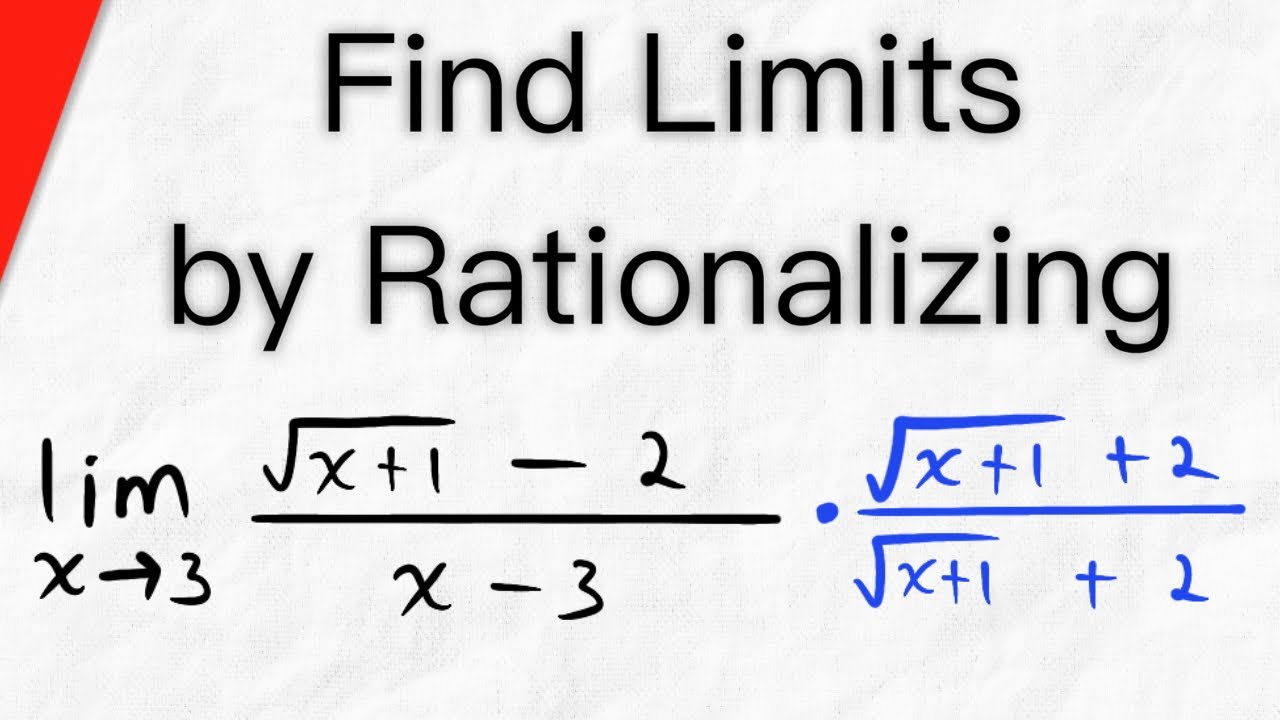
We find limits by rationalizing the numerator (or rationalizing the denominator, it works out very much the same). We'll do two examples, we'll find the limit of (sqrt(x-1)-1)/x as x approaches 0 and the limit of (sqrt(x+1)-2)/(x-3) as x approaches 3. #calculus1 #calculus
Calculus 1 Exercises playlist: https://www.youtube.com/playlist?list=PLz...
Like this
Multiplying and dividing by the conjugate
fallow heart
Because otherwise you would change the function
fallow heart
midnight saddle
and then dividing on the bottom
No, you multiply both top and bottom
Or equivalently you multiply and divide the whole function
midnight saddle
but i have no multiplciation on the bottom
its just 1 x the conjugate
which is the conjugate
fallow heart
Yeah, that's still a multiplication
The number 1 is just not written, but it's there in the denominator
midnight saddle
okay then whats my next step
fallow heart
Doing calculations
midnight saddle
becomes a diff of squares no?
fallow heart
midnight saddle
becomes a diff of squares no?
Exactly
midnight saddle
cancel the square root
fallow heart
Then you can factor out (carefully) an x² from the bottom
midnight saddle
gives me 12x
 fallow heart
Then you can factor out (carefully) an x² from the bottom
fallow heart
fallow heart
Then you can factor out (carefully) an x² from the bottom
You should do this now
And after that you simplify the x which will be in common between numerator and denominator
midnight saddle
But how would I do that from the numerator
Ohhh
But I can’t cancel the x^2 if it’s in a square root
topaz sinewBOT
@midnight saddle Has your question been resolved?
 clear oasis
you little black niggеrs nerds slaves!
midnight saddle
😭😭
midnight saddle
.close
topaz sinewBOT
Channel closed
Closed by @midnight saddle
Use .reopen if this was a mistake.
topaz sinewBOT
Available help channel!
Send your question here to claim the channel.
Remember:
• Ask your math question in a clear, concise manner.
• Show your work, and if possible, explain where you are stuck.
• After 15 minutes, feel free to ping <@&286206848099549185>.
• Type the command .close to free the channel when you're done.
• Be polite and have a nice day!
Read #❓how-to-get-help for further information on how to ask a good question, and about conduct in the question channels.
 upbeat minnow
is the + 2 here just saying take integral from 3 to 7 of y=2 with respect to x and just add it to the other integral of f(x)
 topaz sinewBOT
upbeat minnow
is the + 2 here just saying take integral from 3 to 7 of y=2 with respect to x a...
topaz sinewBOT
upbeat minnow
is the + 2 here just saying take integral from 3 to 7 of y=2 with respect to x a...
 woeful drift
sure
topaz sinewBOT
Channel closed
Closed by @upbeat minnow
Use .reopen if this was a mistake.