

1 messages · Page 169 of 1
 fading shale
for iv), my proof feels wrong and is different to what the MS did, im not sure if its valid, and if not why?
 topaz sinewBOT
fading shale
for iv), my proof feels wrong and is different to what the MS did, im not sure i...
fading shale
fading shale
for iv), my proof feels wrong and is different to what the MS did, im not sure i...
topaz sinewBOT
fading shale
for iv), my proof feels wrong and is different to what the MS did, im not sure i...
fading shale
fading shale
for iv), my proof feels wrong and is different to what the MS did, im not sure i...
also to translate my awful writing at the bottom it says "hence a contraction, hence no integer values that satisfy (x,y)"
<@&286206848099549185>
topaz sinewBOT
@fading shale Has your question been resolved?
 hearty turret
fading shale
for iv), my proof feels wrong and is different to what the MS did, im not sure i...
hearty turret
fading shale
for iv), my proof feels wrong and is different to what the MS did, im not sure i...
practising for the MAT?
fading shale
yeah
hearty turret
fading shale
for iv), my proof feels wrong and is different to what the MS did, im not sure i...
ok so i'm ngl i have no idea what u've done
hearty turret
how did the x^2 - 25y^2 turn into x^4 - 25y^4?
fading shale
it didnt
hearty turret
also btw there is an integer solution to the equation: x=1, y=0
fading shale
oh yeah
hearty turret
so basically whatever method u use must isolate this solution or use the fact that y>0
fading shale
so how do you do it
cuz my method is clearly wayyyy off
i assume you factor or something
oh wait
im dumb
hearty turret
fading shale
for iv), my proof feels wrong and is different to what the MS did, im not sure i...
just as a general comment about presenting ur work in the MAT, make sure u write plenty of words
cus i'm not sure what u've done rearranging-wise
fading shale
hearty turret
just as a general comment about presenting ur work in the MAT, make sure u write...
noted, thanks
fading shale
hearty turret
cus i'm not sure what u've done rearranging-wise
basically set 2 equations that equal 1, equal to eachother, got x in terms of y, subbed it back in to original equation
to prove a contradiction
but
well
either i messed up or that doesnt work
hearty turret
basically i'm just not too sure how you managed to write it as (x^2 + Ny^2)^2 - 25 etc.
hearty turret
fading shale
i assume you factor or something
yeah
also i recognise this
this was the 2022 MAT
cus i did this MAT
fading shale
hearty turret
basically i'm just not too sure how you managed to write it as (x^2 + Ny^2)^2 - ...
from previous parts you get a pattern of in this form, n is equal to the coefficient of negated y^2
hearty turret
fading shale
from previous parts you get a pattern of in this form, n is equal to the coeffic...
we have a different equation so u can't really assume a pattern holds in the previous part still holds now
fading shale
hearty turret
this question is on pell's equation
im not familiar
hearty turret
which funnily enough also came up in like the 2008 MAT lol
fading shale
hearty turret
yeah basically
yeah idk how i missed that, just classic stupid overcite
hearty turret
nw lol, sometimes it happens
fading shale

I assume this is the intended way
Much simpler haha
i think sometimes i get in my head with MAT and try to overcomplicate stuff, without looking at the obvious sometimes
i forget that not every question is gonna be insane
fading shale
.close
topaz sinewBOT
Closed by @fading shale
Use .reopen if this was a mistake.
topaz sinewBOT
 Available help channel!
Send your question here to claim the channel.
Remember:
• Ask your math question in a clear, concise manner.
• Show your work, and if possible, explain where you are stuck.
• After 15 minutes, feel free to ping <@&286206848099549185>.
• Type the command .close to free the channel when you're done.
• Be polite and have a nice day!
Read #❓how-to-get-help for further information on how to ask a good question, and about conduct in the question channels.
 south phoenix
 topaz sinewBOT
south phoenix
topaz sinewBOT
south phoenix
 sterile finch
How did you get 8/3 for your average?
 topaz moon
tip: definite integration
topaz sinewBOT
@south phoenix Has your question been resolved?
topaz sinewBOT
Closed due to timeout
Use .reopen if this was a mistake.
Available help channel!
Send your question here to claim the channel.
Remember:
• Ask your math question in a clear, concise manner.
• Show your work, and if possible, explain where you are stuck.
• After 15 minutes, feel free to ping <@&286206848099549185>.
• Type the command .close to free the channel when you're done.
• Be polite and have a nice day!
Read #❓how-to-get-help for further information on how to ask a good question, and about conduct in the question channels.
 placid temple
Hello
topaz sinewBOT
placid temple
Hello
 cloud tapir
Hey I’m here to get some practice question about pre calculus 12 first chapter Functions and Transformations… i have a test coming up
placid temple


For statement we not talking about E but

Question b) solution

I don't understand why we have that
 opal vault
placid temple
I don't understand why we have that
opal vault
placid temple
I don't understand why we have that
why those two are the same?

you can do double inclusion for example
placid temple
 opal vault
placid temple
opal vault
placid temple
for first question
opal vault
$A^\bN$ is just the set of sequences in $A$
 thorny flameBOT
rafilou2003
 opal vault
this

is the index of
this

remember that for this to be in E

we need S to be a subset of N
placid temple
placid temple
We go from B_p to A_n to A_p to S_p
I still don't understand how we go from one to the other
sorry
opal vault
just write for each p, $B_p = \bigcup_{n\in S_p}A_n$ with some $S_p\subset \bN$
thorny flameBOT
rafilou2003
 opal vault
then the union of the B_p is just the union of that
placid temple
Ok so two questions

Why don't we work directly with this, why do we have to go through a B_p?
 placid temple
opal vault
then the union of the B_p is just the union of that
placid temple
opal vault
then the union of the B_p is just the union of that
After that, what reasoning do they use to get this line?
placid temple
placid temple
.
hearty turret
placid temple
Why don't we work directly with this, why do we have to go through a B_p?
as in we need to check that the countable union of any collection of subsets of \mathscr{E} is in \mathscr{E}
so B_p are just arbitrary sets in \mathscr{E}
also again here, it's much easier if u picture what's going on rather than just manipulate symbols
placid temple

In the second axiom we had already said that

So we started from A ∈ ℰ to go A^c ∈ ℰ
For the last axiom we want to start from A_i ∈ ℰ ~~ to go U A_i ∈ ℰ~~
Ok I think I understand
Need just to understand the last line

Is it a property of calculation with unions that takes us from A_n to A_p?
topaz sinewBOT
@placid temple Has your question been resolved?
placid temple
<@&286206848099549185>
topaz sinewBOT
@placid temple Has your question been resolved?
placid temple
someone please?
topaz sinewBOT
@placid temple Has your question been resolved?
topaz sinewBOT
Closed due to timeout
Use .reopen if this was a mistake.
topaz sinewBOT
Available help channel!
Send your question here to claim the channel.
Remember:
• Ask your math question in a clear, concise manner.
• Show your work, and if possible, explain where you are stuck.
• After 15 minutes, feel free to ping <@&286206848099549185>.
• Type the command .close to free the channel when you're done.
• Be polite and have a nice day!
Read #❓how-to-get-help for further information on how to ask a good question, and about conduct in the question channels.
 graceful pivot
can someone explain
 topaz sinewBOT
graceful pivot
can someone explain
topaz sinewBOT
graceful pivot
can someone explain
 sweet shard
graceful pivot
can someone explain
sweet shard
graceful pivot
can someone explain
,tex .point slope
thorny flameBOT
riemann
 topaz sinewBOT
@graceful pivot Has your question been resolved?
Closed by @graceful pivot
Use .reopen if this was a mistake.
topaz sinewBOT
Available help channel!
Send your question here to claim the channel.
Remember:
• Ask your math question in a clear, concise manner.
• Show your work, and if possible, explain where you are stuck.
• After 15 minutes, feel free to ping <@&286206848099549185>.
• Type the command .close to free the channel when you're done.
• Be polite and have a nice day!
Read #❓how-to-get-help for further information on how to ask a good question, and about conduct in the question channels.
 rugged charm


 topaz sinewBOT
Channel closed due to the original message being deleted.
If you did not intend to do this, please open a new help channel,
as this action is irreversible, and this channel may abruptly lock.
topaz sinewBOT
Available help channel!
Send your question here to claim the channel.
Remember:
• Ask your math question in a clear, concise manner.
• Show your work, and if possible, explain where you are stuck.
• After 15 minutes, feel free to ping <@&286206848099549185>.
• Type the command .close to free the channel when you're done.
• Be polite and have a nice day!
Read #❓how-to-get-help for further information on how to ask a good question, and about conduct in the question channels.
 tawdry rampart
 topaz sinewBOT
tawdry rampart
tawdry rampart
topaz sinewBOT
tawdry rampart
tawdry rampart
how do I telescope this
 merry mason
tawdry rampart
how do I telescope this
merry mason
tawdry rampart
how do I telescope this
Use 2sin(a)sin(b)= cos(a-b)-cos(a+b)
tawdry rampart
merry mason
Use 2sin(a)sin(b)= cos(a-b)-cos(a+b)
but that would be in the denominator right?
merry mason
tawdry rampart
but that would be in the denominator right?
Yeah
Then somehow simplify to numerator
topaz sinewBOT
Closed by @tawdry rampart
Use .reopen if this was a mistake.
topaz sinewBOT
Available help channel!
Send your question here to claim the channel.
Remember:
• Ask your math question in a clear, concise manner.
• Show your work, and if possible, explain where you are stuck.
• After 15 minutes, feel free to ping <@&286206848099549185>.
• Type the command .close to free the channel when you're done.
• Be polite and have a nice day!
Read #❓how-to-get-help for further information on how to ask a good question, and about conduct in the question channels.
 devout wave
Pls help me with exercise e) I know the definition of domain and range but I don’t understand how to find it using the given graph
 topaz sinewBOT
devout wave
Pls help me with exercise e) I know the definition of domain and range but I don...
topaz sinewBOT
devout wave
Pls help me with exercise e) I know the definition of domain and range but I don...
 wooden reef
domain = what values can x be, range = what values can f(x) be
 raw nimbus
find the lowest and highest points of each direction and that's the domain and range
devout wave
All values?
wooden reef
you have to answer with an inverval
devout wave
So, domain will be -5 and 4
wooden reef
just like the last one
devout wave
Domain [-5;4] and range [-2;3]?
wooden reef
no problem
devout wave
.close
topaz sinewBOT
Closed by @devout wave
Use .reopen if this was a mistake.
devout wave
.reopen
topaz sinewBOT
✅
devout wave
Wait what about g curve?
The answer is domain [-4;3] range is what? Is it [0.5;4]?
@wooden reef
devout wave
 merry hill
yes
merry hill
yes
Ok it was a little bit confusing because of 0.5
wooden reef
👍
devout wave
.close
topaz sinewBOT
Closed by @devout wave
Use .reopen if this was a mistake.
topaz sinewBOT
Available help channel!
Send your question here to claim the channel.
Remember:
• Ask your math question in a clear, concise manner.
• Show your work, and if possible, explain where you are stuck.
• After 15 minutes, feel free to ping <@&286206848099549185>.
• Type the command .close to free the channel when you're done.
• Be polite and have a nice day!
Read #❓how-to-get-help for further information on how to ask a good question, and about conduct in the question channels.
 lapis thorn
someone help me with this please
 topaz sinewBOT
lapis thorn
someone help me with this please
topaz sinewBOT
lapis thorn
someone help me with this please
@lapis thorn Has your question been resolved?
topaz sinewBOT
@lapis thorn Has your question been resolved?
sweet shard
lapis thorn
someone help me with this please
do you know the formula for expected value
lapis thorn
sweet shard
do you know the formula for expected value
no actually
sweet shard
lapis thorn
no actually

N = 6 so you just sum the 6 values of x_k * P(X_k) for k = 0, 1, 2, 3, 4, 5
Definitions and examples of Expectation for different distributions
lapis thorn
sweet shard
N = 6 so you just sum the 6 values of `x_k * P(X_k)` for k = 0, 1, 2, 3, 4, 5
wait
so is it 2?
sweet shard
show your work
lapis thorn
0(0.15)+1(0.25)+2(0.25)+3(0.20)+4(0.10)+5(0.05)
0+0.25+0.50+0.60+0.40+0.25=2
for the first one
sweet shard
,calc 0(0.15)+1(0.25)+2(0.25)+3(0.20)+4(0.10)+5(0.05)
thorny flameBOT
Result:
2
yes
sweet shard
sweet shard
https://www.probabilitycourse.com/chapter3/3_2_2_expectation.php
search for "variance" in this link
lapis thorn
alr alr ty
topaz sinewBOT
@lapis thorn Has your question been resolved?
topaz sinewBOT
Closed due to timeout
Use .reopen if this was a mistake.
Available help channel!
Send your question here to claim the channel.
Remember:
• Ask your math question in a clear, concise manner.
• Show your work, and if possible, explain where you are stuck.
• After 15 minutes, feel free to ping <@&286206848099549185>.
• Type the command .close to free the channel when you're done.
• Be polite and have a nice day!
Read #❓how-to-get-help for further information on how to ask a good question, and about conduct in the question channels.
 neon iron
what is $\sqrt {7\sqrt {7\sqrt {7\sqrt {7\sqrt {7\sqrt {7\sqrt {7\sqrt {7\sqrt {7\sqrt {7\sqrt {7\sqrt {7\sqrt {7}}}}}}}}}}}}}..............$
topaz sinewBOT
neon iron
what is $\sqrt {7\sqrt {7\sqrt {7\sqrt {7\sqrt {7\sqrt {7\sqrt {7\sqrt {7\sqrt {...
thorny flameBOT
anjali
 neon iron
nice
Ok so
The thing tends to infinity
I think it's one right
well we can extedn it to any value
 loud oasis
let's call the value of this $x$. then since it's infinite, we can say [ x = \sqrt{7x} ]
thorny flameBOT
cloud

 wary tulip
maybe it’s not something you’re expected to worry about, but this all assumes it converges in the first place
topaz sinewBOT
Closed by @rough narwhal
Use .reopen if this was a mistake.
topaz sinewBOT
Available help channel!
Send your question here to claim the channel.
Remember:
• Ask your math question in a clear, concise manner.
• Show your work, and if possible, explain where you are stuck.
• After 15 minutes, feel free to ping <@&286206848099549185>.
• Type the command .close to free the channel when you're done.
• Be polite and have a nice day!
Read #❓how-to-get-help for further information on how to ask a good question, and about conduct in the question channels.
 thorn anvil
can I have some help with this?
 topaz sinewBOT
thorn anvil
can I have some help with this?
thorn anvil
topaz sinewBOT
thorn anvil
can I have some help with this?
thorn anvil
I know r'(t)=(2t,3-2t,6)
 queen cipher
there must be a vector that is always perpendicular to the vector r'(t)
thorn anvil
that would be the normal vector yes?
queen cipher
thorn anvil
that would be the normal vector yes?
take the cross product of this vector with the normal vector (a,b,c), set the cross product equal to zero, and solve for a,b,c
don't know if this is the standard way to do it but it works :P
thorn anvil
that does work yes. The issue im having is figuring out what the normal vector here is
queen cipher
thorn anvil
that does work yes. The issue im having is figuring out what the normal vector h...
what step are you on
 iron blaze
thorn anvil
can I have some help with this?
iron blaze
thorn anvil
can I have some help with this?
A plane curve with non-vanishing curvature has zero torsion at all points. Conversely, if the torsion of a regular curve with non-vanishing curvature is identically zero, then this curve belongs to a fixed plane.
show that the torsion of this curve is zero
thorn anvil
iron blaze
show that the torsion of this curve is zero
torsion?
iron blaze
In the differential geometry of curves in three dimensions, the torsion of a curve measures how sharply it is twisting out of the osculating plane. Taken together, the curvature and the torsion of a space curve are analogous to the curvature of a plane curve. For example, they are coefficients in the system of differential equations for the Frenet frame given by the Frenet–Serret formulas.
according to wikipedia

this could help
iron blaze
enjoy!
thorn anvil
ill try a few more things and then i might try that
topaz sinewBOT
@thorn anvil Has your question been resolved?
queen cipher
thorn anvil
that does work yes. The issue im having is figuring out what the normal vector h...
what equation did you get relating a,b,c,t?
thorn anvil
queen cipher
what equation did you get relating a,b,c,t?
I’m not sure I understand your question
queen cipher
thorn anvil
I’m not sure I understand your question
ok so the normal vector <a,b,c> and the derivative of r, when you take their cross products, they should equal zero right
thorn anvil
n•(r-r0)=0
thorn anvil
Gah the rest of the message didn’t go through
But yes cross product should probably work too
queen cipher
<a,b,c>•r'(t)=0 so what does the equation become
thorn anvil
Wait no the cross product shouldn’t be 0. The dot product should be
thorn anvil
queen cipher
<a,b,c>•r'(t)=0 so what does the equation become
<a,b,c>•r’(t)=2at-b(2t-3)+6c
thorn anvil
t(2a-2b)+3b+6c
queen cipher
ok
this entire expression equal zero for all values of t
which only makes sense if both 2a-2b=0 and 3b+6c=0
solve for a,b,c
@thorn anvil
thorn anvil
you just end up with b=a and c=-a/2
thorn anvil
which doesnt seem very useful
well, ok, let me ask this. is r'(t) orthogonal to r(t)?
wait hold on, the curve lies in a plane if the derivative of the curve is a constant. So I should just have to show that the derivative is a constant...
yeah im not sure how i would show that its a constant
unless i set t=0
which i guess i could do
topaz sinewBOT
@thorn anvil Has your question been resolved?
queen cipher
thorn anvil
you just end up with b=a and c=-a/2
you can substitute some values into a,b,c
and boom
you've found a vector that is normal to the plane :)
thorn anvil
i suppose. But I'm not sure that my professor will mark that as correct
thorn anvil
if anyone else has any other ideas about how i could solve this, it would be appreciated. not that i think this is a bad way, i just am not sure my professor will take it as correct
topaz sinewBOT
@thorn anvil Has your question been resolved?
 storm nymph
thorn anvil
if anyone else has any other ideas about how i could solve this, it would be app...
storm nymph
thorn anvil
if anyone else has any other ideas about how i could solve this, it would be app...
I believe the way you guys have outlined is actually the most common and conventional way to solve it. Incidentally, there's a handful of relationships in linear algebra that make this much more intuitive and well-rounded
thorn anvil
Alright then
storm nymph
To summarize what you guys have already hashed out:
And you want the inside of the integral to always be 0.
The procedure leads you to a relationship for the vector <a, b, c>. As @queen cipher outlined earlier, pick any values that satisfies the relationship and it can be a normal vector. Reminder that if
<a, b, c> is a normal vector, any scalar multiple of it is also a normal vector, so <2a, 2b, 2c> works, <5.27a, 5.27b, 5.27c> works, as long as it has the same proportions.
This is because if <a, b, c> and r(t) are orthogonal, then
<a,b,c> dot r(t) = 0
And
<5.27a, 5.27b, 5.27c> dot r(t) =
5.27 * <a, b, c> dot r(t) = 5.27 *0
= 0
After that, you just need to express the plane in a readable form. Take any point in the curve of r(t), let's say for t=0 for example. The formula for the plane would be
a(x - r_x) + b(y - r_y) + c(z - r_z) = 0
Where r(t =0) = <r_x, r_y, r_z>
That formula effectively says "the set of points such that if you take the dot product with <a, b, c>, you will get 0; through the point <r_x, r_y, r_z>
I'm done typing for now. Good luck!
topaz sinewBOT
@thorn anvil Has your question been resolved?
Closed by @thorn anvil
Use .reopen if this was a mistake.
topaz sinewBOT
Available help channel!
Send your question here to claim the channel.
Remember:
• Ask your math question in a clear, concise manner.
• Show your work, and if possible, explain where you are stuck.
• After 15 minutes, feel free to ping <@&286206848099549185>.
• Type the command .close to free the channel when you're done.
• Be polite and have a nice day!
Read #❓how-to-get-help for further information on how to ask a good question, and about conduct in the question channels.
 sleek halo
can somoene show me how to actually do this integral
 topaz sinewBOT
sleek halo
can somoene show me how to actually do this integral
sleek halo
topaz sinewBOT
sleek halo
can somoene show me how to actually do this integral
sleek halo
I know how to get $\vec{D} \cdot \vec{dS}$
thorny flameBOT
ahtrader
 sleek halo
I get $\oint D_r r^2 \sin \theta d\phi d\theta$
thorny flameBOT
ahtrader
 sleek halo
but i dont know what to do next
can somoene teach me what to do next
like how to get the bounds etc, cuz when i read surface integral i am supposed to define a $\vec{n}$
thorny flameBOT
ahtrader
 sleek halo
but idk how to actually do that in EM
sweet shard
thorny flame
**ahtrader**
This is just spherical coordinates
Do you know how to parametrize a sphere?
sleek halo
nope
sleek halo
sweet shard
Do you know how to parametrize a sphere?
i dont know how 😦
sweet shard
sleek halo
i dont know how 😦
In this section we will take a look at the basics of representing a surface with parametric equations. We will also see how the parameterization of a surface can be used to find a normal vector for the surface (which will be very useful in a couple of sections) and how the parameterization can be used to find the surface area of a surface.
And do all the examples
https://tutorial.math.lamar.edu/Classes/CalcIII/SurfaceIntegrals.aspx
In this section we introduce the idea of a surface integral. With surface integrals we will be integrating over the surface of a solid. In other words, the variables will always be on the surface of the solid and will never come from inside the solid itself. Also, in this section we will be working with the first kind of surface integrals we’...
sleek halo
$\oint_{S} \vec{D} \cdot \vec{dS} = \iint_{D} \vec{D} \cdot (\vec{r_u} \times\vec{r_v}) dA$
thorny flameBOT
ahtrader
 thorny flameBOT
ahtrader
 sleek halo
that is so weird tosay
sleek halo
 vernal vale
seems right to me <:thonk:406575732563902485> but i suck at calculus
vernal vale
seems right to me <:thonk:406575732563902485> but i suck at calculus
is D (area) like the shadow of the sphere
 vernal vale
you know, i interpreted this as stokes, but its not, is it  its a parameterization
it still seems fine
vernal vale
D is just the parameterization of the outside of the sphere
the integral on the left is like ... i mean its fine to write, but hard to calculate
the integral on the left says that we move over the surface of the sphere (in some unspecified way) to grab the flux of D through the surface
the integral on the right proposes a way to do this, i think, we sweep across the surface of the sphere, using the normal vector produced by the sweeping
does that help? @sleek halo
sleek halo
vernal vale
the integral on the left is like ... i mean its fine to write, but hard to calcu...
ye
i am having trouble with defining the region D
because when i took calc 3, it was explicitly stated what D was
but in EM i am the one who's gonna have to figure it out
im trying to recall what D was but i think it was just the shadow of the surface (?) not sure
vernal vale
theres no real need to call it D, i dont think
you may as well call it S
this will take care of itself, once you start to actually parameterize
well, idk, now you have me worried
sleek halo
😦
vernal vale
you know, i guess, you would say its the same ...
its the same object
right? its the threshold of the sphere
but it matters I guess because in the left integral, its just in 3d, its kind of abstract, i mean it IS a 2d surface, but we havent described it in that way
when you write dA, you imply that you're integrating over a 2d surface now
sleek halo
yeah
vernal vale
so wed use D to mean, I guess, that it's been parameterized in a way that it's 2 dimensional
even though its really just the same 'physical' thing
again the parameterization really holds this so notational things i mean maybe theyre helpful but they arent going to do the heavy lifting
sleek halo
ok i will do the parametrization
sleek halo
i did this before but it was a long itme ago
vernal vale
if not, you should, it'd be pretty insane to expect to derive it from scratch
sleek halo
like 2 years ago
vernal vale
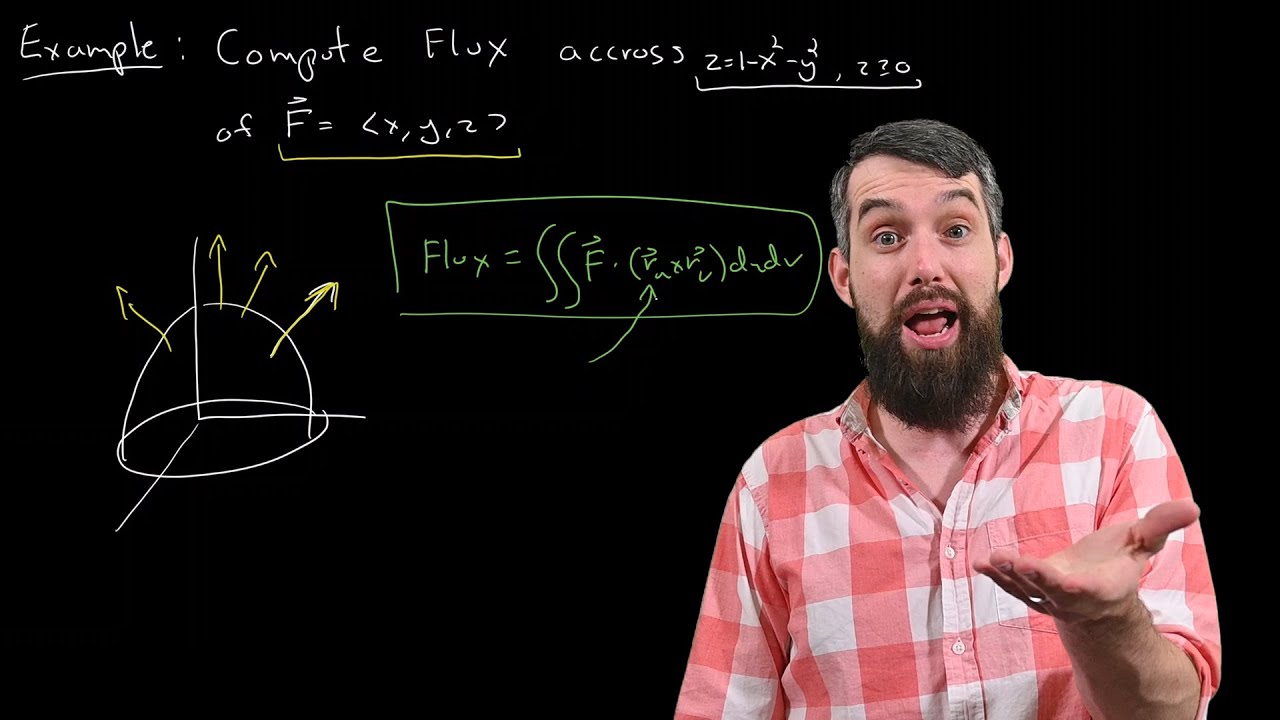
In this example we do an example of a surface integral, specifically computing the flux of a vector field across a surface (a parabaloid). While the surface was given explicitly, based on the region (a circle) we first switch to a parameterized of the surface and then use the surface integral formula for parameterized surfaces.
MY VECTOR CALC...
maybe something like this is helpful
but you know different people make different sense to different people, i would follow some video that makes sense your first few times
sleek halo
yeah i think he is getting the bounds of the integral based on the contour of the surface
vernal vale

sleek halo
😄
vernal vale
hold up i wanna link you one more guy
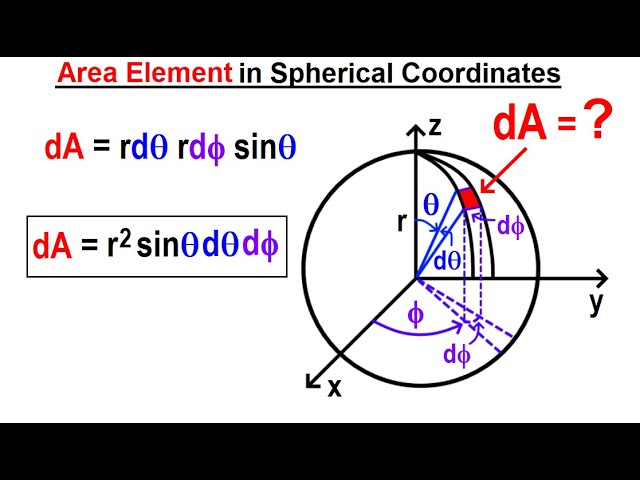
Visit http://ilectureonline.com for more math and science lectures!
To donate:
http://www.ilectureonline.com/donate
https://www.patreon.com/user?u=3236071
We will find dA=?, area element, of a sphere in spherical coordinates.
Next video in this series can be seen at:
https://youtu.be/-Dk3ZSMiNnI
I'm in love with this guy
he has a series of short focused videos on vector calculus specifically in the context of EM
thorny flameBOT
ahtrader
 thorny flameBOT
ahtrader
 sleek halo
this is the same with dA right?
sweet shard
sleek halo
$\vec{dS} = <dydz, dxdz, dxdy>$
You really shouldn't be making stuff up
sweet shard
Just read definitions from sources we linked
vernal vale
playing around is fine but im not sure what youre talking about
@sweet shard is the perfect person to help with these kind of problems though  he actually knows calculus
i just like writing the symbols
vernal vale
Well this is volume element, so already something is wrong
sweet shard
sleek halo
Yes that's right, but only for a cube oriented with its edges parallel to the coordinate axes
sleek halo
ye ye
sweet shard
vernal vale
https://www.youtube.com/watch?v=9w43DlL-txQ&list=PLX2gX-ftPVXWYLuDrKIF5npNwEDs4-...
Eg it'd be wrong for a sphere
sleek halo
it's different for the other coordinate systems, i was gonna ask how do I know what dA is if i got three to choose from
 sweet shard
You have to infer it from the problem
If you see sphere then spherical coordinates are obvious
If you see cylinder, then cylindrical coordinates are the most obvious
sweet shard
What about it
sleek halo
is dA always $\rho d \rho d \phi$ and $ r^2 \sin \theta dr d\phi d\theta$ for cylindrical and spherical
 thorny flameBOT
ahtrader
 sweet shard
You have to infer it from the problem
sweet shard
sweet shard
You have to infer it from the problem
You need to infer dA from the problem
sweet shard
sweet shard
And do all the examples
https://tutorial.math.lamar.edu/Classes/CalcIII/Surface...
.
Do the examples I sent
topaz sinewBOT
@sleek halo Has your question been resolved?
topaz sinewBOT
Closed due to timeout
Use .reopen if this was a mistake.
topaz sinewBOT
Available help channel!
Send your question here to claim the channel.
Remember:
• Ask your math question in a clear, concise manner.
• Show your work, and if possible, explain where you are stuck.
• After 15 minutes, feel free to ping <@&286206848099549185>.
• Type the command .close to free the channel when you're done.
• Be polite and have a nice day!
Read #❓how-to-get-help for further information on how to ask a good question, and about conduct in the question channels.
 spare monolith
$$\emptyset \cup (1,5)$$ $$\emptyset \cap (1,5)$$ $$\emptyset \text{\\} (1,5)$$ $$\mathbb{N} \text{\\} \mathbb{R}$$
topaz sinewBOT
spare monolith
$$\emptyset \cup (1,5)$$ $$\emptyset \cap (1,5)$$ $$\emptyset \text{\\\\} (1,5)$...
thorny flameBOT
Good
 spare monolith
The last two are supposed to be Ø \ (1,5) and N \ R.
I wanted to check if my answers are right. (1,5), Ø, Ø, Ø
 strange whale
yea it's good
topaz sinewBOT
Closed by @spare monolith
Use .reopen if this was a mistake.
Available help channel!
Send your question here to claim the channel.
Remember:
• Ask your math question in a clear, concise manner.
• Show your work, and if possible, explain where you are stuck.
• After 15 minutes, feel free to ping <@&286206848099549185>.
• Type the command .close to free the channel when you're done.
• Be polite and have a nice day!
Read #❓how-to-get-help for further information on how to ask a good question, and about conduct in the question channels.
 dense plover
Let $A$ be a ring (all rings commutative). If an $A$-algebra homomorphism $f : R \rightarrow S$ induces a surjection $Spec(S) \rightarrow Spec(R)$, and $T$ is any $A$-algebra, $R \otimes_A T \rightarrow S \otimes_A T$ induces $Spec(S \otimes_A T) \rightarrow Spec(R \otimes_A T)$. Is this also surjective?
topaz sinewBOT
dense plover
Let $A$ be a ring (all rings commutative). If an $A$-algebra homomorphism $f : R...
thorny flameBOT
DavidL1450
 topaz sinewBOT
@dense plover Has your question been resolved?
topaz sinewBOT
@dense plover Has your question been resolved?
topaz sinewBOT
Closed due to timeout
Use .reopen if this was a mistake.
topaz sinewBOT
Available help channel!
Send your question here to claim the channel.
Remember:
• Ask your math question in a clear, concise manner.
• Show your work, and if possible, explain where you are stuck.
• After 15 minutes, feel free to ping <@&286206848099549185>.
• Type the command .close to free the channel when you're done.
• Be polite and have a nice day!
Read #❓how-to-get-help for further information on how to ask a good question, and about conduct in the question channels.
 hard tinsel
Hi, can someone help me please ?
 topaz sinewBOT
hard tinsel
Hi, can someone help me please ?
hard tinsel
topaz sinewBOT
hard tinsel
Hi, can someone help me please ?
hard tinsel
 hard tinsel
Hi, can someone help me please ?
hard tinsel
hard tinsel
Hi, can someone help me please ?
show that :
 hard tinsel
show that :
hard tinsel
hard tinsel
show that :
deduce :

I already did the first part, I think it's good, because i find the result intended, but i don't know how to do the second part
sweet shard
hard tinsel
show that :
can you simplify the left side here?
try writing the left side for n=3 if you get stuck
then you can solve for the sum just using algebra:
a = 3 * sum - c => sum = (a + c)/3
hard tinsel
ok, i try it
Like this ?

I think this is wrong because we have the same sum on each side and we add something positive on one of the 2 side
hard tinsel
hard tinsel
I think this is wrong because we have the same sum on each side and we add somet...
So we have something bigger on this side
sweet shard
sweet shard
can you simplify the left side here?
you really should have done this first
sweet shard
sweet shard
try writing the left side for n=3 if you get stuck
and this
hard tinsel
With this
 sweet shard
,rotate
thorny flameBOT
 thorny flameBOT
topaz sinewBOT
thorny flameBOT
topaz sinewBOT
@hard tinsel Has your question been resolved?
hard tinsel
sweet shard
that looks right
Is that good now ?

 sweet shard
your boxed answer looks like it has arithmetic mistakes
sweet shard
sweet shard
try writing the left side for n=3 if you get stuck
you really should have done this 30 minutes ago
$\sum_{k=0}^n (k+1)^3 - k^3 = (1^3 - 0^3) + (2^3 - 1^3) + (3^3 - 2^3) + \ldots + (n^3 - (n-1)^3) + ((n+1)^3 - n^3) = ?$
thorny flameBOT
riemann
 hard tinsel
sweet shard
you really should have done this 30 minutes ago
hard tinsel
sweet shard
you really should have done this 30 minutes ago
I did it for the sum of k²
Not the sum of (k+1)³, sry
sweet shard
doing this cancellation of sum of k^3 probably isn't the point of the problem
 sweet shard
thorny flame
**riemann**
sweet shard
thorny flame
**riemann**
figure this out then plug it into the beginning
hard tinsel
It's wrong?
sweet shard
thorny flame
because it's not the right answer
hard tinsel
sweet shard
to the left side of here
Ok, i will did this
hard tinsel

 sweet shard
dude what are you doing
sweet shard
thorny flame
**riemann**
answer this question ONLY before you do anything else
write it out for n=3 or 4 if you can't see how it simplifies
hard tinsel
sweet shard
dude what are you doing
I don't kno, it's 1:35 am, I did 7 jours of maths today, i'm bad in english so it's complicated to understand you. With all this, i can't think anymore.
sweet shard
,calc 4^3
thorny flameBOT
Result:
64
yes
sweet shard
thorny flame
**riemann**
everything cancels except (n+1)^3
sweet shard
thorny flame
,w expand n(n+1)(2n+1)
thorny flameBOT
sweet shard
you shouldn't have a constant term in +3
hard tinsel
Yes, i'm searching the mistake, probably a minus
sweet shard
you should just keep the n+1 instead of expanding

since the other term is just 2*(n+1)^3
and you can factor (n+1) out of both
hard tinsel
sweet shard
since the other term is just 2*(n+1)^3
I don't understand
sweet shard
hard tinsel
Last row first term on the right
hard tinsel
 sweet shard
hard tinsel
sweet shard
hard tinsel
Now you lost a 2
hard tinsel
sweet shard
Now you lost a 2
Where ?
sweet shard
hard tinsel
Where ?
 hard tinsel
Oh yes, sorry
 sweet shard
Yea now factor n+1 out
hard tinsel
sweet shard
Yea now factor n+1 out
Out of the fraction ?
sweet shard
It doesn't matter
sweet shard
thorny flame
Just work towards the answer now
hard tinsel
It's good finally ?

,w $\sum_{i=1}^{n} = (k^2)
@sweet shard thank you really much, I hope that I have not annoyed or upset you, have a Nice day, goodbye
.close
topaz sinewBOT
Closed by @hard tinsel
Use .reopen if this was a mistake.
topaz sinewBOT
Available help channel!
Send your question here to claim the channel.
Remember:
• Ask your math question in a clear, concise manner.
• Show your work, and if possible, explain where you are stuck.
• After 15 minutes, feel free to ping <@&286206848099549185>.
• Type the command .close to free the channel when you're done.
• Be polite and have a nice day!
Read #❓how-to-get-help for further information on how to ask a good question, and about conduct in the question channels.
Channel closed due to the original message being deleted.
If you did not intend to do this, please open a new help channel,
as this action is irreversible, and this channel may abruptly lock.
topaz sinewBOT
Available help channel!
Send your question here to claim the channel.
Remember:
• Ask your math question in a clear, concise manner.
• Show your work, and if possible, explain where you are stuck.
• After 15 minutes, feel free to ping <@&286206848099549185>.
• Type the command .close to free the channel when you're done.
• Be polite and have a nice day!
Read #❓how-to-get-help for further information on how to ask a good question, and about conduct in the question channels.
 grizzled crystal
 topaz sinewBOT
grizzled crystal
grizzled crystal
topaz sinewBOT
grizzled crystal
grizzled crystal
Does anyone know hw to negate what i highlighted in yellow
in predicate logic
is it the => sign the negation?
FYI this is for an assignment and we aren't allowed to use the =/= sign
topaz sinewBOT
@grizzled crystal Has your question been resolved?
topaz sinewBOT
Closed due to timeout
Use .reopen if this was a mistake.
topaz sinewBOT
Available help channel!
Send your question here to claim the channel.
Remember:
• Ask your math question in a clear, concise manner.
• Show your work, and if possible, explain where you are stuck.
• After 15 minutes, feel free to ping <@&286206848099549185>.
• Type the command .close to free the channel when you're done.
• Be polite and have a nice day!
Read #❓how-to-get-help for further information on how to ask a good question, and about conduct in the question channels.
 ivory sorrel
 topaz sinewBOT
ivory sorrel
ivory sorrel
topaz sinewBOT
ivory sorrel
ivory sorrel
19
$f(x)=-g(0)$
\
$g(y) = -f(0)$
\
so $f(x)=f(0)$
\
$g(x)=g(0)$
\
Thus both f(x) and g(x) are constant functions
thorny flameBOT
Veni, vidi, perii

 flint stump
what if y = 1
ivory sorrel
g(1)=g(0)
flint stump
sure, but what does the condition i say?
flint stump
nope, no condition on x
ivory sorrel
well, it would say x=0
flint stump
f(x) = ?
flint stump
ivory sorrel
well, it would say x=0
why?
ivory sorrel
f(x)=-g(1)
flint stump
are u sure?
flint stump
yes that makes f(x) = x - g(0)
ivory sorrel
ooh
flint stump
now is that consistent?
topaz sinewBOT
Closed by @ivory sorrel
Use .reopen if this was a mistake.
topaz sinewBOT
Available help channel!
Send your question here to claim the channel.
Remember:
• Ask your math question in a clear, concise manner.
• Show your work, and if possible, explain where you are stuck.
• After 15 minutes, feel free to ping <@&286206848099549185>.
• Type the command .close to free the channel when you're done.
• Be polite and have a nice day!
Read #❓how-to-get-help for further information on how to ask a good question, and about conduct in the question channels.
 magic grail
What is the image set of this linear transformation? By posing T[(x,y)] = (a, b) and trying to solve the system of equations by the gaussian elimination method I do not reach the conditions.
 topaz sinewBOT
magic grail
What is the image set of this linear transformation? By posing T[(x,y)] = (a, b)...
topaz sinewBOT
magic grail
What is the image set of this linear transformation? By posing T[(x,y)] = (a, b)...
 clear lodge
wouldnt the image be (x-2y, x+y)?
magic grail
clear lodge
wouldnt the image be (x-2y, x+y)?
that is the expression of the transformation itself, not the set of values it can take
clear lodge
it can take any value. As defined, R^2
unless you have additional restrictions in x and y?
topaz sinewBOT
@magic grail Has your question been resolved?
topaz sinewBOT
@magic grail Has your question been resolved?
magic grail
<@&286206848099549185>
magic grail
.close
topaz sinewBOT
Closed by @magic grail
Use .reopen if this was a mistake.
Available help channel!
Send your question here to claim the channel.
Remember:
• Ask your math question in a clear, concise manner.
• Show your work, and if possible, explain where you are stuck.
• After 15 minutes, feel free to ping <@&286206848099549185>.
• Type the command .close to free the channel when you're done.
• Be polite and have a nice day!
Read #❓how-to-get-help for further information on how to ask a good question, and about conduct in the question channels.
 sturdy parrot
pls
sturdy parrot
sry
 compact zodiac
close this one
sturdy parrot
i do not know how to
sturdy parrot
.close
topaz sinewBOT
Closed by @sturdy parrot
Use .reopen if this was a mistake.
topaz sinewBOT
Available help channel!
Send your question here to claim the channel.
Remember:
• Ask your math question in a clear, concise manner.
• Show your work, and if possible, explain where you are stuck.
• After 15 minutes, feel free to ping <@&286206848099549185>.
• Type the command .close to free the channel when you're done.
• Be polite and have a nice day!
Read #❓how-to-get-help for further information on how to ask a good question, and about conduct in the question channels.
 sweet wind
how to solve this like how to find the first derivative of this question?
 topaz sinewBOT
sweet wind
how to solve this like how to find the first derivative of this question?
compact zodiac
topaz sinewBOT
sweet wind
how to solve this like how to find the first derivative of this question?
compact zodiac
chain rule
sweet wind
like theres e^-x how to solve tht?
sweet wind
compact zodiac
chain rule
f'g(x).g'(x) ryt?
compact zodiac
what
no
don't use that
i thought the e^-x is inside the root
use product rule
instead
compact zodiac
yeah
compact zodiac
there should be a - sign in the 2nd term
sweet wind
ohhhh but why exactly?
compact zodiac
derivative of e^-x is -e^-x
derivative of -x is -1
and that is multiplied due to chain rule
topaz sinewBOT
Closed by @sweet wind
Use .reopen if this was a mistake.
topaz sinewBOT
Available help channel!
Send your question here to claim the channel.
Remember:
• Ask your math question in a clear, concise manner.
• Show your work, and if possible, explain where you are stuck.
• After 15 minutes, feel free to ping <@&286206848099549185>.
• Type the command .close to free the channel when you're done.
• Be polite and have a nice day!
Read #❓how-to-get-help for further information on how to ask a good question, and about conduct in the question channels.
 vestal saffron
i need s o to help me in quake question
topaz sinewBOT
vestal saffron
i need s o to help me in quake question
strange whale
N has 0 inside of it, N* doesn't
(assuming you're in a french-speaking country or something)
 prisma mesa
in other words,
N = {0, 1, 2, 3...}
N* = {1, 2, 3...}
vestal saffron
strange whale
(assuming you're in a french-speaking country or something)
yea thats true
thx guys @prisma mesa @strange whale ❤️
vernal vale
what does it mean "quake" here
strange whale
quick ig
vernal vale
oh
strange whale
or they like quakes
topaz sinewBOT
Closed by @vestal saffron
Use .reopen if this was a mistake.
topaz sinewBOT
Available help channel!
Send your question here to claim the channel.
Remember:
• Ask your math question in a clear, concise manner.
• Show your work, and if possible, explain where you are stuck.
• After 15 minutes, feel free to ping <@&286206848099549185>.
• Type the command .close to free the channel when you're done.
• Be polite and have a nice day!
Read #❓how-to-get-help for further information on how to ask a good question, and about conduct in the question channels.
 brazen ocean
hi, wondering if i answered this correctly
 topaz sinewBOT
brazen ocean
hi, wondering if i answered this correctly
hearty turret
brazen ocean
hi, wondering if i answered this correctly
topaz sinewBOT
brazen ocean
hi, wondering if i answered this correctly
hearty turret
brazen ocean
hi, wondering if i answered this correctly
yeah probably
i'm curious why it's s+1 rather than s, idk why it'd be off by 1
but yeah ur probs right
brazen ocean
tyyy
hearty turret
brazen ocean
hi, wondering if i answered this correctly
i think ur explanation could be a bit better
like where does the (x-1) choose y go
topaz sinewBOT
@brazen ocean Has your question been resolved?
brazen ocean
hearty turret
like where does the (x-1) choose y go
i see
ill revise more in a bit
thanks
topaz sinewBOT
Closed due to timeout
Use .reopen if this was a mistake.
Available help channel!
Send your question here to claim the channel.
Remember:
• Ask your math question in a clear, concise manner.
• Show your work, and if possible, explain where you are stuck.
• After 15 minutes, feel free to ping <@&286206848099549185>.
• Type the command .close to free the channel when you're done.
• Be polite and have a nice day!
Read #❓how-to-get-help for further information on how to ask a good question, and about conduct in the question channels.
 ocean terrace
cauchy theorem in group theory. it uses the fact that the conjugacy class and center sum to the order of the group. with induction on the statement being true for smaller subgroups, each conjugacy class has order not divisible by p. however isnt conjugacy classes not a subgroup? so even if the conjugacy class is divisible by p we cant conclude anything
topaz sinewBOT
ocean terrace
cauchy theorem in group theory. it uses the fact that the conjugacy class and ce...
hearty turret
ocean terrace
cauchy theorem in group theory. it uses the fact that the conjugacy class and ce...
can u send the proof u know?
cus i haven't seen a proof of cauchy with induction
ocean terrace
This lecture is part of an online mathematics course on group theory. It gives two proofs of Cauchy's theorem that if a prime p divides the order of a group then the group has an element of that order. It also uses Cauchy's theorem to classify the group of order 2p.
i was looking at this around 8 minn
this might be similar? or maybe im not understanding


this was also similar
is there another way to approach it?
hearty turret
ocean terrace
is there another way to approach it?
there's a way of proving it directly
ocean terrace
could u tell me both
well their induction proof was easy i just did not understand the part where they said that the conjugation classes form a subgroup
could u explain that bit
hearty turret
ocean terrace
well their induction proof was easy i just did not understand the part where the...
the conjugacy classes don't form a subgroup
when i get to what ur asking me abt i'll let u know what they meant
hearty turret
ocean terrace
cauchy theorem in group theory. it uses the fact that the conjugacy class and ce...
but yeah conjugacy classes are generally not a subgroup
ocean terrace
hearty turret
the conjugacy classes don't form a subgroup
yea ik theyve no identity:(
ocean terrace
ocean terrace
this might be similar? or maybe im not understanding
this might be similar or maybe im not understanding it right
hearty turret
ocean terrace
i was looking at this around 8 minn
recall that the centralizer of an element is a subgroup
(i.e. if gxg^-1 = x, hxh^-1 = x then ghx(gh)^-1 = x etc.)
so basically he's saying that by our induction hypothesis we may assume that the centralizers have orders all not divisible by p
now recall that a conjugacy class are basically the cosets of C(x) for some x in G
i.e. size of conj. class = |G|/|C(x)|
but since p divides G and not C(x), then p divides the size of the conj. class
hope that made sense
hearty turret
hearty turret
there's a way of proving it directly
yeah ok the direct proof i know is the 2nd proof borcherds presents
hearty turret
ocean terrace
cauchy theorem in group theory. it uses the fact that the conjugacy class and ce...
yeah so basically it's not that each conjugacy class has size not divisible by p, it's that each conjugacy class has size divisible by p
because if the size of the conj. class weren't divisible by p, then there would be a centralizer subgroup with order divisible by p
ocean terrace
hearty turret
now recall that a conjugacy class are basically the cosets of C(x) for some x in...
sorry.. why?
ocean terrace
hearty turret
recall that the centralizer of an element is a subgroup
also i believe here all centralizers are with respect to the entire group?
hearty turret
ocean terrace
sorry.. why?
let's take say $\gamma \in G$
thorny flameBOT
LY
 hearty turret
and let's let $G$ act on $G$ by conjugation
thorny flameBOT
LY
 hearty turret
then let's look at the orbit of $\gamma$
thorny flameBOT
LY
 hearty turret
the orbit of gamma is its conjugacy class
and stabiliser of gamma is a subgroup of G
hence if we assume induction etc. etc.
hearty turret
hearty turret
and stabiliser of gamma is a subgroup of G
then this stabiliser subgroup has order not divisible by p
hearty turret
hearty turret
the orbit of gamma is its conjugacy class
so by orbit-stab, this must have order div. by p
ocean terrace
hearty turret
and stabiliser of gamma is a subgroup of G
wait i thought.. it was supposed to be the whole G
like that the conjugacy class means H means that for any g in G, gHg^-1 = H
hearty turret
ocean terrace
like that the conjugacy class means H means that for any g in G, gHg^-1 = H
well that's true as well
ocean terrace
then isnt the stabilizer subgroup the entire group?
hearty turret
the stabiliser of the conjugacy class is the same as the stabiliser of something in the conj. class
hearty turret
thorny flame
**LY**
i think this is easier to think about cus we're not fixing a whole set
ocean terrace
the stabilizer subgroup is all elements that leave the elements of the orbit in the same orbit?
hearty turret
ocean terrace
the stabilizer subgroup is all elements that leave the elements of the orbit in ...
that would be the whole group
hearty turret
it's harder for this cus like all the typical examples of groups we think about are abelian lol
ocean terrace
btw, a group has different orbits under conjugation and under group action right?
oh :(
hearty turret
hearty turret
it's harder for this cus like all the typical examples of groups we think about ...
and the ones that aren't abelian are harder to calculate lmao
hearty turret
ocean terrace
btw, a group has different orbits under conjugation and under group action right...
yes
hearty turret
ocean terrace
so this is a case of G acting on X
ocean terrace
sorry could u define stabiliser
hearty turret
we want a case of G acting on G
hearty turret
yes
this is where the definitions that u get might be different depending on how the book presents it
like in my lectures, we covered orbit-stabiliser really early on
so centralisers and conjugacy classes were presented as the orbit and stabiliser of a certain thing
ocean terrace
well in this book they started with divisibility
hearty turret
whereas it's possible to define them without orbits and stabilisers
hearty turret
ocean terrace
i got this, but we replace the group action with conjugation?
but yeah the centraliser of an element is the subgroup of stuff in G that commute with it
the conjugacy class of an element is its orbit by conjugation
hearty turret
ocean terrace
cauchy theorem in group theory. it uses the fact that the conjugacy class and ce...
anyway hope that cleared up ur confusion here
ocean terrace
hearty turret
but yeah the centraliser of an element is the subgroup of stuff in G that commut...
where does stabiliser come in?
is there an example of a stabiliser that isnt the whole group
hearty turret
ocean terrace
where does stabiliser come in?
the centraliser of an element is the stabiliser under the conjugation action
hearty turret
ocean terrace
is there an example of a stabiliser that isnt the whole group
anything not in the centre
hearty turret
ocean terrace
the stabilizer subgroup is all elements that leave the elements of the orbit in ...
basically orbits partition our set so every element of G takes elements of an orbit to other elements of the same orbit
ocean terrace
yea
hearty turret
also out of interest, have u been doing problems whilst learning group theory or have u just been reading theory?
hearty turret
ah fairs
i think in general, if ur trying to learn smth, doing problems is good cus like working with actual groups and problems can often give u intuition behind some of our definitions and also helps u like interalise some of the definitions too
topaz sinewBOT
Closed by @ocean terrace
Use .reopen if this was a mistake.
topaz sinewBOT
Available help channel!
Send your question here to claim the channel.
Remember:
• Ask your math question in a clear, concise manner.
• Show your work, and if possible, explain where you are stuck.
• After 15 minutes, feel free to ping <@&286206848099549185>.
• Type the command .close to free the channel when you're done.
• Be polite and have a nice day!
Read #❓how-to-get-help for further information on how to ask a good question, and about conduct in the question channels.
 sharp lance
I couldn't figure out the range of this function
 topaz sinewBOT
sharp lance
I couldn't figure out the range of this function
neon iron
sharp lance
I couldn't figure out the range of this function
topaz sinewBOT
sharp lance
I couldn't figure out the range of this function
neon iron
sharp lance
I couldn't figure out the range of this function
equate it to y
and get the whole thing into a quadratic
now
use b^2-4ac >0 since x is real
(assuming they gave x is real int he question)
topaz sinewBOT
Closed by @sharp lance
Use .reopen if this was a mistake.
topaz sinewBOT
Available help channel!
Send your question here to claim the channel.
Remember:
• Ask your math question in a clear, concise manner.
• Show your work, and if possible, explain where you are stuck.
• After 15 minutes, feel free to ping <@&286206848099549185>.
• Type the command .close to free the channel when you're done.
• Be polite and have a nice day!
Read #❓how-to-get-help for further information on how to ask a good question, and about conduct in the question channels.
 vernal girder
I don’t know where to start
 topaz sinewBOT
vernal girder
I don’t know where to start
topaz sinewBOT
vernal girder
I don’t know where to start
 vague bramble
For me I will just take logarithm on both sides and turn it into a linear equation of x
This get rid of all the powers
 grizzled sandal
i got an answer hope it's right
x=(ln144-1)/(2-ln18)
i started by writing 4 as 2^2 and 6 as (3x2)
i checked it on my calculator when i plugged the value for x i got the same answer
i hope i'm not mistaken
grizzled sandal
vernal girder
I don’t know where to start
u can dm me if u didn't know how to get to the answer i'll explain it to you
topaz sinewBOT
@vernal girder Has your question been resolved?
topaz sinewBOT
Closed due to timeout
Use .reopen if this was a mistake.
Available help channel!
Send your question here to claim the channel.
Remember:
• Ask your math question in a clear, concise manner.
• Show your work, and if possible, explain where you are stuck.
• After 15 minutes, feel free to ping <@&286206848099549185>.
• Type the command .close to free the channel when you're done.
• Be polite and have a nice day!
Read #❓how-to-get-help for further information on how to ask a good question, and about conduct in the question channels.
 graceful leaf
 topaz sinewBOT
graceful leaf
graceful leaf
topaz sinewBOT
graceful leaf
graceful leaf
is d= 1.262 g/cm^3 good?
does sig figs matter ?
i basically made L to cm^3 so times 3.25 by 1000
4.10^10^3 is 4100
3250 cm^3 divided by 4100g
and use sig fig rules
and get 1.262 g/cm^3
loud oasis
you should get sig figs from the original numbers
topaz sinewBOT
Closed by @graceful leaf
Use .reopen if this was a mistake.
Available help channel!
Send your question here to claim the channel.
Remember:
• Ask your math question in a clear, concise manner.
• Show your work, and if possible, explain where you are stuck.
• After 15 minutes, feel free to ping <@&286206848099549185>.
• Type the command .close to free the channel when you're done.
• Be polite and have a nice day!
Read #❓how-to-get-help for further information on how to ask a good question, and about conduct in the question channels.
 mortal spear
If the series (\sum_{n=1}^{\infty} a_n) converges, then does the series (\sum_{n=1}^{\infty} a_n^2) converge?
topaz sinewBOT
mortal spear
If the series \(\sum_{n=1}^{\infty} a_n\) converges, then does the series \(\sum...
thorny flameBOT
Halex
 mortal spear
have not found a series which square does not converge
 mint crescent

I'm trying to re-learn my undergrad math, and I'm using Stephen Abbot's Understanding Analysis. In section 2.7, he has the following exercise:
Exercise 2.7.5 (a) Show that if $\sum{a_n}$ converges
mortal spear
mint crescent
https://math.stackexchange.com/questions/493756/prove-that-if-suma-n-converges-a...
thx
.close
topaz sinewBOT
Closed by @mortal spear
Use .reopen if this was a mistake.
Available help channel!
Send your question here to claim the channel.
Remember:
• Ask your math question in a clear, concise manner.
• Show your work, and if possible, explain where you are stuck.
• After 15 minutes, feel free to ping <@&286206848099549185>.
• Type the command .close to free the channel when you're done.
• Be polite and have a nice day!
Read #❓how-to-get-help for further information on how to ask a good question, and about conduct in the question channels.
 minor compass
Find the volume of the solid obtained by rotating the region bounded by the given curves about the specified line $xy = 1, y = 0, x =1, x = 2; about x = -1$
topaz sinewBOT
minor compass
Find the volume of the solid obtained by rotating the region bounded by the give...
thorny flameBOT
wakamole
 topaz sinewBOT
What step are you on?
1. I don't know where to begin.
2. I have begun but got stuck midway.
3. I got an answer but I was told that it's wrong.
4. I got an answer and would like my work checked.
5. I have a question about someone else's work/solution.
6. I have completed the problem and don't need help anymore. Thank you.
7. None of the above
i do not know wher to begin
well i made y = 1 / x
i have no idea how to set up the integral
is it just a disk method?
and you do $\pi \int_1^2 \frac {1}{x} dx$ ?
thorny flameBOT
wakamole

 sonic escarp
integral of 1/x is one you should know -> ln x
topaz sinewBOT
@minor compass Has your question been resolved?
minor compass
sonic escarp
integral of 1/x is one you should know -> ln x
my question is how to set the integral up
idk if that is even ther ight integral
.close
topaz sinewBOT
Closed by @minor compass
Use .reopen if this was a mistake.
topaz sinewBOT
Available help channel!
Send your question here to claim the channel.
Remember:
• Ask your math question in a clear, concise manner.
• Show your work, and if possible, explain where you are stuck.
• After 15 minutes, feel free to ping <@&286206848099549185>.
• Type the command .close to free the channel when you're done.
• Be polite and have a nice day!
Read #❓how-to-get-help for further information on how to ask a good question, and about conduct in the question channels.
graceful leaf
 topaz sinewBOT
graceful leaf
graceful leaf
topaz sinewBOT
graceful leaf
graceful leaf
23.21 ml to cm^3
wouldnt it just be time 10^-3 to get to L
then 10^3 to get to cm^3?
so can i just do 23.21 times 1000
😕 to get to cm^3
 icy sky
1mL=1cm^3
loud oasis
1 L = 1000 mL = 1000 cm^3 so from that it's clear that 1 mL = 1 cm^3
icy sky
i believe 1cm^3=1mL was how volume units were defined
loud oasis
you can also define it as 1 L = 1 dm^3 but nobody uses dm or dm^3 in any other context
topaz sinewBOT
@graceful leaf Has your question been resolved?
topaz sinewBOT
Closed due to timeout
Use .reopen if this was a mistake.
Available help channel!
Send your question here to claim the channel.
Remember:
• Ask your math question in a clear, concise manner.
• Show your work, and if possible, explain where you are stuck.
• After 15 minutes, feel free to ping <@&286206848099549185>.
• Type the command .close to free the channel when you're done.
• Be polite and have a nice day!
Read #❓how-to-get-help for further information on how to ask a good question, and about conduct in the question channels.
 solemn pumice
Hello can somebody help me find the number observations in this regression problem?
 topaz sinewBOT
solemn pumice
Hello can somebody help me find the number observations in this regression probl...
solemn pumice
topaz sinewBOT
solemn pumice
Hello can somebody help me find the number observations in this regression probl...
solemn pumice
<@&286206848099549185>
topaz sinewBOT
@solemn pumice Has your question been resolved?
topaz sinewBOT
@solemn pumice Has your question been resolved?
topaz sinewBOT
@solemn pumice Has your question been resolved?
Closed by @solemn pumice
Use .reopen if this was a mistake.
Available help channel!
Send your question here to claim the channel.
Remember:
• Ask your math question in a clear, concise manner.
• Show your work, and if possible, explain where you are stuck.
• After 15 minutes, feel free to ping <@&286206848099549185>.
• Type the command .close to free the channel when you're done.
• Be polite and have a nice day!
Read #❓how-to-get-help for further information on how to ask a good question, and about conduct in the question channels.
sweet shard
,rotate
 true coral
you can then claim that 2q must be even so therefore 2q+1 must be odd
thorny flameBOT
 true coral
that's how I was taught to present it anyway
in regards to formality
which is what you had
 frozen yarrow
can someone help

i just needd help with 3 to 15
I was sick the day they went over this
sorry
true coral
I think it should be fine but depends on teacher
I would use textbooks to reference proper notation
 pearl fog
frozen yarrow
can someone help
pearl fog
frozen yarrow
can someone help
!occupied
topaz sinewBOT
frozen yarrow
can someone help
Someone else is already using this help channel. If you need help with a question, please open your own help channel/thread (see #❓how-to-get-help for instructions).
Closed by @solid solstice
Use .reopen if this was a mistake.
topaz sinewBOT
Available help channel!
Send your question here to claim the channel.
Remember:
• Ask your math question in a clear, concise manner.
• Show your work, and if possible, explain where you are stuck.
• After 15 minutes, feel free to ping <@&286206848099549185>.
• Type the command .close to free the channel when you're done.
• Be polite and have a nice day!
Read #❓how-to-get-help for further information on how to ask a good question, and about conduct in the question channels.
 halcyon swift
can someone please explain what im supposed to do here?
 halcyon swift
.close
topaz sinewBOT
Closed by @halcyon swift
Use .reopen if this was a mistake.
Available help channel!
Send your question here to claim the channel.
Remember:
• Ask your math question in a clear, concise manner.
• Show your work, and if possible, explain where you are stuck.
• After 15 minutes, feel free to ping <@&286206848099549185>.
• Type the command .close to free the channel when you're done.
• Be polite and have a nice day!
Read #❓how-to-get-help for further information on how to ask a good question, and about conduct in the question channels.
graceful leaf
 topaz sinewBOT
graceful leaf
graceful leaf
topaz sinewBOT
graceful leaf
graceful leaf
help plz
like i do what i boxed
will that be the answer
if i do****

like i will do it and say what i got
i wish ihad answer key );
i thought of smth
.close
topaz sinewBOT
Closed by @graceful leaf
Use .reopen if this was a mistake.
Available help channel!
Send your question here to claim the channel.
Remember:
• Ask your math question in a clear, concise manner.
• Show your work, and if possible, explain where you are stuck.
• After 15 minutes, feel free to ping <@&286206848099549185>.
• Type the command .close to free the channel when you're done.
• Be polite and have a nice day!
Read #❓how-to-get-help for further information on how to ask a good question, and about conduct in the question channels.
 swift grove
<@&268886789983436800> 😭 😭
 craggy haven
.close
topaz sinewBOT
Closed by @craggy haven
Use .reopen if this was a mistake.
craggy haven
$\polylongdiv{6x^3-x^2+4x-1}{2x^2-x+2}$
thorny flameBOT
hayley is not layla
 topaz sinewBOT
Available help channel!
topaz sinewBOT
Available help channel!
Send your question here to claim the channel.
Remember:
• Ask your math question in a clear, concise manner.
• Show your work, and if possible, explain where you are stuck.
• After 15 minutes, feel free to ping <@&286206848099549185>.
• Type the command .close to free the channel when you're done.
• Be polite and have a nice day!
Read #❓how-to-get-help for further information on how to ask a good question, and about conduct in the question channels.
 queen dagger
hello
topaz sinewBOT
queen dagger
hello
queen dagger
when it comes to this kinf of question how do i know which part is 90 degree

specically talking about the KON
on line LNK i know a tangent will always form a 90 degree
just dk on which side of the line
neon iron
Both angles ONK and ONL are considered 90 degrees
Because the radius and the tangent line are perpendicular
neon iron
Every time the radius of a circle intersects the tangent line, it’ll be perpendicular
Not just this case
queen dagger
so always both side will be 90
queen dagger
i thought that too but i was so confuse cuz chatgpt say its not lol
neon iron
It says those angles aren’t 90?
neon iron
That’s crazy
topaz sinewBOT
Closed by @queen dagger
Use .reopen if this was a mistake.
neon iron
Yeah np
topaz sinewBOT
Available help channel!
Send your question here to claim the channel.
Remember:
• Ask your math question in a clear, concise manner.
• Show your work, and if possible, explain where you are stuck.
• After 15 minutes, feel free to ping <@&286206848099549185>.
• Type the command .close to free the channel when you're done.
• Be polite and have a nice day!
Read #❓how-to-get-help for further information on how to ask a good question, and about conduct in the question channels.
queen dagger
im trying to find the length of BE here which in this case i have to use tan is there no other way
 topaz sinewBOT
queen dagger
im trying to find the length of BE here which in this case i have to use tan is ...
queen dagger
topaz sinewBOT
queen dagger
im trying to find the length of BE here which in this case i have to use tan is ...
queen dagger
if so i wanna know when to use cos and sin
 rigid ivy
tan is really the only way
you could use sin or cos to find the hypotenuse MN and then use pythag to find ME, but that's just a long way of doing tan
queen dagger
i see
but i dont think sin works?
or am i wrong?
i feel like if i were to do the long way cos is the one that works?
since i dont have the opossible nor the hypotenuse in order to do sin
 nimble garnet
queen dagger
if so i wanna know when to use cos and sin
nimble garnet
queen dagger
if so i wanna know when to use cos and sin
cos is adjacent/hypotenuse and sin is opposite/hypotenuse
queen dagger
yes ik
nimble garnet
they're less common because we typically don't know the hypotenuse
nimble garnet
whereas tangent is kinda just describing the slope (because the angles are 90 degrees from each other)
nimble garnet
you could maybe force cos somehow but it's definitely a strange roundabout solution
nimble garnet
again we don't know the hypotenuse which is necessary for sin/cos
nimble garnet
ok lol
queen dagger
.close
topaz sinewBOT
Closed by @queen dagger
Use .reopen if this was a mistake.
Available help channel!
Send your question here to claim the channel.
Remember:
• Ask your math question in a clear, concise manner.
• Show your work, and if possible, explain where you are stuck.
• After 15 minutes, feel free to ping <@&286206848099549185>.
• Type the command .close to free the channel when you're done.
• Be polite and have a nice day!
Read #❓how-to-get-help for further information on how to ask a good question, and about conduct in the question channels.
 elfin sluice
Why are there a quotient rule and product rule in differentiation?
Why can't we just, d/dx (u*1/v) and apply the product rule?
topaz sinewBOT
elfin sluice
Why are there a quotient rule and product rule in differentiation?
Why can't we...
nimble garnet
you'd still have to do quotient rule on 1/v
loud oasis
the quotient rule is not a rule on its own, but a special case of the product, power, and chain rules
topaz sinewBOT
Closed by @elfin sluice
Use .reopen if this was a mistake.
elfin sluice
loud oasis
the quotient rule is not a rule on its own, but a special case of the product, p...
Yup got, after using product rule for u*1/v,
Later on have to chain rule v^-1, thus the quotient rule
topaz sinewBOT
Available help channel!
Send your question here to claim the channel.
Remember:
• Ask your math question in a clear, concise manner.
• Show your work, and if possible, explain where you are stuck.
• After 15 minutes, feel free to ping <@&286206848099549185>.
• Type the command .close to free the channel when you're done.
• Be polite and have a nice day!
Read #❓how-to-get-help for further information on how to ask a good question, and about conduct in the question channels.
 fading owl
What are the last 4 digits of 2024^2025?
topaz sinewBOT
fading owl
What are the last 4 digits of 2024^2025?
fading owl
help i cant use euler totient theorem nor chinese remainder theorem
and im stuck with 2024^2000=1(mod 625)
 mellow arrow
why would you go with mod 625
mellow arrow
I see
pearl fog
maybe complete lunacy but you can maybe find a pattern
mellow arrow
I don't quite see a way other than trying with powers of 2024
fading owl
pearl fog
maybe complete lunacy but you can maybe find a pattern
dies
mellow arrow
for example 2024^4 is 26 mod 625
fading owl
that would need a calculator + i cant calculate until 2024^999 for a pattern
fading owl
mellow arrow
for example 2024^4 is 26 mod 625
hmm
like how am i gonna calculate until higher powers
pearl fog
20
65
98
37
26
09
54
mellow arrow
fading owl
like how am i gonna calculate until higher powers
2024^8 is easily 51 mod 625
fading owl
erm what
mellow arrow
you only need to brute force up until 2024^25
pearl fog
only
fading owl
mellow arrow
you only need to brute force up until 2024^25
i have 10 min to do the question
pearl fog
goodluck
mellow arrow
pearl fog
*only*
that's much doable as in comparison to ^2025
pearl fog
olympiad question?
fading owl
wait i did it thanks for the patience
fading owl
pearl fog
olympiad question?
yes
mellow arrow
seems like it
pearl fog
feel you man :(
mellow arrow
fading owl
wait i did it thanks for the patience
now im curious
merry hill
why not here
mellow arrow
aight
pearl fog
dont worry
merry hill
fading owl
other ppl need this channel
there are more channels available
pearl fog
theres like 20 channels for people
pearl fog
 fading owl
well thats hard to say what it states exactly
fading owl
pearl fog
i got that as well
basically its a way to calculate p-adic powers of a number
fading owl
and then we can get 2024^2025 + 1^2025 = 0 mod 625
fading owl
mellow arrow
or just practice ones
a practice one
so by crt there is a sol for mod 10000 given explicit residues mod 625 and 16
then the answer is 624//
thx for your patience
.close
topaz sinewBOT
Closed by @fading owl
Use .reopen if this was a mistake.
topaz sinewBOT
Available help channel!
Send your question here to claim the channel.
Remember:
• Ask your math question in a clear, concise manner.
• Show your work, and if possible, explain where you are stuck.
• After 15 minutes, feel free to ping <@&286206848099549185>.
• Type the command .close to free the channel when you're done.
• Be polite and have a nice day!
Read #❓how-to-get-help for further information on how to ask a good question, and about conduct in the question channels.
 vivid fractal
What class is this for? (I’m just curious)
topaz sinewBOT
Channel closed due to the original message being deleted.
If you did not intend to do this, please open a new help channel,
as this action is irreversible, and this channel may abruptly lock.
 dense crescent
Hmm
topaz sinewBOT
Available help channel!
Send your question here to claim the channel.
Remember:
• Ask your math question in a clear, concise manner.
• Show your work, and if possible, explain where you are stuck.
• After 15 minutes, feel free to ping <@&286206848099549185>.
• Type the command .close to free the channel when you're done.
• Be polite and have a nice day!
Read #❓how-to-get-help for further information on how to ask a good question, and about conduct in the question channels.
 opaque yoke
im new to the binomial thereom, and im not sure what ive done wrong in this question, i got 0.0864 as the answer but the correct one should be 0.0043.
 topaz sinewBOT
opaque yoke
im new to the binomial thereom, and im not sure what ive done wrong in this ques...
opaque yoke
topaz sinewBOT
opaque yoke
im new to the binomial thereom, and im not sure what ive done wrong in this ques...
opaque yoke
im also not too sure what the (nx) means in the probability mass function


 torpid sparrow

 proud minnow
 rapid lake

 deft holly