#help-26
1 messages · Page 158 of 1
 wise ivy
It's a little bit strange that trapezium is not equilateral (AD and CB is unequal) but diagonals is perpendicular
Are you sure your conditions right
 supple gulch
Yes
I dont think it has to be iscosceles if they ar eperpendiculae
<@&286206848099549185>
 tidal moss
The one on the right
supple gulch
Yes
tidal moss
Q is the point where the diagonals meet?
tidal moss
I don't see any Q on it that's why I am asking
supple gulch
My bad
supple gulch
Also the prblem says that a circle can be inscribed in the trapezium,, which means that the sum of the 2 pairs of opposite sides is equal
Thats where i got 14- b and b from
supple gulch
tidal moss
is right angled
Yes
tidal moss
So the triangle BOC is right handed right?
 modern rock
supple gulch
Yes
modern rock
supple gulch
Yes
aint no way, its duskblade
tidal moss
doesn't sound plausible tbh
supple gulch
tidal moss
So the triangle BOC is right handed right?
Yes
tidal moss
And AO is 4✓2?
supple gulch
Because the angle between the diagonals is r90
tidal moss
Oc*
gotcha
My battery is dying btw it is at 4%
And I will get home in like 2-3h.
Try using the similar triangle theorem
@supple gulch
supple gulch
On which ones
tidal moss
Maybe DAC and CAB or try AOB and DOC
See ya in a few hours if you didn't manage to solve it send me a message I will be home by then I got 2%
supple gulch
@prisma mesa
 topaz sinewBOT
@supple gulch Has your question been resolved?
topaz sinewBOT
@supple gulch Has your question been resolved?
topaz sinewBOT
@supple gulch Has your question been resolved?
topaz sinewBOT
Channel closed
Closed due to timeout
Use .reopen if this was a mistake.
 Available help channel!
Send your question here to claim the channel.
Remember:
• Ask your math question in a clear, concise manner.
• Show your work, and if possible, explain where you are stuck.
• After 15 minutes, feel free to ping <@&286206848099549185>.
• Type the command .close to free the channel when you're done.
• Be polite and have a nice day!
Read #❓how-to-get-help for further information on how to ask a good question, and about conduct in the question channels.
 rugged oracle
Not specifically math related but it can be. Does anyone know the exact term for the building blocks in a curriculum? For example in order to learn calculus, you would need to know basics of mathematics first, and before mathematics, you would need to know numbers, reading, writing, etc.
In my case, my goal is a mechanical engineering degree. I can pick an advanced subject and break that down into pre-requisite knowledge bases, but I'm not sure how to "define" them or do research on it, I feel like I'm missing the exact word. Best I could find was Building Block
topaz sinewBOT
rugged oracle
Not specifically math related but it can be. Does anyone know the exact term for...
 keen matrix
<@&268886789983436800>
keen matrix
rugged oracle
Not specifically math related but it can be. Does anyone know the exact term for...
idrk, maybe prerequisites or foundations?
 unreal crow
keen matrix
unreal crow
keen matrix
no worries :)
 flint stump
Mechanical engineering is still somewhat vague target
Are you focused enough to have decided what you wanna do in that? Like robotics? Structural mechanics? Fluids and Thermal systems?
Like each of these subtopics have their own prerequisites and future scopes
e.g. Robotics is interdisciplinary so in addition to general mechanical engineering youd need some programming as well
rugged oracle
Right, so if I look up the university I would like to get into, their mechanical engineering program would start like this

and it's structured in an order that you learn the building blocks needed for the next set of courses and concepts. But is there a better word to use instead of building blocks to describe that?
flint stump
Looks to me as if they have listed the prerequisites? Like isnt that what you want?
rugged oracle
yes and no, because I'm not sure if I have the prerequisites to their prerequisites. Sorry if its confusing but I just want to make sure I'm prepared before applying, but its hard to narrow down everything I need to know beforehand
flint stump
Like, lets say you want Solid Mechanics CIVE207 from term 3. Then that needs basic 1st yr course of MECH 210 thats Mechanics 1
and so on
I see
rugged oracle
their program makes sense, what baseline of knowledge do i need before all of that
flint stump
I also did a MechE bachelors before shifting to a Maths Dept Masters. So in my experience, I would say, knowing basic topics, generaly known as precalc are enough
And some basic physics like velocity and acceleration is enough
But, anyways most Unis have their first lectures for any course as refreshers
rugged oracle
Okay, that works for me. For context I'm 30 and just have a bachelors in Business Admin, so I just want to refresh myself on concepts I learned 15 years ago so I'm ready beforehand
Thanks
 strange kindle
<@&268886789983436800>
rugged oracle
.close
topaz sinewBOT
Channel closed
Closed by @rugged oracle
Use .reopen if this was a mistake.
Available help channel!
Send your question here to claim the channel.
Remember:
• Ask your math question in a clear, concise manner.
• Show your work, and if possible, explain where you are stuck.
• After 15 minutes, feel free to ping <@&286206848099549185>.
• Type the command .close to free the channel when you're done.
• Be polite and have a nice day!
Read #❓how-to-get-help for further information on how to ask a good question, and about conduct in the question channels.
 grim swift
 topaz sinewBOT
grim swift
grim swift
topaz sinewBOT
grim swift
grim swift
Guy im having hard time understanding how these rulle were applied here
ln'(x) = 1/x i know
is the entire expression just quotient rule?
was chain rule even used?
or quotient rule IS chain rule in itself ? 😮
just a different version
for when there is a fraction
 coarse tusk
grim swift
or quotient rule IS chain rule in itself ? 😮
coarse tusk
grim swift
or quotient rule IS chain rule in itself ? 😮
no
coarse tusk
grim swift
was chain rule even used?
yes
$\left(\log(\frac{x}{1-x})\right)'=\frac1{\frac{x}{1-x}}\cdot\left(\frac{x}{1-x}\right)'$
 thorny flameBOT
kheerii
 coarse tusk
that's the chain rule bit
grim swift
woah
coarse tusk
to calculate the derivative on the right hand side we use the quotient rule
grim swift
oh so the entire fraction is the inner function
in the original function form
I thought ln immediately multiplies with the numerator
and then numerator = u and denominator = v
.close
topaz sinewBOT
Channel closed
Closed by @grim swift
Use .reopen if this was a mistake.
topaz sinewBOT
Available help channel!
Send your question here to claim the channel.
Remember:
• Ask your math question in a clear, concise manner.
• Show your work, and if possible, explain where you are stuck.
• After 15 minutes, feel free to ping <@&286206848099549185>.
• Type the command .close to free the channel when you're done.
• Be polite and have a nice day!
Read #❓how-to-get-help for further information on how to ask a good question, and about conduct in the question channels.
 candid lance
compute the volume of the solid above the cone x^2 =y^2+z^2 and inside the sphere x^2 +y^2 +z^2 =4
topaz sinewBOT
candid lance
compute the volume of the solid above the cone x^2 =y^2+z^2 and inside the sphe...
candid lance
I need help with this HW proble,
I intergrated with respect p, phi, and theta
p I got 8/3, PHI I got 1 - root2/2, and theta I got 2pi
then I simply combined them and got 16pi/3 (1-root2/2)
<@&286206848099549185>
is this correct
 neon iron
1/3 (theta)
2/phi - 16pi/3 (1-root2/3pi)
candid lance
my p and phi are correct though right
neon iron
Ye
candid lance
do we need the simplify that answer any more
neon iron
I'm not 100% sure tho
neon iron
candid lance
do we need the simplify that answer any more
I don't think you need to
But if you can then ye
candid lance
can you show me the work for theta pls
how did you get thatr
@ helpers
<@&286206848099549185>
topaz sinewBOT
@candid lance Has your question been resolved?
topaz sinewBOT
@candid lance Has your question been resolved?
Channel closed
Closed by @candid lance
Use .reopen if this was a mistake.
Available help channel!
Send your question here to claim the channel.
Remember:
• Ask your math question in a clear, concise manner.
• Show your work, and if possible, explain where you are stuck.
• After 15 minutes, feel free to ping <@&286206848099549185>.
• Type the command .close to free the channel when you're done.
• Be polite and have a nice day!
Read #❓how-to-get-help for further information on how to ask a good question, and about conduct in the question channels.
 tawdry wyvern
I need help Creating a multi step equation where x is 6 and has the distributive property and combining like terms on the same side
topaz sinewBOT
tawdry wyvern
I need help Creating a multi step equation where x is 6 and has the distributiv...
tawdry wyvern
<@&286206848099549185>
 hallow depot
i don t understand .. wdym with " has the distributive property and combining like terms on the same side", are we still talking about equation ?
 fresh copper
tawdry wyvern
I need help Creating a multi step equation where x is 6 and has the distributiv...
fresh copper
tawdry wyvern
I need help Creating a multi step equation where x is 6 and has the distributiv...
Please elaborate
Also
!15m
topaz sinewBOT
Please only use the <@&286206848099549185> ping once if your question has not been answered for 15 minutes. Please do not ping or DM individual users about your question.
 topaz sinewBOT
@tawdry wyvern Has your question been resolved?
tawdry wyvern
<@&286206848099549185>
 thick jay
tawdry wyvern
<@&286206848099549185>
thick jay
tawdry wyvern
<@&286206848099549185>
wuts a multistep equation
tawdry wyvern
An example is like 3x + 5 = 9-5
thick jay
tawdry wyvern
An example is like 3x + 5 = 9-5
so an unsimplified linear equation in 1 variable?
tawdry wyvern
Yes
tawdry wyvern
Let me check
thick jay
x=6
tawdry wyvern
Thank you
topaz sinewBOT
@tawdry wyvern Has your question been resolved?
Channel closed
Closed by @tawdry wyvern
Use .reopen if this was a mistake.
Available help channel!
Send your question here to claim the channel.
Remember:
• Ask your math question in a clear, concise manner.
• Show your work, and if possible, explain where you are stuck.
• After 15 minutes, feel free to ping <@&286206848099549185>.
• Type the command .close to free the channel when you're done.
• Be polite and have a nice day!
Read #❓how-to-get-help for further information on how to ask a good question, and about conduct in the question channels.
 toxic stirrup
how is this row reduced form?
 topaz sinewBOT
toxic stirrup
how is this row reduced form?
topaz sinewBOT
topaz sinewBOT
toxic stirrup
how is this row reduced form?
topaz sinewBOT
Channel closed
Closed by @toxic stirrup
Use .reopen if this was a mistake.
topaz sinewBOT
Available help channel!
Send your question here to claim the channel.
Remember:
• Ask your math question in a clear, concise manner.
• Show your work, and if possible, explain where you are stuck.
• After 15 minutes, feel free to ping <@&286206848099549185>.
• Type the command .close to free the channel when you're done.
• Be polite and have a nice day!
Read #❓how-to-get-help for further information on how to ask a good question, and about conduct in the question channels.
 hollow rose
Say I have N bananas and take 1/3 of them, but leave one behind, how many are left?
topaz sinewBOT
hollow rose
Say I have N bananas and take 1/3 of them, but leave one behind, how many are le...
hollow rose
Because I think I can say I took (N-1)/3 of them
So I think that N - ((N-1)/3) is the amount left
But that's not true
So what am I doing wrong?
 inner wren
hollow rose
Say I have N bananas and take 1/3 of them, but leave one behind, how many are le...
inner wren
hollow rose
Say I have N bananas and take 1/3 of them, but leave one behind, how many are le...
wdym leave
hollow rose
Ill show you the question

Im trying to figure out how many are left after Arthur took his third
inner wren
ok
so
by 1 banana being left we mean that the number of bananas is in the form of 3k+1
3k+1 = N
hollow rose
Okay
inner wren
what;s the question though
hollow rose
Each person does the exact same thing as Arthur, and by the end, there are 3m+1 bananas left
(excluding the orangutang who doesn't take a third)
And I want to find an expression relating N and m
inner wren
I think we have to use the GIF function
hollow rose
Never heard of that in my life
Ohhh
The floor function?
Yes
That's the topic behind the assignment
inner wren
hollow rose
The floor function?
mhm
topaz sinewBOT
@hollow rose Has your question been resolved?
topaz sinewBOT
@hollow rose Has your question been resolved?
Channel closed
Closed by @hollow rose
Use .reopen if this was a mistake.
Available help channel!
Send your question here to claim the channel.
Remember:
• Ask your math question in a clear, concise manner.
• Show your work, and if possible, explain where you are stuck.
• After 15 minutes, feel free to ping <@&286206848099549185>.
• Type the command .close to free the channel when you're done.
• Be polite and have a nice day!
Read #❓how-to-get-help for further information on how to ask a good question, and about conduct in the question channels.
 mortal spear
Could someone help me verify this is a metric? Where x and y are in R
 mortal spear
I am struggling to prove the triangle inequality for metrics
mortal spear
 winter egret
what have you tried?
winter egret
what have you tried?
the triangle inequality haha
winter egret
Have you written out d(x, y)+d(y, z) ?
mortal spear
but the fractions and its denominators are my problem
mortal spear
winter egret
Have you written out d(x, y)+d(y, z) ?
yes
winter egret
can you show me that so I don't have to do it?
mortal spear
$$\frac{\left|x-z\right|}{1+\left|x-z\right|}\le \frac{\left|x-y\right|}{1+\left|x-y\right|}+\frac{\left|y-z\right|}{1+\left|y-z\right|}$$
wait
winter egret
thanks
thorny flameBOT
Halex
 mortal spear
There
winter egret
have you tried combining the RHS into a single fraction?
one thing I am kinda thinking about is I think there's some like general result where you can do convex mappings to a metric or something like that and what you get is another metric
so idk if you're supposed to be somehow clever about this or if you should just bruteforce it
mortal spear
Yes, it turns into something horrible
mortal spear
winter egret
one thing I am kinda thinking about is I think there's some like general result ...
This?
 winter egret
well that would certainly help if we could assume that
lol

Mathematics Stack Exchange
Let $(X,d)$ be a metric space and for $x,y \in X$ define
$$d_b(x,y) = \dfrac{d(x,y)}{1 + d(x,y)}$$
a) show that $d_b$ is a metric on $X$
Hint: consider the derivative of $f(t)$ = $\dfrac{t}{1+t}$
...
so basically
you're putting your metric through an increasing function
and then that helps you in the way outlined in the stack exchange post 😂
sorry if all I did was help you cheat on your homework
mortal spear
winter egret
sorry if all I did was help you cheat on your homework
yep, but that is a general result and can't use it atm
since I just started to learn what metrics are
winter egret
well if you really wanted to you could write this but instead of saying d(x, y) you'd write |x-y|

and then that's it
I doubt there's any easier solution
winter egret
mortal spear
This?
but if this is in your textbook then I think it would make a lot of sense to just refer to that result
mortal spear
winter egret
I doubt there's any easier solution

I'm kinda lost in the second step, first inequality. Does it really holds?
winter egret
remember that everything that you're dealing with is nonnegative
winter egret
mortal spear
if you add a nonnegative number to the denominator, your expressions could get smaller or could stay the same but they will certainly never get bigger
that's a very common trick in university level estimation
if A, B, C are positive numbers then A/B >= A/(B+C)
mortal spear
winter egret
if you add a nonnegative number to the denominator, your expressions could get s...
well, everything makes sense now
winter egret
I'm glad ^^
mortal spear
Thank you!
topaz sinewBOT
@mortal spear Has your question been resolved?
Channel closed
Closed by @mortal spear
Use .reopen if this was a mistake.
Available help channel!
Send your question here to claim the channel.
Remember:
• Ask your math question in a clear, concise manner.
• Show your work, and if possible, explain where you are stuck.
• After 15 minutes, feel free to ping <@&286206848099549185>.
• Type the command .close to free the channel when you're done.
• Be polite and have a nice day!
Read #❓how-to-get-help for further information on how to ask a good question, and about conduct in the question channels.
 supple kayak
i needed help with the question and there’s a tutor thing here to help you but i’m not understanding how it got 2,4,6 as integer answers
 topaz sinewBOT
supple kayak
i needed help with the question and there’s a tutor thing here to help you but i...
supple kayak
supple kayak
i needed help with the question and there’s a tutor thing here to help you but i...
topaz sinewBOT
supple kayak
i needed help with the question and there’s a tutor thing here to help you but i...
supple kayak
supple kayak
i needed help with the question and there’s a tutor thing here to help you but i...
can someone also explain consecutive integers?
 alpine mist
Consecutive:
if n is an integer, then n+1 is the next largest integer.
if n is an ever integer, then n+2 is the next largest even integer.
e.g.
2,3,4,5,6 are a list of consecutive integers
2,4,6,8,10 are a list of consecutive even integers
 dense lily
supple kayak
can someone also explain consecutive integers?
dense lily
supple kayak
can someone also explain consecutive integers?
Successive even numbers
dense lily
dense lily
Successive even numbers
In this case
 steep nebula
alpine mist
if n is an *ever* integer, then n+2 is the next largest *even* integer.
steep nebula
alpine mist
if n is an *ever* integer, then n+2 is the next largest *even* integer.
after that they translated the sentence into an equation and solved for n, almost, you just need to do the last 2 steps
@supple kayak do you need help with anything else?
(aaah pinged the wrong person save meeee)
topaz sinewBOT
@supple kayak Has your question been resolved?
Channel closed
Closed by @supple kayak
Use .reopen if this was a mistake.
topaz sinewBOT
Available help channel!
Send your question here to claim the channel.
Remember:
• Ask your math question in a clear, concise manner.
• Show your work, and if possible, explain where you are stuck.
• After 15 minutes, feel free to ping <@&286206848099549185>.
• Type the command .close to free the channel when you're done.
• Be polite and have a nice day!
Read #❓how-to-get-help for further information on how to ask a good question, and about conduct in the question channels.
mortal spear
For ( x = (x_1, \ldots, x_n) ) and ( y = (y_1, \ldots, y_n) ) in ( \mathbb{R}^n ), define
[
d(x, y) = \min{|x_1 - y_1|, \ldots, |x_n - y_n|}.
]
topaz sinewBOT
mortal spear
For \( x = (x_1, \ldots, x_n) \) and \( y = (y_1, \ldots, y_n) \) in \( \mathbb{...
thorny flameBOT
Halex
 mortal spear
Is d a metric?
I don't know much about the minimum function, so I'm not sure how to approach it
 surreal mural
do you think it is?
I would just go through all the axioms and try to prove them, and if you struggle at some point it may be an indication that this axiom does not hold and you could try to construct a counterexample
topaz sinewBOT
@mortal spear Has your question been resolved?
mortal spear
surreal mural
I would just go through all the axioms and try to prove them, and if you struggl...
how do one make counterexamples when working with R^n?
mortal spear
 jade thunder
Look at the axioms
jade thunder
Look at the axioms
Which ones specifically?
jade thunder
My go to is to check if I can make simple counterexamples to the axioms
If that doesn’t seem doable by inspection maybe it is a metric
mortal spear
fixing an n and just make a counterexample
jade thunder
But it’s always easier to prove it’s not a metric than to prove it’s a metric
Yeah but look at the axioms
Find one that looks easy to “break” and test it first
If you don’t look at the axiom you don’t even know what sort of counterexample you want to construct (if it’s even possible to construct one)
mortal spear
I get it now, thank you
may you help me with this one as well?
For ( x = (x_1, \ldots, x_n) ) and ( y = (y_1, \ldots, y_n) ) in ( \mathbb{R}^n ), define
[
d(x, y) = \max{|x_1 - y_1|, \ldots, |x_n - y_n|}.
]
I know this is a metric but not sure how to justify the triangle inequality
thorny flameBOT
Halex
 jade thunder
I think just put things in to try
topaz sinewBOT
@mortal spear Has your question been resolved?
topaz sinewBOT
Channel closed
Closed due to timeout
Use .reopen if this was a mistake.
Available help channel!
Send your question here to claim the channel.
Remember:
• Ask your math question in a clear, concise manner.
• Show your work, and if possible, explain where you are stuck.
• After 15 minutes, feel free to ping <@&286206848099549185>.
• Type the command .close to free the channel when you're done.
• Be polite and have a nice day!
Read #❓how-to-get-help for further information on how to ask a good question, and about conduct in the question channels.
 thorn talon
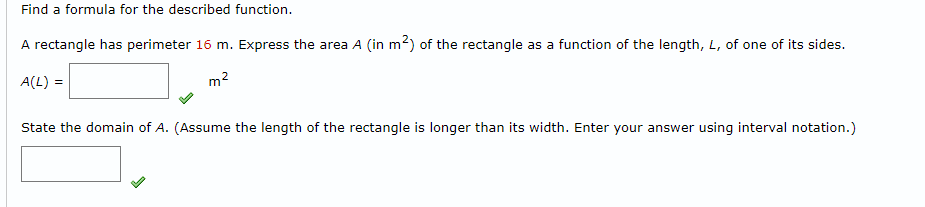 topaz sinewBOT
thorn talon
https://i.imgur.com/zBmf76Y.png
thorn talon
topaz sinewBOT
thorn talon
https://i.imgur.com/zBmf76Y.png
thorn talon
i dont even know where to start
 plush hollow
thorn talon
https://i.imgur.com/zBmf76Y.png
plush hollow
thorn talon
https://i.imgur.com/zBmf76Y.png
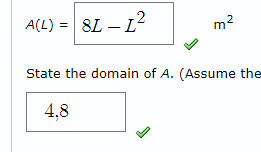
P = 16 = 2(L+W)
8 = L+W
8-L = W
so area, A = L(8-L)
also from the condition in the second part, L>8-L
thorn talon
plush hollow
P = 16 = 2(L+W)
8 = L+W
8-L = W
so area, A = L(8-L)
also from the condition in t...
https://i.imgur.com/MlD8kqs.png so i used chatgpt to help me get this answer before hand but i just dont understand the whole process of how you get to the answer. im sorry if this doesnt make sense. its been a while since ive taken any math classes
 plush hollow
thorn talon
https://i.imgur.com/MlD8kqs.png so i used chatgpt to help me get this answer bef...
plush hollow
thorn talon
https://i.imgur.com/MlD8kqs.png so i used chatgpt to help me get this answer bef...
what is the formula for the perimeter of a rectangle?
thorn talon
plush hollow
what is the formula for the perimeter of a rectangle?
P=2(l+w)
(should this be common sense. because i didnt know that off the top of my head?)
plush hollow
thorn talon
P=2(l+w)
(should this be common sense. because i didnt know that off the top of ...
it is common sense, basically adding up all the sides of the rectangle
now we know P=16, yes?
thorn talon
plush hollow
it is common sense, basically adding up all the sides of the rectangle
so im cooked. got it
thorn talon
so divide each side by 2
so itd be 8 = l+w
then 8-l = w
im not sure where to go from here
plush hollow
thorn talon
then 8-l = w
now whats the formula for the area of a rectangle
thorn talon
a =wl
thorn talon
plush hollow
but w=8-l
im so sorry. im not understanding how you are getting form this step to the next
plush hollow
if A=wl, what is the area if w=4 in terms of l?
thorn talon
A=4L?
topaz sinewBOT
@thorn talon Has your question been resolved?
 night imp
@thorn talon do you still have doubts?
thorn talon
night imp
<@836182934394372097> do you still have doubts?
yes https://i.imgur.com/7qIlYS9.png i tried a practice problem and got stuck again
 night imp
thorn talon
yes https://i.imgur.com/7qIlYS9.png i tried a practice problem and got stuck aga...
night imp
thorn talon
yes https://i.imgur.com/7qIlYS9.png i tried a practice problem and got stuck aga...
Yes after A=WL
put the value of W in that and find A in terms of L ie
A= (12-L) * L
thorn talon
night imp
Yes after A=WL
put the value of W in that and find A in terms of L ie
A= (12-L)...
ok lemme try and work it out
night imp
thorn talon
ok lemme try and work it out
Now about finding domain, did you understand that?
thorn talon
night imp
Now about finding domain, did you understand that?
absolutely not
night imp
night imp
Yes after A=WL
put the value of W in that and find A in terms of L ie
A= (12-L)...
Did you get this , you will get a quadratic equation for A in terms of L
I will help in domain next
thorn talon
night imp
Did you get this , you will get a quadratic equation for A in terms of L
ngl im still confused. idk how yall restructured the whole thing. im so sorry.
oh wait
they distributed the l
yes?
night imp
Yesssss
night imp
night imp
Yes after A=WL
put the value of W in that and find A in terms of L ie
A= (12-L)...
Now give me this A value in terms of L
I will explain domain after that
night imp
Yes
A = 12L-L²
Now to find domain
In question it's given length will be greater than width correct?
thorn talon
correct
night imp
So length is L width in terms of L in 12-L , how to write this in terms of L>W?
L>12-L correct?
thorn talon
yes that makese sense
night imp
night imp
L>12-L correct?
What will be value of L if you solve this inequality?
night imp
Noo😅
L>12-L
Add L both side
night imp
thorn talon
12-7=5
You don't know L value yet
night imp
Now what was the area in terms of L ? Look above and type
night imp
thorn talon
ok idk what that means tbh
It means L will always be greater than 6 no matter what happens
thorn talon
night imp
It means L will always be greater than 6 no matter what happens
ah ok ok
sorry im dumb
night imp
night imp
Now what was the area in terms of L ? Look above and type
@thorn talon
thorn talon
anyway back to math
night imp
thorn talon
sorry im dumb
No problem at all ,I am here to help
thorn talon
night imp
A = 12L-L²
Now to find domain
In question it's given length will be greater tha...
was it this?
night imp
Yes
A=12L-L²
Now you know area cannot be negative, so can we write
12L-L²>0?
thorn talon
ok
night imp
night imp
Yes
A=12L-L²
Now you know area cannot be negative, so can we write
12L-L²>0?
Now can you solve this quadratic equation and give me values of L?
night imp
-L² not L²
thorn talon
oh
night imp
There is a negative sign before L²
thorn talon
night imp
One second there was one slight Mistake
It was
A=L*(12-L)
A= 12L-L²
where did the 22 come from?
night imp
It will be 12 mb
night imp
night imp
So
12L-L²>0
This ^^
thorn talon
im so lost
night imp
thorn talon
im so lost
What is the formula of A , type it again . I will make sure I don't type any Mistake
night imp
Yes now area should always be greater than 0 so you can write
12L-L²>0
night imp
12L-L²>0
Add L²-12L both side , you will get
0>L²-12L
Now
0>L*(L-12)
night imp
thorn talon
<:sully:651816820122189834>
Well that is necessary when we have square terms 😅
night imp
night imp
12L-L²>0
Add L²-12L both side , you will get
0>L²-12L
Now
0>L*(L-12)
Let me know if you understand this or not @thorn talon
thorn talon
night imp
Let me know if you understand this or not <@836182934394372097>
why did you undistribute
night imp
thorn talon
why did you undistribute
Because then I will get two values of L
One L<0
Another L-12<0
thorn talon
uhm ok i think i get the idea but still a little fuzzy
night imp
Yes
L-12<0
Adding 12 both side
night imp
Now what was the starting point of L that we had found out previously?
thorn talon
6
night imp
night imp
No. Worries just deal with it
Now we have two L values
L<0
L<12
Yessss so we need to discard L<0 value from here
Only L< 12 holds true for that
So our final solution is
L will always be greater than 6
L will always be less than 12
So 6,12 is your domain
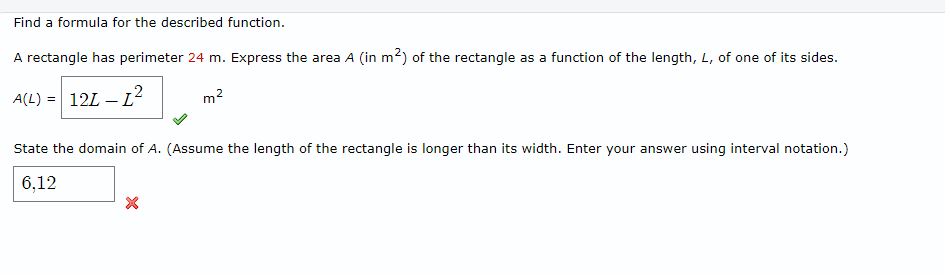 night imp
thorn talon
did i do something wrong
night imp
thorn talon
did i do something wrong
Nooo, ig we found domain of L not A
night imp
Can you put 0,36 in that domain and see if that is correct or not, just wanted to check something
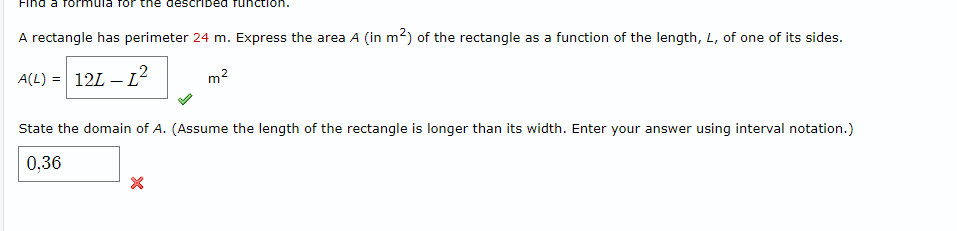 night imp
thorn talon
https://i.imgur.com/ixezldk.png
night imp
thorn talon
https://i.imgur.com/ixezldk.png
Ohhh I get it, can you try 0,12 last one for me
thorn talon
night imp
Ohhh I get it, can you try 0,12 last one for me

nope
dang
hold on
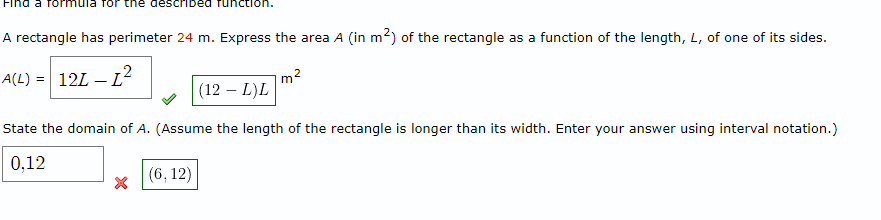
it said its 6, 12
but said it was wrong when i did it
what
 night imp

 night imp

thorn talon
ok well i guess ill just try another problem and see if i can do that one correc haha
thanks lol
.close
topaz sinewBOT
Channel closed
Closed by @thorn talon
Use .reopen if this was a mistake.
topaz sinewBOT
Available help channel!
Send your question here to claim the channel.
Remember:
• Ask your math question in a clear, concise manner.
• Show your work, and if possible, explain where you are stuck.
• After 15 minutes, feel free to ping <@&286206848099549185>.
• Type the command .close to free the channel when you're done.
• Be polite and have a nice day!
Read #❓how-to-get-help for further information on how to ask a good question, and about conduct in the question channels.
neon iron
Would like to check my answer
$$\int{\frac{\sqrt{4x^2-1}}{5x}} dx$$
thorny flameBOT
Edmund Cloudsley
 neon iron
I'll just type it out"
 pearl fog
!nosols
topaz sinewBOT
As a helper, please do not give out answers that could be copied as a homework solution. Have the student work through the problem themselves and guide them along the way.
pearl fog
but dont just give it immediately
neon iron
$$\text{Let x = \frac{1}{2} \sec{\theta}$$
$$\frac{dx}{d\theta} = [\frac{1}{\sec\theta}]^\prime$$
$$\frac{dx}{d\theta} = \frac{\sec{\theta \tan\theta}}{2}$$
$$dx = \frac{\sec\theta \tan\theta}{2} d\theta$$
yeah gimme a sec
I'll fix this
is it okay if I ping you once I am done
thorny flameBOT
Edmund Cloudsley
Compile Error! Click the  reaction for more information.
(You may edit your message to recompile.)
 pearl fog
what does "^\prime" mean?
neon iron
$$\text{Let } x = \frac{1}{2} \sec{\theta}$$
$$\frac{dx}{d\theta} = \left[\frac{1}{2} \sec{\theta}\right]^\prime$$
$$\frac{dx}{d\theta} = \frac{\sec{\theta} \tan{\theta}}{2}$$
$$dx = \frac{\sec{\theta} \tan{\theta}}{2} d\theta$$
thorny flameBOT
Edmund Cloudsley
 pearl fog
oh im stupid ncm
neon iron
ok so this is the first part, the u-substitution part
now I have to substitute this into the main integral
yeah the question asks me to do this long sub
they specifically say use x = 1/2 sec theta
$\int \sqrt{{4(\frac{\sec{\theta} \tan{\theta}}{2})^2 - 1}} \times \frac{1}{5(\frac{\sec{\theta} \tan{\theta}}{2})} \frac{\sec{\theta} \tan{\theta}}{2} d\theta$
thorny flameBOT
Edmund Cloudsley
 neon iron
Holy moly it worked
first try
once sec
oh shit I mistyped it
$$\int \sqrt{4\left(\frac{\sec{\theta}}{2}\right)^2 - 1} \times \frac{1}{5\left(\frac{\sec{\theta}}{2}\right)} \cdot \frac{\sec{\theta} \tan{\theta}}{2} , d\theta
$$
thorny flameBOT
Edmund Cloudsley
 neon iron
yeah this is it
and then we
\int \sqrt{4\left(\frac{\sec{\theta}}{2}\right)^2 - 1} \times \frac{1}{5\left(\frac{\sec{\theta}}{2}\right)} \cdot \frac{\sec{\theta} \tan{\theta}}{2} , d\theta = \int \sqrt{\frac{4\sec^2{\theta}}{4} - 1} \times \frac{2}{5\sec{\theta}} \cdot \frac{\sec{\theta} \tan{\theta}}{2} , d\theta = \int \sqrt{\sec^2{\theta} - 1} \times \frac{\tan{\theta}}{5} , d\theta
god if this doesn't work
$$\int{\frac{\sqrt{4x^2-1}}{5x}} dx$$
$$\text{Let } x = \frac{1}{2} \sec{\theta}$$
$$\frac{dx}{d\theta} = \left[\frac{1}{2} \sec{\theta}\right]^\prime$$
$$\frac{dx}{d\theta} = \frac{\sec{\theta} \tan{\theta}}{2}$$
$$dx = \frac{\sec{\theta} \tan{\theta}}{2} d\theta$$
$$\int \sqrt{4\left(\frac{\sec{\theta}}{2}\right)^2 - 1} \times \frac{1}{5\left(\frac{\sec{\theta}}{2}\right)} \cdot \frac{\sec{\theta} \tan{\theta}}{2} , d\theta = $$
$$\int \sqrt{\frac{4\sec^2{\theta}}{4} - 1} \times \frac{2}{5\sec{\theta}} \cdot \frac{\sec{\theta} \tan{\theta}}{2} , d\theta =
$$
$$ = \int \sqrt{\sec^2{\theta} - 1} \times \frac{\tan{\theta}}{5} , d\theta$$
$$ = \int \tan {\theta} \times \frac{\tan{\theta}}{5} , d\theta$$
$$ = \int \frac{1}{5} {tan^2 \theta} d\theta$$
$$ = \frac{1}{5}\int {sec^2 \theta - 1} d\theta$$
$$ = \frac{1}{5} (\tan \theta - \theta) + C$$
$$ = \frac{1}{5} (\tan{\arcsec{2x}} - \arcsec{2x}) + C$$
Let's go
nope
just a moment
I'll compile everything together
Okay phew finally typed it out
yeah could you check if this is fine @charred dagger
thorny flameBOT
Edmund Cloudsley
 neon iron
really
cool
thanks
this was a long one
yup we need to sub back x right?
I get arcsec 2x = theta
yup
gosh this was a horrible integral
felt like I was doing MIT integration
bee
tho that must be harder
anyways
have great day
.close
topaz sinewBOT
Channel closed
Closed by @echo oxide
Use .reopen if this was a mistake.
topaz sinewBOT
Available help channel!
Send your question here to claim the channel.
Remember:
• Ask your math question in a clear, concise manner.
• Show your work, and if possible, explain where you are stuck.
• After 15 minutes, feel free to ping <@&286206848099549185>.
• Type the command .close to free the channel when you're done.
• Be polite and have a nice day!
Read #❓how-to-get-help for further information on how to ask a good question, and about conduct in the question channels.
 vivid stone
how can i by part this
 topaz sinewBOT
vivid stone
how can i by part this
vivid stone
topaz sinewBOT
vivid stone
how can i by part this
vivid stone
as n is constant
 vivid stone
 wispy pier
Or formula ?
wispy pier
Or formula ?
formula
wispy pier
 wispy pier
vivid stone
i got this
wispy pier
vivid stone
i got this

If we consider the integration to be I
We get I again on LHS
We can take it to RHS and divide by coefficient
To get the derived result
Got me ?
wispy pier
Ofcourse
vivid stone

so i need to divide both side by n^2/4?
ohhh wait
i can +n^2/4 both side
thx so much bro
.close
topaz sinewBOT
Channel closed
Closed by @vivid stone
Use .reopen if this was a mistake.
topaz sinewBOT
Available help channel!
Send your question here to claim the channel.
Remember:
• Ask your math question in a clear, concise manner.
• Show your work, and if possible, explain where you are stuck.
• After 15 minutes, feel free to ping <@&286206848099549185>.
• Type the command .close to free the channel when you're done.
• Be polite and have a nice day!
Read #❓how-to-get-help for further information on how to ask a good question, and about conduct in the question channels.
 prisma mesa
I have few questions about this:
- why is the probability 1 / 2^(# of supersets)?
- why is the # of superset = n - |S|, shouldn't it be 2^(n-|CS)?
 topaz sinewBOT
prisma mesa
I have few questions about this:
1) why is the probability 1 / 2^(# of supersets...
flint stump
topaz sinewBOT
prisma mesa
I have few questions about this:
1) why is the probability 1 / 2^(# of supersets...
flint stump
For 1 - coz even if a cookie is not directly chosen, it'd still be eaten if a cookie that has it in its subset is chosen
prisma mesa
flint stump
For 1 - coz even if a cookie is not *directly* chosen, it'd still be eaten if a ...
Okay, but why is there 2^(# of supersets)?
Oh, I think i kinda get it
# of sets that are not supersets / 2^n should be the probability
okay that makes sense actually
But why is the number of supersets n - |S|
If |S| = 5, then there are 3 (n-5) elements not in S
and I can pick any (nonempty?) subset of those 3 elements and add it to S to get a superset
prisma mesa
prisma mesa
\# of sets that are **not** supersets / 2^n should be the probability
Oh this is incorrect too
i think
flint stump
But you are at the same time taking away all the subsets too
prisma mesa
flint stump
But you are at the same time taking away all the subsets too
oh, how does it influence the probability?
flint stump
so you are choosing in the end the whole subset as a single cookie
that makes the Powerset of S a single cookie
can you see what im saying?
prisma mesa
not quite
flint stump
Sorry, I have the intuition, but cant put it in text
prisma mesa
okay, I'll try to think about it
thanks
i probably have too low intuition in probability for this
flint stump
just a question, are you going thru all olympiad problems?
prisma mesa
flint stump
just a question, are you going thru all olympiad problems?
I'm just reading evan chen's OTIS book
I'd like to try national olympiad this year, so im practising a bit
 topaz sinewBOT
Channel closed
Closed by @prisma mesa
Use .reopen if this was a mistake.
topaz sinewBOT
Available help channel!
Send your question here to claim the channel.
Remember:
• Ask your math question in a clear, concise manner.
• Show your work, and if possible, explain where you are stuck.
• After 15 minutes, feel free to ping <@&286206848099549185>.
• Type the command .close to free the channel when you're done.
• Be polite and have a nice day!
Read #❓how-to-get-help for further information on how to ask a good question, and about conduct in the question channels.
 untold matrix
how to do this
 topaz sinewBOT
untold matrix
how to do this
untold matrix
topaz sinewBOT
untold matrix
how to do this
untold matrix
<@&286206848099549185>
 late quiver
untold matrix
late quiver
untold matrix
hi
its a part of my school assignment but my teacher didnt teach us this
anyone knows how to do
second order partial differentiation that involves intermediate variables? I can solve till first order but I have no idea how to proceed
<@&286206848099549185>
.close
topaz sinewBOT
Channel closed
Closed by @untold matrix
Use .reopen if this was a mistake.
Available help channel!
Send your question here to claim the channel.
Remember:
• Ask your math question in a clear, concise manner.
• Show your work, and if possible, explain where you are stuck.
• After 15 minutes, feel free to ping <@&286206848099549185>.
• Type the command .close to free the channel when you're done.
• Be polite and have a nice day!
Read #❓how-to-get-help for further information on how to ask a good question, and about conduct in the question channels.
 opaque nymph
hey i dont really know how to navigate discord well, but could someone direct me (if there is a page?) to where i can find formula sheets and useful links. I need to make a matrices and functions "cheat sheet" for a first year engmath test and would like to save some time by modifying an original one if possible. Thank you
topaz sinewBOT
opaque nymph
hey i dont really know how to navigate discord well, but could someone direct me...
opaque nymph
.close
topaz sinewBOT
Channel closed
Closed by @opaque nymph
Use .reopen if this was a mistake.
Available help channel!
Send your question here to claim the channel.
Remember:
• Ask your math question in a clear, concise manner.
• Show your work, and if possible, explain where you are stuck.
• After 15 minutes, feel free to ping <@&286206848099549185>.
• Type the command .close to free the channel when you're done.
• Be polite and have a nice day!
Read #❓how-to-get-help for further information on how to ask a good question, and about conduct in the question channels.
 hoary fable
Idk the first part, showing the volume
 topaz sinewBOT
hoary fable
Idk the first part, showing the volume
topaz sinewBOT
hoary fable
Idk the first part, showing the volume
 crisp raptor
you could integrate the Identity function for a regular tetrahedron in R^3, however that's probably overkill for such a simple geometric object
topaz sinewBOT
@hoary fable Has your question been resolved?
hoary fable
crisp raptor
you could integrate the Identity function for a regular tetrahedron in R^3, howe...
i hvent learnt integration
 astral juniper
something like this
 topaz sinewBOT
Channel closed
Closed by @hoary fable
Use .reopen if this was a mistake.
topaz sinewBOT
Available help channel!
Send your question here to claim the channel.
Remember:
• Ask your math question in a clear, concise manner.
• Show your work, and if possible, explain where you are stuck.
• After 15 minutes, feel free to ping <@&286206848099549185>.
• Type the command .close to free the channel when you're done.
• Be polite and have a nice day!
Read #❓how-to-get-help for further information on how to ask a good question, and about conduct in the question channels.
 snow gyro
 snow gyro
Instructions:
- Get the equation and diagram
- Get diagram and it has a specific number -3 to 3
- Get diagram
pearl fog
wdym "it has a specific number -3 to 3", like the graph from -3 to 3?
pearl fog
do you do all 3 of the instructions per question or just like for number 1 you do instruction 1, num 2 do ins 2 ect
snow gyro
wdymm
pearl fog
actually nvm
snow gyro
the instruction is per number
 fallow heart
Wdym?
pearl fog
- just graph it and estimate
- notice its a parabola, find its zeroes and find its extreme point and try to find some points to try to graph it roughly
- change it to the y=something and graph it
snow gyro
what latter?
snow gyro
pearl fog
1. just graph it and estimate
2. notice its a parabola, find its zeroes and find...
WUTTT 1.1 why is there a point .1
snow gyro
pearl fog
1. just graph it and estimate
2. notice its a parabola, find its zeroes and find...
oh so this is for no.1?
pearl fog
sorry
pearl fog
bruh just ignore it 😭
snow gyro
ok okkk
snow gyro
pearl fog
1. just graph it and estimate
2. notice its a parabola, find its zeroes and find...
This is for all numbers?
pearl fog
yeah
pearl fog
these are parabolas
 topaz sinewBOT
@snow gyro Has your question been resolved?
snow gyro
no
topaz sinewBOT
Channel closed
Closed due to timeout
Use .reopen if this was a mistake.
Available help channel!
Send your question here to claim the channel.
Remember:
• Ask your math question in a clear, concise manner.
• Show your work, and if possible, explain where you are stuck.
• After 15 minutes, feel free to ping <@&286206848099549185>.
• Type the command .close to free the channel when you're done.
• Be polite and have a nice day!
Read #❓how-to-get-help for further information on how to ask a good question, and about conduct in the question channels.
snow gyro
<@&286206848099549185>
topaz sinewBOT
snow gyro
<@&286206848099549185>
snow gyro
.close
topaz sinewBOT
Channel closed
Closed by @snow gyro
Use .reopen if this was a mistake.
 fallow igloo
snow gyro
.close
fallow igloo
snow gyro
.close
you can do that again
 vernal matrix
snow gyro
no
vernal matrix
snow gyro
no
.(yea make sure you use the reacts on the bot next time, rather than typing the response to it  )
)
fallow igloo
 timber plover
I need help pls
timber plover
I need help pls
claim your channel bro
timber plover
how
fallow igloo
consider checking #❓how-to-get-help
topaz sinewBOT
To ask for mathematics help on this server, please open your own help channel or help thread. See #❓how-to-get-help for instructions.
vernal matrix
(underneath there, there are available channels you can take)
snow gyro
.close
fallow igloo
it's closed Xd
prisma mesa
It's already close, it will lock soon
topaz sinewBOT
Available help channel!
Send your question here to claim the channel.
Remember:
• Ask your math question in a clear, concise manner.
• Show your work, and if possible, explain where you are stuck.
• After 15 minutes, feel free to ping <@&286206848099549185>.
• Type the command .close to free the channel when you're done.
• Be polite and have a nice day!
Read #❓how-to-get-help for further information on how to ask a good question, and about conduct in the question channels.
 fathom brook
Solve the system of equations by elimination.
3x–y–3z= -2
x+3y–3z=6
2x+2y+3z= -14
topaz sinewBOT
fathom brook
Solve the system of equations by elimination.
3x–y–3z= -2
x+3y–3z=6
2x+2y+3z=...
 north lion
are there any variables whose coefficients are the same?
topaz sinewBOT
@fathom brook Has your question been resolved?
topaz sinewBOT
Channel closed
Closed due to timeout
Use .reopen if this was a mistake.
Available help channel!
Send your question here to claim the channel.
Remember:
• Ask your math question in a clear, concise manner.
• Show your work, and if possible, explain where you are stuck.
• After 15 minutes, feel free to ping <@&286206848099549185>.
• Type the command .close to free the channel when you're done.
• Be polite and have a nice day!
Read #❓how-to-get-help for further information on how to ask a good question, and about conduct in the question channels.
thorny flameBOT
IndyRishi
 topaz sinewBOT
Channel closed
Channel closed due to the original message being deleted.
If you did not intend to do this, please open a new help channel,
as this action is irreversible, and this channel may abruptly lock.
 maiden root
Consider the energy levels of a hydrogenic atom for which $n$=3. In terms of appropriate quantum number values, list the different eigenstates, first assuming no spin-orbit coupling and then with spin-orbit coupling. Compare the degeneracies for the two cases (including electron spin) and sketch the component levels that result from spin-orbit coupling.
thorny flameBOT
IndyRishi
 maiden root
How can I find the eigenstates for n=3? They showed a diagram for n=2
I figured it out, this is my answer:
For n=3, there are 3 states of L: 0, 1, and 2.
For L = 0, there's only one magnetic quantum number state: 0
Since there are 2 spins, + or - 1/2, that means there are 2 states for l = 0.
Repeating the processes for L = 1 and L = 2 yields 6 and 10 states.
With spin orbit coupling, j can be l +/- 1/2 (spin of electron), except for if l is 0, then j is just 1/2
So j can be 1/2 for l = 0, 3/2 & 1/2 for l = 1, and 5/2 & 3/2 for l = 2.
M_j can go from -j to +j in integer steps. For each value of j, 1/2, 3/2, and 5/2, there are 2, 4, and 6 values respectively.
To calculate the states with spin-orbit coupling, multiply the m_j values calculated before by 2, because s can be +/- 1/2 (2 values).
In lieu of sketch, text diagram below:
If l = 0, j = 1/2. There are 2 states for m_j that we calculated earlier. Multiply by 2: there are 4 states.
If l = 1, j can be 3/2 or 1/2. For 3/2, there are 4 states for m_j and 8 states in general with spin. For 1/2, there are 2 states for m_j and 4 states in general with spin.
If l = 2, j can be 5/2 or 3/2. For 5/2, there are 6 states for m_j and 12 states with spin. For 3/2, there are 4 states and 8 states with spin.
topaz sinewBOT
Available help channel!
Send your question here to claim the channel.
Remember:
• Ask your math question in a clear, concise manner.
• Show your work, and if possible, explain where you are stuck.
• After 15 minutes, feel free to ping <@&286206848099549185>.
• Type the command .close to free the channel when you're done.
• Be polite and have a nice day!
Read #❓how-to-get-help for further information on how to ask a good question, and about conduct in the question channels.
 daring schooner
 topaz sinewBOT
daring schooner
topaz sinewBOT
daring schooner
 celest bough
I will try something
 sudden temple
daring schooner
Guys how do I do question number 2?
sudden temple
daring schooner
Guys how do I do question number 2?
have you tried anything?
okay nvm i am blind
daring schooner
sudden temple
have you tried anything?
No not yet
sudden temple
daring schooner
No not yet
try to separate the log terms from the others
I mean, keep the log terms on a single side
then it'll be fine to work on
daring schooner
I got this step
daring schooner
sudden temple
try to separate the log terms from the others
 sudden temple
erm yeah seems alright
btw, it is better if you multiply both sides by -1
and then proceed by properties of logarithm
daring schooner
okok
sudden temple
sudden temple
btw, it is better if you multiply both sides by -1
the reason is that, we have 5^{2-x} thing in the logarithm so it is better to have 2-x on the other side too
rather than x-2
daring schooner
sudden temple
the reason is that, we have 5^{2-x} thing in the logarithm so it is better to ha...
how do i have it on the other side
wait let me show you
 sudden temple
logarithm doesn't distribute over addition/subtraction
 torpid sparrow
Hint (from the beginning), rewrite every single term like log_5(something)
 daring schooner
torpid sparrow
Hint (from the beginning), rewrite every single term like log_5(something)
daring schooner
torpid sparrow
Hint (from the beginning), rewrite every single term like log_5(something)
.
anyone?
sudden temple
daring schooner
here
sudden temple
daring schooner
what's all that
sudden temple
daring schooner
oh you tried it differently here
sudden temple
daring schooner
you know what
if you wanna do it that way
treat 2-x as a single term
it'll be quicker to solve it
sudden temple
daring schooner
by doing that everything will be simplified in just 2-3 steps
just treat 2-x as a single entity
daring schooner
Alright
daring schooner
sudden temple
just treat 2-x as a single entity
 sudden temple
daring schooner
sudden temple
daring schooner
just combine the logarithms on the left hand side, after writing log(2^3) as log(8)
and you'll be done
sudden temple
$\log{a}+\log{b}=\log{ab}$
thorny flameBOT
77²
 daring schooner
daring schooner
daring schooner
I combined it here
sudden temple
daring schooner
I combined it here
bro that multiplication symbol is crazy
daring schooner
You thought it was a plus ?
daring schooner
My handwriting was bad
daring schooner
 sudden temple
no
daring schooner
NO?😭😭
sudden temple
I mean the way is not rright
daring schooner
What is wrong
sudden temple
5^2 times 3^2 is not 15^4
it is 15^2
also 3^x times 5^x is not 15^2x
it is just 15^x
exponents add when the bases are same
I think you got it right?
topaz sinewBOT
If you are done with this channel, please mark your problem as solved by typing .close
@daring schooner Has your question been resolved?
Channel closed
Closed by @daring schooner
Use .reopen if this was a mistake.
topaz sinewBOT
Available help channel!
Send your question here to claim the channel.
Remember:
• Ask your math question in a clear, concise manner.
• Show your work, and if possible, explain where you are stuck.
• After 15 minutes, feel free to ping <@&286206848099549185>.
• Type the command .close to free the channel when you're done.
• Be polite and have a nice day!
Read #❓how-to-get-help for further information on how to ask a good question, and about conduct in the question channels.
 buoyant rose
hey, any idea how the answer is 1,8 ?
 topaz sinewBOT
buoyant rose
hey, any idea how the answer is 1,8 ?
topaz sinewBOT
buoyant rose
hey, any idea how the answer is 1,8 ?
 buoyant rose
hey, any idea how the answer is 1,8 ?
buoyant rose
buoyant rose
hey, any idea how the answer is 1,8 ?
I need to find the point in which they contact
I got 1,12
anyone has any idea? <@&286206848099549185>
 fringe maple
Two affine function intersect when their values (y) are equal hence they intersect when 2x+6=-4x+12
 wispy frost
The intersection
fringe maple
fringe maple
Two affine function intersect when their values (y) are equal hence they interse...
Which is trivially solvable
wispy frost
fringe maple
Which is trivially solvable
Wait, what?
You can find the intersect here
fringe maple
Solution should be 1
fringe maple
wispy frost
You can find the intersect here
You like solve it rigorously instead on just looking at the answer ?
fringe maple
fringe maple
Solution should be 1
You do see that by imputing x=1 in the two function you find the same y
fringe maple
buoyant rose
I have 2x+6=-4x+12
You put the X on one side and the whole number on the other
buoyant rose
ok and I get -2x = 6
fringe maple
You want to privilege removing any negative sign
fringe maple
buoyant rose
ok and I get -2x = 6
You put the -4x on the other side so 6x and remove the 6 from the 12 on the other so 6x=6 is the correct solution
Do you get it or do you want me to explain again ?
fringe maple
No worries
buoyant rose
okay so we get x=1?
fringe maple
Yep
fringe maple
fringe maple
You do see that by imputing x=1 in the two function you find the same y
^
buoyant rose
I see, Lemme try
fringe maple
buoyant rose
we need x and y
You imput X in one of the equation and you should get your y
fringe maple
buoyant rose
I got y=12
No y=8 ?
wispy frost
here
 fringe maple
y = 21 + 6 = 8
Or
y = -41 + 12 = 8
fringe maple
buoyant rose
ok so yeah it's 8
Yep so intersect point is (1;8)
You understood the method ?
buoyant rose
yeah, but what do I do if I need to find y intersect point
so for example, we have: y=4x+8
and I need to find the intersect point on the Y axis
fringe maple
Well what we did here is finding the intersect on the x axis and on the y axis at the same time. On the x axis it’s 1 and on the y axis it’s 8
buoyant rose
wispy frost
y = mx + b
b is the y-intercept
b is just y ?
wispy frost
y-intercept
buoyant rose
lmao the function's wording is kind'a confusing
fringe maple
Ohhhhhhhh y axis intersect
buoyant rose
wdym y-intercept? like, they height of it
buoyant rose
so, the answer is literally in the formula
fringe maple
I actually have a whole note on that
wispy frost
 buoyant rose
there's no need for any calculations 😂
buoyant rose
Hold on a sec, I don't get it
wispy frost
if you're trying to find the y int in
y = 4x + 8
it's just... 8. No calculations needed.
buoyant rose
oh okay
buoyant rose
nope?
 buoyant rose
It says I need to find the point
wispy frost
which point
buoyant rose
of B
buoyant rose
ohh, x just is 0
wispy frost
0, 8
wispy frost

buoyant rose
ok now we need to do the same thing with x
fringe maple
buoyant rose
so y is 0
 buoyant rose
yes
fringe maple
fringe maple
A note I made for a friend taking a test, might be helpful in your study
wispy frost
and solve with y = 0
 wispy frost
wispy frost
wispy frost
this looks like -2
buoyant rose
it does
wispy frost
0 = 4x + 8 is -2
buoyant rose
but it's not working here s
buoyant rose
buoyant rose
no?
did I input it correctly?
wispy frost
buoyant rose
no?
and it's the same equation?
buoyant rose
yes
wispy frost
calculator says it's right
buoyant rose
DA FUCK
 wispy frost
yeah
buoyant rose
😂 WHA
buoyant rose
exam in a week
got an entire syllabus to catch up on
I'm here

EACH ONE IS A TOPIC
SO HARDD
wispy frost
i believe in you
buoyant rose
allright
so- next question (same formula, same line)
I need to find "for what X value, the line gets positive values"
whatever the heck that means


 wispy frost
all values
not just one
bc there are multiple values
that would have a positive y
buoyant rose
I'm learning...
from a course that the teacher gave me
I'm essentially not supposed to be trying 4 units, but I want to rank up to it
so I need to study since the exam is soon
wispy frost
you should read the lessons associated to the exam not just take the exam itself
buoyant rose
There isn't anywhere to "read"them
you come to class, you do the stuff the teacher says and u try to learn
but I was put in a lower-tier math's class, and got 100 on the final exam. so now if I wanna rank up- I gotta catch up on all of this material
wispy frost
buoyant rose
but I was put in a lower-tier math's class, and got 100 on the final exam. so no...
do you have to use this platform
wispy frost
learning from just taking quizes isn't good
it should be a refresher
not how you learn
buoyant rose
Yeah, but there aren't any video classes
wispy frost
you can look up ones from different resources
like find a YT tutorial on the section that exam is
i think your resource isn't really to teach, but mainly to quiz from things you learned elsewhere
buoyant rose
yeah it's annoying
Do you know where I can find this kind of thing?
starting with analatics
wispy frost
analytics?
wispy frost
is this for algebra 1, what class is it
buoyant rose
yeah, I don't know what this subject that we're working on rn is caled in english
but in translation it's analytics
buoyant rose
wispy frost
is this for algebra 1, what class is it
uh..
we just have.. units here
I guess it's algebra, I don't know
there's 3, 4, and 5 units
wispy frost
I have no idea how your education system works so I couldn't give you any recommendations
topaz sinewBOT
Channel closed
Closed by @buoyant rose
Use .reopen if this was a mistake.
topaz sinewBOT
Available help channel!
Send your question here to claim the channel.
Remember:
• Ask your math question in a clear, concise manner.
• Show your work, and if possible, explain where you are stuck.
• After 15 minutes, feel free to ping <@&286206848099549185>.
• Type the command .close to free the channel when you're done.
• Be polite and have a nice day!
Read #❓how-to-get-help for further information on how to ask a good question, and about conduct in the question channels.
 twin walrus
How would I solve the integral "(3x+1)/((x^2)+1) dx" ?
twin walrus
so far I've substituted ((x^2)+1) for u(x)
 agile harness
then what
twin walrus
and gotten dx = 1/2x du
crisp raptor
use the linearity of Integration operator
twin walrus
what is that
crisp raptor
$\int (f(x) + g(x)) dx = \int f(x) dx + \int g(x) dx$
thorny flameBOT
tobi
 agile harness
so then what is the issue
crisp raptor
$\int \frac{1}{1+x^2} dx$
thorny flameBOT
tobi
 crisp raptor
this is a well known integral
twin walrus
and I have (3x+1)/((x^2)+1) on one side and the thing that turns into arc tan on the other
oh
neon iron
tan
twin walrus
yeah but I dont know what to do with the other integral
agile harness
use your u sub
twin walrus
Mhmm?
neon iron
twin walrus
and I have (3x+1)/((x^2)+1) on one side and the thing that turns into arc tan on...
you just split it
crisp raptor
3 can be brought outside of the Integral using the linearity property
neon iron
{3x/x^2 +1 } + 1/x^2 +1
agile harness
and you’re left with 3/2u
twin walrus
wow the x does cancel
crisp raptor
yeah then 3/2 can be brought outside of the Integral and you are left with 1/u du
agile harness
twin walrus
and gotten dx = 1/2x du
^
crisp raptor
twin walrus
not 1/2x du
whenever you 1/f`(x) this works!
twin walrus
that I didnt even know where to start with
agile harness
twin walrus
that I didnt even know where to start with
send it
crisp raptor
 twin walrus
integral from pi to -pi, sinxcosx dx
neon iron
twin walrus
that I didnt even know where to start with
well solve more questions..... you will notice the similarities
agile harness
what’s sin(2x)?
crisp raptor
this is the rule, you multiply with the derivative of your substitution
neon iron
twin walrus
integral from pi to -pi, sinxcosx dx
sin2x=2sinxcosx
agile harness
apples
twin walrus
I dont know