#help-26
1 messages · Page 138 of 1
 dusk adder
 ocean pewter
Yeah, I've heard it's needed for eigen-stuff
dusk adder
It is also fundamental to making projection matrices
And just projections in general as you are doing right now
 urban grove
wait, w1 = (1, 1, 0) and w2 = (0, 1, 1) though I thought?
v - c1 w1 - c2 w2 = (2 - c1, 4 - c1 - c2, 3 - c2)
ocean pewter
I thought w1 = <3, 3, 0> and w2 = <-2, 2, 4>
urban grove
No, those were the projections we calculated using the previous method
That method was wrong, my mistake
Sorry
This method should be faster and work correctly
By w1 and w2, I mean the two vectors that span S in the original problem
ocean pewter
Ohh, okay
ocean pewter
urban grove
By w1 and w2, I mean the two vectors that span S in the original problem
Now I'm getting c1=-11 and c2=8
urban grove
How'd you get that
ocean pewter
I used dot product to get the system
2*c1 + c2 = 6
c1 + 2*c2 = 7
urban grove
ocean pewter
I used dot product to get the system
2\*c1 + c2 = 6
c1 + 2\*c2 = 7
that's right, but your solution for c1 and c2 isn't right
(for example 2*-11 + 8 = -14, not 6)
ocean pewter
c2 = 8/3
c1 = 5/3 ?
Let me check with substitution
Yeah, I'm getting those solutions
ocean pewter
urban grove
How'd you get that
Are those the solutions you got?
urban grove
You mixed up c1 and c2, I think
ocean pewter
So c1 = 8/3?
urban grove
No I mean
c1 = 5/3 and c2 = 8/3
But it looks like you accidentally did c1 = 8/3 and c2 = 5/3 in your calculation for the final answer
urban grove
yea
ocean pewter
So I have a visualization of what I think the porjection is, but I don't really know waht it means or does
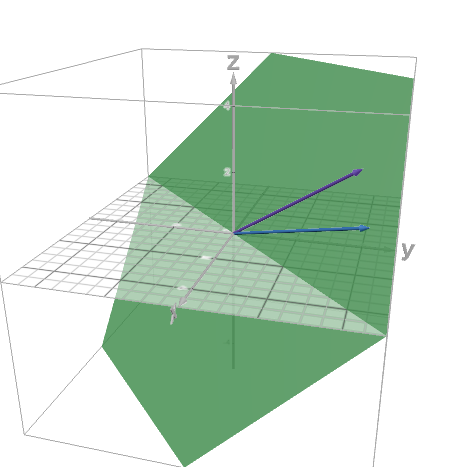
Desmos
I notice that the projection bector lies on the span of <1,1,0> and <0,1,1> but it isn't orthogonal to <2,4,3>
dusk adder
Projection is the opposite of what you are thinking
It is the closest point to (2,4,3)
If (2,4,3) was in the span
ocean pewter
That makes sense now that I think about
dusk adder
The projection would have just been (2,4,3)
ocean pewter
So projection of a vector is the closest that a scalar multiple of the vector can be to another vector
and the projection of a subspace is the closest that a vector in the span of the of the subspace can be to another vector
dusk adder
ocean pewter
and the projection of a subspace is the closest that a vector in the span of the...
Projection of a vector onto the subspace
ocean pewter
My bad
dusk adder
You can actually see this
Because the difference between vector and the it's projection is orthogonal to the span
 dusk adder
It was already used here
dusk adder
ocean pewter
The orthogonal is supposed to be perpendicular, right?
It would be normal to the plane
ocean pewter
Like a normal line in calculus?
dusk adder
No like a normal line to a plane
dusk adder
ocean pewter
Like a normal line in calculus?
If you are talking multivariable calculus where they taught you the definition of a plane yes
ocean pewter
I haven't taken calc iii yet
dusk adder
Just google
ocean pewter
ocean pewter
Like a normal line in calculus?
I was kinda thinking this
 urban grove
ocean pewter
I was kinda thinking this
urban grove
ocean pewter
I was kinda thinking this
Ignore the red curve here, the blue line is normal to the green one
(normal just means perpendicular)
We're only working with linear stuff rn
ocean pewter
Okay
I just used the red curve to make the green and blue ones
I was going to ask about the least squares regression problem, but it's getting a little late
Thanks @dusk adder & @urban grove
.close
dusk adder
np
 topaz sinewBOT
Channel closed
Closed by @ocean pewter
Use .reopen if this was a mistake.
urban grove
you're welcome!
ocean pewter
dusk adder
In more dimensions
Like this?
 dusk adder
The blue line does look normal to that plane yes
ocean pewter
Cool, thanks again
topaz sinewBOT
 Available help channel!
Send your question here to claim the channel.
Remember:
• Ask your math question in a clear, concise manner.
• Show your work, and if possible, explain where you are stuck.
• After 15 minutes, feel free to ping <@&286206848099549185>.
• Type the command .close to free the channel when you're done.
• Be polite and have a nice day!
Read #❓how-to-get-help for further information on how to ask a good question, and about conduct in the question channels.
 heady maple
ok ques time
topaz sinewBOT
heady maple
ok ques time
heady maple
for me
im kinda confused here
I wanted to practice some algebra
and I found this on one site

 boreal mulch
heady maple
boreal mulch
heady maple
gaussian elimination?
 grave karma
what is 2+2
boreal mulch
heady maple
<@343931343031500803>
ig 2R1-R2->R2?
topaz sinewBOT
Channel closed
Closed by @heady maple
Use .reopen if this was a mistake.
boreal mulch
heady maple
thanks bro
yw
topaz sinewBOT
Available help channel!
Send your question here to claim the channel.
Remember:
• Ask your math question in a clear, concise manner.
• Show your work, and if possible, explain where you are stuck.
• After 15 minutes, feel free to ping <@&286206848099549185>.
• Type the command .close to free the channel when you're done.
• Be polite and have a nice day!
Read #❓how-to-get-help for further information on how to ask a good question, and about conduct in the question channels.
 queen cloud
In a randomised controlled experiment are there no omitted variables
 astral blaze
you supposed not to or can assume that the expectation of that is zero
There are omitted variables (I mean, randomization would not change the fact that I have a certain gene for example) but those should not influence the treatment (i.e., the distribution of people who have a certain gene should be randomized enough to not have effect on treatment effect)
queen cloud
astral blaze
There are omitted variables (I mean, randomization would not change the fact tha...
So there are omitted variables but they don't possess an influence on the study
But then
Isn't the definition of an omitted variable one that DOES influence the study
queen cloud
queen cloud
Isn't the definition of an omitted variable one that DOES influence the study
And it has been wrongly excluded
So technically those variables are not "omitted variables"?
astral blaze
I mean. Yes. For example, suppose we have a new drug to reduce blood pressure. We let the participants consume it and let them go home and come back to check. What patients eat at home can influence their blood pressure, but does that count as an omitted variable? RCE ensures that those are evenly distributed (hopefully) and mitigate those biases.
Meal does influence blood pressure, but if we only care about the effect of the drug, RCE remove those effects
(hopefully)
queen cloud
So would you say that
"There are no omitted variables in a randomised controlled experiment" is True?
astral blaze
There should be no omitted variables bias in a randomised controlled experiment. The variables are still there (like meals) but the effects are even out from randomization.
topaz sinewBOT
@queen cloud Has your question been resolved?
topaz sinewBOT
Channel closed
Closed due to timeout
Use .reopen if this was a mistake.
Available help channel!
Send your question here to claim the channel.
Remember:
• Ask your math question in a clear, concise manner.
• Show your work, and if possible, explain where you are stuck.
• After 15 minutes, feel free to ping <@&286206848099549185>.
• Type the command .close to free the channel when you're done.
• Be polite and have a nice day!
Read #❓how-to-get-help for further information on how to ask a good question, and about conduct in the question channels.
 dense cosmos
 topaz sinewBOT
dense cosmos
topaz sinewBOT
dense cosmos
 glacial cliff
k is just the normal variable people use for growth rate
 unreal kite
$P(t)=60\cdot (2)^{(3t)} \to P'(t) = 60 \cdot 3 ln(2) \cdot 2^{(3t)}$\
or\
$P'(t)=3ln(2) \cdot P(t)$ \
giving by definition a relative growth rate of $3ln(2)$ (the amount $P(t)$ increases at a rate of $3ln(2)$ of its amount)
 thorny flameBOT
Crystopher
 dense cosmos
so 3ln2 is correct?
unreal kite
if we assume that your function P(t) is correct, then it should be 3ln(2)
 unreal kite
how did you arrive at your results?
dense cosmos
i just used average rate of change in the given interval 💀
i have no idea what it wants
unreal kite
b) states basically that given two points $(1800,980)$ and $(1850,1260)$ find a function $P(t)=P_0e^{kt}$ with parameters $k$ and $P_0$ that goes through these points, then use it to find $P(1900)$.
thorny flameBOT
Crystopher
 dense cosmos
would this work
 unreal kite
that should work
a bit different to what I had in mind but still seems to check out.
topaz sinewBOT
@dense cosmos Has your question been resolved?
Channel closed
Closed by @dense cosmos
Use .reopen if this was a mistake.
topaz sinewBOT
Available help channel!
Send your question here to claim the channel.
Remember:
• Ask your math question in a clear, concise manner.
• Show your work, and if possible, explain where you are stuck.
• After 15 minutes, feel free to ping <@&286206848099549185>.
• Type the command .close to free the channel when you're done.
• Be polite and have a nice day!
Read #❓how-to-get-help for further information on how to ask a good question, and about conduct in the question channels.
 glass root
.reopen
 craggy lily
 topaz sinewBOT
craggy lily
craggy lily
topaz sinewBOT
craggy lily
craggy lily
wait is the one solution 0?
I was confused for a second but I thinkk the only value that makes sense is 0
.close
topaz sinewBOT
Channel closed
Closed by @craggy lily
Use .reopen if this was a mistake.
topaz sinewBOT
Available help channel!
Send your question here to claim the channel.
Remember:
• Ask your math question in a clear, concise manner.
• Show your work, and if possible, explain where you are stuck.
• After 15 minutes, feel free to ping <@&286206848099549185>.
• Type the command .close to free the channel when you're done.
• Be polite and have a nice day!
Read #❓how-to-get-help for further information on how to ask a good question, and about conduct in the question channels.
 tall quiver
Can someone explain to me why my solution sets are wrong?
 topaz sinewBOT
Please don't repeatedly close and claim a new channel with the exact same question. This erases all previous progress made towards your problem and is confusing for helpers, making it more difficult to help you. Please be patient, even if your channel has not received much attention.
 muted relic
you just fliped the sign
tall quiver
i was told to flip the sign to get rid of the -1/5
tall quiver
so should i have not flipped the sign
pretend im new to math
i have been stuck on this problem for hours
muted relic
- and 1) is the correct answer
 verbal hound
Moo
muted relic
correct answers
muted relic
- is fifth, 2) is first i mean
tall quiver
(−2, 3) ∪ (4, ∞)
(−∞, −2) ∪ (4, ∞)
(−2, 4)
(−2, 3)
(−∞, −2) ∪ (3, 4)
these are my options for the answers
LOL
your answer doesnt fit into any of these
tall quiver
ok
can you circle on the problem where i did it wrong then?
so i can learn and know for next time
muted relic
if you don't divide both sides by -1/5 but 1/5, the answer is clear
muted relic
okay
tall quiver
f(x) = -1/5 (x+2) (x-3) (x-4)
original problem
I want to find f(x) > 0
so now its
(-1/5) (x+2) (x-3) (x-4) > 0
is that correct so far?
muted relic

this one is wrong
the fliped function isn't anymore f(x)
let's assume that is f'(x)
tall quiver
wait i dont want to confuse myself even more if i dont have to..
so should i just have not fliped the sign
my teacher didnt teach me inverses yet
i was just told to divide both sides by -1/5 to get rid of it
and because of that i flipped the sign
can i do it without flipping the sign
(-1/5) (x+2) (x-3) (x-4) > 0
divide both sides by 1/5 correcct?
muted relic
yes.
 muted relic
yeah,
tall quiver
do we have to do anything with the -1?
muted relic
of course
tall quiver
ok
so i now have the equation
(-1) (x+2) (x-3)(x-4) > 0
now i do the line with the points correct?
muted relic
yeah
tall quiver
?
what steps did u skip
im only at the number line rn
so now i have the number line
-2 , 3 , 4
do i do -1 too?
or ignore that
muted relic
if x=-1, (-1) (x+2) (x-3)(x-4) = 20
tall quiver
um
thats different from the method i did in the picture
😭
this is the part im confused on
and have been for the past 2 hours
bc no one explains it

this is what i have so far
muted relic
yes
tall quiver
so are we just not doing the number line?
muted relic
i made an error cuz i'm tired too
tall quiver
whats the calculation for?
im on the number line and i dont know what this calculation is for
muted relic
muted relic
if x=-1, (-1) (x+2) (x-3)(x-4) = -20

let me explain this
if x is bigger than 4,
x+2 >0, x-3 >0, x-4 >0
that means f(x)is smaller than 0
right?
tall quiver
wait
can i ask you why my method didnt work?
and why you chose this method instead
my teacher told me once I graphed the numbers on the number line
(-2 , 3 , 4)
we have 4 intervals
and then we choose a number within those intervals to test
so i chose -3 for the first interval
0 for the second interval
3.5 for the third interval
5 for the fourth interval
then
for each interval
i input it into x
so for first interval
muted relic
when x = -3
tall quiver
(-3 + 2) = -1
(-3 -3) = -6
(-3-4) = -7
so that section is negative
is it because i need to multiply eveyrthing by (-1)?
because i got - + - +
but since theres -1 do i just do the opposites?
muted relic
that's it
tall quiver
ok
thats literally the part ive been stuck on for 2 hours
i didnt know why it was opposite
muted relic
okay
let me try to explain
as the problem says fx = -1/5(x+2)(x-3)(x-4)
then if we introduce a new function g(x) which is equal to -1/5 * f(x)
g(x) = (x+2)(x-3)(x-4)
right?
tall quiver
yea
muted relic
in this case, about a specific x if g(x) < 0,
what about f(x)?
f(x) = (-5) * g(x) > (-5) * 0 = 0
right?
tall quiver
where is the -5 from?
muted relic
muted relic
then if we introduce a new function g(x) which is equal to -1/5 * f(x)
we just assumed that g(x) = (-1/5) f(x)
that means f(x) = (-5) * g(x)
muted relic
muted relic
we just assumed that g(x) = (-1/5) f(x)
okay g(x) = -1/5 * f(x)
if we divide both sides with (-1/5)
tall quiver
i think if we were in vc it would make more sense to explain
tall quiver
- fx = -1/5(x+2)(x-3)(x-4)
- g(x) which is equal to -1/5 * f(x)
why are we multiplying f(x) by -1/5
is it to get a coefficient of 1?
muted relic
tall quiver
is it to get a coefficient of 1?
maybe. you can multiply by -1 instead of -1/5
the result is same.
topaz sinewBOT
Channel closed
Closed by @tall quiver
Use .reopen if this was a mistake.
topaz sinewBOT
Available help channel!
Send your question here to claim the channel.
Remember:
• Ask your math question in a clear, concise manner.
• Show your work, and if possible, explain where you are stuck.
• After 15 minutes, feel free to ping <@&286206848099549185>.
• Type the command .close to free the channel when you're done.
• Be polite and have a nice day!
Read #❓how-to-get-help for further information on how to ask a good question, and about conduct in the question channels.
 ripe heron
- A wolf runs along a straight road that goes directly from her lair (W ) to Grandmother’s house
(G). Some of this road is on flat ground and some is downhill or uphill. The wolf runs downhill
at 20 km/h, on flat ground at 15 km/h, and uphill at 12 km/h. It takes the wolf 3 hours and
27 minutes to run from W to G. It takes the wolf 2 hours and 33 minutes to run from G to W .
Which of the following is closest to the distance between W and G?
(A) 33 km (B) 36 km (C) 39 km (D) 42 km (E) 45 km
topaz sinewBOT
ripe heron
2. A wolf runs along a straight road that goes directly from her lair (W ) to Gr...
 sly pasture
!status
topaz sinewBOT
What step are you on?
1. I don't know where to begin.
2. I have begun but got stuck midway.
3. I got an answer but I was told that it's wrong.
4. I got an answer and would like my work checked.
5. I have a question about someone else's work/solution.
6. I have completed the problem and don't need help anymore. Thank you.
7. None of the above
@ripe heron Has your question been resolved?
sly pasture
ripe heron
hmm
x=vt => t = x/v is a good start
ripe heron
huh
sly pasture
x is distance
v is speed
t is time
sly pasture
ripe heron
huh
if you still don't understand I will send an ss that creates the equation
ripe heron
sly pasture
if you still don't understand I will send an ss that creates the equation
k thx
i still dont understand
sly pasture
ripe heron
i still dont understand
 ripe heron
so after everything is the answer 45
sly pasture
yes
sly pasture
I can try
ripe heron
What is the sum of the rightmost two digits of 106^2024?
chatgpt gave me 15 😄
idk if its right or wrong tho
sly pasture
i'm sure about I have to find a pattern or sth like that but I have no idea how can I find one but gonna try
ripe heron
k thanks
topaz sinewBOT
Channel closed
Closed by @ripe heron
Use .reopen if this was a mistake.
topaz sinewBOT
Available help channel!
Send your question here to claim the channel.
Remember:
• Ask your math question in a clear, concise manner.
• Show your work, and if possible, explain where you are stuck.
• After 15 minutes, feel free to ping <@&286206848099549185>.
• Type the command .close to free the channel when you're done.
• Be polite and have a nice day!
Read #❓how-to-get-help for further information on how to ask a good question, and about conduct in the question channels.
 final hollow
hey
topaz sinewBOT
final hollow
hey

 shadow salmon
Pick for example theta_1 = theta_2 = pi/2
final hollow
mhm
shadow salmon
what happens?
final hollow
uhhh, im not sure? i don't understand what you are asking.
final hollow
ah ok
shadow salmon
Im asking you to simply try some values
shadow salmon
shadow salmon
Pick for example theta_1 = theta_2 = pi/2
like these
final hollow
oh yeah, i know they dont equal i just want to see some sort of proof.
shadow salmon
well that is a proof
 leaden hatch
proof by contradiction?
 glass maple
if u want a proof for more general case, have u been taught compound angles yet?
shadow salmon
nope, its a perfectly valid proof by counter example
final hollow
because my rational is they should be equal sine x(a) + x(b) = x(a+b)
shadow salmon
why?
 keen raptor
sin is not being multiplied by a or b here
it's not the distributive property because it's not multiplication
final hollow
oh yea, its a ratio...
keen raptor
it's a function application, which is different and just happens to use the same notation
final hollow
well. thanks yall! i just needed to know that because im confused about the cast law.
glass maple
ive never heard of cast law
shadow salmon
the thing you have to learn here is that linearity is a special property and not something that works for just about any function
glass maple
i feel like the term linearity wont mean much to them at the moment
final hollow
how could sin (180) =-0.801152635734, how can you have a triangle with negative length?
shadow salmon
im calling it by name, to make it more obvious it's a special property
keen raptor
well first you should probably switch to degree mode instead of radians
glass maple
shadow salmon
im calling it by name, to make it more obvious it's a special property
yeah fair enough
final hollow
radians
keen raptor
You can switch to degrees in settings (top right)
glass maple
Out of curiosity, has your teacher shown you the unit circle or are you familiar with it
shadow salmon
final hollow
how could sin (180) =-0.801152635734, how can you have a triangle with negative ...
desmos sin(x) is a generalized notion, than that of the definition from a triangle
final hollow
but my point being, how can some trig values be equal to negative if you can't have a negative distance? no im just studying on my own.
keen raptor
sine is defined a little differently outside of 0-90 since you can't use right triangles
final hollow
yeah
keen raptor
so the definition is generalized
shadow salmon
it makes sense once you encounter the unit circle
glass maple
final hollow
but my point being, how can some trig values be equal to negative if you can't h...
there are videos on youtube that will teach u the unit circle concept better than we can probably word here on discord
Courses on Khan Academy are always 100% free. Start practicing—and saving your progress—now: https://www.khanacademy.org/math/algebra2/x2ec2f6f830c9fb89:trig/x2ec2f6f830c9fb89:unit-circle/v/unit-circle-definition-of-trig-functions-1
Extending SOH CAH TOA so that we can define trig functions for a broader class of angles
Practice this lesson y...
diagrams will probably help more than texts for this topic so i would consider just watching these videos
final hollow
i tried to look but i couldn't find any, they all used ref angles and i don't get why ref angle has to be the one adjacent to the x axis and why using the unit circle to get the trig values could translate to triangles.
my first road block was sin (110), i thought that you could just get sin (90) then add sin (20) but i see thats wrong.
so i was confused why you would need a ref angle
shadow salmon
infact distances aren't now negative, here the triangle is instead represented in a coordiante system, so the coordinates may be negative, but we still treat distances between points as non-negative

Desmos
play around with this
notice how the triangle is still there
final hollow
yeah I was confused about that, how can a negative coordinate translate to a triangle which can't have negative distance. i was looking for some sort of geometric proof too.
shadow salmon
it's just a rather convenient generalization
if you tried to keep the coordinates positive, youd have ugly jumps
and again, the distances arent negative its the coordinates
we've changed represenation here
glass maple
The negative sign should be thought more of as direction than anything else
final hollow
so, what i am confused on, is why we would use a ref angle, and if there was any geometric proof to show that a triangle with a sin value would correspond to a coordinate that on the unit circle.
i can see that the unit circle is already a geometric proof of most trig functions, but i want to see if there was anyways to translate transformation in the unit circle into math steps, like how would you represent a turn of the radius to some angle theta on an equation.
well, thats all i guess. thanks for the clarifications.
shadow salmon
im not sure what you mean by ref angles, but for the latter imagine you're on the 1st quadrant and have a unit circle. Place a right angle triangle such that the hypotenuse is the radius of the unit circle, so it must be a distance of 1. (refer to the desmos link)
final hollow
yup
shadow salmon
now (again refer to the desmos link) given some angle a, which is between the adjacent side, origin and hypotenuse
shadow salmon
so like this
 final hollow
oh ya
shadow salmon
again we know the hyp is 1, could you express the other sides in terms of sin and cos?
final hollow
yes you could repersent the adjacent side as cos and the opposite as sin
final hollow
cos (a) and sin(a)
shadow salmon
yeah and why?
final hollow
because both those functions equal to some number x over the hypotenuse which is 1
shadow salmon
Sorry, i cant quite follow; let me ask you the defintions of cos and sin instead
 jaunty badge
What are we doing here?
final hollow
oh its opp/hyp for sin and adj/hyp for cos, we are doing trig.
jaunty badge
Question?
shadow salmon
final hollow
oh its opp/hyp for sin and adj/hyp for cos, we are doing trig.
yup!
jaunty badge
What is the Question?
shadow salmon
okay cool, now since we're in a coordiante system
shadow salmon
jaunty badge
What is the Question?
im clearly already helping them rn?
just scroll up idk
final hollow
i just didn't understand how the sin values could be negative since that implys a negative ratio which means a triangle with negative distance. and how the unit circle is relevant to a triangle.
jaunty badge
shadow salmon
im clearly already helping them rn?
K but still
shadow salmon
shadow salmon
okay cool, now since we're in a coordiante system
now, since we're in a coordiante system
shadow salmon
notice how from the origin traversing a distane cos(a) to the right
we land on the coordiante (cos(a), 0)
jaunty badge
Ok, but if you guys still need help ping @jaunty badge
shadow salmon
so if we imagine a line segment from (0,0) to (cos(a),0) what would that represent?
final hollow
a value of x
shadow salmon
Sorry, whats x?
final hollow
the distance from the origin to the x axis which is also equal to the cos(a) in this context.
final hollow
yes the x- coodinate
shadow salmon
like if you had a line segment from (0,0) to (cos(a),0) what would that look like?
final hollow
yes
shadow salmon
so what im trying to get at is that this line segment is just the adjacent side on our triangle
do you see that?
final hollow
ya
shadow salmon
and how the point (cos(a),0) would then be the right endpoint of that line or in other words the bottom right corner of the triangle
final hollow
yes
shadow salmon
so now imagine we're on the point (cos(a),0)
final hollow
mhm
shadow salmon
let's traverse upwards by sin(a)
final hollow
yes
shadow salmon
where would we land you reckon?
final hollow
at the end point of the hypotenuse
shadow salmon
yup!
so if our right triangle lives in the 1st quadrant, we're able to use the definitions from geometry (since our coordinates will be positive) and the points on this triangle can be expressed with cos(a) and sin(a), and so we havent really done anything different yet apart from representing points of the triangle as points in a coodiante system
final hollow
yeah
shadow salmon
now notice, once we move the right triangle say to the 2nd quadrant, our triangle will be flipped horizontally if it must obey the same conditions as we said earlier, i.e hyp is the radius of the cirlce etc
but now our x coordinate for example will be negative if we talk about the corners of the points we talked about eariler
we'd like to keep using say the point (cos(a), 0) to describe that corner we mentioned before
or even (cos(a), sin(a))
final hollow
yes but, when we do that, a becomes the exterior angle though.
shadow salmon
the natual thing to do here is if our angle a is greather than 180, then the cos(a) should be negative, to account for this change in the coordiate sytem
Yeah sure
final hollow
and if that happens then the values of the trig functions would be respective the exterior angle not the interior one, and the exterior angle does not form a right angled triangle but an oblique triangle
shadow salmon
Yeah so that's perfectly valid if you want to keep the coordinates positive, but what we want here is be able to represent the same points the same way we moved it, i.e the x-coordinate of our corner will be negative. Also notice that the point (cos(a),sin(a)) will act as a rotation about the origin
if we let cos be negative, once in the 2nd quadrant, we can start rotating things rather nicley aswell, as you would in real life
final hollow
yeah but the interior angle is not equal to the exterior angle so how could you use the interior angle to represent the exterior angle.
shadow salmon
So youll have that the interior angle + exterior angle = 180 (if we treat the x-axis as our floor in this case)
just solve for whatever youre keen on knowing
final hollow
wait...
nvm, i am still confused, thanks for the help though - you cleared up most of the confusions i had
can i ask you a different algebra question?
shadow salmon
im glad i could help, sure!
final hollow
it one that i have been having trouble with
ok so...
can you solve this system of equation step by step, i have been having trouble with it. i think i do the steps correctly but the results never make sense
 shadow salmon
Hm let's try
I should start by asking what progress you made, so i could focus on something in particular
final hollow
so, i can solve for x in the first equation, then i plug it into the third equation and solve for y
then i plug x again into the third equation
this yealds me some sort of quadratic equation with two variables instead
then i plug in y from the previous equation and plug it into the third equation
this only leaves z then i solve the quadratic and the results dont make sense
when i input the value of z in desmos, the graphs don't get a point where they all intersect
shadow salmon
Alright, let's try something different
final hollow
oks
shadow salmon
so let me just label these, so we have the system
$$\begin{cases}
x+2y-z=2&\quad (1)\
3x-y+2z=7&\quad (2)\
1/x+y-z=0&\quad (3)
\end{cases}$$
final hollow
ok
thorny flameBOT
Aslan
 shadow salmon
notice that if we multiply equation (1) with 2, we get 2x + 4y -2z = 4, right?
final hollow
yeah
shadow salmon
so by adding (1) and (2) we get 5x + 3y = 11, right?
final hollow
yup
shadow salmon
alright lets remember this one and instead notice something else
final hollow
ok ok
shadow salmon
if we say subtract (1) from (3), what do we get?
final hollow
we get, 1/x - y -x = 0
shadow salmon
almost!
shadow salmon
shadow salmon
so by adding (1) and (2) we get 5x + 3y = 11, right?
oh and i already made a typo lol, it should say 2y and not 3y
or no, nvm ignore that
final hollow
hm. i really cant fact check you rn so im just comming along until it clicks :d
final hollow
because i have been focused on that equation for the past week and every where i search its always just a quadratic system with only two variables and rn im just desperate for some sort of mental ease, don't worry, im following along.
shadow salmon
alright!
final hollow
🙂
shadow salmon
final hollow
we get, 1/x - y -x = 0
so going back to this
final hollow
ok
final hollow
oh wait. wouldnt it be 0 though? because you substracted a negative by a negative so the negative becomes additon.
shadow salmon
so when you subtract or add equation, formally what we really mean is that we are subtracting or adding each side separately, if that was unclear
so on the RHS, we are doing 0 - (+2)
final hollow
oh so like x+y+z - ( x+Y+z) not each term substracted seperatly?
shadow salmon
Let me show it more explicitly maybe
final hollow
ah yeah i got it dont worry
shadow salmon
you sure?
Well, just to make sure we're on the same page. Say we have the equations w = 4 and k = 2, could you add these two for me?
shadow salmon
yeah! so that would be the RHS and LHS resp. !
I.e we have that w+k = 6
makes sense?
final hollow
so is it the one with the brackets or the one without.
shadow salmon
final hollow
wait, is it 1/x + y -z - x + 2y-z or 1/x + y -z - ( x + 2y -z)
it would be the one with brackets, but this is only the LHS, we also have a RHS of the equation
shadow salmon
shadow salmon
Well, just to make sure we're on the same page. Say we have the equations w = 4 ...
so going back to this example
final hollow
yeah?
shadow salmon
could you subtract say w=4 from the eq. k=2?
final hollow
w - k = 2
shadow salmon
Thats correct, if i told you to subtract the eq. k=2 from the eq. w=4; but it seems youre on the same page atleast
shadow salmon
final hollow
we get, 1/x - y -x = 0
alright, so do you now see why we're missing a -2 on the RHS here?
final hollow
yeah, so for the other equation it would equal 1/x -x -y = -2 oh yeah my bad i forgor about the rhs
final hollow
yeah
shadow salmon
5x + 3y = 11
final hollow
mhm
shadow salmon
Let's solve for y here
final hollow
yeah
shadow salmon
What do we get?
final hollow
we get y = (11-5x)/3
final hollow
k
shadow salmon
we should now have an equation in one variable
final hollow
yeah
shadow salmon
could you write it for me?
thorny flameBOT
element
 shadow salmon
missing a RHS here!
thorny flameBOT
element
 final hollow
: - )
shadow salmon
neat!
after a bit of algebra we have the equivalent equation (3+6x)/x = 11 - 2x
would you agree?
shadow salmon
alright cool, you might see where this is going, now multiply the nonzero x to both sides to get a quadratic equation.
Namley 3+6x = 11x - 2x^2
final hollow
ya
shadow salmon
I suppose you can solve this one on your own?
thorny flameBOT
element
 shadow salmon
I can provide atleast one solution, x=1
Check this by plugging it in
There’s one more however
final hollow
yeah i already knew the values of those varables, so this works. and yes there is the second value
but my one problem is
shadow salmon
thorny flame
**element**
But uh, this isn’t right?
final hollow
this worked but why didn't it worked when i didn't do elimination and dis substitution through out the entire system.
i mean why didnt it work when i did substitution through out
the entire system
shadow salmon
In theory it should of worked
final hollow
this time you used elemination and then substitution but when i used substitution through out the entire system it didn't work.
i don't know why that is, do you? or it was just a miscalculation on my part.
shadow salmon
It could be just due to a mistake, but in principle it should work too
I haven’t seen the explicit work for me to judge though
final hollow
because when you don't use elimination you get massive numbers like $54x^{2}-132x+46=0$
thorny flameBOT
element
 final hollow
and when you solve it, it gets bigger
but anyways, thanks for your help, atleast now i know how to solve em.
i guess ill ask a teacher when i get back to school.
shadow salmon
If you’re getting different solutions to that quadratic, then you’ve made a mistake
final hollow
yeah, its when i solve the quadratic i get a different answer.
but its not the quadratic that i miscalculate, its at the steps before. because when i check my quadratic equation answers in a calcualtor they make sense.
shadow salmon
shadow salmon
Namley 3+6x = 11x - 2x^2
You did however also not provide the correct solutions to this, so it could very well be a mistake on your part
Like when solving the quadratic
final hollow
wait what was my answer?
shadow salmon
thorny flame
**element**
This
final hollow
isn't that the solution?
shadow salmon
As I said, one of the solutions is x = 1, but neither of them is that
final hollow
i used the completing the square method this time and it made sense through out, lemme do that again
topaz sinewBOT
@final hollow Has your question been resolved?
shadow salmon
@final hollow how’s the progress?
final hollow
ah i see, i messed up because i divided by -2 instead of 2
i just got that...
wait lemme send you wnat i got
$x=\frac{5-1}{4},x=\frac{5+1}{4}$
thorny flameBOT
element
 final hollow
well thats all. thanks 👍
shadow salmon
Great! Ur welcome 
topaz sinewBOT
Channel closed
Closed by @final hollow
Use .reopen if this was a mistake.
Available help channel!
Send your question here to claim the channel.
Remember:
• Ask your math question in a clear, concise manner.
• Show your work, and if possible, explain where you are stuck.
• After 15 minutes, feel free to ping <@&286206848099549185>.
• Type the command .close to free the channel when you're done.
• Be polite and have a nice day!
Read #❓how-to-get-help for further information on how to ask a good question, and about conduct in the question channels.
 gaunt quartz
x²+3x
6x²+24x
can i cancel out the x² numerator on top with the 6x² on the bottom to make it 5x²? and can i also just divide 24 and 3 individually?
topaz sinewBOT
gaunt quartz
x²+3x
------
6x²+24x
can i cancel out the x² numerator on top with the 6x² on t...
 deft holly
if you want to cancel things on fractions, it has to apply to every term. you cant do anything to individual terms
gaunt quartz
so how would i simplify this fraction?
deft holly
factorise so that the numerator and denominator has common factors and then cancel
topaz sinewBOT
Channel closed
Closed by @gaunt quartz
Use .reopen if this was a mistake.
topaz sinewBOT
Available help channel!
Send your question here to claim the channel.
Remember:
• Ask your math question in a clear, concise manner.
• Show your work, and if possible, explain where you are stuck.
• After 15 minutes, feel free to ping <@&286206848099549185>.
• Type the command .close to free the channel when you're done.
• Be polite and have a nice day!
Read #❓how-to-get-help for further information on how to ask a good question, and about conduct in the question channels.
 lyric cobalt
Need help with this stats question 😃
 topaz sinewBOT
lyric cobalt
Need help with this stats question 😃
astral blaze
topaz sinewBOT
lyric cobalt
Need help with this stats question 😃
astral blaze
what is percentile?
if you understand the definition, this should be more obvious to you
astral blaze
I will say that there are a lot of ways to answer this question, however. Many of them result in a slightly different answer.
but that depends on what is being taught in your class
lyric cobalt
astral blaze
if you understand the definition, this should be more obvious to you
I’ve put the answer 6.8 it didn’t work and I can’t understand any other way of finding the answer
 cinder sequoia
lyric cobalt
I’ve put the answer 6.8 it didn’t work and I can’t understand any other way of f...
cinder sequoia
lyric cobalt
I’ve put the answer 6.8 it didn’t work and I can’t understand any other way of f...
i believe 6.8 would be the 30th percentile?
astral blaze
I mean, you are not entirely wrong. 6.8 is lower bound for the 40th percentile
but I think you can do better
Hint:|| Think about the position. What does that decimal point tell you?||
lyric cobalt
Are you telling me I’m supposed to arrange them by the lowest to highest decimal point?
astral blaze
no
when you find the percentile, you need to find the position for that, correct?
what is that position?
lyric cobalt
Well I mean it would be the 4th box no? 🙂↕️
thorny flameBOT
nobody
 astral blaze
are you sure?
Anyway... if it is like .4, you know that it should be far off from 4 but not that far that it becomes 5.
you know that your 4th position is 6.8 and 5th position is 16.1
so your percentile should lie inbetween that
astral blaze
not really
one of the way to approximate that is to think that if the length between 6.8 to 16.1 is one unit, what is the length of 0.4 of that unit?
like... if it is 4.5, you know that it should be in the middle between 6.8 and 16.1
lyric cobalt
Honestly dude I’m actually fried I don’t get this last part at all
astral blaze
 lyric cobalt
Alr Alr I UNDERSTAND THAT
astral blaze
so you approximate that
lyric cobalt
Soo I would think 9.3 or 10.3
astral blaze
well... you know that it is 0.4 position more than 4th position. so if I know that one position around there is 16.1 - 6.8, then 0.4 of that is...
(like, you need 16.1 - 6.8 much to turn 6.8 [4th position] into 16.1 [5th position])
lyric cobalt
.close
topaz sinewBOT
Channel closed
Closed by @lyric cobalt
Use .reopen if this was a mistake.
topaz sinewBOT
Available help channel!
Send your question here to claim the channel.
Remember:
• Ask your math question in a clear, concise manner.
• Show your work, and if possible, explain where you are stuck.
• After 15 minutes, feel free to ping <@&286206848099549185>.
• Type the command .close to free the channel when you're done.
• Be polite and have a nice day!
Read #❓how-to-get-help for further information on how to ask a good question, and about conduct in the question channels.
 brazen inlet
A ball weighs 0.3125 pounds. How many foot-pounds does it take to throw a ball 90mph.
topaz sinewBOT
brazen inlet
A ball weighs 0.3125 pounds. How many foot-pounds does it take to throw a ball 9...
 ivory sorrel
brazen inlet
A ball weighs 0.3125 pounds. How many foot-pounds does it take to throw a ball 9...
ivory sorrel
brazen inlet
A ball weighs 0.3125 pounds. How many foot-pounds does it take to throw a ball 9...
foot-pounds?
what's that in SI
brazen inlet
ivory sorrel
foot-pounds?
Newton meters
ivory sorrel
ah
ivory sorrel
so work
brazen inlet
Yeah
ivory sorrel
ok, maybe I can help
brazen inlet
uh
thorny flameBOT


 Requested by physicsrocks
brazen inlet
Requested by physicsrocks
brazen inlet
1/2(mv_2^2)-1/2(mv_1^2)
ivory sorrel
what units is the answer in
brazen inlet
Foot pounds
ivory sorrel
,w 0.3125 pounds to kg
thorny flameBOT
 Requested by physicsrocks
ivory sorrel
Requested by physicsrocks
ivory sorrel
,w 0.5(0.14175)(40.23)^2
thorny flameBOT
 Requested by physicsrocks
ivory sorrel
Requested by physicsrocks
ivory sorrel
,w 114.707 Newton meters to foot pounds
thorny flameBOT
 Requested by physicsrocks
ivory sorrel
Requested by physicsrocks
ivory sorrel
must have made a calculation mistake
brazen inlet
How
ivory sorrel
maybe work in SI and then covert to imperial ?
brazen inlet
90^2x0.3125x0.5
brazen inlet
Because that’s the units we using
ivory sorrel
not feet per second
ivory sorrel
no, I mean convert the speed to feet per second
ivory sorrel
I'm not familiar with calculations in imperial, so I can only guess
but because the standard unit of time in imperial is second
ivory sorrel
brazen inlet
I have transitioned to metric 😎
stick to metric, calculations are much easier
brazen inlet
Yeah I don’t need to know there’s 37393746.27384 feet in a mile
topaz sinewBOT
@brazen inlet Has your question been resolved?
Channel closed
Closed by @brazen inlet
Use .reopen if this was a mistake.
Available help channel!
Send your question here to claim the channel.
Remember:
• Ask your math question in a clear, concise manner.
• Show your work, and if possible, explain where you are stuck.
• After 15 minutes, feel free to ping <@&286206848099549185>.
• Type the command .close to free the channel when you're done.
• Be polite and have a nice day!
Read #❓how-to-get-help for further information on how to ask a good question, and about conduct in the question channels.
 neon iron
question
topaz sinewBOT
neon iron
question
neon iron
why is f(x)=2x^3-3 an even number?
dusk adder
That's a function and it is also odd for all integer x
neon iron
oh f I'm stupid 💀💀💀...
i just realised
sorry for wasting your time idk what got into me
dusk adder
No worries
topaz sinewBOT
@neon iron Has your question been resolved?
Channel closed
Closed by @hearty haven
Use .reopen if this was a mistake.
Available help channel!
Send your question here to claim the channel.
Remember:
• Ask your math question in a clear, concise manner.
• Show your work, and if possible, explain where you are stuck.
• After 15 minutes, feel free to ping <@&286206848099549185>.
• Type the command .close to free the channel when you're done.
• Be polite and have a nice day!
Read #❓how-to-get-help for further information on how to ask a good question, and about conduct in the question channels.
glass maple
It is more of a general question in techniques of evaluating power series
topaz sinewBOT
glass maple
It is more of a general question in techniques of evaluating power series
glass maple
context is highschool math and power series isnt a stand alone topic
Overall I find it quite hard to evaluate power series and idrk where to proceed with them
i haven't been taught any techniques or general guidance in how to evaluate these series so I was wondering if anyone here have readings or general suggestions in solving these
topaz sinewBOT
@glass maple Has your question been resolved?
 ocean prairie
glass maple
Overall I find it quite hard to evaluate power series and idrk where to proceed ...
ocean prairie
glass maple
Overall I find it quite hard to evaluate power series and idrk where to proceed ...
There is not really a standard way of evaluating power series, except it’s like a known series
topaz sinewBOT
@glass maple Has your question been resolved?
Channel closed
Closed by @glass maple
Use .reopen if this was a mistake.
topaz sinewBOT
Available help channel!
Send your question here to claim the channel.
Remember:
• Ask your math question in a clear, concise manner.
• Show your work, and if possible, explain where you are stuck.
• After 15 minutes, feel free to ping <@&286206848099549185>.
• Type the command .close to free the channel when you're done.
• Be polite and have a nice day!
Read #❓how-to-get-help for further information on how to ask a good question, and about conduct in the question channels.
 vast vector
Hi! I'm making a tower defense game and I want to calculate where the tower should shoot the bullet to hit the monster and the equation would look like this where everything is constant except for x,y :
x = monster.rect.centerx + (monster.direction[0]*sqrt((x^2) + (y^2))) - self.rect.centerx
y = monster.rect.centery + (monster.direction[1]*sqrt((x^2) + (y^2))) - self.rect.centery
topaz sinewBOT
vast vector
Hi! I'm making a tower defense game and I want to calculate where the tower shou...
vast vector
I want to somehow solve these equations to:
x = something
y = some other thing
 odd pagoda
well are the monsters only moving in the same direction always?
otherwise your turret will definitely miss if they turn a corner
vast vector
odd pagoda
otherwise your turret will definitely miss if they turn a corner
yeah rn I don't care about that this will be good enough
please someone help me <@&286206848099549185>
topaz sinewBOT
@vast vector Has your question been resolved?
topaz sinewBOT
@vast vector Has your question been resolved?
topaz sinewBOT
@vast vector Has your question been resolved?
 old cloak
Dist = sqrt((monster_pos_x + monster_vel_x * t - turret_pos_x) ^ 2 + (monster_pos_y + monster_vel_y * t - turret_pos_y) ^ 2) = t * proj_vel
solve for t
then
monster_pos_x' = monster_pos_x + monster_vel_x * t
aim turret at (monster_pos_x', monster_pos_y')
@vast vector
vast vector
hmm
old cloak
solving for t should just be a quadratic
vast vector
old cloak
Dist = sqrt((monster_pos_x + monster_vel_x * t - turret_pos_x) ^ 2 + (monster_po...
t = (-monster_pos_xmonster_vel_x - monster_pos_ymonster_vel_y + monster_vel_xturret_pos_x + monster_vel_yturret_pos_y - sqrt(-monster_pos_x**2monster_vel_y*2 + monster_pos_x**2proj_vel*2 + 2monster_pos_xmonster_pos_ymonster_vel_xmonster_vel_y - 2monster_pos_xmonster_vel_xmonster_vel_yturret_pos_y + 2monster_pos_xmonster_vel_y**2turret_pos_x - 2monster_pos_xproj_vel*2turret_pos_x - monster_pos_y*2monster_vel_x*2 + monster_pos_y**2proj_vel*2 + 2monster_pos_ymonster_vel_x**2turret_pos_y - 2monster_pos_ymonster_vel_xmonster_vel_yturret_pos_x - 2monster_pos_yproj_vel*2turret_pos_y - monster_vel_x*2turret_pos_y*2 + 2monster_vel_xmonster_vel_yturret_pos_xturret_pos_y - monster_vel_y**2turret_pos_x*2 + proj_vel**2turret_pos_x*2 + proj_vel**2turret_pos_y*2))/(monster_vel_x**2 + monster_vel_y**2 - proj_vel**2)
,
t = (-monster_pos_xmonster_vel_x - monster_pos_ymonster_vel_y + monster_vel_xturret_pos_x + monster_vel_yturret_pos_y + sqrt(-monster_pos_x**2monster_vel_y*2 + monster_pos_x**2proj_vel*2 + 2monster_pos_xmonster_pos_ymonster_vel_xmonster_vel_y - 2monster_pos_xmonster_vel_xmonster_vel_yturret_pos_y + 2monster_pos_xmonster_vel_y**2turret_pos_x - 2monster_pos_xproj_vel*2turret_pos_x - monster_pos_y*2monster_vel_x*2 + monster_pos_y**2proj_vel*2 + 2monster_pos_ymonster_vel_x**2turret_pos_y - 2monster_pos_ymonster_vel_xmonster_vel_yturret_pos_x - 2monster_pos_yproj_vel*2turret_pos_y - monster_vel_x*2turret_pos_y*2 + 2monster_vel_xmonster_vel_yturret_pos_xturret_pos_y - monster_vel_y**2turret_pos_x*2 + proj_vel**2turret_pos_x*2 + proj_vel**2turret_pos_y*2))/(monster_vel_x**2 + monster_vel_y**2 - proj_vel**2)
@old cloak how do I know which one to use for t?
old cloak
should just be the positive one
no solution if both are negative
t = max(t1, t2);
if (t < 0) {
return Null;
}
well no if both are positive then you should pick the smaller one
not sure if possible
vast vector
proj vel is the projectile's x or y?
old cloak
it is both combined
vast vector
in what way?
 vast vector
ooh
old cloak
velocity as a vector
but also you should go from proj_vel to proj_vel_x and y and not the other way around
it's a constant that you should decide
vast vector
okay I'll get back when I implemented this in my code
and what is the monster_pos_y'?
old cloak
' is used for changed / updated value, in this case it means future position
vast vector
oh I subsitute everything into a solved version for y of this?
y = monster.rect.centery + (monster.direction[1]sqrt((x^2) + (y^2))) - self.rect.centery
old cloak
what I wrote should do everything that you want, not sure what you were doing
old cloak
old cloak
then
monster_pos_x' = monster_pos_x + monster_vel_x * t
aim turret at (monster_p...
.
vast vector
you never said what monster_pos_y' is did u?
old cloak
old cloak
' is used for changed / updated value, in this case it means future position
.
vast vector
but what is the future value of the monster's y position?
old cloak
you aim to where the moster will be given its current velocities and position
old cloak
old cloak
then
monster_pos_x' = monster_pos_x + monster_vel_x * t
aim turret at (monster_p...
same for y
mb
old cloak
yes, t is the time it takes for the projectile to go the distance to the future position of the monster
vast vector
hmm
for some reason it says no solution every time
there are math domain errors (negative numbers inside sqrt) in the sqrt
old cloak
should check for the discriminant first yes
vast vector
like both t1 and t2 fail always for some unholy reason
old cloak
the error tells you everything
discriminant = b ^ 2 - 4 * a * c
if (discriminant < 0) then error
a * t ^ 2 + b * t + c = 0
vast vector
?
old cloak
old cloak
Dist = sqrt((monster_pos_x + monster_vel_x * t - turret_pos_x) ^ 2 + (monster_po...
the quadratic you get from squaring both sides of this gives you the form
a * t ^ 2 + b * t + c = 0
the quadratic formula tells us that the discriminant (the part that is under the square root)
b ^ 2 - 4 * a * c
must be positive in order for solutions to exist
vast vector
yeah but this happens every time
old cloak
vary the starting conditions, check your variables
a = monster_vel_x ^ 2 + monster_vel_y ^ 2 - proj_vel ^ 2
b = 2 * (monster_vel_x * (monster_pos_x - turret_pos_x) + monster_vel_y * (monster_pos_y - turret_pos_y))
c = (monster_pos_x - turret_pos_x) ^ 2 + (monster_pos_y - turret_pos_y) ^ 2
simple case: it is impossible to hit if the monster is moving away at a speed faster than the projectile
vast vector
frick it I'll go with projectiles that follow the enemy until they hit it
I tried to do this in various ways, this one, an iterative one, one where I check the coords where the monster will be and if I shoot in that direction will I hit it
vast vector
thanks anyways
topaz sinewBOT
@vast vector Has your question been resolved?
topaz sinewBOT
Channel closed
Closed due to timeout
Use .reopen if this was a mistake.
Available help channel!
Send your question here to claim the channel.
Remember:
• Ask your math question in a clear, concise manner.
• Show your work, and if possible, explain where you are stuck.
• After 15 minutes, feel free to ping <@&286206848099549185>.
• Type the command .close to free the channel when you're done.
• Be polite and have a nice day!
Read #❓how-to-get-help for further information on how to ask a good question, and about conduct in the question channels.
 stray wave
 topaz sinewBOT
stray wave
topaz sinewBOT
stray wave
 cedar wagon
Hey
stray wave
I was wanting some clarification on the first 2 and I was wondering if someone could explain the last one
So for 1. Code 5
2. Code 3
stray wave
cedar wagon
Hey
Hi
And for question 3 I'm stuck at the beginning I have no idea how to start
 steep nebula
stray wave
So for 1. Code 5
2. Code 3
steep nebula
stray wave
So for 1. Code 5
2. Code 3
its not code 3
 arctic igloo
find gradient of 5x-8y+12=0
stray wave
arctic igloo
find gradient of 5x-8y+12=0
What is a gradient I haven't learned that yet
 rose sierra
arctic igloo
stray wave
What is a gradient I haven't learned that yet
rose sierra
arctic igloo
stray wave
What is a gradient I haven't learned that yet
in any linear equation y=mx+c m is the gradient
stray wave
steep nebula
its not code 3
And why isn't it code 3
arctic igloo
so arrange the equation in the form y=mx+c where y and x are variables whereas m and c are constants
stray wave
Oh so code 4
stray wave
arctic igloo
so arrange the equation in the form y=mx+c where y and x are variables whereas m...
Ok
stray wave
steep nebula
solve for y
Is it code 4
steep nebula
yes it is
topaz sinewBOT
@stray wave Has your question been resolved?
topaz sinewBOT
Channel closed
Closed due to timeout
Use .reopen if this was a mistake.
topaz sinewBOT
Available help channel!
Send your question here to claim the channel.
Remember:
• Ask your math question in a clear, concise manner.
• Show your work, and if possible, explain where you are stuck.
• After 15 minutes, feel free to ping <@&286206848099549185>.
• Type the command .close to free the channel when you're done.
• Be polite and have a nice day!
Read #❓how-to-get-help for further information on how to ask a good question, and about conduct in the question channels.
 wicked burrow
 topaz sinewBOT
wicked burrow
wicked burrow
topaz sinewBOT
wicked burrow
wicked burrow
for the first matrix in the span
i get the 0101
and they get 1010
is it the same?
basically the answer i get has the columns switched
 opal vault
so x_4 is supposed to be fixed and equal to 1
wicked burrow
yes
opal vault
so I doubt the x_4 coefficient would be in the span
opal vault
!show
topaz sinewBOT
Show your work, and if possible, explain where you are stuck.
wicked burrow

its a bit messy but
x1 = a and x2 = c
but no matter how i calculate it, i get a = 0
when i chose b as 1 and c as 0
so basically x2 and x3 are free
so when calcualting the span, i chose x2 as 1 and x3 as 0
and i always get x1 = 0
but in the answers x1 = 1
nvm i goofed with the values
.close
topaz sinewBOT
Channel closed
Closed by @wicked burrow
Use .reopen if this was a mistake.
topaz sinewBOT
Available help channel!
Send your question here to claim the channel.
Remember:
• Ask your math question in a clear, concise manner.
• Show your work, and if possible, explain where you are stuck.
• After 15 minutes, feel free to ping <@&286206848099549185>.
• Type the command .close to free the channel when you're done.
• Be polite and have a nice day!
Read #❓how-to-get-help for further information on how to ask a good question, and about conduct in the question channels.
topaz sinewBOT
cedar wagon
Factor lhs by x_1
And divide to isole it
p_1x_1 + p_22x_1 = m
x_1 ( p_1 + 2p_2) = m
x_1 = m/( p_1 + 2*p_2)
 hollow drum
You're suppose to factor out x1 first before dividing
It'll make it easier
Because if you divided by p1, you're dividing all the terms by that
topaz sinewBOT
Channel closed
Closed by @dark pond
Use .reopen if this was a mistake.
hollow drum
It'll be like this

If that makes sense
So if you divided by 2p2 then you'll have x1/p2 + x1/p1 on the left
topaz sinewBOT
Available help channel!
Send your question here to claim the channel.
Remember:
• Ask your math question in a clear, concise manner.
• Show your work, and if possible, explain where you are stuck.
• After 15 minutes, feel free to ping <@&286206848099549185>.
• Type the command .close to free the channel when you're done.
• Be polite and have a nice day!
Read #❓how-to-get-help for further information on how to ask a good question, and about conduct in the question channels.
 trim trench
is there something wrong with this process?
 topaz sinewBOT
trim trench
is there something wrong with this process?
topaz sinewBOT
trim trench
is there something wrong with this process?
 restive inlet
just a lot of bad notatiion
trim trench
whereabouts
restive inlet
and ambiguous fraction
trim trench

first one is my friends soln and this one is mine
integral calculator says his is right though
are they the same? or am i wrong somewhere
restive inlet
they're the same
trim trench

 icy sky
you can use a change of base
,w -(ln(2))^3/(2(ln(x))^2)=-(ln(2))/(2(log_2(x)^2))
crap
anyway
you can do
$-\frac{\ln^3(2)}{2\ln^2(x)}=-\frac{\ln(2)}{2}\left(\frac{\ln(2)}{\ln(x)}\right)^2$
thorny flameBOT
Underfull \hbox (badness 10000)
 icy sky
then you can use change of base on the fraction on the right
topaz sinewBOT
@trim trench Has your question been resolved?
trim trench
.close
topaz sinewBOT
Channel closed
Closed by @trim trench
Use .reopen if this was a mistake.
Available help channel!
Send your question here to claim the channel.
Remember:
• Ask your math question in a clear, concise manner.
• Show your work, and if possible, explain where you are stuck.
• After 15 minutes, feel free to ping <@&286206848099549185>.
• Type the command .close to free the channel when you're done.
• Be polite and have a nice day!
Read #❓how-to-get-help for further information on how to ask a good question, and about conduct in the question channels.
 meager anchor
I've been having trouble with a question here
 topaz sinewBOT
meager anchor
I've been having trouble with a question here
topaz sinewBOT
meager anchor
I've been having trouble with a question here
 rigid ivy
 rigid cloak
<@&286206848099549185>
rigid cloak
<@&286206848099549185>
!15m
topaz sinewBOT
rigid cloak
<@&286206848099549185>
Please only use the <@&286206848099549185> ping once if your question has not been answered for 15 minutes. Please do not ping or DM individual users about your question.
rigid cloak
Bro answer his question
I am busy in my question
I k I am helper but seeking help myself
rigid ivy
rigid cloak
Bro answer his question
Don't spam helper ping
rigid ivy
rigid cloak
Just pinged one time bro
Don't ping until 15 minutes have passed
rigid cloak
Okok
rigid ivy
!noadvert
topaz sinewBOT
Please do not advertise your help channel or thread in other parts of the server. There are many people who need help, so advertising can quickly turn into spam.
rigid ivy
meager anchor
I've been having trouble with a question here
Your question is cut off a lot
 split cloak
 topaz sinewBOT
@meager anchor Has your question been resolved?
topaz sinewBOT
Channel closed
Closed due to timeout
Use .reopen if this was a mistake.
Available help channel!
Send your question here to claim the channel.
Remember:
• Ask your math question in a clear, concise manner.
• Show your work, and if possible, explain where you are stuck.
• After 15 minutes, feel free to ping <@&286206848099549185>.
• Type the command .close to free the channel when you're done.
• Be polite and have a nice day!
Read #❓how-to-get-help for further information on how to ask a good question, and about conduct in the question channels.
 rancid forum
What are the steps to solve this trig identity?
I tried it and the answer was wrong
 topaz sinewBOT
rancid forum
What are the steps to solve this trig identity?
I tried it and the answer was wr...
rancid forum
topaz sinewBOT
rancid forum
What are the steps to solve this trig identity?
I tried it and the answer was wr...
rancid forum
I began to solve the left side by turning the sin^2theta into 1-cos^2theta
rigid ivy
Let u=cos and maybe factoring will work
rancid forum
rigid ivy
Let u=cos and maybe factoring will work
wdym by u=cos
Would i now subtract the 1 and the 3 like normal from the denominator
so that it becomes
-cos^2theta+3costheta-2
rigid ivy
rancid forum
wdym by u=cos
Would i now subtract the 1 and the 3 like normal from the denomina...
I'm saying instead of writing cos everywhere, write u
 torpid sparrow
rancid forum
wdym by u=cos
Would i now subtract the 1 and the 3 like normal from the denomina...
torpid sparrow
rancid forum
wdym by u=cos
Would i now subtract the 1 and the 3 like normal from the denomina...
Factor after that numerator and denominator
Simplify and multiply by the conjugate
topaz sinewBOT
@rancid forum Has your question been resolved?
rancid forum
rigid ivy
I'm saying instead of writing cos everywhere, write u
ohh
i think i got it
topaz sinewBOT
Channel closed
Closed by @rancid forum
Use .reopen if this was a mistake.
rancid forum
thanks
topaz sinewBOT
Available help channel!
Send your question here to claim the channel.
Remember:
• Ask your math question in a clear, concise manner.
• Show your work, and if possible, explain where you are stuck.
• After 15 minutes, feel free to ping <@&286206848099549185>.
• Type the command .close to free the channel when you're done.
• Be polite and have a nice day!
Read #❓how-to-get-help for further information on how to ask a good question, and about conduct in the question channels.
 pearl patio
solve this Differential equation
 topaz sinewBOT
pearl patio
solve this Differential equation
topaz sinewBOT
pearl patio
solve this Differential equation
@pearl patio Has your question been resolved?
Channel closed
Closed by @pearl patio
Use .reopen if this was a mistake.
Available help channel!
Send your question here to claim the channel.
Remember:
• Ask your math question in a clear, concise manner.
• Show your work, and if possible, explain where you are stuck.
• After 15 minutes, feel free to ping <@&286206848099549185>.
• Type the command .close to free the channel when you're done.
• Be polite and have a nice day!
Read #❓how-to-get-help for further information on how to ask a good question, and about conduct in the question channels.
 patent beacon
Hey
Can someone please explain how to multiply / divide exponents that have coefficients?
I couldn't understand it
Something like $(5x^3)(7x^4)$ or $\frac{8x^2}{4x^3}$
Thanks
topaz sinewBOT
patent beacon
Hey
Can someone please explain how to multiply / divide exponents that have coe...
thorny flameBOT
𝓣𝓪𝓼𝓴

 reef fjord
note that $(bx)^n \ne bx^n$
thorny flameBOT
🫎 Moosey 🫎
 patent beacon
Yeah
reef fjord
but otherwise you can multiply just like ordinary numbers, recall your expontent rules as well
,tex .exp rules
thorny flameBOT
🫎 Moosey 🫎
 reef fjord
basically, as long as you don't have any addition attached, you can freely divide/multiply numbers just as you normally would
so you can just do 5*7 then apply product rule, or do product rule first, then mutliply the numbers
essentially you treat them separately
patent beacon
Ok I'll try