#help-26
1 messages · Page 110 of 1
 topaz sinewBOT
✅
 mortal marsh
lemme get a fast example
 keen venture
Any cubic can also be graphed with an x-y plot, but I think you'll agree that cubics have "one more dimension" to them
 bitter hemlock
dimensionality here refers to the dimension of the vector space; definition of dimentionality? remember it's simply the number of vectors you need to form a basis for a finite-dimensional vector space
mortal marsh
like here u must find the span for R2[X]
 mortal marsh
keen venture
Any cubic can also be graphed with an x-y plot, but I think you'll agree that cu...
mortal marsh
keen venture
Any cubic can also be graphed with an x-y plot, but I think you'll agree that cu...
well ye
bitter hemlock
R3 being a 3 dimensional space should be pretty clear, but individual vectors are still just straight line segments more or less, that doesn't mean the vector space is 1 dimensional
mortal marsh
bitter hemlock
dimensionality here refers to the dimension of the vector space; definition of d...
ye im still studying whats basis
and thats why i found this dim thing
bitter hemlock
basically a set of linearly independent vectors such that you can express any vector in the vector space a linear combination of them
bitter hemlock
so you can think of any general vector in this vector space as Ax^2 + Bx + C and the most natural basis (but there are infinite other ones you could choose) are x^2, x, and 1. Then you can express the polynomial Ax^2 + Bx + C very naturally as a linear combination of those 3 vectors: A * x^2 + B * x + C
you can see there is a very natural 1 to 1 correspondence between Ax^2 + Bx + C and the R3 vector (A, B, C) they both hold the same amount of information
bitter hemlock
and the vectors of the basis {x^2, x, 1} correspond to (1, 0, 0), (0, 1, 0), and (0, 0, 1)
mortal marsh
the linear combinations between them is always in the basis
or like thats where it can go
but isnt that a span ?
or subspace
bitter hemlock
mortal marsh
the linear combinations between them is always in the basis
hm what are you saying here?
mortal marsh
bitter hemlock
basically a set of linearly independent vectors such that you can express any ve...
i have 2 vectors in a set
and like any linear combination between them
bitter hemlock
yes, that's a linear combination
mortal marsh
so thats a span
bitter hemlock
and the set of all possible linear combinations is the span of those vectors
mortal marsh
ye
bitter hemlock
so what's your question about that?
mortal marsh
bitter hemlock
basically a set of linearly independent vectors such that you can express any ve...
but isnt that what u said here
bitter hemlock
yes, you could word things many different ways, you could say a basis is a linearly independent set that spans the vector space
mortal marsh
so basis is same as span ?
bitter hemlock
no?
in R2, an example of a basis is:
the set of two elements: { (0, 1), (1, 0)}
another example of a basis is { (2, 1), (1, 2)}
so these are both sets of two elements each
their span is R2
bitter hemlock
think of the basis as the simplest "building blocks" you can come up with for a set, each of the elements can't be expressed by the other because they are all linearly independent. span is like the opposite, it's all the myriad ways you can combine elements of a basis (or in general of any set of vectors, doesn't have to be linearly independent)
bitter hemlock
yes, E is a set of vectors that are
- linearly independent
- they span the vector space (in this case R2)
so yes they qualify as a basis for R2
if you then consider the set { (0,1), (1,0), (1, 2) } is this still a basis for R2?
mortal marsh
no
bitter hemlock
doesn't it span R2 though?
mortal marsh
but its not linear independent
bitter hemlock
well yes its a set of vectors with certain properties
bitter hemlock
dim is the number of vectors in a basis
mortal marsh
wait
so
if i have 3 vectors in the set
and it only has 2 dimensions
like (0,1)
bitter hemlock
it turns out that if you find a basis for a vector space, then all other bases will also have the same exact number of elements (this is a theorem that should be proven in your book if you haven't studied it yet). so you're never gonna have a basis with 3 vectors then another basis with 4 vectors. any bases will always have the same number of vectors
mortal marsh
does that mean its for sure not linear independant
bitter hemlock
right, since all bases for a particular vector space will always have the same number of vectors, then a trivial first requirement for a basis is to have the number of vectors that you know you need
mortal marsh
bitter hemlock
it turns out that if you find a basis for a vector space, then all other bases w...
i just got to the subject of basis so still gettin it
bitter hemlock
so if you can build up a set of linearly independent vectors 1 by 1
and you reach the number of the dimension of a vector space
that will automatically be a basis
so i.e. in R3: start with any vector that's not (0, 0, 0) (since the set of just the zero vector is already linearly dependent)
ok, now you have a set with 1 linearly independent vector, off to a good start
now pick any other vector that isn't colinear with your first vector, now you would have a set with 2 linearly independent vectors
ok now pick any 3rd vector that isn't in the plane defined by the first 2 vectors
and you are guaranteed to have a basis now
mortal marsh
ah ok so thats like
if i can achieve this
then its a basis
does it have any other condition
bitter hemlock
nope, if you come up with n linearly independent vectors that are all in an n dimensional vector space, they will be guaranteed to span the vector space (this should also be a theorem you prove)
topaz sinewBOT
Channel closed
Closed by @mortal marsh
Use .reopen if this was a mistake.
mortal marsh
.reopen
topaz sinewBOT
✅
mortal marsh
ok just came across a confusing example

nvm i just didnt read it properly
.close
topaz sinewBOT
Channel closed
Closed by @mortal marsh
Use .reopen if this was a mistake.
topaz sinewBOT
 Available help channel!
Send your question here to claim the channel.
Remember:
• Ask your math question in a clear, concise manner.
• Show your work, and if possible, explain where you are stuck.
• After 15 minutes, feel free to ping <@&286206848099549185>.
• Type the command .close to free the channel when you're done.
• Be polite and have a nice day!
Read #❓how-to-get-help for further information on how to ask a good question, and about conduct in the question channels.
 rose spire
Hey! Can someone help me with this? Thank you
 topaz sinewBOT
rose spire
Hey! Can someone help me with this? Thank you
rose spire
topaz sinewBOT
rose spire
Hey! Can someone help me with this? Thank you
rose spire
I am not sure how the integral of secxdx is that
 agile harness
yea so they used a trick
rose spire
What’s the trick? Or rule
agile harness
they multiplied by (secx+tanx)/(secx+tanx)
if you do this
it works out nicely
and it’s just u sub
u=secx+tanx
the numerator will be precisely du
rose spire
So it will become u^2/u?
agile harness
no
 merry hill
1/u*
rose spire
Oh hmmm
agile harness
the derivative of the denominator is secxtanx+sec^2x
which is the numerator
so it’s just integral of du/u
which is ln(u)
topaz sinewBOT
Channel closed
Closed by @rose spire
Use .reopen if this was a mistake.
topaz sinewBOT
Available help channel!
Send your question here to claim the channel.
Remember:
• Ask your math question in a clear, concise manner.
• Show your work, and if possible, explain where you are stuck.
• After 15 minutes, feel free to ping <@&286206848099549185>.
• Type the command .close to free the channel when you're done.
• Be polite and have a nice day!
Read #❓how-to-get-help for further information on how to ask a good question, and about conduct in the question channels.
 opal bone
Hi, this is probably a really stupid question but would anyone be able to help me out with the algebra for this? I have no idea how this guy got his answer for Va
 topaz sinewBOT
opal bone
Hi, this is probably a really stupid question but would anyone be able to help m...
opal bone
topaz sinewBOT
opal bone
Hi, this is probably a really stupid question but would anyone be able to help m...
opal bone
just for some context j is just the imaginary number
 noble laurel
you're kidding right
topaz sinewBOT
@opal bone Has your question been resolved?
topaz sinewBOT
@opal bone Has your question been resolved?
topaz sinewBOT
@opal bone Has your question been resolved?
topaz sinewBOT
@opal bone Has your question been resolved?
topaz sinewBOT
@opal bone Has your question been resolved?
opal bone
.close
topaz sinewBOT
Channel closed
Closed by @opal bone
Use .reopen if this was a mistake.
topaz sinewBOT
Available help channel!
Send your question here to claim the channel.
Remember:
• Ask your math question in a clear, concise manner.
• Show your work, and if possible, explain where you are stuck.
• After 15 minutes, feel free to ping <@&286206848099549185>.
• Type the command .close to free the channel when you're done.
• Be polite and have a nice day!
Read #❓how-to-get-help for further information on how to ask a good question, and about conduct in the question channels.
keen venture
Tripping. Notice that x² - 3x is being subtracted
topaz sinewBOT
Channel closed
Closed by @tranquil leaf
Use .reopen if this was a mistake.
topaz sinewBOT
Available help channel!
Send your question here to claim the channel.
Remember:
• Ask your math question in a clear, concise manner.
• Show your work, and if possible, explain where you are stuck.
• After 15 minutes, feel free to ping <@&286206848099549185>.
• Type the command .close to free the channel when you're done.
• Be polite and have a nice day!
Read #❓how-to-get-help for further information on how to ask a good question, and about conduct in the question channels.
 drifting ether
 topaz sinewBOT
drifting ether
topaz sinewBOT
drifting ether
 topaz sinewBOT
@drifting ether Has your question been resolved?
topaz sinewBOT
@drifting ether Has your question been resolved?
topaz sinewBOT
Channel closed
Closed due to timeout
Use .reopen if this was a mistake.
Available help channel!
Send your question here to claim the channel.
Remember:
• Ask your math question in a clear, concise manner.
• Show your work, and if possible, explain where you are stuck.
• After 15 minutes, feel free to ping <@&286206848099549185>.
• Type the command .close to free the channel when you're done.
• Be polite and have a nice day!
Read #❓how-to-get-help for further information on how to ask a good question, and about conduct in the question channels.
 abstract smelt
 topaz sinewBOT
abstract smelt
topaz sinewBOT
abstract smelt
 cursive mango
Can you think of an equation go make
abstract smelt
i found x
 neon iron
Which is?
abstract smelt
Ticket prices of 3 and 10 would make a profit of 200
ohhh because of applications of solving
neon iron
Nevermind
Sorry I misread the rest of the problem
Just do the same equation as before
Right hand side is 200
abstract smelt
so its 3 and 10
abstract smelt
its alright imma go with that
thanks for the help bro imma endorse u in general
.close
topaz sinewBOT
Channel closed
Closed by @abstract smelt
Use .reopen if this was a mistake.
topaz sinewBOT
Available help channel!
Send your question here to claim the channel.
Remember:
• Ask your math question in a clear, concise manner.
• Show your work, and if possible, explain where you are stuck.
• After 15 minutes, feel free to ping <@&286206848099549185>.
• Type the command .close to free the channel when you're done.
• Be polite and have a nice day!
Read #❓how-to-get-help for further information on how to ask a good question, and about conduct in the question channels.
 quiet dome
2 people are playing the game. The first player throws 6 2-sided pieces (let's say coins). If all 6 coins match, the player gets 5 points and throws again. If 5 of 6 match, the player gets 1 point and throws again. Otherwise the player passes the coins to the second player. The first player to 40 points wins. What’s the expected number of throws to get to 40 points?
topaz sinewBOT
quiet dome
2 people are playing the game. The first player throws 6 2-sided pieces (let's s...
@quiet dome Has your question been resolved?
quiet dome
<@&286206848099549185>
topaz sinewBOT
@quiet dome Has your question been resolved?
topaz sinewBOT
@quiet dome Has your question been resolved?
 jade thunder
quiet dome
2 people are playing the game. The first player throws 6 2-sided pieces (let's s...
jade thunder
quiet dome
2 people are playing the game. The first player throws 6 2-sided pieces (let's s...
Have you done part 2
topaz sinewBOT
Channel closed
Closed due to timeout
Use .reopen if this was a mistake.
Available help channel!
Send your question here to claim the channel.
Remember:
• Ask your math question in a clear, concise manner.
• Show your work, and if possible, explain where you are stuck.
• After 15 minutes, feel free to ping <@&286206848099549185>.
• Type the command .close to free the channel when you're done.
• Be polite and have a nice day!
Read #❓how-to-get-help for further information on how to ask a good question, and about conduct in the question channels.
topaz sinewBOT
Channel closed
Closed by @vocal sage
Use .reopen if this was a mistake.
topaz sinewBOT
Available help channel!
Send your question here to claim the channel.
Remember:
• Ask your math question in a clear, concise manner.
• Show your work, and if possible, explain where you are stuck.
• After 15 minutes, feel free to ping <@&286206848099549185>.
• Type the command .close to free the channel when you're done.
• Be polite and have a nice day!
Read #❓how-to-get-help for further information on how to ask a good question, and about conduct in the question channels.
 dreamy maple
How do the graphs for R and r relate to the torus. I understand that they are the outer and inner radius but i dont see it from the graphs shown in desmos

 topaz sinewBOT
dreamy maple
How do the graphs for R and r relate to the torus. I understand that they are th...
topaz sinewBOT
dreamy maple
How do the graphs for R and r relate to the torus. I understand that they are th...
@dreamy maple Has your question been resolved?
dreamy maple
<@&286206848099549185>
dreamy maple
<@&286206848099549185>
topaz sinewBOT
@dreamy maple Has your question been resolved?
dreamy maple
.close
topaz sinewBOT
Channel closed
Closed by @dreamy maple
Use .reopen if this was a mistake.
topaz sinewBOT
Available help channel!
Send your question here to claim the channel.
Remember:
• Ask your math question in a clear, concise manner.
• Show your work, and if possible, explain where you are stuck.
• After 15 minutes, feel free to ping <@&286206848099549185>.
• Type the command .close to free the channel when you're done.
• Be polite and have a nice day!
Read #❓how-to-get-help for further information on how to ask a good question, and about conduct in the question channels.
 steel wolf
 topaz sinewBOT
steel wolf
noble laurel
steel wolf
topaz sinewBOT
steel wolf
noble laurel
steel wolf
Swag
topaz sinewBOT
@steel wolf Has your question been resolved?
topaz sinewBOT
Channel closed
Closed due to timeout
Use .reopen if this was a mistake.
Available help channel!
Send your question here to claim the channel.
Remember:
• Ask your math question in a clear, concise manner.
• Show your work, and if possible, explain where you are stuck.
• After 15 minutes, feel free to ping <@&286206848099549185>.
• Type the command .close to free the channel when you're done.
• Be polite and have a nice day!
Read #❓how-to-get-help for further information on how to ask a good question, and about conduct in the question channels.
 fierce sierra
Im confused with this question, is it just asking me to solve the augmented matrix (A|b)?
 topaz sinewBOT
fierce sierra
Im confused with this question, is it just asking me to solve the augmented matr...
topaz sinewBOT
fierce sierra
Im confused with this question, is it just asking me to solve the augmented matr...
@fierce sierra Has your question been resolved?
fierce sierra
.close
topaz sinewBOT
Channel closed
Closed by @fierce sierra
Use .reopen if this was a mistake.
Available help channel!
Send your question here to claim the channel.
Remember:
• Ask your math question in a clear, concise manner.
• Show your work, and if possible, explain where you are stuck.
• After 15 minutes, feel free to ping <@&286206848099549185>.
• Type the command .close to free the channel when you're done.
• Be polite and have a nice day!
Read #❓how-to-get-help for further information on how to ask a good question, and about conduct in the question channels.
drifting ether
 topaz sinewBOT
drifting ether
drifting ether
topaz sinewBOT
drifting ether
drifting ether
Practicing differentiation
But it’s gotten so complicated I feel stuck on where to go next
neon iron
drifting ether
But it’s gotten so complicated I feel stuck on where to go next
in all honesty you are pretty much "done"
you got your derivative, and thats really sufficient
as to if you want to make it look nicer or not, thats just extra steps if you want to go through the algebra
drifting ether
I want to get rid of the fraction on the top but I forgot how to do that 😭
neon iron
multiply top and bottom of the big fraction by sqrt(t^2-4)
also u can add the two terms in the numerator of the big fraction first
 neon iron
so like
,align
\3{t^2 -4} - \4{t^2}{\3{t^2-4}} &= \0r{\4{\3{t^2 -4}}{\3{t^2 -4}} \2} \3{t^2 -4} - \4{t^2}{\3{t^2-4}} \ &= \4{t^2-4}{\3{t^2-4}} - \4{t^2}{\3{t^2-4}}\ &=\4{t^2-4-t^2}{\3{t^2-4}}\ &=\4{-4}{\3{t^2-4}}
 thorny flameBOT
 neon iron
@drifting ether hope this makes it slightly clearer
when u r adding fractions u always wanna do like [
\4ab + \4cd = \0r{\4dd\2}\4ab +\4cd \0r{\2\4bb}
]
thorny flameBOT
 neon iron
adding fraction with no common denominators*
neon iron
no worries !! good luck
topaz sinewBOT
Channel closed
Closed by @drifting ether
Use .reopen if this was a mistake.
topaz sinewBOT
Available help channel!
Send your question here to claim the channel.
Remember:
• Ask your math question in a clear, concise manner.
• Show your work, and if possible, explain where you are stuck.
• After 15 minutes, feel free to ping <@&286206848099549185>.
• Type the command .close to free the channel when you're done.
• Be polite and have a nice day!
Read #❓how-to-get-help for further information on how to ask a good question, and about conduct in the question channels.
 upper gale
what happen from the 2nd step to get into the result on the last one
 topaz sinewBOT
upper gale
what happen from the 2nd step to get into the result on the last one
topaz sinewBOT
upper gale
what happen from the 2nd step to get into the result on the last one
Please don't occupy multiple help channels.
 limpid linden
multiply both side by 2*sqrtx
topaz sinewBOT
Channel closed
Closed by @upper gale
Use .reopen if this was a mistake.
topaz sinewBOT
Available help channel!
Send your question here to claim the channel.
Remember:
• Ask your math question in a clear, concise manner.
• Show your work, and if possible, explain where you are stuck.
• After 15 minutes, feel free to ping <@&286206848099549185>.
• Type the command .close to free the channel when you're done.
• Be polite and have a nice day!
Read #❓how-to-get-help for further information on how to ask a good question, and about conduct in the question channels.
 vapid seal
-8,4,-2,1,-1/2,...... find the 9th term
topaz sinewBOT
vapid seal
-8,4,-2,1,-1/2,...... find the 9th term
vapid seal
I found the formula which is -8 * (-0.5)^n
is the first term 1th term or 0th term?
I mean -8
neon iron
Tn = ar^(n-1)
 versed cairn
vapid seal
I mean -8
versed cairn
vapid seal
I mean -8
first term is -8
versed cairn
yes
 fickle kite
1/4
versed cairn
!nosols
topaz sinewBOT
As a helper, please do not give out answers that could be copied as a homework solution. Have the student work through the problem themselves and guide them along the way.
versed cairn
vapid seal
I thought the n-1 was optional, and I was wrong
no , that is the general formula to find nth term
Tn = ar^(n-1) for geometric series
topaz sinewBOT
Channel closed
Closed by @vapid seal
Use .reopen if this was a mistake.
topaz sinewBOT
Available help channel!
Send your question here to claim the channel.
Remember:
• Ask your math question in a clear, concise manner.
• Show your work, and if possible, explain where you are stuck.
• After 15 minutes, feel free to ping <@&286206848099549185>.
• Type the command .close to free the channel when you're done.
• Be polite and have a nice day!
Read #❓how-to-get-help for further information on how to ask a good question, and about conduct in the question channels.
neon iron
I am trying to remember how to prove [
\vj A \vd (\vj B \cross \vj C) = \vj B \vd (\vj C \cross \vj A) = \vj C \vd (\vj A\cross \vj B)
]
topaz sinewBOT
neon iron
I am trying to remember how to prove \[
\vj A \vd (\vj B \cross \vj C) = \vj B \...
thorny flameBOT
 neon iron
can anyone nudge me towards it?
i remember something about using the determinant quick-hand way of calculating the cross product and then using determinant properties like the swapping of columns/rows only differs the dets with a minus sign factor, but i think thats kinda dumb since the cross product isnt even a true determinant

In this video I go over properties of the cross product and show where they are similar to typical multiplication and where they differ. The first set of properties I cover are using the standard basis vectors. I also go over Theorem 3 which has a list of 6 important properties or identities involving the cross product. Lastly, I provide a proof...
A.(BxC) = B.(AxC)=B.(CxA)=Cx(BxA)=Cx(AxB)
just used two properties
the commutative in cross product
and the other (in the first step) I forgot the name
neon iron
neon iron
the commutative in cross product
the cross product isnt commutative tho
Well the dot product is
(BxC).A =B.(CxA)
idk how u ascertain that either though
neon iron
neon iron
https://youtu.be/xkvUi7t1tao?si=5Jiu9CJYQiAjBBig
i feel like computing out the terms like the person did here is iffy as well, as those properties should generalise to any dimensions and not just 3D (well, to be fair, I hear the notion of a cross product is only defined for 0, 1, 3, and 7 dimensions only but i think ignoring that here is ok for now)
topaz sinewBOT
@neon iron Has your question been resolved?
neon iron
.close
topaz sinewBOT
Channel closed
Closed by @dim talon
Use .reopen if this was a mistake.
topaz sinewBOT
Available help channel!
Send your question here to claim the channel.
Remember:
• Ask your math question in a clear, concise manner.
• Show your work, and if possible, explain where you are stuck.
• After 15 minutes, feel free to ping <@&286206848099549185>.
• Type the command .close to free the channel when you're done.
• Be polite and have a nice day!
Read #❓how-to-get-help for further information on how to ask a good question, and about conduct in the question channels.
 magic grail
Hello, can you help me with this physics problem please? It is more of geometry. I need help mainly to make the graph.
A person stands 2m in front of a plane mirror. Behind the person at 1m, there is a 3m high tree. what minimum length of mirror does the person need to see the whole tree?
topaz sinewBOT
magic grail
Hello, can you help me with this physics problem please? It is more of geometry....
@magic grail Has your question been resolved?
topaz sinewBOT
Channel closed
Closed due to timeout
Use .reopen if this was a mistake.
topaz sinewBOT
Available help channel!
Send your question here to claim the channel.
Remember:
• Ask your math question in a clear, concise manner.
• Show your work, and if possible, explain where you are stuck.
• After 15 minutes, feel free to ping <@&286206848099549185>.
• Type the command .close to free the channel when you're done.
• Be polite and have a nice day!
Read #❓how-to-get-help for further information on how to ask a good question, and about conduct in the question channels.
 little grail
hm
topaz sinewBOT
little grail
hm
little grail
im so confused
i have a spec investigation booklet on 3d functions
and i just cant wrap my head around any of it
1+1=
it might be over for me
.close
topaz sinewBOT
Channel closed
Closed by @little grail
Use .reopen if this was a mistake.
topaz sinewBOT
Available help channel!
Send your question here to claim the channel.
Remember:
• Ask your math question in a clear, concise manner.
• Show your work, and if possible, explain where you are stuck.
• After 15 minutes, feel free to ping <@&286206848099549185>.
• Type the command .close to free the channel when you're done.
• Be polite and have a nice day!
Read #❓how-to-get-help for further information on how to ask a good question, and about conduct in the question channels.
 scenic osprey
How to find a
 topaz sinewBOT
scenic osprey
How to find a
scenic osprey
topaz sinewBOT
scenic osprey
How to find a
scenic osprey
I know it’s the vertical stretch but idk how to get it
 radiant sparrow
Well sine's maximum value is 1, and the graph shows to be reaching 7 and -7
So the stretching factor is 7
scenic osprey
How did u get 7
radiant sparrow
By looking at the highest and lowest points
scenic osprey
I don’t get it like do u subtract the highest and the lowest or what
Like overall how do u tell the vertical stretch
radiant sparrow
It's just by maximum and minimum of the graph because it's a sine function
Sine only goes from -1 to 1
This graph is going -7 to 7 so a is 7
scenic osprey
Why isn’t it -7 then
radiant sparrow
scenic osprey
Why isn’t it -7 then
If the graph was vertically mirrored compared to original sine then it would be -7
But it's not
scenic osprey
 lucid junco
the amplitude a is |a|
lucid junco
the amplitude a is |a|
Ok
Also
What if the graph went from negative 4 to positive 7
scenic osprey
Then what would a be
lucid junco
ignore what i said
scenic osprey
Ok
radiant sparrow
That would never happen, sin is symmetrical
scenic osprey
Oh ok
 tranquil stirrup
sin(x) can be any value from -1 to 1
a*sin(x) can be any value from -a to a
topaz sinewBOT
Channel closed
Closed by @scenic osprey
Use .reopen if this was a mistake.
scenic osprey
.stop
topaz sinewBOT
Available help channel!
Send your question here to claim the channel.
Remember:
• Ask your math question in a clear, concise manner.
• Show your work, and if possible, explain where you are stuck.
• After 15 minutes, feel free to ping <@&286206848099549185>.
• Type the command .close to free the channel when you're done.
• Be polite and have a nice day!
Read #❓how-to-get-help for further information on how to ask a good question, and about conduct in the question channels.
 exotic arch
could someone please show me how to solve this integral?

 chilly walrus
exotic arch
could someone please show me how to solve this integral?
chilly walrus
exotic arch
could someone please show me how to solve this integral?
the solution looks super complicated
topaz sinewBOT
Channel closed
Closed by @exotic arch
Use .reopen if this was a mistake.
 kind sentinel
topaz sinewBOT
Available help channel!
kind sentinel
topaz sinewBOT
Available help channel!
Send your question here to claim the channel.
Remember:
• Ask your math question in a clear, concise manner.
• Show your work, and if possible, explain where you are stuck.
• After 15 minutes, feel free to ping <@&286206848099549185>.
• Type the command .close to free the channel when you're done.
• Be polite and have a nice day!
Read #❓how-to-get-help for further information on how to ask a good question, and about conduct in the question channels.
 eager timber
Could someone explain why this is zero?
$\lim_{h \to 0} \frac{\cos(h) -1 }{h}$
topaz sinewBOT
eager timber
Could someone explain why this is zero?
$\lim_{h \to 0} \frac{\cos(h) -1 }{h}$
thorny flameBOT
Tomi
 eager timber
well I can just plug in h I suppose?
so that 1-1 over zero?
which is zero over zero
$\lim_{h \to 0} h = 0 \$
$\lim_{ \to 0} cos(h) - 1 = 1 - 1 = 0$
thorny flameBOT
Tomi
 topaz sinewBOT
@eager timber Has your question been resolved?
topaz sinewBOT
@eager timber Has your question been resolved?
 potent hare
On a zero over zero limit. You can use l'hôpitals rule
So take the derivative of the top and bottom
topaz sinewBOT
@eager timber Has your question been resolved?
Channel closed
Closed by @eager timber
Use .reopen if this was a mistake.
Available help channel!
Send your question here to claim the channel.
Remember:
• Ask your math question in a clear, concise manner.
• Show your work, and if possible, explain where you are stuck.
• After 15 minutes, feel free to ping <@&286206848099549185>.
• Type the command .close to free the channel when you're done.
• Be polite and have a nice day!
Read #❓how-to-get-help for further information on how to ask a good question, and about conduct in the question channels.
exotic arch
is this possible to be solved without substitution?
 topaz sinewBOT
exotic arch
is this possible to be solved without substitution?
topaz sinewBOT
exotic arch
is this possible to be solved without substitution?
 outer laurel
expand that and use partial fraction decomposition idk
topaz sinewBOT
Please show the original problem, exactly as it was stated to you, with the entire original context. A picture or screenshot is best. If the original problem is not in English, then post it anyway! The additional context might still be helpful. Do your best to provide a translation.
 neon iron
outer laurel
expand that and use partial fraction decomposition idk
neon iron
outer laurel
expand that and use partial fraction decomposition idk
there is nothing to decompose here, so that's not gonna work
topaz sinewBOT
@exotic arch Has your question been resolved?
exotic arch
<@&286206848099549185>
topaz sinewBOT
@exotic arch Has your question been resolved?
exotic arch
.close
topaz sinewBOT
Channel closed
Closed by @exotic arch
Use .reopen if this was a mistake.
topaz sinewBOT
Available help channel!
Send your question here to claim the channel.
Remember:
• Ask your math question in a clear, concise manner.
• Show your work, and if possible, explain where you are stuck.
• After 15 minutes, feel free to ping <@&286206848099549185>.
• Type the command .close to free the channel when you're done.
• Be polite and have a nice day!
Read #❓how-to-get-help for further information on how to ask a good question, and about conduct in the question channels.
 keen linden
how to find out how many prime numbers are under a certain number?
keen linden
question is how many numbers that have 3 divisors are under 3000
so it's basically how many primes are under 54 since 54^2=2916
or is that not how u answer the problem?
 obsidian solstice
keen linden
how to find out how many prime numbers are under a certain number?
obsidian solstice
keen linden
how to find out how many prime numbers are under a certain number?
Count them one by one
obsidian solstice
keen linden
or is that not how u answer the problem?
Yes, that is a correct solution
keen linden
obsidian solstice
Count them one by one
it's a 20 second problem tho
actually this is the full problem
Lee Cooper, a fashion and numbers enthusiast, likes labeling numbers that have a certainnumber of factors. He calls numbers that have exactly 3 positive divisors fab while the ones withexactly 9 factors glam. How many fab numbers and glam numbers are under 3000?
it's also asking dor how many numbers below 3000 that contains 9 divisors
idk how to do shit i'm uneducated
obsidian solstice
And you have to answer that in 20 seconds?
keen linden
obsidian solstice
And you have to answer that in 20 seconds?
yeah
i don't think the intended solution is manual counting
i can't find the solution manual rn
some student prob went home with it
obsidian solstice
keen linden
i don't think the intended solution is manual counting
It must be
Because
A number has exactly three divisors if and only if it is the square of a prime
obsidian solstice
keen linden
i don't think the intended solution is manual counting
Thus, if there were an easier way, there would be an easy way to count prime numbers as well
keen linden
obsidian solstice
It must be
the solutions are pretty smart ngl problems where u think the intended solution is manual counting the solution instead is rlly smart
topaz sinewBOT
@keen linden Has your question been resolved?
topaz sinewBOT
@keen linden Has your question been resolved?
 radiant marlin
keen linden
question is how many numbers that have 3 divisors are under 3000
radiant marlin
keen linden
question is how many numbers that have 3 divisors are under 3000
doesn't 3 divisors mean square, no primes involved
there'd be no trick with primes we just know that the number is like N/ln(N) within 10%ish
topaz sinewBOT
Channel closed
Closed due to timeout
Use .reopen if this was a mistake.
Available help channel!
Send your question here to claim the channel.
Remember:
• Ask your math question in a clear, concise manner.
• Show your work, and if possible, explain where you are stuck.
• After 15 minutes, feel free to ping <@&286206848099549185>.
• Type the command .close to free the channel when you're done.
• Be polite and have a nice day!
Read #❓how-to-get-help for further information on how to ask a good question, and about conduct in the question channels.
 royal hazel
Hi,
I have a combinatorics problem:
7 Birds of Type 1, 5 Birds of Type 2, 4 Birds of Type 3
How many combinations exist to arrange these birds if you cannot see the difference between birds of a specific type
topaz sinewBOT
royal hazel
Hi,
I have a combinatorics problem:
7 Birds of Type 1, 5 Birds of Type 2, 4 Bird...
royal hazel
Is it 16! / ( 7! × 5! × 4!) ?
 craggy haven
yes (you'd call these permutations though, not combinations)
craggy haven
ja
topaz sinewBOT
Channel closed
Closed by @royal hazel
Use .reopen if this was a mistake.
topaz sinewBOT
Available help channel!
Send your question here to claim the channel.
Remember:
• Ask your math question in a clear, concise manner.
• Show your work, and if possible, explain where you are stuck.
• After 15 minutes, feel free to ping <@&286206848099549185>.
• Type the command .close to free the channel when you're done.
• Be polite and have a nice day!
Read #❓how-to-get-help for further information on how to ask a good question, and about conduct in the question channels.
 wicked burrow
 topaz sinewBOT
wicked burrow
topaz sinewBOT
wicked burrow
 vernal vale
theyre the roots of the polnomial
you think of the polynomial as a function of lambda
and try to find the roots
so, its an algebra problem
can you see that lambda = 1 is a root? @wicked burrow
wicked burrow
vernal vale
can you see that lambda = 1 is a root? <@397189502143168578>
yea i can see that
vernal vale
okay
 normal tapir
the (lambda - 1)^2 - a^2 is a difference of squares
vernal vale
so now we are on the hunt for two more
lets use difference of square
$a^2 - b^2 = (a-b)(a+b)$
thorny flameBOT
jan Niku
 wicked burrow
sure
vernal vale
once you know that then you can see it presumable
thorny flameBOT
jan Niku
 keen linden
radiant marlin
doesn't 3 divisors mean square, no primes involved
keen linden
radiant marlin
doesn't 3 divisors mean square, no primes involved
4^2 does not have 3 divisors, it needs to be a prime square
wicked burrow
.close
topaz sinewBOT
Channel closed
Closed by @wicked burrow
Use .reopen if this was a mistake.
topaz sinewBOT
Available help channel!
Send your question here to claim the channel.
Remember:
• Ask your math question in a clear, concise manner.
• Show your work, and if possible, explain where you are stuck.
• After 15 minutes, feel free to ping <@&286206848099549185>.
• Type the command .close to free the channel when you're done.
• Be polite and have a nice day!
Read #❓how-to-get-help for further information on how to ask a good question, and about conduct in the question channels.
 neon sedge
Hello, I need help with a trig problem: tanx/2(1+cosx) = sinx
Verifying the identity
topaz sinewBOT
neon sedge
Hello, I need help with a trig problem: tanx/2(1+cosx) = sinx
Verifying the ide...
neon sedge
Im totally confused where to go
noble laurel
I believe my sir @solemn wigeon can help you with this
 half edge
I also believe our sir @solemn wigeon can help you with this
 solemn wigeon
neon sedge
Im totally confused where to go
solemn wigeon
neon sedge
Im totally confused where to go
Hello sir. Recall the rule : you usually want to simplify the more complicated looking side first.
SIR THIS IS THE WROGN CHANNEl
!help
topaz sinewBOT
To ask for mathematics help on this server, please open your own help channel or help thread. See #❓how-to-get-help for instructions.
noble laurel
 neon sedge
solemn wigeon
Hello sir. Recall the rule : you usually want to simplify the more complicated l...
neon sedge
solemn wigeon
Hello sir. Recall the rule : you usually want to simplify the more complicated l...
right the left side, however im confused what to do
solemn wigeon
neon sedge
right the left side, however im confused what to do
Try expressing tan(x) as sin(x)/cos(x)
And simplifying the fractions
neon sedge
the tanx/2 part is where im getting confused at
thorny flameBOT
Ultimate Chad
 solemn wigeon
Or $\tan(x)/2 \cdot (1+\cos(x))$
thorny flameBOT
Ultimate Chad
 neon sedge
thorny flame
**Ultimate Chad**
neon sedge
thorny flame
**Ultimate Chad**
this
solemn wigeon
II see
Have you tried writing tan(x) as sin(x)/cos(x)
If you temporarily forget about the dividing by 2 you get $\tan(x)(1+\cos(x)) = \frac{\sin(x)(1+\cos(x))}{\cos(x)}$
thorny flameBOT
Ultimate Chad
 neon sedge
but what about the 2
solemn wigeon
Sir are you sure your probablem statement is correct
Oh is it meant to be tan^2(x)?
neon sedge
yup I can send a picture
solemn wigeon
Please do that sir
 neon sedge
yeah
solemn wigeon
Have u tried plugging that one in
neon sedge
how i plug it in is what im more confused about
solemn wigeon
Well what is the half angle formula that you know of?
solemn wigeon
Ah i see yeah that one is pretty complicated
solemn wigeon
neon sedge
or (sina)/(1+cosa)
Sir does this one look suspicious
What happens if you multiply that by (1+cos(a))?
neon sedge
?
solemn wigeon
Like try plugging in $\tan(\frac x2) = \frac{\sin(x)}{1+\cos(x)}}$ into your above equation
thorny flameBOT
Ultimate Chad
Compile Error! Click the  reaction for more information.
(You may edit your message to recompile.)
 neon sedge
yeah but im confused about the meaning of tan(x/2) (1+cosx) since im not sure how to plug that into the half angle formula
like what parts
solemn wigeon
Like you have that above identity
Just replace tan(x/2) with the thing i wrote above
topaz sinewBOT
Channel closed
Closed by @neon sedge
Use .reopen if this was a mistake.
 topaz sinewBOT
Available help channel!
topaz sinewBOT
Available help channel!
Send your question here to claim the channel.
Remember:
• Ask your math question in a clear, concise manner.
• Show your work, and if possible, explain where you are stuck.
• After 15 minutes, feel free to ping <@&286206848099549185>.
• Type the command .close to free the channel when you're done.
• Be polite and have a nice day!
Read #❓how-to-get-help for further information on how to ask a good question, and about conduct in the question channels.
 feral spade
 topaz sinewBOT
feral spade
feral spade
topaz sinewBOT
feral spade
feral spade
I tried separating the imaginary and real parts and tried to use Euler's complex exponential function formula but it did not work
I am unsure if i had the right approach
solemn wigeon
Your approach sounds good.
You just need to split the e^(4.927it) using the Eulers formula now
 solemn wigeon
Ah i see what you mean
You don't just get cos as the real part
Ah now i see why it said the first thing was wrong
It looks like you might have to expand and then use that $\cos(x) = \sin(\pi/2 - x)$
thorny flameBOT
Ultimate Chad
 feral spade
oh
thats annoying
okay.

I am so confused 😭
I feel like this is more difficult than it should be
How do i combine the two different sin and cos parts if they have different stuff inside?
@solemn wigeon
solemn wigeon
Damn you make a good point
What might work better is if you write the term (4.516+1.722) in the form r * e^itheta
Yeah the way we were doing it before was super complicated ur right
feral spade
solemn wigeon
What might work better is if you write the term (4.516+1.722) in the form r * e^...
what is r? is r the magnitude of the complex number in front?
like distance from origin if you graphed it?

Does this look correct?
topaz sinewBOT
@feral spade Has your question been resolved?
feral spade
<@&286206848099549185>
feral spade
feral spade
I figured out my mistake here, I need to add the initial angle when t=0, so arctan(1.722/4.516) to the inside of both trig functions.
Thanks!
.close
topaz sinewBOT
Channel closed
Closed by @feral spade
Use .reopen if this was a mistake.
topaz sinewBOT
Available help channel!
Send your question here to claim the channel.
Remember:
• Ask your math question in a clear, concise manner.
• Show your work, and if possible, explain where you are stuck.
• After 15 minutes, feel free to ping <@&286206848099549185>.
• Type the command .close to free the channel when you're done.
• Be polite and have a nice day!
Read #❓how-to-get-help for further information on how to ask a good question, and about conduct in the question channels.
 granite kelp
need to know if it diverges or converges and if so to what
 granite kelp
I was thinking telescopic at first but now im not so sure
<@&286206848099549185>
<@&286206848099549185> please
 keen tundra
granite kelp
I was thinking telescopic at first but now im not so sure
keen tundra
granite kelp
I was thinking telescopic at first but now im not so sure
it's not difficult to calculate the numerical result if you split it up into the infinite sums 5/2^n and 1/3^n, then apply the formula for a geometric series sum. it can also be proven to be convergent by using the comparison test, by comparing it to the infinite sum of 5/2^n, and by showing that 5/2^n - 1/3^n is always positive
granite kelp
so I can just split them up into two different summations?
keen tundra
yeah basically
topaz sinewBOT
Channel closed
Closed by @granite kelp
Use .reopen if this was a mistake.
topaz sinewBOT
Available help channel!
Send your question here to claim the channel.
Remember:
• Ask your math question in a clear, concise manner.
• Show your work, and if possible, explain where you are stuck.
• After 15 minutes, feel free to ping <@&286206848099549185>.
• Type the command .close to free the channel when you're done.
• Be polite and have a nice day!
Read #❓how-to-get-help for further information on how to ask a good question, and about conduct in the question channels.
 distant shell
the answer to this question is supposed to have 2 or 3 options, but I cant figure out what the dash above the letters signifies. Although, I do know that option A is definitely correct.
 topaz sinewBOT
distant shell
the answer to this question is supposed to have 2 or 3 options, but I cant figur...
topaz sinewBOT
topaz sinewBOT
distant shell
the answer to this question is supposed to have 2 or 3 options, but I cant figur...
topaz sinewBOT
Channel closed
Closed by @distant shell
Use .reopen if this was a mistake.
topaz sinewBOT
Available help channel!
Send your question here to claim the channel.
Remember:
• Ask your math question in a clear, concise manner.
• Show your work, and if possible, explain where you are stuck.
• After 15 minutes, feel free to ping <@&286206848099549185>.
• Type the command .close to free the channel when you're done.
• Be polite and have a nice day!
Read #❓how-to-get-help for further information on how to ask a good question, and about conduct in the question channels.
 hybrid stream
how would i find this out?
 topaz sinewBOT
hybrid stream
how would i find this out?
topaz sinewBOT
hybrid stream
how would i find this out?
 restive inlet
formula for area of trianglular prism
hybrid stream
i have no idea
restive inlet
look up ^
hybrid stream
Does this mean
Area = 1/2 * 2 * 6
 restive inlet
for the purple triangle yes,
topaz sinewBOT
@hybrid stream Has your question been resolved?
topaz sinewBOT
Channel closed
Closed due to timeout
Use .reopen if this was a mistake.
Available help channel!
Send your question here to claim the channel.
Remember:
• Ask your math question in a clear, concise manner.
• Show your work, and if possible, explain where you are stuck.
• After 15 minutes, feel free to ping <@&286206848099549185>.
• Type the command .close to free the channel when you're done.
• Be polite and have a nice day!
Read #❓how-to-get-help for further information on how to ask a good question, and about conduct in the question channels.
neon iron
how can i prove triangle inequality for complex numbers?
 wicked bolt
same as for vectors
neon iron
i mean |z_1 + z_2| <= |z_1| + |z_2| and the counterpart for this
neon iron
wicked bolt
same as for vectors
havent learnt anything of the sort yet
 dreamy drum
try |z1 + z2|^2 and the proof should be pretty direct from there
neon iron
try |z1 + z2|^2 = |z1|^2 + |z2|^2 + 2Re(z1* con(z2))
what if 2Re(z1* con(z2)) is positive?
so |z1 + z2|^2 should be greater right?
Oh hell
i messed up
but i know what i was thinking wrong
thank you guys
.close
topaz sinewBOT
Channel closed
Closed by @vagrant lance
Use .reopen if this was a mistake.
topaz sinewBOT
Available help channel!
Send your question here to claim the channel.
Remember:
• Ask your math question in a clear, concise manner.
• Show your work, and if possible, explain where you are stuck.
• After 15 minutes, feel free to ping <@&286206848099549185>.
• Type the command .close to free the channel when you're done.
• Be polite and have a nice day!
Read #❓how-to-get-help for further information on how to ask a good question, and about conduct in the question channels.
limpid linden
can someone help me with the 2nd one
 topaz sinewBOT
limpid linden
can someone help me with the 2nd one
limpid linden
topaz sinewBOT
limpid linden
can someone help me with the 2nd one
limpid linden
i know you use cos(a+b) to get the RHS but don't know why
<@&286206848099549185>
please help me with this
.close
topaz sinewBOT
Channel closed
Closed by @limpid linden
Use .reopen if this was a mistake.
topaz sinewBOT
Available help channel!
Send your question here to claim the channel.
Remember:
• Ask your math question in a clear, concise manner.
• Show your work, and if possible, explain where you are stuck.
• After 15 minutes, feel free to ping <@&286206848099549185>.
• Type the command .close to free the channel when you're done.
• Be polite and have a nice day!
Read #❓how-to-get-help for further information on how to ask a good question, and about conduct in the question channels.
neon iron
finite set can't be equivalent to its super set but a infinite set can is that cuz infinite set can always contain its super set
topaz sinewBOT
neon iron
finite set can't be equivalent to its super set but a infinite set can is that ...
neon iron

topaz sinewBOT
@neon iron Has your question been resolved?
Channel closed
Closed by @fringe hollow
Use .reopen if this was a mistake.
Available help channel!
Send your question here to claim the channel.
Remember:
• Ask your math question in a clear, concise manner.
• Show your work, and if possible, explain where you are stuck.
• After 15 minutes, feel free to ping <@&286206848099549185>.
• Type the command .close to free the channel when you're done.
• Be polite and have a nice day!
Read #❓how-to-get-help for further information on how to ask a good question, and about conduct in the question channels.
neon iron
can someone help me on how I would reason/show that the second inequality holds? n is a large natural number an p_i is a polynomial
 topaz sinewBOT
neon iron
can someone help me on how I would reason/show that the second inequality holds?...
topaz sinewBOT
topaz sinewBOT
neon iron
can someone help me on how I would reason/show that the second inequality holds?...
topaz sinewBOT
@neon iron Has your question been resolved?
topaz sinewBOT
@neon iron Has your question been resolved?
topaz sinewBOT
Channel closed
Closed due to timeout
Use .reopen if this was a mistake.
Available help channel!
Send your question here to claim the channel.
Remember:
• Ask your math question in a clear, concise manner.
• Show your work, and if possible, explain where you are stuck.
• After 15 minutes, feel free to ping <@&286206848099549185>.
• Type the command .close to free the channel when you're done.
• Be polite and have a nice day!
Read #❓how-to-get-help for further information on how to ask a good question, and about conduct in the question channels.
 alpine smelt
Hello does anyone speak german? If not could someone help me who has a little bit of time? Thanks
topaz sinewBOT
alpine smelt
Hello does anyone speak german? If not could someone help me who has a little bi...
neon iron

alpine smelt
We have a list of x1, x2, ….. x50. „If every element of the list gets multiplied by 100, how does it affect the variance“
Idk if this makes sense
topaz sinewBOT
@alpine smelt Has your question been resolved?
 clear crescent
alpine smelt
We have a list of x1, x2, ….. x50. „If every element of the list gets multiplied...
clear crescent
alpine smelt
We have a list of x1, x2, ….. x50. „If every element of the list gets multiplied...
Are the x₁, x₂, …, x₅₀ random variables (zufallsvariable) or just numbers/observations?
topaz sinewBOT
Channel closed
Closed due to timeout
Use .reopen if this was a mistake.
topaz sinewBOT
Available help channel!
Send your question here to claim the channel.
Remember:
• Ask your math question in a clear, concise manner.
• Show your work, and if possible, explain where you are stuck.
• After 15 minutes, feel free to ping <@&286206848099549185>.
• Type the command .close to free the channel when you're done.
• Be polite and have a nice day!
Read #❓how-to-get-help for further information on how to ask a good question, and about conduct in the question channels.
neon iron
hi I need help with this integral please!
 topaz sinewBOT
neon iron
hi I need help with this integral please!
topaz sinewBOT
neon iron
hi I need help with this integral please!
 regal charm
use the pythagorean identity to rewrite the numerator
neon iron
^
regal charm
,, \sin^2 (x) + \cos^2 (x) = 1
thorny flameBOT
nyxie9151
 neon iron
would i get (1-cosx)/(cosx+1)?
regal charm
thorny flame
**nyxie9151**
what would you get solving for sin^2 (x)?
regal charm
okay better
neon iron
sorry :<
regal charm
,, \frac{1 - \cos^2 (x)}{\cos (x) + 1}
thorny flameBOT
nyxie9151
 regal charm
any idea how you can simplify this even further?
neon iron
I could seperate stuff
like
1/cosx+1 - cos^2x/cosx+1
does that make sense? sorry I don't know how to use the bot
regal charm
u can but think of what you can do with
thorny flameBOT
nyxie9151
 neon iron
what is that
regal charm
yes
regal charm
,, \frac{(1 - \cos (x)) \cancel{(1 + \cos (x))}}{\cancel{\cos (x) + 1}} = 1 - \cos (x)
yes
thorny flameBOT
nyxie9151
 regal charm
u should know how to integrate this now
neon iron
so the final result would be x - sinx !
regal charm

neon iron
.close
topaz sinewBOT
Channel closed
Closed by @vagrant lava
Use .reopen if this was a mistake.
 topaz sinewBOT
Available help channel!
topaz sinewBOT
Available help channel!
Send your question here to claim the channel.
Remember:
• Ask your math question in a clear, concise manner.
• Show your work, and if possible, explain where you are stuck.
• After 15 minutes, feel free to ping <@&286206848099549185>.
• Type the command .close to free the channel when you're done.
• Be polite and have a nice day!
Read #❓how-to-get-help for further information on how to ask a good question, and about conduct in the question channels.
neon iron
Whats a quick way of finding the characteristic equation?
 neon iron
this true?

View full question and answer details: https://www.wyzant.com/resources/answers/855178/4x4-matrix-characteristic-polynomial?utm_source=youtube&utm_medium=organic&utm_campaign=aae_video
Question: 4x4 matrix characteristic polynomial
Is there a shortcut way to find the characteristic polynomial of a 4x4 matrix like this? 4 4 4 4 4 4 4 4 4 ...
alpine smelt
clear crescent
Are the x₁, x₂, …, x₅₀ random variables (zufallsvariable) or just numbers/observ...
Random
 shut obsidian
neon iron
Whats a quick way of finding the characteristic equation?
shut obsidian
neon iron
Whats a quick way of finding the characteristic equation?
Per definition, it's $\det(A - XI_n)$ where $I_n$ is the $n \times n$ unit matrix

Here, you can use Sarrus' rule to find the determinant, since this is 3x3
neon iron
shut obsidian
Per definition, it's $\det(A - XI_n)$ where $I_n$ is the $n \times n$ unit matri...
what
I found this video but the method is weird https://www.youtube.com/watch?v=QfF_whXs_CA
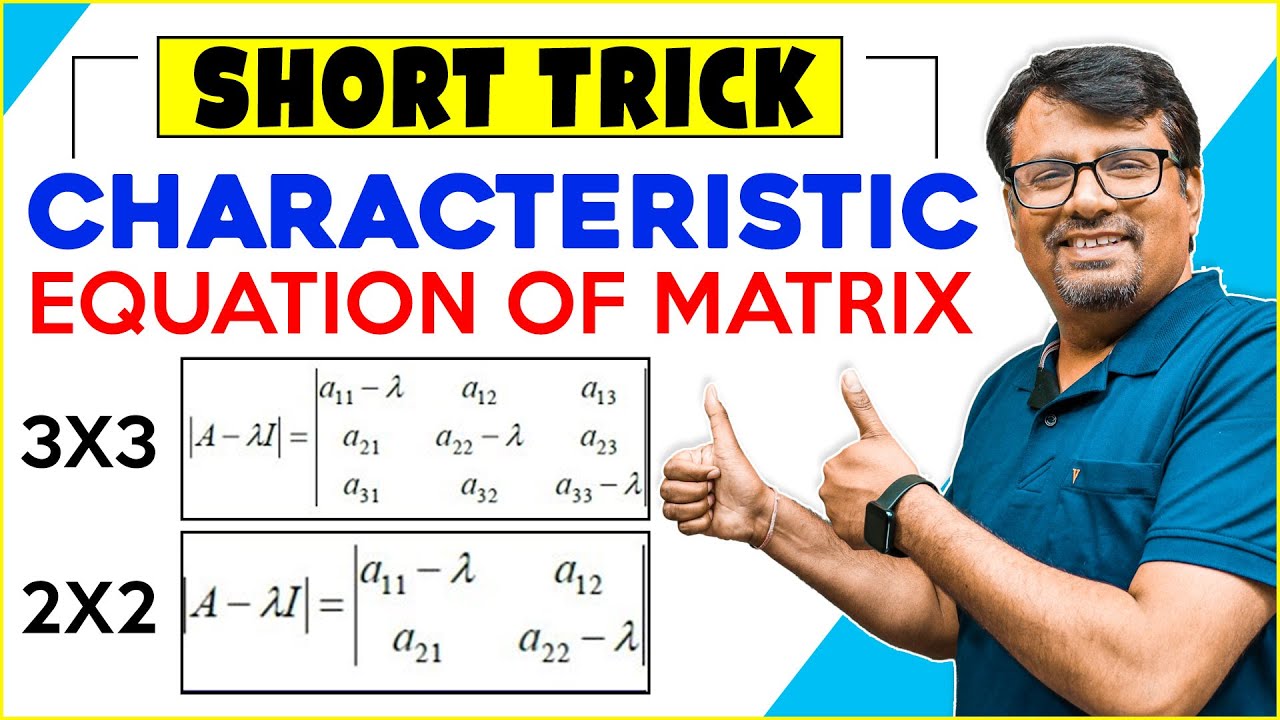
📒⏩Comment Below If This Video Helped You 💯
Like 👍 & Share With Your Classmates - ALL THE BEST 🔥
Do Visit My Second Channel - https://bit.ly/3rMGcSA
This video lecture of Short Tricks | Characteristic Equation |Characteristic Polynomial 3x3 & 2x2 | Problems & Concepts by GP Sir will help Engineering and Basic Science students to understand f...
the equation from the video is off by a negative sign

pain
.close
topaz sinewBOT
Channel closed
Closed by @coarse lynx
Use .reopen if this was a mistake.
topaz sinewBOT
Available help channel!
Send your question here to claim the channel.
Remember:
• Ask your math question in a clear, concise manner.
• Show your work, and if possible, explain where you are stuck.
• After 15 minutes, feel free to ping <@&286206848099549185>.
• Type the command .close to free the channel when you're done.
• Be polite and have a nice day!
Read #❓how-to-get-help for further information on how to ask a good question, and about conduct in the question channels.
scenic osprey
How can u identify the pattern expression here
 topaz sinewBOT
scenic osprey
How can u identify the pattern expression here
topaz sinewBOT
scenic osprey
How can u identify the pattern expression here
Please don't occupy multiple help channels.
fickle kite
Square number
 queen cipher
u mean da sum?
scenic osprey
fickle kite
Square number
I didn’t ask for the answer I asked how
queen cipher
or da numbers themselves
fickle kite
Like these numbers are just particuliar know your square
Or I don't know Fibonacci sequence or sth else
scenic osprey
.close
topaz sinewBOT
Channel closed
Closed by @scenic osprey
Use .reopen if this was a mistake.
topaz sinewBOT
Available help channel!
Send your question here to claim the channel.
Remember:
• Ask your math question in a clear, concise manner.
• Show your work, and if possible, explain where you are stuck.
• After 15 minutes, feel free to ping <@&286206848099549185>.
• Type the command .close to free the channel when you're done.
• Be polite and have a nice day!
Read #❓how-to-get-help for further information on how to ask a good question, and about conduct in the question channels.
 cerulean quartz
would the answer be y>=-7x-47 or y<=-7x-47 ??????????

 granite idol

 rigid ivy
granite idol
https://tenor.com/view/senator-armstrong-memes-maths-metal-gear-rising-revengean...
rigid ivy
granite idol
https://tenor.com/view/senator-armstrong-memes-maths-metal-gear-rising-revengean...
!redir
topaz sinewBOT
granite idol
https://tenor.com/view/senator-armstrong-memes-maths-metal-gear-rising-revengean...
This channel is only for on-topic discussion. Please take casual conversation to #discussion or #chill.
topaz sinewBOT
cerulean quartz
would the answer be y>=-7x-47 or y<=-7x-47 ??????????
Show your work, and if possible, explain where you are stuck.
cerulean quartz
rigid ivy
!show
 rigid ivy
you need to flip the inequality sign when dividing by -4
cerulean quartz
so y <= -7x - 47 is right?
rigid ivy
should be
cerulean quartz
okay ty
topaz sinewBOT
@cerulean quartz Has your question been resolved?
Channel closed
Closed by @cerulean quartz
Use .reopen if this was a mistake.
topaz sinewBOT
Available help channel!
Send your question here to claim the channel.
Remember:
• Ask your math question in a clear, concise manner.
• Show your work, and if possible, explain where you are stuck.
• After 15 minutes, feel free to ping <@&286206848099549185>.
• Type the command .close to free the channel when you're done.
• Be polite and have a nice day!
Read #❓how-to-get-help for further information on how to ask a good question, and about conduct in the question channels.
 lost lynx


 lost lynx
Wouldn't h'(x) just be the exact same graph as f'
So then all the points where h(x) is increasing is where f' is positive
 fiery badge
hmmm... look at the boundaries of the integral for h
lost lynx
fiery badge
hmmm... look at the boundaries of the integral for h
x to -3?
fiery badge
This question is funky lol
I assumed x > -3 so then it doesn't copy the part of f' from -5 to -3
now I'm not even sure
lost lynx
For c I just used the fundamental theorem of calculus to find h'(x) = f'(x)
Then from that I'm assuming since h'(x) = f'(x), the graph would indicate the points where h(x) is increasing
topaz sinewBOT
@lost lynx Has your question been resolved?
topaz sinewBOT
@lost lynx Has your question been resolved?
topaz sinewBOT
Channel closed
Closed due to timeout
Use .reopen if this was a mistake.
Available help channel!
Send your question here to claim the channel.
Remember:
• Ask your math question in a clear, concise manner.
• Show your work, and if possible, explain where you are stuck.
• After 15 minutes, feel free to ping <@&286206848099549185>.
• Type the command .close to free the channel when you're done.
• Be polite and have a nice day!
Read #❓how-to-get-help for further information on how to ask a good question, and about conduct in the question channels.
 sour egret
Hi
topaz sinewBOT
sour egret
Hi
sour egret
If there’s a negative number inside a square root should I put the negative outside?
 sleek gate
like sqrt(-1)?
 sour egret
So negative outside right
sleek gate
it stays outside
sour egret
Oh ok
topaz sinewBOT
@sour egret Has your question been resolved?
Channel closed
Closed by @sour egret
Use .reopen if this was a mistake.
Available help channel!
Send your question here to claim the channel.
Remember:
• Ask your math question in a clear, concise manner.
• Show your work, and if possible, explain where you are stuck.
• After 15 minutes, feel free to ping <@&286206848099549185>.
• Type the command .close to free the channel when you're done.
• Be polite and have a nice day!
Read #❓how-to-get-help for further information on how to ask a good question, and about conduct in the question channels.
 quaint maple
topaz sinewBOT
quaint maple
topaz sinewBOT
Channel closed
Channel closed due to the original message being deleted.
If you did not intend to do this, please open a new help channel,
as this action is irreversible, and this channel may abruptly lock.
topaz sinewBOT
Available help channel!
Send your question here to claim the channel.
Remember:
• Ask your math question in a clear, concise manner.
• Show your work, and if possible, explain where you are stuck.
• After 15 minutes, feel free to ping <@&286206848099549185>.
• Type the command .close to free the channel when you're done.
• Be polite and have a nice day!
Read #❓how-to-get-help for further information on how to ask a good question, and about conduct in the question channels.
 stiff cave
 topaz sinewBOT
stiff cave
thorny flameBOT
topaz sinewBOT
stiff cave
thorny flameBOT
 stiff cave
tried writing the function as a power series but it doesn’t match the books answer, can someone explain where I made a mistake?

 kindred linden
Still here @stiff cave ?
stiff cave
🫡
stiff cave
did I mess up distributing the powers
stiff cave
which part did I mess up
stiff cave
should it be x^n - x^(n+1)?
kindred linden
No you should have (-1)^n
Added to what you wrote
Because (-a)^n = (-1)^n * a^n
Ah latex doesn’t work like that
stiff cave
so it should look like this?
 stiff cave
I’m a bit confused on how to actually distribute the powers
kindred linden
You just have to know 2 rules
(ab)^n = a^n b^n
(a/b)^n = a^n/b^n
There’s no other rule to distribute the powers
Once you distributed the power of n there is some more step to get their result
stiff cave
idk I’m getting more confused

ik this is wrong but I’m not sure how to distribute it from there
kindred linden
kindred linden
(a/b)^n = a^n/b^n
What would you get using this rule
stiff cave
x^n/2^n
stiff cave
it would be 2^n+1
stiff cave
would it be x^(n+1)-x^n
kindred linden
Yes exactly
You just forgot the (-1)^n the first time
Now add it up to the result
But now we have a problem
In the formula they don’t have a x^n+1
They only have x^n
kindred linden
If you stay with only 1 sum you can’t
There is no magic that can do that
So we have to divide the sum into 2 sum, one whit x^n and the other with x^n+1
Idk if « divide » make sense for you here
stiff cave
could you do that like this?
 kindred linden
In the result there is a sum
So instead of calculating one, we will transform it
Do you know how to shift a sum ?
Idk the term in English
stiff cave
okay I think I know how to do that
kindred linden
Because in the result we see that there is x^n so let’s not touch that one with x^n
stiff cave
like this?
 kindred linden
Be careful are you sure it was (-1)^n+1 ?
kindred linden
Yes
Okay so now we’re happy we got x^n
However to make one sum out of the two sums what do we need to do ?
stiff cave
can we just add them back together
stiff cave
they don’t share a common denominator?
kindred linden
That’s a good point but that’s when we want 1 fraction, so that’s the next step
But keep in mind the index
stiff cave
oh right now they’re indexed differently
kindred linden
Indeed
stiff cave
how do we get around that then
stiff cave
I’m not sure
kindred linden
We will not touch the left sum
stiff cave
if we indexed the right sum at 1 the powers would be n-1
but that doesn’t really help
stiff cave
oh is that the -1/2 from the answer?
kindred linden
Exactly
stiff cave
I didn’t know you could do that lol
stiff cave
oh it should be x^n/2^n right
kindred linden
stiff cave
could you do that like this?
Here the x^n should be on 2^n+1
kindred linden
stiff cave
oh it should be x^n/2^n right
Yes but with n+1
stiff cave
ok that makes sense
stiff cave
I think it looks like this
 kindred linden
Okay looks good
The only thing we don’t like is having n-1
There is no n-1 in the formula
How could we get n instead of n-1 ?
stiff cave
we can’t change the index again
stiff cave
maybe multiply by -1?
stiff cave
I guess dividing by -1?
kindred linden
Yes and what does 1/-1 equal to ?
stiff cave
just 1
kindred linden
Oh no no
stiff cave
oh 1/—1 = -1
 stiff cave
ohh
that makes a lot of sense actually
yeah I'm not sure why I didn't realize you could just multiply it by negative 1
kindred linden
Yes but messages doesn’t translate well that king of sense sometimes
kindred linden
stiff cave
yeah I'm not sure why I didn't realize you could just multiply it by negative 1
It’s just the habit
Of doing calc
kindred linden
Well you know how to add two fraction right ?
kindred linden
Try and tell me if what you find looks familiar
 kindred linden
Okay
But maybe there is a way simpler common denominator ?
We are talking about 2^n and 2^n+1
2^n+1 is a common denominator you can get
stiff cave
oh so you would just multiply the right sum by 2?
stiff cave
yeah the left one mb
kindred linden
And then add the 2 fractions
stiff cave
 kindred linden
Isn’t it the result ?
kindred linden
stiff cave
You Just forget a -
stiff cave
oh right they're both negative, so its -3x^n
yeah I think I get it now, thanks for the help 🙏
topaz sinewBOT
@stiff cave Has your question been resolved?
topaz sinewBOT
Channel closed
Closed due to timeout
Use .reopen if this was a mistake.
topaz sinewBOT
Available help channel!
Send your question here to claim the channel.
Remember:
• Ask your math question in a clear, concise manner.
• Show your work, and if possible, explain where you are stuck.
• After 15 minutes, feel free to ping <@&286206848099549185>.
• Type the command .close to free the channel when you're done.
• Be polite and have a nice day!
Read #❓how-to-get-help for further information on how to ask a good question, and about conduct in the question channels.
 urban pulsar
Help

 topaz sinewBOT
urban pulsar
Help
urban pulsar
topaz sinewBOT
urban pulsar
Help
urban pulsar
Im not getting anywhere
topaz sinewBOT
@urban pulsar Has your question been resolved?
topaz sinewBOT
Channel closed
Closed due to timeout
Use .reopen if this was a mistake.
Available help channel!
Send your question here to claim the channel.
Remember:
• Ask your math question in a clear, concise manner.
• Show your work, and if possible, explain where you are stuck.
• After 15 minutes, feel free to ping <@&286206848099549185>.
• Type the command .close to free the channel when you're done.
• Be polite and have a nice day!
Read #❓how-to-get-help for further information on how to ask a good question, and about conduct in the question channels.
 autumn plaza
hai
topaz sinewBOT
autumn plaza
hai
 ripe spoke
hai
autumn plaza
how come indepndent looks different here?


i thot for independent u find AnB and then see if it equals to P(a) x p(b) and if they the same
they indepndent
ripe spoke
those are equivalent tests I believe
meaning that if one is true, the other is as well
ripe spoke
yeah
P(B|C) = P(BnC)/P(C)
so if P(BnC) = P(B)xP(C),
P(B|C) = P(B)xP(C)/P(C) = P(B)
and you can do something similar in the other direction
ripe spoke
autumn plaza
can i do it the other way too
So to prove independence, proving either is true will work.
topaz sinewBOT
Channel closed
Closed by @autumn plaza
Use .reopen if this was a mistake.
topaz sinewBOT
Available help channel!
Send your question here to claim the channel.
Remember:
• Ask your math question in a clear, concise manner.
• Show your work, and if possible, explain where you are stuck.
• After 15 minutes, feel free to ping <@&286206848099549185>.
• Type the command .close to free the channel when you're done.
• Be polite and have a nice day!
Read #❓how-to-get-help for further information on how to ask a good question, and about conduct in the question channels.
 jolly hollow
Hi, so what is sq root -81
topaz sinewBOT
jolly hollow
Hi, so what is sq root -81
jolly hollow
wait acutally i have a idfferent one
could you pls explain de moivres thereom
and further in plar form
polar form*
topaz sinewBOT
@jolly hollow Has your question been resolved?
 echo galleon
jolly hollow
Hi, so what is sq root -81
echo galleon
jolly hollow
Hi, so what is sq root -81
9i
topaz sinewBOT
@jolly hollow Has your question been resolved?
topaz sinewBOT
Channel closed
Closed due to timeout
Use .reopen if this was a mistake.
Available help channel!
Send your question here to claim the channel.
Remember:
• Ask your math question in a clear, concise manner.
• Show your work, and if possible, explain where you are stuck.
• After 15 minutes, feel free to ping <@&286206848099549185>.
• Type the command .close to free the channel when you're done.
• Be polite and have a nice day!
Read #❓how-to-get-help for further information on how to ask a good question, and about conduct in the question channels.
 topaz sinewBOT
 sterile path
Please help me on question ten from e and the rest
sterile path
Please help me on question ten from e and the rest
 wary tulip
so you want to find how many of the 52 cards are
- not a king, or
- a diamond
how many satisfy 1)?
wary tulip
48 of them are not kings yea
sterile path
Yeah
wary tulip
and then of the remaining 4, one is a diamond
sterile path
Yeah
wary tulip
so got the answer now?
sterile path
Yeah I guess
wary tulip

topaz sinewBOT
@sterile path Has your question been resolved?
topaz sinewBOT
Channel closed
Closed due to timeout
Use .reopen if this was a mistake.
topaz sinewBOT
Available help channel!
Send your question here to claim the channel.
Remember:
• Ask your math question in a clear, concise manner.
• Show your work, and if possible, explain where you are stuck.
• After 15 minutes, feel free to ping <@&286206848099549185>.
• Type the command .close to free the channel when you're done.
• Be polite and have a nice day!
Read #❓how-to-get-help for further information on how to ask a good question, and about conduct in the question channels.
 jade scarab
"(a) Rewrite as a double integral, (b) use some symmetries to simplify, re-scale (change vars) to simplify
yet more, and finally, (c) exchange the order of integration again to evaluate the improper integral"
 topaz sinewBOT
jade scarab
"(a) Rewrite as a double integral, (b) use some symmetries to simplify, re-scale...
topaz sinewBOT
jade scarab
"(a) Rewrite as a double integral, (b) use some symmetries to simplify, re-scale...
@jade scarab Has your question been resolved?
topaz sinewBOT
@jade scarab Has your question been resolved?
Channel closed
Closed by @jade scarab
Use .reopen if this was a mistake.
Available help channel!
Send your question here to claim the channel.
Remember:
• Ask your math question in a clear, concise manner.
• Show your work, and if possible, explain where you are stuck.
• After 15 minutes, feel free to ping <@&286206848099549185>.
• Type the command .close to free the channel when you're done.
• Be polite and have a nice day!
Read #❓how-to-get-help for further information on how to ask a good question, and about conduct in the question channels.
 balmy citrus
 topaz sinewBOT
Channel closed
Closed due to timeout
Use .reopen if this was a mistake.