
#help-26
1 messages · Page 91 of 1
 thorny flameBOT
 topaz sinewBOT
Channel closed
Closed by @lost tapir
Use .reopen if this was a mistake.
 vernal vale
👀 hope that helped 🙏
topaz sinewBOT
 Available help channel!
Send your question here to claim the channel.
Remember:
• Ask your math question in a clear, concise manner.
• Show your work, and if possible, explain where you are stuck.
• After 15 minutes, feel free to ping <@&286206848099549185>.
• Type the command .close to free the channel when you're done.
• Be polite and have a nice day!
Read #❓how-to-get-help for further information on how to ask a good question, and about conduct in the question channels.
 lost charm
i need help with congruent or supplementary math
topaz sinewBOT
lost charm
i need help with congruent or supplementary math
lost charm
 topaz sinewBOT
@lost charm Has your question been resolved?
topaz sinewBOT
Channel closed
Closed due to timeout
Use .reopen if this was a mistake.
topaz sinewBOT
Available help channel!
Send your question here to claim the channel.
Remember:
• Ask your math question in a clear, concise manner.
• Show your work, and if possible, explain where you are stuck.
• After 15 minutes, feel free to ping <@&286206848099549185>.
• Type the command .close to free the channel when you're done.
• Be polite and have a nice day!
Read #❓how-to-get-help for further information on how to ask a good question, and about conduct in the question channels.
 woeful jungle
The day before two days after the ay before tomorrow is monday. What day is it today?
topaz sinewBOT
woeful jungle
The day before two days after the ay before tomorrow is monday. What day is it t...
woeful jungle
i also need help how to justify the answer with a formula. My answer is saturday but others say its sunday
woeful jungle
how is it so?
 charred rampart
the day before tomorrow is js today
woeful jungle
oohh i see, oke tyy
is this right if i change the T into today, rather than tomorrow?


 dreamy drum
,rotate
thorny flameBOT
 topaz sinewBOT
@woeful jungle Has your question been resolved?
topaz sinewBOT
Channel closed
Closed due to timeout
Use .reopen if this was a mistake.
Available help channel!
Send your question here to claim the channel.
Remember:
• Ask your math question in a clear, concise manner.
• Show your work, and if possible, explain where you are stuck.
• After 15 minutes, feel free to ping <@&286206848099549185>.
• Type the command .close to free the channel when you're done.
• Be polite and have a nice day!
Read #❓how-to-get-help for further information on how to ask a good question, and about conduct in the question channels.
 mossy agate
I think my solution isn’t correct so what do u guys think of this ? Am I missing something?

 topaz sinewBOT
mossy agate
I think my solution isn’t correct so what do u guys think of this ? Am I missing...
topaz sinewBOT
mossy agate
I think my solution isn’t correct so what do u guys think of this ? Am I missing...
 crystal goblet
mossy agate
I think my solution isn’t correct so what do u guys think of this ? Am I missing...
crystal goblet
mossy agate
I think my solution isn’t correct so what do u guys think of this ? Am I missing...
$du=\frac{sin(t/2)}{2}dt$, $du=sin(t/2)dt$ is incorrect
thorny flameBOT
smidgin
 crystal goblet
(chain rule)
crystal goblet
Yep
mossy agate
so i just need to add to my solotion 2 up there right ?
crystal goblet
mossy agate
then multply by 2 right ?
.
 crystal goblet
Yep
topaz sinewBOT
Channel closed
Closed by @mossy agate
Use .reopen if this was a mistake.
topaz sinewBOT
Available help channel!
Send your question here to claim the channel.
Remember:
• Ask your math question in a clear, concise manner.
• Show your work, and if possible, explain where you are stuck.
• After 15 minutes, feel free to ping <@&286206848099549185>.
• Type the command .close to free the channel when you're done.
• Be polite and have a nice day!
Read #❓how-to-get-help for further information on how to ask a good question, and about conduct in the question channels.
 elfin seal
Show that the number overline(352) in base b cannot be a perfect square whatever the number base b, b > 5, b is natural
topaz sinewBOT
elfin seal
Show that the number overline(352) in base b cannot be a perfect square whatever...
elfin seal
I dont even know how to begin...
 gusty bane
what is overline 352
 bitter hemlock
elfin seal
Show that the number overline(352) in base b cannot be a perfect square whatever...
bitter hemlock
elfin seal
Show that the number overline(352) in base b cannot be a perfect square whatever...
well if 352 were in base 10 you can write it as 3 * 10^2 + 5 * 10 + 2 right?
elfin seal
gusty bane
what is overline 352
like
bitter hemlock
what if it's in base b, how would you write that sum?
elfin seal
the number 352
elfin seal
bitter hemlock
what if it's in base b, how would you write that sum?
generally 3* b^2 + 5*b + 2
bitter hemlock
yep, now that's a quadratic we can factor
elfin seal
is it uh (3b+2)(b+1)
bitter hemlock
yeah, now presumably we can hopefully draw some conclusion from that 😛
elfin seal
hopefully 😭
bitter hemlock
i guess one thing i see is that either b + 1 factor itself is a perfect square OR it has to be a factor of 3b+2
but 3b + 3 is divisible by (b+1) and 3b + 2 is only 1 apart from 3b + 3 so b + 1 cannot be a factor of 3b + 2?
so then if you can show b+1 being a perfect square implies 3b+2 isn't a square that would be enough
i'm not very good at this kinda stuff though so maybe this is completely the wrong way to think of it and theres something easier
elfin seal
Hm.
I was thinking we can prove that uh
(3b+2)(b+1) is a multiple of 3+2 or M4+2 or M4+3 or M5+2 or M6+2
therefore they aren't perfect squares
because we didnt use the information that b > 5
idk
bitter hemlock
i think that is just necessary because for b <= 5 we wouldn't even be able to use the digit 5 in the given number
elfin seal
Oh, right...
bitter hemlock
so if b + 1 is a pefect square
b + 1 = c^2
3b + 3 = 3c^2
3b + 2 = 3c^2 - 1
i dunno does that help 😅
<@&286206848099549185> anyone with an idea of how to prove that
b + 1 being a perfect square implies 3b + 2 isn't a perfect square?
 neon iron
Hint: it doesnt matter that b+1 is a square
elfin seal
neon iron
Hint: it doesnt matter that b+1 is a square
if nothing really matters
how can i finally prove
neon iron
||modulo 3||
bitter hemlock
can you elaborate?
neon iron
But b+1 doesnt necessarily have to divide 3b+2 or be a square itself
bitter hemlock
bitter hemlock
<@&286206848099549185> anyone with an idea of how to prove that
b + 1 being a pe...
^ just interested in this question, we saw already that if b + 1 isn't a perfect square then the (b+1)(3b+2) number can't be a perfect square
neon iron
bitter hemlock
i guess one thing i see is that either b + 1 factor itself is a perfect square O...
So this is wrong
neon iron
bitter hemlock
^ just interested in this question, we saw already that if b + 1 isn't a perfect...
No that is wrong
You are saying that if xy is a perfect square then x is a perfect square or x divides y
But for example 144=8*18 contradicts your statement
bitter hemlock
yeah you're right, i guess the two numbers can share factors
so what i was saying is bogus
neon iron
Im gonna try to prove now that (3b+2)(b+1) can never be a square
elfin seal
alright
bitter hemlock
neon iron
No that is wrong
i'm also having a hunch that b+ 1 and 3b+2 might always be relatively prime
elfin seal
uh like
may the common divisor of them be d
and prove that d is 1
i forgot how to solve those
neon iron
Suppose d divides b+1 and 3b+2, then d divides 3(b+1)=3b+3 . So d divides 3b+3-(3b+2)=1
crystal goblet
bitter hemlock
but how to show that? : )
||Euclid division algorithm||
neon iron
So d=1
elfin seal
neon iron
Suppose d divides b+1 and 3b+2, then d divides 3(b+1)=3b+3 . So d divides 3b+3-(...
yes, exactly
bitter hemlock
ok then we're back to my previous argument! 😄
the only way this could happen now is if both b+1 and 3b+2 are both perfect squares
bitter hemlock
no?
neon iron
And we are done
bitter hemlock
is it more obvious that i think or something?
neon iron
Do you know modular arithmetic?
bitter hemlock
its been like 15+ years since i took an abstract algebra class
most of my math has been collecting dust in my brain
bitter hemlock
elfin seal
3b+2 is M3+2
M?
bitter hemlock
those can't be perfect squares for some reason? 🤔
elfin seal
Yes.
elfin seal
elfin seal
(3b+2)(b+1) is a multiple of 3+2 or M4+2 or M4+3 or M5+2 or M6+2
as i said here
neon iron
Proof:
Every number is of the form 3k, 3k+1 or 3k+2.
(3k)^2=9k^2=3(3k^2)
(3k+1)^2=9k^2+6k+1=3(3k^2+2k)+1
(3k+2)^2=9k*2+12k+4=3(3k^2+4k+1)+1
So squares are of the form 3k and 3k+1
But never of the form 3k+2
bitter hemlock
elfin seal
as i said here
sorry just went over my head i guess!
neon iron
Therefore 3b+2 cant be a square
elfin seal
Indeed!
topaz sinewBOT
Channel closed
Closed by @elfin seal
Use .reopen if this was a mistake.
topaz sinewBOT
Available help channel!
Send your question here to claim the channel.
Remember:
• Ask your math question in a clear, concise manner.
• Show your work, and if possible, explain where you are stuck.
• After 15 minutes, feel free to ping <@&286206848099549185>.
• Type the command .close to free the channel when you're done.
• Be polite and have a nice day!
Read #❓how-to-get-help for further information on how to ask a good question, and about conduct in the question channels.
 solemn mountain
I honestly have no idea where to start with this. This is a worksheet to prepare myself for a quiz tmrw. And would like guidance on how to figure out what to do! Thank you.
 topaz sinewBOT
solemn mountain
I honestly have no idea where to start with this. This is a worksheet to prepare...
topaz sinewBOT
solemn mountain
I honestly have no idea where to start with this. This is a worksheet to prepare...
 woeful stone
solemn mountain
I honestly have no idea where to start with this. This is a worksheet to prepare...
woeful stone
solemn mountain
I honestly have no idea where to start with this. This is a worksheet to prepare...
So the first thing would be figuring out what you don't understand
solemn mountain
woeful stone
So the first thing would be figuring out what you don't understand
So when I read it, it says ivt on the interval [3,5]
I look at the graph and I see theres lines going thru [3,5] but not points?
I don't know if I can still use that because I see a open circle at that point (-2,2)
but i'm just super lost tbh
woeful stone
solemn mountain
I look at the graph and I see theres lines going thru [3,5] but not points?
a line consist of points
The [3, 5] is a set
solemn mountain
ik for it to be ivt it has to be continuous right
woeful stone
It refers to alll the values of x such that 3<=x<=5
solemn mountain
so the first one would be continuous because on the graph theres points that are between there correct
or i mean it would be an ivt
woeful stone
yes it would satisfy the ivt property
solemn mountain
that would mean the second one wouldn't
because there isn't a line connecting them
and the third one would
so then im stumped on question 4
solemn mountain
woeful stone
yes it would satisfy the ivt property
how would i go about the 4th one
[-2,3] ivt k = 1
woeful stone
You just find the x-values such that f(x) = 1
solemn mountain
also wanted to say thank you for the help with 1-3 because i had the answers written I just had no idea if I was right or not about them
solemn mountain
woeful stone
You just find the x-values such that f(x) = 1
im still a bit confused by that
woeful stone
So x=-1 satisfy the equation. There is also another value of x between 1 and 2 that satisfies the equation but exact value is not clear
solemn mountain
woeful stone
So x=-1 satisfy the equation. There is also another value of x between 1 and 2 t...
i'm not sure how you got that answer thought thats what im trying to figure out
woeful stone
You just look at the graph
solemn mountain
we have [-2,3] -2<=1<=3?
woeful stone
solemn mountain
we have [-2,3] -2<=1<=3?
[-2, 3], -2 <= x <=3
[-2, 3] is the domain
solemn mountain
woeful stone
[-2, 3], -2 <= x <=3
im looking at the graph I see where -2 is i don't see where 3 is
sorry if I seem like so lost rn because i am
i'm very confused
woeful stone
when x= 3 y =0. It is the point (3, 0)
woeful stone
yes
woeful stone
So when x=-1 what does f(x) equal?
solemn mountain
okay can i explain my thought process why im lost rn
the first 3 problems
where either on a line
or not
and i said yes or no
I see for #4
(-2,0) and (3,0)
not on a line together
K= 1
woeful stone
So the question is just asking for what values of c does, f(c) =1 for -2 <= c<=3
It is not about lines. It is about the graph
woeful stone
At what x values does the line y = 1 intersect or touch the graph f(x)?
solemn mountain
at -1 and 1
woeful stone
-1 yes but not 1
You can see the hollow circle. That indicates the function is not defined at the point
woeful stone
yep
topaz sinewBOT
Channel closed
Closed by @solemn mountain
Use .reopen if this was a mistake.
solemn mountain
.reopen
topaz sinewBOT
✅
topaz sinewBOT
Channel closed
Closed by @solemn mountain
Use .reopen if this was a mistake.
topaz sinewBOT
Available help channel!
Send your question here to claim the channel.
Remember:
• Ask your math question in a clear, concise manner.
• Show your work, and if possible, explain where you are stuck.
• After 15 minutes, feel free to ping <@&286206848099549185>.
• Type the command .close to free the channel when you're done.
• Be polite and have a nice day!
Read #❓how-to-get-help for further information on how to ask a good question, and about conduct in the question channels.
 alpine jetty
Can someone solve this with full working out (no steps skipped please)
topaz sinewBOT
alpine jetty
Can someone solve this with full working out (no steps skipped please)
alpine jetty

heres the answer but i dont quite understand it. if anyone can supply a much more simpler working out I would greatly appreciate that ❤️


 sweet shard
alpine jetty
Can someone solve this with full working out (no steps skipped please)
sweet shard
alpine jetty
Can someone solve this with full working out (no steps skipped please)
!noans
topaz sinewBOT
alpine jetty
Can someone solve this with full working out (no steps skipped please)
The purpose of this server is to help you learn, not to hand out answers. Do not ask someone to give you the answer directly.
alpine jetty
.close
topaz sinewBOT
Channel closed
Closed by @alpine jetty
Use .reopen if this was a mistake.
topaz sinewBOT
Available help channel!
Send your question here to claim the channel.
Remember:
• Ask your math question in a clear, concise manner.
• Show your work, and if possible, explain where you are stuck.
• After 15 minutes, feel free to ping <@&286206848099549185>.
• Type the command .close to free the channel when you're done.
• Be polite and have a nice day!
Read #❓how-to-get-help for further information on how to ask a good question, and about conduct in the question channels.
 rotund hawk
how do I do this?
 topaz sinewBOT
rotund hawk
how do I do this?
neon iron
topaz sinewBOT
rotund hawk
how do I do this?
neon iron
substitute x = y^6
so you get lim_{y-> 1} (y^2 -1)/(y^3-1)
y^2 -1 = (y-1)(y+1) and (y^3 -1) = (y-1) (y^2 + 1 +y)
simplify
rotund hawk
neon iron
simplify
how do you go back to x tho
neon iron
you just need the limit don't you
so it doesnt really matter going back to x
because if x-> 1, y^6-> 1 so y-> 1
 fallow igloo

rotund hawk
neon iron
because if x-> 1, y^6-> 1 so y-> 1
what if it was going towards something else
so x -> 4
neon iron
then y^6 -> 4 so y-> 4^{1/6}
 fathom pendant
Real
Wait actually
Direct substitution seems really difficult for this one
Have you heard of L’H? @rotund hawk
rotund hawk
fathom pendant
Have you heard of L’H? <@813447252063944786>
no?
fathom pendant
What are “the first principles”?
rotund hawk
fathom pendant
What are “the first principles”?
using the f
fathom pendant
Ohh the limit?
rotund hawk
f'(x)= f(x+h)-f(x)/h
rotund hawk
fathom pendant
Do you know the power rule then?
he doesnt want us to use it yet
i know how it goes
actually i knew
fathom pendant
Ohh
rotund hawk
i forgo
fathom pendant
Hmm
fathom pendant
Its ok I could show you L’H
Dont use it though
Think of it as a tool to help you verify your answers
L’H states then when dealing with limits and using direct substitution gives you an answer that is either 0/0 or inf+/inf+ (this is called indeterminate form btw)
Then finding the derivatives of the numerator and denominator and using direct substitution on that gives the same result
For example, the problem you gave us is good
The numerator is: cuberoot(x) - 1
cuberoot(x) can be written as x^1/3
And using the power rule, we get the derivative of it, which is 1/3*x^-2/3
Which after some calculation is 1/(3*x^2/3)
Now the denominator is a lot easier: squareroot(x) is x^1/2
The derivative is 1/(2*squareroot(x))
And we divide these 2, and use direct substitution
To find the the limit is 2/3
I’ll send you some photos to make it easy to visualize
rotund hawk
fathom pendant
I’ll send you some photos to make it easy to visualize
yes pls
I understood getting the derivative
but i dont understad what you do next

 fathom pendant
No problem
rotund hawk
fathom pendant
No problem
why does this work tho
fathom pendant
Basically the trick to this is to find the rate at which the numerator and the denominator approach 0
Or infinity
Im not the best explainer for this
And the proof is absolutely insane
Convoluted too
Yeah thats about it
I should remind you that since you havent learned L’H or even the power rule, you cant use this
Its just a tool for now
topaz sinewBOT
@rotund hawk Has your question been resolved?
rotund hawk
fathom pendant
I should remind you that since you havent learned L’H or even the power rule, yo...
my teachers marking system is weird, so i might use it if im stuck
topaz sinewBOT
Channel closed
Closed by @rotund hawk
Use .reopen if this was a mistake.
Available help channel!
Send your question here to claim the channel.
Remember:
• Ask your math question in a clear, concise manner.
• Show your work, and if possible, explain where you are stuck.
• After 15 minutes, feel free to ping <@&286206848099549185>.
• Type the command .close to free the channel when you're done.
• Be polite and have a nice day!
Read #❓how-to-get-help for further information on how to ask a good question, and about conduct in the question channels.
 hardy meteor
[m\dot{r}-\frac{l^2}{mr^3}=f(r)]\
topaz sinewBOT
hardy meteor
\[m\dot{r}-\frac{l^2}{mr^3}=f(r)]\
hardy meteor
[m\dot{r}-\frac{l^2}{mr^3}=f(r)]\
thorny flameBOT
yehuihe
 thorny flameBOT
yehuihe
 hardy meteor
$\dv{t}=\frac{l^2}{mr^2}\dv{\theta}$

 hardy meteor
$\frac{1}{r^2}\dv{\theta}(\frac{1}{mr^2}\dv{r}{\theta})-\frac{l^2}{mr^3}=f(r)$
thorny flameBOT
yehuihe
 hardy meteor
hi all, how to substitute second equation to first one to get last equation
hardy meteor
thorny flame
**yehuihe**
this is second
hardy meteor
thorny flame
**yehuihe**
this is first
topaz sinewBOT
@hardy meteor Has your question been resolved?
topaz sinewBOT
@hardy meteor Has your question been resolved?
hardy meteor
should be chain rule but i still can't get this one
topaz sinewBOT
@hardy meteor Has your question been resolved?
topaz sinewBOT
Channel closed
Closed due to timeout
Use .reopen if this was a mistake.
Available help channel!
Send your question here to claim the channel.
Remember:
• Ask your math question in a clear, concise manner.
• Show your work, and if possible, explain where you are stuck.
• After 15 minutes, feel free to ping <@&286206848099549185>.
• Type the command .close to free the channel when you're done.
• Be polite and have a nice day!
Read #❓how-to-get-help for further information on how to ask a good question, and about conduct in the question channels.
 uncut gale
 topaz sinewBOT
uncut gale
uncut gale
topaz sinewBOT
uncut gale
uncut gale
answers 2046
all i got was theres 2^10 max combinations but idk where to go from there
gusty bane
that's strings of length 10
what about .
or -
or ..
or .-
etc.
express it as a summation
uncut gale
2
uncut gale
2^2
gusty bane
3?
gusty bane
do you see the pattern
gusty bane
yes
uncut gale
idk how to use summation with the bot but i think i got it
gusty bane
this is essentially [\sum_{n=1}^{10} 2^n]
thorny flameBOT
maximo
 gusty bane
which has a well defined formula
gusty bane
but you could also just compute it by hand
uncut gale
wdym formula
gusty bane
[\sum_{n=0}^{k-1} r^n = \frac{1-r^k}{1-r}]
thorny flameBOT
maximo
 gusty bane
in our case, r = 2 and k = 10
so we'd get
[\sum_{n=0}^{10}2^n = \frac{1-2^{10}}{1-2} = 2^{10} - 1]
thorny flameBOT
maximo
 gusty bane
,calc 2^(10) - 1
thorny flameBOT
Result:
1023
oh shoot what did i miss
uncut gale
thorny flame
**maximo**
yea this gives me 2046
uncut gale
thank you so much
gusty bane
yes but i have it off by 1
this should be the actual one
[\sum_{n=0}^{k-1} r^n = \frac{1-r^k}{1-r}]
thorny flameBOT
maximo
 uncut gale
ahhhhh
so r = 2 and k = 10
but if the top is 10
and its k-1
am i saying its 11?
why am i getting 2047
(1 - 2^11)/(1-2)
sorry
gusty bane
k should be 11 yes
gusty bane
uncut gale
why am i getting 2047
because the sum starts at 0
but our original one started at 1
so we have to remove the n = 0 term
which is 2^0 = 1
gusty bane
👍
uncut gale
.close
topaz sinewBOT
Channel closed
Closed by @uncut gale
Use .reopen if this was a mistake.
topaz sinewBOT
Available help channel!
Send your question here to claim the channel.
Remember:
• Ask your math question in a clear, concise manner.
• Show your work, and if possible, explain where you are stuck.
• After 15 minutes, feel free to ping <@&286206848099549185>.
• Type the command .close to free the channel when you're done.
• Be polite and have a nice day!
Read #❓how-to-get-help for further information on how to ask a good question, and about conduct in the question channels.
 woven otter
 topaz sinewBOT
woven otter
woven otter
topaz sinewBOT
woven otter
woven otter
For linear sequence this is the general formula for nth term
If we have a example like
20,17,14,11
And use the formula Tn=an+b
Can someone tell me what a,n and b are
this is the example in the book

I dont understand what is a,n and b
 dusk blade
woven otter
this is the example in the book
dusk blade
woven otter
this is the example in the book
Look at the note on the side. It's similar to a line, y = mx + c
Let's take your data, 20, 17, 14, 11
Think about it as a line. What would it look like?
It's going down 3 points every next value, meaning the slope is ?
And it's starting at 20, meaning the c is ?
woven otter
🥲i dont understand
dusk blade
You know what a line is, yes?
woven otter
Yes
woven otter
dusk blade
It's going down 3 points every next value, meaning the slope is ?
And it's star...
What do u mean what the c is
dusk blade
woven otter
What do u mean what the c is
It's the equation on the right side
y = mx +c
what does the c stand for
 outer carbon
woven otter
outer carbon
woven otter
what sort of tn is this
 frosty prairie
yo I never imagined an arithmetic progression as a line this is cool damn. It's obvious in hindsight
woven otter
Ah im not sure
outer carbon
The one I know is tn = a +(n-1)d
frosty prairie
Yeah but that's the nth term for AP in general, I think this topic is trying to relate it with a linear function which is better for inuitively understanding it
dusk blade
frosty prairie
yo I never imagined an arithmetic progression as a line this is cool damn. It's ...
Same
It works tho
woven otter
outer carbon
The one I know is tn = a +(n-1)d
Yes i like using that one but my teacher uses this one and i dont think i should use that for the test
dusk blade
This has a constant change between each value
frosty prairie
dusk blade
It works tho
Yes
dusk blade
It's like a slope between them
woven otter
dusk blade
This has a constant change between each value
Yea
dusk blade
Think about it like a line

Look at the points visualized. You see something going on between them?
What if we put a line in the middle of them

That's similar to what you're finding. It's basically telling to you find the "line"
woven otter
Ok i understand
dusk blade
If you look closely, each value is _ points less than previous number @woven otter
20 becomes 17, 17 becomes 14
Their difference is 3 points right?
woven otter
Yes the difference is 3
dusk blade
outer carbon
But why are they relating it to a line in the first place?
Visualization, I assume. Regardless, I think it's genius
woven otter
dusk blade
We can infer that the slope is -3
Mhm
dusk blade
woven otter
Yes the difference is 3
Now, think about it. It's going down by 3 points, meaning a should be -3 right?
woven otter
Yep
dusk blade
-3x + b
Because each next value they're less 3 points
And what value do we start at? isn't it 20?
So what if the sequence is -3x + 20
(20 - 3x is better way to write it imo)
Does that make sense or
frosty prairie
outer carbon
it is simple as it is
No it's actually pretty smart to relate it to a line. Any arithmetic progression can be represented by a line because the slope always remains constant which signifies that the difference between each subsequent term in an AP also remains constant. If you move on to more difficult stuff like 2, 7, 14, 23, where the difference BETWEEN the terms is in AP i.e. 7-2=4, 14=7=7, 23-14=9, etc. i.e. 4,7,9,... then you can represent the nth term for that sequence by increasing a degree and denoting it as tn=an^2+bn+c and so on and so forth
dusk blade
woven otter
Brain not braining
Why is brain not braining
You know they're reducing by 3 points
What's the first value that you start with
woven otter
The formule is Tn=an+b
T1=20 becUse its the first twrm to the sequence
 frosty prairie
Yeah this is what I was talking about when I said difference of each term is in AP (quadratic), difference of difference of each term is in AP (cubic) and so on. But first try to understand why the basic AP is represented by ax+b
dusk blade
Ok, with the quadratic and cubic sequences... this doesn't seem cool anymore
woven otter
😂i want the linear sequence only
dusk blade
It would work as a good visualization method, but this is certainly quite a different approach on teaching sequences
frosty prairie
Let's try it with an easier linear sequence. Like 0,1,2,3,4,5,6...
The 0th term is a*0 + b
b=0 this means the intercept is 0
so at the x=0 y=0 as well so the line starts at the origin
woven otter
Hoooooold up why is there x and y.y is b 0 and why is a*0 sjdksndbsksknsbdbdsjks
frosty prairie
 woven otter
Can we skip the line thing
thorny flameBOT
Usopper
 woven otter
Its the nth term
frosty prairie
Yes
nth term for an AP, which happens to be a line
forget about my previous example for a sec
so each n denotes a point in the sequence right?
woven otter
Ye
dusk blade
Usopper is cooking 👨🍳
frosty prairie
Noice
wait a bit
ok I got confused for a moment there as well but now I understand
woven otter
Oki
frosty prairie
Note that the x co-ordinates starting from 1 denote n
 woven otter
Yes
frosty prairie
for 1st term i.e. n=1 the first red dot will be the number you get for a particular line
each sequence can be denoted by a unique line
for n=2 you will get the second dot
woven otter
Mhm
frosty prairie
see that the difference between them is constant because the slope remains constant
The curvature always remains straight, there is no change
it's linear
woven otter
Ohhh ok
frosty prairie
now let's use your initial example
woven otter
20,17,14,11?
frosty prairie
This one
 frosty prairie
woven otter
20,17,14,11?
frosty prairie
woven otter
20,17,14,11?
Yes
woven otter
Oki
frosty prairie
I pasted it again so that it will be easier to reference
woven otter
Ok
What abt the a and b .in the equation its tn=an+b
What happened to the n near the a for t1 and t2
frosty prairie
yeah getting there
woven otter
Oki
frosty prairie
frosty prairie
Note that the x co-ordinates starting from 1 denote n
In this example, not that the sequence is increasing, it's probably something like 3, 5, 7, ...

In your example the sequence is decreasing
woven otter
Yea
frosty prairie
(t_n=an+b) is nothing but (y=ax+b) which is clear from the graph
thorny flameBOT
Usopper
 woven otter
Mhm
frosty prairie
So to find the first term of sequence you just put x i.e. n=1. y=a+b. It's already given to you that it is 20
(a+b=20)
thorny flameBOT
Usopper
 woven otter
Mhm
thorny flameBOT
Usopper
 woven otter
Simultaneous?
frosty prairie
yes
woven otter
Ah oki waiy
frosty prairie
Still waiting lol
frosty prairie
No worries lol
woven otter
 frosty prairie
((2a+b)-(a+b)=2a+b-a-b)
thorny flameBOT
Usopper
 frosty prairie
You wrote (2a+b-a+b)
thorny flameBOT
Usopper
 woven otter
 frosty prairie
woven otter
frosty prairie
woven otter
Correct
woven otter
Ohh oki
woven otter
So tn=-3n+23?
frosty prairie
Yes
woven otter
Ohhhhh
frosty prairie
Note that the graph is not required, it's just to understand why you use t_n=an+b and then plug values to figure it out
and not just something else like t_n=an+bn or t_n=an^3+b
For any arithmetic sequence you just need to make an equation from the first and second term (or any two distinct terms really) and then solve
find a, b you're done
hope you get it now
woven otter
.close
topaz sinewBOT
Channel closed
Closed by @woven otter
Use .reopen if this was a mistake.
topaz sinewBOT
Available help channel!
Send your question here to claim the channel.
Remember:
• Ask your math question in a clear, concise manner.
• Show your work, and if possible, explain where you are stuck.
• After 15 minutes, feel free to ping <@&286206848099549185>.
• Type the command .close to free the channel when you're done.
• Be polite and have a nice day!
Read #❓how-to-get-help for further information on how to ask a good question, and about conduct in the question channels.
neon iron
How exactly do you define unit vectors for $\theta$ and $\varphi$ in cylinderical and spherical coordinates?
topaz sinewBOT
neon iron
How exactly do you define unit vectors for $\theta$ and $\varphi$ in cylinderica...
thorny flameBOT
 neon iron
it seems kind of cursed but i dont see how it is done


 neon iron
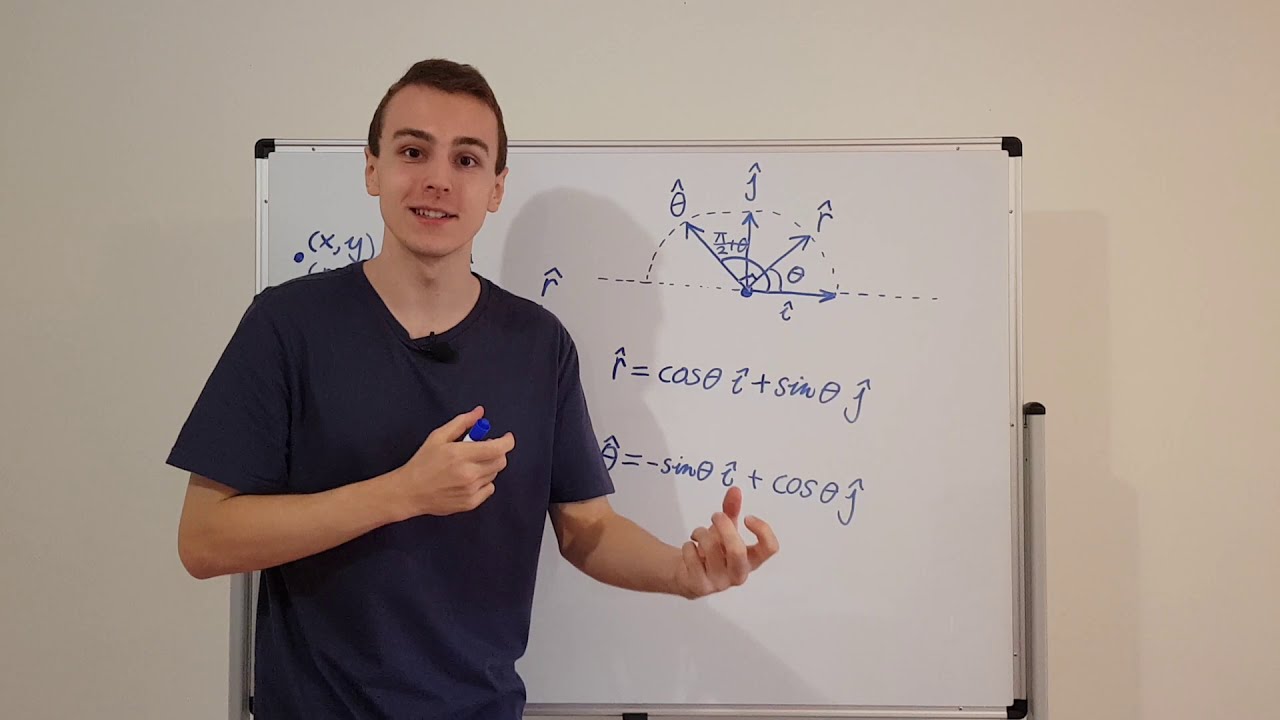
Link to Quantum Playlist:
https://www.youtube.com/playlist?list=PLl0eQOWl7mnWPTQF7lgLWZmb5obvOowVw
I introduce coordinate systems in 2 dimensions, which will be used in subsequent classical and quantum mechanics videos in the playlist above.
#PolarCoordinates
#UnitVectors
#KonstantinLakic
oh okay wait this seems kind of related
probably easier to start there
neon iron
 ionic oar
the azimuth would be along the same direction as z
ionic oar
the azimuth would be along the same direction as z
oh wait wdym
thorny flameBOT
NEON
 neon iron
yes
ionic oar
and if the azimuth was an axial vector
then by the right hand curl rule
or whatever
it would also point along $\hat k$
thorny flameBOT
NEON
 neon iron
so what we havw is not that then
neon iron
apparently like the theta is the unit vector tangential to the cylinder
ionic oar
me neither
ionic oar
I went with the axial assumption cuz angular displacement and it deirvatives are axial vectors
neon iron
okay if its tangential to r then obviously it is orthogonal to r
so thats that
how tf is it orthogonal to z tho 
neon iron
oh ic yeah fair enough
okay i mean i guess this makes sense
kinda weird
but makes sense
ok until another time 
time to close this
.clsoe
/;cplse
,close

.close
topaz sinewBOT
Channel closed
Closed by @dim talon
Use .reopen if this was a mistake.
ionic oar
neon iron
but makes sense
i dont see why you just cant use regular unit vectors
if the end result is the same
neon iron
ionic oar
if the end result is the same
i mean i guess its important for actually defining the coordinates?
ionic oar
Perchance.
neon iron

neon iron
ionic oar
Perchance.
altho its kinda weird in the sense that $\vc*\theta$ is going to be changing direction
 knotty ledge
 neon iron
like everytime
thorny flameBOT
 knotty ledge
Yes it's weird it's like a local coordinate system, maybe people sometimes use the phrase "frame"
neon iron
knotty ledge
yoo thanks for the spherical corods hook up
knotty ledge

In differential geometry, the Frenet–Serret formulas describe the kinematic properties of a particle moving along a differentiable curve in three-dimensional Euclidean space
        R


        3


{\displaystyle \mathbb {R} ^{3}}
, or the geometr...
Generalisation here
knotty ledge
knotty ledge
Also note θφ are flipped here, blame physicists
knotty ledge
Whichever is in your text
neon iron
i remember snow saying if u switch them it becomes like a left handed coordinate system
or something
probably misinterperting
knotty ledge
Eh maybe idk
I just prefer the other one than what I posted
"Extends" polar coords
knotty ledge
It's not overly fun
neon iron
its more so i cant get it to my brain ill be honest
well i think i get it now
but its just more so
i cant remember the formulae for like the conversions
knotty ledge
Just have to look at a lot of pictures
knotty ledge
No one remembers those unless you use them lmao
neon iron
too true
oh actually sigma can i ask u like a few questions regarding defining surfaces
ok lemme reopen this if u say yes
knotty ledge
I have like 10 mins before teaching sure
topaz sinewBOT
✅
neon iron
so uh in their derivation of like the formula for the surface area of an implicitly defined surface
why is their parameterisation like this

its super weird
(we can continue this later whenever u r freer haha)
.close
topaz sinewBOT
Channel closed
Closed by @dim talon
Use .reopen if this was a mistake.
knotty ledge
neon iron
(we can continue this later whenever u r freer haha)
I'm sorry I got nerdsniped lol
I'll look later if you haven't a answer
neon iron
knotty ledge
I'll look later if you haven't a answer
alrighty haha
topaz sinewBOT
Available help channel!
Send your question here to claim the channel.
Remember:
• Ask your math question in a clear, concise manner.
• Show your work, and if possible, explain where you are stuck.
• After 15 minutes, feel free to ping <@&286206848099549185>.
• Type the command .close to free the channel when you're done.
• Be polite and have a nice day!
Read #❓how-to-get-help for further information on how to ask a good question, and about conduct in the question channels.
 wide bane
 wide bane
Not sure how to begin

The one mentioned from the book
Actually, I would prefer to just be given or referred to a place where I can find the calculation rules needed for this proof, since it requires some things like linearity, etc
topaz sinewBOT
@wide bane Has your question been resolved?
topaz sinewBOT
@wide bane Has your question been resolved?
topaz sinewBOT
Channel closed
Closed due to timeout
Use .reopen if this was a mistake.
topaz sinewBOT
Available help channel!
Send your question here to claim the channel.
Remember:
• Ask your math question in a clear, concise manner.
• Show your work, and if possible, explain where you are stuck.
• After 15 minutes, feel free to ping <@&286206848099549185>.
• Type the command .close to free the channel when you're done.
• Be polite and have a nice day!
Read #❓how-to-get-help for further information on how to ask a good question, and about conduct in the question channels.
sweet shard
use 25 = 5^2 and get a quadratic equation in 5^t
neon iron
,, a^{m+n} = a^m\2a^n
 icy sky
5^(t-1) = 5^t * 5^(-1)
thorny flameBOT
 icy sky
oh lmao
frosty prairie
Garlic!
icy sky
hello
frosty prairie
Hello
Fancy seeing you here. Your Discord profile is really memorable. I know you from MODS
icy sky
ah
topaz sinewBOT
@neon iron Has your question been resolved?
Channel closed
Closed by @zealous osprey
Use .reopen if this was a mistake.
topaz sinewBOT
Available help channel!
Send your question here to claim the channel.
Remember:
• Ask your math question in a clear, concise manner.
• Show your work, and if possible, explain where you are stuck.
• After 15 minutes, feel free to ping <@&286206848099549185>.
• Type the command .close to free the channel when you're done.
• Be polite and have a nice day!
Read #❓how-to-get-help for further information on how to ask a good question, and about conduct in the question channels.
 native flume
How would u solve this other than using a system of equations?

 rigid ivy
What can you say about the quadrilateral LMNP? What features does it have?
topaz sinewBOT
@native flume Has your question been resolved?
native flume
rigid ivy
What can you say about the quadrilateral LMNP? What features does it have?
It’s a parallelogram that has 360 degrees
The opposite sides are equal
Yeah that’s all I know
rigid ivy
native flume
It’s a parallelogram that has 360 degrees
It is a parallelogram. Yes.
rigid ivy
native flume
The opposite sides are equal
If it is a parellologram, what else does that say about the opposite sides?
native flume
Oh it would be that opposite angles are equal so x = y
native flume
rigid ivy
If it is a parellologram, what _else_ does that say about the opposite sides?
Which would mean that 3a-7 = 4a+6
topaz sinewBOT
Channel closed
Closed by @native flume
Use .reopen if this was a mistake.
topaz sinewBOT
Available help channel!
Send your question here to claim the channel.
Remember:
• Ask your math question in a clear, concise manner.
• Show your work, and if possible, explain where you are stuck.
• After 15 minutes, feel free to ping <@&286206848099549185>.
• Type the command .close to free the channel when you're done.
• Be polite and have a nice day!
Read #❓how-to-get-help for further information on how to ask a good question, and about conduct in the question channels.
 cursive sparrow
Hi, im having problems figuring out why the the numerators can be disregarded in the eqn when finding x.
-1/16 = -1/x^(4/3)
topaz sinewBOT
cursive sparrow
Hi, im having problems figuring out why the the numerators can be disregarded in...
sweet shard
cursive sparrow
Hi, im having problems figuring out why the the numerators can be disregarded in...
show how you got x
cursive sparrow
-1/16 = -1/x^(4/3)
16 = x^(4/3)
4root(16) = 4root [x^(4/3)]
2^3 = (x^1/3)^3
8 = x
I think it would have been fine to take a picture
 rocky gulch
$-\frac{1}{16} = -\frac{1}{x^{\frac{4}{3}}} \
16 = x^{\frac{4}{3}} \
\sqrt[4]{16} = \sqrt[4]{x^{\frac{4}{3}}}$
how do i go on the next line
cursive sparrow
wdym
rocky gulch
with the bot
thorny flameBOT
dqvidutzul
 cursive sparrow
yes
rocky gulch
do you need this answer checked?
cursive sparrow
it should be right but I was confused about the numerators
rocky gulch
seems fine to me
cursive sparrow
do you know why the numerators can just be taken out from the equation?
I think I might have missed it entirely
cross multiplying
🤦♂️
ok thanks for the help
rocky gulch
you flipped the fractions on the first lines
and multiplied by -1 to get rid of the minus
topaz sinewBOT
Channel closed
Closed by @cursive sparrow
Use .reopen if this was a mistake.
topaz sinewBOT
Available help channel!
Send your question here to claim the channel.
Remember:
• Ask your math question in a clear, concise manner.
• Show your work, and if possible, explain where you are stuck.
• After 15 minutes, feel free to ping <@&286206848099549185>.
• Type the command .close to free the channel when you're done.
• Be polite and have a nice day!
Read #❓how-to-get-help for further information on how to ask a good question, and about conduct in the question channels.
bitter hemlock
cursive sparrow
cross multiplying
you can also think of it as...well if the numerators are equal then the fractions are only gonna be equal if the denominators are also equal
5/2 = 5/x is only gonna work for x = 2
topaz sinewBOT
bitter hemlock
you can also think of it as...well if the numerators are equal then the fraction...
bitter hemlock
.close
topaz sinewBOT
Channel closed
Closed by @bitter hemlock
Use .reopen if this was a mistake.
Available help channel!
Send your question here to claim the channel.
Remember:
• Ask your math question in a clear, concise manner.
• Show your work, and if possible, explain where you are stuck.
• After 15 minutes, feel free to ping <@&286206848099549185>.
• Type the command .close to free the channel when you're done.
• Be polite and have a nice day!
Read #❓how-to-get-help for further information on how to ask a good question, and about conduct in the question channels.
 faint trail
Hey, I just wanna make sure I'm doing this right, it seems wrong because usually the graph isn't put in a certain quadrant if the answer is in a different quadrant 😭
This is rotations with a non-origin center
The points in the column on the left is for the distance from the point and the right set of points are after they're put in the counterclockwise form
We don't have to graph these, but I've just been graphing the point and the prime figure because it's easier
 topaz sinewBOT
faint trail
Hey, I just wanna make sure I'm doing this right, it seems wrong because usually...
faint trail
topaz sinewBOT
faint trail
Hey, I just wanna make sure I'm doing this right, it seems wrong because usually...
faint trail
Let me know if the image is blurry
topaz sinewBOT
@faint trail Has your question been resolved?
topaz sinewBOT
@faint trail Has your question been resolved?
topaz sinewBOT
@faint trail Has your question been resolved?
topaz sinewBOT
@faint trail Has your question been resolved?
 whole geode
@faint trail your technique for rotations by 90 degrees would be correct if you were rotating around the origin (0, 0). But the problem specifies that you are intended to rotate around (4, 1)
So what you need to do is map (4, 1) to the origin, do the rotation, and then map the origin to (4, 1).
Original point: (x, y)
Map (4, 1) to origin: (x-4, y-1)
Perform rotation: (1-y, x-4)
Map origin to (4, 1): (1-y+4, x-4+1)
Simplify: (5-y, x-3)
topaz sinewBOT
@faint trail Has your question been resolved?
topaz sinewBOT
Channel closed
Closed due to timeout
Use .reopen if this was a mistake.
Available help channel!
Send your question here to claim the channel.
Remember:
• Ask your math question in a clear, concise manner.
• Show your work, and if possible, explain where you are stuck.
• After 15 minutes, feel free to ping <@&286206848099549185>.
• Type the command .close to free the channel when you're done.
• Be polite and have a nice day!
Read #❓how-to-get-help for further information on how to ask a good question, and about conduct in the question channels.
 toxic aspen
$[(X^T - B)A]^T = 3(X-B^T)$
topaz sinewBOT
toxic aspen
$[(X^T - B)A]^T = 3(X-B^T)$
thorny flameBOT
Merineth

 outer ledge
If you know the properties of transpose, then it's easy to solve.
toxic aspen
I think so, we are given a formula for the properties of transpose

Is that what you mean?
$[(X^T - B)A]^T = 3(X-B^T) \
[AX^T -AB]^T = 3X-B^T$
thorny flameBOT
Merineth
$[(X^T - B)A]^T = 3(X-B^T) \\
[AX^T -AB]^T = 3X-B^T$
```Compilation error:```! Missing number, treated as zero.
<to be read again>
A
l.50 [AX^T -AB]
^T = 3X-B^T$
A number should have been here; I inserted `0'.
(If you can't figure out why I needed to see a number,
look up `weird error' in the index to The TeXbook.)``` topaz sinewBOT
@toxic aspen Has your question been resolved?
toxic aspen
 topaz sinewBOT
@toxic aspen Has your question been resolved?
topaz sinewBOT
@toxic aspen Has your question been resolved?
Channel closed
Closed by @toxic aspen
Use .reopen if this was a mistake.
Available help channel!
Send your question here to claim the channel.
Remember:
• Ask your math question in a clear, concise manner.
• Show your work, and if possible, explain where you are stuck.
• After 15 minutes, feel free to ping <@&286206848099549185>.
• Type the command .close to free the channel when you're done.
• Be polite and have a nice day!
Read #❓how-to-get-help for further information on how to ask a good question, and about conduct in the question channels.
 proud sluice
hello i badly need help in a student organization there are 4 positions in the executive committee; president secretary vice president and treasurer. these officers will be chosen from among 12 finalists who were elected by the members at large. in how many ways can the positions be filled up if one finalist will only serve in the executive committee if he is chosen president?
topaz sinewBOT
proud sluice
hello i badly need help in a student organization there are 4 positions in the e...
@proud sluice Has your question been resolved?
topaz sinewBOT
Channel closed
Closed due to timeout
Use .reopen if this was a mistake.
Available help channel!
Send your question here to claim the channel.
Remember:
• Ask your math question in a clear, concise manner.
• Show your work, and if possible, explain where you are stuck.
• After 15 minutes, feel free to ping <@&286206848099549185>.
• Type the command .close to free the channel when you're done.
• Be polite and have a nice day!
Read #❓how-to-get-help for further information on how to ask a good question, and about conduct in the question channels.
 vale oriole
What it mean J/I ?
 topaz sinewBOT
vale oriole
What it mean J/I ?
topaz sinewBOT
vale oriole
What it mean J/I ?
 opal vault
J/I is the image of J by the quotient map
topaz sinewBOT
@vale oriole Has your question been resolved?
vale oriole
opal vault
J/I is the image of J by the quotient map
It is extension of J ?
opal vault
yes
opal vault
if you have $\pi_I:R\to R/I$ and $\overline{\pi}_J:R/I\to R/J$, prove that $Ker(\overline{\pi}_J) = \pi_I(J)$
thorny flameBOT
rafilou2003
 opal vault
Of course $\pi_I(J) = J/I$
thorny flameBOT
rafilou2003
 opal vault
and then you'll be done
vale oriole
opal vault
and then you'll be done
It is equivalent to that preimage of Kernel is J ?
opal vault
vale oriole
It is equivalent to that preimage of Kernel is J ?
if you prove that preimage of kernel by pi_I is J then you're done yes
because pi_I is surjective
vale oriole
For sujective maps image of preimage is identity?
opal vault
For $f:X\to Y$ surjective then $f(f^{-1}(A)) = A$
thorny flameBOT
rafilou2003
 vale oriole
Okay
opal vault
so indeed try to prove that $\pi_I^{-1}(Ker(\overline{\pi}_J)) = J$
thorny flameBOT
rafilou2003
 vale oriole
These two sets are the kernel of πJ ?
And thats why they are equal?
Because πJ = overline πJ(πI)
thorny flameBOT
rafilou2003
 opal vault
yep
vale oriole
Thats it?
opal vault
$\pi_I^{-1}(Ker(\overline{\pi}_J)) = Ker(\overline{\pi}_J\circ \pi_I) = Ker(\pi_J) = J$
thorny flameBOT
rafilou2003
 opal vault
that's it
vale oriole
Oooo there is a beautiful relation
With kernel preimage and composition
topaz sinewBOT
Channel closed
Closed by @vale oriole
Use .reopen if this was a mistake.
topaz sinewBOT
Available help channel!
Send your question here to claim the channel.
Remember:
• Ask your math question in a clear, concise manner.
• Show your work, and if possible, explain where you are stuck.
• After 15 minutes, feel free to ping <@&286206848099549185>.
• Type the command .close to free the channel when you're done.
• Be polite and have a nice day!
Read #❓how-to-get-help for further information on how to ask a good question, and about conduct in the question channels.
 ivory sorrel
I know I have to perform a sub
 topaz sinewBOT
ivory sorrel
I know I have to perform a sub
ivory sorrel
topaz sinewBOT
ivory sorrel
I know I have to perform a sub
ivory sorrel
Desmos gives 2

 dry otter
opal vault
my hunch says 0
dry otter
opal vault
my hunch says 0
Don't you get -1=1 then?
opal vault
positive real solutions
 reef fjord
still 2?
ivory sorrel
3 soln, my bad
opal vault
dry otter
Don't you get -1=1 then?
i meant 0 solutions
ivory sorrel
 opal vault
yeah 2 solutions
dry otter
Oh wait didn't read the question properly 😅
reef fjord
it looks like there's 2 positive solutions
ivory sorrel
oh, +ve
ok, so do I do this via a sub
or a rough sketch
I mean the solns are neat, so I could probably sub smal values of x, but that wouldn't be very rigourous IMO
reef fjord
might be an IVT sorta thing
opal vault
for starters
ivory sorrel
yeah, but I just know the expansions for standard functions
 gleaming thunder
ivory sorrel
So I have to learn IVT to solve this?
gleaming thunder
ivory sorrel
So I have to learn IVT to solve this?
if you don't know IVT, do dammit
topaz sinewBOT
Channel closed
Closed by @ivory sorrel
Use .reopen if this was a mistake.
gleaming thunder
undergrad math major + not knowing IVT are basically incompatibly
topaz sinewBOT
Available help channel!
Send your question here to claim the channel.
Remember:
• Ask your math question in a clear, concise manner.
• Show your work, and if possible, explain where you are stuck.
• After 15 minutes, feel free to ping <@&286206848099549185>.
• Type the command .close to free the channel when you're done.
• Be polite and have a nice day!
Read #❓how-to-get-help for further information on how to ask a good question, and about conduct in the question channels.
ivory sorrel
reef fjord
might be an IVT sorta thing
Ok, how would I apply IVT here?
topaz sinewBOT
ivory sorrel
Ok, how would I apply IVT here?
 haughty gale
 reef fjord
ivory sorrel
Ok, how would I apply IVT here?
reef fjord
ivory sorrel
Ok, how would I apply IVT here?
let f(x)=x^2-x-1 and g(x)=2^x-log_2(x^2+2x), then define g(x)-f(x) or smth. Plug in values for f(x)-g(x), until you reach the case where it changes sign from positive to negative or negative to positive, then you can basically use some derivative/always decreasing/always increasing argument
ivory sorrel
hmm, l think about this, thanks
do close this now, or do I leave it open for Azram?
because I claimed it first, but it's not obvious
reef fjord
azram already has a channel open
ivory sorrel
where?
topaz sinewBOT
Channel closed
Closed by @ivory sorrel
Use .reopen if this was a mistake.
reef fjord
ivory sorrel
hmm, l think about this, thanks
well, actually, it might be easier to just say way the 2 zeros are(they're nice numbers), then basically show past those the function f(x)-g(x) is always increasing/always decreasing for positive reals
ivory sorrel
, IVT seems to be a way more intuitive way of doing it though. Thanks again!
crystal goblet
What moosey said here guarantees that there will be no other solutions other than the 2 you can find via guesswork for x>0
So it's more correct
You cannot guarantee just by the IVT that there are only 2 solutions for x>0
ivory sorrel
why not though?
let me think, don't answer that please
that was rhetorical
hmm, so after applying IVT
if I don't prove it's monotonic
I wouldn't have proved that they aren't more solns/
crystal goblet
Yep, you would've just proved that there is a solution between x=whatever and x=whatever else
topaz sinewBOT
Available help channel!
Send your question here to claim the channel.
Remember:
• Ask your math question in a clear, concise manner.
• Show your work, and if possible, explain where you are stuck.
• After 15 minutes, feel free to ping <@&286206848099549185>.
• Type the command .close to free the channel when you're done.
• Be polite and have a nice day!
Read #❓how-to-get-help for further information on how to ask a good question, and about conduct in the question channels.
 white grotto
How they did this
 sweet shard
white grotto
How they did this
sweet shard
white grotto
How they did this
they factored the stuff in the square root in the denominator
(1 - a^2) = (1-a) * (1+a)
topaz sinewBOT
Channel closed
Closed due to timeout
Use .reopen if this was a mistake.
Available help channel!
Send your question here to claim the channel.
Remember:
• Ask your math question in a clear, concise manner.
• Show your work, and if possible, explain where you are stuck.
• After 15 minutes, feel free to ping <@&286206848099549185>.
• Type the command .close to free the channel when you're done.
• Be polite and have a nice day!
Read #❓how-to-get-help for further information on how to ask a good question, and about conduct in the question channels.
neon iron
im trying to find a parameterisation for the cap cut by $z=\3{x^2+y^2}$ for [
x^2+y^2+z^2=9
]
but i dont know how to go about doing this
topaz sinewBOT
neon iron
im trying to find a parameterisation for the cap cut by $z=\3{x^2+y^2}$ for \[
x...
thorny flameBOT
 neon iron
would appreciate some guidance
sweet shard
find the intersection
neon iron
so z^2 + z^2 = 9 -> 2z^2 = 9 -> z^2 = 9/2 -> z = \pm 3/sqrt(2)
well the cone is defined only for positive values of z so we can drop the negative of that
ok cool z = 3/sqrt(2)
so where do i go from here
 loud oasis
find the intersection in terms of x & y
loud oasis
so then you can parameterize as a circle
neon iron
i need to include the interior of this circle right
ok wait this might be easier if i just convert all of this to spherical
sweet shard
the "cap" of the sphere r^2 = 9 is just the shell. don't know why you'd include the interior
or is cap different for you
neon iron
i imagined it to be like
sweet shard
then it'd be r^2 <= 9
neon iron
you know the hat
of the sphere
because the question does say cap as well
but nonetheless
we have $\rho^2 = 9$ bounded by $\phi = \4\pi4$
if i did the conversion correctly
thorny flameBOT

 neon iron
so uh we just restrict phi between 0 and pi/4
and then thats the standard equation of a sphere
 pastel salmon
that is yoru cap in spherical
sweet shard
psi 
pastel salmon
yes psi )
sweet shard
rebel joanna
pastel salmon
 sweet shard
her psi is probably pi/2 - theta for you
pastel salmon
in my interpretation : phi is angle on OXY, and psi is in 3d angle
pastel salmon
ro is in 3d distance
neon iron
oh ok i see
 sweet shard
is the parametrization you're looking for a hollow sphere or are you parameterizing the interior as well?
neon iron
sweet shard
is the parametrization you're looking for a hollow sphere or are you parameteriz...
interior yeah, i just verified with my book's solution

phi is not fixed to pi/4
ok i guess thats it
ill do another exercise on my own tho just to see if i actually got the idea one sec (ill keep this open)
ok so
 neon iron
pastel salmon
my description is referring to such a region:
neon iron
pastel salmon
my description is referring to such a region:
yeah its what the question intended it to be
a wide ice cream
but anyhow
pastel salmon
ahah es
neon iron

i get the following:
[2\textwidth][
\vj\rho(\theta, \phi) = \33\6\sin\phi\6\cos\theta\vc*\imath + \33\6\sin\phi\6\sin\theta\vc*\jmath + \33\6\cos\phi \vc*k \q -\4\pi3 <\theta < \4\pi3, ; 0 < \phi <\pi
]
would that be correct
thorny flameBOT

 sweet shard
Cheese wheel
topaz sinewBOT
@neon iron Has your question been resolved?
pastel salmon
sweet shard
Cheese wheel
that is description of the "cheese", using my spherical cords definition:
 topaz sinewBOT
Channel closed
Closed due to timeout
Use .reopen if this was a mistake.
Available help channel!
Send your question here to claim the channel.
Remember:
• Ask your math question in a clear, concise manner.
• Show your work, and if possible, explain where you are stuck.
• After 15 minutes, feel free to ping <@&286206848099549185>.
• Type the command .close to free the channel when you're done.
• Be polite and have a nice day!
Read #❓how-to-get-help for further information on how to ask a good question, and about conduct in the question channels.
 twin marsh
hey
topaz sinewBOT
twin marsh
hey

 snow nimbus
twin marsh
why is it not 11
snow nimbus
twin marsh
why is it not 11
Why would it be?
topaz sinewBOT
@twin marsh Has your question been resolved?
twin marsh
snow nimbus
Why would it be?
because count around the shape it 11 btw i dumb
snow nimbus
twin marsh
because count around the shape it 11 btw i dumb
Let's count the horizontal length. What did you get?
twin marsh
4
snow nimbus
twin marsh
4
I think you mean the bottom one. And the top ones?
twin marsh
top on 2 and 1
snow nimbus
twin marsh
top on 2 and 1
Left top is 3 units long
topaz sinewBOT
@twin marsh Has your question been resolved?
topaz sinewBOT
Channel closed
Closed due to timeout
Use .reopen if this was a mistake.
Available help channel!
Send your question here to claim the channel.
Remember:
• Ask your math question in a clear, concise manner.
• Show your work, and if possible, explain where you are stuck.
• After 15 minutes, feel free to ping <@&286206848099549185>.
• Type the command .close to free the channel when you're done.
• Be polite and have a nice day!
Read #❓how-to-get-help for further information on how to ask a good question, and about conduct in the question channels.
 finite mortar
 topaz sinewBOT
finite mortar
finite mortar
topaz sinewBOT
finite mortar
finite mortar

Don’t get why these parts repeat like where does this formula come from ,trying to understand the reasoning behind it
 keen raptor
the first column: all the x_i terms represent what's directly produced