#help-26
1 messages · Page 83 of 1
 vernal matrix
We have the image of (1, -1), the first "new basis" vector, given to us, but in standard basis rather than in "new basis"
But to make the matrix of the linear map, we need the coordinates of the image vector with respect to the new basis
So change the image of (1, -1), which is (1, 1), out of standard basis and into new basis
 agile tree
vernal matrix
We have the image of (1, -1), the first "new basis" vector, given to us, but in ...
agile tree
vernal matrix
We have the image of (1, -1), the first "new basis" vector, given to us, but in ...
this part?
 vernal matrix
agile tree
this part?
vernal matrix
agile tree
this part?
Yep, that bit 
agile tree
okk!
i think i get it, i will try a few more problems and hopefully continue tomorrow :D
thank you for such elaborate and kind help i really really appreciate it
im #1 chartbit fan 
have a great day ^^
vernal matrix
Awwww, you're so sweet  hope you have a wonderful day too, shall catch ya around
 topaz sinewBOT
@agile tree Has your question been resolved?
topaz sinewBOT
Channel closed
Closed due to timeout
Use .reopen if this was a mistake.
 Available help channel!
Send your question here to claim the channel.
Remember:
• Ask your math question in a clear, concise manner.
• Show your work, and if possible, explain where you are stuck.
• After 15 minutes, feel free to ping <@&286206848099549185>.
• Type the command .close to free the channel when you're done.
• Be polite and have a nice day!
Read #❓how-to-get-help for further information on how to ask a good question, and about conduct in the question channels.
 keen harness
 topaz sinewBOT
keen harness
topaz sinewBOT
keen harness
 split cloak
keen harness
In no.5 is it EWO or OWE?
split cloak
keen harness
In no.5 is it EWO or OWE?
Ig it doesn't really matter
keen harness
I think there's only one answer but thanks still!
 ruby tree
EWO if the vertices are ordered, but technically both refer to the same triangle, so... depends on your teacher
topaz sinewBOT
@keen harness Has your question been resolved?
topaz sinewBOT
Channel closed
Closed due to timeout
Use .reopen if this was a mistake.
topaz sinewBOT
Available help channel!
Send your question here to claim the channel.
Remember:
• Ask your math question in a clear, concise manner.
• Show your work, and if possible, explain where you are stuck.
• After 15 minutes, feel free to ping <@&286206848099549185>.
• Type the command .close to free the channel when you're done.
• Be polite and have a nice day!
Read #❓how-to-get-help for further information on how to ask a good question, and about conduct in the question channels.
 shut obsidian
 topaz sinewBOT
shut obsidian
shut obsidian
topaz sinewBOT
shut obsidian
shut obsidian
Shouldn't we get e.g. y(x) = x as solution too?
 odd pagoda
we do because lambda=0 is a double root
 weary lodge
shut obsidian
odd pagoda
we do because lambda=0 is a double root
weary lodge
shut obsidian
odd pagoda
we do because lambda=0 is a double root
How does that give us y(x) = x
 neon iron
Okay so the thing is the solution set e^{0x}, e^{0x} and e^{3x} are linearly dependent.
To solve this issue, consider the particular solution e^{0x} = 1. To make the solution set linearly independent, multiply it by x and assume another particular solution of the form Ax, where A is some constant. This makes the solution set: 1, Ax and e^{3x} linearly independent, and you can find A now.
Yeah sorry
neon iron
The goal is to make the solution set linearly independent, because a linearly dependent solution set leaves out some solutions to the DE
In this case, functions of the form y(x) = cx are left out
shut obsidian
We could've aswell multiplied by x^3, no?
neon iron
Sure, but you would have to verify if it satisfies the DE by substitution
shut obsidian
Well don't we have to do that with x too
neon iron
You have to, when you do it, you find a unique value of A or if all values of A satisfy the DE, then such a particular solution exists
If you aren't able to find a value of A (for example), then the assumed particular does not exist and you would have to think of another
Slight guesswork is involved here
shut obsidian
neon iron
If you aren't able to find a value of A (for example), then the assumed particul...
you mean for A in Ax, right?
neon iron
Yes
shut obsidian
Alright
neon iron
Another way you can deal with this problem is directly tackle the DE
shut obsidian
Hm, isn't this fulfilled for all A
y'''(x) - 3y''(x) = 0 holds for all y(x) = Ax
That's just 0 - 0 = 0
Or do you mean plug in e^(3x) + Ax + 1
neon iron
Apologies, edited my message
shut obsidian
neon iron
Okay so the thing is the solution set e^{0x}, e^{0x} and e^{3x} are linearly dep...
Why is that an issue
neon iron
neon iron
The goal is to make the solution set linearly independent, because a linearly de...
^
shut obsidian
So now we can just arbitrarily toss out one of those linearly dependant pieces and throw in anything we want (as long as it works out after plugging back)
neon iron
Kind of
neon iron
shut obsidian
Why is that an issue
Do you remember that system of ODEs message in #odes-and-pdes ?
Of turning a higher order linear DE to a system of ODEs?
Turns out that this is the reason why some solutions are left out, because there are always n linearly independent solutions to a nth order linear ODE
neon iron
neon iron
Another way you can deal with this problem is directly tackle the DE
So you have y"' - 3y" = 0
=> (y' - 3y)" = 0
=> y' - 3y = a + bx
=> ye^{-3x} = -3ae^{-3x} - 3bxe^{-3x} + C
=> y = A + Bx + Ce^{3x}
I'll brb in 10 min, dinner
Back
topaz sinewBOT
@shut obsidian Has your question been resolved?
shut obsidian
neon iron
So you have y"' - 3y" = 0
=> (y' - 3y)" = 0
=> y' - 3y = a + bx
=> ye^{-3x} = -...
Ah
shut obsidian
neon iron
So you have y"' - 3y" = 0
=> (y' - 3y)" = 0
=> y' - 3y = a + bx
=> ye^{-3x} = -...
Ok, so after we have these three solutions, we need to check if they are linearly independant
My instructor usually does this by picking some random x
And then getting multiple equations

Though those were two variable cases
I guess we need another equation
neon iron
Yeah that's the general way of checking linear independency/dependency.
If you find that LHS is 0 iff every alpha_n = 0, then the particular solutions are linearly independent.
This is just like checking linear independency of vectors
There's also another way to check this, by computing something called the Wronskian
neon iron
shut obsidian
Here, you form three equations (since three variables (a1, a2,a3)) and solve for them
shut obsidian
neon iron
There's also another way to check this, by computing something called the Wronsk...
Ah, alright
shut obsidian
neon iron
So you have y"' - 3y" = 0
=> (y' - 3y)" = 0
=> y' - 3y = a + bx
=> ye^{-3x} = -...
How do you go from line 2 to 3
neon iron
I again apologise if I have caused any inconvenience
neon iron
shut obsidian
How do you go from line 2 to 3
Multiplied by integrating factor then integrated
shut obsidian
neon iron
I again apologise if I have caused any inconvenience
Absolutely not
shut obsidian
neon iron
Multiplied by integrating factor then integrated
From [y' - 3y = a + bx] to [ye^{-3x} = -3ae^{-3x} - 3bxe^{-3x} + C]

What's the integrating factor
neon iron
y'e^{-3x} -3ye^{-3x} = (a+bx)e^{-3x}
=> (ye^{-3x})' = (a+bx)e^{-3x}
=> ye^{-3x} = int((a+bx)e^{-3x}dx)
neon iron
shut obsidian
What's the integrating factor
Uhh have you done exact and non exact des yet?
shut obsidian
neon iron
Uhh have you done exact and non exact des yet?
Oh, nope, we haven't
Yeah, we haven't had this method yet
neon iron
Oh, it will pop up there
shut obsidian
But seems interesting
neon iron
It's a factor that turns a non-exact de into an exact de
shut obsidian
neon iron
Yeah that's the general way of checking linear independency/dependency.
If you f...
Do we need to do this if the exercise asks to "determine the solutions"?
neon iron
If you want, you can solve this as usual, obtain general homogeneous solution, then a particular solution, then taking their linear combination as the general solution
shut obsidian
shut obsidian
Do we need to do this if the exercise asks to "determine the solutions"?
I mean testing for linear independancy at the very end
neon iron
shut obsidian
Do we need to do this if the exercise asks to "determine the solutions"?
Well whenever you get particular solutions to the DE, you have to check their linear independency yes or else you would not obtain all the solutions
shut obsidian
Ah, true, same reason as above, where we missed out on x
neon iron
It's not that hard to make out, if you just spot two solutions being multiples of each other, the solution set is linearly dependent
shut obsidian
neon iron
It's not that hard to make out, if you just spot two solutions being multiples o...
Yeah but if it's linearly independant
Then you need to make a system of equations
neon iron
Another trick is computing the ratios of particular solutions and see if you get a constant
topaz sinewBOT
Channel closed
Closed by @shut obsidian
Use .reopen if this was a mistake.
shut obsidian
.reopen
topaz sinewBOT
✅
shut obsidian
neon iron
Another trick is computing the ratios of particular solutions and see if you get...
$y''''(x) - 4y'''(x) + 3y''(x) + 4y'(x) - 4y(x) = 0$. \ With $y(x) = e^{\lambda x}$ we get [\lambda^4e^{\lambda x} - 4\lambda^3e^{\lambda x} + 3\lambda^2 e^{\lambda x} + 4 \lambda e^{\lambda x} - 4 e^{\lambda x} = 0]
So in this case, it's a bit larger

We should guess, right?
After factoring out e^(lambda x)
Then polynomial long division
Since that's a quartic
neon iron
Yeah you can try that, if it doesn't work, try and check if it factorises into multiplication of two quadratics
Guessing works here
topaz sinewBOT
Channel closed
Closed by @shut obsidian
Use .reopen if this was a mistake.
shut obsidian
.reopen
topaz sinewBOT
✅
shut obsidian
neon iron
Yeah you can try that, if it doesn't work, try and check if it factorises into m...
I got 1, -1 and 2 twice
Again a solution that occurs twice...
So we need to replace one $e^{2x}$
 neon iron
Yes check if Axe^{2x} satisfies the DE
neon iron
This is like the usual way of doing it
Because multiplying by x gives xe^{kx} that has nice derivatives
If you go like way too general and assume a particular solution of the form u(x)e^{kx}, then you again come back to the same DE
(k is a root of the CE)
 pastel salmon
shut obsidian
pastel salmon
shut obsidian
Homogeneous linear equations with constant coefficients always have fundamental systems based on analogous solutions, so there is no need to waste time to always check independence
topaz sinewBOT
Channel closed
Closed by @shut obsidian
Use .reopen if this was a mistake.
shut obsidian
neon iron
This is like the usual way of doing it
Do you have any online reference to this maybe
.reopen
topaz sinewBOT
✅
neon iron
shut obsidian
Do you have any online reference to this maybe
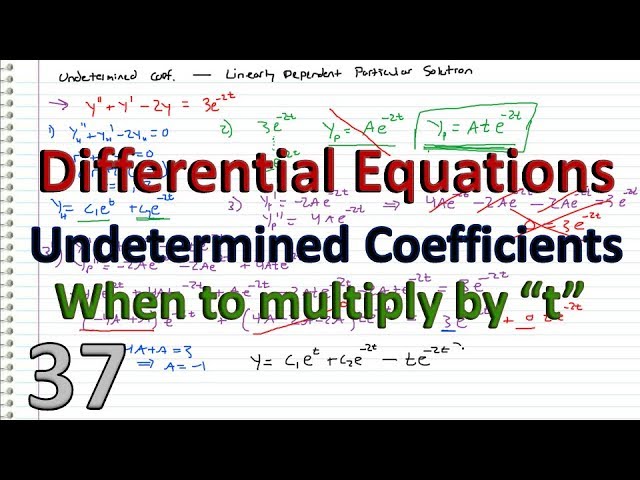
How to solve a 2nd order linear non homogeneous differential equation using the method of undetermined coefficients when the particular solution form has a term that is linearly dependent with a term in the homogeneous form
shut obsidian
neon iron
https://youtu.be/xAZ-hdBJ8u8?feature=shared
Do you also know of a website rather than a video?
neon iron
No sorry, but let me search if I find any
shut obsidian
Oh, I think this is basically this https://en.m.wikipedia.org/wiki/Method_of_undetermined_coefficients
in example 2
neon iron
Yeah examples section
I am not sure if you have covered variation of parameters yet but that is also another useful way of solving such DEs (to be specific, nth order linear non-homogeneous odes)
shut obsidian
neon iron
Yeah examples section
I am not sure if you have covered variation of parameters...
We haven't
shut obsidian
shut obsidian
Oh, I think this is basically this <https://en.m.wikipedia.org/wiki/Method_of_un...
Hm, but isn't this kinda different
They didn't obtain solutions and then have to throw one of them out and replace it
 edgy frigate
I can suggest a book which will be far greater than any YouTube video or online resource on the matter if you want it.
shut obsidian
edgy frigate
I can suggest a book which will be far greater than any YouTube video or online ...
Sure, though I'm taking a course on it rn anyways, but go ahead
neon iron
shut obsidian
They didn't obtain solutions and then have to throw one of them out and replace ...
Example 2
edgy frigate
It will layout precisely when to multiply by t or t^2, etc.
shut obsidian
neon iron
Example 2
Yeah
shut obsidian
edgy frigate
It will layout precisely when to multiply by t or t^2, etc.
Which one is it?
neon iron
I mean the example is different, but the core idea is the same, multiplying by x or its higher powers to make the solutions linearly independent
edgy frigate
The book is Ordinary Differential Equations by Morris Tenenbaum and Harry Pollard, you can probably view the book on Internet Archive. (Starts at Lesson 21A, page 221.)
shut obsidian
edgy frigate
The book is Ordinary Differential Equations by Morris Tenenbaum and Harry Pollar...
Thanks
shut obsidian
neon iron
I mean the example is different, but the core idea is the same, multiplying by x...
Is there any motivation for multiplying by x or is it just something that often works
edgy frigate
Wait, are you wondering why sometimes if you have one solution that you can get another by multiply by t for the complementary solution?
shut obsidian
edgy frigate
Wait, are you wondering why sometimes if you have one solution that you can get ...
No, I obtained lambda = 1, -1 and lambda = 2 (twice) from my characteristic polynomial
Using y = e^(lambda x)
So I have to replace one of the e^(2x) solutions or it won't be linearly independant
And hellothere suggested x * e^(2x)
edgy frigate
edgy frigate
The book is Ordinary Differential Equations by Morris Tenenbaum and Harry Pollar...
Ok. I directed you to somewhere unrelated here, sorry.
shut obsidian
Alright, np
edgy frigate
I think you might be best served by looking at something called the method of Reduction of order. In that same book it is shown (without reference to the name of the method) on page 214.
It all comes back to this for why we require n linearly independent solutions. It's essentially because (19.32) will be a true general solution, i.e., it will contain every possible solution.

We can find the n linearly independent solutions by any means necessary.
Normally if you found one (by the usual methods of y_(t) = e^(λt)), which was a guess all along anyway so you might be tempted to try to find another by forming y_2(t) = u(t) y_1(t).
In fact, it can be shown that this always yields a second solution (See Lesson 23B).
shut obsidian
edgy frigate
We can find the n linearly independent solutions by any means necessary.
Normall...
Ok, so we need to plug in $axe^{2x}$ into $y''''(x) - 4y'''(x) + 3y''(x) + 4y'(x) - 4y(x) = 0$

 thorny flameBOT
stabulo
 edgy frigate
The method of just multiplying by t probably comes from the pattern recognition that if the root is repeated it just always results in u(t) = t.
I do wonder if you choose
$y_{2}(t) = u(t) y(t)$, where this $y(t)$ is any of the non repeated roots if you just start generating all the others and eventually have to keep doing it till you get all the others.
thorny flameBOT
stabulo
 edgy frigate
The problem will quickly arise that finding y_2'. y_2'', y_3''', y_2'''' generally use the product rule a lot will quickly become very long to do by hand.
shut obsidian
edgy frigate
The method of just multiplying by t probably comes from the pattern recognition ...
Oh, ok
edgy frigate
Resources will just probably show it true for the second order case and get you to notice the pattern.
shut obsidian
pastel salmon
Homogeneous linear equations with constant coefficients always have fundamental ...
What do you mean by this, do we never need to check independence?
pastel salmon
shut obsidian
What do you mean by this, do we never need to check independence?
Becasue every fundamental system of solutions of such euqations like yours are based on exp(ax)sin(bx), exp(ax)cos(bx), you never find other solutions if it comes to homogenous linar equations with constant coeff
fundamental syste, means its wronskian is not equal to zero
pastel salmon
shut obsidian
What do you mean by this, do we never need to check independence?
hence if you find roots of the characteristic polynomila, like yours, 1, 1, -1, 2, then
fundamental system is:
{ exp(x), xexp(x), exp(-x), exp(2x) }
hence
the general solution is the lieanr combination of thsoe fours solutions i write
and that is end !
it lasts 3 minutes )
or less
and the appropriate theorem guaranttess
those solutisn are independent,
hence i said, do noto waste to much times on it
it is not worth
such equaitns belive me or not, can be solved in mind
shut obsidian
pastel salmon
it lasts 3 minutes )
oh, my instructor in her example checked if theyre independant
pastel salmon
shut obsidian
oh, my instructor in her example checked if theyre independant
no, no need unleess there;'re equations with non - constant equations
but so far, you re showing only with contants coeff
shut obsidian
Thanks
pastel salmon
yw
shut obsidian
.close
topaz sinewBOT
Channel closed
Closed by @shut obsidian
Use .reopen if this was a mistake.
topaz sinewBOT
Available help channel!
Send your question here to claim the channel.
Remember:
• Ask your math question in a clear, concise manner.
• Show your work, and if possible, explain where you are stuck.
• After 15 minutes, feel free to ping <@&286206848099549185>.
• Type the command .close to free the channel when you're done.
• Be polite and have a nice day!
Read #❓how-to-get-help for further information on how to ask a good question, and about conduct in the question channels.
 eager willow
5 only answer
 topaz sinewBOT
eager willow
5 only answer
topaz sinewBOT
eager willow
5 only answer
The purpose of this server is to help you learn, not to hand out answers. Do not ask someone to give you the answer directly.
 old ether
eager willow
5 only answer
old ether
eager willow
5 only answer
A linear equation can be constructed with the same number of data points as dimensions. This one is two dimensional, so you need two data points. Could you give some? Preferably one with x=0.
eager willow
.close
topaz sinewBOT
Channel closed
Closed by @eager willow
Use .reopen if this was a mistake.
topaz sinewBOT
Available help channel!
Send your question here to claim the channel.
Remember:
• Ask your math question in a clear, concise manner.
• Show your work, and if possible, explain where you are stuck.
• After 15 minutes, feel free to ping <@&286206848099549185>.
• Type the command .close to free the channel when you're done.
• Be polite and have a nice day!
Read #❓how-to-get-help for further information on how to ask a good question, and about conduct in the question channels.
 eternal mauve
 topaz sinewBOT
eternal mauve
topaz sinewBOT
eternal mauve
 glacial acorn
you can solve it with an integral
 keen venture
I think they're trying to go for Riemann sums, but that's not what the sum is
eternal mauve
can i try and do it with the trapezium rule?
glacial acorn
That looks like a Darboux sum to me
keen venture
They probably do intend an integral solution
As written, the sum is just:
0 + 0 + 0 + 0 + 0 + 0
glacial acorn
eternal mauve
🙏🏾
The simplest solution is to write an integral and solve it
Do you know how to do that?
glacial acorn
yes
eternal mauve
i mean i can write the integral of root x
but without a numerical value for the limits
how would i be able to
oh wait-
do i do smthg with 4 and 9
glacial acorn
Whats the integral of root x?
eternal mauve
38/3
 dusky socket
eternal mauve
2x^3/2 divided by 3
dusky socket
eternal mauve
2x^3/2 divided by 3
why divided by 3
eternal mauve
wdym
eternal mauve
x^n+1 divided by n + 1
dusky socket
sorry
glacial acorn
eternal mauve
38/3
And that is your solution
eternal mauve
wha-
i DID NOT KNOW it was this ez
im usually good at calc but the weird symbol and sigma threw me off
glacial acorn
Thats a sum sign
its used to note when you add multiple things at once
You can look up Riemann or Darboux integrals.
glacial acorn
glacial acorn
You can look up Riemann or Darboux integrals.
these are two ways of formally defining integrals
You basically approximate a function with narrow vertical blocks and add up their areas
topaz sinewBOT
@eternal mauve Has your question been resolved?
Channel closed
Closed by @eternal mauve
Use .reopen if this was a mistake.
topaz sinewBOT
Available help channel!
Send your question here to claim the channel.
Remember:
• Ask your math question in a clear, concise manner.
• Show your work, and if possible, explain where you are stuck.
• After 15 minutes, feel free to ping <@&286206848099549185>.
• Type the command .close to free the channel when you're done.
• Be polite and have a nice day!
Read #❓how-to-get-help for further information on how to ask a good question, and about conduct in the question channels.
 sterile cedar
hello
topaz sinewBOT
sterile cedar
hello
sterile cedar
Show that the points form the vertices of the polygon.
isosceles triangle:
(2, −1), (3, 3), (−1, 4)
distance between (2, −1) and (3, 3) d1 =
distance between (3, 3) and (−1, 4) d2 =
distance between (2, −1) and (−1, 4) d3 =
hi @neon iron
it keeps saying my answer is wrong....
4.12
4.12
5.83
topaz sinewBOT
@sterile cedar Has your question been resolved?
sterile cedar
neon iron
oops
u good bro
neon iron
sterile cedar
it keeps saying my answer is wrong....
Did you do the Pythagorean theorem for each one?
neon iron
Can i see your work
neon iron
sterile cedar
4.12
4.12
5.83
These answers should be right
sterile cedar
neon iron
These answers should be right
cengage saying theyr wrong
neon iron
Weird
sterile cedar
yeahhhh i cba man
neon iron
yea idk then
topaz sinewBOT
@sterile cedar Has your question been resolved?
topaz sinewBOT
Channel closed
Closed due to timeout
Use .reopen if this was a mistake.
Available help channel!
Send your question here to claim the channel.
Remember:
• Ask your math question in a clear, concise manner.
• Show your work, and if possible, explain where you are stuck.
• After 15 minutes, feel free to ping <@&286206848099549185>.
• Type the command .close to free the channel when you're done.
• Be polite and have a nice day!
Read #❓how-to-get-help for further information on how to ask a good question, and about conduct in the question channels.
 fickle stirrup
Determine the derivative of the following function:
fickle stirrup
 neon iron
wtf is sen
neon iron
ye
fickle stirrup
But that is not the answer lol
fickle stirrup
I know
neon iron
in other terms
neon iron
the derivative isn't the answer?
neon iron
your question was to find the derivative
fickle stirrup
The answer is 2tan(2x)sec(2x)
But
My question is
How to get to that lol
That is the problem for me
I have been thinking how to get to that for 15 minutes
But I cant find a way lol
topaz sinewBOT
@fickle stirrup Has your question been resolved?
fickle stirrup
.close
topaz sinewBOT
Channel closed
Closed by @fickle stirrup
Use .reopen if this was a mistake.
topaz sinewBOT
Available help channel!
Send your question here to claim the channel.
Remember:
• Ask your math question in a clear, concise manner.
• Show your work, and if possible, explain where you are stuck.
• After 15 minutes, feel free to ping <@&286206848099549185>.
• Type the command .close to free the channel when you're done.
• Be polite and have a nice day!
Read #❓how-to-get-help for further information on how to ask a good question, and about conduct in the question channels.
 waxen niche
 topaz sinewBOT
waxen niche
waxen niche
topaz sinewBOT
waxen niche
waxen niche
just 27 for now
like x = 3cos pi/3 t
y = 2sinpi/3 t
i just plugged in 1 for t
and i got that the distance (pythag) is sqrt 21/2
topaz sinewBOT
@waxen niche Has your question been resolved?
waxen niche
<@&286206848099549185>
 hidden zinc
waxen niche
hidden zinc
waxen niche
bro
for q 27
u have x = 3 cos(pi/3)t
so cos(pi/3)t = x/3
2 sin(pi/3)t = y
so sin(pi/3)t = y/2
now sin^2theta + cos^2 theta = 1
so x^2/9 + y^/4 = 1
now take lcm
4x^2 + 9y^2 = 36
this is an ellipse
waxen niche
waxen niche
and i got that the distance (pythag) is sqrt 21/2
im wondering why this doesn't work
i hav ethe solution
hidden zinc
ur supposed to find the reln b/w x and y
u dont plug values for t
it should be independent of t
do you know
how parameters work
waxen niche
no?
hidden zinc
exactly
parameters
are those points where
we take another variable and express x and y
to get the locus of the points
we must eliminate that variable
waxen niche
hidden zinc
ur supposed to find the reln b/w x and y
yeah but i don't get hwy testing values
wouldnt show u this relationship
cuz wouldnt it be constant
regardless
waxen niche
nah i mean
hidden zinc
it is just another variable
hidden zinc
yeah?
topaz sinewBOT
Channel closed
Closed by @waxen niche
Use .reopen if this was a mistake.
topaz sinewBOT
Available help channel!
Send your question here to claim the channel.
Remember:
• Ask your math question in a clear, concise manner.
• Show your work, and if possible, explain where you are stuck.
• After 15 minutes, feel free to ping <@&286206848099549185>.
• Type the command .close to free the channel when you're done.
• Be polite and have a nice day!
Read #❓how-to-get-help for further information on how to ask a good question, and about conduct in the question channels.
 vapid notch
 topaz sinewBOT
vapid notch
vapid notch
topaz sinewBOT
vapid notch
vapid notch
unsure of 11
how would i calc shaded area?
ik the sector area is 39.26
do i need to solve the triangle to find triangle area? and sub that from sector area?
 whole geode
vapid notch
do i need to solve the triangle to find triangle area? and sub that from sector ...
whole geode
vapid notch
do i need to solve the triangle to find triangle area? and sub that from sector ...
Yes, it might also help to recognize that triangle as exactly one eighth of a regular octagon.
vapid notch
whole geode
Yes, it might also help to recognize that triangle as exactly one eighth of a re...
yes i did that
whole geode
But that depends on the formulas you have handy
vapid notch
law of sines
whole geode
It is also twice of a right triangle with one angle 22.5 degrees.
vapid notch
ill just use law of sines
whole geode
Fair enough
topaz sinewBOT
Channel closed
Closed by @vapid notch
Use .reopen if this was a mistake.
topaz sinewBOT
Available help channel!
Send your question here to claim the channel.
Remember:
• Ask your math question in a clear, concise manner.
• Show your work, and if possible, explain where you are stuck.
• After 15 minutes, feel free to ping <@&286206848099549185>.
• Type the command .close to free the channel when you're done.
• Be polite and have a nice day!
Read #❓how-to-get-help for further information on how to ask a good question, and about conduct in the question channels.
 dreamy wolf
need help
 topaz sinewBOT
dreamy wolf
need help
dreamy wolf
topaz sinewBOT
dreamy wolf
need help
dreamy wolf
I have no idea how to solve some of these

thats what I did for the first two bits, pls see if thats right ill send the 3rd and 4rth but I cant figure out what im doing wrong or ho to do the 5 on wards.

<@&286206848099549185>
someone ?
.close
topaz sinewBOT
Channel closed
Closed by @dreamy wolf
Use .reopen if this was a mistake.
topaz sinewBOT
Available help channel!
Send your question here to claim the channel.
Remember:
• Ask your math question in a clear, concise manner.
• Show your work, and if possible, explain where you are stuck.
• After 15 minutes, feel free to ping <@&286206848099549185>.
• Type the command .close to free the channel when you're done.
• Be polite and have a nice day!
Read #❓how-to-get-help for further information on how to ask a good question, and about conduct in the question channels.
 thick inlet
 topaz sinewBOT
thick inlet
topaz sinewBOT
thick inlet
 void crow
topaz sinewBOT
void crow
topaz sinewBOT
Channel closed
Closed by @thick inlet
Use .reopen if this was a mistake.
Available help channel!
Send your question here to claim the channel.
Remember:
• Ask your math question in a clear, concise manner.
• Show your work, and if possible, explain where you are stuck.
• After 15 minutes, feel free to ping <@&286206848099549185>.
• Type the command .close to free the channel when you're done.
• Be polite and have a nice day!
Read #❓how-to-get-help for further information on how to ask a good question, and about conduct in the question channels.
 grave bough
 topaz sinewBOT
grave bough
grave bough
topaz sinewBOT
grave bough
grave bough
why are we taking in terms of y
why not just x(f(X)dx
shouldnt shell height be sqrt(x)...
topaz sinewBOT
@grave bough Has your question been resolved?
grave bough
oh boy im so fucked
even if we tookt he height as the red bar, it would be x = y^2
why 1-y^2....
topaz sinewBOT
@grave bough Has your question been resolved?
topaz sinewBOT
@grave bough Has your question been resolved?
topaz sinewBOT
@grave bough Has your question been resolved?
topaz sinewBOT
Channel closed
Closed due to timeout
Use .reopen if this was a mistake.
Available help channel!
Send your question here to claim the channel.
Remember:
• Ask your math question in a clear, concise manner.
• Show your work, and if possible, explain where you are stuck.
• After 15 minutes, feel free to ping <@&286206848099549185>.
• Type the command .close to free the channel when you're done.
• Be polite and have a nice day!
Read #❓how-to-get-help for further information on how to ask a good question, and about conduct in the question channels.
 jolly patio
 topaz sinewBOT
jolly patio
topaz sinewBOT
jolly patio
 fair thorn
jolly patio
fair thorn
jolly patio
let me try!
so pennies to nickles is 11:2
and nickles to dime is 4:3
and we need dimes to pennies
22:4 : 4:3 which is 22:3??
22/4 *4/3, 4 crosses out right so its just 22/3?? but thats not an answer
22 dimes and 3 pennies
which is 223 pennies
@fair thorn
jolly patio
why 3:22
jolly patio
oh wait
oh i see
so i know f is correct
bc it is 52 in total as well
isnt that the only answeR?
jolly patio
how do
jolly patio
ah i see
so only d and f?
and e i assume
bc you can divide 24 by 3
and 176 by 22?
@fair thorn
topaz sinewBOT
Channel closed
Closed by @jolly patio
Use .reopen if this was a mistake.
topaz sinewBOT
Available help channel!
Send your question here to claim the channel.
Remember:
• Ask your math question in a clear, concise manner.
• Show your work, and if possible, explain where you are stuck.
• After 15 minutes, feel free to ping <@&286206848099549185>.
• Type the command .close to free the channel when you're done.
• Be polite and have a nice day!
Read #❓how-to-get-help for further information on how to ask a good question, and about conduct in the question channels.
jolly patio

 topaz sinewBOT
jolly patio
neon iron
jolly patio
topaz sinewBOT
jolly patio
neon iron
jolly patio
try n write out all the information you have first
jolly patio
<BCG is 10 degrees less than the measure of <CGD
neon iron
yeah
jolly patio
<DGE is 25 degrees more than the measure of <EGF
 neon iron
what do u get
neon iron
neon iron
what do u get
answer this
i want to see equations representing the sentences you mentioned
jolly patio
yes
neon iron
50 = 30?
neon iron
50 - ??? = 40 what is ???
 tulip parrot
<BCG=<CGD-10
<DGE=<EGF+25
<FGA?
neon iron
tulip parrot
<BCG=<CGD-10
<DGE=<EGF+25
<FGA?
please let them figure out how to set it up at least
jolly patio
<DGE= <EFG+25
tulip parrot
ook i will go..
neon iron
jolly patio
<DGE= <EFG+25
but okay cool yes
neon iron
those are your equations. Can you tell me what EGF is from the graph?
neon iron
no but like there is an x value associated with it
jolly patio
2X
neon iron
yes
neon iron
jolly patio
<DGE= <EFG+25
plug it in here what is DGE
jolly patio
why do i plug it into DGE?
jolly patio
OK
jolly patio
X
neon iron
so sub it in yeah
jolly patio
bgc =x-10
neon iron
amazing
so now you have all the angles in term of x
so uh
sum of all angles = 360
find x
jolly patio
x-10+2x+25=360
jolly patio
oh?
neon iron
ALL angles
jolly patio
hm
 neon iron
jolly patio
x-10+2x+25=360
neon iron
jolly patio
x-10+2x+25=360
yeah but also include those
neon iron
jolly patio
bgc =x-10
u already have bgc
jolly patio
which is 9x+55=360
jolly patio
neon iron
why is it 35
OH WAIT
25
6x+30+x-10+2x+25=360
SO
9x +45=360
which is 9x =315
which is 35
jolly patio
105
neon iron
yeah
jolly patio
ok so im going to be honest
im a little confus
like
I understand we found the equation of BGC and the equation of DGE
neon iron
yeah
jolly patio
oh wait i see
we found the missing ones
and now we add add the values
and equal to 360
i understand that
we got 35 cool
jolly patio
and then we did 3x bc we needed to find agf?
neon iron
yeah i mean thats what they say fga is in the graph
jolly patio
ig my tjing is why did we add all the values and equal to 360
neon iron
bcuz
jolly patio
and THEN find fga
jolly patio
i see
neon iron
jolly patio
and THEN find fga
i mean it's just a way for us to recover x to get fga
jolly patio
ah isee
is it because we wanted to find x
and this is the only way hiw
????
and then we insert it into 3x
neon iron
probably not the only way how but probably the most straightforward one
neon iron
jolly patio
and then we insert it into 3x
yeah
jolly patio
can you help me with another porblem
neon iron
sure
 neon iron
oh okay lmao
jolly patio
i take it in 10 days so
im trying to master is LOL
its still confusing LMAO
anyways
employee x is paid $19.50
and Employee Y is paid $18 an hour
for the first 40 hours
and then is paid 1.5 times the hourly rate for every additional hour worked
and then both employee worked the same number of hours and paid the same amount and we are trying to find how many hours they worked
ok so
i guess make two seperate equations??
neon iron
how do you represent "employee X is paid 19.50 an hour"
neon iron
jolly patio
so employee x =19.50x
yeah
for employee Y we have to set up a piecewise function
jolly patio
piecewise function?
neon iron
yeah
neon iron
,, \begin{dcases*}
13x &if $x < 5$ \ 12-x &if $x\ge 5$
\end{dcases*}
thorny flameBOT
 jolly patio
ok i see
jolly patio
18x is x>40
jolly patio
and then
neon iron
1.5 times that
jolly patio
27x if x >40
neon iron
yeah
jolly patio
ok what should i do next??
neon iron
so we need to find the hour x for which both are equal
jolly patio
so employee x to employee y?
neon iron
wait actually
Sorry i think i misguided you a bit. I guess i didn't fully read the rest of the question until now
we will rewind a bit
jolly patio
okay
jolly patio
ok
neon iron
from the question we know 19.50x
jolly patio
yes
neon iron
for employee Y, the "is paid $18 an hour for thr first 40 hours she works" is basically a constant. Because she MUST work that amount
so in reality thats just $18\240$
thorny flameBOT
 neon iron
because the question including an "additional" time is implicitly saying that those first 40 hours are going to be happening regardless
neon iron
yeah uh so we are not done yet
jolly patio
yes
neon iron
but our variable is going to be y - 40
because like
it only starts after 40 hours right?
neon iron
no
jolly patio
oh
jolly patio
hm ok
neon iron
its just added on top of the additional work
neon iron
no its okay so the first 40 hours are 720
and then
you have 27(y-40) for the additional work
so what is ur equation
jolly patio
so 19.50x=720-27y-21600
neon iron
substitute x for y
jolly patio
why do we do that?
neon iron
the question says they worked the same number of hours
jolly patio
i see that
ig im not seeing why we are putting x into y
what is the x equation
and y equation
jolly patio
im sorry, im not sure im understanding wym
i get what x and y represent
but using the equation 19.50x=720+27(y-40) i dont know what number to replace into y
we didnt even find an x value to replace into y
neon iron
im not asking you to replace it with any number
neon iron
im asking you to replace it with x
jolly patio
OH
neon iron
because we know it's equal to x
neon iron
because
again the question's premise is saying "if they worked the same amount of hours how many hours did they work"
so
neon iron
yeah
jolly patio
48
jolly patio
ok can we do another problemm together
neon iron
ok

 neon iron
ok what do u think
jolly patio
this one, idk how to approach at all
tbh
are f g and h angles?
tbh i would say there's not enough info bc there's no numbers
and its not a specific triangle like equilatal or right so its kind of difficult to indicate the numebers
neon iron
jolly patio
are f g and h angles?
yeah
jolly patio
what are m,n,p?
jolly patio
two angles in each corner?? that makes no sense
neon iron
whats the sum of the angles in a triangle?
jolly patio
180??
neon iron
jolly patio
two angles in each corner?? that makes no sense
its just a very concave angle
neon iron
jolly patio
180??
yeah
jolly patio
ok
neon iron
so f + g + h is what
neon iron
yeah
jolly patio
ok
neon iron
i want u to look at, say, m
jolly patio
yes
neon iron
so here is the thing, that thing ALMOST looks like a full circle right?
jolly patio
yeah
neon iron
but its just missing a small degree that f has
jolly patio
yeah
neon iron
what did we say the degree of a circle is?
jolly patio
maybe 270?
neon iron
what do u get
neon iron
no
neon iron
you are not getting any number u dont know f
jolly patio
well if its 180 total
neon iron
im just asking you for the expression
neon iron
ok but like you're assuming the triangle is equilateral with that
and we dont know that
jolly patio
ah i see
neon iron
we know nothing about the triangle
neon iron
neon iron
im just asking you for the expression
anyways answer this
jolly patio
m=360-f
neon iron
yeah
exactly
do the same for all the others and sum them up
what do you have (give me an expression)
jolly patio
so 180/ 360-f+360-g+360-h
jolly patio
180/1080-f-g-h
jolly patio
oh wait
neon iron
some magic there because there is no = at all yet
thorny flameBOT
 neon iron
how do you do it
jolly patio
-(x+y+z)
neon iron
jolly patio
180/1080-f-g-h
do this here with -f-g-h
jolly patio
so 1/6 -(f+g+h)
neon iron
no
jolly patio
oh
neon iron
,, \4a{a+c} \5r\ne \41{1+c}
thorny flameBOT
 neon iron
this is pretty much what you did
neon iron
you have [
\4{180}{1080-(f+g+h)}
]
thorny flameBOT
 neon iron
right?
jolly patio
yes
jolly patio
180/1080 - 180/f+g+h
neon iron
no
you cant do that
you can't rip the denominator like that
,,\4a{b+c} \5r\ne \4ab +\4ac
thorny flameBOT
 neon iron
ok what did we say f+g+h was
neon iron
neon iron
ok what did we say f+g+h was
but anyways answer this
jolly patio
-(f+g+h)
neon iron
rewind a bit
right at the beginning
what did we say the sum of the angles of a triangle is
neon iron
jolly patio
f+G+h=180
.
neon iron
substitute that in
jolly patio
oh 180/1080 - 180
neon iron
yes
jolly patio
180/900
neon iron
also use parentheses
jolly patio
1/5
neon iron
please
neon iron
jolly patio
1/5
yes
topaz sinewBOT
Channel closed
Closed by @jolly patio
Use .reopen if this was a mistake.
neon iron
alright good luck
topaz sinewBOT
Available help channel!
Send your question here to claim the channel.
Remember:
• Ask your math question in a clear, concise manner.
• Show your work, and if possible, explain where you are stuck.
• After 15 minutes, feel free to ping <@&286206848099549185>.
• Type the command .close to free the channel when you're done.
• Be polite and have a nice day!
Read #❓how-to-get-help for further information on how to ask a good question, and about conduct in the question channels.
 junior linden
is there Isosceles Trapezoid this formula a+b=2c
topaz sinewBOT
junior linden
is there Isosceles Trapezoid this formula a+b=2c
junior linden
i mean if isoscales trapezoid has this formula a+b=2c
 deft dew
junior linden
i mean if isoscales trapezoid has this formula a+b=2c
deft dew
junior linden
i mean if isoscales trapezoid has this formula a+b=2c
No
In an isosceles trapezoid a and b have the same lengths
a+b=2c suggests that the sum of the lengths of both sides equals twice the length of one side
topaz sinewBOT
@junior linden Has your question been resolved?
topaz sinewBOT
Channel closed
Closed by @junior linden
Use .reopen if this was a mistake.
Available help channel!
Send your question here to claim the channel.
Remember:
• Ask your math question in a clear, concise manner.
• Show your work, and if possible, explain where you are stuck.
• After 15 minutes, feel free to ping <@&286206848099549185>.
• Type the command .close to free the channel when you're done.
• Be polite and have a nice day!
Read #❓how-to-get-help for further information on how to ask a good question, and about conduct in the question channels.
 hasty bane
can someone please help me understand where did the minus sign go?

 sweet shard
hasty bane
can someone please help me understand where did the minus sign go?
sweet shard
hasty bane
can someone please help me understand where did the minus sign go?
$|c + b_q - b_p| \le |c+b_q + b_p|$ for all positive c
thorny flameBOT
riemann
 topaz sinewBOT
Channel closed
Closed by @hasty bane
Use .reopen if this was a mistake.
Available help channel!
Send your question here to claim the channel.
Remember:
• Ask your math question in a clear, concise manner.
• Show your work, and if possible, explain where you are stuck.
• After 15 minutes, feel free to ping <@&286206848099549185>.
• Type the command .close to free the channel when you're done.
• Be polite and have a nice day!
Read #❓how-to-get-help for further information on how to ask a good question, and about conduct in the question channels.
neon iron
The answer key says 25/2 is the answer for this but I'm getting 0
neon iron

 golden mesa
do you know how to integrate with absolute value
neon iron
No
 neon iron
golden mesa
looks like this
neon iron
golden mesa
looks like this
Like yea I understand area under curve and all
golden mesa
the problem is that |2x-5| is different to the left and right of x=5/2, so you can't integrate it in one go
you have to split it into when it's 2x-5, and when it's 5-2x
topaz sinewBOT
@neon iron Has your question been resolved?
neon iron
golden mesa
the problem is that |2x-5| is different to the left and right of x=5/2, so you c...
?
 viral skiff
neon iron
?
viral skiff
neon iron
?
in limits,absolutes with variables have 2 different answers
a little unrelated but assume x -> 5/2+ (approaching from the right)
assume the value is very slightly higher than 5/2
if you put it this way,2x will be higher than 5 so it will leave the absolute at it's exact form
hence |2x-5| = 2x-5
if you approach it from the left side
the inside is a minus
because 2x will be smaller than 5
neon iron
viral skiff
in limits,absolutes with variables have 2 different answers
a little unrelated b...
Oh right
But like I don't know how to go about the second answer
viral skiff
neon iron
on this particular problem I do not know integrals so I can't help you about it
but I do know limits
neon iron
.close
topaz sinewBOT
Channel closed
Closed by @slim bloom
Use .reopen if this was a mistake.
topaz sinewBOT
Available help channel!
Send your question here to claim the channel.
Remember:
• Ask your math question in a clear, concise manner.
• Show your work, and if possible, explain where you are stuck.
• After 15 minutes, feel free to ping <@&286206848099549185>.
• Type the command .close to free the channel when you're done.
• Be polite and have a nice day!
Read #❓how-to-get-help for further information on how to ask a good question, and about conduct in the question channels.
hasty bane
how do I show that $$\text{exp}(x) := \sum_{k=0}^{\infty}\frac{1}{k!}$$ is continuous everywhere?
It's continuity can be reduced to continuity at $0$:
$$
|e^{x}-e^{x_0}| = e^{x_0} |\underbrace{e^{x-x_0}}{e^t \ \text{ as } t \text{ is close to } 0 }-\underbrace{1}{e^0}| < \varepsilon
$$
where $e^x := exp(x)$ for convenience
But idk how to show that $\text{exp}(x)$ is continuous at zero 🤔
topaz sinewBOT
hasty bane
how do I show that $$\text{exp}(x) := \sum_{k=0}^{\infty}\frac{1}{k!}$$ is conti...
thorny flameBOT
Sweet Tea 🧋

 final jungle
It's better to show that the sequence of partial sums uniformly converge to e^x. Continuity follows.
There's a typo in the summation btw
hasty bane
final jungle
There's a typo in the summation btw
where?
final jungle
Should be x^n
hasty bane
final jungle
It's better to show that the sequence of partial sums uniformly converge to e^x....
Hmm, I don't remember that theorem... I thought uniform convergence => pointwise convergence, but what does continuity has to do with it?
final jungle
Uniform convergence along with each sequential function being continuous implies the convergent function is continuous
hasty bane
hasty bane
Hmm, I don't remember that theorem... I thought uniform convergence => pointwise...
and either way, this theorem is discussed way before any mention of sequences of functions and their convergence
so I'd like to prove that w/o them
altho thank you for suggesting 
final jungle
Yeah but that's the easiest way I could think of
topaz sinewBOT
@hasty bane Has your question been resolved?
 rigid ivy
thorny flame
**Sweet Tea 🧋**
rigid ivy
thorny flame
**Sweet Tea 🧋**
Are you defining e^x as the limit sum?
@hasty bane
Also, what was your other question?
hasty bane
rigid ivy
Also, what was your other question?
what other question? 🙃
rigid ivy
Hah it's okay.
hasty bane
that's it: continuity of e^x and multinomial expansion
hasty bane
rigid ivy
Are you defining e^x as the limit sum?
yep
rigid ivy
Okay. So basically, you want to show that $\sum_{k=0}^{\infty} \frac{x^k}{k!}$ is continuous everywhere. Or at least continuous at $x=0$ for now.
thorny flameBOT
SWR
 hasty bane
rigid ivy
Okay. So basically, you want to show that $\sum_{k=0}^{\infty} \frac{x^k}{k!}$ i...
hasty bane
rigid ivy
Okay. So basically, you want to show that $\sum_{k=0}^{\infty} \frac{x^k}{k!}$ i...
correct
I suspect we have to bound the e^x - 1 by using either the expansion (or in our case the definition of e^x) or maybe the limit of e^x-1 over x as x goes to 0
like -1 term subtracts straight away the first term of the
$$
e^x := \text{exp}(x) := \sum_{n=0}^{\infty}\frac{x^n}{n!} = 1+x+x^2/2+\ldots
$$
thorny flameBOT
Sweet Tea 🧋
 rigid ivy
I believe simply showing that the sum converges at every x would help show continuity? I think? If you can show that, you can show two neighborhoods are within some epsilon of each other.
But that's only my first guess and may not be helpful to you
hasty bane
hmmm. what if we assume, WLOG, that |x|<1
then e^x-1=x(1+x/2+x^2/3!+...)<=x(1+1/2+1/3!+...)=x(e-1)
hasty bane
rigid ivy
I believe simply showing that the sum converges at every x would help show conti...
definitely not
point wise convergence of functions and their continuity separately does not imply the function they converge to is also continuous
rigid ivy
Give me time after work to think this through. Not 100% sure I can solve this since I forget all my series analysis, but I'll at least take a good look
But I'll at least try to help
 noble laurel
You need to show the series converges uniformly to e^(x)
Since all of the functions in the series are continuous
Their uniform limit will also be
hasty bane
noble laurel
You need to show the series converges uniformly to e^(x)
: (
then (if I get this theorem on the upcoming exam) I'd have to prove this result as well to use it
and the thing is, even tho I'm slightly familiar with the theorem and followed a proof from a textbook (specifically not saying 'proved', because that assumes deeper understanding than I have atm 😅), we didn't cover sequences of functions
so looking for some more elementary methods
noble laurel
You haven’t covered sequences of functions ??
Yet your definition of e^(x) is an infinite series expansion
Can you show the original question
hasty bane
hasty bane
: (
then (if I get this theorem on the upcoming exam) I'd have to prove this re...
I've found a proof online, and it started with 'obviously |e^x-1|<2|x| if |x|<1'
but idk how to prove that
noble laurel
noble laurel
Can you show the original question

hasty bane
noble laurel
Yet your definition of e^(x) is an infinite series expansion
well, we simply defined e^x to be this series
and point wise convergence is elementary (with root test, for example)
so it's well defined
hasty bane
noble laurel
All you’re trying to do is prove e^x is continuous?
yes 🙂
exp(x) to remove any confusion
because u could have defined e^x as a supremum of something, with rational powers approaching your real number x
hasty bane
noble laurel
All you’re trying to do is prove e^x is continuous?
and specifically at the point x=0, since that would automatically prove its continuous everywhere else
noble laurel
I would do a more general epsilon delta proof
It’d be easier I think
Sure you can take c=0
Can you state then what you’re trying to prove in terms of the epsilons and deltas
hasty bane
noble laurel
Can you state then what you’re trying to prove in terms of the epsilons and delt...
given eps > 0 we can find delta > 0 st whenever |x|<delta it follows that |e^x-1|< eps
*with remark that e^x := exp(x) 🙂
noble laurel
Sure and now let c=0