#help-26
1 messages · Page 67 of 1
 topaz sinewBOT
 molten vine
!status
topaz sinewBOT
What step are you on?
1. I don't know where to begin.
2. I have begun but got stuck midway.
3. I got an answer but I was told that it's wrong.
4. I got an answer and would like my work checked.
5. I have a question about someone else's work/solution.
6. I have completed the problem and don't need help anymore. Thank you.
7. None of the above
 verbal bison
1
topaz sinewBOT
@verbal bison Has your question been resolved?
topaz sinewBOT
Channel closed
Closed due to timeout
Use .reopen if this was a mistake.
verbal bison
.reopen
topaz sinewBOT
✅
 novel echo
do those arrows mean approaching from the left/right?
haven’t seen that notation before
 gray storm
Its my first time seeing these types of symbols
topaz sinewBOT
@verbal bison Has your question been resolved?
topaz sinewBOT
Channel closed
Closed due to timeout
Use .reopen if this was a mistake.
 Available help channel!
Send your question here to claim the channel.
Remember:
• Ask your math question in a clear, concise manner.
• Show your work, and if possible, explain where you are stuck.
• After 15 minutes, feel free to ping <@&286206848099549185>.
• Type the command .close to free the channel when you're done.
• Be polite and have a nice day!
Read #❓how-to-get-help for further information on how to ask a good question, and about conduct in the question channels.
 hollow mountain
hello i need help wtih this question
 topaz sinewBOT
hollow mountain
hello i need help wtih this question
hollow mountain
topaz sinewBOT
hollow mountain
hello i need help wtih this question
hollow mountain
i dont know how to find the function of f and function of g
 vale furnace
There's no g here.
hollow mountain
oh..
 pastel oracle
and you're given f
topaz sinewBOT
@hollow mountain Has your question been resolved?
Channel closed
Closed by @hollow mountain
Use .reopen if this was a mistake.
Available help channel!
Send your question here to claim the channel.
Remember:
• Ask your math question in a clear, concise manner.
• Show your work, and if possible, explain where you are stuck.
• After 15 minutes, feel free to ping <@&286206848099549185>.
• Type the command .close to free the channel when you're done.
• Be polite and have a nice day!
Read #❓how-to-get-help for further information on how to ask a good question, and about conduct in the question channels.
 cinder owl
howo did they get the matrix of 1's in a)
 topaz sinewBOT
cinder owl
howo did they get the matrix of 1's in a)
pastel oracle
topaz sinewBOT
cinder owl
howo did they get the matrix of 1's in a)
pastel oracle
by multiplying v by its transpose
topaz sinewBOT
Channel closed
Closed by @cinder owl
Use .reopen if this was a mistake.
Available help channel!
Send your question here to claim the channel.
Remember:
• Ask your math question in a clear, concise manner.
• Show your work, and if possible, explain where you are stuck.
• After 15 minutes, feel free to ping <@&286206848099549185>.
• Type the command .close to free the channel when you're done.
• Be polite and have a nice day!
Read #❓how-to-get-help for further information on how to ask a good question, and about conduct in the question channels.
 inner drum
In words, what are the steps involved in changing 0.2 1/6 to a percent?
verbal bison
novel echo
haven’t seen that notation before
yes it means left/right
 sinful pumice

 neon iron
First, convert the fraction 1/6 to a decimal. Divide 1 by 6 to get 0.1667 (rounded to four decimal places).
Second, add the decimal part to the whole number. 0.2 + 0.1667 = 0.3667.
Lastly, multiply the decimal by 100 to convert it to a percentage.
Then you have the answer!
inner drum
This was exactly what I needed. THANK YOU
You guys are frikkin wizzards!
but my book is saying the answer is 21 2/3
pastel oracle
that's terrible notation
inner drum
% right. my fault. it says the answer is 21 2/3%
pastel oracle
it must mean 0.216666666, converted to percent is 21.66666 --> 21 2/3
pastel oracle
assuming the book answer is correct, it must be
inner drum
Where did the 0.2166... come from?
pastel oracle
1/6 in decimal form is 0.166666, so that stupid notation must indicate that it is not 0.2 + 0.16666, but 0.21666666
neon iron
pastel oracle
1/6 in decimal form is 0.166666, so that stupid notation must indicate that it i...
Yes
pastel oracle
either look earlier in the book to see if they define that notation, or ask your teacher
neon iron
So it's book error
inner drum
I've searched the whole book and I dont have a teacher, Im trying to catch up on basic math stuff before I start college.
But I'm not crazy right?
This is wonky?
topaz sinewBOT
Channel closed
Closed by @inner drum
Use .reopen if this was a mistake.
Available help channel!
Send your question here to claim the channel.
Remember:
• Ask your math question in a clear, concise manner.
• Show your work, and if possible, explain where you are stuck.
• After 15 minutes, feel free to ping <@&286206848099549185>.
• Type the command .close to free the channel when you're done.
• Be polite and have a nice day!
Read #❓how-to-get-help for further information on how to ask a good question, and about conduct in the question channels.
 silk comet
I always end up somewhere where nor x nor y are solved
 vale furnace
!show
topaz sinewBOT
Show your work, and if possible, explain where you are stuck.
silk comet
the picture is not here?
vale furnace
I only see the question.
 vale furnace
no
silk comet
why?
vale furnace
clearly, 6^2 isnt sqrt(54)
silk comet
I know
 thorny flameBOT
Pure
 vale furnace
[2^{2-\log y}\cd3^{\log y} = \s {54}]
thorny flameBOT
Pure
 vale furnace
Like this?
silk comet
so it looked like: 2^(2-logy)*3^(logy)=√54
yes
exactly
and (-logy)+logy is zero
right?
vale furnace
You can't do that
 vale furnace
,,\loglaws
thorny flameBOT
Pure
 vale furnace
silk comet
vale furnace
silk comet
This is wrong. You have to take log of the whole product, and what's happening on he LHS?
silk comet


but the ypsilons aren't supposed to be shortened. Where is the mistake, please?
I´m not sure if I can multiply the logarithms on second line by their exponents (I know I can do it, but if it is correct here)
<@&286206848099549185>
I'm totally clueless
<@&286206848099549185> guys, please I need your help
.close
topaz sinewBOT
Channel closed
Closed by @silk comet
Use .reopen if this was a mistake.
Available help channel!
Send your question here to claim the channel.
Remember:
• Ask your math question in a clear, concise manner.
• Show your work, and if possible, explain where you are stuck.
• After 15 minutes, feel free to ping <@&286206848099549185>.
• Type the command .close to free the channel when you're done.
• Be polite and have a nice day!
Read #❓how-to-get-help for further information on how to ask a good question, and about conduct in the question channels.
 drifting briar
I think i can help you
okay in order to find the time we need to use the standard energy approach
$E_{kin}=E_{L}+E_{F}$
thorny flameBOT
Jill ♡
 drifting briar
oh then you just have to find the normal force and solve from there
yea
and you have to multiply it by the friction coefficient as well
$R=m\cdot g\cdot\cos\left(\theta\right)\cdotmu$
thorny flameBOT
Jill ♡
Compile Error! Click the  reaction for more information.
(You may edit your message to recompile.)
 drifting briar
thorny flame
**Jill ♡**
drifting briar
thorny flame
**Jill ♡**
then you need this formula
do you know the formula for kinetic energy?
oh yea i got it i think
drifting briar
thorny flame
**Jill ♡**
Compile Error! Click the <:errors:504266556054962196> reaction for mo...
basically we want to make use of this formula
and that we know E=F*d
also you probably know that v=d/t
wait
okay let me explain
we know that the kinetic energy is equal to the energy lost by carrying the particle up that slope
so we can use this approach
$E_{K}=E_{R}$
thorny flameBOT
Jill ♡
 drifting briar
now we just have to substitute our formulas
$\frac{1}{2}mu^{2}=g\cdot m\cdot d\cdot\cos\left(\theta\right)\cdot\left(1-mu\right)$
and you can solve for d
and by using the law of velocity, you can solve for t
also (mu) means μ here because it wouldnt let me use the letter here
@muted fjord
thorny flameBOT
Jill ♡
 drifting briar
yw
topaz sinewBOT
@muted fjord Has your question been resolved?
Channel closed
Closed by @muted fjord
Use .reopen if this was a mistake.
topaz sinewBOT
Available help channel!
Send your question here to claim the channel.
Remember:
• Ask your math question in a clear, concise manner.
• Show your work, and if possible, explain where you are stuck.
• After 15 minutes, feel free to ping <@&286206848099549185>.
• Type the command .close to free the channel when you're done.
• Be polite and have a nice day!
Read #❓how-to-get-help for further information on how to ask a good question, and about conduct in the question channels.
 strange quartz
hey
topaz sinewBOT
strange quartz
hey

 acoustic pecan
$$\frac{ax(x-2)}{x-2}+\frac{(2a+b)x+c}{x-2}$$
$$ax+\frac{(2a+b)x-2(2a+b)+2(2a+b)+c}{x-2}$$
$$ax+\frac{(2a+b)(x-2)+2(2a+b)+c}{x-2}$$
thorny flameBOT
AℤØ
 strange quartz
acoustic pecan
$$\frac{ax(x-2)}{x-2}+\frac{(2a+b)x+c}{x-2}$$
$$ax+\frac{(2a+b)x-2(2a+b)+2(2a+b)...
strange quartz
acoustic pecan
$$\frac{ax(x-2)}{x-2}+\frac{(2a+b)x+c}{x-2}$$
$$ax+\frac{(2a+b)x-2(2a+b)+2(2a+b)...
where is 2(2a+b) coming from
second step
strange quartz
acoustic pecan
well, i added (2(2a+b)-2(2a+b)) which is 0
why not just leave it as it is
acoustic pecan
whats this question actually answering
topaz sinewBOT
@strange quartz Has your question been resolved?
topaz sinewBOT
Channel closed
Closed due to timeout
Use .reopen if this was a mistake.
Available help channel!
Send your question here to claim the channel.
Remember:
• Ask your math question in a clear, concise manner.
• Show your work, and if possible, explain where you are stuck.
• After 15 minutes, feel free to ping <@&286206848099549185>.
• Type the command .close to free the channel when you're done.
• Be polite and have a nice day!
Read #❓how-to-get-help for further information on how to ask a good question, and about conduct in the question channels.
 undone dragon
completely lost
topaz sinewBOT
undone dragon
completely lost
undone dragon
 topaz sinewBOT
@undone dragon Has your question been resolved?
Channel closed
Closed by @undone dragon
Use .reopen if this was a mistake.
Available help channel!
Send your question here to claim the channel.
Remember:
• Ask your math question in a clear, concise manner.
• Show your work, and if possible, explain where you are stuck.
• After 15 minutes, feel free to ping <@&286206848099549185>.
• Type the command .close to free the channel when you're done.
• Be polite and have a nice day!
Read #❓how-to-get-help for further information on how to ask a good question, and about conduct in the question channels.
neon iron

 pseudo bear
First, use the double angle formula.
pseudo bear
Well, theta on the bottom.
thorny flameBOT
mj
 neon iron
$\frac{\sin \theta}{\cos \theta}+ \frac{1}{\cos 2\theta}=1$
thorny flameBOT
mj
 pseudo bear
You can't do that.
neon iron
why not
pseudo bear
You need the denominators to be the same to add the tops like that.
neon iron
they are
pseudo bear
cos(theta) is not cos(2 theta).
neon iron
I skipped a few steps butessentially yes
pseudo bear
You need to cross multiply.
It should be sin(theta) cos(2 theta) + cos(theta) on top.

 pseudo bear
This is getting too complicated, though.
neon iron
mhm
we could factor
a cos
from top and bottom
but we'd have to simplify the double angle
so not sure if we could do that
pseudo bear
[\frac{\sin(\theta)}{\cos(\theta)} + \frac1{\cos(2\theta)} = 1]
[\frac{\sin(\theta)}{\cos(\theta)} + \frac1{\cos^2(\theta) - \sin^2(\theta)} = 1]
thorny flameBOT
Chai T. Rex
 neon iron
we're going back steps?
oh I see
you went back a step
and you changed cos2theta
into it's identity
cos2theta-sin2theta
^
hm, but what can we do from here
re cross multiply?
$\frac{\sin(\theta)\cdot (\cos^2(\theta) - \sin^2(\theta))+\cos(\theta)}{\cos(\theta)(\cos^2(\theta) - \sin^2(\theta))} = 1$
what could we weven do with this though
we could move the denom to the otehr side
but we can't solve for theta
yet
pseudo bear
The cross multiplication was done incorrectly.
neon iron
without eliminating sins or cos
pseudo bear
But, instead, try to get rid of the denominators.
neon iron
pseudo bear
The cross multiplication was done incorrectly.
what was it supposed to be?
thorny flameBOT
mj
 pseudo bear
[\frac{\sin(\theta)}{\cos(\theta)} + \frac1{\cos(2\theta)} = 1]
[\frac{\sin(\theta)}{\cos(\theta)} + \frac1{\cos^2(\theta) - \sin^2(\theta)} = 1]
[\sin(\theta) + \frac{\cos(\theta)}{\cos^2(\theta) - \sin^2(\theta)} = \cos(\theta)]
thorny flameBOT
Chai T. Rex
 neon iron
wait whaaatt
pseudo bear
You multiply everything by cos(theta).
pseudo bear
[\sin(\theta)(\cos^2(\theta) - \sin^2(\theta)) + \cos(\theta) = \cos(\theta)(\cos^2(\theta) - \sin^2(\theta))]
thorny flameBOT
Chai T. Rex
 neon iron
okay fair enough
pseudo bear
Well, you can make it a bit easier.
Do substitution where s = sin(theta) and c = cos(theta).
[s(c^2 - s^2) + c = c(c^2 - s^2)]
neon iron
should've done that from the start then
thorny flameBOT
Chai T. Rex
 neon iron
there's too many things here lol
pseudo bear
Now you expand everything.
First, we did the double angle stuff.
Then we got rid of the denominators.
Now we get rid of the parentheses.
[sc^2 - s^3 + c = c^3 - s^2c]
thorny flameBOT
Chai T. Rex
 neon iron
okay
hm
you could probably factor c
wait nvm
that would lead you to the previous step
neon iron
pythagorean identity?
pseudo bear
Yes, s^2 + c^2 = 1.
pseudo bear
Get all the things with an odd s power to one side and all the things with an odd c power to the other side:[sc^2 - s^3 = c^3 - s^2c - c]
[s(c^2 - s^2) = c(c^2 - s^2 - 1)]
thorny flameBOT
Chai T. Rex
 pseudo bear
Then, you can factor out one from the odd powers.
Now, c^2 - 1 = -(1 - c^2) = -s^2.
Actually, no, that's too complicated.
Let's go back.
[sc^2 - s^3 + c = c^3 - s^2c]
thorny flameBOT
Chai T. Rex
 pseudo bear
s(1 - s^2) - s^3 + sqrt(1 - s^2) = (1 - s^2) sqrt(1 - s^2) - s^2 sqrt(1 - s^2).
neon iron
$s(1 - s^2) - s^3 + \sqrt{(1 - s^2)} = (1 - s^2) \sqrt{(1 - s^2)} - s^2 \sqrt{(1 - s^2)}.$
thorny flameBOT
mj
 pseudo bear
[s(1 - s^2) - s^3 + \sqrt{1 - s^2} = (1 - s^2) \sqrt{1 - s^2} - s^2 \sqrt{1 - s^2}]
thorny flameBOT
Chai T. Rex
 pseudo bear
Now, move the square roots to one side.
pseudo bear
Well, Wolfram Alpha is saying you should use the Weierstrass substitution, which looks pretty complex.
neon iron
dude what 😭
 pastel salmon
i do not want to disturb but:
$\frac{\sin\theta}{\cos\theta}+\frac{1}{\cos2\theta}=1\Leftrightarrow \sin\theta\cdot \cos2\theta+\cos\theta=\cos\theta\cdot \cos2\theta\Leftrightarrow\\sin\theta\cdot \cos\theta\cdot \cos2\theta=\cos^{2}\theta\left( \cos2\theta-1 \right)=-2\sin^{2}\theta\cdot \cos^{2}\theta\Leftrightarrow \\frac{1}{2}\sin2\theta\cdot \cos2\theta=-\frac{1}{2}\sin^{2}2\theta\Leftrightarrow \\sin2\theta\left( \sin2\theta+\cos2\theta \right)=0$
thorny flameBOT
Joanna Angel
 neon iron
so answers would be sin2 theta = 0
pseudo bear
It looks like that gives the correct solutions.
Well, you use the zero product property.
pseudo bear
Either sin(2 theta) = 0 or sin(2 theta) + cos(2 theta) = 0.
pseudo bear
No, don't do it that way.
sin(2 theta) = 0 can be solved by figuring out when sine gives zero. Divide those angles by 2 to get theta.
neon iron
sine gives 0 at 2pi, pi, and 0
pseudo bear
sin(2 theta) = -cos(2 theta) can be solved by figuring out when sine is negative cosine, then dividing those angles by 2.
pastel salmon
$\sin2\theta=0\Leftrightarrow 2\theta=k\pi\Leftrightarrow \theta=\frac{k\pi}{2}$
thorny flameBOT
Joanna Angel
 pseudo bear
Hmm, that's not included in the list of solutions Wolfram Alpha gives.
thorny flameBOT
Joanna Angel
 pastel salmon
taking into account the reservations, we obtain that, if it comes to the first factor:
$x=k\pi$
thorny flameBOT
Joanna Angel
 pastel salmon
next, it should be considered the second factor
$\sin2\theta+\cos2\theta=0\Leftrightarrow \sin2\theta+\sin\left( \frac{\pi}{2}-2\theta \right)=0\Leftrightarrow \\2\sin\frac{\frac{\pi}{2}}{2}\cos\frac{4\theta-\frac{\pi}{2}}{2}=0\Leftrightarrow \\\cos\left( 2\theta -\frac{\pi}{4}\right)=0\Leftrightarrow 2\theta-\frac{\pi}{4}=\frac{\pi}{2}+k\pi$
thorny flameBOT
Joanna Angel
 topaz sinewBOT
@neon iron Has your question been resolved?
Channel closed
Closed by @neat cosmos
Use .reopen if this was a mistake.
Available help channel!
Send your question here to claim the channel.
Remember:
• Ask your math question in a clear, concise manner.
• Show your work, and if possible, explain where you are stuck.
• After 15 minutes, feel free to ping <@&286206848099549185>.
• Type the command .close to free the channel when you're done.
• Be polite and have a nice day!
Read #❓how-to-get-help for further information on how to ask a good question, and about conduct in the question channels.
 amber ibex
how would i approach this
 topaz sinewBOT
amber ibex
how would i approach this
thorny flameBOT
topaz sinewBOT
amber ibex
how would i approach this
thorny flameBOT
Joanna Angel
 pastel salmon
and then conclude about continuity or discontinuity
pastel salmon
no, it is too simplle for such method
amber ibex
how would i approach this then
pastel salmon
you should use such formula to reach the limit:
$\frac{a-b}{c}=\frac{a^{2}-b^{2}}{c\left( a+b \right)}$
thorny flameBOT
Joanna Angel
 amber ibex
.close thank you
topaz sinewBOT
Channel closed
Closed by @amber ibex
Use .reopen if this was a mistake.
Available help channel!
Send your question here to claim the channel.
Remember:
• Ask your math question in a clear, concise manner.
• Show your work, and if possible, explain where you are stuck.
• After 15 minutes, feel free to ping <@&286206848099549185>.
• Type the command .close to free the channel when you're done.
• Be polite and have a nice day!
Read #❓how-to-get-help for further information on how to ask a good question, and about conduct in the question channels.
 south phoenix
 topaz sinewBOT
south phoenix
thorny flameBOT
topaz sinewBOT
south phoenix
thorny flameBOT
Joanna Angel
 pastel salmon
no
why ?
you do not have any equation there
next you must compute: f(g(2)) = ...
means:
south phoenix
oh bruh
pastel salmon
$f\left( \frac{2}{3}\ln10 \right)=_{\cdots }$
thorny flameBOT
Joanna Angel
 pastel salmon
try it
thorny flameBOT
Joanna Angel
 topaz sinewBOT
Channel closed
Closed by @south phoenix
Use .reopen if this was a mistake.
 topaz sinewBOT
Available help channel!
topaz sinewBOT
Available help channel!
Send your question here to claim the channel.
Remember:
• Ask your math question in a clear, concise manner.
• Show your work, and if possible, explain where you are stuck.
• After 15 minutes, feel free to ping <@&286206848099549185>.
• Type the command .close to free the channel when you're done.
• Be polite and have a nice day!
Read #❓how-to-get-help for further information on how to ask a good question, and about conduct in the question channels.
 ivory tulip
Hi, I need to graph a trig function with already given points. In particular, I am stuck on making sure my asymptote doesnt cross the x intercept, as well as continue infinitely if that is possible. I have to do this for 2 graphs, here they are. I also need to identify the amplitude, period, phase shift, and vertical translation. For the first graph, the function I have so far is y= 0.3973cos(pi/08)(X).
https://www.desmos.com/calculator/uuklva52zw
https://www.desmos.com/calculator/g3dqjkrtpz

Desmos

Desmos
topaz sinewBOT
ivory tulip
Hi, I need to graph a trig function with already given points. In particular, I ...
ivory tulip
I already have the amplitude on the first graph as the highest point, but the amplitude also goes to the inverse of the y value. How can I prevent this? As well as is there something else missing from my function?
topaz sinewBOT
@ivory tulip Has your question been resolved?
ivory tulip
<@&286206848099549185>
topaz sinewBOT
@ivory tulip Has your question been resolved?
topaz sinewBOT
@ivory tulip Has your question been resolved?
Channel closed
Closed by @ivory tulip
Use .reopen if this was a mistake.
Available help channel!
Send your question here to claim the channel.
Remember:
• Ask your math question in a clear, concise manner.
• Show your work, and if possible, explain where you are stuck.
• After 15 minutes, feel free to ping <@&286206848099549185>.
• Type the command .close to free the channel when you're done.
• Be polite and have a nice day!
Read #❓how-to-get-help for further information on how to ask a good question, and about conduct in the question channels.
 umbral ruin
 topaz sinewBOT
umbral ruin
umbral ruin
topaz sinewBOT
umbral ruin
umbral ruin
i need help solving this
 hard crown
umbral ruin
i need help solving this
hard crown
umbral ruin
i need help solving this
what have you done
topaz sinewBOT
@umbral ruin Has your question been resolved?
topaz sinewBOT
Channel closed
Closed due to timeout
Use .reopen if this was a mistake.
Available help channel!
Send your question here to claim the channel.
Remember:
• Ask your math question in a clear, concise manner.
• Show your work, and if possible, explain where you are stuck.
• After 15 minutes, feel free to ping <@&286206848099549185>.
• Type the command .close to free the channel when you're done.
• Be polite and have a nice day!
Read #❓how-to-get-help for further information on how to ask a good question, and about conduct in the question channels.
 fresh lance
Can I get help with this problem
topaz sinewBOT
fresh lance
Can I get help with this problem
fresh lance
 fresh lance
I am a little rusty on this section
but from what I remember
I have to calculate the areas with triangles and cirles
*circles
acoustic pecan
i wouldnt say you have to actually calculate the areas, you can judge by eye really
just keep in mind that the sections below the x-axis have negative values
acoustic pecan
im not sure i agree with that
acoustic pecan
indeed
acoustic pecan
yup
fresh lance
ok I think I got the order
acoustic pecan
what did you end up with
acoustic pecan
id say thats correct
fresh lance
So I just did all the other values around it
Yessir it's correct
Thank you very much
Could I get your help on this one as well

.close
topaz sinewBOT
Channel closed
Closed by @fresh lance
Use .reopen if this was a mistake.
Available help channel!
Send your question here to claim the channel.
Remember:
• Ask your math question in a clear, concise manner.
• Show your work, and if possible, explain where you are stuck.
• After 15 minutes, feel free to ping <@&286206848099549185>.
• Type the command .close to free the channel when you're done.
• Be polite and have a nice day!
Read #❓how-to-get-help for further information on how to ask a good question, and about conduct in the question channels.
 drowsy drum
I need help with these 2 practice problems, they focus on sin cos tan
 drowsy drum
Pre-calculus
 stable relic
For the second one, do you by definition what sine and cos are?
drowsy drum
Not entirely, I know that sin is y, and cos is x
 flat kindle
that's when the triangle is in unit circle
sin = opoosite/hypotenuse
cos = adjacent/hypotenuse
tan = opposite/adjacent
flat kindle
substitute the values in
can you identify which sides are opposite, adjacent and hypotenuse
drowsy drum
13 is opposite, 14 is hypotenuse, and square root of 27 is adjacent
flat kindle
yep
drowsy drum
Im not sure how to get sin cos and tan from the sides
flat kindle
for example sin(theta)=opposite/hypotenuse
plug in opposite=13 and hypotenuse=sqrt(27)
so sin(theta)=13/sqrt(27)
drowsy drum
I thought 14 was hypotenuse

 flat kindle
yes
draw a right triangle
since tan(theta)=4/3 we can let opposite=4 and adjacent=3
drowsy drum
Oh ok yeah that makes sense
Does it matter where I put the angle in the right triangle?
Figured it out myself, channel is free
topaz sinewBOT
@drowsy drum Has your question been resolved?
Channel closed
Closed by @drowsy drum
Use .reopen if this was a mistake.
Available help channel!
Send your question here to claim the channel.
Remember:
• Ask your math question in a clear, concise manner.
• Show your work, and if possible, explain where you are stuck.
• After 15 minutes, feel free to ping <@&286206848099549185>.
• Type the command .close to free the channel when you're done.
• Be polite and have a nice day!
Read #❓how-to-get-help for further information on how to ask a good question, and about conduct in the question channels.
 fallen crescent
could someone help? it says: Define a function 𝑓( 𝑥 ) = sin 𝑥 + cos 𝑥
maximum and minimum value inbetween
 topaz sinewBOT
fallen crescent
could someone help? it says: Define a function 𝑓( 𝑥 ) = sin 𝑥 + cos 𝑥
maximu...
topaz sinewBOT
fallen crescent
could someone help? it says: Define a function 𝑓( 𝑥 ) = sin 𝑥 + cos 𝑥
maximu...
 drifting swift
this is not enough by itself
you'll get that cos(x)+sin(x) lies between -2 and 2 but neither of those values can actually be achieved
the actual min and max values are closer together than that
@fallen crescent still here?
fallen crescent
ooh sorry lmao
i dont know though answer says sqrt of -2
and -1
like max and lowest
 drifting swift
that's only half correct
also that's sqrt(2), not sqrt(-2)
the minimum value is actually -sqrt(2)
which is NOT the same thing as sqrt(-2) at all
what the hell is up with your homework system? why does it give you wrong answers?
topaz sinewBOT
@fallen crescent Has your question been resolved?
fallen crescent
drifting swift
what the hell is up with your homework system? why does it give you wrong answer...
I mean it was created by real authors
not a machine so I assume they want the most basic answer
drifting swift
the most basic != wrong
fallen crescent
also yeah mb no idea where I got the -
drifting swift
the answer is objectively wrong, the min value isn't -1
topaz sinewBOT
@fallen crescent Has your question been resolved?
topaz sinewBOT
Channel closed
Closed due to timeout
Use .reopen if this was a mistake.
Available help channel!
Send your question here to claim the channel.
Remember:
• Ask your math question in a clear, concise manner.
• Show your work, and if possible, explain where you are stuck.
• After 15 minutes, feel free to ping <@&286206848099549185>.
• Type the command .close to free the channel when you're done.
• Be polite and have a nice day!
Read #❓how-to-get-help for further information on how to ask a good question, and about conduct in the question channels.
 coral kraken
claim
topaz sinewBOT
coral kraken
claim
coral kraken
can someone explain this as like if theres any easier way to think of it as or shortcuts


<@&286206848099549185>
topaz sinewBOT
@coral kraken Has your question been resolved?
 marble gate
coral kraken
can someone explain this as like if theres any easier way to think of it as or s...
marble gate
coral kraken
can someone explain this as like if theres any easier way to think of it as or s...
what..specifically about it
like, an easier way to plot these sorts of graphs?
if it's linear (i.e. it doesn't have x^2 or x^10 or whatever) then you can do it with just two points but the idea is the same
doing it for 5 values is a bit much but it's just to make sure you get the concept
coral kraken
oh alr
marble gate
and also I imagine if they only asked you to do it for 2 values, many people would do x=0, x=1, and then freehand draw the line for x=2+
by making you plot more x values, it means you have to draw a straight line
coral kraken
so i do it for those and then place them then what after that
marble gate
you...draw a line through the points
coral kraken
and then after that what
marble gate
so pick some values for n
like n=1, n=3, n=4. doesn't matter what. nice easy numbers
work out what f(1), f(3), f(4) are and plot those points
then draw the line through them
et voila, a graph of f(n)
topaz sinewBOT
@coral kraken Has your question been resolved?
Channel closed
Closed by @coral kraken
Use .reopen if this was a mistake.
Available help channel!
Send your question here to claim the channel.
Remember:
• Ask your math question in a clear, concise manner.
• Show your work, and if possible, explain where you are stuck.
• After 15 minutes, feel free to ping <@&286206848099549185>.
• Type the command .close to free the channel when you're done.
• Be polite and have a nice day!
Read #❓how-to-get-help for further information on how to ask a good question, and about conduct in the question channels.
 fast plover
 topaz sinewBOT
fast plover
fast plover
topaz sinewBOT
fast plover
fast plover
Maybe a bit stupid but the gain in the first inv opamp is -1 right?
So how would I calculate the voltage input at the second amp, which is the important one
topaz sinewBOT
@fast plover Has your question been resolved?
fast plover
<@&286206848099549185> Anyone that can give me a lead? I tried myself but I could not solve this atm
topaz sinewBOT
@fast plover Has your question been resolved?
topaz sinewBOT
@fast plover Has your question been resolved?
 valid marsh
fast plover
<@&286206848099549185> Anyone that can give me a lead? I tried myself but I coul...
valid marsh
fast plover
<@&286206848099549185> Anyone that can give me a lead? I tried myself but I coul...
Can you send your working?
topaz sinewBOT
Channel closed
Closed due to timeout
Use .reopen if this was a mistake.
Available help channel!
Send your question here to claim the channel.
Remember:
• Ask your math question in a clear, concise manner.
• Show your work, and if possible, explain where you are stuck.
• After 15 minutes, feel free to ping <@&286206848099549185>.
• Type the command .close to free the channel when you're done.
• Be polite and have a nice day!
Read #❓how-to-get-help for further information on how to ask a good question, and about conduct in the question channels.
 coral fog

 restive inlet
converting polar to cartesian
(r,t) → (r * cos(t), r * sin(t))
oh. its actually simpler than that here
valid marsh
coral fog
Please how is (d) and (f) the same
going around the origin 7π/3 radians is the same as going around it π/3 radians
restive inlet
^
valid marsh
valid marsh
going around the origin 7π/3 radians is the same as going around it π/3 radians
because 2π radians is a full τurn
 coral fog
restive inlet
converting polar to cartesian
(r,t) → (r * cos(t), r * sin(t))
coral fog
restive inlet
converting polar to cartesian
(r,t) → (r * cos(t), r * sin(t))
I'm getting there
coral fog
valid marsh
going around the origin 7π/3 radians is the same as going around it π/3 radians
so if I split it I get 2pi + pi/3
2pi+pi/3 = pi/3?
valid marsh
coral fog
2pi+pi/3 = pi/3?
they are not equal
it’s just that doing both of them results in the same point
topaz sinewBOT
@coral fog Has your question been resolved?
topaz sinewBOT
Channel closed
Closed due to timeout
Use .reopen if this was a mistake.
Available help channel!
Send your question here to claim the channel.
Remember:
• Ask your math question in a clear, concise manner.
• Show your work, and if possible, explain where you are stuck.
• After 15 minutes, feel free to ping <@&286206848099549185>.
• Type the command .close to free the channel when you're done.
• Be polite and have a nice day!
Read #❓how-to-get-help for further information on how to ask a good question, and about conduct in the question channels.
 waxen field
can i get help on this please
 topaz sinewBOT
waxen field
can i get help on this please
marble gate
topaz sinewBOT
waxen field
can i get help on this please
marble gate
!status
topaz sinewBOT
What step are you on?
1. I don't know where to begin.
2. I have begun but got stuck midway.
3. I got an answer but I was told that it's wrong.
4. I got an answer and would like my work checked.
5. I have a question about someone else's work/solution.
6. I have completed the problem and don't need help anymore. Thank you.
7. None of the above
3/4
marble gate
alright, it seems like the Q is "draw and label a venn diagram and then use that to give a set theory description of the wanted part"
waxen field
yeah
topaz sinewBOT
@waxen field Has your question been resolved?
waxen field
no
topaz sinewBOT
Channel closed
Closed by @waxen field
Use .reopen if this was a mistake.
waxen field
.reopen
topaz sinewBOT
✅
waxen field
i have an answer its the the set notation part that makes me not sure if my answers are correct
waxen field
you want to see ?
marble gate
I mean, do you want help?
It's very hard to help if you go "I have a problem" and then don't elaborate lmao
waxen field
fair point
well number 1)∣N∩W∩¬B∣=270−113=157
the notation looks terrible i apologise
- it states 558 in the question so i thought that was more actually ptoving it
proving it
558=B+N+W−2×(B∩N)−2×(B∩W)−2×(N∩W)+3×(B∩N∩W).
marble gate
well for 2), that includes e.g. B n N
but it wants the hills which are only in 1 set
so it's going to be less than 558
marble gate
I'm also not too sure what notation it wants you to use
waxen field
set theory
marble gate
like if it's asking you to describe what the set of hills is as a union/intersection/difference, or if it's asking for you to use {x | x \in A, x \not in B} etc notation, or if it wants \exists x s.t. x \in A and x \notin B
waxen field
like intersections and unions
i think the second is the most acceptable
thats all the info i got which is in the question
marble gate
because for 1, it could be:
the set of hills: (N n W) / B
whether there is a hill: \exists x \in (N n W) / B or (N n W) / B \neq \empty
though you could also avoid using set difference if you wanted: (N n W n B^c) but using a complement feels weirder
I think it wants the second one for 1), but that only makes sense if it has introduced existentials (\forall and \exists)
topaz sinewBOT
@waxen field Has your question been resolved?
Channel closed
Closed by @waxen field
Use .reopen if this was a mistake.
Available help channel!
Send your question here to claim the channel.
Remember:
• Ask your math question in a clear, concise manner.
• Show your work, and if possible, explain where you are stuck.
• After 15 minutes, feel free to ping <@&286206848099549185>.
• Type the command .close to free the channel when you're done.
• Be polite and have a nice day!
Read #❓how-to-get-help for further information on how to ask a good question, and about conduct in the question channels.
 mellow talon
What does X equal
topaz sinewBOT
mellow talon
What does X equal
mellow talon
Soo im on page in math… and it say to what do X equal.. sound easy right.. wrong because it has no value………..
topaz sinewBOT
Please show the original problem, exactly as it was stated to you, with the entire original context. A picture or screenshot is best. If the original problem is not in English, then post it anyway! The additional context might still be helpful. Do your best to provide a translation.
mellow talon
(8 + 8) - X = 12 it’s impossible…
vale furnace
why is it impossible?
neon iron
mellow talon
(8 + 8) - X = 12 it’s impossible…
What?
 willow stump
topaz sinewBOT
willow stump
topaz sinewBOT
@mellow talon Has your question been resolved?
topaz sinewBOT
Channel closed
Closed due to timeout
Use .reopen if this was a mistake.
Available help channel!
Send your question here to claim the channel.
Remember:
• Ask your math question in a clear, concise manner.
• Show your work, and if possible, explain where you are stuck.
• After 15 minutes, feel free to ping <@&286206848099549185>.
• Type the command .close to free the channel when you're done.
• Be polite and have a nice day!
Read #❓how-to-get-help for further information on how to ask a good question, and about conduct in the question channels.
 paper urchin
 paper urchin
Is this correct?
topaz sinewBOT
@paper urchin Has your question been resolved?
topaz sinewBOT
Channel closed
Closed due to timeout
Use .reopen if this was a mistake.
topaz sinewBOT
Available help channel!
Send your question here to claim the channel.
Remember:
• Ask your math question in a clear, concise manner.
• Show your work, and if possible, explain where you are stuck.
• After 15 minutes, feel free to ping <@&286206848099549185>.
• Type the command .close to free the channel when you're done.
• Be polite and have a nice day!
Read #❓how-to-get-help for further information on how to ask a good question, and about conduct in the question channels.
 fallow dagger
lim((e^(2x)-c)/x); x tends to -0
topaz sinewBOT
fallow dagger
lim((e^(2x)-c)/x); x tends to -0
fallow dagger
this is not the full problem
can t figure it out how to continue
is it -infinite?
thorny flameBOT
jan Niku
 fallow dagger
this is it except the minus is in front of 0 i guess
 vernal vale
no value for c?\
fallow dagger
no, c is 1 when x0=0 here x0<0
vernal vale
fallow dagger
no, c is 1 when x0=0 here x0<0
what? so c is a function of x?
fallow dagger
so there a s system function with parameters and i have to find when the function is a derivate, i have found the left and right limit and now i am trying to find the left derivate
the function is f(x)=e^(2x) when x<0
and f(x)=ax^2+bx+c when x>=0
vernal vale
fallow dagger
and f(x)=ax^2+bx+c when x>=0
okay, so what were really looking at is a and b not mattering here because you are taking the limit near 0
but the value of this limit will depend on c
can you place any conditions on it?
fallow dagger
no, i dont think so
vernal vale
okay, then you have to split it into cases
fallow dagger
and when i calculate the right derivate i get b and i don t think b can be equal to infinite
vernal vale
you can use lh there
fallow dagger
lh?
fallow dagger
we didn t pass it yet though
vernal vale
so even though the 1/x is driving it to infinity
well, negative infinity
the exponential goes to 0 fast enough to make the limit finite
but i think for any other c this ... explodes? right
fallow dagger
i think i am going to ask my teacher tmr
vernal vale
i think the limit doesnt exist
fallow dagger
thx for helping
thorny flameBOT


 fallow dagger
exp is e right?
vernal vale
,w Limit[(Exp(2x) - c)/x, x->0, Direction -> -1]
thorny flameBOT
 fallow dagger
welp, f(x0)=c=1, cus the function is continue, does it mean that i can write c as 1 here?
vernal vale
idk i dont understand your whole f(x) thing tbh
fallow dagger
should i write it again? sorry can t take a pic
wait i am going to use a whiteboard
vernal vale
fallow dagger
should i write it again? sorry can t take a pic
i get the limit i just dont understand what you are talking about with the function
fallow dagger
i have to find the parameters when the function is a derivate in x0=0
thorny flameBOT
jan Niku
 fallow dagger
yes
vernal vale
fallow dagger
i have to find the parameters when the function is a derivate in x0=0
can you share the original text here? is it in another language? its not clear what this means
fallow dagger
it is in romanian
vernal vale

fallow dagger
wait
Find the values of real variables a,b,c so the function is a derivate in the point x0=0
does this help

this the function
fallow dagger
can we?
fallow dagger
dont u need to calculate the left and right limits and f(x0)
fallow dagger
vernal vale
okay so clearly b=0 right
why
vernal vale
well were gonna need the right hand limit to be 0
thats along the polynomial
so itll need to be a min or a max there

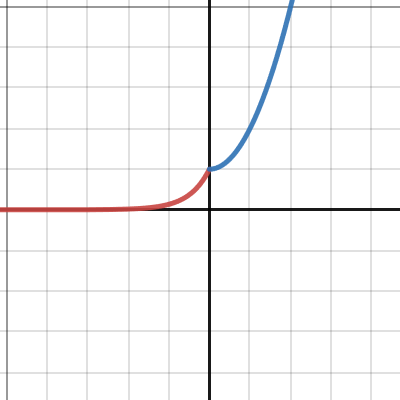 vernal vale
fallow dagger
this is what i got when calculating limits
vernal vale
fallow dagger
this is what i got when calculating limits
i dont think using limits here so directly is gona help
instead you need to make x=0 a critical point of functions
this is equivalent to making the left and right hand limits 0 of both functions
but thats fine, this gives us the right hand of the polynomial and the lefthand of the exponential, right?
im not sure this is possible 
because its not possible to make the derivative of e^2x 0 anywhere but at infinity
if we could set it e^0 then itd be okay
fallow dagger
isn t it e^0?
vernal vale
@fallow dagger are you sure the problem isnt "make the function differentiable at 0?
vernal vale
fallow dagger
isn t it e^0?
i mean, everywhere
if you make the exponential a constant, say, M, you can use a=whatever and b=0 and c=M
and it will have a 0 derivative at 0
but otherwise this isnt possible
unless the problem is "make the function differentiable at x=0"
fallow dagger
vernal vale
<@816983238962184242> are you sure the problem isnt "make the function different...
differentiable?, idek if i translated it corect, derivate means f'(x) right?
vernal vale
fallow dagger
differentiable?, idek if i translated it corect, derivate means f'(x) right?
differentiable would be like, make it so f doesnt have a sharp corner at x=0
so we can take the derivative f'(0) and it exists and is finite
fallow dagger
no, we didn t learn that yet
vernal vale
the problem as I'm understanding youve said it so far is impossible
vernal vale
fallow dagger
there is no way to make this have a 0 derivative at 0
but you can make it have a derivative there
it just wont be 0
vernal vale
alright
so i dont think using limits is totally necessary here, at least this directly
fallow dagger
i mean u have to find a,b,c so the function is a derivate in point x0=0
vernal vale
what I would do is try to make $$\dv x e^{2x} = \dv x (ax^2+bx+c)$$
thorny flameBOT
jan Niku
 vernal vale
can you take the derivative of these functions?
fallow dagger
sorry but what s d and dx
vernal vale
its a derivative
fallow dagger
so (d/dx)e^2x is f'(e^2x)?
vernal vale
it just means take the derivative with respect to x
fallow dagger
aha
vernal vale
can you take derivatives?
vernal vale
nono its not so bad
fallow dagger
should not*
vernal vale
,w D[Exp(2x),x]
thorny flameBOT
 fallow dagger
yeah i misstyped
vernal vale
,w D[a x^2 + b x + c, x]
thorny flameBOT
 vernal vale
so $$2e^{2x} = 2ax+b$$ at $x=0$
thorny flameBOT
jan Niku
 vernal vale
yea
fallow dagger
how do i find a and c tho
thorny flameBOT
jan Niku
 vernal vale
its actually impossible 
fallow dagger
how
vernal vale
you have no additional information
vernal vale
well what you know is this
the derivatives match at x=0
and the functions match at x=0
thats enough to determine 2 constants
and to make the function differentiable there
so, it's undetermined.
but its fine, you just have infinitely many solutions
actually, any a will work
fallow dagger
aight
vernal vale
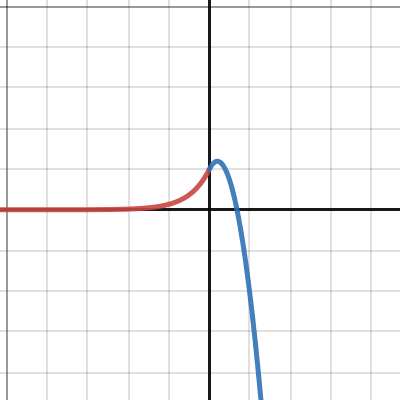
Desmos
vernal vale
topaz sinewBOT
Channel closed
Closed by @fallow dagger
Use .reopen if this was a mistake.
Available help channel!
Send your question here to claim the channel.
Remember:
• Ask your math question in a clear, concise manner.
• Show your work, and if possible, explain where you are stuck.
• After 15 minutes, feel free to ping <@&286206848099549185>.
• Type the command .close to free the channel when you're done.
• Be polite and have a nice day!
Read #❓how-to-get-help for further information on how to ask a good question, and about conduct in the question channels.
 upper monolith
hi
topaz sinewBOT
upper monolith
hi
upper monolith
im doing trig functions but im trying to understand where numbers are coming from

in the minimum, why is pi/2?
and 3pi/2 for the maximum
these numbers seem random to me
topaz sinewBOT
@upper monolith Has your question been resolved?
Channel closed
Closed by @upper monolith
Use .reopen if this was a mistake.
Available help channel!
Send your question here to claim the channel.
Remember:
• Ask your math question in a clear, concise manner.
• Show your work, and if possible, explain where you are stuck.
• After 15 minutes, feel free to ping <@&286206848099549185>.
• Type the command .close to free the channel when you're done.
• Be polite and have a nice day!
Read #❓how-to-get-help for further information on how to ask a good question, and about conduct in the question channels.
 turbid dawn
One person rolls a die until 1 comes out, a second person rolls a coin until 3 tails are rolled. 1) How many throws will each one make on average?
2)What is the probability that they will stop at the same instant, i.e. find P(X=Y).
Answer 1)We denote X = 1st (die) and Y = 2nd (piece). X ~ G(1/6)(geometric distribution) with expectancy EX=6 and variance V(X) =30, Y ~BN(1/2; 3)(negative binomial) with expectancy EX=6 and variance V(Y) = 6
Answer 2) The 3 in the picture is P(X=Y) but my teacher says to me that i need to find 25/343
topaz sinewBOT
turbid dawn
One person rolls a die until 1 comes out, a second person rolls a coin until 3 t...
turbid dawn
 topaz sinewBOT
@turbid dawn Has your question been resolved?
turbid dawn
<@&286206848099549185>
topaz sinewBOT
@turbid dawn Has your question been resolved?
turbid dawn
<@&286206848099549185>
topaz sinewBOT
@turbid dawn Has your question been resolved?
topaz sinewBOT
@turbid dawn Has your question been resolved?
topaz sinewBOT
Channel closed
Closed due to timeout
Use .reopen if this was a mistake.
Available help channel!
Send your question here to claim the channel.
Remember:
• Ask your math question in a clear, concise manner.
• Show your work, and if possible, explain where you are stuck.
• After 15 minutes, feel free to ping <@&286206848099549185>.
• Type the command .close to free the channel when you're done.
• Be polite and have a nice day!
Read #❓how-to-get-help for further information on how to ask a good question, and about conduct in the question channels.
 potent venture
Calculate the distance between the points N=(3,-2) adn L= 8,-6) in the coordinate plane. In the exact answer not a deciamal approx
topaz sinewBOT
potent venture
Calculate the distance between the points N=(3,-2) adn L= 8,-6) in the coordinat...
 sweet shard
potent venture
<@&286206848099549185>
sweet shard
potent venture
<@&286206848099549185>
!15m
topaz sinewBOT
potent venture
<@&286206848099549185>
Please only use the <@&286206848099549185> ping once if your question has not been answered for 15 minutes. Please do not ping or DM individual users about your question.
sweet shard
topaz sinew
And read this
potent venture
.close
topaz sinewBOT
Channel closed
Closed by @potent venture
Use .reopen if this was a mistake.
Available help channel!
Send your question here to claim the channel.
Remember:
• Ask your math question in a clear, concise manner.
• Show your work, and if possible, explain where you are stuck.
• After 15 minutes, feel free to ping <@&286206848099549185>.
• Type the command .close to free the channel when you're done.
• Be polite and have a nice day!
Read #❓how-to-get-help for further information on how to ask a good question, and about conduct in the question channels.
 silent hull
How would I go about solving this?
 topaz sinewBOT
silent hull
How would I go about solving this?
silent hull
topaz sinewBOT
silent hull
How would I go about solving this?
silent hull
I don't really know where to start
 tough nest
Can you rewrite $4n$ and $n$ in a way similar to $c_n$
thorny flameBOT
Katharine

 mint flicker
N means all natural numbers to start
silent hull
tough nest
Can you rewrite $4n$ and $n$ in a way similar to $c_n$
I'm not sure, but I don't think I even understand the sequence. Would the sequence look like {1, 2, 3, 4, 1, 2, 3, 4, 1, ...}?
Where n is the index
silent hull
then what would b_n look like?
thorny flameBOT
Katharine
 tough nest
so $b_0 = 1$ or $b_0 = 2$ or $b_0 = 3$ or $b_0 = 4$
thorny flameBOT
Katharine
 silent hull
ah alright
tough nest
and similarly for $b_1$
thorny flameBOT
Katharine
 tough nest
etc
oh actually they don't include 0 in the indices
the point i'm making is that we know vaguely what b_n looks like but not precisely
we know all the ways b_n CAN look
but not exactly what it does look like
does that make sense?
silent hull
ah alright, yeah i understand that
tough nest
but with that we have enough information for the given problem
silent hull
i know that intuitively then that n <= c_n <= 4n
i just dont know how i would write it on paper
because the lowest it could be is 1 + 1 + 1 + ...
which would always = n
tough nest
exactly
silent hull
and never go below n
tough nest
exactly
tough nest
you can first show the smallest element of the set that all b_n are part of
as in you can show that the smallest any b_n can be is 1
and similarly for the biggest
and then show that with that
if b_n is the smallest always
silent hull
could i just write it similarly to how i explained it?
or is there a certain proof or method i need to use
tough nest
have you done any classes about proving in mathematics?
silent hull
yeah, i know proof by induction, strong induction, etc
im 2nd year in a uk university if that gives any gauge to proof knowledge
tough nest
that helps
in my uni proofs in mathematics is the first course mathematics students do but obviously in other universities it can be later on
so knowing you're in second year of university
silent hull
yeah, we had a lot in set theory last year
tough nest
means you know what language is used in proofs
silent hull
yeah
tough nest
you can use what you wrote
you show that c_n can at its smallest be 1 + 1 + 1 + ... + 1
and at maximum 4 + 4 + ... + 4
and that those are equal to n and 4n respectively
silent hull
just say something like "We shall first assume the smallest case of c_n to be 1 + 1 + 1 + ... + 1, meaning that n will always be equal to c_n, satisfying n <= c_n" etc
?
tough nest
well you have to prove that the smallest case of c_n is 1 + 1 + .. + 1
assuming it would be assuming the thing you are trying to prove basically
so you would show that all b_n can at minimum be 1
and then you say
let us take b_n = 1 for all n
and so c_n = 1 + 1 + ... + 1
etc etc
😛
i
silent hull
ahhh alright
tough nest
i'm lazy
tough nest
np 😄
silent hull
.close
topaz sinewBOT
Channel closed
Closed by @silent hull
Use .reopen if this was a mistake.
Available help channel!
Send your question here to claim the channel.
Remember:
• Ask your math question in a clear, concise manner.
• Show your work, and if possible, explain where you are stuck.
• After 15 minutes, feel free to ping <@&286206848099549185>.
• Type the command .close to free the channel when you're done.
• Be polite and have a nice day!
Read #❓how-to-get-help for further information on how to ask a good question, and about conduct in the question channels.
 daring swan
Whats the formula to solve this type of integral?
 topaz sinewBOT
daring swan
Whats the formula to solve this type of integral?
daring swan
topaz sinewBOT
daring swan
Whats the formula to solve this type of integral?
daring swan
Just need the formula that’s all. Ik (ax+b)^n = 1/a 1/n+1 (ax+b)^n+1 + c but I’m not sure what it would be when it’s x/(ax+b)^n
daring swan
My professor was weird in not wanting to teach us u-substitution
pseudo bear
u-substitution is basically the inverse of the chain rule, so it's important.
 raven sparrow
You can also just add 1 and subtract 1
daring swan
Ex.?
raven sparrow
like (x+1 - 1) / (x+1)^2 = 1/(x+1) - 1/(x+1)^2
daring swan
Like this?
 daring swan
raven sparrow
like (x+1 - 1) / (x+1)^2 = 1/(x+1) - 1/(x+1)^2
daring swan
raven sparrow
like (x+1 - 1) / (x+1)^2 = 1/(x+1) - 1/(x+1)^2
Im confused on how this works
raven sparrow
They are separate, not in the denominator.
With the first two terms in the numerator, you get (x+1)/(x+1)^2 which is just 1/(1+x)
Then the remaining -1 gives -1/(x+1)^2.
daring swan
My friend just replied with how she approached it

Just dragged the x+1 up
I thought you could only drag the denominator up if the numerator was a 1
raven sparrow
daring swan
I thought you could only drag the denominator up if the numerator was a 1
It's just that if the numerator is not constant (like x or something) you can't distribute it inside the negative exponent binomial. Hence you need the numerator to be constant for it to help in any way.
daring swan
daring swan
My friend just replied with how she approached it
So is it legal or illegal to drag the denominator up in this way?
raven sparrow
You can do, but that isn't the problem you asked help for to begin with. It's another problem entirely.
At the end of the day it's just writing the denominator as a negative exponent.
Again this will not help if the numerator is x because you can't just distribute x over (x+1)^(-2).
daring swan
Wdym it’s the same problem
Oh wait
I see the confusion
I just automatically translated K into X as I wrote it down
My fault
raven sparrow
Yeah it's different then. You can just bring the denominator up by changing the sign of its exponent and power rule it
topaz sinewBOT
Channel closed
Closed by @daring swan
Use .reopen if this was a mistake.
Available help channel!
Send your question here to claim the channel.
Remember:
• Ask your math question in a clear, concise manner.
• Show your work, and if possible, explain where you are stuck.
• After 15 minutes, feel free to ping <@&286206848099549185>.
• Type the command .close to free the channel when you're done.
• Be polite and have a nice day!
Read #❓how-to-get-help for further information on how to ask a good question, and about conduct in the question channels.
neon iron
how would i go about doing these two questions?
 topaz sinewBOT
neon iron
how would i go about doing these two questions?
neon iron
topaz sinewBOT
neon iron
how would i go about doing these two questions?
neon iron
for 8, its nPr = 55440, and nCr = 462
topaz sinewBOT
@neon iron Has your question been resolved?
 keen raptor
For 8, use the formula for nPr and nCr
 long stirrup
for 7, i don't know a combinatorial approach, but you can add up paths from top to bottom manually, it's very easy
like with a pencil
it's like a pascal triangle so it's probably the intended way
keen raptor
long stirrup
for 7, i don't know a combinatorial approach, but you can add up paths from top ...
In general you think about permutations of, in this case, 7 down moves and one right move
so, rearrangements of DDDDDDDR
long stirrup
but that's not the solution
keen raptor
?
long stirrup
that's wrong
long stirrup
you can go more R, it's not backwards
keen raptor
LLLRRRR
long stirrup
There's no fixed amount of L and R, it's not the intention and it doesn't follow from the rules
topaz sinewBOT
@neon iron Has your question been resolved?
topaz sinewBOT
Channel closed
Closed due to timeout
Use .reopen if this was a mistake.
topaz sinewBOT
Available help channel!
Send your question here to claim the channel.
Remember:
• Ask your math question in a clear, concise manner.
• Show your work, and if possible, explain where you are stuck.
• After 15 minutes, feel free to ping <@&286206848099549185>.
• Type the command .close to free the channel when you're done.
• Be polite and have a nice day!
Read #❓how-to-get-help for further information on how to ask a good question, and about conduct in the question channels.
 fathom void
 topaz sinewBOT
fathom void
fathom void
topaz sinewBOT
fathom void
fathom void
so would i just factor this first and then use the negative for everything that was factored or negative this stuff first and then factor
 craggy haven
it's already factored 
fathom void
well like the whats it called form
x^2+3x+2 kinda form
forgot name
im guessing do -(x^2+10x+25)
 jagged sparrow
fathom void
im guessing do -(x^2+10x+25)
jagged sparrow
fathom void
im guessing do -(x^2+10x+25)
Yes
topaz sinewBOT
Channel closed
Closed by @fathom void
Use .reopen if this was a mistake.
Available help channel!
Send your question here to claim the channel.
Remember:
• Ask your math question in a clear, concise manner.
• Show your work, and if possible, explain where you are stuck.
• After 15 minutes, feel free to ping <@&286206848099549185>.
• Type the command .close to free the channel when you're done.
• Be polite and have a nice day!
Read #❓how-to-get-help for further information on how to ask a good question, and about conduct in the question channels.
 wooden holly
 topaz sinewBOT
wooden holly
sweet shard
topaz sinewBOT
wooden holly
sweet shard
Try drawing some pictures
sweet shard
Well draw 3 circles first
Find that max first
Then see where you can draw a fourth circle to intersect the other three the most
wooden holly
ok..
 warped thistle
@wooden holly any 2 circles will have 2 points of intersection
wooden holly
ye
warped thistle
So nC2 is the number of ways of choosing 2 circles
And multiply that by 2
wooden holly
okay
warped thistle
Do u get it