#help-26
1 messages · Page 63 of 1
 calm jackal
 opal vault
start back from line 1, and regroup the terms in 3^k
calm jackal
How
opal vault
like how you regroup 7x + 6x
calm jackal
It has a 2(3) dangling on the other one
opal vault
2 * 3^k
calm jackal
How do I add $3^k and 2(3)^k$ altogether
 thorny flameBOT
ICANTCOMEUPWITHANAME
 opal vault
i just told you, $2(3)^k = 2\cdot 3^k$
thorny flameBOT
rafilou2003
 calm jackal
How does that help though?
 verbal crater
thorny flame
**ICANTCOMEUPWITHANAME**
verbal crater
thorny flame
**ICANTCOMEUPWITHANAME**
imagine 3^k as a variable like t
now i ask you, whats 2t + t
calm jackal
3t
verbal crater
so 2(3)^k + 3^k would be?
calm jackal
2(4)^k
verbal crater
what
opal vault
Let's write $X = 3^k$
thorny flameBOT
rafilou2003
 opal vault
$2X + X = ?$
thorny flameBOT
rafilou2003
 calm jackal
$2(6)^k$
thorny flameBOT
ICANTCOMEUPWITHANAME
 opal vault
thorny flame
**rafilou2003**
opal vault
thorny flame
**rafilou2003**
2+1 =
calm jackal
3 bro
opal vault
2X + X =
calm jackal
3x
opal vault
2(3^k) + 3^k =
calm jackal
$3(3^k)
opal vault
yes
verbal crater
there you go
calm jackal
I did not know you could do that
So how do I make this $3(3^k) - 1 = 3^{k + 1} - 1$ equal?
thorny flameBOT
ICANTCOMEUPWITHANAME
 opal vault
uhhuh
And so if you multiply by ANOTHER 3, how does that change the exponent?
for example 3 x 3 x 3 x 3 is 3^4. so if you multiply by one more 3, you get 3 x 3 x 3 x 3 x 3 which is 3^5
how did the exponent change?
calm jackal
By + 1
calm jackal
$3^{k+1}$
thorny flameBOT
ICANTCOMEUPWITHANAME
 opal vault
you did it
opal vault
top of the class mathematics discord
calm jackal
🫠
opal vault
Alright I'll be going, take care
 topaz sinewBOT
Channel closed
Closed by @calm jackal
Use .reopen if this was a mistake.
topaz sinewBOT
 Available help channel!
Send your question here to claim the channel.
Remember:
• Ask your math question in a clear, concise manner.
• Show your work, and if possible, explain where you are stuck.
• After 15 minutes, feel free to ping <@&286206848099549185>.
• Type the command .close to free the channel when you're done.
• Be polite and have a nice day!
Read #❓how-to-get-help for further information on how to ask a good question, and about conduct in the question channels.
 drifting patrol
How to prove what I can't drow 5 squares inside one square
 marble gate
drifting patrol
How to prove what I can't drow 5 squares inside one square
marble gate
drifting patrol
How to prove what I can't drow 5 squares inside one square
you'll need to elaborate a bit more
because you can easily draw 5 squares inside one square if the one square is 1m x 1m and the little squares are 1cm x 1cm
drifting patrol
Not equal ones
marble gate
...you cannot fit 5 squares with side length n inside 1 square with side length n?
drifting patrol
Lemy check problem again
 ivory night
marble gate
...you cannot fit 5 squares with side length n inside 1 square with side length ...
ivory night
marble gate
...you cannot fit 5 squares with side length n inside 1 square with side length ...
I think its that you can't perfectly pack 5 squares with side length n inside 1 square with side length m, where m>n
drifting patrol
Problem is to prove what you can't fit 5 not equal squares in one big square with area of 5
 steep ibex
Have you tried a proof by contradiction? Assuming you CAN?
drifting patrol
What's that
ivory night
 hollow bone
sznd the exact wording
hollow bone
sznd the exact wording
@drifting patrol
steep ibex
Let there be a square of A=n. Assume you can fit 5 equal squares inside it.
I'm not saying this is the way to go, as I am taking the same class. But if a teacher gave me this problem, it's one direction I would attempt.
But this way, you would prove that 5 equal squares do not fit.
topaz sinewBOT
@drifting patrol Has your question been resolved?
Channel closed
Closed by @drifting patrol
Use .reopen if this was a mistake.
topaz sinewBOT
Available help channel!
Send your question here to claim the channel.
Remember:
• Ask your math question in a clear, concise manner.
• Show your work, and if possible, explain where you are stuck.
• After 15 minutes, feel free to ping <@&286206848099549185>.
• Type the command .close to free the channel when you're done.
• Be polite and have a nice day!
Read #❓how-to-get-help for further information on how to ask a good question, and about conduct in the question channels.
 cosmic plaza
Hello guys. I am stuck on integrating this
 topaz sinewBOT
cosmic plaza
Hello guys. I am stuck on integrating this
cosmic plaza
topaz sinewBOT
cosmic plaza
Hello guys. I am stuck on integrating this
cosmic plaza
I am pretty sure I have to integrate by part but how to do so in the case when we have a substitution I dont know
 twin island
that x^4 in the last integral is u
so your integrand is u e^u and you can integrate by parts
cosmic plaza
twin island
so your integrand is u e^u and you can integrate by parts
Oh wait so integration by parts U is the same u substitute ?
twin island
I didn't understand you question
cosmic plaza
twin island
I didn't understand you question
Basically the integration by parts letter “u” in uv-… is the same as the u we use in substitutions?
twin island
you mean the letter "u" in the integration by parts as written like in this image?
 hollow bone
why is there still an x after the change of variable?
twin island
cosmic plaza
Basically the integration by parts letter “u” in uv-… is the same as the u we us...
For integration by parts I'm used to this notation with functions f and g and there is no "u" (which is the arbitrary letter you decided to use in the substitution)
 cosmic plaza
twin island
you mean the letter "u" in the integration by parts as written like in this imag...
cosmic plaza
twin island
you mean the letter "u" in the integration by parts as written like in this imag...
Yes
cosmic plaza
twin island
For integration by parts I'm used to this notation with functions f and g and th...
Ah explains it
Thank you
topaz sinewBOT
@cosmic plaza Has your question been resolved?
Channel closed
Closed by @cosmic plaza
Use .reopen if this was a mistake.
topaz sinewBOT
Available help channel!
Send your question here to claim the channel.
Remember:
• Ask your math question in a clear, concise manner.
• Show your work, and if possible, explain where you are stuck.
• After 15 minutes, feel free to ping <@&286206848099549185>.
• Type the command .close to free the channel when you're done.
• Be polite and have a nice day!
Read #❓how-to-get-help for further information on how to ask a good question, and about conduct in the question channels.
 burnt mountain
 topaz sinewBOT
burnt mountain
burnt mountain
topaz sinewBOT
burnt mountain
burnt mountain
I have this equation but I dont know if its true
 neon iron
use the definition of the absolute value function
burnt mountain
,rotate
thorny flameBOT
 neon iron
To solve the functionf(x) = x^{2}+x x>0 -x^{2}-x{if } x<0in a shorter way, you can simplify it by combining the two cases into a single expression.
For x > 0:
\( f(x) = x^{2}+x \)
For x < 0:
\( f(x) = -x^{2}-x \)
By combining these two cases, we can write the simplified function as:
\( f(x) = x^{2}+x \) for all values of x.
So, the simplified form of the function is \( f(x) = x^{2}+x \) for all x.
burnt mountain
Thanks
After derivating I notice that the signs are the same
So my initial equation is true
.close
topaz sinewBOT
Channel closed
Closed by @burnt mountain
Use .reopen if this was a mistake.
Available help channel!
Send your question here to claim the channel.
Remember:
• Ask your math question in a clear, concise manner.
• Show your work, and if possible, explain where you are stuck.
• After 15 minutes, feel free to ping <@&286206848099549185>.
• Type the command .close to free the channel when you're done.
• Be polite and have a nice day!
Read #❓how-to-get-help for further information on how to ask a good question, and about conduct in the question channels.
 tidal flicker
Can anyone help with this please ?
 topaz sinewBOT
tidal flicker
Can anyone help with this please ?
topaz sinewBOT
tidal flicker
Can anyone help with this please ?
 weary umbra
try to differentiate
topaz sinewBOT
@tidal flicker Has your question been resolved?

 smoky sparrow
same, differentiate using the chain rule for 4a)
e is a constant so differentiates to 0
for b use implicit differentiation
e.g d/dx (y^3) = 3y^2 * d/dx (y) = 3y^2 dy/dx by chain rule
and then rearrange for dy/dx
tidal flicker
smoky sparrow
same, differentiate using the chain rule for 4a)
thanks brother ❤️
what about this one ?
 smoky sparrow
tidal flicker
what about this one ?
smoky sparrow
tidal flicker
what about this one ?
logarithmic differentiation means to take ln of both sides
so d/dx ln(f(x)) = f'(x)/f(x) again by chain rule
and then simplify the RHS using laws of logarithms
for 5b), ln 3x = ln 3 + ln x
tidal flicker
You're smart af i'm impressed
smoky sparrow
it is solveable by algebra
yeah, again being in uni for maths really helps
finished 1st year so
tidal flicker
smoky sparrow
yeah, again being in uni for maths really helps
i hate maths, I hate it so much that even your explanation made me lost ( you explained it fine, the problem is from my side )
smoky sparrow
do you need maths in the future?
I know that not all Indians are engineers / want to be engineers hehe
tidal flicker
I'm not indian though
I'm Egyptian, But I study IT, I kind of don't need maths in the future i guess ?
I'm just into coding
I hate calculus so much
smoky sparrow
oh lol
smoky sparrow
tidal flicker
I'm Egyptian, But I study IT, I kind of don't need maths in the future i guess ...
yeah
IT has really good job prospects if you can work your way up
from being junior technician and so on
you won't need calculus much and the calculus (or linear algebra) you will need, you can just search up
tidal flicker
smoky sparrow
you won't need calculus much and the calculus (or linear algebra) you will need,...
Ikr
thank you for comforting me with this
❤️ xD
You seem Nice and smart, how old are you man
Would love to be around intelligent people
smoky sparrow
I'm 19 yeah as you could tell from the thing I said about uni
tidal flicker
smoky sparrow
and then simplify the RHS using laws of logarithms
Also, could you just give me a direct answer, ? I'm not getting the hang of it that much ngl
tidal flicker
smoky sparrow
I'm 19 yeah as you could tell from the thing I said about uni
19 !?!?!#?!#?!
I'm 20 yooo
now i feel dumber
smoky sparrow
tidal flicker
Also, could you just give me a direct answer, ? I'm not getting the hang of it t...
so $\frac{f'(x)}{f(x)} = \frac{d}{dx} (3 \ln x + \ln(3 - 2x) - x - \frac{1}{3} \ln(3x^3 + 7))$
so $f'(x) = f(x) \left(\frac{3}{x} + \frac{-2}{3 - 2x} - 1 - \frac{1}{3} \frac{9x^2}{3x^3 + 7} \right)$

 smoky sparrow
A
tidal flicker
okay for B what should I do ?
 cosmic stream
oh
smoky sparrow
tidal flicker
okay for B what should I do ?
B is much easier
cosmic stream
thorny flame
**south**
thx bro u helped me
cosmic stream
i needed lik 10 min to undrstand but i got it at the end
smoky sparrow
cosmic stream
i needed lik 10 min to undrstand but i got it at the end
oh no worries!
thanks for letting me know that I helped you too
tidal flicker
smoky sparrow
thanks for letting me know that I helped you too
You did man
thank you so much, you're a clutch
smoky sparrow
💖
topaz sinewBOT
@tidal flicker Has your question been resolved?
Channel closed
Closed by @tidal flicker
Use .reopen if this was a mistake.
Available help channel!
Send your question here to claim the channel.
Remember:
• Ask your math question in a clear, concise manner.
• Show your work, and if possible, explain where you are stuck.
• After 15 minutes, feel free to ping <@&286206848099549185>.
• Type the command .close to free the channel when you're done.
• Be polite and have a nice day!
Read #❓how-to-get-help for further information on how to ask a good question, and about conduct in the question channels.
 soft thicket
How to cure depression
topaz sinewBOT
soft thicket
How to cure depression
soft thicket
Frfr
topaz sinewBOT
Channel closed
Closed by @torpid matrix
Use .reopen if this was a mistake.
Available help channel!
Send your question here to claim the channel.
Remember:
• Ask your math question in a clear, concise manner.
• Show your work, and if possible, explain where you are stuck.
• After 15 minutes, feel free to ping <@&286206848099549185>.
• Type the command .close to free the channel when you're done.
• Be polite and have a nice day!
Read #❓how-to-get-help for further information on how to ask a good question, and about conduct in the question channels.
 cobalt vortex
I have a right triangle ABC with the right angle at C. Then there are points A¹,B¹ and C¹ which are reflections of A,B,C. A¹ is reflected about C, B¹ about A and C¹ about B.
topaz sinewBOT
cobalt vortex
I have a right triangle ABC with the right angle at C. Then there are points A¹,...
cobalt vortex
Then I have to prove that

This is the first time I encountered a problem this weird to me. No matter how I look at it, I cant think of any way in which that makes sense. Could someone help me with this?
topaz sinewBOT
@cobalt vortex Has your question been resolved?
cobalt vortex
<@&286206848099549185>
topaz sinewBOT
@cobalt vortex Has your question been resolved?
topaz sinewBOT
@cobalt vortex Has your question been resolved?
topaz sinewBOT
@cobalt vortex Has your question been resolved?
topaz sinewBOT
Channel closed
Closed due to timeout
Use .reopen if this was a mistake.
Available help channel!
Send your question here to claim the channel.
Remember:
• Ask your math question in a clear, concise manner.
• Show your work, and if possible, explain where you are stuck.
• After 15 minutes, feel free to ping <@&286206848099549185>.
• Type the command .close to free the channel when you're done.
• Be polite and have a nice day!
Read #❓how-to-get-help for further information on how to ask a good question, and about conduct in the question channels.
neon iron
Hey I need help real quick, just a minute
topaz sinewBOT
neon iron
Hey I need help real quick, just a minute
neon iron

How do I solve number 19 and 21
I'm a quick learner
How do i use the formulas
It will take a minute or 2
Come on dude, don't have me waiting 10 minutes
 reef fjord
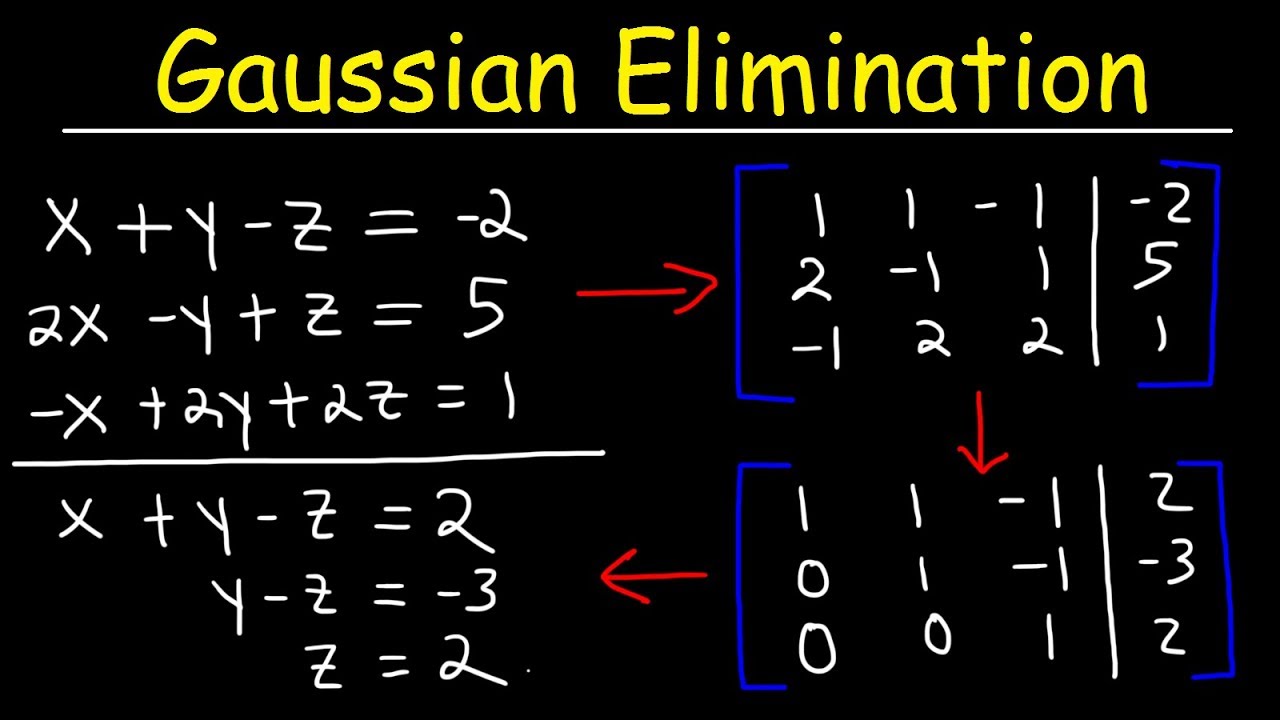
This precalculus video tutorial provides a basic introduction into the gaussian elimination - a process that involves elementary row operations with 3x3 matrices which allows you to solve a system of linear equations with 3 variables. You need to convert the system of equations into an augmented matrix and use matrix row operations to write it ...

This precalculus video tutorial provides a basic introduction into the gauss jordan elimination which is a process used to solve a system of linear equations by converting the system into an augmented matrix and using elementary row operations to convert the 3x3 matrix into its reduced row echelon form. You can easily determine the answers once...
topaz sinewBOT
Channel closed
Closed by @supple swan
Use .reopen if this was a mistake.
Available help channel!
Send your question here to claim the channel.
Remember:
• Ask your math question in a clear, concise manner.
• Show your work, and if possible, explain where you are stuck.
• After 15 minutes, feel free to ping <@&286206848099549185>.
• Type the command .close to free the channel when you're done.
• Be polite and have a nice day!
Read #❓how-to-get-help for further information on how to ask a good question, and about conduct in the question channels.
neon iron
can someone help me out with specific parts of this problem?
 topaz sinewBOT
neon iron
can someone help me out with specific parts of this problem?
topaz sinewBOT
neon iron
can someone help me out with specific parts of this problem?
@neon iron Has your question been resolved?
topaz sinewBOT
@neon iron Has your question been resolved?
topaz sinewBOT
Channel closed
Closed due to timeout
Use .reopen if this was a mistake.
topaz sinewBOT
Available help channel!
Send your question here to claim the channel.
Remember:
• Ask your math question in a clear, concise manner.
• Show your work, and if possible, explain where you are stuck.
• After 15 minutes, feel free to ping <@&286206848099549185>.
• Type the command .close to free the channel when you're done.
• Be polite and have a nice day!
Read #❓how-to-get-help for further information on how to ask a good question, and about conduct in the question channels.
 cinder oxide

Mathematics Stack Exchange
I should solve the following question:
Find formulas for the entries of Mn, where n is a positive integer.
where M=
$$
\begin{bmatrix}11&-2\4&5\end{bmatrix}
$$
I found the eigenvalues and ...
topaz sinewBOT
cinder oxide
https://math.stackexchange.com/questions/4105096/find-formulas-for-the-entries-o...
cinder oxide

I understand how eigenvalues were found
but how do you find multiplicity?
and eigenvectors
also, does it matter if you use
9 0 0 7
or
7 0 0 9?
it would depend on which eigenvalue you find first, right?
 hollow drum
cinder oxide
but how do you find multiplicity?
hollow drum
cinder oxide
but how do you find multiplicity?
Multiplicity is founded during the process of the eigenvalues
hollow drum
cinder oxide
also, does it matter if you use
`9 0
0 7`
or
`7 0
0 9`?
It doesn't matter
cinder oxide
OK
so multiplicity is just whatever you subtract?
in this case 1 lambda multiplied by I?
 torpid matrix
its how many times its a root of the characteristic polynomial
for example $x^2 = 0$ has eigenvalue 0 with multiplicity 2
thorny flameBOT
 torpid matrix
$x^100 = 0$ has multiplicity 100
thorny flameBOT
 torpid matrix
$(x-2)^3$ has eigenbalue 2 with multiplicity 3
thorny flameBOT


 hollow drum
cinder oxide
but here shouldn't multiplicity by 2 since it is the highest power?
hollow drum
cinder oxide
but here shouldn't multiplicity by 2 since it is the highest power?
This tells you how many roots there would be
 hollow drum
Yes
cinder oxide
alright
so it's the highest root?
if 7 was found as a root twice for example
multiplicity of 𝜆=7 would be 2
hollow drum
hollow drum
It doesn't matter
It does matter if you are doing a decomposition though, $A = PDP^{-1}$ where D is the eigenvalue matrix and P is the eigenvectors, so you have to construct the matrix so the columns lines up. Like in that image, [3; 0] is the eigenvalue which is the first column so it coorelates to the first column of the eigenvector matrix so [1; 1]
 thorny flameBOT
CaptainNova22
 hollow drum
cinder oxide
so it's the highest root?
hollow drum
cinder oxide
so it's the highest root?
Not sure what you mean
cinder oxide
im not sure either
i thought i understood but maybe not, in terms of roots to show multiplicity
hollow drum
But you are overthinking the terms, lambda is just a variable like x. As stated, multiplicity is how many times the roots occurred. If you have the equation, $(x - 3)^3(x+2)^4(x - 1) = 0$ would you be able to tell me the roots and multiplicity of each?
thorny flameBOT
CaptainNova22
 cinder oxide
x = 3 (mult 3)
x = -2 (mult 2)
x = 1 (mult 1)?
i think i need to expand but not sure how to solve for power 3 polynomial finding roots, only power 2
hollow drum
cinder oxide
x = 3 (mult 3)
x = -2 (mult 2)
x = 1 (mult 1)?
Yes this is exactly it
cinder oxide
Oh OK
was just guessing
so how do I find "P"?
I think that's all I need now to solve
hollow drum
That's the eigenvector
hollow drum
It will be
cinder oxide
I will need to combine both eigenvectors to get P?
hollow drum
P is the matrix of eigenvectors
cinder oxide
by row, or by column?
hollow drum
Columns
cinder oxide
OK
hollow drum
Do you know how to find the eigenvectors?
cinder oxide
hollow drum
Do you know how to find the eigenvectors?
Does it start with this?

I gotta do RREF on that, yeah?
or wait, maybe it's RREF on A
11 -2 4 5
hollow drum
No
cinder oxide
hollow drum
Do you know how to find the eigenvectors?

Oh I replace lambda with the value
hollow drum
Yes
cinder oxide
I will try that now
hollow drum
cinder oxide
Oh I replace lambda with the value
Then you reduce it

 hollow drum
Yes I get that
hollow drum
But you moved it to the other side, to get it equal to x1, correct?
 hollow drum
Yes
hollow drum
That's why in classes, you only go up to 3 x 3 matrices, because it's a tedious process
Anything bigger, you would use software
topaz sinewBOT
@cinder oxide Has your question been resolved?
cinder oxide
hollow drum
Anything bigger, you would use software
OK, good to know
cinder oxide
hollow drum
Anything bigger, you would use software

so I solved for the 2x2 but maybe I didn't need to do this
7 0 6 9

this is what they did instead, trying to figure out the logic here
 topaz sinewBOT
Channel closed
Closed by @cinder oxide
Use .reopen if this was a mistake.
Available help channel!
Send your question here to claim the channel.
Remember:
• Ask your math question in a clear, concise manner.
• Show your work, and if possible, explain where you are stuck.
• After 15 minutes, feel free to ping <@&286206848099549185>.
• Type the command .close to free the channel when you're done.
• Be polite and have a nice day!
Read #❓how-to-get-help for further information on how to ask a good question, and about conduct in the question channels.
 surreal gazelle
this is as far as i got, im not sure how to finish it
 surreal gazelle
<@&286206848099549185>
topaz sinewBOT
@surreal gazelle Has your question been resolved?
 sonic dawn
you're quite literally 1 step from the answer
you got the linearization so now perform the approximation
surreal gazelle
sonic dawn
you're quite literally 1 step from the answer
you got the linearization so now ...
I DON"T KNOW HOW
sonic dawn
surreal gazelle
I DON"T KNOW HOW
stare at the expression and think what's the x value you should sub in
surreal gazelle
im thinking 16.04 but that does not make sense as to why I would do 16.04 - 16 to get a tiny tiny number of .04. And that wouldn't even give me anything.
i dont know, can i have hint
sonic dawn
surreal gazelle
im thinking 16.04 but that does not make sense as to why I would do 16.04 - 16 t...
you have a +8 at the end hellllo
surreal gazelle
okay, let me rephrase my question
"im thinking 16.04 but that does not make sense as to why I would do 16.04 - 16 to get a tiny tiny number of .04. And that wouldn't even give me anything. "
why do we do this
sonic dawn
surreal gazelle
"im thinking 16.04 but that does not make sense as to why I would do 16.04 - 16 ...
because the entire point of linearization (and other methods of close approximations) is to approximate a function at a point close to somewhere that you have a known value of
here you know f(16) exactly so we make the assumption that f(16+h) is approximately f(16) + a small term for small h
where linearization models the change linearly, then you get the small term as f'(16)*((16+h)-16) = f'(16) * h
(and higher degree approximations involved higher degree derivatives)
surreal gazelle
thank you
but how do i actualy calculate the error of approximatino now
plug it in, get a number
and then what
topaz sinewBOT
@surreal gazelle Has your question been resolved?
Channel closed
Closed by @surreal gazelle
Use .reopen if this was a mistake.
surreal gazelle
.reopen
topaz sinewBOT
✅
sonic dawn
surreal gazelle
how do i solve for approximation of error
uh
it's just the error
so f(16.04) minus whatever the approximation is
surreal gazelle
minus f(16) ?
neon iron
surreal gazelle
minus f(16) ?
yes
topaz sinewBOT
@surreal gazelle Has your question been resolved?
topaz sinewBOT
Channel closed
Closed due to timeout
Use .reopen if this was a mistake.
topaz sinewBOT
Available help channel!
Send your question here to claim the channel.
Remember:
• Ask your math question in a clear, concise manner.
• Show your work, and if possible, explain where you are stuck.
• After 15 minutes, feel free to ping <@&286206848099549185>.
• Type the command .close to free the channel when you're done.
• Be polite and have a nice day!
Read #❓how-to-get-help for further information on how to ask a good question, and about conduct in the question channels.
 tulip monolith
$x^2 + \frac{2^2}{3 \cdot 4} x^4 + \frac{2^2 \cdot 4^2}{3 \cdot 4 \cdot 5 \cdot 6} x^6 + \dots$
topaz sinewBOT
tulip monolith
$x^2 + \frac{2^2}{3 \cdot 4} x^4 + \frac{2^2 \cdot 4^2}{3 \cdot 4 \cdot 5 \cdot ...
thorny flameBOT
ColdTee
 tulip monolith
What test can I use for testing the convergence of the series
 tough forge
tulip monolith
What test can I use for testing the convergence of the series
tough forge
tulip monolith
What test can I use for testing the convergence of the series
That infinite series (from 1 to infinity) can be written as x^(2n)/(2n)!*(1/2) . Have you tried using the ratio test on this to get a radius of convergence?
tulip monolith
You mean the nth term
tough forge
tulip monolith
You mean the nth term
Sorry, not sure what you're asking by this. Basically, you would need to do the ratio test for convergence on this infinite series and then plug the values of x in for whatever is left |...| < 1 in order to get a radius for what values of x make the series converge.
tulip monolith
$a_n = \frac{x^{2n}}{(2n!)*\frac{1}{2}}$
thorny flameBOT
ColdTee
 tulip monolith
How did you get this one
tough forge
There isn't a formula for seeing the sequence's expression, you just have to notice a pattern, as far as I'm aware.
tulip monolith
Hmmm
Can you explain
A little how the nth term that you found relates to the series
Its the same as writing $a_n = \frac{2x^{2n}}{(2n!)}$ right?
thorny flameBOT
ColdTee
 tough forge
Yes, this is correct. By the way, sorry for the late response, I'm still trying to express that multiplication in the numerator {1, 4, 4*16, ...} which is missing in the sequence.
tulip monolith
tough forge
Yes, this is correct. By the way, sorry for the late response, I'm still trying ...
That I was wondering too
topaz sinewBOT
@tulip monolith Has your question been resolved?
tulip monolith
ah
need the nth term
why didnt i realize it earlier
$a_n = \frac{2^2 \cdot 4^2 \dots (2n)^2}x^{2n}{3 \cdot 4 \cdot 5 \cdot 6 \dots (2n + 1) (2n +2)}$
thorny flameBOT
ColdTee
 thorny flameBOT
RA4
 tulip monolith
Smart
tulip monolith
thorny flame
**ColdTee**
What's wrong with this
tough forge
Have you begun learning about series' as a function of f(x)? Because you've defined your sequence without x in it.
$s_n=\sum_{1}^{n}\frac{2^{3n-3} * (2n)^2 }{(2n)!} * x^{2n}$
thorny flameBOT
RA4
 tough forge
tulip monolith
What's wrong with this
tough forge
tulip monolith
What's wrong with this
this is what s_n would be above. It needs to also have x in it, because the series you're working with may or may not converge depending on what your value of x is. That's the main thing you're missing.
topaz sinewBOT
@tulip monolith Has your question been resolved?
tulip monolith
Ah shit
@tough forge
$a_n = \frac{2^2 \cdot 4^2 \dots (2n)^2 x^{2n}}{3 \cdot 4 \cdot 5 \cdot 6 \dots (2n + 1) (2n +2)}$
Uh oh
Why does look so bad
thorny flameBOT
ColdTee
 tough forge
Another big issue with your definition of a_n is that you can't just simply include ...
That would make it look like you're multiplying by an infinite sum over an infinite sum for each value of n. Everything should be expressed as an explicit formula with only operations and the variables "x" and "n".
tough forge
tulip monolith
What test can I use for testing the convergence of the series
The explicit formula will let you use the ratio test as a way to find the convergence of an infinite series at different values of x, going back to your original question.
https://www.youtube.com/watch?v=4L9dSZN5Nvg Here's a video on how this would be done. The video goes from sigma notation to the infinite sum while you are going to do the opposite, but the same rules apply.

Description
More free lessons at: http://www.khanacademy.org/video?v=4L9dSZN5Nvg
tulip monolith
Thank you very much
I will look into it
Can I dm you if ever I want to discuss more about this
tough forge
tulip monolith
Can I dm you if ever I want to discuss more about this
Sure!!
topaz sinewBOT
Channel closed
Closed by @tulip monolith
Use .reopen if this was a mistake.
topaz sinewBOT
Available help channel!
Send your question here to claim the channel.
Remember:
• Ask your math question in a clear, concise manner.
• Show your work, and if possible, explain where you are stuck.
• After 15 minutes, feel free to ping <@&286206848099549185>.
• Type the command .close to free the channel when you're done.
• Be polite and have a nice day!
Read #❓how-to-get-help for further information on how to ask a good question, and about conduct in the question channels.
Channel closed
Closed by @brave remnant
Use .reopen if this was a mistake.
Available help channel!
Send your question here to claim the channel.
Remember:
• Ask your math question in a clear, concise manner.
• Show your work, and if possible, explain where you are stuck.
• After 15 minutes, feel free to ping <@&286206848099549185>.
• Type the command .close to free the channel when you're done.
• Be polite and have a nice day!
Read #❓how-to-get-help for further information on how to ask a good question, and about conduct in the question channels.
 woven hatch
Help
topaz sinewBOT
woven hatch
Help
 topaz sinewBOT
Channel closed
Closed by @woven hatch
Use .reopen if this was a mistake.
Available help channel!
Send your question here to claim the channel.
Remember:
• Ask your math question in a clear, concise manner.
• Show your work, and if possible, explain where you are stuck.
• After 15 minutes, feel free to ping <@&286206848099549185>.
• Type the command .close to free the channel when you're done.
• Be polite and have a nice day!
Read #❓how-to-get-help for further information on how to ask a good question, and about conduct in the question channels.
 upper mountain
 topaz sinewBOT
upper mountain
upper mountain
topaz sinewBOT
upper mountain
upper mountain
I need help
 dreamy drum

neon iron
Fine
neon iron
upper mountain
Y = mx + b
Or
Y = mx + c
Is the general equation of a line
Where
m is the slope or the gradient or "dy/dx"
c/b is the y intercept, the value of y where x coordinate is 0
 ruby mural
||I thought c was the y intercept...||
neon iron
ruby mural
||I thought c was the y intercept...||
It is...
ruby mural
You wrote c/b
ruby mural
Oh
neon iron
Idk what they call it
neon iron
No no
upper mountain
THIS IS EXACTLY WHY I AM CONFUSED
neon iron
It's a fair doubt
neon iron
upper mountain
THIS IS EXACTLY WHY I AM CONFUSED
Shut ur ass up
ruby mural
Ayo
neon iron
You didn't study shit did you?
Like no offense but
HOW do you not KNOW the y intercept...
I would understand if the question was posed in a tricky way
But like come on.. that is like asking what's the first letter in the word apple
And it sure isn't b
ruby mural
Yes that's right
The first letter is p
neon iron

ruby mural
xD
ruby mural
Ok but here's another way to think about it
When does a point lie on the y axis?
upper mountain
neon iron
Shut ur ass up
I learned this today..
ruby mural
I mean what's special about it's coordinates?
upper mountain
Holy shit
upper mountain
On my dick for something i learned today
upper mountain
neon iron
"Learned"
Attemped 2 learn
ruby mural
ruby mural
Ok but here's another way to think about it
When does a point lie on the y axis?
...
neon iron
ruby mural
I mean what's special about it's coordinates?
About
neon iron
ruby mural
The q was for the other guy
@upper mountain
upper mountain
neon iron
<@1068717567990042644>
hi
ruby mural
Hey
neon iron
Answer.
topaz sinewBOT
Channel closed
Closed by @upper mountain
Use .reopen if this was a mistake.
upper mountain
ngl
dreamy drum
😦
neon iron
I am not mad at you or shit dude
neon iron
upper mountain
was never that serious
You should be, like
topaz sinewBOT
Available help channel!
Send your question here to claim the channel.
Remember:
• Ask your math question in a clear, concise manner.
• Show your work, and if possible, explain where you are stuck.
• After 15 minutes, feel free to ping <@&286206848099549185>.
• Type the command .close to free the channel when you're done.
• Be polite and have a nice day!
Read #❓how-to-get-help for further information on how to ask a good question, and about conduct in the question channels.
topaz sinewBOT
neon iron
You should be, like
dreamy drum
:/
neon iron
Uhm
ruby mural
Close it
dreamy drum
@neon iron 👎
neon iron
dreamy drum
<@456226577798135808> 👎
Come on 😭
Okay my bad
@upper mountain I am sorry man
I didn't mean it in an offending manner
 topaz sinewBOT
Channel closed
Closed by @true bloom
Use .reopen if this was a mistake.
Available help channel!
Send your question here to claim the channel.
Remember:
• Ask your math question in a clear, concise manner.
• Show your work, and if possible, explain where you are stuck.
• After 15 minutes, feel free to ping <@&286206848099549185>.
• Type the command .close to free the channel when you're done.
• Be polite and have a nice day!
Read #❓how-to-get-help for further information on how to ask a good question, and about conduct in the question channels.
 swift finch
@topaz sinew
topaz sinewBOT
swift finch
<@805217272087838750>
swift finch
If p is "I love Lucy" , then the second is an implication, but I don't get how to proceed from here

@near panther sorry to ping, but could you help me w/ this by any chance?

 snow nimbus
swift finch
If p is "I love Lucy" , then the second is an implication, but I don't get how t...
snow nimbus
swift finch
If p is "I love Lucy" , then the second is an implication, but I don't get how t...
What did you do so far?
 vale furnace
Why do ppl always ping bot 
swift finch
I get that one is p, the other is p->q
so to get p->q true or false, q will always be true
because if q is false, then T->F will be false, even if F->F is true
The question says they're both either true or both either false, so if I want them both to be true or false at the same time, then q(loves Vivian) will always have to be true, right?
I don't know how to go from here, or if this is even right 💀
snow nimbus
So you got if P is true then Q is true, too. That is always right. Seems like we get like P <=> Q
swift finch
but if p is false, then I don't get how p->q is also false
I'm kinda confused
Yeah that's where I'm confused
The question says P is false and P->Q is also false and I don't get that
Where do I go from here?
Is there something wrong w/ the question?
@snow nimbus could you please help me figure this out?
snow nimbus
swift finch
<@774739847608139796> could you please help me figure this out?
Thinking about it for myself. Looks like indeterminable for me. I'll ask in helpers channel to get another opinion
topaz sinewBOT
@swift finch Has your question been resolved?
 near panther
swift finch
<@468617290083074058> sorry to ping, but could you help me w/ this by any chance...
near panther
swift finch
<@468617290083074058> sorry to ping, but could you help me w/ this by any chance...
U still need help or did you figure it out?
swift finch
I still need help
How do I deal with
p=F and p->q= F
I don't get where to go in this question
 vital relic
<@&268886789983436800> troll
swift finch
I'm losing my mind please help 
near panther
I’m pre sure the strat here is to make a truth table for the statements
And then you see in each case whether the implication holds that he loves Lucy by examining each case
I’m not really sure what exactly they are asking for though, “determine whether John really loves Lucy” depends on which statements are true and false so I think they want you to analyze each case but it’s not worded clearly
swift finch
https://math.stackexchange.com/questions/1700834/propositions-logic
I found this answer but I don't get it
Mathematics Stack Exchange
John made the following statements:
1.I love Lucy
2.If i love Lucy then i love Vivian.
Given that john either told the truth or lied in both cases.Determine whether John really loves Lucy.What t...
near panther
Have you covered truth tables ?
swift finch
I have, yes
I don't see what kind of table works here though
Like
For ->q is false AND p is false
What do I even do
near panther
yea so we have
P true q true
P true q false
P false q true
P false q false
Those are the 4 possibilities
And now you can analyze each statement independently
swift finch
P true q true, so p->q is T
P true q false, so p->q is F
P false q true, so p->q is T
P false q false, so p->q is T
but the question says P false, P->Q false
So P is false but P is also true and Q is also false?
So do we disregrard when he's lying
That when he's lying he's not being consistent (P is T and P is F) so that must mean that P is T, P->Q is T, and he loves Lucy (and also loves Vivian?)
near panther
Yea not every case will make sense, if it doesn’t make sense then you can just call it false I think as it’s not consistent
The thing is that the question isn’t really like p -> q. You can think of p as A and then q is A -> B
swift finch
near panther
The thing is that the question isn’t really like p -> q. You can think of p as A...
If I do that, then how would I proceed?
💀 I'm sorry my braincells aren't working, the test is in 10 hours and I've still got a ton to cover 
near panther
Nah these questions are really confusing cuz they super easy to overthink when you don’t set it up right
1 sec lemme make sure what I’m saying is actually correct then I’ll explain
@swift finch so this part make sense?
 near panther
oh like u figured out the whole question?
swift finch
I got what you were saying
swift finch
swift finch
So do we disregrard when he's lying
That when he's lying he's not being consis...
Is this the right way to think about the solution though?
Like
1 is true and 2 is true can happen, but 1 is false and 2 is true can never happen, so 1 is true?
near panther
1 is true and 2 is false can happen though
that would be like saying "i dont love lucy but If i did love lucy I would love vivian too"
the statement still makes sense
swift finch
yeah 1 is true and 2 is false can happen, but both can't be false at the same time right?
and the question is saying he's either telling the truth or he's lying in both cases
swift finch
swift finch
If p is "I love Lucy" , then the second is an implication, but I don't get how t...
.
near panther
essentially this is how I would solve this and this way you dont really need to think about contradictions or anything

the idea is just use symbols for statements or else you kinda get caught up in all the details of it and it gets way more confusing
if you cant make a conclusion for B then then you can just say that hes not consistent so his statement just dont make sense
topaz sinewBOT
Channel closed
Closed by @swift finch
Use .reopen if this was a mistake.
Available help channel!
Send your question here to claim the channel.
Remember:
• Ask your math question in a clear, concise manner.
• Show your work, and if possible, explain where you are stuck.
• After 15 minutes, feel free to ping <@&286206848099549185>.
• Type the command .close to free the channel when you're done.
• Be polite and have a nice day!
Read #❓how-to-get-help for further information on how to ask a good question, and about conduct in the question channels.
 raven sparrow
When you take the limit at infinity, you can assume that x is positive, so it works on your second method.
The issue is that when you take the limit at -infinity, then x is negative, so you can't just divide by x because the square root it always positive.
So you have to "leave" the sign behind in a way, hence why it turns negative.
In a visual way, it is pretty clear that if it goes to some value, it must be negative because sqrt(x^2 + 4) > 0 and x < 0.
topaz sinewBOT
@neon iron Has your question been resolved?
Channel closed
Closed by @tardy comet
Use .reopen if this was a mistake.
Available help channel!
Send your question here to claim the channel.
Remember:
• Ask your math question in a clear, concise manner.
• Show your work, and if possible, explain where you are stuck.
• After 15 minutes, feel free to ping <@&286206848099549185>.
• Type the command .close to free the channel when you're done.
• Be polite and have a nice day!
Read #❓how-to-get-help for further information on how to ask a good question, and about conduct in the question channels.
 edgy mantle
Given this grammar, give the highest chomsky type and the language generated by the grammar
- I know that this is type 3 in the hierarchy
- Way I see it, we have bbbbbbbbbbb... ∪
and basically {a,b}* \ {a, b, words with even length and words that end with b}
 topaz sinewBOT
edgy mantle
Given this grammar, give the highest chomsky type and the language generated by ...
edgy mantle
topaz sinewBOT
edgy mantle
Given this grammar, give the highest chomsky type and the language generated by ...
edgy mantle
but it seems a tad bit random to me . . is there a pattern here im not seeing?
 strange whale
well if you start with b, the word can't terminate
edgy mantle
strange whale
well if you start with b, the word can't terminate
is a word that can't terminate not a word?
strange whale
if we allowed infinite words, then maybe bbbbbbbbb.... would make sense
edgy mantle
so i suppose bbb.. is not included . . but im not sure how to express/formulate the changing a and b pattern mathematically
strange whale
well alright
first we start with an a right
that's non negotiable
S -> aX
let's forget about the bT
edgy mantle
alright, we can get aa, ab - but then it grows exponentially almost . . and it will never end on even length/b as ending
strange whale
then we have whatever char we want
then we can terminate with an a
or we add 2 other chars then an a
etc...
so something like a {a, b} ({a,b}^2)* a for a regex describing this language
edgy mantle
can you explain the term in a bit more detail? i have never seen {a,b}^2 for example
strange whale
if you've seen *, you surely have seen ^n
edgy mantle
ah! i see
strange whale
edgy mantle
can you explain the term in a bit more detail? i have never seen {a,b}^2 for exa...
all length 2 strings made of a and b if you want
edgy mantle
i dont think i have seen that/used it
but i think thats a complete enough hint for now - i will try it out first
thanks a lot!
.close
topaz sinewBOT
Channel closed
Closed by @edgy mantle
Use .reopen if this was a mistake.
Available help channel!
Send your question here to claim the channel.
Remember:
• Ask your math question in a clear, concise manner.
• Show your work, and if possible, explain where you are stuck.
• After 15 minutes, feel free to ping <@&286206848099549185>.
• Type the command .close to free the channel when you're done.
• Be polite and have a nice day!
Read #❓how-to-get-help for further information on how to ask a good question, and about conduct in the question channels.
 onyx wolf
how can i improve my problem solving ability for log exercises
i had a small question on a quiz and it took me a while to figure out, which i only did after i ran out of time.
i'm sure doing practice exercises helps, but it would help for exercises which resemble it. Ideally a student should be able to apply that knowledge to different exercices, but i struggle with that; it's only once I'm told how an exercice is done that i can do the similar exercices. So how can i improve being able to figure out a method to do a question.
i hope this isn't too vague
topaz sinewBOT
onyx wolf
how can i improve my problem solving ability for log exercises
i had a small que...
 young tinsel
onyx wolf
how can i improve my problem solving ability for log exercises
i had a small que...
young tinsel
onyx wolf
how can i improve my problem solving ability for log exercises
i had a small que...
I love this! Figuring things out yourself is paramount, especially in Calculus, so applying this approach beforehand is great. For Logaritihims before doing practice exercises when you learn a concept best way to apply it is to learn the methods and don't do practice problems till u ensure that u fully understand the methods. Explain it to a 5 year old they say.
From what I recall when doing Logs here were the rules.
Power rule
Product Rule
Quotient Rule
Base change rule
Reciprocal Rule
One way of remembering these rules and applying them quickly is simply using numbers. For instance I may not be able to right off the bat memorize the quotient rule, but the way I am able to retain it is I apply it to a scenario where I can derive the rule really quick. Example:
log_2(8/2) = log_2(8) - log_2(2)
2^x = 7
log_2(2^x) = log_2(7)
xlog_2(2) = log_2(7)
Product Rule:
log_2( 2 x 4) = log_2(2) + log_2(4)
Reciprocal Rule:
log_2(8) = 1/(log_8(2))
Also if you are solving for something within a log function then ensure that the solution is not an extraneous solution by simply plugging it in and ensuring it abides the rules of logarithims.
onyx wolf
yeah that's true, every step really just comes down to applying a rule
but sometimes i don't know which step to take
like there are plenty of different steps that you can do, i'm just not sure which ones help or not. So i sometimes just brute force different rules
is there a way to know which rules you should apply
young tinsel
onyx wolf
yeah that's true, every step really just comes down to applying a rule
but somet...
Never do that.
young tinsel
onyx wolf
is there a way to know which rules you should apply
Ofc.
You have any questions you want to show me? Solve them in front of me, I analyze your critical thinking and we go onwards from there.
onyx wolf
like for example i had 2^x = 5^(x+2)
i rly struggled with this one
what's your though process for it
young tinsel
That way I'll be able to deduce your core issue.
mk, so the ultimate goal is to find a solution of x that satisfies both sides of the equation
now
2^x = 5^(x+2)
What is the first thing that comes to mind upon seeing this relation?
onyx wolf
they have a different base so i can't simplify it like that
i told myself i can split up the right side as 5^x * 5^2, but for no particular reason, idk if it helps or not
maybe i can also move it to the left side so i have all x on one side
young tinsel
Alright, so lets try your approach
onyx wolf
2^x - 5^x * 5^2 = 0
young tinsel
and see where that gets us
onyx wolf
kinda stuck here
young tinsel
Alright ima show you.

This is all u r essentially saying rn.
Now we could try various approaches here.
But its not going to work cus we need abide the rules of logs
Any other ideas that come to your mind?
onyx wolf
not really lol
young tinsel
Alright no worries we have to use the base change rule and I'm gonna explain the intuition behind the rule
So lets say I have an equation like this

assume z and b are some arbitrary constants
Now what is our prime goal here don't overthink it.
onyx wolf
get x to one side?
young tinsel
Right, cause our goal is to ultimately find an x value that will satisfy both sides.
onyx wolf
or make the base the same
young tinsel
Now when we find this x value and plug it in to both sides
what is going to do when we plug it in.
onyx wolf
it's going to be equal if that's what you're asking
young tinsel
onyx wolf
it's going to be equal if that's what you're asking
YES THAT IS A HUGE THING
TREMENDOUS.
onyx wolf
loolllll
young tinsel
Your going
to understand why in a sec.
So because we know both sides are equal to one another for a certain x value.
Here is what we can do.
We can set the base to any base we desire, but knowing that both of them are equal to one another for a certain x value we input do you agree with this relation?
 onyx wolf
yeah ok
young tinsel
Because we know this relation is true we can cross out the logs from both sides and would ultimately obtain the original equation.

Taking the log from both sides doesn't change the equation in anyway.
and here is a proof as to why both sides would be equal.
onyx wolf
this is all being said without looking at restrictions right
young tinsel
onyx wolf
this is all being said without looking at restrictions right
Of course we have to abide the log restrictions.
The restrictions is that the inside function cannot be negative, but we have no way of knowing this beforehand, until we obtain the x value only then we can determine if it will abide the restriction.
onyx wolf
oh yeah that's true ok
onyx wolf
Dont think so
young tinsel
Okay what makes you say that? Have you learnt abt the rule
b^log_b(x) = x
young tinsel
Okay but do you understand why that rule works the one I just mentioned. Its okay if not I'll quickly resolve it for you.
onyx wolf
It's like an axiom right
Isn't that just how log is defined
I view log as getting the exponent with a base and product
So it's intuitive
 onyx wolf
ok im following
young tinsel
Good.
now.
What would 10^log_10(b^x+10) simplify to
Write it down and use your thought process.
 young tinsel
Exactly! So what we just did here was a proof that z^x = b^(x+10)
Essentially I showed you why we can take the log of both sides and solve for x, because at the end of the day we cannot change the equation or relation.
Now don't worry that is just the proof
onyx wolf
yeah that's cool to know
young tinsel
its just to get you thinking intuitively about how to approach these problems.
So we know that if we take the log of both sides like here for a certain x value since both sides we be the same it doesn't matter what we choose to take the base as from both sides.
we could say
log_5(z^x) = log_5(b^(x+10)) if we wanted to and would still be able to solve it.
Now don't worry Bikaty I don't expect you to understand all of this right off the bat it took me a while as well.
onyx wolf
hahha alright, i'm very slow with it but i'm sure if reread it'll help
young tinsel
Now, lets solve it.
Lets solve for x.
We know that taking the log of both sides doesn't change the relation as shown by the proof above.
onyx wolf
yeah
young tinsel
2^x = 5^(x+2)
so lets attack this problem and try your original method one more time.
2^x = 5^x * 5^2
onyx wolf
2^x -25(5)^x = 0
young tinsel
okay
there is no apparent way of solving for it by just manipulating variables.
Would you agree?
onyx wolf
yeah
young tinsel
Mk, so what is another approach we could possibly try here.
onyx wolf
log both sides perhaps
young tinsel
So lets do that.
onyx wolf
log of 0 is impossible tho right
young tinsel
🙂
that is exactly what I wanted u to realize
It is impossible indeed good job.
So solving it this way we can deduce it will simply not work.
onyx wolf
ok ok i see
young tinsel
There is no way of solving for it in this format do you agree?
Knowing this approach won't work
what is another way we can try solving for this?
onyx wolf
log both sides befores making one side zero
young tinsel
Mhmmm, so the relation that was initially stated right?
young tinsel
Yep and we know from the proof I did above taking the log from both sides does not change this relation at all.
onyx wolf
log(2^x) = log(5^(x+2))
young tinsel
That is really important to realize.
Yep.
We can say that because we know at the end of the day we are going to find an x that will ensure both sides are true.
now use the simplification rules.
onyx wolf
x log(2) = (x+2) log(5)
young tinsel
log_2(8) = 3
We also can say
log_2(2^3) = 3log_2(2)
that is one way to think abt the rules at a rapid speed ensuring u use em correctly.
young tinsel
onyx wolf
x log(2) = (x+2) log(5)
yep.
continue
For instance when I solve a problem I jus don't apply the rules. I think abt why the rule is true also which saves me from making silly errors.
like a quick scenario you know for instance product rule
young tinsel
onyx wolf
i have no idea what the proof behind that rule is
There is no proof as such behind this rule its simply a property that exists in nature.
Anyways.
continue solving.
young tinsel
okay, but how does that help us solve for x?
onyx wolf
trying to put x on one side :p
young tinsel
Okay keep going.
young tinsel
Well you should expand it simply.
onyx wolf
x log(2) / (x+2) =log(5)
onyx wolf
not sure
young tinsel
Your complicating the algebra.
Go back to the part before you manipulated it.
and check again.

 young tinsel
🙂
onyx wolf
ok wait so to resume
young tinsel
Mhmm?
onyx wolf
you said moving everything to one side = 0 does not help because you can't apply any log rules right
and you can't manipulate it or simplify it
young tinsel
Exactly.
Right.
In the case you cannot manipulate and simplify it and have a 0 on one side, then your only option is using logs on both sides, but we know that doesn't work as log(0) is not possible.
onyx wolf
hypothetically, if there was not zero on the other side, you'd resort to loging both sides?
young tinsel
Well it depends on the scenario obviously.
onyx wolf
right ok
young tinsel
If its in exponential form sure we would take the log of both sides if there is no other way of simplifying using our rules.
onyx wolf
oh ok i see
alright so then we put it back to its og form
and logged both sides
because as you said, when it's exponential you generally resort to logging both sides right
from there it's developing and simplyfing
or factorizing
whatever
onyx wolf
true ok
young tinsel
onyx wolf
yeah thanks for patient 😄
Aye no worries.
onyx wolf
let me get exercice papers brb
onyx wolf
👍 tyy
prolly won't take that long but who knows
anyways
7^(2x) - 7^(X) = 90
i was stuck on this
until a kid did a method where considered 7^x as y
then it was very easy to see that it's a simple quadratic
idk what im trying to ask here
young tinsel
uhhhhhhh quadratic has a degree of 2 on x.
onyx wolf
i meant quadratic when you subsistute 7^x as y
onyx wolf
i thought this was the simplest way
unless your logging both sides again?
yeah i'll try that
young tinsel
In this question
 young tinsel
one second.
topaz sinewBOT
@onyx wolf Has your question been resolved?
topaz sinewBOT
Channel closed
Closed by @onyx wolf
Use .reopen if this was a mistake.
topaz sinewBOT
Available help channel!
Send your question here to claim the channel.
Remember:
• Ask your math question in a clear, concise manner.
• Show your work, and if possible, explain where you are stuck.
• After 15 minutes, feel free to ping <@&286206848099549185>.
• Type the command .close to free the channel when you're done.
• Be polite and have a nice day!
Read #❓how-to-get-help for further information on how to ask a good question, and about conduct in the question channels.
 left torrent
I think I might have the right answer but I only have 1 attempt left so I just wanted to make sure
 topaz sinewBOT
left torrent
I think I might have the right answer but I only have 1 attempt left so I just w...
topaz sinewBOT
left torrent
I think I might have the right answer but I only have 1 attempt left so I just w...
 rigid ivy
screenshot please. No weird file formats.
left torrent
rigid ivy
screenshot please. No weird file formats.
sorry that was a photo from my phone, ill try to fix it

Heres the work
topaz sinewBOT
@left torrent Has your question been resolved?
Channel closed
Closed by @left torrent
Use .reopen if this was a mistake.
topaz sinewBOT
Available help channel!
Send your question here to claim the channel.
Remember:
• Ask your math question in a clear, concise manner.
• Show your work, and if possible, explain where you are stuck.
• After 15 minutes, feel free to ping <@&286206848099549185>.
• Type the command .close to free the channel when you're done.
• Be polite and have a nice day!
Read #❓how-to-get-help for further information on how to ask a good question, and about conduct in the question channels.
neon iron
i need steps please
 topaz sinewBOT
neon iron
i need steps please
neon iron
topaz sinewBOT
neon iron
i need steps please
neon iron
im literally gonna cry
idk how to fucking do it
they only taught me what to do if its 1 on the top with no fraction exponent
hollow drum
If it wasn't fractions, what would you do, for example $\frac{x^3}{x^2}$
thorny flameBOT
CaptainNova22
 hollow drum
That's one of the rules but not the right one to use
neon iron
quotient property
?
wait yes it is
omggg my mind
so for x^3 / x^2 i wouldve done
x^3 / x^2 = x ^ 3 - 2
so x^1
right
so is it the same idea for fractions
hollow drum
neon iron
right
Yes, that's right
neon iron
so x ^ 5/6 - 1/6
hollow drum
Yes
hollow drum
Yes that's it
neon iron
thank you
omg
this guy yelled at me trying to explain it
is a single rational exponent just like
a normal number

like x^2
hollow drum
A rational exponent is an exponent that is a fraction
neon iron
so like 1/6
hollow drum
Yes
hollow drum
Can you post one of the problems that you're doing?
 hollow drum
Single rational exponent means it has one exponent that is a fraction
neon iron
which means
hollow drum
It means what it means, you have an expression that one has one exponent that is fraction
neon iron
so when it says which is equivalent it just means which have the same answer
the first one would be x ^3/4 right
hollow drum
neon iron
the first one would be x ^3/4 right
Yes
neon iron
but
hollow drum
neon iron
so when it says which is equivalent it just means which have the same answer
It just means which answer choices are the same
hollow drum
Do you have a list of properties?
hollow drum
You didn't answer my question, do you have a list of properties?
 hollow drum
neon iron
1 divided by 1 / x^-1
hollow drum
neon iron
1 divided by 1 / x^-1
Are you applying the negative exponent rule? Is that what you are doing here?
hollow drum
If you were to do that, what do you get?
hollow drum
This is also an application of the negative exponent property, $\frac{1}{a^{-n}} = a^n$
thorny flameBOT
CaptainNova22
 hollow drum
Yes
 hollow drum
neon iron
wait
hollow drum
neon iron
wait
Yes
topaz sinewBOT
@neon iron Has your question been resolved?
Channel closed
Closed by @regal burrow
Use .reopen if this was a mistake.
topaz sinewBOT
Available help channel!
Send your question here to claim the channel.
Remember:
• Ask your math question in a clear, concise manner.
• Show your work, and if possible, explain where you are stuck.
• After 15 minutes, feel free to ping <@&286206848099549185>.
• Type the command .close to free the channel when you're done.
• Be polite and have a nice day!
Read #❓how-to-get-help for further information on how to ask a good question, and about conduct in the question channels.
 solar rock
Hi would anyone be able to help me with this problem, I have no idea on where to even start on it
returns of 10% and that returns between years are uncorrelated and normally distributed.

In how many years (integer) will it be before it has positive total (arithmetic, not compounded) returns with probability at least 97.5%?
@solar rock Has your question been resolved?
solar rock
<@&286206848099549185>
topaz sinewBOT
@solar rock Has your question been resolved?
 vernal vale
fwiw you might have better luck on the stats server
its a slower server but ppl here are spooked by stats

 sweet shard
solar rock
3-5 business days for a potential response
sweet shard
solar rock
3-5 business days for a potential response
Yes free help is often slower than paid help
You're not really doing business if it's free help
solar rock
sweet shard
Yes free help is often slower than paid help
i didnt mean it that way
solar rock
vernal vale
its a slower server but ppl here are spooked by stats
but anyway forgot to say ty
vernal vale
solar rock
but anyway forgot to say ty
id help if i understood it ❤️
topaz sinewBOT
@solar rock Has your question been resolved?
topaz sinewBOT
@solar rock Has your question been resolved?
topaz sinewBOT
@solar rock Has your question been resolved?
Channel closed
Closed by @solar rock
Use .reopen if this was a mistake.
topaz sinewBOT
Available help channel!
Send your question here to claim the channel.
Remember:
• Ask your math question in a clear, concise manner.
• Show your work, and if possible, explain where you are stuck.
• After 15 minutes, feel free to ping <@&286206848099549185>.
• Type the command .close to free the channel when you're done.
• Be polite and have a nice day!
Read #❓how-to-get-help for further information on how to ask a good question, and about conduct in the question channels.
 proper field
 topaz sinewBOT
proper field
topaz sinewBOT
proper field
 molten vine
proper field
ping if anyone replies thanks
molten vine
proper field
ping if anyone replies thanks
use the exponential form for complex numbers (for -18i and x+iy)
proper field
molten vine
use the exponential form for complex numbers (for -18i and x+iy)
is there a more simpler way?
bc i dont think ive learned that yet
molten vine
$(x+iy)^2=-18i \ x^2-y^2+2ixy=-18i$
thorny flameBOT
Adam Chebil
 molten vine
proper field
is there a more simpler way?
molten vine
proper field
is there a more simpler way?
use system of equations
topaz sinewBOT
@proper field Has your question been resolved?
Channel closed
Closed by @proper field
Use .reopen if this was a mistake.
Available help channel!
Send your question here to claim the channel.
Remember:
• Ask your math question in a clear, concise manner.
• Show your work, and if possible, explain where you are stuck.
• After 15 minutes, feel free to ping <@&286206848099549185>.
• Type the command .close to free the channel when you're done.
• Be polite and have a nice day!
Read #❓how-to-get-help for further information on how to ask a good question, and about conduct in the question channels.
 valid pine
 topaz sinewBOT
Channel closed
Closed due to timeout
Use .reopen if this was a mistake.
Available help channel!
Send your question here to claim the channel.
Remember:
• Ask your math question in a clear, concise manner.
• Show your work, and if possible, explain where you are stuck.
• After 15 minutes, feel free to ping <@&286206848099549185>.
• Type the command .close to free the channel when you're done.
• Be polite and have a nice day!
Read #❓how-to-get-help for further information on how to ask a good question, and about conduct in the question channels.
 marsh storm
Heyo people
topaz sinewBOT
marsh storm
Heyo people
marsh storm
I have a question about geometry, disguised as a complex number problem
 shy swan
marsh storm
shy swan
marsh storm
|z-2|/|z-3| = 2
Represent a Circle then the radius of the circle is , z being a complex number
I can easily solve this by assuming z = x + iy
But
the problem says that the ratio of the distance from a point to the distance from another point is a constant how does this represent a circle
I mean is this a geometry property of a circle??
Can somebody answer this please ??
<@&286206848099549185> , I guess?
.close
topaz sinewBOT
Channel closed
Closed by @marsh storm
Use .reopen if this was a mistake.
topaz sinewBOT
Available help channel!
Send your question here to claim the channel.
Remember:
• Ask your math question in a clear, concise manner.
• Show your work, and if possible, explain where you are stuck.
• After 15 minutes, feel free to ping <@&286206848099549185>.
• Type the command .close to free the channel when you're done.
• Be polite and have a nice day!
Read #❓how-to-get-help for further information on how to ask a good question, and about conduct in the question channels.
 polar shoal
how do u do this
 topaz sinewBOT
polar shoal
how do u do this
polar shoal
topaz sinewBOT
polar shoal
how do u do this
polar shoal
@odd pagoda
 past cradle
Sub ax for u
 odd pagoda
dont ping me
polar shoal
odd pagoda
dont ping me
ok mb
topaz sinewBOT
@polar shoal Has your question been resolved?
polar shoal
.close
topaz sinewBOT
Channel closed
Closed by @polar shoal
Use .reopen if this was a mistake.
Available help channel!
Send your question here to claim the channel.
Remember:
• Ask your math question in a clear, concise manner.
• Show your work, and if possible, explain where you are stuck.
• After 15 minutes, feel free to ping <@&286206848099549185>.
• Type the command .close to free the channel when you're done.
• Be polite and have a nice day!
Read #❓how-to-get-help for further information on how to ask a good question, and about conduct in the question channels.
 brisk geyser
where do i start
 topaz sinewBOT
brisk geyser
where do i start
topaz sinewBOT
brisk geyser
where do i start
 north timber
hold on pls
north timber
brisk geyser
where do i start
You're solving for $$M(T)=\begin{bmatrix}a&b\c&d\end{bmatrix}$$ where $$\begin{bmatrix}a&b\c&d\end{bmatrix}\begin{bmatrix}1&1\2&0\end{bmatrix}=\begin{bmatrix}3&5\-1&4\end{bmatrix}$$
This is a linear system
thorny flameBOT
luke1337
 topaz sinewBOT
@brisk geyser Has your question been resolved?