#help-26
1 messages · Page 52 of 1
 ivory wave
it's canadian question
i mean canada math is just lame
also what's derivative? I think this belongs in calc right?
 acoustic pecan
if they get a parabola by the substitution they could find the vertex of A(x) or A(y)
 vale furnace
ivory wave
also what's derivative? I think this belongs in calc right?
vale furnace
ivory wave
also what's derivative? I think this belongs in calc right?
Basically the rate of change of a function
Oh yeah
ivory wave
yup never learned that yet
ivory wave
acoustic pecan
if they get a parabola by the substitution they could find the vertex of A(x) or...
sorry im so lost rn
ivory wave

vale furnace

vale furnace
You only need one
ivory wave
ok
vale furnace
It’s a negative parabola so if you find the vertex that’s the maximum
 topaz sinewBOT
Channel closed
Closed by @ivory wave
Use .reopen if this was a mistake.
topaz sinewBOT
 Available help channel!
Send your question here to claim the channel.
Remember:
• Ask your math question in a clear, concise manner.
• Show your work, and if possible, explain where you are stuck.
• After 15 minutes, feel free to ping <@&286206848099549185>.
• Type the command .close to free the channel when you're done.
• Be polite and have a nice day!
Read #❓how-to-get-help for further information on how to ask a good question, and about conduct in the question channels.
 cedar sinew
 topaz sinewBOT
cedar sinew
cedar sinew
topaz sinewBOT
cedar sinew
cedar sinew
competition math
anyone want to help?
i can start with the fact that with a quadruplet of 4 points on the octagon, there is one pair of diagonals with an internal intersection
so there are 70 internal intersections, but are not distinct
i want to remove all the double/mutiple counts
obviously the center is one
there are 6 possibilities to remove
so i am thinking it is 49 just from the fact that we alr have at most 64 as the answer
but im not sure
ok no yes 49 is correct but i need to know how
wait i just realized that doesnt work 😅
so i just guessed it correct
wait no im confused
there are 4 directly opposite diagonals
4 choose 2 yields 6 possible diagonal intersections that we overcount
so we must subtract 5
to get 65
now we have to show that there exists at least one double count to arrive at 49
this would mean that we have three concurrent lines
other than the longest diagonal
the diagonal cannot skip over only one point
beacuse then you cannot have a triplet of concurrent lines
 strong citrus
well you did guess it
strong citrus
but that's kinda how I would approach it
cedar sinew
what happens if there was another option?
strong citrus
we have 4 diagonals intersecting at the center right
cedar sinew
like 52?
yes
that gives 6 intersection points that we count as the same
so we subtract 5
you understand how i got 70 for the total right?
strong citrus
there will be more double counts
and
there is only one option that's less than our number, which is 65
being 40
cedar sinew
49*
strong citrus
49 mb
cedar sinew
but how do you know there are more double counts
cedar sinew
i drew a picture
strong citrus
drawing is the most clear option
cedar sinew

obviously one of the three diagonals cannot skip over only one point, right?
and we cannot have two longest diagonals right?
the longest diagonal being the one that goes directly oppostie
when i say that a diagonal skips over a point i just mean that it connects two points with a single point between them
in the picture above the diagonals skip two points
if we have two D_3 (diagonal that skips three points) then we intersect in the middle whihc we alr counted
and if we have 0 D_3 then we must have 3 D_2 but as pictured above that doesnt work
so then there is 1 D_3 and 2 D_2
wait
OHHHH IM SO STUPID
strong citrus
lol i was trying to draw it up for you
cedar sinew
i can just reflect one D_2 diagonal over a D_3 diagonal to yield another D_2 diagonal that together forms a triple of concurrent lnies
either consec D_2's or not
so we do have more double counts
but how do i get to 49
well lets see there are 4 potential lines of symmetry
and then there are two possibilites for each of them
so i get 8 triples
each triplet has three intersections
i subtract two as to now overcount
so i do
65 - 8 * 2
which is 49
yayyy
woohoo
i did it
.close
topaz sinewBOT
Channel closed
Closed by @cedar sinew
Use .reopen if this was a mistake.
cedar sinew
thanks for your help @strong citrus
topaz sinewBOT
Available help channel!
Send your question here to claim the channel.
Remember:
• Ask your math question in a clear, concise manner.
• Show your work, and if possible, explain where you are stuck.
• After 15 minutes, feel free to ping <@&286206848099549185>.
• Type the command .close to free the channel when you're done.
• Be polite and have a nice day!
Read #❓how-to-get-help for further information on how to ask a good question, and about conduct in the question channels.
 hardy steppe
need someone to check my work on related rates
topaz sinewBOT
hardy steppe
need someone to check my work on related rates

 topaz sinewBOT
@hardy steppe Has your question been resolved?
hardy steppe
.close
topaz sinewBOT
Channel closed
Closed by @hardy steppe
Use .reopen if this was a mistake.
Available help channel!
Send your question here to claim the channel.
Remember:
• Ask your math question in a clear, concise manner.
• Show your work, and if possible, explain where you are stuck.
• After 15 minutes, feel free to ping <@&286206848099549185>.
• Type the command .close to free the channel when you're done.
• Be polite and have a nice day!
Read #❓how-to-get-help for further information on how to ask a good question, and about conduct in the question channels.
 dim yew
Hello can somebody help me solve this, or walk me through it

 pearl peak
have you encountered the quadratic formula
dim yew
yes but do you know nay other ways i can solve it
 torpid matrix
dim yew
yes but do you know nay other ways i can solve it
torpid matrix
dim yew
yes but do you know nay other ways i can solve it
you wont be able to factor it in any other way, as ||it has no solutions||
dim yew
I had a problem on my quiz with irrational coefficients and use the quadratic formula on it when we had 3 minutes per problem and ended up getting √5000 something. (I failed the quiz)
dim yew
torpid matrix
you wont be able to factor it in any other way, as ||it has no solutions||
💀
torpid matrix
you can do the discriminant test to determine it has no roots though
 hollow drum
torpid matrix
you wont be able to factor it in any other way, as ||it has no solutions||
hollow drum
torpid matrix
you wont be able to factor it in any other way, as ||it has no solutions||
No real solutions*
torpid matrix
if you do the full quadratic formula you just end up with imaginary solutions
torpid matrix
hollow drum
No real solutions*
true, but I assume someone asking this question isn't at a level of math such that they are expected to find imaginary solutions
dim yew
oh ok thanks
torpid matrix
regardless, note that $\sqrt{b^2-4ac} < 0$ and therefore there are no real* solutions
 thorny flameBOT
 topaz sinewBOT
Channel closed
Closed by @dim yew
Use .reopen if this was a mistake.
topaz sinewBOT
Available help channel!
Send your question here to claim the channel.
Remember:
• Ask your math question in a clear, concise manner.
• Show your work, and if possible, explain where you are stuck.
• After 15 minutes, feel free to ping <@&286206848099549185>.
• Type the command .close to free the channel when you're done.
• Be polite and have a nice day!
Read #❓how-to-get-help for further information on how to ask a good question, and about conduct in the question channels.
 sonic bone
help🥲
 topaz sinewBOT
sonic bone
help🥲
sonic bone
topaz sinewBOT
sonic bone
help🥲
sonic bone
just need guide through question
 radiant tapir
so the first thing first, what is the period of sin(x)?
sonic bone
is it 8pi
radiant tapir
well I meant in general, but yes for your fucntion it's 8 pi lol
sonic bone
o
radiant tapir
what is the period of a normal sine function?
sonic bone
is it 2pi
radiant tapir
bingo
so we need to see how we translate for 2pi to 8pi
we can do that with the following: $2 \pi = x8 \pi$. Solve for x. That'll give you your scalar for your sin function
no wait
sonic bone
4?
thorny flameBOT
MellowDramaLlama
 radiant tapir
sorry I had it backward lmao
radiant tapir
yeah so solve for x just like you did before
sonic bone
1/4?
radiant tapir
bingo!

hey would you look at that? 😮
since you didn't have to consider vertical stretch, vertical translation, or horizontal translation, you're good to go 🙂
 sonic bone
is it 3
 sonic bone
ohh okay this isnt that bad
radiant tapir
where it gets trickier is when you have vert/hor translations, vert/hor stretches all at the same time haha
sonic bone
lemme do this rq and see if i need help again
radiant tapir
sounds good
sonic bone

i understand the period of this is 2pi
right
this wavelength is built a lil different tho
it doesnt go through the middle perfectly like the other
radiant tapir
yeah so this one is a horizontal translation
ummmm
I guess you can take your best guess? I hate when they do that to you though
it looks like y = 0.75, would you agree?
sonic bone
watchu mean
radiant tapir
it's not crossing at y = 1, it looks a little bit less
but not as small as y = 1/2
so it's somehwere between that
best guess I would say is that it's crosses the y axis at y = 0.75
(or 3/4)
sonic bone
are u talking about like here when it first goes through
radiant tapir
I'm talk about where it crosses the y axis, aka the horizontal translation
 radiant tapir
yeah exactly
I'm arguing that since it's not a nice number and we can't see the value we have to guess
which sucks
I hate when they make you do that
buuut I'm saying it's not 1, it's not 1/2, it's somewehre in between
sonic bone
yeah i gotchu now
radiant tapir
so I was saying my best guess would be 3/4
sonic bone
so im trying to transform this to the like orginal way sine is?
radiant tapir
omg I"m in an idiot I"m so sorry
I was looking at the graph like a vertical translation 😦
horizontal translation would be somthing like y = sin(x - d)
so we have to find d
sonic bone
how i do that
radiant tapir
where does sin(x) normally cross the x axis?
sonic bone
0?
sonic bone
pi/2?
radiant tapir
nope
pi

so we can see in your graph that it crosses the x axis at 3pi/4, which means we need to translate the graph over pi/4 units to the left
so how can we do that?
sonic bone
-pi/2?
radiant tapir
no too much
we only need to shift by pi/4
ok let's take something more simple
something like y = 2x + 4

how would we shift it 1 unit to the right?
radiant tapir
-1 where though in the equation?
sonic bone
oh ok
radiant tapir

every function, no matter what, will abide by these properties

so if you want to shift something to the left, you add a value into where x is (aka within the parentheses). If you want to shift something to the right, you subtract a value similarly
so we're shifting to the left by pi/4 units, so what should we do?
we have y = sin(x - h) here
Here's another chart if it helps
 radiant tapir
in this case to the left
it's crossing the x axis at x = 3pi/4, which is less than pi
sonic bone
so we going this way?
 radiant tapir
yes correct
sonic bone
so its gone be sin(x+d)
sonic bone
pi/2?
radiant tapir
nope
normally it crosses the x axis over at pi, we're not crossing it over by 3pi/4,
so what's pi - 3pi/4?
radiant tapir
bingo
sonic bone
oh i said that before i edited it
radiant tapir
so what's the equation? 🙂
radiant tapir
there's a general rule that `sin(x) = cos(x - pi/2)
so instead you'll just do cos(x - pi/2 + pi/4) and simplify
sonic bone
3pi/4?
radiant tapir
postiive or negative?
sonic bone
postive?
radiant tapir
,w pi/2 - pi/4
thorny flameBOT


 Requested by mellowdramallama
radiant tapir
Requested by mellowdramallama
radiant tapir
it's positive pi/4
double check your work
did you just guess or did you work that out?
sonic bone
i thought we were adding pi/2+pi/4
radiant tapir
it's -pi/2 + pi/4
sonic bone
radiant tapir
it's positive pi/4
postive?
radiant tapir
there ya go, that's how to find the cos equiv 🙂
sonic bone
i got negative pi/4
topaz sinewBOT
@sonic bone Has your question been resolved?
Channel closed
Closed by @sonic bone
Use .reopen if this was a mistake.
Available help channel!
Send your question here to claim the channel.
Remember:
• Ask your math question in a clear, concise manner.
• Show your work, and if possible, explain where you are stuck.
• After 15 minutes, feel free to ping <@&286206848099549185>.
• Type the command .close to free the channel when you're done.
• Be polite and have a nice day!
Read #❓how-to-get-help for further information on how to ask a good question, and about conduct in the question channels.
 spiral yarrow
taking ap calculus and this is supposed to be relatively easy but i’m not sure on what to do after i take the derative of the original problem😭
 topaz sinewBOT
spiral yarrow
taking ap calculus and this is supposed to be relatively easy but i’m not sure o...
radiant tapir
topaz sinewBOT
spiral yarrow
taking ap calculus and this is supposed to be relatively easy but i’m not sure o...
radiant tapir
do you recall what happens when we have a horizontal tangent? What does the slope equal?
spiral yarrow
slope = derivative
that’s all i know
and OHH
DO WE EQUAL IT TO 0?
we dooo right
but idk what after lol😭🙈
radiant tapir
you're on the right track
so let's take problem 12
so we set f'(x) = 0
so what do we have there?
radiant tapir
well you can, it's just 0
spiral yarrow
yeah
spiral yarrow
okayy hmmmm
radiant tapir
like literally set f'(x) = 0 = 2x^3 + 3x^2 + x
now we have to solve for x
so we have this:
0 = 2x^3 + 3x^2 + x
what's something we can do to simplify this?
spiral yarrow
factor?
thorny flameBOT
eve:P
 thorny flameBOT
eve:P
 spiral yarrow
nvm that wouldn’t work cuz of the one
radiant tapir
thorny flame
**eve:P**
This is correct
Finally, 2x^2 + 3x + 1 looks pretty factorable to me
so far we have 0 = x(2x^2 + 3x + 1)
radiant tapir
coolio, waht did you get?
spiral yarrow
(2x+1)(x+1)
radiant tapir
there's one more 🙂
radiant tapir
 radiant tapir
what about this little fella?
spiral yarrow
UHHHHH x= 0?
radiant tapir
bingo
spiral yarrow
dangggt
radiant tapir
oh hey look at that
 spiral yarrow
that was it and i was stressing lol
radiant tapir
fire
spiral yarrow
ooooo i didn’t even know that could happen
radiant tapir
exactly what we expected
spiral yarrow

the way i alr got one horizontal tangent randomly 😭
just not in the right way cuz i did twice the derivative .. but hey i still got x= -1/2
radiant tapir
well what you found there was an inflection point
radiant tapir
that's the 2nd derivative
spiral yarrow
well
radiant tapir
oh that's the 3rd derivative lol
spiral yarrow
omg it was
what was i even doing i couldn’t even fully do the first derivative
😭😭🙈
anywaysss thank u sm for ur help :)
radiant tapir
yeah no problem. Also what would help is notation:
f'(x) = 1st derivative
f''(x) = 2nd derivative
f'''(x) = 3rd derivative
write the same number of ticks for which derivative you're taking
spiral yarrow
how far does it go Omg😭😭 i’m scared for when that comes up later
radiant tapir
anything past the 4th derivative you just write the number in parentheses
spiral yarrow
ahhh
radiant tapir
for example like if you had the 5th derivative it'd be f^(5)
Her'es a simple example
radiant tapir
$f(x) = x^6\\f'(x) = 6x^5\\f''(x)= 30x^4\\f'''(x) = 120x^3\\f''''(x) = 360x^2\\ f^{(5)} = 720x \\ f^{(6)} = 720$
thorny flameBOT
MellowDramaLlama
 radiant tapir
after about 3 to 4 ticks you can switch notation
radiant tapir
you can technically use the (a) notation for any of them, but by convention the ticks are easier
radiant tapir
spiral yarrow
that is insane but also simple at the same time??
well when you get into oscillating functions like sin and cos it gets crazy
for example
so we know the following facts:
$f(x) = sin(x)\f'(x) = cos(x)\f''(x) = -sin(x)\f'''(x) = -cos(x)\f^{(4)} = sin(x)$
thorny flameBOT
MellowDramaLlama
 radiant tapir
make sense, right?
radiant tapir
what would the 5th derivative be? At the 4th derivative we come back to the original function
spiral yarrow
so it would be
radiant tapir
ah ok
spiral yarrow
$f^(5) = cos (x)$
thorny flameBOT
eve:P
 radiant tapir
Bingo!
radiant tapir
off the top of your head, how would you know something like the 385th derivative of sin(x)?
spiral yarrow
ummmm i wouldn’t know😭 maybe knowing it’s divisible by 5 it wojld make it cos (x) ?? idk
radiant tapir
oooh you are so close
radiant tapir
it correlates to the remainder when you divide the derivative number and divide it by 4
so what is the remainder of 385/4?
spiral yarrow
96.25
radiant tapir
no sorry just the remainder
radiant tapir
not quite, remember a reaminder has to be a either a postive integer or a 0
 spiral yarrow
OHHH
radiant tapir
it does correlate to .25 however 🙂
spiral yarrow
it’s 1/4? uhh I’m sorry I don’t know what the remainder is😔
 spiral yarrow
i’m pretending to get it kinda but long division left my head ages ago
😭😓😅☠️whoops
radiant tapir
it comes back around to you so I would suggest refreshing on it
ok Imma try to manually do this real quick
spiral yarrow
radiant tapir
it comes back around to you so I would suggest refreshing on it
omg what
spiral yarrow
radiant tapir
ok Imma try to manually do this real quick
okay no rush you can take your time
radiant tapir
lol oh yes
integrals are basically a geomtetric proof, but it's not too bad
if you don't go past calculus then you probably won't use it too much
but in advanced math it rears its head

ok there we go
radiant tapir
so you see how our remainder is 1?
spiral yarrow
yes
radiant tapir
so that's how that's related
it's not wrong
but 0.25 is not teh remainder
1 is
radiant tapir
bingo
spiral yarrow
But how does that relate to trigonometry and cosine?
radiant tapir
the reason we divide it by 4 is because 4's remainders can only be 0, 1, 2, 3
it just happens that the derivative correlates to the remainder
get a remainder of 1? It's the first derivative
remainder of 2? 2nd derivative
remainder of 3? 3rd derivative
spiral yarrow
ohhhhhhhh
spiral yarrow
so it’s sin x?
radiant tapir
our original funtion was sin(x)
spiral yarrow
You said it’s the 1st derivative
ohh
IHHH
OH
Lightbulbs are flickering in my mind right now
spiral yarrow
okiiii
 spiral yarrow
yes
radiant tapir
so what's our derivative?
spiral yarrow
-cos x
I had to school all the way up to see your picture for that, but I still got the answer right .., :) ?
radiant tapir
yep exactly!
see?
super cool right
BUT
this only works if it's the original parent function sin(x) or cos(x) or if it has a scalar like 2sin(x)
but if you were to have something like sin(2x), then you can't use this trick
spiral yarrow
radiant tapir
super cool right
yes but that means I have to find out the remainder through long division every time, right
spiral yarrow
radiant tapir
but if you were to have something like `sin(2x)`, then you can't use this trick
So nothing inside the X
radiant tapir
yeah exactly
even something like sin(x) + 1 won't work
becuase you lose that + 1 in the derivative
radiant tapir
so it's kind of a special case thing
spiral yarrow
But the pattern is easy than it being something different every time and you having to actually calculate it
radiant tapir
yep exactly
really what I wanted to show was that there are sometimes patterns that make your life so much easier
it also shows up in some parts of higher math but it's complex and I don't feel like getting into it right now haha
spiral yarrow
loll don’t worry u don’t need too but i do appreciate you teaching me this little trick cuz if my teacher ever mentions it imma feel ahead and lowkey like a smarty pants LOL and it’s fun so thank u !
topaz sinewBOT
Channel closed
Closed by @spiral yarrow
Use .reopen if this was a mistake.
Available help channel!
Send your question here to claim the channel.
Remember:
• Ask your math question in a clear, concise manner.
• Show your work, and if possible, explain where you are stuck.
• After 15 minutes, feel free to ping <@&286206848099549185>.
• Type the command .close to free the channel when you're done.
• Be polite and have a nice day!
Read #❓how-to-get-help for further information on how to ask a good question, and about conduct in the question channels.
 rose sandal
I need help regarding bounds in a u and v substitute for a double integral im in calc 3 and dont get this part help !!
topaz sinewBOT
rose sandal
I need help regarding bounds in a u and v substitute for a double integral im in...
rose sandal
i will include screenshot of given solution work and circle the part im confused about

does anyone get how he gets the bounds for v???
plzzzz
!status
topaz sinewBOT
What step are you on?
1. I don't know where to begin.
2. I have begun but got stuck midway.
3. I got an answer but I was told that it's wrong.
4. I got an answer and would like my work checked.
5. I have a question about someone else's work/solution.
6. I have completed the problem and don't need help anymore. Thank you.
7. None of the above
What step are you on?
1. I don't know where to begin.
2. I have begun but got stuck midway.
3. I got an answer but I was told that it's wrong.
4. I got an answer and would like my work checked.
5. I have a question about someone else's work/solution.
6. I have completed the problem and don't need help anymore. Thank you.
7. None of the above
To ask for mathematics help on this server, please open your own help channel or help thread. See #❓how-to-get-help for instructions.
@rose sandal Has your question been resolved?
topaz sinewBOT
@rose sandal Has your question been resolved?
Channel closed
Closed by @rose sandal
Use .reopen if this was a mistake.
topaz sinewBOT
Available help channel!
Send your question here to claim the channel.
Remember:
• Ask your math question in a clear, concise manner.
• Show your work, and if possible, explain where you are stuck.
• After 15 minutes, feel free to ping <@&286206848099549185>.
• Type the command .close to free the channel when you're done.
• Be polite and have a nice day!
Read #❓how-to-get-help for further information on how to ask a good question, and about conduct in the question channels.
 soft escarp
 topaz sinewBOT
soft escarp
soft escarp
topaz sinewBOT
soft escarp
soft escarp
Calculator help - idk how to exit this
I just want to exit so i can do general calculations
 reef fjord
2nd+quit?
@soft escarp
I mean 2nd+mode (which will quit)
so press 2nd, then press 'mode'
soft escarp
Umm that didn’t really work for some reason
But then i removed the battery
And then put it back
And it reset like a charm
Lol
Well anyhow the problem has been solved!
Thank you for your help : )
.close
topaz sinewBOT
Channel closed
Closed by @soft escarp
Use .reopen if this was a mistake.
Available help channel!
Send your question here to claim the channel.
Remember:
• Ask your math question in a clear, concise manner.
• Show your work, and if possible, explain where you are stuck.
• After 15 minutes, feel free to ping <@&286206848099549185>.
• Type the command .close to free the channel when you're done.
• Be polite and have a nice day!
Read #❓how-to-get-help for further information on how to ask a good question, and about conduct in the question channels.
 tiny yew
Could someone check my work on this proof?
 topaz sinewBOT
tiny yew
Could someone check my work on this proof?
tiny yew
topaz sinewBOT
tiny yew
Could someone check my work on this proof?
tiny yew
This is Corollary 2.61
 topaz sinewBOT
@tiny yew Has your question been resolved?
tiny yew
<@&286206848099549185>
reef fjord
if no one answers this, may have better luck in #numerical-analysis
reef fjord
i would try to answer but i am very eepy
 odd pagoda
yo @noble laurel someone from your class?
tiny yew
Yes
odd pagoda
answer looks good
tiny yew
Yeah I saw that but I kind of did it out of order and went overkill with the order 5 and didn't bother to go back and change it
odd pagoda
yeah a bit out of order
usually better to first check how much you have to do before doing it
tiny yew
It wasn't really any extra work because all the summation was on a calculator
I almost did like order 10 before revising down lol
odd pagoda
yeah of course. just a general note
topaz sinewBOT
Channel closed
Closed by @tiny yew
Use .reopen if this was a mistake.
Available help channel!
Send your question here to claim the channel.
Remember:
• Ask your math question in a clear, concise manner.
• Show your work, and if possible, explain where you are stuck.
• After 15 minutes, feel free to ping <@&286206848099549185>.
• Type the command .close to free the channel when you're done.
• Be polite and have a nice day!
Read #❓how-to-get-help for further information on how to ask a good question, and about conduct in the question channels.
 deft fulcrum
Hey 😃Is this red market step allowed to do ?
 topaz sinewBOT
deft fulcrum
Hey 😃Is this red market step allowed to do ?
deft fulcrum
topaz sinewBOT
deft fulcrum
Hey 😃Is this red market step allowed to do ?
deft fulcrum
p(x) = -2x^2 - 2x + 4
topaz sinewBOT
@deft fulcrum Has your question been resolved?
deft fulcrum
<@&286206848099549185> maybe
topaz sinewBOT
@deft fulcrum Has your question been resolved?
topaz sinewBOT
@deft fulcrum Has your question been resolved?
topaz sinewBOT
Channel closed
Closed due to timeout
Use .reopen if this was a mistake.
Available help channel!
Send your question here to claim the channel.
Remember:
• Ask your math question in a clear, concise manner.
• Show your work, and if possible, explain where you are stuck.
• After 15 minutes, feel free to ping <@&286206848099549185>.
• Type the command .close to free the channel when you're done.
• Be polite and have a nice day!
Read #❓how-to-get-help for further information on how to ask a good question, and about conduct in the question channels.
 olive edge
 topaz sinewBOT
olive edge
olive edge
topaz sinewBOT
olive edge
olive edge
im stuck on the taylors remainder theorem part
ive found (f^3(c))/3! (x^3) but i dont know what to do after
 strange whale
olive edge
ive found (f^3(c))/3! (x^3) but i dont know what to do after
strange whale
olive edge
ive found (f^3(c))/3! (x^3) but i dont know what to do after
how do you get that ?
what's taylor remainder theorem for you ? do you have a statement of it at hand ?
 strange whale
olive edge
ive found (f^3(c))/3! (x^3) but i dont know what to do after
strange whale
olive edge
ive found (f^3(c))/3! (x^3) but i dont know what to do after
does that allow you to simplify anything in that expression ?
topaz sinewBOT
@olive edge Has your question been resolved?
strange whale
I mostly think about the x and c
you want the answer to be a plain old number
so you have to manage to get rid of those
by using some inequalities you know (or find) on x and f^(3)(c)
strange whale
yeah right so we know $|R_n(x)| = \left\lvert \frac{f^{(3)}(c)}{3!} x^3 \right\rvert \leq \frac{1}{48} |f^{(3)}(c)|$
thorny flameBOT
aPlatypus
 strange whale
that 1/48 is just (1/2)^3 * 1/3!
now the problem is that we have to bound f^(3)(c) for c between 0 and 1/2
it's time to get a few more derivatives of f
olive edge
strange whale
that 1/48 is just (1/2)^3 * 1/3!
how did you get to this??
strange whale
x is between 0 and 1/2
so x^3 is between 0 and (1/2)^3
and the 3! was already there
olive edge
oh okay
strange whale
strange whale
it's time to get a few more derivatives of f
you'll prolly have to get 4 derivatives
olive edge
what do i do after that?
strange whale
well try to find what the minima and maxima of f^(3) are
strange whale
what have you done then ?
olive edge
found f^(4) and found x when f^(4) equals 0
would the max just be when x=1/2 for f^(3)
strange whale
if f^(4) is always positive then yea
olive edge
i have no idea what im doing
strange whale
well what have you got then ?
like post your working if you're unsure
@olive edge
topaz sinewBOT
@olive edge Has your question been resolved?
Channel closed
Closed by @olive edge
Use .reopen if this was a mistake.
Available help channel!
Send your question here to claim the channel.
Remember:
• Ask your math question in a clear, concise manner.
• Show your work, and if possible, explain where you are stuck.
• After 15 minutes, feel free to ping <@&286206848099549185>.
• Type the command .close to free the channel when you're done.
• Be polite and have a nice day!
Read #❓how-to-get-help for further information on how to ask a good question, and about conduct in the question channels.
 thorn terrace
i wanted to find the intervals for which f(x) = 4sin^2x + 8sinx + 3 is concave up or down in the intervals 0 <= x <= 2pi, and i found x = pi/6, 5pi/6, and 3pi/2. when i tested it, i found that 5pi/6 < x < 3pi/2 is concave up, and 3pi/2 < x <= 2pi is concave up.
topaz sinewBOT
thorn terrace
i wanted to find the intervals for which f(x) = 4sin^2x + 8sinx + 3 is concave u...
thorn terrace
does this mean 3pi/2 is not an inflection point?
0 <= x < pi/6 is concave up
pi/6 < x < 5pi/6 is concave down
so pi/6 and 5pi/6 are the inflection points
but is 3pi/2 an inflection point? since the concavity doesnt change
 ruby tree
According to Wikipedia this would be an undulation point instead
topaz sinewBOT
@thorn terrace Has your question been resolved?
ruby tree
It's because the lowest-order non-zero derivative above the second has even order
In other words, at x=3pi/2, the second derivative of f is 0, the third derivative is also 0, and the fourth derivative is not
The fourth derivative is of lowest even order after the second
topaz sinewBOT
Channel closed
Closed due to timeout
Use .reopen if this was a mistake.
Available help channel!
Send your question here to claim the channel.
Remember:
• Ask your math question in a clear, concise manner.
• Show your work, and if possible, explain where you are stuck.
• After 15 minutes, feel free to ping <@&286206848099549185>.
• Type the command .close to free the channel when you're done.
• Be polite and have a nice day!
Read #❓how-to-get-help for further information on how to ask a good question, and about conduct in the question channels.
 jovial cape
Question: Take a shuffled deck of 52 cards and throw the first top 10 cards in the bin. what is the probability that the new top card is red?
Is it just 0.5?
topaz sinewBOT
jovial cape
Question: Take a shuffled deck of 52 cards and throw the first top 10 cards in t...
jovial cape
As all the scenarios of takiing more red than black should balance out with the scenarios of taking more black than red
jovial cape
torpid matrix
"what's the probability the 11th card in the deck is red"
that's a good way of thinkiing about it I didn't consider lol
Thanks!
.close
topaz sinewBOT
Channel closed
Closed by @jovial cape
Use .reopen if this was a mistake.
deft fulcrum
topaz sinew
<@935233056367841350> Has your question been resolved?
Can I repoen this one :D
 restive inlet
claim a new available channel and repost the question
deft fulcrum
Arl, thanks!
topaz sinewBOT
Available help channel!
Send your question here to claim the channel.
Remember:
• Ask your math question in a clear, concise manner.
• Show your work, and if possible, explain where you are stuck.
• After 15 minutes, feel free to ping <@&286206848099549185>.
• Type the command .close to free the channel when you're done.
• Be polite and have a nice day!
Read #❓how-to-get-help for further information on how to ask a good question, and about conduct in the question channels.
topaz sinewBOT
topaz sinewBOT
@sleek fjord Has your question been resolved?
topaz sinewBOT
Channel closed
Closed due to timeout
Use .reopen if this was a mistake.
Available help channel!
Send your question here to claim the channel.
Remember:
• Ask your math question in a clear, concise manner.
• Show your work, and if possible, explain where you are stuck.
• After 15 minutes, feel free to ping <@&286206848099549185>.
• Type the command .close to free the channel when you're done.
• Be polite and have a nice day!
Read #❓how-to-get-help for further information on how to ask a good question, and about conduct in the question channels.
 quaint fulcrum
 topaz sinewBOT
quaint fulcrum
topaz sinewBOT
quaint fulcrum
 balmy roost
topaz sinewBOT
balmy roost
topaz sinewBOT
Channel closed
Closed by @quaint fulcrum
Use .reopen if this was a mistake.
Available help channel!
Send your question here to claim the channel.
Remember:
• Ask your math question in a clear, concise manner.
• Show your work, and if possible, explain where you are stuck.
• After 15 minutes, feel free to ping <@&286206848099549185>.
• Type the command .close to free the channel when you're done.
• Be polite and have a nice day!
Read #❓how-to-get-help for further information on how to ask a good question, and about conduct in the question channels.
 brisk geyser
not sure where to go from this, can someone help?
 topaz sinewBOT
brisk geyser
not sure where to go from this, can someone help?
acoustic pecan
topaz sinewBOT
brisk geyser
not sure where to go from this, can someone help?
acoustic pecan
how come you found the magnitude of the normal vectors?
brisk geyser
tbh i dont even know
acoustic pecan

write the normal vectors
brisk geyser
(2, -1, 4) (-1, 5, -1)?
brisk geyser
if the angle between them is zero or pi
acoustic pecan
i mean, sure but theres a more direct and simple approach
just check if they are multiples of one another
acoustic pecan
whats the point of confusion?
brisk geyser
do you mean if u x v = v x u
is that what you mean if they are multiples of one another
acoustic pecan
no thats just multiplying vectors
brisk geyser
oh no
acoustic pecan
what i mean is, if you have some vector v
if another vector w = av where a is a scalar, then w and v are parallel
check if they are multiples (scaled versions) of eachother
topaz sinewBOT
@brisk geyser Has your question been resolved?
Channel closed
Closed by @brisk geyser
Use .reopen if this was a mistake.
Available help channel!
Send your question here to claim the channel.
Remember:
• Ask your math question in a clear, concise manner.
• Show your work, and if possible, explain where you are stuck.
• After 15 minutes, feel free to ping <@&286206848099549185>.
• Type the command .close to free the channel when you're done.
• Be polite and have a nice day!
Read #❓how-to-get-help for further information on how to ask a good question, and about conduct in the question channels.
 errant flicker
hello i need help about differantial equations
topaz sinewBOT
errant flicker
hello i need help about differantial equations
 eternal spoke
Do you have a specific question
errant flicker

i separeted x s and y s than i integrated x's polynoms but i cannot did -y. y' d/dy
eternal spoke
Can you show your work

 topaz sinewBOT
@errant flicker Has your question been resolved?
 slow cape
help me
topaz sinewBOT
@errant flicker Has your question been resolved?
topaz sinewBOT
Channel closed
Closed due to timeout
Use .reopen if this was a mistake.
Available help channel!
Send your question here to claim the channel.
Remember:
• Ask your math question in a clear, concise manner.
• Show your work, and if possible, explain where you are stuck.
• After 15 minutes, feel free to ping <@&286206848099549185>.
• Type the command .close to free the channel when you're done.
• Be polite and have a nice day!
Read #❓how-to-get-help for further information on how to ask a good question, and about conduct in the question channels.
 tight rivet
Help
 topaz sinewBOT
tight rivet
Help
tight rivet
topaz sinewBOT
tight rivet
Help
tight rivet
 ancient shoal
use the formula arc length = R theta
ancient shoal
use the formula arc length = R theta
What about bottom one
tight rivet
Idk it
topaz sinewBOT
@tight rivet Has your question been resolved?
topaz sinewBOT
Channel closed
Closed due to timeout
Use .reopen if this was a mistake.
Available help channel!
Send your question here to claim the channel.
Remember:
• Ask your math question in a clear, concise manner.
• Show your work, and if possible, explain where you are stuck.
• After 15 minutes, feel free to ping <@&286206848099549185>.
• Type the command .close to free the channel when you're done.
• Be polite and have a nice day!
Read #❓how-to-get-help for further information on how to ask a good question, and about conduct in the question channels.
 green dock
How do I find the roots
 topaz sinewBOT
green dock
How do I find the roots
topaz sinewBOT
green dock
How do I find the roots
 magic cedar
Could you think of another way to rearrange the last but one step? where you have -108cos^3+256sin^3=0
green dock
no
magic cedar
if you move the cos^3 on the other side, then?
 bitter hemlock
so you have
-108 cos^3 theta + 256 sin^3 theta = 0
am i reading that right?
on 2nd to last line?
green dock
yes
bitter hemlock
instead of last step:
256 sin^3 = 108 cos^3
sin^3 / cos^3 = 108 / 256
tan^3 = 108 / 256
then you can take cube root of both sides and take inverse tangent of both sides to solve for theta
topaz sinewBOT
Channel closed
Closed by @green dock
Use .reopen if this was a mistake.
Available help channel!
Send your question here to claim the channel.
Remember:
• Ask your math question in a clear, concise manner.
• Show your work, and if possible, explain where you are stuck.
• After 15 minutes, feel free to ping <@&286206848099549185>.
• Type the command .close to free the channel when you're done.
• Be polite and have a nice day!
Read #❓how-to-get-help for further information on how to ask a good question, and about conduct in the question channels.
 serene dagger
I'm completely at loss with how to do these questions (I've missed the lesson and the internet isn't really helping),
 topaz sinewBOT
serene dagger
I'm completely at loss with how to do these questions (I've missed the lesson an...
serene dagger
topaz sinewBOT
serene dagger
I'm completely at loss with how to do these questions (I've missed the lesson an...
serene dagger
that's my attempt so far, if you could even call it that.
can someone please explain what it means?
 topaz sinewBOT
@serene dagger Has your question been resolved?
serene dagger
<@&286206848099549185> sorry to tag you
 neon iron
serene dagger
I'm completely at loss with how to do these questions (I've missed the lesson an...
neon iron
serene dagger
I'm completely at loss with how to do these questions (I've missed the lesson an...
What are mean reactions at c and d ?
serene dagger
i assume seeing as this model only has "downward" motion (6kg pulling downwards), i only need to look at A and B that's going down respectively?
neon iron
I will try
neon iron
serene dagger
i assume seeing as this model only has "downward" motion (6kg pulling downwards)...
I think this is very easy, but I can't help you enough because my English is kind of weak. Use YouTube, that's a good option too
topaz sinewBOT
@serene dagger Has your question been resolved?
topaz sinewBOT
@serene dagger Has your question been resolved?
serene dagger
<@&286206848099549185> sorry to tag
 foggy ginkgo
ken la o kepeken ni, ni li lukin pona
https://skyciv.com/docs/tutorials/beam-tutorials/determine-the-reactions-at-the-supports/
A step-by-step guide on how to determine the reactions at the supports in beams, and how to calculate them using SkyCiv Beam Calculator.
topaz sinewBOT
@serene dagger Has your question been resolved?
topaz sinewBOT
Channel closed
Closed due to timeout
Use .reopen if this was a mistake.
Available help channel!
Send your question here to claim the channel.
Remember:
• Ask your math question in a clear, concise manner.
• Show your work, and if possible, explain where you are stuck.
• After 15 minutes, feel free to ping <@&286206848099549185>.
• Type the command .close to free the channel when you're done.
• Be polite and have a nice day!
Read #❓how-to-get-help for further information on how to ask a good question, and about conduct in the question channels.
 marble igloo
how did they go from first line to second line
 topaz sinewBOT
marble igloo
how did they go from first line to second line
topaz sinewBOT
marble igloo
how did they go from first line to second line

 dense ridge
Because vector a cross itself is zero(outer product of two vectors which are parallel to each other is zero)
marble igloo
so this is equal to 0?
 marble igloo
so how did 1/2 a × 1/13 b become 1/2 × 1/13 |a × b|
dense ridge
The coefficient can be extracted out the product
Because we add the absolute sign,just care its magnitude
dense ridge
dense ridge
Yes
Sorry, more corretly,zero vector
marble igloo
oh yeah you're right
topaz sinewBOT
@marble igloo Has your question been resolved?
topaz sinewBOT
Channel closed
Closed due to timeout
Use .reopen if this was a mistake.
topaz sinewBOT
Available help channel!
Send your question here to claim the channel.
Remember:
• Ask your math question in a clear, concise manner.
• Show your work, and if possible, explain where you are stuck.
• After 15 minutes, feel free to ping <@&286206848099549185>.
• Type the command .close to free the channel when you're done.
• Be polite and have a nice day!
Read #❓how-to-get-help for further information on how to ask a good question, and about conduct in the question channels.
 regal kiln
 topaz sinewBOT
regal kiln
regal kiln
topaz sinewBOT
regal kiln
regal kiln
I just wanted to confirm 10pi was the answer
I can ofc explain why

Since its only asking for the differential, we only need to find f'(x)*h correct?
The formula for area of a circle is A=pi*r^2, and the derivative is A = 2pir
Since we need to find f'(x), x being 10, I plugged that in to our derivative
That gives us 20pi. H is 0.5, bc 10.50-10 is .5. We multiply 20pi by h, or 0.5
That gives us 10pi
Given all that, I just wanted a confirmation that was correct
topaz sinewBOT
@regal kiln Has your question been resolved?
Channel closed
Closed by @regal kiln
Use .reopen if this was a mistake.
Available help channel!
Send your question here to claim the channel.
Remember:
• Ask your math question in a clear, concise manner.
• Show your work, and if possible, explain where you are stuck.
• After 15 minutes, feel free to ping <@&286206848099549185>.
• Type the command .close to free the channel when you're done.
• Be polite and have a nice day!
Read #❓how-to-get-help for further information on how to ask a good question, and about conduct in the question channels.
 strange mortar
i need to write this as a fraction. i tried turning it into a series of 35/1000+35/100000......... then into a geometric series but i got it completely wrong
 topaz sinewBOT
strange mortar
i need to write this as a fraction. i tried turning it into a series of 35/1000+...
strange mortar
topaz sinewBOT
strange mortar
i need to write this as a fraction. i tried turning it into a series of 35/1000+...
strange mortar
ill recreate my work in ms paint rq
i converted that to a geometric series after but it didnt work

im probably screwing smth up from the very beginning lol
 hybrid fractal
so that last line isn't right
strange mortar
oof
hybrid fractal
10^(n+2) starts at 1,000 then goes to 10,000
hybrid fractal
yeah
i think you want to write it where n starts at 0, so you can use the formula for the summation of a geometric series
actually that might not matter
strange mortar
didnt matter
i got it
thanks dude. i really gotta stop speed running this stuff lmao
i even thought of 2n in my mind but it didnt cross my mind just to like, be smart and not dumb (manually writing the series)
.close
topaz sinewBOT
Channel closed
Closed by @strange mortar
Use .reopen if this was a mistake.
hybrid fractal
ok nice
topaz sinewBOT
Available help channel!
Send your question here to claim the channel.
Remember:
• Ask your math question in a clear, concise manner.
• Show your work, and if possible, explain where you are stuck.
• After 15 minutes, feel free to ping <@&286206848099549185>.
• Type the command .close to free the channel when you're done.
• Be polite and have a nice day!
Read #❓how-to-get-help for further information on how to ask a good question, and about conduct in the question channels.
 modest frigate
this is more of an inquiry... but for the first one how did they come up with those two points in the blue there... i know it uses the equation but i cant figure out how, and for the second one i kinda get it but why was x just replaced with 0
 topaz sinewBOT
modest frigate
this is more of an inquiry... but for the first one how did they come up with th...
topaz sinewBOT
modest frigate
this is more of an inquiry... but for the first one how did they come up with th...
 thorn wing
modest frigate
this is more of an inquiry... but for the first one how did they come up with th...
thorn wing
modest frigate
this is more of an inquiry... but for the first one how did they come up with th...
for the first one they came up with those two points using the y intercept and the gradient
the first point as you can see is the y intercept, 4
modest frigate
i see that
thorn wing
the second point is just the gradient, -2/3 because they moved 2 down and 3 across from the y intercept
thorn wing
ok so
whenever there is y intercept
x always = 0
thats why they substituted it
so it can be like
(0,5)
(0,4)
so when you substitute x for 0 you can find y intercept
and likewise when you substitute y for 0 you can find x intercept
topaz sinewBOT
Channel closed
Closed by @modest frigate
Use .reopen if this was a mistake.
Available help channel!
Send your question here to claim the channel.
Remember:
• Ask your math question in a clear, concise manner.
• Show your work, and if possible, explain where you are stuck.
• After 15 minutes, feel free to ping <@&286206848099549185>.
• Type the command .close to free the channel when you're done.
• Be polite and have a nice day!
Read #❓how-to-get-help for further information on how to ask a good question, and about conduct in the question channels.
 twin juniper
i dont understand this equation, how can i proof it with induction ?

 keen raptor
which part are you having trouble on
do you know what the inductoin hypothesis should be
 keen raptor
probably yeah
twin juniper
and what do i have to do with the <
keen raptor
do you know how a proof by induction works
keen raptor
twin juniper
i dont understand this equation, how can i proof it with induction ?
you want to prove this statement for every n, right
twin juniper
yes
keen raptor
and you want to do this using induction on n
twin juniper
yes
keen raptor
do you know what the inductive hypothesis should be
twin juniper
i dont know the english word for it, do you mean n+1 ?
keen raptor
no
describe to the best of your ability how a proof by induction works
and i'll explain it in the terms you use
twin juniper
i already did this
 keen raptor
oh
you want to assume the inequality is true for n right
and then use that to prove that it's true for n+1
twin juniper
yes
twin juniper
that k * k! is smaller than (n+1)!
keen raptor
i think you're missing the sum part there
and also you didn't tell me which one that is
twin juniper

i would start like this
okay nvm the last part is wrong
i dont know how to do the inductive step
keen raptor
(n+1)! is not equal to (n+1)*(n+1)!
as you seem to have indicated in the second line
twin juniper
i put n+1 in for all k's and n's
keen raptor
i dont think the logic of your work was thought through very far
can you write the statement you assume is true (for the induction step) and the statement you need to prove from it
if not, you don't know how induction works
twin juniper
why ?
keen raptor
it's not needed
keen raptor
 lean meteor
For this proff
lean meteor
For this proff
can you not
twin juniper
twin juniper
i already did this
i tried to use n = n +1 in the second step like in my previous induction.
i dont know why that is false
keen raptor
well
the statement n = n+1 is universally false for all values of n
so that's probably why
twin juniper
does it have to be k * k! < (n + 1 + 1)! ?
keen raptor
twin juniper
does it have to be k * k! < (n + 1 + 1)! ?
when you get rid of the sum entirely that statement makes no sense
twin juniper
can i pretend like the < is a = ?
keen raptor
sort of
if you put an actual sum there
but uh
i think the problem is you're trying to form-fit this to a different problem
you need to take the time to actually understand what a proof by induction is
twin juniper
 keen raptor
rather than just trying to play fill-in-the-blank with a problem copied from someone else doing an induction proof
keen raptor
twin juniper
stop using n and n+1 interchangably
(n+1)! is not equal to (n+2)!
the sum on the left is not less than (n+1)!
you know all of these statements are just universally false

always
all the ones circled in red
pretty much the entire "outline" just consists of mathematically false statements
twin juniper
keen raptor
rather than just trying to play fill-in-the-blank with a problem copied from som...
IF the < would be and =, this would be how i do it

all my inductions worked like that before
keen raptor
do you understand why they work
twin juniper
what do you mean ?
keen raptor
do you know why proof by induction is valid
why did someone first decide this was a good way to do mathematical proofs
how do we know it works
twin juniper
we are trying to prove if this equation is true for 1 number (n) it will be true for all other number ( n+ 1)
keen raptor
that sentence makes zero sense
twin juniper
thats how i learned it
why does it make no sense
okay i dont mean it will be true, i mean we try to prove that its true for all other numbers
keen raptor
n+1 is not "all other numbers"
if n is "1 number" then n+1 is also "1 number"

Mathematics LibreTexts
i would recommend reading something like this
and comparing it to the proofs you've seen that use induction to see if you can understand what's happening
twin juniper
isnt that what i did there ?
 keen raptor
no, that's not a proof by induction
it might be one small step of a proof by induction
twin juniper
yes thats the beginning step
keen raptor
but it doesn't really have to do with the overall meaning of a proof by induction
twin juniper
i just wanted to know if my start is correct
keen raptor
ok yes your proof will have something similar in it
twin juniper
twin juniper
isnt that what i did there ?
i just need to simplify this equation till its the same or am i wrong again ?
keen raptor
no, I'm not sure what you mean by the same
twin juniper
right part needs to be the same as the left part
twin juniper
my teacher told me that if i can show that this statement is true, my induction is done
keen raptor
https://www.youtube.com/watch?v=GdM_iA1Zek4&pp=ygUScHJvb2YgYnkgaW5kdWN0aW9u maybe something like this?

Learning Objectives: Prove a family of claims, indexed by the positive integers, using the idea of induction.
Step 1: Write out the Basis Case
Step 2: Assume true at the kth level. This is the induction assumption.
Step 3: Use the induction assumption to show it is true at the (k+1)th level. This is the induction step.
As a bonus we should ...
keen raptor
twin juniper
isnt that what i did there ?
not this statement
that statement is always true
twin juniper
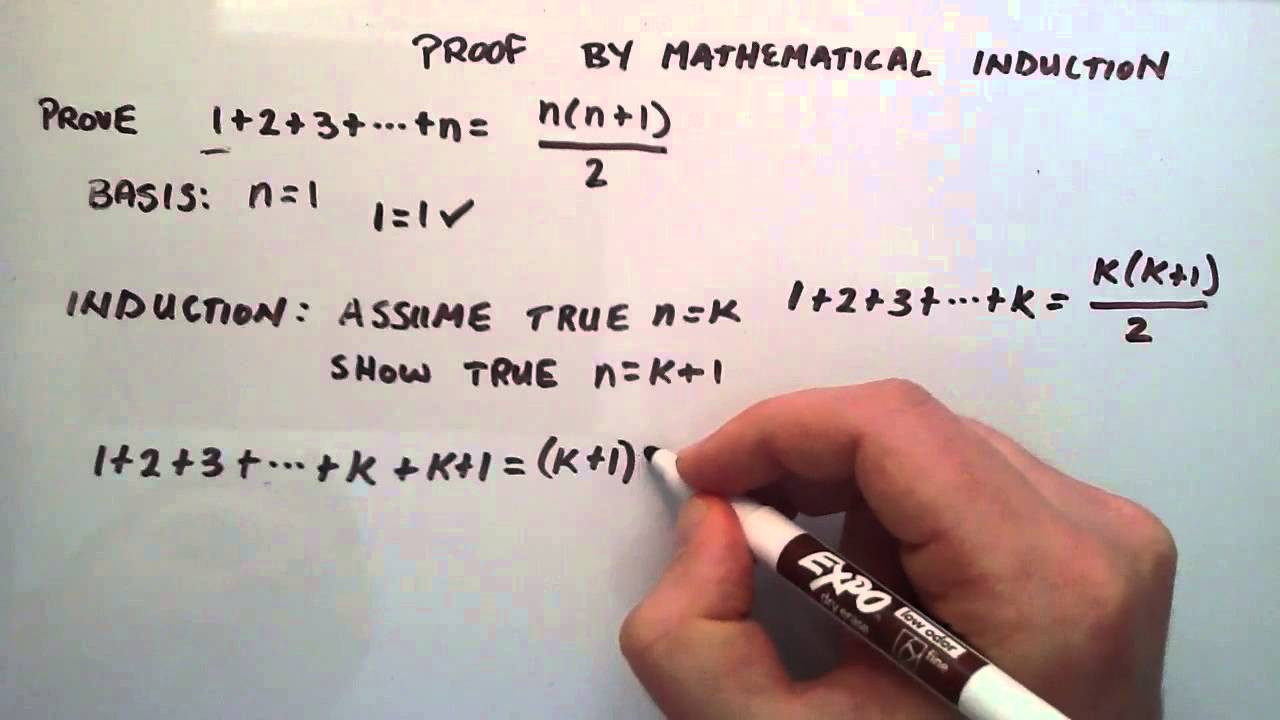
In this tutorial I show how to do a proof by mathematical induction.
Join this channel to get access to perks:
https://www.youtube.com/channel/UCn2SbZWi4yTkmPUj5wnbfoA/join
:)
he i doing the induction like i said
by showing that the statement is true
what else should induction be
keen raptor
twin juniper
isnt that what i did there ?
I assure you induction is not about "proving" this obviously true statement is true
keen raptor
twin juniper
isnt that what i did there ?
otherwise there would only ever be one "proof by induction" and it would be the proof that this statment is always true, regardless of what your a_i values or k is
because it is
the proof is of the proposition P(n+1)
which in the case of the video is the statement that the sum of the first n+1 integers is equal to (n+1)(n+2)/2
keen raptor
twin juniper
isnt that what i did there ?
this is just a tool sometimes used to accomplish that proof
topaz sinewBOT
@twin juniper Has your question been resolved?
topaz sinewBOT
Channel closed
Closed due to timeout
Use .reopen if this was a mistake.
Available help channel!
Send your question here to claim the channel.
Remember:
• Ask your math question in a clear, concise manner.
• Show your work, and if possible, explain where you are stuck.
• After 15 minutes, feel free to ping <@&286206848099549185>.
• Type the command .close to free the channel when you're done.
• Be polite and have a nice day!
Read #❓how-to-get-help for further information on how to ask a good question, and about conduct in the question channels.
 lunar gust
 lunar gust
.close
topaz sinewBOT
Channel closed
Closed by @lunar gust
Use .reopen if this was a mistake.
Available help channel!
Send your question here to claim the channel.
Remember:
• Ask your math question in a clear, concise manner.
• Show your work, and if possible, explain where you are stuck.
• After 15 minutes, feel free to ping <@&286206848099549185>.
• Type the command .close to free the channel when you're done.
• Be polite and have a nice day!
Read #❓how-to-get-help for further information on how to ask a good question, and about conduct in the question channels.
 mint perch
Question about this
