#help-26
1 messages · Page 16 of 1
 wild brook
1/6-1/8010
15*89
885
884/8010
442/4005
Lemme see if correct
and then
we have to get prime factors-
._.
Uh
the answer
is 54
Save me-
 topaz sinewBOT
@wild brook Has your question been resolved?
topaz sinewBOT
Channel closed
Closed due to timeout
Use .reopen if this was a mistake.
 Available help channel!
Send your question here to claim the channel.
Remember:
• Ask your math question in a clear, concise manner.
• Show your work, and if possible, explain where you are stuck.
• After 15 minutes, feel free to ping <@&286206848099549185>.
• Type the command .close to free the channel when you're done.
• Be polite and have a nice day!
Read #❓how-to-get-help for further information on how to ask a good question, and about conduct in the question channels.
 midnight mountain
hi
topaz sinewBOT
midnight mountain
hi

 old patrol
4.25?
old patrol
17/4 = 4.25 then
4.25(4/5) = 17/4 so
4.25 x (-4/5) + 17/5 = 0
are you trying to get 1 diagonally?
midnight mountain
old patrol
17/4 = 4.25 then
4.25(4/5) = 17/4 so
4.25 x (-4/5) + 17/5 = 0
ohh ok
midnight mountain
oh
midnight mountain
wiat no
it’s just explaining how u get to that number
it’s basically asking what number row 2 had to be multiplied by to get from the previous matrix to the one i’m on
old patrol
3 R2 + R3
midnight mountain
if that makes any sense
old patrol
3 x R2 + R3 = 1
midnight mountain
i’m not good at explaining because i don’t really know how to do this
old patrol
its ok dw
since 17/5 = 3.4 then
to get to 1 you are trying to subtract 2.4 from 3.4 so..
2.4 = 12/5 so you know -4/5 x 3 = -12/5 and now
3(-4/5) + 17/5 = 1
midnight mountain
hmmm ok
old patrol
did it work?
i did RREF differently so i might be wrong
bc i would just multiply R3 by 5/17 and solve the rest
old patrol
you should close if ur question got answered @midnight mountain
topaz sinewBOT
@midnight mountain Has your question been resolved?
topaz sinewBOT
Channel closed
Closed due to timeout
Use .reopen if this was a mistake.
Available help channel!
Send your question here to claim the channel.
Remember:
• Ask your math question in a clear, concise manner.
• Show your work, and if possible, explain where you are stuck.
• After 15 minutes, feel free to ping <@&286206848099549185>.
• Type the command .close to free the channel when you're done.
• Be polite and have a nice day!
Read #❓how-to-get-help for further information on how to ask a good question, and about conduct in the question channels.
 nimble crown
can someone explain to me parametrics when it involves trig?
 nimble crown
I understand normal parametric, its just making t the subject for everything
but this seems... harder
 static viper
T ranges from -90 degrees to +90 degrees , therefore what's the max and min value of sin t and cos t
 valid marsh
nimble crown
can someone explain to me parametrics when it involves trig?
valid marsh
nimble crown
can someone explain to me parametrics when it involves trig?
what are you stuck on?
valid marsh
nimble crown
just doing it in general
can you identify your difficulty in this problem?
nimble crown
well normal parametrics is just making t the subject and then subbing it into the other equation
but how would you do it in this case?
becuse if I do make x the subject, what would you do with a cos(sin^-1)?
valid marsh
nimble crown
becuse if I do make x the subject, what would you do with a cos(sin^-1)?
you can draw a triangle
nimble crown
ah fair point
valid marsh
nimble crown
becuse if I do make x the subject, what would you do with a cos(sin^-1)?
let x be the argument of the arcsin
then the physical meaning of the arcsin is
going from a ratio to an angle
nimble crown
I don't understand what your pointing out here... sorry
valid marsh
so you can draw a triangle with angle arcsin x
and then use the triangle to find the cosine
nimble crown
oh I see
but the problem is... what do I kind of use? there are all points on a graph
valid marsh
nimble crown
becuse if I do make x the subject, what would you do with a cos(sin^-1)?
can you make x the subject
 valid marsh
then you can put this into the lower equation
valid marsh
valid marsh
so you can draw a triangle with angle arcsin x
can you use this to physically represent cos arcsin r, where r is a ratio?
nimble crown
r is a ratio....
 pale isle
valid marsh
can you use this to physically represent cos arcsin r, where r is a ratio?
pale isle
valid marsh
can you use this to physically represent cos arcsin r, where r is a ratio?
Yes
valid marsh
pale isle
Yes
Not asking you
 valid marsh
what’s the hypotenuse
nimble crown
thats the problem, I don't know
nimble crown
theta = arcsin?
valid marsh
valid marsh
using the triangle
and trig ratios
nimble crown
I am really trying my hardest here but I cannot understand what I should be looking for
2?
valid marsh
x - 3 = sin theta = (x - 3)/?
nimble crown
x?
valid marsh
nimble crown
if the hypotenuse is 1, then using trig ratios, sin theta = opposite/hypotenuse = (x - 3)/1 = (x - 3) as expected
nimble crown
yes
valid marsh
so the hypotenuse is 1
 valid marsh
then can you find cos theta using this triangle and the pythagorean theorem?
valid marsh
valid marsh
if the hypotenuse is 1, then using trig ratios, sin theta = opposite/hypotenuse ...
I decided to just say the answer since it’s just a step on the way to the answer
valid marsh
nimble crown
yes
this will be cos arcsin (x - 3)
valid marsh
why not
valid marsh
nimble crown
another way, not using a geometric method, is to use cos x = -+ sqrt(1 - sin^2 x)
nimble crown
I see
so now we have cos, how can we use that to solve our question?
because now y = 3 - sqrt(x-3)^2
valid marsh
nimble crown
huh... I got 1 - sqrt(x-3)^2
check your algebra again
valid marsh
valid marsh
another way, not using a geometric method, is to use cos x = -+ sqrt(1 - sin^2 x...
be aware that it could be the negative square root, by this
nimble crown
hmmm this method seems really long to figure out a multiple choice...
valid marsh
nimble crown
then since it’s multiple choice, you don’t need to prove it by deriving it
you could try substituting values
like τ
or τ/4
nimble crown
well we have to relate the graph to the parametric
so the centre and radius could be of help?
wait maybe the domain can help
I think I got it now...
valid marsh
nimble crown
I think I got it now...
what did you get?
nimble crown
well we have the domain right?

just reposting it
since its pi/2
and we are finding sint and cost
you sub it into he domains and you find 0 <= cost <= 1
-1 <= sint <= 1
valid marsh
valid marsh
you could try substituting values
what I mean is, try substituting t = 0
and see if the resulting points lie on the semicircle
for example
you can use this to rule out choice A
nimble crown
for x?
but sin 0 is 0 but x lies on the semi circle
hmm maybe I'll just skip this for now
thanks for the help though
.close
topaz sinewBOT
Channel closed
Closed by @nimble crown
Use .reopen if this was a mistake.
Available help channel!
Send your question here to claim the channel.
Remember:
• Ask your math question in a clear, concise manner.
• Show your work, and if possible, explain where you are stuck.
• After 15 minutes, feel free to ping <@&286206848099549185>.
• Type the command .close to free the channel when you're done.
• Be polite and have a nice day!
Read #❓how-to-get-help for further information on how to ask a good question, and about conduct in the question channels.
 terse linden
why ist it
topaz sinewBOT
terse linden
why ist it

 thorny flameBOT
Ann
 terse linden
huh
 fallow heart
$\frac{x}{y} = x \cdot \frac{1}{y} = x \cdot y^{-1}$
thorny flameBOT
Alberto Z.
 terse linden
OH
OOPS
DIDNT SEE THAT
1 SEC
wait
what would
sqrt2/2-sqrt2/2i=?
$\frac{\sqrt{2}}{2}-\frac{\sqrt{2}}{2}}i$
thorny flameBOT
LW
$\frac{\sqrt{2}}{2}-\frac{\sqrt{2}}{2}}i$
```Compilation error:```! Extra }, or forgotten $.
l.156 $\frac{\sqrt{2}}{2}-\frac{\sqrt{2}}{2}}
i$
I've deleted a group-closing symbol because it seems to be
spurious, as in `$x}$'. But perhaps the } is legitimate and
you forgot something else, as in `\hbox{$x}'. In such cases
the way to recover is to insert both the forgotten and the
deleted material, e.g., by typing `I$}'.
Preview: Tightpage -1310720 -1310720 1310720 1310720
[1{/usr/local/texlive/2020/texmf-var/fonts/map/pdftex/updmap/pdftex.map}]``` terse linden
would it be 0?
 main shale
no
terse linden
hm?
main shale
you cannot subtract imaginary components from reals like that
imagine the i just as a variable
you can't do, say, 2-2x = 0, because there's an extra x there
same with the i
topaz sinewBOT
Channel closed
Closed by @terse linden
Use .reopen if this was a mistake.
terse linden
.reopen
topaz sinewBOT
✅
 thorny flameBOT
Modus
 terse linden
hm?
um

how do they get to this step then
how do they seperate fractions
oh ye
thats the actual formula
thanks @bold nebula
.close
topaz sinewBOT
Channel closed
Closed by @terse linden
Use .reopen if this was a mistake.
Available help channel!
Send your question here to claim the channel.
Remember:
• Ask your math question in a clear, concise manner.
• Show your work, and if possible, explain where you are stuck.
• After 15 minutes, feel free to ping <@&286206848099549185>.
• Type the command .close to free the channel when you're done.
• Be polite and have a nice day!
Read #❓how-to-get-help for further information on how to ask a good question, and about conduct in the question channels.
 neon iron
I'm curious to know how to show that (a) $\implies$ 1 and $1 \implies$ (a)
 topaz sinewBOT
neon iron
I'm curious to know how to show that (a) $\implies$ 1 and $1 \implies$ (a)
thorny flameBOT
topaz sinewBOT
neon iron
I'm curious to know how to show that (a) $\implies$ 1 and $1 \implies$ (a)
thorny flameBOT
 neon iron
I'm curious to know how to show that (a) $\implies$ 1 and $1 \implies$ (a)
neon iron
neon iron
I'm curious to know how to show that (a) $\implies$ 1 and $1 \implies$ (a)
,rccw
neon iron
Yeah
 barren lion
you can use the property that det(A) = det(A^T)
neon iron
We have not learnt what determinants are yet by this point
barren lion
ok, then try taking the transpose of both sides of AB = I
lol, gotta repost the original screenshot to rotate
neon iron
Is this the same logic to showing [
\trans{(A^{-1})} = (\trans A)^{-1}
]
barren lion
yes
thorny flameBOT

 hasty trail
alternatively, you could use the fact that row rank equals column rank
topaz sinewBOT
Channel closed
Closed by @pliant schooner
Use .reopen if this was a mistake.
topaz sinewBOT
Available help channel!
Send your question here to claim the channel.
Remember:
• Ask your math question in a clear, concise manner.
• Show your work, and if possible, explain where you are stuck.
• After 15 minutes, feel free to ping <@&286206848099549185>.
• Type the command .close to free the channel when you're done.
• Be polite and have a nice day!
Read #❓how-to-get-help for further information on how to ask a good question, and about conduct in the question channels.
 empty fossil
solve the equation:
$y'-3y=0$
topaz sinewBOT
empty fossil
solve the equation:
$y'-3y=0$
thorny flameBOT
bigpufik
 empty fossil
y is ofcourse a function
 pale kestrel
$y'=3y$
thorny flameBOT
yannay_sup
 empty fossil
yeah
topaz sinewBOT
@empty fossil Has your question been resolved?
topaz sinewBOT
Channel closed
Closed due to timeout
Use .reopen if this was a mistake.
Available help channel!
Send your question here to claim the channel.
Remember:
• Ask your math question in a clear, concise manner.
• Show your work, and if possible, explain where you are stuck.
• After 15 minutes, feel free to ping <@&286206848099549185>.
• Type the command .close to free the channel when you're done.
• Be polite and have a nice day!
Read #❓how-to-get-help for further information on how to ask a good question, and about conduct in the question channels.
 graceful wolf
The folloiwng numbers are a part of a sequence: 6,11,18,27
is there a way to make a sigma notation based on the values of this specific sequence?
topaz sinewBOT
graceful wolf
The folloiwng numbers are a part of a sequence: 6,11,18,27
is there a way to mak...
 drifting swift
??
do you want to add these up?
also is this the entire sequence or does it continue somehow?
graceful wolf
Yes, a continous sequence
Assume that f(1) = 6, f(2) = 11, and f(3) = 18 etc
is there a way of creating a sigma notation that let's you find any f(x) values?
Like a formula that can be inputted
graceful wolf
drifting swift
~~also is this the entire sequence or does it continue somehow?~~
Had the sequence been for example 2, 7, 5, ... , then we could make the sigma notation where the formula is equal to 3n - 1, if you get what I mean
I wonder if I can find a similar pattern here
drifting swift
???
 gritty mirage
I don't think there are enough terms to find a closed formula.
drifting swift
i think you have a misconception about what a sigma notation is
gritty mirage
However, you might write f(x) in the summand
drifting swift
also
no, there's NO way to predict the next numbers in a sequence just from the first four.
just to put that out there so i don't have to repeat myself.
graceful wolf
drifting swift
also
# no, there's NO way to predict the next numbers in a sequence just from th...
6,11,18,27
6 - 11 = 5
18 - 11 = 7
27 - 18 = 9
7 - 5 = 2
9 - 7 = 2
this means that in order to find the fifth number, add it by 2 + 9
38
27 + 11 = 38
graceful wolf
have i done a mistake somewhere in my calculation?
drifting swift
no, you haven't. the mistake is not in the calculations.
the mistake is in assuming that the first differences of your sequence form an arithmetic progression.
nobody said that they had to do that.
yeah, sure, the first three look like they do. you CANNOT say that it keeps going the same way.
graceful wolf
You're perhaps right, but for our case, let's assume that this was indeed an arithmetic progression
Would it then be possible to go ahead with creating a sigma notation for the sequence
 shut obsidian
drifting swift
yeah, sure, the first three look like they do. you CANNOT say that it keeps goin...
shut obsidian
drifting swift
yeah, sure, the first three look like they do. you CANNOT say that it keeps goin...
Yep, it could be a(n) = n^2 + 2n + 3, smallest k such that n(n+k) + 1 is a cube, ..., for example (from OEIS)
graceful wolf
What I'm trying to do is use my sigma notation to create a formula similar to n(n+1), and use that to further simplify it to become a quadratic equation, with the assumption that the sequence is a part of a quadratic equation https://m.youtube.com/watch?v=bWZwF1H9YbU
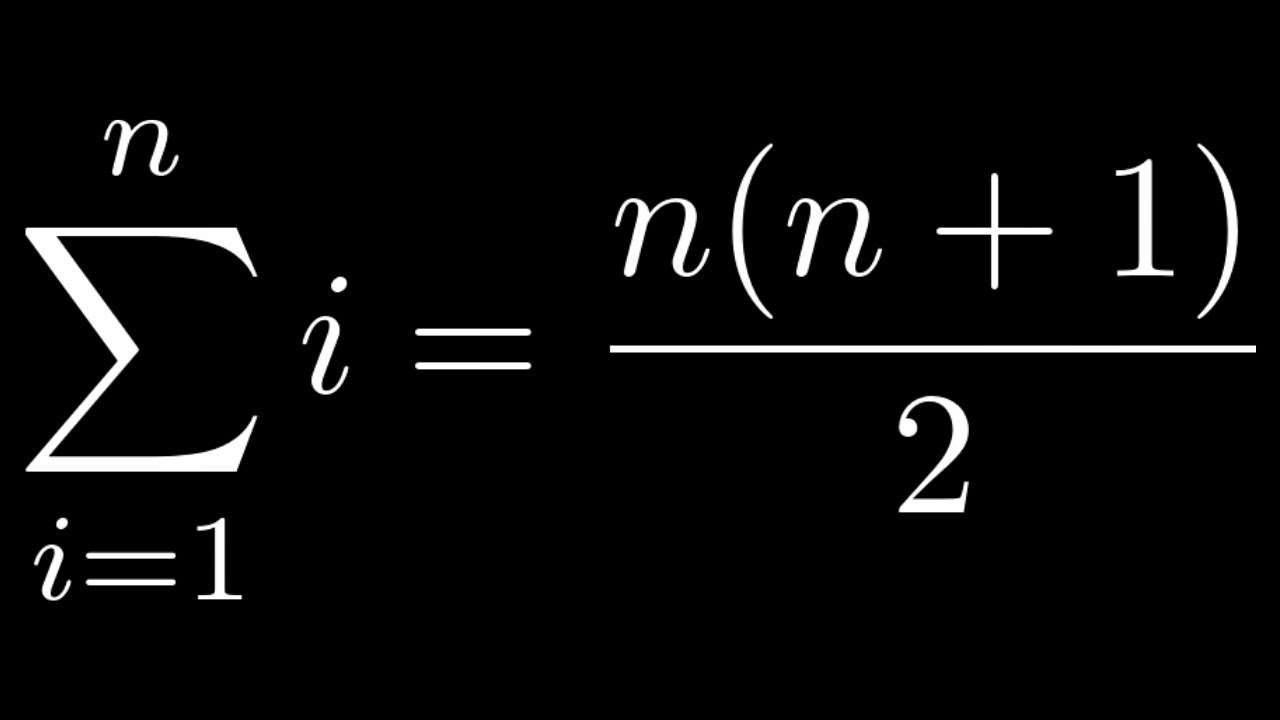
Proof of the formula for the sum of the first n integers without Induction
Please Subscribe here, thank you!!! https://goo.gl/JQ8Nys
#mathsorcerer #onlinemathhelp
drifting swift
uhh
so
you want two things:
- find an expression for the general term of your sequence
- find a formula for the SUM of the first n terms of your sequence
you understand these are not the same task, right
graceful wolf
Yes, the second step can be used to do the first step
drifting swift
eh?
i'd think it goes the other way around lol
like i mean sure but it's harder to do #2 than #1
kepe did already give you the formula for your sequence itself: a_n = n^2 + 2n + 3 [w/ your assumption that it really is quadratic, that's what it works out to be]
graceful wolf
drifting swift
i'd think it goes the other way around lol
The thing is that I am trying to use this as a method to be able to find the general term of the sequence
drifting swift
you're trying to do something that confuses both us and you ngl
graceful wolf
drifting swift
kepe did already give you the formula for your sequence itself: a_n = n^2 + 2n +...
n^2+2n+3 is the correct expression
drifting swift
btw was this problem just suspended in midair like this or did it come from something else you were doing but didn't share?
graceful wolf
graceful wolf
Yes, the second step can be used to do the first step
However, I do not currently have any method using the sequence to find this expression, other than the way I am trying to use here (which involves the message above)
Providing you with context is perhaps helpful here
Okay, so
The following image displays a card house that is built to three levels. The first image displays F(1), the second shows F(2), and the third is F(3).
The amount of cards in the card house of x floors is defined by the formula: F(x) = (3x^2 + x)/2. Explain how this formula was built.
 drifting swift
ah but that's not so hard. if you know triangular numbers you can reason geometrically about this.
graceful wolf
I managed to get help to solve this, but we essentially listed the first three numbers in the sequence, turned them into a sigma notation, then used the sigma notation formula to create the general expression
drifting swift
bad!
by restricting yourself to the first 3 numbers, you completely threw away all the rest of the info about your sequence, and made us go through this somewhat pointless questioning through your http://xyproblem.info/
Asking about your attempted solution rather than your actual problem
graceful wolf
drifting swift
ah but that's not so hard. if you know triangular numbers you can reason geometr...
I have come to the realisation sooner that we can additionally use rectangular numbers to make this easier, and i'm sure that's what you're referring to
drifting swift
what's a "rectangular number"?
graceful wolf
Pronic numbers is perhaps the official terming for it.
graceful wolf
A pronic number is a number that is the product of two consecutive integers, that is, a number of the form
    n
    (
    n
    +
    1
    )
    .


{\displaystyle n(n+1).}
The study of these numbers dates back to Aristotle. They are also called oblong numbers, heteromecic numbers, ...
drifting swift
oh god ok they're numbers of the form n(n+1)
never heard them called by that name lmfao
graceful wolf
Glad I was able to provide you with new information
drifting swift
no, triangular numbers are those times 1/2...
a triangular number is a number obtainable as the sum of the first n natural numbers for some n
graceful wolf
graceful wolf
I managed to get help to solve this, but we essentially listed the first three n...
Yes, which is easier than using the method I first used
drifting swift
or, geometrically, it's the number of dots in a triangular array that has n of them on each side, for some n
or algebraically it's n(n+1)/2
graceful wolf
graceful wolf
I managed to get help to solve this, but we essentially listed the first three n...
I understand the concept of triangular numbers and understood it well. It's just that I thought that the same proccess that is shown in the replied comment can be additionally used to find other quadratic equations
graceful wolf
This includes finding out the formula n^2+2n+3 from the first three/four number sequence I have provided in the pinned message of this chat 6,11,18,27
drifting swift
you have here a triangular array of groups of cards that themselves form triangles as shown, with as many of those as the cardhouse has floors (which you called x)
so the number of cards involved would be 3 * x(x+1)/2
except we do are missing the cards from the foundation, x in total (one from each triangle touching the ground), so we subtract x
 shut obsidian
Back to the original question, we have $a_{n + 1} = a_n + 3 + 2n$. Decompose $a_n$ etc., you'll notice that \begin{align*} a_{n + 1} &= a_n + 3 + 2n \ &= a_{n - 1} + 3 + 2(n-1) + 3 + 2n \ &= a_{n - 2} + 3 + 2(n-2) + 3 + 2(n - 1) + 3 + 2n \ &= \cdots. \end{align*} So $a(n) = 6 + \sum_{k = 1}^n 3 + 2n$, if that's what you wanted.
drifting swift
now tell us where the numbers 6, 11, 18, 27 came from.
graceful wolf
drifting swift
now tell us where the numbers _6, 11, 18, 27_ came from.
These numbers are a part of a triangular number sequence, if i've implied that
drifting swift
you didn't imply it nor say it
also no, there's no such thing as a "triangular number sequence"
unless you mean the sequence of triangular numbers 1, 3, 6, 10, 15, ...
again tell us the problem these numbers came from
dont leave us hanging in midair with nothing to grab on to and force us to fly by our instruments alone
shut obsidian

Well, it should rather be a(n + 1)
This sum notation for a(n) can be simplified though, pulling out the 3 with a factor, then 2, and using the (little) Gauss formula
graceful wolf
drifting swift
also no, there's no such thing as a "triangular number sequence"
I thank you and appreciate your corrections. I am not too familiar with the correct terms.
I am on the lookout to being able to find a quadratic equation for a sequence that I am aware comes from a quadratic equation. The numbers 6, 11, 18, 27 come from the equation n^2+2n+3.
As an attempt to find a method for being able to use these sequence numbers to find the equation, I thought that it might be possible to work with these numbers as if they were triangular or pronic numbers. I had earlier worked with sequences that contained triangular numbers, which involves first finding the sigma notation for the sequence, then simplifying it into a general expression
drifting swift
jhjhkjhksjhk
this is... unhelpful and your thanks reads as insincere to me.
this feels like you are only saying thanks to be polite, and in actuality would rather i shut up rather than continue bitching about every single message you type.
i may well be wrong, but that's how it is reading to me rn.
graceful wolf
No, I actually am trying to find a way to solve this. Let me try to be clear: would it be correct to treat a sequence with numbers from a quadratic expression, the same way as you can treat a sequence with triangular numbers?
graceful wolf
Okay, I would love to see your way of solving this sequence so that I can learn from it
drifting swift
to my understanding, it's this:
you start with the sequence a_n = n^2 + 2n + 3
you write out its first 4 terms
and then you take these 4 terms, and the knowledge that a_n is a quadratic sequence,
and task yourself with recovering its original formula?
like that's just odd af to me sorry
graceful wolf
That is correct
 graceful wolf
Let's consider this an odd problem and look for the ways that this can be solved
shut obsidian
shut obsidian
You wanted a(n) in sum notation, this should be an (intuitive) way, I guess
(Though it should rather be a(n + 1), replace all n with (n-1) to make it a(n))
graceful wolf
Wouldn't it be $a(n) = 6 + \sum{k = 1}^n 3 + 2(n-1)$
One moment
$a(n) = 6 + \sum_{k = 1}^{n} 3 + 2(n-1)$
shut obsidian
$a(n) = 6 + \sum_{k = 1}^{n-1} 3 + 2k$, for $n \geq 2$. We define $a(1) \coloneqq 6$.
graceful wolf
6,11,18,27 = (6), (6 + 5), (6 + 5 + 7), (6 + 5 + 7 + 9)
6 + \sum_{k = 1}^{n} (2(k-1)+3)$
$6 + \sum_{k = 1}^{n} (2(k-1)+3)$
thorny flameBOT
Seed

 graceful wolf
i'm unsure of whether we've come to the same equation or not
but i see mine to be intuitive
One moment, it perhaps doesn't
shut obsidian
graceful wolf
$6 + \sum_{k = 1}^{n} (2(k-1)+3)$
a(2) = 6 + (3) + (2(1) + 3) = 14 for you.
graceful wolf
Correct
What I am essentially trying to do is make the notation be a total of 0 during f(1) but then continue the cycle of being 5, 7 , 9 in the next ones
shut obsidian
Intuitively, $a_{n + 1} = a_n + 3 + 2n$. Decompose $a_n$ etc., you'll notice that \begin{align*} a_{n + 1} &= a_n + 3 + 2n \ &= a_{n - 1} + 3 + 2(n-1) + 3 + 2n \ &= a_{n - 2} + 3 + 2(n-2) + 3 + 2(n - 1) + 3 + 2n \ &= \cdots. \end{align*} So $a(n + 1) = 6 + \sum_{k = 1}^n 3 + 2k$. If we want $a(n)$ instead of $a(n + 1)$, we substitute $n - 1$ for $n$, giving us $a(n) = 6 + \sum_{k = 1}^{n-1} 3 + 2k$.
 shut obsidian
graceful wolf
Correct
What I am essentially trying to do is make the notation be a total of 0 ...
shut obsidian
graceful wolf
Correct
What I am essentially trying to do is make the notation be a total of 0 ...
So you want it defined for all n >= 1, right?
graceful wolf
shut obsidian
So you want it defined for all n >= 1, right?
yes, but i am unsure of how that's achievable
i'm trying to understand the latex you've provided above
shut obsidian
graceful wolf
yes, but i am unsure of how that's achievable
i'm trying to understand the late...
Well, $a(1) = 6 + \sum_{k = 1}^{0}3 + 2k$. That sum isn't defined. We can make it start with $0$ though, we only need to subtract off what the term inside of the sum gives us for $k = 0$, $3$. So $a(n) = 3 + \sum_{k = 0}^{n - 1}3 + 2k$.
 shut obsidian
graceful wolf
yes, but i am unsure of how that's achievable
i'm trying to understand the late...
shut obsidian
graceful wolf
yes, but i am unsure of how that's achievable
i'm trying to understand the late...
Now, you could find the polynomial form of $a(n)$: $3$ just gets added $n$ times, so we have $a(n) = 3 + 3n + \sum_{k = 0}^{n - 1} 2k$. We can pull the 2 out: $a(n) = 3 + 3n + 2\sum_{k = 0}^{n - 1} k$. Now, you can apply Gauss' formula: $\sum_{k = 0}^{n - 1} k = \frac{(n-1)n}{2}$. So we'll have $a(n) = 3 + 3n + (n-1)n \ = n^2 + 2n + 3$.
 topaz sinewBOT
@graceful wolf Has your question been resolved?
topaz sinewBOT
Channel closed
Closed due to timeout
Use .reopen if this was a mistake.
Available help channel!
Send your question here to claim the channel.
Remember:
• Ask your math question in a clear, concise manner.
• Show your work, and if possible, explain where you are stuck.
• After 15 minutes, feel free to ping <@&286206848099549185>.
• Type the command .close to free the channel when you're done.
• Be polite and have a nice day!
Read #❓how-to-get-help for further information on how to ask a good question, and about conduct in the question channels.
 hidden ore
 topaz sinewBOT
hidden ore
hidden ore
topaz sinewBOT
hidden ore
hidden ore
How do we solve for A
And how does it go from p(E) = e^E/KT
To p(n) = e^nhv/KT
E = nhv so does this work assuming hv and KT are constants ?
<@&286206848099549185>
 ionic oar
hidden ore
ionic oar
hidden ore
yes
i get that part
🙂
and hv KT are assumed constant then when vairables are swapped ?
 pastel juniper
if they are kept constant
pastel juniper
e = nhv
hidden ore
yes
topaz sinewBOT
@hidden ore Has your question been resolved?
topaz sinewBOT
@hidden ore Has your question been resolved?
Channel closed
Closed by @hidden ore
Use .reopen if this was a mistake.
Available help channel!
Send your question here to claim the channel.
Remember:
• Ask your math question in a clear, concise manner.
• Show your work, and if possible, explain where you are stuck.
• After 15 minutes, feel free to ping <@&286206848099549185>.
• Type the command .close to free the channel when you're done.
• Be polite and have a nice day!
Read #❓how-to-get-help for further information on how to ask a good question, and about conduct in the question channels.
 low crest
how to simplify
83^2 - 83 x 17 + 17^2
over
83 x 66+(17^2)
low crest
freaking italics
 empty sail
low crest
how to simplify
83^2 - 83 x 17 + 17^2
over
83 x 66+(17^2)
empty sail
low crest
how to simplify
83^2 - 83 x 17 + 17^2
over
83 x 66+(17^2)
Is that $\frac{83^2 - 83 \cdot 17 + 17^2}{83 \cdot 66 + 17^2}$?
thorny flameBOT
dldh06
 empty sail
low crest
how to simplify
83^2 - 83 x 17 + 17^2
over
83 x 66+(17^2)
empty sail
low crest
how to simplify
83^2 - 83 x 17 + 17^2
over
83 x 66+(17^2)
And put spaces before and after * so the italics don't come
 tired niche
low crest
factor 83
tired niche
low crest
factor 83
Yes
topaz sinewBOT
Channel closed
Closed by @low crest
Use .reopen if this was a mistake.
Available help channel!
Send your question here to claim the channel.
Remember:
• Ask your math question in a clear, concise manner.
• Show your work, and if possible, explain where you are stuck.
• After 15 minutes, feel free to ping <@&286206848099549185>.
• Type the command .close to free the channel when you're done.
• Be polite and have a nice day!
Read #❓how-to-get-help for further information on how to ask a good question, and about conduct in the question channels.
 burnt mountain
Precalculus problem
The quadratic function that has its vertex in (-1, 2) and passes through (-3, 6)
topaz sinewBOT
burnt mountain
Precalculus problem
The quadratic function that has its vertex in (-1, 2) and p...
burnt mountain
So
I have to find the algebraic expression
I know that the canonic expression uses the vertex coordinates

like this
I don't know what can I do with the info of the point (-3, 6) though
 fossil flare
plug in -3 for x, 6 for y, then solve for a
topaz sinewBOT
Channel closed
Closed by @burnt mountain
Use .reopen if this was a mistake.
topaz sinewBOT
Available help channel!
Send your question here to claim the channel.
Remember:
• Ask your math question in a clear, concise manner.
• Show your work, and if possible, explain where you are stuck.
• After 15 minutes, feel free to ping <@&286206848099549185>.
• Type the command .close to free the channel when you're done.
• Be polite and have a nice day!
Read #❓how-to-get-help for further information on how to ask a good question, and about conduct in the question channels.
 analog dome
in question 7, i solved the quadratic and got 4
 topaz sinewBOT
analog dome
in question 7, i solved the quadratic and got 4
analog dome
topaz sinewBOT
analog dome
in question 7, i solved the quadratic and got 4
analog dome
so 5^x = 4
so how do i go from here to solve for the exponent x?
oh nvm
i can just put it in log form
log 5(4) = x
topaz sinewBOT
@analog dome Has your question been resolved?
topaz sinewBOT
Channel closed
Closed due to timeout
Use .reopen if this was a mistake.
Available help channel!
Send your question here to claim the channel.
Remember:
• Ask your math question in a clear, concise manner.
• Show your work, and if possible, explain where you are stuck.
• After 15 minutes, feel free to ping <@&286206848099549185>.
• Type the command .close to free the channel when you're done.
• Be polite and have a nice day!
Read #❓how-to-get-help for further information on how to ask a good question, and about conduct in the question channels.
analog dome
analog dome
in question 7, i solved the quadratic and got 4
wait
topaz sinewBOT
analog dome
wait


 undone flicker
6-6^x =10^x
6=16^x
Log6 =xlog16
X=log6-log16
analog dome
yeah but why logs and not ln
undone flicker
I don't know
analog dome
wait
my answer is correct, actually...
the worksheet said -ln4 and my answer is ln(0.25)
theyre the same value
so technically its correct
well, i guess thats all
topaz sinewBOT
@analog dome Has your question been resolved?
Channel closed
Closed by @analog dome
Use .reopen if this was a mistake.
Available help channel!
Send your question here to claim the channel.
Remember:
• Ask your math question in a clear, concise manner.
• Show your work, and if possible, explain where you are stuck.
• After 15 minutes, feel free to ping <@&286206848099549185>.
• Type the command .close to free the channel when you're done.
• Be polite and have a nice day!
Read #❓how-to-get-help for further information on how to ask a good question, and about conduct in the question channels.
neon iron
 topaz sinewBOT
Please only use the <@&286206848099549185> ping once if your question has not been answered for 15 minutes. Please do not ping or DM individual users about your question.
 tall wolf
,rotate
thorny flameBOT
 neon iron
tall wolf
,rotate
neon iron
tall wolf
,rotate
plz help i’m stupid
neon iron
so 5,-2 ?
tall wolf
yeah
neon iron
okay
neon iron
tall wolf
yeah
how do i find everything else
tall wolf
draw it
topaz sinewBOT
@neon iron Has your question been resolved?
neon iron
L server
topaz sinewBOT
@neon iron Has your question been resolved?
topaz sinewBOT
Channel closed
Closed due to timeout
Use .reopen if this was a mistake.
Available help channel!
Send your question here to claim the channel.
Remember:
• Ask your math question in a clear, concise manner.
• Show your work, and if possible, explain where you are stuck.
• After 15 minutes, feel free to ping <@&286206848099549185>.
• Type the command .close to free the channel when you're done.
• Be polite and have a nice day!
Read #❓how-to-get-help for further information on how to ask a good question, and about conduct in the question channels.
 hearty drum
 topaz sinewBOT
hearty drum
hearty drum
topaz sinewBOT
hearty drum
hearty drum
no idea what to do
 rugged agate
Have you got any ideas what you might do for 37?
topaz sinewBOT
@hearty drum Has your question been resolved?
hearty drum
nope
rugged agate
Would you know how to go about calculating h(3) for example
hearty drum
no
rugged agate
Okay cool no worries, have you don't much about functions before then?
rugged agate
Okay I'm surprised someone has given you this task then
So a function is a way of describing something to do to a number
It has a name like f, g, or h, and a parameter
So if I say f(x) = x + 1
I'm saying to apply the function called f to a number, I take that number and add one to it, does that make sense
hearty drum
yes
rugged agate
And you can calculate that by replacing all the X's with your number
f(8) = 8 + 1 = 9
So going back to 37, what would h(3) be
hearty drum
5+a
topaz sinewBOT
Channel closed
Closed due to timeout
Use .reopen if this was a mistake.
rugged agate
hearty drum
5+a
Yep perfect :)
hearty drum
what abt 38?
topaz sinewBOT
Available help channel!
Send your question here to claim the channel.
Remember:
• Ask your math question in a clear, concise manner.
• Show your work, and if possible, explain where you are stuck.
• After 15 minutes, feel free to ping <@&286206848099549185>.
• Type the command .close to free the channel when you're done.
• Be polite and have a nice day!
Read #❓how-to-get-help for further information on how to ask a good question, and about conduct in the question channels.
topaz sinewBOT
Channel closed
Closed due to timeout
Use .reopen if this was a mistake.
topaz sinewBOT
Available help channel!
Send your question here to claim the channel.
Remember:
• Ask your math question in a clear, concise manner.
• Show your work, and if possible, explain where you are stuck.
• After 15 minutes, feel free to ping <@&286206848099549185>.
• Type the command .close to free the channel when you're done.
• Be polite and have a nice day!
Read #❓how-to-get-help for further information on how to ask a good question, and about conduct in the question channels.
 sweet spire
how to solve for c
 topaz sinewBOT
sweet spire
how to solve for c
topaz sinewBOT
sweet spire
how to solve for c
 simple orchid
You gotta label numbers more clearly
sweet spire
the height of the bigger triangle is 70 and the height of the smaller is 47
ill give you a better diagram

i got x=2303/23 but im not sure its right
nvm
i got the answer using similar triangles
.close
topaz sinewBOT
Channel closed
Closed by @sweet spire
Use .reopen if this was a mistake.
topaz sinewBOT
Available help channel!
Send your question here to claim the channel.
Remember:
• Ask your math question in a clear, concise manner.
• Show your work, and if possible, explain where you are stuck.
• After 15 minutes, feel free to ping <@&286206848099549185>.
• Type the command .close to free the channel when you're done.
• Be polite and have a nice day!
Read #❓how-to-get-help for further information on how to ask a good question, and about conduct in the question channels.
 midnight sinew
 topaz sinewBOT
midnight sinew
topaz sinewBOT
midnight sinew
What step are you on?
1. I don't know where to begin
2. I have begun but got stuck midway
3. I got an answer but I'm told it's wrong
4. I got an answer and would like my work checked
5. I have a question about someone else's worked solution
6. None of the above

Does my solve look right?
I have not yet checked for the k=18 in my working but it should also lead to there being 1 solution
Also was there any trick I could have used here to solve it faster/neater?
Ah wait hold on, let me change my working abit.
 distant nymph
midnight sinew
distant nymph
midnight sinew
You have done that column operation. Are you sure that's allowed?
 midnight sinew
midnight sinew
midnight sinew
made a careless mistake above, this one should be right.
distant nymph
midnight sinew
Yes because I just need find number of solutions
Yeah. You are probably right. I think it only causes a solution (a, b, c) to be (c, b, a) so it shouldn't affect number of solutions.
distant nymph
midnight sinew
While doing k3 -> 2k3, constant term should have become -4. Right?
Correct that.
midnight sinew
Oh yes
Ok I checked with a couple of values, the final matrix should be correct
After going from -1 to -4
Would the final step of saying that there is only 1 solution for any value of k be correct?
topaz sinewBOT
@midnight sinew Has your question been resolved?
Channel closed
Closed by @midnight sinew
Use .reopen if this was a mistake.
Available help channel!
Send your question here to claim the channel.
Remember:
• Ask your math question in a clear, concise manner.
• Show your work, and if possible, explain where you are stuck.
• After 15 minutes, feel free to ping <@&286206848099549185>.
• Type the command .close to free the channel when you're done.
• Be polite and have a nice day!
Read #❓how-to-get-help for further information on how to ask a good question, and about conduct in the question channels.
 boreal mesa
How to find the image of f(x)=-2(x+9)^2+15
topaz sinewBOT
boreal mesa
How to find the image of f(x)=-2(x+9)^2+15
boreal mesa
<@&286206848099549185>
topaz sinewBOT
Please only use the <@&286206848099549185> ping once if your question has not been answered for 15 minutes. Please do not ping or DM individual users about your question.
 main vapor
15m
 bleak mirage
here
 slate pebble
boreal mesa
How to find the image of f(x)=-2(x+9)^2+15
slate pebble
boreal mesa
How to find the image of f(x)=-2(x+9)^2+15
do you recognise the form it's in
 boreal mesa
bleak mirage
boreal mesa
bleak mirage
Well i didn’t understand
boreal mesa
slate pebble
do you recognise the form it's in
Yea it’s f(x) = a(x-h)^2+k isn’t it?
topaz sinewBOT
@boreal mesa Has your question been resolved?
topaz sinewBOT
@boreal mesa Has your question been resolved?
topaz sinewBOT
Channel closed
Closed due to timeout
Use .reopen if this was a mistake.
topaz sinewBOT
Available help channel!
Send your question here to claim the channel.
Remember:
• Ask your math question in a clear, concise manner.
• Show your work, and if possible, explain where you are stuck.
• After 15 minutes, feel free to ping <@&286206848099549185>.
• Type the command .close to free the channel when you're done.
• Be polite and have a nice day!
Read #❓how-to-get-help for further information on how to ask a good question, and about conduct in the question channels.
neon iron
What does (relative to "foward") mean?
topaz sinewBOT
neon iron
What does (relative to "foward") mean?
neon iron

 fluid belfry
lawn chess?
 keen venture
A possible answer could be "30° away from forward"
neon iron

 winter egret
"relative to forward" means "forward" is the zero angle, and they probably want the angle as a positive number
keen venture
Or "30° left of forward"
neon iron
Bruh
keen venture
Not that the answer is 30°
keen venture
When they say "relative" they mean "give the answer assuming everyone knows which direction forward is"
neon iron
okay!
thank you
so
relative to
means
whatever direction
is

X is always on the right and is positive direction
for 2d vectors
or
2d coordinates?
topaz sinewBOT
@neon iron Has your question been resolved?
Channel closed
Closed by @coarse lynx
Use .reopen if this was a mistake.
Available help channel!
Send your question here to claim the channel.
Remember:
• Ask your math question in a clear, concise manner.
• Show your work, and if possible, explain where you are stuck.
• After 15 minutes, feel free to ping <@&286206848099549185>.
• Type the command .close to free the channel when you're done.
• Be polite and have a nice day!
Read #❓how-to-get-help for further information on how to ask a good question, and about conduct in the question channels.
 brittle tartan
,,\lim_{n\to\infty} \prod_{k=1}^n \bigg(\frac{k}{n}\bigg)^{1/n}
thorny flameBOT
 brittle tartan
so far ive turned the product into (n!)^(1/n)/n
,,\prod_{k=1}^n (k/n)^{1/n} = \frac{(n!)^{1/n}}{n}
this feels like it has something to do with natural number but i'm lost
thorny flameBOT

 sweet shard
You're looking for the exact value?
brittle tartan
yeah
hint says to use sterling's approximation
maybe the limits are still the same
i get to the approximation sqrt(2 pi n)^(1/n) e^(-1)
,,\frac{\sqrt{2\pi n}^{1/n}}{e}
thorny flameBOT
 topaz sinewBOT
Channel closed
Closed by @brittle tartan
Use .reopen if this was a mistake.
Available help channel!
Send your question here to claim the channel.
Remember:
• Ask your math question in a clear, concise manner.
• Show your work, and if possible, explain where you are stuck.
• After 15 minutes, feel free to ping <@&286206848099549185>.
• Type the command .close to free the channel when you're done.
• Be polite and have a nice day!
Read #❓how-to-get-help for further information on how to ask a good question, and about conduct in the question channels.
neon iron
 neon iron
$$\vec{i}^2 = \vec{j}$$ right?
thorny flameBOT
One person
 neon iron
$$\vec{j}^2 = \vec{i}$$ ?
thorny flameBOT
One person
 thorny flameBOT
One person
 empty sail
neon iron
$$\vec{i}^2 = -j$$ and
$$\vec{j}^2 = -i$$
empty sail
neon iron
$$\vec{i}^2 = -j$$ and
$$\vec{j}^2 = -i$$
None of them if $\vec{i}^2 = \vec{i} . \vec{i}$
thorny flameBOT
dldh06
 neon iron
empty sail
None of them if $\vec{i}^2 = \vec{i} . \vec{i}$
neon iron
empty sail
None of them if $\vec{i}^2 = \vec{i} . \vec{i}$
ummmmmmmmmmmmmmmmmmmmmmmmmmmmmmm
yes?
uuuuuuuuuuuuuuuuuuuuuuuuuuuuuuuuuuh
ummmmmmmmmmmmmmmmmmmmmmmmmmmmmmmmmmmmmmmmm
Uh
so
what
is
empty sail
You should know this
 neon iron
$$(4\vec{i}) \cross (-4\vec{i} - 3 \vec{j})$$
thorny flameBOT
One person
 empty sail
$\vec{i} . \vec{i} = 0$
thorny flameBOT
dldh06
 neon iron
 I see
I see
because
they
are
parallel
and
sin(0) = 0
okay
got
it
TY
Thank you
.close
topaz sinewBOT
Channel closed
Closed by @coarse lynx
Use .reopen if this was a mistake.
topaz sinewBOT
Available help channel!
Send your question here to claim the channel.
Remember:
• Ask your math question in a clear, concise manner.
• Show your work, and if possible, explain where you are stuck.
• After 15 minutes, feel free to ping <@&286206848099549185>.
• Type the command .close to free the channel when you're done.
• Be polite and have a nice day!
Read #❓how-to-get-help for further information on how to ask a good question, and about conduct in the question channels.
 bronze kite
Im not sure if this is math
topaz sinewBOT
bronze kite
Im not sure if this is math
bronze kite
I guess coding is similar to math??

Flow chart
nvm I dont think that is math
mb can somoene close the channel
 halcyon marsh
noone fucking cares
bronze kite
halcyon marsh
noone fucking cares
kys
halcyon marsh
brother
bronze kite
huh

 sick bison
bronze kite
nvm I dont think that is math
sick bison
bronze kite
nvm I dont think that is math
sure is math
and .close is used for closing a channel
topaz sinewBOT
Channel closed
Closed by @bronze kite
Use .reopen if this was a mistake.
topaz sinewBOT
Available help channel!
Send your question here to claim the channel.
Remember:
• Ask your math question in a clear, concise manner.
• Show your work, and if possible, explain where you are stuck.
• After 15 minutes, feel free to ping <@&286206848099549185>.
• Type the command .close to free the channel when you're done.
• Be polite and have a nice day!
Read #❓how-to-get-help for further information on how to ask a good question, and about conduct in the question channels.
neon iron
What is the significance of $$\frac{v_0^2}{g}$$ in $$R= \frac{v_0^2}{g} \sin(2\theta_0)$$
topaz sinewBOT
neon iron
What is the significance of $$\frac{v_0^2}{g}$$ in $$R= \frac{v_0^2}{g} \sin(2\t...
thorny flameBOT
One person
 neon iron
I know that $$\frac{v_0}{g}$$ is the time required to accelerate from 0 to -v_0
thorny flameBOT
One person
Compile Error! Click the  reaction for more information.
(You may edit your message to recompile.)
 neon iron
if $$ g = 9.8$$
thorny flameBOT
One person
 neon iron
but what does it meant mean when you square the initial velocity
topaz sinewBOT
@neon iron Has your question been resolved?
Channel closed
Closed by @coarse lynx
Use .reopen if this was a mistake.
Available help channel!
Send your question here to claim the channel.
Remember:
• Ask your math question in a clear, concise manner.
• Show your work, and if possible, explain where you are stuck.
• After 15 minutes, feel free to ping <@&286206848099549185>.
• Type the command .close to free the channel when you're done.
• Be polite and have a nice day!
Read #❓how-to-get-help for further information on how to ask a good question, and about conduct in the question channels.
 topaz sinewBOT
 timber mirage
don't understand what this means
timber mirage
timber mirage
don't understand what this means
timber mirage
maybe i'm just being dumb
no pollen produced by trees or grasses means it can either months where pollen was only produced by weed or months where no pollens are produced?
there's surely more than 3 if that's the case, or did i just misinterpret the question
main shale
yeah, I'd think 3 as well
ignore the black bars and look at the union of the grey/white bars
it starts halfway into January and ends halfway into October overall, so there's 3 months without pollen from these sources
topaz sinewBOT
@timber mirage Has your question been resolved?
timber mirage
main shale
yeah, I'd think 3 as well
yeah makes sense
was a bit hard to understand the question
maybe i was just slow on the uptake
makes sense now though
thanks btw @main shale
.close
topaz sinewBOT
Channel closed
Closed by @timber mirage
Use .reopen if this was a mistake.
Available help channel!
Send your question here to claim the channel.
Remember:
• Ask your math question in a clear, concise manner.
• Show your work, and if possible, explain where you are stuck.
• After 15 minutes, feel free to ping <@&286206848099549185>.
• Type the command .close to free the channel when you're done.
• Be polite and have a nice day!
Read #❓how-to-get-help for further information on how to ask a good question, and about conduct in the question channels.
 cloud jackal
3cosy+coty=0 (solve for x)
topaz sinewBOT
cloud jackal
3cosy+coty=0 (solve for x)
 noble laurel
!status
topaz sinewBOT
What step are you on?
1. I don't know where to begin
2. I have begun but got stuck midway
3. I got an answer but I'm told it's wrong
4. I got an answer and would like my work checked
5. I have a question about someone else's worked solution
6. None of the above
!15mins
topaz sinewBOT
Please only use the <@&286206848099549185> ping once if your question has not been answered for 15 minutes. Please do not ping or DM individual users about your question.
cloud jackal
3cosy+coty=0 (solve for x)
noble laurel
!status
topaz sinewBOT
What step are you on?
1. I don't know where to begin
2. I have begun but got stuck midway
3. I got an answer but I'm told it's wrong
4. I got an answer and would like my work checked
5. I have a question about someone else's worked solution
6. None of the above
1
noble laurel
do you know what cos(y) is
noble laurel
cloud jackal
3cosy+coty=0 (solve for x)
also there literally is not an x in this equation to solve for
it only has y's
cloud jackal
oh sorry solve for y
noble laurel
cloud jackal
oh sorry solve for y
how do you expect anyone to help you when you do not respond to those trying to help you?
cloud jackal
cosx=sinxcotx
noble laurel
why is there x's now?
cloud jackal
the question is in y's that's why
cloud jackal
bcz the question is in y's
cloud jackal
but it may look confusing if the question is in y's and the formula is in x's
noble laurel
why are you unable to solve this question
noble laurel
noble laurel
why are you unable to solve this question
@cloud jackal
topaz sinewBOT
@cloud jackal Has your question been resolved?
topaz sinewBOT
Channel closed
Closed due to timeout
Use .reopen if this was a mistake.
topaz sinewBOT
Available help channel!
Send your question here to claim the channel.
Remember:
• Ask your math question in a clear, concise manner.
• Show your work, and if possible, explain where you are stuck.
• After 15 minutes, feel free to ping <@&286206848099549185>.
• Type the command .close to free the channel when you're done.
• Be polite and have a nice day!
Read #❓how-to-get-help for further information on how to ask a good question, and about conduct in the question channels.
simple orchid
Can someone correct me if I am wrong?
Since arcsin of √3/2 is 60, That means cos(60) should be 1/2
There are two values for 1/2 between the given intervals
Which then x is equal to π/3 and 5π/3
fallow heart
No, they only ask you for x, which you correctly found to be cos(60°) = 1/2
Also, remember that 60° ≠ 60
simple orchid
fallow heart
No, they only ask you for x, which you correctly found to be cos(60°) = 1/2
So the answer is just π/3?
topaz sinewBOT
Channel closed
Closed by @simple orchid
Use .reopen if this was a mistake.
topaz sinewBOT
Available help channel!
Send your question here to claim the channel.
Remember:
• Ask your math question in a clear, concise manner.
• Show your work, and if possible, explain where you are stuck.
• After 15 minutes, feel free to ping <@&286206848099549185>.
• Type the command .close to free the channel when you're done.
• Be polite and have a nice day!
Read #❓how-to-get-help for further information on how to ask a good question, and about conduct in the question channels.
 fervent moss
dont know how to get started
 topaz sinewBOT
fervent moss
dont know how to get started
topaz sinewBOT
fervent moss
dont know how to get started
 drowsy oasis
basically what u want to do
is imagnie a function based of those statements
that allows f(c) = 10 to exist
i doesnt matter what function
u know what increasing means right?
drowsy oasis
it just means that as x increases in f(x), the y-value increases
fervent moss
so it has to have 10 right then does that mean it would be 0 through 20 since that has 10 in it
fervent moss
yea it doesnt have 10
drowsy oasis
the lowest point f(-2) = 15
which is already above ur wanetd value
and the graph is increasing
meaning that f(x) will never go below 15
for [-2,3]
fervent moss
how do i know if its continuous or increasing?
drowsy oasis
it says
continious means that all of the points exist in that domain
like if u were to draw the graph, you could draw it without lifting ur pencil
fervent moss
so would the answer be c since 10 is continuous in that domain?
drowsy oasis
listen
ur 2 best choices are A or C
because both have the possibility of 10 existing
right
fervent moss
yea
drowsy oasis
the lowst and highest point on the graph can include 10
but u want the option that guarantees it
like i said continous simply means that all the points between -2 and 3 exist
it doesnt tell u which points
sorry i meant that for the increasing graph
u dont know if all the points exist or not
that graph could look like this
lemme show u

the point (c,10) could just not exist
for option D
i mean C
all the points exist
and to get from 0-20
fervent moss
i feel u so since its increasing it doesnt implicitly tell us if that point is there but if its continous it has all the points
drowsy oasis
fervent moss
i feel u so since its increasing it doesnt implicitly tell us if that point is t...
yeah
u may have considered D, but the lowest value is 15. The graph could dip down to 10 (because it doesn't say if the graph is increasing or not), but its not guaranteeed
option C is the only one that guarantees it
drowsy oasis
i gotchu
fervent moss
.close
topaz sinewBOT
Channel closed
Closed by @fervent moss
Use .reopen if this was a mistake.
Available help channel!
Send your question here to claim the channel.
Remember:
• Ask your math question in a clear, concise manner.
• Show your work, and if possible, explain where you are stuck.
• After 15 minutes, feel free to ping <@&286206848099549185>.
• Type the command .close to free the channel when you're done.
• Be polite and have a nice day!
Read #❓how-to-get-help for further information on how to ask a good question, and about conduct in the question channels.
 sleek halo
Is there a way to do this using stoke's theorem? im not sure because I don't know how to find the boundary curve given a parametric surface
 topaz sinewBOT
sleek halo
Is there a way to do this using stoke's theorem? im not sure because I don't kno...
topaz sinewBOT
sleek halo
Is there a way to do this using stoke's theorem? im not sure because I don't kno...
 flat kindle
to find the flux use divergeance theorem
sleek halo
flat kindle
to find the flux use divergeance theorem
wait what?
 flat kindle
oh it's of curl F
sleek halo
yes
topaz sinewBOT
Channel closed
Closed by @sleek halo
Use .reopen if this was a mistake.
topaz sinewBOT
Available help channel!
Send your question here to claim the channel.
Remember:
• Ask your math question in a clear, concise manner.
• Show your work, and if possible, explain where you are stuck.
• After 15 minutes, feel free to ping <@&286206848099549185>.
• Type the command .close to free the channel when you're done.
• Be polite and have a nice day!
Read #❓how-to-get-help for further information on how to ask a good question, and about conduct in the question channels.
topaz sinewBOT
undone flicker
I want to learn this topic
What is this where can I find this?
High school or graduation topic?
topaz sinewBOT
Channel closed
Closed due to the original message being deleted
undone flicker
 undone flicker
.reopen
noble laurel
it wont reopen
it happens when the original message gets deleted
just open a new one
no problem
topaz sinewBOT
Available help channel!
Send your question here to claim the channel.
Remember:
• Ask your math question in a clear, concise manner.
• Show your work, and if possible, explain where you are stuck.
• After 15 minutes, feel free to ping <@&286206848099549185>.
• Type the command .close to free the channel when you're done.
• Be polite and have a nice day!
Read #❓how-to-get-help for further information on how to ask a good question, and about conduct in the question channels.
topaz sinewBOT
barren lion
it's a quadratic in cos(x)
simple orchid
Okay trying that now
neon iron
To make things way easier , before doing that you can also take out the common the denominator 2√2 first
simple orchid
$\cos^{2}\left(x\right)+\frac{\sqrt{2}-2}{2\sqrt{2}}\cos\left(x\right)-\frac{1}{2\sqrt{2}}$
thorny flameBOT
LE SSERAFIM
 simple orchid
You mean like this?
simple orchid
$\cos\left(x\right)=\frac{1}{2},-\frac{1}{\sqrt{2}}$
neon iron
(2√2)cos²x + (√2-2)cosx + 1 = 0
thorny flameBOT
LE SSERAFIM
 simple orchid
This right?
neon iron
I have to calculate it wait
But if your Calculations are correct yeah
Now just write the general solutions for x
Or principle solutions
Whichever the question is asking
Yeah in between 0 - 2π
simple orchid
So the answer would be arccos(1/2)?
simple orchid
inverse of cos
simple orchid
neon iron
cos^ (-1) ??
I don't like to write this way because it's technically incorrect format
neon iron
simple orchid
I don't like to write this way because it's technically incorrect format
Yeah
No worries
simple orchid
Yay thanks for helping 🙂
topaz sinewBOT
Channel closed
Closed due to the original message being deleted
Available help channel!
Send your question here to claim the channel.
Remember:
• Ask your math question in a clear, concise manner.
• Show your work, and if possible, explain where you are stuck.
• After 15 minutes, feel free to ping <@&286206848099549185>.
• Type the command .close to free the channel when you're done.
• Be polite and have a nice day!
Read #❓how-to-get-help for further information on how to ask a good question, and about conduct in the question channels.
topaz sinewBOT
simple orchid
Hi
simple orchid
neon iron
All values of x in [0,2π] such that cos x = 1/2 OR -1/√2
This was the answer we've derived
But why is desmos showing different answers?
 neon iron
Brb wait
 void yew
simple orchid
This was the answer we've derived
void yew
simple orchid
This was the answer we've derived
whats the problem?
simple orchid
void yew
whats the problem?
$\cos^{2}\left(x\right)+\frac{\sqrt{2}-2}{2\sqrt{2}}\cos\left(x\right)-\frac{1}{2\sqrt{2}}=0$
neon iron
simple orchid
Show me the uhh full view with the equation you wrote
thorny flameBOT
LE SSERAFIM
 neon iron
void yew
I think I see a (a+b)^2 sequence here
neon iron
void yew
I think I see a (a+b)^2 sequence here
Isn't quadratic sufficient?
simple orchid
wdym by sufficient?
simple orchid
We already got the answer
void yew
now the equation becomes
p^2 + ((sqrt(2) - 2) / 2 * sqrt(2)) * p - (1 / (2 * sqrt(2))) = 0
then whats the issue?
simple orchid
We are just corroborating the answer
simple orchid
neon iron
All values of x in [0,2π] such that cos x = 1/2 OR -1/√2
This is what we got
However, desmos is showing different answers
neon iron
simple orchid
However, desmos is showing different answers
Hmm
Lemme
@simple orchid
You should be getting +1/√2 and - 1/2
Check calculations again
simple orchid
How?
neon iron
And oh cuz literally they gave us
The General form of a quadratic equation in its roots
You know about that?
neon iron
simple orchid
How?
Try again, must have done a calc error
simple orchid
Oh wait
Should this be plus?
$cos\left(x\right)^2+\frac{\sqrt{2}-2}{2\sqrt{2}}cos\left(x\right)-\frac{1}{2\sqrt{2}}=0$
thorny flameBOT
LE SSERAFIM
 neon iron
simple orchid
Should this be plus?
neon iron
simple orchid
Should this be plus?
Plus where what?
Anyway you know what's the root form of a quadratic eqn??
void yew
neon iron
You should be getting +1/√2 and - 1/2
these are the correct roots for substitution
neon iron
Like quadratic polynomial in ots zeroes?
neon iron
void yew
these are the correct roots for substitution
Yeah
simple orchid
 neon iron
x² - (alpha + beta) + (alpha Into beta) where alpha beta are roots
neon iron
simple orchid
Yess
 void yew
I got this result
x {cos inv (1 / sqrt(2)), cos inv (-1 / 2)}
simple orchid
and find arccos(-1/2) in the interval 0 ≤ x ≤ 2π
neon iron
And arccos(-1/2)
void yew
yup
neon iron
Yep
neon iron
Welcome
simple orchid
.close
topaz sinewBOT
Channel closed
Closed by @simple orchid
Use .reopen if this was a mistake.
Available help channel!
Send your question here to claim the channel.
Remember:
• Ask your math question in a clear, concise manner.
• Show your work, and if possible, explain where you are stuck.
• After 15 minutes, feel free to ping <@&286206848099549185>.
• Type the command .close to free the channel when you're done.
• Be polite and have a nice day!
Read #❓how-to-get-help for further information on how to ask a good question, and about conduct in the question channels.
 quasi elbow
tan(5y-35)= -2 - √3 for 0≤y≤90
topaz sinewBOT
quasi elbow
tan(5y-35)= -2 - √3 for 0≤y≤90
quasi elbow
i cant seem to get the answer in the range
 acoustic tangle
 lean meteor
5y-35 =19/24 pi
lean meteor
5y-35 =19/24 pi
tan(19pi/24) is not equal to -2 - sqrt3
quasi elbow
hm the answers 28 and 64 degrees
lean meteor
Thats -tan 75
acoustic tangle
lean meteor
How
 quasi elbow
- its also not in the range I've provided unfortunately
acoustic tangle
Are you arguing with a calculator now?
acoustic tangle
Ah
lean meteor
Ill just solve in degrees then
- tan theta
Can come in 2 quadrants
From 4th ans is 64
From 2nd
5y-35 =105
lean meteor
???????
I stopped using radian
Its in degrees now
5y=140
Y=28
28 degree and 64 degree
acoustic tangle
Yeah, arctan(-2 - sqrt3) = -75 degrees
quasi elbow
how did u work this out though
lean meteor
Observation
lean meteor
I know tan 75
Is 2+root 3
So i want for what angles
I can get
- tan 75
Tan is negative
In 2 quadrants
2nd and 4th
For 4th quadrant
Tan (-x) =- tan x
One solution from this
And for the second quadrant
Tan (180-x) =-tan x
One solution from this
So i put
5y+35
=115
And =285
quasi elbow
hm
quasi elbow
lean meteor
Its tan 270+15
how did u know -75 = 270 + 15
acoustic tangle
For now I can't think of any other way rather than recalling tan(75) is equal to like melmetal did