#help-26
1 messages · Page 2 of 1
 languid mulch
 keen matrix
well yea Mellow just kept it as such cause I think he was showing conversion
getting a common denominator
 topaz sinewBOT
@elfin stone Has your question been resolved?
topaz sinewBOT
Channel closed
Closed due to timeout
Use .reopen if this was a mistake.
 Available help channel!
Send your question here to claim the channel.
Remember:
• Ask your math question in a clear, concise manner.
• Show your work, and if possible, explain where you are stuck.
• After 15 minutes, feel free to ping <@&286206848099549185>.
• Type the command .close to free the channel when you're done.
• Be polite and have a nice day!
Read #❓how-to-get-help for further information on how to ask a good question, and about conduct in the question channels.
 muted crow
 topaz sinewBOT
muted crow
muted crow
topaz sinewBOT
muted crow
muted crow
Is this correct?
 rigid ivy
did you get your last one correct?
muted crow
rigid ivy
did you get your last one correct?
it dosnt tell me until I submit all of em
rigid ivy
What you had selected for the last one did not look correct, btw
muted crow
rigid ivy
What you had selected for the last one did not look correct, btw
do you wanna do that one first or this
rigid ivy
first one
muted crow
 keen matrix
muted crow
keen matrix
muted crow
select option E "just measure it"  but there I'd suggest you use the trig area formulas
muted crow
keen matrix
select option E "just measure it" <:kekw:752021756650455061> but there I'd sugge...
can you help me through it
I think the answer is b now
and 11.4
so b and c
is that correct now
keen matrix
how did you get those?
muted crow
using sas area formula
keen matrix
$A=\frac{1}{2]ab\sin(C)$
rigid ivy
muted crow
None of the answers are possible
muted crow
rigid ivy
None of the answers are possible
how
keen matrix
muted crow
using sas area formula
$A=\frac{1}{2}ab\sin(C)$?
 thorny flameBOT
XxMrFancyu2xX
 muted crow
thorny flame
**XxMrFancyu2xX**
muted crow
thorny flame
**XxMrFancyu2xX**
yes
and for a I put 7.2 and 5.8
7.2 gave me 9.2
and 5.8 11.4
keen matrix
well then ig those are your two areas
muted crow
ok
muted crow
muted crow
@keen matrix
how about this one
did I do it right I just guessed idk how to do it rlly
keen matrix
We have $\cos(C)=\frac{a^2+b^2-c^2}{2ab}$ and $\sin(C)=\sqrt{1-\cos(C)}$, yes?
thorny flameBOT
XxMrFancyu2xX
 keen matrix
you understand how to get those?
muted crow
yes
keen matrix
how did you get the second equality?
 keen matrix
ok good I was jut testing you lol
I just wanted to make sure you weren't just saying yes
keen matrix
Hence $\sin(C)=\sqrt{1-\left(\frac{a^2+b^2-c^2}{2ab}\right)^2}$
muted crow
I got that but I dont know how to do what 3 is asking
 keen matrix
I forgot to square it
muted crow
keen matrix
I forgot to square it
ok so what would 3 be
rigid ivy
 thorny flameBOT
XxMrFancyu2xX

 rigid ivy
@muted crow what is the name of the website where you are getting these problems? Is the company making these problems, or your teacher?
muted crow
rigid ivy
<@879855894849028106> what is the name of the website where you are getting thes...
im not sure
he just assigns it
I dont think he would spend time making these
its just this dumb site
can you guys tell me what I did wrong
is 3-5 good?
rigid ivy
muted crow
can you guys tell me what I did wrong
You did nothing wrong
albert.io is a scam site
muted crow
exactly
rigid ivy
You can't get these problems right
topaz sinewBOT
Channel closed
Closed by @muted crow
Use .reopen if this was a mistake.
Available help channel!
Send your question here to claim the channel.
Remember:
• Ask your math question in a clear, concise manner.
• Show your work, and if possible, explain where you are stuck.
• After 15 minutes, feel free to ping <@&286206848099549185>.
• Type the command .close to free the channel when you're done.
• Be polite and have a nice day!
Read #❓how-to-get-help for further information on how to ask a good question, and about conduct in the question channels.
 sand mirage
 topaz sinewBOT
sand mirage
topaz sinewBOT
sand mirage
 grim jacinth
range of f = domain of f inverse
sand mirage
wait what
is going on
i am so confused she ella
shenella
ohhh nvm
how did they get the range of the original
grim jacinth
Idk, I can't see that
 radiant tapir
.close
topaz sinewBOT
Channel closed
Closed by @radiant tapir
Use .reopen if this was a mistake.
Available help channel!
Send your question here to claim the channel.
Remember:
• Ask your math question in a clear, concise manner.
• Show your work, and if possible, explain where you are stuck.
• After 15 minutes, feel free to ping <@&286206848099549185>.
• Type the command .close to free the channel when you're done.
• Be polite and have a nice day!
Read #❓how-to-get-help for further information on how to ask a good question, and about conduct in the question channels.
 night flax
 topaz sinewBOT
night flax
night flax
topaz sinewBOT
night flax
night flax
I need help
 loud dawn
Have you sketched it? @night flax
night flax
nope
loud dawn
Do you know how to sketch it?
night flax
after I sketch the graph
what do I do next

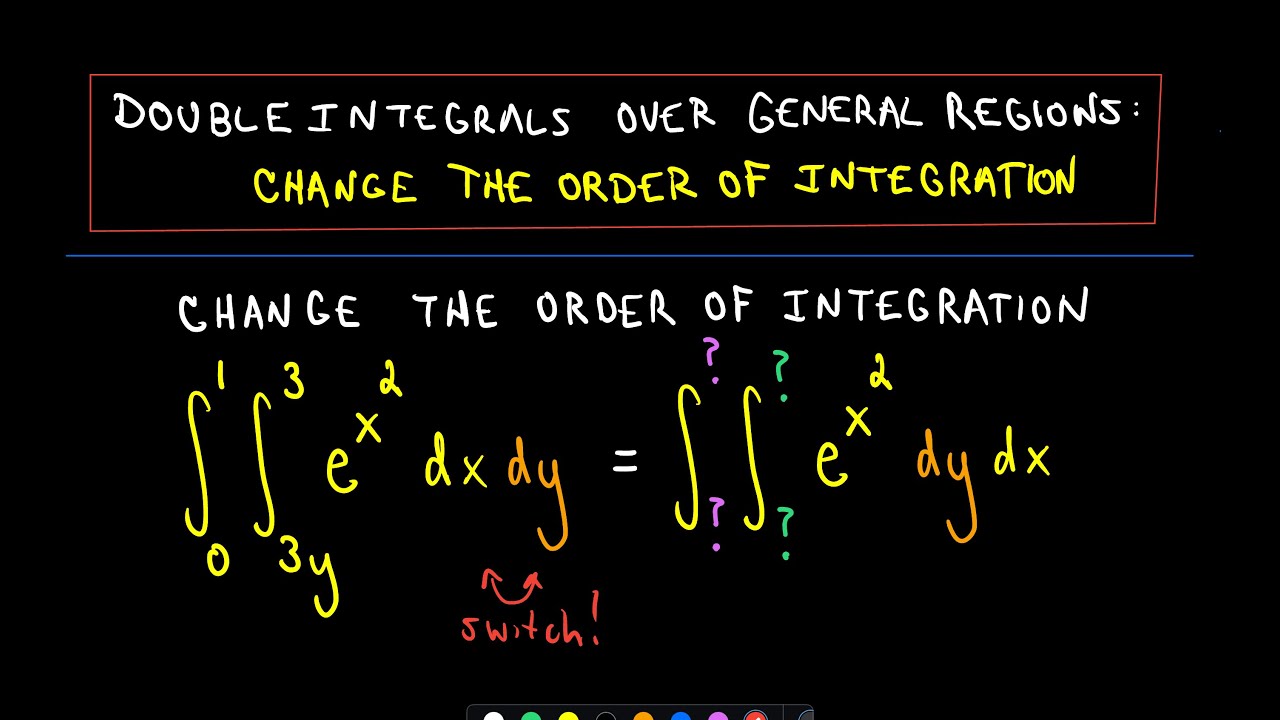
Thanks to all of you who support me on Patreon. You da real mvps! $1 per month helps!! :) https://www.patreon.com/patrickjmt !! Double Integrals - Changing Order of Integration - Full Example.
In this video, I show an example of how to switch the order of integration. I also integrate the function to get the final answer.
For more free math ...
I found a video

Patrick Jmt clutched it
😎
topaz sinewBOT
@night flax Has your question been resolved?
topaz sinewBOT
Channel closed
Closed due to timeout
Use .reopen if this was a mistake.
Available help channel!
Send your question here to claim the channel.
Remember:
• Ask your math question in a clear, concise manner.
• Show your work, and if possible, explain where you are stuck.
• After 15 minutes, feel free to ping <@&286206848099549185>.
• Type the command .close to free the channel when you're done.
• Be polite and have a nice day!
Read #❓how-to-get-help for further information on how to ask a good question, and about conduct in the question channels.
 drifting wigeon
 topaz sinewBOT
drifting wigeon
drifting wigeon
topaz sinewBOT
drifting wigeon
drifting wigeon
Need help with this problem I have work done of how i set up and what equations
and I don’t know what I did wrong
 silk pewter
drifting wigeon
silk pewter
drifting wigeon
section formula


 silk pewter
wtf is that
drifting wigeon
and here’s my work
my teacher didn’t go over this part in the lesson and says to use to that formula
so i got (1.5,3.5)
silk pewter
$(x,y) = \left( \frac{mx_2 + nx_1}{m+n} , \frac{my_2 + ny_1}{m+n} \right)$
thorny flameBOT
bettim
 drifting wigeon
i’ve never seen that equation
silk pewter
wtf
drifting wigeon
what does n stand for
silk pewter
then idk
drifting wigeon
yeah i haven’t seen that the ss i sent is the equation it says we’re supposed to use but i don’t know
cause my teacher didn’t go over it in class
topaz sinewBOT
Channel closed
Closed by @drifting wigeon
Use .reopen if this was a mistake.
Available help channel!
Send your question here to claim the channel.
Remember:
• Ask your math question in a clear, concise manner.
• Show your work, and if possible, explain where you are stuck.
• After 15 minutes, feel free to ping <@&286206848099549185>.
• Type the command .close to free the channel when you're done.
• Be polite and have a nice day!
Read #❓how-to-get-help for further information on how to ask a good question, and about conduct in the question channels.
 carmine elbow
 topaz sinewBOT
carmine elbow
carmine elbow
topaz sinewBOT
carmine elbow
carmine elbow
why would it be (1/3)(sin(3x)) instead of 3sin(3x)
the chain rule is f'(g) * g' right ?
 woeful drift
for derivatives, yes
topaz sinewBOT
Channel closed
Closed by @carmine elbow
Use .reopen if this was a mistake.
Available help channel!
Send your question here to claim the channel.
Remember:
• Ask your math question in a clear, concise manner.
• Show your work, and if possible, explain where you are stuck.
• After 15 minutes, feel free to ping <@&286206848099549185>.
• Type the command .close to free the channel when you're done.
• Be polite and have a nice day!
Read #❓how-to-get-help for further information on how to ask a good question, and about conduct in the question channels.
 shy oar
Why is the -4 in ) but 7 in[ in this case?
 topaz sinewBOT
shy oar
Why is the -4 in ) but 7 in[ in this case?
topaz sinewBOT
shy oar
Why is the -4 in ) but 7 in[ in this case?
 drifting swift
does -4 belong to the domain?
shy oar
I know that X=7 for the numerator and x=-4 in the denominator, but how does that relate to the domain again?
drifting swift
sounds like some kind of misconception or overfocus on computation on your part
can you describe in your own words what the domain of a function is, in general?
shy oar
The set of numbers that the function reaches in the x line in a graph.
drifting swift
the set of numbers that are valid inputs to the function.
 junior pumice
shy oar
Why is the -4 in ) but 7 in[ in this case?
junior pumice
shy oar
Why is the -4 in ) but 7 in[ in this case?
what ann is trying to say is that you're forgetting this is a composite function, the outer function being square root. which has a certain domain that would involve the numerator in this case.
shy oar
So since it’s in a square root the numerator is also apart of the domain?
junior pumice
what is the domain of square root
 unique seal
junior pumice
what ann is trying to say is that you're forgetting this is a composite function...
unique seal
junior pumice
what ann is trying to say is that you're forgetting this is a composite function...
sqrt doesnt have anything to do with this question specifically
-4 isnt part of the domain because at exactly -4 the function is undefined
division by zero
junior pumice
unique seal
sqrt doesnt have anything to do with this question specifically
-4 isnt part of ...
i suggest re-reading what they are asking and looking at the domain of this function
square root's domain. that is the answer to the reason why the domain is the way it is.
yes we can't divide by zero, that's the first step.
what else can't we do with square root
look at a graph of sqrt(x) if you have to.
shy oar
[o,inf.)
junior pumice
right, so in this case, how do we make sure that the value under the square root stays within that interval?
same thing we did to make sure we don't divide by zero.
shy oar
Include 7 so [7,inf) since 0/n is still valid?
junior pumice
so to make sure we didn't divide by zero, you took the denominator and set it = 0 right?
shy oar
Yes
junior pumice
so now we take the other piece of the puzzle, the numerator... make sure it's not what?
think of the domain of square root
what is outside the domain
0 separates the number line between what kind of numbers

shy oar
Negative and positive
junior pumice
right, so what condition must the numerator satisfy here? what does it have to be? think of an equality.
shy oar
Does it have to be positive since there can’t be a negative in a square root
junior pumice
can't be a negative, right
shy oar
Yeah
shy oar
Or 0 right
junior pumice
we're thinking in equalities here. less than, greater than or equal to
shy oar
Greater or equal to 0
shy oar
Inf
junior pumice
no. remember how we used algebra to make sure we didn't divide by zero?
we can use algebra on inequalities just like equations
shy oar
7
junior pumice
no. we are concerned with the numerator here aren't we?
this is very similar to making sure we don't divide by zero, but instead we use an equality

whats the numerator
junior pumice
we are dealing with what we input into the square root, not the square root itself.
? >= 0
junior pumice
use the whole numerator, because that's what determines whether what we give to the square root will be negative or not.
x - 7 >= 0 you can solve this for x. and this gives you the other piece of the domain. then you combine the domains of the denominator and numerator and that is the answer they are showing you.
whatever x may be must satisfy both conditions: no division by zero and no negative numbers.
these are the restrictions put on the function by division and square roots.
i suggest studying more on what exactly a function is. its something that takes an input and produces an output. sometimes a function can only take certain inputs, restricting its domain.
and it can even have a limit to what it outputs, which is its range.
study these terms some more and you'll get it.
topaz sinewBOT
Channel closed
Closed by @shy oar
Use .reopen if this was a mistake.
topaz sinewBOT
Available help channel!
Send your question here to claim the channel.
Remember:
• Ask your math question in a clear, concise manner.
• Show your work, and if possible, explain where you are stuck.
• After 15 minutes, feel free to ping <@&286206848099549185>.
• Type the command .close to free the channel when you're done.
• Be polite and have a nice day!
Read #❓how-to-get-help for further information on how to ask a good question, and about conduct in the question channels.
 west isle
Hi I need help with this question
 topaz sinewBOT
west isle
Hi I need help with this question
west isle
topaz sinewBOT
west isle
Hi I need help with this question
west isle
I have worked out the 1st and 2nd derivative
and found the critical point
but I am a bit stuck as what to do from there
 rain radish
Could you send your working
 rain radish
Are you aware of the condition of critical point in the second derivative to identify the minima and maxima
west isle
yes
so can I just sub in my critical points into the second derivative?
and that will give me the sign as to if it is a max or min
 elfin stone
tysm for your help, my wifi turned of so i coudnt reply but i got the question right!
west isle
ok so i figured out which is max and which is min
rain radish
Now, put them into the first equation and find the values of a
west isle
will do 👍
topaz sinewBOT
@west isle Has your question been resolved?
west isle
Thank you I think I got it
topaz sinewBOT
Channel closed
Closed by @west isle
Use .reopen if this was a mistake.
Available help channel!
Send your question here to claim the channel.
Remember:
• Ask your math question in a clear, concise manner.
• Show your work, and if possible, explain where you are stuck.
• After 15 minutes, feel free to ping <@&286206848099549185>.
• Type the command .close to free the channel when you're done.
• Be polite and have a nice day!
Read #❓how-to-get-help for further information on how to ask a good question, and about conduct in the question channels.
 glad lion
so i need help
 topaz sinewBOT
glad lion
so i need help
topaz sinewBOT
glad lion
so i need help
 sage anchor
we should fins x value??
glad lion
sage anchor
we should fins x value??
no no xD
convert this equation to general form
ax^2+by+c=0
you know?
keen matrix
glad lion
so i need help
you can multiply $x$ to both sides of the equation and keep the equality:
$4x-\frac{3}{x}=2\implies x\cdot(4x-\frac{3}{x})=2\cdot x$
sage anchor
glad lion
ax^2+by+c=0
easy question
thorny flameBOT
XxMrFancyu2xX
 sage anchor
4x^2-2x-3=0
topaz sinewBOT
sage anchor
4x^2-2x-3=0
As a helper, please do not give out answers that could be copied as a homework solution. Have the student work through the problem themselves and guide them along the way.
sage anchor
topaz sinew
As a helper, please do not give out answers that could be copied as a homework s...
sry sry
glad lion
so
keen matrix
sage anchor
sry sry
nah ur good just not supposed to lmao
 keen matrix
glad lion
4x-2x-3x=0
keen matrix
glad lion
4x-2x-3x=0
this is wrong
glad lion
keen matrix
this is wrong
mb i forgot the ^2
thorny flameBOT
XxMrFancyu2xX
 glad lion
keen matrix
this keeps the equality, yes?
glad lion
keen matrix
this keeps the equality, yes?
yes because 4x-3=2x
keen matrix
not because that but because we can divide $x$ out of both sides of the equation
thorny flameBOT
XxMrFancyu2xX
 keen matrix
albeit that result is still incorrect
we multiply x to both 4x and 3/x
what is 4x timex x?
glad lion
keen matrix
what is `4x` timex `x`?
4x^2 ofc
thorny flameBOT
XxMrFancyu2xX
 keen matrix
now we can get that into the form ax^2+bx+c=0
glad lion
ye so 4x^2-2x-3=0
glad lion
keen matrix
I agree with that
oh so all this time you wanted me to put the zero lmaaoooo
glad lion
keen matrix
well also the x^2 you missed that
lmao so sorry i forgot
i subconsciously wrote it
keen matrix
also as for this, do you now how to complete the square?

or do you know what completing the square means?
glad lion
keen matrix
also as for this, do you now *how* to complete the square?
i mean i did ques 1 and i did something
glad lion
keen matrix
or do you know *what* completing the square means?
yes
so i moved 7 to the other side
keen matrix
Show me your work or logic for q1a
keen matrix
you start out with the quadratic $x^2+6x+8=0$ where did $-x+5x=3$ come from?
thorny flameBOT
XxMrFancyu2xX
 glad lion
keen matrix
you start out with the quadratic $x^2+6x+8=0$ where did $-x+5x=3$ come from?
glad lion
keen matrix
you start out with the quadratic $x^2+6x+8=0$ where did $-x+5x=3$ come from?
i mean the first
one
im not sure of my ans
for 1
thorny flameBOT
XxMrFancyu2xX
 glad lion
yes
keen matrix
are you stuck there?
keen matrix
of so your first issue


 keen matrix
yes
thorny flameBOT
XxMrFancyu2xX
 keen matrix
thorny flame
**XxMrFancyu2xX**
keen matrix
thorny flame
**XxMrFancyu2xX**
^
glad lion
keen matrix
^
ah i see
keen matrix
ok so how do you do that in your quadratic: $-x^2+5x-3=0$?
thorny flameBOT
XxMrFancyu2xX
 glad lion
keen matrix
ok so how do you do that in your quadratic: $-x^2+5x-3=0$?
glad lion
keen matrix
ok so how do you do that in your quadratic: $-x^2+5x-3=0$?
x^2-5x+3+0
keen matrix
= but yes
i agree with that answer
ok now we're all good to proceed, do you know how to complete the square, what's the first step?
glad lion
keen matrix
ok now we're all good to proceed, do you know how to complete the square, what's...
-5/2)^2?
glad lion
keen matrix
but there's another step that must come first
which is?you mean the factorisation thing?
keen matrix
move the 3 over
keen matrix
yes
glad lion
x^2-5x-25/4=3-25/4
thorny flameBOT
XxMrFancyu2xX
 keen matrix
yes I agree
glad lion
keen matrix
yes I agree
so how do i procceed?
keen matrix
now do you remember the perfect square trinomial?
glad lion
keen matrix
now do you remember the perfect square trinomial?
(x-2)^2= ax+2ax+b?
keen matrix
not quite
If I have a quadratic $x^2-2\cdot\frac{5}{2}\cdot x+\left(\frac{5}{2}\right)^2$
thorny flameBOT
XxMrFancyu2xX
 keen matrix
what do you notice about it?
glad lion
keen matrix
what do you notice about it?
x+b/2^2-b/2^2+c=0
keen matrix
no, we can write it as $\left(x-\frac{5}{2}\right)^2$
thorny flameBOT
XxMrFancyu2xX
 keen matrix
do you see how?
glad lion
ye bc factorise
keen matrix
ok now solve $\left(x-\frac{5}{2}\right)^2=-\frac{13}{4}$ and we have the answer!
thorny flameBOT
XxMrFancyu2xX
 glad lion
so uhh we expand
 glad lion
4.303 and 0.697
thorny flameBOT
XxMrFancyu2xX
 glad lion
yea
keen matrix
you have this right?
keen matrix
not entirely
glad lion
oh
keen matrix
$x-\frac{5}{2}=\pm\frac{\sqrt{-13}}{2}$
thorny flameBOT
XxMrFancyu2xX
 glad lion
how do you type that omg
keen matrix
ohhh just wait till you see matrices in latex 💀
$\begin{vmatrix}\frac{\partial}{\partial\rho}\left[\rho\cos\theta\right] & \frac{\partial}{\partial\theta}\left[\rho\cos\theta\right]\ \frac{\partial}{\partial\rho}\left[\rho\sin\theta\right] & \frac{\partial}{\partial\theta}\left[\rho\sin\theta\right]\end{vmatrix}=\begin{vmatrix}\cos\theta & -\rho\sin\theta \ \sin\theta & \rho\cos\theta\end{vmatrix}$
thorny flameBOT
XxMrFancyu2xX
 glad lion
keen matrix
$\begin{vmatrix}\frac{\partial}{\partial\rho}\left[\rho\cos\theta\right] & \frac...
glad lion
keen matrix
$\begin{vmatrix}\frac{\partial}{\partial\rho}\left[\rho\cos\theta\right] & \frac...
how
are you guys capable of this wizardy
thorny flameBOT
XxMrFancyu2xX
 glad lion
$x^2$
thorny flameBOT
Adonis
 keen matrix
now x cubed?
glad lion
$x^3$
thorny flameBOT
Adonis
 glad lion
$x^10$
thorny flameBOT
Adonis
 glad lion
heh
glad lion
nope?
thorny flameBOT
XxMrFancyu2xX
 keen matrix
if you don't have curly braces the LaTeX compilier will only look at the first character and raise that
however if the curly braces are there it will raise everything in the curly braces
so try writing x^(abcdefgh) in LaTeX @glad lion ? (sorry for ping)
glad lion
x^{10}
keen matrix
don't forget your dollar signs!!
dollar signs indicate when the LaTeX compiler should enter "math mode" and when to stop
glad lion
keen matrix
dollar signs indicate when the LaTeX compiler should enter "math mode" and when ...
why that choice of syntax
keen matrix
because besides for money when do you use the dollar sign?
glad lion
keen matrix
because besides for money when do you use the dollar sign?
fair enough
keen matrix
so what's x^(10) in latex form?
glad lion
x^${10}$
thorny flameBOT
Adonis
Compile Error! Click the  reaction for more information.
(You may edit your message to recompile.)
 glad lion
x^${10}$
thorny flameBOT
Adonis
Compile Error! Click the reaction for more information.
(You may edit your message to recompile.)
 keen matrix
the entire thing should have dollar signs
glad lion
$x^${10}$
thorny flameBOT
Adonis
Compile Error! Click the reaction for more information.
(You may edit your message to recompile.)
 keen matrix
you have three there
glad lion
x^{10}$
keen matrix
just at the beginning and end
glad lion
$x^{10}$
thorny flameBOT
Adonis
 glad lion
$x^2{10}$
thorny flameBOT
Adonis
 glad lion
$x^{37}$
thorny flameBOT
Adonis
 keen matrix
yes
very nice!
in latex fractions can be written as: \frac{a}{b} and yield $\frac{a}{b}$
thorny flameBOT
XxMrFancyu2xX
Compile Error! Click the reaction for more information.
(You may edit your message to recompile.)
 glad lion
this is like learning js for the first time
topaz sinewBOT
@glad lion Has your question been resolved?
topaz sinewBOT
Channel closed
Closed due to timeout
Use .reopen if this was a mistake.
Available help channel!
Send your question here to claim the channel.
Remember:
• Ask your math question in a clear, concise manner.
• Show your work, and if possible, explain where you are stuck.
• After 15 minutes, feel free to ping <@&286206848099549185>.
• Type the command .close to free the channel when you're done.
• Be polite and have a nice day!
Read #❓how-to-get-help for further information on how to ask a good question, and about conduct in the question channels.
 hazy saffron
How do I verify this? I got stuck when I substitute it to cos and sin. I started at the left hand side
 topaz sinewBOT
hazy saffron
How do I verify this? I got stuck when I substitute it to cos and sin. I started...
hazy saffron
topaz sinewBOT
hazy saffron
How do I verify this? I got stuck when I substitute it to cos and sin. I started...
hazy saffron
So, what I did is to convert csc to 1/sin and cot to cos/sin. And in denominator, tan to sin/cos.
 spare smelt
,w cot(x)csc(x) - (csc(x)+cot(x))/(tan(x)+sin(x))
thorny flameBOT


 Requested by Mr. Gamer#6658
hazy saffron
Requested by Mr. Gamer#6658
hazy saffron
And in there is where I don’t know what to do.
spare smelt
alright so we know it's true.
hazy saffron
Yep
spare smelt
ok why don't we try writing in terms of sines and cosines
(1/sin + cos/sin) / (sin/cos + sin)
multiply the top and bottom through by sin
hazy saffron
I don’t know if mine is correct. I got in the top is 1+cos and below is sin^2/ cos plus sin^2
spare smelt
yep
so you have
(1 + cos) / (sin^2/cos + sin^2)
now multiply the top and bottom through by ?
(what will allow you to clear the fraction?)
hazy saffron
So, I foil?
hazy saffron
I multiply both below and top by cos?
topaz sinewBOT
@hazy saffron Has your question been resolved?
Channel closed
Closed by @hazy saffron
Use .reopen if this was a mistake.
Available help channel!
Send your question here to claim the channel.
Remember:
• Ask your math question in a clear, concise manner.
• Show your work, and if possible, explain where you are stuck.
• After 15 minutes, feel free to ping <@&286206848099549185>.
• Type the command .close to free the channel when you're done.
• Be polite and have a nice day!
Read #❓how-to-get-help for further information on how to ask a good question, and about conduct in the question channels.
 thick adder
I have calculated the skaters velocity using $\sqrt(2\times9.8\times4)$, this will give me the velocity that the skater will have at point O. I have then calculated the loss of GPE that the skater will experience past O, using 4cos(30) to give the small change in height. I am unsure how to find the anser though...
 topaz sinewBOT
thick adder
I have calculated the skaters velocity using $\sqrt(2\times9.8\times4)$, this wi...
topaz sinewBOT
thick adder
I have calculated the skaters velocity using $\sqrt(2\times9.8\times4)$, this wi...
Please don't occupy multiple help channels.
thorny flameBOT
totalminer
 topaz sinewBOT
thick adder
I have calculated the skaters velocity using $\sqrt(2\times9.8\times4)$, this wi...
topaz sinewBOT
thick adder
I have calculated the skaters velocity using $\sqrt(2\times9.8\times4)$, this wi...
Please stick to your channel.
 empty sail
Don't open multiple channels
empty sail
Even so, you don't open multiple channels
thick adder
I will close the other one and come back to it later.
topaz sinewBOT
@thick adder Has your question been resolved?
topaz sinewBOT
@thick adder Has your question been resolved?
 full ravine
thick adder
I have calculated the skaters velocity using $\sqrt(2\times9.8\times4)$, this wi...
full ravine
thick adder
I have calculated the skaters velocity using $\sqrt(2\times9.8\times4)$, this wi...
its just pendulum motion
thick adder
but i havent studied that in this chapter... ? it wants me to use energy equation
thick adder
I DIDNT SKIP IT I HAVE WORKED THROUGH EVERY CHAPTER CHRONOLIGICALLY
@neon iron i didnt skip it :(((
 neon iron
Lol dude same well kinda , i regret skipping
I eventually have to DO IT
Wait is there a
Oh damnnnn
I DIDN'T KNEW THAT EXISTED
@thick adder
Go there
I'll join too
thick adder
i have to verify my phone number tho....
neon iron
Its literally 1:1 to maths server
Exactly same
Just channels are different
Kinda dead too
thick adder
I DIDNT SKIP NOTHING >...... ::(((
ITS ON THE LATER CHAPTER
I CAN SHOW U MY TEXT BOOK
u mus be able to solve using mgh ??
neon iron
thorny flame
**totalminer**
velocity will be calculated by formula root2gr-rcostheta
neon iron
thick adder
u mus be able to solve using mgh ??
All I know is
Somehow
Curve is same as
A straight free fall
If smooth
Frictionless
And all it does is
Change its velocity from vertical to horizontal
@thick adder so yes u should be able to apply mgh till the 90° arc
But that extra 30°
I'm not sure how
To apply it
Probably will have
2 different components
neon iron
thick adder
ITS ON THE LATER CHAPTER
Lol u are ahead of ur current topic , and here i literally skipped it
neon iron
Circular motion??
thick adder
but only thing i think is similar
no not yet thats on literal next chapter
after momentum chapter
neon iron
U should try vertical circle questions to understand this one better
Vertical circular motion i mean
neon iron
neon iron
2 different components
I gave you the direct formula
root 2g r-rcostheta
here theta is 30
can u
Theoretically explain
oh ohk
How it measures
That extra 30°
Ik till 90°
like the change in height is r-rcostheta
The first 90
neon iron
neon iron
like the change in height is r-rcostheta
Hmm i see
So it dosent matter what angle it is
Wait it does
From the formula
yh
But generally from mgh
We only need to know the height
Cant we use trignometry somehow
wait let me recheck my formula I actually rote while preparing for jee
let me verify it
To find that end Hight
neon iron
neon iron
wait let me recheck my formula I actually rote while preparing for jee
Ok
hey it will be just rcostheta
you just need to see the chnge in height
between two points
which is rcostheta by geometry
thick adder
then calculated mgh using 60 * g * (4-4cos(30))
neon iron
thick adder
then calculated mgh using 60 * g * (4-4cos(30))
ahh yess lol
thick adder
took eq 2 from eq 1 an applied ke
thick adder
i normaly dont like telling my story cus it is embarrasing
neon iron
thick adder
i normaly dont like telling my story cus it is embarrasing
not embarassing
thick adder
i dropped out of college
full ravine
now i know your age
topaz sinewBOT
Channel closed
Closed by @thick adder
Use .reopen if this was a mistake.
thick adder
dont drop out
topaz sinewBOT
Available help channel!
Send your question here to claim the channel.
Remember:
• Ask your math question in a clear, concise manner.
• Show your work, and if possible, explain where you are stuck.
• After 15 minutes, feel free to ping <@&286206848099549185>.
• Type the command .close to free the channel when you're done.
• Be polite and have a nice day!
Read #❓how-to-get-help for further information on how to ask a good question, and about conduct in the question channels.
 elder glacier
 topaz sinewBOT
elder glacier
topaz sinewBOT
elder glacier
 copper delta
Try pulling out all common factors first
elder glacier
copper delta
Try pulling out all common factors first
it wants me to factorise and shorten it as much as possible
copper delta
Yeah so (15a+3b) can be written as 3(5a+b)
Eventually there will be terms that cancel out and give you your answer
 thorny flameBOT
 elder glacier
Is this correct?
copper delta
Yup, is it one of the answers?
topaz sinewBOT
@elder glacier Has your question been resolved?
elder glacier
copper delta
Yup, is it one of the answers?
yeah
can you help me with this one tho?

@copper delta
copper delta
Its a similar question, for example 4xy+8x^2y^2 could be written as 4xy(1+2xy) since 4xy is a common factor
neon iron
elder glacier
can you help me with this one tho?
take x=1y=2see which option matches
elder glacier
copper delta
Its a similar question, for example 4xy+8x^2y^2 could be written as 4xy(1+2xy) s...
6 can not be written with 4 though
do i change the factor?
topaz sinewBOT
Channel closed
Closed due to timeout
Use .reopen if this was a mistake.
Available help channel!
Send your question here to claim the channel.
Remember:
• Ask your math question in a clear, concise manner.
• Show your work, and if possible, explain where you are stuck.
• After 15 minutes, feel free to ping <@&286206848099549185>.
• Type the command .close to free the channel when you're done.
• Be polite and have a nice day!
Read #❓how-to-get-help for further information on how to ask a good question, and about conduct in the question channels.
 lyric spruce
Hii
topaz sinewBOT
lyric spruce
Hii
 silver edge
How do I solve this with a coordinate system
for the first one ive got y= -1/6x +1/3
but if I put put 0 on the coordinate system my y is 1/3
 grim jacinth
silver edge
How do I solve this with a coordinate system
for the first one ive got y= -1/6x...
grim jacinth
silver edge
How do I solve this with a coordinate system
for the first one ive got y= -1/6x...
Solve for x or y in one equation. Plug that expression into the other equation. That new equation will have just one variable in it you can solve for
silver edge
grim jacinth
Solve for x or y in one equation. Plug that expression into the other equation. ...
it needs to be graphically
and my coordinate system is a bit messed up
grim jacinth
Then plot both graphs
silver edge
 restive inlet
messed up how?
restive inlet
messed up how?
I didn't knew the term
it was a table of values
like if I put 0 on x my y would be 1/3
but we can't use decimal numbers
restive inlet
there are values of x that'll give integer values for y
combining
-x/6 +1/3 into a single fraction may make them easier to identify
silver edge
restive inlet
combining
-x/6 +1/3 into a single fraction may make them easier to identify
-x/6 +2/6?
restive inlet
denominators are the same
now combine the fractions
silver edge
restive inlet
denominators are the same
now combine the fractions
-1x + 2?
don't know what you mean with combine
restive inlet
don't overthink
write as a single fraction
instead of a sum/difference of two fractions
silver edge
ah ok
silver edge
restive inlet
instead of a sum/difference of two fractions
can you help me to do the table of values
I really don't know how to do it (i mean I know but the fraction is just struggling me
restive inlet
did you combine the fractions
silver edge
I did
restive inlet
what's the combined fraction
silver edge
-1x +2 /6
im probably wrong
restive inlet
missing ()
to indicate the numerator
the 1 next to the x isn't necessary either
y = (-x + 2)/6
silver edge
oh so If I combine a fraction with the same numerator
it needs ()?
restive inlet
writing on paper assuming you write it out properly like
$$\frac{-x +2}{6}$$
parentheses aren't needed. \
on text however it's different
thorny flameBOT
ℝamonov
 restive inlet
writing \verb|-1x +2/6| following the order of operations will be interpreted as
$$-1x + \frac 26$$
thorny flameBOT
ℝamonov
 restive inlet
anyway continuing
y = (-x + 2)/6
this will be an integer if the numerator is a multiple of 6 (which are divisible by 6)
so try finding such values
silver edge
restive inlet
anyway continuing
> y = (-x + 2)/6
this will be an integer if the numerator is a...
-1x .6 and the 2.6
6x + 12 ?
silver edge
restive inlet
what
I thought I have to get rid of the denominator
restive inlet
did I say get rid of denominator anywhere?
silver edge
no
restive inlet
do you agree that
(multiple of 6)/6 will be an integer
silver edge
yes
restive inlet
so if -x+2 is a multiple of 6
then
(-x+2)/6 will be an integer
giving you an integer value for y
so try finding values of x where
-x+2 is a multiple of 6
you could pick a multiple of 6,
set -x+2 equal to that
then solve for x
silver edge
restive inlet
you could pick a multiple of 6,
set -x+2 equal to that
then solve for x
-6
silver edge
restive inlet
no
-x/6
silver edge
-x/6 + 1/3
restive inlet
it's like you're not reading what I'm saying
now you're going backwards
do you agree that
(multiple of 6)/6 will be an integer
you agreed to that right
silver edge
yes I do it's just understaning in another language is a bit hard
restive inlet
following that, do you have an issue with
so if -x+2 is a multiple of 6
then
(-x+2)/6 will be an integer
giving you an integer value for y
silver edge
restive inlet
following that, do you have an issue with
>>>
so if `-x+2` is a multiple of 6
t...
-x +2
I have a feeling its wrong again 💀
restive inlet
that was a yes/no question
restive inlet
yes you agree or yes you have an issue/problem with what i said
silver edge
I agree
restive inlet
so try finding values of x where
-x+2 is a multiple of 6
and to do that you can
follow these steps one at a time
you could pick a multiple of 6,
silver edge
can I just pick 6?
restive inlet
yes, 6 is a multiple of 6
now set -x+2 equal to what you just chose
i.e.
write the equation
-x+2 = 6
then solve for x
silver edge
-2
silver edge
-4
restive inlet
that's better
and this is one of the values of x where y is an integer
to get others, choose another multiple of 6, then same idea
silver edge
restive inlet
to get others, choose another multiple of 6, then same idea
so this is the easiest way?
silver edge
restive inlet
yes, 6 is a multiple of 6
like I haven't seen to do this
restive inlet
this idea would be applied in some way
topaz sinewBOT
@lyric spruce Has your question been resolved?
silver edge
restive inlet
i.e.
write the equation
-x+2 = 6
wait one more question
How do I have to write it down?
Do I have to write -x+6 =6 separately?
restive inlet
why are you doing
-x+6 = 6
silver edge
restive inlet
i.e.
write the equation
-x+2 = 6
you said to write down this equation
im confused where to put y or something
restive inlet
solving this equation gives you the value of x,
the y value will be (whatever you chose)/6
as
y = (multiple of 6 you chose)/6 = (-x+2)/6
silver edge
how would it look like?
restive inlet
how would what look like
continuing from
y = (-x+2)/6
when -x + 2 = 6
x= -4,
y = 6/6 = 1
topaz sinewBOT
Channel closed
Closed due to timeout
Use .reopen if this was a mistake.
topaz sinewBOT
✅
restive inlet
just realised you aren't the official owner of this channel
silver edge
restive inlet
just realised you aren't the official owner of this channel
I was 1 minute later and he just said hi
topaz sinewBOT
@lyric spruce Has your question been resolved?
topaz sinewBOT
Channel closed
Closed due to timeout
Use .reopen if this was a mistake.
Available help channel!
Send your question here to claim the channel.
Remember:
• Ask your math question in a clear, concise manner.
• Show your work, and if possible, explain where you are stuck.
• After 15 minutes, feel free to ping <@&286206848099549185>.
• Type the command .close to free the channel when you're done.
• Be polite and have a nice day!
Read #❓how-to-get-help for further information on how to ask a good question, and about conduct in the question channels.
Channel closed
Closed due to the original message being deleted
 gilded shoal
 topaz sinewBOT
Available help channel!
topaz sinewBOT
Available help channel!
Send your question here to claim the channel.
Remember:
• Ask your math question in a clear, concise manner.
• Show your work, and if possible, explain where you are stuck.
• After 15 minutes, feel free to ping <@&286206848099549185>.
• Type the command .close to free the channel when you're done.
• Be polite and have a nice day!
Read #❓how-to-get-help for further information on how to ask a good question, and about conduct in the question channels.
 smoky pasture
hey simple question, im curious how you can find the normal vector using gradients to the function -3x+4y
i was taught we have to put the function into 1 higher dimension, then take the gradient and that is our normal vector, ie -3x+4y=z then take gradient
what i dont understand is how you actually take the gradient, taking it like i would normal, id get <f_x,f_y,f_z>=<-3,4,1> but that doesnt make sense as the normal vector to a 2d function cant be a 3d vector right?
topaz sinewBOT
smoky pasture
hey simple question, im curious how you can find the normal vector using gradien...
neon iron
if you are embedding into 3d, say its 0z
 keen venture
In 2d it's easy.
If your gradient vector is (1,2), then the normal is (-2,1)
Something something take the negative reciprocal
smoky pasture
neon iron
if you are embedding into 3d, say its 0z
So -3x+4y=0z
 bronze bison
i would do it like with planes
in a plane, like -3x+4y+5z=2
your normal vector is (-3,4,5)
so here in 2d we could do the exact same
smoky pasture
keen venture
In 2d it's easy.
If your gradient vector is (1,2), then the normal is (-2,1)
But howd u do that?
bronze bison
we have the line -3x+4y=0
then (-3,4) should be the normal
keen venture
Oh yeah, there's that too. The coefficients spell out the normal
bronze bison
other than that, we could do:
-3x+4y=0
y=3y/4
y'=3/4
the slope of the normal is the negative inverse of the slope of y
so we get for the normal:
n'=-4/3
integrate
n=-4x/3+b
the b can be whatever, depends on where you want your normal
b=0 if in origin of course
smoky pasture
that seems different to what i was taught but gives the same answer, im just wondering about the way i was taught with the raise the dimensions then take gradients
or is the way ur doing it the only logically consistent way to do it?
bronze bison
i guess there are more ways than one
i guess you could take your 3rd dimension to be 0 and then take the gradient
smoky pasture
do you think you could try to explain the dimension way, otherwise youd have to teach me the whole concept of ur way
smoky pasture
bronze bison
i guess you could take your 3rd dimension to be 0 and then take the gradient
so like 0z?
bronze bison
yeah i guess
smoky pasture
ah ok
bronze bison
but that is pretty weird
cause
-3x+4y+0z=0
take the gradient of that
you could just take the gradient of
-3x+4y=0
smoky pasture
yeah its the long way, im just learning it so i want to understand whats happening behind the scenes, i can optimize speed once i understand it
but the 0z makes sense
ty for the help!
bronze bison
i dont see what taking it to a higher dimension should give us though
as that does not increase our information
the only possible reason would be to use a function that is only defined in 3d
smoky pasture
well the way i was taught is that gradients are perpendicular to a level curve of a function
bronze bison
at least thats the only thing i could think of
smoky pasture
smoky pasture
well the way i was taught is that gradients are perpendicular to a level curve o...
thus every function is a level curve to another
thus find that function that turns into the level curve equal to our function then take the gradient of that
smoky pasture
bronze bison
as that does not increase our information
functionally it does nothing
so your totally right
but it just helps build my intuition for why something is occuring
anyways, thanks for the help, have a good one!
.close
topaz sinewBOT
Channel closed
Closed by @smoky pasture
Use .reopen if this was a mistake.
Available help channel!
Send your question here to claim the channel.
Remember:
• Ask your math question in a clear, concise manner.
• Show your work, and if possible, explain where you are stuck.
• After 15 minutes, feel free to ping <@&286206848099549185>.
• Type the command .close to free the channel when you're done.
• Be polite and have a nice day!
Read #❓how-to-get-help for further information on how to ask a good question, and about conduct in the question channels.
neon iron
How do I factor the left side
 topaz sinewBOT
neon iron
How do I factor the left side
copper delta
topaz sinewBOT
neon iron
How do I factor the left side
copper delta
x^3 +9x^2 can be written as x^2(x+9) and x^2 - 81 can be written as (x-9)(x+9) using difference of squares
Then they just cancel
?
 rapid marten
guys we have a comedian
empty sail
<@&268886789983436800>
rapid marten
hes jealous hes failing maths
copper delta
neon iron
I don’t know how to simplify it down
The (x-9)'s cancel
neon iron
copper delta
x^3 +9x^2 can be written as x^2(x+9) and x^2 - 81 can be written as (x-9)(x+9) u...
Thx
Does the 2x change at all
topaz sinewBOT
@neon iron Has your question been resolved?
topaz sinewBOT
Channel closed
Closed due to timeout
Use .reopen if this was a mistake.
Available help channel!
Send your question here to claim the channel.
Remember:
• Ask your math question in a clear, concise manner.
• Show your work, and if possible, explain where you are stuck.
• After 15 minutes, feel free to ping <@&286206848099549185>.
• Type the command .close to free the channel when you're done.
• Be polite and have a nice day!
Read #❓how-to-get-help for further information on how to ask a good question, and about conduct in the question channels.
 radiant lion
There are five white balls and three red balls if we put these eight balls in a row with no adjoining red balls the number of arrangements is? And, if we put this eight balls in a row with adjoining red balls the number of possible arrangements is?
topaz sinewBOT
radiant lion
There are five white balls and three red balls if we put these eight balls in a ...
 glad cliff
Are you familiar with the "balls in bins formula"?
glad cliff
Combinatorics
topaz sinewBOT
Channel closed
Closed by @radiant lion
Use .reopen if this was a mistake.
Available help channel!
Send your question here to claim the channel.
Remember:
• Ask your math question in a clear, concise manner.
• Show your work, and if possible, explain where you are stuck.
• After 15 minutes, feel free to ping <@&286206848099549185>.
• Type the command .close to free the channel when you're done.
• Be polite and have a nice day!
Read #❓how-to-get-help for further information on how to ask a good question, and about conduct in the question channels.
 spring ivy
someone help me please
topaz sinewBOT
spring ivy
someone help me please
neon iron
(also post the problem)
 spring ivy
Idrk I missed school yesterday and I don’t have the notes so idk how to do this really
 safe burrow
have you done completing the square before?
 frank torrent
$x^2+y^2+Cx+Dy+E$
thorny flameBOT
MochaOhwelp
 spring ivy
safe burrow
have you done completing the square before?
spring ivy
safe burrow
have you done completing the square before?
yeah
thorny flameBOT
MochaOhwelp

 glass badger
8 is easier than 7, try that first
spring ivy
Ok
glass badger
Do you remember Pythagoras theorem? For example, x^2+y^2=2^2 gives all the points that are 2 units of distance away from a center
It makes a circle
glass badger
In question 8, what would the radius of the circle be?
spring ivy
4?
glass badger
the radius is c, not c^2. So it would be 2
glass badger
do you know how graphs are shifted along an axis?
For example, f(x-3) shifts the graph of f(x) along the positive x axis 3 units. Same applies here for the center of the circle
So (x+3)^2+y^2=2^2 moves the circle 3 units to the left and vice versa
same for y too
Try graphing 8 now
frank torrent
actually its just pythagoras theorem
glass badger
ye
spring ivy
oh
glass badger
did you graph it?
glass badger
That one's just an example
X+3 shifts a circle center along the x axis in the left direction
Note that the directions are switched
So x^2+(y-1)^2 shifts the circle 1 unit upwards
And vice versa
You can graph every circle possible with this info
So your example, what would the x axis of the center be?
glass badger
It's x^2, so it would be at 0
If it was (x-5)^2 , then the center would be at 5 on the x axis like you said
spring ivy
so i got it correct?
glass badger
no
spring ivy
oh
glass badger
ok, How about (y-1)^2? Where along the y axis would the center of the circle be?
spring ivy
1
glass badger
Yep
 spring ivy
ok
glass badger
7, you have do some algebra to try and fit the equation into this form
In question 7 I mean
glass badger
Question 8 or 7?
spring ivy
7
glass badger
You can't do that since you haven't generalized the equation yet
glass badger

Add 9 and 4 to both sides of the equation
You get two factorable quadratic equations
frank torrent
thorny flame
**MochaOhwelp**
For me I'll remember this to calculate faster
Tho it's not good
glass badger
Ye it is faster
spring ivy
how do you get the 4 and 9 tho
glass badger
Do you know how completing a square is done? You take half of the coefficient of x and square it
spring ivy
yeah
spring ivy
3
glass badger
Then square it
spring ivy
then squared is 9
glass badger
Then that's what you need to add
spring ivy
glass badger
here u would put everything under a like check mark thing and take off the ^2
?
glass badger
 glass badger
spring ivy
here u would put everything under a like check mark thing and take off the ^2
glass badger
spring ivy
here u would put everything under a like check mark thing and take off the ^2
The center would be at (3,-2)
Radius would be 4
glass badger
?
 glass badger
Yes hold on
OK I figured it out
It's been a long time since I studied analytic geometry so I don't remember much. Sorry lol. Hold on a moment so I can show you how to do it
topaz sinewBOT
@spring ivy Has your question been resolved?
Channel closed
Closed by @spring ivy
Use .reopen if this was a mistake.
spring ivy
.reopen
topaz sinewBOT
✅
spring ivy
glass badger
It's been a long time since I studied analytic geometry so I don't remember much...
ok
glass badger
OK sorry for the delay I was just making sure
Do you know how to solve systems of equations?
And you subtract the second equation from the first one to solve for a. Then you subtract the third equation from the second to solve for b
After you solve for a and b, plug them in in any of the 3 equations and solve for c
Try it with the question 27
topaz sinewBOT
As a helper, please do not give out answers that could be copied as a homework solution. Have the student work through the problem themselves and guide them along the way.
glass badger
Oh alright
spring ivy
glass badger
Do you know how to solve systems of equations?
can u remind me again
I know how but I like kinda forgot
glass badger
Well, you try to add or subtract to equations you have to eliminate unknown variables. When working with only one unknown variable, you can solve for it
glass badger
kinda yeah
For example you have 2x+y=1 and 3x+y=5
You can very easily get rid of one of the unknown variables
Try subtracting them from each other and solve for x
 glass badger
Yeah like that
spring ivy
Alr
glass badger
You need to write out three equations to solve for the points of the circle
Recall the general form of a circle
You were give 3 points, so 3 values for both x and y
Though you don't know a and b
Try writing it out like how you would solve a system of equations
glass badger
They're represented with the x and y coordinates
spring ivy
yeah
spring ivy
yes
glass badger
I showed you the general form of a circle before right?
spring ivy
Um
spring ivy
glass badger
this?
spring ivy
glass badger
or this
glass badger
This one
 spring ivy
oh
glass badger
We we have three pieces of information about x and y, their coordinates
(1-a)^2+(6-b)^2=c^2 and so on
spring ivy
ok
glass badger
That's for point (1,6)
Try solving for a and b and tell me how it goes
That's all the info you need to solve this question
Reminder that you have three points
 glass badger
Yep exactly
Now, try using systems of equations. You don't have to add ALL of them. Try going 2 at a time
Excuse me, I said add. But you can also subtract
spring ivy
spring ivy
this has three terms
spring ivy
spring ivy
and this is like in parentheses and squared
glass badger
Look carefully. What happens when you subtract them?
Subtract the second and first, see what happens and count how many unknowns you have left
glass badger
it shouldn't be that way
spring ivy
oh
glass badger
Look, don't square them then subtract. You're complicating it. Do the first and second both have (6-b)^2? And do they both have c^2? Then what happens if you subtract them from each other?
spring ivy
it would be (1-a)^2 above (5-a)^2