#help-23
1 messages · Page 176 of 1
 drowsy karma
yes, we always do that, we move "x" to inside of the series
if you read problem books with series
you always notice answers
are writtin in such way
bu tyou also may transform it to yoru needs
 clever storm
Okay, and 9/15?
drowsy karma
yes
becasue
constant alaso belongs
to the general term
of the series
but remeber
if you have x^n, then all next to it, we call c_n
but if you have
x^(n+1)
then all you call as: c_(n+1)
so the name
depends on the epxoent
of the x
but there is another trick , also sued in such sum notations:
look
clever storm
ok
drowsy karma
$\sum_{n=0}^{\infty }\frac{x^{n+1}}{n+1}=\sum_{n=1}^{\infty }\frac{x^{n}}{n}$
 flat frigateBOT
Joanna Angel
 drowsy karma
pzl consider it
and thikn if you agreed
i want you to see, that both sides shwos the same
onyl in two diffeernt ways
clever storm
Yes, that makes sense
drowsy karma
this way , allowws you for manipualtions
with indexes
and n_terms inside the series
=
when you subtract one from n nside the terms
you add one to index
and opppsite
memorize it
clever storm
Yes, that makes sense, let me write this down
drowsy karma
k
clever storm
got it
flat frigateBOT
Joanna Angel
 drowsy karma
that is fo rfinite sums
but infite sums alslo work wiith it
in discrete mathemtics, you do oftensuch manipulations
clever storm
Okay, I'll keep this in minid for my final exam for calc 2, I think this could really help out there
Since there are many series like this
clever storm
Alright, thanks a bunch, I'll get back to studying but I appreciate it
drowsy karma
kk Good Luck! 🙂
 safe radishBOT
Channel closed
Closed by @clever storm
Use .reopen if this was a mistake.
 Available help channel!
Send your question here to claim the channel.
Remember:
• Ask your math question in a clear, concise manner.
• Show your work, and if possible, explain where you are stuck.
• After 15 minutes, feel free to ping <@&286206848099549185>.
• Type the command .close to free the channel when you're done.
• Be polite and have a nice day!
Read #❓how-to-get-help for further information on how to ask a good question, and about conduct in the question channels.
 worthy frost
NO idea what to make of it
 safe radishBOT
worthy frost
NO idea what to make of it
worthy frost
safe radishBOT
worthy frost
NO idea what to make of it
worthy frost
sure do
 wind shoal
Ok so basically when u plug in 2 u get 0/0
worthy frost
again forgot to specify
wind shoal
Now derive the top and the bottom
worthy frost
i can't use it in this exercise, my proff asked me
wind shoal
Ohh
worthy frost
my bad
safe radishBOT
@worthy frost Has your question been resolved?
worthy frost
<@&286206848099549185>
safe radishBOT
@worthy frost Has your question been resolved?
worthy frost
.close
safe radishBOT
Channel closed
Closed by @worthy frost
Use .reopen if this was a mistake.
worthy frost
.reopen
safe radishBOT
✅
 upper rivet
$\sin{\pi x} = \sin{\pi x - 2\pi} = \sin{\pi (x-2)}$
flat frigateBOT
nebula40

 fleet condor
upper rivet
$\sin{\pi x} = \sin{\pi x - 2\pi} = \sin{\pi (x-2)}$
fleet condor
upper rivet
$\sin{\pi x} = \sin{\pi x - 2\pi} = \sin{\pi (x-2)}$
does this help though
 sage vault
it might
fleet condor
the term is still stuck in the sin
upper rivet
you use a^3-b^3 in the numerator and sub u = x-2
sage vault
do you know how to factorise x^3 - 8?
upper rivet
the basic concept is that we want to bring it of the form sin(x)/x because we know that approaches 1 as x -> 0
worthy frost
You mean (x-2)(x^2 + 2x + 4?
upper rivet
or x/sin(x) in this case
upper rivet
worthy frost
You mean (x-2)(x^2 + 2x + 4?
yes
worthy frost
but x—> 2, no?
upper rivet
thats why you do what I said
upper rivet
flat frigate
**nebula40**
.
sage vault
I think the brackets in that chain of equalities is confusing
there's no brackets in the sines
upper rivet
yeah idk why tex doesnt do it automatically lol
but everything is the argument of the sin
sage vault
then that means you should do it manually I guess
worthy frost
So ill have x->2 (x^2 + 2x + 4)/sinPi
upper rivet
$\lim{x \to 2} \frac{(x-2)(x^2 + 2x + 4)}{\sin{(\pi (x-2))}}$
sage vault
nebula I think you should write those chain of equations again
with the brackets inserted manually
also it's \lim_{x\to 2} (you're missing the underscore)
upper rivet
$\sin{(\pi x)} = \sin{(\pi x - 2\pi)} = \sin{(\pi (x-2))}$
flat frigateBOT
nebula40
 upper rivet
sage vault
also it's \lim_{x\to 2} (you're missing the underscore)
upper rivet
sage vault
also it's \lim_{x\to 2} (you're missing the underscore)
thanks
sage vault
nw
 meager plover
Why sub if 2 isnt a root of x^2 + 2x + 4
upper rivet
that part doesnt matter
$\lim_{x \to 2} \frac{(x-2)(x^2 + 2x + 4)}{\sin{(\pi (x-2))}}$
flat frigateBOT
nebula40
 upper rivet
the left part is where we bring to x/sin(x) form
upper rivet
just substitute 12 for x^2 + 2x + 4
so now we have $\lim_{x \to 2} \frac{12(x-2)}{\sin{(\pi (x-2))}}$
$\lim_{x \to 2} \frac{12(x-2)}{\sin{(\pi (x-2))}}$
flat frigateBOT
nebula40
 upper rivet
this should be clear enough
worthy frost
Could you do one more step? Maybe im tired but i dont see what i should do next
upper rivet
alright so we substitute u = x - 2
like bishop said it's not really necessary but it helps makes things clearer
$\lim_{u \to 0} \frac{12(u)}{\sin{(\pi (u)}} = \lim_{u \to 0} \frac{12(\pi u)}{\pi \sin{(\pi u)}}$
flat frigateBOT
nebula40
 upper rivet
forgot the multiply denominator
sage vault
yeah I see where this is going now. This is pretty good
sage vault
worthy frost
Could you do one more step? Maybe im tired but i dont see what i should do next
John, do you remember that infamous sin(x)/x limit that equals 1?
worthy frost
sure
sage vault
do you think you can use it here?
meanwhile, I think I learned something new here thanks to @upper rivet
worthy frost
How did we get to x-> 0 from x-> 2?
meager plover
worthy frost
How did we get to x-> 0 from x-> 2?
Sub
sage vault
you can see that u -> 0
worthy frost
Oh i see
I dont know what do with sin being in the denominator, if not that i would know how to solve it
I think i got it
meager plover
worthy frost
I think i got it
L hopital
 meager plover
What are you doing
worthy frost
oh
meager plover
limit of x/sin(x) is 1 because of l hopital
1/cos(0)
= 1/1
we assume it exists
Because if it didnt then your original limit doesnt either
worthy frost
I didnt know x/sinx also -> 1, so instead I created it in the denominator dividing and then multiplying it by (piu) and then reduced piu in the nominator
sage vault
@meager plover He's not allowed to use l'hopitals. Scroll up to see the bit where he says it
sage vault
worthy frost
I didnt know x/sinx also -> 1, so instead I created it in the denominator dividi...
very well done mate
worthy frost
thank you!
meager plover
worthy frost
I didnt know x/sinx also -> 1, so instead I created it in the denominator dividi...
Whats the proof of sin(x)/x one
sage vault
meager plover
Whats the proof of sin(x)/x one
long story
meager plover
well technically you can probably prove x/sin(x) without l hopital either but if you insist you have a different proof then...
sage vault
worthy frost
alright, i will close it now, again thank you very much for your help, i learned something new
.close
safe radishBOT
Channel closed
Closed by @worthy frost
Use .reopen if this was a mistake.
Available help channel!
Send your question here to claim the channel.
Remember:
• Ask your math question in a clear, concise manner.
• Show your work, and if possible, explain where you are stuck.
• After 15 minutes, feel free to ping <@&286206848099549185>.
• Type the command .close to free the channel when you're done.
• Be polite and have a nice day!
Read #❓how-to-get-help for further information on how to ask a good question, and about conduct in the question channels.
 sour karma
can someone explain why these are equal?
 safe radishBOT
sour karma
can someone explain why these are equal?
meager plover
sour karma
can someone explain why these are equal?
safe radishBOT
sour karma
can someone explain why these are equal?
meager plover
sour karma
can someone explain why these are equal?
Let $a^x$ be some exponential function , so all the conditions like $a > 0$ etc , then its obvious that $e^ln(x) = x$ and that $ln(x^k) = kln(x)$ thus $e^{ln(a^{x})} = e^{ln(a) \cdot x}$
flat frigateBOT
Bishop
 flat frigateBOT
Bishop
 meager plover
the derivative of e^f(x) is f'(x) e^f(x)
meager plover
sour karma
can someone explain why these are equal?
The derivative of ln(a)x is ln(a) , because it's a simple linear function
sour karma
i think im kind of getting it, so the derivative of an exponent is the whole thing multiplied by the derivative of its exponent?
sour karma
meager plover
The derivative of ln(a)x is ln(a) , because it's a simple linear function
i see thanks, could you explain this a little more? i'm not too sure on why the x is being removed
wait actually i think i kind of get it now
meager plover
f(x) = ln(a)x
Derivative of f(x) is ln(a)
With respect to x
i dont think i need to prove that
sour karma
oh okay, thanks that makes sense now
thanks for the help and sorry if it was a little hard to get me to understand
.close
safe radishBOT
Channel closed
Closed by @sour karma
Use .reopen if this was a mistake.
safe radishBOT
Available help channel!
Send your question here to claim the channel.
Remember:
• Ask your math question in a clear, concise manner.
• Show your work, and if possible, explain where you are stuck.
• After 15 minutes, feel free to ping <@&286206848099549185>.
• Type the command .close to free the channel when you're done.
• Be polite and have a nice day!
Read #❓how-to-get-help for further information on how to ask a good question, and about conduct in the question channels.
 safe hawk
 safe hawk
would anyone by chance know how to solve this?
 normal moss
This requires knowledge of the properties of logarithms
normal moss
safe hawk
would anyone by chance know how to solve this?
Do you know them?
safe hawk
I actually do not, no
normal moss
I would suggest learning them, as they are crucial when solving these equations
Like how to change bases, what's the logarithm of a product, etc.

Here
safe hawk
I missed the crucial days due to me being sick, would you be able to walk me through that one problem?
normal moss
I unfortunately can't because I don't have time right now as I have to leave in a few minutes. I'm sure someone else will hop in soon. Sorry about that 😦
safe hawk
no worries! I'll just wait hopefully someone else can help me
normal moss
Okay. Best of luck. Have a good day

 craggy falcon
i’m trying to figure it out rn i’ll walk you through it if i figure it out
safe hawk
thank you!
craggy falcon
i’ve looked through the properties of logarithms image enterprise provided and i don’t know if the answer lies there
but idk
wait the product rule for the right side of the equation
log_3(x) = log_9(6) + log_9(x)
idk if that helps i’m just throwing ideas around
with my understanding of the logarithm properties that’s the only thing i can think of
idk where to go from there
hope i helped
safe hawk
thank you so much for trying to help me out, i might have some sort of idea
craggy falcon
alright
safe hawk
I’ll ask my teacher tomorrow as I’m returning to school thank you again
craggy falcon
yeah no problem
 tranquil drum
raise 9 to both sides of the equality so 9^(log_3(x)) = 9^(log_9(6x)) which can be rewritten as (3^(log_3(x))^2 = 9^(log_9(6x)) which from there you can cancel the logs
and check for extraneous solutions
 willow gust
safe hawk
willow gust
safe hawk
the 9 in the RHS, i.e the base of the log
convertt it to a form of 3
like 9 = 3^2
log_(3^2) (6x) = 1/2 log_3 (6x) = log_3 (6x)^(1/2)
safe radishBOT
@safe hawk Has your question been resolved?
normal moss
Change bases on the right, it changes to base 3 very nicely; use the product rule; move all terms with x to one side; collect like terms. Then you've got your answer on a silver platter
safe radishBOT
Channel closed
Closed due to timeout
Use .reopen if this was a mistake.
Available help channel!
Send your question here to claim the channel.
Remember:
• Ask your math question in a clear, concise manner.
• Show your work, and if possible, explain where you are stuck.
• After 15 minutes, feel free to ping <@&286206848099549185>.
• Type the command .close to free the channel when you're done.
• Be polite and have a nice day!
Read #❓how-to-get-help for further information on how to ask a good question, and about conduct in the question channels.
safe radishBOT
Channel closed
Channel closed due to the original message being deleted.
If you did not intend to do this, please open a new help channel,
as this action is irreversible, and this channel may abruptly lock.
Available help channel!
Send your question here to claim the channel.
Remember:
• Ask your math question in a clear, concise manner.
• Show your work, and if possible, explain where you are stuck.
• After 15 minutes, feel free to ping <@&286206848099549185>.
• Type the command .close to free the channel when you're done.
• Be polite and have a nice day!
Read #❓how-to-get-help for further information on how to ask a good question, and about conduct in the question channels.
sour karma
Is there a better way of finding the second derivative when x = 8?
 sour karma
I messed up somewhere but this seems really long
 hasty wagon
sour karma
Is there a better way of finding the second derivative when x = 8?
hasty wagon
sour karma
Is there a better way of finding the second derivative when x = 8?
yes there is
consider cubic root of x as
x^(1/3)
and also get the constant out
$\frac12\left(x^{\frac53}+x^{-\frac13}\right)$
flat frigateBOT
Biscuity
 hasty wagon
now you can differentiate 2 times
sour karma
How did you get 5/3?
hasty wagon
2-1/3
sour karma
I see, thanks I’ll try that
Did I do something wrong here

<@&286206848099549185> am I doing this right 
sour karma
 dapper venture
you don't need the product rule but ok
dapper venture
you don't need the product rule but ok
How do I do it without the product rule?
My answer is off from the answer key though
dapper venture
treat 1/2 as a constant instead of a function
 hexed panther
as you noticed, the derivative of a constant is 0
so you can just skip writing the 0x part
sour karma
Oh yeah I just like writing it out sometimes so I know what I did
sour karma
dapper venture
treat 1/2 as a constant instead of a function
How do I do that?
hexed panther
if c is a constant, then the derivative of cf is c times the derivative of f
basically what you did, again, just shortcutting
sour karma
Oh okay, I’m just a little lost now because I’m not getting the right answer
dapper venture
what's the answer in answer key?
dapper venture
???
sour karma
dapper venture
what's the answer in answer key?
161/576
sour karma
Oh okay thanks, I might’ve plugged it in wrong because I’m using my calculator on my phone rn
.close
safe radishBOT
Channel closed
Closed by @sour karma
Use .reopen if this was a mistake.
Available help channel!
Send your question here to claim the channel.
Remember:
• Ask your math question in a clear, concise manner.
• Show your work, and if possible, explain where you are stuck.
• After 15 minutes, feel free to ping <@&286206848099549185>.
• Type the command .close to free the channel when you're done.
• Be polite and have a nice day!
Read #❓how-to-get-help for further information on how to ask a good question, and about conduct in the question channels.
 quartz wasp
Need help with this
 safe radishBOT
quartz wasp
Need help with this
safe radishBOT
quartz wasp
Need help with this

 supple plaza
No I just found the solutions cause its kinda obvious
quartz wasp
yea but i need to do it
supple plaza
Thinking on it
Well there is a hard way to do it
You can rewrite (x+5)^4 as (x+5)^2 * (x+5)^2 then use the formula
Doing the same for x+3
Not sure if it will get you far tho
quartz wasp
i did that alr but the what
supple plaza
Another idea could be taking (x+5)^4 to the other side of =
quartz wasp
its still a ^4
supple plaza
So you get 16 - (x+5)^4
Which is the same if we write 4^2-((x+5)^2)^2
And then we use a^2-b^2 formula
This should get you somewhere
Try it, you can also bring (x+3)^4 after some simplifications
quartz wasp
can i just substitute it?
supple plaza
Whats that
quartz wasp
like let something be a
supple plaza
Thats what im suggesting
Without the use of a tho, you can do it if it helps you
Let (x+5)^2 be a then (x+5)^4 is a^2
Take a to the other side and you get 16-a^2
16 is 4^2 so we get 4^2-a^2 which is (4-a)(4+a)
Insert value of a
That is (x+5)^2
quartz wasp
Can i just rewrite as this?
 quartz wasp
Ill lose answers right
supple plaza
Root of a+b is not root of a + root of b
supple plaza
quartz wasp
Ill lose answers right
You wont even get right answers
supple plaza
supple plaza
That is (x+5)^2
Do this its getting us somewhere
quartz wasp
Ok wait
supple plaza
supple plaza
Do this its getting us somewhere
Then let b=(x+5) then (x+5)^2 is b^2
We have 2^2-b^2 which is (2-b)(2+b)
And so on
quartz wasp
Like this?
 quartz wasp
can you write it on paper?
quartz wasp
no
flat frigateBOT
WOWWA

 jaunty owl
u would still have to expand but it's easier
and alot of stuff will cancel out
like alot
jaunty owl
yeah so like
$(u+1)(u+1)(u+1)(u+1)$
flat frigateBOT
WOWWA
 flat frigateBOT
WOWWA
 jaunty owl
and then do the distribution
from that
or if you know $(a+b+c)^2 = a^2 + b^2 + c^2 + 2(ab +bc + ac)$ then u can apply that to
$(u+2u+1)^2$
flat frigateBOT
WOWWA
 quartz wasp
flat frigate
**WOWWA**
quartz wasp
flat frigate
**WOWWA**
ok now i do the tecond one right?
jaunty owl
not sure what u mean but u just multiply it out
or if you mean (u-1)^4
then yeah same thing
but u need to fully expand it
once u fully expand both terms and then do the canceling let me know what you get in terms of u
quartz wasp
Like write it like that
(U+2u+1)(u+2u+1)
Do i just multyple to ech other or what next
jaunty owl
yes
 jaunty owl
you forgot the plus sign
 jaunty owl
also
need to multiply it out
both sides of.the plus sign
so far it's good
but need to multiply the trinomials together
 jaunty owl
hmm
don't think so
after you fully expand it and simplify you should get
$2u^4 + 12u^2 + 2 = 16$
flat frigateBOT
WOWWA
 quartz wasp
what how
jaunty owl
you probably messed up some arithmetic
,w (u+1)^4 + (u-1)^4
not what I wanted lol
,w expand (u+1)^4 + (u-1)^4
flat frigateBOT


 jaunty owl
great
quartz wasp
now what
flat frigateBOT
WOWWA
 quartz wasp
yes
jaunty owl
this is a quadratic in terms of u^2
so factor the quadratic
you can divide out a two
quartz wasp
i can substitute again right
flat frigateBOT
WOWWA
 quartz wasp
so u would be root 1
jaunty owl
so you can get it in terms of x
quartz wasp
and what about -7
jaunty owl
complex solutions
quartz wasp
isint root 1 just one
quartz wasp
ok so u is 1
jaunty owl
do u know sqrt(-1)
quartz wasp
1?
flat frigateBOT
WOWWA
 jaunty owl
have u heard of imaginary numbers or nah
quartz wasp
i dont need tht we havent lernd it yet
jaunty owl
oh ok
quartz wasp
i just need the normal 2 answers
jaunty owl
so if ur only looking for real solutions
then yes
u = 1
u only need to consider that case
jaunty owl
it's $\pm 1$
flat frigateBOT
WOWWA
 jaunty owl
yeh
quartz wasp
Can you also help me do this?
 quartz wasp
Like how do k do it
 jaunty owl
oh the domain
the main thing for the domain is that none of the denominators can = 0, and the inside of square roots cannot be negative

 jaunty owl
yeah but the fourth root part isn't needed
quartz wasp
what dose that even do?
quartz wasp
ok what do i do next
jaunty owl
solve the inequalities
quartz wasp
like the roots?
jaunty owl
have you ever solved a quadratic inequality
jaunty owl
https://youtube.com/watch?v=OP91XWBRI1w
I would reccomend this video
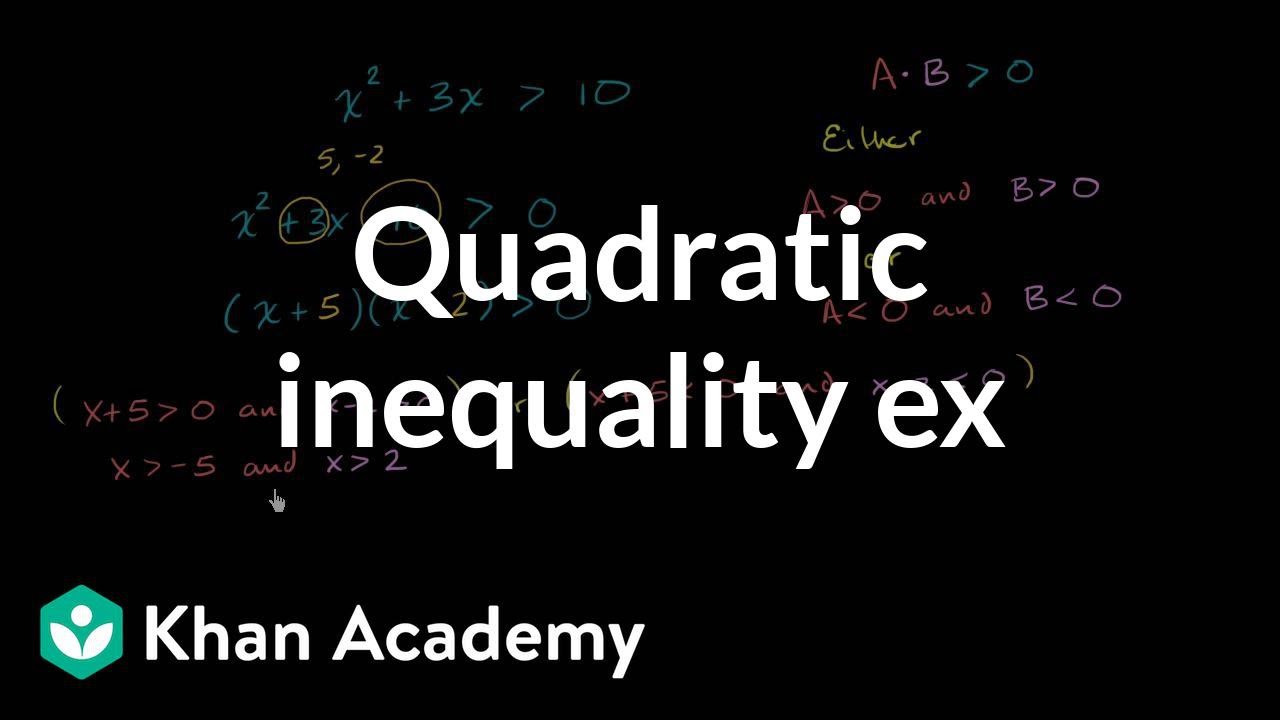
Practice this lesson yourself on KhanAcademy.org right now:
https://www.khanacademy.org/math/algebra2/functions_and_graphs/one-variable-modeling/e/modeling-with-one-variable-equations-and-inequalities?utm_source=YT&utm_medium=Desc&utm_campaign=AlgebraII
Watch the next lesson: https://www.khanacademy.org/math/algebra2/functions_and_graphs/one-v...
watch the video you will understand much better than if I explain through text
he is good teacher ong
jaunty owl
ok then solve the inequality
jaunty owl
yes
quartz wasp
4root throws me off tho
jaunty owl
it doesn't matter
if u raise both sides to the 4
what happens
0^4 = 0 and the 4th root vanishes on.the left hand side
also u need to understand that we specifically don't want to inside of the root to be negative
quartz wasp
so it dose nothing
jaunty owl
so u shouldn't have written the inequality with the fourth root in the first place
bc the point is we don't want the inside of the root to be negative
bc taking the nth root of a number which is negative when n is even is undefined
over the reals
quartz wasp
Do i slove this first?
 jaunty owl
it's the fourth root and also again there's no point writing the inequality with the root in the first place
bc it's the inside of the root that should be greater than or equal to 0
jaunty owl
yes
jaunty owl
well u need to find the interval
what values of X satisfy the inequality
it's not only -2 and 8
quartz wasp
Next wich one
jaunty owl
well u still didn't answer the question
jaunty owl
quartz wasp
Do i slove this first?
which values of X satisfy this inequality
quartz wasp
 jaunty owl
yes
jaunty owl
quartz wasp
now u need to solve the denominator not equal to 0
quartz wasp
do i solve that normally
quartz wasp
like get 2 answers
jaunty owl
ye
quartz wasp
-1 and 1
jaunty owl
ok
so now u know x cannot equal those values
oh but actually it's more intricate than that
jaunty owl
quartz wasp
Can you also help me do this?
if both the numerator and denominatouplr are negative, then the inside becomes positive
so u need to figure out the interval where they are both negative
and the interval where they are both positive
quartz wasp
how do i do that?
jaunty owl
find the interval where the numerator is positive, find the interval where the denominator is positive and take the intersection
find the interval where the numerator is negative and where the denominator is negative, and take the intersection
making sure not to include the values where the denominator is zero
quartz wasp
i gtg now will you be on in like 3 hovers so we can continiu?
quartz wasp
ok wait
i got one more thing
so in a club there are 320 seats they make lines in each line there are same amount of seats the club owner added 4 seats to each line and he also added 1 more line after that there where 420 seats in total
i need to find how many lines there are now
i think i need a equation
safe radishBOT
@quartz wasp Has your question been resolved?
Channel closed
Closed by @quartz wasp
Use .reopen if this was a mistake.
Available help channel!
Send your question here to claim the channel.
Remember:
• Ask your math question in a clear, concise manner.
• Show your work, and if possible, explain where you are stuck.
• After 15 minutes, feel free to ping <@&286206848099549185>.
• Type the command .close to free the channel when you're done.
• Be polite and have a nice day!
Read #❓how-to-get-help for further information on how to ask a good question, and about conduct in the question channels.
 ashen parcel
is thsi right?

 willow storm
yep
dapper venture
yes
willow storm
nop gang
ashen parcel
wait r these also right


 safe radishBOT
@ashen parcel Has your question been resolved?
safe radishBOT
Channel closed
Closed due to timeout
Use .reopen if this was a mistake.
Available help channel!
Send your question here to claim the channel.
Remember:
• Ask your math question in a clear, concise manner.
• Show your work, and if possible, explain where you are stuck.
• After 15 minutes, feel free to ping <@&286206848099549185>.
• Type the command .close to free the channel when you're done.
• Be polite and have a nice day!
Read #❓how-to-get-help for further information on how to ask a good question, and about conduct in the question channels.
 thin bridge
(sqrt(x))^2 = x
by definition
 wild copper
Is this supposed to a complex number problem?
thin bridge
i suppose you'd need to be working with complex numbers here though
$\sqrt{x^2}$ is different from $(\sqrt{x})^2$
flat frigateBOT
ℝαμΩℕωⅤ
 safe radishBOT
Channel closed
Closed by @strange orchid
Use .reopen if this was a mistake.
Available help channel!
Send your question here to claim the channel.
Remember:
• Ask your math question in a clear, concise manner.
• Show your work, and if possible, explain where you are stuck.
• After 15 minutes, feel free to ping <@&286206848099549185>.
• Type the command .close to free the channel when you're done.
• Be polite and have a nice day!
Read #❓how-to-get-help for further information on how to ask a good question, and about conduct in the question channels.
 umbral swan
can the cauchy-product converge if the two series don't converge absolutely?
safe radishBOT
umbral swan
can the cauchy-product converge if the two series don't converge absolutely?
 obsidian oracle
safe radishBOT
obsidian oracle
safe radishBOT
Channel closed
Closed by @umbral swan
Use .reopen if this was a mistake.
Available help channel!
Send your question here to claim the channel.
Remember:
• Ask your math question in a clear, concise manner.
• Show your work, and if possible, explain where you are stuck.
• After 15 minutes, feel free to ping <@&286206848099549185>.
• Type the command .close to free the channel when you're done.
• Be polite and have a nice day!
Read #❓how-to-get-help for further information on how to ask a good question, and about conduct in the question channels.
 neon citrus
@safe radish I'm in serious need of help, i'm in middle school and I still don't understand fractions, and it's embarassing,
safe radishBOT
neon citrus
<@805217272087838750> I'm in serious need of help, i'm in middle school and I st...
 frozen veldt
I recommend looking up fractions on Khan Academy
frozen veldt
Khan Academy is free
 peak wraith
or oganic chemistry its also free ...
peak wraith
neon citrus
I appreciate you trying to help me but I don't want that kind of help.
online helped me a lot with math
frozen veldt
well is there something specific about fractions that you're struggling with?
neon citrus
the whole thing
frozen veldt
how deeply do you wish to understand fractions
neon citrus
like deep into my heart
peak wraith
can u provide a example of a qn
frozen veldt
The way I like to think about fractions is that the defining property of a/b is that when you multiply it by b you get back a
So for example 5/3 is such a number that when you multiply it by 3 you get 5, in other words three of that number equals 5
neon citrus
ok
frozen veldt
From this point of view one can understand the multiplication of fractions as not a definition but as a consequence of the properties that we want fractions to satisfy
So if we consider
3/4 * 5/6 then we can think about what properties that number has
If you multiply it by four and then six then you get
(3/4) * (5/6) * 4 * 6
= ((3/4) * 4) * ((5/6) * 6)
and now by definition, the first part becomes 3 and the second part becomes 5
Therefore, even though we don't know what (3/4) * (5/6) is, we know that it has the property that if you multiply it by (4*6) then you get 3*5. But hmm, this is by definition (3*5)/(4*6)
By the same token we have that multiplying any two fractions together amounts to multiplying the numerator and the denominator together because the result satisfies the same defining property as the initial expression by definition
neon citrus
This isn't what I was studying last year...
it's 5th grade fractions not whatever that is,
frozen veldt
You asked to understand fractions deep in your bones, this is what you got
neon citrus
Ok fair enough.
frozen veldt
if you're not satisfied then feel free to consult Khan Academy
frozen veldt
no problem
As a fun sidenote, the rabbit hole for what fractions actually are actually goes a lot deeper than that. In fact I've basically just assumed that a certain number with certain properties exists with no justification to my claim. But this turns out to be a reasonable assumption to make, and the technical details don't add any real additional understanding
The real usefulness of fractions is not in what they are, in fact in middle school they're often taught as representations of sliced pizzas or pies, but rather what makes fractions useful is how they play nice with multiplication
This turns out to be a common pattern in math. Often times the true nature of a mathematical object is hidden away behind a million layers of abstraction, kind of like how a computer is made up of a million highly technical smaller parts, but then ultimately what mathematicians, or computer users, care about is what you can do with your objects of study and how they behave
 snow haven
safe radishBOT
snow haven
safe radishBOT
@neon citrus Has your question been resolved?
safe radishBOT
Channel closed
Closed due to timeout
Use .reopen if this was a mistake.
Available help channel!
Send your question here to claim the channel.
Remember:
• Ask your math question in a clear, concise manner.
• Show your work, and if possible, explain where you are stuck.
• After 15 minutes, feel free to ping <@&286206848099549185>.
• Type the command .close to free the channel when you're done.
• Be polite and have a nice day!
Read #❓how-to-get-help for further information on how to ask a good question, and about conduct in the question channels.
sour karma
Does doing this make sense if I’m trying to find the derivative?

 drowsy moss
What is the variable here? x or k?
sour karma
We’re trying to find k
drowsy moss
in what context? you should post the whole original question
sour karma
Oh there isn’t really context, my friend just made me a random question
Maybe it isn’t really a great question
Well thanks I think I’ll just try a diff problem
.close
safe radishBOT
Channel closed
Closed by @sour karma
Use .reopen if this was a mistake.
Available help channel!
Send your question here to claim the channel.
Remember:
• Ask your math question in a clear, concise manner.
• Show your work, and if possible, explain where you are stuck.
• After 15 minutes, feel free to ping <@&286206848099549185>.
• Type the command .close to free the channel when you're done.
• Be polite and have a nice day!
Read #❓how-to-get-help for further information on how to ask a good question, and about conduct in the question channels.
 silent bloom
hiya, so im writing a paper about some statistical stuff and im attempting to use the empirical rule to justify why it's a normal distribution. as you can see from my findings, it does not meet the first part of the rule. im wondering how ""lenient"" the empirical rule is, whether im still able to justify it being a normal distribution, and if not what my next-best alternative is... dont assume i know a lot of stats, im having to teach myself as i go for this project as i havent actually learned any stats past linear regression. thanks in advance
 safe radishBOT
silent bloom
hiya, so im writing a paper about some statistical stuff and im attempting to us...
silent bloom
safe radishBOT
silent bloom
hiya, so im writing a paper about some statistical stuff and im attempting to us...
silent bloom
 stoic dune
What's the data from?
stoic dune
What's the data from?
deviation from the mean climotogical climate betweeen 1961 and 1990 (in kelvin)
here's all the graphs ive made using the data provided, if any are of use


i'm using exclusively the natural forcings
don't know if i should use the simulated forcings, i should look more into that most likely
did i just rubberduck myself
should i just try applying the empirical rule to the simulated forcings
safe radishBOT
@silent bloom Has your question been resolved?
safe radishBOT
@silent bloom Has your question been resolved?
silent bloom
okay back to my question... i replotted and redetermined the data, it's very close to the boundaries... what do i do?
 silent bloom
.close
safe radishBOT
Channel closed
Closed by @silent bloom
Use .reopen if this was a mistake.
Available help channel!
Send your question here to claim the channel.
Remember:
• Ask your math question in a clear, concise manner.
• Show your work, and if possible, explain where you are stuck.
• After 15 minutes, feel free to ping <@&286206848099549185>.
• Type the command .close to free the channel when you're done.
• Be polite and have a nice day!
Read #❓how-to-get-help for further information on how to ask a good question, and about conduct in the question channels.
 wooden umbra
would the derivative of f(x)=-3000,97^(x)+300 if x = 8 be
f'(8)=-300*0,97^(8)*****1ln(0,97^(8))?
safe radishBOT
wooden umbra
would the derivative of f(x)=-300*0,97^(x)+300 if x = 8 be
f'(8)=-300******0,97...
wooden umbra
do you also remove the -300?
 candid oar
flat frigateBOT
candid oar
flat frigateBOT
ℝαμΩℕωⅤ
 thin bridge
is that an accurate representation of your function?
wooden umbra
thin bridge
is that an accurate representation of your function?
yes it is
wooden umbra
thin bridge
do you have a pic of the original
nope
thin bridge
if so, that -300 doesn't get removed/erased
wooden umbra
because it's inn front of the thing we want to find the derivative of
right?
cuz f'(x)=-300******[0,97^(x)******x'****ln(0,97^(x))]
thin bridge
yeh, also you didn't differentiate 0.97^x correctly
wooden umbra
what do you mean?
thin bridge
* ln(0.97)
not *ln(0.97^x)
safe radishBOT
Channel closed
Closed by @wooden umbra
Use .reopen if this was a mistake.
Available help channel!
Send your question here to claim the channel.
Remember:
• Ask your math question in a clear, concise manner.
• Show your work, and if possible, explain where you are stuck.
• After 15 minutes, feel free to ping <@&286206848099549185>.
• Type the command .close to free the channel when you're done.
• Be polite and have a nice day!
Read #❓how-to-get-help for further information on how to ask a good question, and about conduct in the question channels.
 paper cove
The assignment is to "find a polar equation for the curve represented by y=x". I'm getting 1=tan(theta)? Could someone just confirm if that's right, it seems too simple 😂
safe radishBOT
paper cove
The assignment is to "find a polar equation for the curve represented by y=x". I...
paper cove
Because y=r•sin(theta) and x=r•cos(theta) so if I see them equal then I get 1=tan
 median vigil
you could also solve for a particular value of θ that satisfies that
but in general a line passing through the origin can be described in polar by a constant angle and nothing else
paper cove
Makes sense
So it's not right then? How do I get to the single angle?
Oh I see what you mean
Solve tan=1
π/4?
median vigil
yes
paper cove
Cool, thanks 🙏
median vigil
since tan(θ) is periodic on period π you can find infinitely many other angles that also work by adding multiples of π, but θ=π/4 is the simplest
safe radishBOT
Channel closed
Closed by @paper cove
Use .reopen if this was a mistake.
safe radishBOT
Available help channel!
Send your question here to claim the channel.
Remember:
• Ask your math question in a clear, concise manner.
• Show your work, and if possible, explain where you are stuck.
• After 15 minutes, feel free to ping <@&286206848099549185>.
• Type the command .close to free the channel when you're done.
• Be polite and have a nice day!
Read #❓how-to-get-help for further information on how to ask a good question, and about conduct in the question channels.
 patent vault
how in the world am i supposed to do this lol
 safe radishBOT
patent vault
how in the world am i supposed to do this lol
safe radishBOT
patent vault
how in the world am i supposed to do this lol
 lusty spear
patent vault
how in the world am i supposed to do this lol
lusty spear
patent vault
how in the world am i supposed to do this lol
is "L2" of importance here ?
dont know what that means
patent vault
lusty spear
is "L2" of importance here ?
no its just a name of the group
lusty spear
the only reasonable answer for me is monish took a look at the card, if this has a mathmatical explanation I wanna hear it as well
but i think I once heard about a familiar problem and it was quite crazy
fleet condor
there is almost certainly a math way to do it - the ones like this are usualyl soeme crazy tricks
fleet condor
the important part is "picks"
each of the places it mentions "picks" has to be deliberate
 buoyant shadow
it's kinda easy
patent vault
but dont give the full answer
buoyant shadow
it's easier than i expected from first glance to be precise
fleet condor
oh can you just do every other, sandwich it, then third card gives the last hint for the 38
patent vault
but shuffling?
buoyant shadow
idk how to give just a hint
 trim swan
the pigeonhole principle is a hint. though I'm not sure if frownyfrog and I are thinking of the same solution. there might be more than one way to do it
lusty spear
trim swan
the pigeonhole principle is a hint. though I'm not sure if frownyfrog and I are ...
but how in the world would the pidgenhole principle be applied when you could have any card out of 38 ?
trim swan
It's more about Alex's two cards
buoyant shadow
if you pair up all cards, then Alex can pick a complete pair
lusty spear
how does that info help?
buoyant shadow
then the third card will stand out
buoyant shadow
yes
patent vault
oh
trim swan
Alex gets to choose two of the 40 cards the student gives him
lusty spear
bruh
buoyant shadow
picks is about looking in this question
lusty spear
...
ok but still
even if so
monish still has to figure out what card out of the 36 were chosen
how ?
patent vault
does monish look at the 3 cards
buoyant shadow
yes
trim swan
after they're all chosen, yes
lusty spear
boooh
trim swan
otherwise he is just picking randomly
lusty spear
I thought only from the 2 chosen he can predict the third
patent vault
so what is he predicting
trim swan
He looks at the three cards, and he can tell which one was added by the student
patent vault
oh
lusty spear
since the other 2 were paired right ?
patent vault
couldnt monish and alex have talked before hand and talked about which 2 cards he would choose
patent vault
wait no
trim swan
No, because Alex only has access to 40 of the cards, and he doesn't know which 40 they will be
patent vault
but what pairing lol
trim swan
"what pairing" is the whole question
what pairing is always possible given any 40 of the cards?
it's always possible for Alex to choose two cards that have some property together
lusty spear
damn it thats the exact problem I talked about in the beginning, now I am remembering it lmao
I think mod sounds right
also any third card must not have that property
lusty spear
ye
buoyant shadow
the exact pairing doesn't matter, it only changes how much they have to think
in this case even odd makes it easy
lusty spear
wait what
patent vault
that would cause too much ambiguity though
buoyant shadow
i mean (56)(78)...
buoyant shadow
yes, Alex can always pick an odd card X and an even card X+1
patent vault
oh
ooh
and the student cant choose anything else to mess it up
and there will always be at least 2 consecutive cards by pigeonhole principle
trim swan
buoyant shadow
yes, Alex can always pick an odd card X and an even card X+1
ahh yeah, I was thinking of two cards whose sum is 79, but yeah any predetermined pairing would work
patent vault
trim swan
ahh yeah, I was thinking of two cards whose sum is 79, but yeah any predetermine...
are there always garunteed 2 of those?
how would you prove that there will always be 2 that sum to 79
buoyant shadow
because it's also a pairing
patent vault
wdym
buoyant shadow
1 goes with 78
6 goes with 73
you want to split them in to 39 groups of 2, then the proof is the same whatever you did
safe radishBOT
Channel closed
Closed by @patent vault
Use .reopen if this was a mistake.
safe radishBOT
Available help channel!
Send your question here to claim the channel.
Remember:
• Ask your math question in a clear, concise manner.
• Show your work, and if possible, explain where you are stuck.
• After 15 minutes, feel free to ping <@&286206848099549185>.
• Type the command .close to free the channel when you're done.
• Be polite and have a nice day!
Read #❓how-to-get-help for further information on how to ask a good question, and about conduct in the question channels.
 foggy cloud
 safe radishBOT
foggy cloud
foggy cloud
safe radishBOT
foggy cloud
foggy cloud
For this example I did was using -b/2a
Which is wrong
So how to know when using complete the square
thin bridge
show work
safe radishBOT
@foggy cloud Has your question been resolved?
foggy cloud
.close
safe radishBOT
Channel closed
Closed by @foggy cloud
Use .reopen if this was a mistake.
Available help channel!
Send your question here to claim the channel.
Remember:
• Ask your math question in a clear, concise manner.
• Show your work, and if possible, explain where you are stuck.
• After 15 minutes, feel free to ping <@&286206848099549185>.
• Type the command .close to free the channel when you're done.
• Be polite and have a nice day!
Read #❓how-to-get-help for further information on how to ask a good question, and about conduct in the question channels.
 manic heart
what did i do wrong
safe radishBOT
manic heart
what did i do wrong
manic heart

 subtle robin
you shouldve factored out the two at the start
manic heart
subtle robin
you shouldve factored out the two at the start
so i should have divided everything by 2?
subtle robin
yeah
safe radishBOT
Channel closed
Closed by @manic heart
Use .reopen if this was a mistake.
Available help channel!
Send your question here to claim the channel.
Remember:
• Ask your math question in a clear, concise manner.
• Show your work, and if possible, explain where you are stuck.
• After 15 minutes, feel free to ping <@&286206848099549185>.
• Type the command .close to free the channel when you're done.
• Be polite and have a nice day!
Read #❓how-to-get-help for further information on how to ask a good question, and about conduct in the question channels.
 near ginkgo
Any idea what [z(x)]8 mean? The square bracket?
 safe radishBOT
near ginkgo
Any idea what [z(x)]8 mean? The square bracket?
safe radishBOT
near ginkgo
Any idea what [z(x)]8 mean? The square bracket?
 dreamy hornet
square bracket is the same as () usually
near ginkgo
oh so its basically power 8?
dreamy hornet
yes
near ginkgo
ohkk thanks
dreamy hornet
no prob
near ginkgo
.close
safe radishBOT
Channel closed
Closed by @near ginkgo
Use .reopen if this was a mistake.
Available help channel!
Send your question here to claim the channel.
Remember:
• Ask your math question in a clear, concise manner.
• Show your work, and if possible, explain where you are stuck.
• After 15 minutes, feel free to ping <@&286206848099549185>.
• Type the command .close to free the channel when you're done.
• Be polite and have a nice day!
Read #❓how-to-get-help for further information on how to ask a good question, and about conduct in the question channels.
 native robin
Let $r, s, t$ be the solutions to the cubic equation $x^3+7x^2=1$. What is the value of $\frac{1}{r^3}+\frac{1}{s^3}+\frac{1}{t^3}?$
safe radishBOT
native robin
Let $r, s, t$ be the solutions to the cubic equation $x^3+7x^2=1$. What is the v...
flat frigateBOT
Jash
 native robin
no calculater
 quasi sentinel
1+7/x = 1/x³
native robin
quasi sentinel
1+7/x = 1/x³
then what
quasi sentinel
think about it
native robin
you get 1/1+7/x-1/x^3 = 0
quasi sentinel
that doesnt matter
native robin
the sum is 3+7/r+7/s+7/t
quasi sentinel
you can still get the values of r+s+t, rs+st+rt, rst
native robin
quasi sentinel
you can still get the values of r+s+t, rs+st+rt, rst
so combine the 3 fractions
quasi sentinel
yes
native robin
3+(7s+7r+7t)/(rst)
quasi sentinel
no
native robin
wait i know
quasi sentinel
ok
native robin
3+(7sr+7st+7rt)/(str)
quasi sentinel
yes
native robin
then what
 safe radishBOT
@native robin Has your question been resolved?
Channel closed
Closed by @native robin
Use .reopen if this was a mistake.
Available help channel!
Send your question here to claim the channel.
Remember:
• Ask your math question in a clear, concise manner.
• Show your work, and if possible, explain where you are stuck.
• After 15 minutes, feel free to ping <@&286206848099549185>.
• Type the command .close to free the channel when you're done.
• Be polite and have a nice day!
Read #❓how-to-get-help for further information on how to ask a good question, and about conduct in the question channels.
 lean otter
if i have a table, like this
Tide Height(ft) Time
first high tide 12.95 4:25 AM
first low tide 2.02 10:55 AM
a. Determine the amplitude, period, phase shift, and vertical shift of a sine function that models the height of the tide. Let x represent the number of hours that the high or low tide occured after midnight
b. Write the a sine function that models the data
c. according to said model, what is the height of the tide at 8:45 PM at night?
(mostly just A and B here)
safe radishBOT
lean otter
if i have a table, like this
Tide Height(ft) Time...
@lean otter Has your question been resolved?
lean otter
<@&286206848099549185>
 drifting mountain
!show
safe radishBOT
Show your work, and if possible, explain where you are stuck.
drifting mountain
whats a sine functions
lean otter
drifting mountain
whats a sine functions

i dont have work dude
thats the thing
idk how to do this problem at all
drifting mountain

A sine wave, sinusoidal wave, or sinusoid (symbol: ∿) is a periodic wave whose waveform (shape) is the trigonometric sine function.
In mechanics, as a linear motion over time, this is simple harmonic motion; as rotation, it corresponds to uniform circular motion.
Sine waves occur often in physics, including wind waves, sound waves, and light wa...
google is your friend
<@&268886789983436800>
<@&268886789983436800>
 lean thorn
lean otter
i dont have work dude
thats the thing
idk how to do this problem at all
lean thorn
lean otter
i dont have work dude
thats the thing
idk how to do this problem at all
So youtube is a great rsource for questions like this
 white umbra
cyanide, yeah only ping helpers once after 15 minutes, ils stop posting here if you're not gonna help
lean otter
white umbra
cyanide, yeah only ping helpers once after 15 minutes, ils stop posting here if ...
yeah ik-im sorry abt that
lean otter
lean thorn
So youtube is a great rsource for questions like this
do tell
lean thorn
lean otter
this is where google comes into rescue

Amplitude, period, vertical shift, phase shift,
how to find the amplitude of sine,
how to find the period of sine,
how to find the vertical shift of sine,
how to find the phase shift of sine,
blackpenredpen
lean otter
no like ehres the thing
i know what those are
i just dont know how to turn a table into that
lean thorn
ah I see
ok so in part (a), it tells you what we should represent for x. What should our x line be?
lean otter
lean thorn
ok so in part (a), it tells you what we should represent for x. What should our ...
time-hrs past midnight
which means the function will have to have a pi in it somewhere since its whole numbers and not fractions with pi in them
lean thorn
lean otter
which means the function will have to have a pi in it somewhere since its whole ...
well not necessarily. The way I see you breaking down your function is by doing the hour and then the mintutes / 60 for the fraction portion
So someting like 4:25AM would be 4.4167, right? It's 4 hours and 25/60 = 4.16666667 (simplified here to 5 sig figs)
so there's your first x value
lean otter
i see ok ok
lean thorn
are those the only 2 values they provided in the table?
lean otter
yes
lean thorn
ok bet
since one represents high tide and one represents low tide, it should be enough info
lean otter
ye...
lean thorn
,calc 55/60
flat frigateBOT
Result:
0.91666666666667
ye
lean otter
yeah ik binary and decimal do a funny when you get small enough
lean thorn
like 10.917 if we want to keep to 5 sig figs
lean otter
alr so 4.4167 and 10.9117
lean thorn
yep. Now just plot those somewhere like desmos with the corresponding y value and then figure out the requested items 🙂
lean thorn
well we can infer them with the info we have
lean otter
mm do tell
lean thorn
so let's start off with the amplitude
lean otter
ok
lean thorn
the amplitude represents the distance to our given crest (aka the max) and trough (aka the min) to the symmetrical line where they're equidistant from one another
lean thorn
in other words, amplitude is the distance between the crest and the trough divided by 2
lean otter
ye
lean thorn
so what would that be? 🙂
lean otter
wait you're fucking joking
lean thorn
I hardly do lol
lean otter
no like
THAT SEEMS SO OBVIOUS NOW
lean thorn
we all go through this too don't worry
math is obvious once you figure it out!
but until then you struggle lol
lean otter
i just assumed for whatever reason that the values were not top and bottom
and now i realize
THEY WERE
ueiryngeukriyfngvh8uwriejs
anyways
lean thorn
oooh oh yeah
yeah that's what they mean by high tide and low tide. They represent the min and max height of a shoreline
anywho
lean otter
so now B
lean thorn
ok so that's the amplitude
lean otter
yeah
lean thorn
ok so the period represents what?
lean otter
the period is 2pi/b
lean otter
lean thorn
ok so the period represents what?
1 full cycle
lean thorn
bingo
lean thorn
so since sine waves are cyclic, then we can assume that the distance between the trough and the crest will be equidistant themselves
so in other words, the distance from one crest to another is twice the distance from a crest to a trough
lean thorn
very good
lean thorn
huh that's sus haha
lean otter
lean thorn
huh that's sus haha
it has the amp as 5.465
but period is 13
¯_(ツ)_/¯
weird
anyways
lean thorn
yeah that's strange lol
lean thorn
,calc 2* ( 10.91666 - 4.4167)
flat frigateBOT
Result:
12.99992
oh weird i got 13.89
no i used uh
10.9117
not wait
wait
thats so f*cked up LMFAO
lean thorn
Oh that's why lol. Sorry my bad I didn't catch that. Your value should be rounded to 10.9167, not 10.9117
lean thorn
I dunno hidden somewhere in that number probably
lol
it's not important for these purposes
lean otter
alr
so all that aside
vertical shift shoudnt be that bad
i THINK its amp/2 + 2.02
no wait
LMAO
just amp + 2.02
lean thorn
so a normal sin function has a crest at 1 right?
lean thorn
ok excellent
lean otter
and wait
the phase shift
is just 4.417
lmfao this all seems so simple now
i h8 myself
lean thorn
I haven't done it yet but I'll take your word for it 🙂
lean otter
 lean otter
lean thorn
I haven't done it yet but I'll take your word for it 🙂
lean otter
lean thorn
I haven't done it yet but I'll take your word for it 🙂
phase is just 4.417 because the smallest x value is 4.417 and thats where trough is
like in the table
also this is completely unrelated
but your PFP is hilarious
lean thorn
lmaooo thanks
lean otter
but wait part B now
lean thorn
it's from the movie Sister Act