#help-23
1 messages · Page 166 of 1
 mortal thicket
but 1/-inf is 0-
so in teh end u get (0-) - (0-) in the numberator
a number thats slight les than 0 - another number that slightly less than 0 is still a number tahts slightly less then 0
so the numerator is 0-
in the denominator
1 +(0-) + (0-) = 1 + a number that is silght less than zero + a number that is slight less then 0 = a number that is slighty larger than 1 (1+)
so u fraction becomes $\frac{0^{-}}{1^{+}}$
 flat frigateBOT
Big Chicken
 mortal thicket
0- will always win
so u get a number that is slight less than 0 / a number that is slight less than 1 = a number that is still slightly less than 0
or 0-
this way is easier as u only need to show the division part
and u just sub it in and skip straight to the answer, while doing the reasoning part in ur head
if u want to check, sub a very negative number into ur calc
btw this method only works if the power of the denominator is greater than the power of the numerator
 safe radishBOT
@fringe pivot Has your question been resolved?
safe radishBOT
Channel closed
Closed due to timeout
Use .reopen if this was a mistake.
 Available help channel!
Send your question here to claim the channel.
Remember:
• Ask your math question in a clear, concise manner.
• Show your work, and if possible, explain where you are stuck.
• After 15 minutes, feel free to ping <@&286206848099549185>.
• Type the command .close to free the channel when you're done.
• Be polite and have a nice day!
Read #❓how-to-get-help for further information on how to ask a good question, and about conduct in the question channels.
 fallen thunder
hello, what’s the difference between symmetric and evenly spaced data set?
safe radishBOT
fallen thunder
hello, what’s the difference between symmetric and evenly spaced data set?
fallen thunder
another question i have is: mean = median = mode in a symmetric distribution but i know the reverse doesn’t necessarily hold
is there any other noteworthy implication to keep in mind when i encounter a data that has mean = median = mode or is there nothing of significance to be wary of?
safe radishBOT
@fallen thunder Has your question been resolved?
fallen thunder
<@&286206848099549185>
safe radishBOT
@fallen thunder Has your question been resolved?
safe radishBOT
@fallen thunder Has your question been resolved?
safe radishBOT
Channel closed
Closed due to timeout
Use .reopen if this was a mistake.
Available help channel!
Send your question here to claim the channel.
Remember:
• Ask your math question in a clear, concise manner.
• Show your work, and if possible, explain where you are stuck.
• After 15 minutes, feel free to ping <@&286206848099549185>.
• Type the command .close to free the channel when you're done.
• Be polite and have a nice day!
Read #❓how-to-get-help for further information on how to ask a good question, and about conduct in the question channels.
 astral pawn
hi is this the correct formula in finding the coefficient of x^7 in (1+x)^11? or should it be
a = x
b = 1
instead?
 safe radishBOT
astral pawn
hi is this the correct formula in finding the coefficient of x^7 in (1+x)^11? or...
safe radishBOT
astral pawn
hi is this the correct formula in finding the coefficient of x^7 in (1+x)^11? or...
 split ether
What you sent is correct
 thin bridge
doesn't really matter due to symmetry
astral pawn
wait no sorry, I meant which one among these two LOL
disregard the first formula

 split ether
Like Ramonov said, they are both correct
astral pawn
oh okay thanks
safe radishBOT
@astral pawn Has your question been resolved?
safe radishBOT
Channel closed
Closed due to timeout
Use .reopen if this was a mistake.
Available help channel!
Send your question here to claim the channel.
Remember:
• Ask your math question in a clear, concise manner.
• Show your work, and if possible, explain where you are stuck.
• After 15 minutes, feel free to ping <@&286206848099549185>.
• Type the command .close to free the channel when you're done.
• Be polite and have a nice day!
Read #❓how-to-get-help for further information on how to ask a good question, and about conduct in the question channels.
 balmy ferry
If
safe radishBOT
balmy ferry
If
flat frigateBOT
Nel
 balmy ferry
Ye but with parenthesis
Of the top and bottom
and then the negative is outside the parenthesis
 glacial cairn
Unnecessary if the - sign clearly comes before the fraction
$-\frac{(x^3+5)}{(3x^2+10)}$
flat frigateBOT
Nel
 glacial cairn
This is the same thing
 glacial cairn
To answer your question, no, you only put the - sign on either the top part or the bottom part
balmy ferry
ok ok
flat frigateBOT
Nel
 thin bridge
or just leave it outside
glacial cairn
$\frac{-(x^3+5)}{3x^2+10}$
flat frigateBOT
Nel
 glacial cairn
That works too
thin bridge
$$-\frac ab = \frac{-a}{b} = \frac{a}{-b}$$
one may be more ideal than the others depending on what you have
flat frigateBOT
ℝαμΩℕωⅤ
 balmy ferry
what cartoon is that pink guy from
balmy ferry
thin bridge
$$-\frac ab = \frac{-a}{b} = \frac{a}{-b}$$
one may be more ideal than the other...
ok yea
.close
safe radishBOT
Channel closed
Closed by @balmy ferry
Use .reopen if this was a mistake.
thin bridge
balmy ferry
what cartoon is that pink guy from
looks like carbot
glacial cairn
My profile picture? Yes, CarbotAnimations
safe radishBOT
Available help channel!
Send your question here to claim the channel.
Remember:
• Ask your math question in a clear, concise manner.
• Show your work, and if possible, explain where you are stuck.
• After 15 minutes, feel free to ping <@&286206848099549185>.
• Type the command .close to free the channel when you're done.
• Be polite and have a nice day!
Read #❓how-to-get-help for further information on how to ask a good question, and about conduct in the question channels.
 lean otter
hi, I have a math task I struggle with:
P(a)yz+P(b)zx+P(c)xy<=0.```
I found that if
P(x) = n, n > 0 - so polynomial is constant
I cant write it down as
n(x^2+xy+y^2) >= 0  because z = -x-y
and it's easy to calucalate that x, y are any real numbers
also if n = 0 the equation is 0 >= 0 so n also fits
this is fairy obvious part of the task but what should i do now?@lean otter Has your question been resolved?
 vocal surge
lean otter
hi, I have a math task I struggle with:
```Find all polynomials with real coeffi...
vocal surge
lean otter
hi, I have a math task I struggle with:
```Find all polynomials with real coeffi...
hint: afaik, there is a limit of a side when it's compared to other sides in a triangle, google Triangle Inequality Theorem
safe radishBOT
@lean otter Has your question been resolved?
lean otter
vocal surge
hint: afaik, there is a limit of a side when it's compared to other sides in a t...
ik about it, but I couldn't find a way to use it
that's why I am here because it was weird for me that property of a,b,c would remain unused
vocal surge
polynomial is constant?
lean otter
not necessarily
the content of the task is in
i just found that if P(x) = n, n >= 0
<@&286206848099549185>
safe radishBOT
@lean otter Has your question been resolved?
lean otter
vocal surge
polynomial is constant?
Are you still here?
lean otter
vocal surge
yes
Do you have any other hint?
vocal surge
no, sorry
vocal surge
lean otter
hi, I have a math task I struggle with:
```Find all polynomials with real coeffi...
but what is this if n > 0, what do you mean by constant
what does change
also, where is the original question (on the paper)
if you give some resources, it might be easier (if it's english)
lean otter
vocal surge
but what is this if n > 0, what do you mean by constant
in this task we have polynomial P(x)
and if we have polynomial P(x) = n where n is any real number
polynomial is constant https://mathworld.wolfram.com/ConstantPolynomial.html
A polynomial P(x) that, when evaluated over each x in the domain of definition, results in the same value. The simplest example is P(x)=c for x in R and c a constant.
and polynomial meets conditions of task only if n >= 0
lean otter
i make notes on paper so let me transcribe them here
vocal surge
I think I don't have enough experience to solve this
but we can tag helpers
<@&286206848099549185>
lean otter
x,y,z are real numbers
a,b,c > 0
x+y+z = 0
z = -x -y
P(x) = n, n any real number
if n > 0
nyz + nzx + nxy <= 0
n(yz + zx + xy) <= 0
-n(x^2 + xy + y^2) <= 0
n(x^2 + xy + y^2) >= 0 divide by n
x^2 + xy + y^2 >= 0
delta is -3y^2, it has to be <= 0
-3y^2 <= 0
y^2 >= 0
which is always true
and n = 0 is pretty obvious so n >= 0```thats what i have
@vocal surge
 sour maple
$P(a)yz + P(b)zx + P(c)xy \leq 0
x,y,z are real numbers
a,b,c \gtrsim 0
x+y+z = 0
z = -x -y
P(x) = n, n \text{, \quad any real number}
if n \gtrsim 0
nyz + nzx + nxy \leq 0
n(yz + zx + xy) \leq 0
-n(x^2 + xy + y^2) \leq 0
0 \leq n(x^2 + xy + y^2) \text{ divide by } n
0 \leq x^2 + xy + y^2
\text{delta is }-3y^2 \text{, it has to ben } \leq 0
-3y^2 <= 0
y^2 >= 0
\text{ which is always true }
\text{ and } n = 0 \text{ is pretty obvious so } 0 \leq n $
lean otter
sour maple
$P(a)yz + P(b)zx + P(c)xy \leq 0
x,y,z are real numbers
a,b,c \gtrsim 0
x+y+z = ...
what of it?
safe radishBOT
@lean otter Has your question been resolved?
safe radishBOT
@lean otter Has your question been resolved?
safe radishBOT
Channel closed
Closed due to timeout
Use .reopen if this was a mistake.
Available help channel!
Send your question here to claim the channel.
Remember:
• Ask your math question in a clear, concise manner.
• Show your work, and if possible, explain where you are stuck.
• After 15 minutes, feel free to ping <@&286206848099549185>.
• Type the command .close to free the channel when you're done.
• Be polite and have a nice day!
Read #❓how-to-get-help for further information on how to ask a good question, and about conduct in the question channels.
 obtuse harbor
How do I translate across u if the vector is the same length roughly as the triangle 🤔
 safe radishBOT
obtuse harbor
How do I translate across u if the vector is the same length roughly as the tria...
obtuse harbor
safe radishBOT
obtuse harbor
How do I translate across u if the vector is the same length roughly as the tria...
obtuse harbor
Because the shape of the triangle would change right??? So I am confused
safe radishBOT
@obtuse harbor Has your question been resolved?
safe radishBOT
@obtuse harbor Has your question been resolved?
safe radishBOT
Channel closed
Closed due to timeout
Use .reopen if this was a mistake.
safe radishBOT
Available help channel!
Send your question here to claim the channel.
Remember:
• Ask your math question in a clear, concise manner.
• Show your work, and if possible, explain where you are stuck.
• After 15 minutes, feel free to ping <@&286206848099549185>.
• Type the command .close to free the channel when you're done.
• Be polite and have a nice day!
Read #❓how-to-get-help for further information on how to ask a good question, and about conduct in the question channels.
 vale oriole
Prove by induction for positive integers n that $1! * 3! * 5! * ... * (2n-1)! \ge (n!)^n$
safe radishBOT
vale oriole
Prove by induction for positive integers n that $1! * 3! * 5! * ... * (2n-1)! \g...
flat frigateBOT
Galaxy
 vale oriole
i have solved for the base case
and assumed true for n=k
though im not sure about the actual solve
 sonic saddle
i need help with a pre test revising for my exam tomorrow, is anyone able to help? i may need help with a lot of questions so if we do it in DMS it would be a lot better thanks
vale oriole
sonic saddle
i need help with a pre test revising for my exam tomorrow, is anyone able to hel...
you're gonna need to solve this before u get any help from me
sonic saddle
?
vale oriole
u came to an occupied help channel asking for help...
if ur gonna do that atleast solve my problem
sonic saddle
bro i dont know how to solve that 😭
wait
OH
sorry im new to the server so i came here thinking this was a channel where you ask for help
safe radishBOT
@vale oriole Has your question been resolved?
safe radishBOT
Channel closed
Closed due to timeout
Use .reopen if this was a mistake.
vale oriole
.reopen
safe radishBOT
✅
glacial cairn
If you have (2n-1)! >= (n!)^n, you need to show (2(n+1)-1)! >= ((n+1)!)^(n+1)
Makes sense?
glacial cairn
Actually I forgot the 1! * 3! * ...
vale oriole
yeah but i got what u meant
glacial cairn
Try to expand the left side but keeping what you had for the previous case
Then do the same for the right side
glacial cairn
Ok let's start on the left side
What do you add to that side to go from the case n to the case n+1?
glacial cairn
Just use n
(2n+1)! as a factor
So if the left side in case n is P, in case n+1 it becomes P * (2n+1)!, right?
vale oriole
yeah
glacial cairn
Now the right side is where we actually expand some things
Can you transform ((n+1)!)^(n+1) to get something with (n!)^n in it?
vale oriole
(n!)^n * (n+1)^n * (n+1)!
glacial cairn
$((n+1)!)^{n+1} = ((n+1)*n!)^n * (n+1)! = (n+1)^n * (n!)^n * (n+1)!$
flat frigateBOT
Nel
 glacial cairn
Seems correct
Now you need to show P * (2n+1)! >= (n!)^n * (n+1)^n * (n+1)!
where P >= (n!)^n
So if you show (2n+1)! >= (n+1)^n * (n+1)!, you won
vale oriole
right
glacial cairn
Maybe transform (2n+1)! to something with a (n+1)!
vale oriole
(2n+1)(2n)(2n-1)...(n+2)(n+1)!
vale oriole
see this part i dont know
glacial cairn
2n+1 - (n+2) + 1 = n, right
vale oriole
yuh
glacial cairn
So as a product that would be $\prod_{i=1}^{n} (n+1+i)$
flat frigateBOT
Nel
 glacial cairn
Is that bigger than (n+1)^n?
vale oriole
yeah
glacial cairn
There you go
vale oriole
aight thanks man, but if i get another factorial question i'm done there's no way im solving this
safe radishBOT
Channel closed
Closed by @vale oriole
Use .reopen if this was a mistake.
safe radishBOT
Available help channel!
Send your question here to claim the channel.
Remember:
• Ask your math question in a clear, concise manner.
• Show your work, and if possible, explain where you are stuck.
• After 15 minutes, feel free to ping <@&286206848099549185>.
• Type the command .close to free the channel when you're done.
• Be polite and have a nice day!
Read #❓how-to-get-help for further information on how to ask a good question, and about conduct in the question channels.
 fringe linden
Hi, I would like to know how I can find the inverse matrix of a 2x3 matrix :(.
safe radishBOT
fringe linden
Hi, I would like to know how I can find the inverse matrix of a 2x3 matrix :(.
fringe linden

 flat frigateBOT
ElPanaArturo

 peak estuary
A doesn't need an inverse for the equation to be solvable
AX=4C+B
write out all the entries of X
solve the linear systems of equations
peak estuary
X is matrix, yes
safe radishBOT
@fringe linden Has your question been resolved?
fringe linden
.close
safe radishBOT
Channel closed
Closed by @fringe linden
Use .reopen if this was a mistake.
Available help channel!
Send your question here to claim the channel.
Remember:
• Ask your math question in a clear, concise manner.
• Show your work, and if possible, explain where you are stuck.
• After 15 minutes, feel free to ping <@&286206848099549185>.
• Type the command .close to free the channel when you're done.
• Be polite and have a nice day!
Read #❓how-to-get-help for further information on how to ask a good question, and about conduct in the question channels.
 keen dome
Hello, can I get some help with an exercise?
safe radishBOT
keen dome
Hello, can I get some help with an exercise?
keen dome
Basically, I have an exercise from a Real Analysis book from my country, and it doesn't have solutions.
The exercise says something like this

don't mind the other language
the idea of exercise 1 is that we have defined a vector norm as a function and we must prove that it doesn't follow Parallelogram law
 cosmic grove
you need to show if the norm satisfies the parallelogram indentity
keen dome
the first exercise respresented the first order norm if this is the correct saying in english
so p = 1 from the bottom general formula
keen dome
cosmic grove
you need to show if the norm satisfies the parallelogram indentity
yeah, and I don't get it how to do it
cosmic grove
||a + b ||² + ||a - b ||² = 2 ||a ||² + 2 ||b ||²
keen dome
yes
but if I blindly put the vector components and apply the function I don't really get anywhere
cosmic grove
keen dome
yeah, and I don't get it how to do it
you have the formula of the norm 1, should be easy
cosmic grove
keen dome
but if I blindly put the vector components and apply the function I don't really...
are you sure ?
keen dome
well, if you put the first norm components in the equation it doesn't lead you anywhere good
at least it didn't for me
can I try it again and send a picture in a few minutes?
cosmic grove
$$ |a+b |1^2 = \left(\sum{k=1}^n |a_k + b_k| \right)²$$
flat frigateBOT
Herels
 keen dome
so I should write them in Sum notation rather than have them one after another as a simple arithmetic sum?
cosmic grove
$$|a-b |1^2 = \left(\sum{k=1}^n |a_k - b_k| \right)²$$
flat frigateBOT
Herels
 cosmic grove
keen dome
so I should write them in Sum notation rather than have them one after another a...
cosmic grove
keen dome
so I should write them in Sum notation rather than have them one after another a...
hmm ?
keen dome
should I use the notation you have given me right now as a Series
or is it ok if I write it as a simple sum
such as
x1 + .... + xn
cosmic grove
you dont need to, im just lazy
keen dome
:)))
cosmic grove
and it wont change much
cosmic grove
as u wish, thats not my exercise
keen dome
Ok, I don't want to hold a help chat uselessly that's what I was trying to say
but if you can help others while this chat is open it's perfect
cosmic grove

safe radishBOT
@keen dome Has your question been resolved?
 keen dome
<@&286206848099549185>
I found a solution in a recitation book
thank you for trying to help anyways
.close
safe radishBOT
Channel closed
Closed by @keen dome
Use .reopen if this was a mistake.
safe radishBOT
Available help channel!
Send your question here to claim the channel.
Remember:
• Ask your math question in a clear, concise manner.
• Show your work, and if possible, explain where you are stuck.
• After 15 minutes, feel free to ping <@&286206848099549185>.
• Type the command .close to free the channel when you're done.
• Be polite and have a nice day!
Read #❓how-to-get-help for further information on how to ask a good question, and about conduct in the question channels.
 strong escarp
can I have help with this question please. I'm not sure where to start.
 safe radishBOT
strong escarp
can I have help with this question please. I'm not sure where to start.
safe radishBOT
strong escarp
can I have help with this question please. I'm not sure where to start.
 normal light
Do you have access to the answers?
I think its 2.5
if thats right then I can explain it
strong escarp
normal light
Do you have access to the answers?
no unfortunately
normal light
oh ok heres how i would do it
sinve f1 is horizontal anyway we can just leave it alone
and find the horiz component of f2
if u draw out the triangle
you would find that the horiz component is hypotenuse = magnitude of f2 times cos60
normal light
normal light
you would find that the horiz component is hypotenuse = magnitude of f2 times c...
hypotenuse is the magnitude of f2
so 0.5 times 1
is 0.5
and then u add the 2 horizontal vectors tgt
2 + 0.5 = 2.5
sorry about the poor explanation but i hope that makes sense
safe radishBOT
Channel closed
Closed by @strong escarp
Use .reopen if this was a mistake.
normal light
np
safe radishBOT
Available help channel!
Send your question here to claim the channel.
Remember:
• Ask your math question in a clear, concise manner.
• Show your work, and if possible, explain where you are stuck.
• After 15 minutes, feel free to ping <@&286206848099549185>.
• Type the command .close to free the channel when you're done.
• Be polite and have a nice day!
Read #❓how-to-get-help for further information on how to ask a good question, and about conduct in the question channels.
 humble sphinx
Huh how is this true?
 safe radishBOT
humble sphinx
Huh how is this true?
safe radishBOT
humble sphinx
Huh how is this true?
 median vigil
in an or statement, if either is true then the entire statement is true
 fleet condor
tldr "true or false" is true
humble sphinx
Wait nvm I read the 1st statement as 0>7 ☠️
safe radishBOT
@humble sphinx Has your question been resolved?
Channel closed
Closed by @humble sphinx
Use .reopen if this was a mistake.
safe radishBOT
Available help channel!
Send your question here to claim the channel.
Remember:
• Ask your math question in a clear, concise manner.
• Show your work, and if possible, explain where you are stuck.
• After 15 minutes, feel free to ping <@&286206848099549185>.
• Type the command .close to free the channel when you're done.
• Be polite and have a nice day!
Read #❓how-to-get-help for further information on how to ask a good question, and about conduct in the question channels.
 turbid marsh
 safe radishBOT
turbid marsh
turbid marsh
safe radishBOT
turbid marsh
turbid marsh
I don't know where to start on this
 tame raft
try drawing a diagram
turbid marsh

 stoic dune
Consider instead, a radius that goes to a corner of the rectangle
turbid marsh
 stoic dune
This should be enough to make an equation between x, y, and r
tame raft
what's the area
turbid marsh
xy
 elfin kettle
Constraint:x²+y²=(2r)²=4r²
Goal:find the maximum of the area=maximum of xy
There are many ways to solve it
The simplest one,use arithmetic-geometric mean I to solve it
turbid marsh
elfin kettle
Constraint:x²+y²=(2r)²=4r²
Goal:find the maximum of the area=maximum of xy
The...
but how? That's what I'm having trouble with, I don't know how to solve it
I'm probably just missing something very obvious, so I would appreciate a walkthrough
elfin kettle
Hint:the left side of inequality is (x²+y²)/2
turbid marsh
I'm not getting it
can you please just walk me through how to solve the problem? Been spending way too long on this one problem and I have a lot of work I need to do.
Alright I'm just gonna close this. Been over 30 minutes and I need to move on. I'll just ask my teacher next class period.
.close
safe radishBOT
Channel closed
Closed by @turbid marsh
Use .reopen if this was a mistake.
Available help channel!
Send your question here to claim the channel.
Remember:
• Ask your math question in a clear, concise manner.
• Show your work, and if possible, explain where you are stuck.
• After 15 minutes, feel free to ping <@&286206848099549185>.
• Type the command .close to free the channel when you're done.
• Be polite and have a nice day!
Read #❓how-to-get-help for further information on how to ask a good question, and about conduct in the question channels.
 shrewd hazel
boo
safe radishBOT
shrewd hazel
boo
 lean otter
well to find it you first need to find the square root of 216
do you know what the square root of 216 is
lean otter
what is that bro
lean otter
alright so the square root is 14.6969 right
does the question say you are allowed to approximate anywhere or to what degree?
shrewd hazel
yup
 fossil shell
a variable can't equal a number
shrewd hazel
lean otter
does the question say you are allowed to approximate anywhere or to what degree?
it just says fill the space
lean otter
ohhh
fossil shell
you can solve for x
lean otter
we arent solving for x
u were right mb bro @fossil shell
cant you just put any number in front of x then
fossil shell
yeah you can solve for "blank" if you don't know what x is
or else anything would make sense
lean otter
lean otter
cant you just put any number in front of x then
@fossil shell
fossil shell
I guess, but idk the purpose of that
unless, its a "make your own equation" builder lol
lean otter
shrewd hazel
it just says fill the space
does it say to solve for x anywhere
shrewd hazel
lean otter
does it say to solve for x anywhere
nope
lean otter
fossil shell
unless, its a "make your own equation" builder lol
is it a question like this @shrewd hazel
shrewd hazel
lean otter
is it a question like this <@983274879593873460>
no
fossil shell
yeah post the whole question

 pastel abyss
Variable?
lean otter
pastel abyss
Variable?
the last one is a
shrewd hazel
lean otter
did you find the answers to those 3
yup
first one is 50
second is 25
idk c
lean otter
@shrewd hazel what method did you use to find the other 2
the answer for c is 27a btw
my method was to find 9^2 through 3
81 divided by 3 is 27
 brave apex
its 26
lean otter
brave apex
its 26
??
brave apex
yeah
lean otter
brave apex
yeah
for c or d?
brave apex
81/3
brave apex
hmm i dunno
lean otter
istg
lean otter
@brave apex u got any ideas for question d
im thinking the question is just not clear enough
lean otter
brave apex
i thought u had to wait
are u trying to get help with something
lean otter
look at pins
press her message
below it is d
pretty sure its just a trick question or something
because its not asking to solve for x
brave apex
what even is that lol
lean otter
@shrewd hazel skip the question or just fill it in with a random real number
.close if thats all you needed
brave apex
i guess you could say 216 something / something x = 36
if u square both sides
216x/6x = 36
lean otter
i dont think theres an x in front of 216
brave apex
ok cool
lean otter
brave apex
216x/6x = 36
@shrewd hazel
safe radishBOT
@shrewd hazel Has your question been resolved?
safe radishBOT
Channel closed
Closed due to timeout
Use .reopen if this was a mistake.
Available help channel!
Send your question here to claim the channel.
Remember:
• Ask your math question in a clear, concise manner.
• Show your work, and if possible, explain where you are stuck.
• After 15 minutes, feel free to ping <@&286206848099549185>.
• Type the command .close to free the channel when you're done.
• Be polite and have a nice day!
Read #❓how-to-get-help for further information on how to ask a good question, and about conduct in the question channels.
 solemn mirage
 safe radishBOT
solemn mirage
safe radishBOT
safe radishBOT
solemn mirage
safe radishBOT
Channel closed
Closed by @solemn mirage
Use .reopen if this was a mistake.
safe radishBOT
Available help channel!
Send your question here to claim the channel.
Remember:
• Ask your math question in a clear, concise manner.
• Show your work, and if possible, explain where you are stuck.
• After 15 minutes, feel free to ping <@&286206848099549185>.
• Type the command .close to free the channel when you're done.
• Be polite and have a nice day!
Read #❓how-to-get-help for further information on how to ask a good question, and about conduct in the question channels.
 little mountain
Lets say I have 100 numbers in a hat. I shuffle the numbers, and randomly pick 10 of them to write down. Afterwards I put the 10 numbers back into the hat, and repeat the steps until every number is written down.
How many shuffles would it take to write down every single number?
safe radishBOT
little mountain
Lets say I have 100 numbers in a hat. I shuffle the numbers, and randomly pick 1...
@little mountain Has your question been resolved?
safe radishBOT
Channel closed
Closed due to timeout
Use .reopen if this was a mistake.
Available help channel!
Send your question here to claim the channel.
Remember:
• Ask your math question in a clear, concise manner.
• Show your work, and if possible, explain where you are stuck.
• After 15 minutes, feel free to ping <@&286206848099549185>.
• Type the command .close to free the channel when you're done.
• Be polite and have a nice day!
Read #❓how-to-get-help for further information on how to ask a good question, and about conduct in the question channels.
 stone crypt
 safe radishBOT
stone crypt
safe radishBOT
stone crypt
 solar hazel
stone crypt
Can someone make sure 4 and 5a are correct?
solar hazel
stone crypt
Can someone make sure 4 and 5a are correct?
not sure 4 is right
solar hazel
stone crypt
Wait am i even approaching 4 correctly?
not sure, i didn't really understand your setup
stone crypt
So its asking me to solve for dh/dt (height w respect to time)
And they gave dV/dt (volume w respect to time)
And so id use the formula for volume of rect prism, find the derivative of it w respect to dt and solve right
Or is there anything I'm missing
solar hazel
oh
sorry i didn't read the question well enough and thought the well was a cylinder from the pic lol
yea that's right then
 mighty yarrow
but i would say there's a problem with the unit
feet^3 seems off
it's a height it should simply be feet
solar hazel
yea
solar hazel
1/8 is right yea
stone crypt
Kk and hb #5a
solar hazel
i'll look at it now
stone crypt
Ok, thanks:)
solar hazel
also a really simple way to think about 4 is that each second, a rectangular prism of volume 3 with dimensions 4 by 6 by h is added to the cube
i.e. 3 = 24h, so h = 1/8
no calculus needed
stone crypt
Ohhh okok
solar hazel
did you use "when radius is 3 feet" at all in 5a?
solar hazel
i don't think it's right then 😛
solar hazel
$V = \frac{4}{3}\pi r^3$ right
flat frigateBOT
layla
 mighty yarrow
stone crypt
Ok, thanks:)
mighty yarrow
stone crypt
Ok, thanks:)
If i use calculus like you did i get the following
dV/dt = 2
V = 4/3pir^3
dV/dt = d(4/3pir^3)/dt = 2
4/3pi*d(r^3)/dt = 2 (factor out the constants)
d(r^3)/dt = 6/(4pi)
And d(r^3)/dt = 3 * dr/dt * r²
meh discord doing its things
wait
mighty yarrow
 solar hazel
you should get $2 = \frac{12}{3}\pi r^2 \frac{dr}{dt}$ or something and plugging in $r = 3$ should give the answer
hmm so that would give 1/(18pi)
mighty yarrow
solar hazel
hmm so that would give 1/(18pi)
I get 1/(18pi) lol
flat frigateBOT
layla
 stone crypt
Uhhhh
solar hazel
mighty yarrow
I get 1/(18pi) lol
yea me as well, had a typo
stone crypt
Imma try re-solving this
mighty yarrow
For the last one you could use this

Then using your results you'd have an easy answer
stone crypt
Okay
mighty yarrow
Derivative rule we've used btw
 safe radishBOT
@stone crypt Has your question been resolved?
safe radishBOT
Channel closed
Closed by @stone crypt
Use .reopen if this was a mistake.
Available help channel!
Send your question here to claim the channel.
Remember:
• Ask your math question in a clear, concise manner.
• Show your work, and if possible, explain where you are stuck.
• After 15 minutes, feel free to ping <@&286206848099549185>.
• Type the command .close to free the channel when you're done.
• Be polite and have a nice day!
Read #❓how-to-get-help for further information on how to ask a good question, and about conduct in the question channels.
 worldly sinew
 safe radishBOT
worldly sinew
safe radishBOT
worldly sinew
 final halo
not always, but for most functions you meet it will be
examples where its not true are fairly pathological
if the second partials are continuous then they will be equal
mighty yarrow
What about something x^y ?
worldly sinew
so if i never differentiate non continious functions i have nothing to worry about?
mighty yarrow
It doesn’t seem to work
final halo
worldly sinew
so if i never differentiate non continious functions i have nothing to worry abo...
a function must be continuous for it to be differentiable
worldly sinew
oh right lol
final halo
https://math.stackexchange.com/questions/3253340/prove-that-second-partial-derivatives-are-not-equal

Mathematics Stack Exchange
$$
f(x,y)=
\begin{cases}
\frac{x^3y-y^3x}{x^2+y^2},\ \ (x,y)\ne(0,0)\
0,\ \ (x,y)=(0,0)
\end{cases}
$$
I have to prove that
$$
\frac{\partial^2f}{\partial x\partial y}\ne
\frac{\partial^2f}{\parti...
worldly sinew
so i can just always use that and not worry about them being unequal right?
final halo
i mean that is something you should really check in general
but i doubt in computation questions you'll be given functions for which this isnt true
mighty yarrow
worldly sinew
thats way to difficult for me to read at this time xd
mighty yarrow
Basically this result lol
 safe radishBOT
Channel closed
Closed by @worldly sinew
Use .reopen if this was a mistake.
Available help channel!
Send your question here to claim the channel.
Remember:
• Ask your math question in a clear, concise manner.
• Show your work, and if possible, explain where you are stuck.
• After 15 minutes, feel free to ping <@&286206848099549185>.
• Type the command .close to free the channel when you're done.
• Be polite and have a nice day!
Read #❓how-to-get-help for further information on how to ask a good question, and about conduct in the question channels.
 verbal shadow
can someone tell me where i went wrong?
i know its probably a really dumb mistake but i dont see it
i took the integral of both terms. for (21/x), i rewrote the first as 21(1/x), and realized thatthe derivative of ln(x) = 1/x, so i wrote the ln(x)
and i just kept the 13e^x the same
 safe radishBOT
verbal shadow
can someone tell me where i went wrong?
i know its probably a really dumb mistak...
safe radishBOT
verbal shadow
can someone tell me where i went wrong?
i know its probably a really dumb mistak...
@verbal shadow Has your question been resolved?
verbal shadow
please lmao
 left karma
verbal shadow
please lmao
left karma
verbal shadow
please lmao
It looks like you did it perfectly to me, could it be a formatting thing? Or maybe the answer key has a typo
 safe radishBOT
Channel closed
Closed by @verbal shadow
Use .reopen if this was a mistake.
Available help channel!
Send your question here to claim the channel.
Remember:
• Ask your math question in a clear, concise manner.
• Show your work, and if possible, explain where you are stuck.
• After 15 minutes, feel free to ping <@&286206848099549185>.
• Type the command .close to free the channel when you're done.
• Be polite and have a nice day!
Read #❓how-to-get-help for further information on how to ask a good question, and about conduct in the question channels.
 leaden scaffold
Could anyone help me understand how to solve this problem? I am being asked the following:For the function, let g(x,y,z) = xy^(2)+2z^(2). Compute the directional derivative at the point (1,1,0) for <u_1,u_2,u_3>.
safe radishBOT
leaden scaffold
Could anyone help me understand how to solve this problem? I am being asked the ...
leaden scaffold
Like, I had a discussion previously on this type of problem but it got archived. So, all I do is calculate partial derivatives, evaluate them at the points (I got gradient vector <1,2,0> when doing that), and then I apply dot product between that and the vector u_1,u_2,u_3?
median vigil
yes, as long as the direction vector u is a unit vector
safe radishBOT
@leaden scaffold Has your question been resolved?
leaden scaffold
median vigil
yes, as long as the direction vector u is a unit vector
I don't know if its a unit vector. All It says is <u_1, u_2,u_3>.
median vigil
you can make it a unit vector by dividing by the magnitude
leaden scaffold
median vigil
you can make it a unit vector by dividing by the magnitude
By the magnitude of what?
median vigil
if you divide any vector by its own magnitude the resulting vector is a unit vector
leaden scaffold
median vigil
if you divide any vector by its own magnitude the resulting vector is a unit vec...
So I find the magnitude of gradient vector, which is sqrt root 5, and divide the gradient vector by root(5)?
median vigil
the gradient vector should have its magnitude intact, it's the direction vector u that needs to be a unit vector
leaden scaffold
median vigil
the gradient vector should have its magnitude intact, it's the direction vector ...
So we do sqrt(u_1+u_2+u_3)?
leaden scaffold
median vigil
well the components should be squared in a magnitude
Okay, so I'm stuck right now. I was told previously to just apply dot product between my gradient vector and the vector given to me <u_1,u_2,u_3>, now I'm told I must first divide it by its magnitude in order to apply dot product between it and gradient, which is the process to follow?
median vigil
if u is taken to already be a unit vector, then the magnitude is 1 and nothing changes
it depends on whether we are able to assume u is a unit vector or not
leaden scaffold
Okay, does it seem to be a unit vector to you? This is the problem verbatim:

this is 7
leaden scaffold
median vigil
it depends on whether we are able to assume u is a unit vector or not
is the vector given to me a unit vector in above image?
I cannot tell.
median vigil
u can denote a unit vector but with just the given information it's not enough to tell. to be on the safe side i would assume it's not
leaden scaffold
median vigil
u can denote a unit vector but with just the given information it's not enough t...
Okay, so then I go your route and take that strange vector given to me, and find its magnitude doing sqrt(u_1^(2)+u_2^(2)+u_3^(3))
median vigil
yes
leaden scaffold
median vigil
yes
right, but I cannot simplify that further, do i just take that, and do <u_1,u_2,u_3>/sqrt(u_1^(2)+u_2^(2)+u_3^(3))?
leaden scaffold
median vigil
keep in mind your answer is dependent on the values of u1, u2, u3 either way
So we do <1,2,0>*<u_1,u_2,u_3>/sqrt(u_1^(2)+u_2^(2)+u_3^(3)).
That wont give us a scalar quantity though..
median vigil
it is a scalar quantity, just in terms of a few unknown variables
leaden scaffold
median vigil
it is a scalar quantity, just in terms of a few unknown variables
So I get <u_1+2u_2>/sqrt(u_1^(2)+u_2^(2)+u_3^(2)).
median vigil
that should be a scalar
leaden scaffold
median vigil
that should be a scalar
right, but i cannot possibly simplify further, right?
leaden scaffold
median vigil
also u3 should be squared, not cubed
My mistake. I am also asked to find a direction where g(x,y,z) (the function) is inncreasing. Would I need to compute that, or must I just recall certain rules?
safe radishBOT
@leaden scaffold Has your question been resolved?
median vigil
well the gradient always points in the direction the function is increasing fastest
leaden scaffold
median vigil
well the gradient always points in the direction the function is increasing fast...
Isn't it just any points where x, y, and z are all positive?
So for instance, the vector (1,1,1)represents a direction where the function g(x,y,z) is increasing
median vigil
keep in mind that y and z are squared in the function so any direction that increases their absolute value would make the function increase (which at 1,1,0 would have to be positive for y but could be any direction for z)
leaden scaffold
median vigil
keep in mind that y and z are squared in the function so any direction that incr...
So (1,1,1) would be a valid answer?
median vigil
it would be. basically, if you replace u1, u2, and u3 with any numbers and get a positive directional derivative then that direction is increasing.
however, when we talk about a "direction" we often mean a unit vector, so they may be specifically asking for a unit vector here
leaden scaffold
median vigil
it would be. basically, if you replace u1, u2, and u3 with any numbers and get a...
So how would I be able to find that then?
like, the unit vector where g(x,y,z) is increasing..
median vigil
there are pretty much an infinite number of unit vectors that work for that, but if you find any vector where it's increasing you can make it a unit vector by dividing by the magnitude
leaden scaffold
median vigil
there are pretty much an infinite number of unit vectors that work for that, but...
How about finding a direction where the function is zero?
median vigil
do you mean directions where the dure directional derivative is zero? in that case, take your directional derivative and find values of u1, u2, u3 where that's zero
leaden scaffold
median vigil
do you mean directions where the dure directional derivative is zero? in that ca...
so would i just plug in 0 for those variables?
median vigil
set the directional derivative equal to 0. note that the denominator can't make it zero, so just focus on the numerator
leaden scaffold
median vigil
set the directional derivative equal to 0. note that the denominator can't make ...
So we'd do: <1u_1+2u_2+0>/sqrt(u_1^2+u_2^2+u_3^2) = 0?
median vigil
that would give a direction where the function doesn't change, yes
leaden scaffold
we multiply the denominator on both sides, and we get <1u_1+2u_2> = 0.
So would that be the direction where it equals 0 ?
median vigil
we need to find some u_1 and u_2 such that u_1 + 2u_2 = 0
leaden scaffold
median vigil
we need to find some u_1 and u_2 such that u_1 + 2u_2 = 0
Wouldnt that u_1 and u_2 just be 0?
median vigil
that's one possibility
leaden scaffold
median vigil
that's one possibility
what are other possibilities?
median vigil
remember that u1 or u2 can be negative
leaden scaffold
median vigil
remember that u1 or u2 can be negative
Ahh, I see. That creates many other possibilities I see, but I could simply just say 0 and call it a day.
safe radishBOT
@leaden scaffold Has your question been resolved?
safe radishBOT
Channel closed
Closed due to timeout
Use .reopen if this was a mistake.
Available help channel!
Send your question here to claim the channel.
Remember:
• Ask your math question in a clear, concise manner.
• Show your work, and if possible, explain where you are stuck.
• After 15 minutes, feel free to ping <@&286206848099549185>.
• Type the command .close to free the channel when you're done.
• Be polite and have a nice day!
Read #❓how-to-get-help for further information on how to ask a good question, and about conduct in the question channels.
lean otter
Hi
safe radishBOT
lean otter
Hi
lean otter
I ≠ I1 + I2 have to prove this with a single phase asynchronous motor
I is current
I know this is about engineering but its math am working with
safe radishBOT
@lean otter Has your question been resolved?
 viral venture
Not enough info
lean otter
 viral venture
I don't fully get what you are asking
Of course if you have alternating current
I1+I2≠I
They're effective values of alternating current
KCL doesn't apply unless you change into the complex domain
viral venture
I1 + I2 = I
lean otter
But in this case it isnt when i set up the motor i1 = i total and i2 = i total
lean otter
viral venture
__I1__ + __I2__ = __I__
So thats why this isn’t right in this specifc motor but i dont get why
viral venture
Hmm well they teach you that in electrical engineering classes
lean otter
Ye but they told me to find out myself
I did some research but haven’t found much
So i thought i need to calculate alot here maybe someone here can help
viral venture

This physics video tutorial provides a basic introduction into the difference between alternating current vs direct current. It explains how to calculate the rms voltage and rms current in an AC circuit as well as the peak voltage and peak current. In addition, it explains how to calculate the average power in an AC circuit. This video contai...
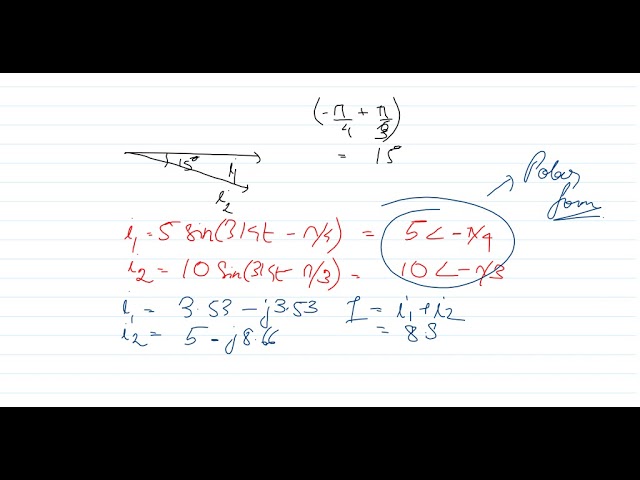
Learn how to add two or more AC quantities easily so as to obtain the final resultant.
lean otter
 lean otter
viral venture
https://youtu.be/ERIToctYUcQ?si=Xv67bBFuTC_afeY2
lean otter
viral venture
https://youtu.be/ERIToctYUcQ?si=Xv67bBFuTC_afeY2
But those vvd
Only handle the basics they dont give me the info i need
.close
safe radishBOT
Channel closed
Closed by @summer tide
Use .reopen if this was a mistake.
viral venture
Your info is the most basic piece of alternating current analysis @lean otter
The first class
lean otter
viral venture
Your info is the most basic piece of alternating current analysis <@456226577798...
If it is do u know then why?
I1+i2 isnt i
safe radishBOT
Available help channel!
Send your question here to claim the channel.
Remember:
• Ask your math question in a clear, concise manner.
• Show your work, and if possible, explain where you are stuck.
• After 15 minutes, feel free to ping <@&286206848099549185>.
• Type the command .close to free the channel when you're done.
• Be polite and have a nice day!
Read #❓how-to-get-help for further information on how to ask a good question, and about conduct in the question channels.
 spice trail
if i have 107 billion rn, and i make 20.48m a second, how many hours will it take me to reach 1 trillion? WEIRD QUESTION BUT PLS HELP
safe radishBOT
spice trail
if i have 107 billion rn, and i make 20.48m a second, how many hours will it tak...
 wise pebble
spice trail
if i have 107 billion rn, and i make 20.48m a second, how many hours will it tak...
wise pebble
spice trail
if i have 107 billion rn, and i make 20.48m a second, how many hours will it tak...
divide to see how many seconds it will take
spice trail
wise pebble
divide to see how many seconds it will take
107 divided by 20.48m
b
right
wise pebble
b?
spice trail
wise pebble
b?
107b i mean
i forgot to write the b
but 107b divided by 20.48m
roght
right
spice trail
ITS OK
wise pebble
no i was right nvm
spice trail
wise pebble
no i was right nvm
so if i have 107b rn and
spice trail
OK
spice trail
wise pebble
1.45 hours
so again, if i have 107b rn and i make 20.48m a second
wise pebble
or 1 hour 27 minutes
wise pebble
spice trail
in an hour and 27 mins
correct
spice trail
wise pebble
correct
TYSM BRO
im just doing something in this one game and i’m getting 20.48m a second with 116b now😭 so i was curious about it
BUT THANK YOU
wise pebble
spice trail
TYSM BRO
ofc man
spice trail
wise pebble
ofc man
have a great day akhi
AKHI MEANS BROTHER BTW
JUST ICNASE IF U DONT KNOW WHAT THAT MEANS
.close
safe radishBOT
Channel closed
Closed by @spice trail
Use .reopen if this was a mistake.
Available help channel!
Send your question here to claim the channel.
Remember:
• Ask your math question in a clear, concise manner.
• Show your work, and if possible, explain where you are stuck.
• After 15 minutes, feel free to ping <@&286206848099549185>.
• Type the command .close to free the channel when you're done.
• Be polite and have a nice day!
Read #❓how-to-get-help for further information on how to ask a good question, and about conduct in the question channels.
lean otter
I asked myself some days ago: What is the probability of sin(2x) being greater than 2*sinx?
safe radishBOT
lean otter
I asked myself some days ago: What is the probability of sin(2x) being greater t...
lean otter
And graphically I see the probability is 1/2, but there is something I don't quite get
We're basically solving for 2*sinx*cosx>2*sinx; but if you simplify you get cosx>1, which hasn't got a solution in the real numbers
That happened when I tried to solve it algebraically, and 2*sinx(cosx-1)>0
 rigid inlet
lean otter
I asked myself some days ago: What is the probability of sin(2x) being greater t...
rigid inlet
lean otter
I asked myself some days ago: What is the probability of sin(2x) being greater t...
I'm not huge on the formulation of this question, but you're getting there
lean otter
I thought it was a curious question
Ok, I'll try to solve it algebraically again, thank you!
rigid inlet
. not !
lean otter
.close
safe radishBOT
Channel closed
Closed by @fleet tartan
Use .reopen if this was a mistake.
safe radishBOT
Available help channel!
Send your question here to claim the channel.
Remember:
• Ask your math question in a clear, concise manner.
• Show your work, and if possible, explain where you are stuck.
• After 15 minutes, feel free to ping <@&286206848099549185>.
• Type the command .close to free the channel when you're done.
• Be polite and have a nice day!
Read #❓how-to-get-help for further information on how to ask a good question, and about conduct in the question channels.
 warped jackal
 safe radishBOT
warped jackal
warped jackal
safe radishBOT
warped jackal
warped jackal
Please let me know the answer
safe radishBOT
@warped jackal Has your question been resolved?
 vague frost
!nosols
safe radishBOT
As a helper, please do not give out answers that could be copied as a homework solution. Have the student work through the problem themselves and guide them along the way.
@warped jackal Has your question been resolved?
Channel closed
Closed by @warped jackal
Use .reopen if this was a mistake.
Available help channel!
Send your question here to claim the channel.
Remember:
• Ask your math question in a clear, concise manner.
• Show your work, and if possible, explain where you are stuck.
• After 15 minutes, feel free to ping <@&286206848099549185>.
• Type the command .close to free the channel when you're done.
• Be polite and have a nice day!
Read #❓how-to-get-help for further information on how to ask a good question, and about conduct in the question channels.
 buoyant pond
 safe radishBOT
buoyant pond
buoyant pond
safe radishBOT
buoyant pond
buoyant pond
can't i divide both sides with z2²
Putting z1/z2 then as x
it gets simplified to x= 0
That means z1/z2 is real
 fiery merlin
What are the choices?
buoyant pond
But the answers purely imaginary
buoyant pond
fiery merlin
What are the choices?
Zero or purely imaginary , purely imaginary, purely real and none of these
The answer's purely imaginary
 spice grove
Use this.
fiery merlin
So, you have z_1 = a + bi, z_2 = c + di.
spice grove
$|z|^2 = z \cdot \bar{z}$
buoyant pond
Can say
flat frigateBOT
! What the hell am I doing here?
 flat frigateBOT
! What the hell am I doing here?
 spice grove
I mean, x = i, satisfies just fine.
(which it should, because you yourself told it's purely imaginary  )
)
buoyant pond
Oh my dumbass i got it what i was doing
spice grove
Re(x) = 0
buoyant pond
I completely ignored the moduluss
appreciate that
Thanks
Ill try zzbar
yeah i got z + zbar = 0
.close
safe radishBOT
Channel closed
Closed by @buoyant pond
Use .reopen if this was a mistake.
buoyant pond
.reopen
safe radishBOT
✅
safe radishBOT
Channel closed
Closed by @buoyant pond
Use .reopen if this was a mistake.
Available help channel!
Send your question here to claim the channel.
Remember:
• Ask your math question in a clear, concise manner.
• Show your work, and if possible, explain where you are stuck.
• After 15 minutes, feel free to ping <@&286206848099549185>.
• Type the command .close to free the channel when you're done.
• Be polite and have a nice day!
Read #❓how-to-get-help for further information on how to ask a good question, and about conduct in the question channels.
leaden scaffold
 safe radishBOT
leaden scaffold
leaden scaffold
safe radishBOT
leaden scaffold
leaden scaffold
Does anyone understand how I’d solve this problem?
 rain bear
leaden scaffold
Does anyone understand how I’d solve this problem?
rain bear
leaden scaffold
Does anyone understand how I’d solve this problem?
derivative analysis
the q asks for points where derivative is negative, positive and 0
you dont know the function tho i presume
leaden scaffold
rain bear
you dont know the function tho i presume
Yes it's all based off of the graph. How can I read the graph to determine this?
rain bear
to be honest i was looking at it as well
the function is non continuous af
oh wait its a multivariable fn
which makes this even more unreadable
where did u find this question
leaden scaffold
rain bear
which makes this even more unreadable
Past exam question
rain bear
the teacher just visualized a 3d function in 2d?
and then asked based on it to find the properties of its derivative?
leaden scaffold
rain bear
and then asked based on it to find the properties of its derivative?
Yes.
leaden scaffold
rain bear
such nice
Can I ask an unrelated question then?
On diff multi var problem, related to directional derivatives
rain bear
sure
leaden scaffold
rain bear
sure
Find the directional derivative of f(x,y,z)=z^(3)−x^(2)y at the point (-4, -5, 3) in the direction of the vector v=⟨2,−5,−5⟩.
Problems like these confuse me, because they're similar to so many others.
Can I walk you through my process?
rain bear
lets do it
leaden scaffold
rain bear
lets do it
So I take the partial derivatives of the function (I got -2xy, -x^(2), 3z^(2)), and then I evaluate it at the given points (-4,-5,3), and I get <-40,-16,27>.
leaden scaffold
rain bear
lets do it
Do I then just apply the dot product to this new gradient vector and the direction vector given to me? (<2,-5,-5>?
Or do I have to calculate the magnitude of the direction vector first.
rain bear
what was the formula for the directional derivative at a point?
let me tell u it was $\triangle f \cdot v$
flat frigateBOT
Rootsyl
 rain bear
now here is the thing. as you are trying to find a new direction with respect to the v you have to remove the magnitute from $\triangle f$
flat frigateBOT
Rootsyl
 rain bear
oops
from v i meant
because consider this
f is a function
that changes as x,y,z changes
*x,y changes
leaden scaffold
rain bear
now here is the thing. as you are trying to find a new direction with respect to...
I got it! It was correct, so it seems I calculate partial derivatives, evaluate the derivatives at the given points, and boom. That's your gradient vector. Then, I take the direction vector, divide it by its magnitude, and apply the dot product between my gradient vector and my direction vector/by its magnitude.
I get a scalar quantity as answer.
rain bear
if the v has more value than only its direction
it will alter the result
to be bigger than it needs to be
u are saying direction v but v is not just direction if its not unit vector
leaden scaffold
rain bear
u are saying direction v but v is not just direction if its not unit vector
Okay. May i ask questions on separate problem?
rain bear
sure
leaden scaffold
rain bear
sure
Could we talk about this problem: Let g(x,y,z) = xy^(2)+2z^(2).
Compute directional derivative at the point (1,1,0) for <u_1,u_2,u_3>,
rain bear
is u_1 u_2 u_3 given to be unit v?
leaden scaffold
rain bear
is u_1 u_2 u_3 given to be unit v?
No. it is not.
rain bear
ok fine
leaden scaffold
rain bear
ok fine
In that case, all I'd do is make it more unit vector by dividing it by its magnitude, right?
flat frigateBOT
Rootsyl
 rain bear
where the denominator is the magnitute yes
leaden scaffold
rain bear
where the denominator is the magnitute yes
right, so i just divide that vector <u_1,u_2,u_3> by its magnitude
rain bear
each element by the magnitute
yes
meaning ur new direction vector is $\left<\frac{u_1}{\sqrt{u_1^2+u_2^2+u_3^2}}, \frac{u_2}{\sqrt{u_1^2+u_2^2+u_3^2}}, \frac{u_3}{\sqrt{u_1^2+u_2^2+u_3^2}}\right>$
flat frigateBOT
Rootsyl
 leaden scaffold
rain bear
meaning ur new direction vector is $\left<\frac{u_1}{\sqrt{u_1^2+u_2^2+u_3^2}}, ...
leaden scaffold
rain bear
meaning ur new direction vector is $\left<\frac{u_1}{\sqrt{u_1^2+u_2^2+u_3^2}}, ...
So I get <u_1,u_2,u_3>/(each element squared and added with one another)*<1,2,0>
rain bear
leaden scaffold
So I get <u_1,u_2,u_3>/(each element squared and added with one another)*<1,2,0>
if the $\triangle f(1,1,0) = <1,2,0>$ then yes
the triangle didnt show xD
flat frigateBOT
Rootsyl
 leaden scaffold
rain bear
if the $\triangle f(1,1,0) = <1,2,0>$ then yes
leaden scaffold
rain bear
if the $\triangle f(1,1,0) = <1,2,0>$ then yes
Awesome stuff! I'm then asked to find a direction where g(x,y,z) is increasing. This seems fairly simple, wouldnt it just be the points where x,y, and z are positive?
leaden scaffold
rain bear
it needs to be "strictly increasing"
So for instance, the vector <1,1,1> would be an option.
rain bear
for what?
leaden scaffold
rain bear
for what?
a direction where its increasing.
rain bear
its not a direction tho as its not unit vector
leaden scaffold
rain bear
its not a direction tho as its not unit vector
What would be a direction then? Would it be a scalar quantity?
rain bear
a direction is a unit vector, because directions and vectors are different things
all directions are vectors but not all vectors are directions
all unit vectors are directions
leaden scaffold
rain bear
all directions are vectors but not all vectors are directions
Right, so why wouldnt <1,1,1> be a valid option?
rain bear
because its magnitute isnt 1
so the vector goes outside the unit circle
$\sqrt{1+1+1} = \sqrt{3} \neq 1$
flat frigateBOT
Rootsyl
 rain bear
sqrt(3) > 1
leaden scaffold
rain bear
because its magnitute isnt 1
Why do we need its magnitude to be one? I thought all it needs to be is greater then 0 to be increasing.
rain bear
i think you are mistaken. You asked wheather if the "direction" $<1,1,1>$ was positive for $\triangle f$ then i said this was not a direction
flat frigateBOT
Rootsyl
 rain bear
Let me ask you something
what would happen if you changed a thing's direction
would that thing go faster or slower?
or would only the direction change
leaden scaffold
rain bear
or would only the direction change
only the direction changes, not speed..
rain bear
exactly
for this to hold the magnitute of the thing should not change
when you are multiplying a thing with a direction that has magnitute thats different than 1 you are basically changing its speed as well
a magnitute is the value a vector represents
leaden scaffold
rain bear
when you are multiplying a thing with a direction that has magnitute thats diffe...
So what would be a valid answer?
rain bear
for what
leaden scaffold
rain bear
for what
"Find a direction where g(x,y,z) is increasing"
rain bear
at the point (x,y,z), a function $f(x,y,z)$ is increasing if $\frac{\delta f}{\delta x} > 0, \frac{\delta f}{\delta y} > 0, \frac{\delta f}{\delta z} > 0$
flat frigateBOT
Rootsyl
 rain bear
leaden scaffold
So for instance, the vector <1,1,1> would be an option.
rain bear
leaden scaffold
So for instance, the vector <1,1,1> would be an option.
if this is a point then yes
i thought you meant as a direction xD
leaden scaffold
rain bear
if this is a point then yes
So we'd plug the points (1,1,1) into our equation xy^(2)+2z^(2)?
rain bear
yes and we would get a directional derivative for that point
then we could find the rate of change for any direction vector at that point
leaden scaffold
rain bear
yes and we would get a directional derivative for that point
Wait no, I don't think what I said makes sense. Rather, we'd simply take the partial derivatives again for the function given to us, evaluate them at the points where I suspect them to be increasing (1,1,1), and apply dot product of that with my unit vector, right?
rain bear
leaden scaffold
So we'd plug the points (1,1,1) into our equation xy^(2)+2z^(2)?
is this $f(x,y,z)$?
flat frigateBOT
Rootsyl
 rain bear
if it is then our directional derivative would be $<y^2, 2xy, 4z>$
flat frigateBOT
Rootsyl
 rain bear
at point (1,1,1) it would be $<1, 2, 4>$
flat frigateBOT
Rootsyl
 rain bear
so for any directional vector you would multiply these two things to get a rate of change at that direction
leaden scaffold
rain bear
is this $f(x,y,z)$?
Our function for g(x,y,z) = xy^(2)+2z^(2).
leaden scaffold
rain bear
so for any directional vector you would multiply these two things to get a rate ...
Right, then I'd take my new gradient vector <1,2,4> and apply dot product to it with my unit vector (the one we got before, <u_1,u_2,u_3>/sqrt(each element squared and added with one another)?
leaden scaffold
rain bear
so you would find the rate of change at that point at that direction for g(x,y,z...
So in the end, I get: <1u_1+2u_2+0>/(sqrt((u_1)^2+(u_2)^2+(u_3)^2)
leaden scaffold
rain bear
yes
Interesting. Now, to find a direction where g(x,y,z) is 0, all I'd do is set my vector equal to 0?
rain bear
u_1+2u_2 must be 0. Every direction vector that satisfies this is a candidate
and you can find this with substituting this equality to $\sqrt{(u_1)^2+(u_2)^2+(u_3)^2} = 1$
flat frigateBOT
Rootsyl
 leaden scaffold
rain bear
u_1+2u_2 must be 0. Every direction vector that satisfies this is a candidate
leaden scaffold
rain bear
u_1+2u_2 must be 0. Every direction vector that satisfies this is a candidate
So I'd <1u_1+2u_2+0>/sqrt(u_1^2+u_2^2+u_3^2) = 0, look at numerator and realize anyytime 0 is divided by something its 0, so i just plug 0 in for my u's in numerator?
leaden scaffold
rain bear
you mean i assume
darn, now I'm loss again. Why would we set it equal to 0?
leaden scaffold
rain bear
its equal to1
Why?
leaden scaffold
rain bear
right?
yes
rain bear
ok what is the rate of change for all possible <u_1,u_2,u_3> matrices?
let me tell you
its (u_1+2u_2+0)/sqrt(u_1^2+u_2^2+u_3^2)
if the vector is a unit vector then the denominator is 1 and is omitted
so you want (u_1+2u_2+0) = 0 and sqrt(u_1^2+u_2^2+u_3^2) = 1
any triplet satisfying both conditions is a direction where the rate of change is 0
clear?
leaden scaffold
rain bear
clear?
Yeah, but I definitely have to go over it again. Could I one final separate problem?
rain bear
leaden scaffold
Yeah, but I definitely have to go over it again. Could I one final separate prob...
ask what you did not understand
leaden scaffold
rain bear
ask what you did not understand
It's on a different problem, finding critical points and classifying each as local max, local min, and saddle point
rain bear
they were about the eigenvalues right
it has been 2 years since i took this course xD
oh wait its the derivative
not the eigen value
rain bear
leaden scaffold
It's on a different problem, finding critical points and classifying each as loc...
i thought these were pretty straight forward?
leaden scaffold
rain bear
i thought these were pretty straight forward?
Do you remember how to do them?
rain bear
find the points where the slope is 0, then find the matrix of (the image1), then find the discriminant, then do (image2). For each point where slope is 0 obviously

 safe radishBOT
@leaden scaffold Has your question been resolved?
safe radishBOT
Channel closed
Closed due to timeout
Use .reopen if this was a mistake.
Available help channel!
Send your question here to claim the channel.
Remember:
• Ask your math question in a clear, concise manner.
• Show your work, and if possible, explain where you are stuck.
• After 15 minutes, feel free to ping <@&286206848099549185>.
• Type the command .close to free the channel when you're done.
• Be polite and have a nice day!
Read #❓how-to-get-help for further information on how to ask a good question, and about conduct in the question channels.
 queen goblet
 safe radishBOT
queen goblet
queen goblet
safe radishBOT
queen goblet
queen goblet
I know that
EP=4
BQ=8
But I don’t know what to do next
queen goblet
People don’t respond when they see someone has already responded
viral venture
yeah they do
 twilit kayak
What
 jolly cradle
What's happened?
queen goblet
That’s why I open a new one so people don’t think it’s solved
viral venture
bro opened and closed a channel 4 times to ask the same question
queen goblet
jolly cradle
What's happened?
I opened a new channel for my question
viral venture
in the span of 5 minutes
twilit kayak
Please don't spam help channels
fleet condor
idk if its mod worthy but noah is channel hopping to stay on top of the list
viral venture
queen goblet
3*
i know it was 3 i just wanted you to correct me to incriminate yourself
twilit kayak
Opening and reopening for visibility isn't okay either
Pick one channel and stick to it until you're done with the problem, please
queen goblet
twilit kayak
Opening and reopening for visibility isn't okay either
It’s not for visibility it’s because people won’t see it bc they will think it’s solved when they see other messages
queen goblet
Well I guess I’ll post it again here and wait
 shadow glade
queen goblet
It’s not for visibility it’s because people won’t see it bc they will think it’s...
shadow glade
queen goblet
It’s not for visibility it’s because people won’t see it bc they will think it’s...
if i see people doing what you do i am less inclined to help, telling you from experience, and i think majority feel the same way
queen goblet
shadow glade
if i see people doing what you do i am less inclined to help, telling you from e...
Ok ig
I’ll post it again
In here
.
.
.
.
.
.

I know that
EP=4
BQ=8
But I don’t know what to do next
shadow glade
anyway for this problem, just draw these segmnts, all the same-color segments are the same lengths (red is same side as the cube side length), you should be able to solve from here using only pythagorean theorem a few times
 queen goblet
shadow glade
anyway for this problem, just draw these segmnts, all the same-color segments ar...
queen goblet
shadow glade
anyway for this problem, just draw these segmnts, all the same-color segments ar...
Thank You!!!!!!
I’ll close this soon once I copy it
.close
safe radishBOT
Channel closed
Closed by @queen goblet
Use .reopen if this was a mistake.
Available help channel!
Send your question here to claim the channel.
Remember:
• Ask your math question in a clear, concise manner.
• Show your work, and if possible, explain where you are stuck.
• After 15 minutes, feel free to ping <@&286206848099549185>.
• Type the command .close to free the channel when you're done.
• Be polite and have a nice day!
Read #❓how-to-get-help for further information on how to ask a good question, and about conduct in the question channels.
safe radishBOT
 halcyon carbon
 safe radishBOT
@lean otter Has your question been resolved?
safe radishBOT
Channel closed
Closed due to timeout
Use .reopen if this was a mistake.
Available help channel!
Send your question here to claim the channel.
Remember:
• Ask your math question in a clear, concise manner.
• Show your work, and if possible, explain where you are stuck.
• After 15 minutes, feel free to ping <@&286206848099549185>.
• Type the command .close to free the channel when you're done.
• Be polite and have a nice day!
Read #❓how-to-get-help for further information on how to ask a good question, and about conduct in the question channels.
 brittle crystal
 safe radishBOT
brittle crystal
safe radishBOT
safe radishBOT
brittle crystal
safe radishBOT
@brittle crystal Has your question been resolved?
safe radishBOT
@brittle crystal Has your question been resolved?
safe radishBOT
Channel closed
Closed due to timeout
Use .reopen if this was a mistake.
Available help channel!
Send your question here to claim the channel.
Remember:
• Ask your math question in a clear, concise manner.
• Show your work, and if possible, explain where you are stuck.
• After 15 minutes, feel free to ping <@&286206848099549185>.
• Type the command .close to free the channel when you're done.
• Be polite and have a nice day!
Read #❓how-to-get-help for further information on how to ask a good question, and about conduct in the question channels.
 supple shore
So I have a function $f : x \mapsto x + e^x$ and I want to calculate $f^{-1}'(x)$ I don't know how to do if you have any hint, or method to do that ?
safe radishBOT
supple shore
So I have a function $f : x \mapsto x + e^x$ and I want to calculate $f^{-1}'(x...
flat frigateBOT
phoestaclies
Compile Error! Click the  reaction for more information.
(You may edit your message to recompile.)

 patent flame
have you heard of the lambert W function
supple shore
no
patent flame
do you want to find the inverse of the derivative, or the derivative of the inverse?
supple shore
the derivative of the inverse
patent flame
the inverse of the function f(x) = x + e^x cannot be expressed in terms of elementary functions
Mathematics Stack Exchange
As the natural $\log(x)$ function is the inverse of the exponential $e^x$ and $\log(x +1)$ is the inverse of $e^x - 1$, what is the inverse of $e^x + x$?
supple shore
I don't want the inverse function but the derivative of the inverse function
like I can know the derivative of the inverse function without knowing the inverse function
patent flame
you can only calculate the derivative of the inverse without knowing the inverse only at a particular point
 plucky elk
Google "inverse function theorem"
patent flame
[f^-1(x)]' = 1/[f'(f^-1(x))] basically
supple shore
yes
patent flame
are you looking to find the derivative of the inverse at a certain point?
supple shore
no for all x in R
plucky elk
supple shore
no for all x in R
Why do you need this
patent flame
maybe send a photo of the question if possible?
supple shore
because it's said in the exercise 👍
plucky elk
supple shore
because it's said in the exercise 👍
!original
safe radishBOT
supple shore
because it's said in the exercise 👍
Please show the original problem, exactly as it was stated to you, with the entire original context. A picture or screenshot is best. If the original problem is not in English, then post it anyway! The additional context might still be helpful. Do your best to provide a translation.
supple shore
So the questions is : For all y real, find [f^-1(y)]'
patent flame
where y is?
plucky elk
safe radish
Please show the original problem, **exactly as it was stated to you**, with the ...
picture or screenshot
supple shore
? what do you mean, sorry I'm not english I try my best maybe I don't understand
I do not have a phone sorry, but It's the question
there is no more than that
patent flame
and the function is y = x + e^x?
supple shore
the function is $f :x \mapsto x+e^x$
flat frigateBOT
phoestaclies
 patent flame
could it be that you are trying to find the derivative of f^-1(f(x)) which is just x so the answer is 1?
supple shore
patent flame
could it be that you are trying to find the derivative of f^-1(f(x)) which is ju...
?
patent flame
let y = f(x)
supple shore
I don't want to find the derivative of f^-1(f(x))
y is not equal to f(x) in this context
y is a real
And it's for all y real because we have f^-1 which is C inf in R
patent flame
sorry ill need a photo of the question to understand
supple shore
I said earlier that I have no phone but the question is not complicated : we know that we have a function , $f:x \mapsto x+e^x$ and we want to find for all y real [f^-1(y)]' .
flat frigateBOT
phoestaclies
Compile Error! Click the reaction for more information.
(You may edit your message to recompile.)
