 verbal adder

#help-23
1 messages · Page 103 of 1

 wind stream
yes, it is true both way
 safe radishBOT
Channel closed
Closed by @verbal adder
Use .reopen if this was a mistake.
safe radishBOT
 Available help channel!
Send your question here to claim the channel.
Remember:
• Ask your math question in a clear, concise manner.
• Show your work, and if possible, explain where you are stuck.
• After 15 minutes, feel free to ping <@&286206848099549185>.
• Type the command .close to free the channel when you're done.
• Be polite and have a nice day!
Read #❓how-to-get-help for further information on how to ask a good question, and about conduct in the question channels.
 pseudo scroll
The number of solutions in $[0, 2\pi]$ to the equation $4(\cos^2 2x + \cos 2x + 1) + \tan x (\tan x + 2\sqrt 3)$
safe radishBOT
pseudo scroll
The number of solutions in $[0, 2\pi]$ to the equation $4(\cos^2 2x + \cos 2x + ...
 flat frigateBOT
NEONPerseus
 pseudo scroll
I think the most straight forward thing to do would be to write $\cos 2x = \frac{1 - \tan^2 x}{1 + \tan^2 x}$
flat frigateBOT
NEONPerseus

 lean otter
pseudo scroll
The number of solutions in $[0, 2\pi]$ to the equation $4(\cos^2 2x + \cos 2x + ...
lean otter
pseudo scroll
The number of solutions in $[0, 2\pi]$ to the equation $4(\cos^2 2x + \cos 2x + ...
=0?
flat frigateBOT


 Requested by NEONPerseus#2128
lean otter
Requested by NEONPerseus#2128
lean otter
,w 4(cos^2 (2x) + cos (2x) + 1) + (tan x) (tan x + 2sqrt 3)=0
flat frigateBOT

 Requested by Toby#2275
pseudo scroll
Requested by Toby#2275
pseudo scroll
,calc 1.16218/pi
flat frigateBOT
Result:
0.36993338352508
its nice on desmos
 pseudo scroll
I need the number of solutions
pseudo scroll
lean otter
its nice on desmos
Yeah but is there no algebraic way to get to it
pseudo scroll
Lol
lean otter
flat frigate
**NEONPerseus**
this is a way
but I also dont like the idea of expanding everything
lean otter

pseudo scroll
What if I completed the square in the cos 2x part
pseudo scroll
$(4\sin^2 x - 1)^2 + \tan^2 x -2\sqrt 3 \tan x + 3 = 0$
flat frigateBOT
NEONPerseus
 pseudo scroll
That wasn't quite as bad as it could've been
lean otter
pseudo scroll
$(4\sin^2 x - 1)^2 + \tan^2 x -2\sqrt 3 \tan x + 3 = 0$
I think it should be (4sin^2x - 3) inside the square?
lean otter
ah ok
safe radishBOT
Channel closed
Closed by @pseudo scroll
Use .reopen if this was a mistake.
Available help channel!
Send your question here to claim the channel.
Remember:
• Ask your math question in a clear, concise manner.
• Show your work, and if possible, explain where you are stuck.
• After 15 minutes, feel free to ping <@&286206848099549185>.
• Type the command .close to free the channel when you're done.
• Be polite and have a nice day!
Read #❓how-to-get-help for further information on how to ask a good question, and about conduct in the question channels.
 brazen parrot
Hi
safe radishBOT
brazen parrot
Hi
brazen parrot
Is it ok if i only say this for part b and not allat


 south epoch
The correct answer seems wrong to me.
the correct answer should be with congruency of the triangles formed.
and then first prove that the opposite sides are parallel
brazen parrot
wasnt that part A
 south epoch
You need part A for part B
south epoch
and yes all of this is also needed
 brazen parrot
are u serious
 timber crescent
brazen parrot
Is it ok if i only say this for part b and not allat
timber crescent
brazen parrot
Is it ok if i only say this for part b and not allat
AE = CE does not equal BE = DE
timber crescent
or use pythagoras' theorem to show that all the sides are the same
south epoch
otherwise you havent proved that the opposite sides are parallel which is a property of rhombus
south epoch
timber crescent
or use pythagoras' theorem to show that all the sides are the same
cant we use congruency? it would be much easier
brazen parrot
cuz ive alr proved that the triangles were congruent
timber crescent
south epoch
cant we use congruency? it would be much easier
right yea
but there's something about AB = BC = CD = AD = (x^2 + y^2)^1/2 that makes it satisfying for me 
brazen parrot
ok back to my question
so i cant say AB = AD = CB = CD (corresponding sides)? i dont get why cuz ive alr proved triangles were congruent
brazen parrot
so i can?
timber crescent
i think so
brazen parrot
timber crescent
i think so
excuse me
if u dont mind me asking
whats the differnece between bisect and intersect?

 timber crescent
what do you mean by imaginary lines
timber crescent
 brazen parrot
um
timber crescent
the second one is bisect while the first one is intersect
timber crescent
in the first picture AO does not equal BO
but in the second picture PO equals QO so it was divided in half
brazen parrot
oh so bisect is like exactly?
timber crescent
bisect means dividing in half
brazen parrot
brazen parrot
wait but for this question
part a
i divided it in half and still got it rigjt
oh wait i divided it into 4s
wait im confused again
can u draw the difference using parallelograms with sides of equal lengths
 brazen parrot
yez
 brazen parrot
idk what im not getting............. so intersect is like
anywhere?
and bisect is like precise
timber crescent
but if the lines intersect and one of the lines becomes halved, then the line bisect

 timber crescent
brazen parrot
is this right?
timber crescent
brazen parrot
is this right?
ye
but one thing tho is bisect just means dividing in half
it doesnt have to be a line
can also be an angle
say you bisected a 90 degree angle, you'll have two 45 degree angles on both sides of the line
brazen parrot
oh
brazen parrot
brazen parrot
if that is right does that mean these 2 are the same
wait so these 2 questions r the same?
cuz bisect is to happen at 90 degrees part a intersects at 90 degrees
timber crescent
the second question asks about the interior angles
timber crescent
it's alr
brazen parrot
timber crescent
it's alr
hi sorry
can this also be SSS

cause DA = BC, DC = BA, DB is shared
timber crescent
yea that's correct
safe radishBOT
Channel closed
Closed by @brazen parrot
Use .reopen if this was a mistake.
Available help channel!
Send your question here to claim the channel.
Remember:
• Ask your math question in a clear, concise manner.
• Show your work, and if possible, explain where you are stuck.
• After 15 minutes, feel free to ping <@&286206848099549185>.
• Type the command .close to free the channel when you're done.
• Be polite and have a nice day!
Read #❓how-to-get-help for further information on how to ask a good question, and about conduct in the question channels.
 spiral yew
,tex ln (b/a)= ln (d/c)
safe radishBOT
spiral yew
,tex ln (b/a)= ln (d/c)
flat frigateBOT
CA

 clear blade
$x = y$ implies $e^x = e^y$
flat frigateBOT
tushar

 earnest wagon
Ln of anything=something=) e^something=anything
safe radishBOT
Channel closed
Closed by @spiral yew
Use .reopen if this was a mistake.
Available help channel!
Send your question here to claim the channel.
Remember:
• Ask your math question in a clear, concise manner.
• Show your work, and if possible, explain where you are stuck.
• After 15 minutes, feel free to ping <@&286206848099549185>.
• Type the command .close to free the channel when you're done.
• Be polite and have a nice day!
Read #❓how-to-get-help for further information on how to ask a good question, and about conduct in the question channels.
 lusty spear
In our course the attribute of symmetry for a relation $R \subseteq A \cross B$ is defined as
$\forall a \forall b : (a,b) \in R \rightarrow (b,a)\in R$
Now my question is , shouldnt this implication be a biimplication ?
safe radishBOT
lusty spear
In our course the attribute of symmetry for a relation $R \subseteq A \cross B$ ...
flat frigateBOT
barış
 lusty spear
or is it like the biimplication would be overkill because we already quantified all 2 elements meaning we always regard a,b and b,a
 obtuse jackal
Prove it is
lusty spear
. _ .
I should, you are right
but that sounds like the biimplication is a bad idea
I mean like
we say its for all
a,b
so also for b,a
if b,a is in R then a,b has to be in R aswell
obtuse jackal
We usually define things with the "weakest" phrasing possible
lusty spear
and vice versa
obtuse jackal
And the rest are properties
Because that way it's easier to check that the property is verified
lusty spear
obtuse jackal
Because that way it's easier to check that the property is verified
I see
ok I also found an easy way to show this actually
I would just simply compare the truthtables of both formulas
obtuse jackal
For what ? Verifying symmetry ?
lusty spear
no I mean
If I wanted to show that theres no difference between using the implication or the biimplication
that both would be equivalent
the truthtable would be a very clear way ig
as it is usually undoubtable
obtuse jackal
Define sym1 with the implication
sym2 with the equivalence
Show that R is sym1 <=> R is sym2
Then that means sym1 and sym2 are the same
obtuse jackal
R is a binary relationship
lusty spear
R is symmetric by the defintiion of sym1 or sym2
I see
well I got it, thank you bezier hell , I appreciate your help a lot !
obtuse jackal
Need to work on that project actually right
lusty spear
.close
safe radishBOT
Channel closed
Closed by @lusty spear
Use .reopen if this was a mistake.
Available help channel!
Send your question here to claim the channel.
Remember:
• Ask your math question in a clear, concise manner.
• Show your work, and if possible, explain where you are stuck.
• After 15 minutes, feel free to ping <@&286206848099549185>.
• Type the command .close to free the channel when you're done.
• Be polite and have a nice day!
Read #❓how-to-get-help for further information on how to ask a good question, and about conduct in the question channels.
 lethal scaffold
this is so confusing idk any of it, but i really need help, i'll even pay


 safe radishBOT
lethal scaffold
this is so confusing idk any of it, but i really need help, i'll even pay
safe radishBOT
lethal scaffold
this is so confusing idk any of it, but i really need help, i'll even pay
@lethal scaffold Has your question been resolved?
lethal scaffold
.close
safe radishBOT
Channel closed
Closed by @lethal scaffold
Use .reopen if this was a mistake.
Available help channel!
Send your question here to claim the channel.
Remember:
• Ask your math question in a clear, concise manner.
• Show your work, and if possible, explain where you are stuck.
• After 15 minutes, feel free to ping <@&286206848099549185>.
• Type the command .close to free the channel when you're done.
• Be polite and have a nice day!
Read #❓how-to-get-help for further information on how to ask a good question, and about conduct in the question channels.
 wicked tiger
 safe radishBOT
wicked tiger
safe radishBOT
safe radishBOT
wicked tiger
safe radishBOT
Show your work, and if possible, explain where you are stuck.
 lean otter
yeah, you need to find k_1, k_2 such that 1 and 2 are true
do 1 and 2 seperately
2 is easier, so start with that
 lean otter
k shouldnt depend on n
wicked tiger
i divided by n^5
lean otter
you can bound the terms with n in them
wicked tiger
how does it work ?
lean otter
the goal is for k_1 to be a number
wicked tiger
and then it must be true for all numbers starting at n0
lean otter
yes
lean otter
I personally wouldn't have done that, but there's no harm in it
wicked tiger
I dont see the next step
wicked tiger
ok... so I insert 2 for n and then get the k1
lean otter
you should show that it works
 clear blade
if for all $n > n_0$, you can find a lower bound $m \in \mathbb{R}^+$ such that $$m \leq 1 - \frac{1}{2n^2} + \frac{1}{n^5},$$ then you can pick $k \leq m$ and this will satisfy the inequality (1)
flat frigateBOT
tushar
 clear blade
you can bound the function below using calculus, if you want
wicked tiger
so I could choose K1 = 0 ?
clear blade
 wicked tiger
can I choose K1 = 0,5 or 0,25 and then I can calculate the n0 ?
clear blade
Toby suggested $n_0=2$ because for all $n > 2$, you have $$-\frac{1}{8} < -\frac{1}{2n^2}$$
flat frigateBOT
tushar
 clear blade
flat frigate
**tushar**
clear blade
flat frigate
**tushar**
so that achieves one step in bounding this below
try bounding the other term below
lean otter
wicked tiger
can I choose K1 = 0,5 or 0,25 and then I can calculate the n0 ?
technically yes, but you have no idea whether that k1 works at stage in general
wicked tiger
the 1/n^5 term ?
clear blade
yeah
this shouldn't be too hard to bound below
you don't need to add anything to the constraint n > 2
you already have a trivial lower bound for all positive n
wicked tiger
what is a bound ?
clear blade
,w plot 1/x^5 x = 0 to x = 5

 clear blade
so for all $n > 0$, but $n > 2$ here in particular, you have $$0 \leq 1/n^5$$
flat frigateBOT
tushar
 clear blade
flat frigate
**tushar**
clear blade
flat frigate
**tushar**
now combine this with this
clear blade
flat frigate
**tushar**
and see if you can do this
wicked tiger
so the first term is bigger than -1/8 and the second term is bigger than 0
clear blade
the first term is bigger than -1/8
this happens, crucially, only when n is greater than 2
you have to always say this
 clear blade
should say min
but sure
to summarize, for all $n > 2$, you have the facts $$-\frac{1}{8} < -\frac{1}{2n^2}\quad \text{and}\quad 0\leq \frac{1}{n^5}$$
flat frigateBOT
tushar
 clear blade
now can you bound $$1 - \frac{1}{2n^2} + \frac{1}{n^5}$$
flat frigateBOT
tushar
 clear blade
below
clear blade
flat frigate
**tushar**
i.e. find a number m here
using these facts
simply by combining these inequalities
wicked tiger
m >= 1 - 1/8 ?
clear blade
don't need >=
for all $n > 2$, these facts give $$1 - \frac{1}{8} + 0 \leq 1 - \frac{1}{2n^2} + \frac{1}{n^5}$$
flat frigateBOT
tushar
 clear blade
wicked tiger
clear blade
wicked tiger
just reverse this step
wicked tiger
to find the k ?
clear blade
you already have a candidate for k by virtue of that inequality
clear blade
wicked tiger
7/8, or any positive number less than or equal to 7/8, will satisfy the lower inequality here, and hence satisfy the upper one
clear blade
wicked tiger
n0 = 2 ?
yes
clear blade
the value of we got for k depends on the n0 we chose
wicked tiger
so we always choose the n0 first
clear blade
wicked tiger
so 0,5 would be ok ?
you just need to find a suitable k
wicked tiger
and then we get the k
clear blade
wicked tiger
so we always choose the n0 first
usually conveniently so that you're able to bound stuff
note that we could've also chosen n0 = 1
then i could say for all $n > 1$, $$1 - \frac{1}{2} + 0 \leq 1 - \frac{1}{2n^2} + \frac{1}{n^5}$$
flat frigateBOT
tushar
 clear blade
and so i could choose k = 0.5
wicked tiger
so K1 <= 7/8 ?
wicked tiger
ah ok. K1 <= 7/8 for N0 = 2
clear blade
you just need one value of k1
wicked tiger
ok. 0,5
clear blade
i just said that any 0 < k <= 1 - 1/8 will work for n0 = 2 for redundancy
but once you have found 1 - 1/8, no reason to not just use that to be as clear as possible
clear blade
wicked tiger
ok. 0,5
i'd say use 1 - 1/8 to eliminate confusion
since it just follows cleanly from your work
you don't even need to bother introducing the variable k
clear blade
flat frigate
**tushar**
just multiply this by n^5
then you have for all n > 2, (some constant) * n^5 <= n^5 - 1/2 n^3 + 1
which is all you need
clear blade
wicked tiger
a la (1) here
you could use 0.5, but you'd just be adding an extra step, since the only reason it follows from your work is because 0.5 <= 1 - 1/8, which is less than n^5 - 1/2 n^3 + 1 by transitivity
 clear blade
sure
wicked tiger
clear blade
then you have for all n > 2, (some constant) * n^5 <= n^5 - 1/2 n^3 + 1
maybe I shouldn't have divided by n^5 at the beginning
clear blade
yeah
wicked tiger
ok thanks a lot
clear blade
,w 1/2 n^5 <= n^5 - 1/2 n^3 + 1
flat frigateBOT

 Requested by tushar#0942
clear blade
Requested by tushar#0942
clear blade
holds for all n >= -1.35, so surely too when n >= 2
wicked tiger
ah
I dont need to find the intersect between the curves
so I also could have choosen n = 1
clear blade
yes
wicked tiger
nice
clear blade
since you're finding n0 separately such that (1) and (2) hold, just take the maximum of the two n0 you find
then both (1) and (2) hold for n > than this maximum
wicked tiger
ah ok thanks
and the second part is the <= k2*n^5 -part
the n0 is the same
for (1) and (2) ?
clear blade
wicked tiger
the n0 is the same
not necessarily
wicked tiger
ah ok
clear blade
you need to now choose n0 such that you can bound 1 - 1/(2n^2) + 1/(n^5) above by a positive number, for all n > n0
 clear blade
yes
clear blade
wicked tiger
its obvious that the left side is smaller
for all n past which point?
just give me any point
clear blade
wicked tiger
its obvious that the left side is smaller
unless 1/2 n^3 is smaller than 1
(which would contradict the choice k2 = 1)
clear blade
yep, so if you can choose n0 such that for all n > n0, this doesn't happen, then you can choose k2 = 1
wicked tiger
ah so 1/2n^3 > 1 ?
clear blade
yes, which is to say $-\frac{1}{2} n^3 < -1$ so $$n^5 - \frac{1}{2} n^3 + 1 < n^5 - 1 + 1 = n^5$$
flat frigateBOT
tushar
 clear blade
just need n^3 > 2
the cube of n must be greater than 2
so what n0 will work
such that this holds for all n > n0
you can choose something extremely redundant if you want
n0 = 100
of course n^3 > 2 for all n > 100
your choice
clear blade
yep
but if you've found a real number, then ceil of that number will always work for n0
clear blade
flat frigate
**tushar**
you already have a k2 from here
wicked tiger
because 1* n^5 ?
clear blade
wicked tiger
because 1* n^5 ?
yes
clear blade
you can also choose anything greater than 1 because n^5 <= k n^5 if you do this
clear blade
flat frigate
**tushar**
just as you automatically have a value for k1 from here
or anything less than 1-1/8
clear blade
depends on your definition
some definitions say "for all n > n0"
others say "for all n >= n0"
n0 = 1 works for the latter but not the former
since 1^3 is not greater than 2
clear blade
it's not wrong
it's just that our argument wouldn't work if n0 = 1
their argument could be different
clear blade
flat frigate
**tushar**
our line of reasoning that allows us to conclude this
there are multiple ways to bound it depending on n0
wicked tiger
so its another correct possible way to solve it

 wicked tiger
I understand ... Thanks a lot
for your help
I have to practice more 🙂
can I contact you If I have another question ?
if you have time
and did you study math or why do you know so much ?
wicked tiger
ok
clear blade
wicked tiger
and did you study math or why do you know so much ?
i'm a math student
wicked tiger
nice
I study informatics and there also seems to be much math
but not as much as in your study
ok... So thanks for your help
clear blade
happy to help
clear blade
flat frigate
**tushar**
sorry, replace -1/2 n^5 with 0 here @wicked tiger since -1/2 n^3 < 0
that is wrong
clear blade
sure
clear blade
flat frigate
**tushar**
that's the same as this but with 0 instead of -1/2 n^5
and the last < replaced with =
wicked tiger
its nice to see that there are many possible ways to do it
clear blade
infinitely many ways
safe radishBOT
@wicked tiger Has your question been resolved?
safe radishBOT
Channel closed
Closed due to timeout
Use .reopen if this was a mistake.
Available help channel!
Send your question here to claim the channel.
Remember:
• Ask your math question in a clear, concise manner.
• Show your work, and if possible, explain where you are stuck.
• After 15 minutes, feel free to ping <@&286206848099549185>.
• Type the command .close to free the channel when you're done.
• Be polite and have a nice day!
Read #❓how-to-get-help for further information on how to ask a good question, and about conduct in the question channels.
 shell galleon
can anyone pls help solve it
 safe radishBOT
shell galleon
can anyone pls help solve it
safe radishBOT
shell galleon
can anyone pls help solve it
 empty gyro
!status
safe radishBOT
What step are you on?
1. I don't know where to begin
2. I have begun but got stuck midway
3. I got an answer but I'm told it's wrong
4. I got an answer and would like my work checked
5. I have a question about someone else's worked solution
6. None of the above
2
shell galleon
empty gyro
!status
56n =600 + (n-10)x HERE iam stuck
600 + (n-10)x / n = 56 this i did
are you there?
empty gyro
shell galleon
56n =600 + (n-10)x HERE iam stuck
You want to solve for x
Technically, you want to solve for x/(n-10), since that's your arithmetic mean of the remaining integers
You know n>100, so try n=101 Anna progressively larger n and make an inference from there
safe radishBOT
@shell galleon Has your question been resolved?
safe radishBOT
Channel closed
Closed due to timeout
Use .reopen if this was a mistake.
safe radishBOT
Available help channel!
Send your question here to claim the channel.
Remember:
• Ask your math question in a clear, concise manner.
• Show your work, and if possible, explain where you are stuck.
• After 15 minutes, feel free to ping <@&286206848099549185>.
• Type the command .close to free the channel when you're done.
• Be polite and have a nice day!
Read #❓how-to-get-help for further information on how to ask a good question, and about conduct in the question channels.
lean otter
 safe radishBOT
lean otter
lean otter
safe radishBOT
lean otter
lean otter
I just need the answer
 quasi bison
we do not give out answers
safe radishBOT
@lean otter Has your question been resolved?
Channel closed
Closed by @brave marsh
Use .reopen if this was a mistake.
Available help channel!
Send your question here to claim the channel.
Remember:
• Ask your math question in a clear, concise manner.
• Show your work, and if possible, explain where you are stuck.
• After 15 minutes, feel free to ping <@&286206848099549185>.
• Type the command .close to free the channel when you're done.
• Be polite and have a nice day!
Read #❓how-to-get-help for further information on how to ask a good question, and about conduct in the question channels.
 unborn fern
I need to describe this piece of information with words to support my other statistical findings, how would i do it? Should I mention that significance is low or that t score is very high?
 safe radishBOT
unborn fern
I need to describe this piece of information with words to support my other stat...
safe radishBOT
unborn fern
I need to describe this piece of information with words to support my other stat...
 median vigil
if the p-value is very low that would indicate that the result is statistically significant
safe radishBOT
@unborn fern Has your question been resolved?
safe radishBOT
Channel closed
Closed due to timeout
Use .reopen if this was a mistake.
Available help channel!
Send your question here to claim the channel.
Remember:
• Ask your math question in a clear, concise manner.
• Show your work, and if possible, explain where you are stuck.
• After 15 minutes, feel free to ping <@&286206848099549185>.
• Type the command .close to free the channel when you're done.
• Be polite and have a nice day!
Read #❓how-to-get-help for further information on how to ask a good question, and about conduct in the question channels.
 scenic otter
mechanics (physics) what does the y represent? integral of v?
 pseudo scroll
It's a unit vector
pseudo scroll
 mint holly
In the y direction
mint holly
In the y direction
The direction is ambiguous
mint holly
Uh
pseudo scroll
Generally you'd use j hat for the y direction, so I'd think this is something else
¯_(ツ)_/¯
pseudo scroll
Doesn't really matter since you can arrange your axes anyway you like
scenic otter
meaning its not a constant sign and i need to provide more info to understand what it means?
what it means generally that is
scenic otter
so i can just replace the y with its formula? (y=y+vt-(at^2)/2?
 pseudo scroll
You realize that is what a unit vector does
scenic otter
pseudo scroll
Or more specifically, what is b?
just a parameter i need for this specific question it has no actual meaning , if u guys have a good video explaining what youre talking about it would be great
because i cant seem to understand what exactly you guys are talking about
pseudo scroll
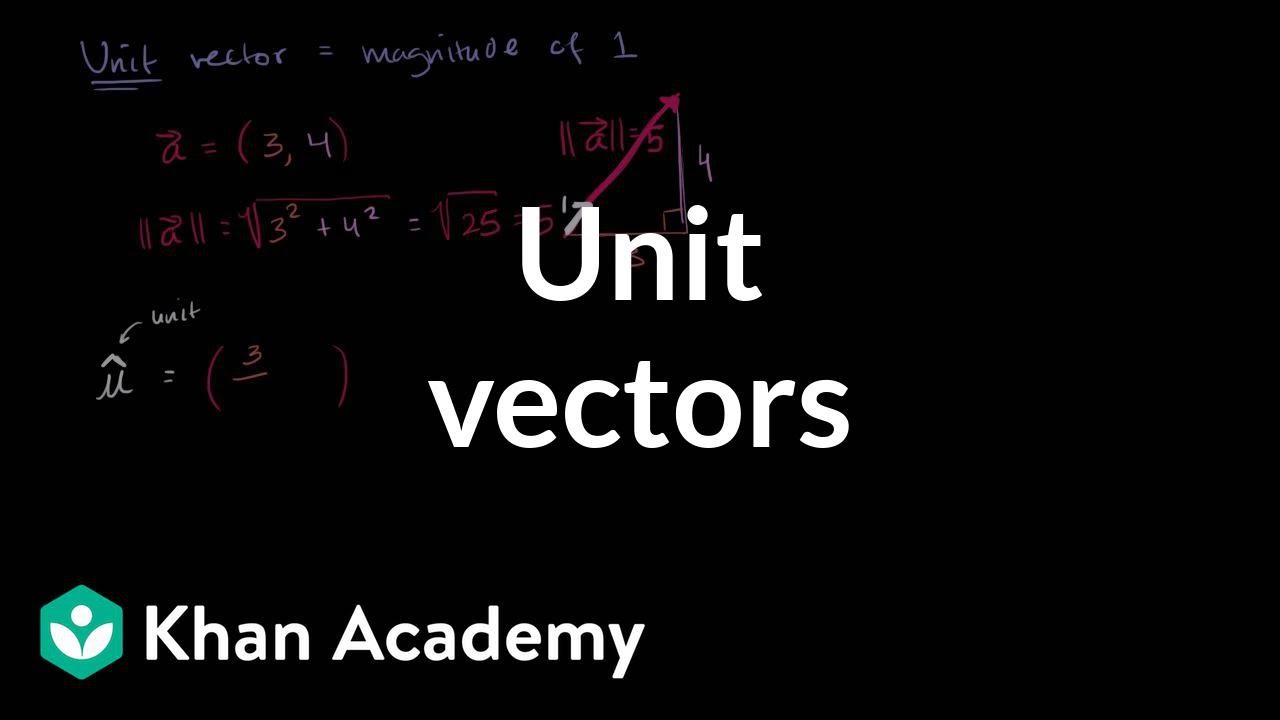
Practice this lesson yourself on KhanAcademy.org right now:
https://www.khanacademy.org/math/precalculus/vectors-precalc/magnitude-direction/e/unit-vector?utm_source=YT&utm_medium=Desc&utm_campaign=Precalculus
Watch the next lesson: https://www.khanacademy.org/math/precalculus/vectors-precalc/magnitude-direction/v/scaling-unit-vector?utm_sourc...
scenic otter
so if i was giving the following info that a ball was thrown horizontally at the speed of:

the x is basically 1 and holds no meaning
but just indicates that the speed has direction
?
scenic otter
yes
this is the air values

this is the fall time

trying to understand how to use the fact that the air resistance = integral of v
or its not integral
but an equation of v?
mint holly
It’s not really the integral
Yeah it’s the equation of b
V
Usually it’s F=-bv(t)
And as v increases the force increases
scenic otter
alright so i can assume -bv is the maximum force because its at its terminal velocity
?
scenic otter
scenic otter
mechanics (physics) what does the y represent? integral of v?
hmm i need to go see some videos on air resistance though i think i have some missing piece because i can put together the original answer
mint holly
If you send the original question I can try
 scenic otter
if u got a video on how to use differential equation\integrals\ derivatives into the subject it would be great, i learned mechanics over a year without using either of these and i have hard time making the transition
mint holly

It should be something like this
For mechanics I think most people just memorize the process since you only deal with 2-3 integrals
In SHM questions you deal with a lot of diffeqs that look the same
scenic otter
yes
scenic otter
wait shit the air makes the thing have ma, instead of just a if i just had mg without air
correct?
mint holly
Uh im not sure what you mean but the first line is just a net force equation
You should always have ma
It’s Fg+Fair=Fnet
scenic otter
i just thought mg-bv=a
mint holly
No
scenic otter
remind me how this integral is called
 mint holly
Im not sure it has a name
scenic otter
Definite Integrals
mint holly
Oh that name
Well you could just leave it as v instead of vf
And you would get a function of v
And I kinda did that for the last line
scenic otter
@mint holly honestly have zero idea what you have done there other than the first line, i cant even seem to understand why even do differential equation
i guess i will wrap this up and try to find some info to get me in the correct mindset
thanks a lot of the help though
.close
safe radishBOT
Channel closed
Closed by @scenic otter
Use .reopen if this was a mistake.
Available help channel!
Send your question here to claim the channel.
Remember:
• Ask your math question in a clear, concise manner.
• Show your work, and if possible, explain where you are stuck.
• After 15 minutes, feel free to ping <@&286206848099549185>.
• Type the command .close to free the channel when you're done.
• Be polite and have a nice day!
Read #❓how-to-get-help for further information on how to ask a good question, and about conduct in the question channels.
 ruby oar
!help
safe radishBOT
ruby oar
!help
ruby oar
If this question wants me to find the arc length not of the visible sector but the invisible remaining part of it would I Do
Arc Length/π * D = Angle At Centre/360
Arc Length/π * 24 = (360-135)/360
Arc Length/π * 24 = 225/360
Arc Length = 225/360 x (π * 24)
Arc Length = 47.12cm

 grizzled shoal
r=12
circumference c=2 pi r=24pi
angle phi = 360°-135°=225°
percentage of circumference: 225°/360°=0.625
arc length: 0.625c=47.12... cm
so yes, you are correct
ruby oar
Cheers 👍
A box of emergency rations can feed 12 people for 6 days, How long would
the box of rations last for 18 people?
12 people = 6 days
1 person = 72 days
18 people = 72/18 = 4
4 days
grizzled shoal
looks good
here you used "="
however obviously we can's say people=days
so i would suggest to use some other symbol
not entirely sure which one, i would probably use ≙
grizzled shoal
which part?
ruby oar
Yo
the whole thing
i dont understand how to work that out
i just worked it out using help
A school has 400 students and 20 teachers. If each classroom can hold a maximum of 30 students and 2 teachers, how many classrooms are needed for all the students and teachers to be accommodated?
Students + teachers = 400 + 20 = 420
student and teachers per classroom = 30+2 = 32
420/32 = 13.1
So 14 classes would be needed?
grizzled shoal
i think i would do this differently
400 students, 30 per room
400/30=13.333 rooms
20 teachers, 2 per room
20/2=10 rooms
so we would need 10 rooms to accomodate all teachers and 13.333 (so 14) rooms to accomodate all students
therefore we would need 14
grizzled shoal
with your reasoning we could run into problems:
assume we have 99 students and 1 teacher
assume a room can hold 1 student an 99 teachers
with your reasoning:
students + teachers = 100
students and teachers per classroom = 100
100/100 = 1
so only one room needed, which is not true
why not true?
we have 99 students but each room only holds 1 student so we need at least 99 rooms
ruby oar
would i even obtain more than one mark
grizzled shoal
depends on the teacher
ruby oar
not the work?
grizzled shoal
since some teacher value the result more than others
i myself would not value the result by much
in my opinion work and reasoning is more important than the result
ruby oar
we both winded up with the same answer
grizzled shoal
yes, but that does not mean that both reasonings were correct
ruby oar
so we would need 10 rooms to accomodate all teachers and 13.333 (so 14) rooms to accomodate all students
therefore we would need 14
wouldnt that be 23.333
rooms
grizzled shoal
the teachers can still fit into the rooms we already have
therefore we dont need any more rooms
ruby oar
never taught this kinda stuff
school system is trash
The base of the right angled triangle is 14^2 - 10^2 which = 96m and the root of 96 is 9.79795897113
To find the whole length of the base of the triangle its square root of (16^2 - 10^2) = 12.4899959968
12.4899959968 - 9.79795897113 = 2.69m

AM i right
@grizzled shoal
ok
safe radishBOT
@ruby oar Has your question been resolved?
safe radishBOT
Channel closed
Closed due to timeout
Use .reopen if this was a mistake.
safe radishBOT
Available help channel!
Send your question here to claim the channel.
Remember:
• Ask your math question in a clear, concise manner.
• Show your work, and if possible, explain where you are stuck.
• After 15 minutes, feel free to ping <@&286206848099549185>.
• Type the command .close to free the channel when you're done.
• Be polite and have a nice day!
Read #❓how-to-get-help for further information on how to ask a good question, and about conduct in the question channels.
 wanton hornet
 safe radishBOT
wanton hornet
wanton hornet
safe radishBOT
wanton hornet
wanton hornet
Is my answer correct?
 formal sphinx
yup
formal sphinx
sure, just more congruence formulas?
 formal sphinx
cool
wanton hornet
is this right
formal sphinx
looks good
 formal sphinx
SSA congruence basically doesnt work whenever the side opposite the known angle is less than the other known side
wanton hornet
formal sphinx
SSA congruence basically doesnt work whenever the side opposite the known angle ...
ok
wanton hornet
wanton hornet
@formal sphinx is this good aswell?
formal sphinx
wanton hornet
uh i think
 lunar drift
help
wanton hornet
ok I have a few more
 plush kettle
help
 formal sphinx
lunar drift
help
formal sphinx
lunar drift
help
try going to an unoccupied channel
formal sphinx
plush kettle
help
pythagorean and subtract that from 48+55
formal sphinx
wanton hornet
ok I have a few more
shoot
 formal sphinx
looks good
 formal sphinx
wanton hornet
formal sphinx
wanton hornet
wait so some case of ssa is ambiguous
but you could use law of sines to solve asa as well
wanton hornet
so is it wrong
formal sphinx
wanton hornet
this ones good
wanton hornet
formal sphinx
this ones good
could it be 45deg aswell
wanton hornet
lunar drift
I can't create a channel
type in #help-19 and it will work
formal sphinx
wanton hornet
could it be 45deg aswell
no, because the sin of angle b would have to be greater than 1
wanton hornet
formal sphinx
no, because the sin of angle b would have to be greater than 1
ok
let me do this one rq

@formal sphinx
lunar drift
channel
where's my channel
help me pleaae
bro
i can't find my channel
it's not there
please help me on my channek
safe radishBOT
Channel closed
Closed by @wanton hornet
Use .reopen if this was a mistake.
Available help channel!
Send your question here to claim the channel.
Remember:
• Ask your math question in a clear, concise manner.
• Show your work, and if possible, explain where you are stuck.
• After 15 minutes, feel free to ping <@&286206848099549185>.
• Type the command .close to free the channel when you're done.
• Be polite and have a nice day!
Read #❓how-to-get-help for further information on how to ask a good question, and about conduct in the question channels.
 steep gust
hellp
safe radishBOT
steep gust
hellp


 safe radishBOT
@steep gust Has your question been resolved?
safe radishBOT
Channel closed
Closed due to timeout
Use .reopen if this was a mistake.
safe radishBOT
Available help channel!
Send your question here to claim the channel.
Remember:
• Ask your math question in a clear, concise manner.
• Show your work, and if possible, explain where you are stuck.
• After 15 minutes, feel free to ping <@&286206848099549185>.
• Type the command .close to free the channel when you're done.
• Be polite and have a nice day!
Read #❓how-to-get-help for further information on how to ask a good question, and about conduct in the question channels.
 lime grove
$\lim_{x \to +\infty}(ln(\sqrt{9x^2+1}+3x)-x) $
can someone help i'm having alot of problems with this kind of limits
safe radishBOT
lime grove
$\lim_{x \to +\infty}(ln(\sqrt{9x^2+1}+3x)-x) $
can someone help i'm having alot...
 tiny wraith
You can do these questions by estimating which functions grow faster
lime grove
tiny wraith
You can do these questions by estimating which functions grow faster
how?!!
tiny wraith
Okay, so this limit should be "bigger" then ln(sqrt(9x^2) + 3x) - x right? (removing the + 1)
lime grove
yes
tiny wraith
which is ln(6x) - x
lime grove
yeah
tiny wraith
ln(6x) - x is bigger then ln(x) - x again
lime grove
yeah
tiny wraith
But what would the limit of ln(x) - x be?
lime grove
-1
tiny wraith
Omg, I went the wrong way around, instead of making the limits smaller each time they should have been made bigger
The same argument still applies though
Only the first step has to be changed
The limit is now smaller then ln(sqrt(10x^2) + 3x) - x for big enough x
which is smaller then ln(7x) - x
tiny wraith
If the new limits keep getting bigger, then the original limit is the smallest
But the new limits approach -inf
lime grove
tiny wraith
The limit is now smaller then ln(sqrt(10x^2) + 3x) - x for big enough x
why not ln(sqrt(25x^2)+3x)-x
 lone arch
\begin{align*} \lim_{x \to \infty}\Biggl(\ln(\sqrt{9x^2+1}+3x)-x\Biggr) \end{align*}
lime grove
so it'll be ln(8x)-x
tiny wraith
Still the original limit is smaller than ln(8x) - x indeed
lone arch
 tiny wraith
but ln(8x) - x also goes to -inf
tiny wraith
Why do you rewrite it like that?
lime grove
to make it easier
tiny wraith
Yeah the ln(8) + ln(x) can be useful, but why the x/(x-1)
tiny wraith
Yeah, sorry I'm used to people forgetting brackets
And you use the fact that ln x / x goes to 0?
lime grove
yeah yeah btw i forget it too
lime grove
tiny wraith
And you use the fact that ln x / x goes to 0?
yes
tiny wraith
I think evaluating it at lnx - x is easier
lime grove
no it'll give +inf -inf
tiny wraith
You could use ln(x) < 0.5x
lime grove
tiny wraith
Either way the limit is solved now
how??
tiny wraith
Since each time we changed te limit to something smaller, limit1 < limit2 < ln x - x + ln10 -> -infinity
*smaller
tiny wraith
Yes
lime grove
tiny wraith
Yes
is there another way to get the limit
tiny wraith
No, I think all methods come down to the same thing
lime grove
yeah you're right it's -inf
lone arch
\begin{align*} \lim_{x \to \infty}\Biggl(\ln(\sqrt{9x^2+1}+3x)-x\Biggr) &= \lim_{x \to \infty}\Biggl(\ln(\sqrt{9x^2}+3x)-x\Biggr) \&= \lim_{x \to \infty}\Biggl(\ln(6x) -x\Biggr) \ &= \lim_{x \to \infty}\Biggl(\ln(6x) - \ln(e^x)\Biggr) \ &= \lim_{x \to \infty}\Biggl(\ln(\frac{6x}{e^x})\Biggr), \end{align*} since $e^x >>> 6x$ as $x \to \infty$, this just becomes $\lim_{x \to 0} \ln(x)$ which is $-\infty$
 lime grove
where did the 1 go...?
lone arch
lime grove
where did the 1 go...?
One term under the square root, 9x^2, goes to infinity, that constant 1 won't matter
lime grove
yeah yeah
lone arch
So we should be able to throw the 1 out. @tiny wraith maybe you can check, I think it should be correct like this.
It's probably similar to your solution
tiny wraith
Yeah this is mostly the same
The principle is that the thing inside the ln becomes 6x for large enough x
and that -x outgrows ln(x)
safe radishBOT
@lime grove Has your question been resolved?
safe radishBOT
Channel closed
Closed due to timeout
Use .reopen if this was a mistake.
Available help channel!
Send your question here to claim the channel.
Remember:
• Ask your math question in a clear, concise manner.
• Show your work, and if possible, explain where you are stuck.
• After 15 minutes, feel free to ping <@&286206848099549185>.
• Type the command .close to free the channel when you're done.
• Be polite and have a nice day!
Read #❓how-to-get-help for further information on how to ask a good question, and about conduct in the question channels.
 burnt berry
 safe radishBOT
burnt berry
burnt berry
safe radishBOT
burnt berry
burnt berry
can someone explain why we divide by 2! in this question
 tulip pivot
This is quite simple. As you can see in the word TASTE, not all letters are distinct. T is repeated twice.
So, this can be said to be permutation of 5 objects in a row taken all at a time where two objects are identical. Which is 5! /2!.
An easier way to understand this would be that consider 5! as the answer. Now for each combination of letters, you can interchange the positions of T s and no change in the word will take place. Since you have also counted those interchange of T in your arrangement, exclude them by dividing by 2.
Clear?
tulip pivot
What is your thinking, you may write.
burnt berry
for example if i had 5 letters... and i wanted to arrange them in such a way that i need to form 3 letter words using these 5 letters
then i'd arrive at the same answer ryt?
then in this case would the 5 letters be the 5 letters of the word 'taste'?
burnt berry
burnt berry
for example if i had 5 letters... and i wanted to arrange them in such a way tha...
okay my bad... i'll change the question to this...
like in this case we would arrive at the same answer ryt
tulip pivot
Nope, in case you have 5 distinct letters and you have to arrange them in 3 letter words then you take 5P3. Which is 5! /2! or 5x4x3.
An easier way to understand this would be the following.
Consider 3 letter words by 3 boxes.
You have got 5 distinct letters. You have been given task to put letters in each of the boxes, and one letter cannot go to multiple box. So, you fill 1st box, you have 5 choices. You fill 2nd box, 4 choices. You fill 3rd box, 3 choices. Your job is done when you have filled all of the boxes. So using multiplication rule of counting, you get answer as 5x4x3.
burnt berry
hmmmm
tulip pivot
Is it understandable?
burnt berry
yes, but is it possible to use this same logic in the original question by making certain modifications to our information?
for example saying that when we are given words which repeat, we're practically just arranging the other words which do not repeat
would that be true?
or how about saying this
the answer is 5!
but every way in which u can arrange 2 letters are considered as one
so in order to make the 2! =1 u divide it by 2!.... is that right?
tulip pivot
Yes, that could be a possible explanation. Each rearrangement in the two Ts is neglected, so divide 2!.
tulip pivot
You may ask.
burnt berry
find the number of ways in which you can arrange the letters of the word PRASHANT such that P always comes before S and S always comes before T
tulip pivot
Is the answer 8!/2!2!2! = 7!
burnt berry
well the answer was of the form 8!/2!3!
tulip pivot
I understand.
This is an interesting one. Listen.
You know the total number of ways without any restriction of arranging the letters of the word given is 8!/2! .
Because of the two As
burnt berry
yes
tulip pivot
Then now as per our restriction, it should be P then S then T. Right?
burnt berry
yes
tulip pivot
Consider one such arrangement where this restriction is true.
Then, if you interchange any of P S or T with each other, you will be getting a word on which this restriction is false. The total ways of interchange if the 3 taken two at a time is 3C2 or 3!.
burnt berry
yes, that makes a lot of sense
tulip pivot
So, since you have taken all arrangements in 8!/2!, you must exclude the false ones, which will be exactly 8!/2!3!
burnt berry
yes
there's something interesting ive observed about all these questions... but i dont have an explaination to it
tulip pivot
1/3! Part of 8!/2! Will satisfy the restriction.
burnt berry
yes
tulip pivot
burnt berry
there's something interesting ive observed about all these questions... but i do...
What is it?
burnt berry
like the choice of the permutation of the letters is arbitrary
for eg. int he first q i asked
it could have been 'ETSAT' instead of 'TASTE'
we'd still arrive at the same answer
tulip pivot
Yes, you are correct, since ETSAT is one of the words formed upon rearrangement of letters T , A , S , T , E.
It is not the word that matters, rather the letters.
burnt berry
and in the second question instead of 'PRASHANT' if it ws "PSTRAHAN' i'd arrive at the same answer
tulip pivot
Yes.
burnt berry
or for that matter any permuation of the words using those letters
but why do we only consider one such permuation and it works for all other permutations
burnt berry
tulip pivot
Consider one such arrangement where this restriction is true.
like u explained using htis.... but it ended up being true for all perumtations
burnt berry
ah... but i wanted to know why it was true
tulip pivot
It is just that any permutation will have the same letters.
burnt berry
and when i generally problem solve what can i consider arbitrary and what can i not
tulip pivot
burnt berry
and when i generally problem solve what can i consider arbitrary and what can i...
Depends on problem. You will get hang of it, just keep solving problems of various kinds.
tulip pivot
Goodbye.
safe radishBOT
Channel closed
Closed by @burnt berry
Use .reopen if this was a mistake.
Available help channel!
Send your question here to claim the channel.
Remember:
• Ask your math question in a clear, concise manner.
• Show your work, and if possible, explain where you are stuck.
• After 15 minutes, feel free to ping <@&286206848099549185>.
• Type the command .close to free the channel when you're done.
• Be polite and have a nice day!
Read #❓how-to-get-help for further information on how to ask a good question, and about conduct in the question channels.
lean otter
how do you define 'transitive closure'?
induction would work, but I think it is possible to do it without
take two arbitrary elements of R^+, then construct the composition of them
 pastel verge
lean otter
take two arbitrary elements of R^+, then construct the composition of them
pastel verge
lean otter
take two arbitrary elements of R^+, then construct the composition of them
Do you know what $R^n \mid R$ is? Or you need it's definition too?
flat frigateBOT
fäf
 safe radishBOT
@vestal sable Has your question been resolved?
safe radishBOT
@vestal sable Has your question been resolved?
safe radishBOT
Channel closed
Closed due to timeout
Use .reopen if this was a mistake.
safe radishBOT
Available help channel!
Send your question here to claim the channel.
Remember:
• Ask your math question in a clear, concise manner.
• Show your work, and if possible, explain where you are stuck.
• After 15 minutes, feel free to ping <@&286206848099549185>.
• Type the command .close to free the channel when you're done.
• Be polite and have a nice day!
Read #❓how-to-get-help for further information on how to ask a good question, and about conduct in the question channels.
 lapis cove
 safe radishBOT
lapis cove
lapis cove
safe radishBOT
lapis cove
lapis cove
I just need a finger in the right direction regarding this question
proving trig identities
 thin bridge
hint: 2^2 = 4
lapis cove
right
so i could rewrite the top part as that
but what about the bottom?
does that equal to cos^2 theta
thin bridge
no
lapis cove
yea wrong identity
thin bridge
lapis cove
so i could rewrite the top part as that
be more specific
thin bridge
no
lapis cove
oh
lapis cove
thin bridge
hint: 2^2 = 4
could u explain what u meant by this then
thin bridge
my intention was for you to identify that sin^4(x) is the square of sin^2(x)
thin bridge
and thus on the numerator you have a difference of two squares
lapis cove
lapis cove
(1-sin^2 theta)(1-sin^2 theta)
was that the problem here?
safe radishBOT
@lapis cove Has your question been resolved?
safe radishBOT
Channel closed
Closed due to timeout
Use .reopen if this was a mistake.
Available help channel!
Send your question here to claim the channel.
Remember:
• Ask your math question in a clear, concise manner.
• Show your work, and if possible, explain where you are stuck.
• After 15 minutes, feel free to ping <@&286206848099549185>.
• Type the command .close to free the channel when you're done.
• Be polite and have a nice day!
Read #❓how-to-get-help for further information on how to ask a good question, and about conduct in the question channels.
 lime skiff
 safe radishBOT
lime skiff
lime skiff
safe radishBOT
lime skiff
lime skiff
•True
or
•False
 cyan vale
lime skiff
•True
or
•False
cyan vale
lime skiff
•True
or
•False
!status
safe radishBOT
lime skiff
•True
or
•False
What step are you on?
1. I don't know where to begin
2. I have begun but got stuck midway
3. I got an answer but I'm told it's wrong
4. I got an answer and would like my work checked
5. I have a question about someone else's worked solution
6. None of the above
Channel closed
Closed by @lime skiff
Use .reopen if this was a mistake.
Available help channel!
Send your question here to claim the channel.
Remember:
• Ask your math question in a clear, concise manner.
• Show your work, and if possible, explain where you are stuck.
• After 15 minutes, feel free to ping <@&286206848099549185>.
• Type the command .close to free the channel when you're done.
• Be polite and have a nice day!
Read #❓how-to-get-help for further information on how to ask a good question, and about conduct in the question channels.
lean otter
 safe radishBOT
lean otter
flat frigateBOT
safe radishBOT
lean otter
flat frigateBOT
jan Niku

 plush saddle
$\sqrt{y^a} = y^\frac{a}{2}$
flat frigateBOT
WHAT?


 marsh walrus
cursed
flat frigateBOT
jan Niku
 marsh walrus
the second
lean otter
yes
marsh walrus
$\qty(x^a)^b = x^{ab}$
flat frigateBOT
jan Niku
 marsh walrus
thats all
lean otter
 safe radishBOT
@lean otter Has your question been resolved?
Channel closed
Closed by @onyx hull
Use .reopen if this was a mistake.
lean otter
.close
safe radishBOT
Available help channel!
Send your question here to claim the channel.
Remember:
• Ask your math question in a clear, concise manner.
• Show your work, and if possible, explain where you are stuck.
• After 15 minutes, feel free to ping <@&286206848099549185>.
• Type the command .close to free the channel when you're done.
• Be polite and have a nice day!
Read #❓how-to-get-help for further information on how to ask a good question, and about conduct in the question channels.
 wispy crest
 safe radishBOT
wispy crest
wispy crest
safe radishBOT
wispy crest
wispy crest
Some help
 fresh wraith
I'm an ap student. No helper role, so take whatever I say with doubt.
I only see the first one being must be true
there's no indication that you can take the derivative at f(x)
so I would choose number c
@wispy crest
 plucky elk
wispy crest
Some help
plucky elk
wispy crest
Some help
Check the definition of continuity at a point
 safe radishBOT
Channel closed
Closed by @wispy crest
Use .reopen if this was a mistake.
wispy crest
.close
safe radishBOT
Available help channel!
Send your question here to claim the channel.
Remember:
• Ask your math question in a clear, concise manner.
• Show your work, and if possible, explain where you are stuck.
• After 15 minutes, feel free to ping <@&286206848099549185>.
• Type the command .close to free the channel when you're done.
• Be polite and have a nice day!
Read #❓how-to-get-help for further information on how to ask a good question, and about conduct in the question channels.
@vestal sable Has your question been resolved?
safe radishBOT
@vestal sable Has your question been resolved?
safe radishBOT
Channel closed
Closed due to timeout
Use .reopen if this was a mistake.
safe radishBOT
Available help channel!
Send your question here to claim the channel.
Remember:
• Ask your math question in a clear, concise manner.
• Show your work, and if possible, explain where you are stuck.
• After 15 minutes, feel free to ping <@&286206848099549185>.
• Type the command .close to free the channel when you're done.
• Be polite and have a nice day!
Read #❓how-to-get-help for further information on how to ask a good question, and about conduct in the question channels.
 autumn sable
I know that the symetry lies at the point 0,0 but i dont know how to find the point of the tangent to get T
safe radishBOT
autumn sable
I know that the symetry lies at the point 0,0 but i dont know how to find the po...
autumn sable
 safe radishBOT
@autumn sable Has your question been resolved?
autumn sable
<@&286206848099549185>
safe radishBOT
@autumn sable Has your question been resolved?
autumn sable
 proud haven
just find the tangent of x any
proud haven
just find the tangent of x any
Thing is when dy/dx = 0
T = undefined
Unless my differential is wrong i dont see where im going wrong
safe radishBOT
Commands:
clopen: .close, .reopen, .solved, .unsolved
consensus: .poll
factoids: .tag
help: .help
Type .help <command name> for more info on a command.
safe radishBOT
@autumn sable Has your question been resolved?
autumn sable
.close
safe radishBOT
Channel closed
Closed by @autumn sable
Use .reopen if this was a mistake.
safe radishBOT
Available help channel!
Send your question here to claim the channel.
Remember:
• Ask your math question in a clear, concise manner.
• Show your work, and if possible, explain where you are stuck.
• After 15 minutes, feel free to ping <@&286206848099549185>.
• Type the command .close to free the channel when you're done.
• Be polite and have a nice day!
Read #❓how-to-get-help for further information on how to ask a good question, and about conduct in the question channels.
 upbeat swan
Hi
safe radishBOT
upbeat swan
Hi
 lean otter
cool wheel
 elfin yew
2/8
upbeat swan
What is the probability that after i spin 3 times, i will get the colour red at least once
?
 high mica
1 - the chance that you never get a red
high mica
so every time you spin, the chance you dont get a red is 7/8 right?
so you need to multiply that by itself 3 times, since you spin thrice
so the chance you dont get a red after you spin 3 times is (7/8)^3
right?
flat frigateBOT

 Requested by Master Oogway#0599
high mica
Requested by Master Oogway#0599
high mica
there it is
upbeat swan
Ok thanks
lean otter
upbeat swan
Ok thanks
Don't forget to .close the channel
upbeat swan
.close
safe radishBOT
Channel closed
Closed by @upbeat swan
Use .reopen if this was a mistake.
Available help channel!
Send your question here to claim the channel.
Remember:
• Ask your math question in a clear, concise manner.
• Show your work, and if possible, explain where you are stuck.
• After 15 minutes, feel free to ping <@&286206848099549185>.
• Type the command .close to free the channel when you're done.
• Be polite and have a nice day!
Read #❓how-to-get-help for further information on how to ask a good question, and about conduct in the question channels.
 fickle abyss
how do find the range of $4-\frac{7}{-2x^2+35}$
safe radishBOT
fickle abyss
how do find the range of $4-\frac{7}{-2x^2+35}$
flat frigateBOT
yomiko
 fickle abyss
$4+\frac{7}{2x^2+35}$
flat frigateBOT
yomiko
 fickle abyss
$2x^2+35 = 0$?
flat frigateBOT
yomiko

 cosmic grove
this equation is false for all real numbers